Family of kidnap suspect deny Israeli accusations
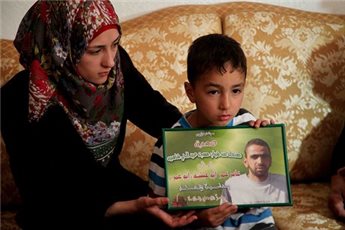
Ma’an – 27/06/2014
HEBRON – The father of one of the suspects named by Israel as being behind the disappearance of three Israeli youths has denied that his son was involved in the suspected kidnapping.
On Thursday, Israel named Marwan al-Qawasmeh, 29, and Amer Abu Eisha, 33, as the two main suspects behind the kidnapping of three Israeli youths on June 12.
Israel’s Shin Bet said they had been jailed in the past for taking part in “terrorist activity on behalf of Hamas.”
Speaking to Ma’an, Abu Eisha’s father denied the allegations and said the family is worried that he has been detained and is being tortured by Israeli security forces.
“The occupation kidnapped my son Amer and I’m afraid they will kill him and say that they killed the terrorist and saved the settlers,” Omar Abu Eisha said.
“I have not yet grasped that Amer and Marwan could kidnap three settlers from the most dangerous security square in Etzion. These are Israeli fabrications, whose goal could be is to strike Hamas in the West Bank and strike the national reconciliation,” he added.
Omar Abu Eisha said that he was with his son Amer at a social event the night the three Israelis went missing, but said that later on in the night he could not find his son and he has been missing ever since.
“He told his wife that he might be away for two days for work in al-Eizariya, but he has not called and I am certain that Israel has kidnapped and hid him,” he said.
Omar Abu Eisha told Ma’an that his son was “working hard and saving money” to build a new house.
The family of Marwan al-Qawasmeh refused to be interviewed or comment on the Israeli accusations.
Eisha was first arrested in Nov. 2005 and was held without trial or charge by Israeli forces until June 2006. He was re-arrested in April 2007 for a short period of time.
Eisha’s brother was shot dead by Israeli forces in Nov. 2005 while ostensibly trying to “throw an explosive” at them, and his father had been arrested by Israel multiple times.
After the Israeli teens disappeared while hitchhiking in the West Bank, the army launched a vast hunt for them focusing on the Hebron area.
Israeli forces initially accused Hamas of the kidnapping, which it vigorously denied, and authorities vowed to “crush” the Palestinian political and militant group.
More than 120 Palestinians have been injured in the military operation, which Israel dubbed “Brother’s Keeper,” and more than 1,350 homes and offices, including numerous universities, have been raided.
The Palestinian Prisoner’s Society said on Thursday that 566 Palestinians have been detained in the campaign, including 12 members of parliament.
Hamas: Israeli announcement of names of kidnappers an attempt to cover its failure
MEMO | June 27, 2014
Hamas has described Israel’s announcement of the names of some of those it accuses of kidnapping the three settlers in Hebron as “an attempt to cover up its utter failure in finding them”, Anadolu news agency reported a Hamas official as saying.
Spokesman for the movement Sami Abu-Zuhri said yesterday: “The Israeli announcement of some of the names it accuses of implementing the Hebron operation reflects its continued state of confusion and an attempt to cover up its utter failure in finding them.”
The Israeli General Security Service, Shin Bet accused two Hamas activists from Hebron, in the south of the West Bank, “of kidnapping three Israeli settlers two weeks ago”.
An Israeli military spokeswoman confirmed reports that troops were seeking Marwan Kawasme and Amar Abu Aysha, members of Hamas in Hebron, both of whom have served time in Israeli prisons in the past.
Israel’s Prime Minister, Benjamin Netanyahu said in a statement: “A short time after the kidnapping, I said that those who perpetrated this activity were terrorists of Hamas, and indeed today the security services of Israel published the names of two of the perpetrators of this heinous crime.”
He added: “I now expected President Abbas, who said important things in Saudi Arabia, to stand by those words and to break his pact with the Hamas terrorist organization that kidnaps children and calls for the destruction of Israel.”
Since the disappearance of three settlers from the south of the West Bank, the Israeli army has arrested nearly 571 Palestinians, mostly leaders and activists in the Hamas movement.
No Palestinian party has claimed responsibility for the abduction, but Netanyahu held Hamas responsible, an accusation the movement has rejected, without confirming or denying the charges.
Catalonians hold rally against Spanish monarchy
Press TV – June 27, 2014
Pro-independence Spaniards have staged a protest rally against the Spanish monarchy as the new king urges collaboration in the region.
On Thursday, thousands of Catalonians took to the streets of Girona to voice their anger against the royal family’s involvement in a series of corruption scandals.
The fresh protest came hours after Spain’s newly-appointed King Felipe VI reached out to Catalonians earlier in the day, urging their collaboration to help defuse tensions with Madrid.
“Sincere and generous collaboration is the best way to fulfill the legitimate aspirations of each person and achieve great collective goals for the common good,” the king said in a speech on his first visit to Catalonia since ascending to the throne.
The majority of 7.5 million inhabitants of Catalonia have expressed resentment for the redistribution of their taxes to other regions of Spain.
Catalan leaders plan to hold an independence referendum in November. The government has condemned the move as illegal.
Catalonia has been seeking independence and autonomy from Spain since the end of the 19th century. In recent years, massive rallies have been held to claim the self-determination right for the region.
The latest protest comes as the image of the royal family has been tarnished by a series of scandals. Juan Carlos’s daughter, Princess Cristina, and her husband, Inaki Urdangarin, are under investigation for possible tax fraud and money laundering.
Spain has been the scene of anti-monarchy protests in recent weeks after Juan Carlos announced he would step down in favor of his son Philippe. The 46-year-old monarch was officially sworn in before parliament on June 19.
According to a survey conducted earlier this month, the majority of the Spanish people are in favor of a referendum on the future of monarchy in their country.
Obama’s People Show Their True Colors
By David McCarey | CounterPunch | June 27, 2014
For those who wondered what happened to Robert Gibbs, President Obama’s former campaign advisor and mealy-mouthed White House press secretary, he has resurfaced in the private sector. He is the co-founder of Incite Agency, an upscale public relations firm. Apparently, going from an underpaid shill for the White House to an overpaid shill for Corporate America was a seamless (and guiltless) transition.
Gibbs’ public relations company’s first major assignment is going to be a real whopper. Hold on to your seat. Incite Agency is going to launch a national public relations campaign aimed at destroying America’s teachers’ unions. It’s true. Gibbs and company have announced that they will be preparing the groundwork for lawsuits across the country, challenging tenure and other teachers’ job protection.
When you consider that Obama has surrounded himself with anti-union people (Rahm Emanuel, Arne Duncan, Eric Holder, et al), this vile announcement should come as no surprise, not to people who’ve been paying attention. Still, the naked audacity and venality of the move caught some of us off-guard. We’re reminded of that Lily Tomlin line: “I worry that no matter how cynical I become, it’s never going to be enough.”
If people out there—say parents—were truly and sincerely opposed to school teachers receiving tenure, believing that union protection somehow contributed to “substandard education” (which every study ever conducted has refuted), one could almost forgive their ignorance. Not knowing the facts, all that these good people want is a decent education for their kids, for America’s kids, and no one should ridicule that.
But this anti-teacher campaign has nothing to do with improving education. It has as much to do with that as “designer water” has to do with improving people’s health. Some ambitious guys simply got together and figured out a way to get people to reject municipal water. By pretending that plastic water was somehow better than tap (even though municipal standards are higher), they were able to carve out a new market. Getting people to pay for something they could otherwise get free is no small feat.
These same guys (the ones who want more toll roads and want to charge fees for walking on hiking trails) now want to privatize America’s public education system. The prospect of millions of families willing to pay for something that they could otherwise get free has these covetous money-grubbers positively drooling. This would be a bonanza for the ruling class. But it’s tricky. It’s a big move. How do they pull off something like that?
Obviously, they can’t compare resumes or backgrounds or certification. Obviously, they can’t mention the fact that public school teachers are required to have not only a college degree but a teaching credential. They can’t mention it because of the embarrassing fact that private school teachers aren’t required to have either.
Private school teachers require less certification and are paid less. Yet these entrepreneurs want people to believe private schools somehow attract the best teachers. That argument wouldn’t work for doctors. You couldn’t convince people that the best physicians were the ones with the least education and lowest salaries. So how do they convince them that privatization is a smart move? They do it by demonizing the labor unions that represent the teachers.
Given that there is a massive public relations smear-job loose upon the land, it is incumbent upon the AFL-CIO to respond in kind. The House of Labor has money to spend. They need to spend it wisely. Instead of blowing it on futile organizing drives (e.g., Wal-Mart), they should focus their energy on speaking frankly with the American public. Convince them that they’re being played for suckers. There is still time.
David Macaray is a labor columnist and author (“It’s Never Been Easy: Essays on Modern Labor, 2nd Edition). dmacaray@earthlink.net
Ukraine and EU sign free trade zone deal
RT | June 27, 2014
Ukraine has signed the economic part of the Association Agreement with the EU, with Georgia and Moldova also joining the pact, even though big economic risks lie ahead.
The signing of the economic part of the agreement comes after 8 months of violent unrest in Ukraine, which broke out in Kiev and spread across the country in November after then-President Viktor Yanukovich decided to reject the trade agreement in favor of trilateral talks.
The document contains 31 signatures – Ukraine, all 28 EU member states, as well as that of the President of the European Council Herman Van Rompuy, and European Commission President Jose Manuel Barroso. The agreement will only come into force when it is ratified by every national parliament in the EU. It is expected that the ratification process will be complete by this fall.
Georgia and Moldova also signed both political and economic parts of the Association Agreement. Ukraine signed a political part of the agreement in March, shortly after Crimea rejoined Russia.
“By signing the association agreement, Ukraine, like European nation, which shares the same rules of law, stresses its sovereign choice to become a member of the EU Association Agreement in the future,” said Ukraine’s President Poroshenko before the signing ceremony. The Ukrainian President sees the trade document as a stepping stone to eventual EU statehood.
Friday signing the Free Trade Agreement will open up trade barriers between the former Soviet states, but doesn’t guarantee them EU membership, a main goal of the three governments.
“It is their sovereign right, but the Russian Federation will have to take measures in case it negatively effects the local market,” Dmitry Peskov, Putin’s spokesperson said, commenting on the agreements signed between the EU and Ukraine, Georgia and Moldova.
Russia has warned these “measures” could include $500 billion in lost trade and possible bans on Ukrainian imports.
“There is no economic growth to be had by suddenly having western European goods dumped at low cost on your marketplace,” Patrick Young, an expert on emerging markets, told RT.
In order to fully implement the free trade zone, it could cost Ukraine’s already fragile economy an additional $104 billion, according to a previous estimate by Yanukovich. This will include adopting hundreds of new trade laws and thousands of new laws to comply with EU standards.
In 2013, EU exports to Ukraine were worth $33 billion (23.9 billion euro), dominated by industrial equipment, chemicals, and manufactured goods.
Ukraine exported 13.8 billion euro worth of goods to the EU, mostly materials like iron, steel, and minerals. Agricultural and food products are also substantial exports.
The Association Agreement and Deep and Comprehensive Free Trade Area (DCFTA) will replace the current Partnership and Cooperation Agreement Ukraine signed with the EU in 1998.
Eastern Ukraine, which rejects the new Ukrainian government’s authority, is skeptical of Kiev’s European ambition, as is the EU itself.
“EU is not ready to integrate at this stage a country like Ukraine,” Jose Barroso, President of the European Commission said before the talks.
Brussels started the Eastern Partnership initiative to incorporate six former Soviet Republics into the EU free trade zone. Ukraine, Moldova, and Georgia have followed Poland’s example, whereas Armenia, Belarus, and Azerbaijan are likely to opt for closer trade links with Russia.
Trilateral trade talks between the EU, Russia, and Ukraine will take place on July 11. Russia has made it very clear that by signing the trade agreement Ukraine can no longer enter the Eurasian Customs Union, which already includes Belarus and Kazakhstan.
NYT Revamps Its False Ukraine Narrative
By Robert Parry | Consortium News | June 26, 2014
It’s always interesting when the New York Times promotes a false narrative – as it has on Ukraine by blaming the crisis all on “Russian aggression” – and then has to shift its storyline when events move in a different direction, like President Vladimir Putin’s recent peacemaking initiatives.
On Thursday, the Times explained Putin’s call for an extended ceasefire as a case of him caving in to U.S. pressure. Correspondents Andrew Roth and David S. Herszenhorn wrote:
“Faced with the threat of additional economic sanctions from Washington, President Vladimir V. Putin of Russia discussed an extension of the cease-fire, which is to expire on Friday, in a telephone call with Chancellor Angela Merkel of Germany, President François Hollande of France and Ukraine’s new president, Petro O. Poroshenko.”
The article then continued the tough-guy, ultimatum-threatening chest-pounding that has become de rigueur for the State Department and the mainstream U.S. news media. The Times article noted:
“The Obama administration has drawn up plans to escalate sanctions against Russia if it does not back the current peace plan by halting the flow of weapons and fighters across the Russian border. The sanctions could target some of Russia’s largest banks, or energy and defense firms.”
The Times also reported, without skepticism, the unverified allegations that the Russian government is supplying heavy weapons to the eastern Ukrainian separatists who rebelled after violent protests by western Ukrainians ousted elected President Viktor Yanukovych on Feb. 22.
The U.S. government has repeatedly made allegations about “Russian aggression” in eastern Ukraine but has failed to present any verifiable proof to support the claims. One State Department attempt, which involved getting the Times to run a lead article citing photos purportedly proving that Russian military personnel were operating in Ukraine, collapsed under scrutiny and was later retracted by the Times.
Nevertheless, the Times still conveys the State Department’s claims without noting the absence of evidence, itself evidence of the Times’ unstinting bias in its coverage of the Ukraine crisis. For instance, the Times reported:
“On Wednesday, Secretary of State John Kerry began a news conference at NATO in Brussels by calling for Mr. Putin ‘to stop the flow of weapons and fighters across the border.’ Mr. Kerry said that the missile launcher that brought down the [Ukrainian military] helicopter on Tuesday was Russian-made and urged Mr. Putin to call for separatist forces to lay down their arms. A senior administration official said Friday that several tanks under rebel possession had come from Russia.”
Normally, when one party in a dispute makes an allegation and fails to provide meaningful evidence to support it, news organizations add something like: “However, the claim could not be independently verified” or the Times might have noted that “similar claims by the State Department in the past have proven to be false.”
But the Times simply can’t seem to deviate from its four-month display of an extraordinary lack of balance, which brings us back to the Times’ attempt to explain Putin’s peacemaking as a development that could only be explained as him caving in to U.S. pressure. [For more on the Times’ bias, see Consortiumnews.com’s “NYT’s One-Sided Ukraine Narrative.” For more on Herszenhorn’s bias, see “Ukraine, Through the US Looking Glass.”]
Putin’s Thinking
There is, of course, an alternative explanation for Putin’s recent behavior: that he never sought the Ukraine crisis and surely did not plan it; it resulted, in part, from U.S. and European provocations designed to put Putin in a corner in his own corner of the world; Putin reacted to this Western maneuver but was always willing to compromise as long as the end result was not a strategic threat to Russia.
I’m told that Putin, like many historic Russian leaders, has wanted to see Russia accepted as a member of the First World and took personal pride in helping President Barack Obama defuse crises in Syria and Iran last year. Arguably, it was Putin’s assistance on those crises that made him a target of Washington’s still influential neocons who had hoped instead for U.S. bombing campaigns against Syria and Iran.
By late September 2013 – on the heels of Obama rejecting plans to bomb Syria – leading neocons, such as National Endowment for Democracy President Carl Gershman, identified Ukraine as a key piece on the chessboard to checkmate Putin. [See Consortiumnews.com’s “What Neocons Want from Ukraine Crisis.”]
The Ukraine crisis really emerged from the European Union’s offer of an association agreement that President Yanukovych was initially inclined to accept. But it was accompanied by harsh austerity demands from the International Monetary Fund, which would have made the hard life for the average Ukrainian even harder.
Because of those IMF demands and a more generous $15 billion loan offer from Russia, Yanukovych backed away from the EU association, angering many western Ukrainians and creating an opening for U.S. neocons, such as Assistant Secretary of State for European Affairs Victoria Nuland and Sen. John McCain, to urge on protests to unseat Yanukovych.
In February, as the Ukraine crisis worsened, Putin was preoccupied with the Winter Olympics in Sochi, but he went along with a compromise plan on Feb. 21 in which Yanukovych agreed to reduced powers and early elections (so he could be voted out of office) as well as to pull back the police. That opened the way for violent attacks by neo-Nazi militias who overran government buildings on Feb. 22 and forced Yanukovych and his officials to flee for their lives.
With the U.S. State Department endorsing the coup as “legitimate,” a right-wing government quickly took shape under the leadership of Nuland’s hand-picked prime minister, Arseniy Yatsenyuk. Four ministries were given to the neo-Nazis in appreciation of their key role in the coup, including the appointment of Andriy Parubiy as chief of national security.
The new regime immediately displayed hostility toward the ethnic Russians in the east and south, including sending wealthy “oligarchs” to serve as the new regional governors and dispatching neo-Nazi militias – reconstituted as the National Guard – to crackdown on dissent.
The regional government of Crimea, a longtime part of Russia and home of the Russian naval base at Sevastopol, organized a referendum to secede from Ukraine and to rejoin Russia, a move supported by Putin and aided by the thousands of Russian troops already in Crimea under a basing agreement with Ukraine.
Crimea’s secession was treated by the mainstream U.S. media as a Russian “invasion” and an act of “aggression,” though the reunification with Russia clearly had overwhelming support from the people of Crimea as expressed in the referendum and in opinion polls.
Still, across Official Washington, the narrative took hold that Putin had ginned up the Ukraine crisis so he could seize territory and begin to reconstitute the old Soviet Union. Right-wing and neocon pundits raised the specter of Putin attacking the Baltic states. The U.S. news media lost all perspective on the actual events in Ukraine.
The reality was that Putin was reacting to a Western provocation on his border, a coup d’etat to pry Ukraine away from its traditional relationship with its neighbor Russia and into the embrace of the European Union and NATO. Putin himself noted the threat to Russian national security if NATO’s nuclear-missile-bearing ships were berthed in Sevastopol.
From the beginning, Putin hoped to resolve this crisis through discussions with his erstwhile collaborator, Barack Obama, but – with the U.S. media in a frenzy demonizing Putin – Obama would not even come to the phone at first, I’m told. Afraid of being called “weak,” Obama followed the lead of the State Department’s hawks who were lusting for Cold War II.
Gradually, with Europe’s fragile economic recovery at risk if Russia’s natural gas supplies were disrupted, cooler heads began to prevail. Obama eventually took Putin’s phone calls and the two met face-to-face during the ceremonies around the 70th anniversary of D-Day in France. Putin also viewed chocolate manufacturer Petro Poroshenko as a reasonable choice to fill the slot of Ukraine’s new president.
Poroshenko and Putin found common ground in their desire to deescalate the crisis although neither leader has been able to fully control the hardliners, not Poroshenko in trying to rein in the Right Sektor which has taken a lead role in killing ethnic Russians in Odessa and other cities, nor Putin in convincing the separatists that they have a future in the post-coup Ukraine.
But Putin continues to signal support for Poroshenko’s stated intent to respect the rights of eastern Ukrainians by offering more self-rule and respecting their use of Russian as an official language. In a sign of good faith, Putin has even sought to rescind the permission from the Russian legislature to intervene militarily to protect ethnic Russians in Ukraine.
However, these developments created a dilemma for the New York Times and the rest of the mainstream U.S. news media. If the Ukraine crisis had been just an excuse for Putin to seize territory and revive the “Russian empire,” why would he be so eager to work out a peaceful settlement? The opposite should be true. If the MSM had it right, Putin would be escalating the crisis.
So, we now have this new version: Yes, Putin precipitated the Ukraine crisis so he could conquer Eastern Europe. But he backed down because of tough talk from Official Washington (including on the MSM’s op-ed pages). In other words, the MSM had it right but tough-guy-ism and the threat of sanctions scared Putin into retreat.
That this analysis makes little sense – since it was the European Union that was most unnerved by the prospects of U.S.-driven sanctions disrupting Russia’s natural gas supplies and plunging the Continent into a recessionary relapse – was of little regard to the U.S. press corps. The new false narrative was simply a necessary way to cover for the old false narrative.
It could never be acknowledged that the New York Times and the other esteemed U.S. journals had gotten another major international story wrong, that another “group think” had led the MSM down another rabbit hole of mistakes and misunderstanding. Instead, all that was needed was some creative tinkering with the storyline.
~
Investigative reporter Robert Parry broke many of the Iran-Contra stories for The Associated Press and Newsweek in the 1980s. You can buy his new book, America’s Stolen Narrative, either in print here or as an e-book (from Amazon and barnesandnoble.com).
Germany gives Verizon the boot over NSA spying scandal
RT | June 26, 2014
Citing concerns over the NSA’s wiretapping of Chancellor Angela Merkel and other top officials’ phones, the German Interior Ministry announced Thursday that it will not renew its contract with Verizon to provide service for government ministries.
As part of an effort to revamp its secure communications networks, the country will instead rely on Germany’s Deutsche Telekom, Reuters reported.
Since the beginning of the NSA scandal, US businesses have expressed concern over the potential blowback of the revelations on their bottom lines. Fearing foreign governments and other firms will no longer trust them to provide secure products and services, they’ve pushed back against the government, demanding more transparency of how the intelligence community operates.
Verizon is one of the first companies that can point to the NSA as a direct cause for a failed business deal. The Interior Ministry released a statement Thursday, saying “the ties revealed between foreign intelligence agencies and firms in the wake of the U.S. National Security Agency affair show that the German government needs a very high level of security for its critical networks.”
Although it was the first company outed by journalist Glenn Greenwald and British newspaper The Guardian as providing the NSA with millions of instances of metadata on a daily basis, Verizon is not the only – or necessarily the first – to do so.
As far back as 2001, the NSA reportedly collected data from AT&T by re-routing information on its network to government computers. Reporting by Wired revealed documents from AT&T technician Mark Klein showing how the feat was accomplished using hardware in a now famous secret room at the company’s San Francisco data center.
Though the US and Germany are allies, documents released over the past year by whistleblower Edward Snowden revealed an American intelligence community with access to a wide variety of German communications. The fallout has been a chilling of relations between the two nations, with the Bundestag (German parliament) especially fierce in its criticisms and demands for answers from the US.
To the consternation of American officials hoping to prosecute Snowden for espionage, the German parliament even invited the leaker to testify about the NSA’s practices in a formal hearing.
Chancellor Merkel, however, has a mixed history with demanding answers from the US.
At first reacting with outrage and comparing the NSA to the Stasi – the communist East German secret police – she also demanded the two nations agree to a “no-spying” pact.
Her attitude changed markedly, however, after meeting with President Barack Obama in May. Stressing the need for unity, Merkel attempted to brush the scandal that has outraged German citizens under the rug. This was not received warmly by opposition parties and many of her constituents, a large number of whom view Snowden as a hero.
Meanwhile, further allegations regarding US surveillance continue to be brought forward. According to a report recently published by the German newspaper Süddeutsche Zeitung , NDR and WDR, the NSA had been given access to large swaths of telecoms data by the country’s Federal Intelligence Service (BND). For at least three years raw data was fed directly to the US agency out of Frankfurt — the city is a telecoms hub for much of Europe and beyond.
The former Minister of the Interior, Hans-Peter Friedrich, declared last year that if a foreign intel service had been given a tap into the telecoms node in Frankfurt, it would be a violation of Germany’s sovereignty.
Obama requests $500 million to aid Syrian rebels
RT | June 26, 2014
The White House on Thursday asked Congress for half-a-billion dollars in aid to go towards opposition fighters in Syria at war with the regime of recently re-elected President Bashar Al-Assad.
In a report sent to lawmakers at the Capitol on Thursday, the White House requested $500 million in aid to “help defend the Syrian people, stabilize areas under opposition control and facilitate the provision of essential services, counter terrorist threats and promote conditions for a negotiated settlement.”
The Associated Press reported that the multimillion dollar request makes up just a fraction of a larger, $65.8 billion overseas operations request sent to Congress that, if approved, would fund a number of Pentagon and State Department programs, as well as $1 billion in assistance to nations adjacent to Syria.
This latest request by the administration for aid comes merely weeks after the president outlined his foreign policy objectives during a speech last month at the West Point Military Academy graduation ceremony.
“As president, I made a decision that we should not put American troops into the middle of this increasingly sectarian civil war, and I believe that is the right decision. But that does not mean we shouldn’t help the Syrian people stand up against a dictator who bombs and starves his own people,” Obama said. “And in helping those who fight for the right of all Syrians to choose their own future, we are also pushing back against the growing number of extremists who find safe haven in the chaos.”
“So with the additional resources I’m announcing today, we will step up our efforts to support Syria’s neighbors — Jordan and Lebanon, Turkey and Iraq — as they contend with refugees and confront terrorists working across Syria’s borders.”
At the time, Obama added that he would “work with Congress to ramp up support for those in the Syrian opposition who offer the best alternative to terrorists and brutal dictators.” Now only weeks later, he appears to have taken the first steps to securing such funding.
Since nearly the start of the Syrian civil war more than three years ago, hawkish Republicans in Congress have urged the White House to take action against Assad, with Sen. John McCain (R-Arizona) going as far as to travel abroad to meet with rebel fighters overseas. Others have condemned any response from Washington altogether, though, including Sen. Rand Paul (R-Kentucky), who this week attributed the arming of fighters in Iraq as the impetus for a “jihadist wonderland” there created on Uncle Sam’s watch and dime.
According to the AP’s Julie Pace, White House officials said the Obama administration would work with members of Congress and regional player to come to terms with what sort of training and assistance in particular would be provided to opposition fighters by the US.
“One potential option,” Pace wrote, “would be to base US personnel in Jordan and conduct the training exercise there.”
Also last month, the Pentagon deployed more than 6,000 Marines to Jordan to conduct drills alongside military officials there.
Tired of World Bank, China to launch alternative
RT | June 26, 2014
China is moving forward with a plan to create its own version of the World Bank, which will rival institutions that are under the sway of the US and the West. The bank will start with $100 billion in capital.
The Asian Infrastructure Investment Bank (AIIB) will extend China’s financial reach and compete not only with the World Bank, but also with the Asian Development Bank, which is heavily dominated by Japan. The $100 billion in capital is double that originally proposed, the Financial Times (FT) reported.
A member of the World Bank, China has less voting power than countries like the US, Japan, and the UK. It is in the ‘Category II’ voting bloc, giving it less of a voice. In the Asian Development Bank, China only holds a 5.5 percent share, compared to America’s 15.7 percent share and Japan’s 15.6 share.
At the International Monetary Fund, China pays a 4 percent quota, whereas the US pays nearly 18 percent, and therefore has more influence within the organization and where loans go.
“China feels it can’t get anything done in the World Bank or the IMF so it wants to set up its own World Bank that it can control itself,” the FT quoted a source close to discussions as saying.
To date, 22 countries have expressed interest in the project, including oil-rich Middle Eastern nations, the US, India, Europe, and even Japan, the FT reported.
“There is a lot of interest from across Asia but China is going to go ahead with this even if nobody else joins it,” the FT source said.
Funding for the Asian Infrastructure Investment Bank will mostly be sourced from the People’s Republic of China and be used to pay for infrastructure projects.
The bank’s first project will be a reincarnation of the ancient Silk Road, the vast network of trade routes between China and its regional neighbors. Another proposed project is a railway from Beijing to Baghdad.
The idea for the bank was first floated in October 2013, when China unveiled plans to create the bank. Then it was initially to be funded with $50 billion in capital.
Separately, the BRICS nations plan to have a $100 billion development bank ready by 2015.
Funds will be reserved for emerging market members who are often bypassed by institutions like the IMF and World Bank.
Bank preparations will likely be finalized at the 6th annual BRICS summit on July 14-16, when the five world leaders convene in Brazil.
Featured Video

Iran Is Not Our Enemy
or go to
Aletho News Archives – Video-Images
Frlom the Archives
The 52 Major Jewish American Organizations and Israel Celebrate Passover with the Slaughter of 25 Muslim, Christian and Secular Palestinians
By James Petras • Unz Review • April 8, 2018
Introduction
As of April 7, nearly three thousand unarmed Christian, Muslim and secular Palestinians have been wounded, over three dozen are in critical condition and at least twenty-five unarmed protestors, including children have been assassinated by hundreds of Israeli snipers and heavily armed troops shooting tank shells into crowds of civilians protesting their decades of incarceration by the racist Israeli state.
The Israeli government praised the ‘restraint and morality’ of the IDF, as did the fifty-two Major Jewish American Organizations (MJAO) who largely control the US Congress. These grotesque massacres began during the Christian Holy Week on Good Friday and Easter, coinciding with the Jewish Passover. The self-righteous officials of the MJAO and their relatives and friends broke matzos at joyful Seders as the blood of Palestinians soaked into ground at the fence containing the largest open-air prison camp in history, Gaza.
While tribal loyalties bonded the Israeli and Jewish American leaders, the politicians of the Western oligarchic electoral regimes refrained from criticizing the shocking display of brute force and even defended Israel’s cold blood mass killings of Palestinian civilians in their Gaza prison.
This paper will discuss and analyze the reasons for Israel’s willing Western accomplices and the centrality of its fifth column in the United States. … continue
Blog Roll
 Aletho News
- Israeli Journalist Demands Tucker Carlson and Candace Owens Be Placed in WWII-Style Internment Camps
- No Liability, No Studies, No Accountability: The Vaccine System Aaron Siri Exposed in Federal Court
- No time for losers: Why the war meant to save Israel may destroy it
- Top US Counterterrorism Official Resigns in Protest of Operation Against Iran
- Just Get Out! Now!
- Unpacking glaring contradictions in US-Zionist justifications for war against Iran
- Iranian model of warfare bleeds US dry while Persian Gulf states watch and learn: Analyst
- IRGC orders ‘defeated’ US to evacuate industrial facilities in region
- Hegseth’s call for ‘no mercy’ to Iranians deemed war crime
- Iran War Exposes Limits of US Military Power – Journalist
- If Americans Knew
- Trump’s counterterrorism chief, whose own wife was killed by ISIS, quits over Iran War saying Tehran posed ‘no imminent threat’
- Here’s what US could fund instead of Bibi’s war on Iran
- Israel Killed Over a Dozen Lebanese Paramedics in Three Days, Now Claiming That Ambulances Are “Hezbollah” Targets
- War on Iran: These are the heritage sites devastated by US and Israeli attacks
- Four news stories from Israeli media that illustrate Israeli “justice”
- CIA Prepares Criminal Referral of Tucker Carlson, as Israel and Its Loyalists Demand His Arrest
- Top US counterterror advisor resigns in protest of “war manufactured by Israel” – Not a ceasefire Day 157
- ‘I Liked the House’: When Israeli Soldiers Turn Palestinian Homes into Barracks
- ‘They Were All I Had’: Lebanese Father Buries Parents, 4 Daughters Killed by Israeli Bombing
- Israel and its supporters are causing attacks on Jewish institutions. Case in point: Michigan synagogue tragedy.
- No Tricks Zone
- New Research: South Australia’s Mid-Holocene Sea Surface Temperatures Were 4°C Warmer Than Today
- Storing Green Energy To Last Germany 10 Days Would Require A 60-Million Tonne Battery
- New Studies: UK Sea Levels Were 4 Meters Higher Than Today During The Mid-Holocene
- Destructive Green New Deal: German Energy And Metal Group Warns Of Drastic Crisis
- New Study Documents A 20-Year Pause In Arctic Sea Ice Decline – Driven By Internal Variability
- Wake-up Call: Survey Shows Majority Of Germans Now Favor Postponing Climate Targets!
- Televised! Leading German Political Candidate Tells Schoolchildren CO2 Makes Sun Hotter!
- New Study: A Century Warming Of 1.1°C Is ‘Commonplace’ And ‘Not Unusual’ During This Interglacial
- New Study: ‘Internal Noise’ And Volcanic Forcing Can Trigger 10-15°C Warming Within Decades
- Glaciers Worldwide Are Suddendly Surging, Experts Blame Warming!
 Aletho News