Bulgaria: South Stream doesn’t breach EU laws
RT | June 26, 2014
Bulgarian officials say the construction of the Russian-led South Stream gas pipeline does not breach EU legislation. The European Commission is concerned the agreement between Russia and Bulgaria violates EU competition law.
The Bulgarian government stood by its position on the legality of the pipeline in a Wednesday statement, ITAR-TASS reports. The agreement on South Stream construction signed in 2008 did not provide any exclusive rights, concessions, or tendering for the South Stream Bulgaria Company which is the owner of the pipeline, and therefore it does not violate EU law, it said.
“With its position the government presents arguments and motives in support of the decisions the Bulgarian nation has taken and which were the subject of concern at the EU Commission,” Reuters quotes the official statement.
Bulgaria will put these arguments at the Brussels summit on Friday, but the decision of the commission whether to accept or reject them may end up in full infringement proceedings and possible fines against Sofia, Reuters says.
According to Gunther Oettinger, the European Commissioner for Energy, the construction process should be suspended until, “it completely corresponds to the requirements of the European Union.”
On Tuesday Austria, another strong defender of the pipeline, signed a deal to construct a South Stream arm on its territory, thus showing its firm commitment.
The 2,446 km South Stream pipeline will stretch across southern and central Europe via the Black Sea, bypassing Ukraine and reducing the country’s importance as a gas transit route. 64 billion cubic meters of gas will be transported annually.
Gazprom has said the project, estimated to cost $45 billion, can be completed without any funding from international partners.
Happy Custer Massacre Day!
By James Bovard | CounterPunch | June 26, 2014
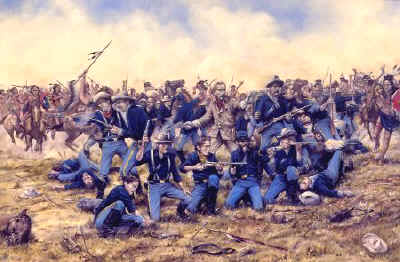
On this day in 1876, Gen. George Custer led his 7th Cavalry regiment to their demise in Montana. The Battle of Little Big Horn was one of the biggest defeats suffered by the U.S. Army in the war against the Indians. It is only in recent years that proper attention has been paid to the role of atrocities by Custer and other military leaders in stirring up the wrath of oppressed Indians.
I visited the Little Big Horn Battlefield National Monument 45 years ago during a cross-country trip as a 12-year-old boy to a Boy Scout Jamboree in Idaho. Like most Scouts, I subscribed to the Patriotic Version of American History. After visiting the battlefield, I scribbled (or copied) a note that the Seventh Cavarly’s “heroic defense made the nation yearn for details that no white man lived to tell.” Many years later, I learned that Custer’s men were wiped out in part because the Army Quartermaster refused to permit them to carry repeating rifles – which supposedly wasted ammo. The Indians didn’t have a quartermaster, so they had repeating rifles, and the rest is history.
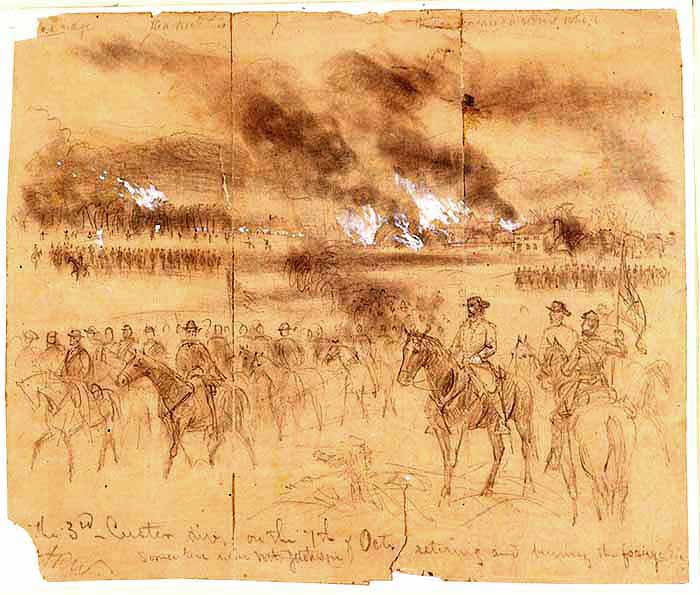
Custer also played a leading role in the 1864 desolation of the Shenandoah Valley, where I was raised a century later. After failing to decisively vanquish southern armies in the battlefield, Lincoln and his generals decided to win the war by brutalizing civilians. In August 1864, Gen. U.S. Grant ordered the destruction of all the barns, crops, and livestock in the Shenandoah Valley. The etching above shows his troops after torching much of the town of Mt. Jackson, Virginia. The population of Warren County, my home county, fell by 20% during the 1860s. Did anyone who refused to submit to Washington automatically forfeit his right to live? The desolation from the war and the systemic looting in its aftermath (ironically labeled “Reconstruction”) helped keep the South economically prostrate for generations.
During the 1864 campaign, Custer was under the command of Gen. Phil Sheridan. Sheridan later became notorious for slaughtering Indians as a top commander out west. He is best known for telling an Indian chief in 1869: “The only good Indian is a dead Indian.” He apparently felt the same way about Southerners – or at least “secessionists” and their wives and children.
Sheridan’s campaign to starve Shenandoah Valley residents into submission evoked fierce opposition from the guerillas led by Col. John S. Mosby, the “Grey Ghost of the Confederacy.” Late in the war, when Confederate armies were being trounced or pinned down everywhere, a few hundred Mosby partisans tied up ten thousand Yankees. Mosby suffered none of the Sir Walter Scott-style sentimentality that debilitated many Southern commanders. Instead of glimmering sabers, his men carried a pair of .44 caliber revolvers. There was so much fear of Mosby that the planks on the bridge across the Potomac were removed each night, for fear that he would raid the capital. Reading about him as a boy, I was impressed how a few well-placed attacks could throw the entire government into a panic. (Herman Melville captured the dread that northern troops had of Mosby in his epic poem, A Scout to Aldie.)
Mosby’s men were vastly outnumbered but they fought valiantly to try to stop Sheridan’s torching of the valley. Sheridan responded by labeling Mosby’s men war criminals and announcing that they would be executed if captured. The North stretched the definition of illegal enemy combatant at the same time it redefined its own war crimes out of existence. Six of Mosby’s men were hung in Front Royal, Virginia in September 1864.
In the weeks after the hanging of his men, Mosby’s men captured 700 northern troops. In early November, his troops hanged several captured Yankees in retaliation. A sign was attached to one of the corpses: “These men have been hung in retaliation for an equal number of Colonel Mosby’s men, hung by order of General Custer at Front Royal. Measure for measure.” Recognizing the perils to his own troops, Sheridan ceased executing captured Mosby’s guerillas.
Unfortunately, most of the war crimes of the Civil War have been forgotten in the rush to sanctify a pointless vast loss of lives. Recasting the war as a triumph of good over evil was an easy way to make atrocities vanish. And failing to recognize the true nature of that war lowered Americans’ resistance to politicians commencing new wars that promised to vanquish evil once and for all.
James Bovard, a policy advisor to the Future of Freedom Foundation, is the author of author of Public Policy Hooligan,Attention Deficit Democracy, The Bush Betrayal, Terrorism and Tyranny, and other books. More info at www.jimbovard.com; on Twitter @jimbovard
Enough Secret Law: Newly Released DOJ Drone Killing Justification Memo… Points To Another Secret Drone Memo
By Mike Masnick | Techdirt | June 25, 2014
We already reported on the finally released DOJ legal drone memo that supposedly “justifies” the extrajudicial killing of Americans via drones. However, as we noted, much of it was actually redacted, leaving many of the details and reasons totally secret. Jameel Jaffer, the ACLU lawyer who helped get this heavily redacted memo released in the first place has written up an analysis which notes how ridiculous the redactions are and the fact that the memo actually points to another secret memo that reveals more details:
In one instance, the long sought-after drone memo references another legal memo that concluded that al-Awlaki’s American citizenship did not “preclude the contemplated lethal action.” From this reference, we can deduce that the OLC authored a separate drone memo assessing – and dispensing with – the proposition that an American citizen had the right not to be deprived of his life without some form of judicial process. But that earlier memo, treated by the executive branch as binding law, is still secret.
This kind of thing is all too common, but tremendously problematic. For folks actually trying to understand what the law actually is the fact that people have to play this bizarre game of 20 questions, seeking secret laws and interpretations, only to get breadcrumbs pointing to other secret interpretations of the law is just ridiculous. We’ve complained in the past about the dangers of a secret law, but just the fact that the American public needs to play this stupid game, and the DOJ appears to have broken up the secret interpretations of the law into different sections, making it that much harder to track it all down, raises serious questions about what sort of government we have, and how Americans can be expected to respect, let alone obey, the law when we can’t even be told what it is.
Israeli forces invade Madama

International Solidarity Movement | June 25, 2014
Madama, Occupied Palestine – At 12:30 a.m. on June 22, 2014, approximately 50 Israeli soldiers invaded the village of Madama.
Madama, which is located 10 km southwest of Nablus, in the northern part of the West Bank, has approximately 2000 residents. The soldiers raided close to 100 homes and took 80 men to the local elementary school, where they held them for several hours. The men were blindfolded, and their arms were tied behind their backs with handcuffs.
The soldiers released all of the men at 5 a.m.
At 1:00 a.m., the soldiers invaded the house of Nizar Abdullah Sadaq Ziyaada in Madama. They asked Ziyaada about the whereabouts of his money and proceeded to ransack the house. They drilled holes into the walls and threatened to destroy his home. They found a total of roughly 200,000 shekels underneath a cupboard and in various hiding places throughout the house. Finally, the soldiers took all of the money, two laptops, and several mobile phones before leaving.
The reasons for the theft of Ziyaada’s money are unclear.
Ziyaada had worked in Israel until the year 2000 and kept all of his earnings from that time in his house in Madama. It is likely that the Israelis knew about this money, as they asked him about it as soon as they entered his house.
Hany Ziyaada’s house was invaded by 15 Israeli soldiers the same night at 1 a.m. They broke down the door, but Hany asked them to wait a few minutes, so that the women of the house could get dressed. The soldiers swore at him, and he responded in kind. They proceeded to kick him in the back and stomach for several minutes and dragged him to their jeep, where they continued to beat him. They blindfolded and handcuffed him and took him to the school, where they held him by the throat, forced his arms back and drove their knees into his back. At 4 a.m. they allowed him to go home.
“Why do they not respect human rights?,” Hany asked an ISM activist. “I’m a policeman, and I know about human rights. Why don’t they?”
Communities Protest That UK’s Equatorial Palm Oil Are Poised to Seize Land in Liberia
Forest Peoples Programme | June 24, 2014
The UK-listed company, Equatorial Palm Oil (EPO), which is threatening to seize land owned by Liberians in defiance of commitments by Liberia’s President, will today receive a visit from affected communities. Members of the Jogbahn Clan, together with representatives from Liberian and international NGOs, will deliver a petition with over 90,000 signatures, reminding EPO that it does not have community consent to expand onto their lands, and that doing so could escalate violence. [1] EPO’s past operations in Liberia have triggered allegations of conflict and human rights abuses. The company has maintained that any expansion is legal. [2]
“EPO’s recent expansion efforts are a brazen example of a company defying international law, government orders and the rights of communities,” said Silas Kpanan’Ayoung Siakor, campaigner at the Sustainable Development Institute. “EPO has no claim to this land, it is owned by the communities who live on it.” [3]
Residents from the Jogbahn Clan in Liberia’s Grand Bassa County say that EPO has begun demarcating blocks of land in preparation for clearing, and have accused its security officers of threatening community members. These actions defy the March commitment by Liberian President Ellen Johnson Sirleaf that EPO could not expand onto the lands of the Joghban Clan without their permission. [4] The right of Liberian communities such as the Joghban Clan to give or withhold consent to projects that could have an impact on their land and resources is also provided under international human rights law, as well as the Principles and Criteria of the Roundtable on Sustainable Palm Oil (RSPO) of which EPO is a member. [5] The Joghban people have refused to give such consent.
EPO has a very poor track record in Grand Bassa County. In September of last year, officers from the EPO security team and the Liberian Police reportedly worked together to assault and beat Joghban community members who were peacefully protesting the company’s operations. Those arrested were soon released after it was determined by the government’s Grand Bassa attorney that there was no justification for continued detention. No government investigation report regarding this incident has been made public. [6]
EPO denied any involvement in the violence, saying that it had been “falsely accused”, and does not “condone or encourage such described behaviour,” and “never instructed or directed any of its staff or PSU officers to intimidate Jogbahn community members in September or at any time.” However, EPO admitted to Global Witness that it provided logistical support to the Liberian police who are accused of intimidating villagers on the plantation. The company further stated that it “respect[s] the Liberian community rights and land, and ha[s] followed the law and procedures laid out”, had taken “strict steps” to ensure that it only plants oil palm on its concession land and legally-acquired community land, and is “a responsible company and committed to sustainable oil palm development.” [7]
EPO’s concessions in Liberia total 8,900 km2 of land, which the company believes gives it the legal right to use the land to develop a palm oil concession. The company is listed on the London-based AIM stock market, and is now majority owned by Malaysian palm oil giant Kuala Lumpur Kepong Bhd (KLK). Major brands including Kellogg’s, Kraft, Nestle, Unilever, Procter & Gamble, and General Mills have been reported as direct or indirect consumers of KLK palm oil. [8]
“We demand that EPO stops inciting conflict by preparing to clear our land,” commented Jogbahn Elder Joseph Chio Johnson, “EPO must stop threatening our people and accept that our no means no.”
Notes
- Sustainable Development Institute and Friends of the Earth International, Tell Equatorial Palm Oil NO means NO!, Rainforest Rescue, Wir stoppen die Walddiebe!, Friends of the Earth US, Stop an abusive palm oil company from grabbing Liberian land, Milieudefensie, Laat Equatorial Palm Oil weten dat NEE echt NEE betekent!
- Equatorial Palm Oil, Letter to Global Witness, 17 December 2013. EPO’s full response can be found on Global Witness’ website at: www.globalwitness.org.
- Customary land rights are protected under a range of international human rights laws applicable to Liberia, including the African Charter on Human & Peoples’ Rights (1981), the International Covenant on Economic, Social & Cultural Rights (1966), the International Covenant on Civil & Political Rights (1966), the Convention on the Elimination of Racial Discrimination (1965), as well as principles of customary international law expressed in the Universal Declaration on Human Rights (1948) and UN Declaration on the Rights of Indigenous Peoples (2007).
- Sustainable Development Institute, SDI welcomes President Sirleaf’s commitment to protecting Joghban clan’s land from further encroachment by British palm oil company Equatorial Palm Oil, 6 March 2014; Global Witness,NGOs welcome Liberian President’s commitment to stop British palm oil company “taking” community land, 10 March 2014.
- Free Prior and Informed Consent (FPIC) is a key principle of Liberia’s Community Rights Law with respect to Forest Lands (2009), which provides communities with a right to give or withhold their consent to activities planned on community land or which may impact on that land and the community. Article 7 of the Liberian Constitution provides for the maximum feasible participation by citizens of Liberia, in the management of Liberia’s natural resources. FPIC is also an established legal principle supported by numerous regional and international legal instruments to which Liberia is legally bound, including the African Charter on Human and Peoples’ Rights (ACHPR). The decision of the African Commission on Human & Peoples’ Rights in the case of Endorois Welfare Council v. Kenya (276/2003) e.g. at para 209, including with regard to right to property (Art. 14 ACHPR), as well we the right to development (Art. 22 ACHPR). See also ACHPR Resolution 224 on a Human Rights-Based Approach to Natural Resources Governance, the United Nations Declaration on the Rights of Indigenous Peoples as well as numerous other provisions and jurisprudence elaborated under the International Convention on the Elimination of all Forms of Racial Discrimination, the International Covenant on Economic, Social and Cultural Rights and the International Covenant on Civil and Political Rights.
- Sustainable Development Institute, SDI calls on Equatorial Palm Oil to immediately cease land survey in Grand Bassa District #4, 25 September 2013. Sustainable Development Institute, Global Witness, FoE EWNI, FERN, Save My Future Foundation, UK’s Equatorial Palm Oil accused of human rights abuses in Liberia, 20 December 2013.
- Equatorial Palm Oil, Letter to Global Witness, 17 December 2013. EPO’s full response can be found on Global Witness’ website at: www.globalwitness.org. Meeting between Global Witness and EPO in London on 14 November, 2013. EPO, “Letter to Global Witness,” 17 December 2013.
- Rainforest Action Network, Conflict Palm Oil in Practice: Exposing KLK’s role in rainforest destruction, land grabbing and child labour, 2 April 2014.
Unanimous Supreme Court Backs Whistleblowers over White House Objections
By Dr. Marsha Coleman-Adebayo | Black Agenda Report | June 25, 2014
The US Supreme Court on Thursday, June 19th ruled that First Amendment protections extend to public employees who provide testimony, under subpoena, on corruption from adverse actions, such as retaliation or job termination. In a rare show of bi-partisan unity in Washington, DC, Justice Sonia Sotomayor wrote the Supreme Court decision in favor of whistleblowers over the opposition of those who nominated her for the Supreme Court, the Obama Administration. Although the corporate media hailed it as triumphant, the decision fails to provide necessary protections to whistleblower against retaliation for exposing corruption.
The case of Lane v. Franks centers on an employee, Edward Lane of Alabama Community College, hired in 2006 to direct an at-risk youth program that provided “counseling and educations as an alternative to incarceration.” The program received “substantial federal funds.” In the course of conducting an audit, Lane discovered that a state representative, Suzanne Schmitz, was being paid for work that she did not provide. Lane raised concerns about this fraudulent situation and was warned by the president of the community college, Steve Franks, that firing Schmitz could have a negative impact on his career at the community college. Despite the warning, Lane terminated Schmitz’s employment. As a result, a lawsuit was filed and the FBI initiated an investigation.
In 2008, Lane was subpoenaed and testified against Schmitz at her criminal trial. She was convicted of “fraudulently obtaining $177,000 in public in funds.” Under the thin pretext of a budgetary crisis, Franks laid off 29 employees but withdrew all but two of those lay offs – Lane was one of the two employees not re-hired. Lane filed charges claiming that Franks retaliated against him for testifying against Schmitz. He argued that his First Amendment rights had been violated. Franks on the other hand argued that he was protected from these charges because he was acting in an official capacity and therefore immune from such charges. In the federal government, managers also claim to be above the law because of sovereign immunity.
Justice Sotomayor wrote in the Courts decision that Lane gave his testimony “as a citizen on a matter of public concern – a public program and misuse of state funds.” Sotomayor wrote: “ Anyone who testifies in court…bears an obligation, to the court and society at large, to tell the truth.”
Sotomayor further asserted:
“…The importance of public employee speech is especially evident in the context of this case: a public corruption scandal. The United States, for example, represents that because “[t]he more than 1000 prosecutions for federal corruption offenses that are brought in a typical year . . . often depend on evidence about activities that government officials undertook while in office,” those prosecutions often “require testimony from other government employees.” Brief for United States as Amicus Curiae 20. It would be antithetical to our jurisprudence to conclude that the very kind of speech necessary to prosecute corruption by public officials-speech by public employees regarding information learned through their employment may never form the basis for a First Amendment retaliation claim. Such a rule would place public employees who witness corruption in an impossible position, torn between the obligation to testify truthfully and the desire to avoid retaliation and keep their jobs.” [emphasis added]
Unfortunately, Franks was not held accountable for terminating Lane because of the on-going bias towards protecting the illegal behavior of managers and those in power.
The Sotomayor opinion is certainly a step forward in protections for citizens who have the courage to fight against corruption. However, what remains unclear is why a citizen should need a subpoena to protect them from retaliation?The Supreme Court, in future rulings need to eliminate this unnecessary barrier to justice. Because the Supreme Court did not order Lane to be reinstated, the Court ruling still sends a chilling message to whistleblowers in the sense that their jobs are still in jeopardy. This issue of holding officials to account for their illegal behavior remains unaddressed. The First Amendment victory is small consolation when one is facing unemployment.
However, the Barack Obama Administration — true to its core values of retaliating against, maligning and silencing whistleblowers– argued against First Amendment protections for public employees who testify against corruption at trials. At one point, the Obama Administration even argued “a police department would be within their rights to fire an officer who responded to a subpoena and testified about a search warrant in a court.”
Had the Supreme Court accepted the Obama Administration’s argument it would have further undermined democratic ideals and intensified the fear of losing ones job by providing testimony in corruption cases, even with a subpoena. With the Supreme Court pushing back against the Obama Administration’s position they have set the stage for further examination of how to best provide transparency in government and comprehensive whistleblower protection.
~
Dr. Marsha Coleman-Adebayo is the author of No FEAR: A Whistleblowers Triumph over Corruption and Retaliation at the EPA. Dr. Coleman-Adebayo worked at the EPA for 18 years and blew the whistle on a US multinational corporation that endangered South African vanadium mine workers. Marsha’s successful lawsuit against the EPA lead to the introduction and passage of the first civil rights and whistleblower law of the 21st century: the Notification and Federal Employees Anti-discrimination and Retaliation Act of 2002 (No FEAR Act).
Supreme Court Requires Warrant for Cell Phone Searches by Police
ACLU | June 25, 2014
WASHINGTON – The Supreme Court unanimously ruled today that police must obtain a warrant before searching the contents of a cell phone seized from someone who has been arrested, absent a true emergency situation. The American Civil Liberties Union had filed an amicus brief in the case, Riley v. California.
Steven R. Shapiro, the national legal director of the ACLU, had this reaction:
“By recognizing that the digital revolution has transformed our expectations of privacy, today’s decision is itself revolutionary and will help to protect the privacy rights of all Americans. We have entered a new world but, as the court today recognized, our old values still apply and limit the government’s ability to rummage through the intimate details of our private lives.”
Writing the court’s opinion, Chief Justice John Roberts said:
“Modern cell phones are not just another technological convenience. With all they contain and all they may reveal, they hold for many Americans ‘the privacies of life’… The fact that technology now allows an individual to carry such information in his hand does not make the information any less worthy of the protection for which the Founders fought. Our answer to the question of what police must do before searching a cell phone seized incident to an arrest is accordingly simple—get a warrant.”
Today’s ruling is at:
supremecourt.gov/opinions/13pdf/13-132_8l9c.pdf
AIPAC urges US lawmakers not to cut Egypt aid
Press TV – June 25, 2014
American Israel Public Affairs Committee (AIPAC), the pro-Israel lobby which is based in Washington, has begun a lobbying campaign to stop US lawmakers from cutting military aid to Egypt.
The group already said in public that it wanted aid to Egypt to continue flowing.
“In light of the treaty’s achievements and resilience,” AIPAC said in a March 27 memorandum, “The United States should continue its strong support for the treaty and back Egypt as it works with Israel to combat the threats of extremists within its borders who would seek to undermine it.”
On Tuesday, an amendment from Rep. Adam Schiff, D-Calif. was defeated in the House of Representatives. The amendment called for a cut in US military assistance to Egypt by $300 million – from $1.3 billion down to $1 billion.
Tuesday’s vote was partly due to pressure by AIPAC, Schiff said as reported by Al-Monitor.
“I didn’t know that AIPAC was weighing in at all on this until after the vote,” Schiff said. “But members did communicate to me after the vote that they had been persuaded by AIPAC not to support this.”
According to the report, Israel was a main topic of discussion during the debate of Schiff’s amendment as part of Tuesday’s markup of the State and Foreign Operations spending bill for FY2015.
Pro-Israel representatives argued the new government of President Abdel Fattah al-Sisi was doing a better job fighting Israel’s “enemies,” the report said.
“The aid we provide for the military also provides for Israel’s security,” said Rep. Kay Granger, R-Texas, the chairwoman of the State and Foreign Operations panel.
EU sanctions on Crimea lead to deadlock – Republic’s head
RT | June 24, 2014

SergeyAksyonov, Acting Head of the Republic of Crimea and Chairman of the Crimea Council of Ministers (RIA Novosti / Andrey Iglov)
The head of the Crimean government has stressed rejoining Russia is irreversible. Sergey Aksyonov said an EU ban on imports from Crimea and Sevastopol deprives Europe of a market and it must “realise that the regime of pressure leads to nothing good.”
Aksyonov characterized the EU sanctions targeting the new Russian territory as “a deadlock situation, including for the European Union. They [EU states] deprive themselves of markets to sell their products and of the opportunity to participate in the investment program of Crimea”.
The peninsula head suggests the EU decision to prohibit imports from Crimea was influenced by the US government.
”General agitation over Crimea’s accession to Russia has calmed down in the EU. As far as I understand in this case the US authorities have pushed this stance,” he said.
The EU Commission imposed a ban on imported goods from Crimea following its position of not recognizing Crimea’s accession to Russia.
However Crimean officials say EU sanctions won’t have any serious impact on the region’s economy.
“I do not envisage any major crisis. I do not even know which economic sector might be affected by it. Most of our exports were to Russia; now this is no longer export but domestic operations,” said Vitaly Nakhlupin, the head of the Crimean State Council’s Economic Commission.
Court Rules No Fly List Process Is Unconstitutional and Must Be Reformed
Court Orders Government to Give Plaintiffs in ACLU Lawsuit a Chance to Clear Their Names
ACLU | June 24, 2014
PORTLAND, Ore. – In a landmark ruling, a federal judge struck down as unconstitutional the government’s procedures for people on the No Fly List to challenge their inclusion. The decision came in an American Civil Liberties Union lawsuit brought on behalf of 13 Americans who found themselves on the list without any notice, reasons, or meaningful way to get off it.
The judge ordered the government to create a new process that remedies these shortcomings, calling the current process “wholly ineffective” and a violation of the Fifth Amendment’s guarantee of due process. The ruling also granted a key request in the lawsuit, ordering the government to tell the ACLU’s clients why they are on the No Fly List and give them the opportunity to challenge their inclusion on the list before the judge.
“For years, in the name of national security the government has argued for blanket secrecy and judicial deference to its profoundly unfair No Fly List procedures, and those arguments have now been resoundingly rejected by the court,” said ACLU National Security Project Director Hina Shamsi, one of the attorneys who argued the case.
“Our clients will finally get the due process to which they are entitled under the Constitution. This excellent decision also benefits other people wrongly stuck on the No Fly List, with the promise of a way out from a Kafkaesque bureaucracy causing them no end of grief and hardship. We hope this serves as a wake-up call for the government to fix its broken watchlist system, which has swept up so many innocent people.”
According to media reports, there are more than 20,000 people on the No Fly List. Their only recourse is to file a request with the Department of Homeland Security’s Traveler Redress Inquiry Program (DHS TRIP), after which DHS responds with a letter that does not explain why they were denied boarding. The letter does not confirm or deny whether their names remain on the list, and does not indicate whether they can fly.
The ruling from the U.S. District Court in Oregon found, “[W]ithout proper notice and an opportunity to be heard, an individual could be doomed to indefinite placement on the No-Fly List. … [T]he absence of any meaningful procedures to afford Plaintiffs the opportunity to contest their placement on the No-Fly List violates Plaintiffs’ rights to procedural due process.”
One of the plaintiffs in the case is Sheikh Mohamed Abdirahman Kariye, who is the imam of Portland’s largest Mosque.
“Finally I will be able to challenge whatever incorrect information the government has been using to stigmatize me and keep me from flying,” Imam Kariye said. “I have been prevented by the government from traveling to visit my family members and fulfill religious obligations for years, and it has had a devastating impact on all of us. After all this time, I look forward to a fair process that allows me to clear my name in court.”
The national ACLU, along with its affiliates in Oregon, Southern California, Northern California, and New Mexico, filed the lawsuit in June 2010 on behalf of 13 U.S. citizens, including four military veterans. In July 2012, the 9th Circuit Appeals Court reversed the district court’s dismissal of the case on jurisdictional grounds, allowing the district court to consider the case on its merits. In August 2013, the court found that constitutional rights are at stake when the government places Americans on the list.
Today’s ruling is at:
aclu.org/sites/default/files/assets/no_fly_list_ruling__-_latif_v._holder_-_6-24-14.pdf
More information on the case and plaintiffs is at:
aclu.org/national-security/latif-et-al-v-holder-et-al-aclu-challenges-government-no-fly-list
A recent ACLU report on the problems with the government’s overall watchlist system is at:
aclu.org/sites/default/files/assets/watchlist_briefing_paper_v3.pdf
FOIA Request On Effectiveness Of License Plate Readers Greeted With A Blank Stare By Virginia Police Department
By Tim Cushing | Techdirt | June 23, 2014
Law enforcement agencies are generally pretty happy with their automatic license plate readers. It allows them to harvest millions of plate/location records without having to exit their vehicles, much less slow them down. It also allows them to spring from their cruisers with guns out and force non-car thieves into submissive positions while they perform the sort of due diligence that should have been completed long before the cops/guns exited their respective holders.
What they don’t seem to like is anyone asking questions about the massive databases they’re compiling or whether they’ve bothered to institute any minimization/privacy policies. When questioned, they usually talk about what a great tool it is for crime-fighting, even if said tool contains millions of useless photos entirely unrelated to criminal activity. Some even claim that every single photo in the database is integral to ongoing investigations and therefore cannot be subjected to minimization procedures, much less the pesky FOIA requests of surveilled citizens.
And sometimes, these agencies are so sure they like the tech that they can’t even be bothered to determine whether it’s actually doing anything to assist in the business of law enforcement. Stephen Gutowski at the Capitol City Project recently asked the Fairfax County, VA police about the effectiveness of its license plate photo database and got this ‘FILE NOT FOUND’ statement in response.
This letter is in response to your FOIA request in which you requested the number of ALPR records Fairfax County currently has on file. This number is constantly fluctuating, but as of 05/20/2014 at 1003 hours there were 2,731,429 reads in the system.
You further requested any available metric the county uses to determine the system’s effectiveness. It was found that the Fairfax County Police Department does not possess any such responsive materials based on the information you requested.
The assumption here is that the system works. The Fairfax County PD occasionally posts arrests linked to ALPR database hits and… well, beyond that, the PD draws a blank. Presumably a handful of arrests justifies a multi-million image-and-location photo database. But this lack of self-assessment shouldn’t be acceptable, not for an agency that has abused its technology in the past.
It came to light late last year that the Fairfax PD trolled political rallies to grab more plate data, racking up nearly 70,000 photos in five days. This abuse prompted a local lawmaker to push legislation aimed at severely limiting, if not completely eradicating, ALPR readers in his district. Not a bad idea, as far it goes.
Virginia law enforcement agencies aren’t going to be happy with this move and they’ll be able to mobilize a pretty powerful opposition. But these are the same entities that tried to bury info on plate readers back in 2009, simply because they felt the public might try to get the system shut down if they knew what was going on. But the lack of controls or any gauge of the system’s effectiveness shouldn’t be allowed to escape unnoticed, because the failure to monitor error rates and hits can result in catastrophic consequences for citizens whose plates trigger false hits — something this system does at twice the rate of recoveries.
The license plate readers demonstrated a high error rate. Four ALPR vehicles used in Fairfax County over the course of five nights in February 2009 scanned 69,281 vehicles. The camera database produced twelve bogus hits and recovered four stolen vehicles, for a recovery rate of 0.6 percent and an error rate of 1.7 percent.
The technology can be used responsibly, but law enforcement agencies with tough minimization policies are almost nonexistent. And as we’ve seen twice in the last month alone, officers relying on faulty data aren’t making an effort to verify database hits before attempting to effect arrests. Someone’s going to be hurt or killed because of bad data, and hardly anyone in law enforcement seems to be concerned. If they did, strict policies on verification and disposal of non-hit data would be the rule, rather than the exception.
Battlefield USA: American police ‘excessively militarized’ – ACLU study
RT | June 24, 2014
Inheriting both the weapons and the mindset of the US military, police are becoming militarized and ‘hyper aggressive’ in their approach to maintaining security on the streets of America. A new study calls on police not to treat people as ‘wartime enemies’.
The tragic story of Jose Guerena, 26, who served as a Marine in the Iraq War, only to be killed by ‘friendly fire’ at his home in Tucson, Arizona, is becoming a disturbingly familiar one across the country.
On the morning of May 5, 2011, Guerena’s wife alerted him when she heard strange sounds and the silhouette of a man standing outside their home. Guerena got his wife and child into a closet, grabbed his rifle, and went to investigate. This proved to be a deadly mistake. A SWAT team opened fire on Guerena, who died on his kitchen floor with multiple wounds and without medical attention.
As it later emerged, the SWAT unit raided a number of residences in the neighborhood, turning up nothing more than a small bag of marijuana. No drugs were found in the Guerenas’ home.
Created in the late 1960s as “quasi-militaristic” units designed to handle emergency situations such as riots, hostage scenarios, and active shooter situations, the number of SWAT squads have since surged, and are “used with greater frequency and, increasingly, for purposes for which they were not originally intended—overwhelmingly to serve search warrants in drug investigations,” according to an ACLU report, entitled ‘War Comes Home: The Excessive Militarization of American Policing.’
The report examines 818 SWAT operations from July 2010 to last October, which were conducted by more than 20 law enforcement agencies in 11 states.
Today, paramilitary squads are better equipped to fight terrorists in foreign lands [occupations] than serve and protect US civilians at home, and are becoming a dark chapter to America’s newfound capacity for “needless violence” and treating its citizens like “wartime enemies,” it said.
The 98-page document details the militarization of state and local law enforcement agencies, courtesy of expensive federal programs, which are dispensing “weapons and tactics of war, with almost no public discussion or oversight.” Although explicitly aimed at fighting drugs, the strategy is backfiring, sowing fear and discord among citizens, many of whom are starting to fear police as much as criminals.
As the United States winds down its military operations in Afghanistan and Iraq, local police forces are getting the used ‘hand-me-downs’ from the US military. This makes some American communities resemble the latest occupied zones with police dressed in combat fatigues and driving MRAPs and carrying AR-15s down Main Street.
“Using these federal funds, state and local law enforcement agencies have amassed military arsenals purportedly to wage the failed War on Drugs… But these arsenals are by no means free of cost for communities. Instead, the use of hyper aggressive tools and tactics results in tragedy for civilians and police officers, escalates the risk of needless violence, destroys property, and undermines individual liberties,” according to the report.
One bit of curious hardware being distributed to local police forces from the government’s military closet is the MRAP (Mine Resistant Ambush Protected) vehicle, which gives troops protection from improvised explosive devices (IEDs). Using media sources, ACLU put the number of towns that now possess the armored carriers at around 500. Among the lucky recipients, Dallas, Texas, has one, as does Salinas, California and even the Utah Highway Patrol.
The report noted that even the Ohio State University Police own one of the MRAPs in order to give a sense of “presence” on big football game days.
The results of the report revealed a worrying trend: “If the federal government gives the police a huge cache of military-style weaponry, they are highly likely to use it, even if they do not really need to.”
Case in point: Gwinnett County, Georgia, which received at least 57 semi-automatic rifles, mostly M-16s and M-14s. One-third of the county’s SWAT deployments dealt with drug investigations; in half of them, the SWAT team broke down the door to get inside, “and there was no record in any of the reports that weapons were found.”
Other examples were provided in Concord, Keene, and Manchester, quaint New Hampshire towns in close proximity to each other, yet each took advantage of DHS grants to buy the military-grade armored BearCat (the amount of grants received by these agencies ranged from $215,000 to $286,000). Justifications for the need to acquire such vehicles pointed to weapons of mass destruction and the threat of terrorism.
The Keene police department, for example, cites in its application (which trumps Ohio State University’s need for armored vehicles to provide “presence” at big football games), the annual pumpkin festival as a potential terrorism target that requires the assistance of an APC.
Military-style mentality invades police
Another leftover from America’s military adventures abroad is the peculiar military mindset that allows US personnel to survive in hostile lands. Equally unsettling as spotting armored vehicles winding through the tree-lined streets of otherwise quiet American neighborhoods is the spectacle of local police officers receiving military-style combat training.
The US Department of Justice described the boot-camp conditions being used to train new police recruits.
According to a Bureau of Justice Report, “the majority of police recruits receive their training in academies with a stress-based military orientation. This begs the question: is this military model—designed to prepare young recruits for combat—the appropriate mechanism for teaching our police trainees how to garner community trust and partner with citizens to solve crime and public order problems?”
As a result, a so-called “warrior” mentality inside local police forces is “pervasive and extends well beyond hostage situations and school shootings, seeping into officers’ everyday interactions with their communities,” the report said.
The report describes a PowerPoint presentation that was delivered to Cary, North Carolina, SWAT team members entitled “Warrior Mindset/Chemical Munitions” for all Emergency Response Team personnel.
The National Tactical Officers Association (according to its website, the NTOA “strives to provide our members with the tools they need to protect an increasingly dangerous society”) urges trainees to “Steel Your Battlemind” and defines “battlemind” as “a warrior’s inner strength to face fear and adversity during combat with courage. It is the will to persevere and win. It is resilience.”
The question, however, is whether such an approach to policing is conducive to creating peace on the streets of America? An escalation of police operations going awry are growing cause for concern among civil rights groups.
In early June, for example, a toddler was severely burned and left unable to breathe on his own when a Georgia SWAT team tossed a flashbang grenade in his crib during a drug raid – over a single meth sale of $50. Bounkham “Bou Bou” Phonesavanh, a 19-month-old, was asleep in his portable crib in the same room as his parents and three older sisters, when police opened the door to the converted garage and threw the stun grenade in.
In the ACLU’s study, SWAT units forced entry into a person’s home using a battering ram or other breaching device in 65 percent of drug searches.
As the report emphasizes, the training documents do not suggest that SWAT teams “should constrain their soldier-like tactics to terrorism situations.” Moreover, the majority of SWAT raids examined for the report “took place in the context of serving search warrants at people’s homes—not in response to school shootings or bombings.”
The survey discovered that 62 percent of SWAT missions were for drug searches. Some 79 percent involved raids on private homes, and a similar proportion were carried out with warrants authorizing searches. However, just 7 percent of the incidents fell into those categories for which SWAT was originally designed to handle, such as hostage situations or shootings.
It is this type of military mindset, compounded with excessive firepower, which is turning many American communities into veritable tinderboxes, which only requires the slightest provocation to spiral into senseless violence and death.
The survey, which provided a small picture of the overall trend, reported seven cases where civilians died in connection with the deployment of SWAT units, two of which appeared to be suicides. Another 46 individuals were injured, often as the result of physical force by officers.
Background: ‘It’s a war zone in the US’ – Interview with Indiana sheriff
Update: ACLU sues Mass. SWAT agency for refusing to release records
Featured Video

Iran Is Not Our Enemy
or go to
Aletho News Archives – Video-Images
Book Excerpt
“Vaccines Do Not Cause Autism!” The Science is Settled. Right?
ICAN urges the IACC to actually study infant vaccines and autism
 By Aaron Siri | Injecting Freedom | March 16, 2026
On behalf of ICAN, we just sent a copy of chapter 11 of Vaccines, Amen to the newly appointed members of the federal Interagency Autism Coordinating Committee (IACC).
If you haven’t already read this chapter, you can read the whole thing in the attached letter. I trust that after you read it, you’ll see why the statement “vaccines do not cause autism” is a belief, not science!

Blog Roll
 Aletho News
- Russia Strongly Condemns Actions Aimed at Harming Health of Iranian Leadership – Kremlin
- Israeli Journalist Demands Tucker Carlson and Candace Owens Be Placed in WWII-Style Internment Camps
- No Liability, No Studies, No Accountability: The Vaccine System Aaron Siri Exposed in Federal Court
- No time for losers: Why the war meant to save Israel may destroy it
- Top US Counterterrorism Official Resigns in Protest of Operation Against Iran
- Just Get Out! Now!
- Unpacking glaring contradictions in US-Zionist justifications for war against Iran
- Iranian model of warfare bleeds US dry while Persian Gulf states watch and learn: Analyst
- IRGC orders ‘defeated’ US to evacuate industrial facilities in region
- Hegseth’s call for ‘no mercy’ to Iranians deemed war crime
- If Americans Knew
- Trump’s counterterrorism chief, whose own wife was killed by ISIS, quits over Iran War saying Tehran posed ‘no imminent threat’
- Here’s what US could fund instead of Bibi’s war on Iran
- Israel Killed Over a Dozen Lebanese Paramedics in Three Days, Now Claiming That Ambulances Are “Hezbollah” Targets
- War on Iran: These are the heritage sites devastated by US and Israeli attacks
- Four news stories from Israeli media that illustrate Israeli “justice”
- CIA Prepares Criminal Referral of Tucker Carlson, as Israel and Its Loyalists Demand His Arrest
- Top US counterterror advisor resigns in protest of “war manufactured by Israel” – Not a ceasefire Day 157
- ‘I Liked the House’: When Israeli Soldiers Turn Palestinian Homes into Barracks
- ‘They Were All I Had’: Lebanese Father Buries Parents, 4 Daughters Killed by Israeli Bombing
- Israel and its supporters are causing attacks on Jewish institutions. Case in point: Michigan synagogue tragedy.
- No Tricks Zone
- New Research: South Australia’s Mid-Holocene Sea Surface Temperatures Were 4°C Warmer Than Today
- Storing Green Energy To Last Germany 10 Days Would Require A 60-Million Tonne Battery
- New Studies: UK Sea Levels Were 4 Meters Higher Than Today During The Mid-Holocene
- Destructive Green New Deal: German Energy And Metal Group Warns Of Drastic Crisis
- New Study Documents A 20-Year Pause In Arctic Sea Ice Decline – Driven By Internal Variability
- Wake-up Call: Survey Shows Majority Of Germans Now Favor Postponing Climate Targets!
- Televised! Leading German Political Candidate Tells Schoolchildren CO2 Makes Sun Hotter!
- New Study: A Century Warming Of 1.1°C Is ‘Commonplace’ And ‘Not Unusual’ During This Interglacial
- New Study: ‘Internal Noise’ And Volcanic Forcing Can Trigger 10-15°C Warming Within Decades
- Glaciers Worldwide Are Suddendly Surging, Experts Blame Warming!
 Aletho News