62% of British public says Israel committing war crimes, as polls show sympathy for Palestinians
MEMO | July 30, 2014
Almost two thirds of the British public (62%) believe that the Israeli government is committing war crimes, a new YouGov poll has revealed.
The survey, conducted 27-28 July, comes days after a separate poll carried out on behalf of The Sunday Times showed that 52% of the British public sees Israel’s bombing of the Gaza Strip as “unjustified”. Questioned about their attitude to the conflict more generally, 27% said their sympathies lie more with the Palestinians, while 14% said their sympathies lay more with the Israelis.
Polling data from the U.S. indicates Israel’s growing image problem, even amongst the citizens of its closest ally. A new Pew Research Center poll shows that among 18 to 29-year old Americans, 29% blame Israel more for the current violence, while 21% blame Hamas. Meanwhile, a Gallup poll last week showed that a majority of nonwhite Americans under-50 view Israel’s assault as “unjustified”.
In a CNN poll conducted July 18-20, only 57% of respondents said Israel’s actions in ‘Operation Protective Edge’ are justified.
Meanwhile, a survey of UK Christians commissioned by charity Embrace the Middle East has revealed that 35.4% sympathise more with the Palestinians, while 16.9% sympathise more with Israel. The research was conducted before Israel’s attack on Gaza, which charity head Jeremy Moodey said would likely only increase support for the Palestinians in UK churches.
Israel kills 20 in sixth UNRWA school bombing
Al-Akhbar | July 30, 2014
Updated at 2:41 pm: Israeli bombardments early on Wednesday killed more than 68 Palestinians in Gaza, including at least 20 at a UN school, medics said, on day 23 of the Israeli assault on the besieged enclave.
The deaths brought the Palestinian toll to more than 1,297, according to Gaza’s emergency services spokesman Ashraf al-Qudra’s latest figures. Qudra added that 180 Palestinians were injured on Wednesday, raising the total number of wounded to 7,200.
A shelling shortly after 5:30 am killed some 20 people at the UN school being used as a shelter for those displaced by the war, Qudra said.
An AFP correspondent said that at least one shell had hit the school – the outer wall of the complex was damaged by shellfire. The correspondent said the army had been pounding the area with tank fire for an hour prior to the incident.
Blood splattered floors and mattresses inside classrooms, and some survivors picked through shattered glass and debris for flesh and body parts to bury.
At the edge of the schoolyard, some 20 donkeys lay dead, still tied to a railing.
Displaced Palestinians who had already had to leave their homes quickly gathered belongings and fled the building.
Khalil al-Halabi, director of UNRWA’s northern Gaza operations, said some 3,000 Palestinians were taking refuge in the school, in Jabalia refugee camp, when it came under fire around dawn.
“There were five shells – Israeli tank shells – which struck the people and killed many of them as they slept. Those people came to the school because it is a designated UN shelter,” he said.
Five of the wounded were in critical condition, Halabi said. It was the second time in a week that a UN school sheltering hundreds of homeless Palestinians had been hit.
“I condemn in the strongest possible terms this serious violation of international law by Israeli forces,” said UNRWA commissioner General Pierre Krahenbuhl, saying the school’s location had been communicated to the Israeli army 17 times.
“This is the sixth time that one of our schools has been struck,” he said, indicating some 3,300 people had been sheltering in the school when it was hit.
Abdel-Karim al-Masamha, 27, said he and his family had come to the school after fleeing fighting near their home in the northern Gaza Strip.
“We did not find safety here,” he said. “People were martyred before our eyes. They were dismembered.”
A shelling earlier in the northern Gaza Strip killed an 11-year-old handicapped girl, Qudra said, with a subsequent shelling in the center of the small coastal territory killing a 16-year-old girl.
Five members of the same family in Jabalia were killed in a strike, Gaza officials said.
A strike shortly afterwards in the southern city of Khan Younis killed 10 members of a single family, Qudra said, including one child who could not immediately be identified.
According to Qudra, the victims were all from the Abu Amer family.
A middle-aged man was killed early in the morning in the southern city of Rafah.
Three children were among six people killed in an Israeli tank shelling on Gaza City on Wednesday, medics said.
The attack took place in Tuffah neighborhood in the northeastern part of the city, killing six members of the Al-Khalili family, Qudra said.
Rights groups have expressed alarm at the number of children victims.
The more than 240 Palestinian children who have died represent at least 29 percent of civilian casualties, the United Nations Children’s Fund, UNICEF, said in a statement, adding that another six children in Israel had been wounded from Gaza rocket fire.
“We see children killed, injured, mutilated and burnt, in addition to being terrified to their core. The consequences run much deeper than previous flare-ups” in Gaza, UNICEF’s Gaza field office chief Pernille Ironside said.
UNRWA, the main UN relief agency in Gaza, said it was at “breaking point” with an estimated 240,000 Palestinians having taken shelter in 85 of its schools and buildings following calls by Israel for civilians to evacuate whole neighborhoods before military operations.
On the Israeli side, militant fire, including cross-border rocket fire, has killed 53 Israeli soldiers in addition to two Israeli civilians and a Thai laborer. … Full article
Chile, El Salvador, Peru Recall Israel Envoys in Protest of Gaza Offensive
Al-Manar | July 30, 2014
Chile, El Salvador and Peru have announced they are recalling their ambassadors in Tel Aviv in consultation to protest the Israeli assault on the besieged strip of Gaza.
The moves come on the heels of Brazil and Ecuador, who announced last week that they were recalling their envoys.
“Given the escalation of Israeli military operations in Gaza, the Government of Chile, in coordination with others in our region, has decided to call in consultation Santiago Ambassador of Chile in Tel Aviv, Jorge Montero,” the Chilean foreign ministry in Santiago said in a statement.
“Chile notes with great concern and dismay that such military operations, which at this stage of development are subject to a collective punishment against the Palestinian civilian population in Gaza do not respect fundamental rules of international humanitarian law.”
The Chilean foreign ministry emphasized the more than 1,000 Palestinians killed, including women and children during Operation Protective Edge, which continued for a 22nd day on Tuesday. The statement also noted Israel’s attacks “on schools and hospitals.”
“The scale and intensity of Israeli operations in Gaza violate the principle of proportionality in the use of force, an essential requirement to justify self-defense,” the statement added, referring to rocket fire by the resistance movements in the coastal territory.
El Salvador Ambassador in the Zionist entity Susana Edith Gun was also recalled for “urgent consultations” on Tuesday. The Foreign Ministry of the Central American country said that El Salvador President Sanchez Ceren gave these instructions “over serious escalation of violence and Israel’s bombings in the northern part of the Gaza Strip.”
A similar statement was also published by the Peruvian Foreign Ministry, condemning Israel’s operation in Gaza.
Venezuela and Bolivia that cut their ties with Tel Aviv over Israel’s 2009 war on Gaza have also strongly condemned Israel’s actions.
Brazil, Chile, Argentina, Costa Rica, Cuba, Mexico and Venezuela were among the 29 countries that voted in favor of a probe by the UN Human Rights Council into Israel’s war crimes in Gaza.
President of the Canadian Green Party channels Mark Regev
Interventions Watch | July 28, 2014
Paul Estrin is the President of the Green Party of Canada. He recently shared his thoughts on the current fighting in Israel and Gaza.
I thought his comments were worth going over in some detail, if only because they’re so incongruous with what I believe to be some fundamental ‘Green’ principles: namely equality, social justice, human rights and self-determination.
So without further ado . . .
On the Israeli ‘withdrawal’ from Gaza in 2005, Estrin writes:
‘Israel decided to leave, fighting its own citizens, showing once more that it sticks to its word about the settlements not being permanent, but instead something to be removed painfully if peace is achievable to be had’.
But Alvaro De Soto, who was the U.N.’s Peace Envoy to the Middle East at the time, gives quite a different version of events.
In a leaked U.N. report from 2007, he writes that:
‘I don’t think the disengagement marked in any way a conversion by Sharon to the idea of an independent and viable Palestinian state – on the contrary, it was basically a spectacular move that killed and put into ‘formaldehyde’ the Road Map, to quote his key advisor. Sharon used the disengagement to gain vital concessions from the U.S. – including the Bush letter of assurances on retention of settlement blocs and non-return of Palestinian refugees to Israel – while proceeding with the construction of the barrier and the implementation of more settlers in the West Bank’.
http://image.guardian.co.uk/sys-files/Guardian/documents/2007/06/12/DeSotoReport.pdf – p.8
The number of settlers living in the Occupied West Bank and East Jerusalem has increased by over 100’000 since 2005, giving credence to De Soto’s analysis.
The De Soto report also disputes that the Israeli occupation of Gaza ever ended, saying that:
‘Since, as I recall, the test of occupation in international law is effective control of the population, few international lawyers contest the assessment that Gaza remains occupied, with it’s connections to the outside world by land, sea and air in the hands of Israel’.
http://image.guardian.co.uk/sys-files/Guardian/documents/2007/06/12/DeSotoReport.pdf – p.10
That remains as true in 2014 as it was in 2007, and mainstream Human Rights NGOs like Amnesty International and Human Rights Watch concur.
On how Hamas came to be the dominant political force in Gaza, Estrin writes:
‘And then Hamas took power. It has nearly been ten years. Since August 2005, Gazans have been in control of their own destiny’.
It might be worth mentioning here that Hamas actually won parliamentary elections in 2006.
The usual narrative is then to say that Hamas went on to wrest complete control of Gaza in a coup in 2007, driving Fatah out in the process. But that isn’t the full story.
Another facet to the story is that elements in Fatah, working alongside Israel and a George Bush/Condoleezza Rice/Elliot Abrams axis in the U.S., had themselves planned a coup to overthrow Hamas – the democratically elected government of the Occupied Palestinian Territories, remember – and Hamas had simply got wind and pre-empted it.
This is according a lengthy Vanity Fair article based on leaked documents and the testimony of some of those involved.
Either way, to say that Hamas simply ‘took power’ is to remove some important context (and the claim that ‘Gazans have been in control of their own destiny’ since 2005 is just downright false, for reasons already mentioned).
On the state of the economy in Gaza, Estrin writes:
‘instead of showing openness to the world, or managing, or caring . . . Gaza has instead shown that it is not interested in peace, in building a stable economy, in a secure future’.
Notice here that he’s stopped referring to ‘Hamas’, and is openly referring to Gaza as a whole. And Gaza as a whole is not ‘interested in peace, in building a stable economy, in a secure future’, apparently. Is he implying a kind of collective guilt?
But it is no secret that, since 2007, Israel has been deliberately trying to strangle the Gazan economy, as a means of inflicting collective punishment on the population of Gaza. That’s what the so-called blockade is expressly designed to do.
As the International Committee of the Red Cross put it in 2010:
‘The closure imposed on the Gaza Strip is about to enter its fourth year, choking off any real possibility of economic development . . . The whole of Gaza’s civilian population is being punished for acts for which they bear no responsibility. The closure therefore constitutes a collective punishment imposed in clear violation of Israel’s obligations under international humanitarian law’.
http://www.icrc.org/eng/resources/documents/update/palestine-update-140610.htm
Estrin is quite simply engaged in victim blaming here. Lambasting Gazans for not building their economy, while Israel has been deliberately implementing policies to prevent them doing so.
And I just wonder how the U.S., U.K. and Canada would manage their economies if a near total ban on imports and exports was placed on them, and their means of production were destroyed via aerial bombardment every couple of years.
On the Hamas charter, Estrin writes:
‘In Canada and elsewhere, national charters protect the people. In Gaza, the first article calls for the death of Israel and the Jew. (Let me quote just a bit: “Israel will exist and will continue to exist until Islam will obliterate it, just as it obliterated others before it”‘.
Personally, I’m more perturbed by the fact that whole areas of Gaza are being obliterated right now, than I am about what a Charter written in 1988 says.
And there are in fact real questions over just how relevant to Hamas’ political program the 1988 charter is anymore.
In January 2009, Jeremy Greenstock – who is a former U.K. ambassador to the U.N., and who has negotiated with Hamas leaders as part of his work with the Ditchley Foundation – told BBC Radio 4’s Today program that Hamas:
‘ . . . are not intent on the destruction of Israel. That is a rhetorical statement of resistance . . . The charter was drawn up by a Hamas linked Imam some years ago, and has never been adopted, since Hamas was elected as the Palestinian government in January 2006, as part of their political program. This is a grievance based organisation desperate to end the occupation’.
http://news.bbc.co.uk/today/hi/today/newsid_7823000/7823746.stm
Greenstock is Establishment to the bone, and yet even he recognises that the focus on Hamas’ charter is a red herring while Israel continues to build settlements in the Occupied West Bank and East Jerusalem, thus making a just two-state solution a virtual impossibility.
On Gaza Vs Syria, Estrin writes:
‘It looks very bad for Israel. 800+ Gazans dead. 1000s injured. Lots of destruction. Meanwhile, in Syria, how many hundreds of thousands of people, including so many Palestinians, are dead or injured … where are the inflammatory protests …’.
This is basically a claim that Israel is being unfairly singled out as compared to Syria.
First and foremost, it’s worth pointing out that the regime in Israel is heavily supported by the governments of the U.K., U.S.A. and Canada. That support takes the form of military sales, economic aid, general praise and diplomatic protection (e.g. the U.S. using its veto to thwart attempts by the U.N.S.C. to hold Israel accountable for its serial war crimes).
I suspect that protests against Israel in the U.K., U.S.A. and Canada are as much designed to get the respective governments in those countries to stop facilitating Israeli crimes as they are designed to express outrage at Israel itself.
Such support for the Assad regime, however, hasn’t been forthcoming from said same governments, and so there have been no protests designed to stop it.
You could argue that there should still have been more protests against the Assad regime regardless, but that doesn’t change this basic context.
And indeed, in other important ways, Israel is actually being given highly preferential treatment as compared to Syria. There is no talk of formally sanctioning Israel, for example. No talk of ‘no-fly zones’ or ‘humanitarian intervention’, and no talk of equipping Palestinian rebels with high-tech weaponry so they can better defend themselves and their people.
Compare that to Syria now or Libya in February 2011, when some or all of those things were put on the agenda pretty much straight away, and were then carried out to a greater or lesser degree (for reasons that had nothing to do with humanitarianism or human rights, obviously).
Israel is literally getting away with mass murder scot free, for the third time in five years, and so the idea of Israel being singled out is simply untenable.
On the people who have attended protests against Israeli state violence over the last couple of weeks, Estrin writes:
‘if it is anti-Israel it is an easy band-wagon to get on, to get their anti-Israel war-paint on and join their friends between potlucks, veggie smoothies and coffee breaks’.
Seriously, why didn’t he just call them Long Haired Hippy Freaks and have done with it?
On Israel’s military tactics, Estrin writes:
‘Military experts look at Israel’s military strategy: No carpet bombing, no quick actions, but instead pinpoint strikes whilst warning the enemy in advance of what their plans are, and slow movements . . . What other military calls up the enemy on their phone to tell them that their building will be bombed, to kindly leave, yes, you have enough time to leave, just thought it would be the neighbourly thing to do … anyone else in war, and that is what Hamas is calling this time in Gaza, would simply bomb, kill and destroy’.
Once again, research carried out by mainstream human rights organisations belies this claim that the IDF is a profoundly moral army that tries its hardest to avoid inflicting civilian casualties.
On July 16th, Human Rights Watch published a short report documenting how:
‘Israeli air attacks . . . have been targeting apparent civilian structures and killing civilians in violation of the laws of war . . . Recent documented cases in Gaza sadly fit Israel’s long record of unlawful airstrikes with high civilian casualties’.
On July 21st, Amnesty International published a short report documenting how:
‘Israel’s continuing bombardment of civilian homes in several areas of the Gaza Strip, as well as the shelling of a hospital, add to the list of possible war crimes that demand an urgent independent international investigation’.
http://www.amnesty.org.uk/press-releases/israelgaza-attacks-hospitals-are-possible-war-crimes
Also on July 21st, Medicins Sans Frontieres published a short report documenting how:
‘Since the beginning of Operation Protective Edge in the Gaza Strip, the majority of the dead and wounded in Gaza are civilians and medical workers are also coming under fire’.
http://www.msf.org/article/gaza-strip-israel-must-stop-bombing-trapped-civilians
Circa 1,000 Palestinian civilians now lie dead, hundreds of homes have been destroyed, and over 100’00 civilians have been displaced. ‘Hell of a pin-point operation’, as John Kerry said.
I am absolutely certain that when international investigators get into Gaza and research these attacks in more detail, they will conclude that Israel has indeed been wilfully targeting civilian infrastructure, and systemically as well, to the extent that both war crimes and Crimes against Humanity have been committed by them.
On ‘Gaza’s’ respect for human life, Estrin writes:
‘And that is it in a nutshell: Whilst Israel does all that is in its power to protect the lives of all its citizens and the lives of those it is attacking, Gaza does all in its power to have all the more die’.
Once again, Estrin is engaged in shameless victim blaming here, and once again he is referring to ‘Gaza’ as a whole. They are trying to get themselves killed in large numbers, see, to make Israel look bad.
But I wouldn’t be at all surprised if, as on previous occasions, the claim that Hamas uses Palestinians as ‘human shields’ turns out to be without foundation – Israeli propaganda, in other words.
For example, the BBC’s senior middle east correspondent, Jeremy Bowen, recently wrote in an article for the New Statesman :
‘I saw no evidence during my week in Gaza of Israel’s accusation that Hamas uses Palestinians as human shields’.
And as they are doing now, Israeli spokespeople also continually accused Hamas of using ‘human shields’ during Operation Cast Lead in 2008/2009, but the Goldstone Report found:
‘ . . . no evidence . . . to suggest that Palestinian armed groups either directed civilians to areas where attacks were being launched or that they forced civilians to remain within the vicinity of the attacks’.
http://www2.ohchr.org/english/bodies/hrcouncil/docs/12session/A-HRC-12-48.pdf – p.18
They did, however, uncover:
‘ . . . four incidents in which the Israeli armed forces coerced Palestinian civilian men at gunpoint to take part in house searches during the military operations . . . The Mission concludes that this practice amounts to the use of Palestinian civilians as human shields and is therefore prohibited by international humanitarian law’.
http://www2.ohchr.org/english/bodies/hrcouncil/docs/12session/A-HRC-12-48.pdf – p.22/23
So if anything, it is the IDF, and not Hamas, who have form for using Palestinians as ‘human shields’ in this kind of operation.
To conclude:
Only in the bizarro world inhabited by apologists for Israeli state violence is Gaza free from occupation, and Israel keen on ending the settlement enterprise in the Occupied West Bank and East Jerusalem.
Only in the bizarro world inhabited by apologists for Israeli state violence are Gazans responsible for the ruination of their own economy, and desperate to get themselves killed.
And only in the bizarro world inhabited by apologists for Israeli state violence does the IDF make strenuous efforts to avoid civilian casualties.
In the real world inhabited by the rest of us, the complete opposite is true, and demonstrably so.
Estrin has apparently chosen to firmly ensconce himself in that bizarro world, and its to the detriment of the Green Party of Canada.
European Union agrees on Russian sectoral sanctions – top EU officials
RT | July 29, 2014
The EU has agreed on a new package of sanctions against Russia targeting the military, oil and finance sectors, according to a joint statement by the presidents of the EU Commission and Council.
All 28 member states agreed on the broader economic sanctions, which “will limit access to EU capital markets for Russian State-owned financial institutions, impose an embargo on trade in arms, establish an export ban for dual use goods for military end users, and curtail Russian access to sensitive technologies particularly in the field of the oil sector,” the statement says.
Fresh sanctions come amid the EU’s growing frustration with Russia’s alleged interference in eastern Ukraine, and is being fanned by the tragedy of the shooting down of MH17, which killed hundreds of EU citizens.
The tougher stance goes along with American foreign policy after the US issued a fresh round of sanctions against Russia on July 16.
Many worry that sanctions, which in the past haven’t proved a practical measure in punishing countries, will have a boomerang effect, and end up hurting Western markets more than Russia itself, particularly financial centers like London.
Worldwide, Russia ranks the fifth largest economy by purchasing power, and even after sanctions will remain a large and powerful international player.
Journalist, His Family, Killed By Israeli Missile In Rafah
By Saed Bannoura | IMEMC & Agencies | July 29, 2014
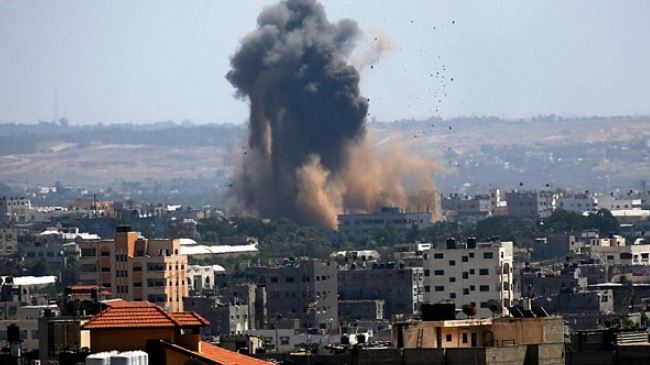
The Israeli army continued its illegitimate bombardment of Palestinian homes, and civilian property, and killed five family members of a Palestinian journalist, including two children in Gaza City.
Media sources said the Israeli strikes also targeted government facilities and ministries, media outlets, mosques and even homes of senior political leaders of Hamas, including the deputy head of the Hamas Political Bureau, Ismael Haniyya.
Medical sources said resident Ezzat Dheir, a 23-year-old journalist, working for a local radio, was killed along with four members of his family, after an Israeli missile striking his home.
The slain Palestinians have been identified as:
1. Ezzat Dheir, 23, Rafah.
2. Turkeyya Dheir, 80, Rafah.
3. Yasmeen Dheir, 25, Rafah.
4. Mary Dheir, 12, Rafah.
5. Tasneem Dheir, 8, Rafah.
The al-Hurriyya (Freedom) Radio issued a statement denouncing the ongoing Israeli crimes against the Palestinian people, including journalists and medics, adding that Dheir was its correspondent in Gaza.
Also on Tuesday, head of the al-Borei Local council, Anis Abu Shammala, was killed after an israeli missile was fired into his home.
On Monday, ten children were killed, and more than 30 were injured, when the army fires missiles into a playground north of the Shaty’ refugee camp, west of Gaza City.
The army also fired missiles into clinics of the Shifa Hospital, one of the biggest hospitals in the Gaza Strip, wounding at least five Palestinians.
Another Palestinian was killed, and three were injured, after the army fired a missile into his home in Beit Lahia, in the northern part of the Gaza Strip.
Three Palestinians, including two brothers, have also been killed by an Israeli missile striking a home, belonging to al-Hashshash family, in Rafah.
Gaza’s main power plant was hit by Israeli tank shells on Tuesday, shutting it down completely. The power plant had already been operating at 20% capacity, after having been hit by Israeli airstrikes last week. Most Palestinians depend on the central Gaza power plant to provide electricity.
This will also severely impact the ability of Palestinians to communicate to the outside world via the Internet — which has been the main source of information getting out of Gaza up until this point. Gaza’s main power plant was also heavily bombarded during the Israeli invasion of 2009, which had a serious impact on hospitals’ ability to provide care.
Iran ready to build makeshift hospital in Gaza
Press TV – July 29, 2014
The Iranian Red Crescent Society (IRCS) says it is ready to set up a fully equipped makeshift hospital in the Gaza Strip amid deadly Israeli attacks on the impoverished coastal enclave.
Seyyed Reza Raeis Karami, the IRCS under-secretary general for health, treatment and rehabilitation, said the humanitarian body is ready to dispatch a medical team to Gaza and build a field hospital there to treat those wounded in Israeli attacks.
The hospital could be built up in a six-month period, while a group of 23 Iranian surgeons will also operate in the medical center to treat the injured Gazans, according to the IRCS official.
Karami added that the IRCS will be prepared to send necessary equipment and human resources to set up the hospital after gaining permission and making assessments of the situation in the Palestinian land.
The first consignment of relief aid provided by the IRCS for Gazans has been flown into the Egyptian capital of Cairo and is waiting to be cleared for transfer into the coastal enclave via the Rafah border crossing.
On July 21, Iran’s Health Minister Seyyed Hassan Qazizadeh Hashemi said the country’s hospitals were fully prepared to admit the injured Palestinians, saying the Islamic Republic is ready to supply the wounded with necessary medicine.
Latest reports say Israeli aerial and ground assaults have killed more than 1,100 Gazans and injured over 6,500 others since July 8.
Hospitals in Gaza are in desperate need of medicine and equipment. Over the past days, Israeli warplanes and tanks have pounded several hospitals across the besieged region.
Earlier this month, the Israeli military targeted the hospitals in Deir al-Balah and Beit Hanoun, killing a number of Palestinian civilians and wounding several others.
The Consistency of Official Iranian Commentary, Part III: On Khamenei’s Referendum Rhetoric, Reuters is Wrong
By Nima Shirazi | Wide Asleep in America | July 27, 2014
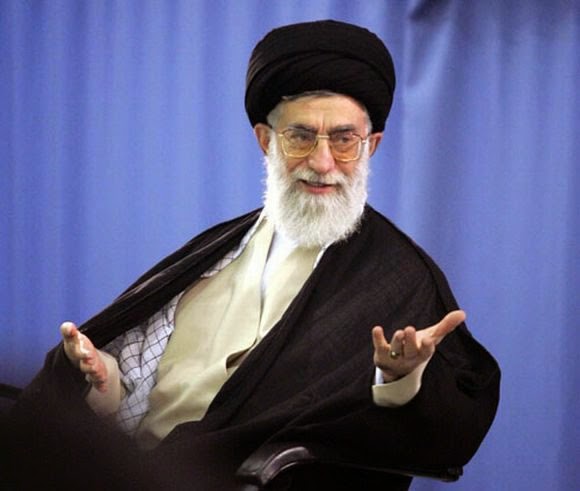 Last week, Iranian leader Ayatollah Ali Khamenei addressed a meeting of Iranian university students and, in his first public comments on the ongoing assault on Gaza, spoke of his belief in the necessity of continued Palestinian resistance to Israel aggression, oppression, and occupation.
“Don’t the Palestinians have the right to defend their lives and security?” he asked rhetorically, and condemned Western nations like the United States and Great Britain for openly supporting Israel’s assault and justifying “crimes that no ordinary person would.”
In the right-wing Daily Caller, notorious neocon darling Reza Kahlili noted that Khamenei reiterated the call by his predecessor, Ayatollah Rouhollah Khomeini, that “Israel must be destroyed,” adding that “until that time with the help of God for this cruel and murderous regime to be destroyed, strong confrontation with steadfast armed resistance is the only solution against this destructive regime.”
Yet the Caller omitted a crucial aspect of Khamenei’s speech – deliberately replaced by an ellipsis linking the the paraphrased Khomeini quote with Khamenei’s endorsement of Palestinian armed struggle – in which the Iranian leader stated that the ideal solution to the current impasse was a democratic vote.
The missing piece, however, was reported by other outlets. “There are logical and practical means to this end, which is for people who live and belong there to pick the government of their choice through a referendum. That would be the end of a usurping fake regime,” Khamenei said, according to a translation by Reuters. Until that time, he continued, “while waiting for an end to this cold-blooded murderous regime, mighty armed resistance is the only way to deal with it.”
Only through a vote by the indigenous population, Khamenei said, will “the usurper and forged regime” of Israel “be practically annihilated.”
Kahlili’s report predictably expunged all mention of a referendum, focusing instead on Iranian military capabilities and nuclear negotiations. More troubling, perhaps, is that “The Young Turks,” a liberal (some might even say, progressive) news and commentary outlet led by host Cenk Uygur, promoted the Daily Caller line in their own round table discussion of the matter. After hearing a portion of the Kahlili article read aloud verbatim, co-host Ana Kasparian described Khamenei’s comments as “extremely violent” and “crazy,” while John Iadarola called such statements “depressing.”
Reuters also quoted Khamenei as saying, “Israel’s annihilation is the only real cure, but that doesn’t mean destroying Jews in this region,” a statement also ignored by the Daily Caller. With this comment, Reuters editorialized, “Khamenei made clear for the first time that he was talking about the dismantling of the state of Israel, not the death of Jews.”
While such clarification is important, the characterization of that distinction as being a new addition to Khamenei’s rhetoric is curious. In fact, this is a distinction made often by Iranian officials when discussing this very topic – and Iran’s official position toward Israel/Palestine. Cursory research into past statements quickly reveals the consistency of such statements and proves the Reuters claim to be, not only sloppy, but ludicrous.
A similar presumption was made last year in the wake of then-newly-inaugurated Iranian President Hassan Rouhani’s insistence that, “when it comes to the settlement and resolution of regional issues,” including the colonization and occupation of Palestine, “we believe that the only path is through the ballot box, through democracy.” International news media declared this to be a breakthrough moment, despite the clear fact that Rouhani’s immediate predecessor, the much-maligned Mahmoud Ahmadinejad, had made identical statements throughout his eight-year tenure as president.
“We are opposed to the idea that the people who live there should be thrown into the sea or be burnt,” Ahmadinejad said in comments reported by the New York Times in September 2008. “We believe that all the people who live there, the Jews, Muslims and Christians, should take part in a free referendum and choose their government.”
More to the point, however, Khamenei himself has remained remarkably consistent on this issue, and Iran’s official prescription, for over two decades. In an extensive analysis of Khamenei’s speeches since 1990, published in the Boston Review in November 2013, well-known Iranian dissident Akbar Ganji – no fan of the Iran’s theocratic leadership – revealed the truth: Khamenei has long called for a new, inclusive Palestinian government to supersede the current Zionist one, thereby dismantling what is currently known as “Israel” politically, not violently.
For instance, Ganji notes, on April 17, 1991, Khamenei discussed “his solution for the Palestinian problem and said, ‘The Islamic Republic’s solution is to disband the usurping Zionist regime, forming a government of the Palestinians, and [guaranteeing] peaceful co-existence of Jews, Christians, and Muslims in all of Palestine.'” Four months later, on August 19, 1991, Ganji adds, Khamenei stated, “Solving the Palestinian problem entails destroying and eliminating the illegitimate government there, so that the true owners [of the land] can form a new government; Muslims, Christians, and Jews can live side by side… Our view regarding the Palestine issue is clear. We believe the solution is destroying the Israeli regime.”
Nearly a decade later, Khamenei’s position had not shifted. In a speech to the Basij militia on October 21, 2000, Ganji tells us that Khamenei again laid out his vision for the indigenous people of Palestine to choose their own political path forward. “The solution is for the millions of the Palestinians to return to Palestine, the several millions that live away from home to return to Palestine. The indigenous people of Palestine—Jews, Christians, and Muslims—should hold a referendum to decide what kind of a regime they want. The vast majority are Muslims. There are also Jews and Christians that belong there, as their parents also lived there. They can decide the political system that they favor,” he opined.
In March 2002, Khamenei again stated, “Holding a referendum in Palestine among the Palestinians, and all those that became refugees—if, of course, they want to return to Palestine—is a rational solution.” In June 2002, he repeated, “The only solution for the Palestine problem is that the true Palestinians, not the usurping and occupying immigrants, those who live in Palestine and those who became refugees, decide the type of government that they want. If asking for the vote of the people of a nation is a solution for those who claim to be democracy advocates, [then] Palestine is also a nation and must decide [its fate].”
The Palestinian problem has only one solution, and that is what we proposed several years ago. Hold a referendum among the indigenous Palestinians, those who live there, or are in refugee camps, or live elsewhere, regardless of whether they are Muslim, Christian, or Jew, and ask them to decide the government that they want. Regardless of whether that government is run by the Muslims, Jews, or Christians, as long as it is the result of people’s direct votes, is acceptable, and will solve the problem. Without it [the referendum] the problem will never be solved.
That Reuters would now claim Khamenei’s recent comments about Gaza mark a stark break from the past is absurd. In his Friday prayer sermon on June 20, 2008, Khamenei declared, “No, we have no problems with Jews. We have no problems with Christians, and with adherents of other religions in the world. The usurper is just the Zionist regime. This is the position of our state, and that of our revolution and our people.”
Similarly, on September 30, 2011, Khamenei spoke at a conference in support of the Palestinian struggle for freedom, justice, and self-determination, and said, “We neither advocate a classic war between Israel and the Islamic countries, nor throwing the Jewish people into the sea, and neither do we accept mediation by the United Nations or any other international organization. We propose a referendum among the Palestinian people. Similar to any other nation, the Palestinians also have the right to decide their fate and pick the type of government they want.”
Addressing the opening assembly of the Non-Aligned Movement on August 30, 2012 in Tehran, Khamenei once again reiterated Iran’s “just and entirely democratic solution” to the conflict:
All the Palestinians – both the current citizens of Palestine and those who have been forced to immigrate to other countries but have preserved their Palestinian identity, including Muslims, Christians and Jews – should take part in a carefully supervised and confidence-building referendum and chose the political system of their country, and all the Palestinians who have suffered from years of exile should return to their country and take part in this referendum and then help draft a Constitution and hold elections. Peace will then be established.
Regardless of whether Khamenei’s proposals are realistic, idealistic, inevitable or impossible, is irrelevant. That he has consistently called for a referendum to alter the exclusivist and discriminatory political system that controls Palestinian lives and has routinely made distinctions between the Zionist government in Israel specifically and Jewish people in general, is indisputable.
Reuters should get their facts straight.
Hague court had no authority in Yukos case, ruling politicized – Moscow
RT | July 28, 2014
The Hague’s arbitration court was not legally empowered to view the case of Yukos Oil Company v. Russia, and the court’s “one-sided” ruling disregards previous Strasbourg court decisions on the issue, the Russian Finance Ministry said in a statement.
Viewing the case, filed by shareholders of former Russian oil giant Yukos against the Russian government, was not in the jurisdiction of the Permanent Court of Arbitration (PCA) in the Hague, as Russia has not ratified the Energy Charter Treaty, the ministry said on Monday.
The statement, following the court’s sensational Monday ruling that ordered Russia to pay $50 billion in damages, also provided a detailed list of issues, which, according to the ministry, make the decision “opportunistic” and “politically biased.”
First of all, The Hague court ignored the previous decisions of the Strasbourg-based European Court of Human Rights (ECHR), which in September 2011 ruled that the Russian authorities had carried out “legitimate” and not politically motivated actions against Yukos “to counter the company’s tax evasion,” the ministry noted. The ruling contradicted Yukos shareholders’ claims that the company’s assets were purposefully expropriated by Moscow.
The Russian Finance Ministry meanwhile blasted the arbitration ruling as based on “one-sided investigation with one-sided application of evidence.”
The Hague court in effect reviewed the decisions of Russian courts on Yukos “as if the arbitration court was an additional authority for appealing the court orders,” the ministry said. It has made “theoretical speculations not supported by evidence” over the motivation of the Russian authorities’ actions in the case of Yukos, it added.
The international body failed to note that the people who controlled Yukos, including the oil tycoon Mikhail Khodorkovsky released from jail in December, were apparently aware of financial machinations aimed at a mass-scale tax evasion in favor of the company, the ministry stressed. The tax evasion scheme, which involved the creation of numerous bogus companies, was not properly considered in the court.
The arbitration court went as far as to judge “what Russian tax legislation should be like” as opposed to what it required in reality, the ministry said. The court refused to pass several controversial issues on taxes for review by Russian, UK or Cyprus competent authorities despite relying on the Energy Charter Treaty that outlines a need for such reviews, it added.
While in effect saying The Hague court decision was not legally binding for Moscow, the ministry added that “the Russian Federation will challenge the arbitration court’s decisions in the courts of the Netherlands.”
According to the ministry, “the arbitration court failed to approach the adjudication with common sense, which is required from the judges in such situations,” which resulted in an nonobjective and biased decision.
“Such an approach undermines the authority of the Arbitration court and the Energy Charter Treaty, which are being applied in increasingly politicized manner and, as in this case, have become the objects of abuse on behalf of domestic investors trying to evade taxes,” the ministry said.
ECHR is expected to announce a fresh decision on Yukos’ multi-billion dollar claim against Russia on Thursday, as the defunct company’s shareholders have filed a separate application with the Strasbourg court, Reuters reported.
Background: ‘Mega-arbitration’: Court orders Russia to pay $50bn in Yukos case
The US’ H17 End Game: Shadow NATO in Ukraine and Russia as a ‘State Sponsor of Terrorism’
By Andrew KORYBKO | Oriental Review | July 28, 2014
The Ukrainian Civil War took a violent and headline-grabbing international turn for the worst on 17 July following the downing of Flight MH17. Although it appears more and more likely that it was the Ukrainian Army that shot it down and not the anti-Kiev Resistance, pro-Western media has been aggressively pushing the narrative that Russia, specifically President Putin, was involved and has been suppressing evidence to the contrary. It has even gone as far as to infer that “Russian-backed separatists” carried out a “terrorist attack”, further upping the propaganda ante. The reason behind this massive information war is that the US wants to “isolate Russia” and expand NATO into Ukraine, something which it has largely been unable to successfully do up until this point. In fact, it appears as though the US is now readying to play its trump card – granting Ukraine major non-NATO ally status and declaring Russia as a “state sponsor of terrorism”, both of which would in turn advance NATO interests and threateningly force the EU to choose whether its destiny lies with the Atlantic or the Continent.
“Operation: Isolation” before Flight MH17
Prior to the downing of MH17, US-led sanctions against Russia were unsuccessful in isolating Moscow. The EU refused to enact any meaningful sanctions that would endanger its $330 billion yearly trade with Russia, thereby mitigating the US’ economic bullying efforts. In fact, the verbal threat of sanctions was actually beneficial for Russia since it motivated the country to look outside the West for future economic prospects. An historic gas deal with China was signed in May that was worth nearly half a trillion dollars, and in the same month, the Eurasian Economic Union was officially formed. Then, right before 17 July, Putin attended the BRICS conference in Brazil where he met with leaders representing nearly half of the world’s population, and they committed to creating the alternative BRICS Development Bank. Clearly, Russia wasn’t going to be isolated by the West.
All while this was happening, the US kept trying to find a backdoor way for incorporating Kiev’s armed forces into NATO, and it found it through its local lackey, Poland. A plan was concocted by Ukraine to create a joint brigade between it, Lithuania, and Poland, with Poland being the key NATO partner involved (Lithuania on its own is almost insignificant in international and military affairs of any kind). The importance here is that Kiev has been institutionalizing the relationship it has with its new strategic partner, Poland, also inviting its former overlord and mercenary-in-arms into the east to assist with “creating new jobs” (read: plundering) in Donbass. What is happening here is that even if the West was unsuccessful in isolating Russia, it could at the very least move as much of its influence eastward to the Russian frontier as it can in order to enact maximum pressure on Moscow.
The “Terrorist” Label and Shadow NATO
Almost immediately after it happened, the MH17 catastrophe was seized upon by Western political opportunists as valuable capital for their geostrategic game. As was mentioned in the first paragraph, pro-Western media outlets immediately laid the blame squarely at Putin’s feet, and this wasn’t coincidental. The objective in doing so has been to generate enough anti-Russian sentiment in Europe so as to justify mutually disadvantageous sanctions (more so for the socially and politically fractured EU, many of whose members are still in recession, than for the economically resolute Russia). The EU, and especially Germany, will only “shoot itself in the kneecaps” as either an emotional or forced response, as to do so under any normal circumstances would be absolutely unreasonable.
Thus, the “terrorist” label entered the discourse.
 It has now become popular for Western opinion makers to repeat the Kiev slur that the anti-coup Resistance are “terrorists”, emphasizing that they are “Russian-backed” and “supported by Putin”. It doesn’t matter that none of this is true – what is important is that it is repeated as loudly and as often as can be. The result is to acclimate the public into believing that Russia under Putin is a pariah state, much as Newsweek magazine tried to convince their audience with its last hate piece. Poroshenko has taken things even further, likening MH17 to Lockerbie and 9/11 and trying to get Donetsk and Lugansk’s governments on the international terrorist list.
It is only a short leap of “logic” to see the connection between Russia and Putin as terrorist sponsors and the US’ designation of state-sponsor-of-terrorism status onto the country. Such a step would lead to immediate US sanctions and intense pressure on the EU to cut off its major non-energy trade contacts with Russia and fiendishly move towards diversifying away from Russian gas (to say nothing of killing the South Stream project). The US will only take this extreme step if it is sure that it has more influence over Europe than Russia does and that Europe can be convinced to sacrifice its economic well-being for ideological and political reasons (which is not that far-off of a possibility for such an indoctrinated leadership).
Just as before the tragedy, it must be noted that the US is still pursuing the goal of shadow NATO integration with Ukraine parallel to isolating Russia. It is reported that it may be on the cusp of granting Ukraine major non-NATO ally status and even providing pinpoint precision intelligence for attacking anti-Kiev SAM sites. This could rapidly creep into something much more, per the Libya model, especially since US military advisors will be on the ground. Thus, in one fell swoop, by evoking the “terrorist” label, the US can ‘kill two birds with one stone’ – guilt/force the EU into “isolating Russia” (thereby isolating and harming itself as well) and swallow Ukraine into Shadow NATO.
Concluding Thoughts
The US has plainly demonstrated that it is salivating for a Cold War redux with Russia, and once more, Europe is caught in the middle. It is completely contrary to any of its interests for it to participate in this needless and aggressive geopolitical struggle, but as the EU seems wont to do nowadays, it may easily get sucked into it out of misguided ideological and political reasons dictated by the US. In fact, it may have little choice: the US could unilaterally declare Russia as a state sponsor of terrorism and then force the EU, whose largest export market is the US and with whom it is negotiating the Trans-Atlantic Trade and Investment Partnership (which European political elite naively believe will benefit them), into acquiescing to its military occupier’s demands. This wouldn’t “isolate” Russia, which has already made a strong push into the non-Western world since April, as much as it would isolate the EU, but ironically, this may even work in Washington’s favor by crippling its friendly economic rival and keeping it under its thumb for at least another decade.
Moreover, Russia as a “state sponsor of terrorism” would create a clear dividing line between the West and Russia and could give a renewed hybrid purpose to NATO. Whereas in the Cold War it was an anti-Russian organization and then in the “Global War on Terror” it nominally became an anti-terrorist organization, it may soon carry the new hybrid mission of containing a “terrorist-supporting” Russia. This would also provide enhanced justification to European populations for the deployment of even more US and NATO personnel in Eastern Europe, as well as deeper and faster Shadow NATO integration for Ukraine, Georgia, and Moldova, thereby laying the framework for a Western battering ram into Russia’s Near Abroad. All of this would rightfully alarm Russia, which would then defensively ramp up its multivector cooperation with ‘The Rest’ and BRICS. This would be especially so for its prized strategic partner and fellow Western target, China, potentially creating an eventual de-facto alliance between the two giants out of shared security concerns and transforming the Eurasian strategic landscape.
Andrew Korybko is the American political correspondent of Voice of Russia who currently lives and studies in Moscow, exclusively for ORIENTAL REVIEW.
Former CIA Boss George Tenet Leading Plans To Attack Upcoming Senate Report On CIA’s Torture Program
By Mike Masnick | Techdirt | July 28, 2014
As we continue to wait for the White House to finally release the heavily redacted version of the executive summary of the Senate Intelligence Committee’s CIA torture report (the full report is over 6,300 pages and cost $40 million to produce), it appears that those who are likely to take the blame are already preparing their response. As has already leaked out over the past few months, the report will show how the program went further than people expected, that it basically uncovered no terrorist plots and that the CIA regularly lied to Congress about the nature of the program and its impact. The CIA, led by current boss John Brennan, has hit back against these conclusions, but it appears that those who were actually in power during the torture program are even more worried. Former CIA boss George Tenet, who was already considered something of a disgrace for the CIA’s intelligence failures prior to invading Iraq, is apparently working hard behind the scenes to coordinate an attack on the credibility of the report — because it pretty clearly is going to attack his credibility.
Just after the Senate Intelligence Committee voted in April to declassify hundreds of pages of a withering report on the Central Intelligence Agency’s detention and interrogation program, C.I.A. Director John O. Brennan convened a meeting of the men who had played a role overseeing the program in its seven-year history.
The spies, past and present, faced each other around the long wooden conference table on the seventh floor of the C.I.A.’s headquarters in Northern Virginia: J. Cofer Black, head of the agency’s counterterrorism center at the time of the Sept. 11 attacks; the undercover officer who now holds that job; and a number of other former officials from the C.I.A.’s clandestine service. Over the speakerphone came the distinctive, Queens-accented voice of George J. Tenet.
Over the past several months, Mr. Tenet has quietly engineered a counterattack against the Senate committee’s voluminous report, which could become public next month.
Apparently Tenet and others demanded early access to the report, and eventually Dianne Feinstein, the White House and those former CIA officials negotiated a deal letting them read the report over in James Clapper’s offices. The NY Times report also details how Brennan is basically a Tenet lackey whose rise through the ranks occurred under Tenet — making it more likely that Brennan wants to protect the reputation of his former boss.
We’ll see how this eventual “response” comes out, but given the initial leaks from the report, it sounds like it’s going to be fairly devastating, and make a further mockery of Tenet. As the report linked above also notes, back in 2007 Tenet got angry at a 60 Minutes interviewer and started wagging his finger at the correspondent, while insisting “We don’t torture people!”
Wagging a finger at the correspondent, Scott Pelley, Mr. Tenet said over and over, “We don’t torture people.”
“No, listen to me. No, listen to me. I want you to listen to me,” he went on. “Everybody forgets one central context of what we lived through: The palpable fear that we felt on the basis of that fact that there was so much we did not know. I know that this program has saved lives. I know we’ve disrupted plots.”
It’s pretty easy to say that when no one can fact-check you. But it appears that the report is going to point out that almost none of what Tenet said was true. No wonder he’s so concerned about leading the attack on the report.
Featured Video

Michael von der Schulenburg: Europe’s Self-Defeating Iran War Policy
or go to
Aletho News Archives – Video-Images
Frlom the Archives
Who Rules America?
The Power Elite in the Time of Trump
By James Petras | Axis of Logic | September 6, 2017
Introduction
In the last few months, several competing political, economic and military sectors – linked to distinct ideological and ethnic groups – have clearly emerged at the centers of power.
We can identify some of the key competing and interlocking directorates of the power elite:
- Free marketers, with the ubiquitous presence of the ‘Israel First’ crowd.
- National capitalists, linked to rightwing ideologues.
- Generals, linked to the national security and the Pentagon apparatus, as well as defense industry.
- Business elites, linked to global capital.
This essay attempts to define the power wielders and evaluate their range of power and its impact. … continue
Blog Roll
 Aletho News
- Is there even an off ramp?
- Michael von der Schulenburg: Europe’s Self-Defeating Iran War Policy
- Sorry, The New Republic, Climate Change Isn’t Causing Somali Migration. Blame Civil Strife and Poverty.
- Expert Guts Claims That HPV Vaccine Reduces Cancer Risk
- No evidence Russia sabotaged Baltic cables – Finnish intel
- The Strategic Folly of a (Serious) US Ground Invasion of Iran
- US-Israeli war of aggression on Iran meant to reshape region: Omani FM
- Iran Does Not Consider Israel Party to Talks to Need Mediators With It – Ambassador
- Macron’s aircraft carrier and warplanes to the Persian Gulf is a dangerous vanity project
- Meet The Ellisons: Zionists, Technocrats, Moguls
- If Americans Knew
- Are we on the precipice of World War III?
- ‘Catastrophic,’ Says UNICEF: 1,100+ Children Killed or Wounded in Mideast Since US-Israel Launched Iran War
- The Unbelievable Madness of Our War With Iran
- World Council of Churches calls on govts to hold Israel accountable for violations of intl law
- How to end the war on Iran that costs US taxpayers $1M per minute – Not a ceasefire Day 153
- Israeli strategic plans to “remake the Middle East” from the 1950s and since
- Honoring Gaza’s women who refused to let the world look away
- 97% of victims of war on Iran are Iranian, 98% of victims in war on Gaza are Gazans – Not a ceasefire Day 152
- Early Iran strikes cost $5.6 billion in munitions, Pentagon estimates
- Israel Decided the War, But Trump’s America Fights and Pays the Bill
- No Tricks Zone
- New Studies: UK Sea Levels Were 4 Meters Higher Than Today During The Mid-Holocene
- Destructive Green New Deal: German Energy And Metal Group Warns Of Drastic Crisis
- New Study Documents A 20-Year Pause In Arctic Sea Ice Decline – Driven By Internal Variability
- Wake-up Call: Survey Shows Majority Of Germans Now Favor Postponing Climate Targets!
- Televised! Leading German Political Candidate Tells Schoolchildren CO2 Makes Sun Hotter!
- New Study: A Century Warming Of 1.1°C Is ‘Commonplace’ And ‘Not Unusual’ During This Interglacial
- New Study: ‘Internal Noise’ And Volcanic Forcing Can Trigger 10-15°C Warming Within Decades
- Glaciers Worldwide Are Suddendly Surging, Experts Blame Warming!
- Surprising Discovery: Sahara Is Greening…Billions Of Trees Where Once Thought To Be Barren
- New Research Reaffirms Clouds, Aerosols, And Surface Solar Radiation Are ‘Driving The Climate System’
 Aletho News