Danish F16s to fight ISIS: Danish government more loyal to the U.S. than to its own citizens
By Jan Oberg | TFF | September 26, 2014
What’s your image of Denmark? Apart from the Little Mermaid, Carlsberg beer and H.C. Andersen perhaps something with decency, welfare, development aid, equality and peace?
Unfortunately, that image is outdated. During the last good 15 years Denmark has participated in wars on/in Yugoslavia and Afghanistan, it was an occupying country in Iraq for four years and a main bomber nation of Libya.
The government’s decision earlier today to send 7 F16s to fight with the U.S. increases the risk of terror actions against Denmark.
It must have been known for quite some time since, about a month ago, the Danish government decided to send a Hercules transport plane with humanitarian aid to Iraq. Most likely, it was a set-up because it was immediately changed into a Hercules transport plane + 55 soldiers to assist the U.S. and the Kurds.
Today’s decision is a violation of the UN Charter – the spirit of the Preamble as well as Article 1 which states that peace shall be established by peaceful means – and, later, only when everything has been tried and found in vain can a military action be decided.
Denmark must now calculate with Danish casualties and, even worse, with taking responsibility for scores of innocent civilians’ death – something that can’t be avoided when targeting individuals from the air.
The decision documents that Denmark has learnt nothing from the earlier – failed – wars and that it does not have alternative expertise.
The common sense, solidarity and humanity that characterised Denmark, at least to some extent, about 20 years ago is now eradicated and replaced by thoughtless militarism; its only guideline has been and is: Accept willingly and unconditionally what the US does and follow it when it calls upon you to do its dirty job – His Master’s Voice.
If you think I exaggerate: There is not one major policy or decision the last 30-40 years where Denmark has shown the courage to stand up against Washington.
Millions of dollars are allocated to state-financed research institutes, military analysis centres and mainstream thinking that “explains” and legitimizes the policies. (The only peace research institute, COPRI, which was very well evaluated by international scholars was destroyed by the government of Anders Fogh Rasmussen who also made Denmark an occupying power – only to be rewarded with the position of NATO Secretary-General).
It is my judgement that the decision to participate in the war on Iraq was the largest foreign policy blunder in Denmark since 1945.
I wrote ”Predictable Fiasco” in which the present situation in Iraq was predicted fairly precisely and I presented a 20-point plan on what to do instead of war.
Thus I don’t know how to characterise a decision by a Social Democratic-led government to go to war in Iraq for a second time!
PM Helle Thorning Schmidt presented the decision around lunch time today Friday September 26. Each of her arguments and assumptions were dubious, anti-intellectual and constructed to suit the event
1) She said that this was not a war because ISIS is not a state (!!) – now you know the level of what followed.
But this is war no matter what her spin doctors may have invented. Those who in the thousands will be killed – ISIS people as well as civilians – can’t see it as anything but war. And nothing but military equipment is being used.
2) As mentioned above, the decision violates the UN Charter.
3) Mission creep is already a fact. First, Denmark should send only humanitarian aid, then it changed to military aid and now 7 F16s – the next step is likely to be what is constantly denied and therefore rather safe to predict: Boots on the ground.
4) It will not be a short, limited affair – it could well last for years. ISIS may be relatively small in numbers but could grow fast – there is enough of hatred; it has a lot of funds from Western allies such as Saudi-Arabia, Qatar and Bahrein – who are playing a double game. And they have advanced weapons, a lot of it U.S.-produced, stolen from the Iraqis.
5) ISIS is the result of more than 100 years of Western arrogance in the region – wars, deceit, lies and agreements such as Sykes-Picot (1916) and Balfour – imposing of Western values, occupations (foremost Iraq), base-building, stealing of oil and coup d’etats. The list is long!
6) This action as a whole will only have one result: More terrorists. The entire ‘War on Terror’ is wrongly conceived from October 7, 2001. We can’t rid the world of terrorism by killing terrorists and ignoring the underlying causes any more than we can combat criminality by killing criminals.
Eventually there will be a blowback, a boomerang effect.
7) The Danish government now gives ISIS and others a perfect reason for targeting Denmark. It puts the security of the Danish citizens at risk – something that must be seen in relation also to the Muhammad caricatures as well as Denmark’s participation in the wars in Afghanistan, Iraq and Libya.
While it is the first duty of a government to secure the lives and safety of its people, the Danish government does the opposite. To be loyal to Its Master’s Voice.
Add to this that Obama’s speech about how to combat ISIS was a manifest disappointment with neither strategy nor a vision for the future of the region. It boiled down to the bizarre: We kill people who kill people because it is wrong to kill people! (Deliver back that Nobel Peace prize medal, Mr. President!)
Finally, Denmark’s defence, security and foreign policy establishment increasingly looks like a one-party system with very little diversity.
All security research at its Institute for International Studies is financed by – you guessed it! – the Ministry of Defence. Not much research there on peace by peaceful means or alternative defence, peace-making, reconciliation, forgiveness etc.
Since 1975 when Denmark bought F16s a MIMAK has developed – a Military-Industrial-Media-Academic Complex with a degree of consent that is pathetic for a society that professes to be pluralist, democratic, humanist and open (-minded).
In particular, Denmark has been rewarded with lots of contracts for its booming military industry – and plans to waste at least US$ 5 billion on new fighter planes.
So, next week the Danish Parliament will – probably with one small left-wing party as dissenter – endorse that Denmark goes to war yet again, for a fifth time – only to cash in yet another fiasco (to be denied).
This only goes to show that democracy is forced to give in to militarism – because there is a considerable opinion in Denmark that does not support this and also did not support the four preceding wars.
Like in Norway and Sweden (exception in the latter: the xenophobic Sweden Democrats) those of us believing in international law and who have the idea that peace is better than war have no party anymore that represents our views.
In summary, the Denmark and the Norden you may think you know is changing and we need a debate about this moral and intellectual defeat under MIMAK in our countries.
But certainly people in the rest of the world who used to look up to Scandinavia should know and tell us what they think.
Rogue states, big and small, is a problem to the whole world. And the sooner they change, the better for all.
Israel bars entry to Al-Aqsa mosque to Palestinians for third consecutive day
Al-Akhbar | September 26, 2014
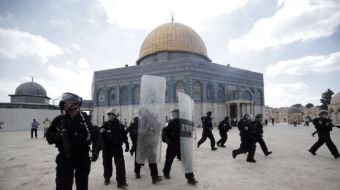
Israel on Friday imposed restrictions on the entry of Palestinian worshipers into the Al-Aqsa Mosque in annexed East Jerusalem for the third consecutive day.
Israeli police stepped up security around the mosque, deploying 2,000 troops in Jerusalem and erected roadblocks at entrances to Jerusalem’s Old City.
“Police prevent men under 50 and West Bankers from entering Al-Aqsa compound or Friday prayers,” Sheikh Azzam al-Khatib, director-general of the Organization for Muslim Endowments and Al-Aqsa Affairs, told the Turkish Anadolu Agency.
Jews celebrated the start of Rosh Hashanah (Jewish New Year) on Wednesday evening, the first day of new Jewish year of 5775.
Israel typically imposes restrictions on Muslim worshipers’ access to Al-Aqsa during Jewish holidays
The Israeli authorities also closed the Ibrahimi Mosque to Muslims in the West Bank city of Hebron on Wednesday and Thursday for Rosh Hashanah.
Israel is also closing the Gaza Strip’s only functioning commercial crossing – the Kerem Shalom border terminal – for four days starting Thursday for the Jewish holiday.
Khatib said that while Israel restricts the entry of Palestinians into Al-Aqsa mosque compound, it facilitates the entry of Zionist settlers into the holy site.
He said that at least 300 Zionist settlers and 120 Israeli soldiers had forced their way into the compound in the past three days.
In recent months, groups of extremist settlers – often accompanied by Israeli security forces – have repeatedly forced their way into the flashpoint compound.
The frequent violations anger Palestinian Muslims and occasionally lead to violent confrontations.
For Muslims, Al-Aqsa represents the world’s third holiest site.
Jews, for their part, refer to the area as the “Temple Mount,” claiming it was the site of two prominent Jewish temples in ancient times.
Israel occupied East Jerusalem during the 1967 Middle East War. It later annexed the city in 1980, claiming it as the capital of the Zionist state – a move never recognized by the international community.
In September 2000, a visit to the site by controversial Israeli leader Ariel Sharon sparked what later became known as the “Second Intifada” – a popular uprising against the Israeli occupation in which thousands of Palestinians were killed.
(Anadolu, Al-Akhbar)
Eric Holder Resigns, Will Likely Go Back to Representing Banks at Covington and Burling
emptywheel | September 25, 2014
As we speak, Chuck Schumer is probably yelling into a phone trying to get President Obama to nominate Wall Street’s US Attorney Preet Bharara to succeed Eric Holder as Attorney General. “Barahck,” Schumer is probably yelling, “I can get Mitch to agree to push Preet through in the Lame Duck.”
That’s because Holder has just announced his resignation, pending confirmation of his successor.
The three most interesting details in Carrie Johnson’s scoop on Holder’s resignation are that he is likely to return to Covington and Burling, where — like former Criminal Division Chief Lanny Breuer before him — he will represent banks as they craft sweetheart deals with DOJ.
Friends and former colleagues say Holder has made no decisions about his next professional perch, but they say it would be no surprise if he returned to the law firm Covington & Burling, where he spent years representing corporate clients.
Nice to know a guy can still profit off of 6 years of overlooking rampant bank crime.
Johnson also reported that Holder plans to push through racial profiling guidelines that will protect African Americans but not Muslims.
Long-awaited racial profiling guidelines for federal agents will be released soon, too. Those guidelines will make clear that sexual orientation, ethnicity and religion are not legitimate bases for law enforcement suspicion, but controversial mapping of certain communities — including Muslim Americans — would still be allowed for national security investigations, one of the sources said.
That will soil the one real bright spot of Holder’s tenure at DOJ, his fight for civil rights.
Finally, Johnson reported that Don Verrilli — the guy who seemed to, but did not quite — lose the ObamaCare fight is the leading candidate to replace Holder.
The sources say a leading candidate for that job is Solicitor General Don Verrilli, the administration’s top representative to the Supreme Court and a lawyer whose judgment and discretion are prized in both DOJ and the White House.
By “judgement and discretion,” I wonder whether Johnson’s sources are referring to Verrilli’s stubbornness in not correcting the lies he told SCOTUS (wittingly or unwittingly) about DOJ’s implementation of FISA Amendments Act in the Amnesty v. Clapper case. By claiming, falsely, that DOJ gives defendants notice that they’ve been caught using Section 702, Verrilli successfully beat back the Justices’ concerns that no one would ever have standing to challenge these laws.
For what it’s worth, I think people are vastly overestimating the time it will take to replace Holder. After all, Republicans are on the record that they believe Holder to be contemptuous of Congress. While the House GOP that is suing him don’t actually get a vote on his replacement, surely they’ll convince their proxy Ted Cruz to represent their contempt.
Thus, for the right candidate, I suspect confirmation will happen quickly, just as Caroline Krass got confirmed in a landslide when the costs of leaving Robert Eatinger — who referred CIA’s overseers to DOJ for investigation — in place as Acting CIA General Counsel became clear.
I’m just not convinced Verrilli is that guy. And while Preet did lead the investigation into Alberto Gonzales’ politicization of the US Attorneys when he worked for Schumer, surely the GOP cares more about his diligent efforts to not investigate the banks in the interim.
Coalition of the Clueless
By Sharmine Narwani | RT | September 25, 2014
This US-engineered Coalition is in for some surprises. With few common goals, it has thrust itself into battle against the most determined players in the region and beyond.
The airwaves are still heaving with spin two days after US airstrikes against Syria.
Undoubtedly the attacks were timed to occur on the eve of the annual gathering of world leaders at the United Nations, so ‘Coalition’ partners could cluster behind the decision to bomb a sovereign state, uninvited.
The irony, of course, is that they are doing so at the UN – the global political body that pledges to uphold international law, peace and stability, and the sanctity of the nation-state unit.
The goal this week will be to keep the ‘momentum’ on a ‘narrative’ until it sinks in.
On day one, heads of state from Turkey, Jordan, Qatar, the UK and France were paraded onto the podium to drum in the urgency of American strikes against the Islamic State of Iraq and the Levant (ISIL), Jabhat al-Nusra and other militant groups inside Syria.
Every American official – past and present – in the White House rolodex was hooked up to a microphone to deliver canned sound bites and drive home those ‘messages.’ In between, video-game-quality footage of US strikes hitting their targets was aired on the hour; clips of sleek fighter jets refueling midair and the lone Arab female fighter pilot were dropped calculatingly into social media networks.
The global crew of journalists that descends annually on the UN for this star-studded political event, enthused over US President Barak Obama’s ability to forge a coalition that included five Arab Sunni states – Saudi Arabia, Qatar, Jordan, Bahrain and the UAE.
Few mentioned that these partners are a mere fig leaf for Obama, providing his Syria campaign with Arab and Muslim legitimacy where he otherwise would have none. Not that any of these five monarchies enjoy ‘legitimacy’ in their own kingdoms – kings and emirs aren’t elected after all – and two of these Wahhabi states are directly responsible for the growth and proliferation of the Wahhabi-style extremism targeted by US missiles.
Even fewer spent time dissecting the legality of US attacks on Syria or on details of the US ‘mission’ – as in, “what next?”
But with a mission this crippled at the outset, it didn’t take long for an alternative view to peek through the thick media fog.
On the ground in Syria, dead civilians – some of them children killed by US bombs – muddied the perfect script. Confused Syrian rebels – many who had called for foreign intervention to help crush the government of Syrian President Bashar al-Assad – demanded to know how these airstrikes were meant to help them.
Sunni Arabs would be radicalized by these strikes, they warned, as ideologically sympathetic citizens of the Arab coalition states took to their information channels and swore revenge for airstrikes against ISIL and al-Nusra.
The Syrian government, for the most part, remained mute – whether to save face or because they could ‘smell’ the gains coming. Contrary to Washington’s prevailing narrative, privately the story was that the US had informed the Assad government of both the timing and targets of the attacks in advance.
Sources say that the US even provided ‘guarantees’ that no Syrian military or government interests would be targeted. A Reuters exclusive claiming that the US went so far as to provide assurances to Iran, suggests this version is closer to the truth. When US airstrikes against Syria were on the table a year ago, the various parties went through a similar game of footsies. Last September, the Americans backed off – allegedly because of communications from their adversaries that even a single US missile would trigger a warfront against Israel. This time, Washington needed to know that scenario was not going to be activated, and this week they offered the necessary guarantees to ensure it.
Although the Russians and Iranians have publicly lashed out at the illegality of US strikes, they do not seem too worried. Both know – like the Syrian government – that these air attacks could be a net gain for their ‘Axis.’
Firstly, the United States is now doing some useful heavy-lifting for Assad, at no real cost to him. The Syrian armed forces have spent little time on the ISIL threat because their focus has traditionally been on protecting their interests in Aleppo, Damascus, Homs, Hama – and the countryside in these areas – as well as towns and cities around the Lebanese and Jordanian borders. That changed when ISIL staged successful attacks on Mosul and created new geopolitical urgency for Assad’s allies – which triggered some major Syrian strikes against ISIL targets.
But to continue along this path, the Syrians would have to divert energy and resources from key battles, and so the American strikes have provided a convenient solution for the time being.
Secondly, the Syrians have spent three years unsuccessfully pushing their narrative that the terrorism threat they face internally is going to become a regional and global problem. The US campaign is a Godsend in this respect – Obama has managed to get the whole world singing from the same hymn sheet in just two months, including, and this is important, the three states – Saudi Arabia, Qatar and Turkey – most instrumental in financing, weaponizing and assisting ISIL and other extremist militias inside Syria.
Syria, Iran, Russia, Hezbollah and a host of like-minded emerging powers are pleased about this new laser focus on jihadi terror and for the accompanying resource shift to address the problem.
Thirdly, the US has now been placed in the hot seat and will be expected to match words with action. For three years, Washington has overlooked and even encouraged illegal and dangerous behaviors from its regional Sunni allies – all in service of defeating Assad. With all eyes on America and expectations that Obama will fail in his War on Terror just like his predecessors, the US is going to have to pull some impressive tricks from its sleeves.
Ideally, these would include the shutting down of key border crossings (Turkey, Jordan, Lebanon); punishing financiers of terror and inhibiting the flow of funds and assistance from Washington’s regional allies; cutting off key revenue streams; tightening immigration policies to stem the flow of foreign fighters; disrupting communications networks of targeted terrorist groups; broader intelligence sharing with all regional players; and empowering existing armies and allied militias inside the ‘chaos zone’ to lead and execute ground operations.
Thus far, there are signs that some of these things are already happening, with possibly more to come.
Now for the fun part. The Syrians, Iranians and Russians do not fundamentally trust Washington or its intentions. The suspicion is that the US is on another one of its regime-change missions, displaying its usual rogue-state behavior by violating the territorial integrity of a sovereign state under false pretenses, and that it will shortly revert to targeting the Syrian government.
While they can see clear gains from the current level of US intervention – as distasteful as they find it – they are watching carefully as events unfold.
If there is the slightest deviation from the ‘guarantees’ provided by the US, this trio has plenty of room to maneuver. Iran, for one, has dallied with the Americans in both Iraq and Afghanistan and they know how to cause some pain where it counts. The Russians, for that matter, have many playgrounds in which to thwart US ambitions – most urgently in Ukraine and in Afghanistan, from which the US hopes to withdraw billions of dollars’ worth of military equipment by the end of 2014.
All understand that Washington has just assumed a risky public posture and that many, many things can go wrong. The Sunni Arab fig leaf can disappear in a nano-second if domestic pressures mount or revenge attacks take place internally. Information could leak about continued assistance to terrorist militias from one or more of its coalition partners – a huge embarrassment for Washington and its wobbly Coalition. ISIL will almost certainly act against coalition partner soft-targets, like carrying out further kidnappings and executions. Continued airstrikes will almost definitely result in a growing civilian casualty count, turning those ‘hearts and minds’ to stone. Syrian rebels could swiftly turn against the US intervention and radicalize further. Massive displacement caused by airstrikes could exacerbate the humanitarian crisis. And as in all other past US military War-on-Terror adventures, terrorism could thrive and proliferate in quantum leaps.
As Moscow-based political analyst Vladimir Frolov noted to the Washington Post : “The United States has underestimated the complexity of the situation before, so let’s just wait until they run into problems.”
The idea that US military engagement could continue for the long-term is unlikely given the myriad things that can go wrong fast. Obama is going to be reluctant to have his last two years in office defined by the hazardous Syrian conflict – after all, he was to be the president who extracted America from unessential wars.
But the most compelling reason that this Coalition will not pass the first hurdle is that its key members have entirely different ambitions and strategic targets.
Over a decade ago, these US-engineered coalitions were wealthier, less-burdened and shared common goals. Today, many of the coalition members face domestic economic and political uncertainties – and several states are directly responsible for giving rise to ISIL. How can the Coalition fight ISIL and support it, all at once?
What’s missing is a formula, a strategy, a unified worldview that can be equally as determined as the ideological adversary it faces.
Down the road, we will discover that the only coalition able and willing to fight extremism does indeed come from inside the region, but importantly, from within the conflict zone itself: Lebanon, Syria, Iraq and Iran. For starters, they are utterly vested in the outcome of their efforts – and would lead with political solutions alongside military ones. Those elusive boots-on-the-ground that everyone is seeking? They live it. Pit that group against Obama’s Coalition-of-the-Clueless any day and you know which side would win handily.
The question is, can this Coalition stomach a solution it is working so hard to avoid? Will it partner with vital regional players that were foes only a few months ago? It is doubtful. That would require a worldview shift that Washington is still too irrational to embrace.
Follow @snarwani on Twitter
Crackdown on freedoms? Australian Senate passes draconian anti-terror laws
RT | September 26, 2014
Australia’s senate has endorsed new anti-terror laws that will grant its intelligence agency the right to spy on any citizen with just a warrant, while journalists and whistleblowers “recklessly” exposing special ops can face up to 10 years in jail.
The anti-terror laws, which cleared the Australian Senate on Thursday – and will almost certainly pass the House of Representatives on Tuesday – grants extraordinary powers to the nation’s spying agency, ASIO, to effectively monitor the entire Australian internet.
The National Security Legislation Amendment Bill allows one warrant to give the ASIO access to a limitless number of computers on a computer network when attempting to monitor a target. It also allows for the content of communications to be stored – while ASIO agents will be allowed to copy, delete, or modify the data on any of the computers it has a warrant to spy on.
Critics of the law say it effectively allows the entire internet to be monitored as it is a ‘network of networks’ and the bill doesn’t define a computer network.
Moreover, under the new law, anyone identifying ASIO agents or disclosing the information related to a special intelligence operation faces up to 10 years in jail. To be found guilty one would only need to be proven to be “reckless as to whether the disclosure of the information will endanger the health or safety of any person or prejudice the effective conduct of an SIO.”
In addition, any operation can be declared “special” by an ASIO officer, and a person may never know which investigation he allegedly obstructed and being put on trial for – because it is a secret one.
The Australian Lawyers Alliance said the law could have a freezing effect on national security reporting, although Senator George Brandis and the government’s Attorney General, said the laws didn’t target journalists but instead went after people who leak classified information like the former US National Security Agency contractor Edward Snowden.
The new laws were introduced to target government whistleblowers, and over growing concerns about the Islamic State jihadists who threatened to directly target Westerners including Australians.
“Regrettably, for some time to come, the delicate balance between freedom and security may have to shift,” Prime Minister Tony Abbott said in a statement on Monday.
Voting against the measure in the 44-12 vote was Australian Green party Senator Scott Ludlam who added an amendment limiting the number of computers to 20 to be searched at any one time, which failed to gain support.
“What we’ve seen [tonight] is I think a scary, disproportionate and unnecessary expansion of coercive surveillance powers that will not make anybody any safer but that affect freedoms that have been quite hard fought for and hard won over a period of decades,” Senator Ludlam told Fairfax Media.
Obama Unleashes Plan to Support ‘Civil Society’ Groups Across the Globe
teleSUR | September 25, 2014
President Barack Obama announced in a speech on Tuesday that the United States would be aggressively funding and supporting “civil society” groups around the globe, calling it a “national security” issue.
“It is precisely because citizens and civil society can be so powerful — their ability to harness technology and connect and mobilize at this moment so unprecedented — that more and more governments are doing everything in their power to silence them,” said Obama at the Clinton Global Initiative’s annual conference in New York.
Obama singled out Venezuela for allegedly “vilifying legitimate dissent” and said that Latin America would host one of the six Regional Civil Society Innovation Centers, a new initiative that seeks to create a global network to create cross-border partnerships. Other regions targeted for these new centers include Sub-Saharan Africa, the Middle East and Asia.
However, U.S. assistance to so-called civil society groups, especially in Latin America, has been marred in controversy, especially with regards to leftist governments.
The United States Agency for International Development (USAID), one of the U.S. bodies that funds and supports “civil society” organizations abroad, funded Venezuelan opposition groups responsible for the 2002 coup attempt against the democratically-elected former president Hugo Chavez.
In 2009, according to USAID documents obtained through the U.S. Freedom of Information Act, the group had also funded local regional governments and municipalities in Bolivia at a time when the government of Evo Morales was dealing with right-wing separatist movements in the eastern part of the country. Morales eventually expelled the agency from the country in 2013, a move followed by Ecuador’s President Rafael Correa later that year. Correa announced in November 2013 that USAID is required to leave the country by the end of this month.
“Partnering and protecting civil society groups around the world is now a mission across the U.S. government,” said Obama.
He ordered, via a presidential memorandum, agencies such as USAID, the Department of State, and Homeland Security, to work more regularly with civil society groups across the globe. … Full article
Israel continues to harass and restrict Gaza fishermen despite truce agreement
Al-Akhbar | September 25, 2014
Every time Gaza fisherman Rami goes to sea, the same thing happens: five nautical miles offshore, shots ring out and a voice over an Israeli loudspeaker demands he turn back.
Officially, Gaza’s fishing fleet has the right to trawl the waters up to six nautical miles off the shore under the terms of Israel’s illegal and brutal eight-year blockade.
Although that outer limit has frequently been reduced, or even cancelled outright over the years, it was formally reinstated by virtue of an August 26 truce agreement which ended a deadly 50-day war between Israel and Hamas militants.
But nearly a month after the ceasefire took effect, even those six nautical miles — which the fishermen say is not nearly enough — are unattainable.
One afternoon, Rami Bakr and his 10-man crew put to sea for a 10-hour fishing expedition. With them was an AFP team.
Very quickly, warning shots skimmed the boat as an Israeli navy vessel approached. On board were around a dozen soldiers armed with machine guns, shouting through a loudspeaker for them to stop.
“These are the worst conditions we’ve ever known,” said the 41-year-old fisherman, who has spent more than three decades of his life fishing the waters off Gaza.
“During the war, the Israelis bombed fishing huts on the beach and now they are preventing fishermen from earning their crust at sea,” he said.
The Gaza Strip has long been known for its plentiful seafood and fish although the stocks have been depleted by pollution, frequent wars and the blockade.
Today, the coastal enclave counts some 4,000 fishermen, more than half of whom live below the poverty line, said Nizar Ayash, head of the Gaza fishermen’s syndicate.
During the recent seven-week war launched by Israel which killed over 2,000 Palestinians, the majority of which are civilians, 80 of Gaza’s fleet of around 1,500 fishing boats and dozens of fishing huts were destroyed in the Israeli bombardment, which also reduced nets and fishing equipment to ashes, he said.
For Ayash, the problems experienced by Rami are widespread.
“Since the ceasefire, many Israeli attacks have been reported,” he said, referring to repeated shooting at fishing vessels.
Israeli forces say the warning shots are necessary because Palestinian boats flout the six-mile limit.
With their tackle destroyed and the price of oil soaring, Gaza’s fishermen are almost working at a loss.
Today, a single fishing expedition can cost up to about $500, said another fisherman called Mehdi Bakr, who lost his hand when an Israeli navy vessel fired at his boat in 1997.
For every night on the water, they need 270 liters (59 gallons) of diesel and 250 liters of petrol, he explained.
And all this for a very small catch.
“September and October is sardine season and they are only found between six to nine nautical miles from the shore, so with a six-mile limit, we’re bringing home hardly anything,” explained Taha Bakr, a 24-year-old member of Rami’s crew.
Because fishing is a trade passed on from father to son, and because he can no longer provide for his family and the job is so dangerous, the young man with green eyes and a neatly-trimmed beard has signed up to journalism school.
“It’s so that I don’t have to fish again, that job is just too risky,” he told AFP.
Maria Jose Torres, deputy head of office in the Palestinian branch of the UN humanitarian agency (OCHA), said that the 1993 Oslo Accords established a fishing zone of up to 20 nautical miles.
“It is essential to increase the fishing zone beyond six nautical miles to allow the fishermen to earn their living,” she said, indicating that the vast majority today are unable to support themselves.
“Some 84 percent of them are only able to survive thanks to help from the UN,” she said.
Rami said he keeps putting out to sea so that he can feed his children.
“It has been a long time since we last heard the singing and laughter of fishermen at sea who returned with their nets full,” he said.
But Mehdi fears for the future of this millennia-old profession in Gaza.
“We, the young generation, are not happy with this. If it carries on like this, there won’t be any more fishing in Gaza at all,” he said.
(AFP, Al-Akhbar)
Gaza farms adjacent to buffer zone suffer greatest losses
MEMO | September 24, 2014
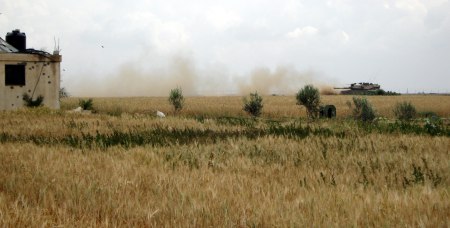
Palestinian residents in the buffer zone along the eastern borders of the Gaza Strip suffer the loss of their homes and source of income in every Israeli escalation.
Palestinian farmer Mohamed Qudih, 60, and his wife Sabiha, 59, lost their house, which was destroyed by the Israeli occupation during the ground invasion in the Khan Younis village of Khuza’a. They also lost their farm, which included around 50 olive and date trees and okra crops.
“I was surprised when I saw the rubble of my house,” Qudih told local Palestinian news agency Quds Net. “I was also surprised to see around 50 olives trees and date palms were uprooted and the okra crop was crushed.”
Qudih’s farm is 800-metres away from the Gaza-Israeli border. “We suffer so much as the Israeli occupation always razes the farms adjacent and near its borders,” he said.
He added: “We are always in danger while working or staying in our farms as the Israeli border troops in the military towers always fire live bullets and tanks and bulldozers move on the ground when they feel anything approaching the borders.”
Iyad Qudih, 40, whose farm is 500-metres from the border, had a similar story: “I came back to my farm to find no sign of my house and all the trees and crops were damaged.”
Mu’taz Al-Najjar, 19, tends to his family’s farm which is 450-metres from the border. He hopes the buffer zone is cancelled in order for his family to freely access their entire farm and benefit from it. He called for the representatives of the Palestinian fighters to the indirect talks with the Israelis in Cairo to stick to this demand.
“This will help hundreds of farmers access all areas of their farms and thus more farmers will have work and agriculture produce will increase,” he said.
Khuza’a is located to the east of Khan Younis, a Palestinian city in the south of the Gaza Strip. It is located on 4,000 Dunams (1,000 acres) of land and is home to 14,000 Palestinians, most refugees.
The Israeli occupation razed a large number of Palestinian houses in the neighbourhood during the latest war on Gaza and wrecked most of its farms and empty lands.
Colorado students stage mass walk-out over US history ‘censorship’
RT | September 25, 2014
Hundreds of Denver-area high school students walked out their classrooms in a mass protest against what they call an attempt to censor their history curriculum by refocusing it on topics that promote citizenship, patriotism and obedience.
Students at six Denver-area highs schools walked out their classrooms en masse, protesting a plan by the conservative-majority Jefferson County school board to push for curriculum changes to Advanced Placement history courses to promote patriotism and deference to authority. The proposed changes would include the removal of topics that could ‘encourage’ civil disobedience from textbooks and materials.
The protest was organized through social media, encouraging students to stand outside the Jefferson County School Administrative Building with placards which read “People didn’t die so we erase them,” “Educate free thinkers,” “There is nothing more patriotic than protest,” and “History is History.”
The student protest comes after teachers at two schools caused a shutdown the week before when they staged a sick-out over the curriculum changes, which the school board says provides a balanced view of American history.
“I understand that they want to take out our very important history of slavery and dropping the atomic bombs on Hiroshima and Nagasaki because it portrays the US in a negative light,” a high school senior, Casey McAndrew, told CNN.
The proposal calls for establishing a committee that would regularly review texts and course plans, starting with Advanced Placement history to make sure materials “promote citizenship, patriotism, essentials and benefits of the free market system, respect for authority and respect for individual rights,” and don’t “encourage or condone civil disorder, social strike or disregard of the law.”
“The nation’s foundation was built on civil protests,” Tyrone G. Parks, a senior student told the Associated Press. “And everything that we’ve done is what allowed us to be at this point today. And if you take that from us, you take away everything that America was built of.”
Those students participating in the protest will not be punished but will receive unexcused absences unless their parents request permissions for missed classes, according to school district spokeswoman Lynn Setzer said.
Meanwhile, Jefferson County Superintendent Dan McMinimee tried to calm the tensions saying that no changes in the curriculum have been finalized and renewing his offer to continue discussions on the issue.
READ MORE: Journalism groups blast Obama admin for ‘politically driven suppression of news’
Ohio cops killed Walmart air gun-wielding man moments after confrontation, new video shows
RT | September 25, 2014
Recently released surveillance video showing the fatal Walmart shooting of a black man carrying an air gun – which he picked up in the same store – seems to contradict police accounts, after a grand jury decided not to indict the officers.
James Crawford III, 22, was shot and killed by police officers after they received a 911 call on August 5 that a man was carrying a rifle in the BeaverCreek Walmart, Ohio, and allegedly waving it at store customers.
Police said in their report that Crawford ignored their numerous orders to drop the rifle before he was shot. However, the video, obtained by the Xenia Daily Gazette, shows Crawford being fired upon mere seconds after police encounter him.
The video shows Crawford walking to the sporting goods section, apparently talking on his phone, and picking up what looks like an assault rifle. In fact it was an air rifle that had been left unboxed on a shelf. He then continues walking around the store – sometimes carrying the gun over his shoulder, sometimes pointed at the ground – before police arrive and shoot him dead.
The video was released as the grand jury decided not to indict the two officers involved and said “they were justified in their actions.”
The Crawford family said they were “disgusted” by the grand jury decision to not file charges against the two officers involved in the shooting.
The August 5 incident triggered protests from residents and family members demanding the video be released. Crawford is black, and the two officers involved in the fatal shooting are white. Crawford’s family asked for a federal investigation to determine if race was a factor.
The Justice Department said Wednesday it would “conduct an independent review of the facts and circumstances” around Crawford’s death to see if there were any civil rights violations. The review will be conducted by the department’s civil rights division, the US attorney’s office and the FBI.
READ MORE: Local police kill at least 400 people a year, mostly minorities
Featured Video

Meet The Ellisons: Zionists, Technocrats, Moguls
or go to
Aletho News Archives – Video-Images
Frlom the Archives
With apparently fabricated nuclear documents, Netanyahu pushed the US towards war with Iran
By Gareth Porter | The Grayzone | April 29, 2020
President Donald Trump scrapped the nuclear deal with Iran and continued to risk war with Iran based on Israeli Prime Minister Benjamin Netanyahu’s claim to have proven definitively that Iran was determined to manufacture nuclear weapons. Netanyahu not only spun Trump but much of the corporate media as well, duping them with the public unveiling of what he claimed was the entire secret Iranian “nuclear archive.”
In early April 2018, Netanyahu briefed Trump privately on the supposed Iranian nuclear archive and secured his promise to leave the Joint Comprehensive Plan of Action (JCPOA). That April 30, Netanyahu took the briefing to the public in a characteristically dramatic live performance in which he claimed Israel’s Mossad intelligence services had stolen Iran’s entire nuclear archive from Tehran. “You may well know that Iran’s leaders repeatedly deny ever pursuing nuclear weapons…” Netanyahu declared. “Well, tonight, I’m here to tell you one thing: Iran lied. Big time.”
However, an investigation of the supposed Iranian nuclear documents by The Grayzone reveals them to be the product of an Israeli disinformation operation that helped trigger the most serious threat of war since the conflict with Iran began nearly four decades ago. This investigation found multiple indications that the story of Mossad’s heist of 50,000 pages of secret nuclear files from Tehran was very likely an elaborate fiction and that the documents were fabricated by the Mossad itself. … continue
Blog Roll
 Aletho News
- Meet The Ellisons: Zionists, Technocrats, Moguls
- US failures in Iran reveal Russia is key to South Korea’s strategic security
- ‘All ports in Persian Gulf will be legitimate targets if Iranian ports are attacked’
- 40 Years of Endless War, Data Point by Data Point
- Department of War Using Palantir AI to Pick Targets in Iran
- American bases do not protect – they attack the peoples of the Persian Gulf
- ‘We’ve Obliterated Their Missiles’
- Syrian president vows ‘absolute support’ to disarm Hezbollah
- Ukraine attacking Russian gas pipeline to stop deliveries to Europe – Defense Ministry
- ‘Heinous crime’: Iran denounces Israeli assassination of 4 Iranian diplomats in Lebanon
- If Americans Knew
- Israeli strategic plans to “remake the Middle East” from the 1950s and since
- Honoring Gaza’s women who refused to let the world look away
- 97% of victims of war on Iran are Iranian, 98% of victims in war on Gaza are Gazans – Not a ceasefire Day 152
- Early Iran strikes cost $5.6 billion in munitions, Pentagon estimates
- Israel Decided the War, But Trump’s America Fights and Pays the Bill
- Conscientious Objector Group: Phone ‘Ringing Off Hook’ As Huge Mobilization Underway
- U.S. support for Israel continues to plummet, despite media’s best efforts
- Threats and missiles fly, death tolls soar in Iran, Lebanon, Gaza – Not a ceasefire Day 151
- Lebanon: Israel’s White Phosphorous Use Risks Civilian Harm
- Corporate Media Go All Out To Support The US-Israeli War On Iran
- No Tricks Zone
- Destructive Green New Deal: German Energy And Metal Group Warns Of Drastic Crisis
- New Study Documents A 20-Year Pause In Arctic Sea Ice Decline – Driven By Internal Variability
- Wake-up Call: Survey Shows Majority Of Germans Now Favor Postponing Climate Targets!
- Televised! Leading German Political Candidate Tells Schoolchildren CO2 Makes Sun Hotter!
- New Study: A Century Warming Of 1.1°C Is ‘Commonplace’ And ‘Not Unusual’ During This Interglacial
- New Study: ‘Internal Noise’ And Volcanic Forcing Can Trigger 10-15°C Warming Within Decades
- Glaciers Worldwide Are Suddendly Surging, Experts Blame Warming!
- Surprising Discovery: Sahara Is Greening…Billions Of Trees Where Once Thought To Be Barren
- New Research Reaffirms Clouds, Aerosols, And Surface Solar Radiation Are ‘Driving The Climate System’
- Germany: Electric Car Catches Fire At Charging Station, Sets Off Local “Inferno”, Widespread Damage
 Aletho News