Japan to reopen 1st nuclear plant after Fukushima disaster – despite volcano risks
RT | October 28, 2014
A local council has voted to re-open the Sendai Nuclear Power Plant on the outermost western coast of Japan, despite local opposition and meteorologists’ warnings, following tremors in a nearby volcano.
Nineteen out of 26 members of the city council of Satsumasendai approved the reopening that is scheduled to take place from early 2015. Like all of Japan’s 48 functional reactors, Sendai’s 890 MW generators were mothballed in the months following the 2011 earthquake and tsunami.
Satsumasendai, a town of 100,000 people, relies heavily on state subsidies and jobs, which are dependent on the continuing operation of the plant.
But other towns, located within sight of the plant, do not reap the same benefits, yet say they are being exposed to the same risks. A survey conducted by the local Minami-Nippon Shimbun newspaper earlier this year said that overall, 60 percent of those in the region were in favor of Sendai staying shut. In Ichikikushikino, a 30,000-strong community just 5 kilometers away, more than half of the population signed a petition opposing the restart. Fewer than half of the major businesses in the region reported that they backed a reopening, despite potential economic benefits.
Regional governor Yuichiro Ito has waved away the objections, insisting that only the city in which the plant is located is entitled to make the decision.
While most fears have centered around a lack of transparency and inadequate evacuation plans, Sendai is also located near the volcanically active Kirishima mountain range. Mount Ioyama, located just 65 kilometers away from the plant, has been experiencing tremors in recent weeks, prompting the Meteorological Agency to issue a warning. The government’s nuclear agency has dismissed volcanic risks over Sendai’s lifetime as “negligible,” however.
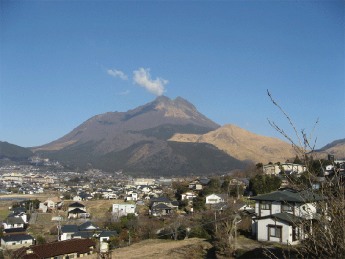
Mount Ioyama (image from blogs.yahoo.co.jp)
Satsumasendai’s Mayor Hideo Iwakiri welcomed the reopening, but said at the ensuing press conference that it would fall upon the government to ensure a repeat of the accident that damaged Fukushima, an outdated facility subject to loose oversight, is impossible.
September’s decision to initiate the return Japan’s nuclear capacity back online was taken by Prime Minister Shinzo Abe, who endorses nuclear production in the country, but has delegated the controversial call on reopening to local councils. Sendai was chosen after becoming the first plant to officially fulfill the government’s new stricter safety rules. It may also have been picked due to its geographical remoteness, and distance from the 2011 disaster area.
The primary reason for Abe’s nuclear drive been the expense in replacing the lost energy that constituted 30 percent of the country’s consumption, which the government says cost Japan an extra $35 billion last year. Japanese consumers have seen their energy bills climb by 20 percent since the disaster as a result.
But another concern remains the state of the country’s aging nuclear plants, which will cost $12 billion to upgrade. Meanwhile plans to build modern nuclear reactors – which were supposed to be responsible for half of the country’s nuclear power by 2030, according to previous government energy plans – have predictably been shelved in the wake of the disaster.
Fukushima dome removal suspended
The painfully slow and calamitous decommissioning of the Fukushima Daiichi plant, in the northeast of the country, had to be halted yet again Tuesday, after the removal of the temporary dome over the damaged Reactor 1 was interrupted by severe winds.
The canopy needs to be taken off so that the radioactive reactor rods, which have been contaminating the soil and water around the plant, can be placed in storage.
But as workers attempted to lift a section of the plastic dome to decontaminate the air inside, a segment of the cover up to six feet was blown off by a severe gust of wind.
Tokyo Electric Power Company, TEPCO, the operator of the shuttered plant, says that the incident has not impacted radiation levels, and hopes to resume operations as soon as possible.
Natural resource exploitation in the Dead Sea area – The case of Ahava
Alhaqhr | October 28, 2014
This is the first in a series of new Virtual Field Visits focusing on the topic of business and human rights. This video will highlight corporate complicity in the exploitation of natural resources in the Dead Sea area of the Occupied Palestinian Territory.
U.S. Sends Planes Armed with Depleted Uranium to Middle East
By David Swanson | War is a Crime | October 28, 2014

The U.S. Air Force says it is not halting its use of Depleted Uranium weapons, has recently sent them to the Middle East, and is prepared to use them.
A type of airplane, the A-10, deployed this month to the Middle East by the U.S. Air National Guard’s 122nd Fighter Wing, is responsible for more Depleted Uranium (DU) contamination than any other platform, according to the International Coalition to Ban Uranium Weapons (ICBUW). “Weight for weight and by number of rounds more 30mm PGU-14B ammo has been used than any other round,” said ICBUW coordinator Doug Weir, referring to ammunition used by A-10s, as compared to DU ammunition used by tanks.
Public affairs superintendent Master Sgt. Darin L. Hubble of the 122nd Fighter Wing told me that the A-10s now in the Middle East along with “300 of our finest airmen” have been sent there on a deployment planned for the past two years and have not been assigned to take part in the current fighting in Iraq or Syria, but “that could change at any moment.”
The crews will load PGU-14 depleted uranium rounds into their 30mm Gatling cannons and use them as needed, said Hubble. “If the need is to explode something — for example a tank — they will be used.”
Pentagon spokesman Mark Wright told me, “There is no prohibition against the use of Depleted Uranium rounds, and the [U.S. military] does make use of them. The use of DU in armor-piercing munitions allows enemy tanks to be more easily destroyed.”
On Thursday, several nations, including Iraq, spoke to the United Nations First Committee, against the use of Depleted Uranium and in support of studying and mitigating the damage in already contaminated areas. A non-binding resolution is expected to be voted on by the Committee this week, urging nations that have used DU to provide information on locations targeted. A number of organizations are delivering a petition to U.S. officials this week urging them not to oppose the resolution.
In 2012 a resolution on DU was supported by 155 nations and opposed by just the UK, U.S., France, and Israel. Several nations have banned DU, and in June Iraq proposed a global treaty banning it — a step also supported by the European and Latin American Parliaments.
Wright said that the U.S. military is “addressing concerns on the use of DU by investigating other types of materials for possible use in munitions, but with some mixed results. Tungsten has some limitations in its functionality in armor-piercing munitions, as well as some health concerns based on the results of animal research on some tungsten-containing alloys. Research is continuing in this area to find an alternative to DU that is more readily accepted by the public, and also performs satisfactorily in munitions.”
“I fear DU is this generation’s Agent Orange,” U.S. Congressman Jim McDermott told me. “There has been a sizable increase in childhood leukemia and birth defects in Iraq since the Gulf War and our subsequent invasion in 2003. DU munitions were used in both those conflicts. There are also grave suggestions that DU weapons have caused serious health issues for our Iraq War veterans. I seriously question the use of these weapons until the U.S. military conducts a full investigation into the effect of DU weapon residue on human beings.”
Doug Weir of ICBUW said renewed use of DU in Iraq would be “a propaganda coup for ISIS.” His and other organizations opposed to DU are guardedly watching a possible U.S. shift away from DU, which the U.S. military said it did not use in Libya in 2011. Master Sgt. Hubble of the 122nd Fighter Wing believes that was simply a tactical decision. But public pressure had been brought to bear by activists and allied nations’ parliaments, and by a UK commitment not to use DU.
DU is classed as a Group 1 Carcinogen by the World Health Organization, and evidence of health damage produced by its use is extensive. The damage is compounded, Jeena Shah at the Center for Constitutional Rights (CCR) told me, when the nation that uses DU refuses to identify locations targeted. Contamination enters soil and water. Contaminated scrap metal is used in factories or made into cooking pots or played with by children.
CCR and Iraq Veterans Against the War have filed a Freedom of Information Act Request in an attempt to learn the locations targeted in Iraq during and after the 1991 and 2003 assaults. The UK and the Netherlands have revealed targeted locations, Shah pointed out, as did NATO following DU use in the Balkans. And the United States has revealed locations it targeted with cluster munitions. So why not now?
“For years,” Shah said, “the U.S. has denied a relationship between DU and health problems in civilians and veterans. Studies of UK veterans are highly suggestive of a connection. The U.S. doesn’t want studies done.” In addition, the United States has used DU in civilian areas and identifying those locations could suggest violations of Geneva Conventions.
Iraqi doctors will be testifying on the damage done by DU before the Tom Lantos Human Rights Commission in Washington, D.C., in December.
Meanwhile, the Obama Administration said on Thursday that it will be spending $1.6 million to try to identify atrocities committed in Iraq . . . by ISIS.
‘Russian distress call’ prompting Swedish sub hunt never existed – sigint source
RT | October 28, 2014
There was no Russian distress call. That’s the opinion of a Swedish signal intelligence (SIGINT) source after a massive $2.8mn military and media sub-hunt consumed the country for a week.
Reports of a Russian distress signal and a grainy-picture were enough to deploy the navy while the media widely concluded the vessel had to be a Russian submarine spooking Stockholm.
The proof of this was an alleged comms intercept, at distress call frequency, between the supposed sub and Kaliningrad base.
But the Dagens Nyheter daily cited a Swedish Intel source who confessed there was no distress call.
Citing freedom of information requests and its own sources, the paper said Sweden’s signal intelligence agency knows nothing about the alleged distress calls, and registered no spikes in communication with Kaliningrad at the time.
“I’d be glad to read about that emergency call myself. But it didn’t happen, this information is incorrect,” the newspaper cites a source as saying.
The navy operation, which was dubbed ‘Hunt for the Reds in October’ by the Swedish media, was reminiscent of the Cold War era, when Swedish warships patrolled the Baltic Sea looking for Soviet submarines.
During the search, many recalled the infamous 1981 incident, when a Russian submarine got stranded near Karlskrona, a major naval base. The incident, which caused serious diplomatic waves, was dubbed ‘Whiskey on the Rocks’ because the S-363 sub in question belonged to the Whiskey-class.
Russia has denied sending any subs to spy on Sweden, or having one suffer an emergency in Sweden’s waters. Sources in the Russian military suggested that the fuss was caused by a sighting of a Norwegian U-boat participating in a joint NATO drill in the Baltics.
The Swedish Navy’s efforts to find the elusive foreign activity cost the country 2.2 million euros ($2.8 million), it reported last week. The operation was the biggest in decades in a nation, where military spending accounts for about 1 percent of GDP and has seen steady cuts during the years of the European economic slowdown.
According to the latest draft budget published in the wake of the naval operation, Sweden plans to increase military spending for 2015 by $93.7 million.
READ: Sweden ready to use force to surface foreign sub as search continues
Israeli mayor storms into al-Aqsa without permission
Al-Akhbar | October 28, 2014
Israeli-occupied Jerusalem’s mayor Nir Barkat forced his way on Tuesday into the al-Aqsa Mosque compound in East Jerusalem under heavy police protection, a Palestinian official said, as Israel continues to restrict the entry of Palestinian worshipers into al-Aqsa for the fifth week in a row.
“We protest this intrusion. Barakat entered the compound under the Israeli police’s protections without permission or a prior request,” Sheikh Azzam al-Khatib, head of the Jordan-run Organization for Muslim Endowments and Al-Aqsa Affairs, told Anadolu Agency.
This is the first time Barkat storms the holy site since assuming office in 2008.
“Barkat took a tour at the compound’s courtyards before leaving,” al-Khatib added.
The intrusion came one day after Palestinian Prime Minister Rami Hamdallah visited the complex.
Hamdallah’s visit came after Palestinian Authority President Mahmoud Abbas warned against Israeli plans to “divide” the holy site.
In an urgent message to the US administration on Sunday, Abbas warned that Israel’s continued provocations at the mosque complex would lead to a “wide-reaching explosion.”
Israel continues to restrict the entry of Palestinian worshipers into al-Aqsa for the fifth week in a row.
Israeli authorities have imposed restrictions on Palestinians seeking to enter the al-Aqsa Mosque compound, denying Muslim men under 40 access to the holy site while facilitating the entry of Zionist settlers of all ages.
In recent months, groups of extremist Zionist settlers – often accompanied by Israeli security forces – have repeatedly forced their way into East Jerusalem’s flashpoint al-Aqsa Mosque complex.
The frequent violations anger Palestinians and occasionally lead to violent confrontations.
For Muslims, al-Aqsa represents the world’s third holiest site.
Israel occupied East Jerusalem during the 1967 Middle East War. It later annexed the holy city in 1980, claiming it as the capital of the self-proclaimed Zionist state – a move never recognized by the international community.
In September 2000, a visit to the site by controversial Israeli leader Ariel Sharon sparked what later became known as the “Second Intifada” – a popular uprising against the Israeli occupation in which thousands of Palestinians were killed.
(Anadolu, Al-Akhbar)
Philly Cop Threatens to Beat Teen for Making Eye Contact
By Carlos Miller | PINAC | October 27, 2014
A Philadelphia cop was caught on video threatening to beat a teenager walking home from school because he had made eye contact with the officer.
“Big man, do we have a problem?” the cop asks. “Because I notice that you keep trying to make eye contact with me. Is there a problem?”
The teens’ response is inaudible.
“Okay, well keep fucking walking,” the cop says. “The next time you look me in my fucking eye, I’m gonna beat the shit out you!”
The video, uploaded to Facebook earlier this month, is only 12 seconds long, but it was enough for his department to discipline him. Or so they say.
The department didn’t go as far as providing his name to the local media who inquired about the officer, so there is a good chance he will receive a slap on the wrist, if anything.
According to NBC Philadelphia:
Police told NBC10 they were aware of the incident and the officer in the video will be disciplined for his actions. However, they also did not reveal when and where the incident occurred or what led to it.
According to a law enforcement source, the officer belongs to the 19th District.
A Philadelphia Police official, who did not want to be identified, also commented on the video.
“The video does not reflect well on the officer,” the official said. “I have no doubt he had good reason to be exasperated but you have to maintain your professional demeanor.”
It isn’t clear if the teen was giving the cop “dehumanizing stares,” which Miami-Dade police used to justify beating a teen who had been carrying a puppy on a beach last year.
Two journalists hit by Israeli rubber bullets while covering protest (VIDEO)
RT | October 28, 2014
An AP photographer and his Swiss colleague were hurt after Israeli border police fired a crowd control grenade at a group of journalists covering Palestinian protests in the West Bank.
The news agency’s Majdi Mohammed and Swiss freelance journalist Lazar Simeonov were injured during the Israeli forces’ suppression of protests, where they deployed rubber-coated bullets, stun grenades and tear gas.
The photographers were working in the West Bank town of Silwad, where Palestinians were protesting after the funeral of a 14-year-old boy, who was killed in an earlier clash with Israeli soldiers.
Mohammed told the Agency that as he was taking pictures, an armored car pulled up behind him and a border policeman stepped out and fired directly at him from a distance of 10 to 20 meters.
The officer fired a round that discharges a number of rubber-coated steel projectiles, which is basically a grenade designed to hurt small groups of people. Simeonov was injured by the same round.
“The impact was so strong that it made me fall to the ground,” Mohammed said. “The policeman aimed straight at us … even though we were clearly a group of media people and there were no protesters at all around us.”
Both journalists reported minor injuries and Simeonov’s camera was also damaged.
AP said it would lodge a protest with the Israeli government. John Daniszewski, AP’s senior managing editor for international news, said the incident showed “outrageous disregard for the safety of journalists” lawfully doing their jobs.
Israeli police spokesman, Micky Rosenfeld, said it was not immediately clear why the border patrol policeman had opened fire on the journalists. He added the police “dispersed hundreds of rioters,” some of whom threw firebombs and stones at the Israeli forces.
Featured Video

American Military Failure in Afghanistan
or go to
Aletho News Archives – Video-Images
Frlom the Archives
The Fiction of the Jewish History in Palestine
By Hasan Afif El-Hasan | The Palestine Chronicle | April 8, 2011
Prime Minister Benjamin Netanyahu told NNC Pierce Morgan on March 18, 2011 that he might agree to a Palestinian state through negotiations. And he added, “We will make territorial concessions although it is very painful to do that in our ancestral land.” Netanyahu was not talking about Poland where his ancestors lived. He was talking about Palestine where generations of its indigenous population ancestors lived, cultivated the land and are buried.
By the end of the nineteenth century, Zionism created a new Jewish identity of blood and soil. To mobilize their followers and supporters and appeal to their emotions, the Zionists created myths. Zionism started as a tribal religion without god, but in order to fulfill its function as a unifying force, Zionism required external religious and race symbols, not inner content. Its leaders regarded metaphysical religious belief and purity of race as having value in itself. They created a divine paradisiacal state of merger with the gods. Despite his non-religious ideology, Herzl’s writings were replete with religious references. The Jews should settle in Palestine because, in his words, “the Temple will be visible from long distance, for it is only our ancient faith that has kept us together”.
The Zionists and their supporters have invested tremendous financial and scholarly resources to work within the Hebrew Bible historical narratives to affirm the links between the intrusive Zionist population and the ancient Israelite past, and by doing so assert the right of that population to the land. The political end-game shaped the investigation and the outcome. Tracing the roots of Israel’s ethnic state in biblical antiquity is effectively to silence the indigenous Palestinian claim to the past and therefore to the land. The Biblical scholarship employs a bewildering array of terms for the region: “the Holy Land”, “the Land of the Bible”, “Eretz Israel”, “the Land of Israel”, or “Judah and Samaria.” To the casual reader these names appear interchangeable, but they all imply connection to ancient Israel.
Biblical narratives or poems that cannot be supported by archeology and common sense are treated by the Zionists and their supporters as historical language. … continue
Blog Roll
 Aletho News
- Hezbollah Returns: It Didn’t Start a War, It Is Ending One
- EU states seek ‘talks’ with Iran for access to Strait of Hormuz: Report
- Trump on Hormuz: “Others must take care of it” after US falters
- Who Is closer to collapse?
- A War that Backfired: Why the US-Israeli Campaign Is Strengthening Iran
- How Zionist Control Is Hurting US Interests
- Iran warns it may target US missile launch sites in UAE cities
- American Military Failure in Afghanistan
- Friendly Skies of Georgia: Are Israeli-Linked Drones Launching False Flags from Georgian Territory?
- The Three Big Lies about Mammography Screening
- If Americans Knew
- No let-up in attacks on Gaza as Israel takes on Iran, Lebanon – Not a ceasefire Day 155
- ‘Of Course’: IDF Drops Case Against Soldiers Accused of Raping Palestinian Prisoner
- Don’t Fall for the Regime Change Talk. Israel Is ‘Mowing the Lawn’ in Iran
- Will Israel and the US wreck the Gulf States along with Iran?
- US so far burned through ‘years’ of munitions in Iran war: Report
- How the Israeli Tail Wags the American Dog
- Outdated intel likely led to deadly U.S. strike on Iranian elementary school, sources say
- Pentagon insider says high U.S official Douglas Feith reported to Netanyahu
- In fond memory of Walid Khalidi, the historian of Palestine
- 6 more Americans killed, as Israel ‘mows the lawn’ in Iran – Not a ceasefire Day 154
- No Tricks Zone
- Storing Green Energy To Last Germany 10 Days Would Require A 60-Million Tonne Battery
- New Studies: UK Sea Levels Were 4 Meters Higher Than Today During The Mid-Holocene
- Destructive Green New Deal: German Energy And Metal Group Warns Of Drastic Crisis
- New Study Documents A 20-Year Pause In Arctic Sea Ice Decline – Driven By Internal Variability
- Wake-up Call: Survey Shows Majority Of Germans Now Favor Postponing Climate Targets!
- Televised! Leading German Political Candidate Tells Schoolchildren CO2 Makes Sun Hotter!
- New Study: A Century Warming Of 1.1°C Is ‘Commonplace’ And ‘Not Unusual’ During This Interglacial
- New Study: ‘Internal Noise’ And Volcanic Forcing Can Trigger 10-15°C Warming Within Decades
- Glaciers Worldwide Are Suddendly Surging, Experts Blame Warming!
- Surprising Discovery: Sahara Is Greening…Billions Of Trees Where Once Thought To Be Barren
 Aletho News