America stumbles through another year, spreading chaos and trivia everywhere in its path
By John Chuckman | Aletho News | December 30, 2014
The Palestinians are seeking a vote in the United Nations’ Security Council on a resolution favoring their statehood, unquestionably a reasonable proposal in the minds of most of the world’s people. Of course, the United States, a permanent member of the Security Council, would automatically veto such a resolution, as it vetoes all efforts to restore order to the chaos of the Middle East. And of course, were such a resolution somehow miraculously to pass, Israel would simply ignore it, as it has ignored a long list of binding UN resolutions. But a veto and certain contempt are not enough for an upright, God-fearing Southern gentleman like US Senator Lindsey Graham. He busied himself recently with threatening America’s withholding funds from a United Nations that gets involved in the “peace process.” Imagine, the United Nations getting involved in peace? That is a chilling thought. Since the United States has a history of withholding its UN dues against its solemn treaty obligations to bully its way to certain changes, such threats do carry weight.
Senator Graham, regarded neither as an idealist nor a voice for peace, is only doing what so many American politicians do under the unbelievably corrupt, money-drenched American election system, and that is to make ridiculous public statements about the Middle East in return for generous dollops of campaign funds from the world’s most tireless political lobby, that for Israel. You might think that the lobby itself would tire of funding backwater blowhards demanding the other ninety-five percent of humanity play the game by America’s rules or America is picking up its marbles or chips or whatever and going home, but clearly it does not.
“The peace process” is the longest running farce on the planet, continuing for nearly fifty years. It might have been funny in the vein of The Mouse That Roared, but there is nothing remotely funny in the killing of thousands of people and the extreme abuse and hopelessness of millions. You just could not make a worse hash of a diplomatic and human welfare situation than America has made in the Middle East. And the situation has only intensified in its cruelty and injustice. Today, Israel openly and regularly steals homes in East Jerusalem and the West Bank. It threatens ancient Muslim shrines and desecrates some of them. It has savaged Gaza, the world’s largest open-air prison camp, twice, killing close to four thousand including nearly a thousand children. It has attempted to starve Gaza’s people out with a years-long embargo, and is making ugly noises about still another invasion. It is about to steal Syrian oil on the occupied Golan Heights, drilling there illegally, and it is busy arranging the theft of offshore natural gas that belongs to Gaza and Lebanon. It does all of this with complete impunity and not even a cross word from the likes of Senator Graham. I do think the Middle East provides the strongest possible evidence of the complete unsuitability of the United States to play a dominant role in international affairs. It is genuinely a case of the inmates running the asylum.
In another example of chaos mixed with farce, the United States pretends to fight ISIS in Iraq and Syria, and while that charade continues, planes loaded with American weapons keep flying out of Turkey to make the seeming lunatics even stronger. Indeed, the various ragtag factions trying to overthrow the Syrian government, cutthroats assembled by the US and its friends from all corners of the globe in a kind of hellish foreign legion, announced a new alliance, so telling Washington’s approved terrorists in the conflict from those who haven’t made the cut is more difficult than ever. Recently, one or another of the lunatic mobs shot down two fighter jets, and how do you think they managed that without American anti-aircraft missiles? Turkey’s certifiably unbalanced president, Tayyip Erdoğan, one day makes fiery speeches threatening Israel (to please the poor fools voting for him) and the next makes new secret deals with Israel. Remember, this is a man who just built a one-thousand room palace for himself – yes, that’s right, exactly one thousand rooms – and it is the ugliest, most pointless large structure built since the early Soviet era, a kind of gigantic sprawling warehouse incrusted with jewels and filled with porcelain.
Well, dippiness is no barrier to membership in a secret club in the region which includes the UAE, Saudia Arabia, and Israel, all lovingly assisted by the US. They are all governments who regard change as desirable only when it results in an even more rigid status quo, as in Egypt. Never mind the welfare of the region’s people or democracy or human rights or national boundaries. These guys resemble twelfth century lords seeing paupers cross their paths: they run them down and proceed to a rollicking good dinner in the great hall. The club is all about security for hereditary monarchs, security for America’s crusader fortress colony in the Middle East, and security for helper states in the American agenda. We’ve had many reports recently of secret air-freight flights between Tel Aviv and Abu Dhabi. We also have reports of flights out of Turkey into Syria. The never explained events at Benghazi were undoubtedly blowback from an operation collecting unemployed thugs and arms for secret shipment to Turkey and then into Syria. Saudi Arabia is voluntarily taking a bath by pushing oil prices down, a favor to the US and Israel and Turkey and a way of hurting Russia, Iran, Syria, and even Venezuela – all current members in good standing of Captain America’s ever-changing galaxy of villains – aka, the Axis of Evil. The US is willing to sacrifice for the time being its booming shale oil industry, whose more costly production requires higher prices than Saudi conventional crude, in return for the Saudi sacrifice.
Since both countries are desperate to hurt Russia, Iran, and Syria, the deal is a marriage made in Realpolitik heaven. Russia has helped Syria and does business with Iran, while Saudi Arabia and Israel hate Iran and Syria. The US has made a large investment in toppling Syria for Israel’s benefit, but the plan has been thwarted by Syrian endurance and Russian help. The plan also overlooked the loyalty of important Syrian societal groups to President Assad, but America often overlooks details as it attempts to reshape the world to its liking with bombs. Of course, there was also the precedent of Iraq, a bloody fiasco that achieved nothing but a million deaths and splintering a country into pieces. That splintering, by the way, continues with the ISIS fiasco: Iraq’s Kurds are being used against ISIS to strengthen their own region’s quasi-independence from Iraq.
The chaos the secret club-member countries have created in Syria – perhaps 200,000 killed and a couple of million refugees – appears not to bother them in the least, just so many paupers in the roadway when galloping home to dinner at the great hall. The victims do provide useful free material for the propaganda war being waged, the understanding implicit in America’s and Canada’s and Europe’s press being always that President Assad is responsible for the catastrophe. The US, and cheerleaders on the sidelines like Canada’s current dismal right-wing government, are doing virtually nothing for the refugees, or for the many civilians crippled or wounded. Ironically, Israel actually accepts for treatment in its northern medical facilities some of the very fanatics wounded in the dirty work. After all, it is ultimately Israel’s dirty work they do, regardless of their fanaticism. It’s a phenomenon we might call selective terrorism: fanatical killers who do America’s work, or Israel’s, are not treated as terrorists at all. No matter how many women and children you kill, no matter how many places you bomb, you only become a terrorist if you oppose the interests of America or Israel.
The toll in killed and wounded and homeless in Eastern Ukraine continues to mount. New punitive measures come regularly from Kiev, undoubtedly with American advice about possible vulnerabilities – after all, a top cabinet minister in the coup-created government is American. Only the other day we read reports of Ukrainian militia-types, the kind of right-wing thugs who helped the US overthrow an elected government in Kiev, blocking food traffic into the East. Attempting to starve people into submission is defined in international law as a war crime, but we hear no word of concern from America, just as we heard no word of concern for Israel’s original blockade of Gaza which actually included a calculated level of calories intended to just keep the population alive (since modified under intense secret international pressure).
In all these induced chaotic situations, we hear little or nothing from the UN, an institution which should be among the first condemning aggressive behavior. But the UN, despite the many differing private views of its members, is now in all official capacities under the thumb of the US. Its current Secretary-General, Ban Ki-moon, a candidate favored by America, is ineffectual and behaves at times almost as though he headed an organization having nothing to do with peace or human rights.
Well, there is some intimidating history. Boutros Boutros-Ghali was the only UN secretary-general not to be elected to a second term in office, and the reason was an American plan to be rid of him, one of Madeleine Albright’s glorious career achievements. America vetoed his second term because it was most unhappy when he did not embrace the bombing of Bosnia, and they disliked other of his views which tended to be thoughtful and compassionate. Earlier, Secretary-General Dag Hammarskjöld, a much admired man, was assassinated in an engineered plane crash, said to have been the work of Belgian mining companies unhappy with the UN’s policies in Congo, a place the mining companies had drained of wealth for decades of brutal exploitation, but I think it unlikely anything of that nature happened without at least a nod of approval from Washington, which after all was a major customer for the products of Congo.
The evidence is piling up, despite delays and many irregularities in the official investigation into the crash of airline Flight MH-17 in Ukraine, that a Ukrainian pilot deliberately shot the plane down. His fighter jet is said to have been armed with air-to-air missiles on take-off, something completely out-of-the-ordinary in the conflict since Eastern Ukrainians have no air force. It returned, according to an eye-witness, with no missiles and the pilot muttering cryptic phrases. Of course, this would be the kind of act you might expect from people who used sniper rifles earlier this year to kill many hundreds of civilians in Maidan, the central square of Kiev, in order to terrorize the population and start the coup. But where is America’s voice in these grotesque doings? As Russia has patiently pointed out, an American spy satellite was virtually overhead at the time of the crash, so definitive evidence exists without a doubt but is not produced. But then neither is it produced for the destruction of Flight MH-370 in the Indian Ocean, an event it is virtually certain was the work of American forces at the secret Diego Garcia base as the plane came their way for whatever unknown reason.
The irregularities around Flight MH-17’s investigation include Malaysia, owners of the airline, being excluded from the group conducting the investigation and include the fact that segments of the wreckage were left behind at the crash site, and that after taking a very long time to get there in the first place, making manipulation of forensic evidence possible and even likely. We also have the absence of any American satellite or radar records, and we have not a word about the autopsy on the pilot, something which might solve the entire mystery, as from the discovery of Ukrainian missile fragments in his body.
What kind of world do we want to live in? One where coups and civil wars are engineered for the pleasure of others? One where airliners full of people are shot down deliberately? This is the chaos, and just part of it, America has bestowed upon us in the twenty-first century. I won’t even go into the financial tsunami it created in 2008 with the same lack of caution for others and concern about doing things correctly. The full impact of that has yet to strike us all.
But America brings laughable trivia, too. The President of the United States spending time and breath on the hacking of a private company’s web site? A Japanese company, no less? And turning the relatively trivial business of hacking, which happens every day now somewhere, into an international incident by blaming, almost certainly incorrectly, North Korea?
The President said the FBI had investigated and assured him that North Korea was responsible. What he didn’t tell us was that the FBI has a decades-long record of being wrong, seriously wrong, a great deal of the time. Given the FBI’s history, it certainly is in the running for the title of Most Incompetent Security Organization in the Western World, although, like other national security institutions in the United States, it is grossly over-funded with money gushing out like water from broken plumbing. Americans pay more per unit of misinformation than likely any other people on the planet.
Anyone familiar with the record of the FBI listens to assurances like the President’s with a sarcastic smile at best (see FOOTNOTE for a partial list of the FBI’s viciousness and incompetence over the years). Shortly after the president’s silly words, we had several world-class tech experts tell us why it could not have been North Korea, and I’ll take bets against the FBI on this one from anyone.
It likely was someone at Sony doing a publicity stunt to promote what by all reports is a dud of a film, but why should the man with the biggest job in the world join in? Consider also the fact that if you make what can be viewed as a threatening comment or presentation of any kind against the President of the United States, you will be visited and interviewed by the Secret Service, who will then keep you on file permanently. Why is it okay to make a movie about the assassination of North Korea’s president then, the subject of The Interview ? Sony certainly has a right to do stupidly foolish things, but it is more than a little muddled for the President, eagerly, to support it. Will he now address the rights of porn actors in California to work without condoms?
As I write this, a British newspaper reports that some Sony employees have been quietly dismissed. Reported also is the discovery of a web site strongly suggesting disgruntled employees. See what I mean about America overlooking the facts before it acts?
FOOTNOTE ON HOW WRONG AND DISHONEST THE FBI HAS BEEN: The FBI was wrong in claiming there was no such thing as the Mafia, something J. Edgar Hoover insisted for many years while he gambled at their racetracks and stayed at their resorts for free, some biographers believing Hoover had been compromised by the Mafia with photos of his secret gay, cross-dressing life. The FBI was wrong in focusing huge resources for many years on the pathetic American Communist Party, half of whose small membership is said to have consisted of FBI agents. The FBI was wrong about the threat of Albert Einstein, seeking his extradition for a time and checking the contents of his garbage to his dying day. The FBI was wrong about the danger of Dr. Martin Luther King, and it played judge and jury with his personal life. The FBI was wrong about Dr. Wen Ho Lee of Los Alamos being a spy, although it ruined his career. The FBI was wrong about the crash of TWA Flight 800, taking an inordinate amount of time trying to let public interest cool and avoid the obvious fact that the crash was an accidental shoot-down by the American military, there being a radar track showing something like a missile rising towards the plane. Despite its vast resources, the FBI never saw 9/11 coming. One of its own senior agents, Robert Hanssen, was one of the more damaging spies of modern times, a man whose carelessness in many details, classic indicators of a paid spy, went unnoticed for years. The FBI was wrong in the Atlanta Olympic bombing, ruining the life of another innocent man. It couldn’t have been more wrong in its handling of the sad kooks at Waco, effectively murdering them all. So, too, at the Ruby Ridge standoff where an FBI sniper killed a woman and her child needlessly. The FBI Crime Labs were cited in the 1990s by the Inspector General for misconduct and manipulating evidence, something many had suspected for years. The FBI specialized for years in hurting the reputations of those it didn’t like or those it merely suspected, as by asking questions at their place of work and neighborhood, not have any proof of wrong-doing. The FBI, at least under J. Edgar Hoover, held career-threatening information obtained by spying over the heads of many prominent congressmen and government leaders, effectively blackmailing them to do its bidding. It did the same with non-government officials where it felt so inclined. The FBI was wrong about the assassination of President Kennedy, it being the only investigative agency for the lamentable, embarrassing Warren Commission, thereby assuming at least equal responsibility for its inaccurate, dishonest report. Indeed, the FBI did not reveal at the time that Oswald secretly worked for them as a paid informant (since documented). It also lied about evidence a senior FBI agent destroyed after the assassination, a note Oswald had written.
Gaza, Syria, militarized cops, and ‘lone-wolf’ shootings: during a brutal year, 9/11 truth held its own

The people of Gaza experienced real terrorism during a siege that left 2,100 dead
By Craig McKee | Truth and Shadows | December 30, 2014
Gaza, ISIS, Syria, Ukraine, Ferguson, militarized cops, Malaysian planes, torture, drones, and “lone-wolf” shootings. It has been a tough year for the truth.
But in the midst of all the deception and brutality, it has been an intriguing year for the struggle to expose the lies of 9/11. The elusive breakthrough that 9/11 truthers fantasize about may not be coming any time soon, but there are encouraging signs on a number of fronts. There were also some disappointments, but even those don’t seem so bad if you subscribe to the idea that there’s no such thing as bad publicity.
A major highlight was the spectacular sight of an 89-foot wide electronic billboard in New York City’s Times Square repeatedly showing the destruction of WTC 7 throughout the month of September. An estimated two million New Yorkers saw the message. Who would have thought something like that would ever happen? This latest project was the initiative of Rethink 9/11 and Architects and Engineers for 9/11 Truth, which were responsible for billboards in major cities around the world last year.
At the beginning of December we had the presentation of a petition asking the Canadian government to conduct a Parliamentary review of the evidence of 9/11. For years, no politician was willing to touch this subject or this petition in Canada until Green Party leader Elizabeth May agreed to present it to Parliament. Of course the likelihood of Parliament reviewing the evidence is about as good as Congress doing so in the U.S. But anything is positive that gets 9/11 into the news and lets people know that the movement continues to fight.
Unfortunately, May chose to tell the mainstream media that she only presented the petition because Parliamentary rules obligated her to do so. They don’t. She also said she doesn’t agree with the petition, which was regrettable but predictable. Any politician who shows any openness about 9/11 is going to get roasted in the media, and she was. But at least May was willing to take some political risk. Following up on the petition effort, AE911Truth has commissioned a poll of Canadians, asking them their views about 9/11.
Speaking of media, the High-Rise Safety Initiative launched by the New York Coalition for Accountability Now got 9/11 into the news even though it ultimately did not succeed in getting the initiative on to the New York City ballot. The goal was to force a change to the city charter obligating the Department of Buildings to investigate any building collapses going back to Sept. 11, 2001 (including Building 7 but not the twin towers).
The money was raised and the signatures were collected. It was quite an effort. But the courts did what they always do, dashing hopes for the time being. I know many truthers are quick to say that no official investigation will ever get to the truth of 9/11 – and that’s probably true – but the publicity the effort would produce would be worth it. Mayor Bill De Blasio calling the initiative “inappropriate after all the suffering that went on 9/11,” got the subject some welcome mainstream coverage.
The most hostile – and incoherent – attack on 9/11 truth occurred after AE9/11Truth distributed information pamphlets at the opening of the 9/11 Memorial and Museum at Ground Zero. The hook was that the pamphlets used the same design to offer an alternative view of what happened on 9/11. CNN’s Jake Tapper and his guest, Slate editor Emily Bazelon combined on a five-minute piece that made the usual gibberish about conspiracy theories seem intelligent.
My favorite quote from Bazelon: “You see these dark corners of the Internet where people pile on, and there’s this minute parsing of the technicalities of the supposed evidence, and more and more detail gets added and accumulated, and it kind of feeds on itself.”
Don’t you hate it when conspiracy theorists parse evidence and examine details?
Then there was the vicious maligning of Richard Gage and all truthers as being anti-Semitic hate mongers by the Canadian “news” network, Sun News. This came in an interview of Gage done by right wing hack Michael Coren in Toronto. I filed two complaints against Coren with the Canadian Broadcast Standards Council and waited more than six months for a decision from their adjudicating panel. I got an email from the national chair of the Council, Andrée Noel, saying that the complaint did not deal with anything that hadn’t been ruled on in the past, and that she had dismissed both complaints without giving them a hearing.
In an interview, Noel said that Coren’s accusation that Gage was a hate monger was “not unduly aggressive.” Riiiight. The only recourse left is to refer the complaint to the Canadian Radio and Telecommunications Commission (CRTC). My expectations for that are not high.
The year produced some excellent research material relating to 9/11 in the form of books, films, and art. Graeme MacQueen published an important book, The 2001 Anthrax Deception: The Case for a Domestic Conspiracy, which explains the failure of the anthrax false flag and reveals how 9/11 was its twin false flag. This excellent book was the subject of a review on Truth and Shadows by Barrie Zwicker.
David Hooper also released his personal documentary The Anatomy of a Great Deception, which chronicles his awakening about 9/11 as well as offering an excellent overview of the evidence that the official story of what happened at the World Trade Center is false.
The most pleasantly unexpected bit of news was that a wonderful piece of 9/11 truth art was (inexplicably) accepted into the private collection of the “official” 9/11 Museum. And the best part is that the artist, Anthony Freda, is a prominent illustrator who works with mainstream media like the New York Times and Rolling Stone, but who is also an articulate voice on behalf of 9/11 truth. The donation of the art will also be featured in an upcoming documentary called Behind Truth Art by John Massaria.
The bigger picture in 2014
While progress on the 9/11 front was encouraging but slow, world events were neither and seemed to be filled with ever more contrived chaos, deception and violence. The supposed “war on terror” – which was truly launched by the 9/11 false flag deception – played out in the CIA-backed assault on Syria, and the appearance of ISIS, the latest Muslim “threat.” The convenient and implausibly sudden emergence of this well-funded and outfitted band of “extremists” has provided the West with all the excuse it needs to bomb Iraq and Syria. There were highly suspicious videos of beheadings and a highly unbelievable back story to explain ISIS, the latest excuse for more military action in the Middle East and the stripping away of more civil liberties at home.
The U.S. Senate torture report got lots of press in 2014, but of course that’s because it serves the illusion that terrorists are truly a genuine threat, and the most important issue is how we deal with them.
On the domestic front, there was the police state crackdown on protests in Ferguson, Missouri after a cop shot unarmed black 18-year-old Michael Brown. Not only did this focus attention on the targeting of blacks for police violence, but also on the militarization of police forces across America – a process that has been ongoing for two decades.
We’re being conditioned to accept police in military gear as being standard and normal. In the U.S., 2014 was a truly disturbing year during which a shocking number of individuals were killed by police, often for minor infractions or no infractions at all. The most visible of those was the choking of Eric Garner as he was held down by five New York City police officers. Finally, we had the killing of two NYPD cops, seemingly in retaliation for police violence.
And the number of “lone wolf” shootings (in some cases labelled terrorist attacks) continued to increase in 2014. While the media automatically accepted all of these as being authentic and focused on the emotional and sensational aspects of each, many alternative voices seriously questioned whether some of the shootings were either staged or perpetrated by organized entities rather than crazed extremists or disturbed loners.
We had the killings of two soldiers in Canada in October. There was the Santa Barbara shooting, the Portland shooting, the Las Vegas shooting, the LAX shooting, the Seattle shooting, the Vancouver shooting, the Moncton shooting, and finally the Sydney hostage taking and shooting.
In the case of the LAX event, a drill had been practised three weeks before using “the exact same scenario,” according to an LAPD spokesman. We learned that in the few weeks before the Canadian one-two punch, authorities had carried out an exercise simulating a terrorist attack in Quebec followed by one in a large Canadian city – exactly what happened. We found out that police in Melbourne, Australia had practised their response to a hostage taking in a cafe just six weeks before the real thing happened in Sydney. They had also held a drill a year before in Martin Square where the hostage taking would play itself out 12 months later.
With all this, the story that affected me more than any other was Israel’s brutal siege against Gaza, leaving 2,100 Palestinians dead, tens of thousands homeless, and turned large parts of the city to rubble. And while this human catastrophe was going on the Israeli government and its apologists in the U.S., Canada, and elsewhere were making the Orwellian claim that Israel was the victim, that Hamas was the aggressor, and that it was the Palestinians’ own fault for electing them.
Who Was Behind the Cyberattack on Sony?
By GREGORY ELICH | CounterPunch | December 30, 2014
The cyberattack on Sony Pictures unleashed a torrent of alarmist media reports, evoking the image of North Korean perfidy. Within a month, the FBI issued a statement declaring the North Korean government “responsible for these actions.” Amid the media frenzy, several senators and congresspersons called for tough action. Arizona Senator John McCain blustered, “It’s a new form of warfare that we’re involved in, and we need to react and react vigorously.” President Barack Obama announced his administration planned to review the possibility of placing North Korea on the list of states sponsoring terrorism, a move that would further tighten the already harsh sanctions on North Korea. “They caused a lot of damage, and we will respond,” Obama warned darkly. “We will respond proportionally, and we’ll respond in a place and time and manner that we choose.”
In the rush to judgment, few were asking for evidence, and none was provided. Computer security analysts, however, were vocal in their skepticism.
In its statement, the FBI offered only a few comments to back its attribution of North Korean responsibility. “Technical analysis of the data deletion malware used in the attack revealed links to other malware that the FBI knows North Korean actors previously developed,” it reported, including “similarities in specific lines of code, encryption algorithms, data deletion methods, and compromised networks.” The FBI went on to mention that the IP addresses used in the Sony hack were associated with “known North Korean infrastructure.” Tools used in the attack “have similarities to a cyberattack in March of last year against South Korean banks and media outlets, which was carried out by North Korea.”
The major problem with the evidence offered by the FBI is that it is self-referential, all of it pointing back to the 2013 attack on South Korean banks and media that was carried out by the DarkSeoul gang. At that time, without supplying any supporting evidence, the United States accused North Korea of being behind DarkSeoul. In effect, the FBI argues that because the U.S. spread the rumor of North Korean involvement in the earlier attack, and some of the code is related, this proves that North Korea is also responsible for the Sony hack. One rumor points to another rumor as ‘proof,’ rendering the argument meaningless.
The logical fallacies are many. To date, no investigation has uncovered the identity of DarkSeoul, and nothing is known about the group. The linking of DarkSeoul to North Korea is purely speculative. “One point that can’t be said enough,” emphasizes Risk Based Security, “is that ‘attribution is hard’ given the nature of computer intrusions and how hard it is to ultimately trace an attack back to a given individual or group. Past attacks on Sony have not been solved, even years later. The idea that a mere two weeks into the investigation and there is positive attribution, enough to call this an act of war, seems dangerous and questionable.”
Consider some of the other flaws in the FBI’s statement. The IP addresses that were hard-coded in the malware used in the Sony hack belonged to servers located in Thailand, Poland, Italy, Bolivia, Singapore, Cypress, and the United States. The FBI implies that only the Democratic People’s Republic of Korea (DPRK – the formal name for North Korea) could have used these servers. The Thai port is a proxy that is commonly used in sending spam and malware. The same is true of the Polish and Italian servers. All of the servers used in the Sony attack have been previously compromised and are among the many computers that are widely known and used by hackers and spam distributors. Anyone with the knowhow can use them.
Whether or not these machines were used is another matter. Hackers often use proxy machines with phony IP addresses to mislead investigators. No hackers use their own computers to launch an attack. Vulnerable systems are hijacked in order to route traffic. For the FBI to point to IP addresses either reveals a fundamental misunderstanding of cybersecurity or a cynical attempt to deliberately mislead the public.
The Sony hack also bears similarities with the 2012 Shamoon cyberattack on computers belonging to Saudi Aramco. Those responsible for that attack have never been identified either, although the United States accused Iran without providing any evidence. Using the FBI’s logic, one could just as easily argue that the Sony hack was the work of Iran. One groundless accusation is used to buttress another. As evidentiary matter, it is worthless. It should also be recalled that in 1998, the United States blamed Iraq for the Solar Sunrise hack into Defense Department computers, only for it be ultimately revealed that it was the act of a few teenagers.
Nor do the similarities in code between the Sony hack and the earlier Shamoon and DarkSeoul attacks indicate a shared responsibility. Malware is freely available on the black market. Hackers operate by purchasing or borrowing, and then tweaking commonly available software, including both illegal and legal components. Code is shared among hackers on forums, and malware is assembled by linking various elements together.
One of the components used in the Sony cyberattack was the RawDisk library from EldoS, a commercial application that allows direct access to Windows hardware bypassing security. Anyone can legally purchase this software. There is nothing to tie it to the DPRK.
“There’s a lot of malware that’s shared between different groups, and all malware is built on top of older malware,” reports Brian Martin of Risk Based Security. “They’re also built on top of hacking tools. For example, you’ll find lots of malware that uses pieces of code from popular tools like Nmap. Does that mean that the guy who wrote Nmap is a malware author? No. Does it mean he works for North Korea? No.”
Robert Graham of Errata Security regards the evidence offered by the FBI as “complete nonsense. It sounds like they’ve decided on a conclusion and are trying to make the evidence fit.” Graham adds: “There is nothing unique in the software. We know that hackers share malware on forums. Every hacker in the world has all the source code available.”
Trojan-Destover, the malware used in the Sony cyberattack, included at least six components utilized earlier by Shamoon and DarkSeoul. “Even in such damaging scenarios, the cyber attacker’s tools are reused,” points out Sariel Moshe of CyActive. “For them, if it worked once, tweak it a bit and it will work again. The attack on Sony demonstrates quite clearly that this method works quite well.” Indeed, while Shamoon and DarkSeoul are the most commonly mentioned predecessors to the Sony hack, it is thought that this software has been used on several occasions in the past against multiple targets.
The software utilized in the Sony cyberattack is atypical for a nation state. “It’s a night and day difference in quality,” says Craig Williams of Cisco’s Talos Security Intelligence and Research Group. “The code is simplistic, not very complex, and not very obfuscated.”
Four files used in the attack were compiled on a machine set to the Korean language. That fact proves nothing, notes computer security analyst Chris Davis. “That is pretty weak evidence. I could compile malware code that used Afrikaans and where the timestamp matched JoBerg in about five seconds.” Any reasonably competent hacker would change the language setting in order to misdirect investigators. Had North Korean conducted this attack, it certainly would have taken the basic step of changing the language setting on the machine used to compile code.
What about North Korean resentment over Sony Picture’s tasteless lowbrow comedy, The Interview, which portrays the assassination of DPRK leader Kim Jong-un? It is doubtful that Americans would find themselves any more amused by a foreign comedy on the subject of killing a U.S. president than the North Koreans are by The Interview.
Among the emails leaked by the cyberattack on Sony was a message from Bruce Bennett of the Rand Corporation. Bennett was a consultant on the film and opposed toning down the film’s ending. “I have been clear that the assassination of Kim Jong-un is the most likely path to a collapse of the North Korean government,” he wrote, adding that DVD leaks of the film into North Korea “will start some real thinking.” In another message, Sony CEO Michael Lynton responded: “Bruce – Spoke to someone very senior in State (confidentially). He agreed with everything you have been saying. Everything.” Lynton was also communicating with Robert King, U.S. Special Envoy for North Korean Human Rights Issues in regard to the film.
The Western media portray North Korean reaction to The Interview as overly sensitive and irrational, while U.S. officials and a Rand Corporation consultant saw the film as having the potential to inspire the real-life assassination of Kim Jong-un. The scene of Kim’s assassination was not intended merely for so-called ‘entertainment.’
The mass media raced to attribute the Sony hack to the DPRK, based on its reaction to the Sony film. A closer look at the cyberattack reveals a more likely culprit, however. The group taking responsibility for the hack calls itself ‘Guardians of Peace’, and in one of the malware files the alternate name of ‘God’sApstls’ is also used. In the initial attack, no reference was made to the film, nor was it mentioned in subsequent emails the attackers sent to Sony. Instead, the hackers attempted to extort money: “Monetary compensation we want. Pay the damage, or Sony Pictures will be bombarded as whole.”
In an interview with CSO Online, a person represented as belonging to Guardians of Peace said the group is “an international organization…not under the direction of any state,” and included members from several nations. “Our aim is not at the film The Interview as Sony Pictures suggests,” the hacker wrote, but mentioned that the release of a film that had the potential of threatening peace was an example of the “greed of Sony Pictures.”
For two weeks following the cyberattack, the media harped on the subject of North Korean culpability. Only after that point did the Guardians of Peace (GOP) make its first public reference to The Interview, denying any connection with the DPRK. Yet another week passed before the GOP denounced the movie and threatened to attack theaters showing the film.
It appears that the narrative of North Korean involvement repeated ad nauseam by the media and the U.S. government presented a gift to the hackers too tempting to pass up. The GOP played to the dominant theme and succeeded in solidifying the tendency to blame the DPRK, with the effect of ensuring that no investigation would pursue the group.
For its part, the Obama Administration chose to seize the opportunity to bolster its anti-North Korea policy in preference over tracking down the culprits.
There are strong indications that the cyberattack involved one or more disgruntled Sony employees or ex-employees, probably working together with experienced hackers. The malware used against Sony had been modified to include hard-coded file paths and server names. System administrator user names and passwords were also hard-coded. Only someone having full access with system administrator privileges to Sony’s computer network could have obtained this information.
The GOP could have hacked into the Sony system months beforehand in order to gather that data. But it is more likely that someone with knowledge of Sony’s network configuration provided the information. Arguing against the possibility that critical information had been siphoned beforehand through a hack, cybersecurity expert Hemanshu Nigam observes, “If terabytes of data left the Sony networks, their network detection systems would have noticed easily. It would also take months for a hacker to figure out the topography of the Sony networks to know where critical assets are stored and to have access to the decryption keys needed to open up the screeners that have been leaked.”
The most likely motivation for the attack was revenge on the part of current or former Sony employees. “My money is on a disgruntled (possibly ex) employee of Sony,” Marc Rogers of CloudFlare wrote. “Whoever did this is in it for the revenge. The info and access they had could have easily been used to cash out, yet, instead, they are making every effort to burn Sony down. Just think what they could have done with passwords to all of Sony’s financial accounts.”
Nation states never conduct such noisy hacking operations. Their goal is to quietly infiltrate a system and obtain information without detection. Sony had no data that would have been of interest to a nation state. Computer security blogger The Grugq wrote, “I can’t see the DPRK putting this sort of valuable resource onto what is essentially a petty attack against a company that has no strategic value.”
It would have been reckless for a North Korean team to draw attention to itself. Cybersecurity specialist Chris Davis says, “All the activity that was reported screams Script Kiddie to me. Not advanced state-sponsored attack.” Davis adds, “Well, the stupid skeleton pic they splashed on all the screens on the workstations inside Sony…is not something a state-sponsored attack would do…Would ANY self-respecting state-sponsored actor use something as dumb as that?” The consensus among cybersecurity experts is clear, Davis argues. “The prevalent theory I am seeing in the closed security mailing lists is an internet group of laid off Sony employees.”
Following his cybersecurity firm’s investigation, Kurt Stammberger of Norse echoes that view. “Sony was not just hacked. This is a company that was essentially nuked from the inside. We are very confident that this was not an attack master-minded by North Korea and that insiders were key to the implementation of one of the most devastating attacks in history.”
“What is striking here is how well they knew to exploit Sony’s vulnerabilities,” reports Nimrod Kozlovski of JVP Labs. “The malware itself is not creative or new; there are plenty of actors that could have manifested this particular attack.” The hackers “knew more about the company, Sony, and its vulnerabilities than they knew, or needed to know, about hacking.”
As an indication of the hacker’s real motivation, it should be noted that the first communications focused on a different issue than the Sony film. The content of an email sent by the GOP to the IDG News Service refers to Sony’s restructuring, in which thousands of employees lost their jobs: “Sony and Sony Pictures have made terrible racial discrimination and human rights violation, indiscriminate tyranny and restructuring in recent years. It has brought damage to a lot of people, some of whom are among us. Nowadays, Sony Pictures is about to prey on the weak with a plan of another indiscriminate restructuring for their own benefits. This became a decisive motive for our action.” In an email to The Verge, the GOP wrote, “We want equality. Sony doesn’t… We worked with other staff with similar interests to get in.”
Seeking to diffuse tensions, North Korea proposed to conduct a joint investigation with the United States into the Sony cyberattack. Predictably, the United States quickly rebuffed the offer. National Security Council spokesman Mark Stroh arrogantly responded, “If the North Korean government wants to help, they can admit their culpability and compensate Sony for the damages this attack caused.” North Korea can hardly be expected to accept blame for an act it did not commit. But getting to the truth of the matter was the farthest thing from the Obama Administration’s mind. Similarly, U.S. officials are ignoring requests from cybersecurity experts to be allowed to analyze the Destover code. “They’re worried we’ll prove them wrong,” Robert Graham concludes.
The Obama Administration’s outrage over the Sony attack contains more than a small measure of hypocrisy. It was the United States that launched the Stuxnet attack that destroyed many of Iran’s nuclear centrifuges. According to a Washington Post article published in 2013, the United States conducted 231 cyber operations throughout the world two years before. The National Security Agency, as is now well known, regularly hacks into computer networks, scooping up vast amounts of data. The GENIE program, the Post reported, was projected to have broken into and installed implants in 85,000 computers by the end of 2013. It was reported that GENIE’s next phase would implement an automated system that could install “potentially millions of implants” for gathering data “and active attack.” According to former deputy of defense secretary William J. Lynn III, “The policy debate has moved so that offensive options are more prominent now.”
Contrast the mild treatment the media gave to the recent large-scale hacks into Target, Home Depot and JP Morgan, in which millions of credit cards and personal information were stolen, with the coverage of the cyberattack on Sony Pictures. It is impossible to avoid the conclusion that political considerations are driving the media furor over the latter case.
After six years in office, the Obama Administration has yet to engage in dialogue or diplomacy with North Korea. It prefers to maintain a wall of hostility, blocking any prospect of progress or understanding between the two nations.
Already, North Korean websites have been targeted by persistent denial of service operations. Whether the attacks were launched by a U.S. government cyber team or independent hackers inspired by media reports is not known. In any case, President Obama has already promised to take unspecified action against the DPRK. Actual responsibility for the Sony attack is irrelevant. Backed by media cheerleading, U.S officials are using the cyberattack as a pretext to ratchet up pressure on North Korea. Any action the Obama Administration takes is likely to trigger a response, and we could enter a dangerous feedback loop of action/counteraction.
Gregory Elich is on the Board of Directors of the Jasenovac Research Institute and the Advisory Board of the Korea Policy Institute. He is a member of the Committee to Defend Democracy in South Korea and a columnist for Voice of the People. He is also one of the co-authors of Killing Democracy: CIA and Pentagon Operations in the Post-Soviet Period, published in the Russian language.
2014: year of futility in the fight against climate change
By Steve Goreham | Communities Digital News | December 29, 2014
The year 2014 was another year of futility in the fight against climate change. Climatists redoubled efforts to convince citizens that urgent action is needed to stop dangerous global warming. But the gap between public warnings and actual events produced an endless stream of climate irony.
January began with a frosty bang as an arctic air mass descended on the central United States, following a similar event in December. What was once called a cold snap is now ominously christened a “polar vortex.” Record-low daily temperatures were recorded from Minnesota to Boston, along with all-time seasonal snowfalls in many cities.
In a White House video released on January 8, John Holdren, chief science advisor to President Obama, made the paradoxical statement, “But a growing body of evidence suggests that the kind of extreme cold being experienced by much of the United States as we speak is a pattern that we can expect to see with increasing frequency as global warming continues.”
Also in January, passengers of the research ship Akademik Shokalskiy were rescued after the ship was locked in ice for 10 days near the antarctic coast. The expedition lead by professor Chris Turney had intended to study how weather patterns near Antarctica were changing due to man-made global warming.
On February 16, during a presentation in Indonesia, Secretary of State John Kerry stated that climate change was “perhaps the world’s most fearsome weapon of mass destruction.” Only two days later, protestors set fire to Kiev, the capital of Ukraine, leading to the resignation of President Viktor Yanukovych. In March, Russia seized the Crimea. In July, Malaysia Airlines Flight 17 was shot down over eastern Ukraine, and political unrest continues today. In the Middle East, slaughter of innocent civilians and beheading of western captives became a growing trend. Man-made climate casualties seem remarkably scarce in comparison.
In March, the Intergovernmental Panel on Climate Change of the United Nations released Climate Change 2014: Impacts, Adaptation, and Vulnerability, part of its Fifth Assessment Report. The report said that man-made climate change would reduce world agricultural output. Lead author Dr. Mark Howden stated, “There’s increasing evidence that climate change is also impacting on agriculture, particularly on some of the cereal crops such as wheat and maize. The negative impacts are greater and quicker than we previously thought.”
Meanwhile, farmers continued to ignore the warnings of the IPCC. According to the US Department of Agriculture, world agricultural production set all-time records for all three major cereal crops in 2014, with rice output up 1.1 percent, wheat up 11.2 percent, and corn up a whopping 14.0 percent over 2013.
The Obama administration continued its attack on coal-fired power plants, which provide about 40 percent of US electricity. In June, the EPA proposed new restrictions on carbon emissions that would make it virtually impossible to build a new coal-fired plant in the US. At the same time, more than 1,200 new coal-fired plants are planned across the world, with two-thirds to be built in India and China.
In his 2007 Noble Prize acceptance speech, former Vice President Al Gore warned that the arctic ice could be gone in “as little as seven years.” But arctic sea ice rebounded in 2014 and antarctic sea ice has been growing for decades. According to the University of Illinois, satellites measured global sea ice area at above the 30-year average at the end of 2014.
In September, the United Nations held a climate summit in New York City to urge the world to conserve energy and reduce emissions. Spokesman Leonardo DiCaprio stated, “This disaster has grown beyond the choices that individuals make.” Mr. DiCaprio neglected to mention his frequent flights on carbon-emitting private jets or his ownership of the world’s fifth largest yacht, purchased from a Middle East oil tycoon.
In October, climate skeptics reported the eighteenth straight year of flat global temperatures. Satellite data shows no temperature increase since 1997. The “pause” in global warming is now old enough to vote or to serve in the military.
Hurricanes and tornadoes are favored events for generating alarming climate headlines, but US weather events were few in 2014. US tornadic activity was below average and the lack of strong hurricanes continued. No Category 3 or stronger hurricane has made US landfall for more than eight years, the longest period since records began in 1900.
The last half of 2014 witnessed a steep drop in world petroleum prices from over $100 per barrel to under $60 per barrel. Hydraulic fracturing and horizontal drilling, technologies perfected by US geologists and petroleum engineers over the last two decades, produced an explosion in US oil production and triggered the fall in world prices.
But the concurrent drop in US gasoline prices to two dollars per gallon is not welcomed by man-made global warming believers. Former Energy Secretary Stephen Chu said in 2008, “So we have to figure out how to boost the price of gasoline to the levels in Europe.” English journalist George Monbiot has lamented, “We were wrong about peak oil: there’s enough in the ground to deep-fry the planet.”
With all the climate fun in 2014, what will 2015 hold?
Steve Goreham is Executive Director of the Climate Science Coalition of America and author of the book The Mad, Mad, Mad World of Climatism: Mankind and Climate Change Mania.Chi
Ecuador: CIA Justifies Reyes “Targeting” in 2008
Weekly News Update on the Americas | December 29, 2014
According to a secret study released by the Wikileaks group on Dec. 18, the US Central Intelligence Agency (CIA) considers the killing of Revolutionary Armed Forces of Colombia (FARC) second-in-command Raúl Reyes by Colombian forces in Ecuadorian territory on Mar. 1, 2008 [see Update #937] an example of ways that assassinations of rebel leaders “can play a useful role.”
In addition to the Reyes case, the paper reviews the use of “high-value targeting (HVT)”—the killing or capture of top leaders—in fighting rebels in Afghanistan, Algeria, Colombia, Iraq, Israel, Peru, Northern Ireland and Sri Lanka. HTV can have “negative effects,” the study concludes, but the practice can “contribute to successful counterinsurgency outcomes” if used strategically. The July 9, 2009 study, marked “secret” and “NOFORN” (“no foreign nationals”), is entitled “Making High-Value Targeting Operations an Effective Counterinsurgency Tool”; it apparently forms part of a “Best Practices in Counterinsurgency” series.
Reyes, the FARC’s chief spokesperson and negotiator, was killed when the Colombian military launched a nighttime air raid and then an incursion against a rebel encampment in Ecuador’s northeastern Sucumbíos province about three kilometers from the Colombian border. Some 19 FARC members were killed in the operation, as were four Mexican students who had been visiting the encampment while in Ecuador to attend a leftist conference. Although the Colombian government and the media treated the attack as a simple raid against a group of rebels, the CIA study refers to it as part of a number of “successful HVT strikes against top insurgent leaders in early 2008, in conjunction with earlier strikes against second and third-tier leaders and finance and logistics specialists.” Reyes’ death “is likely to have seriously damaged FARC discipline and morale, even among its leadership, according to a CIA field commentary.” As an example of the operation’s success, the CIA noted that “[p]ublic support for the Colombian government solidified in the wake of the killing… with President Alvaro Uribe’s approval rating increasing from the mid-70% range to as high as 84%.”
The study treats the Reyes killing as a strictly Colombian operation, although there have been reports that in fact the Colombians dropped US “smart bombs” and that an HC-130 airplane, used for refueling helicopters, took off from the US base then at Manta, Ecuador, just hours before the attack. The FARC itself claimed in a Mar. 14 communiqué that the US Southern Command had led the operation [see Update #940]. Theoretically US agencies are not allowed to participate in targeted assassinations. Executive Order 12333, signed by US president Ronald Reagan on Dec. 4, 1981, states that “[n]o person employed by or acting on behalf of the United States Government shall engage in, or conspire to engage in, assassination.” (La Jornada (Mexico) 12/19/14)
ISIL militants equipped with US anti-tank missiles: Report
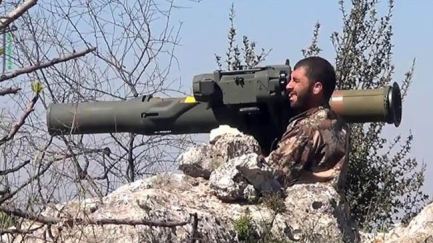
File photo shows a foreign-backed militant preparing to launch a US-made TOW anti-tank missile in Idlib countryside in northwestern Syria.
Press TV – December 30, 2014
The ISIL Takfiri group has released a photo showing one of its members preparing to launch a US-made TOW anti-tank missile against rival terrorists in Syria’s strategic and mountainous Qalamoun region along the border with Lebanon.
The ISIL militant is shown aiming at the positions of the Jaysh al-Islam militant group on the outskirts of al-Qaryatayn, located approximately 120 kilometers (74 miles) northeast of the capital, Damascus.
Political analysts say the photo shows the scale of threats the ISIL militants pose to the Qalamoun region against fighters of the Lebanese Hezbollah resistance movement.
On October 5, Hezbollah fighters killed scores of Takfiri militants after the gunmen crossed from crisis-hit Syria into eastern Lebanon and attacked the Lebanese resistance movement’s posts.
Most of the militants killed during the clashes were from the al-Qaeda-linked al-Nusra Front. Two Hezbollah fighters were also killed in the shootout.
Meanwhile, Ghuraba al-Sham Battlion and Lions of Shahba Battalion, both allied to the so-called Free Syrian Army, are reportedly training their members in a camp set up in Qalamoun.
Over the past months, Lebanon has been grappling with terrorist attacks by al-Qaeda-linked militants and rocket attacks, in what is said to be a spillover of the conflict in Syria.
The Takfiri ISIL terrorists currently control parts of Syria mostly in the east and north. They have also seized large swathes of land in neighboring Iraq.
More than 1.1 million Syrian refugees are currently taking shelter in Lebanon. The influx of Syrian refugees is exerting huge pressure on Lebanon’s poor infrastructure, education and health systems.
Syria has been grappling with a deadly crisis since March 2011. Western powers and their regional allies – especially Qatar, Saudi Arabia, and Turkey – are the main supporters of the militants operating inside Syria.
More than 200,000 people have died so far in the conflict in Syria, according to UN High Commissioner for Human Rights Zeid Ra’ad Zeid al-Hussein.
Outgoing senator urged to release full CIA torture report
RT | December 29, 2014
Calls for Sen. Mark Udall (D-Colorado) to reveal the entire, unredacted CIA torture report have increased, with a group of former intelligence analysts issuing a memo that urges the outgoing legislator to read the report on the Senate floor.
Veteran Intelligence Professionals for Sanity (VIPS) released the letter, asking Udall to use his constitutional protection as a still-sitting member of Congress to introduce the full 6,000-plus-page report by the Senate Intelligence Committee into the congressional record by reading it on the Senate floor. The current version is heavily redacted.
“We, the undersigned are veteran intelligence officers with a combined total of over 300 years of experience in intelligence work,” the letter begins. “We send you this open letter at what seems to be the last minute simply because we had been hoping we would not have to.”
“You seem on the verge of leaving the Senate without letting your fellow Americans know all they need to know about CIA torture,” the memo continues. “In the eight weeks since you lost your Senate seat you gave off signs that, during your last days in office, you would provide us with a fuller account of this sordid chapter in our country’s history, exercising your right to immunity under the “Speech or Debate” clause in Article 1 of the Constitution.”
VIPS is not the first to call on Udall to introduce the unredacted report into the congressional record. On November 5 ‒ the day after the incumbent senator lost his re-election bid to Republican Rep. Cory Gardner, and over a month before the Intelligence Committee published their findings ‒ Trevor Timm wrote an op-ed in the Guardian urging the “lame-duck transparency advocate” to grab the “rare opportunity to truly show his principles in the final two months of his Senate career and finally expose, in great detail, the secret government wrongdoing he’s been criticizing for years.”
The Speech or Debate clause in the US Constitution states that so long as legislators are “acting in the sphere of legitimate legislative activity,” they are “protected not only from the consequence of litigation’s results but also from the burden of defending themselves” from retribution from the government’s executive branch.
The senator has said he is considering the option.
“Transparency and disclosure are critical to the work of the Senate intelligence committee and our democracy, so I’m going to keep all options on the table to ensure the truth comes out,” Udall told the Denver Post in an interview.
“I mean, I’m going to keep all options on the table,” said Udall, when asked specifically about using his position in Congress to reveal the unredacted document.
Udall would not be the first to use his constitutional immunity to reveal classified materials on the Senate floor. In 1971, then-Sen. Mike Gravel (D-Alaska) released the Pentagon Papers – the secret official study that revealed the lies and manipulations of successive US administrations that misled the country into the Vietnam War. His action was in response to the Nixon administration’s move to block any further publication of the report and to punish any newspaper publisher who revealed the contents, after The New York Times published portions of the leaked study.
“From the floor of the senate, Gravel (a junior senator at the time) insisted that his constituents had a right to know the truth behind the war and proceeded to read 4,100 pages of the 7,000 page document into the senate [sic] record,”the biography on his website reads.
Gravel’s recitation lasted for three hours before he almost collapsed. He then entered thousands of more pages into the record after he couldn’t speak any longer from exhaustion.
The former Alaskan senator has also joined the calls for Udall to follow in his footsteps.
“If Udall wants to call me, I can explain this to him,” Gravel told the Intercept in early November. “What he’d have to do is call a subcommittee meeting like I did, late at night.”
The two biggest reasons not to do it, Gravel said, are no longer relevant.
“The biggest fear you have is peer pressure: What are my members of the Senate going to think of me? But I’ve got to say, if you lose office, like he has, he’s got no more peer pressure,” he said.
The Senate has rules against disclosing classified information, and could punish Udall with “censure, removal from committee membership, or expulsion from the Senate.”
Since Udall was already voted out of office, none of those punishments would affect him, Gravel noted.
Transparency advocates hoped that Udall would use his December 10 speech on the Senate floor, as Timm wrote, to “go out with a bang.” Instead, he blasted both the CIA and the White House over what the lawmaker considers to be complicity with regards to propagating long-standing lies about the United States’ use of torture against foreign detainees.
Udall’s last day as a US senator will be January 2. The 114th Congress begins the following day.
‘US military hardware will cause more bloodshed in Ukraine’ – Russian senator
RT | December 29, 2014
The possible relocation of US hardware from Afghanistan to Ukraine suggested by President Obama will only lead to more casualties, a senior Russian lawmaker has stated.
“Russia cannot be content with such plans as they would increase the tensions near our borders and also inevitably cause more casualties in Donbass,” the head of the Upper House Committee for Foreign Relations, Konstantin Kosachev, told reporters on Monday.
The senator added that such a step by the United States would be an open interference into the conflict, which would definitely lead to further aggravation both in Russian-American relations and within the security situation in Eastern Europe as a whole.
Kosachev also gave a critical appraisal to the allied mission in Afghanistan that is being wrapped up this year. The Russian lawmaker called the result of Western military presence in the country disappointing, noting that the military mission did not solve any problems in the region – but rather created a few new ones.
Earlier on Monday, a Russian Lower House MP also criticized Washington’s decision to transfer military hardware from Afghanistan to Ukraine, promising reciprocal actions from Russia. A member of the State Duma Committee for Defense and the chairman of the Russian Union of Afghanistan War Veterans, Frants Klintsevich (United Russia party) told reporters that he would use all his powers to initiate an official State Duma address to President Putin, seeking to start the supplies of Russian military hardware to the Lugansk and Donetsk republics.
In early December, MP Mikhail Yemelyanov of the leftist Fair Russia party said the US Senate’s decision to arm the Kiev regime should prompt “adequate measures” from Russia, such as deploying military force on Ukrainian territory before the threat becomes too high.
Yemelyanov also noted that in his opinion, the US Senate’s decision to arm Ukraine has revealed that Washington is not interested in the de-escalation of the Ukrainian conflict. “In a few years, Ukraine will turn into a poor and hungry country with an anti-Russian government that will teach its population to hate Russia. They will be armed to the teeth, and Ukraine and US reluctance to recognize the Russian Federation within its current borders would always provoke conflicts,” the MP noted.
On March 1 2014, the Upper House of the Russian Parliament – the Federation Council – approved a resolution allowing the president to use military force on the territory of Ukraine “until the normalization of the social and political situation in that country.” The resolution was adopted in accordance with the first part of Article 102 of the Constitution of the Russian Federation.
However, on June 25, the Federation Council voted to repeal the legislation following a request from Vladimir Putin. The Russian president instigated the move from a desire to alleviate tensions in view of the three-party talks on a peaceful settlement in the east and southeast of Ukraine.
The Prison State of America
By Chris Hedges | Truthdig | December 28, 2014
Prisons employ and exploit the ideal worker. Prisoners do not receive benefits or pensions. They are not paid overtime. They are forbidden to organize and strike. They must show up on time. They are not paid for sick days or granted vacations. They cannot formally complain about working conditions or safety hazards. If they are disobedient, or attempt to protest their pitiful wages, they lose their jobs and can be sent to isolation cells. The roughly 1 million prisoners who work for corporations and government industries in the American prison system are models for what the corporate state expects us all to become. And corporations have no intention of permitting prison reforms that would reduce the size of their bonded workforce. In fact, they are seeking to replicate these conditions throughout the society.
States, in the name of austerity, have stopped providing prisoners with essential items including shoes, extra blankets and even toilet paper, while starting to charge them for electricity and room and board. Most prisoners and the families that struggle to support them are chronically short of money. Prisons are company towns. Scrip, rather than money, was once paid to coal miners, and it could be used only at the company store. Prisoners are in a similar condition. When they go broke—and being broke is a frequent occurrence in prison—prisoners must take out prison loans to pay for medications, legal and medical fees and basic commissary items such as soap and deodorant. Debt peonage inside prison is as prevalent as it is outside prison.
States impose an array of fees on prisoners. For example, there is a 10 percent charge imposed by New Jersey on every commissary purchase. Stamps have a 10 percent surcharge. Prisoners must pay the state for a 15-minute deathbed visit to an immediate family member or a 15-minute visit to a funeral home to view the deceased. New Jersey, like most other states, forces a prisoner to reimburse the system for overtime wages paid to the two guards who accompany him or her, plus mileage cost. The charge can be as high as $945.04. It can take years to pay off a visit with a dying father or mother.
Fines, often in the thousands of dollars, are assessed against many prisoners when they are sentenced. There are 22 fines that can be imposed in New Jersey, including the Violent Crime Compensation Assessment (VCCB), the Law Enforcement Officers Training & Equipment Fund (LEOT) and Extradition Costs (EXTRA). The state takes a percentage each month out of prison pay to pay down the fines, a process that can take decades. If a prisoner who is fined $10,000 at sentencing must rely solely on a prison salary he or she will owe about $4,000 after making payments for 25 years. Prisoners can leave prison in debt to the state. And if they cannot continue to make regular payments—difficult because of high unemployment—they are sent back to prison. High recidivism is part of the design.
Corporations have privatized most of the prison functions once handled by governments. They run prison commissaries and, since the prisoners have nowhere else to shop, often jack up prices by as much as 100 percent. Corporations have taken over the phone systems and charge exorbitant fees to prisoners and their families. They grossly overcharge for money transfers from families to prisoners. And these corporations, some of the nation’s largest, pay little more than a dollar a day to prison laborers who work in for-profit prison industries. Food and merchandise vendors, construction companies, laundry services, uniforms companies, prison equipment vendors, cafeteria services, manufacturers of pepper spray, body armor and the array of medieval instruments used for the physical control of prisoners, and a host of other contractors feed like jackals off prisons. Prisons, in America, are a hugely profitable business.
Our prison-industrial complex, which holds 2.3 million prisoners, or 25 percent of the world’s prison population, makes money by keeping prisons full. It demands bodies, regardless of color, gender or ethnicity. As the system drains the pool of black bodies, it has begun to incarcerate others. Women—the fastest-growing segment of the prison population—are swelling prisons, as are poor whites in general, Hispanics and immigrants. Prisons are no longer a black-white issue. Prisons are a grotesque manifestation of corporate capitalism. Slavery is legal in prisons under the 13th Amendment of the U.S. Constitution. It reads: “Neither slavery nor involuntary servitude, except as punishment for crime whereof the party shall have been duly convicted, shall exist within the United States. …” And the massive U.S. prison industry functions like the forced labor camps that have existed in all totalitarian states.
Corporate investors, who have poured billions into the business of mass incarceration, expect long-term returns. And they will get them. It is their lobbyists who write the draconian laws that demand absurdly long sentences, deny paroles, determine immigrant detention laws and impose minimum-sentence and three-strikes-out laws (mandating life sentences after three felony convictions). The politicians and the courts, subservient to corporate power, can be counted on to protect corporate interests.
Corrections Corporation of America (CCA), the largest owner of for-profit prisons and immigration detention facilities in the country, had revenues of $1.7 billion in 2013 and profits of $300 million. CCA holds an average of 81,384 inmates in its facilities on any one day. Aramark Holdings Corp., a Philadelphia-based company that contracts through Aramark Correctional Services to provide food to 600 correctional institutions across the United States, was acquired in 2007 for $8.3 billion by investors that included Goldman Sachs.
The three top for-profit prison corporations spent an estimated $45 million over a recent 10-year period for lobbying that is keeping the prison business flush. The resource center In the Public Interest documented in its report “Criminal: How Lockup Quotas and ‘Low-Crime Taxes’ Guarantee Profits for Private Prison Corporations” that private prison companies often sign state contracts that guarantee prison occupancy rates of 90 percent. If states fail to meet the quota they have to pay the corporations for the empty beds.
CCA in 2011 gave $710,300 in political contributions to candidates for federal or state office, political parties and so-called 527 groups (PACs and super PACs), the American Civil Liberties Union reported. The corporation also spent $1.07 million lobbying federal officials plus undisclosed sums to lobby state officials, according to the ACLU. CCA, through the American Legislative Exchange Council (ALEC), also lobbies legislators to impose harsher detention laws at the state and federal levels. The ALEC helped draft Arizona’s cruel anti-immigrant law SB 1070.
The United States, from 1970 to 2005, increased its prison population by about 700 percent, according to statistics gathered by the ACLU. The federal Bureau of Justice Statistics, the ACLU report notes, says for-profit companies presently control about 18 percent of federal prisoners and 6.7 percent of all state prisoners. Private prisons account for nearly all newly built prisons. And nearly half of all immigrants detained by the federal government are shipped to for-profit prisons, according to Detention Watch Network.
But corporate profit is not limited to building and administering prisons. Whole industries now rely almost exclusively on prison labor. Federal prisoners, who are among the highest paid in the U.S. system, making as much as $1.25 an hour, produce the military’s helmets, uniforms, pants, shirts, ammunition belts, ID tags and tents. Prisoners work, often through subcontractors, for major corporations such as Chevron, Bank of America, IBM, Motorola, Microsoft, AT&T, Starbucks, Nintendo, Victoria’s Secret, J.C. Penney, Sears, Wal-Mart, Kmart, Eddie Bauer, Wendy’s, Procter & Gamble, Johnson & Johnson, Fruit of the Loom, Motorola, Caterpillar, Sara Lee, Quaker Oats, Mary Kay, Microsoft, Texas Instruments, Dell, Honeywell, Hewlett-Packard, Nortel, Nordstrom’s, Revlon, Macy’s, Pierre Cardin and Target. Prisoners in some states run dairy farms, staff call centers, take hotel reservations or work in slaughterhouses. And prisoners are used to carry out public services such as collecting highway trash in states such as Ohio.
States, with shrinking budgets, share in the corporate exploitation. They get kickbacks of as much as 40 percent from corporations that prey on prisoners. This kickback money is often supposed to go into “inmate welfare funds,” but prisoners say they rarely see any purchases made by the funds to improve life inside prison.
The wages paid to prisoners for labor inside prisons have remained stagnant and in real terms have declined over the past three decades. In New Jersey a prisoner made $1.20 for eight hours of work—yes, eight hours of work—in 1980 and today makes $1.30 for a day’s labor. Prisoners earn, on average, $28 a month. Those incarcerated in for-profit prisons earn as little as 17 cents an hour.
However, items for sale in prison commissaries have risen in price over the past two decades by as much as 100 percent. And new rules in some prisons, including those in New Jersey, prohibit families to send packages to prisoners, forcing prisoners to rely exclusively on prison vendors. This is as much a psychological blow as a material one; it leaves families feeling powerless to help loved ones trapped in the system.
A bar of Dove soap in 1996 cost New Jersey prisoners 97 cents. Today it costs $1.95, an increase of 101 percent. A tube of Crest toothpaste cost $2.35 in 1996 and today costs $3.49, an increase of 48 percent. AA batteries have risen by 184 percent, and a stick of deodorant has risen by 95 percent. The only two items I found that remained the same in price from 1996 were frosted flake cereal and cups of noodles, but these items in prisons have been switched from recognizable brand names to generic products. The white Reebok shoes that most prisoners wear, shoes that last about six months, costs about $45 a pair. Those who cannot afford the Reebok brand must buy, for $20, shoddy shoes with soles that shred easily. In addition, prisoners are charged for visits to the infirmary and the dentist and for medications.
Keefe Supply Co., which runs commissaries for an estimated half a million prisoners in states including Florida and Maryland, is notorious for price gouging. It sells a single No. 10 white envelope for 15 cents—$15 per 100 envelopes. The typical retail cost outside prison for a box of 100 of these envelopes is $7. The company marks up a 3-ounce packet of noodle soup, one of the most popular commissary items, to 45 cents from 26 cents.
Global Tel Link, a private phone company, jacks up phone rates in New Jersey to 15 cents a minute, although some states, such as New York, have relieved the economic load on families by reducing the charge to 4 cents a minute. The Federal Communications Commission has determined that a fair rate for a 15-minute interstate call by a prisoner is $1.80 for debit and $2.10 for collect. The high phone rates imposed on prisoners, who do not have a choice of carriers and must call either collect or by using debit accounts that hold prepaid deposits made by them or their families, are especially damaging to the 2 million children with a parent behind bars. The phone is a lifeline for the children of the incarcerated.
Monopolistic telephone contracts give to the states kickbacks amounting, on average, to 42 percent of gross revenues from prisoner phone calls, according to Prison Legal News. The companies with exclusive prison phone contracts not only charge higher phone rates but add to the phone charges the cost of the kickbacks, called “commissions” by state agencies, according to research conducted in 2011 by John E. Dannenberg for Prison Legal News. Dannenberg found that the phone market in state prison systems generates an estimated $362 million annually in gross revenues for the states and costs prisoners’ families, who put money into phone accounts, some $143 million a year.
When strong family ties are retained, there are lower rates of recidivism and fewer parole violations. But that is not what the corporate architects of prisons want: High recidivism, now at over 60 percent, keeps the cages full. This is one reason, I suspect, why prisons make visitations humiliating and difficult. It is not uncommon for prisoners to tell their families—especially those that include small children traumatized by the security screening, long waits, body searches, clanging metal doors and verbal abuse by guards—not to visit. Prisoners with life sentences frequently urge loved ones to sever all ties with them and consider them as dead.
The rise of what Marie Gottschalk, the author of “Caught: The Prison State and the Lockdown of American Politics,” calls “the carceral state” is ominous. It will not be reformed through elections or by appealing to political elites or the courts. Prisons are not, finally, about race, although poor people of color suffer the most. They are not even about being poor. They are prototypes for the future. They are emblematic of the disempowerment and exploitation that corporations seek to inflict on all workers. If corporate power continues to disembowel the country, if it is not impeded by mass protests and revolt, life outside prison will soon resemble life in prison.
Palestinian youth shot dead by Israeli forces south of Nablus
Ma’an – 29/12/2014
 NABLUS – A Palestinian youth was shot dead by Israeli forces at the Tappuah checkpoint south of Nablus in the northern West Bank on Monday.
Local Palestinian sources told Ma’an that Israeli troops opened fire at two young Palestinian men in the Jabal Sbeih area within Beita village, near the Tappuah checkpoint, which is also known to Palestinians as Zaatara.
The youth who was killed in the incident was identified by Nablus TV as Imam Jamil Dweikat, a resident of Beita. His age was not yet clear, however.
The other victim was identified as Nael Thiab, 19, and he was reportedly evacuated to a hospital in Nablus with moderate to serious gunshot wounds following the incident.
Palestinian security sources confirmed that the Israeli liaison department officially notified the Palestinian Authority that Israeli troops shot dead a young Palestinian man and that his body is still with the Israeli army.
The slain youth is the 50th Palestinian to be killed by Israeli forces in the West Bank in 2014, bringing the total Palestinian dead at Israeli hands so far this year, including those who died in Gaza as a result of Israel’s summer offensive, to around 2,335.
An Israeli military spokeswoman told Ma’an that an Israeli military patrol was passing through the area when they “encountered a group of Palestinians hurling rocks at a main road, which endangered both civilians and vehicles.”
“The forces called them to halt and fired warning shots, and when they didn’t comply they responded to the threat with direct fire which wounded one of the attackers.”
She said that the military treated him on site but he later died of his wounds.
“A military police investigation has been opened into the matter,” she added.
Featured Video
9/11 In Perspective
or go to
Aletho News Archives – Video-Images
From the Archives
Still No End in Sight of the Murder and Mayhem Wrought by the 9/11 Culprits
By Prof. Tony Hall | American Herald Tribune | July 17, 2016
The Kevin Barrett-Chomsky Dispute in Historical Perspective – Fourth part of the series titled “9/11 and the Zionist Question”
Back in 2006 all but a prescient few, such as Christopher Bollyn, perceived it as premature to try to identify and bring to justice the actual perpetrators of the 9/11 crimes. There was still some residue of confidence that responsible officials in government, law enforcement, media and the universities could and would respond in good faith to multiple revelations that great frauds had occurred in interpreting 9/11 for the public.
Accordingly, the main methodology of public intellectuals like Dr. Kevin Barrett or, for instance, Professors David Ray Griffin, Steven E. Jones, Peter Dale Scott, Graeme MacQueen, John McMurtry, Michael Keefer, Richard B. Lee, A.K. Dewdney, Nafeez Mossadeq Ahmed, and Michel Chossudovsky, was to marshal evidence demonstrating that the official narrative of 9/11 could not be true.
The marshaling of evidence was spurred on by observations coming from government insiders like Eckehardt Wertherbach, a former head of Germany’s intelligence service. In a meeting in Germany with Christopher Bollyn and Dr. Andreas von Bülow, Wertherbach pointed out that, “an attack of this magnitude and precision would have required years of planning. Such a sophisticated operation would require the fixed frame of a state intelligence organization, something not found in a loose group like the one led by the student Mohammed Atta in Hamburg.”
Andreas von Bülow was a German parliamentarian and Defense Ministry official. He confirmed this assessment in his book on the CIA and 9/11. In the text von Bülow remarked that the execution of the 9/11 plan “would have been unthinkable without backing from secret apparatuses of state and industry.” The author spoke of the “invented story of 19 Muslims working with Osama bin Laden in order the hide the truth” of the real perpetrators’ identity. … continue
Blog Roll
 Aletho News
- The U.S. Sanctions Cuban Journalist For Reporting On The U.S. Blockade
- Israeli firms transform cars into intelligence devices: Reports
- Zionist-controlled companies to surveil British citizens
- THE CHILDREN GAMBIT
- A note on comment posting at Alethonews
- Trump stalls over Iran strike plan, Iran holds all the aces
- Zelensky’s Ceasefire for Elections is Strategic Gambit, Not Democratic Move
- US and Dutch pilots flying F-16s for Ukraine – Western media
- West’s Claims of Non-Involvement in Ukraine Conflict ‘Epitome of Hypocrisy’ – Expert
- Putin aide urges retaliation to ‘Western piracy’
- If Americans Knew
- Help end the injustice against Shadi
- Israel’s Favorite American President
- Israel’s “Yellow Line” Is a Death Trap for Palestinians. We Drove Into It.
- Why Israel’s expanding occupation in Syria presents a critical legal test
- Gaza is not a natural disaster. It is the victim of genocide enabled by global inaction
- Netanyahu’s plan to “end” US aid to Israel is to give even more money under a different name
- Israel ceased firing on Gaza for just 15 days of the “ceasefire” – Not a ceasefire Day 130
- In Gaza, “rats run over our faces” – Not a ceasefire Day 129
- Israel-backed border guards, GHF-linked aid – Not a ceasefire Day 128
- Israel battles Palestinian right of return, one Palestinian at a time – Not a ceasefire Day 127
- No Tricks Zone
- New Study: A 4°C Warmer Beaufort Sea Had ‘No Sea Ice’ 11,700 – 8200 Years Ago
- Unfudging The Data: Dutch Meteorological Institute Reinstates Early 20th Centruy Heat Waves It Had Erased Earlier
- German Gas Crisis…Chancellor Merz Allegedly Bans Gas Debate Ahead of Elections!
- Pollen Reconstructions Show The Last Glacial’s Warming Events Were Global, 10x Greater Than Modern
- Germany’s Natural Gas Storage Level Dwindles To Just 28%… Increasingly Critical
- New Study Rebuts The Assumption That Anthropogenic CO2 Molecules Have ‘Special’ Properties
- Climate Scientist Who Predicted End Of “Heavy Frost And Snow” Now Refuses Media Inquiries
- Polar Bear Numbers Rising And Health Improving In Areas With The Most Rapid Sea Ice Decline
- One Reason Only For Germany’s Heating Gas Crisis: Its Hardcore-Dumbass Energy Policy
- 130 Years Later: The CO2 Greenhouse Effect Is Still Only An Imaginary-World Thought Experiment
 Aletho News