Leaked documents raise new questions over UK complicity in secret US drone strikes
Reprieve | December 29, 2014
Previously secret documents obtained by Der Speigel – including a ‘Kill List’ that included both Pakistani and Afghan targets – have raised new concerns about British complicity in the US’s covert drone war in Pakistan.
The documents, detailed in an article published yesterday evening, show that NATO and British forces in Afghanistan planned to target and kill individuals that were located across the border in Pakistan. The UK government has consistently denied that it has taken strikes outside of Afghanistan and has refused to confirm whether and to what extent it is involved in the CIA’s covert drone war in Pakistan.
Other documents reportedly show that those included on the ‘kill list’ were limited not just to key Al Qaeda leaders, but extended to hundreds of other individuals. In some instances, nothing more than a cell phone intercept was need to initiate a strike. The list also targeted alleged drug dealers, the inclusion of whom potentially constitutes a violation of international law.
Commenting, Jennifer Gibson, Staff Attorney at human rights NGO Reprieve, said: ‘Today’s revelations offer the most damning evidence to date of UK complicity in the covert drone war in Pakistan. The UK can no longer dodge questions by claiming the drone wars in Pakistan are a ‘matter for the states involved.’ These documents clearly show the UK is one of those states. The UK now needs to come clean about its role in executing a ‘kill list’ that goes far beyond targeting only militant leaders.”
Merkel staffer’s laptop infected by US/UK spy malware – report
RT | December 29, 2014
An aide to the German chancellor has become the victim of a cyber-attack, according to media. The highly-sophisticated Regin virus that was found on her infected USB stick is reported to be a product of British and US spy agencies.
Having written a draft of a speech at work, one of Angela Merkel’s senior staff members decided to take it home to polish it on her private laptop in the evening. When the head of the Department of European Policy brought the USB stick with the document back to her work computer, virus scanning software revealed that it was infected, according to Monday’s report of Bild newspaper.
The USB stick was infected with the Regin spying software, but additional checks revealed no other infections on any of the 200 other high-security laptops in the Chancellery, sources from German security services said.
Regin was first warned of at the end of November by cyber-security company Symantec. A back door-type Trojan is able to “provide its controllers with a powerful framework for mass surveillance.”
According to the report, the virus demonstrates such a “rare degree of technical competence” that indicates it has probably been developed by a nation state – and it could have taken years. Regin is able to fulfill a range of customizable tasks, such as making screenshots, controlling the mouse cursor and stealing passwords, depending on the target of a spying operation.
Media reports associated Regin with the US National Security Agency (NSA) and its British counterpart Government Communications Headquarters (GCHQ). The virus is believed to begin operating in 2008, targeting governments, infrastructure operators, researchers, as well as private individuals and businesses.
READ MORE:
Germany to drop investigation into US spying on Merkel – report
Sophisticated ‘state-sponsored’ spying tool targeted govts, infrastructure for years
High School Bans “I Can’t Breathe” T-Shirts at Tournament
By John Vibes | The Free Thought Project | December 28, 2014
San Francisco, California – In the aftermath of the many recent high profile police killings, athletes all over the country have been using their platform to spread awareness about the growing police state.
Many professional players have worn shirts that say “I Can’t Breathe”, in remembrance of Eric Garner’s last words before his life was taken by NYPD cops. In most cases, the professional sports teams have stood by their athletes and respected their freedom of speech. However, many young athletes who play for school teams have been banned from wearing these shirts during games and tournaments.
At a high school basketball tournament in California, administrators have banned all of their players from wearing the controversial T-shirts during warm-ups and practices. The three-day tournament was actually temporarily cancelled until every player from every team involved agreed not to wear any police brutality related clothing during their warm-ups.
One female team from the Mendocino Unified School District was actually disqualified from the tournament after several girls on the team refused to comply with the new conditions.
Not everyone from the boys teams decided to comply with the orders, some decided to sit out because they felt that their rights to freedom of speech were violated. However, there were enough players on the boys team to agree for the tournament to take place.
According to a statement from Principal Rebecca Walker, the ban is intended “To protect the safety and well-being of all tournament participants it is necessary to ensure that all political statements and or protests are kept away from this tournament. We are a small school district that simply does not have the resources to ensure the safety and well-being of our staff, students and guests at the tournament should someone get upset and choose to act out.”
Mendocino teams created controversy on December 16th when the teams first wore the “I Can’t Breathe” T-shirts before a game with Fort Bragg.
The political correctness brigade has succeeded once again at stifling the free exchange of ideas. To all those students who refused to comply with the dictates of the censors, we commend you; you are an example for children everywhere and a beacon of hope for society.
Selling ‘Peace Groups’ on US-Led Wars
By Margaret Sarfehjooy and Coleen Rowley | Consortium News | December 25, 2014
“War is peace” double-speak has become commonplace these days. And, the more astute foreign policy journalists and commentators are beginning to realize the extent of how “liberal interventionists” work in sync with neocon warhawks to produce and sustain a perpetual state of U.S. war.
More and more “peace and social justice” groups are even being twisted into “democracy promotion,” U.S. militarism style. But rarely do we get a window to see as clearly into how this Orwellian transformation occurs as with the “Committee in Solidarity with the People of Syria” (CISPOS) based in Minnesota’s Twin Cities, a spin-off of “Friends for a Nonviolent World” (FNVW), steering its Quaker-inspired founding in nonviolence to promote speakers and essayists with strong ties to the violent uprising to topple the Syrian government of President Bashar al-Assad, resulting in a war that has already taken some 200,000 lives.
Do the real pacifist members approve? Or even know?
Middle Eastern expats who support U.S. intervention in their countries are especially effective in promoting their message to Western audiences because they provide “proof” of the demonization of governments that the U.S. plans to invade and dominate, and often peace groups include these expats in presentations believing them to be representatives of an entire country.
In Minneapolis, FNVW and its spin-off CISPOS hosted several events with Syrian expats who were on record as supporting the U.S. bombing of their country. (This isn’t only happening in the U.S. In April 2011, a Vancouver peace group documented its objection to the fact that other Canadian “peace” groups were sponsoring speakers who justified and advocated “in favour of the NATO bombing of Libya.”)
Often Syrian “experts” speaking to peace groups, such as FNVW/CISPOS’s upcoming speaker, Mohja Kahf, have ties to the early destabilization of Syria. This American Prospect article documents how Najib Ghadbian, Kahf’s husband of over 20 years (apparently up to last year when they divorced) was one of the Syrian dissidents who attended the early 2006 meeting with Liz Cheney (then-Vice President Dick Cheney’s daughter), along with other Syrian dissidents to plan how to destabilize Syria and topple its government. Like some Syrian version of Ahmed Chalabi, the neocons’ choice to run post-invasion Iraq, Kahf’s husband apparently got himself invited to Liz Cheney’s “Iran-Syria Operations Group” by having signed the “Damascus Declaration” in 2005, the year before.
When Najib and Mohja sat down for a long 2011 interview with The Arkansas Traveler, they discussed their involvement with the Syrian Revolution, even joking about Ghadbian becoming the next Prime Minister. Kahf and Ghadbian reportedly divorced in 2013 but when CISPOS-FNVW first published her long essays, they were still appearing together at Syrian revolutionary meetings and speaking forums. Additionally, CISPOS’s latest handout (December 2014) lists Ghadbian’s organization, www.etilaf.us (The National Coalition of Syrian Revolutionary Forces) as a resource “For More Information on Syria and How to Help.”
Resources for information on Syria often come from “citizen journalists” with deep ties to neocons and U.S. government sources. From the State Department’s website , the $330 million in support for the Syrian opposition includes training for networks of citizen journalists, bloggers and cyber-activists to support their documentation and dissemination of information on developments in Syria.
Syrian dissidents received funding from the Los Angeles-based Democracy Council, which ran a Syria-related program called the “Civil Society Strengthening Initiative” funded with $6.3 million from the State Department. The program is described as “a discrete collaborative effort between the Democracy Council and local partners” to produce, among other things, “various broadcast concepts.”
James Prince, the founder and President of the Democracy Council, is also an adviser to CyberDissidents.org , a project created in 2008 by the Jerusalem-based Adelson Institute for Strategic Studies, founded and funded by Sheldon Adelson, a patron and confidant of Benjamin Netanyahu.
Other resources include postings on social media and alternative websites with sensational stories such as the anti-Assad activist “Gay Girl in Damascus” who turned out to be a middle-aged American man in Scotland or Syrian Danny Abdul Dayem, who was frequently interviewed using fake gun fire and flames in his interviews.
With all of the information about Syria, what are we to believe as true? We know the facts about recent U.S. interventions in Middle Eastern countries. Why would Syria be any different?
Afghanistan is still in shambles with the majority of the people living in extreme poverty; Libya, which had the highest GDP per capita and life expectancy on the continent, is now a failed state; Western intervention transformed Iraq from an emerging country with moderate prosperity into an impoverished country with a starving population. In the lead-up to each intervention, “experts” emerged to explain that while anti-imperialism is good in general and in past scenarios, this time is different. Is it?
Isn’t it time for war-weary Americans to wise up and stop falling for these pretexts of bringing democracy and human rights to foreign countries through training and funding of “color (and umbrella) revolutions,” inciting of coups and regime changes and eventually, through U.S.-NATO military might?
Liberal interventionists clearly assist neocon warhawks towards their mutual goal of “full spectrum dominance” under the euphemistic guise of Pax Americana. Only the “Pax” always turns out to be endless war and occupation.
Margaret Sarfehjooy is an anti-war activist and registered nurse in Minnesota. Coleen Rowley is a retired FBI agent and former Minneapolis Division legal counsel.
US Senate will vote on Iran sanctions bill in January
Press TV – December 28, 2014
Hawkish Republican Senator Lindsey Graham has announced that the US Senate will vote on Iran sanctions legislation next month despite ongoing nuclear negotiations.
“In January of next year, there will be a vote on the Kirk-Menendez bill, bipartisan sanction legislation,” he said in a press conference with Israeli Prime Minister Benjamin Netanyahu on Saturday.
He was referring to sanctions legislation drafted by Senate Foreign Relations Chairman Bob Menendez and Sen. Mark Kirk.
 The bill that would impose more sanctions against Iran came one month after Tehran and six world powers reached an interim nuclear agreement in Geneva in November 2013.
Several important lobby groups, including the American Israel Public Affairs Committee (AIPAC), are working hard to build support for the measure.
The White House has said President Barack Obama will veto the bill if it is passed.
“We continue to believe that adding on sanctions while negotiations are ongoing would be counterproductive,” White House spokesman Josh Earnest said last month.
The Obama administration is under pressure to put additional sanctions against Iran following the extension of nuclear talks between Tehran and the P5+1 countries — the US, Britain, France, Russia, China and Germany.
Last month, Iran and the six world powers agreed to extend the negotiations.
They also agreed that the interim deal they had signed in Geneva last November remain in place during the remainder of the negotiations until July 1, 2015.
The EU shifting its strategy on Syria, Iraq and fighting ISIS
By Sami Kleib | Al-Akhbar | December 27, 2014
After the United States abandoned the idea of Syrian President Bashar al-Assad stepping down and enhanced security coordination with the Syrian army against the Islamic State in Iraq and Syria (ISIS), it appears the Europeans began some time ago a series of meetings to change their policy on Syria. According to information obtained by Al-Akhbar, some senior European officials did not hesitate to say at the last Council of European Union Foreign Ministers meeting that “this policy was wrong.” It is necessary, therefore, to change it and let the United Nations envoy Staffan de Mistura’s initiative lead the way. Does that mean we will soon see favorable signs towards the Syrian regime and further disregard for the external opposition?
Geneva – A European official told Al-Akhbar about the proceedings of an important meeting between United Nations (UN) envoy Staffan de Mistura and European Union (EU) foreign affairs ministers on December 11, confirming that there is a change in the European position towards Syria. He said the meeting was closed like all meetings during which Europeans discuss sensitive matters. De Mistura began to explain the situation in Syria and the regional and international framework surrounding his plan that is supposed to be implemented in three months “otherwise it loses its ability to be implemented.”
This, in short, is what de Mistura said and the Europeans’ position towards it.
- The plan to freeze the fighting in Aleppo is the only one currently available. There is no hope for another plan. Therefore, the EU should support it practically and not just verbally. It is the only plan capable of freezing the fighting, securing people’s needs and returning the displaced people who are burdening neighboring areas and states. It will also allow for the eventual process of reconstruction.
- Syrian President Bashar al-Assad, who showed readiness to ensure the success of the international plan in Aleppo, convinced Russian President Vladimir Putin of the plan and played a major role in convincing his Iranian allies as well. This was necessary because Moscow was reluctant, thinking that no US-Atlantic effort can be trusted and the plan might lead to dire consequences for Russia and its allies.
- Although the Americans expressed reservations and doubt about the plan at the beginning, they have become more flexible, tying their approval with that of some of their regional allies, meaning of course Saudi Arabia primarily. In any case, I am going to Riyadh to convince Saudi officials of the plan’s feasibility. If we obtain preliminary approval from them, I will subsequently continue my efforts in Damascus so we can start as soon as possible because time is running out.
Here, we should remember that Brahimi had told the Europeans once what he said on more than one occasion and in more than one place, namely, that his resignation will “relieve two people, Assad and Saudi Foreign Affairs Minister Saud al-Faisal” because his personal relationship with both men was quite bad. He was probably speaking about “Saud al-Faisal’s personal hatred towards Assad being a hindrance to finding a solution.” It is also known that the Syrian president, from his very first meeting with Brahimi, questioned his intentions especially when the Algerian UN envoy suggested that Assad should step down and intended to meet Syrian Vice President Farouk al-Sharaa before Assad prevented him from doing so, arguing that this is improper on an official visit. Brahimi at the time had to make do with a phone call. After a while, Sharaa was removed from power.
- Turkey remains a real problem for the Europeans. Some officials say it is impossible to predict what Ankara could do next. Others believe that Turkey is pretty much the only country still facilitating the passage of foreign fighters to Syria, it has not made up its mind about fighting the Islamic State in Iraq and Syria (ISIS) and is trying to blackmail the international community with its position. Here, the Europeans make two suggestions. Either put pressure on Turkey, including perhaps issuing a warning – which some believe is pointless because it might make the Turkish president Recep Tayyip Erdogan’s position more intransigent and push him further into Russia and Iran’s arms – or try to cajole and get closer to Turkey, prompting it to commit to the international decision to fight ISIS and stop the flow of foreign fighters. Either way, the Turkish position remains worrisome for Europe.
- Iran has become a central player in both the Syrian and Iraqi crises. It is necessary to deal with this reality regardless of the reservations that some might have. There is nothing to prevent engaging with Iran in a serious dialogue about Syria, even before signing a nuclear agreement. This is useful because it could lead to political concessions from the Syrian regime and it could strengthen the presence of European companies in Iran. Perhaps this has become a European need despite French reservations, which are understandable, given French-Saudi relations and France’s concern not to upset Israel.
- It is impossible to think of serious solution or temporary solutions in Syria without Saudi Arabia, which has extensive relations with a number of Anti-Assad parties. It is important to reassure Riyadh that the European efforts do not intend to buoy up the regime. De Mistura said that Saudi Arabia implicitly welcomes his initiative. The Spanish foreign affairs minister was clearer, saying that Riyadh accepts the plan and it is in France’s interest to tone down its critique otherwise it will appear more extremist than Saudi Arabia, which is not an understandable position. The Spanish minister went as far as suggesting that an international conference for Syria be held in his country given that the idea might be accepted by everybody.
- Russia remains the main obstacle to any solution that does not satisfy the Kremlin and the Syrian regime. Since its relationship with the US and Europe is currently strained because of Ukraine, it is necessary to look for ways to separate any discussion with Russia about Syria from the position regarding Ukraine. Some European officials intend to strengthen the dialogue with Moscow because “it is unacceptable to return to the logic of the cold war.” Perhaps the High Representative of the EU for Foreign Affairs and Security Policy Federica Mogherini will visit Moscow soon. Besides, Russia is active and serious about finding a political solution. The Europeans keeping their distance from Moscow might mean distancing the US and Russia.
The Europeans with and against Assad
First, everyone agrees to de Mistura’s plan, but they want to support it because it is the only plan currently available while awaiting the results of Russian efforts to bring the opposition and the Syrian regime delegation together in Russia. However, France, which currently enjoys strong trade relations with Saudi Arabia and Britain, is ahead of other Europeans in its contacts with Iran and insists that the plan should not support the Syrian army against the moderate opposition in Aleppo. In other words, the issue should not be portrayed as standing with the army against ISIS because in Aleppo and its surroundings there are fighters affiliated with the moderate opposition and they should be taken into consideration and supported “so we won’t appear as though we are drawing a parallel between the regime and the opposition and that we view both sides equally.”
The French foreign affairs minister was the most intransigent even though some within the current French administration point out the need to take a new position towards Syria, especially after the terrorist attacks that took place on French soil. Laurent Fabius said, “We don’t want what happened to Homs to happen in Aleppo,” where suspending the fighting benefited the regime only and was not balanced. The fighters left after they turned in their weapons to the state and were transported in government buses to the areas they come from.
A European official with ties to the Syrian opposition said “the departure of the fighters then was a farce for them. Imagine that the Grand Mufti, Ahmad Badreddin Hassoun, who is a regime loyalist showed up in the buses transporting the fighters joking with them and asking them isn’t it better to marry while they are young instead of getting killed on battlefronts? They were given cell phones to talk with their families and undermine their morale. In the end, the media image and the reality on the ground were in the interest of the regime.”
The French minister was insistent that “the regime should not benefit from this plan in terms of relieving it at the Aleppo front so it can focus on other fronts in other areas.” That is what Fabius was saying when the EU received information about the possibility of the Syrian and Iraqi armies engaging in a wide joint military operation in Deir Ezzor.
Second, the European relationship with Assad is possible, but it becomes evident during the discussions of the foreign affairs ministers and commissioners of the EU that they are at a loss on how to deal with Syria. For example, a European official in Geneva says that a number of his European colleagues have begun to talk about the failure of the policy adopted so far and about the “uncalculated mistake” of suggesting early on that Assad step down.
Some Europeans argue that their assessment of the situation was erroneous while others believe that trusting the US from the beginning was a mistake because Washington, as usual, places its interests ahead of all its alliances, often putting the Europeans in an awkward position. Still others argue that underestimating the capabilities of the Syrian army and its allies was their biggest mistake.
As such, EU officials are currently discussing how to “modify” the political position that has been adopted for more than three years in Syria. One sign of this change is abandoning the mantra of “Assad stepping down” and finding more realistic statements that have been repeated now and then, such as “Assad is not a final solution to the crisis” or “Assad will not stay at the end of the political solution” or “it is only natural that a political solution will eventually lead to transferring powers from the presidency and not all powers” according to Geneva I. Another sign of a change in position is abandoning the phrase “proceeding with a transitional process now” and replacing it with one accepted by all, namely, “calling for the start of a transitional process.”
It appears that Mogherini succeeded, to some extent, in promoting the point of view that “we agree on the end result but political realism and the developments of the situation require us to adjust our course and use new phrases.” In other words, even if everyone in Europe wanted Assad to step down, political realism suggests that this is not possible at this point and encouraging a political solution might eventually lead to this end, meaning this is no longer a European priority.
The security council in Aleppo?
In light of these discussions about modifying the European position towards the Syrian regime, the most important question in the EU is how to ensure the success of the Aleppo plan and how to implement it without portraying Assad as the winner, especially given that the Syrian army advanced in a noticeable way in Aleppo recently?
The dominant trend is to find a monitoring mechanism by the UN Security Council. However, the Europeans realize that this is impossible due to the dual Sino-Russian veto that is always ready to protect Syria. Therefore, unlike the French and British positions which insist on an international force from the UNSC, the EU is more inclined towards finding a diplomatic formula that talks about “a monitoring mechanism linked to the UNSC.”
All of this will be released soon in what is now called “the EU strategy on Syria, Iraq and fighting ISIS.”
Despair with the Syrian opposition, particularly, the National Coalition for Syrian Revolution and Opposition Forces, which for a long time monopolized, with international support, the representation of the opposition has infiltrated EU states after the US. The Europeans too are now more inclined towards expanding the scope of the opposition to include forces that were previously not accepted and undermine the Muslim Brotherhood.
It is remarkable for instance that when the head of the Coalition, Hadi al-Bahra, visited the EU in Brussels few days ago, representatives from the Coalition were calling the Europeans to say that Bahra no longer represents them. A European official says jokingly: “Everytime we begin to talk with an official from the Coalition, we discover that this Coalition held new elections and changed the official. So we start all over again. And every time we meet with a Coalition official, he repeats the same question, how are you going to prevent the regime from benefiting from the plan you are proposing? But we have noticed for some time now that some parties within the Coalition have come to accept the idea of negotiating with the regime and reaching a political agreement with it even if their ultimate goal is for Assad to step down. This is the case with Moaz al-Khatib and his team for instance. The problem of the Coalition is that it does not know the meaning of political realism and continues in its fragmentation as it is tossed around by conflicting foreign alliances.”
In light of all the above, is the EU starting to change its position towards Assad? Perhaps all its members still support the departure of the Syrian president. But political realism requires a change in behavior and approach and not insisting on Assad’s departure as a priority. This will become more evident in the future as terrorist attacks inside Europe have increased. The only solution left is to cooperate with Syrian security forces, the Syrian army and Iran in the context of fighting terrorism.
As for de Mistur’as plan in Aleppo, it is currently in a feverish race between a military solution and security arrangements that cannot be undertaken without the regime’s approval and that might be to its advantage.
Once again, history repeats the same old maxim, “international interests are more important than principles and people’s tragedies.”
Predictions Based on the 2015 Federal Budget – An Analysis
By Lawrence Davidson | To the Point Analyses | December 28, 2014
Part I – Predictions
I can make high-probability predictions for 2015 and the near-beyond without the benefit of a crystal ball, tarot cards or tea leaves. The only thing that I need is a list of items from the new 2015 federal budget. Here are some of my forecasts and the budget items that make them so highly probable:
1. There will be more deadly truck-related accidents than necessary on the nation’s highways in 2015. That means more deaths, injuries, highway delays, stress and frustration. How do I know? Because the 2015 budget rolls back the safety requirement that truckers need to get more rest between driving assignments. The regulation that was rolled back was itself barely adequate. It restricted drivers to a 70-hour week with mandated rest times between long periods behind the wheel. Nonetheless, despite obviously being in the public interest, this regulation could not survive the pressure of the lobbies representing the trucking industry and its corporate customers. Now we are back to truckers working 85-hour weeks with hardly any mandated rest at all.
2. Either in 2015 or soon thereafter there will be another major banking crisis requiring the outlay of enormous sums of public money to avert economic meltdown. How do I know? Because the 2015 federal budget rolls back the requirement, put in place after the last financial crisis, that forced the trading of derivatives to be done by corporate entities separated from the banks and not covered by the Federal Deposit Insurance Company. In other words, if the banks wanted to devise unreasonably risky investment strategies for their more gullible customers, they had to insulate these strategies from their main banking operations that are crucial to the national economy. In addition the government was not required to insure such undue risks through the Federal Deposit Insurance Corporation. Although obviously in the public interest, these regulations could not survive the pressure coming from the banking lobbies and so, once more, we all must be prepared to pay the price of this version of insufficiently regulated capitalism.
3. The political influence of the nation’s wealthiest individuals will increase by a factor of ten in 2015, making the United States more of a plutocracy and less of a democracy than at any time since the 1920s. How do I know? Because the new federal budget emasculates what little was left of the 2002 McCain-Feingold Bipartisan Campaign Finance Reform Act by increasing tenfold the amount of money individuals can give to political parties. This is the result of conservatives’ demanding that political campaigns be underwritten wholly by private funds. Common sense tells us that such an arrangement can only confirm political power in the hands of those who are already economically dominant. By the way, most countries claiming to be democracies regulate against just this dominance of private money because it is recognized as politically corrupting.
4. Environmental protection will deteriorate in 2015. If you live in a rural area where there are large farms, your water supply will become more suspect. How do I know all this? Because the 2015 federal budget slashes funding for the Environmental Protection Agency by $60 million and forbids the same agency from applying the Clean Water Act to farm ponds and irrigation ditches. In the public interest? Of course not. However this move pleases agribusiness concerns and other industries.
5. Israel, the economically developed nation that has violated just about every human rights regulation listed under international law, and also has repeatedly broken U.S. law forbidding the use of U.S.-supplied weapons for offensive actions against civilian populations, will continue to be both economically and militarily subsidized by the American taxpayer in 2015. How do I know this? Because the 2015 federal budget follows in the footsteps of so many past budgets by setting aside huge sums of money – in the present case $3.1 billion in total aid – for the Zionist state. Of that aid package, $619.8 million is military related.
I could not get exact gross figures for how much money the federal government gives back per year to U.S. states for various programs, but certainly Israel gets more of your federal tax dollar than any single state does, and maybe more than all fifty states put together.
On the same topic of foreign aid to undeserving governments, the 2015 budget will help insure the survival of the brutal military dictatorship in Egypt. That bunch of gangsters will be getting $1.3 billion in military aid.
These dubious expenditures are also not in the U.S. public interest for they will undermine democracy in Egypt and uphold dictatorship. In the case of Israel the money will help uphold racist authoritarianism, ethnic cleansing and religious bigotry. All of which (including the aid to Egypt) has been successfully encouraged by the financial power of the Zionist lobby.
Part II – John Boehner’s Bipartisanism
According to House Speaker John Boehner, the 2015 federal budget is a product of bipartisan compromise: “Understand all these provisions … were worked out in a bi-partisan, bi-cameral fashion.” However, this can hardly be the whole story. Boehner’s statement implies that there were only Republicans and Democrats in the proverbial back room where the budget was worked out and that everyone was practicing sweet reason so as to come to a compromise that benefits the nation. In truth, looking over the shoulders of those representing both parties were numerous lobbyists who had given a lot of money to all these politicians and now wanted something back for their investment. As a result, we as a nation, as a community, were thoroughly outbid by the trucking industry, the bankers, agribusiness, and a good number of conservative ideologues who want the right to gut the federal government (particularly the Environmental Protection Agency and the Internal Revenue Service) while monopolizing funding of our two major political parties. They want to do this so that, among other things, they don’t have worry about regulations or pay even a reasonable amount of taxes.
Part III – Conclusion
The ultimate conclusion we can draw from this “bipartisan” process is that there is no sense of national interest, and damn little sense of community, in the American political system. Both concepts have been superseded by the particular parochial goals and sense of solidarity of groups and subgroups with the deep pockets necessary to buy legislators and legislation. This is what happens when democracy allows itself to be captured by an increasingly unregulated capitalist ethic – an erosion of any politically based sense of a need to work for the common good.
The really depressing part is that for most of our national history it has not been very different. In the mid nineteenth century President James Polk, himself a man of questionable integrity, observed, “There is more selfishness and less principle among members of Congress than I had any conception of, before I became President of the United States.” Well, the problem persists, and given our political way of doing things, it may never be fully overcome
Molten metal under Trade Center rubble could NOT have come from jet fuel
By Craig McKee | Truth and Shadows | October 24, 2010
When they can’t explain it, they do the next best thing.
They ignore it.
The U.S. government, the 9/11 Commission, the National Institute of Standards and Technology, FEMA and the mainstream media all do the same thing. When they can’t explain something that contradicts the official version of events on 9/11, they simply pretend the questions don’t exist.
Among the most crucial examples of this are the large pools of molten metal found under the rubble of the two twin towers of the World Trade Center and Building 7. The molten metal burned under the rubble for weeks, with the final fires not being extinguished until December of 2001, three months after the disaster.
The official story can’t explain this; it doesn’t even try. That’s because the molten metal points to a controlled demolition – explosive charges combined with a material that causes a chemical reaction creating extreme heat to cut through steel beams.
According to Brigham Young University physics professor Steven Jones, who has questioned the science of the official story, the most likely material to have been used to melt through the beams is thermite.
Thermite devices could have been wrapped around the steel girders diagonally to cut through them. They could have contributed, along with the explosives, to bringing the structure down. When ignited, thermite can reach temperatures of 4,500F in less than two seconds.
One of the by-products of the use of thermite is molten steel. Another is aluminum oxide, which shows itself as a fine white smoke. What did we have in the wake of the towers’ collapse? Molten steel and fine white “smoke.” There was so much of this smoke that it could be seen from the International Space Station.
FEMA, the Federal Emergency Management Agency, stated in its report that most of the jet fuel from the planes would have burned up in the initial impact or in the first minutes after impact.
So what was all that smoke coming from the towers and later the wreckage of the towers? Smoke poured out of the rubble for weeks as emergency workers attempted to extinguish the molten metal fires underneath.
The melting point for steel is about 2,800F while the maximum temperature that jet fuel can burn at is about 1,800F. Experts like Jones have pointed out that the black smoke coming from the towers indicates that the fire was oxygen starved and therefore was burning at a much lower temperature even than 1,800F.
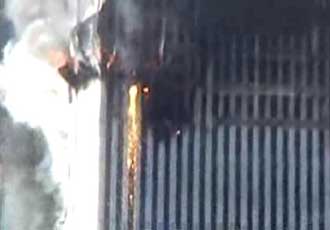
How do we know the molten metal didn’t come from some underground source? We know this because there are photographs that clearly show molten metal flowing from the 81st floor of the South Tower BEFORE collapse. Some have tried to explain this by saying that it is molten aluminum from the planes.
Aluminum may glow at a high enough temperature but it’s ridiculous to suggest that aluminum burned underground for three months. Molten metal was found under Building 7, which was not hit by a plane. Those of you who refuse to consider the “demolition” possibility might want to try and explain where this molten metal came from.
By the way, the existence of these “hot spots” under all three buildings was confirmed by aerial thermal images taken by NASA in the first two weeks after 9/11.
As for proving that the molten steel was actually there, photographs show it, and even then New York Mayor Rudy Giuliani talked about it publicly. He talked about how the boots of emergency workers would melt after a few hours of clearing rubble.
Many other witnesses reported the presence of the molten pools under the building rubble. Leslie Robertson, one of the designers of the World Trade Center, reported molten metal running under the buildings 21 days after 9/11.
Public health adviser Ron Burger likened the pools to a volcano. Other workers say it looked like a foundry or that the metal “looked like lava.” Witnesses say they saw molten steel “dripping from beams and walls” in the basement of the towers. New York firefighters referred to “rivers of molten metal” under the rubble.
SOMEONE NEEDS TO EXPLAIN THIS.
The FEMA report also mentions sulfur residue on the steel beams of the towers after collapse. This also supports the controlled demolition theory because sulfur is used to lower the melting point of the steel. Sulfur combined with thermite creates thermate. This dramatically speeds up the melting of the steel.
If there’s a reasonable explanation for all of this, why haven’t we heard it? And if you’re wondering if the whole controlled demolition case might all rest on this, you can be assured it does not.
It’s just the beginning.
Featured Video
9/11 In Perspective
or go to
Aletho News Archives – Video-Images
From the Archives
Still No End in Sight of the Murder and Mayhem Wrought by the 9/11 Culprits
By Prof. Tony Hall | American Herald Tribune | July 17, 2016
The Kevin Barrett-Chomsky Dispute in Historical Perspective – Fourth part of the series titled “9/11 and the Zionist Question”
Back in 2006 all but a prescient few, such as Christopher Bollyn, perceived it as premature to try to identify and bring to justice the actual perpetrators of the 9/11 crimes. There was still some residue of confidence that responsible officials in government, law enforcement, media and the universities could and would respond in good faith to multiple revelations that great frauds had occurred in interpreting 9/11 for the public.
Accordingly, the main methodology of public intellectuals like Dr. Kevin Barrett or, for instance, Professors David Ray Griffin, Steven E. Jones, Peter Dale Scott, Graeme MacQueen, John McMurtry, Michael Keefer, Richard B. Lee, A.K. Dewdney, Nafeez Mossadeq Ahmed, and Michel Chossudovsky, was to marshal evidence demonstrating that the official narrative of 9/11 could not be true.
The marshaling of evidence was spurred on by observations coming from government insiders like Eckehardt Wertherbach, a former head of Germany’s intelligence service. In a meeting in Germany with Christopher Bollyn and Dr. Andreas von Bülow, Wertherbach pointed out that, “an attack of this magnitude and precision would have required years of planning. Such a sophisticated operation would require the fixed frame of a state intelligence organization, something not found in a loose group like the one led by the student Mohammed Atta in Hamburg.”
Andreas von Bülow was a German parliamentarian and Defense Ministry official. He confirmed this assessment in his book on the CIA and 9/11. In the text von Bülow remarked that the execution of the 9/11 plan “would have been unthinkable without backing from secret apparatuses of state and industry.” The author spoke of the “invented story of 19 Muslims working with Osama bin Laden in order the hide the truth” of the real perpetrators’ identity. … continue
Blog Roll
 Aletho News
- Kaja Kallas: an uncomfortable figure useful to the EU’s Russophobic purposes
- German state blacklists right-wing party for first time
- Romania’s stolen elections were only the start: Inside the EU’s war on democracy
- Hawaii bills would allow gov’t to quarantine people, enter property without permission, seize firearms, and suspend laws
- Epstein files may contain ‘crimes against humanity’ – UN
- UK Government Plans to Use Delegated Powers to Undermine Encryption and Expand Online Surveillance
- Epstein Files Expose Israeli Occupation of America
- The Mandelson Molecule: Exposing the Architecture of Cross-Border Political Suppression
- The U.S. Sanctions Cuban Journalist For Reporting On The U.S. Blockade
- Israeli firms transform cars into intelligence devices: Reports
- If Americans Knew
- Why won’t Trump’s “Board of Peace” bring peace? – Not a ceasefire Day 131
- Help end the injustice against Shadi
- Israel’s Favorite American President
- Israel’s “Yellow Line” Is a Death Trap for Palestinians. We Drove Into It.
- Why Israel’s expanding occupation in Syria presents a critical legal test
- Gaza is not a natural disaster. It is the victim of genocide enabled by global inaction
- Netanyahu’s plan to “end” US aid to Israel is to give even more money under a different name
- Israel ceased firing on Gaza for just 15 days of the “ceasefire” – Not a ceasefire Day 130
- In Gaza, “rats run over our faces” – Not a ceasefire Day 129
- Israel-backed border guards, GHF-linked aid – Not a ceasefire Day 128
- No Tricks Zone
- Coal Power Back In Trend As Globe Tries To Keep Pace With Growing Demand For Power
- New Study: A 4°C Warmer Beaufort Sea Had ‘No Sea Ice’ 11,700 – 8200 Years Ago
- Unfudging The Data: Dutch Meteorological Institute Reinstates Early 20th Centruy Heat Waves It Had Erased Earlier
- German Gas Crisis…Chancellor Merz Allegedly Bans Gas Debate Ahead of Elections!
- Pollen Reconstructions Show The Last Glacial’s Warming Events Were Global, 10x Greater Than Modern
- Germany’s Natural Gas Storage Level Dwindles To Just 28%… Increasingly Critical
- New Study Rebuts The Assumption That Anthropogenic CO2 Molecules Have ‘Special’ Properties
- Climate Scientist Who Predicted End Of “Heavy Frost And Snow” Now Refuses Media Inquiries
- Polar Bear Numbers Rising And Health Improving In Areas With The Most Rapid Sea Ice Decline
- One Reason Only For Germany’s Heating Gas Crisis: Its Hardcore-Dumbass Energy Policy
 Aletho News