Professor Salaita Sues University of Illinois For Free Speech Rights
By Deirdre Fulton | Common Dreams | January 29, 2015
Professor Steven Salaita, a Palestinian-American professor of Indigenous studies whose offer of a tenured position at the University of Illinois at Urbana–Champaign was rescinded last year because of his tweets criticizing the Israeli government’s bombing of Gaza, has filed a civil rights suit against the school and its top officials and donors, saying that his termination violated his First Amendment right to free speech and other constitutional rights, as well as basic principles of academic freedom.
“Like any American citizen, I have the right to express my opinion on pressing human rights concerns, including Israeli government actions, without fear of censorship or punishment,” Salaita said in a statement. “The University’s actions have cost me the pinnacle of academic achievement—a tenured professorship, with the opportunity to write and think freely. What makes this worse is that in my case the University abandoned fundamental principles of academic freedom and shared governance, crucial to fostering critical thought, that should be at the core of the university mission.”
Salaita, who is being represented by the Center for Constitutional Rights along with the Chicago civil rights law firm of Loevy & Loevy, filed the lawsuit Thursday in a U.S. federal court in Chicago.
The complaint (pdf) alleges that university officials, including the chancellor and university trustees, violated Salaita’s constitutional rights to free speech and due process of law, and breached an employment contract with him. According to CCR, the suit is also against university donors who, based on emails made public, unlawfully threatened future donations to the university if it did not fire Salaita on account of his political views.
As Common Dreams reported in September, Salaita had been awarded the tenured position in fall 2013 and was scheduled to begin on August 16, 2014—just two weeks after Chancellor Phyllis Wise rescinded the offer. University documents released in response to a public-records request revealed that Wise had been pressured by numerous pro-Israel students, parents, alumni, and big-money donors to abort his appointment. These demands followed critical comments by Salaita regarding Israel’s most recent attack on Gaza, during which thousands of Palestinians, including hundreds of children, were killed.
The university’s action, which Wise explained was taken because Salaita’s speech lacked “civility,” spurred protests from within the university as well as the academic community at-large. Sixteen academic departments of the university have voted no confidence in the university administration, and prominent academic organizations, including the American Association of University Professors, the Modern Language Association, and the Society of American Law Teachers have publicly condemned the university’s actions.
“The use of ‘civility’ as cover for violating Professor Salaita’s rights must be challenged, as it threatens the very notion of a University as a place for free inquiry and open debate,” said Maria LaHood, a senior attorney with the Center for Constitutional Rights. “There is neither a ‘civility’ exception nor a ‘Palestine’ exception to the First Amendment.”
According to CCR, the lawsuit seeks Salaita’s reinstatement and monetary relief that includes compensation for the economic hardship and reputational damage he suffered as a result of the university’s actions.
“Only donor pressure, or sheer pride, can explain the administration’s stubborn refusal to revisit a decision that has done so much harm to Dr. Salaita and to constitutional and other principles that academics hold dear,” said Anand Swaminathan of Loevy & Loevy. “The administration has something to hide, and through this lawsuit we intend to expose it.”
Netanyahu and His Wife Sued For ‘Racist and Physical Abuse’ of African Bodyguard and Maid
By Zeidy David | Counter Current News | January 26, 2015
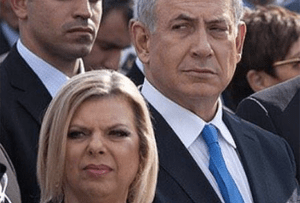 Benjamin Netanyahu has long been accused by Palestinians and African refugees of being a racist. But now the Israeli Prime Minister is being sued by a former bodyguard who says that he was constantly subjected to racist and physical abuse.
Manny Naftali, 35, says that Bibi and his wife Sarah did not just provide him with a job, primarily as a bodyguard, they also provided him with constant abuse. The former soldier says that the humiliating treatment by Mrs Netanyahu was the worse, and it occurred almost entirely with her husband’s knowledge.
The lawsuit was just filed with Jerusalem district labour court. Mr Naftali explains in the suit that he worked for 20 months at the Balfour Street residence.
During that time, he describes one particularly disturbing incident when Mrs Netanyahu complained to him about a Shabbat meal.
“We are sophisticated Europeans,” she explained to the Moroccan-descended Naftali. “We don’t eat as much food as you Moroccans. You are stuffing us, so that when they photograph us abroad, we look fat.”
It is unclear why the meal was being blamed on their African Jewish bodyguard.
Mrs Netanyahu also woke him at 3am once just to tell him that he had bought the wrong kind of milk the day before. The intention seemed clearly just to harass Naftali, not to explain her shopping preferences to him. Again, it would seem that the bodyguard was being asked to perform many jobs well outside of the boundaries of his job description.
“When I complained about the time and the tone in which she spoke the harsh words to me, Mr Netanyahu interfered in the discussion and said I should do everything Mrs Netanyahu asked ‘so she will calm down’,” Mr Naftali explained.
Once Sarah Netanyahu smashed a vase of flowers on the floor after discovering the flowers Naftali had placed in them were not fresh. Naftali, she said, “was a poor manager and that such a thing would never happen at the Elysee Palace”.
Naftali said that he was hardly the only one to allege such treatment. A full 29 staff members left “on a bad note.”
“It was made clear to me that I would have to work with a bitter and undermanned staff, and an unreasonable workload and an unending turnover of household workers who refused to work in the presence of the prime minister’s wife,” he added.
Naftali is suing for financial damages, but he is also demanding an apology after Bibi told a television interviewer that Mr Naftali was fired when in fact he had resigned.
This follows a suit in 2010 against the Netanyahus, where their maid, Liliane Peretz said she was constantly shouted at, humiliated, overworked and underpaid. She was also insultingly forced to change her cloths repeatedly throughout the day because the Netanyahus said she was unhygienic.
Angry Man Threatens Students at University of Toronto Scarborough
January 24, 2015
Dear University of Toronto and University of Toronto Asset Management Corporation:
This is in response to the recent assault on student activism and student spaces at the University of Toronto Scarborough Campus:
On Thursday November 6, a 34 year-old man with no affiliation to the University of Toronto furiously entered the Scarborough Campus Students’ Union office after hours. He stole a poster that read WARNING: THIS UNIVERSITY PROFITS OFF ISRAELI APARTHEID AND OCCUPATION. All attempts to calm him down failed. After stealing the poster he drove off, recording the incident with his phone. Campus police filed a report and said to notify them if the man returns. After a couple of weeks we put up another sign. The man came back. He forced his way into the student union. We tried to calm him down and initiate dialogue. The man replied with, “I’ll rip your fucking throat out” and “I have twelve guys on standby ready”—implying that he or other people will be back. He shouted that he use to be a part of the “israeli” military and regularly killed “terrorists”. Campus police came to the scene and issued the man a Notice of Trespass for the UTSC campus.
In fury, we wondered how a man with no affiliation to the University of Toronto invaded student spaces, threatened students, stole private property, and walked away with just a Notice of Trespass. Why hasn’t the University been held accountable for investing in companies such as Northrop Grumman and Lockheed Martin, both of which supply F-16 bomber jets and Hellfire missiles to “israel”? Why do our tuition dollars continue to fund “israel’s” colonization and ethnic cleansing of Palestine? The University—rather than addressing their complicity—responded with increased policing of student union spaces and activism. We are not looking for increased policing of activist activities, we want to cut ties with international law violations without facing death threats. If the University of Toronto did not invest in these companies we would not be threatened repeatedly on University grounds.
We demand that the University of Toronto, University of Toronto Asset Management Corporation:
– Immediately divest from companies complicit in international law violations, including all companies profiting off “israel’s” colonization and ethnic cleansing of Palestinian land.
– Apologize and take accountability for the violence and death threats we’ve incurred as a result of raising awareness of UTAM’s investments.
– Ensure safer spaces for student organizers not through increased policing and surveillance but rather by validating our voices and addressing our concerns.
U of T Divest – Scarborough
Fiji compensates victims of 1950s UK nuclear tests
RT | January 30, 2015
Fiji’s prime minister said his island nation would compensate soldiers exposed to radiation during British nuclear tests in the Pacific more than 56 years ago.
The British government has refused to pay any compensation, but Prime Minister Voreqe Bainimarama said Fiji could wait no longer.
“We are righting a wrong. We are closing an unfortunate chapter in our history,” Bainimarama said at a ceremony recognizing the suffering of the veterans.
“We are bringing justice to a brave and proud group of Fijians to whom a great injustice was done.
“Fiji is not prepared to wait for Britain to do the right thing. We owe it to these men to help them now, not wait for the British politicians and bureaucrats.”
Veterans and their families have campaigned for decades to get payouts for their health problems. More than 70 Fijians were stationed on Kiritimati, then known as Christmas Island, during the 1957 and 1958 nuclear tests during the Cold War.
As a result, they suffered serious health problems, including leukemia and other blood disorders, due to the radiation they were exposed to.
The 24 survivors who attended the ceremony each received Fiji$9,855 (£3,181) from a compensation pool of Fiji$2.95 million (£950,000).
“We were only told that we will go there to test some weapons, but when we got there we found out that we were brought there to be part of the British test of weapons of mass destruction,” survivor Naibuka Naicegulevu, 76, whose job was to clean and repair vehicles on the island, told AFP.
“My two sons, now in their early 30s, get sick suddenly and they can be ill for one week, sometimes more, this is all because of the radiation that we were exposed to,” he added.
Bainimarama said Fiji, which was a Crown colony until 1970, could no longer afford to wait for Britain to take the lead on compensation.
“The ranks of these survivors are rapidly thinning. Too many men – our fellow Fijians – have gone to their graves without justice. Those who remain deserve justice and Fiji as a nation is determined for them to finally get it,” he said.
Legacy of Endless Afghan War Includes Nation Plagued by Unexploded Bombs
By Jon Queally | Common Dreams | January 29, 2015
As seen in other abandoned battlefields in the anals of U.S. wars overseas, new reporting out of Afghanistan shows that among the other deadly legacies left behind by foreign troops are tens of thousands unexploded munitions dropped from the sky or left in the ground that will continue to kill and maim civilians long after the “official” fighting has stopped.
Reporting from the Afghan city of Khost, Guardian foreign correspondent Sune Engel Rasmussen reviewed data and spoke with members of the UN’s Mine Action Coordination Centre of Afghanistan (Macca) to learn that unexploded bombs and shells in Afghanistan “are killing and maiming people at a rate of more than one a day”—the vast majority of whom are children.
Citing MACCA statistics from 2014, Rasmussen reports “there were 369 casualties in the past year, including 89 deaths. The rate rose significantly in October and November when 93 people were injured, 84 of them children. Twenty died.”
Offering a tragic account of siblings from a single family, Rasmussen relays the story of 10-year-old Mohammad Yunus and his eight-year-old sister, Sahar Bibi. “The grenades that killed Mohammad and Sahar, as they were combing through dry branches to collect firewood for their family, should have detonated long before they were picked up. Instead, the shells exploded in the children’s hands and ripped through their bodies, killing them instantly. The blasts also injured their two brothers, aged five and 12.”
In a war that has spanned more than twelve years—with no end in sight—it is not surprising that the number of unexploded ordnances (UXOs) has risen to alarming rates, but as was true in the U.S. war in southeast Asia—where the nations of Laos, Vietnam, and Cambodia continue to suffer the consequences of years of carpet bombing by the U.S. military—the problem will not go away just because the war is at some point declared over.
As the Guardian reports:
Though first steps have been taken to tackle [UXO], agencies complain the US-led forces are withholding information about where they may have dropped explosives.
“We ask for information about battlefields that may have UXO, but we have received coordinates for only 300 locations. It’s not enough,” said Mohammad Sediq Rashid, director of Macca.
Colonel Calvin Hudson, Nato’s Combined Joint Task Force chief engineer in Kabul, says Nato gives as much information to mine-clearing agencies as possible without compromising operational operational security – coordinates for areas where Afghan forces continue their operations are withheld.
Much of the fighting in Afghanistan has taken place in and around residential areas, increasing the risk of civilian casualties in the aftermath of the war. UK and US diplomats emphasise that international law does not give their countries a responsibility to clear battlefields. But that does not absolve Nato countries of their duty to clean up after themselves, said Rashid.
US Company’s Rice Plantation Pushes out Nigerian Communities
teleSUR | January 29, 2015
After years of working with the government to develop a sustainable community agriculture system, over 40,000 Nigerians will now have to fend for themselves after their land was given away to U.S. food company Dominion Farms, international human rights groups told teleSUR Thursday.
“The land in question is taken from the farmers,” Raymond Nyayiti Enoch from the Center for Environmental Education and Development (CEED) Nigeria told teleSUR via email.
“Added still, they will have no alternative fertile land of food production because the Federal Government Agency, the Upper Benue River Basin Development Authority (UBRBDA) have spent years developing the land and working with the farmers to boost food production in the way and manner beneficial to the farmers and their community,” he said.
A report was released Wednesday detailing a land grab case in the Gassol community in Nigeria’s northeastern Tabara State, where Dominion Farms has taken over a large swath of fertile community land in order to develop a 300-square-kilometer rice plantation.
The move comes as a shock to the communities, who were kept in the dark about the development decision and who had previously been working with the government to develop small-scale, community agriculture that they could depend on for food.
For years, the federal government has been trying to increase international investment in Nigeria’s agriculture sector in order to increase local food production and become a food exporter in order to increase GDP.
However, according to Enoch, potential economic benefits for the country come at a high price. The secretive way in which the government carried out the transaction with Dominion Farms could cause internal conflict, not only between the federal government and the tens of thousand of Nigerians affected by the sudden loss of land, but also with the government-led UBRBDA who the federal bodies involved excluded from the deal.
“It poses a potential conflict that would mar the production process even before its started,” said Enoch, who added that this will make it hard to attract further international investment.
Ange David, member of GRAIN, an international rights group that supports small farmers, said the government is taking the wrong tactic if its trying to improve its economy.
“Nigeria has a target to resolve the problem of employment, so how [will it] resolve it by this kind of ‘investment’ who will put more than 40,000 persons on the street or push [them] to leave their village and to join the urban zone like Abuja or Lagos,” David told teleSUR in an email, referring to two of the most populous cities in Nigeria that experience high poverty rates.
“As we know, the major occupation of the people of Taraba is agriculture,” said David. “So how can we imagine that this land grab can help that communities who will lose the land for ever.”
According to Enoch, this is the first major land grab in Nigeria, with several others “looming” across the country, including in the same state of Tabara.
Nigeria is one of the many countries around the world being affected by U.S. multinational companies and their land grabbing strategies.
In Sierra Leone, a western African nation embattled by Ebola, the people have joined forces to combat another virus, that of “multinational companies,” which have recently taken advantage of the poverty stricken communities to buy up their lands at negligible prices. This only benefits the corporations, leaving the population without the possibility of cultivating their own land.
Also see: Paraguay: Big Business Want to “Eliminate Farmers and Indigenous Communities” Says Activist
The American Sniper Was No Hero
By Sleldon Richman | FFF | January 28, 2015
Despite what some people think, hero is not a synonym for competent government-hired killer.
If Clint Eastwood’s record-breaking movie, American Sniper, launches a frank public conversation about war and heroism, the great director will have performed a badly needed service for the country and the world.
This is neither a movie review nor a review of the late Chris Kyle’s autobiographical book on which the movie is based. My interest is in the popular evaluation of Kyle, America’s most prolific sniper, a title he earned through four tours in Iraq.
Let’s recall some facts, which perhaps Eastwood thought were too obvious to need mention: Kyle was part of an invasion force: Americans went to Iraq. Iraq did not invade America or attack Americans. Dictator Saddam Hussein never even threatened to attack Americans. Contrary to what the George W. Bush administration suggested, Iraq had nothing to do with the attacks on Sept. 11, 2001. Before Americans invaded Iraq, al-Qaeda was not there. Nor was it in Syria, Yemen, and Libya.
The only reason Kyle went to Iraq was that Bush/Cheney & Co. launched a war of aggression against the Iraqi people. Wars of aggression, let’s remember, are illegal under international law. Nazis were executed at Nuremberg for waging wars of aggression.
With this perspective, we can ask if Kyle was a hero.
Defenders of Kyle and the Bush foreign policy will say, “Of course, he was a hero. He saved American lives.”
What American lives? The lives of American military personnel who invaded other people’s country, one that was no threat to them or their fellow Americans back home. If an invader kills someone who is trying to resist the invasion, that does not count as heroic self-defense. The invader is the aggressor. The “invadee” is the defender. If anyone’s a hero, it’s the latter.
In his book Kyle wrote he was fighting “savage, despicable evil” — and having “fun” doing it. Why did he think that about the Iraqis? Because Iraqi men — and women; his first kill was a woman — resisted the invasion and occupation he took part in.
That makes no sense. As I’ve established, resisting an invasion and occupation — yes, even when Arabs are resisting Americans — is simply not evil. If America had been invaded by Iraq (one with a powerful military, that is) would Iraqi snipers picking off American resisters be considered heroes by all those people who idolize Kyle? I don’t think so, and I don’t believe Americans would think so either. Rather, American resisters would be the heroes.
Eastwood’s movie also features an Iraqi sniper. Why isn’t he regarded as a hero for resisting an invasion of his homeland, like the Americans in my hypothetical example? (Eastwood should make a movie about the invasion from the Iraqis’ point of view, just as he made a movie about Iwo Jima from the Japanese point of view to go with his earlier movie from the American side.)
No matter how often Kyle and his admirers referred to Iraqis as “the enemy,” the basic facts did not change. They were “the enemy” — that is, they meant to do harm to Americans — only because American forces waged an unprovoked war against them. Kyle, like other Americans, never had to fear that an Iraqi sniper would kill him at home in the United States. He made the Iraqis his enemy by entering their country uninvited, armed with a sniper’s rifle. No Iraqi asked to be killed by Kyle, but it sure looks as though Kyle was asking to be killed by an Iraqi. (Instead, another American vet did the job.)
Of course, Kyle’s admirers would disagree with this analysis. Jeanine Pirro, a Fox News commentator, said, “Chris Kyle was clear as to who the enemy was. They were the ones his government sent him to kill.”
Appalling! Kyle was a hero because he eagerly and expertly killed whomever the government told him to kill? Conservatives, supposed advocates of limited government, sure have an odd notion of heroism.
Excuse me, but I have trouble seeing an essential difference between what Kyle did in Iraq and what Adam Lanza did at Sandy Hook Elementary School. It certainly was not heroism.
Cuba Détente
By ROBERT SANDELS and NELSON P. VALDÉS | CounterPunch | January 28, 2015
“I do not expect the changes I am announcing today to bring about a transformation of Cuban society overnight.”
— Barack Obama, Dec. 17, 2014
President Obama’s Dec. 17 statement announcing changes in U.S. Cuba policy was a mixture of historical truths and catch phrases drawn from the catalog of myths about Cuba and U.S. policy goals.
The first round of rule changes, announced by Jan. 16 by the Office of Foreign Assets Control (OFAC), was significant in the areas of trade and banking. At the same time, much of the language is drawn from the old justifications for regime change. (Let us put aside the hypocrisies in Obama’s speech such as the instruction — coming from a country where labor unions have been systematically destroyed — that “Cuban workers should be free to form unions.”)
In his speech, Obama reworked Einstein’s famous definition of insanity to support his partial abandonment of the half-century attempts to destroy the Cuban revolution. “I do not believe we can keep doing the same thing for over five decades and expect a different result,” said Obama. (If he means that the policy he has supported for six years is insane, what does that say about him?)
Nowhere in the speech did Obama renounce the longstanding U.S. commitment to regime change in Cuba or even acknowledge that it ever existed. While implicitly recognizing that the use of sanctions to achieve political results had failed, he continues to pursue them in Korea, Russia and elsewhere. One day after making the Cuba speech, he signed a bill imposing sanctions on Venezuela alleging that the government of President Nicolas Maduro had violated the human rights of protestors during violent anti-government demonstrations last February. The demonstrations were led by right-wing representatives of the Venezuelan elite who have long been backed by the United States.
We should note that the phrase about doing the same thing for over five decades and expecting a different result is incorrect. True, five decades ago the Eisenhower administration broke diplomatic relations with Cuba, but since then his 10 successors, who account for 14 presidential terms, tried a variety of other “things” besides cutting diplomatic relations. There were the commando raid things launched from U.S. territory by Cuban exiles burning cane fields and sugar mills and the CIA-trained underground blowing up movie theaters and shopping centers. Then of course, there was the Bay of Pigs invasion thing by an exile expeditionary force landing in a swamp. That was a really big thing. With that failure came Bobby Kennedy’s Operation Mongoose thing, which was expected to be a let’s-get- it-right-this-time do-over of the Bay of Pigs disaster.
Since the 1962 Missile Crisis, there have been endless “democracy promotion” things financed by CIA front organizations. There have been clandestine anti-Cuban shortwave things broadcast from all manner of conveyances — yachts, balloons, zeppelins, airplanes. Leaflets, books and pamphlets of every kind were surreptitiously sent to Cuba in tourist luggage, in diplomatic pouches, hidden in hollow trees and even dropped from airplanes. Then there were the hit-and-run attacks from speedboats shooting up Russian ships, Cuban fishing boats, coastal hotels and hamlets.
Alan Gross, pretending to bring computer equipment to synagogues in Cuba that didn’t need them, is only a recent and not the last example of the often ludicrous plotting of various U.S. government agencies. Currently, the U.S. Agency for International Development (USAID) is at the forefront of the regime-change program. Obama did not mention the Gross thing but revealed that he would have proposed détente earlier had Cuba not imprisoned him.
Obama has it backwards. It’s not the “thing” that needs to be changed but the desired “result.” His new policy direction does not promise to end imperial bullying or to accept Cuban independence and sovereignty. Why else would he say the new thing he has in mind “will promote our values through engagement”?
Making the crime fit the punishment
To justify the long hostility toward Cuba, the United States has created a Cuba that never existed; a tropical gulag of indiscriminate terror where hordes of political prisoners rot while a cartoon dictator recites hours of his political poetry to a captive audience.
It is not surprising that the external and domestic opponents of the Cuban government, whether or not they are paid by the United States or its European partners, do not have their own vision of what a post-Castro society would look like. They and Obama are bound by the official blueprint drawn up by Congress in the Helms-Burton law of 1996, which essentially calls for a non-Cuban Cuba.
What would happen to employment, housing, health care and education in the new Cuba of Washington and Miami invention? Why is it that regime change is couched in fuzzy terms like “freedom” devoid of any economic, social or cultural content? And why is it that Obama criticizes the old policy because it “failed to advance our interests” without acknowledging what those interests really are?
Nothing in Obama’s speech corrects the half-century assault on truth. Many of the media commentaries on the Obama speech recite from the fantasies concocted over the years to mask the insanity of the policy. Here is just a sampling:
-Seventy-five Cubans dissidents were arrested in April 2003 in what is called the Black Spring. Ever since then they have been referred to as political prisoners or freedom fighters.
Actually, they were tried and convicted in a Cuban court for operating as paid agents of the pretend dissident movement funded by the United States. Roger Noriega, former assistant secretary of state for Western Hemisphere Affairs, conspired with James Cason, then head of the U.S. Interest Section in Havana, to openly encourage local dissidents hoping that the Cuban government would kick Cason out and give George W. Bush an excuse for closing the Cuban Interest Section in Washington and worsening bilateral relations. The scheme is what got the 75 arrested.
Among the 75 were journalists, few of whom ever practiced journalism. There also were pretend independent librarians paid by the United States to pose as part of a pretend grassroots defiance of a pretend Cuban control of what people could read.
A report to the American Library Association in 2001 described how one of the “independent” libraries in Cuba “consisted of four or five dusty shelves of books.” A woman in one of these libraries said, “No books had ever been confiscated [and] that she was not being intimidated or threatened by the government as a result of having this collection….The woman receives many of her books as well as payment for her activities from the U.S. and Mexico but would not identify individual sources. She said she was asked to operate the library because she is a dissident.”
-Cuba always blocks U.S. efforts to improve relations.
The example often cited is the shooting down in 1996 of two private exile planes near the Cuban coast. But Fidel Castro did not plot with well-known terrorist José Basulto, founder of Brothers to the Rescue, to have him organize provocative flights over the Cuban capital; Basulto did that on his own. It was the shootdown that led to enactment of the Helms-Burton law, which now prevents Obama from lifting the blockade. So, was it Fidel Castro or Helms, Burton and Basulto who torpedoed some supposed improvement in bilateral relations?
– The Cuban Five were spies.
Nearly every news outlet continues to refer to the five Cuban agents imprisoned in 1998 as “spies.” (The last three were released as part of the Obama opening.)
Actually, they were Cuban agents who infiltrated Brothers to the Rescue and other counterrevolutionary groups in Florida and then alerted the FBI to their plans for attacks against Cuba from the United States in violation of U.S. law.
– Alan Gross, who, was released from prison on “humanitarian grounds” as part of the Obama opening, was unjustly imprisoned in Cuba.
Actually, he was a sub-contractor working under a USAID grant and sent on five trips to Cuba to set up clandestine electronic networks as part of the U.S. subversion obsession and therefore correctly imprisoned. People who do that sort of thing in the United States can be tried as unregistered agents of a foreign power and sent to prison, just like Alan Gross.
Where did all those doctors come from?
The president’s positive comment on Cuba’s contribution to fighting Ebola in Africa has been noted as one of the inducements for change. Good, but Obama needs to explore what Cuba’s worldwide medical missionary program says about the island.
Imagine what it would take for the mythical Cuba the United States created, with its tiny population of the impoverished and the oppressed, to produce such quantities of surplus doctors, nurses and medical technicians who are now working in 66 countries. If Obama could admit that his mythical Cuba could never have done that, he might start setting the historical record straight and maybe ask the Cubans to advise him on Obamacare.
Today Cuba has 75,000 physicians or one per 160 inhabitants. Approximately 132,000 medical/health professionals have provided medical and dental attention to poor people abroad. At present, there are over 50,000 medical workers and no less than 25,000 doctors working outside of Cuba. In 2013, the health sector had 322,627 health professionals and technicians – that is, 28.9 per 1000 inhabitants — 76,836 physicians and 14,964 dentists as well as 88,364 nurses.
All of these accomplishments at home and abroad have taken place while the U.S. government persisted in enticing doctors, nurses and other professionals to leave Cuba. Remember, it was the people of Cuba who, we are incessantly told, make only $20 a month, who paid for their education even as Cuba confronted relentless U.S. financial and economic obstruction. Does Obama intend to reimburse the Cubans?
The United States calls the maze of economic and commercial sanctions an embargo. (The Cubans, referencing international law, call it a blockade.) Obama cannot unilaterally put an end to this kind of warfare but must wait for Congress to act. While the executive branch has the constitutional power to define foreign policy, Bill Clinton signed the Helms-Burton bill transferring control of Cuba policy to Congress. This was the second time he relinquished executive power over Cuba policy. The first was in 1992 when, running against George H.W. Bush, he announced his support for the Torricelli Act, which severely tightened trade restrictions. Obama’s Democratic predecessor made it necessary for him to go before Congress in his recent State of the Union message and ask Republicans to give back his foreign policy powers.
New rules
Clearly, the old rules lacked consistency. For example, when OFAC travel and remittance rules affecting Cuban-Americas were relaxed in the past, the justification was always to promote democracy and to separate Cubans from dependence on their government. But, when the same rules were made more severe, as under George W. Bush, the justifications were the same.
OFAC’s new regulations will materially ease the sanctions. Some of the changes sound like attempts through administrative regulations, to overturn fundamental sanctions in the Helms-Burton law. These include new rules allowing direct interbank transfers with the U.S. banking system, the use of U.S.-issued credit and debit cards and the elimination of “cash and carry,” which was a burdensome requirement for Cuba in paying for imports in convertible currencies.
Nevertheless, other changes may conflict with old practices. For example, will the U.S. Treasury Department protect credit/debit card companies from lawsuits by U.S. nationals seeking compensation from the Cuban government? The logistics of these transactions remains to be clarified.
Travel to Cuba can now be insured by U.S. companies and U.S. airlines could fly to Cuba from any city if market demand is sufficient instead of from a few government-selected cities. The major airlines could then reduce the advantage that the smaller companies enjoyed until now.
The travel ban has been relaxed even as OFAC preserves the principle of controlling travel for political purposes. The 12 categories of allowable travel remain in place although now without requiring a written specific license and organized travel and tours will be opened to more players.
Still, restrictions remain. Those who will be able to travel more freely are prohibited by a watchful government from having fun. New categories of travel are authorized under the new rules, “provided that the traveler’s schedule of activities does not include free time or recreation in excess of that consistent with a full-time schedule.”
Picking winners for a Cuban market economy
Trade sanctions have always had the effect of indirectly “managing” the Cuba economy. The new rules can determine who gets to invest in or trade with Cuba and which Cuban sectors will receive the most benefit. The majority of U.S. firms will be left out of the great Cuban market economy as envisioned in Washington.
Until now only agricultural and some medical and educational materials could be sold to Cuba. The new regulations allow for an increase in the kinds of goods that Cuba can import from the United States such as construction and agricultural tools and machinery. However, these can only be sold to non-state sectors such as co-ops and private entrepreneurs. Thus, certain sectors of the U.S. corporate world will be given preferential treatment.
OFAC is also giving Cuban entrepreneurs in the private sector an advantage over the state, but the Obama administration also wants U.S. information technology corporations to invest in Cuba’s telecommunications infrastructure, which means selling services, software and equipment to the Cuban government.
Rules applied to the banking sector raise significant questions. Financial institutions will be allowed to open accounts in Cuban banks to simplify transactions that are authorized by the United States and Cuba. But will Cuban banks be allowed to do the same in the United States?
Are these U.S. banks going to open dollar accounts in Cuban banks? Are they going to be held liable for breaking the restrictions that the United States Treasury Department imposed on dozens of banks for doing the same thing? Less than 24 months, ago the Bank of Nova Scotia, Commerzbak, Credit Suisse and many others were charged with billions of dollars in fines. Will the new rules be retroactively applied or is this a case of sorry — bad timing?
Since 1962, any ship that called on a Cuban port was prohibited from entering a U.S. port for at least six months. Now, ships transporting food, medicine, medical equipment and other materials may, in case of some emergency in Cuba, go to Cuba and then enter any U.S. port without prejudice as can any other ship owned by the same company. But Cuba is still not permitted to use U.S. currency in international transactions or purchase of technologies that might have more than 10 percent of U.S. components.
Some U.S. companies shall not suffer
Obama appears to have come around to where former Secretary of State Henry Kissinger was in 1972 when he limited the scope of economic sanctions to protect the interests of selected U.S. corporations. In April of that year, Kissinger approved export licenses for three U.S. automakers with subsidiaries in Argentina permitting them to sell cars to Cuba. The State Department issued a statement that read in part, “Our policy toward Cuba is unchanged. We did not wish to see these U.S. companies suffer as a result of U.S. policy.”
Stifling trade and financial transactions in Cuba by withholding all the utilities of capitalism was inconsistent with promoting a free market, which is mentioned 13 times in Helms-Burton.
Do the new regulations show that Obama is rejecting the old insanity and striking out toward true respect for Cuban sovereignty? While there is symbolic importance in resuming formal diplomatic relations, there is nothing in normal diplomacy that prevents Obama from carrying on regime change schemes by other means. As he said Dec. 17, “we can do more to support the Cuban people and promote our values through engagement.”
Relaxing the restrictions on travel is fine but does anyone find Obama’s reasoning for doing so a little suspicious? “Nobody represents America’s values better,” said Obama, “than the American people, and I believe this contact will ultimately do more to empower the Cuban people.”
Obama wants to transfer information technology to Cuba. Good. He could also transfer to dissidents the supplies of military-grade microchips that Alan Gross was imprisoned for doing.
The day for celebration should be postponed until we see whether the true potential of Cuba’s social and political experiment can proceed unobstructed by an enraged superpower and whether the United States is ready to work with Cuba in bringing a more constructive future to both countries. Maybe by then Cuba can show the United States how to form labor unions.
Robert Sandels lives in Mexico and writes on Cuba and Mexico.
Nelson P. Valdés is Professor Emeritus, University of New Mexico. For more information on Cuba visit: http://www.cuba-l.com
Hollywood’s anti-Arab and anti-Muslim propaganda

Screengrab from American Sniper
By Noura Mansour | MEMO | January 29, 2015
The media plays a significant role in shaping public opinion and narratives. Over the years, it has become a force to be reckoned with in all aspect of life, culture, education, society, language, economy and, especially, politics. Visual media such as movies and TV shows are probably the most popular as there is a wide and diverse audience. Films and programmes target the hearts and minds of viewers, who tend to sympathise with characters and get caught up in the emotion of what they watch. The effect doesn’t end when the credits roll, as people internalise the sights and sounds they have witnessed. Some studies have shown that this not only affects viewers’ perceptions but also their behaviour, especially in the younger age groups.
Hollywood, the movie capital of the world, is as an efficient and powerful tool for mainstreaming American culture and values. However, with great power goes great responsibility. When it comes to films involving Arab and Muslim characters, Hollywood has proved repeatedly to be irresponsible, manipulative, misleading and biased. It has been presenting and reinforcing stereotypical images, which line up with belligerent and orientalist American policies towards Arabs and Muslims; the industry has seldom challenged that image or made an effort to reflect a more objective version.
“The Wind and the Lion” (1975); “Under Siege” (1986); “Wanted: dead or alive” (1987); “True Lies” (1994); “Homeland” (2011-2013); “World War Z” (2013); “Teenage Mutant Ninja Turtles” (2014); and “American Sniper” (2014), are all examples of films and TV programmes which contribute, directly or indirectly, to the constant vilification of Arabs and Muslims in the mainstream media. Some, such as “True Lies” and, most recently, “American Sniper” have done so openly by presenting uncivilised, violent and merciless Arab characters, which end up being killed as a part of the “happy” ending. Others have done it in a more subtle way, like “World War Z” and “Teenage Mutant Ninja Turtles”, for example.
In “World War Z”, the Israeli army and “security” agencies are portrayed as the guardians of Jerusalem, who built the Apartheid Wall in order to keep zombies locked-in behind it. In real life, the Wall functions as a racist barrier, a key component of Israel’s occupation policies which strip almost 3 million Palestinians in the West Bank of their rights and freedoms. That very same wall is presented in the film as a positive and necessary tool for the salvation of humanity. Israeli soldiers are the heroes and protectors, misleading viewers and distorting reality. By creating sympathy and positive feelings towards militant oppressors and a brutal colonial occupation whilst demonising those living behind the wall, the film provides a degree of legitimacy to Israel’s occupation and, indeed, to the state itself. It is worth remembering that Israel has, since 1948, committed numerous war crimes and crimes against humanity as it carries out the ethnic cleansing of Palestine.
If you don’t think anything is wrong with this let’s change a few variables and then consider whether you still think nothing is wrong. Instead of the Apartheid Wall, let’s use concentration camps to control the zombies and instead of Israeli soldiers the security is provided by those in Nazi uniforms. For the sake of objectivity, let’s add that ridiculous scene where Arabs and Israelis are singing together aimlessly about peace in Jerusalem; only let’s have Nazis and Jews singing together about peace instead. See what I mean?
Such a film would, rightfully, have caused outrage around the world for diminishing the suffering of European Jews during World War Two. It should have created a similar reaction for diminishing the ongoing suffering of the Palestinian people, but it didn’t.
Similarly, in “American Sniper”, US soldiers are glorified and Arabs are demonised. Saying that the movie is one-sided and biased is an understatement. American soldiers are presented as heroes, protectors and even at times victims in Iraq, whereas the Arabs are all presented as militants, including women and children, who are also engaged in fighting. There are no civilian Iraqis in this movie, except for one family, whose members are killed by Iraqi militants, of course, and not American soldiers.
The movie sends out a pernicious message at the very beginning that killing women and children is inevitable and is a part of a soldier’s duty to “protect”. The moral dilemma about such issues is absent. The sniper shoots to kill and not to disarm, even when the targets are women and children.
Furthermore, there is a clear objectification of Iraqi militants versus the humanisation of American militants. When an American soldier is killed, we get to see a close up of his face so that we can absorb his feelings and his wounds. However, when an Iraqi militant is killed, we only see his body falling down from afar; there’s no blood, no facial expressions and thus no feelings. In addition, American soldiers are more than just soldiers; they are husbands, fathers, sons and daughters, whereas Iraqi militants are one-dimensional.
The “hero” is a man admired for holding the record for the highest number of kills in Iraq and whose fellow soldiers call a “legend”; he shows no remorse over those whom he has killed. The only thing he regrets is not having the chance to kill more Arabs. It is no surprise that such a movie has evoked massive anti-Arab and anti-Muslim responses among cinema audiences in the United States; social media outlets are alive with people expressing enthusiasm for killing Arabs and Muslims.
Even when the plot has nothing to do with Arabs or Palestinians, Hollywood inserts completely irrelevant Arabic/Muslim cultural indicators, often planted on the bad guy, creating a false link between evil and Arabs or Muslims. In “Teenage Mutant Ninja Turtles” it is deemed appropriate, relevant and logical to use the Palestinian Keffiyeh scarf as a part of the Foot Clans’ (Shredder’s army) uniform even though the characters couldn’t be any further from the Arab/Muslim world geographically, culturally, socially and politically; they were originally meant to be Japanese.

Screengrab from Teenage Mutant Ninja Turtles
Hollywood promotes anti-Arab and anti-Muslim propaganda, by creating a false association between evil and Arabs and Muslims, regardless of the context of the plot, or by portraying them as the ultimate bad guys in all contexts and providing justification for illegal, immoral and inhumane practices against them. There is a long history of this, even in apparently innocent films.
This incitement against Arabs and Muslims could have disastrous outcomes. Feelings of hate and animosity towards Arabs are translated into actions in many places around the world, not only on a political level but also socially and physically. Whether cinema reflects life or vice versa, the powerful effect it has on us is undeniable. It is pertinent to ponder the words of Malcolm X in this respect: “If you are not careful, newspapers [media] will have you hating the oppressed and loving the oppressors.” The evidence for the truth of his words can be found without too much effort. Hollywood has a lot to answer for.
Dash Cam Video Shows Seattle Cop Falsified Charge Against Elderly Man Walking Down Street
By Carlos Miller | PINAC | January 28, 2015
Seattle police officer Cynthia Whitlatch was cruising down the street in her patrol car when she came across an elderly man standing on the corner using a golf club as a cane, prompting her to stop her car and order him to place the club down, claiming it could be a weapon.
William Wingate, a retired bus driver and Air Force veteran who was 69 at the time, said he’s been using that golf club as a cane for 20 years and refused to set it down.
So Whitlatch escalated the lying.
“You just swang that golf club at me …. It was on audio and videotape, put it down,” she said.
The incident took place last July, but Whitlach’s dash cam video was just released after a public records request by The Stranger, Seattle’s alternative weekly.
The video, posted below, shows Wingate remained professional but defiant, insisting she call another officer.
But when she did, the second officer took her side, arresting him on harassment and obstruction charges when it was clear from the video she was the only one harassing and obstructing his freedom to move freely in the city.
After spending a night in jail, King County prosecutors switched the charge against him to unlawful use of a weapon, obviously not bothering to watch the video.
Wingate, represented by a public defender who also didn’t watch the video, was told to sign an agreement stating the case would be dropped in two years if he complied with certain stipulations.
Fortunately, a former politician learned of the case and got involved, and eventually persuaded the judge to dismiss the case. But police never admitted wrongdoing, even after watching the video.
And Whitlach is still on the force, a protected liar who should be behind bars.
Because Wingate is black and Whitlach is white, she was accused of racial profiling, but police balk at that notion, insisting she would have falsified records to arrest him even if he had been white.
According to The Stranger :
In the police report filed by Officer Coles about the incident, Whitlach said “she observed him look at her and aggressively swing his golf club in the direction of her patrol car.”
“Because Wingate was still in possession of the golf club,” Coles wrote in the report, “and she was fearful of being assaulted by him, she said that she kept her distance from him upon exiting her patrol car.”
“It’s like, c’mon lady. You were lying,” Mason told me. “She wasn’t afraid of him at all.”
But the police commanders, including Metz and Davis, didn’t see it that way. Mason said they “tried to convince me nothing was wrong.”
Metz, in particular, “kept trying to convince us nothing was wrong here. He defended the officer.”
Nothing came out of that meeting, Mason said. But weeks later, she received a call from Deputy Chief Carmen Best, who, like Wingate, is black.
“The solution we came up with,” she said, “was actually good on the part of the [police] chief”—who’d assigned Best to look into the case. “It became African American and white women coming together to work on a solution.”
Weeks later, city prosecutors, after conferring with Best, recommended dismissing both the case against him and the two-year stipulation.
“They know that had this been a white man,” said Mason, “we wouldn’t be here.”
But, in fact, it appears they don’t know that. The Seattle Police Department insists racial bias played no role in the incident.
“If this person had been white,” said SPD spokesman Sean Whitcomb, speaking by phone on Tuesday, “I would imagine it would have been the same outcome. We don’t believe this was a biased policing incident. We don’t believe the officer acted out of malice or targeted this man because of his race.”
Whitlatch enjoys playing the victim having been one of 126 Seattle police officers last year who sued the Department of Justice, claiming the agency was infringing on their Constitutional rights by requiring them to be less violent towards citizens.
Her conversation with Wingate begins at the 1:40 mark.
UPDATE: The Stranger posted another story today, revealing some comments apparently made by Whitlach on Facebook regarding her disdain for black people who blame white people for their problems.
Featured Video

The Most Important Bet You’ve Never Heard Of
or go to
Aletho News Archives – Video-Images
From the Archives
The Occupied Mentality Syndrome
Saudi Arabia on the American chessboard – Part 2
By B. J. Sabri | American Herald Tribune | April 19, 2016
Since the Korean War, but particularly since the Iranian Revolution of 1979 until today, the United States has been steadily escalating its military presence in the Persian Gulf. Taking advantage of many colossal events of the past 36 years, [1] the hyper-empire has institutionalized its massive presence on land and sea, and expanded its objectives to include the unambiguous physical control of the area, as well as the clear understanding that local Arab governments should abide by them. The pretext is always the same: in “defense” of the national interests and security of the United States. From observing how the United States has been interacting with the governments of the region, and by judging from the size of its expeditionary force, we could reach a basic conclusion. The United States is occupying, de facto, the entire Arabian Peninsula. (Yemen, devastated by Saudi and American jets is yet to be conquered. Oman? Britain returned not as colonial ruler but as a soft occupying power.)
Under this articulation, Saudi Arabia, Qatar, Kuwait, and the United Arab Emirates are virtually occupied countries. If we compare this type of occupation to the mandate and protectorate regimes of the past, the results might be identical—the nations affected by it lose sovereignty. When Arab governments comply with the objectives of a foreign power that station military forces on their national milieu, then that power controls them in multiple ways including how they react to policy deliberations and what decisions they intend to take on specific issues. A good method to verify the concept of effective occupation is this: take notice of what the United States says and wants, and then compare it to what the gulf rulers do in response. (I shall discuss this detail at some point in the upcoming parts.)
If the presence of US forces or other means of political pressure are a factor in Saudi Arabia’s interventionist Arab wars, then we need to debate this issue. However, from the history of resistance to colonialism, we learnt: if a powerful state imposes its order on a nation by military means or other forms of coercion, and if this nation does not resist that imposition, then a mental subordination to the powerful state will ensue. This is especially true in the case of Saudi Arabia. One single event, 9/11, has transformed it from a US “ally” into an instant political hostage of the American Empire. … continue
Blog Roll
 Aletho News
- Trump and the debris of Iran war
- IRGC hits US tech giant Oracle’s data center, computing site in UAE over new assassinations
- Bombing Iran Back Into the Stone Age /Lt Col Daniel Davis & Jim Jatras
- UAE rejects report claiming it is ready to join war on Iran to reopen Hormuz
- A New Resistance Front: How Does Syria Factor into the Regional War?
- Gulf states weigh pipeline expansion plans, hoping to bypass Hormuz
- Iran sets up ‘tollbooth’ system in Strait of Hormuz
- Wave 90: IRGC strikes US-linked industrial sites in Gulf
- Iran Says US-Israeli Claims of Its Military Strength Are Wrong
- Trump’s April Fools’ Address to the nation
- If Americans Knew
- ‘War crime’: Global condemnation as Israeli ministers celebrate death penalty law targeting Palestinian prisoners
- 7 Ways Israel Is Turning Lebanon Into Gaza
- World’s Leading Football Bodies Under Fire Over Israel Policies
- Experts warn of possible use of nukes against Iran
- Israeli invasion of Lebanon could be worse than 1982, warn European officials
- Passover: Liberation and collective punishment
- Trump says the quiet part out loud: (Israel’s) war on Iran > Americans’ health – Daily Update
- Gaza families reunite years after babies evacuated amid Israel’s war
- International Rescue Committee warns Gaza’s children face grave protection risks
- Iran’s Alleged 47-Year War on America: Debunking the 1,050 American Deaths Canard
- No Tricks Zone
- Low Intensity Tornado Wrecks Major Solar Farm, Creating A Potential Toxic Dump
- New Study Finds Warming Saves Lives…Cold Temperatures 12 Times More Deadly Than Excess Heat
- German Science Blog Accuses PIK Climate Institute Of Hallucinating Climate Tipping Points
- Devastating Assessment Of Comirnaty Vaccine By Former Senior Pfizer Europe Toxicologist
- New Study: CO2 Is ‘Effectively Negligible’ As An Explanatory Climate Change Factor Since 2000
- Former Pfizer Toxicologist Dr. Helmut Sterz Tells Bundestag Hearing Pfizer Vaccine Should Have Never Been Approved
- Energy Expert: Germany’s Nuclear Phaseout Was A “500 Billion Euro Mistake”
- New Research: South Australia’s Mid-Holocene Sea Surface Temperatures Were 4°C Warmer Than Today
- Storing Green Energy To Last Germany 10 Days Would Require A 60-Million Tonne Battery
- New Studies: UK Sea Levels Were 4 Meters Higher Than Today During The Mid-Holocene
 Aletho News