Ex-NATO Chief Calls for Holy Crusade Against Russia in the Name of “Democracy”
Rasmussen’s case for war is built on a stack of lies
By Jon Hellevig | Russia Insider | April 22, 2015
In his op-ed in Project Syndicate, ex-NATO chief and former Danish PM Anders “Fog of War” Rasmussen calls for war against Russia in the name of democracy and the ever so elusive “Western values”. “The current conflict between Russia and the West is, at its core, a clash of values,” he announces to start with, but then through a seriously convoluted brain process arrives at the conclusion that “It is about democracy.” In his mind the latter must be the distilled sublime product of the former. And since it is about democracy, Mr. Fog of War reasons, “the West must respond accordingly.”
I cannot fathom why on earth this concept, “democracy”, this linguistic abstraction, stirs such passions in a man who, by all formal counts, should rank among the best that his nation, with its long traditions of progress, has produced. Isn’t this guy in actual fact taking us a thousand years back and calling for a Holy Crusade against Russia? The crusades were military campaigns in the name of a God and true interpretation of the scripture. They were sanctioned by the Roman Catholic Church during the Middle Ages with the ostensible goal to restore Christian access to holy places in Jerusalem. In reality, they were aggressive Western expansion attempts driven by economic and political reasons, fueled by personal ambitions and served to the European sheeple packaged in lofty religious causes.
Rasmussen, the former High Priest of NATO, is driven by all these exactly same considerations. He is supporting the NATO war effort to take a stranglehold of Russia with the actual aim to create a global hegemony led by the Western elite. As in the Middle Ages, so today, the idea of a war for the sake of pure conquest does not sell with the herds — if the pasture is good enough, then why bother — therefore, all you need to do is replace God with Democracy and the Ten Commandments with Western Values. (What easy work for the modern day apostles, the Western stink tanks — they do not actually have to spell out what these “values” are, not even in a list of ten).
I will not here expound on my view of what democracy is; suffice to say that it cannot be defined as a concept but rather as a result of social practices and societal conditions which enable the practices. I have elaborated on this in my book All is Art, where the second part is dedicated to this question under the title “Democratic Competition”. (From page 182 of this file).
Instead I will here treat you to a sample of what kind of “values” Rasmussen stands for as evidenced by the op-ed in question. These values are all firmly rooted in lies, as we will see.
1. Rasmussen writes: “Russian authorities recently threatened to aim nuclear missiles at Danish warships if Denmark joins NATO’s missile-defense system. This was obviously an outrageous threat against a country that has no intention of attacking Russia.”
In fact: Denmark is part of an anti-Russian war coalition which is — through vicious propaganda, economic warfare and military actions — continuously closing in on Russia with the aim to conquer it or force a regime change that would install a pliant Western puppet leader.
2. Rasmussen: “Russia’s leaders know very well that NATO’s missile defense is not directed at their country. … we repeatedly emphasized that the purpose was to defend Alliance members from threats originating outside the Euro-Atlantic area [Iran]”.
In fact: We all know this is total baloney.
3. Rasmussen: “Recall how the Ukrainian conflict began: Tens of thousands of Ukrainian citizens from all parts of society demanded, in overwhelmingly peaceful demonstrations, an association agreement with the European Union.“
In fact: We know very well that the protests were not peaceful and amounted to a Western managed, violent coup d’état.
4. Rasmussen: “No one was calling for a pogrom against Ukraine’s Russian-speakers, despite the Kremlin’s claims to the contrary.”
In fact: From the very beginning of Maidan, the protests where fiercely anti-Russia and soon resulted in unheard of physical harm and mass-murder against the population that identified themselves as Russian.
5. Rasmussen: “And NATO membership was not part of the deal.”
In fact: It was very much so.
6. Rasmussen: “Yet Russia reacted swiftly and harshly. Long before violence engulfed the protests, Russian officials began accusing the demonstrators of being neo-Nazis, radicals, and provocateurs.”
In fact: It is proven beyond any doubt that the most active part of the demonstrators were precisely neo-Nazis, radicals and provocateurs. And that the regime that came into power very much adopted their war cries and utilized those forces in their terror campaign all across Ukraine.
7. Rasmussen: “As soon as Ukraine’s then-President Viktor Yanukovych fled Kyiv, Russian President Vladimir Putin began engineering the annexation of Crimea.”
In fact: Here Rasmussen has a point, save for the word “annexation”. Funny, though, as the common Western line was always that Putin had been “scheming” this for years.
8. Rasmussen: “For Russia, the threat posed by the Ukrainian protesters was existential. In demanding change, freedom, and democracy – right on Russia’s doorstep, no less – the protesters challenged Putin’s model of “sovereign democracy,” in which the president eliminates all opposition, restricts media freedom, and then tells citizens that they can choose their leaders. The Kremlin feared that if the Ukrainians got what they wanted, Russians might be inspired to follow their example.”
In fact: So much nonsense that it does not deserve a comment. Shortly, we have seen what kind of “change, freedom, and democracy” they got under the new Western backed oligarch and neo-facsist regime.
9. Rasmussen: “That is why Russia’s leaders have been so keen to label Ukraine’s leaders as Russophobes and fascists.”
In fact: Russia does not need to do any labeling here; the Ukraine leaders and their subservient media speak for themselves.
10. Rasmussen: “It is why they have portrayed the Baltic States for years as dysfunctional oppressors of their Russian citizens.”
In fact: The Baltic states have, ever since their independence, run an oppressive apartheid system denying vast portions of their populations – mainly Russian ethnic nationals – even citizenship. And Fog of War knows that very well, coming from a neighboring country.
11. Rasmussen: “And it is why they are now portraying the EU as decadent, immoral, and corrupt.”
In fact: I have not seen Kremlin engaged in this, although I definitely think they should more actively call out these ignominious characteristics of the EU, which Rasmussen so correctly identified.
12. Rasmussen: ”The Kremlin is trying desperately to convince Russians that liberal democracy is bad, and that life under Putin is good. That requires not only spreading damaging lies at home, but also sowing violence and instability among its neighbors.”
In fact: Russia under Putin is much more a true liberal democracy in the classical sense of the concept. Life under Putin may not be as good as we all would like it to be, but it is for sure better than ever in Russian history and continuously improving, which cannot be said for the EU countries. “Sowing violence and instability in the world” — that is clearly the business of NATO and its member states.
After having enumerated this list of lies, Rasmussen concludes: “Despite whatever pain we incur, we must maintain – and, if necessary, deepen – sanctions against Russia and reinforce NATO’s front line. “
How long will the good Europeans be willing to sacrifice all they have for these warmongering lies?
Mass Surveillance is Driven by the Private Sector
By Bill Blunden | CounterPunch | April 23, 2015
Yet another report has surfaced describing how tools created by the malware-industrial complex are being deployed by U.S. security services. While the coverage surrounding this story focuses primarily on federal agencies it’s important to step back for a moment and view the big picture. In particular, looking at who builds, operates, and profits from mass surveillance technology offers insight into the nature of the global panopticon.
A report published by Privacy International as well as an article posted by Vice Motherboard clearly show that both the DEA and the United States Army have long-standing relationships with Hacking Team, an Italian company that’s notorious for selling malware to any number of unsavory characters.
Federal records indicate that the DEA and Army purchased Hacking Team’s Remote Control System (RCS) package. RCS is a rootkit, a software backdoor with lots of bells and whistles. It’s a product that facilitates a covert foothold on infected machines so intruders can quietly make off with sensitive data. The aforementioned sensitive data includes encryption keys. In fact, Hacking Team has an RCS brochure that tells potential customers:
“What you need is a way to bypass encryption, collect relevant data out of any device, and keep monitoring your targets wherever they are, even outside your monitoring domain”
[Note: Readers interested in nitty-gritty details about RCS can check out the Manuals online.]
It’s public knowledge that other federal agencies like the FBI and the CIA have become adept at foiling encryption. Yet this kind of subversion doesn’t necessarily bother high tech luminaries like Bruce Schneier, who believe that spying is “perfectly reasonable” as long as it’s targeted. Ditto that for Ed Snowden. Schneier and Snowden maintain that covert ops, shrouded by layers of official secrecy, are somehow compatible with democracy just so long as they’re narrow in scope.
But here’s the catch: RCS is designed and marketed as a means for mass collection. It violates the targeted surveillance condition. Specifically, a Hacking Team RCS brochure proudly states:
“’Remote Control System’ can monitor from a few and up to hundreds of thousands of targets. The whole system can be managed by a single easy to use interface that simplifies day by day investigation activities.”
Does this sound like a product built for targeted collection?
So there you have it. Subverting encryption en masse compliments of Hacking Team. The fact that there’s an entire industry of companies just like this should give one pause as there are unsettling ramifications regarding the specter of totalitarian control.
Corporate America is Mass Surveillance
Throughout the Snowden affair there’s a theme that recurs. It appeared recently in a foreword written by Glenn Greenwald for Tom Engelhardt’s book Shadow Government:
“I really don’t think there’s any more important battle today than combating the surveillance state [my emphasis]. Ultimately, the thing that matters most is that the rights that we know we have as human beings are rights that we exercise.”
There’s a tendency to frame mass surveillance in terms of the state. As purely a result of government agencies like the CIA and NSA. The narrative preferred by the far right is one which focuses entirely on the government (the so-called “surveillance state”) as the sole culprit, completely ignoring the corporate factions that fundamentally shape political decision making.
American philosopher John Dewey once observed that “power today resides in control of the means of production, exchange, publicity, transportation and communication. Whoever owns them rules the life of the country,” even under the pretense of democratic structures[1].
There are some 1300 billionaires in the United States who can testify to this fact. As can anyone following the developments around the secretive Trans-Pacific Partnership.
Dewey’s observation provides a conceptual basis for understanding how business interests drive the global surveillance apparatus. Mass surveillance is a corporate endeavor because the people who inevitably drive decisions are the same ones who control the resources. For example, the backbone of the internet itself consists of infrastructure run by Tier 1 providers like Verizon and Level 3 Communications. These companies are in a perfect position to track users and that’s exactly what they do.
Furthermore when spying is conducted it’s usually executed, in one form or another, by business interests. Approximately 70 percent of the national intelligence budget end up being channeled to defense contractors. Never mind that the private sector’s surveillance machinery dwarfs the NSA’s as spying on users is an integral part of high tech’s business model. Internet companies like Google operate their services by selling user information to the data brokers. The data broker industry, for example, generates almost $200 billion a year in revenue. That’s well over twice the entire 2014 U.S. intelligence budget.
From a historical vantage point it’s imperative to realize that high tech companies are essentially the offspring of the defense industry. This holds true even today as companies like Google are heavily linked with the Pentagon. For decades (going back to the days of Crypto AG) the private sector has collaborated heavily with the NSA’s in its campaign of mass subversion: the drive to insert hidden back doors and weaken encryption protocols across the board. Companies have instituted “design changes” that make computers and network devices “exploitable.” It’s also been revealed that companies like Microsoft have secret agreements with U.S. security services to provide information on unpublished vulnerabilities in exchange for special benefits like access to classified intelligence.
In a nutshell: contrary to talking points that depict hi-tech companies as our saviors, they’re more often accomplices if not outright perpetrators of mass surveillance. And you can bet that CEOs will devote significant resources towards public relations campaigns aimed at obscuring this truth.
Denouement
A parting observation: the current emphasis on Constitutional freedom neglects the other pillar of the Constitution: equality. Concentrating intently on liberty while eschewing the complementary notion of equality leads to the sort of ugly practices that preceded the Civil War. In fact there are those who would argue that society is currently progressing towards something worse, a reality by the way that the financial elite are well aware of. When the public’s collective misery reaches a tipping point, and people begin to mobilize, the digital panopticon of the ruling class will be leveraged to preserve social control. They’ll do what they’ve always done, tirelessly work to maintain power and impose hierarchy.
Bill Blunden is a journalist whose current areas of inquiry include information security, anti-forensics, and institutional analysis. He is the author of several books, including “The Rootkit Arsenal” and “Behold a Pale Farce: Cyberwar, Threat Inflation, and the Malware-Industrial Complex.” Bill is the lead investigator at Below Gotham Labs.
Notes.
[1] The Later Works of John Dewey, 1925-1953, Volume 9: 1933-1934, Essays, Reviews, Miscellany, and A Common Faith, Southern Illinois University Press, 2008, page 76.
Israeli pesticides destroy Gaza Crops: Report
Palestine Information Center – April 23, 2015
Isam Abu Mohareb, a Palestinian farmer from Gaza, did not think that the Israeli agricultural aircraft’s spray on Tuesday would ruin all his hopes of compensating his loss in the Israeli aggression of 2014.
As the farmers finished their night shift, Israeli agricultural aircraft were spraying unknown pesticides over large farming areas to the south and north of Kissufim military site.
Unaware of the gravity of the spray, Abu Mohareb left the farm and came the next morning to find that the watermelon, pepper, yard-long cucumber, squash, and mallow plants had withered and lost color. He then knew that the aircraft spray had destroyed the crops over 500 meters to the north of Gaza-Israeli borders, with another 700-meter agricultural area destroyed by the pesticides carried by the eastern wind.
The Israeli agricultural aircraft repeatedly sprayed the Gaza agricultural border lands this week, destroying tens of agricultural fields. The Ministry of Agriculture has not estimated the losses yet.
Abu Mohareb said, “We have been in a 30,000-Shekel debt since the last Israeli aggression as the Israeli forces bulldozed a water well, a warehouse of agricultural tools, water networks, and a number of our houses. The Israeli agricultural aircraft destroyed our crops and dashed our hopes. We use the money we earn from our farming to sustain 60 family members.”
Workers of the farm witnessed the incident as the Israeli aircraft flew at 10-meter height above the crops and sprayed foul-smelling pesticides.
Marwan Abu Mohareb, Isam’s brother, appealed to the Ministry of Agriculture and the concerned officials to protect the border farmers from what he called Israeli “displacement campaigns” that target the Palestinian farmers on the Gaza borders.
Marwan continued, “A friend took me on his motorcycle to Abdullah Abu Mughseib’s farm. The land there is low and the Israeli watchtowers and espionage balloons appear clearer.”
Abu Mughseib expressed his surprise as he saw the withered almond and grape buds and the destroyed red-colored squash, beans and okra plants.
He added, “The crops are not in 300-meter buffer zone. Israel destroyed a 500-meter wide strip of our lands and the winds carried the pesticides to destroy another area over 700 meters deep.”
Ahmad Abu Sawaween, a farmer of the destroyed lands, had to increase the irrigation water hoping to recover the destroyed squash and bean plants.
During the last Israeli aggression on Gaza, Israeli forces destroyed Abu Sawaween’s house, murdered one of his brothers, and arrested another.
He said that the Israeli pesticides destroyed the squash, okra, and bean crops, as well as many other vegetable seedlings. He added, “We had to harvest the bean plants ahead of time, and we lost a huge amount of the crops over an area of around 20 acres. This is the second time we lose this season. We are going to remain heavily in debt. We are going to feed the crops for the livestock.”
Israeli deliberate policy
The agricultural engineer, Ahmed Abd Al-Hadi, Director of the Ministry of Agriculture in Deir Al-Balah governorate, said it was the second time for the Israeli agricultural aircraft to spray chemical pesticides over the Gaza farms.
Abd Al-Hadi went on, “The first time was in January following the Israeli aggression of 2014. It is probably pesticides similar to herbicides. It destroyed crops, vegetables, and trees over 90 acres in Wadi Al-Salqa village alone, in addition to large areas in eastern Al-Qarara town.”
Abd Al-Hadi confirmed the Israeli deliberate efforts to destroy the agricultural lands on its borderline with the Gaza Strip. He also asserted that several human rights and humanitarian organizations have recently documented the incident, including the Red Cross, the Danish Institute for Human Rights, and other local and international organizations.
The Palestinian residents on Israel-Gaza borders said that Israel, that used to continuously bulldoze the borders and destroy the crops under security pretexts, has started implementing a new tactic to destroy the crops and evacuate the farmers without military vehicles.
Billionaire prince offers give one Bentley to each Saudi bomber for striking Yemen

The Bentley Continental GT (bentleymotors.com)
Press TV – April 23, 2015
Billionaire Saudi Prince al-Waleed bin Talal has vowed to give a free Bentley to every Saudi pilot that has taken part in bombardment of Yemen.
According to a Wednesday report by the Daily Mail, late Saudi King Abdullah’s nephew pledged to reward each of the 100 pilots a free Bentley, a British luxury automobile.
The Saudi business tycoon, one of the richest men in the world, reportedly made the pledge in a Twitter post that was later removed.
“To recognize the one hundred participating Saudi pilots I am pleased to present them with 100 Bentley cars,” read the post.
“I congratulate our wise leaders on the victory of ‘Operation Decisive Storm’ and the beginning of ‘Operation Restoring Hope’,” Waleed said.
Meanwhile the airstrikes, which have killed nearly 1,000 people continued against the impoverished country despite the fact that Riyadh declared an end to them on Tuesday.
Airstrikes continue
Saudi warplanes continued their air campaign in the seaport city of Aden in the early hours of Thursday.
They also conducted at least six airstrikes on the Manbeh region in Sa’ada province in northwestern Yemen.
On Wednesday, several other strikes hit the Arab world’s poorest country.
Saudi Arabia’s military campaign was launched without a UN mandate in a bid to undermine the Ansarullah movement and to restore power to the country’s fugitive former president, Abd Rabbuh Mansur Hadi, a staunch ally of Riyadh.
No War Crimes Here
Sixteenth Anniversary of the Attack on Yugoslavia: Nish
By Gregory Elich | CounterPunch | April 22, 2015
As a member of a delegation documenting NATO war crimes in 1999, I visited Nish, the third largest city in Yugoslavia. NATO attacked this appealing old city on forty occasions, destroying approximately 120 buildings and damaging more than 3,400.
On the night of our second stop in Nish, we attended a meeting with university professor Jovan Zlatich. During the NATO war, Dr. Zlatich served as commander of the city’s Civil Defense Headquarters. In his discussion of the bombardment of Nish, he focused particular attention on the use of cluster bombs. Nish had the misfortune of being the target of several CBU-87/B cluster bombs, a weapon designed to open at a predetermined height and release 202 bomblets. These smaller bombs burst in a furious repeating series of explosions, spraying thousands of pieces of shrapnel over a wide area. Cluster bombs are anti-personnel weapons. While causing relatively minor damage to structures, they inflict frightful damage on human beings.
According to Dr. Miodrag Lazich of the surgical department at Nish University Hospital, “Cluster bombs cause enormous pain. A person standing a meter or two away from the cluster bomb gets the so-called air-blast injuries, coming from a powerful air wave. The body remains mostly intact while internal organs like liver, brains or lungs are imploded inside. Parts of the exploding bombs cause severe injuries to people standing 15 to 20 meters away, ripping apart their limbs or hitting them in the stomach or head.” The starting speed of the explosive charge in a cluster bomb is more than three times that of a bullet fired from an automatic rifle. Consequently, as shrapnel strikes its victim, the combined kinetic energy and explosive power is capable of causing a wound up to thirty times the size of the fragment itself. Because the bomblets are dispersed, they can cover an area as large as three football fields with their deadly rain.
Dr. Zlatich showed us photographs of his city’s cluster bomb victims. We viewed page after page of civilians lying in pools of blood, and then – much worse, pre-autopsy photographs. What cluster bombs do to soft human flesh is beyond anything that can be imagined, and an anguished silence fell over the room as Dr. Zlatich flipped through the photos. Viewing such scenes was unbearable. Finally, Dr. Zlatich looked up at us and softly said, “Western democracy.”
We had the opportunity to visit these sites. On three separate occasions, we walked down Anete Andrejevich Street and talked with residents. It was on this street at shortly after 11:30 AM on May 7 that cluster bombs fell. At one end of Anete Andrejevich Street is a marketplace, and on the day of the bombing the area was busy with shoppers. The street was narrow, lined with buildings that were old and charming. Evidence of the attack was unmistakable. Almost every house was pockmarked, and shrapnel had gouged hundreds of holes in the walls of the more heavily damaged homes. There was no place for pedestrians to hide on that day. One parked car had not moved since the day of the bombing. It was still there, riddled with punctures and resting on flattened tires, its windows covered with plastic. Memorials to the victims were posted at the spots where they had been killed.

Home on Anete Andrejevich Street, pockmarked by cluster bomb fragments. Photo: Gregory Elich.
As cluster bombs descended on this neighborhood, a violent and rapidly repeating series of explosions sounded as the bomblets sprayed razor-sharp shrapnel by the thousands. Seventy-three-year-old Smilja Djurich was inside her home when the attack came. “It went blat-blat-blat,” she recalled. “I didn’t know where I was. I was completely stunned. If I had been in the street, I would have been dead. When it began, we rushed to the cellar. People were screaming afterwards.” She sobbed as she told a reporter, “I survived World War II, but I haven’t seen anything like this.”
A young man was killed near her doorstep, sliced to pieces and lying in a pool of blood. Nearby, an elderly woman, her forehead pierced by shrapnel, was stretched out in the street, a bag of carrots beside her. Zhivorad Ilich was selling onions and eggs on a cardboard box that served as a makeshift stall when flying metal killed him. Slavica Dinich explained how she managed to survive. “We ducked for cover under the bed. One bomb fell through the roof of the upper floor of our house.”
Bozidar Panich reported, “I was in my garden when I heard something crack.” He saw smoke rising from the street. “Then I looked at the sky above and saw a small parachute with a yellow grenade descending toward me. Instinctively, I threw myself to the ground and covered my head with my hands. The bomb landed and exploded beside me so that everything shook. I remember that I was all covered with soil. I ran out into the street to look for my son, who had gone out minutes earlier. On the street, it was chaos. The dead and wounded were lying all over the place… People were crying out for help, in shock, and the cars and roofs of houses were burning.”
At the corner of Jelene Dimitrijevich and Shumatovachka Streets, a memorial for Ljiljana Spasich was posted on a brick wall at the place where she was killed while walking home from the market. Only 26 years-old and seven months pregnant, she was just one month away from completing her fifth and final year at medical school. She had planned her life well, expecting to give birth shortly after graduation. But NATO had other plans for her, and an exploding cluster bomb canister killed both her and her unborn baby.

Memorial to Ljiljana Spasich, posted at the spot where she was killed. Photo: Gregory Elich.
Accompanying Spasich on that day was her mother-in-law, Simeunka Spasich, who recalled, “We were 300-400 meters from our apartment and some 100 meters from the market when we heard planes. Suddenly, bombs were falling all around us. It was terrible. Explosions, smoke, leaves, branches… I felt a blow on my head, and blood leaking. Then I fainted. Several times I regained consciousness. I looked around me and realized that I was lying in the street, my right leg was broken as well as my right arm. People around me were dead or injured. It was terrible. Right next to me I saw my daughter-in-law Ljiljana, who was lying motionless. She was dead. At that moment, I thought her to be alive, but later they told me she had been killed on the spot, and the child could not have been saved.”
When the ambulance picked up Spasich, she lapsed back into unconsciousness. “I finally gained consciousness at the Military Medical Academy in Belgrade. My left leg was amputated below the knee, and my right hand was seriously injured. I could not move it. I was told that I would have to endure several operations more… My son, who came to visit me, told me that they did not believe I would stay alive, since my intestines had spilled.”
Two memorials to Pordani Seklich were posted on the front door window of the restaurant where she was employed as a waitress. She was in the kitchen when whizzing shrapnel tore through the roof and killed her where she stood. Our hotel, located across the Nishava, overlooked the neighborhood around Anete Andrejevich Street, and we had walked extensively throughout the area. It was an entirely residential neighborhood, with nothing that could be construed as a military target.
Only ten minutes after the cluster bombing of the marketplace neighborhood, a NATO warplane dropped an incendiary cluster bomb on the parking lot of the Clinical Center. A ball of fire engulfed the parking lot, igniting cars and sending thick clouds of black smoke billowing into the sky. Several homes on the adjacent block were damaged. Shrapnel by the hundreds shot through the hospital, causing the roof over the classroom to collapse. It was the everyday routine for staff to meet in the classroom at noon to discuss the war while eating lunch. Had the attack come twenty minutes later, all would have perished. In one room alone, over ninety holes from bomb fragments were counted.

Parking lot of Clinical Center, target of incendiary cluster bomb. Photo: Gregory Elich.
The incendiary effect of the bomb brought to mind Djakovica, where NATO attacked a column of Albanian refugees who were returning to their homes in Kosovo. According to a wartime report in Jane’s Defence Weekly, the Pentagon was anxious to introduce the newly developed CBU-97 cluster bomb. This weapon was designed to spray shrapnel heated to an intense temperature and ignite everything within its blast radius. The charred remains of the automobiles in the parking lot indicated that this was probably the weapon used at the Clinical Center. Djakovica was another site that served as a testing ground for the CBU-97, where it proved a rousing success, killing 73 civilians and dismembering and incinerating most of them beyond recognition. Survivors of that attack scattered and sought cover in nearby homes. NATO pilots, spotting this, launched missiles on the houses, adding to the death toll.
The photographs I saw of the victims were horrifying. We were later to talk with Albanians in Belgrade who served in the Yugoslav government or held prominent positions in the society. One of them mentioned his anger over the slaughter at Djakovica, as well as other instances where NATO warplanes killed his fellow Albanians. “The man who could command NATO to bomb people is not human. He is an animal. After the bombing of Djakovica, I saw decapitated bodies. I have pictures of that. It is horrible, terrible. I saw people without arms, without feet.”

Office building of So Produkt, a distributor of salt products. Photo: Gregory Elich.
The state-owned DIN cigarette factory in Nish was one of Yugoslavia’s largest manufacturing facilities, employing 2,500 workers. It was bombed on four occasions. The factory’s deputy managing director, Milovoje Apostolovich, told us that cluster bombs were among the munitions dropped on DIN. Workers found two cluster bomb fragments with messages scrawled on them: “Do you still want to be Serbs?” and “Run faster.” Apostolovich estimated damage to his factory at $35 million. A cigarette factory clearly lacked military utility. The only reason DIN was attacked was because it was the largest employer in Nish. We strolled through the factory’s grounds. A cruise missile had completely flattened the tobacco storehouse. Two of the larger buildings were substantially demolished. Merely to clear away the rubble would be an imposing task. Many of the smaller buildings had also sustained substantial damage. Bricklayers were busily rebuilding the canteen. Across the lane, the façade of the large financial and computer center bore the marks of a cluster bomb, with hundreds of gouged holes spread across its face.
Reconstruction continued at the state-owned DIN until it was made fit for privatization by a new Western-friendly government, as 1,400 employees were thrown out of work. In October 2003, DIN was purchased by Philip Morris, which six years later eliminated a third of the remaining workforce, terming those it laid off as “technological surplus.”
Several requests were filed by various parties with the International Criminal Tribunal for the Former Yugoslavia (ICTY) to investigate NATO war crimes, including the cluster bombing of Nish. Established at the behest of the United States, from which it received the bulk of its funding, the ICTY was not an entirely disinterested party. Compelled to deflect persistent complaints about NATO actions, the ICTY Prosecutor’s Office formed a committee it authorized to conduct an “investigation” to determine if there was a basis for legal action against NATO.
Not surprisingly, the Prosecutor’s committee found no basis to charge NATO for any of its actions. In regard to the cluster bombing of Nish, it correctly pointed out that there is no treaty prohibiting or restricting the use of cluster bombs. The Prosecutor’s office added that it indicted Serbian Krajina leader Milan Martich for launching a cluster bomb missile at Zagreb because it “was not designed to hit military targets but to terrorize the civilians of Zagreb.” NATO cluster bombs, evidently by their inherent nature, cannot be so characterized. “There is no indication cluster bombs were used in such a fashion by NATO,” the Prosecutor’s report asserts. The Office “should not commence an investigation into the use of cluster bombs as such by NATO.”

Bridge over the Nishava River. Photo: Gregory Elich.
The report goes on to explain that military commanders are obliged to “do everything practicable to verify that the objectives to be attacked are military objectives,” and to refrain from striking purely civilian targets. Against all evidence, the Prosecutor’s Office claimed that most of NATO’s targets were “clearly military objectives,” and “military objectives are often located in densely populated areas.”
The evidence for arriving at that determination was clear, according to the Prosecutor’s Office. “It has tended to assume that the NATO and NATO countries’ press statements are generally reliable and that explanations have been honestly given,” despite the fact that when it asked NATO about specific incidents, replies were vague and “failed to address the specific incidents.” Only one conclusion was possible: “On the basis of the information reviewed, however, the committee is of the opinion that neither an in-depth investigation related to the bombing campaign as a whole nor investigations related to specific incidents are justified.”
Try telling Ljiljana Spasich’s widowed husband that his wife and unborn baby were legitimate military targets.
Gregory Elich is on the Board of Directors of the Jasenovac Research Institute and the Advisory Board of the Korea Policy Institute.
University of East Anglia students back boycott of ‘apartheid’ Israel
MEMO | April 22, 2015
The University of East Anglia’s student body has endorsed the Palestinian-led Boycott, Divestment and Sanctions (BDS) campaign, in a motion passed last Thursday.
Meeting for the final time this academic year, the Council of the Union of UEA students passed the motion “in support of international law and human rights in Palestine” with 41 in favour and 15 against, with 11 abstentions.
The motion commits the SU to severing ties with companies that “facilitate Israel’s human rights abuses, military capacity, or settlement expansion”, as well as to opposing any university contract with complicit companies.
The SU also resolved to lobby the university “to adopt an academic boycott of Israeli universities” and provide scholarships for Palestinian students.
The motion describes Israel as “an apartheid state” and mentions specific crimes and abuses including illegal settlements, atrocities in Gaza, and “systematic” discrimination in both the occupied Palestinian territory (oPt) and inside Israel’s pre-1967 lines.
Israel’s “expansion” in the oPt is described as “a settler-colonial project, predicated on the ethnic cleansing and expulsion of its indigenous people.”
Proposed by a member of the campus Amnesty International group and seconded by the Ethnic Minorities Officer, the motion notes recent pro-BDS resolutions at NUS National Executive Council, NUS Women’s Conference, NUS Postgraduate Conference and NUS Black Students Conference.
In addition, it was recalled that students have voted for boycotts of Israel on campuses across the UK, including “Kent, Goldsmiths, Birkbeck, Kingston, Swansea, Exeter, Brunel, the University of Strathclyde, Edinburgh, Dundee, Essex, Sussex and SOAS.”
The case for BDS, according to the motion, is based on “Israel’s multitude of human rights and international law violations” and its lack of accountability. The motion affirms Palestinian students’ right to education unhindered by discrimination, and the necessity of international solidarity from students in response to the BDS campaign.
The motion asserts that “global boycotts are a non-violent, legitimate and effective tactic”, that “all other methods of pressuring Israel and the ending of the occupation have failed,” and that members of an academic community “have a responsibility to ensure that ethical considerations and social justice are at the heart of research and academia.”
The Union Council rejected a proposed amendment which would have removed BDS from the motion. Procedural motions to delay the vote were also voted down.
Egyptian National Security summons journalists following report on police violations
Mada Masr | April 21, 2015
The National Security Agency summoned the editor-in-chief of the privately owned newspaper Al-Masry Al-Youm and four of the newspaper’s journalists for investigations on Tuesday, following the publication of a controversial report documenting police violations.
Published last Sunday, “Police martyrs and sins: Holes in the uniform of the police” is a seven-page spread documenting recent police violations and individual cases against policemen. The report also highlights policemen who were killed in action, acknowledging their sacrifices.
The NSA summoned editor-in-chief Mahmoud Mosallam and journalists Yosry al-Badry, Mostafa Makhlouf, Hassan Ahmed Hussein and Ibrahim Qaraa for questioning pertaining to the report.
The investigation was postponed to April 26 at the request of Journalists Syndicate head Yehia Qallash to allow more time for the journalists in question to be notified and for syndicate members to attend the questioning, since the summons was only issued late on Monday, the state-owned Al-Ahram newspaper reported.
Ahmed Ragab, chief editor of Al-Masry Al-Youm’s news site, declined to comment on the case.
The Interior Ministry issued a statement on Sunday calling the report in question “unprofessional,” and asserting that it would take legal action against the newspaper. The ministry said that the paper wrote the report in retaliation against the referral of its journalist, Yosry al-Badry, and former editor-in-chief to prosecution last December.
Badry was referred to the prosecution at the behest of the National Security Agency over a story he published on a suicide bombing that targeted the Ministry of Interior in Daqahlia.
In a statement published on Monday, the Journalists Syndicate denounced what it called the Interior Ministry’s “attempts to intimidate colleagues,” decrying the ministry’s response to the report as a “restriction on the freedom of the press.”
The increase in complaints filed against journalists “opens the door for restricting freedoms, instead of closing it,” the syndicate said.
The statement added that the ministry should have investigated the violations in the report and provided answers to the public, instead of taking legal action against the journalists.
The syndicate will issue a memo to the general prosecutor, reiterating the legal guarantees pertaining to publishing cases, the statement concluded.
Gamal Eid, head of the Arabic Network for Human Rights Information, told Mada Masr that there isn’t enough information on the dynamics behind the recent conflicts between state institutions and media outlets, many of which were aligned with the state until recently. He speculates that two factors could be at play.
“The brutality of the Interior Ministry has really increased, meaning ignoring police violations is worse than under Mubarak,” he said. “It became an issue newspapers couldn’t ignore.” Another explanation is that state institutions are pitting newspapers against each other, Eid said.
“We know that the military, intelligence services, national security and all these institutions have their own men in certain newspapers, and each of them is more loyal to a certain publication. It’s possible that one institution agreed to attack another,” he claimed.
Last week, a journalist at the privately owned Al-Dostour newspaper was arrested on allegations that he had waged a campaign against the Ministry of Interior. The privately owned Al-Watan newspaper was forced to remove a report on tax evasion by state institutions from publication last month, and in October, Al-Masry Al-Youm was impelled to rescind an interview with a security agent.
Saudi Arabia’s Disastrous War in Yemen
By Michael Horton | CounterPunch | April 22, 2015
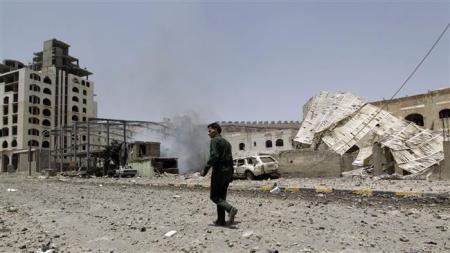
In what has been three decades of ill-advised wars in the Middle East, Saudi Arabia’s war in Yemen may be the most ill-advised of them all. “Operation Decisive Storm,” the ironic name for Saudi Arabia’s aerial campaign in Yemen, has led to nothing decisive in Yemen beyond ensuring that the country remains a failed state and fertile ground for organizations like al-Qaeda in the Arabian Peninsula (AQAP). Long before the commencement of “Operation Decisive Storm,” Yemen, the poorest country in the Middle East, was grappling with a host of problems ranging from severe water shortages, food insecurity, and a moribund economy, to a long running multi-front insurgency. Saudi Arabia’s war in Yemen has exacerbated all of these problems and could well be the coup de grace for a unified and relatively stable Yemen.
On Tuesday April 21st, the government of Saudi Arabia abruptly announced that it was ending “Operation Decisive Storm” and that it would be scaling back its aerial campaign in Yemen. “Operation Decisive Storm” will be replaced with “Operation Restore Hope,” an unfortunate name for a military operation given that it was also the name for the US’ ill-fated 1992-3 intervention in Somalia. It is unclear what “Operation Restore Hope” aims to achieve; however, the first phase of Saudi Arabia’s war in Yemen has been disastrous.
According to the World Health Organization, more than 900 people have died in Yemen since the Saudi led aerial campaign against Yemen began on March 25th. In addition, one hundred and fifty thousand Yemenis have been displaced and the number of food insecure people has increased to more than twelve million. Due to the ongoing blockade of its ports—Yemen imports more than 90% of its food—prices for basic food items have soared and there are widespread shortages. In Aden, where temperatures routinely climb into the triple digits, most of the city of more than five hundred thousand has no access to water. Across the country, supplies of gasoline and gas have been exhausted. Hospitals, which were already struggling to cope with a lack of medicine and supplies, now have little or no fuel left to run their generators. Those patients in Yemen’s Intensive Care Units will likely die as their life saving machines are idled due to a lack of electricity.
AQAP has, so far, been the only beneficiary of Saudi Arabia’s war in Yemen. In south east Yemen, in the governorate of the Hadramawt, al-Qaeda in the Arabian Peninsula (AQAP) has taken over Yemen’s fifth largest city, Mukalla, and has also taken control of the city’s airport and port. “Operation Decisive Storm” targeted the Houthis, a Zaidi militia that is the sworn enemy of al-Qaeda. Saudi Arabia’s aerial bombardment also focused on those elements of the Yemeni Armed Forces that are allied with the Houthis and former Yemeni president Ali Abdullah Saleh. These same military units, including the Yemeni Air Force which has been largely destroyed, were also critical to fighting AQAP and its allies. “Operation Decisive Storm” has effectively neutralized the two forces that were responsible for impeding AQAP’s advance across large sections of southern and eastern Yemen.
So what did the Saudis hope to achieve with “Operation Decisive Storm?” The government of Saudi Arabia claimed that it launched military operations against Yemen to restore the now exiled government of Yemeni President Abd Rabbuh Mansur al-Hadi who fled Yemen for Saudi Arabia on March 25th.
However, the reinstallation of Hadi’s government, which had little support before he and his ministers openly called on the Saudis and their partners to bomb their own country, remains unlikely. Hadi, who was Saleh’s long serving vice-president, was chosen to be vice-president by Saleh for a reason: Hadi has no power base in the Yemen. Hadi is a southerner who has no ties to Yemen’s perennially powerful northern based tribes and as a southerner who sided with Saleh and the north in the 1994 civil war, he is regarded as a traitor by many in the south.
It is also important to note that the so called Hadi supporters who are fighting Houthi militias and their allies in south Yemen are fighting under the flag of the Peoples’ Democratic Republic of Yemen (PDRY). Most of those fighting in Aden and in other southern cities are not fighting for Hadi but for independence from the north due to a long list of unaddressed grievances. Up until a few months before his departure for Saudi Arabia, the security services under Hadi’s control were pursuing and arresting members of al-Hirak, the Southern Separatist Movement.
The second—and linked—goal of the Saudi led aerial campaign was to force the Houthis to disarm. This was as unlikely as the restoration of Hadi’s government. The Houthis have fought six wars against the Yemeni Armed Forces since 2004 and successfully fought off Saudi forces in 2009-10. While Saudi Arabia’s air war undoubtedly degraded some of the Houthis’ military capabilities and may have resulted in the loss of what is already arguably limited support for the Houthis and their allies, it in no way defeated the Houthis who have withstood far worse with far fewer resources than they now have.
After bombing Yemen for nearly a month and igniting what could be a prolonged civil war, the government of Saudi Arabia may have finally come to the conclusion that the only way forward for Yemen is through dialogue and negotiation. No one party or faction in Yemen is capable of asserting control over the country, even with the support of a regional power, be it Saudi Arabia or Iran. Former Yemeni president Ali Abdullah Saleh, a master of Machiavellian politics with an encyclopedic knowledge of Yemen’s tribes and clans, was never able to exert full control over Yemen. For much of his 33 years in power, Saleh was derisively referred to as the “mayor of Sana’a” because his writ did not extend much beyond the Yemeni capital. In many respects, Yemen can be described as an “asylum of liberty.” Power has historically been dispersed among various factions. This dispersal of power militates against strong centralized authority.
In an April 19th interview with Russia Today, Jamal Benomar, who resigned as the United Nations Special Adviser on Yemen on April 16th, claimed that negotiations between all parties in Yemen were ongoing and nearing a successful interim conclusion before the bombardment of Yemen began. In his rambling April 19th speech, Houthi leader, Abdul Malek al-Houthi, vowed not to surrender but also indicated that the Houthis remained open to negotiations. Yemen’s former ruling party, the General People’s Congress, and its former leader, Ali Abdullah Saleh, have both called for renewed negotiations.
Yemen has a rich corpus of traditions that, when allowed to function, can limit conflict and favor negotiated settlements. These traditions were in evidence during Yemen’s own popular uprising in 2011 which, while violent, did not, at that time, lead to the kind of brutally violent civil wars that have engulfed Libya and Syria. Saudi Arabia’s war in Yemen, if it continues, could upend many of these traditions and ensure that Yemen is the next Syria or Libya. At a minimum, the war has already led to the deaths of hundreds of civilians, destroyed critical infrastructure, impoverished thousands more Yemenis, and allowed AQAP to dramatically expand the areas under its control.
Interview: Eyewitness to the Odessa massacre of May 2, 2014
The New Cold War
April 21, 2015–The following interview with Vladislav Wojciechowski was published on April 3, 2015 on the Russian language website Free Press. It is translated to English by Greg Butterfield and published on the website of Borotba.
Vladislav Wojciechowski is the founder of the website Committee of May 2 (Committee for the Liberation of Odessa), concerning the Odessa Massacre of May 2, 2014. He is a former political prisoner and a communist in his outlook.
He gave an exclusive interview to Free Press correspondent Dmitry Ogneevu about the protests in Odessa, the events of May 2, 2014, and his arrest.
Introduction by Dmitry Ogneevu
 I’ve known Vlad Wojciechowski for several years. Once upon a time, before the Maidan, which split history into “before” and “after” and destroyed the Ukrainian state, I loved coming to Odessa, meeting there with local activists of Borotba, including Vlad. At night we sat in noisy Odessa courtyards, walked around Primorsky Boulevard and discussed the prospects of political struggle. I remember on one of my last visits we strongly criticized Yanukovych and thought about how great Ukraine would be without him. That was two years ago.
Now, two years later, we are back together in the trench, placing guns on the parapet, watching the movements of “Ukropov” at the checkpoint. A ridiculous irony of fate. Vlad was one of the most active participants in the Odessa Anti-Maidan movement from the beginning, and was in the House of Trade Unions on May 2, 2014. After the terrible violence against opponents of the junta on Kulikovo Field, he was forced to flee to Crimea with other activists. He returned to Odessa at the end of the summer, was arrested and thrown into prison by the Security Service of Ukraine (SBU). In late December, he was exchanged for captured Ukrainian soldiers, and found himself in Novorossiya. Ukrainian officials took his papers, and now he’s unable to leave the country. However, it is not too perplexing. He seems to have found his place here — in the political department of the Ghost Brigade. We sit at the headquarters of the political department in Alchevsk and reminisce…
Free Press: How did Antimaidan begin in Odessa?
Vladislav Wojciechowski: For us, Antimaidan began in late 2013. The leader of the Odessa chapter of Borotba, Alexey Albu, was then a regional council deputy. The head of the Party of Regions faction asked his assistance in protecting the regional council — they really expected an assault then. Of course, we were no friends of the Regionals, but everyone understood that it was better for them to remain in power than the alternative …
And were there supporters of the Maidan in Odessa?
Of course, we had Maidan from the beginning. A small number of people, several hundred on average, hanging around the monument to the Duke of Richelieu, but nobody took them seriously: there were fools, what could they take over? Nobody even tried to disperse them. And Odessites plainly did not support them.
How did the local authorities treat them?
The local authorities panicked a little. During the defense of the regional council, after we had already spent three nights there, the TV reported that Yanukovych had proposed Yatsenyuk to become head of government. This was a serious wake-up call, as it showed that he had no other way to cope with them. Yatsenyuk ultimately refused, that is, he was aware that the power had already shifted 100 percent. Therefore, the local authorities were in a panic, not knowing what to do.
How did the Kulikovo Field movement develop?
It turned out that the defense of the regional council had rallied many people from various organizations, including some we sometimes protested, like “Slavic Unity.” A collective decision was reached to create a unified council to build a real people’s resistance to Maidan. All the Antimaidan forces rallied. That’s how the Kulikovo Field movement was born — because the first rally was held on the Kulikovo Field. Once there was a statue of Lenin there, before it was brought down and moved. It’s just a very large area in the center of the city. When the first rally was held there, we were about 10,000 people. It was just a rally, not yet a march. Prior to this, the largest rally that I had ever seen in Odessa was held by the Communist Party on January 24, 2009, against the Rada’s infringement of workers’ rights. About 900 people had come to that.
And here there were about 10,000, and from the podium it was announced that we’re not going anywhere and we will create a tent city. At the same time a people’s defense team was set up — young guys with bats who were supposed to protect Kulikovo Field. And on March 16 the first march was held – it brought out 20,000 to 25,000 people. Everyone thought here there would be no change of power.
There was a victorious euphoria?
Of course. Twenty-five thousand people. Odessa had never seen anything like it. I stood at the beginning of the march at a crossroads, where it turned in the direction of the regional council, filming it on video. I was shooting continuously for 40 minutes. And the march had still not ended, the tail was not visible. Moreover, 90 percent of the participants were not in any organizations. People spontaneously took to the streets to prevent what was happening in Kiev. Then it seemed, what Maidan in Odessa? There’s nothing here for them.
What happened on May 2?
The day before, on the first of May, we had a small May Day action — we held a march, which was about 4,000 people. By that time people had become tired of marches as they began to realize that they accomplished nothing. Every weekend we held marches, the first was 25,000, then 20,000, then 15,000. Everyone complained that there was nothing but talk and walking around the city. Four thousand people on the first of May — and that’s respectable. Then everyone crashed and went to rest.
On May 2, not suspecting anything, at about 2 o’clock I went with my sister to the Tavria supermarket on Deribasovskaya Street. We went (everything started then, but I still did not see anything), we bought something, and the guard started running around, yelling that everyone must leave, they are closed …
Did you know that football fans gathered there?
I knew, because just the week before when Chernomorets [Odessa soccer team] played, there were rumors that Kulikovo Field would be razed, so an urgent mobilization was called to defend the encampment. Naturally, we all ran there, but no one came. Everyone got fed up and no one took it seriously afterward. So, the guard kicked us out of the supermarket, and we saw shooting, flying stones, firecrackers … I took my sister home, went on the Internet, watched an online broadcast and was stunned, because there were never so many of these morons in the city.
You mean, it was all people from out of town?
That’s right. Because the Chernomorets fans who participated in the march “For a United Ukraine,” for the most part, when they saw how it was flying off the handle, said, “We don’t want to be part of this!” and went on to the football match. I’m not talking about the ultra-rightists, but about those who just came to the march.
I called my friend Andrei Brazhevsky. I was sure that he went there because he was always near the action. I asked him: “Andrei, what’s happening?” He said, “We got squeezed, but we’re still holding on, we have no forces here.” I said, “Come on, we will try to get to you!” We must help our comrades – you can’t throw them to the wolves. We decided to go to the Kulikovo Field, to see what was happening there. People were preparing for an attack on Kulikovo …
We arrived to a depressing spectacle. At that time there were only about 150 people. Moreover, the composition was depressing. About 40 young guys, 50 women aged 30 to 60, and 50 men aged 50-60-70 years. A sad spectacle, but, nevertheless, we took sticks in hand, made barricades — in general, prepared to defend ourselves. Of course, we all understood coming here that we will get it in the neck, but we had no moral right to leave the people. We decided to stay with them, arm them with sticks, collect stones.
We gathered up 250-300 people. There was a rumor that those who were defending themselves on Greek Street, a few hundred people, were coming back to us, and with their help we would repulse the crowd. Eventually, exactly 15 people returned from the Greek. These were the only ones who managed to get out of there without being stopped by police. They escaped the crowd, ran to Kulikovo, we met them …
So. We get a call from the city center, saying the fascists have already passed the Little Book, the book market halfway between Kulikovo and Greek. A march of one thousand. Several hundred from the Maidan, fully equipped with firearms. And half with bats and chains. We were told they were 10 minutes away, get ready! Well, we looked at the perimeter. It turned out that we had one person for every meter of barricade, well, it’s just gibberish, so we narrowed the barricades to the porch of the building.
You controlled the building then?
No one had control. It was empty. No, there were some workers from the House of Trade Unions. But on May 2, along with security, the usual guards, there were the boys from the Odessa squads. We decided to stay at the building. Naturally, we tried to send the women away. Many accuse the leaders of the Antimaidan of bringing people into the building, but that’s a lie. There are videos taken by us when Deputy Vyacheslav Markin, who died there, went to the podium with a microphone and starts yelling, uncharacteristicly for him, demanding all women leave the Kulikov Field. And there were grandmothers walking around with shields and helmets. He says, “Go away! Why do you need it?! Go away! Do not bother us! We will not run to save you.”
But some refused to retreat from the fight. In the confusion that followed, people ran into the building, because they could already see the march coming. We were part of the group left on the porch …
And were there attempts to strengthen the defenses, in terms of military science? Were there experts among you, who knew how to hold the defenses?
From the point of view of military science, it was all for nothing. There was no defense as such. Well, there were pieces of asphalt that we broke up for half an hour before their arrival, broken pallets — all spontaneous.
We had one person with military experience, a friend. When we saw him, he came up and said: “Guys, you know that it’s all over if we stay here?! You must understand this! What are you doing?” We said,” Come on, suggest something else.” And what is there to offer? There is nothing to offer. As a result, this highly intelligent military guy fled, and said to hell with it.
Some people who had shields remained on the porch and began throwing stones. A wooden shield is, of course, a good thing when you’re deflecting stones, but then they started to shoot at us …
What kind of firearms were used?
 A 5.45 mm barrel was definitely used. This is either a Saiga semi-automatic hunting rifle, or a Kalashnikov assault rifle. Most likely they were hunting rifles, the only difference being that such weapons cannot fire bursts.
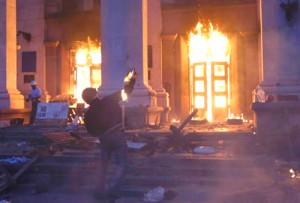
When our people with shields began to fall, riddled with bullets, we all went into the building, because there was no other choice. We were in the building, and they were over forty meters away. We threw stones, they stood and shot. They did not even have to come close.
When we entered the building, there was a fuss. I saw a man of about 60 standing at the window, watching. Then he just crumpled — shot in the head, I saw it, it’s clear that it was not a thrown stone, but a shot in the head that killed him. There were a lot of pictures. Don’t look through a window or at once a couple of bullets will fly, or a Molotov cocktail.
We continued to throw stones until we ran out. There were few stones – we had to shove everything in our pockets! Then he started throwing pieces of glass at them — well, at least it was something. It was a little confusing. You throw a piece of glass about twenty meters, and someone forty meters away shoots at you.
Then we ran into a wing of the building, with one exit on the side stairs. Apparently they had already infiltrated it and sprayed a lot of pepper spray. Normal police “pepper” — it was impossible to breathe, just tears. We ran from that wing. By this time, the bottom had flared up …
And you had some personal weapons, gas cylinders, blunt weapons?
I didn’t see any, though I ran through all our “defenses.” We really had nothing to fight back with. If we had had two Kalashnikovs and a hundred rounds of ammunition each, we could have at least put up some resistance — they would have just run away.
At what point did you realize it was necessary to leave the building?
There was already heavy smoke. I started running around, looking for Alexey Albu and Andrei Brazhevsky, and there’s turmoil, a lot of people running around. At one point, Deputy Markin caught me by the arm and said, “Vlad, don’t be nervous, everything will be fine!” I said, “Ok, I’m not nervous!” And I ran on. I saw Andrei Brazhevsky. But Andrei had a problem – he couldn’t see well. Although he was an athlete, his vision was very poor, he just couldn’t recognize you past three to five meters. I yelled, “Andrei!” He heard me, but couldn’t see. Looking-looking, bang, and he ran off somewhere. Then I met Alexey Albu. He said, if there is a fire, it makes no sense to run upstairs, because you can’t jump and will either burn or suffocate, so let’s stick to the first floor.
Following this logic, we gathered who we could, and hand in hand, went through one of the wings of the building, down the stairs to a second floor window, and now two to three meters below us is a playground! A lot of people still stood under that window. We simply knocked out all the glass and breathed the air. And those below were saying, “Okay, let’s go!”
Well, we thought we’d preserve the defenses, hold the line on that floor. It was a narrow space, and in a narrow space, as is well known, the number of defenders is not so significant. And so there we were, until after a while one of the ultras with a Ukrainian ribbon crashes in and says, “Oops, this is the end of you!” And beside me was an old grandfather. Maybe a former military man — he was wearing camouflage. Well, I respected this grandfather — he kept his head and immediately threw a punch at this fool. He hit him in the stomach so hard that he got up and ran away. And I was holding a large fire extinguisher. I took it in case we had to hold back the flames, it had very strong pressure. I sprayed him with the fire extinguisher, he scrambled up and fled, dramatically threw a bottle at us, but missed.
Then they decided to talk with us. They said: “Bring out the women, and then let’s deal!” We said, “Well, just let them withdraw peacefully, without problems.” They still said: “Bring out the women, we will not touch them, we are local.” We said: “Local, what area are you from?” They: “We’ll kill you all!” Just local right-wingers, right, we know them all. We had five years of conflicts, we fought constantly with them. In general, there are only 50 people in Odessa, morons. It was clear that they were not local.
Eventually, we brought the women through the second floor window. Firefighters helped by putting up a ladder. We evacuated eight women, and we had seven people left. Four were young men up to 35, the rest 45-50 years. We realized that they are ready to shower us with Molotov cocktails, yet we need to somehow get out. We already realized that this was the end – all will have to pass through their hands, there were no other options — the smoke was already very heavy, there was nothing left to breathe.
We came out and immediately it began. First the firefighter went down, he said, “Come on, guys, I’ll try to bring you!” It was clear that he did not have a chance to bring us, because up comes a bald goon with a revolver in his hand who said to him: “Freedom! Go home.” The firefighter left. Us: “Hands up!” But he was not alone, there were a bunch of morons standing around.
We reached the ground, and then another fascist runs up with a bat in one hand, and a chain in the other, swinging for me (and I was in a bright light green jacket): “This is the reptile who threw glass at us!” I was surprised the glass hit someone in their march …
And that’s all of us, 15 people in the corridor that the police made …
The police were present?
Yes, but there were only about 30 of them, okay, where to intervene? War is coming … In fact, we are grateful because they brought a lot of people out and saved them. Simply, if they had fled, the crowd would have snuffed us all. In general, they made a corridor for us to withdraw — there were fifteen policemen on one side, fifteen on the other, and among them about a hundred of these goats with bats and chains. We had just started to come out haphazardly, I did not even have time to do anything. Just trying to cover my head, when a chain hit me. Now I have a scar from the chain [shows wound]. Hit, I fell down in a heap. Then some idiot brings the Ukrainian flag and tells me, “Kiss the flag!” There I sat with a busted head. I pretended to be stunned, to not understand anything. Then he was dragged off by his own people, so as not to shame them.
Then time seemed to run a little differently, it’s hard to remember now, as I lay there in a pool of blood. In the end, it was dark, and we tried to reach the police. There is a video showing a handful of us, the gangsters walking around us, someone laughs, someone spits. An old grandfather tries to take me by the hand, hit me with a shovel. Then the police drove their van closer to us, saying, “Get up quickly, crawl, get in!” This was another test, because there I was, my head was busted, but at least I could move. But there were a few people with us who were lying unconscious, beaten to a pulp – we dragged them. Those who could went toward the police van, and got beaten on the head with sticks. We rolled away in this van, and they started to run, hitting it with sticks.
Once we got away, the police brought us to the station on Malinowski. One of the commanders of the district department came out, and said: “Guys, hold on! We are morally with you, but you see, there’s nothing we can do to help you, we have orders to arrest all of you. But I’m leaving these orders in the dark! I called an ambulance and you are leaving!”
Yes, the police were behind us. But what chance did their hundred people have to disperse 3,000 hoodlums?! The thirty or forty people that were at the House of Trade Unions, they almost didn’t intervene, they couldn’t do much. But if they hadn’t, we would not have gotten out. We would have just been beaten to death. A blow on the head with a stick by itself isn’t fatal, but 20 times in the same place, this is serious. So we went to the hospital, my head was bandaged. I was supposed to have an x-ray, but we didn’t wait, we wanted to hide at home to recover, find out what’s going on …
In your opinion, what was the cause of death of the majority of those killed in the House of Trade Unions? There’s been much speculation that the burned bodies were already dead …
I can’t answer unequivocally. Yes, there were several bodies that were burned, but there were so many armed gangsters with Wolfsangels [neo-Nazi symbol], and even members of the Azov Battalion. Sasha Gerasimov, a member of the Komsomol who spent 11 years in prison, was there. He began to choke from carbon monoxide, lost consciousness and fell. Men in black helmets with Wolfsangels pulled him up. They dragged him to the window and said, “Jump! Better jump, or we will beat you to death!” On the fifth floor! Naturally, he did not jump, he tried to resist, they began to beat him. There is even a piece of video where he crawls out as they beat and beat on him. He stayed in the hospital for three months, one leg severely burned, the other knee crushed – he is disabled now, and still walks with a cane.
But I think if not half, then at least one-third died from firearms. I’m a hundred percent sure. They could be seen, that’s the way it was …
But did any expert see the bullets …
The experts saw, but they had to blame us. They wrote on Andrei Brazhevsky’s death certificate that he died from the crash after falling from a window. But the video shows that when he fell, he just broke his leg. He was still alive and tried to get away. No, he was finished off. Some worthless fascist bashed his skull. Well, was it the crash? In the video everything is clearly visible, including those who pursued him prior to his death.
Then you had to flee from Odessa?
Yes. We left urgently on the night of May 8-9, that is, a week later. There was danger of arrest. A good friend warned comrade Alexey Albu by phone that they were preparing to arrest all the Borotba members on May 9, and that it was better for us to disappear. We left all together, the whole organization, in two cars, by taxi, then hired a minibus to Kherson, then to Crimea. I returned to Odessa on August 12 …
For what purpose?
I just wanted to, and came back. No, I knew it was dangerous. But I had nothing to hide. The SBU and police came to my home several times – they wanted to call me in for questioning as a witness to May 2. I wasn’t afraid, let them call me. I’ll come if I have to. I witnessed what happened, I didn’t kill anyone. But they did not call me for any interrogations. A month later I was arrested, exactly one month after I returned.
Of course, they knew that I was back. The phone was tapped, and naturally I did not change any of the numbers since I was not hiding from anyone. Nothing frightened me, and my mother and sister had long been accustomed to having the phone tapped. No one was hiding, I lived in a rented apartment, worked …
When I came back, I started to communicate with people from the Antimaidan — these were people who did not accept what had happened and wanted to do something. We went out at night, painted graffiti like “Junta out!” We pasted leaflets – something, anything to contribute to the struggle. Propaganda for Novorossiya, of course. Novorossiya is the only living example of confrontation with the Kiev authorities, this was not happening anywhere else. That’s where the banner was raised. And the people there took up arms and risked their lives to prevent this plague from descending upon them.
Friday, September 12, was a lovely autumn evening, the “velvet season” in Odessa, when the sea is still warm and the air is a little cool. An ordinary evening, a small group had gathered, all seemed normal. Our door was always open – we were not afraid. This was a typical Odessa courtyard, any neighbor can stop by without asking. And some people flew in. At first it was not clear who they were. Half of them were “citizens” and those who were in uniform were unmarked. No Ukrainian flags or insignia. The first thing I saw was some reptile with a brand new Kalashnikov. A good Kevlar helmet with a skull and crossbones. He ran in, shouting “All hands up!”, handcuffed us, start kicking people out. That left me, Popov and the third bad man, Palycha Shishman, who, it turned out, had cooperated with them. Comrade Popov was with us on the second of May. He is now in the Lugansk people’s militia, in the fourth brigade.
At night we were brought into the SBU, and various officers began questioning us. They already had a finished “pidozra” – in Russian, literally “suspicion.” Something like an indictment. First, they document a “suspicion,” then try to prove it in a pretrial investigation, and then refer the case to the court. Personally, I was charged with “suspicion” under Article 28-3, “Organization of a Terrorist Group.” By organization, they meant financing. That is, if you bought a drink for someone and talked to them about Novorossiya, it was already terrorism. A bottle of cognac – this is funding. The investigator said: From eight to 15 years in prison. But, he says, you have a problem there. I said, what? He said: You’re the organizer. I say, so what? He: Well, okay, not 15, but you’ll get 14 years for sure.
We spent a few days waiting for lawyers. We talked to them about the tactics of our defense, hoping for some relief in the court. But at the first trial, extended preventive measures were applied, and we realized that it’s useless. The lawyer says, the best thing to do is try to have you transferred to house arrest. The judge read it all, laughing: Article 28-3? She looks at the investigator: Are you serious? But what have they done? The investigator says: They did it! Well, the judge says she understands that we should be under house arrest. But there are no options, and … 60 days in jail! The judge said bluntly: “I have no options. If I release you, tomorrow they will come for you…”
So for four months, I ended up in jail. There, in Odessa. Once a week, I was pulled in for questioning by the SBU – not very pleasant conversations with not very nice people …
How did you come to be exchanged?
This was due to hard underground work, because it was difficult to get a hold of our lists, we had no connection to normal due process. On December 26, at eight in the evening, during the evening roll call, a senior officer came with a sheet of paper, called four names, and said: “You have fifteen minutes to get ready, a car is waiting for you, you are free, goodbye!”
We were in shock, they were going to let us go. The door opened, there were some fools in uniforms wearing masks, and one lead us somewhere. Well, we thought then it was the exchange, we had heard about it before. We were issued a ruling from the Prosecutor’s Office that the case was closed for lack of evidence. A note that says you are officially free. So I thought with this certificate I could leave prison quietly and go home to sleep. But I was taken out in handcuffs. “Alpha” soldiers put us in the trunk of a Volkswagen minivan. The Alphas took the seats, and the four of us were in the trunk. They handcuffed us together, took off and announced we were being taken to Kharkov. We already knew that. In Kharkov, they gathered 200-something men from all over Ukraine – this is kind of a transit hub. And then through Izium to Donetsk.
What happened after the exchange? How did you get into the Ghost Brigade?
In Donetsk, military intelligence took over. Everyone had to go through questioning, to find out who was really a rebel and who was just mishandled. The next day my comrades from the LC arrived and brought me to Lugansk. For the first month I lived with a man from the Hooligan Battalion, just thinking that this is freedom, cool! Then I met with Evgeni Wallenberg, who I knew from Borotba. Evgeni took me to Alchevsk and said: “Don’t you want to help me in the political department? I need people who are intelligent, ideologically savvy!” I said that I’d think about it. I thought, and now I’m here.
Why do you think the resistance in Odessa lost? Why did it succeed in the Donbass region, and not yours?
Frankly, I’m ashamed to answer, because I am ashamed for Odessa. Seventy percent of the people there still support us. Yes, they are all intimidated. But here, too, they tried to intimidate and arrest everyone. Here they began to bomb people …
In Odessa, the leaders of Antimaidan, rather than unite, were each pulling the blanket. Some used volunteers to collect money in the name of Antimaidan, and spent it on themselves. There was no cohesion. There were a thousand people, and 1,500 organizations. Fifteen hundred organizations per thousand people! And May 2 happened. If we knew what would happen, we could have gathered 20,000 people and chased all that crap out of town. But it turned out that in general no one gathered. There was an opportunity, but it was not taken advantage of.
Maybe people were not completely aware of the seriousness of the situation. This may have played a role. The mentality of Odessans is different from Donbass. Odessans are more opportunists by nature. On May 2 our enemies managed to intimidate most of the city’s population. On the one hand, shame and disgrace – fear is stupid! But on the other hand, you can understand them – stones against guns are not good odds …
How do you see the resolution of the whole situation? Do you see Odessa liberated?
I see it. I even see the liberation of Kiev …
Should Novorossiya be established within the borders of the Donetsk and Lugansk regions? Or within the boundaries of the eight regions [of southeastern Ukraine]? Or should all of Ukraine be liberated from the junta, and the country rebuilt?
As I said, in Odessa 70 percent support us. They now live under occupation. I understand that you cannot leave them that way. How could you say that in 1941-1945 …
It’s necessary, as you say, to “rebuild” on a new basis. Novorossiya is a new banner, which has risen for many people, they want to separate and build their own state. But a neighboring country, Ukraine, is suffering, and we are duty-bound to help get rid of the junta. And give people the freedom to choose the country in which they live, to choose their government. To release them from the occupation is just the beginning. Our enemy is not the soldier of the Ukrainian Armed Forces (APU), who stands in the trenches at the front, but the Kiev junta, the power of the oligarchs.
Washington prepares for diplomatic war of attrition with Russia
RT | April 22, 2015
The US reportedly expects that the ongoing confrontation with Russia would continue until at least 2024 and involve many directions. Washington wants to rally support of its European allies to continue mounting pressure on Moscow.
The expected diplomatic and economic war of attrition is being outlined in a Russia policy review currently prepared by Celeste Wallander, special assistant to President Barack Obama and senior director for Russia and Eurasia on the National Security Council, reports Italian newspaper La Stampa. The publication said it learned details of the upcoming policy change from a preview that Washington sent to the Italian government to coordinate the future effort.
US diplomats say Russia changed the cooperative stance it assumed after the collapse of the Soviet Union and is now using force to defend its national interests, the paper said. The change is attributed to the personality of Russian President Vladimir Putin, who, Washington expects, will remain in power until at least 2024.
The change became apparent with the conflict in Ukraine, but was emerging since at least the 2008 conflict in South Ossetia, when Russia used military force after Georgia sent its army to subdue the rebellious region, killing Russian peacekeepers in the process.
Washington’s solution to the new Russia is keeping sanctions pressure on it while luring its neighbors away with economic aid and investment, La Stampa said. The current round of sanctions, it reports, was designed not to have too much impact on the Russian economy so that a threat of harsher sanctions could be applied.
While the tug of war in Europe continues into the next decade, Washington wants to continue cooperation with Russia in other areas like nuclear non-proliferation and space exploration. However until Putin is out of the picture, the US does not expect for things to go back to where they were, the newspaper said.
The strategy was hardly unnoticed in Moscow, as evidenced by the annual report of the Russian Foreign Ministry published on Wednesday. The document said the US is pursuing “a systematic obstruction to Russia, rallying its allies with the goal to damage domestic economy” through blocking credits, technology transfer and an overall destabilization of the business environment.
The ministry said Washington had some success with the policy that resulted in an almost 8 percent drop of Russia’s trade with EU members in 2014. However some European countries like Austria, Hungary or Slovakia are pragmatically keeping bilateral ties with Russia active. In European heavyweight Germany, whose government is among the leading supporters of the anti-Russian sanctions, there is a strong business resistance to keeping them.
Non-EU members in the region like Serbia and Turkey are among priority partners for Russia in the current environment, the ministry added.
Featured Video

Theodore Postol: Iran’s Missiles & Drones Were Underestimated
or go to
Aletho News Archives – Video-Images
From the Archives
Wars for Israel: A reminder of who’s giving the marching orders
By Damian Lataan | February 7, 2012
As the West prepares to march off to yet another war in the Middle East, we should perhaps remind ourselves of who is giving the West their marching orders.
In February 2003, just weeks before the US and their allies launched their attack on Iraq and her peoples, a delegation of US congressmen, together with the US Ambassador to the United Nations, John Bolton, a well known pro-Zionist and neoconservative war-hawk, were in Israel at the invitation of the Israeli government then led by Israeli Prime Minister Ariel Sharon.
Addressing the congressmen, Sharon told them ‘that Iran, Libya and Syria should be stripped of weapons of mass destruction after Iraq’. Later, Sharon told John Bolton ‘that Israel was concerned about the security threat posed by Iran, and stressed that it was important to deal with Iran even while American attention was focused on Iraq’. … continue
Blog Roll
 Aletho News
- The Most Important Bet You’ve Never Heard Of
- The killing of three Indonesian soldiers in Lebanon should remind Jakarta that Israel does not want peace
- Defeated and delusional: Netanyahu’s remarks reveal $80bn war failure, says analyst
- Iran’s friends are about to make life much more difficult for Israel and the US
- The war of liberation of the Arab and Islamic peoples expands across the Gulf
- Envoy warns UN on Trump’s threat to ‘obliterate’ Iran’s civilian infrastructure
- The Larak Corridor: Iran’s Rial Gate With No US, No Israel, and No Way Around
- ‘Economic terrorism’: Steel facilities hit again in US-Israeli strike
- ‘War Crime’: Iran condemns attacks on Arak, Ardakan nuclear sites
- Two-thirds of Americans want quick end to Iran war even if goals unmet
- If Americans Knew
- Gaza families reunite years after babies evacuated amid Israel’s war
- International Rescue Committee warns Gaza’s children face grave protection risks
- Iran’s Alleged 47-Year War on America: Debunking the 1,050 American Deaths Canard
- Israel wants US to bomb more of Iran’s civilian structures (113,000 is not enough) – Not a ceasefire Day 173
- Ann Coulter Rips Into Fox News for Iran War Coverage
- Joe Kent Urges Americans To Call White House and Congress To Object To Sending Troops Into Iran
- DNC Resolution to Reject AIPAC Funding Puts Democratic Leaders in the Hot Seat
- Swedish foundation to build 400 schools as over 650,000 Gaza children remain without education for 2 years
- Israeli army admits photshopping image of slain Lebanese journalist
- This is how Israel is systematically killing health workers under the cover of war in Lebanon
- No Tricks Zone
- New Study Finds Warming Saves Lives…Cold Temperatures 12 Times More Deadly Than Excess Heat
- German Science Blog Accuses PIK Climate Institute Of Hallucinating Climate Tipping Points
- Devastating Assessment Of Comirnaty Vaccine By Former Senior Pfizer Europe Toxicologist
- New Study: CO2 Is ‘Effectively Negligible’ As An Explanatory Climate Change Factor Since 2000
- Former Pfizer Toxicologist Dr. Helmut Sterz Tells Bundestag Hearing Pfizer Vaccine Should Have Never Been Approved
- Energy Expert: Germany’s Nuclear Phaseout Was A “500 Billion Euro Mistake”
- New Research: South Australia’s Mid-Holocene Sea Surface Temperatures Were 4°C Warmer Than Today
- Storing Green Energy To Last Germany 10 Days Would Require A 60-Million Tonne Battery
- New Studies: UK Sea Levels Were 4 Meters Higher Than Today During The Mid-Holocene
- Destructive Green New Deal: German Energy And Metal Group Warns Of Drastic Crisis
 Aletho News