From Reagan to Obama: Forced Disappearances in Honduras
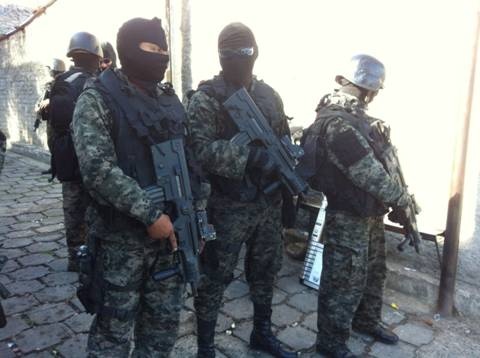
Honduran military police on patrol in Tegucigalpa, Honduras. (Photo: Karen Spring)
teleSUR | May 25, 2015
The 1980s saw widespread political violence and countless forced disappearances in many countries in Latin America, and Honduras was no exception.
Hundreds of political opponents of the 1980s U.S.-backed regime were kidnapped, tortured, and assassinated by the CIA-trained secret army unit Battalion 316, while at the same time Honduras served as a military base and training ground for U.S. counterinsurgency strategy in the region, especially in neighboring El Salvador and Nicaragua.
With the Reagan Administration turning a blind eye to the brutality of Battalion 316, intentionally downplaying or denying its violence in order to continue backing Honduras financially and using the country as a key U.S. military outpost, the details of this death squad’s operations did not become clear until years later. A historic expose published in the Baltimore Sun in 1995, which included interviews with ex-Battalion 316 torturers and details from declassified U.S. government documents, revealed the full extent of the secret unit’s atrocities and its close links to Washington.
However, torture and disappearances aren’t just a tragic reality of the past in Honduras. Human rights defenders have drawn disturbing parallels between Battalion 316 and the present day situation in Honduras, saying the current level of human rights abuses and political repression is just as bad, if not worse than the era of forced disappearances in the 1980s.
In the wake of the 2009 U.S.-backed coup ousting democratically elected President Manuel Zelaya, forced disappearance, torture, and targeted assassinations re-emerged as state terror tactics to intimidate and repress a broad-based resistance. Conspicuous and even conscious links to 1980s tactics since the 2009 coup, as well as ongoing U.S. complicity, show a continuity of state sponsored terror, with new elements for the post-coup context.
Cold War Anti-Communism, Battalion 316, and Spreading Terror with U.S. Support
As U.S. President Ronald Reagan took office in January 1980, the Sandinista revolutionary government was in power in Nicaragua and revolutionary forces were struggling for political control in El Salvador. Honduras was undergoing its so-called transition to democracy with a return to civilian rule. The U.S., already supporting the Guatemalan military’s bloody counterinsurgency efforts for over a decade, played a key role in backing the counter-revolutionary factions of the political struggles gripping the region in civil war, namely Salvadoran government forces and the Nicaraguan Contras.
While Honduras did not have a mass revolutionary guerrilla movement like its neighboring Central American countries, political opposition was criminalized to contain the threat of an armed, popular uprising. Much of this violent work was carried out through forced disappearances by the death squad Battalion 316, the special unit of the Honduran military responsible for political torture and assassinations, with the collaboration of other military branches, special forces, and police.
According to the Honduran human rights organization COFADEH, formed in the 1980s by family members of the disappeared, Battalion 316 was responsible over 180 forced disappearances between 1980 and 1988, and many more were kidnapped and tortured.
Forced disappearance refers to the practice of secretly abducting and murdering victims, making them disappear from society without a trace. Bodies of the disappeared are often carefully hidden, or rendered unrecognizable, to instil fear without the identity of the victim or the perpetrator becoming known..
Battalion 316’s terror was simultaneously covert and public, carried out by disguised agents at times in broad daylight, intended to instill fear and make an example of their victims. Suspected political dissidents were kidnapped, detained in secret jails, and tortured. Sometimes remains of victims were found in ditches. According to the Baltimore Sun expose, torture techniques included electric shock, suffocation, freezing temperatures, and psychological torture as part of interrogation, which sometimes involved CIA agents. Berta Oliva, director of the Committee of Relatives of the Disappeared in Honduras (COFADEH), has said that at least one prisoner was skinned alive in a clandestine Battalion 316 jail.
While the numbers of people disappeared in Honduras was considerably less than in many other Latin American countries during the same period, the hundreds killed and disappeared created a broader fear and terror campaign that had the intended outcome of disempowering the Honduran left.
According to Adrienne Pine, Professor of Anthropology at American University, it’s hard to overstate Battalion 316’s impact.
“The highly publicized disappearance, torture and murder of just under 200 activists, students, journalists and professors in the early 1980s created an atmosphere of terror, effectively crushing any possibility for civic or democratic engagement in Honduras,” she told teleSUR. “As such, it laid the groundwork for the implementation of U.S.-led neoliberal economic policies, of which the Honduran military itself was a primary beneficiary.”
Battalion 316, led in its most brutal years from 1982-1984 by School of the Americas and Argentine-trained head of the Honduran armed forces General Gustavo Alvarez Martinez, was a right-wing project designed to aid the Cold War fight against the alleged threat of communism in the region. Many Battalion agents were graduates of the U.S. School of the Americas (renamed in 2001 to the Western Hemisphere Institute for Security Cooperation) military training center for U.S. allies in Latin America, specializing in Cold War counterinsurgency training. The Battalion itself was trained and financed by the CIA. Meanwhile, Honduras received tens of millions of dollars in U.S. funding throughout the decade, reaching its height of US$77.4 million in 1984.
The secret military unit also received training in Chile under dictator General Augusto Pinochet, as well as from Argentine counterinsurgency forces, at the time deep in their own dirty war against leftist dissidents that claimed some 30,000 victims in Argentina by early the 1980s.
U.S. Ambassador under the Reagan Administration, John Negroponte, is documented to have met frequently with Battalion 316 leader Alvarez Martinez. However, the violence and human rights abuses perpetrated by Alvarez Martinez’s forces are conspicuously absent from the hundreds of cables of records of their correspondence. In 1983, the U.S. awarded Alvarez Martinez the Legion of Merit for “encouraging the success of democratic processes in Honduras,” exposing the true face of U.S. hypocrisy.
U.S. denial of the violent situation in Honduras enabled the ongoing use of the country as a strategic U.S. military base from which to execute counterinsurgency strategy in the region, while the supposed threat of an armed insurgency in Honduras justified the existence of Battalion 316 and its terror.
State Terror Returns: Post-Coup Fear Tactics and Forced Disappearances
After the 2009 military coup against democratically elected President Manuel Zelaya, the ousted president said in an exclusive interview with Democracy Now! that Battalion 316 was “already operating” in Honduras under a different name and using “torture to create fear.”
“There was a tremendous resurgence (after the coup) of death squad activity and assassinations of human rights defenders, trade unionists, campesinos, activists of the resistance of all sorts including journalists, lawyers,” Dana Frank, professor of History at the University of California Santa Cruz, told teleSUR. “It was very rare in the 20 years before the coup for these kinds of assassinations to happen … but it shot up dramatically after the coup.”
The post-coup links to Battalion 316 terror were palpable, both in the vast increase in human rights abuses, including torture, assassinations, and forced disappearances, as well as the direct connections of Battalion 316 personnel offering their expertise to the coup regime.
Former head of the Battalion 316, School of the Americas graduate Billy Joya, became a prominent coup regime spokesperson, advisor, and aide to de facto president Roberto Micheletti. According to COFADEH, many other retired Battalion 316 agents also became government advisors.
Pine, author of “Working Hard, Drinking Hard: On Violence and Survival in Honduras,” said that the numbers of state-sponsored disappearances, tortures, and extrajudicial killings since the coup have far exceeded those of the 1980s.
With striking similarity to the fear campaign of the 1980s, COFADEH documented in 2010, along with dozens of other death threats and assassinations, that a former Battalion 316 agent publicly threatened resistance activist Candelario Reyes with forced disappearance and death, saying that killing such a “communist dog” would make the “best example” for other resistance activists.
“You can see the continuity with some of these individuals including the references to the 80s that are conscious references,” said Frank. “It’s terror, it’s deliberately spreading terror.”
Harkening back to 1980s terror was a deliberate strategy to instil fear in perceived political threats. In 2012, COFADEH human rights defender Dina Meza received a series of threats of death and sexual violence by text message signed with the initials CAM, standing for Comando Alvarez Martinez, early 1980s head of Battalion 316 responsible for grave human rights abuses. According to Amnesty International, CAM was used as a pseudonym in numerous death threats against journalists and activists in the wake of the coup.
According to Frank, an expert on human rights and U.S. foreign policy in Honduras, the clearest and most alarming examples of post-coup strategies that follow the model of Battalion 316 are the TIGRES special units of the police force and FUSINA inter-agency task forces that bring together military, police, military police, prosecutors, and other government officials under military control.
FUSINA was initially headed by School of the Americas graduate Colonel German Alfaro, former commander of Battalion 15, the military unit in the Aguan Valley region implicated in dozens of post-coup murders of campesino activists. Trained by the FBI, DEA, and U.S. Marines, FUSINA is not only troubling for its conglomeration of agency functions under a military mandate, but also for its U.S.-enhanced intelligence capacities.
COFADEH denounced TIGRES as a “crude resurrection” of Battalion 316’s political disappearances, murder, and “criminal behaviour.”
These new constellations of state and military power, designed and deployed to create fear and contain political dissent, have again had a deep social and political impact in Honduras.
“A combination of the ‘soft power’ of USAID and NED-funded (so-called pro-democracy) programs on the one hand, and death squads within the police, the military, and now the military police have succeeded in destroying the post-coup resistance movement,” explained Pine. “This is what makes possible the neoliberal plunder of the country currently underway.”
A Different Pretext for Familiar Terror Tactics
But while there are clear continuities between the 1980s and post-coup strategies, there are also important differences.
Despite the fact that the armed left was a very small faction in Honduras, particularly in comparison to the revolutionary uprising in neighboring countries, Battalion 316’s violence was committed in the name of counterinsurgency. As Frank explains, the broad based nature of the post-coup popular resistance means that the victims of extrajudicial killings and forced disappearances have been from a more diverse cross-section of society than the 1980s campaign against suspected revolutionary leftists.
Now, with the pretext of an alleged communist armed struggle no longer relevant, post-coup repression, including use of these historical counterinsurgency tactics, and U.S.-backing of a violent regime is framed in different terms.
“The pretext now is drug trafficking,” said Frank. “The drug war has been the frame within which the United States government has legitimated support for repression by state security forces in Honduras and increased funding for them.”
And while the U.S. goal of maintaining a regional base of power amidst the threat of emerging or consolidating leftist alternatives remains much the same, the political context in the region has significantly changed.
“The larger context is the many democratically elected center and center-left governments all over Latin America that the United States is threatened by because they aren’t going to pay obeisance to United States power,” said Frank. “The United States wanted to lock down its power in Honduras so that it can maintain what has long been the most captive nation in Latin America.”
In the process, the U.S. also promotes the interests of transnational corporations that are making a killing from state-sponsored death squads that suppress resistance and pave the way for capitalist exploitation of land, labor, and indigenous and campesino resources.
“With the consolidation of neoliberal corporate capital, Honduran and U.S. politicians are more beholden to their sponsors than they were three decades ago,” explained Pine. “Hondurans today suffer not just from the terror of death squads but from the ravages of three decades of the implementation of neoliberal policy made possible by death squads, which makes them that much more vulnerable.”
COFADEH: Seeking Justice, Truth, and Respect for Human Rights
Bertha Oliva, director of COFADEH, lost her husband Tomas Nativi to forced disappearance by Battalion 316. Nativi was taken from their home by masked agents in 1981 and has never been seen again.
Over the year after Nativi’s disappearance, Oliva came to realize that she was not alone, and others had similar experiences of family members being disappeared. In 1982, 12 of these families came together to form COFADEH with the clear objective of bringing back alive family members who had been disappeared. In the majority of cases throughout the 1980s while Battalion 316 was operating, COFADEH did not succeed in their goal.
After the 1980s, COFADEH broadened its scope as an organization not only committed to seeking justice for the families of the disappeared and truth for Honduran society, but also representing and defending victims of human rights abuses, documenting cases, and providing training to raise awareness about human rights.
The creation of COFADEH was, in its own words, a “concrete action” in the face of the inactivity of the state to ensure “the right of victims to live and to have due process, among other rights that have been violated.”
COFADEH has continued to play a key role in documenting and denouncing human rights abuses and demanding justice, particularly once again in the years since the coup.
A Nuclear Weapons Ban Emerging?
By ROBERT F. DODGE | CounterPunch | May 26, 2015
Every moment of every day, all of humanity is held hostage by the nuclear nine. The nine nuclear nations are made up of the P5 permanent members of the United Nations Security Council and their illegitimate nuclear wannabes Israel, North Korea, India and Pakistan, spawned by the mythological theory of deterrence. This theory has fueled the nuclear arms race since its inception wherein if one nation has one nuclear weapon, its adversary needs two and so on to the point that the world now has 15,700 nuclear weapons wired for immediate use and planetary destruction with no end in sight. This inaction continues despite the 45-year legal commitment of the nuclear nations to work toward complete nuclear abolition. In fact just the opposite is happening with the U.S. proposing to spend $1 Trillion on nuclear weapons “modernization” over the next 30 years, fueling the “deterrent” response of every other nuclear state to do likewise.
This critical state of affairs comes as the 189 signatory nations to the Treaty on the Non-Proliferation of Nuclear Weapons (NPT) concluded the month long Review Conference at the U.N. in New York. The conference was officially a failure due to the refusal of the nuclear weapons states to present or even support real steps toward disarmament. The nuclear gang demonstrates an unwillingness to recognize the peril that the planet faces at the end of their nuclear gun; they continue to gamble on the future of humanity. Presenting a charade of concern, they blamed each other and bogged down in discussions over a glossary of terms while the hand of the nuclear Armageddon clock continues to move ever forward.
The nuclear weapons states have chosen to live in a vacuum, one void of leadership. They hoard suicidal nuclear weapons stockpiles and ignore recent scientific evidence of the humanitarian impact of nuclear weapons that we now realize makes these weapons even more dangerous than we thought before. They fail to recognize that this evidence must be the basis for prohibiting and eliminating them.
Fortunately there is one powerful and positive response coming out of the NPT Review Conference. The Non-Nuclear Weapons States, representing a majority of people living on the planet, frustrated and threatened by the nuclear nations, have come together and demanded a legal ban on nuclear weapons like the ban on every other weapon of mass destruction from chemical to biologic and landmines. Their voices are rising up. Following a pledge by Austria in December 2014 to fill the legal gap necessary to ban these weapons, 107 nations have joined them at the U.N. this month. That commitment means finding a legal instrument that would prohibit and eliminate nuclear weapons. Such a ban will make these weapons illegal and will stigmatize any nation that continues to have these weapons as being outside of international law.
Costa Rica’s closing NPT remarks noted, ”Democracy has not come to the NPT but Democracy has come to nuclear weapons disarmament.” The nuclear weapons states have failed to demonstrate any leadership toward total disarmament and in fact have no intention of doing so. They must now step aside and allow the majority of the nations to come together and work collectively for their future and the future of humanity. John Loretz of the International Campaign to Abolish Nuclear Weapons said, “The nuclear-armed states are on the wrong side of history, the wrong side of morality, and the wrong side of the future. The ban treaty is coming, and then they will be indisputably on the wrong side of the law. And they have no one to blame but themselves.”
“History honors only the brave,” declared Costa Rica. “Now is the time to work for what is to come, the world we want and deserve.”
Ray Acheson of Women’s International League for Peace and Freedom says, “Those who reject nuclear weapons must have the courage of their convictions to move ahead without the nuclear-armed states, to take back ground from the violent few who purport to run the world, and build a new reality of human security and global justice.”
Robert F. Dodge, M.D., is a practicing family physician, writes for PeaceVoice, and serves on the boards of the Nuclear Age Peace Foundation, Beyond War, Physicians for Social Responsibility Los Angeles, and Citizens for Peaceful Resolutions.
Holder Deadline for Prosecuting Wall Street Executives for Financial Crisis Passes without a Single Charge
By Noel Brinkerhoff and Danny Biederman | AllGov | May 26, 2015
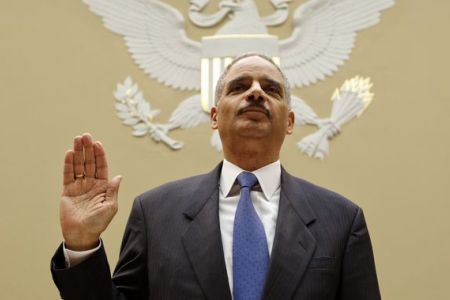
Shortly before Attorney General Eric Holder left office, he gave his prosecutors 90 days to decide whether to indict any Wall Street executives for decisions that caused the 2008 financial crisis.
Holder has now left the building at the Department of Justice (DOJ). Also gone is his deadline for punishing big bankers, none of whom were charged with a crime.
Holder’s shop had six years to build cases against key people at institutions like Citigroup and JP Morgan Chase. It’s not known if prosecutors ever did that. What is known is that the only charges actually filed by DOJ lawyers have been against smaller fish, namely those working at small and medium sized banks, according the Center for Public Integrity (CPI).
The investigative news site reviewed enforcement actions and civil lawsuits filed by the Justice Department, Federal Deposit Insurance Corp. (FDIC) and Securities and Exchange Commission (SEC) and found “these agencies have been far more likely to charge or sue individuals who work at small and medium sized banks, and foreign financial firms, than those that work at domestic banking giants such as J.P. Morgan Chase & Co. or Citigroup.”
CPI’s Alison Fitzgerald reported that none of the five largest banks in the country are involved in criminal cases filed by the Justice Department that pertain to the financial crisis.
“Two defendants who were unsuccessfully prosecuted ran a hedge fund for the now-defunct investment bank Bear Stearns,” she wrote. “About a dozen others are from smaller banks or foreign institutions.”
At the SEC, only four of the more than 100 bank executives named in lawsuits were from the top five banks, according to Fitzgerald. The FDIC has sued nearly 2,000 bank executives, none of whom worked at any of the big Wall Street banks.
“There’s no question that these banks have admitted that they’ve violated laws and regulations,” Independent Community Banker of America CEO Camden Fine told CPI. “These guys on Wall Street get their checkbooks out and write a check. This is an issue of unequal enforcement.”
For his part, Holder recently defended his efforts and that of the DOJ to prosecute individuals at the big banks for criminal wrongdoing. “To the extent that individuals have not been prosecuted, people should understand it is not for lack of trying,” he said.
“Nonsense,” countered former U.S. Assistant Attorney General Jimmy Gurulé. “Charges for white-collar crimes are filed every single day by U.S. attorneys across the country,” he told International Business Times. “Just because they’re more difficult with banks is not a legitimate excuse for bringing zero charges against individuals.”
To Learn More:
Bankers From Major Institutions Still Haven’t Been Held Responsible For Financial Crash (by Alison Fitzgerald, Center for Public Integrity)
Who Caused The Financial Crisis? Prosecutors Face 3-Month Deadline for Bringing Charges in the Subprime Mortgage Mess (by Owen Davis, International Business Times )
Instead of Wall St. Prosecutions, Holder Delivers a Deadline (by William Cohan, New York Times )
Eric Holder’s Last Chance to Prosecute Financial Meltdown Bankers (by Noel Brinkerhoff, AllGov )
“West uses capital outflow as pressure tactics on BRICS”- Russia
The BRICS Post | May 26, 2015
Russian national security advisor Nikolai Patrushev has alleged that Western countries have used capital outflows from BRICS countries as a pressure tactic.
India and Brazil, among the BRICS countries, are most vulnerable to capital outflows as they rely heavily on external funding.
Western countries have pulled out more than $3.5 trillion over the last 10 years and $1.5 trillion from BRICS countries over the last three years as a mechanism to pressure the group, Russian Security Council Secretary Nikolai Patrushev said Tuesday.
“International financial institutions are being used by the West more and more often as an instrument of pressure. Over the last 10 years, the total capital outflow from the BRICS economies has reached $3.5 trillion, and more than half of that total left over the last three years,” Patrushev said during a BRICS security meeting in Moscow.
Patrushev added “the creation of BRICS development bank is an important step in ensuring economic security of the BRICS countries.”
India’s Central Bank Governor Raghuram Rajan, had also said earlier that India needs to build a “bullet-proof national balance sheet” to deal with the fallout on the economy from outflow of capital.
Tehran-Moscow talks on S-300 successful: Iran official
Press TV – May 26, 2015
A senior Iranian official has described as “successful” negotiations on the delivery of Russia’s S-300 surface-to-air missile system to Iran.
“Negotiations on the delivery of the S-300 [missile system] to Iran has been successful”, Iran’s Deputy Foreign Minister for Arab and African Affairs Hossein Amir-Abdollahian said on Monday during a press conference after a meeting with Russian Deputy Foreign Minister Mikhail Bogdanov in the Russian capital, Moscow.
Amir-Abdollahian also stressed that all issues surrounding the delivery of the system to Iran are progressing well.
He further noted that the delivery of S-300 to Iran will happen at the soonest opportunity possible.
On April 13, Russian President Vladimir Putin signed a presidential decree paving the way for the long-overdue delivery of the missile system to Iran.
Russian President Vladimir Putin
The decision to deliver the missile system came after Iran and the P5+1 group of countries – the five permanent members of the UN Security Council plus Germany – reached a mutual understanding on Tehran’s nuclear program in the Swiss city of Lausanne on April 2.
Moscow had banned the delivery of the S-300 system to Tehran in 2010 under the pretext that the agreement it signed with Iran in 2007 was covered by the fourth round of the Security Council sanctions against Iran over its nuclear program. The resolution bars hi-tech weapons sales to the Islamic Republic.
The Russian president defended Moscow’s decision on S-300 supply to Iran, saying the system is meant for deterrence amid ongoing developments in war-torn Yemen.
The UN says since March, nearly 2,000 people have been killed and 7,330 others injured due to the conflict in Yemen. However, according to Yemen’s Freedom House Foundation, the Saudi airstrikes have claimed the lives of about 4,000 Yemeni people.
Israeli Prime Minister Benjamin Netanyahu criticized Russia over its decision to lift the ban on the delivery of S-300 missile system to Iran, saying Tel Aviv sees the plan with “utmost gravity.”
Second senior Brotherhood official dies in prison
MEMO | May 26, 2015
Senior Muslim Brotherhood official and former parliamentarian Mohamed Falahji, 58, died in an Egyptian prison on Monday morning, Quds Press has reported.
Falahji is the second top leader of the movement to have died in prison as a result of maltreatment or lack of proper medical attention. His death brings the number of prisoners who have died in Egyptian prisons since the ouster of the freely-elected President Mohamed Morsi in August 2013 to 265.
The parliamentarian was arrested on 26 August, 2013 on charges of affiliation with a “terrorist” organisation, taking part in demonstrations and inciting violence. He was sent to Jamasah Prison, northern Egypt just over a month later. It was there that he started to experience a lot of pain.
After several calls by his family and appeals by his lawyer, he was transferred to the public hospital in Damietta last month. After examination, he was found to be suffering from kidney stones and inflammation of the gall bladder. He was sent back to prison without receiving any proper treatment.
Falahji’s death comes just a few days after former lawmaker and official in the Freedom and Justice Party Farid Ismail died of liver failure in a Cairo hospital. He was also 58 years old.
Isamil, who was sentenced to seven years in prison last year, was moved from jail in Al-Zagazig to Al-Aqrab Prison Hospital in Tora, south of Cairo, a few days before his death. He was in a coma for several days before he was pronounced dead by the authorities.
On 27 September, 2013, a Brotherhood official in Daqhaliyya, Safwat Khalil, 57, died of cancer in Al-Mansoura Prison. Several others at different leadership levels and members of the Islamic movement have also died in custody due to different diseases or in mysterious circumstances.
The Egyptian authorities insist that all prison inmates have access to proper medical treatment. They stress that they are following international standards and conventions in this regard.
According to Ahmed Mufreh, the director of the Egypt portfolio with NGO Al-Karama for Human Rights, 135 prisoners have died in Egyptian custody since Abdel Fattah Al-Sisi led the coup against Morsi in 2013.
Israeli court sentences Palestinian speaker to prison

Speaker of the Palestinian Legislative Council (PLC) Abdul Aziz Duwaik
Press TV – May 25, 2015
An Israeli military court has handed down a months-long prison term to the speaker of the Palestinian Legislative Council (PLC) and ordered him to pay more than a thousand dollars on charges on of delivering a speech at a pro-resistance celebration three years ago.
On Monday, the Ofer Court in northern Israel sentenced Abdul Aziz Duwaik to 12 months in jail and a fine of six thousand Israeli shekels (USD 1,550), Arabic-language Palestinian news agency Safa reported.
The Ahrar Center for Prisoner Studies and Human Rights condemned the verdict, demanding the immediate release of all Palestinian prisoners currently being held at Israeli detention facilities, the 67-year-old PLC speaker in particular.
Fuad al-Khafash, director of the Palestinian non-governmental organization (NGO), said the Tel Aviv regime has targeted the Palestinian parliament ever since the Palestinian resistance movement Hamas scored a landslide victory in Palestinian elections in 2006, preventing Palestinian lawmakers from serving their respective nation.
Khafash named Hassan Yousef, Mohammad al-Natsheh, Hassan al-Bourini, Mohammad Maher, Yousef Bader and Ezam Salhab as some of the Palestinian legislators that Israel holds captive in its jails.
Israeli soldiers abducted Duwaik in the occupied West Bank city of al-Khalil (Hebron) early on June 16, 2014. Palestinian sources said the senior Hamas official was taken away after his house in al-Khalil was stormed.
Meanwhile, Israeli forces have also arrested at least sixteen Palestinians, including a number of teenagers, during separate raids on a number of houses across the occupied West Bank.
Palestinian security sources, speaking on condition of anonymity, said Israeli military soldiers raided the town of Silwan, which lies on the edge of East al-Quds (Jerusalem) and al-Quds on Monday, and detained eleven Palestinians.
Israeli forces took away five other Palestinians from the entrance gate of the al-Aqsa Mosque compound in the occupied West Bank.
In recent months, Israeli forces have frequently raided the houses of Palestinians in the West Bank, arresting dozens of people, who are then transferred to Israeli prisons, where they are kept without any charges.
There have been many reports about the deteriorating health of Palestinian prisoners held inside Israeli jails.
More than 7,000 Palestinians are reportedly held in 17 Israeli prisons and detention camps. Moreover, 540 Palestinians are held without any trial under the so-called administrative detention, which is a sort of imprisonment without trial or charge that allows Israel to incarcerate Palestinians for up to six months. The detention order can be renewed for indefinite periods of time.
American ‘democracy’ at work
By Jay Syrmopoulos | The Free Thought Project | May 25, 2015
Atlanta, Ga. – An investigative team for an Atlanta television station WXIA, exposed massive government corruption when they found a secret meeting at a Georgia resort hotel held by the American Legislative Exchange Council (ALEC).
The stunning investigative report included video footage of corporate lobbyists and legislators admitting that the legislators are paid by the lobbyists to attend the events.
Reporter Brendan Keefe attempted to gain entrance to the conference but was summarily denied access by ALEC staff and was subsequently escorted from the hotel, where Keefe was a paying guest.
In the video, Keefe approaches the conference room and is blocked by a woman who closes the door to the camera. The woman tells Keefe and the camera-person to follow her away from the room, as Keefe asks if there are legislators in the room.
As Keefe persists in questioning why he is not allowed access, he is confronted by Bill Meierling, an ALEC Director of Communications, accompanied by four sheriff’s deputies.
Keefe attempts to interview Meierling when he approaches, but the ALEC representative refuses and threatens to have the reporter “escorted from the building.” The fact that Keefe is a paying guest of the hotel is seemingly irrelevant when big business is attempting to conceal its incestuous relationship with government.
Why all the secrecy if there is nothing to hide?
Don’t Americans have a right to know that their elected representatives don’t actually represent them, but are simply the rubber stamp for corporate America to enact law?
The lack of transparency in the legislative process should raise serious red flags. The secretive process taking place in the video happens all across the country and in reality is how law is made in the U.S.
Prior to the hotel confrontation, Keefe interviewed Georgia State Senator Nan Orrock, a former ALEC member, who exposed the secretive activities taking place.
“(ALEC) is really a corporate ‘bill mill.’ I mean, they’re cranking out legislation and put it in the hands of legislators who go back and file it. … There are votes taken, that have the corporate votes, voting at the same table with the legislators on what bills to pick. That, at its core, just screams out, ‘inappropriate.’ … (Corporations) absolutely vote, and the truth be told, they write the bills,” said Orrock.
The hustle being pulled on the American public is laid bare, and the order followers enforcing it have been exposed.
ALEC is technically listed as a 501(c)(3) organization, for “charitable and educational purposes,” thus giving legislators a tax write-off for any funds received from the organization.
To provide a clearer example of this process, Keefe explains that ALEC will write a model bill, such as the Georgia Asbestos Claims Priorities Act, which effectively shields corporations from being sued by asbestos victims. The bill eventually presented was an almost exact duplicate of an ALEC bill first approved in a secretive closed-door meeting in a Las Vegas casino.
Unsurprisingly, the three Georgia Senators that sponsored the bill had received over $22,000 in ALEC “scholarships” to attend resort meetings around the same time the asbestos bill was initially being forwarded.
How can anyone continue to put faith in the state after realizing exactly how the corrupt legislative process truly works?
Hezbollah victories belong to all Lebanon: Nasrallah

Press TV – May 24, 2015
Hezbollah Secretary General Seyyed Hassan Nasrallah says the resistance movement’s success in forcing Israeli forces out of Lebanon’s soil 15 years ago was a victory for all Lebanese and Muslims.
Nasrallah made the remarks in the southern town of Nabatiyeh on Sunday during a televised speech celebrating the anniversary of the Israeli forces’ withdrawal from southern Lebanon.
He paid tribute to those who sacrificed their lives to bring victory to the resistance movement.
The Hezbollah chief added that if the the resistance movement had not risen against the Tel Aviv regime Israel would have occupied Lebanon.
Hezbollah forced the Israeli military out of the southern parts of Lebanon on May 25, 2000, after more than two decades of occupation.
People in Lebanon consider May 25 as a beginning of dramatic change in the region.
The Lebanese commemorate the day as a national holiday and see it as a transformation that changed the regional equations for good, and put an end to the invincibility myth of the Israeli military.
Nasrallah said after the Israeli regime attacked Lebanon, some groups in Lebanon hesitated to stand against the Zionist regime and even communicated with “the Israelis and considered them allies and friends.”
But, he added, some other Lebanese “did not wait for the Arab League, the United Nations Security Council, the UN, the US or the West. They rather relied on their capabilities, men, heroes and friends in Iran and Syria, and the resistance was launched.”
“This victory was achieved by some of the Lebanese who believed in resistance,” said Nasrallah.
“From the very first day, the resistance believed that it was defending all Lebanese,” he said, adding that “backstabbing and treason did not prevent it from dedicating its victory to all of Lebanon, the Arabs and the world.”
Takfiri threat
Nasrallah called on the international community and especially on the Lebanese authorities to step up fight against ISIL Takfiri group which is threatening mankind.
Nasrallah said “history is repeating itself” and a scheme spearheaded by ISIL Takfiri group is threatening the Middle East region.
“We are before a danger that is unparalleled in history,” Nasrallah said referring to ISIL terrorist group, adding, “We must understand the threat.”
Nasrallah stressed that all people in the region are facing the threat of the terrorist group, adding, “We are before a threat that does not tolerate the existence of others. All people in the region are facing this barbarous situation.”
The Hezbollah chief stated that remaining silent against the Takfiri threat would be unproductive, adding, “Those who believe that their silence would protect them and their sect are delusional. It is unacceptable to wait and we must take the initiative” against the Takfiri threat.
Nasrallah stressed that those refusing to counter the terrorist group will suffer a lot.
He said the US-led coalition allegedly fighting the terrorist group in Iraq and Syria has not been instrumental in putting an end to the brutalities of the Takfiri group.
“What has the US-led coalition done? The number of their airstrikes throughout a year is much less than the number of Israel’s raids on Lebanon in the [2006] July war or its raids on Gaza,” Nasrallah added.
He urged the Christians in Lebanon to fight the Takfiri group, asking, “Who will protect your women from enslavement and your churches from destruction?”
“We call on everyone in Lebanon and the region to shoulder their responsibilities in the face of the threat and to end their silence and neutrality,” he said, adding, “We call on you to defend your land, sovereignty and people.”
Nasrallah noted that people in the Lebanese city of Arsal are feeling the threat of the Takfiri group every day, calling on the Lebanese government to take action to save the people.
“We are ready to stand by Arsal’s people, but the state must shoulder its responsibility,” he said.
Nasrallah said Hezbollah fighters are present in Syria combating against terrorists, saying, “We are fighting alongside the Syrian army and popular resistance based on our vision that fighting there is aimed at defending everyone in Lebanon, Palestine and Iraq.”
He also called on Saudi Arbia, which has been pounding Yemen since March 26, to stop bombarding the impoverished Arab country.
US, UK, and Canada Reject Nuke-Free Mideast
Press TV has interviewed two journalists and political commentators Hafsa Kara-Mustapha from London and Maxine Dovere from New York, to discuss the United States’ rejection of a proposal made by Arab countries to establish a nuclear weapons-free zone in the Middle East.
Featured Video
Theodore Postol: Iran’s Missiles & Drones Were Underestimated
or go to
Aletho News Archives – Video-Images
From the Archives
What is the Israeli Lobby in Australia Doing in Interfaith Dialogue?
By Ali Kazak | Dissident Voice | October 11, 2015
For years Israel and its lobby around the world have been trying to normalise their relations with Arabs and Muslims without solving the Palestine Question.
One of the methods they resorted to in the last few years is using human rights and community organizations such as interfaith dialogue and Multiculturalism to achieve this objective and to: isolate the Palestinians, marginalise the Palestine question, end Israel’s isolation, and prevent criticism of Israel, knowing that these organisations will be the first to stand against Israel’s violations, racial and religious discrimination.
The group responsible for this task in Australia is The Australia/Israel & Jewish Affairs Council (AIJAC); its Director of International & Community Affairs, Jeremy Jones is in charge of lobbying religious community organizations, specifically Muslims and Christians. Consequently he convened the Faith Communities for Reconciliation, founding participant in the Australian Partnership of Religious Organisations and the Australian National Dialogue of Christians, Muslims & Jews.
AIJAC is a private political propaganda group. It is recognised as the main Israeli lobby in Australia. It coordinates its activities and works intimately with the Israeli embassy in Canberra and different institutions in Israel. It is privately funded by some Jewish businessmen. It monitors closely Australian politicians, the media, ethnic and religious groups, (especially Arabs and Muslims), unions and academics on their stands towards Israel and the Palestine question. … continue
Blog Roll
 Aletho News
- The killing of three Indonesian soldiers in Lebanon should remind Jakarta that Israel does not want peace
- Defeated and delusional: Netanyahu’s remarks reveal $80bn war failure, says analyst
- Iran’s friends are about to make life much more difficult for Israel and the US
- The war of liberation of the Arab and Islamic peoples expands across the Gulf
- Envoy warns UN on Trump’s threat to ‘obliterate’ Iran’s civilian infrastructure
- The Larak Corridor: Iran’s Rial Gate With No US, No Israel, and No Way Around
- ‘Economic terrorism’: Steel facilities hit again in US-Israeli strike
- ‘War Crime’: Iran condemns attacks on Arak, Ardakan nuclear sites
- Two-thirds of Americans want quick end to Iran war even if goals unmet
- Trump to Give “Important Update on Iran” Wednesday in Prime-Time Speech
- If Americans Knew
- Gaza families reunite years after babies evacuated amid Israel’s war
- International Rescue Committee warns Gaza’s children face grave protection risks
- Iran’s Alleged 47-Year War on America: Debunking the 1,050 American Deaths Canard
- Israel wants US to bomb more of Iran’s civilian structures (113,000 is not enough) – Not a ceasefire Day 173
- Ann Coulter Rips Into Fox News for Iran War Coverage
- Joe Kent Urges Americans To Call White House and Congress To Object To Sending Troops Into Iran
- DNC Resolution to Reject AIPAC Funding Puts Democratic Leaders in the Hot Seat
- Swedish foundation to build 400 schools as over 650,000 Gaza children remain without education for 2 years
- Israeli army admits photshopping image of slain Lebanese journalist
- This is how Israel is systematically killing health workers under the cover of war in Lebanon
- No Tricks Zone
- New Study Finds Warming Saves Lives…Cold Temperatures 12 Times More Deadly Than Excess Heat
- German Science Blog Accuses PIK Climate Institute Of Hallucinating Climate Tipping Points
- Devastating Assessment Of Comirnaty Vaccine By Former Senior Pfizer Europe Toxicologist
- New Study: CO2 Is ‘Effectively Negligible’ As An Explanatory Climate Change Factor Since 2000
- Former Pfizer Toxicologist Dr. Helmut Sterz Tells Bundestag Hearing Pfizer Vaccine Should Have Never Been Approved
- Energy Expert: Germany’s Nuclear Phaseout Was A “500 Billion Euro Mistake”
- New Research: South Australia’s Mid-Holocene Sea Surface Temperatures Were 4°C Warmer Than Today
- Storing Green Energy To Last Germany 10 Days Would Require A 60-Million Tonne Battery
- New Studies: UK Sea Levels Were 4 Meters Higher Than Today During The Mid-Holocene
- Destructive Green New Deal: German Energy And Metal Group Warns Of Drastic Crisis
 Aletho News