Families of detained journalists commence sit-in at syndicate
By Mostafa Mohie* | Mada Masr | June 28, 2015
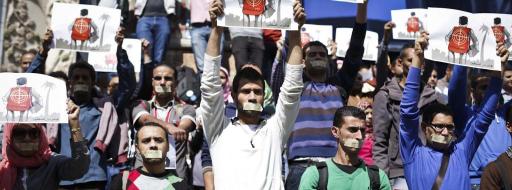
The families of detained journalist Mohamed Saber al-Battawy and photojournalist Mahmoud Abou Zeid, known as Shawkan, started a sit-in on Sunday at the Journalists Syndicate until the release of their relatives.
Battawy’s wife, Rofaida al-Safty, told Mada Masr, “We don’t know why my husband has been detained, we and his lawyers haven’t seen him yet, despite the fact that he has been prosecuted and received a 15-day detention order pending investigation.”
Safty explained that on June 17 at dawn, “a masked force broke into the house and confiscated personal documents, books and Battawy’s hard drive.” Safty wasn’t home when this happened, but Battawy’s father was with him and recounted the details to her.
When Battawy’s father asked about where his son would be taken, he was told “Toukh Police Station,” but Safty didn’t find him there or at any other station within Qalyubiya Governorate, and his arrest was denied by those she asked.
“We called around, notified the syndicate, as well as state-owned Akhbar al-Youm media oulet, and filed a complaint with the general prosecutor and interior minister. We even called the human rights division within the ministry, who asked us to call again, but when we did, their phone was off, Safty recounted.
The Journalists Syndicate filed a complaint with the prosecutor on Monday last week, demanding the disclosure of Battawy’s place of detention and the charges brought against him. The syndicate added in a statement released on the same day that it had communicated with the interior ministry, but received no adequate answer.
On Tuesday, the state-owned Middle East News Agency published an article quoting security sources saying Battawy is in Tora prison and has been accused of “being a member of an illegal group.” Battawy’s defense team headed to the prosecution to verify this information, but no accusations were listed.
Safty reportedly awaits her husband’s transfer to the prosecution again next Wednesday.
As for Shawkan’s family, his mother said he was arrested in August 2013 while covering the Rabea sit-in, along with two foreign photographers who were later released. Shawkan was taken to Cairo Stadium and then transferred to the prosecution, who charged him with murder, attempted murder, being part of an armed group, assaulting security forces, and the possession of a firearm, she added.
Shawkan hasn’t been released or transferred to court and has been detained for 22 months.
Ahmed Abdel Naby, Shawkan’s lawyers, previously told Mada Masr, “There is no evidence against Shawkan and upon arrest he was only carrying a camera. We have submitted all the necessary documents, stating that the photojournalist was working when he was arrested, in addition to the testimony of both his foreign colleagues before their release, but obviously all this is insufficient for his acquittal.”
Abdel Naby said Shawkan was beaten at Cairo Stadium and was then taken to Abu Zaabal Prison, then finally to Tora Prison. Shawkan’s health condition has deteriorated in detention as he has Hepatitis C.
A letter from Shawkan to Yehia al-Qalash, head of the Journalists Syndicate, was published a couple of days ago saying, “All that matters now is the release of all journalists, so that they don’t die a slow death like me. I am afraid that my colleagues will end up like me … thin, pale, with dark circles under the eyes, a heart with an irregular pace and a featureless face that has lost all hope that one day I will be free and will be able to hug my mother again.”
Shawkan added, “I have explained how I die each day, so that you know the suffering of my colleagues in detention. Therefore, I do not ask for my release, but theirs, and I hope that one day they will be free, whether I am alive inside prison or dead.”
Qalash met with Shawkan’s family upon their arrival at the syndicate on Sunday and told reporters he is communicating with the presidency concerning Shawkan’s case.
The Association for Freedom of Thought and Expression (AFTE) issued a report on Saturday on the violations of freedom of the press during the first half of 2015. According to the report, 18 journalists were arrested, 14 others were illegally detained, 34 were physically assaulted, eight were verbally abused, and 85 were prohibited from future coverage. AFTE reported one case in which a media institution was raided. AFTE added that five journalists were detained for more than 500 days and five others for more than 100 days.
The Committee to Protect Journalists (CPJ) issued a statement on June 25 saying that Egyptian authorities jailed 18 journalists in 2015 — the highest number of detentions since 1990.
CPJ sent a “delegation to Egypt in February, where it met with the general prosecutor and the minister of transitional justice, who said that no journalists have been detained because of their work. However, the committee stated that Sisi’s government used national security as a way to control human rights and freedom of the press.”
The report added, “The Egyptian government is randomly accusing journalists and activists of being members of a banned group. The majority of detained journalists have been accused of being Muslim Brotherhood affiliated.
* Translated by Mada Masr
‘Nonsense’: Norway PM lashes out at NATO spending goals
RT | June 29, 2015
The prime minister of Norway, Erna Solberg has described NATO’s defense spending plans as “nonsense.” The alliance wants members to spend two percent of their GDP on defense, but Oslo, one of the world’s richest countries, says it won’t meet the target.
“If I am allowed to speak, I think the percentage goal is nonsense,” she said in an interview with the Norwegian Armed Forces’ Forum Magazine, as cited by the Local. “The aim of the NATO countries must be the greatest possible defense capability, not a percentage goal in itself,” she added.
Solberg added that while meeting the two percent target may be easier for countries enjoying strong economic growth, it would be harder for those within the alliance whose economies are shrinking.
Norway’s Defense Minister Ine Eriksen Soreide said in April that for Oslo to spend 2 percent of its GDP on defense would be “very challenging” in the short term. The Scandinavian country has already said it will increase its spending this year, but this will only bring it to around 1.6 percent and short of the target that was set at the NATO summit in Cardiff, the United Kingdom, last year.
NATO’s General Secretary Jens Stoltenberg, who was also Solberg’s predecessor as Norway’s PM, said that the country could easily meet the target.
“If there is a political will, there is economic space. But it must be given priority,” he said in a visit to Norway in June. “Compared with other major initiatives we have implemented in Norway, reaching two percent is quite possible.”
Aside from the United States, traditional NATO allies have found meeting the target a taxing affair. Germany allocates 1.2 percent of its GDP, the Netherlands 1.3 percent and Spain less than 1 percent. France is the only Western European country that is boosting defense spending. However, some Eastern European nations are increasing their military expenses citing what they call Russian aggression. Lithuania, for instance, wants to allocate twice as much on defense as it did last year.
READ MORE: NATO defense spending a ‘red line’ – US Air Force Secretary
Jewish group suggests ‘outing’ of American anti-Israel professors, calls for Israel studies programs

Press TV | June 29, 2015
A Jewish institute has proposed “outing” of anti-Israel professors from universities in the United States in order to reduce anti-Israel activity on American college campuses.
The Jewish People Policy Institute said in its 2014-2015 annual assessment that there are over 300 anti-Israel groups at American universities and they are responsible for resolutions passed by the Boycott, Divestment and Sanctions (BDS) movement.
According to the report published on Sunday, severe anti-Israel activity “is limited to around 20 campuses, mainly in California and in some elite eastern schools.”
“We recommend exposing ‘activist’ faculty members who use their academic lecterns to advance an anti-Israel agenda,” said the report.
It suggested enlisting Jewish donors in efforts “to prevent the misuse of academic freedom in promoting a politicized anti-Israel platform.”
Other suggestions are promoting “additional departments for Israeli studies programs on campuses” and increasing “cooperative endeavors with Israeli universities.”
The group gave the report to Israeli Prime Minister Benjamin Netanyahu.
The BDS campaign seeks to increase economic and political pressure on Israel until it ends the occupation and colonization of Palestinian lands and respects the right of return of Palestinian refugees.
The boycott campaign began in 2005 by 171 Palestinian organizations, calling for “various forms of boycott against Israel until it meets its obligations under international law.”
In 2013, two US academic groups — the American Studies Association and the Association for Asian American Studies — supported the boycott.
The refusal of the University of Illinois to hire Professor Steven Salaita last year for his tweets about Israel’s crimes against the Palestinians in the Gaza Strip sparked controversy.
Salaita decided to leave his job at Virginia Tech University after he was offered a professor’s job at the University of Illinois in 2013.
He wrote a number of messages in 2014 to condemn Israel’s war in the Gaza Strip.
In one message, Salaita said, “Only #Israel can murder around 300 children in the span of a few weeks and insist that it is the victim.”
He was told that he would not get the job after writing the messages.
UK activists to block arms factory on Gaza anniversary

MEMO | June 29, 2015
Activists in Britain are planning to block an Israel-linked arms factory to mark one year since Israel’s devastating assault on the Gaza Strip.
In what organisers are billing as “the biggest, most beautiful action” ever seen at a UK arms factory, buses of activists from around the country will descend on Shenstone in the West Midlands on July 6 for “a day of creative action in solidarity with Palestine.”
Last August, during Israel’s attack on Gaza, activists occupied the roof of the UAV Engines Ltd factory in Shenstone, which is owned by the Israeli arms company Elbit Systems. The drone engine factory was shut for two days as a result, which activists claim cost the company more than £180,000.
Elbit-produced drones are used by the Israeli military, and were used to conduct attacks during ‘Operation Protective Edge’.
A year on, and activists plan to ‘Block the factory’ on July 6, “transforming the space around the arms factory… into a fun, creative and child-friendly environment.” The focus is on “an inclusive and family friendly affair”, activists say.
The planned action is “part of the wider Boycott, Divestment and Sanctions campaign (BDS) and the Stop Arming Israel Campaign”, with the latter urging “the UK to end its extensive collaboration with the Israeli weapons industry and to institute a two-way arms embargo.”
Organisers note how “anger and disbelief over last year’s massacre led to widaespread and creative forms of resistance”, including “mass demonstrations, occupations of government buildings and complicit businesses, and growing public pressure on governments and arms companies to stop arming Israel.” The intention is for July 6 to be a continuation of such efforts.
Israel Hijacks Humanitarian Ship to Gaza in International Waters
By Stephen Lendman | June 29, 2015
Gaza has been lawlessly blockaded for nine years – entirely for political, not security reasons. Israel wants its 1.8 million people slowly suffocated.
Flotilla III is the latest humanitarian mission bringing vital aid – symbolic of how much more is needed and a call for world leaders to intervene responsibly for suffering Gazans, victimized by Israeli viciousness.
The latest news from Ship to Gaza Sweden reads as follows:
“Marianne and the #FreedomFlotilla right now
Boarded by Israeli navy in international waters
Distance to Gaza: 97 nautical miles
Last known position: 31.716667 latitude, 32.550000 longitude
Position received at: 29 June 00:57 (CET)
Speed: Unknown”
Hours earlier, Ship to Gaza’s site reported Marianne’s interdiction in international waters, then taken to Israel’s Ashdod seaport. Activists and international politicians on board include:
Dror Feiler, Sweden: musician and composer
Bassel Ghattas, Israel: Palestinian MK
Dr. Moncef Marzuki, Tunisia: former Tunisian president
Ana Miranda, Spain: European Parliament member
Nadya Kevorkova, Russia: RT International correspondent
Kajsa Ekis Ekman, Sweden: journalist and author
Robert Lovelace, Canada: Queen’s University professor
Ammar Al-Hamdan, Norway: Al Jazeera Arabic correspondent
Mohammed El Bakkail, Morocco: Al Jazeera Arabic correspondent
Ohad Herno, Israel: Israeli TV Channel 2 journalist
Ruwani Perera, New Zealand: MaoriTV journalist
Jacob Bryant, New Zealand: Maori TV journalist
Crew members include: Joel Opperdoes (Sweden) Gustave Bergstrom (Sweden), Herman Reksten (Norway), Kevin Neish (Canada), Jonas Karlin (Sweden), Charlie Andreasson (Sweden)
Three other Flotilla III vessels heading for Gaza changed course and returned to their ports of origin – Rachel, Vittorio and Juliano II.
In total, 47 participants from 17 countries are involved. Their mission is “break(ing) the illegal and inhumane blockade of Gaza,” as well as opening the territory to the world. A statement issued said:
“We once again call on the government of Israel to finally lift the blockade on Gaza. Our destination remains the conscience of humanity.”
The Marianne of Gothenburg carried medical equipment and solar panels. Flotilla spokesman Petros Stergiou reported contact with the vessel lost around 2AM local time Monday as three Israeli naval ships approached it.
“What we learned is that the Israeli navy attacked the Marianne about 100 nautical miles from the shore of Gaza,” he said.
Activists on board “said they could see three military boats approaching them that had identified themselves as being military.”
“Once again, the Israeli government and its military acted like state pirates and attacked our boat in international waters,” Stergiou explained. IDF spokesman Peter Lerner called the seizure “uneventful.”
Netanyahu commented as expected, saying “(t)his flotilla is nothing but a demonstration of hypocrisy and lies that is only assisting the Hamas terrorist organization and ignores all of the horrors in our region.”
He congratulated Israeli naval commandos for their high-seas piracy. He lied saying he acted according to international law and support from a “UN Secretary-General committee.”
Defense Secretary Moshe Ya’alon issued a similar statement irresponsibly claiming the mission has “no humanitarian intentions…which instead of caring for Gaza residents, tries to smuggle in weapons (to be) use(d) against Israel and its civilians.”
Fact: Hamas is no “terrorist organization.” It’s Palestine’s democratically elected government.
Fact: Israel and America bear full responsibility for regional “horrors.”
Fact: Palestinians are longstanding victims – along with Iraqis, Libyans, Syrians, Yemenis and others living under monarchal or military dictatorships.
Fact: No flotilla or other humanitarian missions carried weapons for anyone. The whole world knows it. So does Israel.
Its blockade breaches international law. It’s an act of war against 1.8 million largely defenseless Gazans – denied their fundamental human rights.
Poverty and unemployment are extreme. Most Gazans need international aid to survive. The Strip’s most arable land is off limits. Israeli buffer zone diktats prohibit cultivation. Fishing in 85% of Gazan waters is banned.
A nutritional crisis continues along with inaccessibility to clean water for 90% of Gazans. An acute shortage of medicines, medical supplies, building materials and other essentials exists.
Ship to Gaza activists say the international community fails to help a trapped population desperately in need. “As human beings, we cannot stand by silently while witnessing what the blockade is to doing to” people deserving much better. (T)herefore we will act,” they said.
We’ll continue “send(ing) more ships with many more people (in) solidarity with the people of Gaza.”
“New groups are being formed all over the world…(O)ur coalition is growing…Our (mission) is a natural, brotherly action; our objective is humanitarian; our basis lies in international law; and our method is non-violent.”
Israel’s blockade severely restricts movement of people and goods into and from Gaza. It constitutes lawless collective punishment – strictly prohibited under international law.
It deprives Gazans of their livelihoods, security, accessibility to proper nutrition, clean water, medicines, medical care, education, and ability to move freely.
Israeli aggression denies many of their right to life and well-being. Israeli media reported IDF commandos seizing the vessel overnight without incident or injuries to activists on board.
We’ll know more when they’re able to speak for themselves, explain exactly what happened and how they were mistreated.
Israel’s interdiction was high-seas piracy – a lawless bandit act. An IDF statement lied claiming it acted “(i)n accordance with international law.” It blatantly violated it.
Pre-recorded SOS messages called for international help before seizure by Israeli commandos occurred.
Based on how other interdicted activists were treated, Marianne participants can expect short-term detention under harsh conditions, abusive interrogations, confiscation of their possessions, and perhaps denial of food, water and outside contacts, followed by deportations.
Gazans remain trapped and isolated under brutalizing siege. The Al Haq human rights organization reported continued Israeli use of “excessive force” across the West Bank and Gaza – using live fire and other forms of brutality against defenseless civilians, “disregarding Palestinians’ right to life.”
Al Haq director Shawan Jabarin said Palestinian officials delivered documents to the International Criminal Court charging Israel with the crime of apartheid and 22 other criminal offenses, including seven war crimes – pertaining to Operation Protective Edge, illegal settlements, denial of due process and judicial fairness, as well as mistreatment of Palestinian prisoners, mostly held for political reasons.
Throughout nearly half a century of brutalizing military occupation (lawless under international law), punctuated by intermittent acts of aggression, no Israeli government or military official ever was held accountable. Expect justice again denied this time.
Stephen Lendman lives in Chicago. He can be reached at lendmanstephen@sbcglobal.net.
His new book as editor and contributor is titled “Flashpoint in Ukraine: US Drive for Hegemony Risks WW III.”
Cops Refuse to Stop Chase Plowing Over Multiple Children, Killing Them During Neighborhood Pursuit
By Eva Decesare | The Free Thought Project | June 27, 2015

“Officers must place the protection of human life above all other considerations.”
Detroit, MI — Or so says the official policy of the Detroit Police Department. Yet, on Wednesday, Detroit police continued a high-speed chase into a busy neighborhood, resulting in two small children being killed and others injured.
Brother and sister Michaelangelo and Makiah Jackson, ages 6 and 3 respectively, were playing in front of their home when a police car appeared, chasing what appeared to be a red Challenger. According to eyewitnesses, the police car bumped the Challenger, and the car “flew up in the air.” Witnesses heard tire squeals, as if the car was attempting to stop, but by then it was going too fast and had lost control and hit the two small children, killing them instantly.
A friend of the family described the horrible scene:
“[The police] were right on their rear, the police car bumped their tail a little bit, and the car flew up in the air,” the friend said. “There was no need for the police to be that close. I yelled ‘WATCH OUT’ but it was too late. When the car hit them, both of them just looked at me. They screamed. It just keeps re-playing in my head. … I ran down there, I yelled out their names, but they were gone. Makiah’s eyes were wide open, they died on impact.”
“I’m the last one they talked to. They looked at me, they were here, I saw their faces. L’il Mama (Makiah) thought I was going to take them to the park, so she came with me to the sidewalk. I told her I promise I’ll take you to the park tomorrow.”
Even after the car had dragged the children a distance down the street, the police did not stop their pursuit. They continued to chase the car across one front lawn after another, finally crashing, critically injuring three more children including three year old Darius Andrews, Jr., Isaiah Williams, 5, and Zyaire Gardner, 7. Twenty-two-year-old LaKendra Hill sustained injuries. The father of the youngest called seven-year-old Zaire “the real hero,” adding, “He saved my son’s life. He grabbed him and tried to hold him.”
Police report that the driver of the car they were chasing was 29 year old Lorenzo Harris, who was on parole but had not been reporting in to his parole officer. An unidentified passenger in the car was also in serious condition.
As to other details of the event, police reports are conflicting. On the night of the incident, police Chief James Craig said that the police car had already stopped the chase after they “lost sight of the car.” After many eyewitnesses had refuted that claim, Craig said that a supervisor had ordered a stop to the pursuit.
Furthermore, in an early report, Craig claimed that police saw an occupant of the car holding a gun. The next day the chief said there was no gun, and that the case started when the police “made eye contact” with the occupants of the car.
Two small children being killed while playing in their own front yard and several more being injured during a pursuit over what may have been nothing more than a parole violation shows a drastic imbalance in police judgment and in police priorities. For the police to create such a horribly dangerous situation – a situation that proved tragically fatal – sends a very clear message. Those with badges are far more concerned with having control and gaining compliance by any means necessary than they are with actually protecting the innocent.
On paper, the official policy of the Detroit Police Department includes this:
“Members involved in a pursuit must question whether the seriousness of the violation warrants continuation of the pursuit. A pursuit shall be discontinued when, in the judgment of the primary unit, there is a clear and present danger to the public which outweighs the need for immediate apprehension of the violator. Officers must keep in mind that a vehicle pursuit has the same potential for serious injury or death as the use of fatal force. … Officers must place the protection of human life above all other considerations.”
Their true attitude, priorities, “policy” is written in the blood of small children on those front lawns. Our hearts go out to the victims of this horrible tragedy.
The family of Mikiah and Michael Angelo Jackson has set up a GoFundMe account to help with their funeral expenses, which they said they cannot afford.
Media Coverage of Europe’s Migrant Crisis Ignores Root Cause: NATO
Danielle Ryan | Russia Insider | June 23, 2015
The scale of the migrant crisis Europe is facing today cannot be understated. It is truly unprecedented. What is habitually understated, however — and in fact almost completely ignored by mainstream media — are the real roots of the crisis.
The debate around migration into the EU is happening nearly entirely without reference to the causes of the recent influx of migrants from North Africa and the Middle East. The elephant in the room is NATO and nobody really wants to talk about it.
Hundreds of articles, laden down with numbers and proposals and predictions fail to make any direct link between cause and effect. News anchors sit seemingly baffled, mouths agape, at the apocalyptic-like pictures they are seeing land on their desks, and yet few are willing to draw the appropriate conclusions. But it is such a basic and logical connection that it’s hard to believe it is not being made very loudly and very persistently.
Maybe it’s just that these journalists are so conditioned to framing U.S. and NATO policy in a positive light that the links don’t even really occur to them. Or maybe they’re simply embarrassed and trying to shift focus from their long-recorded support for various military interventions in these countries.
Either way, the result is that the story is framed in such a way that it makes the timing of the crisis sound almost random. We’re witnessing a conversation about how to ‘deal’ with boats full of Libyans making their way across the Mediterranean — as if Libya was a country that had just self-imploded yesterday, and for no discernible reason.
A fierce debate is raging over ‘what to do’ about these migrants — and in a way that’s understandable because that is the more immediate problem — but the debate we really need to be having is about the policies, NATO’s policies, which were the catalyst.
Even if Europe unites in formulating a ‘solution’ to the problem, it will be nothing more than a band-aid fix because it will only deal with symptom. After all, what’s the point in covering your open wound with a band-aid when the guy who cut you is still wielding a knife in the same room? It doesn’t take a genius to work out how that story ends.
Whenever the cause is grudgingly mentioned by the media, it is mentioned briefly and abstractly where the author or anchor might refer to “conflict” or make mention of how violence has “reignited” in these countries in recent years and months.
The editors at the New York Times in particular, are big fans of loading all the blame squarely onto Europe’s shoulders. Here a Times piece argues that the migrant crisis “puts Europe’s policy missteps into focus”. Another piece, from the editorial board, lectures Europe on how to handle the situation.
In April, NATO head Jens Stoltenberg called for a “comprehensive response” to the crisis and promised that NATO would help to stabilize the situation. The alliance’s role in “stabilizing” Afghanistan was part of its broader approach to the refugee crisis in the Mediterranean, he said.
That is rich coming from the head of a ‘security’ and ‘defensive’ alliance which for years has pursued a policy of offensive destabilization in the very regions which people are fleeing from in their hundreds of thousands. But Stoltenberg’s comments and NATO’s actions are easily decoded by the employment of some basic common sense.
The NATO modus operandi is clear. The pattern, repeated over and over, involves the complete destabilization of a region, to be swiftly followed up with another NATO-led ‘solution’ to the problem. When you couple that with the use of spokespeople who are unashamed to feign ignorance and lie blatantly (Jen Psaki, Marie Harf etc.), and a compliant media that will regurgitate the line without question, this is what you get.
The 2011 NATO intervention in Libya was authorized by the United Nations on “humanitarian” grounds and resulted in the deaths of between 50,000 and 100,000 people and the displacement of 2 million. Very humanitarian.
Similarly, after the U.S.-led campaign to destabilize Syria in an effort to topple Bashar al-Assad, facilitating (and even supporting) the rise of ISIS in the region, a staggering 10 million have been displaced (according to Amnesty International) and European countries are left to help pick up the pieces. Germany, for example, has pledged to resettle 30,000 Syrian refugees. Sweden, a non-NATO nation, has taken in similar numbers.
It should be made clear however, that the numbers European countries have taken or pledged to take pale in comparison to the numbers being hosted in other Middle Eastern countries. Lebanon, for example, is hosting 1.1 million Syrian refugees. Jordan is hosting more than 600,000. Iraq hosts nearly a quarter of a million. Turkey hosts 1.6 million.
There is one country that’s getting off scot-free in all of this — at least on the Syrian front. That country is the United States. The U.S. has taken in less than 900 Syrian refugees after four years of war. American officials have cited “national security” in their explanations for not yet taking more, although they have said they would like to see the number increase.

Maybe this has something to do with it?
Debate not allowed
There is a second media crime flying under the radar here and it is this: In European countries where the massive influx of migrants from the Middle East and North Africa have caused serious societal divisions, where migrants have failed to assimilate (for a variety of reasons, including both government policies and often radical religious beliefs), Western media will allow no one to talk about it honestly — and woe betide the person who tries.
Take Sweden, where the disease of political correctness is at an even more advanced stage than it is in the rest of Europe. There, any attempt to debate the coherence of a ‘doors wide open’ immigration policy is branded as “racist”. A further irony in the Swedish context, is that the country is facing a housing crisis and has nowhere to put most of the people they are pledging to resettle. There’s some real forward-thinking, common sense policy for you.
This is a dangerous combination for Europe: An unsustainable influx of migrants, foreign policy which ensures its continuation, a docile media, and an epidemic of political correctness which has infected the entire continent.
Media 101 on the migrant crisis: Talk a lot about migrants, don’t mention why they fled and then call anyone who has a problem with it a “racist” — success! Oh, and you get an added bonus if you can somehow link it all to ‘Russian aggression’, Vladimir Putin and NATO as a ‘defensive’ alliance.
Some European countries are taking a more hardline approach and are getting slammed for it. Hungary, for example, is looking at building a barrier wall along its border with Serbia, similar to barriers along the Greek-Turkish and Bulgarian-Turkish borders. Again, this has sparked accusations of xenophobia and racism from media and political quarters.
But that’s part of the game, isn’t it? If NATO’s war supporters can focus the debate around the idea that anyone who wants to address or critically assess immigration policy is “racist” then we won’t have to talk about why the migrants are here in the first place or why they are facing such dire circumstances at home.
Russia Today’s Oksana Boyko tried recently, to broach this topic with Peter Sutherland, the UN’s special representative on international migration and development, but she got nowhere. She argued that the debate around migration into the EU can’t really be had without addressing the essence and heart of the problem, but found that NATO policy is apparently a topic not up for discussion.
Debating Europe’s migrant crisis without acknowledging the context in which it has been created it useless. It would be like asking Americans to debate police brutality without talking about race. The two are inescapably interlinked and any ‘solutions’ that come from an incomplete debate will ultimately fail.
For now though, it seems Europe will continue to debate this humanitarian crisis in terms of ‘what to do’ without addressing the ‘how to stop’ and we’ll keep running around in a vicious circle.
An easier solution, of course, would be for NATO to put an end to its campaign of destabilization in the Middle East and North Africa, but that would require the acceptance and acknowledgement of some very hard truths.
Freedom Flotilla III en route to Gaza; military plane spotted overhead

From left to right: Algerian MP Nasser Hamdaduche; Former US Army colonel and retired State Department official Ann Wright; Moroccan MP Abouzaid El Mokrie El Idrissi; and journalist Abdul Latif from Echorouk TV on one of boats of the Freedom Flotilla III, sailing in international waters towards Gaza
By Celine Hagbard | IMEMC News | June 28, 2015
On June 26th 2015, four boats of the 2015 the Freedom Flotilla III set sail toward Gaza to try to break Israel’s nine-year-long economic siege on Gaza. The ships are planning to sail from international waters directly into Palestinian waters, with no Israeli involvement. But just hours after setting sail, the captain of one of the ships took note of a military reconnaissance plane that appeared to be tracking the ships.
The captain of the lead ship, ‘The Marianne’, noticed military vessels and reconnaissance planes near Marianne on Saturday afternoon. The crew could not identify nationality for neither the vessels or the planes. The vessel and plane disappeared around 5pm, and the crew has not seen any sign of them since then.
According to a statement by the group, the Flotilla is due to reach Gaza in just a few days. Participants on board include about 50 human rights activists, journalists, artists, and political figures representing 17 countries. This is the third Freedom Flotilla, in addition to nine single boats that have undertaken to sail to Gaza, beginning in 2008 when several voyages reached Gaza City harbor and returned to Europe after their mission of bringing supplies and solidarity to the people of Gaza.
Israeli forces attacked every subsequent attempt to break the siege on Gaza by sea, seizing the humanitarian goods, medical supplies and water treatment equipment on the ships and arresting the participants. In an attack which garnered international attention, Israeli paratroopers dropped onto a Freedom Flotilla ship called the ‘Mavi Marmara’ and began shooting the passengers, killing nine.
In the current Freedom Flotilla, a converted fishing trawler, dubbed the ‘Marianne of Gothenburg’ left Sweden in May to join the flotilla and has made numerous stops along its journey around Europe. Marianne is carrying solar panels that will help alleviate the serious problem of electricity in Gaza, as well .as medical equipment. Three other sailing vessels (Rachel, Vittorio and Juliano II) are accompanying Marianne in its mission to break the blockade of Gaza, in solidarity with the 1.8 million Palestinians in Gaza. With different strategies and different itineraries, the group says they will continue to sail until the blockade is lifted and Gaza’s port is open.
Dr. Basel Ghattas, a member of the Israeli Knesset, is on board one of the ships, as well as Dr. Moncef Marzouki, former President of Tunisia, the first president after the 2011 popular uprising. Members of parliament from Spain, Jordan, Greece and Algeria are also on board, together with members of European Parliament. Ten of the current participants and crew have been on previous missions. Media outlets on board the flotilla are Al Jazeera, Euronews, Maori TV (New Zealand), Al-Quds TV, Channel 2 TV (Israel) and Russia Today TV, as well as several independent print journalists.
Over 100 European Parliamentarians have signed a letter to the EU’s High Representative, Federica Mogherini, in support of the Freedom Flotilla and calling for an end to the blockade of Gaza.
Saudi Arabia Thwarts UN Emergency Aid for Yemen
Sputnik – 27.06.2015
Months after the Saudi government pledged to single-handedly meet the United Nations’ (UN) “flash appeal” for humanitarian aid to Yemen, Riyadh is making it clear that the donation doesn’t come without strings attached.
On April 12, as the Saudi-led air campaign rained bombs over Yemen, the UN issued an emergency flash appeal calling for $274 million in aid for the country to address the increasingly dire humanitarian condition. Less than 24 hours later, the call was met entirely by the very government that was leading the attacks against Yemen.
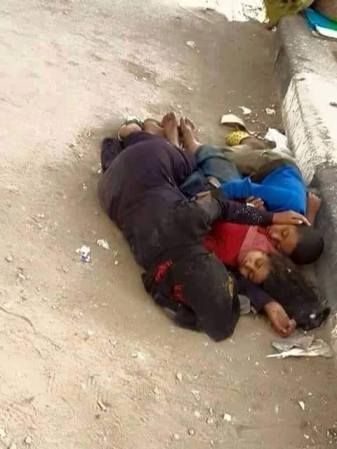 Overseen by the UN Office for Coordination of Human Affairs (UNOCHA), emergency funds are meant to be distributed quickly to where they are most needed. Over two months have passed since Riyadh pledged the full $274 million, however, and the money has yet to be delivered to Yemen.
A UN memo obtained exclusively by VICE news has revealed the reason for this delay is the restrictive conditions the Saudi government has placed on the aid disbursement. What’s more, the UN appears to have consented to these conditions.
On Tuesday, Riyadh announced that $244 million of the total amount pledged will be split between nine UN agencies. The next day, the UN’s undersecretary for humanitarian affairs and emergency relief coordinator Stephen O’Brien sent a letter to the Interagency Standing Committee, a global humanitarian coordinating body for humanitarian agencies.
In the letter, O’Brien explained that the funds would go through the King Salman Center for Relief and Humanitarian Work (KSC). He also noted that KSC would dictate the terms of the fund distribution with each of the nine agencies.
“The KSC would like to negotiate the Memorandums of Understanding (MoUs) with each recipient agency,” he wrote. “They would also like to be assured that the Government of Yemen in exile is consulted.”
The memo indicates that the pledge was a calculated move on the part of the Saudi government to monopolize the aid and control where it goes and when. According to VICE, the letter alarmed many aid workers who say that it was too vaguely worded, thereby giving Riyadh leeway for further delays.
“It’s really unusual for a single donor to have any substantive role once they contribute funds, let alone negotiate individual MoUs with agencies,” an anonymous official involved in the Yemen response told VICE.
He also noted the UN’s acquiesce to Riyadh’s stipulations.
“The charitable way of saying it is this is a compromise – the less charitable way of saying it is that they folded,” he said. “Now the UN has punted and handed off the problems to these agencies. I’ve never seen that before.”
The letter comes as the UNOCHA struggles with massive funding deficits in over two dozen countries, including in Yemen where the agency estimates that 80% of the population needs humanitarian aid, and may explain the UN’s agreement to the Saudi government’s stipulations.
“With regard to NGOs, I am aware that there are sensitivities in receiving funding directly from the KSC,” O’Brien wrote, acknowledging the unusual Saudi stipulations. “We therefore must work actively to mobilize additional funds to be allocated directly, or via the Pooled Fund, to our front-line partners.”
However, another aid worker with an organization that delivers humanitarian supplies to Yemen told VICE that O’Brien’s acknowledgement does not take away from the UN’s concession to Saudi over control of the fund disbursement.
“The thing about this communication that we all got, it’s really vague,” he said. “We are trying to assume and guess what they mean by this plan, but it’s not clear. The Saudis might very well sit on it for a long time.”
While it is not unusual for donor countries to have a degree of control over the distribution of funds, InterAction humanitarian vice president Joel Charny notes that emergency situations require agencies like the UN to make the final call.
“It’s not that donors don’t care where the money goes, but there’s a sense that in an urgent case like Yemen you let the professionals make the call,” he said.
O’Brien also told VICE a day before the letter was released that, as a general rule, the UN does not “condone any modality based on geography,” meaning that donors cannot restrict aid distribution from certain areas.
Yet Riyadh has already asked for the restriction of aid distribution to Houthi-held areas in Yemen.
Saudi Arabia launched its air campaign against Houthi rebels in Yemen in March in an effort to reinstate Yemeni President Abdu Rabbu Mansour Hadi. Since the beginning of the airstrike campaign, over 2,800 people have been killed in the fighting and 13,000 have been wounded, according to local hospitals.
Ukraine Masses Troops on Border With Transnistria
Sputnik – 28.06.2015
Ukraine continues to mass troops and heavy weapons on the border with Transnistria on the pretext that the self-proclaimed republic may launch a military campaign against Ukraine, Russian media reported on Saturday.
“It looks like the Kiev authorities want to picture themselves as encircled by enemies, ready to attack,” a representative of the Transnistrian KGB told Russia’s Zvezda TV channel.
“That we may have a war here tomorrow is hard to say, but we are not ruling out a Ukrainian provocation either… They could use for this purpose one of their many small private armies which refuse to take any orders from Kiev,” the official added.
On June 22, the deputy foreign minister of the Transnistrian Republic, Vitaly Ignatyev, said that Ukraine was moving its troops towards the borders of the self-proclaimed republic, sandwiched between Ukraine and Moldova.
“The situation here is very bad… Economic production is going down, foreign trade is shrinking, the security situation is equally alarming with our Moldovan partners holding military drills with NATO and the Ukrainian pressure mounting every day,” Ignatyev said.
He also mentioned the curbs Kiev has imposed on the transit of Transnistrian nationals and citizens of Russia, almost 200,000 of whom currently live in Transnistria.
“They haven’t been able to travel to Russia via Ukraine for more than a year now. They have to move across Moldova, but Chisinau is creating problems too, along with economic sanctions,” Ignatyev added.
The newly appointed governor of Ukraine’s Odessa region Mikheil Saakashvili earlier announced plans to reinforce Ukraine’s border with Transnistria.
“We have two major tasks — to reinforce the border and curb corruption. Drug and weapons trafficking across this border means nothing good,” Saakashvili told a news conference in Odessa.
He also blamed the Transnistrian authorities for destabilizing the situation in Ukraine.
Featured Video

Dr. Tony Martin – The Jewish Role in the African Slave Trade
or go to
Aletho News Archives – Video-Images
In Memoriam
James Petras, In Memoriam
 02.13.2026
Professor James Petras, 89, world-renowned sociologist, public intellectual, and scholar of Latin American politics and global economics, died peacefully on January 17, 2026, in Seattle, WA, surrounded by family.
A prolific scholar and activist, he devoted his life to challenging power, imperialism, and inequality. … continue
Blog Roll
 Aletho News
- Travelers Take a Pass on Visiting America
- EU members divided on 20th Russia sanctions package – media
- Lawyers ask police to investigate Elbit Systems UK for alleged war crimes complicity
- Israel ready to strike Iran-backed armed groups – media
- Behind US war drums against Iran: No goals, no plan, no off-ramp
- With Ukraine blamed for cutting oil flows to Hungary, Croatia also refuses to transfer Russian oil in violation of EU law
- Friedrich Merz’s Push to End Online Anonymity Has a Troubling Subtext
- Macron: French citizens fighting for Israel cannot be labeled ‘genociders’
- US eyes Gaza security force drawn from armed gangs
- The Only Motive Behind The ‘Imminent’ U.S. War With Iran Is The Zionist Lobby
- If Americans Knew
- ‘Christians Out’: Jerusalem Church Tagged With Hate Graffiti, Police Investigating
- Israeli Settlers Kill American Teen
- ‘We returned from hell’: Palestinian journalists recount torture in Israeli prisons
- No mercy for Gaza in Ramadan – Not a ceasefire Day 133
- The Israeli Government Installed and Maintained Security System at Epstein Apartment
- Tucker Carlson interrogated in Israel, has passport seized after interviewing US ambassador
- 6,000 Amputees in Gaza Face Impossible Recovery amid Israeli War Ultimatum
- The Lancet: Gaza death toll far higher than reported – Not a ceasefire Day 132
- Compliant aid: Who are the Israel-approved NGOs scaling up in Gaza?
- Why won’t Trump’s “Board of Peace” bring peace? – Not a ceasefire Day 131
- No Tricks Zone
- New Study: Canada’s New Brunswick Was 1°C Warmer Than Today During The Medieval Warm Period
- Coal Power Back In Trend As Globe Tries To Keep Pace With Growing Demand For Power
- New Study: A 4°C Warmer Beaufort Sea Had ‘No Sea Ice’ 11,700 – 8200 Years Ago
- Unfudging The Data: Dutch Meteorological Institute Reinstates Early 20th Centruy Heat Waves It Had Erased Earlier
- German Gas Crisis…Chancellor Merz Allegedly Bans Gas Debate Ahead of Elections!
- Pollen Reconstructions Show The Last Glacial’s Warming Events Were Global, 10x Greater Than Modern
- Germany’s Natural Gas Storage Level Dwindles To Just 28%… Increasingly Critical
- New Study Rebuts The Assumption That Anthropogenic CO2 Molecules Have ‘Special’ Properties
- Climate Scientist Who Predicted End Of “Heavy Frost And Snow” Now Refuses Media Inquiries
- Polar Bear Numbers Rising And Health Improving In Areas With The Most Rapid Sea Ice Decline
 Aletho News