Latin American Revolutions Under Attack
By ANDRE VLTCHEK | CounterPunch | June 26, 2015
Do not take the Latin American revolutions for granted.
They inspired the entire Planet. They brought hope to every corner of our scarred Earth. But now they are themselves in need of our support.
If left alone, they would thrive for decades and centuries. But the Empire is once again on the offensive. It is shaking with fury. It is ready to invade, to smash, burn to ashes all the hopes, all that which had been achieved.
Don’t believe in the “common wisdom” which proclaims that the rulers of the world simply “closed their eyes” more than a decade ago; that George W. Bush was “too busy” ravishing the Middle East, therefore “allowing” most of the Latin American countries to “sneak away” from the iron grip of the Empire.
Such “analyses” are as patronizing as they are false. The Empire never sleeps! What Latin America now has was built on its daring, its sweat, its genius and its blood – it fought against the Empire, courageously, for decades, losing its best sons and daughters. It fought for freedom, for justice and socialism.
The Empire was not “looking the other way”. It was looking straight south, in fury, but for some time it was too confused, too astounded, too shocked at what it was witnessing. Its “slaves” had risen and taken power back into their own hands. They showed to the entire world what freedom really is.
For some time, the Empire was paralyzed by rage and unable to act.
The Empire’s undeniable property, Latin America, inhabited by “un-people” born only in order to supply cheap labor and raw materials to the rich part of the world, was suddenly, proudly and publicly, breaking its shackles, declaring itself free, demanding respect. Its natural resources were now used to feed its own people, to build social housing, create public transportation systems, construct hospitals, schools and public parks.
But after the first wave of panic, the Empire began to do what it does the best – it began the killings.
It attempted to overthrow Venezuelan government in 2002, but it failed. The Venezuelan people rose, and so did the Venezuelan military, defending then President Hugo Chavez. The Empire tried again and again, and it is trying until now. Trying and failing!
“We are at war”, I was told by one of the editors of Caracas-based television network, TeleSUR, for which I made several documentary films. “We are literally working under the barrel of cannon”.
***
Ms. Tamara Pearson, an Australian revolutionary journalist and activist, who recently moved from Venezuela to Ecuador, explained the difficult situation in Venezuela, a country that is under constant attack from both the US, and the local comprador elites:
“People are suffering a lot. Basic food prices are high, much medicine is unavailable, and various services aren’t working. On one level, people are used to this – the business owners would cause shortages and blame the government before each of the many elections. But usually it’s less intense and lasts just a few months. But this has been going on and getting worse, since Chavez died – over two years now. There is no doubt that the US, and more so, Venezuelan and Colombian elites and business owners are a huge or even the main factor…”
All of revolutionary Latin America is “screaming”.
As I described in two of my recent books, “Exposing Lies Of The Empire” and “Fighting Against Western Imperialism”, the Empire is using similar destabilization strategy against all countries that are resisting its deadly embrace.
Its propaganda is mighty and omnipresent. CNN and FOX TV are beamed into almost all major hotels and airports of Latin America, even in some revolutionary countries like Ecuador. Almost all major newspapers of the continent, including those in Venezuela, Ecuador, Chile and Argentina, are controlled by the right wing business elites. Almost all of the foreign news coverage comes from European and North American sources, making the Latin American public totally confused about Islam, China, Russia, South Africa, Iran, even about their own neighbors.
The local elites continue to serve foreign interests, their loyalties firmly with North America and Europe.
Every left wing Latin American government has been facing bizarre protests and subversion actions conducted by the elites. Destabilization tactics have been clearly designed in far away capitals. They were mass-produced and therefore almost identical to those the West has been using against China, Russia, South Africa, and other “rebellious” nations.
Propaganda, disinformation and spreading of confusion have been some of the mightiest tools of the fascist right wing.
“Economic uncertainty” is an extremely powerful weapon. It was used first in Chile, in the 1973 coup against socialist President Salvador Allende. Pro-Western Chilean elites and businessmen created food shortages, and then blamed it on the socialist government, using El Mercurio and other daily newspapers as their propaganda tools.
Peter Koenig, former World Bank economist and now prominent dissident and critic of the world neoliberal regime, wrote for this essay:
Today Madame Bachelet, the socialist President of Chile has a hard time fighting against the Mercurio inspired Chilean oligarchs. They will not let go. Recently they invited the World Bank to assess the school reform package proposed by Bachelet, basically to return universities to the public sector. Of course, the ‘upper class’ of Chileans knew that the World Bank would come up with nothing less than predicting an economic disaster if the reform is approved. As a result, Bachelet made concessions – which on the other hand are not accepted by professors and teachers. It’s the first step towards chaos – and chaos is what the empire attempts to implant in every country where they strive for ‘regime change’.
But one of the “dirtiest” of their weapons is the accusation of corruption. Corrupt pro-Western politicians and individuals who misused tens, even hundreds of millions of dollars of the peoples money and destroyed the economies of their countries by taking unserviceable loans that kept disappearing into their deep pockets, are now pointing their soiled fingers at relatively clean governments, in countries like Chile and Argentina. Everything in “Southern Cone” and in Brazil is now under scrutiny.
Peter Koenig (who co-authored a book “The World Order and Revolution!: Essays from the Resistance” with leading Canadian international lawyer Christopher Black and me) shows how important it is, for the Empire, destabilization of Brazil, one of the key members of BRICS:
Brazil being a member of the BRICS is particularly in the crosshairs of the empire – as the BRICS have to be destabilized, divided – they are becoming an economic threat to Washington. Brazil is key for the non-Asian part of the BRICS. A fall of Brazil would be a major blow to the cohesion of the BRICS.
There are totally different standards for pro-Western fascist politicians and for those from the Left. The Left can get away with nothing, while the Right has been getting away literally with mass murder and with the disappearance of tens of billions of dollars.
It is, of course, the common strategy in all the client states of the West. For instance, one of the most corrupt countries on earth, Indonesia, tolerates absolute sleaze and graft from former generals, but when progressive socialist Muslim leader, Abdurrahman Wahid, became the President, he was smeared and removed in a short time, on “corruption” charges.
After centuries of the Monroe Doctrine, after mass murder committed in “Latin” America first by Europeans and then by North Americans and their rich local butlers, it will take long decades to fully eradicate the corruption, because corruption comes with the moral collapse of the colonial powers and the local elites. Financial greed is only its byproduct.
The great pre-colonial cultures of what are now Peru, Ecuador and Bolivia did not have corruption. Corruption was injected by Western colonialism.
And now, corruption under left wing, revolutionary governments still exists, since it is difficult to root out all the rats at once, but it is incomparably smaller than under the previous fascist right wing cliques!
***
The rich in Latin America are heartless, servile (to the Empire) and greedy in the extreme. Latin America has still the most unequal distribution of wealth on earth. True, it is much richer (and even its poor are richer, with some exceptions of Central America, Peru or Paraguay) than Africa or even in Southeast Asia, but this cannot be used as an excuse.
Even the most progressive socialist governments now in power would ever dare to touch, to slap the private enterprises too hard. From this angle, China with its central planning and controlled economy is much more socialist than Ecuador or Bolivia.
A few days ago, as I was flying from Ecuador to Peru, I read that the number of multimillionaires in Latin America was actually increasing, and so is the social gap between the rich and the rest of the societies. The article was using some anecdotal evidence, saying that, for instance, in Chile alone, now, more Porsche sports cars are sold than in the entirety of Latin America few years ago. As if confirming it, I noticed a Porsche auto dealership next to my hotel in Asuncion, the capital of the second poorest country in South America. I asked for numbers, but the Porsche manager refused to supply them, still proudly claiming that his company was “doing very well”.
So what do they – the “elites” – really want? They have money, plenty of money. They have luxury cars, estates in their own countries, and condominiums abroad. What more?
As in Thailand, Philippines, Indonesia or Kenya, and all over the West, they want power. They want to feel unique. They want to be admired.
The Socialist governments allow them to stay rich. But they force them to share their wealth and above all, they shame them. They are also trying to minimize the gap – through education, free medical care and countless social projects.
That is, of course, unacceptable to the elites. They want it all, as they always had it. And to have it all, they are ready to murder, to side with the darkest foreign interests, even to commit treason.
***
Increasingly, the interests of the local elites are very closely linked to foreign interests – those of the Empire and those of the private sector.
As I was told in Ecuador, by Ms. Paola Pabón, Assembly Member representing Pichincha area:
Behind the involvement of the US, are some ex-bankers such as Isaiah brothers, who lost power here, escaped courts and went to live in the United States, but there are also huge economic powers such as Chevron. It means that there are not only political interests of the US, but also private, economic ones.
Predominantly, the local elites are using their countries as milking cows, with very little or zero interest in the well being of their people.
That is why their protests against Latin American revolutions are thoroughly hypocritical. They are not fighting for improvements in their countries, but for their own, selfish personal interests. Those shouts and the pathetic hunger strikes of the “opposition” in Venezuela may appear patriotic, but only thanks to propaganda abilities to the Western mass media.
The elites would do anything to make all revolutions, all over Latin America, fail and collapse. They are even spending their own money to make it happen.
They know that if they manage to remove progressive forces from power, they could rule once again, totally unopposed, as their counterparts do in all other client states of the West – in the Middle East, Africa, South and Southeast Asia, and Oceania.
The temptation is tremendous. Most of the elites in Latin America still remember well, how it feels, how it tastes – to control their countries unopposed, and with full support from the West.
***
Eduardo Galeano, the great Uruguayan writer and revolutionary thinker, once told me: “I keep repeating to all those new leaders of Latin America: “Comrades, do not play with poor people’s hopes! Hope is all they have.”
It appears that hope has finally been takes seriously, in Bolivia, Uruguay, Venezuela, Ecuador, Chile, Argentina, Brazil, Nicaragua and elsewhere.
It was also taken seriously in Honduras, but hope was crushed by the US-orchestrated coup. In Paraguay, under a semi-progressive priest who preached liberation theology, hope was taken semi-seriously, but even that was too much in the country that had been ruled, for decades, by fascist cliques. In 2012, a constitutional coup followed by an appalling massacre of predominantly indigenous people, and fascism returned.
After these two setbacks, Latin America shook, but kept moving forward. Hugo Chavez died, or was murdered by the North, depending which theory you subscribe to. His demise was a tremendous blow to the entire continent, but still, the continent kept moving. “Here, nobody surrenders!” Chavez shouted, dying, but proud.
“President Correa of Ecuador is one of very few leaders of the “original project””, said Paola Pabón. “Lula in Brazil will not be able to stand for reelection, anymore, mainly due to corruption scandals. Mujica is not in power, anymore, and Cristina Fernandez will be retiring. Evo Morales does not have regional influence, and even Maduro does not have… For this reason, Ecuador is so important, strategically. If ‘they’ hit us, if there is a successful coup, it would be tremendous victory for them, to destroy a President with regional importance; who speaks for the region… and also, because Ecuador is one country where the government actually functions well.”
Walter Bustos, who used to work for this government, is alarmed by developments in Ecuador and the entirety of Latin America. Both he and Paula Pabón realize how fragile the Latin American revolutions are. While driving with me to an indigenous area of Riobamba, Walter lamented:
In case there is a military coup in Ecuador, the difference between here and Venezuela would be enormous: while in Venezuela, Chavez incorporated the military into his revolution, in case of citizens revolution in Ecuador, we have no security; we cannot count on support of the military in case there is some armed, political or economic attack against us.
Hugo Chavez was not only a great revolutionary, but also a tremendous strategist. He knew that any great revolution has to be fought, won, and then defended. Winning the battle is never enough. One has to consolidate forces, and uphold the victory. Chavez was first thinker, and then soldier.
Correa, Morales, Fernandez go forward, brave, proud but unprotected. Under their governments, the lives of ordinary people improve tremendously. That is what matters to them. They are decent and honest beings, unwilling to dirty themselves with intrigues, speculations and conspiracy theories.
But their great success will not gain them any recognition from the Empire, or from their own elites. The success of socialism is the worst nightmare for rulers of the world and their local butlers.
This is how President Salvador Allende died in 1973. He dismissed all rumors, and then all warnings that the coup was coming. “I am not going to arrest people just because of some suspicion that they may do something”, he used to say. After the coup took place, he died proudly, a true hero, committing suicide by marching towards the helicopter gunships and fighter jets that were bombarding the Presidential Palace of La Moneda. But he was not the only victim. As a result of the coup, thousands of Chilean people died, and tens of thousands were savagely tortured and raped. Chile did not die, but went into a horrific coma, from which it only recently manages to recover.
Henry Kissinger summarized the moral corruption/collapse of his country’s regime when he uttered his memorable phrase:
I don’t see why we need to stand by and watch a country go communist due to the irresponsibility of its people. The issues are much too important for the Chilean voters to be left to decide for themselves.
Despite his great intentions, President Salvador Allende failed his people. He underestimated the bestiality of the Empire, and the result were millions of broken lives.
Since then, the Empire’s selfishness and brutality only evolved. The more successful leaders like Correa become, the more real is the danger of a coup – of a devastating, deadly attack from the North, and subversion from within.
The fragility of Latin American revolutions is obvious. The elites cannot be trusted. They showed on many occasions how far they are willing to go, committing treason, collaborating with the West against their own nations: in Chile, Peru, Colombia, Mexico, Honduras, Venezuela, Paraguay and Bolivia, to name just a few cases.
Appeasing both the elites and the Empire, while fighting for social justice and true independence, is impossible. The elites want to have full control of their countries, while the Empire demands full submission. No compromise could be reached. The history speaks clearly about that. And the Empire demonstrated on countless occasions that Latin American democracy would be respected only if the people vote the way that suits Washington.
Latin America has to learn how to defend itself, for the sake of its people.
Its closer and closer cooperation with China and Russia is essential. A coherent regional defense agreement should follow.
The next few years will be crucial. The revolutions have to be institutionalized; they cannot depend only on charisma of its leaders.
Constant sabotages and coup attempts, like those in Venezuela, should not be tolerated. They lead to chaos and to uncertainty. They break countries economically and socially.
It is clear what the Empire and its servants are doing: they are trying to push Latin American revolutionary countries against the wall, as they pushed, in the past, North Korea. They are trying to make them “react”, so they could say: “You see, this is true socialism, this defensive, hermitic and paranoid system.”
The path will not be easy. It will be dangerous and long.
Latin America can only survive through international cooperation and solidarity. It would also have to fight legally, at home and abroad. Those who are committing treason and those who are interrupting development of the country should face justice.
The left wing governments that are ruling South American countries won democratic elections: much more democratic than those in Europe and the United States. If the individuals and groups act against the expressed will of their own people, they should be taken to courts.
If a powerful country tortures other countries and shows total spite for their people, it should face an international legal system. The United States demonstrated, countless times, that it considers itself well above the law. It even forced several government in Latin America and elsewhere, to give its military personnel immunity. One of these countries is Paraguay, historically flooded with CIA, DEA and FBI agents.
In order to legally restrain the Empire, huge international pressure would have to be built. Like in the case of Managua, which legally sued the US for many acts of terror committed against Nicaragua. The Empire will most likely refuse to accept any guilty verdict. But the pressure has to be on!
All this would be meaningless without dedicated, constant coverage of the events by independent or opposition media, be they huge new state-funded networks like RT, TeleSur, CCTV or Press TV, of progressive independent media like Counterpunch, VNN, or ICH. It is essential that Latin Americans demand information from these sources, instead of consuming the toxic lies spread through CNN en Español, FOX, EFE and other right wing Western sources.
The battle for the Latin American people and for their freedom is on. Do not get fooled, it has been on for quite some time, and it is very tough fight.
Latin America is one of the fronts of the integrated fight for the survival of our Planet.
People who admire this part of the world, all those who have been inspired by Latin American revolutions, should participate in the struggle.
The best sons and daughters of this continent are now fighting in their own, quixotic way, as they always did: frontally, with exposed heart, totally unprotected. But their fight is just, and they are in this battle in order to defend the people.
Their opponents are rich, deceitful and brutal. But they are also selfish and they fight only for their own interests. They are not loved by their nations. If they lose, Latin America will win!
Those countries defending themselves against the Empire should unite, before it’s too late. Now as Latin America is rising from its knees, it becomes clear who are its foes and who are real friends, real brothers and sisters!
This scarred but stunning continent of courageous poets, of dreamers and revolutionaries should not be allowed to fall. In Caracas, Quito and La Paz, they are fighting for entire humanity.
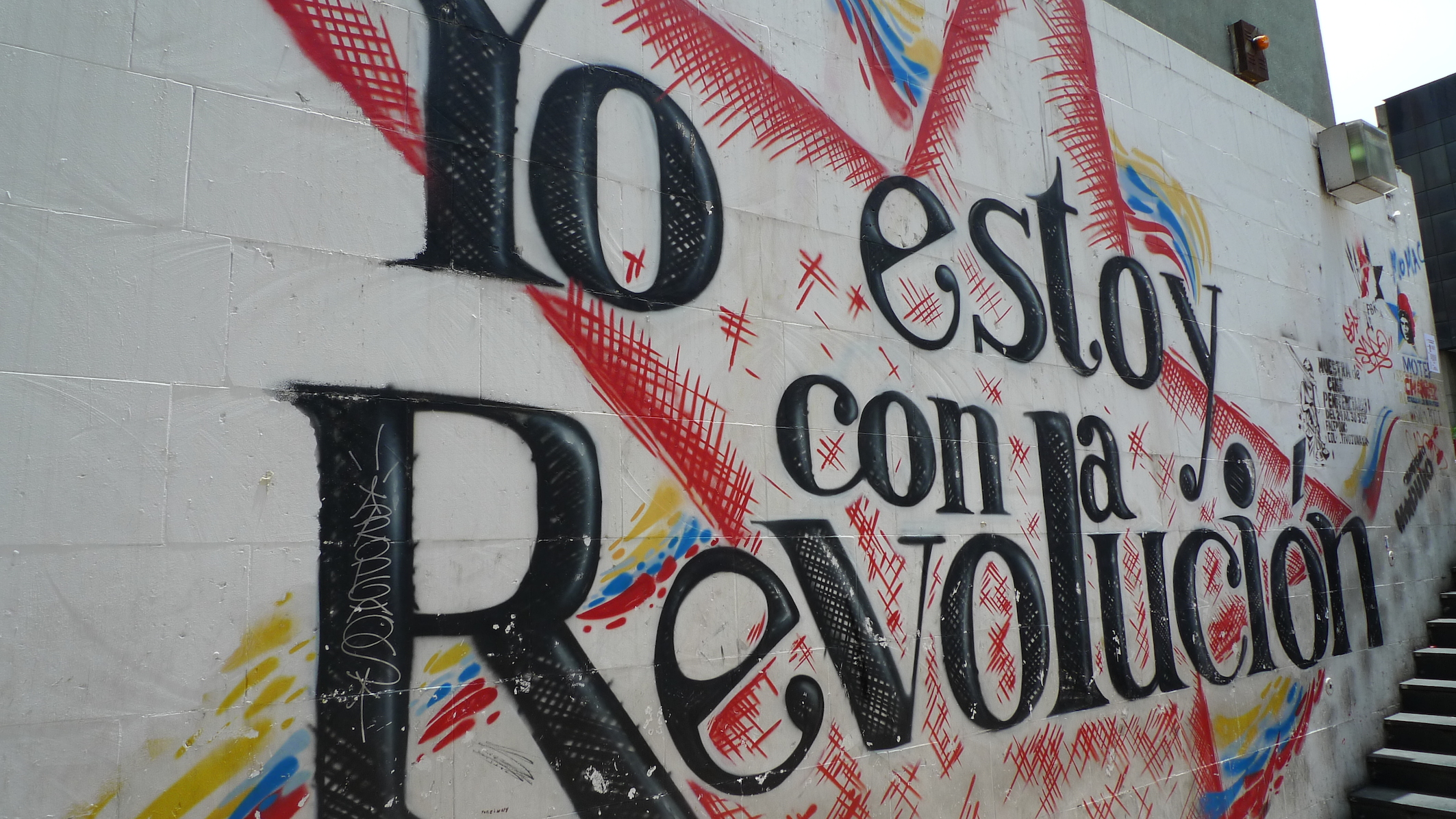
Andre Vltchek is a philosopher, novelist, filmmaker and investigative journalist. He covered wars and conflicts in dozens of countries. His latest books are: “Exposing Lies Of The Empire” and “Fighting Against Western Imperialism”.
Food Security: a Hostage to Wall Street
By COLIN TODHUNTER | CounterPunch | June 26, 2015
In October of last year, World Food Day celebrated ‘Family Farming: Feeding the world, caring for the earth’. According to the UN Food and Agriculture Organization’s website, the family farming theme was chosen to raise the profile of family farming and smallholder farmers. The aim was to focus world attention on the significant role of family farming in eradicating hunger and poverty, providing food security and nutrition, improving livelihoods, managing natural resources, protecting the environment, and achieving sustainable development, especially in rural areas.
Family farming should indeed be celebrated because it really does feed the world. This claim is supported by a 2014 report by GRAIN, which revealed that small farms produce most of the world’s food.
Around 56% of Russia ‘s agricultural output comes from family farms which occupy less than 9% of arable land. These farms produce 90% of the country’s potatoes, 83% of its vegetables, 55% of its of milk, 39% of its meat and 22% of its cereals (Russian Federation Federal State Statistics Services figures for 2011).
In Brazil, 84% of farms are small and control 24% of the land, yet they produce: 87% of cassava, 69% of beans, 67% of goat milk, 59% of pork, 58% of cow milk, 50% of chickens, 46% of maize, 38% of coffee, 33.8% of rice and 30% of cattle.
In Cuba, with 27% of the land, small farmers produce: 98% of fruits, 95% of beans, 80% of maize, 75% of pork, 65% of vegetables, 55% of cow milk, 55% of cattle and 35% of rice (Braulio Machin et al, ANAP-Via Campesina, “Revolucion agroecologica, resumen ejectivo”).
In Ukraine, small farmers operate 16% of agricultural land, but provide 55% of agricultural output, including: 97% of potatoes, 97% of honey, 88% of vegetables, 83% of fruits and berries and 80% of milk (State Statistics Service of Ukraine. “Main agricultural characteristics of households in rural areas in 2011″).
Similar impressive figures are available for Chile, Hungary, Belarus, Romania, Kenya, El Salvador and many other countries.
The evidence shows that small peasant/family farms are the bedrock of global food production. The bad news is that they are being squeezed onto less than a quarter of the world’s farmland and such land is under threat. The world is fast losing farms and farmers through the concentration of land into the hands of rich and powerful speculators and corporations.
The report by GRAIN also revealed that small farmers are often much more productive than large corporate farms, despite the latter’s access to various expensive technologies. For example, if all of Kenya’s farms matched the output of its small farms, the nation’s agricultural productivity would double. In Central America, it would nearly triple. In Russia, it would be six fold.
Yet in many places, small farmers are being criminalised, taken to court and even made to disappear when it comes to the struggle for land. They are constantly exposed to systematic expulsion from their land by foreign corporations, some of which are fronted by fraudulent individuals who specialise in corrupt deals and practices to rake in enormous profits to the detriment of small farmers and food production.
Imagine what small farmers could achieve if they had access to more land and could work in a supportive policy environment, rather than under the siege conditions they too often face. For example, the vast majority of farms in Zimbabwe belong to smallholders and their average farm size has increased as a result of the Fast Track Land Reform Programme. Small farmers in the country now produce over 90% of diverse agricultural food crops, while they only provided 60 to 70% of the national food before land redistribution.
Throughout much of the world, however, agricultural land is being taken over by large corporations. GRAIN concludes that, in the last 50 years, 140 million hectares – well more than all the farmland in China – have been taken over for soybean, oil palm, rapeseed and sugar cane alone.
By definition, peasant agriculture prioritises food production for local and national markets as well as for farmers’ own families. Big agritech corporations take over scarce fertile land and prioritise commodities or export crops for profit and markets far away that cater for the needs of the affluent. This process impoverishes local communities and brings about food insecurity. The concentration of fertile agricultural land in fewer and fewer hands is directly related to the increasing number of people going hungry every day and is undermining global food security.
The issue of land ownership was also picked up on by another report last year. A report by the Oakland Institute stated that the first years of the 21st century will be remembered for a global land rush of nearly unprecedented scale. An estimated 500 million acres, an area eight times the size of Britain, was reported bought or leased across the developing world between 2000 and 2011, often at the expense of local food security and land rights.
A new generation of institutional investors, including hedge funds, private equity, pension funds and university endowments, is eager to capitalise on global farmland as a new and highly desirable asset class. Financial returns, not food security, are what matter. In the US, for instance, with rising interest from investors and surging land prices, giant pension funds are committing billions to buy agricultural land.
The Oakland Institute argues that the US could experience an unprecedented crisis of retiring farmers over the next 20 years, leading to ample opportunities for these actors to expand their holdings as an estimated 400 million acres changes generational hands.
The corporate consolidation of agriculture is happening as much in Iowa and California as it is in the Philippines,Mozambique and not least in Ukraine.
Imperialism and the control of agriculture
Ukraine’s small farms are delivering impressive outputs, despite being squeezed onto just 16% of arable land. But the US-backed toppling of that country’s government may change all that. Indeed, part of the reason behind destabilizing Ukraine and installing a puppet regime was for US agritech concerns like Monsanto to gain access to its agriculture sector, which is what we are now witnessing.
Current ‘aid’ packages, contingent on the plundering of the economy under the guise of ‘austerity reforms’, will have a devastating impact on Ukrainians’ standard of living and increase poverty in the country.
Reforms mandated by the EU-backed loan include agricultural deregulation that is intended to benefit agribusiness corporations. Natural resource and land policy shifts are intended to facilitate the foreign corporate takeover of enormous tracts of land. The EU Association Agreement includes a clause requiring both parties to cooperate to extend the use of biotechnology. Frederic Mousseau, Policy Director of the Oakland Institute states:
“Their (World Bank and IMF) intent is blatant: to open up foreign markets to Western corporations… The high stakes around control of Ukraine’s vast agricultural sector, the world’s third largest exporter of corn and fifth largest exporter of wheat, constitute an oft-overlooked critical factor. In recent years, foreign corporations have acquired more than 1.6 million hectares of Ukrainian land.”
Chemical-industrial agriculture and the original ‘green revolution’ has proved extremely lucrative for the oil and chemical industry and has served to maintain and promote US hegemony, not least via the uprooting of indigenous farming practices in favour of cash crop/export-oriented policies, dam building to cater for what became a highly water intensive industry, loans, indebtedness, dependency on the dollar and the corporate control of seeds, etc.
Whether through ‘free trade’ agreements, commodity market price manipulations, loan packages, the co-optation of political leaders or the hijack of strategic policy-making bodies, corporate profits are being secured and food sovereignty surrendered to the US, which has always used agriculture as a tool with which to control countries.
(The GMO issue has to be regarded within such a geopolitical framework too: it has less to do with ‘feeding the world’ and more about controlling it (see this and this)
While celebrating of the role of the family farm in feeding the world, rich speculators and powerful US agritech corporations continue to colonise agriculture and undermine the existence of small farms and global food security.
Choosing to ignore the research, however, much mainstream thinking rests on the fallacious assumption that uprooting small farms and displacing rural populations is a good thing. This assumption stems from an ethnocentric mindset that legitimises the plunder we are witnessing across the globe.
Environmentalist Vandana Shiva sums it up as follows:
“People are perceived as ‘poor’ if they eat food they have grown rather than commercially distributed junk foods sold by global agri-business. They are seen as poor if they live in self-built housing made from ecologically well-adapted materials like bamboo and mud rather than in cinder block or cement houses. They are seen as poor if they wear garments manufactured from handmade natural fibres rather than synthetics.”
This is an ideology that fuels the myth that the ‘poor’ are poor due to their own fault and must be lifted up by the West and its corporations and billionaire ‘philanthropists’. It is the ideology that attempts to legitimise imperialism and economic colonialism, which causes economic devastation and ecological destruction in the first place. From Africa to India and beyond, the disease is being offered as the cure.
Media Report on “Terrorists and Hostages” While Falsifying Iran-Contra
By Sam Husseini | June 26, 2015
Much of the media has been abuzz with President Barack Obama’s announcement that, as NBC put it: “the government will no longer threaten to criminally prosecute families of American hostages who pay ransom to get loved ones back from such groups as ISIS…”
The NBC report — and virtually every other report on this subject I’ve seen — have made no mention of when the U.S. government did pay for hostages in the Iran-Contra Affair. That’s when the Reagan administration sold arms to Iran in exchange for hostages and illegally used the funds for the Contras in Nicaragua.
An extreme example of media mis-reporting was Jake Tapper who claimed on November 18, 2014: “It’s a policy the U.S. government has never wavered on. America does not negotiate with terrorists. You have heard them say that, but now the Obama administration is ordering a full review of how it does deal with hostage situations in light of recent criticism from families of Americans brutally murdered by ISIS terrorists.”
So, I tweeted to Tapper: “never wavered on negotiating for hostages? I guess Iran-Contra didn’t happen.”
He tweeted back: “good point, we should we have couched that”
I responded: “No corrections on cable. Cause, 24-hour news.”
And indeed, no correction was forthcoming. Because it’s not like CNN has a lot of time to fill to educate, especially younger viewers about what happened in Iran-Contra.
Particularly insidious is Tapper’s notion that he should have “couched that” differently. Firstly, it avoids acknowledging that what he said was false: “It’s a policy the U.S. government has never wavered on.” That’s just a brazen lie.
But in a subtle way, his response is even worse. Tapper, it would seem, is tacitly blaming himself for not finessing the lie better. Perhaps he thinks it would be better had he said: “Administration after administration has declared they don’t negotiate with terrorists, but now, that policy is being reconsidered…” This would fulfill the goal of creating a false impression while not being so oafish as to outright lie. And in some way, that’s what most of the media did on this story (and countless others) — create the impression that the U.S. has never traded for hostages without outright lying about it.
All this helps put Iran-Contra, one of the few instances when the machinations of policy were exposed to public scrutiny to at least some degree, further into the memory hole. Indeed, what’s called the Iran-Contra Affair helped bring some light on several insidious policies, including plans to outright suspend the U.S. Constitution.
Another deceitful aspect of this story is it further solidifies the “definition” of terrorist that’s commonly employed by major media being whoever the U.S. government says is a terrorist. These hypocrisies certainly include as FAIR and others have noted not calling Dylann Storm Roof a terrorist. But outside even that discussion is if the violence of the U.S. government and its allies shouldn’t be called terrorism.
Much is also lost by not understanding the dynamics around the Iran-Contra Affair — which involved the U.S. arming both Iran and Iraq while those two countries fought a bloody war. Dahlia Wasfi in her recent piece “Battling ISIS: Iran-Iraq war redux” points out that the U.S. government is in effect doing the same thing in the Mideast now — arming warring sides. She writes: “Just as with Iran and Iraq in the 1980s, the people in the battlefields of Syria and Iraq pay the highest price. And just as was the case in the 1980s, the devastation of these countries serves U.S. and Israeli hegemony.”
State Dept: Hillary Clinton Did Not Turn Over All Emails
By Sheryl Attkisson | June 25, 2015
The State Department has informed the House Committee on Benghazi that former Secretary of State Hillary Clinton failed to turn over all of her records related to Benghazi and Libya. That’s according to a statement today from Committee Chairman Trey Gowdy, R-South Carolina.
The news contradicts claims from the Clinton camp which said all relevant emails had, in fact, been handed over.
“This confirms doubts about the completeness of Clinton’s self-selected public record and raises serious questions about her decision to erase her personal server—especially before it could be analyzed by an independent, neutral third party arbiter,” said Gowdy in a statement.
The New York Times was first to reveal that Clinton made controversial use of a private server while she was serving as secretary of state. When the unusual arrangement was discovered, Clinton said she sifted through all the emails from her private server and turned over all of the relevant ones to the State Department. She acknowledged destroying tens of thousands of other emails that she says were private in nature, and she acknowledged wiping her server clean.
Earlier this month, prior to testifying behind closed doors, Clinton confidant Sidney Blumenthal turned over additional email exchanges between himself and Clinton. The exchanges had not been previously produced to the Committee despite multiple requests and a subpoena. Additionally, the material was not produced as required by law in response to Freedom of Information Act requests, including one I made in 2012.
“This has implications far beyond Libya, Benghazi and our committee’s work. This conclusively shows her email arrangement with herself, which was then vetted by her own lawyers, has resulted in an incomplete public record,” said Gowdy today.
Clinton’s critics say the email exchanges with Blumenthal show that she was receiving and soliciting unvetted intelligence about Libya from Blumenthal, a source with a financial business interest in the country.
Clinton had previously stated that the messages from Blumenthal were unsolicited.
While the State Department says Clinton did not turn over all relevant emails, the agency did give the Committee a new set of Clinton emails that were responsive to subpoena but were not previously provided. The Committee did not disclose the content of the emails.
Clinton has insisted she did nothing wrong and that she complied with the letter and spirit of record retention laws. She says she previously gave the State Department all relevant emails, and that she did not destroy any materials except those which were entirely private in nature.
Neocons Urge Embrace of Al Qaeda
By Daniel Lazare | Consortium News | June 26, 2015
Just nine days after the fall of the World Trade Center, George W. Bush announced that he was imposing a radical new policy on virtually the entire globe: “Every nation, in every region, now has a decision to make. Either you are with us, or you are with the terrorists. From this day forward, any nation that continues to harbor or support terrorism will be regarded by the United States as a hostile regime.”
As dramatic as the statement was, just about every phrase was open to question in one form or another. But rather than launching into a long and vigorous debate about the meaning of terrorism or America’s right to impose diktat on the world at large, congressmen turned their minds off and gave Bush a standing ovation.
Today, the same Bush Doctrine is sinking beneath the waves as a growing portion of the punditocracy declares that some forms of terrorism are better than others and that harboring a terrorist may not be so bad if it advances U.S. interests. But once again, the response is not questioning, debate, or even applause, but silence.
The latest evidence of a sea change in establishment thinking is a blog that Ahmed Rashid, a prominent Middle East correspondent, recently published on The New York Review of Books website. Entitled “Why We Need al-Qaeda,” it argues that Al Qaeda and its Syrian affiliate, Al Nusra, are evolving in a more moderate direction in growing contrast to its rival, the super-violent Islamic State. So why not use Al Nusra as a counterforce against both Bashar al-Assad and ISIS?
As Rashid puts it: “Unlike ISIS, which demands absolute subjugation of the inhabitants of any territory it conquers (surrender or be executed), al-Nusra is cooperating with other anti-Assad groups and recently joined the ‘Army of Conquest’ alliance of rebel militias in northern Syria. Moreover, in contrast to ISIS’s largely international and non-Syrian fighting force, al-Nusra’s fighters are almost wholly Syrian, making them both more reliable and more committed to Syria’s future.
“Meanwhile, in interviews with Al Jazeera, al-Nusra leaders have vowed not to attack targets in the West, promoting an ideology that might be called ‘nationalist jihadism’ rather than global jihad. In recent months, al-Nusra’s leaders have toned down the implementation of their own brutal version of Islamic law, while putting on hold their own plans of building a caliphate.”
Thus, according to Rashid’s viewpoint, Al Nusra is cooperative, patriotic, unthreatening to anyone other than Assad, and in favor of a kinder and gentler form of shari‘a as well. Yet, Rashid argues, that while Turkey and the Arab gulf states recognize that change is afoot, the U.S. keeps its eyes resolutely shut:
“With 230,000 killed and 7.6 million people uprooted in Syria alone, the Arab states want a quick end to the Assad regime and a viable solution for Syria. They know that solution will never come from the weak moderate opposition, and that any lasting peace will require support by the strong and ruthless Islamist groups fighting there.”
Gulf States’ Favorite
So the gulf states are backing the second most ruthless Islamist group in Syria (Al Qaeda’s affiliate) in hopes of offsetting the first most ruthless (ISIS) and making short work of the Baathist regime in Damascus. But as Arab leaders prepare for direct negotiations with Al Nusra, Rashid warns, “the only one not at the table could be the United States.”
This is dramatic stuff. After all, Rashid is not taking aim at some minor doctrine, but one that has been a cornerstone of U.S. foreign policy since 9/11. Moreover, he’s not the only one talking this way. Since Turkish President Recep Tayyip Erdogan flew to Riyadh in early March to meet with Saudi King Salman and discuss ways of upping support for the Syrian Islamist opposition, there has been a veritable boomlet in terms of calls for a rapprochement with Al Qaeda.
Within days of the Riyadh get-together, Foreign Affairs went public with an article arguing that even though “the United States is the closest it has ever been to destroying al Qaeda, its interests would be better served by keeping the terrorist organization afloat.” Lina Khatib, director of the Carnegie Middle East Center in Beirut, wrote a few weeks later that “while not everyone likes Nusra’s ideology, there is a growing sense in the north of Syria that it is the best alternative on the ground – and that ideology is a small price to pay for higher returns.”
Charles Lister of the Brookings Institute’s Doha Center, wrote that Al Nusra is undergoing a “moderating shift.” Frederic Hof, Obama’s former envoy to the Syrian guerrillas and now a senior fellow at the Atlantic Council in Washington, said the group has become “a real magnet for young Syrian fighters who don’t have any particular jihadist or even radical sectarian agenda.” They are drawn to Al Nusra, he explained, for two reasons – because it’s “well-resourced” and because it “seems to have been willing to fight the regime and not to engage in some of the corrupt activities and warlordism that you would find elsewhere within the panoply of Syrian opposition.”
So, Rashid’s views are hardly unique. Nonetheless, they’re the most explicit and upfront to date, an indication that support for an alliance with Al Qaeda is on the upswing and that advocates are growing bolder and more self-confident. So how should ordinary people who are not part of the elite foreign-policy discussion respond?
One-Sided Arguments
For one thing, they might notice that such articles are remarkably one-sided and poorly reasoned. Rashid may be “one of Pakistan’s most respected journalists,” as the BBC puts it, someone whose work has appeared in such publications as the Daily Telegraph and the Far Eastern Economic Review. Yet shooting holes through his arguments is child’s play.
Take his claim that “al-Nusra’s leaders have toned down the implementation of their own brutal version of Islamic law.” Whatever the difference between Al Nusra and ISIS on this score, it’s less impressive than Rashid lets on.
The Soufan Group, a New York-based security firm headed by a Lebanese-American ex-FBI agent named Ali H. Soufan, notes, for instance, that while Islamic State released a video in January showing its forces stoning an accused adulteress, Al Nusra released one around the same time showing its forces shooting two women for the same alleged offense. Since the victims in either case were killed, the difference, as the Soufan Group noted, was purely “stylistic.”
Rashid claims that Al Nusra is less extreme in its hostility to Shi‘ism, in part because it thinks “anti-Shia fanaticism” is backfiring and becoming “an impediment to gaining more territory.” Indeed, Abu Mohammad al-Julani, Al Nusra’s commander-in-chief, told Al Jazeera in a rare interview on May 27 that his forces were willing to welcome Alawites, as Syria’s Shi‘ites are known, back into the fold.
“If they drop weapons,” al-Julani said, “disavow Assad, do not send their men to fight for him and return to Islam, then they are our brothers.” But when he described Alawism as a sect that has “moved outside the religion of God and of Islam,” the meaning became clear: Alawite must either convert or die.
Whether this makes Al Nusra less genocidal than ISIS is open to debate. According to the pro-rebel Syrian Observatory for Human Rights, meanwhile, Al Nusra recently massacred more than 20 Druze villagers in northwestern Syria – reportedly after a local commander denounced them as kuffar, or infidels, while al-Julani, in his Al Jazeera interview, specified that Christians must pay the jizya, a special head tax imposed by Islamic law, as well – a stipulation Syria’s ten-percent Christian minority is not likely to find very reassuring.
Ordinary people viewing this from afar might notice that the government that al-Julani is seeking to overthrow is officially secular and non-discriminatory and that even Obama has conceded that it has “protected the Christians in Syria,” as he told a Syrian Christian delegation last September. They might also notice that Rashid’s article is in other respects highly revealing, although not in ways he cares to admit.
For instance, Rashid writes that U.S. policy in the Middle East is beset by “growing contradictions.” This is obviously correct. But the problem is not that Washington refuses to face facts about Al Nusra’s alleged moderating trend, but that the U.S. is attempting to hammer out an accord with Iran while struggling to preserve its alliance with Israel and the Arab gulf states, all of whom regard Iran as public enemy number one.
Obama’s Fence Straddling
The effort has led to monumental fence straddling. While entering into talks with Iran, the Obama administration has given the go-ahead to Saudi Arabia’s two-month-old assault on Iranian-allied forces in Yemen while turning a blind eye to growing Turkish and Saudi support for anti-Iranian terrorists in Syria.
While paying lip service to the Bush Doctrine that he who harbors a terrorist is as bad as a terrorist, the Obama administration made no objection when the Saudis and Turks donated U.S.-made TOW missiles to Al Nusra-led forces in northern Syria or when the Saudi bombing campaign allowed Al Qaeda to expand in Yemen.
It’s a mixed-up policy that has people in the Middle East shaking their heads. Yet Rashid adds to the confusion by misrepresenting the Saudi role. He writes, for instance, that the Arab States are swinging behind Al Nusra because they “want a quick end to the Assad regime and a viable solution for Syria,” when, in fact, Saudi Wahhabists have sought from the start to impose a government much like their own, as a report by U.S. Defense Intelligence Agency observed back in August 2012.
Rather than “viable,” such a government would be precisely the opposite for a highly variegated society like Syria with its large Christian, Shi‘ite, and Druze minorities fearful of Sunni fundamentalist domination – yet the gulf states, backed by the U.S., have pushed on regardless.
On the issue of Al Qaeda’s brutal intolerance, Rashid adds, “For Arab leaders, determining whether al-Qaeda has really changed will depend on the group’s long-term attitude toward Shias,” suggesting that the gulf states are seeking a fairer outcome for Syria’s Alawites.
Saudi Intolerance
But this is misleading as well since Saudi attitudes toward the kingdom’s own 15-percent Shi‘ite minority are deeply oppressive and seem to be getting worse.
According to the Cambridge scholar Toby Matthiesen, for example, Saudi Shi‘ites are barred from the army and the National Guard as well as the top rungs of the government. State-mandated schoolbooks denounce them as “rejectionists,” while, according to the independent scholar Mai Yamani, they cannot testify in court or marry a Sunni and must put up with abuse from Wahhabist clerics who regularly preach that killing a Shi‘ite merits a greater heavenly reward than killing a Christian or a Jew.
Since Salman’s accession in late January, there is no sign of a softening. Indeed, by bombing Yemen’s Shi‘ite Houthi rebels and stepping up support for fanatically anti-Shi‘ite rebels in Syria, Salman gives every indication of intensifying his anti-Shi‘ite crusade and taking it abroad.
Neocons pushing for an explicit alliance with Al Nusra are thus attempting to plunge the U.S. ever more deeply into a growing sectarian war. Ordinary people might also notice that such “experts” expound their views from cushy posts financed by Qatar (the case with Brookings’ Doha Center) or by Saudi Arabia, Kuwait, the United Arab Emirates, and Bahrain (the case with the Atlantic Council).
Yet Congress doesn’t care about such conflicts of interest and the White House is too intimidated to speak out, while the American people at large are not consulted. Questioning and debate are more imperative than ever, yet they are as absent as they were back in 2001.
Report: 90% of Palestinian prisoners suffer continuous, systematic torture in Israeli jails
MEMO | June 26, 2015
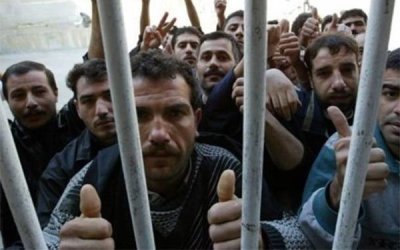
As many as 90 per cent of Palestinian prisoners have been subjected to various types of torture and abuse in Israeli jails, a report revealed yesterday.
The report by the Palestinian Committee for Prisoners’ and Ex-Prisoners Affairs, which came on the occasion of the International Day in Support of Victims of Torture, highlighted the increasing practice of torture against Palestinian prisoners after the kidnapping of three settlers in June 2014.
According to the report, torture is systematically practiced by the Israeli Security Agency, Shin Bet, under legal cover from the Israeli government, the Israeli Legal Counsel and the Supreme Court who allow investigators to use violence and internationally prohibited means during interrogations under the pretext that the detainees pose a “security risk for the state of Israel”.
The Committee’s report points out that Israel’s use of torture is considered a war crime according to the Geneva Convention and the International Criminal Court, however the Israeli penal code gives immunity for Shin Bet interrogators.
Earlier this week, the Israeli Knesset extended a law which allowed security officials not to record the interrogation of detainees held on security charges, which many believe leaves them open to being tortured and forced to confession under duress.
The report said the Israeli intelligence used brutal and immoral methods of torture during interrogations including: severe beatings, insults and curses, isolation in solitary confinement, no access to lawyers, arrest of family members as a means of pressure, sexual harassment, sleep deprivation, violent shaking, electric shocks and stress amongst others.
According to the report, the percentage of complaints on the use of torture increased after mid-2014 to reach twice the number documented in 2013.
Human rights organisations point out that as many as 850 complaints were filed by Palestinian prisoners against the practice of torture; however the cases were rejected by the Israeli judiciary.
Israel’s Civil Wrongs Law passed on 23 July 2012 prevents Palestinian victims from filing complaints against Israeli officials who committed crimes including torture against them.
Israel deports Turkish journalists and activists after hours-long detention

Turkish ‘Ulke TV’ Editor-in-Chief Hasan Ozturk (L) and Journalist Halime Kokce (R) from Star Newspaper speak to media as they arrived with the group of Turkish citizens who were deported from Israel, at Ataturk International Airport on June 26, 2015
MEMO | June 26, 2015
Israel has deported nine Turkish citizens, including journalists and activists, after holding them for over six hours at Israel’s Ben Gurion International Airport on Thursday.Ulke TV Editor-in-Chief Hasan Ozturk, Ozden Ayvaz and Huseyin Gunay from TRT News, Halime Kokce from Star Newspaper, Memur-sen vice chairman Levent Uslu and four activists – Kemal Ozdal, Durdane Ozdal, Fatih Bolcan and Sumeyra Bolcan – were detained at the airport.
“We are under detention for six hours at the Ben Gurion Airport with a group of journalists and activists. They questioned us individually,” Kokce wrote on Twitter.
She said in another tweet that Israeli officials confiscated the group’s cell-phones and quizzed them on their WhatsApp conversations and contacts.
In a final tweet, Kokce said the group had been informed they were being deported, and had been banned from entering Israel for ten years.
Gaza flotilla ship ‘sabotaged’ days before expected arrival
Ma’an – June 25, 2015
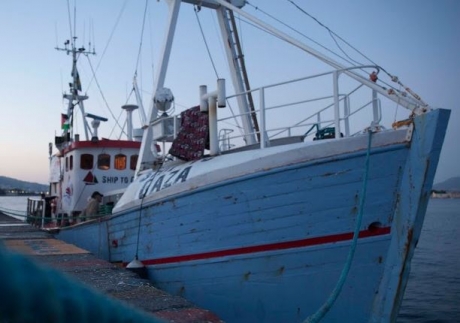
BETHLEHEM – One of the ships taking part in a flotilla headed towards the Gaza Strip was sabotaged south of Crete, an activist aboard one of the ships said Thursday.
Israeli-born Swedish activist Dror Feiler told Nazareth-based al-Shams radio that the ship had been sabotaged by professionals, and would have sunk if sailed at sea.
“Somebody went underneath the ship at night and sabotaged its propellers, just like they sabotaged the same ship in 2011,” Fieler said referring to similar damage that was inflicted upon a ship participating in a previous flotilla.
Feiler, who relinquished his Israeli citizenship after moving to Sweden, boarded the trawler Marianne of Gothenburg in Sweden with 18 other activists six weeks ago. The crew had refrained from stopping at European ports prior to avoid being held by authorities, but their trip was cut short after realizing that they might have drowned had they continued.
Despite the sabotage, the remainder of the flotilla convoy will move as planned with the ships expected arrive in Gaza in succession within three days, Feiler said.
The flotilla is the third of it’s kind to attempt to access the Gaza Strip by sea since 2010, aiming break the nearly nine-year Israeli blockade causing what is termed by rights organizations as a humanitarian crisis for the strip’s 1.8 million residents.
In May 2010, Israeli forces staged a raid on a six-ship flotilla which ended in bloodshed, claiming the lives of 10 Turkish rights activists and sparked a crisis with Ankara.
The participation in this year’s flotilla of Palestinian Knesset member Bassel Ghattas sparked an outcry among right wing members of the Knesset, Israel’s parliament, who called for Ghattas to be stripped of immunity from prosecution for joining.
Similar response was given to Palestinian MK Hanin Zoabi who took part in the 2010 flotilla, when Israeli minister Miri Regev accused Zoabi for “joining terrorists.”
Israeli leaders say that joining efforts to break the Israeli military blockade of Gaza is directly working against the security of Israel.
“It is the gravest thing possible that an Israeli MP would join the flotilla whose aim is to help the Hamas terror organisation,” said Israeli Immigration Minister Zeev Elkin from the ruling right-wing Likud party earlier this week.
Ghattas will be joined by the former Tunisian president, European lawmakers, and activists in what the Freedom Flotilla Coalition described as “a peaceful, nonviolent action to break the illegal and inhumane blockade of the Gaza Strip.”
Black Earth and the Struggle for Ukraine’s Future
By Andrey Panevin | Slavyangrad | June 25, 2015
The Ukrainian crisis can be viewed as being composed of several interconnected factors, from the civil war to rampant corruption, and the wider geopolitical ramifications of American confrontation with Russia. Another—relatively overlooked—factor is the ongoing conflict over Ukraine’s natural resources. Of particular interest to transnational corporations and their puppet local oligarchs is the ‘black earth’ of Ukraine. Black earth or ‘Chernozem’ is found in two major zones on earth, one of which encompasses sections of Moldova, Russia and Ukraine. Black earth is characterized by its very high fertility and, consequently, its capacity for producing a high agricultural output.
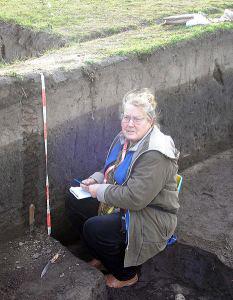
A scientist examines ‘chernozerm’ in Nikolaev, Ukraine.
(image: Saghnol, wikimedia commons)
International corporations have long been utilizing loopholes and political lobbying in order to overturn a Ukrainian moratorium on land sales to foreigners. By leasing numerous parcels of land these companies anticipate both the Ukrainian government’s desperation for money and the EU obligations to force open a goldmine of agricultural exploitation. The role of the ‘big players’—Monsanto, Cargill and Dupont—has been explored previously. The focus now is on agro-holding companies and individual oligarchs who seek to buy up and sell out Ukrainian land and livelihood.
One of the largest agro-holding companies operating in Ukraine is AgroGeneration. AgroGeneration seeks to “transform the land it works and today outperforms Ukrainian average yields. The company follows a traditional crop rotation and puts money into first-class fertilizers, seeds, and agricultural chemicals for the purpose of achieving profitability per crop.” The company has amassed 120,000 hectares of arable land, with 70,000 hectares being located in Kharkov oblast, whose eponymous capital is a city of great political and military importance in Ukraine. Kharkov has a large ethnic Russian and Russian-speaking population that has been actively repressed by the Kiev authorities, and it remains a region of dissent against the Kiev regime.
Michael Bleyzer, the Kharkov-born chairman of AgroGeneration, and founder of its sibling companies Sigma-Bleyzer and the Bleyzer Foundation, recognizes the importance of the city and has actively spoken about the need to maintain political and military order within it. In an op-ed for the KyivPost, Bleyzer writes of Kharkov as the most critical region, in need of being made “a very high priority. A large segment of the population in Kharkiv oblast is so discouraged by events and by the constant bombardment of Russian propaganda that they could be supportive of a Russian invasion or an attempt to establish a so-called People’s Republic.” Bleyzer further advocates a ‘Social Stabilization Fund’ for Kharkov, Dnepropetrovsk, Zaporozhia, Kherson, Nikolaev and Odessa. It is worth noting that these regions all contain either chernozerm or, as in the case of Odessa, ports through with which agricultural products transit.

The vast tracts of agricultural land controlled by AgroGeneration alone. (www.agrogeneration.com)
Michael Bleyzer’s role as a mouthpiece for the Kiev regime’s ‘war’ against Russia extends past his personal business interests and falls in line with the broader neoliberal, capitalist takeover of Ukraine. AgroGeneration and Sigma-Bleyzer (a private equity firm also owned by Bleyzer) seek to take advantage of the current regime’s plea to the West to ‘buy Ukraine’. These corporations and others are not only taking control of Ukraine’s farm land, they are doing it with European and American government assistance. In 2005, Sigma-Bleyzer received financing for a project worth up to 250 million euros from the European Bank for Reconstruction and Development (EBRD). In 2011, the EBRD gave AgroGeneration ten million dollars to double its ownership of Ukrainian land. In 2012 the Overseas Private Investment Corporation (OPIC)—an American government financial institution—gave Sigma-Bleyzer fifty million dollars for its ‘Eastern Europe fund.’
While these international corporations receive vast sums of money for their expansion in Ukraine, ‘access to credit remains a major problem for Ukraine’s small and medium farmers’. This interconnected system of funding from government finance institutions to private corporations has spelled doom for Ukraine’s agricultural sector, opening it up to exploitation and eventual ruin from the inside out.

Bleyzer (left) with US presidential candidate Ted Cruz on Maidan Square in Kiev. (Source: Secure America Now)
Connections between government and private corporations are at the core of this exploitation, with both entities seeking to employ what Bleyzer himself refers to as a system of “quasi-private equity funds managed by money managers from the private sector whenever possible.” Bleyzer’s attitude to the financial invasion of countries was well honed during the US-led invasion and occupation of Iraq, where he actively encouraged the US government to “create and implement the policy measures that will make an attractive investment climate in Iraq. This public-private partnership could play a critical role in making possible dramatic social and economic changes in Iraq and other countries in the region.” The goal of the corporate annexation of sovereign policy-reform has served Bleyzer and countless other oligarchs well from Iraq to Ukraine. In the context of this corrupt, financially imperialist environment it is no wonder that in a May 2015 economic report by Sigma-Bleyzer, it is casually written (in reference to the Ukrainian civil war) that “a frozen conflict could still provide the opportunity for the rest of the country to restart investments and economic growth.”
Ukraine’s precious black earth is being steadily annexed by international corporations and joins the list of resources and national sectors being outsourced to private investors. Agricultural corporations such as AgroGeneration find great corporate solidarity on the board of members of the US-Ukraine Business Council, which includes (among others) Sigma-Bleyzer, Monsanto, Dupont, Cargill, Exxon, Raytheon and the Bleyzer Foundation. These corporations share the common goal of pressuring the Ukrainian government to institute political ‘reforms’ in their favour. For agricultural corporations in particular, the goal is to pressure the government to “think about privatization. They need to prepare everything to allow for farmland sales (to foreign and domestic investors) in three to four years,” as stated by Heinz Strubenhoff, the agribusiness investment manager for the World Bank in Ukraine.
Ukraine is at a national crossroads and if the example of its increasing corporate annexation is anything to go by, it will have neither the money nor the resources to rebuild itself in the face of its political and cultural self-destruction. The West-supported preoccupation with ‘Russian invaders’ has left the oligarchy free to sell Ukraine’s political processes and natural resources to the highest bidder.
Will Turkey’s Election Give Peace a Chance in Syria?
By Rick Sterling | Dissident Voice | June 24, 2015
The June 7 parliamentary election in Turkey could have a huge impact on the conflict in Syria. The invincible image of President Erdogan has been cracked. There is a real chance that the election might lead to substantive change in Turkish foreign policy promoting the war in Syria.
Even though Erdogan’s Justice and Development Party (AKP) won the most votes, they lost their majority in parliament and must now find a coalition partner. Turkey’s new parliament was seated for the first time on Tuesday June 23. Now begins the political bargaining and negotiations to form a governing coalition. Depending on the outcome, Turkey may stop or seriously restrict the flow of weapons and foreign fighters through its territory into Syria. If Turkey does this, it would offer a real prospect for movement toward negotiations and away from war in Syria. Why? The Syrian war continues because Saudi Arabia, Qatar, Kuwait, USA, France, UK and others are spending billions of dollars annually to fund the armed opposition and sustain the war in violation of the UN Charter and international law.
Closely allied with Qatar and the Muslim Brotherhood, Turkey has been the primary path for weapons and foreign fighters in Syria. ISIS has depended on export of oil and import of weapons and fighters through Turkey. Jabhat al Nusra, Ahrar al Sham and other armed opposition groups have depended on weapons and foreign fighters coming in via Turkey for attacks on northern Syria including Syria’s largest city, Aleppo.
Turkish Government Support of War on Syria
The following examples show the extent of Turkish involvement in the war on Syria:
- Turkey hosts the Political and Military Headquarters of the armed opposition. Most of the political leaders are former Syrians who have not lived there for decades.
- Turkey provides home base for armed opposition leaders. As quoted in the Vice News video Syria: Wolves of the Valley: “Most of the commanders actually live in Turkey and commute in to the fighting when necessary.”
- Turkey’s intelligence agency MIT has provided its own trucks for shipping huge quantities of weapons and ammunition to Syrian armed opposition groups. According to court testimony they made at least 2,000 trips to Syria.
- Turkey is suspected of supplying the chemical weapons used in Ghouta in August 2013 as reported by Seymour Hersh here. In May 2013, Nusra fighters were arrested in possession of sarin but quickly and quietly released by Turkish authorities.
- Turkey’s foreign minister, top spy chief and senior military official were secretly recorded plotting an incident to justify Turkish military strikes against Syria. A sensational recording of the meeting was publicized, exposing the plot in advance and likely preventing it from proceeding.
- Turkey has provided direct aid and support to attacking insurgents. When insurgents attacked Kassab Syria on the border in spring 2014, Turkey provided backup military support and ambulances for injured fighters. Turkey shot down a Syrian jet fighter that was attacking the invading insurgents. The plane landed 7 kms inside Syrian territory, suggesting that Turkish claims it was in Turkish air space are likely untrue.
- Turkey has recently increased its coordination with Saudi Arabia and Qatar. This has led to the recent assaults by thousands of foreign fighters on Idlib and Jisr al Shugour in northern Syria. Armed with advanced weaponry including TOW missiles, and using suicide bomb vehicles, the armed groups over-ran Syrian armed forces defending both cities. The assaults were facilitated by Turkey jamming and disrupting Syrian radio communications.
- Turkey has facilitated travel into northern Syria by extremist mercenaries from all parts of the globe including Chechen Russians, Uyghur Chinese, Europeans, North Africans, South Asians including Indonesians and Malaysians. The assault on Jisr al Shugour was spearheaded by Chinese Uyghur fighters and suicide bombers crossing over from Turkey with tanks and heavy artillery.
- Turkey itself has provided steady supply of recruits to the Islamic State. Like other countries which have had citizens indoctrinated with wahabi fanaticism, they have done little or nothing to limit the indoctrination or restrict emigration for ‘jihad’.
- Turkey has permitted the supply of huge quantities of car bomb ingredients (ammonium nitrate fertilizer) to the Islamic State. On May 4 the NY Times reported these shipments at the Turkish border. Sixteen days later ISIS over-ran Ramadi in an assault that began with 30 car bombs with ten reportedly the size of the Oklahoma City bombing.
- Finally, as part of its continuing effort to draw the U.S. and NATO into direct participation in the war on Syria, Turkey is an active player in various propaganda campaigns. For example, the “White Helmets” or “Syrian Civil Defence” are trained and supplied in Turkey. Some of the videos purportedly from Syria are likely filmed in Turkey at their training site. White Helmets and Syrian Civil Defence are both creations of the West and join with Turkey in calling for a “No Fly Zone”.
Turkish Repression of Journalism, Police and Courts
The AKP government has vigorously tried to suppress information about the extent of Turkey’s support of the war on Syria. They have resorted to repression and intimidation such as:
- Turkish authorities have charged four regional prosecutors with attempting to topple the government. Their “crime” was to insist on the inspection of four trucks headed from Turkey to Syria. The trucks contained weapons and ammunition in violation of Turkish law. The trial of the four prosecutors is ongoing, 18 months after the inspection.
- Turkish authorities arrrested seven high ranking military officers over the inspection of trucks taking weapons and fighters to Syria.
- Turkish authorities banned social media and news outlets from reporting on arms shipments through Turkey to Syria. Twitter and Facebook accounts that talked about the shipments where shut down. Erdogan went on to threaten to “eradicate” Twitter.
- Turkish President Erdogan threatened two life term sentences for the editor of Hurriyet daily newspaper for publicizing support of the armed opposition in Syria by Turkey’s intelligence agency MIT.
- A whistle-blowing MIT (intelligence agency) officer who opposed the agency’s collusion with terrorism in Syria was arrested, convicted and imprisoned. After two years he managed to escape and tell his story. The blockbuster account was broadcast on Turkey’s OdaTV and later translated into English and published here.
Was American Journalist Serena Shim Murdered?
As seen in the examples above, Turkish AKP authorities have aggressively tried to suppress information on the involvement in Syria. If they have been that aggressive with Turkish journalists, prosecutors and military officers, how far might they go against a foreign journalist working for Iran’s Press TV?
The American born journalist Serena Shim died just days after she documented the use of World Food Program trucks to transport foreign fighters to the border with Syria and into ISIS territory. After learning that Turkish intelligence was looking for her, Serena Shim was so concerned that she expressed her fear on television. Two days later, Serena Shim’s car was hit head-on by a cement truck. The driver of the cement truck disappeared but was later found. There are many discrepancies about what happened. The first reports indicated the truck and driver left without stopping. Then the driver and truck were located, and then photos appeared showing a collision.
While some Turkish security services have preemptively exonerated the driver of the cement truck, the local prosecutor has filed charges against the driver, accusing him of causing death through negligence. There are many suspicious aspects, not least is the fact that the cement truck’s wheels are angled toward the car, not away as one would expect with a vehicle trying to avoid collision.
The death of American journalist Serena Shim, and her factual investigative reporting on Syria and Turkey, stands in sharp contrast with the sensational media accounts about the “kidnapping” of NBC reporter Richard Engel. That event turned out to be a hoax contrived by “rebels” to manipulate American political opinion. With the complicity of individual reporters and mainstream media, the fraud was successful. The bias in mainstream western media is further demonstrated by the almost complete media silence about the death of Serena Shim and her important journalistic work.
Turkey’s Election
For the past 13 years Erdogan’s Justice and Development Party (AKP) has had majority control of Turkey’s parliament. In the recent election AKP’s share of the popular voted plummeted 10% and they lost their parliamentary majority. The results are a clear rebuff to Erdogan and AKP policies. Sixty percent of voters went against AKP, splitting the vote among the three alternative parties. The pro-Kurdish and Leftist People’s Democratic Party (HDP) burst onto the scene capturing 13% of the votes and equaling the number of parliamentary seats captured by the rightist and anti-Kurdish National Movement Party (MHP). The main opposition party is the social democratic Republican Peoples Party (CHP) with 26% of the vote.
Over the coming weeks, AKP will try to form a coalition government with one or more of the alternate parties. However, it won’t be easy. The natural bedfellow would be the anti-Kurdish and rightist MHP, but they are demanding the resumption of a corruption trial against AKP leaders including Erdogan’s son Bilal. That trial would probably lead back to President Erdogan himself, so it seems unlikely AKP will ally with MHP. The three alternative parties could form a coalition to govern without AKP, but it’s hard to imagine the staunchly anti-Kurdish MHP allying with the pro-Kurdish HDP.
If a majority coalition cannot be formed within 45 days, the Turkish constitution requires a rerun of the election.
Election Should Bring Major Change in Syrian Policy
Even with severe repression and intimidation, the Turkish public is aware of Turkey’s policy supporting war on Syria. One consequence of the war has been almost 2 million immigrant refugees with the dispersal of many throughout Turkey, providing cheap labor and adding significantly to the unemployment problem. In addition, there have been terrorist attacks in the border region and an escalation of corruption and repression as external money and weapons have flooded the area en route to Syria. The war against Syria has been widely unpopular and played a significant role in the election.
- All the opposition parties called for change in Turkey’s foreign policy.
- Criticism of Erdogan and Davutoglu’s policy even comes from within the AKP membership: “Many believe that one reason for the AKP’s dismal showing in the 2015 elections is its policy on Syria.”
- The head of the main opposition party (CHP) says Turkey will start controlling the border and stop the flood of arms and fighters into Syria.
The coming weeks will indicate how Turkey moves forward: Will AKP manage to form a coalition government with one of the opposition parties? Or will there be another election?
Will Turkey start enforcing the border and stop shipments of arms to the armed opposition as demanded by the leader of the main opposition party? This would be a huge change in the dynamics within Syria. Without a rear base of constant and steady support, the armed opposition would be forced to rely on their own resources rather than those of foreign governments. They would quickly wither since they have very little support base within Syria.
Since the election, there are already signs of a shift in the balance. Kurdish forces recently captured ISIS’ important border crossing at Tal Abyad. This has been the main route of weapons, fighters and supplies between Turkey and the Islamic State’s ‘capital’ at Raqqa in eastern Syria.
The Past Year and Looking Ahead
Thirteen months ago it looked like the war in Syria was starting to move toward resolution. The last remaining armed opposition in the “capital of the revolution” Homs, reached reconciliation and withdrew from the Old City of Homs in May 2014. On June 3, 2014 the election in Syria confirmed substantial support for the government.
Since then, we have seen dramatic changes. On June 10, 2014 ISIS surged through western Iraq and captured the city of Mosul and huge quantities of American armaments including tanks, rockets, humvees, etc. That led to the creation of the “Islamic State” and expansion in eastern Syria including Tabqa Air Base where hundreds of Syrian soldiers and ISIS fighters died.
This past spring saw the coalescing of numerous foreign and Islamist groups into the Jaish al Fatah (Army of Conquest) supported by Turkey, Saudi Arabia and Qatar. With high powered TOW anti-tank missiles and thousands of shock troops they were able to overtake both Idlib and Jisr al Shugour near the Turkish border.
ISIS and the Army of Conquest are both dependent on the Turkish supply line. If that is closed off or seriously restricted, it will dramatically change the situation.
With the prospect of losing their base of support in Turkey, will the opposition try something desperate to draw the US and NATO into the conflict directly?
The Turkish people have indicated they want to stop their government’s war on Syria. If their will is respected, it should lead to restricting and stopping the foreign funding and promotion of the conflict. If Turkey stops the flood of weapons and foreign fighters into northern Syria, it will be following instead of violating international law. This will give peace a chance in Syria.
Rick Sterling is active with the Syria Solidarity Movement and Mt Diablo Peace and Justice Center. He can be emailed at: rsterling1@gmail.com.
Praise for the Least Popular Guy in Washington
By John V. Walsh | Dissident Voice | June 24, 2015
“I am the least popular guy in Washington.” Thus spoke Rand Paul at a stopover rally in Massachusetts on his way to New Hampshire on June 7. Who can doubt that claim after the events of the last few weeks.
When you have Barack Obama, John McCain, Harry Reid and Mitch McConnell all arrayed against you, you are bound to get the award for least popular guy in Empire’s capital city. An accolade of this magnitude also means that you must be doing something right. And that something right was Paul’s filibuster against the PATRIOT Act in the Senate in defiance of his own Party, an act that killed the Section 215 and the other ugly provisions of the PATRIOT Act dead.
Now here is the strange thing about Senator Paul’s acts of courage and defiance. Those who wish to see respect for privacy and the Bill of Rights withhold their praise from Paul! Is that not strange on the face of it? It is great to have sympathizers who are also critical when the occasion demands it — and Paul has these in abundance. But when a political figure like Rand Paul does something right, he also deserves praise. To withhold such praise will in the end weaken an ally and perhaps lead to his political demise.
So let’s get to the overdue praise right now. One loud full-throated cheer for Rand Paul – for his courageous stance opposing the PATRIOT Act and also for opposing Obama’s fake reform USA FREEDOM Act which has replaced it.1 Virtually all the Democratic Senators who stood against PATRIOT embraced the USA FREEDOM Act. Paul opposed both.
At the Massachusetts rally Paul launched into an impressive and detailed defense of the Bill of Rights, a theme this writer heard him pursue last Fall, at the Liberty Political Action Conference (LPAC) in Virginia. And this time, as then, there was emphasis on the toll that violations of the Bill of Rights took on Blacks, Latinos and other minorities. He put it this way, that violations of the Bill would most affect the “least among us,” those discriminated against based on the color of their skin or other minority status. Of course that is a phrase echoing Matthew 29:40 which would be convincing to the many Christians in the audience. And Paul reminded the audience that one could take on minority status based on what one thinks or believes, another strong appeal to contrarians and libertarians among the listeners. Paul went on to appeal to the audience to turn the Republican Party into one that represents and recruits Blacks, Latinos and other minorities, adding that this was not only an ethical imperative but also a winning strategy. It is easy to imagine the appeal of the Rand Paul libertarians in those communities that are subjected to the New Jim Crow, victimized in the “war” on drugs, hunted and often killed by brutal, militarized police. Rand Paul has stood against all these things openly and vigorously
It is a pity that only the rare progressive will hear such a speech by Paul. For in these matters he is their ally. Unfortunately, most progressives do not feel a need to do this since, as they will tell you, they “already know” what Rand Paul stands for.
So let a second thunderous cheer go up for Rand Paul’s opposition to the war on drugs with its mandatory minimums, to police militarization and brutality and to other manifestations of the New Jim Crow.
While we are at it, let us look at a stance of Paul’s that has attracted less attention but may be one of the most important. He has called attention to the disaster unfolding as a result of the War on Libya, and quite correctly called it Hillary’s War since she was the driving force for it. It has destroyed Libya, which before the war had the highest rating in all of African on the UN’s Human Development Index. It has launched a wave of immigrants to Europe, many of them perishing at sea along the way. And to get approval for the Western intervention, the US lied to the UN Security council, claiming that there would be no bombing but only a no-fly zone for “humanitarian” reasons. Instead the West became the air force for the opposition to Gaddafi, bombing Libya mercilessly. That lie has had grave consequences for world peace, with Vladimir Putin stating that lie was the last straw in terms of believing or trusting the U.S.
So let us add a third and final rousing cheer for Paul in bringing the War on Libya to the forefront where its ugly significance can be seen by one and all. This conflict was no inheritance from Bush but the Obama administration’s very own war from day one.
To return to the issue of mass surveillance, the cause of the first cheer, and those who regret that Rand Paul was unable to stop the USA FREEDOM Act as he did the PATRIOT Act, they should recognize he did what he could. With a bigger base and some more cheers, there is little doubt that much more could be done to stop the Spy State and the other atrocities Paul has opposed.
~
- If you have any doubts that the USA FREEDOM Act is a sham reform, the PATRIOT Act in disguise, here is what the ACLU’s director Jameel Jaffer had to say about the “USA FREEDOM Act”:
This bill would make only incremental improvements, and at least one provision—the material-support provision—would represent a significant step backwards. The disclosures of the last two years make clear that we need wholesale reform.
For more detail and a hint of how bad the USA FREEDOM Act really is, read what Jaffer said to Glenn Greenwald here.
If that does not convince you, think about this. Obama has been making love to the PATRIOT Act since he has been in office, advocating and winning its extension in 2011. But after Snowden’s revelations burst on the scene in 2013, the widespread anger made it impossible for PATRIOT’s ugly provisions like Section 215 to survive. So Obama offered a “reform.” It would have been very surprising, given Obama’s record, if that reform were anything other than the fig leaf it turned out to be. And a pathetic fig leaf it is, woefully inadequate at providing cover for our clothes-less, spying Emperor.
Featured Video

Michael von der Schulenburg: Europe’s Self-Defeating Iran War Policy
or go to
Aletho News Archives – Video-Images
Frlom the Archives
Provoking a Path to Persia
The Saban Center’s prescient paper on war with Iran
By Maidhc Ó Cathail | October 20, 2011
In June 2009, the Saban Center for Middle East Policy published “Which Path to Persia?—Options for a New American Strategy toward Iran.” Writing in a tone strikingly reminiscent of the Project for a New American Century’s infamous pre-9/11 paper “Rebuilding America’s Defenses,” the six co-authors noted that, “It seems highly unlikely that the United States would mount an invasion without any provocation or other buildup.” For a think tank specifically established by media mogul Haim Saban to protect Israel, this could prove to be a formidable obstacle impeding their desired march—of U.S. troops—to Tehran.
“In fact, if the United States were to decide that to garner greater international support, galvanize U.S. domestic support, and/or provide a legal justification for an invasion, it would be best to wait for an Iranian provocation, then the time frame for an invasion might stretch out indefinitely,” Saban’s think-tankers ruefully observed.
“With only one real exception, since the 1978 revolution, the Islamic Republic has never willingly provoked an American military response, although it certainly has taken actions that could have done so if Washington had been looking for a fight. Thus it is not impossible that Tehran might take some action that would justify an American invasion. And it is certainly the case that if Washington sought such a provocation, it could take actions that might make it more likely that Tehran would do so (although being too obvious about this could nullify the provocation). However, since it would be up to Iran to make the provocative move, which Iran has been wary of doing most times in the past, the United States would never know for sure when it would get the requisite Iranian provocation. In fact, it might never come at all.”
Seemingly undeterred by Iran’s frustrating unwillingness to provide the requisite provocation, the analysts continued to examine this option… continue
Blog Roll
 Aletho News
- Seyed M. Marandi: Threat of Seizing Kharg Island & the Use of Nuclear Weapons
- Is there even an off ramp?
- Michael von der Schulenburg: Europe’s Self-Defeating Iran War Policy
- Sorry, The New Republic, Climate Change Isn’t Causing Somali Migration. Blame Civil Strife and Poverty.
- Expert Guts Claims That HPV Vaccine Reduces Cancer Risk
- No evidence Russia sabotaged Baltic cables – Finnish intel
- The Strategic Folly of a (Serious) US Ground Invasion of Iran
- US-Israeli war of aggression on Iran meant to reshape region: Omani FM
- Iran Does Not Consider Israel Party to Talks to Need Mediators With It – Ambassador
- Macron’s aircraft carrier and warplanes to the Persian Gulf is a dangerous vanity project
- If Americans Knew
- Are we on the precipice of World War III?
- ‘Catastrophic,’ Says UNICEF: 1,100+ Children Killed or Wounded in Mideast Since US-Israel Launched Iran War
- The Unbelievable Madness of Our War With Iran
- World Council of Churches calls on govts to hold Israel accountable for violations of intl law
- How to end the war on Iran that costs US taxpayers $1M per minute – Not a ceasefire Day 153
- Israeli strategic plans to “remake the Middle East” from the 1950s and since
- Honoring Gaza’s women who refused to let the world look away
- 97% of victims of war on Iran are Iranian, 98% of victims in war on Gaza are Gazans – Not a ceasefire Day 152
- Early Iran strikes cost $5.6 billion in munitions, Pentagon estimates
- Israel Decided the War, But Trump’s America Fights and Pays the Bill
- No Tricks Zone
- New Studies: UK Sea Levels Were 4 Meters Higher Than Today During The Mid-Holocene
- Destructive Green New Deal: German Energy And Metal Group Warns Of Drastic Crisis
- New Study Documents A 20-Year Pause In Arctic Sea Ice Decline – Driven By Internal Variability
- Wake-up Call: Survey Shows Majority Of Germans Now Favor Postponing Climate Targets!
- Televised! Leading German Political Candidate Tells Schoolchildren CO2 Makes Sun Hotter!
- New Study: A Century Warming Of 1.1°C Is ‘Commonplace’ And ‘Not Unusual’ During This Interglacial
- New Study: ‘Internal Noise’ And Volcanic Forcing Can Trigger 10-15°C Warming Within Decades
- Glaciers Worldwide Are Suddendly Surging, Experts Blame Warming!
- Surprising Discovery: Sahara Is Greening…Billions Of Trees Where Once Thought To Be Barren
- New Research Reaffirms Clouds, Aerosols, And Surface Solar Radiation Are ‘Driving The Climate System’
 Aletho News