Iran’s IRGC launches 2nd Qadir radar system
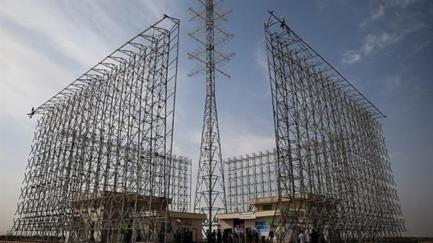
Iran’s first Qadir radar system, which was unveiled in the central city of Garmsar in June 2014. (Fars new agency photo)
Press TV | July 4, 2015
Iran’s Islamic Revolution Guards Corps (IRGC) has launched a long-range radar system in the southwest of the country to enhance its air defense capabilities.
The second Qadir radar system was put into service in Iran’s southwestern city of Ahwaz on Saturday.
The first Qadir system was unveiled in the city of Garmsar in the central province of Semnan in June 2014. The third system is also scheduled to be unveiled in the near future.
The domestically-manufactured Qadir radar system, designed by IRGC’s Aerospace Division, is capable of detecting targets with a very small cross section from a long distance.
The system enjoys a direct range of 1,100 kilometers (more than 680 miles) and can be used to detect different types of aircraft as well as ballistic missiles.
Qadir falls in the category of long-range three-dimensional radar systems.
In recent years, Iran has made major breakthroughs in its defense sector and attained self-sufficiency in producing important military equipment and systems.
The country has manufactured different types of state-of-the-art radar systems, including Arash-2 and Kayhan.
The Islamic Republic has repeatedly assured other nations, particularly its neighbors, that its military might poses no threat to other countries, insisting that its defense doctrine is merely based on deterrence.
Israel seizes 600 dunums of Palestinian lands in Occupied Jerusalem
Palestine Information Center – July 5, 2015
OCCUPIED JERUSALEM – Israeli mayor of Jerusalem, Nir Barkat, ordered that 600 dunums of Palestinian lands in al-Issawiya, in northern Occupied Jerusalem, be temporarily confiscated allegedly for gardening purposes, Peace Now reported afternoon Saturday.
The misappropriation order was issued using a special municipal law that allows the municipality to exploit an empty lot for public uses for five years in cases where the owner does not develop it. Al- Issawiya locals found the orders spread out in their fields.
The lands in question have been targeted by the Israeli occupation authorities in recent years, when a plan to declare them a National Park was promoted in order to create an Israeli dominated continuity between Occupied Jerusalem and the area of E1. The park is also meant to block the potential development of the adjacent neighborhoods of al-Issawiya and al-Tur.
It is required according to the law that the land owners refuse or choose not to make use of the tracts. When the owner wants to use his or her private property they are allowed to do so in accordance with the approved construction plans, Peace Now further stated.
In the case of al-Issawiya, the owners wish to make use of their lands. One month ago, the municipality uprooted trees that were planted by the Palestinians under the pretext of unlicensed cultivation. Thus, it seems now very hard to explain why a Gardening Use Order is required in such case when the owners wish to do the farming on their own.
According to analysts, it seems that in order to bypass the need to declare the lands as National Park, the Israeli occupation authorities are trying to take over the lands through other illegal means.
Peace Now added that the goal of the Israeli authorities is to prevent any potential Palestinian capital in East Jerusalem by taking over and blocking the lands necessary for the future development of a viable Palestinian state. The Jerusalem Municipality and the National Parks Authority seem so obsessed with creating an Israeli dominated corridor in the area, making use of the law only as a pretext for a political agenda.
A month in Palestine
By Tom Blanx | MEMO | July 4, 2015
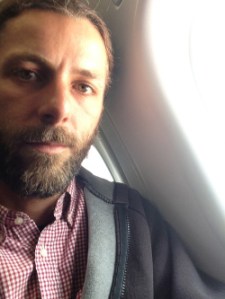 This May, I travelled to the West Bank in occupied Palestine.
I had a fairly good idea of the kind of things I would see when I went, but wanted to take a closer look at what I think is an unfair and asymmetrical situation. I don’t stand against Jews or Israelis. I stand against racism, violence, oppression and ignorance, and all of those things, I think, are here.
During my time in the West Bank, I lived and worked with a Palestinian farmer who runs a Permaculture Project in a small village called Marda. I wanted to see for myself what life was like for Palestinians living under occupation and how Permaculture could help.
Knowledge is everything and with that in mind I’m sharing everything I saw, heard, thought and felt in the time I was there.
Below are excerpts from Tom Blanx’s blog. Read the full blog here.
Getting in
For those who haven’t been, Israel’s not the easiest of places to get in and out of. And if you plan on checking out the occupied territories you’ll need to be a bit creative with the truth. Despite my polite passport note from the queen, I decided not to reveal how freely I would be passing while on my travels as it would have most likely landed me straight back on British soil. This had happened to previous volunteers so the NGO I had organised the trip with had suggested that I lie.
With the help of Murad, my Palestinian friend and his friend, an Israeli who will remain anonymous, I pretended I was traveling to help and learn on a farm in the south. I probably could have said I was there for a beach holiday or Christian visit too, but a bag full of work boots and full length clothing might have been a giveaway. Murad told me to just remain calm and answer all questions confidently but it was a nerve racking and intimidating experience. Much more than I remember it being when I was 18 coming here. In the end I think I got in by inadvertently playing dumb.
Getting into the West Bank was more straight forward. I got on a bus from Tel Aviv bus station all the way to Ari’el (An illegal settlement, next to Marda). There are no stops or checkpoints for settlers (on the way in) so all I had to do was get off before the bus turned into the settlement where Murad was waiting for me and I was in. A better understanding of his instructions, some Hebrew and useful geographical knowledge and I probably wouldn’t have ended up bang in the middle of the Ari’el in the isolating situation of looking for a Palestinian village. I haphazardly navigated my way out of on foot and was an hour late – not the look I was going for, but I guess he was going to find out what I’m about sooner or later.
Marda
Marda is in the Salfit district which is biggest producer of olive oil in Palestine. The village is effectively a ghetto, with reinforced steel gates at each end for when the army want to shut it down and a high metal fence and barbed wire around it, although some of these had been damaged and removed. There used to be resistance here, but like in lots of the rest of Palestine, occupation has become normalized. These days the village is quiet and peaceful. People work and children go to school, cats wander around the place looking for food and donkeys everywhere sound like they’re dying. The village sits directly under the hilltop Ari’el settlement, the 4th biggest in the West Bank. Murad said he used to play there with his friends when he was young before Zionists confiscated and destroyed 9000 dunams of it, in the late 70s to build luxury homes, streets and a university for Israelis and Jewish immigrants. The juxtaposition of the two towns, is a powerful thing to see and its something that you can’t help but see, every day.
As I arrived in Marda another volunteer was leaving. Her name was Judy, a 60 year old American woman from Australia travelling by herself. I wouldn’t normally mention someone’s age or circumstances but I think its significant as many people think the West Bank is too dangerous to travel to and that women could be more vulnerable here. Neither are true. It was her 5th visit to Marda so I wanted to get as much information out of her as I could in the 30 minutes she had left. She gave me the dos and don’ts about living in Marda, how to be with Murad and told me to explore as much as I could of Palestine “You can’t charaterise Palestine on what you see in just Marda as much as you can’t charaterise the US on what you see in Miami”
Murad
Straight away I felt at ease with Murad. From our first Skype conversation, to meeting him an hour late after getting lost, I felt welcome and at home. Chilled and pragmatic, straight talking and funny are the best words I can think of to describe him. Everywhere we went there was banter. Banter with friends, banter with strangers. Sometimes he sounds like he is angry when he’s talking in Arabic but then he laughs and I know he’s not. Judy said his bark is worse than his bite and I now know what she means. “C’mon man!… what you doing man?!”… “Why you sayin sorry all the time man” still echo round my head.
Murads family have lived in Marda for generations spanning centuries. His wider family numbers in the 100s. His immediate family is his his wife, Ghada, daughters Sara, Halla and Tooleen, his youngest – son Khalid, his Mother, Twin brother, older brother, three sisters and their families. I think I can count the number of people in my family with my fingers!
The old house he grew up in has itself been in the family for 300 years. His Mother and twin, Hazim live there now and on my first night, he took me to meet them. We ate dinner, looked at our phones (There’s no escaping it!!!) and then I helped Murad download a Lionel Richie “hello” ringtone he wanted for when Ghada called him. I asked him what other music he liked and he said “none”. “But you like Lionel Richie though?” No. just that song.” Then I reconfigured his answer and decline buttons so he could, in his words, hang up in peoples face.
When violence broke out in the second intifada (literally translated as uprising), Murad decided to leave Palestine. With his Palestinian passport, he traveled to America and spent time working in Chicago and Tennessee. In 2006, he returned to inherit his Father’s land and with some basic knowledge of permaculture from a previous project, he started Marda Permaculture farm.
The Permaculture farm
The farm is 2 1/4 dunams in size. A duman is about 1 square km. The farm has Bees and produces large quantities of honey each year, 5 kilos of which is exported to customers in Qatar. He has chickens and pigeons (with their own cob-built houses) for eggs and meat and and plans on getting some goats and a cow.
The farm is Murad’s livelihood, but its more than that. The farm is his way of fighting the occupation. By growing his own food and providing his own income, he doesn’t need to buy expensive food and water or look for work abroad or in Israel. Permaculuture gives him good health, independence and empowerment.
The farm is a centre for students, activists and volunteers and Murad hopes his model will raise awareness of Permaculture in Palestine and begin to change local peoples attitudes towards farming.
Getting around
I did most of my exploring with Murad. I only did my own thing a couple of times. Once when I went to Jerusalem with Gaie (another volunteer who helped at the farm for a few days) and another time when we split up in Rammalah and I went to see qalandia. But we always left Marda together. Murad wasn’t into the idea of me travelling by myself in case I got mistaken for a settler or deported for being a friend of Palestine. They’re weren’t any bus stops in Marda so unless you hail a passing taxi or sherut you hitch a ride to somewhere you can get a bus. The nearest place to us was Zattara Junction (Tappuah junction for Israelis). From here you can go in three directions north to nablus, east to jericho and south to Rammalah. It used to be checkpoint but some of these have eased off in recent years. There’s still a large military presence here though. Lots of Israelis use the junction so cars are still stopped, IDs are still checked and people are still harassed. We saw one guy in his early 20s being checked out by two soldiers wanting to know where he had been, where he was going, and why he needed to go there.
As we make our way to the bus stop to Rammalah we have to go through the rigmarole of crossing the side of the road we need to the central reservation, avoiding Israeli only bus stop which Palestinans are not allowed to be near, to then cross back 50m further along where the anybody else bus stop is. You keep your head down here as you feel the eyes of soldiers and settlers weigh down on you. You’re at the mercy of the army here, they have done and can do anything they want to you here. This a cold violence that all Palestinans have to go through on a daily basis.
Nablus and Tulkarem
This was the first place outside Marda that I explored. It used to be an important junction on the Old Silk Road and was a strong resistance town in the years following the occupation. Nowadays, its very normalised – the occupation. Like the rest of the country, people are just trying to make enough money to survive. Food and drinks, shops and markets are everywhere. Women are covered up, some even more than in Marda wearing full burkhas which you can also see displayed in shop windows. Lots of women whiten their faces here too. Looks really strange sometimes. On the hilltop behind the city is the largest refugee camp in Palestine – 30,000 refugees packed into ¼ of a sq km. Like the one outside Rammalah they resemble Rio’s hillside favelas. Beautiful backdrop and ugly consequence all at the same time. As we ate a shrawma outside we saw men putting flags up in the main square and cars driving round honking their horns. They were celebrating the release of a young man who had been put in jail by the Israelis. I don’t know who he was or what he had been jailed for but I’m guessing it was for a while and his release was a small victory.
A little bit further on is Tulkarem This is where we met Murad’s friend Fayez, and where I saw the wall for the first time. Like Murad, Fayez also runs a farm in a village just outside Tulkarem called Irtah. His story is amazing: resilience and steadfastness in effect. In a nutshell… Occupation forces tried to confiscate his land to use as a military post; some of the first sections of the segregation wall were built across 20 dunams of his land; he resisted the land confiscation and repeated attacks on him and his crops and was imprisoned, leaving his wife Muna, to manage the farm; 12 chemical factories considered hazardous to Israeli public health were relocated to the other side of the wall, one right next to his farm*; he thus grew more aware of the health impacts of fertilisers and pesticides and made the switch to organic production. Now his and Muna’s farm, famous for popular resistance attracts solidarity activists and volunteers from all over the world.
*Factory chimneys are used when the wind blows east into Palestine, and not when into Israel.
At his home we sat and drank zamzam with his family. Zam zam is holy water welled from the zam zam well in Mecca. They told me the story of zamzam, debating over the specifics but I’m struggling to make sense of my notes so here’s a simple kids version of the origin of zamzam I found online:
“This is the story of the ZamZam water. The water well of Zamzam is a well located within the Masjid al Haram in Mecca. It was a miraculously generated source of water from Allah, which began thousands of years ago when prophet Ismael (PBUH) the son of prophet Abraham and Hajar (the wife of prophet Abraham, May Allah be pleased with her) were thirsty and alone in the dessert.In this area there is very little water if any at all in some places. According to our tradition, Hajar (May Allah be pleased with her) was a very devout mother and wife. When she was separated from her Husband prophet Abraham (PBUH), she was left alone in the dessert, by herself with her small son Ishmael (PBUH). Prophet Abraham made a prayer for his young family as he left them behind and Allah provided the means of sustenance for them. Hagar (May Allah be pleased with her) ran seven times back and forth in the scorching heat between the two hills of Safa and Marwah, in desperation because her son cried as it was very hot and they did not have even a drop of water to drink. Allah provided a Miracle and the ZamZam well was born.”
Fayez’s son “carried” 20L of this water back from his hajj pilgrimage so it goes without saying that I felt really honoured be offered it. It’s meant to contain healing powers so you drink it in 3 sips and wish for good health. I drank mine to my Mum.
Jerusalem
Tony Blair has a multi million penthouse apartment that he rents for free in East Jerusalem. I saw it – Murads not even allowed to come to Jerusalem. No one who lives in the West Bank is, unless they own one of the hard to get permits I mentioned earlier. It’s like me needing permission to visit London.
Jerusalem (East) is as you would expect it to be – tourists, religious places of interest, sight seeing, crap selling blah. The tourism and globalism here makes it more relaxed in its attitudes to drinking and clothing, despite the religious significance of the city. In the old town/holy basin which is a busy Palestinian neighbourhood, Israeli settlers live in homes above the market taken from Palestinians now flagged up and fenced off. Below mesh is in place to stop settlers throwing waste down on the Palestinian’s markets there are Israeli homes.
We tried to get to the Al Aqsa mosque and dome on the rock but it was Muslims only after 4pm and being white and non Muslim looking we were turned away by Israeli police. They control who goes in and out here. It was interesting and maybe kind of nice to see Israelis help enforce the Muslim only after 4pm rule. Was also good to see some soldiers and locals getting on. Saw another soldier help a blind man into the square too which was nice. In the rush to cry dehumanization you can easily find yourself guilty of doing the same thing.
Jenin
Jenin was the furthest town I visited. We had to time our trip around the weather as it gets hotter here. Its in the agricultural north and took about an hour and a half of mountainous driving from Marda to get there although Jenin itself is mostly flat. Didn’t really get a chance to explore Jenin properly it was more of a meet this guy here meet that guy there day but one thing that was noticeable was the absence of anything Israel.
Unlike all the other places Id been to there was no army, no flags, no settlements. This might be because of its unbroken horizontalness as I’m pretty sure most settlements are built strategically on hilltops. Outside the hustling bustling town of markets shops and car-shop after car-shop after car-shop is industrial landscape with factories and fields growing tobacco fruits and vegetables. More mass production than organic production here.
Environment
Despite a deep connection with the land, it gets treated badly by many Palestinians, Israelis too. In many parts of the West Bank, streets and fields are scattered with rubbish. There’s refuse collection once a week in Marda but that’s just to collect landfill waste from peoples houses. Outside though, pedestrians, drivers, kids playing, even farmers, just chuck their empty packets on the ground. Many animals are treated badly: birds caged in small spaces to be sold as meat; donkeys toiling in the insane heat carrying people and heavy loads; dead puppies (clearly not treated well) left next to bins in the street, I could go on. On our way to the farm one day we saw that one donkey had given birth. Murad helped the new donkey to its feet and pushed her closer towards her mother which was tied up to a nearby tree but just out of reach. The next day we saw the same donkey, working, but not the infant. As another mouth to feed and a distraction to his working donkey, the owner, an old guy, chucked the new jenny away. This upset Murad, more out of waste than sentiment, but Murad cares. He understands the important roles animals have. I learnt this early on when some children visited us at the farm and one of them was trying to squash a bug. Murad stopped him and while I couldn’t hear what he actually said, it was clear Murad was telling the boy that he needed those bugs.
Then there’s Israel, the self titled environmentalists, chucking all kind of restrictions and protection laws onto Palestinians in the name of preservation whilst committing all kinds of environmental rights violations: sucking Palestinian land dry of water and selling it back to them at full price; allowing settlements to dump huge quantities of sewage into neighbouring Palestinian fields and villages, damaging buildings, soil and water supplies; poisoning waterways and soil with toxic chemicals; uprooting 1,000s of olive trees, trees that are peoples livelihood, trees that have stood since the Romans were here!; building over ancient springs and vital sources of water, affecting ecosystems and land irrigation; and then the walls and border gates affecting the migration patterns of an array of species.
Culture
I’d never been to a Muslim country before so my head naturally started to fill itself with assumptions and preconceptions of how things were or would be. I knew from the advice the volunteer program gave me, that Marda was a conservative village: No shorts, no singlets (LOL), no drinking, no drugs, and no approaching strange women romantically. I paraphrase but these were all suggested guidelines – Who’s been coming here??
Marda is a conservative village, traditional too – women cover themselves in public and sometimes socialise separately but everyone was friendly and interactive. If my Arabic spanned further than the “Hello, How are you? I’m fine, thank you” at its peak, I may have broken down even more social barriers. Word to the wise: Don’t go in for a handshake with women you’ve just met as you’ll be left hanging.
Despite the occupation and the harassment and intimidation that comes with it, everybody seemed upbeat. There’s a real togetherness here and its so much more chill than it looks and sounds from in the west. There’s lots of joking. Murad likes to take the piss out of people especially people that he likes. There’s one old guy we used to see and Murad always tries to tickle him.
It sounds like a stupid and obvious thing to say but Palestinians really love their children, especially young ones, almost as if preserving their innocence is everything. From about 7-12 boys go through a seen but not heard phase then at 13+ they’re targets for playful clips round the ear and downsizing banter. They have a lot of freedom in Marda. Children as young as 6 walk to and from school through the village, they go to the shops to buy groceries and play outside unsupervised. On paper it sounds like slack parenting but its not. The community polices itself. Everyone knows everyone and when children step out of line or get cheeky the nearest adult will call them up on it. I’d describe it as a golden age if the circumstances didn’t make it sound so ridiculous.
Politics
Murads not the type to push agendas. I wanted a Palestinian perspective on Israel, the occupation, and all the other things that go with it, so I was going to have to ask. Judy ,who I met briefly when I arrived in Marda told me “Don’t ask questions unless you’re ready to accept the context.” I wasn’t completely sure what this meant but I bided my time and began to write down some questions for Murad which I could ask him when we’d got to know each other better. In my spare time I started to plan a positive article about cooperating through collaborating. This had stemmed from seeing how Murad and his Israeli friend had been working together to sneak volunteers into Marda, but with one question my idea, or at least, my inspiration, was blown out of the water. “Do lots of Israelis come here to help?”
“Yes, but I don’t like it. It makes me look bad.” Murad doesn’t pull punches, he tells it as he sees it and when a group of Israeli peace activists came to work on the farm and found this out. He told me how they had asked him what they could do to help the Palestinian cause and in one word, he said, “leave”. “It sounds harsh, but this is a man who has been fired at, arrested, imprisoned, watched as his family’s land was turned into a lavish city for Israelis and Jewish immigrants, which has brought violence right to his door.
“These people say they are for peace but if they really were they would leave Israel. Who built your house?” he asked them. “The person who built your house is living in a tent and you talk about peace?”
Talk leads onto the testimonies of soldiers in, ‘Breaking the silence’. “Breaking the Silence are bastards! They kill innocent men women and children and then feel bad and say sorry? Fuck you’re sorry!” None of this is said in a raised or angry tone of voice. Murad, like lots of other Palestinians, thinks he’s been sold out. Sold out by Israel, sold out by America, sold out by Britain, sold out by Arab states and sold out by their own leaders. I try to explain that propaganda can make people do the worst kind of things but it sounds empty as I say it.
“The world doesn’t care. If it did, Palestinians would have justice.”
The Army
In the whole time I was in Palestine and Israel the only times I ever felt threatened, nervous or insecure was near Israeli police and soldiers. 15 years ago I was in Tower Records in Tel Aviv and 2 young soldiers stood next to me looking through CDs while on duty. It was strange then and it is strange now. In Israel, everywhere soldiers are on the move. Its like scouts but with guns. It’s like something out of the Paul Verhoven film, Starship Troopers. Beautiful, fresh faced, young men and women, IDF issue Tavor assault rifle in one hand and smartphones in the other, all “doing their part!, knowing their foe!, guaranteeing citizenship!” because at the end of the day, “its us or them”
The idea that an 18 year old with a gun has the power to harass and disrespect civilians often much older and wiser than them leaves a nasty taste in my mouth.
For me, military service here is more about protecting a lie than protecting citizens. Imagine a reality where young men and women are indoctrinated with the idea that they are defending their country when all they’re really doing is supporting a decades long colonisation project. It almost doesn’t seem real. Almost.
Pigs
About 5 days in, I was smoking a cigarette on the roof when I heard a gravel moving noise coming from the hill behind my house. The street lights made it difficult to see what it was but I could just about make out a group of large figures making their way down this track. It looked like humans, big humans, on all fours, coming down the hill!! I was scared! The settlement was just up the hill and I’d heard stories of past incursions and still new to this unfamiliar and relatively (to me) troubled place, my imagination and stupidity got the better of me. Reality checked eventually and I concluded they weren’t humans. I still didn’t know what they were though, so I didn’t move or make a sound and just watched as these night monsters marched on by.
The next morning I tell murad what happened… And in his most blasé voice tells me, “That’s the pigs man…. They come and destroy everything in a few minutes!”
So I looked it up. It’s not just in marda. Apparently all over the West Bank wild pigs have been wrecking crops and trees and sometimes attacking people, all since around 2004. People claim they were introduced after the last intifada. One guy even told me he heard a truck load of them had been seen being unloaded in some fields. It’s a wild claim, but in a place where pollution is directed towards specific communities, raw sewage is dumped into village’s water supply and Settler children are marched through villages abusing locals, it becomes more believable. I can only speculate as why pigs. Agitation? Disrespect? One guy joked that Islam should introduce a temporary fatwah so that people could eat the pigs and turn the problem into a solution.
“In 2004 there were no pigs in Palestine! Now there are pigs! They don’t fly in!”
Murad showed me some of the damage they had done to his corn field. To protect his farm he put up a barbed wire fence but it was only when he attached tyres to the fence that they stopped getting in.
I became obsessed by this thing! I really wanted to see the pigs again, I set my alarm to wake me up at all hours, but I never saw them. There were some near encounters. We just missed them on the way to work one day when some builders sent them running down the hill throwing stones at them
A law was passed to protect the pigs so farmers are not allowed to kill them. It would take a bullet to the head to do it apparently which would be pretty hard as you’re not allowed weapons of any description in Palestine.
Getting out
On the way back its the same bus back to Tel Aviv. After speaking to other internationals I was prepping myself for a grilling at the airport. I wasn’t expecting to be removed from the bus by armed officers in plain clothes. And I wasn’t prepared to explain why I was in the West Bank on a settler bus and not where I said I would be in Israel proper. People told me to answer questions confidently, honestly and vaguely. A lot of officials I dealt with had a mediocre knowledge of place names so this helps with the vague answering. You might get through that but you’ve probably been flagged for more security checks. And if you have it’s a tough run in til the fight home. At check in and security your bags will be emptied, their contents swabbed and analysed, your body searched and scanned and your skill at answering repetitive questions tested.
And when you collect your bag from Gatwick airport luggage hall you’ll even find a courtesy note inside explaining that someone’s had another good look through your gear and put everything back as they found it. ‘Come back anytime’ ain’t the vibe I’m getting.
I plan on going back for olive harvest this year but won’t hold my breath on getting in. If one trip is that suspicious, another is probably smoking gun territory.
Ulterior motives behind sanctions on Iran: Ayatollah Khamenei
Press TV | July 4, 2015
 Leader of the Islamic Revolution Ayatollah Seyyed Ali Khamenei says the sanctions against Iran have nothing to do with the country’s nuclear activities or human rights record, adding that there are other motives behind the bans.
Addressing a group of university professors and researchers on Saturday night, Ayatollah Khamenei said those who have imposed sanctions on Iran are themselves the ones who foster terrorism and commit human rights violations.
The Leader said the sanctions against Iran have been imposed because the Islamic Republic has emerged as a nation, a movement and an identity guided by principles against the hegemonic system.
“Their objective is to prevent Iran from reaching a prominent civilizational status,” Ayatollah Khamenei said.
The Leader also highlighted the special role of professors in educating a generation of self-reliable, confident and diligent youths who will further move Iran toward progress.
Greece’s Downfall and Redemption
By Finian Cunningham – Sputnik – 29.06.2015
Decades of exorbitant military spending account for Greece’s present downfall under an Olympian-sized debt. European governments and news media portray the problem of Greece’s financial woes as public spending profligacy.
The truth is that Greece’s debt mountain has been incurred from years of wasteful military splurging. That is the tragic downfall of the country, which European creditor governments and the mainstream news media tellingly ignore.
But in this understanding of Greece’s modern tragedy, there is hope for democratic renewal and redemption. Because that realisation permits a radically different option to restore Greece’s economy in a way that is rational and achievable, without piling up more debt and misery for the population. Instead of more austerity imposed on workers and pensioners, the solution is for Greece to embark on a massive disarmament programme to overturn decades of reckless militarism.
Greece’s outstanding total debt is around $320 billion – or 175 per cent of its national economic output (GDP). Its creditors – the Troika of European Union, European Central Bank and the International Monetary Fund – are insisting that the Athens government must oversee more public cuts.
The reality is that austerity is only driving the Greek economy into further depression and debt.
That inevitably means more and more of the Greek people’s sovereign rights whittled away to the point of becoming a vassal state dictated to by foreign governments and finance capital.
As a foreboding sign of things to come, Greek Prime Minister Alexis Tsipras’ latest offer of raising corporation taxes in place of cutting pensions was slapped down last week by the Troika.
The imperious demand for more austerity has now forced the Greek government to put the choice to the public in the form of a proposed referendum on the EU’s bailout terms, to be held on July 5.
Greece’s debt crisis appears to be heading to an even sharper crisis point. But the Greek origin of that word “krisis” also has a positive connotation of decisive event. The Greek people should reject the never-ending debt addiction that the EU creditors and IMF have hooked the country on. For that way only foreshadows increasing austerity and anti-democratic dictate.
What the Greek people can turn to is a realistic and altogether more democratic and humane option – of demanding their country slash its monstrous military spending.
Even after five years of economic catastrophe, Greece’s annual military budget amounts to $4 billion, according to the Stockholm International Peace Research Institute. That translates to 2.2 per cent of the nation’s GDP – a colossal drain on the economy.
To put Greece’s military spending into perspective, it is double the ratio that most other EU countries currently spend on defence. For example, Germany spends 1.2 per cent of GDP, Italy 1.1 per cent, Netherlands 1.2 per cent and Belgium 1.1 per cent.
If Greece were to cut its outsized military budget by half that would generate $2 billion in one year alone, which would pay off its immediate bill to the IMF and help the country reach a 1 per cent budget surplus that the Troika has set for 2015. In other words, that source of finance would obviate any further need for cutting pensions and workers’ salaries.
Why the Syriza government of Alexis Tsipras, which claims to be a radical socialist coalition, does not pursue this more imaginative and democratic alternative is a curious question. Last week, Tsipras offered to cut the military budget by $200 million – or a mere 5 per cent. But the offer was rebuffed by the IMF because it stated that its rules do not permit interference in a country’s defence policy. To which Tsipras and the Greek electorate should respond with their own rebuff of IMF absurdity – especially evident with the IMF’s throwing billions of dollars to the regime in Kiev which is waging war on the eastern Ukrainian population.
But that’s only a trifling start to addressing the Greek tragedy. The Greek people have legal and moral grounds to repudiate the entire debt mountain as illegitimate or, as economists would say, “odious debt”.
During the decade up to the onset of crisis in 2010, Greece was regularly spending 7 per cent of its GDP on military. Some estimate that during that decade the country spent a total of $150 billion on defence – or half of the current debt pile.
As Greek economist Angelos Philippides told the Guardian back in April 2012: “For a long time Greece spent 7 per cent of its GDP on defence when other European countries spent an average 2.2 per cent. If you were to add up that compound 5 per cent [difference]… there would be no debt at all.”
Moreover, Greece’s past military expenditure was mired in corruption.
In October 2013, ex-defence minster Akis Tsochatzopoulous of the previous PASOK government was jailed for 20 years in a bribery case involving $75 million in kickbacks.
And here is an ironic twist in this Greek tragedy. The biggest European weapons dealers to Greece are German and French companies. In the Tsochatzopoulous scandal, German company Ferrostaal paid a fine of $150 million for its part in using bribes to clinch the sale of four submarines.
It was an open secret that Greece’s military largesse was for years stinking with corruption. Yet the German and French authorities did nothing to derail this gravy train. The Berlin and Paris governments continued to ply Greece with loans because the country was using the money to buy massive amounts of weapons from their manufacturers.
Today, the single biggest institutional creditors to Greece are Germany and France. Those countries stand accused of criminal irresponsibility in racking up Greece’s debt precisely because so much of the money was being spent to prop up the German and French economies through lucrative arms sales.
It is a monumental irony that German leader Angela Merkel is most vehement in lecturing Greece about “living within its means”. Rather than directing corrective action at the source of the problem, it is Greek workers, pensioners, the young and infirm who are being made to pay for the largesse that they actually never saw.
If the Greek people repudiate the entirely artificial debt crisis, it would restore their country’s economy on a sound footing. Of course, the country’s bloated military will not be happy with that. The danger of a military coup is a real threat given the country’s history of fascist dictatorship during the US-backed “regime of the colonels” between 1967-1974. Perhaps this is what the Syriza government is afraid of.
And, to be sure, the Troika of EU leadership, ECB and IMF will be intensely displeased if the Greek people go for the radical alternative of rejecting debt and austerity. However, in the battle shaping up, the Greek people have natural justice on their side. They should and can reject debt slavery and dictate. By doing so, Greece may redeem the meaning of “Demos Kratia” – People Power. And what a beautiful denouement in the Greek tragedy that would be, not only for the people of Greece but right across all the debt-ridden Western countries.
Greece is hailed as the ancient birthplace of democracy. Two millennia on, it could also be the very place for its renaissance.
Austrian Institute Clarifies True Costs of the EU’s Anti-Russian Sanctions
Sputnik – 03.07.2015
The Austrian Institute of Economic Research (WIFO) published a monograph clarifying the projected short and long-term costs of anti-Russian sanctions to the EU 28 plus Switzerland. A summary of the report published Friday has confirmed that Europe as a whole expects €92.34 billion in long-term losses, along with over 2.2 million lost jobs.
While the report attempts to downplay somewhat the losses attributed to sanctions, noting that politicized export restrictions must be considered together with the ongoing Russian recession and other factors, the figures speak for themselves.
The report projects an “observed decline in exports and tourism expenditures of €34 billion value added in the short run, with employment effects on up to 0.9 million people.” Switching to a longer-term perspective, the report estimates “the economic effects increas[ing] to up to 2.2 million jobs (around 1 percent of total employment) and €92 billion (0.8 percent of total value added), respectively.”
Commenting on the geographical disbursement of the economic and jobs losses, WIFO’s report shows that “geographical closeness highly correlates with the relative size of the effects at the national level, with the Baltic countries, Finland and the Eastern European countries being hit above the EU average of 0.3 percent of GDP in the short and 0.8 percent in the long run.” The report also notes that Germany, which accounts for nearly 30 percent of all EU 27 exports to Russia, has been hit the hardest in absolute terms, and is projected to lose €23.38 billion in losses in the long term. Italy is second, with €10.93 billion in projected losses. France rounds out the top three with €7.92 billion in losses.
The study’s figures also show that Estonia is the single most heavily affected country in both the short and the long term, with the country suffering a €800 million (4.91 percent) and €2.1 billion (13.24 percent) decline, respectively. Estonia is followed by Lithuania (-6.37 percent long term), Cyprus (-3.25 percent), Latvia (-1.87 percent), and the Czech Republic (-1.53 percent).
In employment terms, Estonia, Lithuania and Cyprus are also the hardest hit in percentage terms, and are projected to suffer 16.3 percent, 10.84 percent and 4.21 percent losses, respectively. In absolute terms, Germany (losing 395,000 jobs) Poland (300,000), and Italy (200,000) have been the hardest hit; Spain, Lithuania and Estonia are projected to lose between 100,000 and 190,000 jobs.
As for the economic sectors most heavily impacted, the WIFO study found that agriculture and food products, metal products, machine-building, vehicles, and manufacturing-related services are hardest hit in the short term, with construction, business services, and wholesale and retail trade services also projected to suffer disproportionately in the long-term.
Speaking to Radio Sputnik about the report, WIFO economist Oliver Fritz noted that while EU politicians still hope that the sanctions will have some effect on Russian policy, pressure is building on them to change their policy, since the economic consequences are rapidly beginning to add up.
While the economist noted that he does not see the sanctions being lifted in the short term, with German Chancellor Angela Merkel successfully keeping other EU nations in line, Fritz noted that as losses mount, EU politicians may eventually decide to consider rethinking their decisions.
Last month, WIFO conducted research for Europe’s ‘Leading European Newspaper Alliance’, estimating up to €100 billion in losses if anti-Russian sanctions remain in place.
Since March 2014, the United States, European Union, and other Western countries have placed sanctions on Russia’s banking, defense and energy sectors over Moscow’s alleged role in the Ukrainian crisis. In August, Moscow imposed a year-long food embargo on the countries that had sanctioned it. Last month, the EU’s foreign ministers agreed to extend sanctions against Russia until January 31, 2016.
Israeli proposal to expel Palestinians from homeland permanently
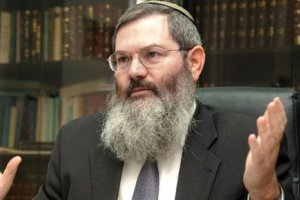
Eli Ben-Dahan
Israel’s deputy defence minister has proposed a law that, if passed, will see the expulsion of Palestinian resistance members and their families permanently from Palestine.
According to Hebrew media reports, Eli Ben-Dahan believes that expelling members of the resistance groups and their immediate family members and exiling them abroad permanently will contribute to “rooting out the phenomenon of emerging saboteurs unaffiliated with any terrorist organisation committing attacks against Israeli targets.” The politician confirmed that he has asked Minister of Justice Ayelet Shaked to consider the proposal and get official approval for it to become law.
A policy of forced expulsion, if adopted by the Israeli authorities, would be a blatant violation of international humanitarian law, which prohibits the expulsion of any citizen or group of people from their own territory, either within the same territory or abroad. In addition, Article 147 of the Fourth Geneva Convention, regarding the protection of civilians during a time of war, makes it a grave breach of the Convention to deport or transfer a protected person.
Samantha Power Lies to Congress About Civilian Shelling in Ukraine, Commits Felony
Russia Insider | July 3, 2015
- The US Ambassador to the UN, she claims she believes majority of civilian shelling casualties are victims of the separatists.
- The penalty for lying to Congress is up to 8 years of imprisonment.
 Ambassador Power’s testimony was the subject of a story we ran on Monday of this week, and a helpful reader got back to us and pointed out that we had missed the most important part of it.
Apparently, Ambassador Power lied to the committee she was testifying before, thereby committing a felony.
Congressman Rohrabacher, one of the loudest critics of Obama’s Russia policy, asked her if she thought it might be possible that the majority of the civilian casualties killed in Ukraine were victims of the Ukrainian army.
It was a “gotcha” question, because this is a universally acknowledged fact.
Here is what the ambassador answered:
“I think it is highly unlikely on the basis of reports we have received from the United Nations and the OSCE.”
See 1.50 in the video:
This statement is demonstrably not true. Reports from the UN and the OSCE conclusively demonstrate what it obvious to everyone even halfway paying attention – that the victims are almost universally victims of Ukrainian army shelling.
It is starkly preposterous to suggest otherwise, because even a dimwit could grasp that the separatists are unlikely to bomb their own people.
It is simply not plausible that the ambassador believes this, and is not aware of the facts.
Ironically, Power is the author of a book which studies US foreign policy responses to genocide, so she has more than a passing interest in these issues. The book’s title is A Problem from Hell: America and the Age of Genocide,
She has made protection of human rights a hallmark of her career, yet she is one of the most energetic and committed boosters of the aggressive Ukrainian military campaigns in the East, which have featured the most barbaric human rights violations imaginable – shelling defenseless civilians – children and elderly, with horrific, blood-curdling casualties, visible for all to see in gory detail on Youtube.
The shelling serves no military purpose and is done only to terrorize the local population in the hopes of triggering a Russian response.
Here is what the law says:

Kiev in violation of heavy weaponry clause in E. Ukraine – OSCE
RT | July 4, 2015
The OSCE has warned that a growing presence of heavy weaponry on the government controlled side of Donbass territory has put Ukrainian security forces in violation of the terms of the demarcation line, according to OSCE Deputy Chief Monitor Alexander Hug.
“We can highlight that the security situation has gotten worse in the Donbass over the past few weeks,” Hug said at a briefing in Mariupol.
The Organization for Security and Co-operation in Europe’s Special Monitoring Mission (OSCE SMM) stressed the growing presence of heavy weaponry, and the increased movement and use of military equipment along the demarcation line in the area controlled by Kiev forces.
“In the last few weeks, our observers as well as drones recorded the presence of heavy weapons in areas controlled by the government, which is a violation of the demarcation line terms regarding the withdrawal of heavy weaponry,” Hug said.
At the same time, he noted that there has been an uptick in military equipment around Komsomolskoe, which is controlled by the self-proclaimed People’s Republic of Donetsk (DNR).
Hug added that one of the remaining challenges is the difficulty observers face when moving around Ukraine on their monitoring mission. “Our observers are still having trouble with freedom of movement, which makes it difficult to monitor certain areas, in particular the border between Ukraine and Russia.”
OSCE has also documented shelling of the buffer-zone areas in eastern Ukraine. The organization’s latest report, published on Friday, said artillery was coming from the west, which is government controlled territory.
“In the south-eastern part of the village [of Shyrokyne], the SMM saw a crater of 12m (over 39 feet) diameter and 4m (over 13 meters) deep, many 82mm mortar shells, the remnants of ammunition crates and numerous impacts of 152mm artillery strikes, which based on their location, the SMM assessed to have been fired from the west,” the report said.
The report added that “SMM did not observe any DPR [Donetsk People’s Republic] presence in Shyrokino,” referring to the village that DPR demilitarized on July 1. OSCE observers visited the area to confirm that claim, which was part of the Minsk withdrawal terms.
The OSCE monitoring mission’s goal is to observe the implementation of the Minsk peace agreements reached by Kiev and pro-independence forces of Donbass in September 2014 and February 2015. The February ceasefire deal called for the creation of a buffer zone and the withdrawal of heavy artillery from the line of contact.
The Ukrainian conflict began last April, when Kiev deployed military and volunteer battalions to the Donetsk and Lugansk regions in eastern Ukraine to crackdown on local militia, who refused to recognize the country’s coup-imposed authorities.
Over 6,400 people have been killed since the start of Kiev’s “anti-terror operation.” A total of 1.35 million Ukrainians are now designated as internally displaced persons, according to UN estimates.
On Iran’s Nuclear Program, Ghosh’s “Gotcha” is Nothing But Smoke
“Whoever is careless with the truth in small matters cannot be trusted in important affairs.” – Albert Einstein
By Nima Shirazi | Wide Asleep in America | July 3, 2015
Bobby Ghosh, former TIME contributor and currently managing editor at Quartz, decided on Tuesday to produce some absurd, mouth-breathing click-bait – the kind of deliberately sloppy disinformation that serves only to further chum the waters of public opinion with the false narratives and grotesque stereotypes that have long been the stock-in-trade of agenda-driven, attention-seeking commentators about Iran and its nuclear program.
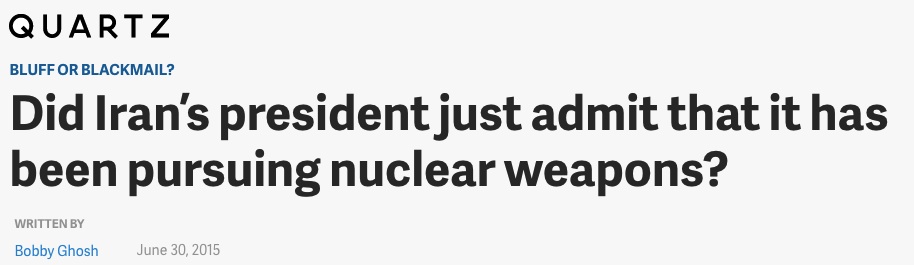
There’s a quick answer to this leading – and deceiving – question: No, no he did not.
There’s a longer answer, too, which we’ll get to in a minute.
Ghosh, in his desire to expose what he thinks is a “gotcha” moment from a recent Iranian media interview with Iranian President Hassan Rouhani, eagerly and disingenuously conflates uranium enrichment with nuclear weapons development. In doing so, he reveals himself to be more interested in delivering page views to his website and dishing out conventional wisdom than in reporting truthfully and critically about an important international issue.
Ghosh notes that, during a interview with Iranian media about the pending nuclear deal with six world powers, Rouhani said that “if the other side breaches the deal, we will go back to the old path, stronger than what they can imagine.” Ghosh omitted Rouhani’s initial comment, “If we reach a deal, both sides should be committed to it.”
What gets Ghosh’s goat is Rouhani’s reference to “the old path,” that is, the allusion to Iran’s previous state of nuclear development, as opposed to its current restricted program under the interim deal and what results from a potential negotiated multilateral agreement.
Conceding that Iranian officials have long “sworn, over and over again, that [Iran] has never pursued nuclear weapons,” Ghosh then gets to the crux of his claim:
If we’re to believe the regime’s claim, then Rouhani’s threat makes no sense. The “old path” would simply be more “peaceful” nuclear research, allowing the sanctions to continue devastating the Iranian economy. That’s not so much a threat as a flagellant’s cry for help: “If you go back on your word, I’ll hurt myself.”
To jump to such a conclusion requires a remarkably mistaken understanding of both the history of Iran’s nuclear program and either the ignorance or dismissal of the massive concessions it has already made during ongoing international talks. Ghosh apparently suffers from both.
In an emblematically Ghoshian column on why the Iranian government is eviler than the Cuban government, Ghosh wrote on December 18, 2014, that Iran “was caught trying to build nuclear-weapons technology as recently as 2002, when its secret facilities at Arak and Nataz [sic] were discovered. Thereafter, under pressure from the US and the international community, the Tehran regime backed down from its policy of developing dual-use nuclear technology (for energy and weapons) and promised not to build bombs.”
There’s a lot wrong here, but I’ll try to be quick (not my strong suit).
The facilities at Arak and Natanz were never “secret” nor do they “build nuclear-weapons technology.” In 2002, they were both under construction and non-operational. Iran was, at that point, not obligated to declare their existence to the IAEA. Arak was designed as a power plant, Natanz is an enrichment site. Upon declaration, both have been subject to IAEA safeguards for over a decade. Iran’s interest in developing an uranium enrichment industry has been open knowledge (and publicly acknowledged) since shortly after the Iranian Revolution in 1979.
The Iranian government never “backed down” from a “policy of developing dual-use technology” and “promised not to build bombs” as Ghosh claims. Such a claim is bizarre. Beyond the fact that, as an original signatory to the Nuclear Nonproliferation Treaty, Iran has in effect “promised not to build [nuclear] bombs” since 1968 and Iranian officials have – since at least the early 1990s – constantly and consistently condemned and prohibited any domestic development of nuclear weapons (not only after 2002), it is literally impossible for any nation with an ongoing enrichment program to stop the acquisition of “dual-use” nuclear infrastructure since every single enrichment program on Earth is inherently dual-use: enriched uranium can be used for both energy or weaponry.
With this false narrative, Ghosh has, however, set up a convenient straw man with which to bandy about his erroneous assumptions of Iran’s nuclear past. This brings us back to his recent article.
In trying to hash out what Rouhani’s “old path” statement means, Ghosh establishes two options – the bluff or the blackmail – one of which, he claims, must be true. The bluff is that, in Ghosh’s words, “There’s no “old path,” and Tehran is simply trying to frighten the P5+1 into relenting on the remaining sticking points at the negotiating table in Vienna.”
The blackmail, on the other hand, is a damning admission by the Iranian leader of a clandestine nuclear weapons program Iran has long denied having. “The alternative,” Ghosh writes, “is that Rouhani has unwittingly revealed that Iran was indeed pursuing nukes. That would be a real threat, especially if he is also sincere in pursuing this path ‘stronger than what they can imagine.'”
But there is a third option, unacknowledged by Ghosh, which is the most obvious and most accurate: Rouhani is not talking about a nuclear weapons program to return to, but rather the reestablishment of full-scale uranium enrichment, which has been curtailed by Iran’s obligations under the terms of its diplomatic agreements since January 2014.
Ghosh doesn’t tell his readers that, in the same interview he cites as “fascinating” and “belligerent,” Rouhani said of his international interlocutors, “If they claim that they want to prevent the development of nuclear weapons in Iran, they should know that Iran has never sought to build nuclear weapons.” Obviously, such a statement – in the very same interview – severely undermines the credibility of Ghosh’s blackmail or blunder claim that Rouhani has either purposely or accidentally revealed something alarming about its nuclear work.
Under the terms of the November 2013 Joint Plan of Action, agreed to by Iran and the six powers – Britain, China, France, Germany, Russia, and the United States – known as the P5+1, Iran has halted all enrichment above 5%, diluted or disposed of its entire stockpile of 19.75% low-enriched uranium (LEU), converted the vast majority of its remaining stockpile of LEU to a form incapable of being weaponized, suspended upgrades and construction on its safeguarded nuclear facilities at Natanz, Fordow, and Arak, and allowed unprecedented access to its program by IAEA inspectors.
At every single juncture, Iran has complied fully with the demands of the plan.
All Rouhani was saying, therefore, is that these commitments – which were negotiated and agreed to by Iran, not imposed forcibly by foreign countries – would no longer be binding and Iran would resume its previous course of action, or “the old path.” This previous course of action, still, was anything but a mysterious, opaque, nefarious development of dubious and deadly technology. Rather, even before current talks began, Iran’s was the most heavily-scrutinized nuclear program on the planet and had been for years.
Rouhani’s statement, therefore, was actually a fairly innocuous clarification of the fact that, if the P5+1 reneges on its own negotiated commitments, Iran will no longer abide by the deal either. That’s hardly cause for Ghosh to collapse on his fainting couch.
What Ghosh also doesn’t point out is that there is clear historical precedent for Rouhani’s statement.
A dozen years ago, Iran’s then-nascent uranium enrichment program was the subject of intensive diplomacy between Iran and the EU-3, shorthand for Britain, France and Germany. It was on Rouhani’s watch – he was secretary of Iran’s Supreme National Security Council and lead negotiator at the talks – that Iran voluntarily suspended uranium enrichment in 2003 and accepted intrusive inspections above and beyond what was legally required by its safeguards agreement as talks progressed. During this period, the IAEA affirmed the peaceful nature of the program.
In mid-2004, with Iran fully complying with its obligations under Saadabad Agreement of October 2013, the negotiations were strained by the prospect of a new European-drafted IAEA resolution against Iran. President Mohammad Khatami told the press, in terms strikingly similar to Rouhani’s recent statement, that Iran’s voluntary suspension of enrichment would thus be endangered if the resolution passed.
“If the draft resolution proposed by the European countries is approved by the IAEA, Iran will reject it,” Khatami said on June 18, 2004. “If Europe has no commitment toward Iran, then Iran will not have a commitment toward Europe.”
A month later, Khatami insisted that “nothing stands in the way” of Iran “building and assembling centrifuges designed for uranium enrichment,” reported the Associated Press.
Throughout the first half of 2005, Iranian officials were still intent on resolving the nuclear impasse through diplomacy with Europe, but explained that the resumption of “full-scale enrichment” was the ultimate goal of the talks, along with assurances that the program would remain forever peaceful.
Following the election of Mahmoud Ahmadinejad in June 2005, outgoing president Khatami made the Iranian position clear. “We will never overlook our legal and national right for possessing nuclear technology and fuel cycle to generate electricity. Iran will never change its national policy in this respect,” he said, adding, “We have made it clear that suspension of uranium enrichment will not be forever. We have displayed our good faith. Now, it is the turn of the European friends to do in line with the commitments they have made about the matter.”
Regardless of the offer soon to be put forward by the EU-3, Khatami reiterated that Iran would resume its conversion activities and eventually enrichment as well, in line with its inalienable rights to development domestic, civilian nuclear technology. “I hope that the Europeans’ proposals will, as agreed, allow for the resumption of [nuclear activities],” Khatami told reporters in late July 2005. “But if they do not agree, the system has already made its decision to resume [uranium conversion] at Isfahan.”
Uranium conversion restarted in early August 2005.
It was only after Iran’s European negotiating partners, at the behest of the Americans, reneged on their promise to offer substantive commitments and respect Iran’s inalienable right to a domestic nuclear infrastructure that talks dissolved and Iran resumed enrichment. The proposal eventually brought to Iran by Western negotiators on August 5, 2005 has been described as “vague on incentives and heavy on demands,” and even dismissed by one EU diplomat as “a lot of gift wrapping around an empty box.”
The resumption of full-scale enrichment by Iran had nothing to do with nuclear weapons, as the IAEA has affirmed consistently in quarterly reports over the past decade that no fissile material has ever been diverted to military purposes. Lingering questions about Iran’s past work have long been debunked as unfounded allegations for which no credible evidence actually exists.
Rouhani’s statement about “the old path” – that is, the legal and inalienable right of Iran to enrich uranium under international safeguards and supervision – therefore reveals nothing not previously known.
On the other hand, Ghosh’s reaction to Rouhani’s statement reveals the extent to which Ghosh himself will go to demonize and propagandize about Iran and its nuclear program. If he can’t get the small stuff like this right, why are we listening to him about anything at all?
*****
Disclosure: I am an (often erstwhile) editor for the online magazine Muftah, which has recently announced a new partnership with Quartz, where Mr. Ghosh is managing editor.
Featured Video

Iran Is Not Our Enemy
or go to
Aletho News Archives – Video-Images
Book Excerpt
“Vaccines Do Not Cause Autism!” The Science is Settled. Right?
ICAN urges the IACC to actually study infant vaccines and autism
 By Aaron Siri | Injecting Freedom | March 16, 2026
On behalf of ICAN, we just sent a copy of chapter 11 of Vaccines, Amen to the newly appointed members of the federal Interagency Autism Coordinating Committee (IACC).
If you haven’t already read this chapter, you can read the whole thing in the attached letter. I trust that after you read it, you’ll see why the statement “vaccines do not cause autism” is a belief, not science!

Blog Roll
 Aletho News
- Israeli Journalist Demands Tucker Carlson and Candace Owens Be Placed in WWII-Style Internment Camps
- No Liability, No Studies, No Accountability: The Vaccine System Aaron Siri Exposed in Federal Court
- No time for losers: Why the war meant to save Israel may destroy it
- Top US Counterterrorism Official Resigns in Protest of Operation Against Iran
- Just Get Out! Now!
- Unpacking glaring contradictions in US-Zionist justifications for war against Iran
- Iranian model of warfare bleeds US dry while Persian Gulf states watch and learn: Analyst
- IRGC orders ‘defeated’ US to evacuate industrial facilities in region
- Hegseth’s call for ‘no mercy’ to Iranians deemed war crime
- Iran War Exposes Limits of US Military Power – Journalist
- If Americans Knew
- Trump’s counterterrorism chief, whose own wife was killed by ISIS, quits over Iran War saying Tehran posed ‘no imminent threat’
- Here’s what US could fund instead of Bibi’s war on Iran
- Israel Killed Over a Dozen Lebanese Paramedics in Three Days, Now Claiming That Ambulances Are “Hezbollah” Targets
- War on Iran: These are the heritage sites devastated by US and Israeli attacks
- Four news stories from Israeli media that illustrate Israeli “justice”
- CIA Prepares Criminal Referral of Tucker Carlson, as Israel and Its Loyalists Demand His Arrest
- Top US counterterror advisor resigns in protest of “war manufactured by Israel” – Not a ceasefire Day 157
- ‘I Liked the House’: When Israeli Soldiers Turn Palestinian Homes into Barracks
- ‘They Were All I Had’: Lebanese Father Buries Parents, 4 Daughters Killed by Israeli Bombing
- Israel and its supporters are causing attacks on Jewish institutions. Case in point: Michigan synagogue tragedy.
- No Tricks Zone
- New Research: South Australia’s Mid-Holocene Sea Surface Temperatures Were 4°C Warmer Than Today
- Storing Green Energy To Last Germany 10 Days Would Require A 60-Million Tonne Battery
- New Studies: UK Sea Levels Were 4 Meters Higher Than Today During The Mid-Holocene
- Destructive Green New Deal: German Energy And Metal Group Warns Of Drastic Crisis
- New Study Documents A 20-Year Pause In Arctic Sea Ice Decline – Driven By Internal Variability
- Wake-up Call: Survey Shows Majority Of Germans Now Favor Postponing Climate Targets!
- Televised! Leading German Political Candidate Tells Schoolchildren CO2 Makes Sun Hotter!
- New Study: A Century Warming Of 1.1°C Is ‘Commonplace’ And ‘Not Unusual’ During This Interglacial
- New Study: ‘Internal Noise’ And Volcanic Forcing Can Trigger 10-15°C Warming Within Decades
- Glaciers Worldwide Are Suddendly Surging, Experts Blame Warming!
 Aletho News