Missing From Reports of Yemeni Carnage: Washington’s Responsibility
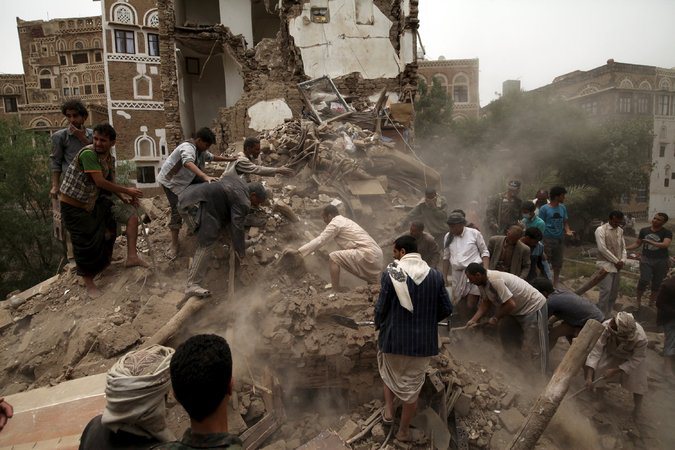
This photo of the aftermath of an airstrike in Sana, Yemen, accompanied a New York Times story (6/24/15) that provided a detailed account of the human toll of the air war—but made no mention of the US’s responsibility. (photo: Mohamed Al-Sayaghi/Reuters)
By Jim Naureckas | FAIR | August 31, 2015
The New York Times (8/30/15) reported on the deaths of civilians in a military assault in Yemen. Wrote reporter Saeed Al-Batati:
Airstrikes by a Saudi-led military coalition killed at least 13 civilians working early Sunday at a water plant in northern Yemen, the plant’s owner said.
The bombings appeared to be the latest in a series of airstrikes by Saudi Arabia or its Arab coalition partners that have hit civilian facilities with no apparent military target nearby.
The Washington Post (8/30/15) briefly covered the story too, using a Reuters wire report that gave a higher death toll:
An airstrike by warplanes from a Saudi-led coalition, which said it targeted a bomb-making factory, killed 36 civilians working Sunday at a bottling plant in the northern Yemeni province of Hajjah, residents said.
Noting that another airstrike had killed four people in Sanaa, Yemen’s capital, the piece continued:
The attacks were the latest in an air campaign launched in March by a Saudi-led alliance in support of Yemen’s exiled government, which is fighting Houthi forces allied with Iran.
Both of these reports left out the information that made this news particularly relevant to the papers’ mostly American readership: The US government is actively backing the air war in Yemen that killed those civilians, as the Times and Post have both reported. The Times (3/26/15) wrote at the start of the Saudi assault:
A spokeswoman for the National Security Council said Wednesday night that the United States was providing intelligence and logistical support for the campaign in Yemen, and that President Obama had authorized a ”joint planning cell” with Saudi Arabia to coordinate American support for the military offensive.

The Washington Post provided a photo of the kind of jets the US had sold to Saudi Arabia—but when such jets were used to kill civilians, they were out of the picture. (photo: Fayez Nureldine/AFP)
And the Post, in a piece headlined “How US Weapons Will Play a Huge Role in Saudi Arabia’s War in Yemen” (3/26/15), noted that the weaponry involved largely comes from the US:
US officials said they will offer intelligence and logistical support to the Saudis, but that’s really only a piece of it: The Saudi military is equipped with billions of dollars in advanced American-made weapons.
But that “huge role” often disappears when the the leading papers are discussing the carnage that results from the air attacks that the US is supporting and supplying. Thus when the Times‘ Rick Gladstone (8/22/15) reported that “Saudi-led airstrikes on a residential district in Yemen’s southwestern city of Taiz had killed more than 65 civilians, including 17 people from one family,” according to Doctors Without Borders, and that the death toll in the war included “hundreds of civilians killed in airstrikes,” Washington’s role in facilitating those deaths went unmentioned.
82 Groups in US Demand Investigation of ‘Muslim-Free Zones’
teleSUR | September 2, 2015
In an open letter to the DOJ, 82 groups led by the Council on American-Islamic Relations (CAIR), expressed concern over a growing trend of businesses refusing to serve customers perceived as Muslim.
 “American businesses posting ‘Muslim-Free Zone’ declarations are no different than the ‘Whites Only,’ ‘No Dogs, No Jews,’ ‘No Mexican’ and ‘Irish Need Not Apply’ signs that were posted during past shameful periods of our nation’s history that we hoped were over,” the letter stated.
The letter lamented the DOJ has “remained silent” on the issue, and called on the department to determine whether “Muslim-free zones” violate Title II of the 1964 Civil Rights Act.
“Title II specifically prohibits discrimination by places of entertainment like, in many instances, firing ranges,” the letter read.
Signatories to the letter include the American Civil Liberties Union, National Association for the Advancement of Colored People and others.
“The broad range of groups calling for government action on the ‘Muslim-free zone’ issue clearly indicates that the U.S. Department of Justice should speak out and take concrete action to protect the constitutional rights of American Muslims,” said CAIR National Executive Director Nihad Awad.
At least one business that has declared itself a “Muslim-free zone” is currently being sued by CAIR.
The lawsuit accuses Florida Gun Supply of Inverness and its owner Andrew Hallinan, 28, of violating the federal public accommodations law and seeks an injunction to stop the discrimination, according to the complaint.
Amendments to CISA “Cybersecurity” Bill Fail in All Regards
By Mark Jaycox | EFF | September 1, 2015
Although grassroots activism has dealt it a blow, the Senate Intelligence Committee’s Cybersecurity Information Sharing Act (CISA) keeps shambling along like the zombie it is. In July, Senator McConnell vowed to hold a final vote on the bill before Congress left for its six-week long summer vacation. In response, EFF and over 20 other privacy groups ran a successful Week of Action, including over 6 million faxes opposing CISA, causing the Senate to postpone the vote until late September.
Senators submitted many amendments to the bill before going on vacation. The amendments, like the original language of the bill, fail to address key issues like the deep link between these government “cybersecurity” authorities and surveillance, as well as the new spying powers the bill would grant to companies.
But “cybersecurity” is already intimately tied to surveillance—a problem CISA would only worsen. Documents released by the New York Times reveal the government used the Comprehensive National Cyber Security Initiative (CNCI) to pay telecommunications companies to spy on consumers using their networks. The CNCI includes initiatives for information gathering, but it’s always been presented to the public as fostering research and encouraging public awareness of cybersecurity problems—not spying on Americans’ Internet traffic.
The revelations are stunning. The NSA paid telecommunications companies nearly $300 million dollars in the 2010 fiscal year to invest in surveillance equipment as part of the CNCI. In fact, STORMBREW’s Breckenridge site was “100% subsidized with CNCI funding.”
In contrast, the DHS only requested $37.2 million during the same time period to support research and development in cybersecurity science and technology. Even if DHS received what it requested, does the American public really want surveillance to outweigh research and education 10 to 1?
The news is compounded by other recently-released Snowden documents that show how the NSA uses foreign intelligence laws to run an intrusion defense system (IDS) on US soil. The documents show that a Justice Department memo gave the agency permission to monitor Internet cables, “without a warrant and on American soil, for data linked to computer intrusions originating abroad — including traffic that flows to suspicious Internet addresses or contains malware.”
CISA—and its amendments—do not even begin to address these serious problems. Instead, they mandate information sharing with the intelligence community, creating even more cyberspying.
EFF will continue to oppose CISA—even if some of these amendments pass—because CISA’s vague definitions, broad legal immunity, and new spying powers allow for a tremendous amount of unnecessary damage to users’ privacy, and it’s highly unlikely that the public will learn about it. Even an amendment (#2612) offered by by Senator Al Franken, which narrows some of the definitions in CISA, does little to clarify its most troubling provisions.
What’s worse is that information-sharing bills like CISA are being painted as silver bullets to data breaches. They aren’t. The bills don’t address problems like unencrypted files, poor computer architecture, un-updated servers, and employees (or contractors) clicking malware links.
Awful Amendments
Plenty of the amendments would make the bill even worse. We’ve already discussed the horrible CFAA amendment, #2626, proposed by Senator Sheldon Whitehouse. The amendment not only increases the scope of the already expansive Computer Fraud and Abuse Act (CFAA) but also authorizes injunctions against botnets (amending 18 U.S.C. § 1345) in a way that creates serious constitutional issues. After all, much of what DOJ and FBI want to do in shutting down botnets is, arguably, a search or a seizure under the Fourth Amendment; moreover, such injunctions may prevent users from communicating, thus raising First Amendment issues. The amendment is a great example of how not to amend the draconian CFAA. If the Senate wants to improve the CFAA, it should take a page out of our book.
Senator Carper has proposed another dubious change to CISA, amendment #2627. The bill attempts to codify the Department of Homeland Security’s EINSTEIN program without any public debate. EINSTEIN is an intrusion detection system—the parent of which was created by the NSA—to scan incoming Internet traffic to the federal government like emails and other connections. DHS has not told the public what agencies are using EINSTEIN. It’s possible that when you email your representative, DHS may also receive a copy. Before codifying EINSTEIN, DHS must be more transparent about the program. The most recent update from DHS about the program is from 2013, and many concerns have been raised about EINSTEIN’s legality and privacy implications. Unlike CISA, Senator Carper’s amendment mandates federal agencies create a plan to identify sensitive information and encrypt it; however, the clause exempts the Department of Defense and the intelligence community. Nor does the amendment authorize additional funding for federal agencies to improve security.
Senator Carper’s attempt to make a horrible bill marginally better is admirable, but he—along with other Senators—should oppose the bill. Even the best amendments fail to fix CISA’s serious flaws.
Not Awful Amendments
Some of the amendments try to narrow the scope of the bill. Senator Chris Coons’ amendment #2552 would limit information sharing to that necessary to describe or identify a cybersecurity threat, while Senator Wyden’s amendment (#2621) would require companies and the government to remove personal information unrelated to the threat.
But these well-meaning changes don’t address the root problems in the bill: the outrageously broad and vague definition of “cybersecurity threat” and the granting of new authorities to spy on users. Senator Franken’s amendment #2612 attempts to address that definition, but even his amendment isn’t enough. Again, no amendment scales back the two new authorities to spy on users and launch countermeasures in the bill.
Other amendments are better, including Senator Patrick Leahy’s #2587, which would remove the current CISA provision exempting all “cyber threat indicators and defensive measures” received by the government from disclosure under the Freedom of Information Act and may help ensure the public can obtain information about how, if CISA is enacted into law, the information “sharing” system actually operates; Senator Jeff Flake’s 6-year sunset (#2582); and, Senator Mike Lee’s email privacy amendment (#2556), which would codify US v. Warshak by amending the Electronic Communications Privacy Act to require warrants for email and other stored content.
While some advocates will paint these amendments as “steps forward,” the amendments merely shuffle deck chairs on the Titanic—even with the better amendments, the bill is still a bad idea. The Senators are going about the wrong strategy. Democrats and libertarian Republicans should be opposing CISA outright. That’s why we’re asking users to continue emailing their Senators to stop this bill. While CISA is the very definition of a zombie bill, the public outcry against it has made a difference. But we can’t stop now. Join us by tweeting, faxing, or emailing your Senator.
U.S. Turns Teen into “Terrorist”
By Margaret Kimberley | Black Agenda Report | September 2, 2015
Ali Shukri Amin is 17-years old, a minor under American law, yet he was just sentenced to eleven years in federal prison. He pleaded guilty and was sentenced as an adult for providing material support for terrorists. This is a crime defined in any way the government wants it to be. Amin had a twitter account, @amreekiwitness, devoted to the group Islamic State, ISIS. He also helped a friend travel to Syria in hopes of joining ISIS. That is the substance of his crime, online opinion and facilitating travel.
The crime of providing material support for terrorists only came into existence with the Patriot Act passed in the aftermath of the September 11th attacks. There are now people serving very long prison terms for providing humanitarian aid, translating documents, sending money abroad, or expressing views in support of nations or groups the United States classifies as terrorist. These crimes are vaguely defined and are often of little consequence to ISIS or any other organization the federal government designates as an enemy.
The prosecutions of Amin and others are meant to make the case for continuing the “war on terror.” This is actually a war of American terror used to justify endless interventions around the world. The Department of Justice would have us believe that a teenager tweeting about making donations to ISIS via bitcoin posed a serious threat. Of course, the United States government is the biggest threat to life in the world. It is the most violent organization with the largest number of kills.
The application of the material support for terror statute is used to capture innocent or harmless people. Some are hoodwinked by agent provocateurs or, like Amin, pose little or no danger. Most importantly, ISIS would not be a credible force in Syria or Libya were it not for American machinations. The United States created the monster and now wants to punish anyone who interacts with it.
At one point Amin, who lived in a Virginia suburb of Washington, DC, had over 4,000 twitter followers who conversed about a variety of issues, including protests in Ferguson, Missouri.
“They cower in fear of us whilst they massacre and oppress you! It’s time to strike fear into the hearts of the oppressors. #FergusonUnderIS”
“May be time to organize Muslims in America upon haqq and mobilize to #Ferguson. Defend the oppressed, start jihad here.”
While Amin and thousands of others expressed their outrage about deadly police brutality, the State Department actually engaged in online debates with the teenager. A bizarre social media program called Think Again, Turn Away is a useless attempt to influence young Muslims who want to fight imperialism through jihad. Aside from having a name reminiscent of a love song title, the effort allowed Amin to engage in argument with and troll the State Department. When the would-be jihad deprogrammers pointed out that ISIS “slaughters innocent people,” Amin had a ready and accurate retort:
“slaughter innocents? You mean like AbdurRahman al-Awlaki, the 16 year old boy not involved with any militants? or what about the thousands killed in drone strikes weekly that make the news? The thousands that don’t? you are nothing more than criminals who betray the Muslims you claim to defend across the globe, butchering them 1.7 million in Iraq, hundreds of thousands in Afghanistan, left, right, everywhere. only an ignoramus who knows nothing about American foreign policy or any Muslim country could accept your lies.”
A few months after these embarrassing interactions, Amin’s mother and his imam unwisely reported him to the FBI in an effort to stop his online involvement with ISIS. He would not have been discovered otherwise.
Killer cops roam the streets with no fear of federal prosecution, but a confused teenager is sent to prison because he holds and expresses opinions contrary to those of the government. Prosecutors use children to make names for themselves and climb the ladder in a corrupt system. American terror is not just carried out abroad with drone strikes and invasions, but it is carried out on a daily basis by the criminal injustice system.
While the Saudis, Israelis and their allies use American money and arms to target civilians for death, anyone who crosses over the thin line of expression is at risk of prosecution and many years in prison. The hypocrisy is stunning but not really surprising. This system will use a child to make its point clear. We live in a police state and anyone who dares to speak up against it is at risk of being made an example.
The federal government does not operate any juvenile facilities. Ali Shukri Amin is now in custody in an adult facility. One need not be a follower of ISIS to see that this is a gross injustice unworthy of a country which claims to be a democracy.
Margaret Kimberley can be reached via e-Mail at Margaret.Kimberley(at)BlackAgendaReport.com.
Growing Doubt: a Scientist’s Experience of GMOs
By Jonathan R. Latham, PhD | Independent Science News | August 31, 2015
By training, I am a plant biologist. In the early 1990s I was busy making genetically modified plants (often called GMOs for Genetically Modified Organisms) as part of the research that led to my PhD. Into these plants we were putting DNA from various foreign organisms, such as viruses and bacteria.
I was not, at the outset, concerned about the possible effects of GM plants on human health or the environment. One reason for this lack of concern was that I was still a very young scientist, feeling my way in the complex world of biology and of scientific research. Another reason was that we hardly imagined that GMOs like ours would be grown or eaten. So far as I was concerned, all GMOs were for research purposes only.
Gradually, however, it became clear that certain companies thought differently. Some of my older colleagues shared their skepticism with me that commercial interests were running far ahead of scientific knowledge. I listened carefully and I didn’t disagree. Today, over twenty years later, GMO crops, especially soybeans, corn, papaya, canola and cotton, are commercially grown in numerous parts of the world.
Depending on which country you live in, GMOs may be unlabeled and therefore unknowingly abundant in your diet. Processed foods (e.g. chips, breakfast cereals, sodas) are likely to contain ingredients from GMO crops, because they are often made from corn or soy. Most agricultural crops, however, are still non-GMO, including rice, wheat, barley, oats, tomatoes, grapes and beans.
For meat eaters the nature of GMO consumption is different. There are no GMO animals used in farming (although GM salmon has been pending FDA approval since 1993); however, animal feed, especially in factory farms or for fish farming, is likely to be GMO corn and GMO soybeans. In which case the labeling issue, and potential for impacts on your health, are complicated.
I now believe, as a much more experienced scientist, that GMO crops still run far ahead of our understanding of their risks. In broad outline, the reasons for this belief are quite simple. I have become much more appreciative of the complexity of biological organisms and their capacity for benefits and harms. As a scientist I have become much more humble about the capacity of science to do more than scratch the surface in its understanding of the deep complexity and diversity of the natural world. To paraphrase a cliché, I more and more appreciate that as scientists we understand less and less.
The Flawed Processes of GMO Risk Assessment
Some of my concerns with GMOs are “just” practical ones. I have read numerous GMO risk assessment applications. These are the documents that governments rely on to ‘prove’ their safety. Though these documents are quite long and quite complex, their length is misleading in that they primarily ask (and answer) trivial questions. Furthermore, the experiments described within them are often very inadequate and sloppily executed. Scientific controls are often missing, procedures and reagents are badly described, and the results are often ambiguous or uninterpretable. I do not believe that this ambiguity and apparent incompetence is accidental. It is common, for example, for multinational corporations, whose labs have the latest equipment, to use outdated methodologies. When the results show what the applicants want, nothing is said. But when the results are inconvenient, and raise red flags, they blame the limitations of the antiquated method. This bulletproof logic, in which applicants claim safety no matter what the data shows, or how badly the experiment was performed, is routine in formal GMO risk assessment.
To any honest observer, reading these applications is bound to raise profound and disturbing questions: about the trustworthiness of the applicants and equally of the regulators. They are impossible to reconcile with a functional regulatory system capable of protecting the public.
The Dangers of GMOs
Aside from grave doubts about the quality and integrity of risk assessments, I also have specific science-based concerns over GMOs. I emphasise the ones below because they are important but are not on the lists that GMO critics often make.
Many GMO plants are engineered to contain their own insecticides. These GMOs, which include maize, cotton and soybeans, are called Bt plants. Bt plants get their name because they incorporate a transgene that makes a protein-based toxin (usually called the Cry toxin) from the bacterium Bacillus thuringiensis. Many Bt crops are “stacked,” meaning they contain a multiplicity of these Cry toxins. Their makers believe each of these Bt toxins is insect-specific and safe. However, there are multiple reasons to doubt both safety and specificity. One concern is that Bacillus thuringiensis is all but indistinguishable from the well known anthrax bacterium (Bacillus anthracis). Another reason is that Bt insecticides share structural similarities with ricin. Ricin is a famously dangerous plant toxin, a tiny amount of which was used to assassinate the Bulgarian writer and defector Georgi Markov in 1978. A third reason for concern is that the mode of action of Bt proteins is not understood (Vachon et al 2012); yet, it is axiomatic in science that effective risk assessment requires a clear understanding of the mechanism of action of any GMO transgene. This is so that appropriate experiments can be devised to affirm or refute safety. These red flags are doubly troubling because some Cry proteins are known to be toxic towards isolated human cells (Mizuki et al., 1999). Yet we put them in our food crops.
A second concern follows from GMOs being often resistant to herbicides. This resistance is an invitation to farmers to spray large quantities of herbicides, and many do. As research recently showed, commercial soybeans routinely contain quantities of the herbicide Roundup (glyphosate) that its maker, Monsanto, once described as “extreme” (Bøhn et al 2014).
Glyphosate has been in the news recently because the World Health Organisation no longer considers it a relatively harmless chemical, but there are other herbicides applied to GMOs which are easily of equal concern. The herbicide Glufosinate (phosphinothricin, made by Bayer) kills plants because it inhibits the important plant enzyme glutamine synthetase. This enzyme is ubiquitous, however, it is found also in fungi, bacteria and animals. Consequently, Glufosinate is toxic to most organisms. Glufosinate is also a neurotoxin of mammals that doesn’t easily break down in the environment (Lantz et al. 2014). Glufosinate is thus a “herbicide” in name only.
Thus, even in conventional agriculture, the use of glufosinate is hazardous; but With GMO plants the situation is worse yet. With GMOs, glufosinate is sprayed on to the crop but its degradation in the plant is blocked by the transgene, which chemically modifies it slightly. This is why the GMO plant is resistant to it; but the other consequence is that when you eat Bayers’ Glufosinate-resistant GMO maize or canola, even weeks or months later, glufosinate, though slightly modified, is probably still there (Droge et al., 1992). Nevertheless, though the health hazard of glufosinate is much greater with GMOs, the implications of this science have been ignored in GMO risk assessments of Glufosinate-tolerant GMO crops.
A yet further reason to be concerned about GMOs is that most of them contain a viral sequence called the cauliflower mosaic virus (CaMV) promoter (or they contain the similar figwort mosaic virus (FMV) promoter). Two years ago, the GMO safety agency of the European Union (EFSA) discovered that both the CaMV promoter and the FMV promoter had wrongly been assumed by them (for almost 20 years) not to encode any proteins. In fact, the two promoters encode a large part of a small multifunctional viral protein that misdirects all normal gene expression and that also turns off a key plant defence against pathogens. EFSA tried to bury their discovery. Unfortunately for them, we spotted their findings in an obscure scientific journal. This revelation forced EFSA and other regulators to explain why they had overlooked the probability that consumers were eating an untested viral protein.
This list of significant scientific concerns about GMOs is by no means exhaustive. For example, there are novel GMOs coming on the market, such as those using double stranded RNAs (dsRNAs), that have the potential for even greater risks (Latham and Wilson 2015).
The True Purpose of GMOs
Science is not the only grounds on which GMOs should be judged. The commercial purpose of GMOs is not to feed the world or improve farming. Rather, they exist to gain intellectual property (i.e. patent rights) over seeds and plant breeding and to drive agriculture in directions that benefit agribusiness. This drive is occurring at the expense of farmers, consumers and the natural world. US Farmers, for example, have seen seed costs nearly quadruple and seed choices greatly narrow since the introduction of GMOs. The fight over GMOs is not of narrow importance. It affects us all.
Nevertheless, specific scientific concerns are crucial to the debate. I left science in large part because it seemed impossible to do research while also providing the unvarnished public scepticism that I believed the public, as ultimate funder and risk-taker of that science, was entitled to.
Criticism of science and technology remains very difficult. Even though many academics benefit from tenure and a large salary, the sceptical process in much of science is largely lacking. This is why risk assessment of GMOs has been short-circuited and public concerns about them are growing. Until the damaged scientific ethos is rectified, both scientists and the public are correct to doubt that GMOs should ever have been let out of any lab.
References
Bøhn, T, Cuhra, M, Traavik, T, Sanden, M, Fagan, J and Primicerio, R (2014) Compositional differences in soybeans on the market: Glyphosate accumulates in Roundup Ready GM soybeans. Food Chemistry 153: 207-215.
Droge W, Broer I, and Puhler A. (1992) Transgenic plants containing the phosphinothricin-N-acetyltransferase gene metabolize the herbicide L-phosphinothricin (glufosinate) differently from untransformed plants. Planta 187: 142-151.
Lantz S et al., (2014) Glufosinate binds N-methyl-D-aspartate receptors and increases neuronal network activity in vitro. Neurotoxicology 45: 38-47.
Latham JR and Wilson AK (2015) Off - target Effects of Plant Transgenic RNAi: Three Mechanisms Lead to Distinct Toxicological and Environmental Hazards.
Mizuki, E, Et Al., (1999) Unique activity associated with non-insecticidal Bacillus thuringiensis parasporal inclusions: in vitro cell- killing action on human cancer cells. J. Appl. Microbiol. 86: 477–486.
Vachon V, Laprade R, Schwartz JL (2012) Current models of the mode of action of Bacillus thuringiensis insecticidal crystal proteins: a critical review. Journal of Invertebrate Pathology 111: 1–12.
Minority police officers sue NYPD over illegal arrest quotas
RT | September 2, 2015
A dozen black and Latino police officers are suing the New York Police Department and the city claiming that their bosses forced them to carry out illegal arrest quotas “against their own minority community.” The NYPD has denied ever using quotas.
The class action lawsuit, filed in the Manhattan federal court on Monday, argued that by forcing police officers to comply with the “illegal quota system,” New York City and the NYPD subjected black and Latino cops to unfair evaluations and discipline, according to the New York Post.
The suit also said performance evaluation was not evenly applied to all precincts. Police officers in precincts with lots of minorities had to make more arrests and issue more tickets than officers in “a precinct located in a predominantly white residential area,” the suit states.
The lawsuit cites testimony and news articles dating to 2010 that provide evidence of a quota system under former Police Commissioner Ray Kelly. The suit said quotas have remained under Commissioner Bill Bratton.
“The reality is that one year later, quotas remain alive and well and the NYPD is aggressively pursuing a numbers driven agenda with regard to arrests, tickets and summonses,” the suit reads.
The 12 named plaintiffs in the suit are all black and Latino NYPD officers who claim to have been penalized for reporting and complaining about “the illegal quotas and its racially discriminatory application against the minority community,” the suit states.
The suit alleges that police officers were being forced to make at least one arrest and issue 20 summonses a month.
The top NYPD spokesman told the Post that the department doesn’t use quotas.
“There are no numerical enforcement quotas established by the NYPD,” spokesman Stephen Davis said in a statement, according to the New York Post. “Performance evaluations are conducted for all department employees based on an assessment of their duties, responsibilities and specific conditions of their assignments.”
An NYC Law Department spokesman said the city would evaluate the merits of each of these claims and respond accordingly once they are served.
One of the lead plaintiff’s in the suit is Adhyl Polanco, a Latino police officer who first complained to the media in 2009 about how arrest and summons quotas affected communities of color. He testified in the high-profile federal stop-and-frisk case.
Polanco also filed a separate lawsuit in Brooklyn federal court on Monday against the NYPD and the city, according to the New York Daily News, claiming his whistleblowing about quotas and discrimination has resulted in a sustained campaign of retaliation by fellow police officers and management, including repeated suspensions, promotion denials and suggestions that he was mentally ill.
Here’s How Law Enforcement Agencies Impersonate Your Friends
By Sonia Roubini | ACLU | August 31, 2015
We recently received a handbook from the DEA, in response to a Freedom of Information Act request, seeking information about the use of impersonation as an investigative technique. While the 1999 handbook, titled Online Investigative Principles for Federal Law Enforcement Agents, was almost identical to a version of the handbook that is available online, there is one notable difference: the version that the DEA sent us includes a copy of the DEA’s Consent to Assume Online Identity: Adult Consent form.
The DEA apparently used this fifteen-year-old form to obtain consent from individuals to impersonate their online identities. It states:
“I ____ hereby voluntarily provide consent to the Drug Enforcement Administration or other Federal, State or Local Task Force officers to assume my Internet online identity. My Internet screen name(s), nick name(s), and/or e-mail addresses are as follows.”
It goes on to state:
I understand that these law enforcement officers will changes [sic] the password(s) to this account so that I will no longer have access to these accounts. My Internet online identity may be used by these law enforcement officers for any official purpose relating to an official investigation, including sending and receiving e-mail, making direct communications on systems such as ICQ or AOL instant messaging, and any other electronic communications. I have been advised of my right to refuse to allow the assumption of my identity. I give this consent freely and voluntarily.
We filed this FOIA request because the impersonation of actual individuals and organizations by law enforcement agencies has the unique ability to erode our trust in each other’s identities. If government agencies impersonate Senate staffers, Internet repair technicians, newspapers, and individual citizens at will — as they appear to have done in the past — or others in our lives, it will erode a form of trust that is critical for relationships in a free society: our ability to trust stated identities.
Unfortunately, the documents released to us so far raise more questions than they answer. This consent form in particular raises some thorny ones, including:
- Under what circumstances can law enforcement agencies ask for consent to impersonate actual individuals?
- If the individual does not consent, can law enforcement get a warrant to impersonate someone?
- Once a law enforcement agency is impersonating someone, what is it allowed to do? Can it communicate with the individuals’ Facebook friends? Can it respond to emails from their family members?
- What factors do law-enforcement agencies consider in deciding whether the extraordinary risks of impersonation are worth the possible reward?
Without this information, it is difficult to assess the lawfulness or wisdom of the DEA’s impersonation of actual individuals — a practice which raises serious constitutional questions. The Fourth Amendment prohibits “unreasonable searches and seizures,” and while courts have generally approved of the government’s use of deception (for example, undercover officers), few have ruled upon the constitutionality of the impersonation of actual individuals.
A recent decision in a Las Vegas District Court involved evidence collected by members of the FBI who impersonated Internet repair technicians to gain physical access to suspects’ hotel rooms. During their investigation of an online gambling ring, FBI agents disconnected the Internet in three rooms of a Las Vegas hotel and impersonated technicians to enter the rooms without suspicion and to collect evidence later used against the suspects in court. The judge eventually tossed the evidence out on the grounds that it was “fruit of a poisonous tree” — legal jargon indicating that the evidence was obtained using an unlawful search.
In another case, the DEA created a fake Facebook profile for a real individual, Sondra Prince, who was arrested on drug charges in 2010, in order to investigate an alleged New York drug ring. The DEA agent who arrested Prince seized her cell phone and mined it for photographs. These were then used to create the fraudulent Facebook profile which was used by the agents as a critical part of their investigation into the drug ring. These photographs notably included ones of Prince in a bathing suit, and photos of her two young children. Prince ultimately sued the DEA over its impersonation of her profile. The Justice Department eventually paid $134,000 to settle the case, which drew the public’s attention to potential privacy violations at play in government agencies’ impersonation of individuals (not to mention the potential dangers involved).
The consent form also raises tricky questions about the scope of consent. Does the form allow the agents, for example, to answer incoming messages from the mother of the consenter? What about a romantic partner or close friends? The form does nothing to clarify these questions. Nor does it address the fact that asking people to turn over their passwords so that law enforcement can then log in to their accounts violates the terms of service of Facebook and a number of other major service providers, which all prohibit password sharing. The government itself has argued in other cases that such password sharing may be a crime under the Computer Fraud and Abuse Act.
Finally, the date of the form — 1999 — raises an obvious but unanswered question: what is the DEA’s current practice? Technology and social media have transformed our society in the last sixteen years. Have the DEA’s practices changed since then? Do they impersonate individuals routinely now? What are the rules that now govern that impersonation? We just don’t know, and that’s a problem.
New Hillary Clinton Emails Show Violation of Freedom of Information Law
By Sheryl Attkisson | September 1, 2015
The newly-released batch of Hillary Clinton emails provides further proof that Freedom of Information (FOI) law has been blatantly violated. The documents include material directly responsive to a FOI request I made back in 2012 after the Benghazi terrorist attacks on the U.S. compounds. However, the material was not produced at the time, as required by law. Once again, there appears to be nobody who holds government officials and agencies accountable for their routine violation of this law. So the infractions occur frequently and with impunity. If nobody polices our government officials and agencies–if they are above the law–then how does a lawful society function?
Click here to view the WSJ database of emails. One of the many emails that should have been provided under FOI in 2012, but was not, is to Clinton from Huma Abedin on Sept. 14, 2012. Others include Clinton communications on Benghazi with her chief aide Cheryl Mills.
Police video flap flares in Oakland
By Chris Reed | Cal Watchdog | August 31, 2015
Several local police forces in California got on the police body-cameras bandwagon well before police killings around the nation in the summer of 2014 triggered a broad push for their adoption. The Rialto Police Department was the focus of a 2013 New York Times story that emphasized how much body cameras improved interactions between officers and the public.
But in Oakland, it appears authorities will only release the body-camera videos when they exonerate police, and that the video will be kept from the public and the media in other circumstances on the grounds that it is part of an ongoing investigation. The East Bay Express recently reported on how the Oakland police are dealing with four police killings. In two cases, Police Chief Sean Whent won’t release any body-cam footage. In the other two cases, police wouldn’t release the footage to the public. Instead, on Aug. 19, the Oakland Police Department held a screening for 11 members of the media.
This account is from the East Bay Express :
[The] videos included police body camera footage taken by officers who were chasing Richard Linyard and Nathaniel Wilks (in two separate incidents). On July 19, Linyard was allegedly fleeing the police on foot when he was later found wedged between two buildings. A coroner’s report said Linyard died from injuries he suffered when he was apparently stuck between the buildings.
On August 12, Wilks allegedly fled the police in a vehicle and then on foot. Several officers confronted and shot Wilks near the intersection of 27th Street and Martin Luther King, Jr. Way.
Watson said OPD showed videos to select members of the media in order to dispel inaccurate reports that officers beat Linyard, and claims that Wilks was shot in the back. Both incidents sparked protests. “We held the viewing in the interest of the public, to be able to share information through fair and balanced reporting,” said Watson.
Watson, however, said that the video footage will not be released to the broader public, and that OPD believes the California Public Records Act allows the department to withhold the footage because it is evidence in several ongoing investigations.
‘Completely wrong’ to withhold some video
As the Bay Area News Group reported, giving the police the right to pick and choose which videos to release outraged local civil-rights lawyer Jim Chanin. “I think it’s completely wrong to have selective showings of one shooting and not another shooting, depending on how the department feels . … There’s an inference now that if (police) don’t show you a video, there could be something wrong or improper about (another) shooting,” he said.
Meanwhile, in Sacramento, a bill that would establish statewide procedures on access to and use of policy body-camera footage appears to have failed, U-T San Diego columnist Steve Greenhut wrote on Friday.
In April, a comprehensive bill by Assemblywoman Shirley Weber, D-San Diego, passed its initial committee vote. Per its official description, “Assembly Bill 66 would provide guidelines about when the cameras are to be operated, require notification of those being recorded, and prohibit law-enforcement officers involved in serious use-of-force incidents that result in serious bodily injury or death from viewing the video until they have filed an initial report.” Whent, the Oakland police chief, testified in favor of the bill.
But Weber’s bill was effectively killed within weeks. As Dan Walters wrote in the Sacramento Bee :
Weber’s body camera bill was beaten up in the Assembly Privacy and Consumer Protection Committee. Police unions, whose endorsements politicians crave, strongly opposed it as unfair, and the committee insisted that only local authorities decide when cops can see body videos.
Featured Video
Prof. Ted Postol: Iran Already Achieved Nuclear Deterrence Against Israel
or go to
Aletho News Archives – Video-Images
From the Archives
How the occupied mentality syndrome works
Saudi Arabia on the American chessboard – Part 3
By B. J. Sabri | American Herald Tribune | June 27, 2016
Read part 2: “The occupied mentality Syndrome“
Previously I argued whether Saudi Arabia’s repeated involvements in U.S. interventions and wars stem from free national will or in response to a specific condition. For starters, in Saudi Arabia there is no national will. In Saudi Arabia, the national will is the will of the Al Saud clan. Still, when a major Arab state allies itself with a superpower that committed unspeakable crimes against humanity in almost every Arab country, then something is wrong. This fact alone should compel us to examine the U.S.-Saudi relation for one exceptional reason. As a result of the U.S.-Saudi wars, hundreds of thousands of people in Afghanistan, Iraq, Iran, Libya, Syria, Yemen, and Somalia have lost their lives. Millions became displaced in their own homelands. And millions more rendered refugees.
Attributing the Saudi policies to the bonds of “partnership” with the U.S. is frivolous. There are no bonds between these two thugs except those of business, military deals, secret plots, and wars. Proving this point, bonds such as these have no space for the American and Saudi peoples to share significant cultural or societal exchanges. If partnership is not the reason for the Saudi contribution to the U.S. strategy of empire and imperialism, then another reason must exist.
This leads to three possibilities. … continue
Blog Roll
 Aletho News
- “Davos Can Really Replace the UN”
- NIAID/NIH and USDA Fund Bioengineered Chimeric Influenza Viruses Built Using Pandemic H1N1 Components: Journal ‘Science Advances’
- Hezbollah hits Israeli warship off Lebanon’s coast, sets it aflame
- Iran slams US strikes on B1 bridge, Mahshahr petrochemical plants as ‘blatant acts of state terrorism’
- In letter to UN chief, Araghchi warns of dire consequences of US-Israeli attacks on Iran’s nuclear facilities
- Why the CIA conspiracy to invade Iran with Kurdish militias failed
- Why Are Upbeat US Claims About Mission to Rescue Pilot ‘Highly Questionable’?
- Aircraft destroyed during US ‘rescue’ of downed F-15 pilot cost more than $100 million each
- Washington University removes professor who condemned US-Israeli war on Iran
- Russia Warns of Retaliation as UK Authorizes Seizure of Vessels
- If Americans Knew
- In Iran, Israel-US take aim at “reason, research, and freedom of thought” – Daily Update
- US loses planes over Iran, Israel downgrades Lebanon war goals – Daily Update
- Israel Is Blocking Palestinians from Easter at Church Where Jesus Resurrected
- Plot to assassinate Palestinian activist follows harassment campaign promoted by Zionist groups and elected officials
- Prominent New York synagogue hosts presentation on why U.S. Jews should support the ethnic cleansing of Gaza
- Tapper vs. Piker: Is the CNN Anchor Auditioning for David Ellison?
- Shouldn’t Democrats Be Able to Condemn Genocide?
- Israel-US kill negotiators, destroy civilian structures, but Iran’s military capabilities still largely intact – Daily Update
- ‘War crime’: Global condemnation as Israeli ministers celebrate death penalty law targeting Palestinian prisoners
- 7 Ways Israel Is Turning Lebanon Into Gaza
- No Tricks Zone
- An Inconvenient Tree: Uncovered In Alps… Europe Much Warmer Than Today 6000 Years Ago
- New Study Reports A 60% Slowdown In Greenland’s Ice Loss Rate In The Last Decade
- Low Intensity Tornado Wrecks Major Solar Farm, Creating A Potential Toxic Dump
- New Study Finds Warming Saves Lives…Cold Temperatures 12 Times More Deadly Than Excess Heat
- German Science Blog Accuses PIK Climate Institute Of Hallucinating Climate Tipping Points
- Devastating Assessment Of Comirnaty Vaccine By Former Senior Pfizer Europe Toxicologist
- New Study: CO2 Is ‘Effectively Negligible’ As An Explanatory Climate Change Factor Since 2000
- Former Pfizer Toxicologist Dr. Helmut Sterz Tells Bundestag Hearing Pfizer Vaccine Should Have Never Been Approved
- Energy Expert: Germany’s Nuclear Phaseout Was A “500 Billion Euro Mistake”
- New Research: South Australia’s Mid-Holocene Sea Surface Temperatures Were 4°C Warmer Than Today
 Aletho News