With Iran testing ballistic missiles, the Russian military bombing in Syria, war grinding on in Yemen and Islamic State as deadly as ever, it may seem like a very dangerous time for the U.S. to find itself without an aircraft carrier near the Persian Gulf. Actually, it’s very unlikely to be a problem, and it’s a good occasion to reconsider the Navy’s plans to build a new fleet of superexpensive “supercarriers.” […]
A Navy war game in 2002 that simulated a swarm attack by speedboats of the type Iran has in the Gulf had devastating results: 16 major warships would be destroyed, including one aircraft carrier. Anti-ship weaponry has only grown more potent since then.
These massive ships were never intended to take on jihadists and other asymmetric threats. But it’s no longer clear that they would be useful in a war against a major power such as Russia or a middling one such as Iran. The Pentagon has spent billions outfitting aircraft carriers with air defenses that are unproven, and the relatively short range of their planes –- an F/A-18 Hornet has to turn around at roughly 500 miles — leaves them vulnerable to land-based missiles that can travel twice that far. … Full article
The charges against Seed are unknown, according to the ANHRI statement, which noted that he is a member of the Journalists Syndicate.
The Interior Ministry did not respond to Mada Masr’s calls for a comment on the incident.
Seed’s arrest comes the day after security forces raided the offices of the Mada Foundation for Media Development and arrested all staff members on the premises.
This raid represents “a dangerous escalation in the Egyptian authorities’ crackdown on freedom of expression and association,” Amnesty International argued in a statement released Wednesday.
Seed’s arrest also coincides with a National Council for Human Rights (NCHR) report on 15 cases of forced disappearances that was issued the day of the Mada Foundation raid, the privately owned newspaper Al-Masry Al-Youm reported.
Reports of journalists being arrested or forcibly disappeared by security forces have swelled since the military-led ouster of former President Mohamed Morsi in July 2013.
There are disagreements about the number of journalists currently detained or in prison, but estimates range from 60 to 70.
At least 30 journalists were arbitrarily arrested in 2014 on charges of organizing or participating in protests, the report said. Reporters Without Borders claimed that President Abdel Fattah al-Sisi’s government is using its ongoing war on terror as a pretext to curb press freedoms and target media institutions affiliated with the banned Muslim Brotherhood.
The Egyptian Commission for Rights and Freedoms released a report in August stating that authorities violated journalists’ rights at least 658 times during the first year of Sisi’s presidency. The violations included preventing journalists from doing their jobs, verbal and physical assault, detention, arrests and imprisonment, damaging and confiscating equipment, banning press reports and filing lawsuits against journalists.
NEARLY a third of all patients referred for urgent medical care outside the Gaza Strip are being barred from leaving.
The number of exit permits granted is now at it’s lowest level for six years, with the exception of last summer during the war.
New figures from the World Health Organisation (WHO) show the Israeli and Egyptian governments stopped three out of every ten people who had medical referrals from leaving Gaza. Of those, 104 were children and ten were elderly patients over 60 years old. And no medical aid or medical delegations were allowed entry into Gaza at all during the entire month of September.
The main referral specialties needed were in oncology, orthopaedic surgery, ophthalmology, paediatrics, and heart catheterization.
Most of the patients had been offered care in Palestinian-run hospitals, with 157 referred to East Jerusalem and the West Bank, 12 in Israel and 3 in Jordan.
The WHO said in a statement yesterday (Wednesday) that of 1,883 patients who applied to leave in September, 527 were rejected. Another 363 patients , including 104 children, received no response to their applications. And permits were formally denied to 72 of the patients, including five children and ten elderly patients over 60 years old.
One 23 year old patient was even arrested by Israeli security at Erez, despite being approved for a permit. He had been referred for treatment for an eye injury following a road accident. He is still in custody and is due in court on October 20.
In August, the WHO reported an “unprecedented” shortage of health staff in Gaza, with many nurses and doctors not being paid for over a year.
In addition, they reported a chronic shortage of drugs and medical disposables, and said staff were working in poor conditions, without sufficient support, were under-trained, and facing shortages of supplies and electricity.
Most of the patients needed Israeli permits, with only 141 patients (8%) seeking approval to exit through the Rafah border crossing into Egypt. But Rafah was open for only 5 days last month, with only a few exceptions for religious pilgrims making the trip to Mecca.
The figures show a stark change since the July 2013 closure, when around 4,000 Gaza civilians a month used the Rafah crossing for medical access.
Family members including parents, who wished to accompany patients, also made 1,920 applications for permits to Israel’s authorities. Of these, only 66.5% were approved, 25.8% were pending and 7.7% were denied.
The top referral destinations were:
Makassed Hospital (22.27%) and Augusta Victoria Hospital (12.16%) in East Jerusalem
An Najah National University Hospital (8.58%) in Nablus
Al-Haia center for heart catheterization in Gaza (4.38%)
Nasser Institute in Cairo (4.09%)
The remaining appointments (48.5%) were in 40 other hospitals.
Source: WHO OPT SITUATION REPORT 1. 19 OCTOBER 2015
Seeking to disrupt the lethal cycle of foreign intervention and military escalation in Syria, a group of 55 House Democrats recently sent a letter to President Barack Obama, calling for a change in U.S. policy.
“[I]t is time to devote ourselves to a negotiated peace, and work with allies, including surrounding Arab states that have a vested interest in the security and stability of the region,” they wrote. “Convening international negotiations to end the Syria conflict would be in the best interests of U.S. and global security, and is also, more importantly, a moral imperative.”
No one — except neoconservative die-hards who view diplomacy as the last refuge of wimps — can argue with their sentiment. But previous failed attempts to promote peace negotiations suggest that Syrian rebels want to talk only about the terms of Syrian President Bashar al-Assad’s surrender — or they won’t talk at all. Unless their foreign backers start turning the screws on these clients, the key players may simply refuse to sit down at the peace table.
The first Geneva conference on Syria was initiated by the United Nations peace envoy Kofi Annan in April 2012. Although the great-power participants agreed on the usual niceties — a transitional government, participation of all groups in a meaningful national dialogue, free elections, etc. — the process foundered quickly when Secretary of State Hillary Clinton insisted that Assad could not participate in the transition government. In August 2011, President Obama had rashly demanded that Assad step down as a precondition for political change in Syria.
Who’s to Blame?
Former Finnish President Martti Ahtisaari later blamed the United States, Britain and France for derailing a huge opportunity for peace. Norwegian General Robert Mood, who led a military observer mission into Syria that spring to monitor an abortive cease-fire, said after the breakdown of Geneva I, “it would have been possible to lead Syria through a transition supported by a united Security Council with Assad as part of the transition. . . . The insistence on the removal of President Assad as a start of the process led them into a corner where the strategic picture gave them no way out whatsoever.”
Contrary to the caricature presented in many Western media, the Russians did not then or later insist that Assad remain in power.
Rather, as President Vladimir Putin emphasized in late 2012, Russia’s “position is not for the retention of Assad and his regime in power at any cost but that the people in the beginning would come to an agreement on how they would live in the future, how their safety and participation in ruling the state would be provided for, and then start changing the current state of affairs in accordance with these agreements, and not vice versa.”
Or as two former members of the State Department’s policy planning staff put it, “For Russia, the Geneva process is about achieving a political settlement in Syria, not about great powers negotiating the end of the Assad regime. . . . Russia’s primary objective in Syria is not to provide support for Assad but rather to avoid another Western-backed effort at coercive regime change, and all of Russia’s actions are consistent with that objective. . . .
“Better US-Russian cooperation on Syria depends on demonstrating to Moscow that Assad and his cronies — rather than the opposition, US policy, or other states in the region — are the main obstacle to a settlement and to stability in Syria, as the US has long argued. That requires pushing ahead with a good-faith effort at a political settlement.”
Another Setback
Chances for peace were set back in spring 2013, however, when the political leader of the non-Islamist opposition, Moaz al-Khatib, resigned after failing to get support for a mediated end to the conflict. His interim successor, a Syrian-American named Ghassan Hitto, reportedly enjoyed strong backing from the Islamist Muslim Brotherhood and “distanced himself from Al-Khatib’s willingness to negotiate with elements of the Assad regime in a bid to bring an end to the civil war.” Secretary of State John Kerry, who had replaced Secretary Clinton, was reported to be “sanguine at the news of the resignation.”
In May 2013, Kerry and Russian Foreign Minister Sergey Lavrov agreed to give peace another chance and try to bring the government and opposition to the negotiating table. This time, significantly, Kerry did not demand that Assad step down as a precondition for talks. Then came the huge diversionary controversy over Syrian chemical weapons, with the White House claiming that the Assad regime had crossed the “red line.” Instead of peace, a vast escalation of the war loomed, until Russia helped broker Syria’s agreement to destroy all of its chemical weapons stocks.
Peace efforts suffered another setback that fall when Syrian opposition forces and their backers in Saudi Arabia and Gulf States balked after the UN envoy to Syria, Lakhdar Bahimi, said that Iran should be part of any settlement talks.
The Beirut Daily Starreported that “Many of Syria’s main rebel brigades … rejected any negotiations not based on Assad’s removal and said they would charge anyone who attended them with treason.” A coalition of 19 Syrian Islamist groups called attempts to restart the Geneva talks “just another part of the conspiracy to throw our revolution off track and to abort it.”
In November 2013, under pressure from Washington and London, the main Syrian exile opposition group voted to attend a new round of peace talks — but only if Assad and others with “blood on their hands” were guaranteed to have “no role” in a transition government or Syria’s future — a non-starter.
The pro-Western National Coalition finally yielded and reluctantly agreed in January 2014 to join a new round of talks, but the more powerful Islamist rebel alliance continued to reject them. The negotiations quickly foundered, with Western powers blaming Damascus for refusing to get serious about a transition government, and Syria’s government insisting that it was committed to “stopping the bloodshed.”
The Ukraine Putsch
Soon, the Western-supported putsch against the Russian-backed government of the Ukraine caused a dramatic setback in U.S.-Russian relations, putting all progress in Syria on hold. Seeking to appease neoconservative critics who demanded even tougher interventions in both theaters, President Obama requested huge new sums of money to arm and train Syria’s rebels — and to beef up the U.S. military presence in Central and Eastern Europe.
In January 2015, Kerry finally began warming again to multilateral negotiations, with Russia’s participation. CIA Director John Brennan made the startling announcement that “None of us, Russia, the United States, coalition, and regional states, wants to see a collapse of the government and political institutions in Damascus.”
The French, longtime hardliners against Assad, also came around. Foreign Minister Laurent Fabius told a radio station, “The political solution will of course include some elements of the regime because we don’t want to see the pillars of the state fall apart. We would end up with a situation like Iraq.”
These were huge changes in the stance of Western interventionist powers, aligning them closely to Russia’s longstanding position based on the original Geneva principles. But of course these changes came too late. Aside from some modest-sized regions held by Kurdish forces (and thus opposed by Turkey), the Syrian opposition today is dominated by Islamic State and by the al-Qaeda-affiliated Nusra Front.
Forcing Russia’s Hand
Continuing military gains by those extreme Islamist forces prompted Putin’s decision to send additional military aid to Damascus and begin for the first time bombing targets in Syria. As usual, domestic U.S. politics forced a reframing of the Syrian issue back into Cold War-era stereotypes as a contest between the United States and Russia. And the French have once again reverted to their intransigent position that “there can be no transition without [Assad’s] departure,” in the words of President Francois Hollande.
Most important, some 75 military factions operating under the umbrella of the Free Syrian Army this month reached an unprecedented political consensus: They rejected plans for a peaceful transition of power put forth by UN Special Envoy Staffan de Mistura. Their political stance confirms that the FSA has become an ally, if not a wholly owned tool, of the Nusra Front.
Pursuing peace remains a worthy — indeed, the only sensible — goal of U.S. foreign policy in Syria. No one should be surprised, however, if Washington’s embrace of that goal comes too late. By pursuing regime change so long and so adamantly, the United States, Western Europe and various Arab powers fostered the rise of the radical Islamist opposition, which has absolutely no interest in peace. Foreign leaders can meet all they want in Geneva, Moscow, or wherever, but facts on the ground will determine the political future of Syria.
If there is to be any hope of an outcome short of a bloodthirsty Islamist victory, it will require a total commitment by foreign powers to halt their supply of money and arms to opposition forces that, for now at least, reject participation in the peace process.
The Russian Foreign Ministry has disputed Western media reports accusing Russia of hitting a field hospital in northwestern Syria and killing 13 people. The reports cited “sources” provided by the London-based Syrian Observatory for Human Rights (SOHR).
Foreign Ministry spokesperson, Maria Zakharova, stressed that such reports show tremendous bias towards Russia’s military efforts in Syria.
“There are so-called mass media reports which allege that Russian aircraft bombed a field hospital in the Idlib Governorate in northwestern Syria and reportedly killed 13 people. I cannot say that these reports are written by journalists but their ingenuity delights,” Zakharova, told reporters.
She questioned the credentials of the Syrian Observatory for Human Rights, pointing out that it is based in Britain and has no direct access to the ground in Syria.
“This information appears with reference to the Syrian Observatory for Human Rights based in London. As we all understand, it is very ‘convenient’ to cover and observe what is happening in Syria without leaving London and without the ability to collect information in the field,” Zakharova added.
She said that Russia’s role in the Syrian conflict is aimed “primarily” at “protecting civilians,” while “terrorist groups” continue to receive “reinforcements of people” and “equipment from abroad,” which is a “very dangerous tendency.”
“These facts raise a question as to whether parties involved in the Syrian conflict are really interested in a peaceful settlement and how this goal is reconciled with financial and technical support for anti-government armed groups, including those who directly cooperate with terrorists,” she said during a briefing.
MSM attacks on Russia
Since joining the fight against Islamic State, Russia’s efforts in Syria have been repeatedly attacked by the Western mainstream media, which have published many unconfirmed reports employing scaremongering tactics.
AFP, a French media outlet, was responsible for publishing a piece titled 13 Dead as Russia strike hits Syria field hospital: monitor. The source in the story was identified as the UK-based Syrian Observatory for Human Rights, which is run by one man – Rami Abdulrahman. Just recently, Abdulrahman told RT that the last time he had been in Syria was 15 years ago and that all the information for his reports is taken from “some of the Observatory activists” who he knows “through common friends.”
In the past, Rahman has said he relies on sources on the ground, who are among the US funded Syrian rebels.
Shortly after the report appeared, a video emerged showcasing the exact moment of the alleged Russian hospital strike. The video was uploaded by activists known as White Helmets – a rebel group which has already been caught faking evidence of civilian deaths supposedly caused by Russian strikes.
Meanwhile, Russia said it struck a meeting place of terrorist leaders in northwestern Syria. The Russian Defense Ministry specified that it had used a KAB-500 bomb.
“A Sukhoi Su-34 bomber attacked the installation with a guided KAB-500 air bomb, which wiped the target out with everything that was inside,” MoD’s spokesman, Major General Igor Konashenkov said on Wednesday.
Despite the power of the explosion, a cameraman in the posted video runs through only a small cloud of dust.
Experts have questioned the authenticity of the video posted by the rebels, stating that it is physically impossible to film such a powerful explosion from a few meters away and survive.
“It didn’t look like an aerial bomb dropped from an airplane. It appeared to come from an angle and the angle of the explosion appeared to be more like artillery,” a former policy analyst for the US Defense Department, Michael Maloof, told RT.
This kind of unreliable reporting is just one of the latest examples. Earlier, the Turkish military released a statement saying that it had downed an unidentified drone in Turkish airspace after issuing the aircraft 3 warnings.
It was not long before reports suggested it was Russian and being used to collect information. However, a Russian drone manufacturer denied the reports, calling the photos of the allegedly downed drone part of a poorly-staged “informational provocation.”
Other baseless accusations quickly followed, including British newspapers speculating that Royal Air Force Tornado jets operating in Iraq were to be equipped with air-to-air missiles and that their pilots had been cleared to fire on “Vladimir Putin’s jets” in the case of an imminent threat.
Moscow issued a formal request to the British Foreign Office, demanding an explanation. The answer came in a news blog, when the UK’s MoD’s spokesperson wrote that “There is no truth in this story.”
Another CNN story suggested that several Russian cruise missiles targeting Islamic State positions in Syria had landed in Iran. Citing two unnamed “top US officials,” the American broadcaster reported that four Russian missiles had crashed somewhere in Iran after being launched from vessels in the Caspian Sea.
The Russian Defense Ministry refuted the report, stating that missiles had hit their intended targets. “Unlike CNN, we don’t distribute information citing anonymous sources, but show the very missile launches and the way they hit their targets almost in real time,” Russian Defense Ministry spokesman Igor Konashenkov said.
On October 2, 2015, speaking during the course of a general policy discussion at the 70th session of the General Assembly of the United Nations, Lee Su Yong, North Korean Foreign Minister, stated that “the government of the Democratic People’s Republic of Korea is willing to engage in constructive dialogue for the prevention of wars and conflicts in the Korean peninsula as soon as the United States agrees to replace the Korean Armistice Agreement with a full-fledged peace treaty and stops pointing fingers at “someone’s” “provocations” in the mass media.” “This is the best option available to us and the best solution that we can propose at this UN forum,” he added.
This issue was raised again on October 7 when an official representative of the North Korean Foreign Ministry stated that the Democratic People’s Republic of Korea (via official channels) had again proposed the signing of a peace treaty to the US and expected it to be conscientiously considered and endorsed by the American party.
It was noted that more than 60 years had passed since the signing of the cessation of hostilities agreement, but peace has still not been achieved in the Korean peninsula. The US and the Republic of Korea continuously conduct military exercises of various scales contributing to the escalation of the risk of casual incidents and unpredictable events.
In the author’s opinion, this problem is indeed serious, and this issue was actually discussed a few years ago: absence of a hotline between the North and South, bilateral demonization, insufficient competence combined with the peculiarities of bureaucracy can easily lead to an aggravation of the situation resulting from a misunderstanding or the desire to blame one’s opponent for one’s own problems, as happened just recently.
In North Korea’s opinion, the only radical measure that can prevent future incidents would be the termination of the Korean Armistice Agreement and the signing of a peace treaty as well as the creation of a robust system of peace guarantees in the Korean peninsula: if the American party will be brave enough to change its policy, the security situation in the Korean peninsula would significantly improve.
The dialog proposed by North Koreans would address two important aspects. Number one—the necessity to formalize the results of the Korean War. Number two—diplomatic relations between the Democratic People’s Republic of Korea and the US, which have never been established.
The 1953 Korean Armistice Agreement is perceived as an agreement signed by all the parties to the conflict. But in reality, the situation was much more complicated. The Democratic People’s Republic of Korea and the (Chinese) People’s Volunteer Army signed it as representatives of the North because officially the People’s Republic of China did not participate in this war. The US was also fighting there as a representative of the UN and the Agreement is, in fact, signed by the UN Force Commanders. As for South Korea, the regime of Syngman Rhee, which at that time was far more villainous in comparison with that in the North, had intentions to fight till final victory, hindering the negotiations and refusing to sign the final document. Thus, although North Korea recently pulled out of the Korean Armistice Agreement, the South never even signed it.
Besides, technically speaking, this Agreement ceased to be effective back in 1957-58. There was a clause prohibiting the deployment of new types of armaments in the peninsula in the Agreement. So, when the US deployed nuclear weapons in the peninsula, the agreement formally ceased to be effective since all its clauses had equal legal force.
In addition, since both Koreas are members of the UN, this circumstance further complicates the situation because it is not quite clear how the peace treaty based on the results of the Korean War should be articulated and what countries must participate in it. Pyongyang traditionally regards the US as a full-fledged war participant and believes that the signing of a peace treaty would promote closer diplomatic relations between the two countries.
The matter is that an absence of diplomatic relations between the Democratic People’s Republic of Korea and the US is more of an exception than a rule. The Democratic People’s Republic of Korea is by no means in complete international isolation. As of June 2012, North Korea had established diplomatic relations with 165 states that are currently standing members of the UN. Only about 20 countries, including the USA, Japan and Ukraine do not have diplomatic relations with it. Actually, at the beginning of the 1990s, the United States and Japan were supposed to recognize the North pursuant to the “cross-recognition” doctrine in accordance with which Russia and China had opened diplomatic relations with South Korea. But it was not concluded.
Diplomatic recognition of the two countries was set out as one of the clauses of the 1994 agreement–the Agreed Framework. This was one of the terms under which the Democratic People’s Republic of Korea later froze its nuclear program. However, due to a number of reasons the American side executed neither this nor other, more important, obligations set out in the Agreed Framework.
Today the embassy of Sweden represents interests of the US in Pyongyang. This causes many inconveniences compelling the parties to resolve the situation, especially in light of the improving relations between the US and Cuba, a country, which had been demonized by the US as much as North Korea.
Here is one more important thought. The “democratic press” painstakingly molds an image of the Democratic People’s Republic of Korea as a country incapable of achieving agreements and unwilling to negotiate with anyone. All its proposals are inevitably renounced as demagogical and meaningless. However, analyses of both the inter-Korean and regional crises involving the Democratic People’s Republic of Korea show that in the majority of cases North Korea was the one to make settlement proposals. A recent example is the August 2015 crisis, which was settled by way of negotiations between the North and the South initiated by North Korea.
Konstantin Asmolov, Ph.D, Chief Research Fellow of the Center for Korean Studies, Institute of Far Eastern Studies, Russian Academy of Sciences.
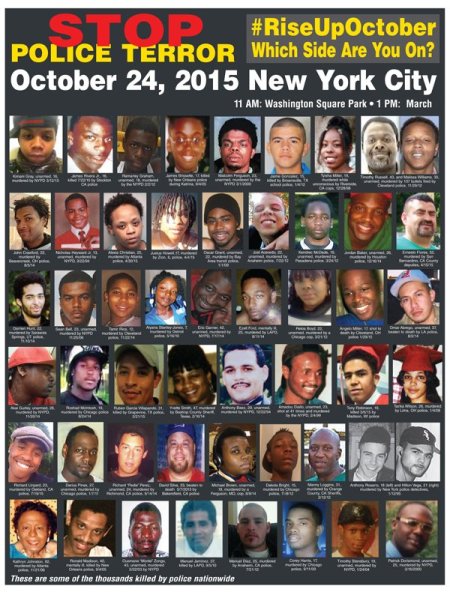
Hundreds gathered in New York City’s Times Square on Thursday, launching a three-day protest against officer-involved killings, brutality and mass imprisonment dubbed “Rise Up October.”
The three-day protest began Thursday morning with a “Say Their Names” rally. Hundreds gathered in midtown Manhattan to hear relatives speak about their loved ones who were killed by police officers over the past several years.
With the help of the Stop Mass Incarceration Network, the rally was organized by Carl Dix of the Revolutionary Communist Party and author and activist Dr. Cornel West.
The organizers said their goal was to organize “mass determined resistance” to a “matrix of oppression.”
Among the celebrities who endorsed the rally was director Quentin Tarantino, who at one point shared the stage with actress Gina Belafonte.
Faith leaders from a number of religious communities supported the gathering.
Also in attendance at the rally were members of the Raging Grannies, the New York chapter of a global movement promoting peace, justice and social and economic equality.
Heavy police presence shadowed the event.
Thursday’s march ended with a rally in Brooklyn.
Friday morning will see the “Shut Down Rikers” protest, aimed against the city’s notorious prison, which is plagued by accusations of violence, brutality and sexual abuse.
The main event is scheduled for Saturday, October 24, with an 11 a.m. rally in lower Manhattan’s Washington Square Park, followed by a march to Bryant Park in midtown.
The system for classifying intelligence and other national security documents is broken in major respects. Increasingly, it is also manipulated to punish perceived critics or to protect agency reputations and high officials, both from adverse publicity and in the courts. Hillary Clinton’s use of a private rather than State Department email service illustrates many of these issues. Her experience stands in stark contrast to treatment of national security whistleblowers, as illustrated in particular by variance in National Security Agency (NSA) communications intelligence policies.
–Culpability. Former Secretary of State Clinton clearly and knowingly mishandled classified information. As a U.S. senator, security clearances were required for her membership on the Senate Armed Services Committee from 2003 to 2009. Therefore, she knew the rules for handling classified information before she decided, at the outset when she became Secretary of State in early 2009, to use personal rather than secure email.
Hillary and Bill Clinton had suffered many political and public relations crises. She had already run for the presidency and likely would do so again. Rules for handling classified information were ignored, the effect being to hide records that could be used against her in a second presidential run.
It simply could never be argued plausibly that for four years, a person in the highest U.S. foreign policy slot had no classified or sensitive information in any business emails that she wrote or received – over 30,000 of them. This defies the definition of the job.
The State Department is a primary user and a significant generator of classified information that bears on the great majority of issues coming before the Secretary. The State Department is also a profligate designator of “Sensitive But Unclassified” information.
–Overclassification. It is widely admitted that the intelligence classification system suffers from systemic over-classification. President Barack Obama has acknowledged the problem, and one review group even stated that almost every item now labeled Confidential should be Unclassified. There is no penalty for playing it safe – or playing it political – by classifying at too high a level, but there are potentially severe repercussions for an individual who mistakenly classifies at too low a level, or who is known to mishandle or publicly reveal classified information.
It is most unlikely, however, that Hillary Clinton will fall victim to accusations that rely on improper overclassification. The State Department and White House, including President Obama himself, sought to protect her and to minimize the effects of her behavior.
The case is extremely high-profile, Democrats in Congress would attack any borderline classification, and a host of wellpaid lawyers would rise to her defense. Improperly classified items or those deemed Sensitive but Unclassified may be redacted from publicly released documents, but it is hard to imagine that Mrs. Clinton would be falsely accused of felonies.
Whistleblowers suffer a quite different fate. Intelligence agencies easily and repeatedly retaliate for the airing of their dirty laundry by accusing the whistleblower of improperly handling or revealing allegedly classified information. The Obama administration then prosecutes them under the Espionage Act, under which altruistic motivation is irrelevant and may not even be raised in court.
Former CIA official John Kiriakou revealed on television that post 9/11 torture was official U.S. policy, not just attributable to a few rogue agents. The CIA seethed, but the Justice Department would not prosecute. Unfortunately, Kiriakou erred in giving a reporter the business card of a man he thought had retired from CIA but was still an agent under cover. The agent’s name was not published, but CIA got its revenge when Kiriakou was indicted under the Intelligence Identities Protection Act of 1981. Left penniless with over $700,000 in legal bills even before trial, Kiriakou finally accepted a felony plea bargain and went to jail.
Thomas Drake and this author went through proper official channels in 20012002 to protest NSA’s surveillance of U.S. citizens. Along with colleagues Kirk Wiebe, William Binney and Edward Loomis, they also reported to the Defense Department Inspector General the waste of money on NSA modernization.
After domestic surveillance leaked to the New York Times four years later, the five became primary suspects, partly because the IG improperly offered their names to the FBI. All were raided, but no evidence was found because, as the reporter later stated publicly, he had not then met or communicated with any of the five.
Nonetheless, Drake was prosecuted under the Espionage Act for possessing five Unclassified NSA papers that NSA retroactively classified. He was threatened with 35 years in prison unless he pled guilty, but heroically resisted. Pretrial hearings proved all the information in the documents had been declassified by NSA. After a yearsold interview record was orally falsified, this author was asked to plead guilty to felony perjury, but also refused.
Section 1.7 of Executive Order 13526 governing classification stipulates that no information may be classified to conceal violations of law, inefficiency or administrative error; to prevent embarrassment; to restrain competition; or to prevent or delay release of information not requiring protection. This section is observed in the breach, as political considerations dictate.
For all the above proscribed reasons, unclassified parts of the NSA IG audit we requested are still withheld by NSA ten years after the audit was first published. Former NSA contractors Edward Snowden and John Kiriakou showed that illegal and unconstitutional activities were hidden from American citizens and others behind the veil of classification. For revealing material that never should have been classified in the first place, they are paying a very high price.
In Snowden’s case, many revelations about domestic surveillance still are treated as classified to keep them from U.S. voters, although every terrorist and every intelligence agency in the world has access to the documents and almost no ordinary person in any country of interest to the U.S. can function efficiently whilst avoiding NSA surveillance.
–Sensitive but Unclassified Material. Individual agencies claim an unsupervised right to withhold admittedly Unclassified information according to any criteria they see fit and for as long as they choose. In the Clinton email case, it is quite striking that not a word has been breathed about such Unclassified but Sensitive material. Her free pass in this respect is the envy of whistleblowers.
In our case, NSA initially refused to return any materials seized in the raids. When sued, NSA claimed that if a computer contained even one admittedly Unclassified document with material that had not been officially released by NSA, the Agency could retain and destroy the entire computer content. Courts eventually allowed NSA to keep such individual documents in their entirety and at their sole discretion, but required that others be copied and returned.
–With ordinary citizens or lower-level whistleblowers, Sensitive but Unclassified material is wielded as yet another weapon in the Executive’s arsenal of punishments. Even highlevel intelligence officials have had difficulty publishing their memoirs, partly because prepublication review agreements routinely allow an agency to withhold unclassified information.
Since the 1950s, most judges refuse to review allegedly classified or sensitive material even to determine that it does not fall under the commonsense prohibitions of Section 1.7 of the Executive Order on classification. The Executive Branch has also been famously successful in promulgating a “state secrets” doctrine to avoid or indefinitely delay court scrutiny of important civil liberties issues such as domestic surveillance. It is now known, however, that the original state secrets precedent wrongly invoked intelligence sources and methods to cover up Air Force culpability for a plane crash.
In the author’s case, even NSA’s grossly inconsistent classifications got a free pass. A document that was released to Kirk Wiebe as Unclassified was branded Top Secret Compartmented when found on the author’s computer. Confronted with this vast discrepancy, NSA alleged that it could neither confirm nor deny that the document had previously been released. It keeps no records of prior declassifications. Even in a related court case. Nor is it interested in an available system to compile and compare such records. But the judge let the classification stand.
Diane Roark retired in 2002 after 17 years on the professional staff of the House Permanent Select Committee on Intelligence and prior service on the National Security Council Staff, in the Office of the Secretary of Defense, and in the Intelligence section of the International division of the Department of Energy.
While most Canadians proudly recognize the beaver, the hockey player and the curling broom as symbols of this country, some of us would be made uncomfortable by another enduring emblem of the Great White North: a businessman wearing a Maple Leaf lapel pin discretely passing a plain manila envelope stuffed with cash to a foreign official.
Two weeks ago SNC-Lavalin agreed to pay $1.5 million to settle a corruption case brought against it by the African Development Bank. Accused of bribing officials in Uganda and Mozambique, the Montréal-based company also accepted a number of other non-monetary conditions on its operations to avoid being blacklisted from projects financed by the African Development Bank.
Over the past half-decade Canada’s biggest engineering company is alleged to have greased palms in Libya, Algeria, Tunisia, Angola, Nigeria, Mozambique, Ghana, Malawi, Uganda and Zambia as well as a number of Asian countries and Canada. A joint CBC/Globe and Mail investigation of a small Oakville based division of SNC uncovered suspicious payments to government officials in connection with 13 international development projects. In each case between five and 10 per cent of costs were recorded as “‘project consultancy cost,’ sometimes ‘project commercial cost,’ but [the] real fact is the intention is [a] bribe,” a former SNC engineer, Mohammad Ismail, told the CBC.
In Libya, the RCMP accused SNC of paying $50 million to Saadi Gadhafi, son of the late Libyan dictator, in exchange for a series of contracts. The company is also alleged to have defrauded $130 million from Libyan public agencies. In a less high profile incident, the RCMP accused SNC of paying $6-million to the son-in-law of former Tunisian dictator Zine al-Abidine Ben Ali in exchange for assistance securing contracts.
In Angola, SNC allegedly paid millions of dollars to government officials in exchange for a hydro dam contract. Former SNC employee Joseph Salim sued the company for wrongful dismissal, claiming he was terminated after he blew the whistle on the illegal payments. Salim alleged that SNC’s former CEO, Jacques Lamarre, agreed to pay a ten percent “agent fee” but company officials were unwilling to declare more than five percent on the books, which necessitated artificially increasing the price of the dam.
In northern Nigeria, SNC officials allegedly paid 1.2 million naira in cash — nearly five times the annual average Nigerian salary — to a government official responsible for a World Bank-funded water and sewer project. One company spreadsheet noted that money was “paid to Musa Tete [the Nigerian bureaucrat overseeing the World Bank-financed project] through Yaroson”, SNC’s Nigerian partner.
As allegations of SNC bribery began to seep out in 2012, the company continued to win billions of dollars in Canadian government contracts, maintained the backing of the Canadian Commercial Corporation and garnered support from Canadian diplomats abroad.
Canada has been quick to denounce corruption in Africa, but has lagged behind the rest of the G7 countries in criminalizing foreign bribery. For example, into the early 1990s, Canadian companies were at liberty to deduct bribes paid to foreign officials from their taxes, affording them an “advantage over the Americans” − they’re forbidden by law to pay out agents’ commissions.”, according to Bernard Lamarre former head of Lavalin (now SNC Lavalin).
In 1977, the US Foreign Corrupt Practices Act outlawed bribes to foreign officials. Ottawa failed to follow suit until the Organisation of Economic Co-operation and Development (OECD) launched its anti-bribery convention in 1997. The OECD convention obligated signatories to pass laws against bribing public officials abroad and two years later Canada complied, passing the Corruption of Foreign Public Officials Act (CFPOA). Still, for the next decade Canadian officials did little to enforce the law. The RCMP waited until 2008 to create an International Anti-Corruption Unit and didn’t secure a significant conviction under the CFPOA until 2011.
Anti-corruption watchdogs have repeatedly criticized Ottawa’s lax approach. A March 2011 report from the OECD Working Group on Bribery criticized Canada’s framework for combating foreign corruption and Ottawa has fared poorly in Transparency International’s rankings. In 2013 Transparency International complained that between 2005 and 2011, Canada exercised “little to no enforcement of the OECD Anti-Bribery Convention.” The group repeatedly ranked Canada the worst performer among G7 countries on this front.
Last week Toronto-based Kinross Gold disclosed that the United States Department of Justice launched an investigation into “improper payments made to government officials and certain internal control deficiencies” at its operations in Ghana and Mauritania. In my new book Canada in Africa : 300 years of Aid and Exploitation I detail numerous reports of Canadian companies accused of bribing officials.
While the federal government recently strengthened anti-bribery legislation, Ottawa has so far largely turned a blind eye to corporations paying off public officials abroad.
Should bribery really be seen as “Canadian” as the RCMP’s Musical Ride?
As Israeli state authorities processed my arrest on account of ‘an Instagram photo’, Israeli forces and settlers shot dead three Palestinian teenagers on the streets of Hebron on Saturday 17.10.15. With three teenagers killed and settlers literally celebrating in their blood, it is perhaps little surprise that those with cameras slung over shoulders are increasingly coming under threat.
Sitting in a cold room for hours, without access to a lawyer, I watched my beloved camera slammed on a table. Meanwhile, my presence in the base was denied to my colleague. One of my photos, I was told, rendered me a threat to the ‘security of Israel’.
An Instagram photo? Me? A threat to one of the most powerful states in the world?
The threat here? The truth.
Truth says Aeschylus, is the first casualty of war. But, can truth be a casualty? Truth cannot be arrested, deported, humiliated, beaten or killed. Hidden? Yes. Repressed? Yes. But it still remains.
Cameras indicate that – Occupation – we are watching you, we are documenting you, we are here, and we see you. We see Palestinian blood running on occupied streets in Hebron. Indeed, I dropped my camera lens cap in Hadeel’s.
CPT, as a very small thread in the fabric of resisting this occupation, has recently come under heightened attack. Including abusive phone-calls, increased police aggression and checks, and now, arrest.
We were detained by Israeli border police as we were en route to the site of 17 year-old Bayan’s murder. We stood detained against the wall as we waited for the commander “who wanted to speak” to me. Informed I was under arrest for taking a photo of “classified material” (two weeks ago in public space), I was taken to a police station to await interrogation. I knew they were ‘serious’ – this was not their normal provocation that we experience daily – but I did not yet know the full extent of the danger they would later put me in ten hours later.
“Why do you love these terrorists?” I was repeatedly questioned, amidst suggestions that I “go and sleep with Abu Mazzan” (PA leader Mahmoud Abbas) throughout the cold hours of waiting. I stated my right to inform my lawyer that I was in custody, to which I was greeted with “you tell your lawyer when I tell you to”, informed I would have to wait for longer because of such non-cooperation. My passport and my camera confiscated, I shivered for seven hours awaiting interrogation.
My body grew tenser and sorer, and, needless to say, my request for something warm was greeted with smirking. One Border Police woman amused herself with staring at me for some time. Another’s gun knocked my leg as he fidgeted. Another attempted to engage me in conversation about how ‘ungrateful’ ‘the Arabs’ were, citing the ‘giving back of Gaza’ in 2005. I declined conversation, deciding it was not the time to discuss locking over 1.5 million people in an open air prison and bombing them. Eventually most of the personnel trickled away, and I was left with one Border Police woman who, thankfully, largely ignored me. The sounds of explosions from all over Hebron, and two consecutive violent films – ironically set in prisons – filled the space as we sat in awkward silence.
Later, as the room refilled there began a somewhat animated discussion about the lack of English speakers to translate in interrogation. I listened wide-eyed as the discussion moved onto ‘Ofer’ – in reference to the renowned military prison near Ramallah. Ofer prison- where countless Palestinians are held for months without charge in ‘administrative detention’. As a British soldier was thankfully located, I was told I had one chance, and one chance only, to call my lawyer.
My one conversation over, interrogation began, and I was informed that I was to be deported. Apparently, I could speak to my lawyer again when I got off the plane. Chuckling, my interrogator changed this to a 15 day ban from Hebron. Supposedly, I was to leave that night. Listening to the clashes raging outside, with two teenagers killed so far, I expressed the impossibility, to which I was given a shrug and a “well if you don’t leave tonight, I deport you”. Told to sign forms, including one fully in Hebrew, I was also skin-crawlingly informed that my interrogator would keep my camera unless “I was a good girl for him”.
Suddenly, the interrogator received a call and ran from the room. 18 year old Tarek had been killed by Israeli soldiers. The third teenager in 12 hours.
Explosions outside the base heightened and a blindfolded Palestinian man, staggering as he was dragged in, was now slumped next to me. He was wincing with pain at the tightness of his handcuffs. “These are the terrorists you love” I was told.
An hour and a half later, my interrogator returned, and took my DNA, while we argued about the danger of leaving Hebron amidst the chaos of that bloody night. “It’s not safe” I said, “I have nowhere to go”, to which my interrogator repeated I could sleep with Abu Mazzan, and another replied “of course it’s not safe – you are in Israel, there are terrorists everywhere”. Resisting temptations of stating that we are in ‘occupied Palestinian territory’, I once again called my lawyer, having blessedly had my phone left with me in the chaos of the killing. Eventually, she convinced them to return my passport, my camera, and for me to leave by 9am the following morning.
Real panic set in as I was released. They did not release me to the Palestinian area, but into the settlement housing strongly ideological individuals. That day settlers had killed a teenager and celebrated in his blood. That day Israeli soldiers had called to other international activists to run, as settlers approached with machine guns. Having had my fair-share of being spat at, jeered at, being swerved at by cars, and accusations of Nazism or ISIS membership from settlers, I knew full well the danger, walking alone at 10pm. Those that made me leave that way were also fully aware of that danger, particularly heightened that day.
Reaching the now deserted road where Palestinians still live, I could hear the noise of mobs of settlers as I headed to the road block to meet my friend. Palestinian families watching the horror of the day from their windows were calling to me: “why are you out walking there? It’s not safe! Come off the street!” Three men cautiously opened their door, ushering me in to their family home. Loaded with the gift of cucumbers, one Palestinian man risked arrest – and even death had we ran into settlers – to walk me to the road block where I met friends, who drove me, also at their own risk, back home.
Back at the office, we sat listening until 3am to continued explosions and the calls of warning and help screaming from mosque towers around the city, as settlers continued to attack families.
My arrest is a very small fragment of a much wider repression of those documenting the violence of occupation. On the day I was arrested, so were two Palestinian activists from Youth against Settlements, having videoed the aftermath of Fadel’s murder. This week, the Israeli military has ransacked journalist offices, Israeli border police were caught on video stamping on the face of an accredited journalist, as the Foreign Press Association report “a series of unprovoked attacks”, and human rights workers and journalists are increasingly targeted in demonstrations.
Flicking through images and videos on my camera, I see the extreme ugliness of this occupation, which we will continue to write about, photograph and video. I also see the faces of the kindergarten children we escort to school in Hebron.
Truth: a casualty of war it may be, but a fatality? No. It cannot be. It exists. It screams. It threatens. It simmers. In ‘speaking truth to power’, not only do we see the horrors of the violence of this occupation, but we see the glimmers of hope and humanity that cannot be repressed.
After a delay, cybersecurity legislation dreaded by privacy advocates and relentlessly pursued by national security officials, known as CISA, will get a vote on the Senate floor “in a couple of days,” a top sponsoring senator anticipates.
The Cybersecurity Information Sharing Act of 2015, also known as CISA, is as polarizing as it is close to a vote. It finally hit the Senate floor for debate on Tuesday, with top sponsor Senator Richard Burr (R-North Carolina) highlighting its necessity because “actors around the world continue to attack US systems, and in many cases penetrate it.”
Under the bill, private companies would have increased liability protection with respect to collecting American’s personal data that could potentially be related to security threats. It would also make it easier for them to share such data with the government, including departments like the National Security Agency.
Prominent CISA opponent and privacy advocate, Senator Ron Wyden (D-Oregon), challenged Burr, who chairs the Select Committee on Intelligence, on one argument in particular.
“He said that the most important feature of the legislation is that it’s voluntary. The fact is, it is voluntary for companies. It will be mandatory for their customers,” Wyden said, “and the fact is the companies can participate without the knowledge and consent of their customers, and they are immune from customer oversight and lawsuits if they do so.”
In many cases, customers have been able to nudge companies from a pro to a con position on CISA. In one instance last month, the Business Software Alliance (BSA) sent a letter to legislators, in part calling for “cyber threat information sharing legislation” granting them immunity so that they could “more easily share that information voluntarily.” However, after Fight for the Future, an internet freedom advocacy group, set up YouBetrayedUs.org to criticize the organizations, the BSA changed its tune.
The BSA, which includes Apple, IBM, and Microsoft, now opposes CISA, as does the Computer and Communications Industry Association, which includes Google, Facebook, and Amazon. Reddit, Wikimedia, Twitter, and Yelp have also released anti-CISA statements.
“Leading security experts argue that CISA actually won’t do much, if anything, to prevent future large-scale data breaches such as the federal government has already suffered, but many worry it could make things worse, by creating incentives for private companies and the government to widely share huge amounts of Americans’ personally identifiable information that will itself then be vulnerable to sophisticated hacking attacks,” added the American Library Association in a press release.
The discussion on CISA comes after a stall in the Senate’s schedule before its August recess. Lawmakers agreed to delay a vote on the bill when it became clear that senators had many amendments to submit, some of which included so-called “riders,” or unrelated issues, such as Senator Rand Paul’s (R-Kentucky) amendments to audit the Federal Reserve and defund “sanctuary cities.” At least 22 amendments will be given a chance to be added to CISA before a final passage vote.
Burr optimistically told The Hill that “a couple of days” was all that was needed to get to a final vote on CISA. He may have overshot, however, because there could be a scrimmage over amendments despite his efforts. Burr, with support of other Senate leaders, has managed to combine eight amendments into a legislative package he shares with CISA co-sponsor Senator Dianne Feinstein (D-California), but the grouping includes only one of Wyden’s two amendments.
Wyden told reporters that the one he feels “most strongly about” hadn’t been included. It would have provided a review system for deleting private info before data gets passed on to the government. The Wyden amendment that was included in the bill only requires that people be notified when their data is inappropriately shared.
Although no vote has been scheduled yet, Senate Majority Leader Mitch McConnell (R-Kentucky) is trying to end debate by Thursday. Beyond CISA, the Senate has an ambitious to-do list. It will decide whether to extend government spending beyond September 30, address the Iran nuclear deal, and fund highways and transportation systems in a comprehensive bill.
A lawsuit has been filed in the United States against former Israeli Prime Minister and Defense Minister Ehud Barak for his role in the 2010 Israeli commando attack upon the Gaza Freedom Flotilla in which eight Turkish citizens and one American citizen were killed by Israeli forces and over 50 Turkish passengers were wounded.
The trial would be the first time a former Israeli Prime Minister would be put on trial for reasons of international terrorism.
The family of Furkan Doğan, the American citizen who appears to have been executed in the attack — shot five times, including point blank to the head, according to the family’s lawyers — filed the lawsuit in the Central District Court of California. Notice of the trial was handed to Barak on Oct. 20 in Los Angeles when he spoke in the Distinguished Speaker series of Southern California.
According to a press release from the Turkish International Humanitarian organization that sponsored the Mavi Marmara ship, charges against Barak include his planning and leadership in the murder of Furkan Doğan and others in international waters, willful killing, attempted willful killing, intentionally causing serious injury to body or health, international terrorism, plundering, intentionally causing damage to property, restriction of people’s freedom and instigating violent crimes.
American attorneys Hydee Dijsktal and Dan Stormer; the British law firm, Stoke & White; British Professor Dr. Geoffrey Nice; and UK attorney Rodney Dixon are the legal team for the Dogan family.
Other legal proceedings against Barak and other senior members of the Israeli government are in the works. In 2010 in France, the widows of Cevdet Kılıçlar and Necdet Yıldırım, two others executed by Israeli commandos, brought a lawsuit against Barak which he evaded when he was informed of the French lawsuit as he was about to deplane in Paris to attend a weapons expo.
In a case brought in the International Criminal Court (ICC), the ICC prosecutor has ruled that the attack by Israeli commandos upon the Mavi Marmara in the Gaza Freedom Flotilla was a war crime.
Additionally, the Seventh High Criminal Court in Istanbul, Turkey, has issued a “red notice” for the arrest of four senior Israeli government officials in a lawsuit filed in Turkey. The Israeli officials named by the court are Israel’s former Chief of Staff Gabi Ashkenazi, former navy chief Eliezer Marom, former military intelligence head Amos Yadlin, and former air force intelligence chief Avishai Levy.
Due to political considerations dealing with the State of Israel, the Ministry of Justice of Turkey has delayed sending to Interpol the “red notice” much to the consternation of those seeking justice.
Ann Wright served 29 years in the U.S. Army/Army Reserves and retired as a Colonel. She also was a U.S. diplomat for 16 years and worked in U.S. Embassies in Nicaragua, Grenada, Somalia, Uzbekistan, Kyrgyzstan, Sierra Leone, Micronesia, Afghanistan and Mongolia. She resigned from the U.S. government in March, 2003 in opposition to the Iraq war. She was on the 2010, 2011 and 2015 Gaza Freedom Flotillas and has been to Gaza six times after Israeli attacks on Gaza.
The Saban Center’s prescient paper on war with Iran
By Maidhc Ó Cathail | October 20, 2011
In June 2009, the Saban Center for Middle East Policy published “Which Path to Persia?—Options for a New American Strategy toward Iran.” Writing in a tone strikingly reminiscent of the Project for a New American Century’s infamous pre-9/11 paper “Rebuilding America’s Defenses,” the six co-authors noted that, “It seems highly unlikely that the United States would mount an invasion without any provocation or other buildup.” For a think tank specifically established by media mogul Haim Saban to protect Israel, this could prove to be a formidable obstacle impeding their desired march—of U.S. troops—to Tehran.
“In fact, if the United States were to decide that to garner greater international support, galvanize U.S. domestic support, and/or provide a legal justification for an invasion, it would be best to wait for an Iranian provocation, then the time frame for an invasion might stretch out indefinitely,” Saban’s think-tankers ruefully observed.
“With only one real exception, since the 1978 revolution, the Islamic Republic has never willingly provoked an American military response, although it certainly has taken actions that could have done so if Washington had been looking for a fight. Thus it is not impossible that Tehran might take some action that would justify an American invasion. And it is certainly the case that if Washington sought such a provocation, it could take actions that might make it more likely that Tehran would do so (although being too obvious about this could nullify the provocation). However, since it would be up to Iran to make the provocative move, which Iran has been wary of doing most times in the past, the United States would never know for sure when it would get the requisite Iranian provocation. In fact, it might never come at all.”
Seemingly undeterred by Iran’s frustrating unwillingness to provide the requisite provocation, the analysts continued to examine this option… continue
This site is provided as a research and reference tool. Although we make every reasonable effort to ensure that the information and data provided at this site are useful, accurate, and current, we cannot guarantee that the information and data provided here will be error-free. By using this site, you assume all responsibility for and risk arising from your use of and reliance upon the contents of this site.
This site and the information available through it do not, and are not intended to constitute legal advice. Should you require legal advice, you should consult your own attorney.
Nothing within this site or linked to by this site constitutes investment advice or medical advice.
Materials accessible from or added to this site by third parties, such as comments posted, are strictly the responsibility of the third party who added such materials or made them accessible and we neither endorse nor undertake to control, monitor, edit or assume responsibility for any such third-party material.
The posting of stories, commentaries, reports, documents and links (embedded or otherwise) on this site does not in any way, shape or form, implied or otherwise, necessarily express or suggest endorsement or support of any of such posted material or parts therein.
The word “alleged” is deemed to occur before the word “fraud.” Since the rule of law still applies. To peasants, at least.
Fair Use
This site contains copyrighted material the use of which has not always been specifically authorized by the copyright owner. We are making such material available in our efforts to advance understanding of environmental, political, human rights, economic, democracy, scientific, and social justice issues, etc. We believe this constitutes a ‘fair use’ of any such copyrighted material as provided for in section 107 of the US Copyright Law. In accordance with Title 17 U.S.C. Section 107, the material on this site is distributed without profit to those who have expressed a prior interest in receiving the included information for research and educational purposes. For more info go to: http://www.law.cornell.edu/uscode/17/107.shtml. If you wish to use copyrighted material from this site for purposes of your own that go beyond ‘fair use’, you must obtain permission from the copyright owner.
DMCA Contact
This is information for anyone that wishes to challenge our “fair use” of copyrighted material.
If you are a legal copyright holder or a designated agent for such and you believe that content residing on or accessible through our website infringes a copyright and falls outside the boundaries of “Fair Use”, please send a notice of infringement by contacting atheonews@gmail.com.
We will respond and take necessary action immediately.
If notice is given of an alleged copyright violation we will act expeditiously to remove or disable access to the material(s) in question.
All 3rd party material posted on this website is copyright the respective owners / authors. Aletho News makes no claim of copyright on such material.


 Aletho News