UK’s leading pro-Palestine campaign group blocks call to expel Israel from the UN (again)
By Stuart Littlewood | American Herald Tribune | January 26, 2016
At its Annual General Meeting last weekend the Palestine Solidarity Campaign (PSC) threw out a proposal to seek Israel’s expulsion from the United Nations.
Chairman Hugh Lanning is reported to have kicked off proceedings on a positive note saying: “Let us recommit to Palestine to make sure that we make a difference in the coming year.”
But the mask slipped when a motion was put for the PSC’s Executive Committee to:
“request the Government of the United Kingdom, enforced by a petition and lobbying, to submit a motion to the Security Council recommending that the General Assembly expel Israel from the UN in compliance with the UN Charter, Article 6.”
The motion failed — 76 in favour, 116 against. A statement by its main sponsor, Blake Alcott, says that an identical motion to the AGM a year ago was likewise opposed by the PSC leadership who felt “the time is not yet right”. His reaction to this latest rejection was to say: “Pro-Palestinians must wonder how much worse Israel’s crimes must be before the international community takes disciplinary action.”
There is ample reason for calling for Israel’s expulsion from the UN. It chimes very well with the ‘Sanctions’ element of Boycott, Divestment and Sanctions (BDS). And it is a good fit with the sort of measures that, in the ‘Call to Action’ by the BDS Movement, should be maintained until Israel meets its obligation to recognize the Palestinian people’s inalienable right to self-determination and fully complies with the precepts of international law by:
1. Ending its occupation and colonization of all Arab lands and dismantling the Wall
2. Recognizing the fundamental rights of the Arab-Palestinian citizens of Israel to full equality; and
3. Respecting, protecting and promoting the rights of Palestinian refugees to return to their homes and properties as stipulated in UN resolution 194.
Israel clearly isn’t the ‘peace-loving state’ required by UN Charter Article 4. Nor has it fulfilled the four conditions put on its acceptance as a member back in May 1949. As the record shows, Israel has wilfully breached conditions of membership for decades. Many have argued it automatically disqualifies itself by failing to fulfill membership requirements in the first place. Furthermore it continues to show contempt for numerous UN resolution despite frequent reminders.
When considering an appropriate response for civil society to make, suspension sounds ‘softer’ than expulsion as membership can be speedily restored if and when Israel satisfies the other member states that it now conforms. And in the circumstances suspension would surely be more difficult to veto.
But under the rules suspension isn’t an option, it seems. This is what the relevant part of the UN Charter says:
(Article 5) A Member of the United Nations against which preventive or enforcement action has been taken by the Security Council may be suspended from the exercise of the rights and privileges of membership by the General Assembly upon the recommendation of the Security Council. The exercise of these rights and privileges may be restored by the Security Council.
(Article 6) A Member of the United Nations which has persistently violated the Principles contained in the present Charter may be expelled from the Organization by the General Assembly upon the recommendation of the Security Council.
It might be argued that the passing of numerous UN Security Council resolutions amounts to ‘preventive action’ (although still awaiting ‘enforcement’). But Article 6, which stipulates expulsion, is more clear-cut. Israel has certainly violated every norm, every rule of decency, every principle of humanity in the book. And it continues to do so without showing a shred of remorse.
Too timid to put down a marker for upholding international law?
 Of course Mr Alcott’s motion, if passed, would have been brushed off by the British Government which is pledged by Cameron to protect and reward Israel right or wrong. But that is not the point. The aim of the motion was to put down a marker and provide a focus around which other campaign groups across the world could mobilise, bringing similar pressure to bear on their own governments and creating an irresistible swell of global opinion to ensure international law is eventually upheld.
Where does the PSC go from here, after failing a simple test? How will it now “make a difference” on behalf of the long-suffering Palestinians? The PSC’s media people have been asked twice for comment and further information but are “too busy”.
Right now some 71 UK doctors are pressuring the WMA to revoke the membership of the Israel Medical Association over claims that its doctors perform medical torture on Palestinian patients. According to Press TV/Al Ray, if the British physicians succeed, the Tel Aviv regime will be banned from taking part in international medical conferences and publishing in journals. Evidently our doctors have the balls for firm action, so why not the PSC?
Meanwhile ace propagandist and chief spokesman for the terror regime in Tel Aviv, Mark Regev, is due to take up his appointment as Israel’s ambassador to the UK later this year. His presence here will have special significance. If the PSC and the impotent Palestine Mission in London are the best he’ll come up against, we can expect a media communications massacre.
Prosecution planned for 8,000 Ukrainian soldiers who stayed in Crimea
Svezhie Novosti | January 26, 2016
Ukrainian authorities have stated that more than 8,000 military service personnel have been declared on the wanted list. It is reported that the soldiers went over to the side of Russia at the time of the so-called Crimean spring. This was stated by the Military Prosecutor of Ukraine Anatoly Matios. The former Ukrainian servicemen are now wanted, and criminal proceedings have been instituted.
According to Matios, all soldiers declared wanted served in the Ukrainian military units that were located on the peninsula of Crimea, and after Crimea went to Russia, did not return to Ukrainian territory.
The number of Ukrainian soldiers, who betrayed their Ukrainian oath and did not leave the territory of Crimea after the unification with Russia, is huge, more than 8,000 people. All of them are now on the wanted list. Measures against them have already been adopted; if in the near future they cross the Ukrainian border, they will be turned over to the courts.
Kiev must understand there is no alternative to Minsk
By Dr Alexander Yakovenko | RT | January 27, 2016
Nearly a year has passed since the Minsk agreements on the settlement in Ukraine were reached. However, the ongoing crisis in south-east Ukraine and problems arising in the course of the implementation of Minsk-II are still a matter of serious concern.
Kiev has been very selective with respect to its obligations, especially as regards implementation of their key political points. Here are just two examples of the Minsk agreements being grossly violated.
First, on the day of the beginning of the withdrawal of artillery, Kiev had to engage in a dialogue starting consultations with Donetsk and Lugansk representatives on how elections were to be held in April on the basis of Ukrainian law and with OSCE oversight.
The second date outlined in the document is 12 March, i.e. a month after the signing of the Minsk agreements Kiev was required to enact a special status law by adopting a resolution designating the territory that this law was supposed to cover. However, this hasn’t been done. A law was passed, the territories marked, but the law said that it didn’t apply to Donetsk and Lugansk.
Let us also remember the amnesty, because the Minsk agreements clearly say that elections should be held in accordance with the OSCE criteria, one of which is to ensure that no one will be subjected to intimidation, harassment, etc. The statement by the Kiev authorities on “elections first, then amnesty” constitute a serious distortion of the sequence and logic of what was really agreed. In accordance with the OSCE elections criteria, the amnesty should be held before the elections.
While Kiev is not contributing to the implementation of the Minsk agreements, the situation in southeastern Ukraine aggravates. Shelling is often witnessed, including the use of weapons that are supposed to have been withdrawn. This leads to civilian casualties and the destruction of property. Regrettably, yet another appeal for a ceasefire made by the Contact Group on January 13 has not been heeded in full. All of this contributes to the growth of tension and complicates progress in other areas of the settlement.
We believe that there is no alternative to the Minsk-II that is the only recipe for a political settlement to the conflict in Ukraine. That’s why Russia and its international partners, including Germany, France and the US continue an active dialogue on ways to settle the crisis in Ukraine.
Dr Alexander Yakovenko, Russian Ambassador to the United Kingdom of Great Britain and Northern Ireland, Deputy foreign minister (2005-2011). Follow him on Twitter @Amb_Yakovenko
Syria: Terrorist bombings in Homs require immediate and stern condemnation from Security Council
Syria Online – January 27, 2016
The Foreign and Expatriates Ministry said that the two terrorist bombings that took place in Homs city on Tuesday and other similar terrorist crimes require an immediate and stern condemnation from Security Council and taking deterrent actions against the states that support and fund terrorism.
In two identical letters sent to the UN Secretary-General and to the head of the Security Council, the Ministry said that terrorist organizations detonated a car bomb on Tuesday morning in al-Siteen Street in al-Zahra’a neighborhood in Homs, and that attack was followed by another attack by suicide bomber using an explosive belt, claiming the lives of 24 civilian and injuring more than 100 civilians, some of whom sustained severe injuries, in addition to damaging houses and infrastructures in the area.
The Ministry noted that these bombings were carried out at a time when the date for holding the Geneva 3 meeting, which seeks to push towards a political solution for the crisis in Syria, is approaching.
The letters pointed out that Syria had informed the Security Council and the Secretary-General of numerous terrorist bombings that targeted the very same neighborhood, but sadly none of these attacks and none of the hundreds of victims who were killed or injured in them were paid any attention by the Council and the Secretary-General.
The Ministry said that those two brutal bombings constitute a continuation of the barbaric and methodical terrorist acts committed by terrorist groups in Syria, groups that are supported by well-known regional and international states that employ terrorists to serve their personal political interests and irresponsible agendas, adding that these crimes also constitute a response to the political efforts to find a political solution by Syrians and to the success of national reconciliation efforts.
The letters also noted that the bombings are also an attempt to raise the morale of terrorist groups that are suffering repeated defeats at the hands of the Syrian Arab Army.
The Ministry said that the crimes and massacres committed by terrorist organizations like ISIS, Jabhat al-Nusra, Jaish al-Islam, al-Jabha al-Islamiya, Jaish al-Fateh, Ahrar al-Cham, and the “Free Army” wouldn’t have taken place without the constant arming, equipping, funding, and logistic support provided to terrorists by the governments of certain states.
The letters said that the Syrian government stresses that as per relevant Security Council resolutions and the principles of international law, such terrorist crimes require an immediate and stern condemnation from Security Council and taking deterrent actions against the states that support and fund terrorism whose destructive impact on peace and security isn’t limited to Syria but also affects the entire world.
The Ministry also stressed the need to cooperate and coordinate with the Syrian government in any effort for combating terrorism.
Kurdish PYD Not Invited to Syria Talks at Behest of Turkey
teleSUR | January 26, 2016
The U.N. sent invitations to several sides of the Syrian conflict but Syrian Kurds said they had not received an invitation likely due to Turkish pressure.
The United Nations Special Envoy to Syria Staffan de Mistura has sent invitations to warring parties in the Syrian conflict to attend peace talks in Geneva Friday it was revealed Tuesday. Mistura has not officially elaborated on who has been invited, but the head of the Syrian Kurdish PYD group said he has not received an official invitation despite promises.
Mistura said details of the guest list were too “sensitive” to reveal. His office said that he does not expect formal responses but he hopes those invited show up in Switzerland Friday.
One of the most contentious issues in the talks was whether or not the Kurdish PYD will be present at the negotiation table. PYD leader Saleh Muslim, who is currently in Geneva, said he has not received an invitation and is not aware that any Kurdish representatives have been asked to attend. He had earlier told Reuters that he expected an invitation letter.
One of Russia’s demands was the inclusion of the PYD in the peace talks, a stipulation that Washington objected to. But Moscow and Washington reached a compromise last Saturday that both the PYD, a former Syrian official and the Saudi-backed Army of Islam would attend the talks.
Analysts say the PYD were not sent an invitation due to Turkish pressure as Ankara said it would boycott the talks if the Syrian Kurds attend. “There cannot be PYD elements in the negotiating team. There cannot be terrorist organisations. Turkey has a clear stance,” Turkish Foreign Minister Mevlut Cavusoglu said Tuesday.
The PYD, who Turkey labels a terrorist organization, has been one of the main forces fighting the Islamic State group and have full control of almost all the Kurdish regions in northern Syria.
Russian Foreign Minister Sergei Lavrov said it would be impossible to reach a peace agreement in Syria without inviting Kurds to join the negotiating process. The PYD says the autonomous government they have established in the northeast is a decentralized model for how to resolve a war that has splintered the country.
Meanwhile, the Saudi-backed Higher Negotiations Committee (HNC), an opposition body made of several anti-government groups, have threatened a boycott unless Russian and Syrian forces stop operations in rebel-held areas.
The HNC met in Riyadh Tuesday to debate whether it would attend and confirmed to the French news agency AFP that it had received an invitation. “The response will be a request for clarifications and not an acceptance or rejection,” the unnamed source told AFP.
HNC member Salem al-Meslet said the group would resume talks Wednesday, adding that the “climate is positive.” However, the HNC says they should be the only opposition delegation and that the Kurdish PYD should be part of the government delegation.
The Syrian government has confirmed that it is attending the talks.
Other opposition figures who don’t belong to the Kurdish side or the HNC side have said they have received invitations to attend and will be present. “I am on my way to Geneva after receiving an invitation,” said Qadri Jamil, a former deputy Syrian Prime Minister who was sacked in 2013 and has good ties with Russia.
The developments come as the Syrian government has been making major advances against the rebels in recent weeks.
On Monday they captured the rebel-held town of Sheikh Maskin in southern Syria near the border with Jordan. The Syrian army also took control of Rabia Sunday, another major town in the northern Latakia province in a bid to cut supply lines for rebels through Turkey.
Life Terms for Turkish Journalists who Reported Shipping Arms to Syria Militants
Al-Manar | January 27, 2016
Turkish prosecutors demanded life sentences for two top journalists who reported that President Recep Tayyip Erdogan’s government tried to ship arms to insurgents in Syria.
Prosecutors asked the Istanbul court to sentence Cumhuriyet newspaper’s editor-in-chief Can Dundar and Ankara bureau chief Erdem Gul each to one aggravated life sentence, one ordinary life sentence and 30 years in jail, the Dogan news agency reported, quoting the indictment.
The report said that both Erdogan and his hugely powerful but low-profile ally, the head of the National Intelligence Organization (MIT) Hakan Fidan, are named as plaintiffs in the indictment.
Dundar and Gul were both placed under arrest in late November over the report earlier in the year that claimed to show proof that a consignment of weapons seized at the border in January 2014 was bound for Takfiri militants in Syria.
Since then, they have both been held in the Silivri jail on the outskirts of Istanbul ahead of their trial, whose date has still yet to be announced.
In the indictment, they have been formally charged with obtaining and revealing state secrets “for espionage purposes” and seeking to “violently” overthrow the Turkish government as well as aiding an “armed terrorist organization”, it said.
The penalties demanded by the prosecutors are significantly higher than had previously been expected.
The case has amplified concerns about press freedom under the rule of Erdogan, who had personally warned Dundar he would “pay a price” over the front-page story.
Saudi war on Yemen violates humanitarian law: UN panel
Press TV – January 27, 2016
A UN panel of experts says Saudi Arabia’s months-long war on impoverished Yemen has violated the humanitarian law as many of the airstrikes have been carried out on civilian targets.
The UN experts have called on the UN Security Council to “investigate reports of violations of international humanitarian law and human rights law in Yemen by all parties and to identify the perpetrators of such violations,” AFP reported on Tuesday.
The report added that Saudi warplanes had carried out 120 sorties, involving documented airstrikes on refugee camps, weddings, buses, medical facilities, residential areas, mosques, markets, factories, food warehouses, schools and airports.
“Many attacks involved multiple air strikes on multiple civilian objects,” the report further said, adding that “civilians are disproportionately affected” by the unabated aerial aggression. It also denounced Riyadh’s crippling blockade on Yemen, which constitutes “the prohibited use of starvation as a method of warfare.”
Saudi Arabia began its military aggression against Yemen in late March last year. The strikes are supposedly meant to undermine the Ansarullah movement and restore power to the fugitive former president, Abd Rabbuh Mansur Hadi.
Some 8,300 people have been killed and over 16,000 others injured since the strikes began. The Saudi war has also taken a heavy toll on Yemen’s infrastructure.
Yemenis have been carrying out retaliatory attacks on the Saudi forces deployed in the country as well as targets inside Saudi Arabia.
Documents Uncover NYPD’s Vast License Plate Reader Database
By Mariko Hirose | NYCLU | January 25, 2016
Supporters of license plate readers are fond of saying that unless you’re a criminal, you needn’t fear the invasive technology. But those who adhere to that argument should consider just a few examples from around the country:
- A police officer in Washington D.C. pleaded guilty to extortion after looking up the plates of cars near a gay bar and blackmailing the car’s owners.
- The DEA contemplated using license plate readers to monitor people who were at a gun show. Since the devices can’t distinguish between those who are selling illegal guns and those who aren’t, a person’s presence at the gun show would have landed them in a DEA database.
- A SWAT team in Kansas raided a man’s house where his wife, 7-year-old daughter, and 13-year-old son lived based in part on the mass monitoring of cars parked at a gardening store. The man was held at gunpoint for two hours while cops combed through his home. The police were looking for a marijuana growing operation. They did not find that or any other evidence of criminal activity in the man’s house.
With these stories firmly in mind, the New York Civil Liberties Union’s latest license plate reader discovery is all the more chilling.
Last year, we learned that the NYPD was hoping to enter into a multi-year contract that would give it access to the nationwide database of license plate reader data owned by the company Vigilant Solutions. Now, through a Freedom of Information Law request, the NYCLU has obtained the final version of the $442,500 contract and the scope-of-work proposal that gives a peek into the ever-widening world of surveillance made possible by Vigilant.
Surveillance is about power. Vigilant gives the NYPD power to monitor our whereabouts and, by extension, our affiliations, interests, activities and beliefs.
The scope-of-work proposal explains how Vigilant vastly expands the NYPD’s surveillance capability beyond what was possible with its own license plate database. Known as the Domain Awareness System, it collects the license plate data scanned by the approximately 500 license plate readers operated by the NYPD and combines it with footage from cameras and other surveillance devices around the city. The NYPD holds on to the license plate data for at least five years regardless of whether a car triggers any suspicion.
The Vigilant database raises similar privacy concerns as the Domain Awareness System, but those concerns are greatly magnified because the Vigilant database is massive: It contains over 2.2 billion location data points, and it is growing by almost a million data points per day. The database also isn’t limited to New York City, which means the NYPD can now monitor your car whether you live in New York or Miami or Chicago or Los Angeles. (See Vigilant’s Nationwide Scan Density Map on page 64.) Even more worrisome, the data comes from private license plate readers that scan locations that the police are less likely to scan: residential areas, apartment complexes, retail areas, and business office complexes with large employee parking areas. And, as far as we can tell, there is no limit on how long Vigilant keeps all of this private location data. There is no incentive for Vigilant to delete any data because its business model is to profit off of selling people’s data.
The Vigilant database also boasts “full suite data analytics tools.” These tools allow police officers to track cars historically or in real time, conduct a virtual “stakeout,” figure out which cars are commonly seen in close proximity to each other, and predict likely locations to find a car.
With this volume of private data and these types of tools, Vigilant enables the NYPD to learn intimate details about people’s lives with a click of a mouse. Through the “stakeout” feature, the NYPD may learn who was at a political rally, at an abortion clinic, or at a gay bar. Through the predictive analysis, the NYPD may learn that a person is likely to be near a mosque at prayer time or at home during certain hours of the day. Through the “associate analysis,” the NYPD may come to suspect someone of being a “possible associate” of a criminal when the person is simply a family member, a friend, or a lover.
Until now, law enforcement agencies under contract with Vigilant, including the NYPD, have said very little in public about how they use the database and what privacy protections they implement. That needs to change. Fifty police officers at the NYPD’s Real Crime Center have access to the Vigilant database and tools every day. The public has the right to know what rules regulate their access and what oversight mechanisms, if any, are in place. They have the right to know when and how the police are using the database and what the consequences are.
Surveillance is about power. Vigilant gives the NYPD power to monitor our whereabouts and, by extension, our affiliations, interests, activities and beliefs. By demanding answers to critical questions about NYPD’s use of Vigilant and other surveillance tools, New Yorkers can begin to take back the power imbalance created by the new era of mass digital surveillance.
“No Cost” License Plate Readers Turn Texas Police into Mobile Debt Collectors and Data Miners
By Dave Maass | EFF | January 26, 2016
Vigilant Solutions, one of the country’s largest brokers of vehicle surveillance technology, is offering a hell of a deal to law enforcement agencies in Texas: a whole suite of automated license plate reader (ALPR) equipment and access to the company’s massive databases and analytical tools—and it won’t cost the agency a dime.
Even though the technology is marketed as budget neutral, that doesn’t mean no one has to pay. Instead, Texas police fund it by gouging people who have outstanding court fines and handing Vigilant all of the data they gather on drivers for nearly unlimited commercial use.
ALPR refers to high-speed camera networks that capture license plate images, convert the plate numbers into machine-readable text, geotag and time-stamp the information, and store it all in database systems. EFF has long been concerned with this technology, because ALPRs typically capture sensitive location information on all drivers—not just criminal suspects—and, in aggregate, the information can reveal personal information, such as where you go to church, what doctors you visit, and where you sleep at night.
Vigilant is leveraging H.B. 121, a new Texas law passed in 2015 that allows officers to install credit and debit card readers in their patrol vehicles to take payment on the spot for unpaid court fines, also known as capias warrants. When the law passed, Texas legislators argued that not only would it help local government with their budgets, it would also benefit the public and police. As the bill’s sponsor, Rep. Allen Fletcher, wrote in his official statement of intent:
[T]he option of making such a payment at the time of arrest could avoid contributing to already crowded jails, save time for arresting officers, and relieve minor offenders suddenly informed of an uncollected payment when pulled over for a routine moving violation from the burden of dealing with an impounded vehicle and the potential inconvenience of finding someone to supervise a child because of an unexpected arrest.
The bill was supported by the criminal justice reform groups such as the Texas Criminal Justice Coalition, but it also raised concerns by respected criminal justice blogger Scott Henson of Grits For Breakfast, who theorized that the law, combined with ALPR technology, could allow police officers to “cherry pick drivers with outstanding warrants instead of looking for current, real-time traffic violations.”
He further asked:
Are there enough departments deploying license plate readers to cause concern? Will they use them in such a fashion? How will anyone know? Is it possible to monitor—or better, measure—any shift in on-the-ground police priorities resulting from the new economic incentives created by the bill?
As it turns out, contracts between between Vigilant and Guadalupe County and the City of Kyle in Texas reveal that Henson was right to worry.
The “warrant redemption” program works like this. The agency gets no-cost license plate readers as well as free access to LEARN-NVLS, the ALPR data system Vigilant says contains more than 2.8-billion plate scans and is growing by more than 70 million scans a month. This also includes a wide variety of analytical and predictive software tools.
The government agency in turn gives Vigilant access to information about all its outstanding court fees, which the company then turns into a hot list to feed into the free ALPR systems. As police cars patrol the city, they ping on license plates associated with the fees. The officer then pulls the driver over and offers them a devil’s bargain: go to jail, or pay the original fine with an extra 25% processing fee tacked on, all of which goes to Vigilant.1 In other words, the driver is paying Vigilant to provide the local police with the technology used to identify and then detain the driver. If the ALPR pings on a parked car, the officer can get out and leave a note to visit Vigilant’s payment website.
But Vigilant isn’t just compensated with motorists’ cash. The law enforcement agencies are also using the privacy of everyday drivers as currency.

From Vigilant Solutions contract with City of Kyle
Buried in the fine print of the contract with Vigilant is a clause that says the company also get to keep a copy of all the license-plate data collected by the agency, even after the contract ends. According the company’s usage and privacy policy, Vigilant “retains LPR data as long as it has commercial value.” Vigilant can sell or license that information to other law enforcement bodies, and potentially private companies such as insurance firms and repossession agencies.
In early December 2015, Vigilant issued a press release bragging that Guadalupe County had used the systems to collect on more than 4,500 warrants between April and December 2015. In January 2016, the City of Kyle signed an identical deal with Vigilant. Soon after, Guadalupe County upgraded the contract to allow Vigilant to dispatch its own contractors to collect on capias warrants.
Alarmingly, in December, Vigilant also quietly issued an apology on its website for a major error:
During the second week of December, as part of its Warrant Redemption Program, Vigilant Solutions sent several warrant notices – on behalf of our law enforcement partners – in error to citizens across the state of Texas. A technical error caused us to send warrant notices to the wrong recipients.
These types of mistakes are not acceptable and we deeply apologize to those who received the warrant correspondence in error and to our law enforcement customers.
Vigilant is right: this is not acceptable. Yet, the company has not disclosed the extent of the error, how many people were affected, how much money was collected that shouldn’t have been, and what it’s doing to inform and make it up to the people affected. Instead, the company simply stated that it had “conducted a thorough review of the incident and have implemented several internal policies.”
We’re unlikely to get answers from the government agencies who signed these contracts. To access Vigilant’s powerful online data systems, agencies agree not to disparage the company or even to talk to the press without the company’s permission:

From Vigilant Solutions LEARN-NVLS User Agreement
You shall not create, publish, distribute, or permit any written, electronically transmitted or other form of publicity material that makes reference to the LEARN LPR Database Server or this Agreement without first submitting the material to Vigilant and receiving written consent from Vigilant thereto…
You agree not to use proprietary materials or information in any manner that is disparaging. This prohibition is specifically intended to preclude you from cooperating or otherwise agreeing to allow photographs or screenshots to be taken by any member of the media without the express consent of LEARN-NVLS. You also agree not to voluntarily provide ANY information, including interviews, related to LEARN products or its services to any member of the media without the express written consent of LEARN-NVLS.
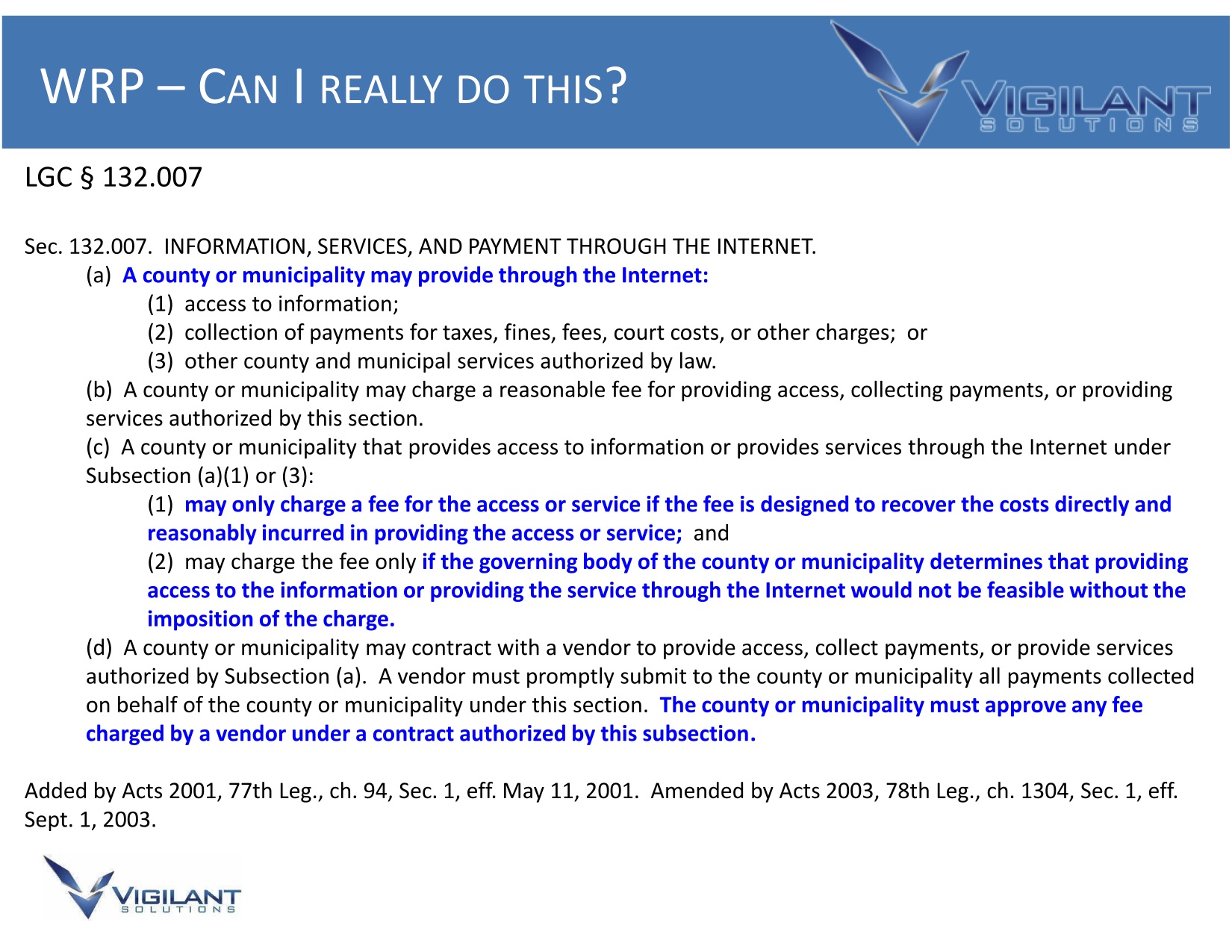
You might very well ask at this point about the legality of this scheme. Vigilant anticipated that and provided the City of Kyle with a slide titled “Can I Really Do This?” which cited a law that they believe allows for the 25% surcharge.
The law states that a county or municipality “may only charge a fee for the access or service if the fee is designed to recover the costs directly and reasonably incurred in providing the access or service.”
We believe that a 25% fee is not reasonable and doesn’t recover just the direct costs, since the fee is actually paying for the whole ALPR system, including surveillance capabilities unrelated to warrant redemption, such as access to the giant LEARN-NVLS database and software suite.
Beyond that, the system raises a whole host of problems:
- It turns police into debt collectors, who have to keep swiping credit cards to keep the free equipment.
- It turns police into data miners, who use the privacy of local drivers as currency.
- It not-so-subtly shifts police priorities from responding to calls and traffic violations to responding to a computer’s instructions.
- Policy makers and the public are unable to effectively evaluate the technology since the contract prohibits police from speaking honestly and openly about the program.
- The model relies on debt: there’s no incentive for criminal justice leaders to work with the community to reduce the number of capias warrants, since that could result in losing the equipment.
- People who have committed no crimes whatsoever have their driving patterns uploaded into a private system and no opportunity to control or watchdog how that data is disseminated.
There was a time where companies like Vigilant marketed ALPR technology as a way to save kidnapped children, recover stolen cars, and catch violent criminals. But as we’ve long warned, ALPRs in fact are being deployed for far more questionable practices.
The Texas public should be outraged at the terrible deals their representatives are signing with this particular surveillance contractor, and the legislature should reexamine the unintended consequences of the law they passed last year.
- 1. The contracts are inconsistent on how this fee breaks down. For example, the City of Kyle contract lists 5% of “credit card processing,” 5% for “credit card handling,” and 15% for a “vendor transaction fee.”
Featured Video

The Most Important Bet You’ve Never Heard Of
or go to
Aletho News Archives – Video-Images
From the Archives
The Occupied Mentality Syndrome
Saudi Arabia on the American chessboard – Part 2
By B. J. Sabri | American Herald Tribune | April 19, 2016
Since the Korean War, but particularly since the Iranian Revolution of 1979 until today, the United States has been steadily escalating its military presence in the Persian Gulf. Taking advantage of many colossal events of the past 36 years, [1] the hyper-empire has institutionalized its massive presence on land and sea, and expanded its objectives to include the unambiguous physical control of the area, as well as the clear understanding that local Arab governments should abide by them. The pretext is always the same: in “defense” of the national interests and security of the United States. From observing how the United States has been interacting with the governments of the region, and by judging from the size of its expeditionary force, we could reach a basic conclusion. The United States is occupying, de facto, the entire Arabian Peninsula. (Yemen, devastated by Saudi and American jets is yet to be conquered. Oman? Britain returned not as colonial ruler but as a soft occupying power.)
Under this articulation, Saudi Arabia, Qatar, Kuwait, and the United Arab Emirates are virtually occupied countries. If we compare this type of occupation to the mandate and protectorate regimes of the past, the results might be identical—the nations affected by it lose sovereignty. When Arab governments comply with the objectives of a foreign power that station military forces on their national milieu, then that power controls them in multiple ways including how they react to policy deliberations and what decisions they intend to take on specific issues. A good method to verify the concept of effective occupation is this: take notice of what the United States says and wants, and then compare it to what the gulf rulers do in response. (I shall discuss this detail at some point in the upcoming parts.)
If the presence of US forces or other means of political pressure are a factor in Saudi Arabia’s interventionist Arab wars, then we need to debate this issue. However, from the history of resistance to colonialism, we learnt: if a powerful state imposes its order on a nation by military means or other forms of coercion, and if this nation does not resist that imposition, then a mental subordination to the powerful state will ensue. This is especially true in the case of Saudi Arabia. One single event, 9/11, has transformed it from a US “ally” into an instant political hostage of the American Empire. … continue
Blog Roll
 Aletho News
- Trump and the debris of Iran war
- IRGC hits US tech giant Oracle’s data center, computing site in UAE over new assassinations
- Bombing Iran Back Into the Stone Age /Lt Col Daniel Davis & Jim Jatras
- UAE rejects report claiming it is ready to join war on Iran to reopen Hormuz
- A New Resistance Front: How Does Syria Factor into the Regional War?
- Gulf states weigh pipeline expansion plans, hoping to bypass Hormuz
- Iran sets up ‘tollbooth’ system in Strait of Hormuz
- Wave 90: IRGC strikes US-linked industrial sites in Gulf
- Iran Says US-Israeli Claims of Its Military Strength Are Wrong
- Trump’s April Fools’ Address to the nation
- If Americans Knew
- Israel-US kill negotiators, destroy civilian structures, but Iran’s military capabilities still largely intact – Daily Update
- ‘War crime’: Global condemnation as Israeli ministers celebrate death penalty law targeting Palestinian prisoners
- 7 Ways Israel Is Turning Lebanon Into Gaza
- World’s Leading Football Bodies Under Fire Over Israel Policies
- Experts warn of possible use of nukes against Iran
- Israeli invasion of Lebanon could be worse than 1982, warn European officials
- Passover: Liberation and collective punishment
- Trump says the quiet part out loud: (Israel’s) war on Iran > Americans’ health – Daily Update
- Gaza families reunite years after babies evacuated amid Israel’s war
- International Rescue Committee warns Gaza’s children face grave protection risks
- No Tricks Zone
- Low Intensity Tornado Wrecks Major Solar Farm, Creating A Potential Toxic Dump
- New Study Finds Warming Saves Lives…Cold Temperatures 12 Times More Deadly Than Excess Heat
- German Science Blog Accuses PIK Climate Institute Of Hallucinating Climate Tipping Points
- Devastating Assessment Of Comirnaty Vaccine By Former Senior Pfizer Europe Toxicologist
- New Study: CO2 Is ‘Effectively Negligible’ As An Explanatory Climate Change Factor Since 2000
- Former Pfizer Toxicologist Dr. Helmut Sterz Tells Bundestag Hearing Pfizer Vaccine Should Have Never Been Approved
- Energy Expert: Germany’s Nuclear Phaseout Was A “500 Billion Euro Mistake”
- New Research: South Australia’s Mid-Holocene Sea Surface Temperatures Were 4°C Warmer Than Today
- Storing Green Energy To Last Germany 10 Days Would Require A 60-Million Tonne Battery
- New Studies: UK Sea Levels Were 4 Meters Higher Than Today During The Mid-Holocene
 Aletho News