FBI cover-up? Dead Oregon rancher’s family call his shooting unjustified for a second time
RT | February 4, 2016
The family of a rancher who was shot by law enforcement during the Oregon standoff is calling the shooting death unjustified for a second time, accusing the FBI and Oregon State Police of a cover-up.
Rancher LaVoy Finicium was shot by Oregon State Police officers during an attempt to stop and arrest the leaders of the Malheur National Wildlife Refuge occupation, then on its 25th day. Protesters took over the refuge’s federal building to protest the arson convictions of two other ranchers, as well as to express anger of federal land policy.
“At this point, based on additional information we have now received, it is our position that not only was the shooting death of LaVoy Finicum completely unjustified, but that the FBI and Oregon State Police may also be engaging in a cover-up, and seeking to manipulate and mislead the media and the American public about what really happened,” read a statement from Finicum’s family, obtained by the Oregonian.
The family said new information from eye witness accounts supplemented their previous accusation that the FBI and OSP could not show any justification for Finicum’s death. One of the passengers riding in the white Jeep driven by Finicum, Shawna Cox, allegedly gave a different account of what happened that day after she was released from custody.
“According to Shawna Cox, they were being fired upon right from the outset at the second stop, before LaVoy exited the vehicle. Bullets had already come through the front windshield…. there was no question that LaVoy was trying to draw gunfire away from the others in the vehicle,” read the statement.
Cox told the family that it was clear LaVoy had his hands in the air and meant to keep them there, not to pull out a firearm.
“[The] best explanation for LaVoy’s arguably furtive hand movements, and why he lowered his hands and reached for his side at one point is because he had already been shot, and he was reaching toward the area where he had been hit as an involuntary physical reflex… before being shot again and collapsing,” read the statement.
Cox told the family that after LaVoy was lying motionless in the snow, federal agents and police “unleashed a barrage of gunfire on LaVoy’s truck and its remaining occupants… Ryan Bundy, Shawna Cox and Victoria Sharp, and shot it repeatedly.”
Cox said Ryan Bundy was wounded during the attack, and that in addition to the gunfire they were “terrorized by repeated smoke and pepper bombs.” She also said law enforcement did not make “any attempt to provide any meaningful or timely medical attention to LaVoy,” according to the statement.
In its previous statement, the family said they thought LaVoy’s movements were animated and said, “there are always at least two sides to every story…they didn’t know exactly what happened.” Now with Cox’s account, they are less convinced about the FBI account.
“After re-reviewing the extended video with better technology, we want to reiterate that we are not accepting at face value the FBI’s statement that LaVoy was actually armed,” the statement said.
Finicum’s family are demanding all applicable audio recordings and sound tracks from the FBI, a full-length unedited video of the operation and complete and close-up images of LaVoy’s truck “following the siege.”
The FBI released a 26-minute aerial video, without audio, of the tactical operation, including graphic footage of the shooting on January 28. The agency said they were releasing the video to counteract inaccurate and inflammatory accusations that the agency had been involved in killing Finicum in “cold blood.” The FBI also held a press conference and issued a formal statement interpreting the video.
The Deschutes County Sheriff’s Office in Oregon, announced Tuesday that an investigation into the shooting won’t be released for another four to six weeks.
The Wages of Plan Colombia Have Been Death

United Self-Defense Forces of Colombia (AUC) paramilitaries patrol a small village. The AUC have been responsible for torture, extrajudicial killings, war crimes and crimes against humanity. Photo: Justice for Colombia
By Daniel Kovalik | teleSUR | February 3, 2016
Plan Colombia’s 15th anniversary will be celebrated in Washington Thursday. But the legacy of the plan is marked by massacres, mass graves, and death squads.
According to Colombia’s Victims Unit, the number of victims of Colombia’s civil war has surpassed 7 million. This number includes those who have been killed, disappeared or displaced since 1956. For a country of under 50 million citizens, these numbers are staggering, and certainly newsworthy, but apparently not for the mainstream media.
Of course, the violence and human rights abuses in Colombia have constituted inconvenient truths for the Western media as the U.S. has been a major sponsor of the violence and abuses in that country.
Indeed, a notable fact in the Colombia Victims Unit report is that “that the majority of victimization occurred after 2000, peaking in 2002 at 744,799 victims.” It is not coincidental that “Plan Colombia,” or “Plan Washington” as many Colombians have called it, was inaugurated by President Bill Clinton in 2000, thus escalating the conflict to new heights and new levels of barbarity. Plan Colombia is a plan pursuant to which the U.S. has given Colombia billions in mostly military and police assistance.
As Amnesty International has explained, these monies have only fueled the human rights crisis in Colombia:
Amnesty International USA has been calling for a complete cut off of US military aid to Colombia for over a decade due to the continued collaboration between the Colombian Armed Forces and their paramilitary allies as well the failure of the Colombian government to improve human rights conditions.
Colombia has been one of the largest recipients of US military aid for well over a decade and the largest in the western hemisphere. . . . Yet torture, massacres, “disappearances” and killings of non-combatants are widespread and collusion between the armed forces and paramilitary groups continues to this day. . . .
“Plan Colombia” — the name for the US aid package since 2000, was created as a strategy to combat drugs and contribute to peace, mainly through military means….
Despite overwhelming evidence of continued failure to protect human rights the State Department has continued to certify Colombia as fit to receive aid. The US has continued a policy of throwing “fuel on the fire” of already widespread human rights violations, collusion with illegal paramilitary groups and near total impunity.
Furthermore, after 10 years and over $8 billion dollars of U.S. assistance to Colombia, U.S. policy has failed to reduce availability or use of cocaine in the US, and Colombia’s human rights record remains deeply troubling. Despite this, the State Department continues to certify military aid to Colombia, even after reviewing the country’s human rights record.
However, what Amnesty International did not explain are two salient facts.
First, the human rights group does not mention that Plan Colombia was initiated in the midst of peace talks between the Colombian government and FARC guerillas, and actually played a key role in derailing these talks, and with them the prospects for peace – prospects which have only been revived recently.
Second, Amnesty International does not mention that the paramilitaries which continue to collaborate with the U.S.-backed military in Colombia were actually a creation of the U.S. Thus, these paramilitaries were the brainchild of the Kennedy Administration back in 1962 – that is, two years before the FARC guerillas were even constituted.
As Noam Chomsky has mentioned a number of times, Kennedy commenced the U.S.’s counterinsurgency program, of which paramilitaries were a key component, in order to combat the scourge of Liberation Theology unleashed by Vatican II. And indeed, as Chomsky has also noted, the U.S. School of the Americas has bragged about how it helped “destroy liberation theology,” which emphasizes the “preferential treatment of the poor.”
Colombia has been ground zero for this plan which has targeted, among others, Catholic clergy for assassination. Accordingly, as documented by the Episcopal Conference of Colombia, over 80 Catholic clergy have been murdered in Colombia since 1984 — including 79 priests and 2 bishops — for the crime of advocating on behalf of the poor.
One brave Colombian Liberation Priest, Father Javier Giraldo sent a letter in September of 2011 to the U.S. Ambassador to Colombia, P. Michael McKinley, imploring him to prevail upon President Barack Obama to reconsider his decision to release millions of dollars in military aid to Colombia in light its abysmal human rights record.
In this letter, Father Giraldo informed the Ambassador that Colombian military’s directive known as EJC 3-10 – a directive based upon General Yarborough’s 1962 recommendation to organize paramilitary groups – is still very much in effect today in the form of paramilitary groups which both the U.S. and Colombian governments attempt to dismiss as mere criminal bands known as “BACRIM.”
According to Father Giraldo, these neo-paramilitary groups, as before, continue to work “in close harmony with the Army and Police” to carry out crimes against humanity, including forced displacement, with the number of internally displaced people in Colombia now at over 6 million; extra-judicial killings which have resulted in the proliferation of mass graves throughout Colombia; and “the systematic crime of forced disappearances, which according to national and international agencies now affects more than 50,000 families.”
And, he also places the responsibility for these continued abuses firmly at the feet of the U.S. Thus, Father Giraldo informs the U.S. ambassador that “[t]he current commanders take part in the same immunity, and impunity and the assistance from your government only reinforces their criminal activity.”
As Father Giraldo explains, the U.S.’s military/paramilitary policy is part and parcel of an unjust economic policy which allows for the unconstrained penetration of Colombia by multinational corporations at the expense of the Colombian people. He states:
The permits issued for mining exploitation to numerous transnational businesses have activated paramilitaries and armed conflict tremendously. They are leaving huge populations of poor people without any land or resources. The destruction of the environment and the destruction of indigenous, campesino and Afro-Colombian communities by these projects are leading to every kind of resistance. This means that the security of these companies and of their destructive projects is only effective with the protection of enormous contingents of paramilitaries secretly co-opted by the armed forces and by the government security agencies, which do not hesitate to murder the leaders of the resistance.
Father Giraldo further describes:
The permanent genocide that is being carried out in Buenaventura, where the neighborhoods and the Community Councils around the port are being invaded by paramilitaries supported or tolerated by the armed forces. They cut people in pieces with horrifying cruelty throwing the body parts in to the sea, if any of them dare to resist the megaproject for the new port. This included the expulsion of people living in the poorest areas and it includes the expropriation of the plots of garbage dumps where these people, in the midst of their misery, have over decades tried to survive.
Not surprisingly, Father Giraldo’s prophetic voice fell on deaf ears, and Obama proceeded with the release of the military aid to Colombia. And, it is the deathly silence over the horrifying human rights situation in Colombia which allows the U.S. to continue its destructive military/economic policy in that country.
Iran-Saudi Crisis and Pakistan
By Alexei Abramov – New Eastern Outlook – 04.02.2016
pakistan-army_140093kPakistan has become an intermediary between the Kingdom of Saudi Arabia (KSA) and the Islamic Republic of Iran against the background of increasing fears that a prolonged bilateral confrontation could potentially have serious consequences for the entire region. With a view to resolving the conflict, the civil and military leadership of Pakistan visited Riyadh and Tehran in January 2016. Both capitals responded favorably to the visits of the high-level guests, the tone of the Iranian leaders changed, the world stood still in anticipation of the detente… but no miracle happened. A few days later Riyadh firmly rejected both the mediatory role of Islamabad and the possibility of a dialogue.
Iran-Saudi tensions were escalating throughout 2015. Riyadh’s irritation grew after diplomatic missions of the Kingdom in Iran were raided, as well as in connection with the lifting of sanctions against Tehran by the United States and the European Union on January 16, 2016, which immediately promised to supply considerable stocks of crude oil to the world market to restore the status of the main hydrocarbon competitor of the KSA.
The mediatory role of Islamabad was quite understandable. Firstly, its concern was caused by the request of the Foreign Ministry of the KSA for the military establishment in Pakistan not only to send land forces into the zone of a potential conflict, but also to use nuclear weapons, the development of which had been actively financed by Riyadh for many years. In the past, Islamabad repeatedly declared the inadmissibility of a military intervention in a conflict on the side of any state within the Muslim Ummah.
Secondly, it was caused by Iran’s reaction to the establishment of an anti-terrorist alliance under the leadership of the KSA in December 2015. Islamabad was registered as its member, but it learned about it from statements of officials in Riyadh. The list included 34 more states, with the exception of Iraq, Iran and Syria. As the Saudi authorities explained later on, these countries had not been invited because of a lack of confidence in them.
Thirdly, Islamabad feared another surge of Sunni-Shiite massacres in its country, especially after the wave of protests that swept neighbouring Iran in early January 2016 in connection with the execution of the well-known Saudi Shiite preacher Ayatollah Nimr al-Nimr by the leadership of the KSA on January 2, 2016.
Pakistan demonstrated impartiality during the growing tension between the two countries. It did not openly condemn the actions of Iran in connection with the attack on the diplomatic mission of the KSA, but it did not sever diplomatic relations with it either, as did a number of countries of the Persian Gulf; it stressed its neutrality even during the visit of the Foreign Minister of the KSA to Islamabad in mid-January this year.
Riyadh’s request to send several thousand Pakistani soldiers at the disposal of the authorities of the KSA changed the subsequent course of events. Islamabad immediately canceled a visit of the civilian Defense Minister H. Asif to Tehran in mid-January this year. In a short time, the Pakistani military and, in particular, the Army Chief of Staff General R. Sharif, initiated a project of mediation in the Iran-Saudi conflict.
On January 18 this year, two Sharifs (the namesakes – Prime Minister Nawaz Sharif and Chief of Army Staff General R. Sharif) visited Riyadh with a mission to settle disputes by peaceful means in the interest of the unity of the Muslims in these difficult times. The leadership of the KSA was sympathetic to the mission of Islamabad and handed over a list of items to the Pakistani delegation to be further discussed with Iranian President Hassan Rouhani and spiritual leader, Ayatollah Ali Khamenei, assuring the guests from Islamabad that if the Islamic Republic of Iran showed positive signs, diplomatic relations could be restored.
The next day, on January 19, the civil and military leadership of Pakistan arrived in Tehran. It is fair to say that Prime Minister Nawaz Sharif was the first world leader who visited Iran after the lifting of sanctions. As reported by the Pakistani media, he managed to obtain a positive response from the Iranian leadership in respect of initiating the Iran-Saudi dialogue and regulating the issue of coordinators, whose mission, as planned, was to maintain business contacts with officials of the Kingdom of Saudi Arabia and the Islamic Republic of Iran. The mediation of Pakistan yielded positive results. On January 20, 2016, the Supreme Leader Ayatollah Ali Khamenei publicly condemned the attack on the embassy of the KSA in Tehran for the first time.
It seems that Riyadh and Iran heard each other thanks to the efforts of the intermediary. But instead of a triumph, Islamabad’s diplomacy failed once again. On January 25, 2016, Minister of Foreign Affairs of the KSA Adel Al Dzhubeir said that Tehran was pursuing a hostile policy towards the Arab world, and interfered in the internal affairs of foreign countries inciting religious strife and supporting terrorism. Of course, the efforts of Islamabad turned out to be useless against this background.
Riyadh’s refusal of Islamabad’s services in the development of dialogue with Tehran is due to several factors: the change in the overall political and military situation in the Middle East, the intensification of the military cooperation of the KSA with the United States and India (Indian military and, consequently, their arms are taking up the positions of Pakistani military trainers stationed in Riyadh under the previous agreements) and Islamabad’s repeated refusal to send land forces at the disposal of the KSA. We should recall that in late March 2015, Prime Minister Nawaz Sharif promised the Saudis to send his troops at the disposal of Riyadh, but in early April the parliamentarians, under pressure of the generals, refused to send their troops to fight against the Huthis in Yemen.
The mediation failure of the civil and military leadership of Pakistan to establish Iran-Saudi dialogue means that this time Riyadh excluded Islamabad from the list of its allies for a long time, and it will greatly reduce the amount of financial assistance and expand trade and economic, military and other contacts with its old rival – New Delhi.
The domestic policy of Pakistan is also in anticipation of change …The issue of the extension of the term of office of the Chief of Army Staff General R.Sharif (official retirement in late November this year), that has long been discussed in the country, has already been decided. On his return from a tour of Iran and Saudi Arabia, Prime Minister Nawaz Sharif refused to extend General R.Sharif’s term of office. The army commander had nothing to do but to publicly declare his refusal to continue service and his retirement upon reaching the retirement age. The generals of Pakistan are one of the strongest and most masterful government institutions and have seized power in the country four times; the Army Chief of Staff is the de facto first person in the state. Thus, the completion of the anti-terrorist campaign initiated by General R.Sharif delivered has been jeopardized.
Turkey’s Refusal of Observation Flight Only Fuels Worries It Supports Daesh
Sputnik – February 4, 2016
Ankara’s refusal to allow Russia to conduct an observation flight over Turkish territory under the Open Skies Treaty confirms Moscow’s concerns that Ankara is supporting the Daesh, which is prohibited in numerous countries including the United States and Russia, on the Turkish-Syrian border, a high-ranking source in the Russian Foreign Ministry said Thursday.
Russian inspectors planned to conduct the observation flight on board an An-30B plane over Turkish territory on February 1-5, but they were refused permission to do so after they arrived in Turkey and announced the flight route.
“This case is of course outrageous because the Open Skies Treaty today is practically one of many mechanisms that continue to operate in the European space and this treaty is valid and allows for acquiring valid information on steps being taken or not being taken by one or another state,” the source told RIA Novosti.
He reminded that in 2015 the West actively accused Russia of illegal activity on the Ukrainian border and NATO member countries requested observation flights over Russian territory, the results of which fully reversed the rumors.
“This once again confirms those concerns that the Russian side has voiced several times on using the Turkish-Syrian border to support Daesh militants,” the source said.
US Regime Change Talks on Syria hit blind alley
By Finian Cunningham | American Herald Tribune | February 4, 2016
And so the wheels of the Geneva talks came off in spectacular fashion, with all parties blaming each other for the breakdown in the so-called Syrian peace process.
The negotiations in the Swiss city were only into their second day –having opened on Monday, and that after a week-long delay –when UN special envoy Staffan de Mistura announced that the talks would be adjourned until February 25. Take it as read: it’s over.
Washington and Paris immediately sought to blame the Syrian government and its Russian and Iranian allies for “torpedoing” the Geneva talks. US Secretary of State John Kerry accused Syria and its allies of seeking a military solution to the five-year-old conflict. With this background of ongoing air and ground assaults, the Geneva negotiations foundered, according to the US and its partners.
Kerry and his French counterpart, Laurent Fabius, are engaging in reality-inversion, ably assisted by the Western mainstream news media.
The fact is the Geneva talks failed because Washington and its terrorist surrogates fighting for regime change in Syria could not affect a semblance of diplomacy.
Yes, Syrian Arab Army military advances are proceeding apace with the support of Russian air power and ground forces from Iran and Hezbollah. The game-changer was Russian intervention nearly four months ago, which has enabled the Syrian government of President Bashar al-Assad to recover huge swathes of territory occupied by foreign-backed mercenaries.
The latest military gains this week in northwest Syria have put the Syrian Arab Army within reach of taking back the city of Aleppo, the country’s largest urban centre, second to the capital Damascus.
Russia’s Foreign Minister Sergei Lavrov said this week that Russian operations in Syria will continue until all “terror groups”are destroyed. Lavrov mentioned Al Qaeda-affiliated Nusra Front and Daesh (also known as ISIL), but Russia’s scope also extends to a myriad of other militants groups who are integrated with the more well-known terrorist organizations.
These militants are falsely and risibly divided into “moderates”and “extremists” by Western governments and their dutiful corporate-controlled news media. What is moderate about chopping heads of civilians considered to be “infidels”? And this barbarity has been routinely practiced by the so-called moderate rebels of the “Free Syrian Army”. Notably, we don’t hear much about the much-lionized FSA these days. That’s because in reality they don’t exist.
Syrian state forces have every right to extirpate all illegally armed groups on the sovereign territory of Syria. While the Geneva negotiations were in process, the main foreign conduits of military supply to the mercenaries –Turkey and Saudi Arabia –had not desisted from their illegal interference in Syria. That was in flagrant violation of the United Nations Security Council resolutions in November and December calling for a global clampdown on terrorist organizations.
Not only were Turkey and Saudi Arabia continuing to supply illegally armed groups inside Syria, these two Western allies had included terrorist organizations into the so-called “opposition”at the Geneva talks. The grandly named High Negotiating Committee demanded it would only continue participating on the condition that the Assad government eventually stands down. That’s the real, proximate reason for breakdown, no matter what John Kerry might say.
Can you believe it? A bunch of foreign-backed and exile-based terrorists dictating terms to the elected government of Syria. Their foot-soldiers are getting wiped out on the ground –after five years of inflicting destruction on Syria –and yet these impostors are attempting to write the “peace terms”.
Syria and Russia are having none of it. Both are determined to crush an existential threat to Syria from foreign-backed terror groups. And Assad and Vladimir Putin are not going to hand over a victory of regime change at the negotiating table either.
That’s why Kerry is in a fluster. The peace process charade has been upended. Washington and its partners expected Syria and Russia to call off the military pressure in order to give their mercenary proxies some breathing space so that they could relaunch their terror war at a more opportune time, while also issuing ultimatums in Geneva for de facto regime change.
Washington and its allies were never serious about finding a genuine peaceful settlement. Now that the wheels have come off this snake-oil bandwagon, the US and its partners are obliged to find some “explanation” to sell to world opinion.
Hence, blame the Syrian government and its Russian ally for blasting the Geneva talks. But the world is not fooled by such reality-inversion. The Western powers’ plans for regime change in Syria just rolled into another blind alley.
The real danger, however, is that Washington and its allies might now attempt a direct military intervention in Syria out of desperation.
Finian Cunningham (born 1963) has written extensively on international affairs, with articles published in several languages. For over 20 years, he worked as an editor and writer in major news media organisations, including The Mirror, Irish Times and Independent.
Think tank director proposes postponement of Russian elections amid Western ‘regime change threat’
© Vladimir Fedorenko / Sputnik
Sputnik – February 4, 2016
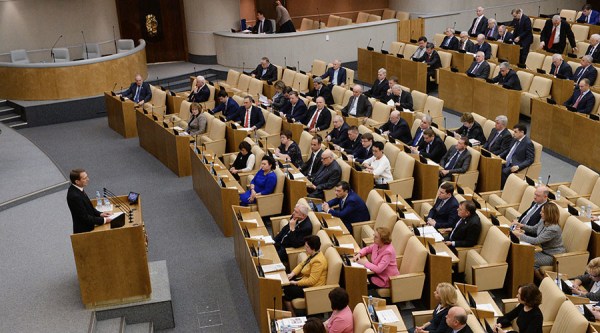
The head of a political research center has sent a letter to the State Duma chairman urging him to postpone parliamentary and presidential elections in Russia until Western nations stop their attempts at regime change through economic pressure.
“I am asking you as the chairman of the State Duma – who has the right to come up with legislative initiatives – to look into the possibility to urgently amend the Constitution with acts that would protect Russia from regime change instigated from abroad and the subsequent breakup [that would result from this],” chairman of the board at the Institute for Political Infrastructure Analysis, Yevgeny Tunik, wrote in his letter to Sergey Naryshkin.
The exact measure suggested by the analyst is a law that would automatically prolong the powers of Russian president and parliament in the event that the authorities decide to introduce a state of emergency or martial law. The new term for legislators and the head of state would last for six months from the moment of the cancellation of the emergency measures. Tunik emphasized that such a step would not violate citizens’ political rights as elections would not be canceled, only postponed.
Tunik also elaborated in his letter that over the past two years Russia has experienced unprecedented pressure from Western nations, primarily from the United States. He warned that the economic crisis and price hike could cause social unrest and protests that, in turn, could bring to power “hostile, pro-Western or even extremist forces.” Canceling all elections for the period of economic crisis would prevent a situation when citizens are asked to make serious choices under pressure from circumstances that could provoke irrational decisions.
“We all can witness the results of 2015 elections in Ukraine that were held in conditions of an undeclared emergency situation,” the analyst noted.
While the State Duma speaker has not commented on the letter, the head of the lower house Committee for Constitutional Law, Vladimir Pligin MP (United Russia), said that he did not consider the initiative as viable.
“All the latest efforts of the state power institutions and society in general are directed at preserving the constitutional norms in the Russian Federation. I think that there is no reason to change them at the current moment,” the lawmaker told RIA Novosti.
Seventy years of harassing political establishment and people of Europe
Oriental Review | February 4, 2016
According to a “sensational” article by the Telegraph, the US director of National Intelligence was recently instructed by Congress to “conduct a major review into Russian clandestine funding of European parties over the last decade.” This disclosure – a classic “controlled leak” – is intended to warn disobedient yet popular political entities across Europe to scale back their ambitions to rebalance the roles and weight of their nation states within the European Union. Hungary’s Jobbik, Greece’s Golden Dawn, Italy’s Lega Nord, and France’s Front National are explicitly included in the US “warning list,” while other unnamed “parties” in Austria, the Czech Republic, and the Netherlands are being advised that they are “under a US security probe.” Even the new British Labour leader, Jeremy Corbyn, is suspected of flirting with the Russians. So, according to the sponsor of the Telegraph’s story, any European politician who dares to question NATO’s eastward expansion, the policy of anti-Russian sanctions, or the current European stance on the Ukrainian conflict is essentially a witting or unwitting tool of “Russia’s hybrid warfare.”
Well, that would be funny if it weren’t so dangerous. In fact, any impartial observer would pose some simple questions: Why the hell do US intelligence agencies care about challenges to Europe’s internal security? Aren’t they the same agents who finance, recruit, and control countless political organizations, individuals, and media outlets on the European continent? Why are they so brazenly revealing their dominion over Europe?
A politically correct challenger would argue that the United States saved Europe from the “Communist threat” after the end of WWII, facilitated its speedy economic recovery, and is still safeguarding the continent under its nuclear umbrella. Perhaps. But a review of the historical background should not begin with the Marshall Plan. First of all, that was launched in April 1948. Since the Nazis capitulated in May 1945, a misinformed reader might deduce that the United States had been drafting a massive investment program for Europe for as long as three years, and … he would be wrong. At the Second “Octagon” Quebec Conference in September 1944, President Roosevelt and US Treasury Secretary Henry Morgenthau Jr. submitted to the British PM Winston Churchill their Post-Surrender Program for Germany. That strictly confidential document envisaged the partition and complete deindustrialization of the German state. According to the plan, Germany was to be divided into two independent states. Its epicenters of mining and industry, including the Saar Protectorate, the Ruhr Valley, and Upper Silesia were to be internationalized or annexed by France and Poland. Following are a few excerpts:
- The [US] military forces upon entry into [German] industrial areas shall destroy all plants and equipment which cannot be removed immediately.
- No longer than 6 months after the cessation of hostilities, all industrial plants and equipment not destroyed by military action shall either be completely dismantled and removed from the area or completely destroyed.
- All people within the area should be made to understand that this area will not again be allowed to become an industrial area. Accordingly, all people and their families within the area having special skills or technical training should be encouraged to migrate permanently from the area and should be as widely dispersed as possible.
- All German radio stations and newspapers, magazines, weeklies, etc. shall be discontinued until adequate controls are established and an appropriate program formulated.
That was the original postwar recovery program for Germany, known as the Morgenthau Plan. The notorious Joint Chiefs of Staff Directive 1067 (JCS 1067) addressed to the Commander-in-Chief of U.S. Occupation Forces in Germany, which was officially issued in April 1945, was fully in line with that document.

Partition of Germany according to Morgenthau Plan, 1944
The Morgenthau Plan very quickly proved to be a strategic mistake. The United States underestimated the ideological and cultural impact the Soviets would have on European societies. Left to their own judgment, American strategists failed to understand the attraction that a socialist system held for the majority of the population of the liberated nations. A vast spectrum of pro-socialist and pro-communist politicians began winning democratic elections and gaining political influence not only in Eastern Europe, but also in Greece, Italy, France, and other European states (Palmiro Togliatti and Maurice Thorez are just a few who could be named here). Thus Washington came to understand that its forced de-industrialization of Europe could result in Soviet-style reindustrialization and eventual Russian dominance of the continent… Therefore the US had to promptly replace the Morgenthau Plan with one named after Secretary of State George Marshall… Over the course of four years it provided Europe with $12 billion USD in credits, donations, leases, etc., for the purpose of buying … American machinery and other goods. Although the plan undoubtedly revived the economies of Europe, its biggest positive effect was on … the US economy itself! Simultaneously a wave of political repression was launched throughout Europe, most notably in Germany.
The media has largely forgotten about a Soviet initiative, proposed in 1950, to withdraw from the GDR and to reunify a neutral, non-aligned, demilitarized Germany within one year of the conclusion of a peace treaty. As a matter of fact, the resolution adopted at the Prague meeting of the foreign ministers of the Soviet Bloc on Oct. 21, 1950 proposed the establishment of an all-German Constituent Council, with equal representation from East and West Germany to prepare for the formation of an “all-German, sovereign, democratic, and peace-loving provisional government.” Needless to say, the US government and West German administration in Bohn strongly opposed the initiative. While a plebiscite on the issue “Are you against the remilitarization of Germany and in favor of the conclusion of a Peace Treaty in 1951?” was announced in both halves of the divided state, that referendum was held and officially acknowledged only in East Germany (with 96% voting “yes”). The authorities in US-controlled West Germany failed to respond in a truly democratic manner. They refused to recognize the preliminary results of the referendum that had been held since February 1951 (of the 6.2 million federal citizens who had taken part by June 1951, 94.4% also voted “yes”) and introduced the draconian cautious Criminal Law Amendment Act (the 1951 Blitzgesetz) on July 11. According to that legislation, anyone guilty of importing prohibited literature, criticizing the government, or having unreported contacts with representatives of the GDR, etc. was to be prosecuted for “state treason,” which was punishable by 5 to 15 years in prison. Consequently, between 1951 and 1968, 200,000 charges were brought against 500,000 members of the Communist Party and other left-wing groups in Germany under this law. Ten thousand people were sent to prison, and most of those who were “cleared” of charges never resumed their political activities. Additional legal amendments in 1953 actually abolished the right to freely hold gatherings and demonstrations, and in 1956 the Communist Party of Germany was banned. [More details can be found in Daniel Burkholz’s 2012 documentary Verboten – Verfolgt – Vergessen (Forbidden-Followed-Forgotten. Half a Million Public Enemies), which is surprisingly unavailable on YouTube].
The political repression that occurred in Germany from the 1950s to the 1980s, compared to similar events in other European countries during the same period, is a very taboo topic. Operation Gladio in Italy, the crimes of the regime of the Black Colonels in Greece, and the controversial assassinations of realistic European politicians who openly advocated for historical compromise with the Soviet bloc – such as Italian PM Aldo Moro (1978) and Swedish PM Olof Palme (1986) – all received far more media attention. The revelations made by a former correspondent for the Frankfurter Allgemeine Zeitung, Udo Ulfkotte, in his book Gekaufte Journalisten (“Purchased Journalists”) about the mechanism of media control in Germany (remember the Morgenthau Plan?) represent only the tip of the iceberg. The almost complete lack of reaction seen in Berlin after Edward Snowden’s disclosure of the blanket electronic espionage routinely conducted against German leaders by the NSA means that in reality, Germany has acknowledged its loss of sovereignty over its own country and thus has nothing to lose.
So, after taking all these facts into account and rereading the article in the Telegraph, are you still so sure that the United States is truly the guardian of Europe’s sovereignty? Is it not more likely that by using the alleged “Russian threat” to control and harass the political establishment and civil society in Europe, Washington is making headway toward a simple and primitive goal – that of merely keeping its sheep within the fold?
Adelson removes publisher of LVRJ, sends signal to employees
By Eoin Higgins | American Herald Tribune | February 4, 2016
The Las Vegas Review-Journal has seen its publisher leave in the latest shakeup for the paper since Las Vegas casino mogul Sheldon Adelson purchased it in December of 2015. For the past two months, staffers at the Nevada paper have been waiting for the next domino to fall as the paper works on transitioning its editorial and news reporting over to Adelson’s control.
The Review-Journal was sold to an Adelson family shell company, News + Media Capital Group LLC, by GateHouse Media, a subsidiary of New Media Investment Group. GateHouse had purchased the paper only nine months before, in March 2015.
A source inside the paper reached by phone told The American Herald Tribune that Adelson overpaid for the paper, substantially.
“We all know he offered way above what GateHouse paid for it,” the source said, “Which is why they sold. The sale agreement said that GateHouse would maintain operational control and keep the publisher.”
Within two weeks of Adelson’s purchase of the Review-Journal, the paper’s editor, Michael Hengel, had his contract bought out and left. Hengel had spearheaded the paper’s internal investigation into the identity of the buyer before resigning.
The investigation, undertaken by the paper’s staff, into who was behind News + Media Capital Group had uncovered Adelson’s identity by connecting the dots to a paper in Connecticut. That paper, The New Britain Herald, ran a story in September attacking one of Adelson’s adversaries, Judge Elizabeth Gonzalez.
Gonzalez memorably shut down Adelson in court in 2015, telling the casino mogul “Sir, you don’t get to argue with me” in open court.
It struck Review-Journal staff as odd that a paper from the other end of the country would report on a judge involved in adjudicating a dispute in Las Vegas, so they investigated further. What they found was a direct connection between their new ownership and the ownership of The New Britain Herald. News + Media Capital Group own both papers.
From there it was easy to connect the dots, although getting the story out was difficult. On December 16, the editorial board persevered and Adelson was outed as the buyer of the Review-Journal in the paper’s pages.
On December 19, the paper published an editorial entitled “Review-Journal will fight to keep your trust every day.” The content was provocative, and indicated the editorial board was spoiling for a fight. They got one. Hengel resigned three days later.
In the wake of Hengel’s departure, The American Herald Tribune’s source said, things largely calmed down at the paper. Most changes at the paper, according to our source, have been “subtle.” They have mainly revolved around bureaucratic issues relating to pay, insurance, and benefits.
As the company control transitions over to News + Media, the source said, “it’s been an HR nightmare. There have been signatures needed for documentation of new benefit packages, transitions. It’s been difficult.”
This bureaucratic transition provided News + Media the pretext to replace publisher Jason Taylor. Taylor, a GateHouse employee, was retained by News + Media in the sale agreement to manage the newsroom. His retention also served to give the impression that Adelson would not interfere with the Review-Journal’s work.
His departure was sudden, and a shock.
“The only reason [Taylor] would have left was because of Adelson,” the source told The American Herald Tribune, “The day before we were in an emergency meeting with [Taylor] and he told the staff ‘If I’m leaving, you should worry.’ He was here that Wednesday, and gone on Thursday. Overnight.”
Adelson’s increasing involvement in Review-Journal operations was not unexpected at the paper. Most employees were prepared for impending influence of the billionaire. But Taylor’s ejection was sudden, brash, and blatant.
“All the changes we’ve seen have been subtle,” our source told us, “Taylor protected us from what was going on.”
Taylor, it should be noted, was the most significant roadblock to the article disclosing the new ownership that preceded Hengel’s resignation. Still, his departure opened the publisher’s position for an Adelson partisan.
The new publisher, Craig Moon, is a veteran of USA Today, which he ran from 2003-2009. Moon’s appointment was announced the same day Taylor was fired, unmistakably signaling that the publisher’s replacement had been planned for some time.
Moon told the press after the announcement that he didn’t expect much interference from the Adelson family, but it remains to be seen if that will hold true.
Adelson’s propensity for buying newspapers is not new- he publishes the free daily Israel Hayom in Israel, a paper known for promoting a hard-right slant to coverage of Israeli politics. The paper is known locally as “Bibiton,” or Bibi’s (Prime Minister Benjamin Netanyahu’s) newspaper.
Adelson’s record in promoting his political point of view through the press overseas, then, has led to a lot of concern over his plans for the future of the Review-Journal.
“We’ve been looking at the stories coming out of the news department,” said our source. “We’ve been the stories that come out now because ultimately the publisher has the final say in what gets printed.”
The paper recently published an editorial strongly endorsing an Adelson project, a proposed $1 billion stadium at the University of Las Vegas.
The stadium is an Adelson vanity project, one that he has been pushing for quite some time. By purchasing the Review-Journal, Adelson has acquired a productive shaper of opinion in Las Vegas. It’s one that will allow him to move forward with his plans for the stadium.
Our source believes that in the short term, Adelson’s purchase of the Review-Journal was based on his desire for the stadium.
“The Adelson family said they wanted to own the paper as a family legacy, but they’re trying to build a $1 billion stadium,” our source explained. The source added that they were sure that more changes were coming in the near future.
“It’ll be a slow process. Adelson’s smart, he’s not going to risk getting called out. It could be a while.” There was a pause on the phone. “Then again, he did just kick out the publisher.”
MORE…
BBC Two Show About Hypothetical WWIII ‘Dangerous Provocation’
Sputnik – 04.02.2016
Russian Ambassador to Latvia Alexander Veshnyakov called the World War Three: Inside the War Room (BBC Two) show a ‘dangerous provocation’ that aims to discredit pro-Russian forces in Europe.
The BBC program explores a hypothetical WWIII scenario, where Russia invades Latvia after Russian nationalists boil over their lack of self-determination in Latvia. Russia then launches a nuclear strike on the British military.
“We consider this TV-program a dangerous provocation. I’ve been working in Latvia for 8 years and do not know of any separatist organization here,” Veshnyakov said in an official commentary on the Embassy’s Facebook page.
According to Veshnyakov, the TV program scenario pursues a purely political agenda.
“This scenario is absolutely contrived, going after political goals: first, to engage in an information war to demonize Russia. Second, to justify the needs of the military-political lobby to increase the spending of NATO in Europe more than 4 times. Third, to discredit any political forces in Latvia, in Europe, that treat Russia without bias.”
Relations between Russia and the West worsened in 2014, when the United States, the European Union and some other Western countries accused Moscow of fueling the Ukrainian crisis, and imposed economic sanctions against it.
Russia’s relations with NATO also deteriorated. NATO has been increasing its presence in Eastern Europe since Crimea rejoined Russia in March 2014 following a referendum the West refused to recognize as legitimate, instead blaming Moscow for violating Ukraine’s territorial integrity. Russia has denied the allegations and has repeatedly stated that the bloc’s increased activities near its borders undermine regional and international stability.
NATO-Russia Council’s work was suspended on April 1, 2014, after the alliance’s foreign ministers issued a statement condemning Crimea’s reunification with Russia.
In January, media reports emerged claiming that the alliance was discussing a possible invitation of Russia to the first formal talks since the deterioration of NATO-Russia relations in 2014. NATO chief Jens Stoltenberg had previously brought up the subject of reconvening the NATO-Russia Council to be used as a tool for political dialogue.
Featured Video
No Threat Can Force Iran’s Surrender /Trita Parsi & Lt Cl Daniel Davis
or go to
Aletho News Archives – Video-Images
From the Archives
An Expert Military Analysis of War with China
Actually, None is Necessary
By Fred Reed • Unz Review • December 13, 2020
The Correlation of Armed Forces: U.S. goods and services trade with China totaled an estimated $634.8 billion in 2019. Exports were $163.0 billion; imports were $471.8 billion. The U.S. goods and services trade deficit with China was $308.8 billion in 2019. Trade in services with China (exports and imports) totaled an estimated $76.7 billion in 2019. Services exports were $56.5 billion; services imports were $20.1 billion. The U.S. services trade surplus with China was $36.4 billion in 2019.
There is talk within the Washingtoniat of a possible war with China. Steve Bannon, who apparently was dropped on his head as a child, actually favors such a war. We hear the usual shoo-the-boobs alarm about how the Chinese are doing something terrible and we must gird our loins and American values and show them what for, bow wow, woof. The danger is that the current game of who-blinks-first in Asian waters might actually provoke a shooting war. You know the kind of thing: One warship refuses to get out of the way of another, a collision ensues, some retard lieutenant who signed up on waivers opens fire, and we’re off and running. It is not a good idea to let children play with matches.
The said war is discussed either in emotional terms by idiots or in purely naval terms by those familiar with such things, so we hear of the First Island Chain and the Second Island Chain and whose missiles against the other’s missiles and so on. This would be appropriate if we were fighting World War Two again. Which we aren’t. Let’s take a quick-and-dirty look at how such a war might go.
To begin the war, America would overestimate itself and underestimate China. This is doctrine in the Pentagon. … continue
Blog Roll
 Aletho News
- Iran To Target Military Industrial-Tech Complex That Facilitated Gaza Genocide
- Collapsing Empire: The Resistance Disarms ‘Israel’
- Suicide Should Not Be a Government Service
- Rethinking America’s greatest threat: Iran vs. Israel-Firsters
- Iran accuses adversaries of false flags to strain Turkey ties
- Poland rules out sending Patriot missiles to US/Israel amid war on Iran
- Tehran approves new Hormuz plan with major restrictions
- No Threat Can Force Iran’s Surrender /Trita Parsi & Lt Cl Daniel Davis
- UK’s New Pandemic Plan Would Turn Big Tech Into a Mass Location Tracking Network
- Growing insecurity, soaring prices fuel protests in north as regime bans evacuation: Sources
- If Americans Knew
- Ann Coulter Rips Into Fox News for Iran War Coverage, Compares to False Rigged 2020 Election Reporting
- Joe Kent Urges Americans To Call White House and Congress To Object To Sending Troops Into Iran
- DNC Resolution to Reject AIPAC Funding Puts Democratic Leaders in the Hot Seat
- Swedish foundation to build 400 schools as over 650,000 Gaza children remain without education for 2 years
- Israeli army admits photshopping image of slain Lebanese journalist
- This is how Israel is systematically killing health workers under the cover of war in Lebanon
- Carrying life under fire: Israeli invasion of Lebanon leaves pregnant women facing deadly risks
- Champagne all around for the new death penalty (for Palestinians) law – Not a ceasefire Day 172
- Why are Palestinian books struggling to be seen on Amazon?
- The Line Between Affinity and Conspiracy
- No Tricks Zone
- New Study Finds Warming Saves Lives…Cold Temperatures 12 Times More Deadly Than Excess Heat
- German Science Blog Accuses PIK Climate Institute Of Hallucinating Climate Tipping Points
- Devastating Assessment Of Comirnaty Vaccine By Former Senior Pfizer Europe Toxicologist
- New Study: CO2 Is ‘Effectively Negligible’ As An Explanatory Climate Change Factor Since 2000
- Former Pfizer Toxicologist Dr. Helmut Sterz Tells Bundestag Hearing Pfizer Vaccine Should Have Never Been Approved
- Energy Expert: Germany’s Nuclear Phaseout Was A “500 Billion Euro Mistake”
- New Research: South Australia’s Mid-Holocene Sea Surface Temperatures Were 4°C Warmer Than Today
- Storing Green Energy To Last Germany 10 Days Would Require A 60-Million Tonne Battery
- New Studies: UK Sea Levels Were 4 Meters Higher Than Today During The Mid-Holocene
- Destructive Green New Deal: German Energy And Metal Group Warns Of Drastic Crisis
 Aletho News