Egypt’s Foreign Minister defends mass imprisonment on US visit
Reprieve – February 10, 2016
The Egyptian Foreign Minister has defended his government’s mass imprisonment of political activists, and the use of lengthy pre-trial detention periods, during a visit to Washington DC to meet with US Secretary of State John Kerry among other officials.
In an interview with NPR that aired today, Foreign Minister Sameh Shoukry defended the detention without trial of activists and others arrested at protests in 2013, saying that arrests only took place where protestors didn’t have ‘permits’. Asked why many protestors were still imprisoned and awaiting trial two years later, he said: “It is a long time, but I believe justice has to be given the opportunity, within the impartiality of the judicial system, to ascertain all of the facts and to pass a verdict”.
Mr Shoukry added that “no country” has a perfect human rights record, and that “there will always be ups and downs.” He said that “it is our intention to do everything possible to live up to those [human rights] standards and provide the rights of all individuals.”
Since taking power in July 2013, the Sisi government has overseen thousands of arrests of protestors, journalists and others, many of whom have been put through mass trials that fail to meet international standards. International human rights group Reprieve, which assists several prisoners in Egypt, recently established that between 2014 and the end of 2015, nearly 600 death sentences were handed down, the majority in relation to political charges.
Hundreds of other prisoners are enduring lengthy periods of pre-trial imprisonment; one trial involving 494 people has been postponed 12 times since it began in 2014. The defendants, including Ibrahim Halawa – an Irish student, who is being assisted by Reprieve – are currently understood to be undergoing torture, including forms of ‘crucifixion’ and electrocution. Mr Halawa is one of several prisoners in the trial who were arrested as juveniles, and who are being tried as adults in violation of Egypt’s Child Law.
Reprieve has previously written to Secretary Kerry, asking him to press the Egyptian government to end the use of mass trials and release prisoners who were arrested as juveniles.
Russia Backs Baghdad’s Demands for Turkish Troops Removal From Iraq’s North
Sputnik – 10.02.2016
BAGHDAD – Russian Deputy Prime Minister Dmitry Rogozin supports Baghdad’s demands that Turkey withdraw its troops from Iran’s northern regions, Russian Deputy Foreign Minister Mikhail Bogdanov said Wednesday.
Bogdanov said that Rogozin was personally met at the airport in Baghdad by Iraqi Foreign Minister Ibrahim Jaafari where they discussed the issue.
“In this context, the issue of the illegal presence of Turkish troops on Iraqi soil was discussed and support was expressed of the official position of the Iraqi government that is based on the need to respect the territorial integrity and sovereignty of Iraq,” Bogdanov told journalists in Baghdad.
In early December, the Turkish government sent a battalion of 25 tanks and about 150 troops into northern Iraq without the permission of the Iraqi government.
Ankara said its forces were there with the assent of the Iraqi government, and were sent in response to security concerns in northern Iraq, where its forces help to train Iraqi militia battling Daesh in northern Iraq.
Wicked Games: US ‘Uses Terrorism as Main Mechanism of Its Foreign Policy’
Sputnik – February 10, 2016
In an interview with RT, Russian military analyst Alexander Zhilin said that US media allegations that Russia is pursuing its own interests in Syria are “absolute nonsense”, given that Moscow “cooperates there with the legitimately elected president.”
He also pointed to Washington’s hypocritical statements about the necessity of fighting terrorism, saying they came as the White House continued to use terrorism as a major mechanism of its foreign policy.
“Just think about it: if a country with a military budget exceeding the consolidated budget of all the countries in the world uses terrorism as the main instrument of its foreign policy, fighting terrorism is almost impossible”, Zhilin said.
He also lashed out at US President Barack Obama and US Secretary of State John Kerry repeatedly calling for the ouster of Syrian President Bashar Assad.
“My question is: who are you to make such calls? It means Obama who bombed out half the world’s territory must not step down, while Assad must step down, right? It is the wrong approach,” he said.
According to him, Washington currently wages so-called network-centric warfare against Moscow, a military doctrine pioneered by the US Department of Defense in the 1990s. The goal is to translate an information advantage, enabled in part by information technology, into a competitive advantage through the robust computer networking of a well-informed, geographically decentralized force.
“The United States has started a propaganda [war] against Russia, which is why it is creating an anti-Russian coalition with the participation of Saudi Arabia, Turkey and the US private military companies,” he pointed out.
Zhilin expressed regret about foreign media outlets, including CNN and the BBC, being involved in this war and misinforming their readers about Russia’s air campaign in Syria. He recalled that Russia’s “participation in Syria suggests the support of the legitimately elected president,” and that “it was Washington which started the invasion without getting the UN’s go-ahead.”
“You know, I’m very sorry that the BBC and CNN, once respected media outlets, have turned into primitive propaganda and disinformation news agencies,” he said.
Zhilin’s remarks came shortly after CNN reported that the Russian air support had allowed the Syrian Army to begin liberating the strategic city of Aleppo, which was seized by militants several years ago. At the same time, CNN alleged that in Syria, Russia does not only struggle with Daesh militants but also pursues its own interests.
Will Geneva talks lead right back to Assad’s 2011 reforms?
By Sharmine Narwani | RT | February 10, 2016
Syrian peace talks have already stalled. The opposition refused to be in the same room as the government delegation, while the latter blamed opposition ‘preconditions’ and the organizers’ inability to produce a ‘list of designated terrorists’.
The UN’s special envoy for Syria Staffan de Mistura has now promised talks will reconvene on February 25, but how will he achieve this?
So much has shifted on the global political stage and in the Syrian military theater since this negotiation process first began gaining steam.
In just the past few weeks, the Syrian Arab Army (SAA) and its allies have recaptured key areas in Latakia, Idlib, Daraa, Homs and Aleppo, and are making their way up to the Turkish border, cutting off supply lines and exits for opposition militants along the way.
While analysts and politicians on both sides of the fence have warned that a ‘military solution’ to the Syrian crisis is not feasible, the SAA’s gains are starting to look very much like one. And with each subsequent victory, the ability for the opposition to raise demands looks to be diminished.
Already, western sponsors of the talks have as much as conceded that Syrian President Bashar al-Assad will continue to play a role in any future government – a slap in the face to the foreign-backed Syrian opposition that have demanded his exit.
And the long list of deliverables in peace talks yet to come – transitional governance, ceasefires, constitutional reform, and elections – are broad concepts, vague enough to be shaped to advantage by the dominant military power on the ground.
The shaping of post-conflict political landscapes invariably falls to the victor – not the vanquished. And right now, Geneva looks to be the place where this may happen, under the watch of many of the states that once threw their weight – weapons, money, training, support – behind the Syrian ‘opposition.’
So here’s a question: As the military landscape inside Syria continues to move in the government’s favor, will a final deal look very much different than the 2011 reforms package offered by Syrian President Bashar al-Assad?
Assad’s 2011 reforms
In early 2011, the Syrian government launched a series of potentially far-reaching reforms, some of these unprecedented since the ascendance of the Baath party to power in 1963.
Arriving in Damascus in early January 2012 – my third trip to Syria, and my first since the crisis began – I was surprised to find restrictions on Twitter and Facebook already lifted, and a space for more open political discourse underway.
That January, less than ten months into the crisis, around 5,000 Syrians were dead, checkpoints and security crackdowns abounded, while themes such as “the dictator is killing his own people” and “the protests are peaceful” still dominated western headlines.
Four years later, with the benefit of hindsight, many of these things can be contextualized. The ‘protests’ were not all ‘peaceful’ – and casualties were racking up equally on both sides. We see this armed opposition more clearly now that they are named Jabhat al-Nusra, Ahrar al-Sham and ISIS. But back in early 2012, these faces were obfuscated – they were all called “peaceful protestors forced to take up arms against a repressive government.”
Nevertheless, in early 2011, the Syrian government began launching its reforms – some say only to placate restive populations; others saw it as an opportunity for Assad to shrug off the anti-reform elements in his government and finish what he intended to start in 2000’s ‘Damascus Spring.’
Either way, the reforms came hard and fast – some big, some small: decrees suspending almost five decades of emergency law that prohibited public gatherings, the establishment of a multi-party political system and terms limits for the presidency, the removal of Article 8 of the constitution that assigned the Baath party as “the leader of state and society,” citizenship approval for tens of thousands of Kurds, the suspension of state security courts, the removal of laws prohibiting the niquab, the release of prisoners, the granting of general amnesty for criminals, the granting of financial autonomy to local authorities, the removal of controversial governors and cabinet members, new media laws that prohibited the arrest of journalists and provided for more freedom of expression, dissolution of the cabinet, reducing the price of diesel, increasing pension funds, allocating housing, investment in infrastructure, opening up direct citizen access to provincial leaders and cabinet members, the establishment of a presidential committee for dialogue with the opposition – and so forth.
But almost immediately, push back came from many quarters, usually accompanied by the ‘Arab Spring’ refrain: “it’s too late.”
But was it?
Western governments complained about reforms not being implemented. But where was the time – and according to whose time-frame? When the Assad government forged ahead with constitutional reforms and called for a nationally-held referendum to gain citizen buy-in, oppositionists sought a boycott and US Secretary of State Hillary Clinton called the referendum “phony” and “a cynical ploy.”
Instead, just two days earlier, at a meeting in Tunis, Clinton threw her significant weight behind the unelected, unrepresentative, Muslim Brotherhood-dominated Syrian National Council (SNC): “We do view the Syrian National Council as a leading legitimate representative of Syrians seeking peaceful democratic change.”
And when, in May 2012, Syria held parliamentary elections – the first since the constitution revamp – the US State Department called the polls: “bordering on ludicrous.”
But most insidious of all the catch-phrases and slogans employed to undermine the Syrian state, was the insistence that reforms were “too late” and “Assad must go.” When, in the evolution of a political system, is it too late to try to reform it? When, in the evolution of a political system, do external voices, from foreign capitals, get to weigh in on a head of state more loudly than its own citizens?
According to statements made by two former US policymakers to McClatchy News : “The goal had been to ‘ratchet up’ the Syria response incrementally, starting with U.S. condemnation of the violence and eventually suggesting that Assad had lost legitimacy.”
“The White House and the State Department both – and I include myself in this – were guilty of high-faluting rhetoric without any kind of hard policy tools to make the rhetoric stick,” confessed Robert Ford, former US Ambassador to Syria.
An analysis penned by veteran Middle East correspondent Michael Jansen at the onset of the talks in Geneva last week ponders the point: “The Syrian crisis might have been resolved in 2011 if US president Barack Obama had not declared on August 18th that year that his Syrian counterpart Bashar al-Assad had to ‘step aside.’”
Were the additional 250,000 Syrian deaths worth those empty slogans? Or might reforms, in Syrian hands, have been worth a try?
Domestic dissent, Assad and reforms
The story inside Syria, within the dissident community, still varied greatly during my January 2012 trip. But with the exception of one, Fayez Sara, who went on to eventually leave the country and join the SNC, Syrian dissidents with whom I met unanimously opposed sanctions, foreign intervention and the militarization of the conflict.
Did they embrace the reforms offered up in 2011? Mostly not – the majority thought reforms would be “cosmetic” and meaningless without further fundamental changes, much of this halted by the growing political violence. When Assad invited them to participate in his constitutional reform deliberations, did these dissidents step up? No – many refused to engage directly with the government, probably calculating that “Assad would go” and reluctant to shoulder the stigma of association.
But were these reforms not a valuable starting point, at least? Political systems don’t evolve overnight – they require give-and-take and years of uphill struggle.
Aref Dalila, one of the leaders of the ‘Damascus Spring’ who spent eight years in prison, told me: “The regime consulted with me and others between March and May and asked our opinion. I told them there has to be very serious reforms immediately and not just for show, but they preferred to go by other solutions.”
Bassam al-Kadi, who was imprisoned for seven years in the 1990s, managed to find one upside to reforms:
Speaking about the abolishment of the state security courts in early 2011, Kadi said: “Since 1973 until last May, it was actually a court outside of any laws and it was the strong arm of the regime. All trials held after abolishing this court have taken place in civilian courts. Sometimes the intelligence apparatus intervenes but in most cases the judge behaves according to his or her opinion. Hundreds of my friends who were arrested in the past few months, most were released within one or two weeks.”
This reform, by the way, took place a mere few months before Jordan’s constitutional reforms added another security layer – the state military courts – for which it was promptly lauded.
Hassan Abdel Azim, head of the National Coordination Committee (NCC) which included 15 opposition parties, took a different view: “Our point of view is that such reforms can only take place when violence stops against protestors… But since the regime tries to enforce its reforms, the result will only be partial reforms that enhances its image but not lead to real change.”
The NCC went on to have a short-lived alliance with the foreign-based SNC which fell apart over disagreements on “non-Arab foreign intervention.”
Louay Hussein who headed the Tayyar movement and spent seven years in prison when he was 22 (and recently as well), told me that January: “We consider Assad responsible for everything that’s happened but we are not prepared to put the country in trouble… In March, we wanted what the regime is giving now (reforms). But when the system started using live bullets we wanted to change it and change it quickly. But after all this time we have to reconsider our strategy.”
And the list goes on. The views ranged from dissidents who “like Assad, but hate the system” to those who wanted a wholesale change that was arrived at through a consultative process – but definitely not foreign intervention. Eighteen months later when I revisited some of these people, their views had transformed quite dramatically in light of the escalation of political violence. Even the ones who blamed the government for this escalation seemed to put their arms around the state, as nationalists first and foremost.
Had the conflict not taken on this stark foreign-backed dimension and become so heavily militarized, they may have expended their energies on pushing at the limits of reforms already on the table.
How can Geneva transform Syria?
First on the table in Geneva is the establishment of a transitional process that gets the two sides working on common governance. On a parallel track, demilitarization is on the menu – which basically consists of organizing ceasefires throughout Syria. The transitional team will then work on hammering out a new constitution, with elections to be held within 18 months.
That sounds a bit like the process already underway in Syria in 2011 and 2012.
Certainly, the opposition believes it has a stronger hand today than back in 2011, supported as it is by the UN-sponsored Geneva process. But the difficulties will start the moment decisions need to be made about which opposition participates in the transitional body, if they can even manage to convince the Syrian government – now racking up military victories every week – that it needs to relinquish a chunk of its authority to this new entity.
It is the kind of ‘opposition’ that eventually enters the transitional process that will help ultimately determine its outcome. Look for some Riyadh- and Turkish-backed opponents to be tossed by the wayside during this process.
With the introduction of Russian air power and qualitative military hardware last autumn, the Syrian army and its allies have gained critical momentum in the field.
So why would the Syrian state backtrack on that momentum to give up authority in Geneva? Even the expectation of this is illogical.
There is a growing consensus among Syria analysts that the Americans have ceded the Syrian theater to the Russians and Moscow’s allies. Washington has barely registered any meaningful objections to Russian airstrikes over the past months, apart from some sound bites about hitting ‘moderate rebels’ and not focusing enough on ISIS.
Part of the US problem is that, without any clear cut Syria strategy, it has found itself neck-deep in this crisis without any means to extricate itself from the uncomfortable dependencies of thousands of rebel militants, and the demands of increasingly belligerent allies like Turkey and Saudi Arabia.
They Russians offer that opportunity – like they did in 2013 by taking the Syrian chemical weapons program off the table – and it looks like Washington is grabbing it with both hands right now. It is likely that Moscow waited to intervene in the Syrian quagmire only when it was absolutely sure the US needed an exit – any earlier, and the Americans were still playing both sides and all cards.
For Geneva to move forward, the participants are going to have to make some awkward commitments. Firstly, the batch of Islamists-for-hire that currently makes up the opposition will need to be finessed – or torn apart – to include a broad swathe of Syrian ethnic groups, sects, political viewpoints and… women.
Secondly, all parties to the talks need to agree on which militants in the Syrian theater are going to make that “terrorist list.” This was a clear deliverable outlined in Vienna, and it hasn’t been done. This all-important list will make clear which militants are to be part of a future ceasefire, and which ones will be ‘fair game.’
After all, there can be NO ceasefires until we know who is a designated terrorist and who can be a party to ground negotiations.
I suspect, however, that this terrorist list has been neglected for good reason. It has spared western rebel-sponsors the discomfort of having to face the wrath of their militants, while allowing time for the Russians and Syrians to mow these groups into the ground. Hence the stream of recent victories – and the accompanying timid reaction from Washington.
As the balance of power shifts further on the ground, we may see a much-altered ‘Geneva.’ Will it genuinely beget a political process, will the players at the table change, will the ‘political solution’ be entirely manufactured behind the curtains… only to be offered up to an unsuspecting public as a victory wrenched from a ‘bad regime?’
Because, right now, Syria would be fortunate to have those 2011 reforms on that table, the rapt attention of the global community encouraging them forward, weapons at rest. A quarter million Syrians could have been spared, hundreds of towns, cities and villages still intact, millions of displaced families in their own homes.
Perhaps Geneva can bring those reforms back, wrapped in a prettier package this time, so we can clap our hands and declare ourselves satisfied.
Sharmine Narwani is a commentator and analyst of Middle East geopolitics. She is a former senior associate at St. Antony’s College, Oxford University and has a master’s degree in International Relations from Columbia University. Sharmine has written commentary for a wide array of publications, including Al Akhbar English, the New York Times, the Guardian, Asia Times Online, Salon.com, USA Today, the Huffington Post, Al Jazeera English, BRICS Post and others. You can follow her on Twitter at @snarwani
JEREMY SALT ON ANTI SYRIA PROPAGANDA ESCALATION
thewallwillfall | February 9, 2016
“I have looked through the report, it has all the characteristics of previous UN Human Rights reports on Syria. The timing is extremely suspect – released just as the Syrian army closes in on Aleppo.We have seen a great spike in propaganda in the past few days, against Russian air strikes and over the number of civilians building up on the Syrian border, said to be 35,000, but 70,000 are said to be coming and yesterday the Turkish deputy PM spoke of 600,000 on the way. All this can be seen as the possible prelude to establishing a buffer zone – we can’t look after any more in Turkey, so the only answer is to look after them inside Syria ….The UN Human Rights Council speaks of 500 interviews. There is no mention of who these people are, how the UN HRC got their names and where they were interviewed. The HRC’s answer is that names cannot be released but at the same time we cannot accept as credible any report that does not/will not provide such information.There is absolutely no means of verifying it and given the HRC’s previous record, its word cannot be trusted. You might remember Navi Pillai’s hysterical statements about Syria when she was head of this council . I had a run-in with one of the committee members when i criticised a report on Syria for the same reasons I am giving here. It made many lurid accusations without providing a skerrick of reliable information. In a very heated discussion she admitted what was not in the report, that most of the people interviewed were in Turkey or Jordan, and, I would imagine, in the refugee camps.I have no doubt that being in a Syrian prison is very unpleasant experience, perhaps as unpleasant as being in prison at Abu Ghraib, but extermination is an extremely powerful word and to make an accusation of a policy of extermination without providing the evidence anyone would need to know to back it up, exposes, I think, the true agenda of this group of people.Watch how its now going to be used by governments and groups like HRW. ” ~ Jeremy Salt
Militants attack Red Cross aid convoy near Damascus
Press TV – February 10, 2016
Foreign-backed militants have attacked the International Committee of the Red Cross (ICRC) vehicles carrying humanitarian aid to an area near the Syrian capital, Damascus.
Militants opened fire on convoys from the ICRC and the Syrian Arab Red Crescent (SARC) trying to enter al-Mazaya district in Damascus on Wednesday, Lebanon’s al-Ahed news website reported.
A number of aid workers were injured in the incident and three of them are reportedly in a critical condition.
On Tuesday, the two relief agencies delivered some 6,500 food packages to a number of villages in the town of Souq Wadi Barada.
This came as Syrian forces made fresh gains in areas north of Aleppo. Local residents from the town of Tal Rif’at, which is located around 20 kilometers from the Turkish frontier, together with government forces freed some areas from foreign-backed militants affiliated to al-Nusra Front. At least two people were injured in the operation.
Kurdish fighters also took full control of the town of Meng, located north of Aleppo, Lebanon’s al-Manar television channel reported.
Reports also said that at least 16 al-Nusra militants were killed in Russia’s airstrikes on the coastal Latakia Province.
Elsewhere in the northeastern province of al-Hasakah, a bomb planted in a car went off. Following the blast, clashes erupted between Takfiri militants and army forces, during which a number of people were killed.
The Syrian military backed by volunteer forces has recently inflicted heavy losses on foreign-backed militants during mop-up operations on different fronts. Over the past few weeks, the Syrian forces have also gained more ground against militants north of Latakia.
The conflict in Syria began in March 2011 and has reportedly claimed the lives of more than 260,000 people with millions of Syrians displaced inside and outside the war-torn country.
Russia has offered US ‘concrete plan’ to end Syrian crisis – Lavrov
RT | February 10, 2016
Russia’s Foreign Minister Sergey Lavrov has revealed the US is studying Moscow’s “concrete” plan to end the war in Syria, while expressing concerns that rhetoric over the humanitarian issue is hindering efforts to resolve the crisis in the Arab country.
“During our contacts with Washington, we have proposed an absolutely concrete plan which they are now studying… I hope the simple proposals the plan contains will not take too much time for Washington to consider,” Lavrov told the Russian daily MK in an interview, while stressing that he could not elaborate on the details of the plan.
The interview, which comes ahead of Diplomat Day in Russia, largely dealt with the “information war” Russia has been embroiled in, according to Lavrov. Russia’s top diplomat said the stand-off goes beyond Eastern Europe, with the settlement of the Syrian crisis seemingly falling prey to it as well.
“They’ve tried to turn the humanitarian situation in Syria into almost a measure of the ability to take further steps towards reaching a political settlement [of the crisis], making its resolution a preliminary precondition for starting any meaningful talks between the Syrians,” Lavrov said, adding that Moscow is now increasingly being accused of aggravating the situation by conducting its air campaign against terrorist groups in the Arab country.
Russia has even had to compile a report for the UN explaining who was behind the humanitarian crisis in Syria, he revealed.
The situation has been further aggravated by selective, incomplete coverage of the humanitarian crisis by the Western media, according to the official.
“Just for how long can you talk about 40,000 civilians in Madaya not getting enough food, medicine, and other basic necessities because they are surrounded by government troops, and at the same time turn a blind eye to the fact that 200,000 people have been surrounded by Islamic State fighters and other militants in the city of Deir ez-Zor?” Lavrov said.
The city of Deir ez-Zor is an enclave in eastern Syria controlled by government troops and surrounded by Islamic State (IS, formerly ISIS/ISIL) jihadists. Russia’s Defense Ministry delivered humanitarian aid to the besieged city in January.
“We started to airdrop humanitarian aid in such [besieged] settlements while being backed and accompanied by Syrian air forces. We were immediately blamed for dropping the cargo blindly, without guarantees that the aid would get into safe hands on the ground. One can invent any reason [for accusations],” Lavrov said.
Lavrov and Kerry agreed in a telephone call last week on plans to convene a meeting of the International Syria Support Group (ISSG) in Munich on February 11, when the sides are to consider “all the aspects of the Syrian settlement.”
The two top diplomats also urged both Bashar Assad and the opposition forces “to ensure humanitarian access… to the areas of the country blocked both by the government troops and the armed opposition units,” the Russian foreign ministry said, adding that Washington and Moscow will look into possibly coordinating their actions to deliver humanitarian aid to certain areas of Syria.
‘Paz Colombia’: the Latest US Attempt to Control Colombia?
By Justin Podur – teleSUR – February 8, 2016
The U.S. has announced funding for a new Plan Colombia as the country moves towards a resolution to its civil war. What is its real purpose?
Colombia’s peace process has entered its final phase. Agreements have been reached on land reform, political participation, and the rights of victims. The discussions are now focused on ending the conflict and implementation and verification of the accords. The deadline for a final agreement is March 23, and it might be met.
In this last phase of negotiations, Colombia’s president reached out to the US for aid. On February 4, a new initiative was unveiled in Washington by presidents Santos and Obama: the new version of Plan Colombia, which they called “Paz Colombia”. Obama began by commemorating the success of Plan Colombia, a plan that brought military helicopters and escalated aerial fumigation to the country. “We were proud to support Colombia and its people as you strengthened your security forces, as you reformed land laws, and bolstered democratic institutions,” he said. “And after 15 years of sacrifice and determination, a tipping point has been reached. The tide has turned.”
Santos elaborated on the successes since Plan Colombia was rolled out in 2000: “Today we can say without a doubt that the goals that we had in 2000 — such as fighting the drug war, strengthening institutions, and imposing the rule of law, and to take social programs to great parts of remote Colombian territory — those objectives have been met.”
The history of Plan Colombia is slightly different than that presented by Obama and Santos. As lawyer Dan Kovalik outlined in this article for teleSUR English, the problems the president’s claim Plan Colombia solved were mostly made worse by it.
Take Santos’s objectives, which Plan Colombia supposedly met: The drug war? There may be a peace agreement between the government and FARC, but the drug war promises to go on and on. The rule of law and the strengthening of institutions? These were certainly areas of struggle over the past 15 years, but any gains made there were fought for by the people, not flown in by the military helicopters of Plan Colombia. Social programs and protections? Many have been lost under neoliberalism – some have been preserved by struggle by Colombia’s movements.
What about Obama’s list? Security forces were strengthened, to be sure. New equipment was introduced and soldiers were trained in its use. But the Plan Colombia years were years of collaboration between the military and the paramilitaries, who were responsible for the most horrific violence. Reformed land laws? The 15 years of Plan Colombia were a time of losses of land and of rights to land. Colombia’s 1991 Constitution was one of the most progressive in Latin America when it came into force. Indigenous and Afro-Colombian territorial rights were enshrined. Paramilitary violence escalated after this constitution, as elites deployed their forces to create facts on the ground: specifically, to use terror and massacre to force people to flee the territories they had just won legal rights to. Millions of people were displaced from their lands in this way. Legal changes under the 15 years of Plan Colombia, the “reformed land laws”, attempted to retroactively legalize this loss of land. As for the bolstering of democratic institutions, it was in the Plan Colombia years that the “para-politica” or “para-Uribe” scandal occurred – evidence of signed contracts between politicians and paramilitaries to kill and displace local people.
There were other scandals too, in the Plan Colombia years. The Colombian security services wiretapping politicians involved in the peace process. The Colombian military entrapping and murdering completely innocent peasants, dressing them up as guerrillas, and using the deaths to inflate the numbers of casualties their units were inflicting (“false positives”).
At the announcement of the Paz Colombia plan, Obama said that the US would support the peace the same way it had supported the war. If this is the plan, it is frightening. When Plan Colombia started in 2000, there was actually a peace process underway between the FARC and the government. It had begun just a year before, in 1999. There is little question that Plan Colombia helped to derail it, steering the Colombian government towards a military solution.
At $450 million USD, the scale of Paz Colombia was reportedly disappointing to President Santos. The original Plan Colombia was announced at $1.3 billion USD, most of which paid for US-manufactured attack helicopters. Colombia paid several times that amount out of its own budget for Plan Colombia. Colombians paid for Plan Colombia, and they will be paying for Paz Colombia.
Those were not the only costs Colombians paid. The environmental and health costs of the spraying are difficult to calculate. In 2008, Ecuador took Colombia to court over the ecological and health damage caused by aerial fumigation on the Colombia-Ecuador border. In 2013, the lawsuit was settled for $15 million, which environmentalists argued was an extreme undervaluation of the damage. The true damages might be in the billions.
Many problems remain. Neither the peace accords nor Paz Colombia deal with the bigger cause of violence over the decades: the paramilitaries. Implementation will be fraught with difficulties. When previous guerrilla groups disarmed and joined politics (Union Patriotica and M-19), they were devastated by state-backed paramilitary assassination campaigns. Unarmed social movements have struggled during the talks, as they did during the war, to get their voices heard and their sacrifices recognized.
But a negotiated end to the armed conflict has long been a demand of these movements, and its realization is to be celebrated. The movements will be the ones fighting to prevent Colombia’s post-war reality from being “mired in structural poverty and violence and endemic corruption”, as Hector Perla wrote in teleSUR last week.
It is not accurate to say that the US is standing with Colombia in peace as it did in war. It might be more accurate to say that the US is trying to control the peace as it controlled the war. If the history of Plan Colombia is a guide, an independent path might yield a better peace.
Occupation Captured
A week of occupation in photos
CPT | February 9, 2016

Getting school supplies through
Pictured here: School books need to pass through the checkpoint in order to get to the Ibrahimi school. Team effort between CPT and one teacher holding the barbwire. (1 Feb 2016)
ID check
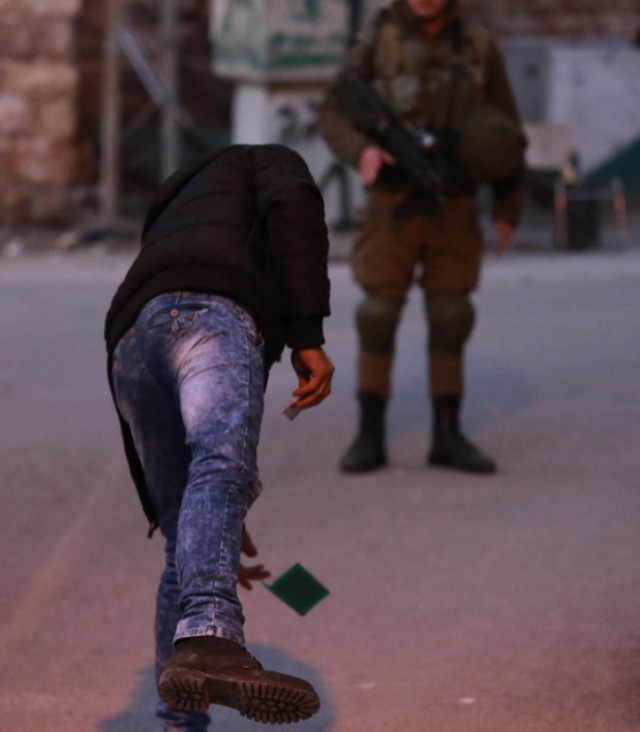
Pictured here: Regular ID check for a young Palestinian man; here at the military checkpoint set up in front of the house taken over by settlers two weeks ago. Palestinians are asked to stay at a distance and to throw their ID cards on the ground for inspection. (29 Jan 2016)
Going back to work
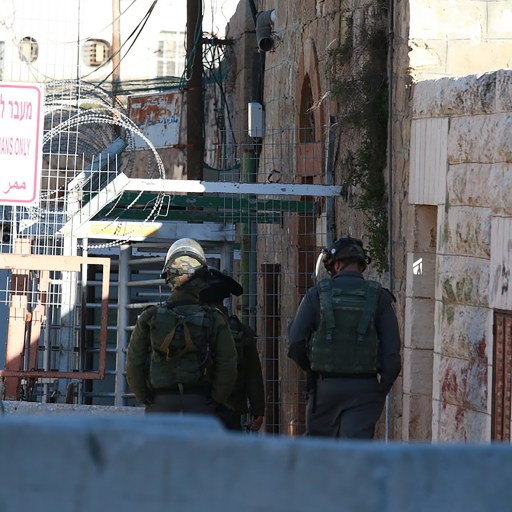
Pictured here: Fully geared up, three IDF soldiers crossed the checkpoint to throw a sound bomb and shoot a rubber bullet to disperse a group of kids. Job done, they’re heading back to their post. (04 Feb 2016)
Rooftop shadows
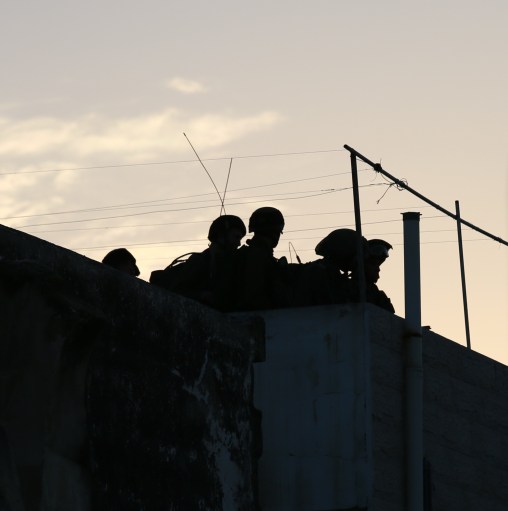
Pictured here: IDF soldiers on the roof of their building in the Old City at dusk, ready to intervene. (25 Jan 2016)
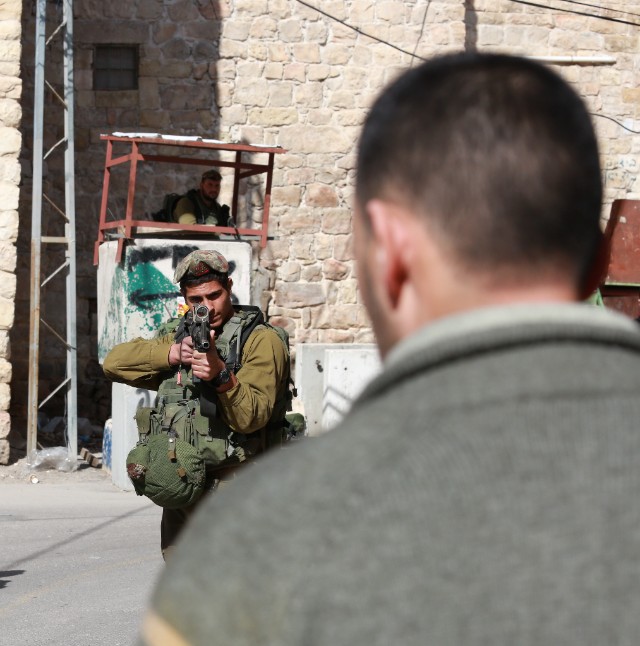
Do not move!
Pictured here: Very zealous IDF soldier, threatening a Palestinian man with his gun who refused to pull his pants down in the middle of the street. (05 Feb 2016)

Full search
Pictured here: Frisks for Palestinians men are common at every checkpoints. (05 Feb 2016)
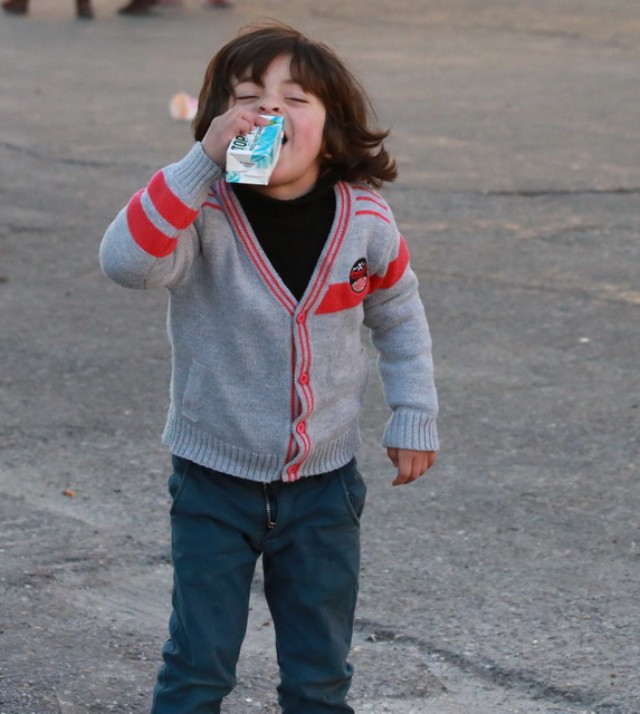
I love pictures
Pictured here: This young boy accompanies CPT every morning at Quitoun checkpoint and loves to pose for pictures, no matter what happens; it looks like it makes his day! (03 Feb 2016)
CPT mailing address: cptheb@cpt.org
Falk reprimands Ban Ki-Moon over truth about Israel’s crimes
‘The politics of deflection’ (shoot the messenger, ignore the message) exposed
By Stuart Littlewood | American Herald Tribune | February 8, 2016
With obvious relish Richard Falk, former professor of international law at Princeton and UN Special Rapporteur on human rights in Occupied Palestine, has issued a well deserved slap on the wrist to UN Secretary General Ban Ki-Moon for his naivety. It follows Israel’s furious reaction to Ban’s remark to the Security Council that “Palestinian frustration is growing under the weight of a half-century of occupation and the paralysis of the peace process”.
The usually timid Ban, suddenly emboldened, also called Israel’s illegal settlement building “an affront to the Palestinian people and to the international community”. He added: “Security measures alone will not stop the violence. They cannot address the profound sense of alienation and despair driving some Palestinians – especially young people.” Whereupon Israel’s prime minister Netanyahu, fresh from approving another 150 squatter homes on stolen Palestinian land, accused the Secretary General of giving a “tailwind to terror”.
Falk penned an open letter to Ban reminding him of his earlier attempts to get Falk dismissed from his UN job for speaking the same truths. “Having read of the vicious attacks on you for venturing some moderate, incontestable criticisms of Israel’s behaviour, I understand well the discomfort you clearly feel. What intrigues and appals me is that while I was Special Rapporteur for Occupied Palestine during the period 2008-2014, you chose to attack me personally in public on several occasions, joining with US and Israel diplomats calling for my dismissal and doing the utmost to undermine my credibility while discharging this unpaid UN job under difficult conditions.
“At the time, I was doing my best to bear witness to some of the same truths about Israel’s unlawful and immoral behavior that recently got you in similar hot water. My UN mandate was to report upon the reality of Israeli violations of international law while sustaining their apartheid regime of oppressive control over the Palestinian people.”
Referring to Ban’s concern that we are reaching “a point of no return” for the two-state solution and his reminder to the Security Council that the UN will “continue to uphold the right of Palestinians to self-determination”, Falk warns that, given present realities, self-determination must be understood as something more than just “another delusionary embrace of a diplomatically negotiated two-state solution”.
He points out that Israel’s leaders want the idea of a Palestinian state abandoned altogether and that reliance on such a discredited diplomatic path [a two-state solution] has resulted over and over again in severe encroachments on occupied Palestine and intense suffering for its people. “Clinging to the two-state mantra is not neutral. Delay benefits Israel, harms Palestine. There is every reason to believe that this pattern will continue as long as Israel is not seriously challenged diplomatically and by the sorts of growing pressures mounted by the international solidarity movement and the BDS campaign.”
Featured Video

Iran Is Not Our Enemy
or go to
Aletho News Archives – Video-Images
Frlom the Archives
The 52 Major Jewish American Organizations and Israel Celebrate Passover with the Slaughter of 25 Muslim, Christian and Secular Palestinians
By James Petras • Unz Review • April 8, 2018
Introduction
As of April 7, nearly three thousand unarmed Christian, Muslim and secular Palestinians have been wounded, over three dozen are in critical condition and at least twenty-five unarmed protestors, including children have been assassinated by hundreds of Israeli snipers and heavily armed troops shooting tank shells into crowds of civilians protesting their decades of incarceration by the racist Israeli state.
The Israeli government praised the ‘restraint and morality’ of the IDF, as did the fifty-two Major Jewish American Organizations (MJAO) who largely control the US Congress. These grotesque massacres began during the Christian Holy Week on Good Friday and Easter, coinciding with the Jewish Passover. The self-righteous officials of the MJAO and their relatives and friends broke matzos at joyful Seders as the blood of Palestinians soaked into ground at the fence containing the largest open-air prison camp in history, Gaza.
While tribal loyalties bonded the Israeli and Jewish American leaders, the politicians of the Western oligarchic electoral regimes refrained from criticizing the shocking display of brute force and even defended Israel’s cold blood mass killings of Palestinian civilians in their Gaza prison.
This paper will discuss and analyze the reasons for Israel’s willing Western accomplices and the centrality of its fifth column in the United States. … continue
Blog Roll
 Aletho News
- Israeli Journalist Demands Tucker Carlson and Candace Owens Be Placed in WWII-Style Internment Camps
- No Liability, No Studies, No Accountability: The Vaccine System Aaron Siri Exposed in Federal Court
- No time for losers: Why the war meant to save Israel may destroy it
- Top US Counterterrorism Official Resigns in Protest of Operation Against Iran
- Just Get Out! Now!
- Unpacking glaring contradictions in US-Zionist justifications for war against Iran
- Iranian model of warfare bleeds US dry while Persian Gulf states watch and learn: Analyst
- IRGC orders ‘defeated’ US to evacuate industrial facilities in region
- Hegseth’s call for ‘no mercy’ to Iranians deemed war crime
- Iran War Exposes Limits of US Military Power – Journalist
- If Americans Knew
- Trump’s counterterrorism chief, whose own wife was killed by ISIS, quits over Iran War saying Tehran posed ‘no imminent threat’
- Here’s what US could fund instead of Bibi’s war on Iran
- Israel Killed Over a Dozen Lebanese Paramedics in Three Days, Now Claiming That Ambulances Are “Hezbollah” Targets
- War on Iran: These are the heritage sites devastated by US and Israeli attacks
- Four news stories from Israeli media that illustrate Israeli “justice”
- CIA Prepares Criminal Referral of Tucker Carlson, as Israel and Its Loyalists Demand His Arrest
- Top US counterterror advisor resigns in protest of “war manufactured by Israel” – Not a ceasefire Day 157
- ‘I Liked the House’: When Israeli Soldiers Turn Palestinian Homes into Barracks
- ‘They Were All I Had’: Lebanese Father Buries Parents, 4 Daughters Killed by Israeli Bombing
- Israel and its supporters are causing attacks on Jewish institutions. Case in point: Michigan synagogue tragedy.
- No Tricks Zone
- New Research: South Australia’s Mid-Holocene Sea Surface Temperatures Were 4°C Warmer Than Today
- Storing Green Energy To Last Germany 10 Days Would Require A 60-Million Tonne Battery
- New Studies: UK Sea Levels Were 4 Meters Higher Than Today During The Mid-Holocene
- Destructive Green New Deal: German Energy And Metal Group Warns Of Drastic Crisis
- New Study Documents A 20-Year Pause In Arctic Sea Ice Decline – Driven By Internal Variability
- Wake-up Call: Survey Shows Majority Of Germans Now Favor Postponing Climate Targets!
- Televised! Leading German Political Candidate Tells Schoolchildren CO2 Makes Sun Hotter!
- New Study: A Century Warming Of 1.1°C Is ‘Commonplace’ And ‘Not Unusual’ During This Interglacial
- New Study: ‘Internal Noise’ And Volcanic Forcing Can Trigger 10-15°C Warming Within Decades
- Glaciers Worldwide Are Suddendly Surging, Experts Blame Warming!
 Aletho News