Five reasons why the TTIP talks are looking a bit wobbly
By Guy Taylor | TruePublica | February 26, 2016

The twelfth round of negotiations for TTIP, the biggest trade deal of them all, started this week in Brussels. The impacts of TTIP are disturbing and well documented elsewhere on this site, but we are seeing signs of panic setting in on the pro-TTIP side of the fence. They’re right to panic.
1) TTIP is hugely behind schedule. It should have been signed off by now, and well into the ‘legal scrubbing’ stage where the lawyers tie up the legal loose ends and smooth of the rough edges. These negotiations are not open ended. Every delay, every extra month taken up at this stage is a threat to the entire project. We have the US elections looming, two of the frontrunners are against the new generation trade deals like TTIP and the Trans-Pacific Partnership (TPP). There is no secret about the desperation of the Obama machine as they try to get the deal done and signed off before he vacates the White House at the end of the year. Obama is due to visit Germany in April to plead with all concerned to get a move on with the project. It is not impossible for the ratification vote in the European parliament to be held in 2019, after the next elections. That would make ratification in Europe very uncertain indeed.
2) There is a huge crisis over the proposals of corporate courts or ‘ISDS’ as it is often known. As the most contentious part of TTIP, it has attracted huge criticism and upset amongst members of the European parliament and in the public domain as well. In 2014, 150,000 responded to a European consultation on the issue and 97% of those responses were very negative. Since then, the trade commissioner in Brussels has dreamt up the Investor Court System as a proposed alternative. It has been made very clear that ICS is not alternative, more a repackaging of the dangerously flawed ISDS. Earlier this month,the largest association of German Judges completely slammed the ICS idea as undemocratic and undermining the sovereignty of domestic courts. Slowly, our representatives in Brussels are beginning to realise this. We need to keep shouting about this
3) You might have noticed, but there is going to be a referendum on membership of the EU in the UK in June. Everything is up for grabs. If the UK votes to leave the EU, TTIP will probably still apply to us. In the horse-trading and arguments that will rage between now and the day of the vote, there will be concessions and deals struck – maybe, just maybe, TTIP could become a casualty. And in the run up to the referendum, the very idea of Brussels politicians signing off on such a far-reaching corporate power grab is adding a whole lot of fuel to the Brexit fire.
4) Procurement at all levels of government, both sides of the Atlantic is proving to be a sticking point. The EU wants access to state level procurement in the US – that’s a huge market to access. And at country level in the EU there’s an almost equally lucrative market to exploit for US corporations. The trouble is, this isn’t a deal being negotiated at state or nation state level. The US Trade Representative and the DG Trade in Europe are doing their utmost to keep scrutiny and influence at that level to a minimum, but agreeing stuff that is essential to their underlings at local level is part and parcel of TTIP and is inflaming opposition. Local authorities across the EU and in the UK are declaring their opposition to TTIP and CETA. In the States, there’s a similar move afoot. It was recently announced that the EU and USA were going to swap procurement market access offers at the end of this month and then hold a special intercessional meeting to discuss them.
5) And finally, one thing that cannot be ignored, is the growing movement of ordinary people across the EU & the US gaining knowledge and understanding about the deals (despite the best efforts of our governments and media). From the 3.2 million people who signed their opposition in the European Citizens’ Initiative last year, to the trade unions and community organisations saying ‘no’ to the deals, we are building a force that will be hard to resist. We can win this fight if we continue to step up the pressure.
More atglobaljustice.org.uk
Israeli settlers escorted by army raid village in Salfit district
Ma’an – February 27, 2016
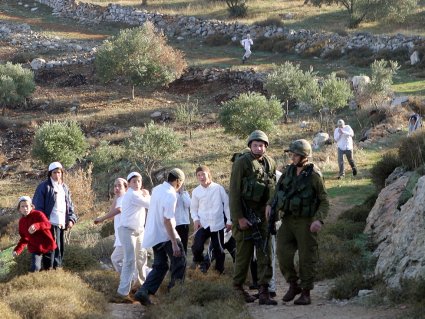
SALFIT – A group of Israeli settlers escorted by Israeli military forces raided the village of Yasuf in the northern West Bank district of Salfit on Saturday.
The head of the Yasuf village council, Hafith Ebayya, said that a group of Israeli settlers raided the village and attempted to enter the al-Basatin area in central Yasuf.
Ebayya said that the settlers were escorted by military vehicles and soldiers, and that a military checkpoint was set up at the entrance of the village.
Clashes erupted between dozens of Palestinian youths and Israeli forces.
Israeli forces fired live bullets, rubber-coated steel bullets and tear gas at youths and several farmers who were in their fields nearby.
Several youths and farmers suffered from tear gas inhalation.
An Israeli army spokesperson told Ma’an they were looking into the report.
Three quarters of Yasuf’s lands are located in Area C — under full Israeli military and administrative control. According to a report by the Applied Research Institute-Jerusalem (ARIJ), over the years, some 602 dunams (148.7 acres) of Yasuf land have been seized to establish settlement housing.
Several Israeli settlements are located near Yasuf, including Ariel, the fourth largest settlement in the West Bank. These settlements in the occupied West Bank and East Jerusalem are illegal under international law.
Syrian Army Not Returning Fire at Russian Request After Damascus Shelled
Sputnik — 28.02.2016
The Syrian army, following a request from the Russian center on reconciliation, did not return fire after Damascus was shelled Saturday from the regions of Ghuta and Jobar, the Russian Defense Ministry said in a statement Sunday.
According to the statement, the Syrian capital of Damascus was shelled six times on Saturday morning from the regions of eastern Ghuta and Jobar, where the so-called “moderate opposition” is stationed.
“The Syrian government troops did not return fire, upon the request of the Russian center on reconciliation,” the statement read.
A ceasefire between Syrian government and rebel forces that entered its second day is largely holding, the head of Russia’s ceasefire monitoring center at the Hmeymim airbase in Latakia said Sunday.
The ceasefire went into force at 22:00 GMT early Friday, or midnight Damascus time. It does not apply to designated terrorist organizations, including Daesh and the Nusra Front.
Hillary Goes to War
By Diana Johnstone | CounterPunch | February 26, 2016
When voters elected Bill Clinton president of the United States in 1992, they were also electing his wife. Bill announced the fact himself, but after the failure of her health reform plan, Hillary’s only political success was her excellent performance in the role of a faithful wife who “stands by her man”. Her brave defense of her frivolous husband was widely appreciated, but as a qualification for the highest office in the land, it seems a bit skimpy. Having played a part in wars in the former Yugoslavia might seem more presidential.
During the 2008 Democratic Party primaries, Hillary evoked the foreign policy experience she had gained as First Lady by repeatedly regaling audiences with an exciting account of her trip to the Bosnian city of Tuzla in 1996:
“I certainly do remember that trip to Bosnia,” she told audiences. “There was a saying around the White House that if a place was too small, too poor, or too dangerous, the president couldn’t go, so send the First Lady. I remember landing under sniper fire. There was supposed to be some kind of a greeting ceremony at the airport, but instead we just ran with our heads down to get into the vehicles to get to our base.”
As word got around of what she was telling audiences, Hillary’s story was rapidly denied by numerous eyewitnesses to the event, as well as by television footage showing Ms. Clinton arriving in Tuzla with her daughter Chelsea and being greeted by little children offering flowers.
Cornered by the Philadelphia Daily News editorial board during an interview in late March, 2008, Hillary Clinton was forced to acknowledge that there were no snipers, but eased her way out:
“I think that, a minor blip, you know, if I said something that, you know, I say a lot of things – millions of words a day – so if I misspoke it was just a misstatement.”
She never had to dodge sniper fire, but she does know how to dodge embarrassing questions. The fact that she utters “millions of words per day” is supposed to give her a generous quota of possible “misstatements”, or to put it more simply, lies.
The claim to have run from snipers was historically absurd and morally pretentious, in addition to being blatantly false. Four months before her visit, the hostilities in Bosnia had been decisively brought to a halt by the Dayton peace accords, signed on November 21, 1995. She could not fail to know that. Indeed, far from being sent to a place that was “too dangerous” for the
 President, the visit by the First Lady and her daughter was intended precisely to emphasize that the White House had not lost interest in Bosnia even though peace had been restored. Hillary’s spokesman Howard Wolfson had also added to the “misstatements” by claiming that she was “on the front lines” of “a potential combat zone”. Aside from the fact that there could be no “front lines” or “combat zone” when the war was over, Tuzla had never been either one. Tuzla was a largely Muslim- inhabited industrial center which had been selected as a U.S. military base, probably in part because it was a particularly safe environment.
Lying about Bosnia was nothing unusual, but this was a particularly silly, self-aggrandizing lie. Hillary evidently assumed that a brush with gunfire would be considered by the masses as adding to her qualifications to become Commander in Chief. It also showed a persistent tendency to view conflicts as occasions to display personal toughness, instead of as challenges calling for intelligent understanding of political complexities. Hillary’s claim to have braved sniper fire is not so far removed from Sarah Palin’s claim to understand Russia because she could see it from Alaska.
Hillary’s recorded statements concerning the former Yugoslavia revealed the same tendency to play to the galleries in matters of foreign policy that would mark her subsequent term as Secretary of State.
The Holocaust Pretext
In her star-struck biography of the First Lady, Hillary’s Choice, Gail Sheehy reported Hillary’s plea in favor of bombing Yugoslavia in 1999 as a major point in her favor. According to Sheehy’s book, Hillary convinced her reluctant husband to unleash the 78-day NATO bombing campaign against the Serbs with the argument that: “You can’t let this ethnic cleansing go on at the end of the century that has seen the Holocaust.”
This line is theatrical and totally irrelevant to the conflict in the Balkans. As a matter of fact, there was no “ethnic cleansing” going on in Kosovo at that time. It was the NATO bombing that soon led people to flee in all directions – a reaction that NATO leaders interpreted as the very “ethnic cleansing” they claimed to prevent by bombing. But Hillary’s remark illustrates the fact that Yugoslavia marks the start of using reference to the Holocaust as the most emotionally-potent argument in favor of war.
It was not always so. At the end of World War II, both the long- suffering survivors and those who discovered the horrors of the Nazi concentration camps wanted only to draw the conclusion that this was yet another powerful reason never again to go to war. But as time passed, by the strange chemistry of the Zeitgeist, the memory of the Holocaust has now become the strongest rhetorical argument for war. It is a sort of imaginary revisionism of past history that gets in the way of facing the present. Hillary’s sentence is a way of saying, “I would have said no to Hitler at Munich”, or “I would have bombed Auschwitz”. The history of World War II, and even world history itself, has been totally overshadowed in recent decades by the tragedy of the Holocaust to such an extent that even Western heads of State may find themselves acting out the dramas of the past instead of facing the realities of the present. The conflict in Kosovo was so obscure, so unfamiliar to Americans and so distorted by deception and self-deception , that the easiest way to think of it was by analogy with a conflict everyone knew about, or thought they knew about. The moral reward seemed immense, especially in consideration of the low cost, since it entailed bombing a country with inadequate air defenses, with no great risk to our side.
It is worth noting that Hillary urged Bill to bomb the Serbs via telephone, while she was in North Africa, touring Egypt, Tunisia and Morocco. Her guide on that trip was her new assistant, Huma Abedin, the young daughter of Muslim scholars and her trusted expert on the Muslim world. Many secular Arab nationalists in North Africa sympathized with the Serbs, due to past good relations with Yugoslavia during the days of the Non-Aligned Movement. However, Hillary had become an apprentice in learning to appreciate the fundamentalist Muslim outlook, and the Muslims of Bosnia and Kosovo enjoyed widespread, even fanatical support, in the Islamic world at this point. Did Huma assure Hillary that Muslims everywhere would applaud the Clinton administration for bombing Serbs?
Nevertheless, there are strong reasons to doubt that Hillary’s moralistic urging was the sole cause of the NATO bombing of what remained of the former Yugoslavia in 1999. Strategists were concerned with less sentimental geopolitical reasons, briefly alluded to above. But there is much less reason to doubt that Hillary did indeed urge Bill to bomb. And there is no reason at all to doubt that she boasted of this to her awed biographer, as a way of proving her “resolve” to use U.S. military power on a “humanitarian” mission. It fits her chosen image as “tough and caring”.
This article is excerpted from Diana Johnstone’s Queen of Chaos: the Misadventures of Hillary Clinton (CounterPunch Books).
The NY Times, Netanyahu’s Stenographer
By Barbara Erickson | TimesWarp | February 27, 2016
The New York Times serves as Benjamin Netanyahu’s stenographer in a story this week that reports his latest rant against critics of Israeli policy, repeating his claims at length but making no attempt to verify or even question the distortions in his response.
The Israeli prime minister was reacting to comments by British Prime Minister David Cameron, who criticized Israel’s settlement construction in and around East Jerusalem during a session in parliament Wednesday, saying that he found the situation “genuinely shocking.” The Times, which made no mention of Cameron’s remarks at the time, now presents us with an article by Isabel Kershner framed around the official Israeli response.
Her story, “Benjamin Netanyahu Rebukes David Cameron for Criticizing Israel,” gives much space to the prime minister’s assertions and allows him the final word. It also quotes Jerusalem Mayor Nir Barkat and allows the comments of both men to stand without challenge.
Netanyahu, speaking at a political meeting Thursday, portrayed Israel as the peacekeeper in East Jerusalem, saying that “only Israeli sovereignty” has prevented ISIS “and Hamas from igniting the holy sites as they are doing all over the Middle East.”
He implied that Israel has brought prosperity to Palestinian residents of East Jerusalem, citing “roads, clinics, employment and all the other trappings of normal life that their brethren do not enjoy elsewhere in the Middle East.” Mayor Barkat also stated that Israel is building “the newest, most advanced schools” for Palestinian youth and paving new roads for residents.
The Times made no attempt to challenge the veracity of these comments although they grossly misrepresent the situation Palestinians face in occupied East Jerusalem. The data is available for all to see and is certainly familiar to Kershner and Times editors.
For instance, as of January 2011:
- Entire Palestinian neighborhoods were not connected to a sewer system and lacked paved roads and sidewalks.
- West Jerusalem had 1,000 public parks compared to 45 in East Jerusalem.
- West Jerusalem had 34 swimming pools; East Jerusalem had three.
- Nearly 90 percent of the sewage pipes, roads and sidewalks in the city were found in West Jerusalem.
- West Jerusalem had 26 libraries; East Jerusalem had two.
More recent news also belies the claims of Netanyahu and Barkat. Far from working to provide education, health care and road access for Palestinian residents, Israeli policies and actions have made life more and more difficult for the non-Jewish residents of the city:
- In 2015, Israel placed dozens of Palestinian children under house arrest in East Jerusalem, preventing them from attending school.
- The Israeli government has been working with settler groups to dispossess Palestinians of their homes.
- More than a third of East Jerusalem students are unable to complete high school because there are not enough classrooms. (Under an order by the Israeli High Court, some new classrooms are being built, but these will only alleviate the shortage by half.)
- Some 38 percent of East Jerusalem’s planned areas have been confiscated for the development of Jewish settler neighborhoods, while only 2.6 percent is zoned for public buildings—such as schools—for the city’s indigenous Palestinians.
- Israeli invasions of Makassed hospital in East Jerusalem hospital and restrictions on patients attempting to enter the hospital prompted several United Nations agencies to condemn the actions as violations of international law.
- By Feb. 22, Israeli forces had demolished 27 Palestinian-owned structures in East Jerusalem, including a school, since the beginning of this year.
Kershner’s story, however, makes no mention of any of this. The focus here is solely on the Israeli show of outrage. Netanyahu and Barkat’s statements are allowed to stand, even the claim that Hamas and ISIS are working together to foment terrorism. In fact, the two are bitter enemies, but the Times has no interest in disabusing its readers of this inconvenient fact.
Cameron’s statements gave the Times an opening, a chance to examine the settlement enterprise, conditions in East Jerusalem and the attitudes of Palestinian leaders and citizens living under Israeli control. But this was not to be. Only the Israeli narrative was of interest to the Times, and even the prime minister of the United Kingdom could not make his voice heard above its strident demands.
Italian Decision to Permit US Attack UAVs Contradicts Constitution
Sputnik – February 27, 2016
In an interview with Sputnik, military expert Antonio Mazzeo described Rome’s decision to allow armed US drones to fly from the Sigonella military base in Sicily to Libya as a gross violation of the Italian Constitution.
According to him, the move will further add to the militarization of the Sigonella base.
He said that even the deployment of unarmed Global Hawk drones to Sicily nine years ago, was not quite in line with the nation’s constitutional provisions limiting the use of Italian military facilities to self-defense, given that their task is to detect targets for bombers.
“Even if they do not carry missiles, they can be called a weapon of attack, destruction, and the first strike,” Mazzeo said. Article 11 of the 1948 Italian Constitution states that “Italy repudiates war as an instrument offending the liberty of the peoples and as a means for settling international disputes.”
His remarks came after Italian Defense Minister Roberta Pinotti confirmed earlier this week that the United States had been given permission to use the Sigonella base to carry out drone strikes on Daesh targets in Libya.
Merkel Asks German Businesses to be Patient With Anti-Russian Sanctions
Sputnik – February 27, 2016
German Chancellor Angela Merkel asked for business representatives reeling from the costly effects of anti-Russian sanctions to remain patient at the Christian Democratic Union’s (CDU) economic conference, the German news agency DPA reported.
“The sanctions have hit some sectors of the economy hard,” Merkel said in her annual address to the conference in Stralsund, northeast Germany, on Friday.
She told those present that the anti-Russian sanctions, which resulted in a 25 percent (7.5 billion euros, $8.2 billion) drop in German exports to Russia last year, will be lifted in accordance with the Minsk Agreements that the representatives of France, Germany, Ukraine and Russia agreed upon in February 2015.
There is no evidence that Russia has not fulfilled the conditions of the agreement, and earlier this month Russia’s Permanent Representative to the Organization for Security and Co-operation in Europe, Alexander Lukashevich, told the OSCE’s Permanent Council meeting about Moscow’ concern that Kiev is not carrying out its obligations under the agreement.

© Sputnik/ Irina Geraschenko
Breaches of the agreement include the bombardment of residential homes by the Ukrainian military, the shelling of a trip by the Principal Deputy Chief Monitor of the OSCE Special Monitoring Mission to Ukraine, and Kiev’s failure to pass legislation that would provide a special status to the eastern regions of Donetsk and Lugansk.
“One of the key problems is that our colleagues pretend that Kiev is faithfully complying with the Package of Measures. In fact, it’s the other way round,” Lukashevich said.
“The Minsk Package of Measures is the foundation of the peace process via a direct dialogue between the parties to the Ukraine conflict. It provides a framework for a sustainable solution to the crisis, and defines the principles of conserving the Donetsk and Lugansk regions as part of Ukraine with constitutional and legislative guarantees ensuring the rights of the people of Donbass.”
Read more: ECHR to Review 551 Complaints From Donbass Residents on Rights Violations
Featured Video
Theodore Postol: Iran’s Missiles & Drones Were Underestimated
or go to
Aletho News Archives – Video-Images
From the Archives
What is the Israeli Lobby in Australia Doing in Interfaith Dialogue?
By Ali Kazak | Dissident Voice | October 11, 2015
For years Israel and its lobby around the world have been trying to normalise their relations with Arabs and Muslims without solving the Palestine Question.
One of the methods they resorted to in the last few years is using human rights and community organizations such as interfaith dialogue and Multiculturalism to achieve this objective and to: isolate the Palestinians, marginalise the Palestine question, end Israel’s isolation, and prevent criticism of Israel, knowing that these organisations will be the first to stand against Israel’s violations, racial and religious discrimination.
The group responsible for this task in Australia is The Australia/Israel & Jewish Affairs Council (AIJAC); its Director of International & Community Affairs, Jeremy Jones is in charge of lobbying religious community organizations, specifically Muslims and Christians. Consequently he convened the Faith Communities for Reconciliation, founding participant in the Australian Partnership of Religious Organisations and the Australian National Dialogue of Christians, Muslims & Jews.
AIJAC is a private political propaganda group. It is recognised as the main Israeli lobby in Australia. It coordinates its activities and works intimately with the Israeli embassy in Canberra and different institutions in Israel. It is privately funded by some Jewish businessmen. It monitors closely Australian politicians, the media, ethnic and religious groups, (especially Arabs and Muslims), unions and academics on their stands towards Israel and the Palestine question. … continue
Blog Roll
 Aletho News
- The Most Important Bet You’ve Never Heard Of
- The killing of three Indonesian soldiers in Lebanon should remind Jakarta that Israel does not want peace
- Defeated and delusional: Netanyahu’s remarks reveal $80bn war failure, says analyst
- Iran’s friends are about to make life much more difficult for Israel and the US
- The war of liberation of the Arab and Islamic peoples expands across the Gulf
- Envoy warns UN on Trump’s threat to ‘obliterate’ Iran’s civilian infrastructure
- The Larak Corridor: Iran’s Rial Gate With No US, No Israel, and No Way Around
- ‘Economic terrorism’: Steel facilities hit again in US-Israeli strike
- ‘War Crime’: Iran condemns attacks on Arak, Ardakan nuclear sites
- Two-thirds of Americans want quick end to Iran war even if goals unmet
- If Americans Knew
- Gaza families reunite years after babies evacuated amid Israel’s war
- International Rescue Committee warns Gaza’s children face grave protection risks
- Iran’s Alleged 47-Year War on America: Debunking the 1,050 American Deaths Canard
- Israel wants US to bomb more of Iran’s civilian structures (113,000 is not enough) – Not a ceasefire Day 173
- Ann Coulter Rips Into Fox News for Iran War Coverage
- Joe Kent Urges Americans To Call White House and Congress To Object To Sending Troops Into Iran
- DNC Resolution to Reject AIPAC Funding Puts Democratic Leaders in the Hot Seat
- Swedish foundation to build 400 schools as over 650,000 Gaza children remain without education for 2 years
- Israeli army admits photshopping image of slain Lebanese journalist
- This is how Israel is systematically killing health workers under the cover of war in Lebanon
- No Tricks Zone
- New Study Finds Warming Saves Lives…Cold Temperatures 12 Times More Deadly Than Excess Heat
- German Science Blog Accuses PIK Climate Institute Of Hallucinating Climate Tipping Points
- Devastating Assessment Of Comirnaty Vaccine By Former Senior Pfizer Europe Toxicologist
- New Study: CO2 Is ‘Effectively Negligible’ As An Explanatory Climate Change Factor Since 2000
- Former Pfizer Toxicologist Dr. Helmut Sterz Tells Bundestag Hearing Pfizer Vaccine Should Have Never Been Approved
- Energy Expert: Germany’s Nuclear Phaseout Was A “500 Billion Euro Mistake”
- New Research: South Australia’s Mid-Holocene Sea Surface Temperatures Were 4°C Warmer Than Today
- Storing Green Energy To Last Germany 10 Days Would Require A 60-Million Tonne Battery
- New Studies: UK Sea Levels Were 4 Meters Higher Than Today During The Mid-Holocene
- Destructive Green New Deal: German Energy And Metal Group Warns Of Drastic Crisis
 Aletho News