22 years after the Ibrahimi mosque massacre, Palestinians still suffer consequences

International Solidarity Movement | February 25, 2016
Hebron, Occupied Palestine – On the 25th of February 1994, a US citizen residing in the illegal Kiryat Arba settlement entered the Ibrahimi mosque in the early morning during the month of Ramadan. Baruch Goldstein, dressed in his army uniform, opened fire on the Palestinians that were crammed inside for the prayer. He killed 29 men and boys and injured dozens before people overpowered him and beat him to death.
That day, many more Palestinians were killed in Hebron during riots protesting the massacre that had occurred, in front of the mosque and the hospital where the injured were treated, as well as in the cemetery were the dead were being buried. In the next few days, protests and marches happened all over the West Bank and across historic Palestine. It is believed that in total, in these few days, 50 to 70 Palestinians were killed, and over 250 were injured.
Immediately after the attack, the Israeli government released a statement condemning this act and affirming that Goldstein was acting on his own behalf. The Prime Minister Yitzak Rabin called Goldstein a “degenerate murderer, a shame on Zionism and an embarrassment to Judaism.” Rabin always affirmed that Goldstein acted on his own behalf and that the Israeli military had no knowledge of his plans. Though his act was condemned, it resulted in many measures that mostly impacted on Palestinians. Instead of evacuating the settlements of Hebron, only a few of the most extreme settlers were temporarily disarmed.
A round-the-clock curfew was imposed. Shops in Shuhada Street were forced shut by the Israeli army, on the pretext of keeping settlers safe on this commercial artery. Many other shops also had to close due to lack of supplies and customers. New checkpoints were installed. Palestinians were first banned from driving and then simply from accessing most of Shuhada Street. Many of these measures resulted in the displacement of many Palestinian families.
In 1997, a protocol was signed between Israel and the PLO, dividing Hebron into two areas: “H1”, controlled by Israeli forces, and “H2”, under Palestinian control. It called for the withdrawal of Israeli soldiers from the H1, which represented 80% of the city. To this day, even though H1 is officially controlled by the Palestinian Authority, it remains under overall Israeli control, while H2 is now the home to many violent and extremist settlers. Some of them still go every year to the tomb of Baruch Goldstein to celebrate his treacherous act of murder.
22 years later, all measures that were declared in Hebron on the 25th of February, 1994 are still enforced, except for the curfew. And settlers are more than ever taking over the city, with the compliance of the Israeli government.
The last tiny bit of Shuhada Street, that was not (yet) declared a ‘sterile zone’ and thus been completely barred for Palestinians, has been under repeated ‘closed military zone’ orders since 1st November 2015. Whereas the majority of Shuhada Street has been completely unaccessible for Palestinians, the tiny strip leading from the recently ‘renovated’ Shuhada checkpoint up to the illegal Beit Hadassah settlement, is slowly resembling a ‘ghost street’ more and more, as only Palestinians registered with the Israeli army are allowed to go there.
The closed military zone order is an illegal collective punishment on the whole Palestinian population of this area, that was forced to register in order to be allowed to live in their own houses whereas settlers in the adjacent illegall settlements can walk the roads freely and completely undisturbed. This clearly is just another step in the Israeli policy of making life for Palestinians as hard and humiliating as possible in an attempt to make them leave the area and eventually drive all of them out and connect the settlements.
Every year, Palestinians in occupied al-Khalil commemorate the Ibrahimi mosque massacre and protest against the closure of Shuhada Street and the illegal Israeli occupation. The week, leading up to the 22nd anniversary of the massacre, has seen and will continue to see creative activities and demonstrations. This past week there were also many commemorations of Palestinians, most of whom have been gunned down by Israeli forces and left to bleed to death without any medical help.
Iran offers $30,000 to families who lost their homes in intifada
MEMO | February 25, 2016
Iran will pay $30,000 to every family whose home was demolished by the Israeli occupation forces during the ongoing Jerusalem Intifada and $7,000 for every family who’s lost a relative, the ambassador to Lebanon said yesterday.
Mohammad Fateh Ali made the announcement in a press conference in Beirut, calling on the Arab and Muslim nations to unite around the main Arab and Muslim project – Palestine.
Former Hezbollah MP Hassan Hoballah called on Arab and Muslim countries to open their embassies to support Palestinians.
The Deputy Head of the Popular Front for the Liberation of Palestine, Talal Naji, said that this is not the first time Iran has made a generous offer to Palestine.
America’s Plan B: Supporting Terrorists Till the Bitter End
By Martin Berger – New Eastern Outlook – 25.02.2016
At a time when the international community is looking forward to the possibility of putting an end to the bloody conflict in Syria that has dragged on for years, while putting their hopes behind the agreement that was achieved between the US and Russia on February 22 regarding the cessation of all hostile activities in Syria, certain forces in the United States carry on banging the war drum.
As it has been pointed out by the The Wall Street Journal :
Defense Secretary Ash Carter; Marine Gen. Joseph Dunford, chairman of the Joint Chiefs of Staff; and Central Intelligence Agency Director John Brennan have voiced increasingly hawkish views toward Moscow in recent White House meetings, calling for new measures to “inflict real pain on the Russians,” a senior administration official said.
Moreover, those gentlemen are somehow convinced that Moscow will break the ceasefire, so they have formulated a “Plan B,” that will imply the strengthening of their support to extremists and the introduction of new sanctions against Russia.
Of course, one could only be amazed by such behavior from Washington’s “hawks” if one did not take into consideration the evidence exposing their direct involvement in the continuous aggravation of the situation in Syria, which makes them directly responsible for the deaths of thousands of civilians. Those actions would for sure present the perfect subject for a careful investigation of an international tribunal.
In particular, according to the facts presented by Daveed Gartenstein-Ross and Nathaniel Barr in the Daily Beast, the CIA is now assisting the terrorist organizations that the United States has been allegedly fighting for 15 years. This program was launched in 2013 to further aggravate the armed conflict in Syria. According to this publication, at least one of these CIA-backed groups severed its ties with the CIA and joined a listed terrroist-led coalition, Later, Associated Press reported that CIA-backed groups are gaining ground in Syria, “fighting alongside more extremist factions.”
The article concludes:
Analysis of the geography of “moderate” rebels’ gains during this period and reports from the battlefield demonstrate that CIA-backed groups collaborated with Jaysh al-Fateh, an Islamist coalition in which Jabhat al-Nusra—al Qaeda’s official Syrian affiliate—is a leading player…
and
At this point it is impossible to argue that U.S. officials involved in the CIA’s program cannot discern that Nusra and other extremists have benefited. And despite this, the CIA decided to drastically increase lethal support to vetted rebel factions following the Russian intervention into Syria in late September.
The authors are convinced that now it’s more important than ever to organize a public debate in the US about the role that the CIA played in the Syrian conflict and the considerable strengthening of radical groups.
It would be no less interesting to take a look at yet another investigation of the criminal role American intelligence agencies played in the inciting of the Syrian conflict that was published in The New York Times. The authors, Mark Mazzetti and Matt Apuzzo described in detail how the United States was using Saudi money to provide radical militants in Syria with lethal weapons. Yet, this is but an episode in the continuous and vicious cooperation between Saudi and American security agencies that lasted for decades. The alliance was in place during the Iran-Contra scandal, the hidden fight against Soviet troops in Afghanistan and countless proxy wars in Africa.
These forces are actively involved in the Ukrainian conflict, openly opposing any form of peaceful settlement, pushing all the blame on Russia while Turkey is pulling the strings behind the stage and sending radical mercenaries to Ukraine.
Therefore, one shouldn’t be surprised that this Plan B will be put into action regardless of the facts surrounding how the parties actually observe the agreements reached or even before it’s imposed. It would be safe to assume that the CIA will be put in charge of the operation, funded with the money provided by Saudi Arabia, therefore we can await provocations and misleading articles about how it is Russia who is continuing with provocations, not these forces hidden in plain view.
That is why today the international community is tasked with preventing the failure of the recent agreement between the leaders of the US and Russia by exposing those “hawks”, namely the CIA, the Pentagon, and Saudi intelligence services.
Using terrorists as pawns prolongs Middle East crises: Lavrov
Press TV – February 25, 2016
Russian Foreign Minister Sergei Lavrov says the crises in the Middle East will not be settled as long as terrorists are used as pawns in pursuit of certain geopolitical agendas.
The fight against terrorism “cannot be successful if attempts are not stopped at using terrorists as pawns in doubtful geopolitical games,” Lavrov said in Moscow on Thursday.
“The further degradation of the situation presents a serious threat for the entire international architecture,” he told a session of the Valdai International Discussion Club.
“Obviously a strong stability of the situation is impossible without the destruction of the center of the terrorist threat, first and foremost Daesh,” he said.
During the session, Russian Deputy Foreign Minister Mikhail Bogdanov said Moscow was concerned about statements from US officials about alternatives to a plan for the cessation of hostilities in Syria.
“We are concerned about claims of certain Western partners, including the United States, about the existence of a certain ‘plan B.’ We know nothing about it, and we are not discussing any alternate plans.”
The United States and Russia announced on February 22 that they had reached a deal for a “cessation of hostilities” in Syria, which would begin on February 27.
The Syrian government said the following day that it accepts the terms of the deal on the condition that military efforts against Daesh and the al-Qaeda-linked al-Nusra Front continue.
In the lead-up to the agreement, US Secretary of State John Kerry said the US had a “plan B” for military action to enforce if the cessation of hostilities failed.
Bogdanov, who serves as President Vladimir Putin’s special envoy to the Middle East, said Russia expects the US to negotiate the implementation of the agreement with the Syrian opposition.
“Russia is doing the necessary work with Damascus and the legitimate Syrian leadership. We expect the United States to do the same with groups allied with them and supported by them,” he said.
The Russian diplomat also said the notion of setting up a buffer zone in Syria and to launch a ground operation in the war-hit country could only exacerbate the situation.
“Steps that could further worsen the Syria crisis cause our great concerns. In particular, this includes attempts to implement the idea of setting up a buffer zone on the Syrian-Turkish border and putting together some blocs for a land operation.”
Bogdanov was referring to Ankara’s plans to set up a buffer zone and by send ground troops into Syria by Turkey and Saudi Arabia.
Abe Goes to Russia for Access to Energy Sources Despite Obama’s Request
Sputnik – 24.02.2016
Japan is continuing preparations for an unofficial visit of Japanese Prime Minister Shinzo Abe to Russia, secretary general of the Japanese government Yoshihide Suga said. In an exclusive interview with Sputnik, former Russian Ambassador to Japan Alexander Panov clarified Japan’s intentions and explained its “disobedience” to Washington.
Earlier, during a telephone conversation with Abe, US President Barack Obama asked him to refrain from visiting Russia in May, but the Japanese politician has refused his advice. In some media, this move has almost been regarded as a sign of a Japanese rebellion against the dictatorship of the United States.
However, according to Panov, Japanese authorities on the contrary stick to a very “balanced” position. On the one hand, they are planning Abe’s trip to Russia, and on the other they are coordinating their efforts with the US and other Western countries.
“On the one hand, Abe is preparing for his visit to Moscow, on the other he is trying to sooth his partners saying that it [the visit] won’t cause serious damage to a common position of G7, especially regarding Ukraine,” the expert said.
Panov argued that Abe’s visit to Russia is most likely to take place as planned. According to him, both parties may be interested in discussing bilateral economic cooperation.
“Maybe it is not a coincidence that the restrictions on the acquisition of controlling stakes in a number of Russian hydrocarbon deposits by Japanese companies are announced to be removed,” the expert said.
“Japan asked for this for a long time, but Russia did not go for it and made exceptions only for China. Now it will be possible to find a formula of Japanese participation in such projects, in spite of the sanctions,” Panov explained.
Regarding the resolution of a long-standing dispute between Russia and Japan over four Pacific Ocean islands, the expert, however, remained skeptical.
“The parties stick to the same positions. The Russian side proceeds from the fact that the ball is on the Japanese side, and Japan should offer some sort of compromise,” the expert concluded.
Beijing Sees Nothing Anti-Chinese in TPP Deal
Sputnik – 23.02.2016
BEIJING — Beijing does not consider the Trans-Pacific Partnership (TPP) free trade deal to be directed against China, the country’s Commerce Minister Gao Hucheng said Tuesday.
“We do not think that the TPP deal is directed against China. We also do not think that the TPP deal and the Regional Comprehensive Economic Partnership [RCEP] contradict each other. I think they supplement each other,” Gao said at a press conference.
According to the minister, the official text of the agreement has been completely translated into Chinese and some time is needed to analyze the deal.
Gao noted that China always positively regarded transparent regional free trade agreements.
In early February, the United States, Australia, Brunei, Canada, Chile, Japan, Malaysia, Mexico, New Zealand, Peru, Singapore and Vietnam signed the TPP agreement. Under the TPP deal, a free trade zone was established between these 12 nations that constitute 40 percent of the world’s GDP. The agreement is to be ratified by every participant.
The US President Barack Obama administration had noted previously that the TPP would allow the United States to write the rules of global trade in the 21st century.
US marshals shoot innocent man in back ‘execution style’ during raid on wrong address: attorney
By David Edwards | Raw Story | February 24, 2016
A New Mexico attorney accused U.S. marshals this week of shooting a 23-year-old man in the back “execution style” when they arrived at the wrong address to make an arrest.
According to KOB, marshals were attempting to execute an arrest warrant for George Bond in Albuquerque on Saturday, but mistakenly opened fire on a home three trailers away from the suspect’s.
The family of 23-year-old Edgar Alvarado confirmed that he was fatally shot by agents.
“They said that they had made a mistake because he was out there at the wrong time. No such a mistake by killing somebody. There’s no accident,” Perla Alvarado, cousin of the victim, told KOB.
At a press conference on Monday, an attorney for the family accused federal agents of shooting Alvarado four times in the back, the Albuquerque Journal reported.
“It’s almost inexplicable, but we have evidence … that Edgar was dragged from the house, after having been struck multiple times, taken outside, given commands to give up a weapon, as he’s gurgling and flailing his arms, and shot a fourth time,” attorney Robert Gorence said. “Almost what you would call ‘execution style.’”
According to Gorence, multiple eyewitnesses had said that Alvarado was shot in the back the fourth time when he was not able to respond to agents’ commands.
“When you do things in the middle of the night, and go to the wrong address, when you don’t know the individual’s name or have a picture of the person you are looking for, is it any surprise you have catastrophic and horrific outcomes?” Gorence noted. “At 3:30 in the morning, when you go to the wrong place in a lock-and-load mentality, it’s kind of easy to see what happens.”
The attorney said that he had sent a letter to Damon Martinez, U.S. Attorney for the District of New Mexico, asking for more details about the case to be released. He said that a federal tort claims notice would be filed by the end of the week.
“All we’re asking right now is to get answers,” Gorence insisted. “So far that has been completely stonewalled.”
New Mexico State Police are investigating the incident, and have only stated that U.S. marshals shot Alvarado during a “confrontation.”
Why It’s Dangerous to Conflate Hamas and Daesh
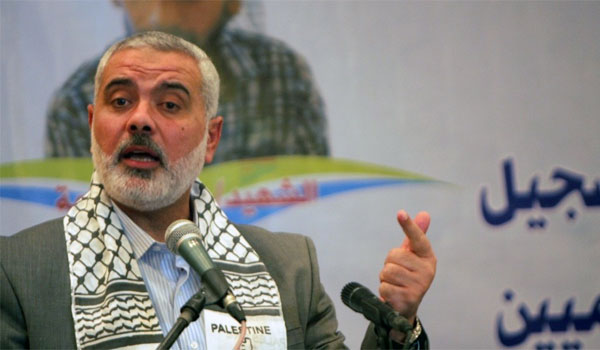
Hamas Prime Minister in Gaza, Ismail Haniyeh
By Belal Shobaki – Al-Shabaka: The Palestinian Policy Network – February 22, 2016
Overview
While Israel’s efforts to link Palestinian resistance to its military occupation to global terrorism are not new, it has expanded its propaganda to address Arab as well as Western audiences. By so doing, it is clearly seeking to exploit the global aversion to movements that have drifted towards extremism and terrorism while claiming to represent Islam. “Hamas is ISIS and ISIS is Hamas,” Israeli Prime Minister Benjamin Netanyahu declared at the United Nations in 2014. Yet better than anyone else, Netanyahu and the Israeli political establishment know that Hamas and Daesh are not related, as do those Arab regimes that also tar all Islamic movements with the same brush to serve their own ends. 1
Not only are Hamas and Daesh unrelated, they are bitter enemies, and Daesh has denounced Hamas as an apostate movement. Al-Shabaka Policy Analyst Belal Shobaki discusses the major ways in which Hamas differs from Daesh including its approach to jurisprudence; the position vis-a-vis the nature of the state; and relations with other religions. He makes the case that it is especially important for the Palestinian national movement to rebut the attempts to conflate Hamas with Daesh and points out the dangers of not doing so.
Serving Short-Term Political Gain
The conflation of Hamas with Daesh ignores reality on the ground. The political environment in Palestine is defined by the occupation, whereas the political environment in the Arab countries where Daesh emerged is defined by authoritarianism and repression as well as sectarian and religious conflicts, an ideal environment for the emergence of a radical ideology motivated by indiscriminate violence.
For Israel, however, the attempt to link the two may pay off regionally and internationally. Many Arabic media outlets have no qualms about referring to this terrorist organization as an “Islamic” State although it is anything but, while many Western media outlets embrace the Israeli conflation of Hamas and Daesh without scrutiny. Arab regimes are uninterested in defending the image of Hamas. Even the Palestinian Liberation Organization (PLO) does not seem concerned with defending Hamas’s international image given the political division between Fatah and Hamas.
Hamas is considered part of the Muslim Brotherhood, which is seen as a threat to authoritarian Arab regimes, particularly in the Arab Mashreq. Thus one way for Arab regimes to fight the Muslim Brotherhood is by claiming it shares common ground or is even synonymous with Daesh, as claimed by the Egyptian regime, and then using this as a justification for excluding the Muslim Brotherhood from participating in political life.
The rapid developments of the past five years in Egypt, the country that provides the only outlet for the Palestinian Gaza Strip, has pushed Hamas into its informal tunnels economy. The official Egyptian stance after Abdel Fattah Sisi’s coup against elected president Mohammad Morsi became tougher against the Gaza Strip, with claims that Hamas was cooperating with Jihadist groups in the Sinai, the same narrative promoted by Israel and its media. However, this narrative is flawed. It is too risky for Hamas to maintain a close relationship with Sinai jihadists, on the one hand, while cracking down on individuals embracing the same ideology in Gaza, on the other. Any links Hamas has established with those groups is limited to securing the needs of the enclave besieged by Israel and Egypt. This interaction is not motivated by a shared ideological identity or shared enmity towards the Egyptian regime. Indeed, Hamas has been eager to keep communication lines open with the Egyptian regime even when accusations conflating Hamas with Sinai’s Salafi Jihadi groups were made in the media. Hamas has also repeatedly said that it is keen on rebuilding the relationship with Egypt in order to ensure the legal flow of goods, services and individuals into Gaza.
It is important to refute this narrative concerning one of the largest Palestinian political movements: Excluding moderate Islamists from political life carries the danger of pushing Palestinian society towards radicalism, in which case both Fatah and Hamas will find themselves fighting takfiri groups. The ensuing discussion will demonstrate the real differences between Hamas and Daesh as well as the very real enmity between them.
Differences in Doctrine
Hamas positions itself as a centrist Islamic movement and an extension of the Muslim Brotherhood, with a rational jurisprudential authority, whereas Daesh adopts a text-based approach that deals with Islamic texts in isolation from their historical context and refuses to interpret them in line with current developments. Hence, for Daesh and other takfiri groups in general, movements like Hamas are secular and un-Islamic, since Hamas is primarily a resistance movement against the Israeli occupation and believes in a moderate Islamic authority. Moreover, Hamas does not take Islamic texts literally; it allows for ijtihad – interpretation and use of discretion. Some scholars have categorized these movements along a horizontal line with the right representing advocates of the text and the left representing advocates of reason. 2 Using this classification, the Muslim Brotherhood can be found a good way down the left of the line, while Daesh is on the far right.
Daesh characterizes Hamas and its discourse as deviant. Hamas for its part has condemned Daesh’s threats and considered these part of a smear campaign that extends beyond Palestine. When threats from Daesh and other takfiri groups materialized into action, Hamas no longer stopped at condemnations. Mahmoud al-Zahar, a prominent Hamas leader, declared “Daesh’s threats can be felt on the ground, and we are handling the situation from a security standpoint. Whoever commits a security offense shall be dealt with in accordance with the law, and whoever wants to debate intellectually shall be debated intellectually; we take this matter seriously”.
Hamas had in fact dealt decisively with a Daesh-like group. In August 2009, Abdul Latif Musa, leader of the “Jund Ansar Allah” (Soldiers of God’s Supporters) armed group, announced the creation of the Islamic Emirate in Gaza at the Ibn Taymiyyah Mosque. The group had previously been accused of destroying cafes and other venues in the Gaza Strip, pushing the Hamas government into a confrontation. Security forces, reinforced by the al-Qassam Brigades (Hamas’ military wing), encircled the Ibn Taymiyyah Mosque and, when Musa’s group refused to surrender, Hamas ended the emirate project in its infancy by killing the members of the group. Hamas was criticized for its use of violence but justified its actions by arguing that the violence that could have been perpetrated by such groups would have been much worse than that used to eradicate extremism in the Gaza Strip.
Daesh’s supporters in Gaza are far fewer than Hamas’s, mainly due to the fact that these groups have not historically contributed to resisting the occupation. Some polls suggest that 24% of Palestinians think positively of jihadist movements, but this percentage is exaggerated. When some Palestinians cheer for the jihadist groups’ hostility towards the US, it is not because they believe in these groups but rather because they see the US, with its infinite support for Israel, as being playing a destructive role.
Different Stances on Statehood
Hamas and Daesh differ in their view of the modern state, in both theory and practice. As noted above, Hamas has always allowed for ijtihad or discretion, evolving its thoughts and opinions. It is thus unfair to assess Hamas’s stance on the civil state and democracy based on the early literature of the mother movement, the Muslim Brotherhood. Hamas maintains that it has embraced new convictions in this regard and has come to fully accept democracy and the concept of the civil state. Indeed, the Muslim Brotherhood itself has evolved. Qatar-based Sheikh Yusuf al-Qaradawi, the jurisprudential authority of the Muslim Brotherhood at large, has stated on multiple occasions, including in his book “The State in Islam”, that the concept of the religious state does not exist in Islam. According to al-Qaradawi, Islam advocates for a civil state founded on respect for the people’s Islam-based opinion, and also founded on the principle of accountability and political pluralism. Although the discussion about the relationship between Islam and democracy predates the Muslim Brotherhood, it gained clarity after the 1950s, when numerous Islamic thinkers, including al-Qaradawi, the Tunisian leader and Ennahda co-founder Rached Ghannouchi and the Algerian philosopher Malek Bennabi, affirmed that Islam and democracy were not in contradiction with each other.
At the opposite end, the movement that Daesh represents rejects democracy in its entirety and considers it an apostate system of governance. Although some jihadist groups do not denounce Islamists who take part in the democratic process as apostates, they do consider their discretion flawed. Daesh views any expression of democracy such as elections as a manifestation of apostasy and any movement or individual taking part in elections as apostates. By contrast, the Muslim Brotherhood participated in elections from its earliest days, when its founder Hassan al-Banna decided to run in the Egyptian parliamentary elections that El-Wafd Party Government sought to hold in 1942. Although al-Banna could not run because the government rejected his candidacy, the Muslim Brotherhood has served in Arab parliaments and sometimes in the executive branch.
When Hamas decided not to participate in 1996 Palestinian Authority elections its position was based on a political and ideological stance towards the Oslo Accords. However, Hamas allowed its members to run in the elections as independents. When the circumstances changed and the 2005 Cairo Agreement became the governing framework for the PA elections instead of the Oslo Accords, Hamas decided to participate. It nominated many members in the movement and some independents to a Change and Reform list to run for the Legislative Council, winning the majority of votes.
By participating in the elections, Hamas has offered evidence that it is willing to function in a modern state and a democratic system. It has called for coalition governments inclusive of leftist and secular parties. Its government as well as its parliamentary list included women and its first government included Muslim and Christian ministers.
Daesh, on the other hand, has turned against all modern institutions in the areas under its control, refusing to recognize borders or national identity. It rules through chaotic and individual decisions. Although Daesh has been eager to use administrative terms derived from the Islamic tradition such as caliphate and shura (consultation), the essence of its governance contradicts the majority of unquestionable texts in the sources of Islamic legislation in many ways. For example, it does not abide by the conditions established in the Quran and sunna (the Prophet Mohammad’s teachings) to declare war or the protection of civilians and treatment of prisoners in wartime. Another example is its imposition of jizya (a tax that was levied on non-Muslim subjects), which is not supposed to be applied to the indigenous inhabitants even if they are non-Muslim. Moreover, it has attacked places of worship and assaulted the faithful in their homes, in clear violation of the Quran and sunna.
Daesh, to some extent, resembles hybrid regimes in the Third World that use modern and democratic vocabulary to describe their political process, even though they remain authoritarian in essence.
Polar Opposites in Treating the Other
The most significant difference between Hamas and Daesh is their position towards followers of other religions. During its formation, Hamas published a charter that used religious vocabulary to describe the conflict. Following severe criticism, Hamas effectively sidelined this Charter and no longer considers it an authoritative reference as some of its leaders have confirmed.
In his interview with The Jewish Daily Forward deputy head of the Hamas politburo Moussa Abu Marzouk confirmed that the Charter was marginal to the movement and not a source for its policies. He added that many members were talking about modifying it because several of Hamas’ present policies contradict it. Hamas’ politburo leaders abroad were not the only ones to disclaim the charter. Gaza-based Hamas leader Ghazi Hamad went even further in an interview with the Saudi Okaz newspaper in which he said the charter was subject to discussion and evaluation in opening up to the world. Sami Abu Zuhri, a young Hamas leader who was the movement’s spokesperson during the Second Intifada, urged in an interview with The Financial Times that focus be shifted away from the 1988 charter, and that Hamas be judged on the statements of its leaders.
Today, Hamas adopts the Quranic verse that reads: “Allah does not forbid you from those who do not fight you because of religion and do not expel you from your homes – from being righteous toward them and acting justly toward them. Indeed, Allah loves those who act justly.” This verse urges kindness and justice when dealing with people of other religions. Unlike Daesh, Hamas has applied this in practice. In addition to appointing Christian ministers to its cabinet, it has celebrated Christmas with Palestinian Christians by sending official delegations to visit during the feast. Meanwhile, Daesh has threatened the lives of those who celebrate Christmas across the world.
Some may argue that these steps are ways in which Hamas tries to beautify its authoritarian rule. However, there is little difference between Hamas’ rule and Fatah’s. The human rights violations committed by Gaza’s government cannot be considered an indication of Hamas’ resemblance to Daesh, but rather an indication of misgovernment. The political leadership of Hamas has spoken out against such practices on occasion, for example as those committed by the Ministry of the Interior under Fathi Hammad.
When some individuals were attacked by extremist groups in Gaza, Hamas and the government acted to ensure their safety and punish the aggressors, as in the case of British journalist Alan Johnston who was freed by Hamas from his radical captors and the killing of Italian solidarity activist Vittorio Arrigoni.
The movement’s position towards the Shiites is similar to that towards Christians. At a time when the Middle East is experiencing a media war between Shiites and Sunnis, Hamas refuses to denounce Shiites as apostates, and has interacted with them politically. When the relationship with Iran became strained during the Syrian crisis, the disagreement was political rather than doctrinal. Daesh, on the other hand, not only thinks of Shiites as apostates, but also all other Sunni groups that hold a different ideology, and believes they must be fought.
Even the two organizations’ treatment of the enemy differs. Hamas identifies the Israeli occupation as the enemy, while Daesh considers everyone else its enemy. Daesh has boasted of its numerous crimes against humanity in its treatment of its abductees and the civilians under its rule, including burning Jordanian pilot Muath al-Kasasbeh alive. It has attempted to legitimize its inhumane conduct by distorting or misinterpreting religious texts. Hamas paid its condolences to al-Kasasbeh’s family and condemned Daesh’s actions. Contrast Daesh’s brutality with Hamas’ treatment of the Israeli soldier Gilad Shalit during his captivity, as even the Jerusalem Post reports.
Moving Forward in Relations with Hamas
Both Hamas and Daesh are on the list of terrorist organizations in many countries, including the member states of the European Union and the United States. However, the listing of Hamas is clearly politically motivated: Unlike Daesh, Hamas has neither targeted nor called for targeting any entity other than the Israeli occupation. Hamas was added to the list of terrorist organizations following the events of September 11, 2001, even though it had nothing to do with this terrorist attack. The political nature of the position against Hamas is underscored by the fact that the General Court of the European Union issued a decision on December 17, 2014, urging the removal of Hamas from the list of terrorist organizations. The Court argued that the order to list Hamas in 2003 was based on media reports rather than solid evidence.
In addition, many European and American dignitaries that are known for their stance against terrorist organizations worldwide have met with Hamas leaders on more than one occasion. Those include European parliamentarians and former US president Jimmy Carter, who met with Ismail Haniyeh in Gaza in 2009 and Khalid Meshaal in Cairo in 2012.
The bottom line is that Israel’s attempt to exploit a chaotic Middle East by implicating Hamas as a terrorist group linked with Daesh is baseless. Hamas is ideologically, intellectually, jurisprudentially and politically different from Daesh. Media outlets that adopt the Israeli narrative hurt their professionalism and credibility.
Palestinian movements must not allow the disagreement with Hamas to justify the accusations that harm the Palestinian cause internationally and create tensions locally. Hamas must also realize that the differences between them and Daesh do not mean that its rule of Gaza is free of abuses and human rights violations, and must therefore revisit its conduct and be more careful in its political discourse. It should move beyond the approach of having one discourse for local consumption and another for global consumption since every word uttered by any Hamas leader is marketed abroad as a message from Hamas to the world.
When the Fatah-led Palestine Liberation Organization (PLO) and Arab regimes, especially in Egypt, do not oppose the efforts to link Hamas with Daesh – or, indeed, occasionally contribute to these efforts – they may “benefit” in the short-term by weakening Hamas as a political opponent. However, this carries the dangers of destabilizing Palestinian society in the medium and long-term. Excluding moderate Islamists could push Palestinian society towards radicalism, in which case both Fatah and Hamas will find themselves fighting takfiri groups.
Notes:
- ISIS: The Islamic State of Iraq and Syria. Daesh is the Arabic acronym for ISIS. Some commentators use ISIL: The Islamic State of Iraq and the Levant. The group itself began to use IS in 2014.
- Samir Suleiman, Islam, Demokratie und Moderene, Herzogenrath: Shaker Media, 2013, P 302. Tariq Ramadan, Muslimesin in Europa, Marburg: Medienreferat, 2001, p15.
Al-Shabaka Policy Member Belal Shobaki is assistant professor in the Department of Political Science at Hebron University, Palestine. He is a member of the American Political Studies Association. He has published on Political Islam and identity and is now working on a book on the Palestinian division. Shobaki is the former Editor-in-Chief of Alwaha Newspaper in Malaysia. He was also a Lecturer in the Department of Political Science at An-Najah National University and the Head of the studies Unit at the Palestinian Centre for Democracy and Studies.
Featured Video

Iran’s Next Strike May Not Explode. It Could Shut You Down
or go to
Aletho News Archives – Video-Images
From the Archive
Zionism’s Violent Legacy
By Donald Neff | Washington Report On Middle East Affairs | January 1996
On January 4, 1948, Jewish terrorists drove a truck loaded with explosives into the center of the all Arab city of Jaffa and detonated it, killing 26 and wounding around 100 Palestinian men, women and children.[1] The attack was the work of the Irgun Zvai Leumi – the “National Military Organization,” also known by the Hebrew letters Etzel – the largest Jewish terrorist group in Palestine. The Irgun was headed by Revisionist Zionist Menachem Begin and had been killing and maiming Arabs, Britons and even Jews for the previous ten years in its efforts to establish a Jewish state.
This terror campaign meant that at the core of Revisionist Zionism there existed a philosophical embrace of violence. … continue
Blog Roll
 Aletho News
- Riyadh Says Its Oil System Is Intact. The Numbers Say Otherwise.
- Trump and Netanyahu Want to “Finish the Job” on Iran
- US ‘one-sided dictation’ not Iran’s beliefs makes rational talks impossible: Baghaei
- Iran’s Next Strike May Not Explode. It Could Shut You Down /Col Doug Macgregor
- Iran: US political targets legitimate if assassinations return
- Iraq shuts key border crossing with Iran under US pressure: Report
- Undersea Internet cables could be targeted in retaliation for attacks on Iran: IRGC deputy chief
- EU sending ‘biased’ observers to interfere in Serbian election – president
- White House envoy declares kinetic action against Yemen ‘fruitless’
- Ukraine deployed thousands of microdrones in Iraqi Kurdistan: Tasnim
- If Americans Knew
- Americans at National Conservatism Conference held in Israel this year criticize Israel
- Christiane Amanpour exits CNN with a legacy shaped by the debate over Israel
- Israel’s war on Iran is the final move in a decades-old strategy
- Israel Denies Entry to French Journalist, U.S. Researcher Amid Rise in Entry Denials
- Gaza’s hospitals are running out of life-saving fuel – Daily Update
- Mysterious bot accounts reportedly spread fake ‘man on the street’ videos for Michigan Senate candidate
- Israeli Defense Minister Katz Says Over 60 Lebanon Villages Have Been Destroyed
- Why Is Israel Running TV Ads in Iowa Ahead of the Midterms?
- Hind Rajab’s Alleged Killer Is in the United States. HRF Demands His Arrest.
- US Officials Face Fresh Pressure After Another American ‘Brutalized’ by Israeli Settlers in West Bank
- No Tricks Zone
- E-Cars Reduce CO2 Emissions By Only 41% Compared To Internal Combustion Engine Vehicles
- Predictions Made By Renowned Climate Professor Over Past Decades Have Been Proven To Be Poor
- New Study Suggests Large Regions Of The Pacific Ocean Have Been Cooling For The Last 80 Years
- Germany’s Green Energy Debacle: High Energy Costs Force Kahla Porzellan to Close After 182 Years!
- New Study: 50 Years Of The Most Aggressive ‘Net Zero’ Policies Can Only Affect The Global Climate By 0.03°C
- US September “Heat” Was No Record…Many Records Set Decades Ago
- Latest European Green Energy Debacle; Portugal’s Largest Flagship Solar Park Insolvent!
- Green Energy Debacle: German Expert Professor Fritz Vahrenholt Warns Of Severe Economic And Social Consequences
- Two More Paleo Reconstructions Affirm Meters-Higher Sea Levels Across Ireland, Brazil 7000-6000 Years Ago
- New Study: Earth And Venus Surface Warmth Largely Explained By Convection And Lapse Rate, Not CO2 Or Radiation

