How narratives killed the Syrian people
By Sharmine Narwani | RT | March 23, 2016
On March 23, 2011, at the very start of what we now call the ‘Syrian conflict,’ two young men – Sa’er Yahya Merhej and Habeel Anis Dayoub – were gunned down in the southern Syrian city of Daraa.
Merhej and Dayoub were neither civilians, nor were they in opposition to the government of Syrian President Bashar al-Assad. They were two regular soldiers in the ranks of the Syrian Arab Army (SAA).
Shot by unknown gunmen, Merhej and Dayoub were the first of eighty-eight soldiers killed throughout Syria in the first month of this conflict– in Daraa, Latakia, Douma, Banyas, Homs, Moadamiyah, Idlib, Harasta, Suweida, Talkalakh and the suburbs of Damascus.
According to the UN’s Independent International Commission of Inquiry on Syria, the combined death toll for Syrian government forces was 2,569 by March 2012, the first year of the conflict. At that time, the UN’s total casualty count for all victims of political violence in Syria was 5,000.
These numbers paint an entirely different picture of events in Syria. This was decidedly not the conflict we were reading about in our headlines – if anything, the ‘parity’ in deaths on both sides even suggests that the government used ‘proportionate’ force in thwarting the violence.
But Merhej and Dayoub’s deaths were ignored. Not a single Western media headline told their story – or that of the other dead soldiers. These deaths simply didn’t line up with the Western ‘narrative’ of the Arab uprisings and did not conform to the policy objectives of Western governments.
For American policymakers, the “Arab Spring” provided a unique opportunity to unseat the governments of adversary states in the Middle East. Syria, the most important Arab member of the Iran-led ‘Resistance Axis,’ was target number one.
To create regime-change in Syria, the themes of the “Arab Spring” needed to be employed opportunistically – and so Syrians needed to die.
The “dictator” simply had to “kill his own people” – and the rest would follow.
How words kill
Four key narratives were spun ad nauseam in every mainstream Western media outlet, beginning in March 2011 and gaining steam in the coming months.
– The Dictator is killing his “own people.”
– The protests are “peaceful.”
– The opposition is “unarmed.”
– This is a “popular revolution.”
Pro-Western governments in Tunisia and Egypt had just been ousted in rapid succession in the previous two months – and so the ‘framework’ of Arab Spring-style, grass roots-powered regime-change existed in the regional psyche. These four carefully framed ‘narratives’ that had gained meaning in Tunisia and Egypt, were now prepped and loaded to delegitimize and undermine any government at which they were lobbed.
But to employ them to their full potential in Syria, Syrians had to take to the streets in significant numbers and civilians had to die at the hands of brutal security forces. The rest could be spun into a “revolution” via the vast array of foreign and regional media outlets committed to this “Arab Spring” discourse.
Protests, however, did not kick off in Syria the way they had in Tunisia and Egypt. In those first few months, we saw gatherings that mostly numbered in the hundreds – sometimes in the thousands – to express varied degrees of political discontent. Most of these gatherings followed a pattern of incitement from Wahhabi-influenced mosques during Friday’s prayers, or after local killings that would move angry crowds to congregate at public funerals.
A member of a prominent Daraa family explained to me that there was some confusion over who was killing people in his city – the government or “hidden parties.” He explains that, at the time, Daraa’s citizens were of two minds: “One was that the regime is shooting more people to stop them and warn them to finish their protests and stop gathering. The other opinion was that hidden militias want this to continue, because if there are no funerals, there is no reason for people to gather.”
With the benefit of hindsight, let’s look at these Syria narratives five years into the conflict:
We know now that several thousand Syrian security forces were killed in the first year, beginning March 23, 2011. We therefore also know that the opposition was “armed” from the start of the conflict. We have visual evidence of gunmen entering Syria across the Lebanese border in April and May 2011. We know from the testimonies of impartial observers that gunmen were targeting civilians in acts of terrorism and that “protests” were not all “peaceful”.
The Arab League mission conducted a month-long investigation inside Syria in late 2011 and reported:
“In Homs, Idlib and Hama, the observer mission witnessed acts of violence being committed against government forces and civilians that resulted in several deaths and injuries. Examples of those acts include the bombing of a civilian bus, killing eight persons and injuring others, including women and children, and the bombing of a train carrying diesel oil. In another incident in Homs, a police bus was blown up, killing two police officers. A fuel pipeline and some small bridges were also bombed.”
Longtime Syrian resident and Dutch priest Father Frans van der Lugt, who was killed in Homs in April 2014, wrote in January 2012:
“From the start the protest movements were not purely peaceful. From the start I saw armed demonstrators marching along in the protests, who began to shoot at the police first. Very often the violence of the security forces has been a reaction to the brutal violence of the armed rebels.”
A few months earlier, in September 2011, he had observed:
“From the start there has been the problem of the armed groups, which are also part of the opposition… The opposition on the street is much stronger than any other opposition. And this opposition is armed and frequently employs brutality and violence, only in order then to blame the government.”
Furthermore, we also now know that whatever Syria was, it was no “popular revolution.” The Syrian army has remained intact, even after blanket media coverage of mass defections. Hundreds of thousands of Syrians continued to march in unreported demonstrations in support of the president. The state’s institutions and government and business elite have largely remained loyal to Assad. Minority groups – Alawites, Christians, Kurds, Druze, Shia, and the Baath Party, which is majority Sunni – did not join the opposition against the government. And the major urban areas and population centers remain under the state’s umbrella, with few exceptions.
A genuine “revolution,” after all, does not have operation rooms in Jordan and Turkey. Nor is a “popular” revolution financed, armed and assisted by Qatar, Saudi Arabia, the US, UK and France.
Sowing “Narratives” for geopolitical gain
The 2010 US military’s Special Forces Unconventional Warfare manual states:
“The intent of US [Unconventional Warfare] UW efforts is to exploit a hostile power’s political, military, economic, and psychological vulnerabilities by developing and sustaining resistance forces to accomplish US strategic objectives… For the foreseeable future, US forces will predominantly engage in irregular warfare (IW) operations.”
A secret 2006 US State Department cable reveals that Assad’s government was in a stronger position domestically and regionally than in recent years, and suggests ways to weaken it: “The following provides our summary of potential vulnerabilities and possible means to exploit them…” This is followed by a list of “vulnerabilities” – political, economic, ethnic, sectarian, military, psychological – and recommended “actions” on how to “exploit” them.
This is important. US unconventional warfare doctrine posits that populations of adversary states usually have active minorities that respectively oppose and support their government, but for a “resistance movement” to succeed, it must sway the perceptions of the large “uncommitted middle population” to turn on their leaders. Says the manual (and I borrow liberally here from a previous article of mine):
To turn the “uncommitted middle population” into supporting insurgency, UW recommends the “creation of atmosphere of wider discontent through propaganda and political and psychological efforts to discredit the government.”
As conflict escalates, so should the “intensification of propaganda; psychological preparation of the population for rebellion.”
First, there should be local and national “agitation” – the organization of boycotts, strikes, and other efforts to suggest public discontent. Then, the “infiltration of foreign organizers and advisors and foreign propaganda, material, money, weapons and equipment.”
The next level of operations would be to establish “national front organizations [i.e. the Syrian National Council] and liberation movements [i.e. the Free Syrian Army]” that would move larger segments of the population toward accepting “increased political violence and sabotage” – and encourage the mentoring of “individuals or groups that conduct acts of sabotage in urban centers.”
I wrote about foreign-backed irregular warfare strategies being employed in Syria one year into the crisis – when the overwhelming media narratives were still all about the “dictator killing his own people,” protests being “peaceful,” the opposition mostly “unarmed,” the “revolution wildly “popular,” and thousands of “civilians” being targeted exclusively by state security forces.
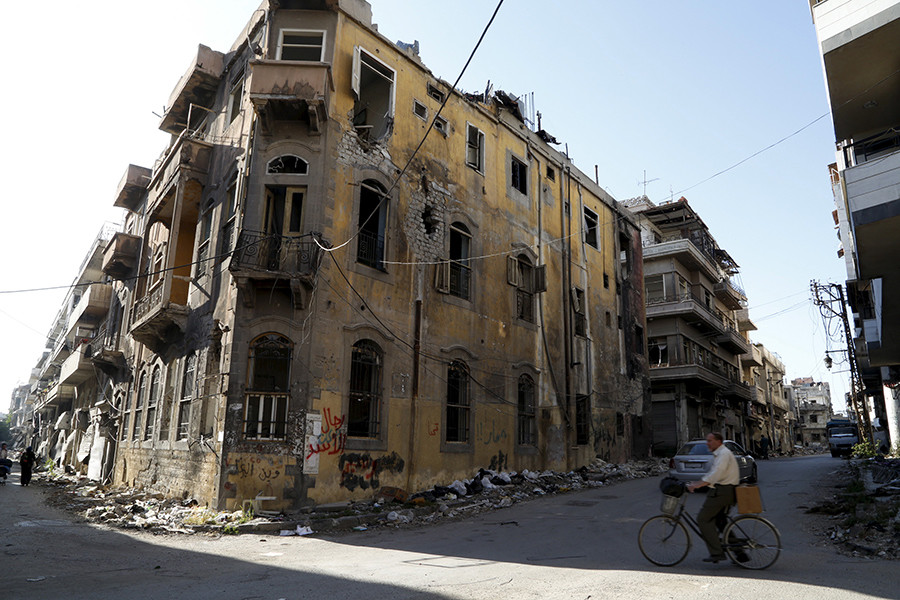
A man rides a bicycle near a building damaged during the Syrian conflict between government forces and rebels in Homs, Syria May 13, 2014 © Omar Sanadiki
Were these narratives all manufactured? Were the images we saw all staged? Or was it only necessary to fabricate some things – because the “perception” of the vast middle population, once shaped, would create its own natural momentum toward regime change?
And what do we, in the region, do with this startling new information about how wars are conducted against us – using our own populations as foot soldiers for foreign agendas?
Create our own “game”
Two can play at this narratives game.
The first lesson learned is that ideas and objectives can be crafted, framed finessed and employed to great efficacy.
The second take-away is that we need to establish more independent media and information distribution channels to disseminate our own value propositions far and wide.
Western governments can rely on a ridiculously sycophantic army of Western and regional journalists to blast us with their propaganda day and night. We don’t need to match them in numbers or outlets – we can also employ strategies to deter their disinformation campaigns. Western journalists who repeatedly publish false, inaccurate and harmful information that endanger lives must be barred from the region.
These are not journalists – I prefer to call them media combatants – and they do not deserve the liberties accorded to actual media professionals. If these Western journalists had, in the first year of the Syrian conflict, questioned the premises of any of the four narratives listed above, would 250,000-plus Syrians be dead today? Would Syria be destroyed and 12 million Syrians made homeless? Would ISIS even exist?
Free speech? No thank you – not if we have to die for someone else’s national security objectives.
Syria changed the world. It brought the Russians and Chinese (BRICS) into the fray and changed the global order from a unipolar one to a multilateral one – overnight. And it created common cause between a group of key states in the region that now form the backbone of a rising ‘Security Arc’ from the Levant to the Persian Gulf. We now have immense opportunities to re-craft the world and the Middle East in our own vision. New borders? We will draw them from inside the region. Terrorists? We will defeat them ourselves. NGOs? We will create our own, with our own nationals and our own agendas. Pipelines? We will decide where they are laid.
But let’s start building those new narratives before the ‘Other’ comes in to fill the void.
A word of caution. The worst thing we can do is to waste our time rejecting foreign narratives. That just makes us the ‘rejectionists’ in their game. And it gives their game life. What we need to do is create our own game – a rich vocabulary of homegrown narratives – one that defines ourselves, our history and aspirations, based on our own political, economic and social realities. Let the ‘Other’ reject our version, let them become the ‘rejectionists’ in our game… and give it life.
Sharmine Narwani is a commentator and analyst of Middle East geopolitics. She is a former senior associate at St. Antony’s College, Oxford University and has a master’s degree in International Relations from Columbia University. You can follow her on Twitter at @snarwani
No comments yet.
Featured Video

Iran, China & Russia v. Trump
or go to
Aletho News Archives – Video-Images
Free Book
Tell Me Again, Who Made The Desert Bloom?
Lawrence of Cyberia | March 19, 2010
In December 1945 and January 1946, the British Mandate authorities carried out an extensive survey of Palestine, in support of the work of the United Nations Special Committee on Palestine. The results were published in the Survey of Palestine, which has been scanned and made available online by Palestine Remembered; all 1300 pages can be read here.
Blog Roll
 Aletho News
- Israeli General: War with Iran does not serve Israel as global standing erodes over Gaza
- The collapse is real – Lebanon ceasefire marks a historic strategic defeat
- Trump keeps Hormuz blockade despite Iran reopening passage
- ‘New order’ in Strait of Hormuz: IRGC Navy mandates authorization for all vessels
- Persian Gulf oil production can take two years to recover from war: IEA chief
- Washington hiding billion-dollar combat losses to Iran’s precision strikes: Report
- Israel Considers Ceasefire a Betrayal
- Iran Opens Strait of Hormuz for Duration of Lebanon Ceasefire
- Russian security chief issues warning to four NATO states
- Seyed M. Marandi: U.S. Naval Blockade & Ground Invasion of Iran?
- If Americans Knew
- Senate again fails to block weapons to Israel
- Think the Iran war is a disaster? Blame these DC think tanks first.
- Number of Palestinian Prisoners Rises By 83% Since October 2023
- With multiple “ceasefires” in place, Israel keeps on killing in Gaza and Lebanon – Daily Update
- Mearsheimer: Israel Owns Trump
- Mark Levin and Jonathan Pollard Push for Nuking Iran
- TCN: America Enables Israel’s Crimes
- Israel’s Next Leader Will Be Just Like Bibi – but Without the Corruption
- Born into war, raised across borders: The story of Gaza’s premature babies separated from their parents amid Israel’s genocide
- Israeli soldiers suspected of raping Palestinian detainee allowed to return to service
- No Tricks Zone
- Reality Check: Maldives Have Actually Grown In Size Or Remained Stable Over Recent Decades
- Abrupt Climate Change Also Occurred NATURALLY In The Past …25 Times During Last Ice Age
- Cave Discovery Reveals Today’s Desert Climates Were Recently Far Warmer, Wetter, Teeming With Life
- German Expert: Heat Dome Led To Record Temps In Western USA…Warmer In 1934, 1936
- New Study: No Linear Warming Or Glacier Retreat Along Northern Antarctic Peninsula Since 1980s
- An Inconvenient Tree: Uncovered In Alps… Europe Much Warmer Than Today 6000 Years Ago
- New Study Reports A 60% Slowdown In Greenland’s Ice Loss Rate In The Last Decade
- Low Intensity Tornado Wrecks Major Solar Farm, Creating A Potential Toxic Dump
- New Study Finds Warming Saves Lives…Cold Temperatures 12 Times More Deadly Than Excess Heat
- German Science Blog Accuses PIK Climate Institute Of Hallucinating Climate Tipping Points
 Aletho News
Leave a comment