Footage of soldier kicking knife ‘represents clear violation of international law’
Ma’an – June 18, 2016
HEBRON – Human Rights Defenders (HRD) in Palestine released a video last week showing an Israeli soldier kicking a knife toward the body of Abd al-Fattah al-Sharif — who was shot point-blank in the head by an Israeli soldier in March — an action the group said represents a clear violation of international law.
The video shows an Israeli soldier casually kicking a knife — allegedly used by al-Sharif during an attempted stabbing attack — to the other side of the road in the town of Tel Rumeida in the southern occupied West Bank district of Hebron, as al-Sharif’s body lay a few meters away.
The footage was taken before al-Sharif was shot execution-style in the head by an Israeli soldier, a graphic video of which was released in March, leading to widespread condemnation by rights groups and the UN demanding an investigation into the apparent “extrajudicial execution.”
Badi Dweik, an activist from HRD, said in a statement released Saturday that the group decided to make the video public in order to challenge current narratives unfolding at the ongoing military trial of Elor Azaria — the Israeli soldier charged with manslaughter after killing al-Sharif. Azaria has claimed that he shot the immobilized Palestinian because he saw al-Sharif reaching for the knife, or feared he had explosives strapped to his chest.
However Azaria’s commander testified in court on Thursday that al-Sharif posed no threat before he was shot dead, and when asked why he shot al-Sharif, Azaria answered: ‘This terrorist was alive, and he needs to die.'”
An additional video surfaced at the start of June, showing an Israeli ambulance driver kicking the same knife near to al-Sharif’s body after he was killed.
The video footage, obtained by Israel’s Channel Two, was expected to be shown to an Israeli military court to disprove claims by the Israeli soldier who killed al-Sharif that he shot the young Palestinian point-blank in the head after al-Sharif moved to grab a knife, according to the Israeli media outlet Ynet.
The footage shows that the knife allegedly used in the attack was far from al-Sharif when he was shot, notably showing an ambulance driving over the knife before it was kicked closer to al-Sharif’s body.The Israeli military prosecutor reportedly said that an Israeli ambulance driver, Ofer Ohanna, who was near the scene kicked the knife towards al-Sharif’s body following his murder, according to Hebrew-language news outlet Maariv.
The new video that has surfaced reveals that the ambulance driver was not the only one to tamper with evidence at the crime scene, but that an Israeli soldier also manipulated a piece of key evidence by moving the knife, which Dweik emphasized was a violation of international law. Al-Sharif was shot alongside Ramzi Aziz al-Qasrawi after the two Palestinians allegedly stabbed and moderately wounded an Israeli soldier at a military checkpoint in the Tel Rumeida area of Hebron on March 24.Although it was widely believed that Al-Qasrawi was killed immediately, new witness accounts documented by Israeli human rights group B’Tselem have since emerged that “raise concerns that al-Qasrawi was also executed with a shot to the head, as he lay injured on the ground after having been hit by gunfire elsewhere in his body.”
Al-Sharif, meanwhile, was left severely wounded for several minutes without treatment, before Azaria stepped forward and put a bullet through his head, killing him.Azaria was charged with manslaughter, rather than murder as had initially been expected, and is being held on a military base in “open detention” where he is free to roam and has received visits from his family. His trial opened in early May.
Palestinians have long held fears that Israeli soldiers and settlers tamper with crime scenes involving Palestinians, with human rights groups accusing Israel of practicing a policy of extrajudicial executions since a wave of violence erupted in October, leaving more than 200 Palestinians and some 30 Israelis killed.
Pro-Israeli sides warn Boeing on Iran deal
Press TV – June 18, 2016
A groundswell of opposition is building among pro-Israeli politicians in the US against Boeing’s plans to sell aircraft to Iran.
The Chicago-based aerospace giant has reportedly received requests for more information after Iran said on Tuesday it had reached an initial agreement with Boeing for the supply of jetliners.
Two senior Republican House representatives have said Boeing could threaten US national security with the planned sale of aircraft to Iran.
“American companies should not be complicit in weaponizing” Iran, Representatives Jeb Hensarling and Peter Roskam were reported to have said in a letter to Boeing released on Friday.
In their letter to Boeing Chief Executive Dennis Muilenburg, the lawmakers asked for “clarification” of the current state of negotiations.
A senior Iranian official said on Friday serious talks were underway between the two sides and expected “good news” about them to be announced within a couple of days.
The European Commission announced on Thursday that the Iranian flag carrier Iran Air has been taken off a safety blacklist and cleared to fly the European skies.
Iran Air agreed in January to buy 118 jets worth $27 billion from Airbus and is discussing further orders with Boeing.
Iranian officials have said the country needs as many as 500 jets to renew its fleet which has suffered under US-led sanctions for years, marked by a series of disasters in which hundreds of people have lost their lives.
Iran’s current civil aviation fleet consists of 248 aircraft with an average age of 20 years, of which 100 are grounded.
Israel law center Shurat Hadin said on Thursday it had told Boeing that it would place liens on any of its airplanes sold to Iran.
The center claims to be representing hundreds of families of alleged victims of terrorism, who have been awarded billions of dollars in damages from frozen Iranian assets.
Shurat Hadin reportedly warned Boeing that a nuclear deal the US and several others countries signed with Iran in July, lifting many sanctions on Tehran, did not override American judgments held by the families the Israeli center represents, which means they can serve liens on anything Iran purchases.
US Representatives Hensarling and Roskam have asked whether Boeing could guarantee that Iran could not convert Boeing passenger jets to cargo aircraft and whether it would repossess aircraft if the nuclear agreement fell through.
The nuclear pact reached by President Barack Obama was opposed by every Republican member of the US Congress. Several questioned the Boeing deal as soon as the news reports came out.
The planned Boeing deal would be the biggest by far between a US company and Tehran since the Islamic Revolution in 1979.
Apart from Airbus and Boeing, Iran is also negotiating with several other global aviation giants over the purchases of planes including Bombardier and Embraer.
According to media reports, Iran’s order list from the American aviation giant includes narrow-body 737s for domestic flights and two-aisle 777s for long-haul routes.
US Underestimates Civilian Death Toll in Iraq and Syria by 95%
teleSUR | June 17, 2016
The United States-led coalition that is bombing Iraq and Syria may be under-reporting the civilian toll of that war by as much as 95 percent, according to a new report released Friday by the monitoring group Airwars.
The U.S.-led coalition, which includes nations such as Britain, France and the Netherlands, has been bombing Islamic State group targets in Iraq and Syria since 2014, carrying out more than 13,121 airstrikes, or just over 19 a day. The vast majority of the strikes are carried out by the U.S., according to Airwars—68 percent in Iraq and and 82.5 percent in Syria—with an estimated civilian death toll of at least 1,312 people.
Over the past six months it’s gotten worse, according to Airwars. “Between December and May, in both Iraq and Syria, there was a marked increase in the number of alleged casualty incidents and civilian death attributed to coalition actions,” it says. In Iraq, the group reports that between 297 and 518 civilians were killed by coalition airstrikes in this time. In Syria, between 197 and 274 civilians were killed, “a 38 percent increase in likely civilian deaths above the previous six months.
The U.S. has admitted to killing just 20 civilians. Its allies have admitted to none. “If correct, Airwars data suggests the coalition may be under-reporting civilian deaths by more than 95 percent,” the report says.
The worst incident for civilians occurred on March 19 in the Islamic State-occupied city of Mosul, when at least 25 innocents were killed when coalition airstrikes hit Mosul University in the middle of the day. As teleSUR reported at the time, such a strike on a civilian institution—confirmed by the U.S. Department of Defense—may constitute a breach of international law.
The U.S. and its coalition allies are not the only foreign governments reportedly killing civilians in the region. Of 630 alleged incidents where civilians died in Syria as a result of international airpower, 91 percent have been attributed to Russia, according to Airwars, killing between 2,792 and 3,451 civilians between December 2015 and May 2016, largely as the result of airstrikes targeting non-Islamic State forces and civilian areas, “particularly in and around Aleppo.”
The Russian government says its airstrikes have not killed any civilians since they began in Sept. 2015.
Saudi repeats call for US strikes on Syrian government
Press TV – June 17, 2016
The Saudi foreign minister has repeated Riyadh’s call on the US to carry out airstrikes against the Syrian government, echoing a similar request by dozens of US diplomats who broke ranks with the White House to push for military action against Damascus.
During a press briefing at the Saudi Embassy in Washington on Friday, Adel al-Jubeir said the Arab monarchy has long been pushing for a US military campaign to overthrow Syrian President Bashar al-Assad.
The Saudi minister added that from the very start of the crisis in Syria, Riyadh has strongly favored “a more robust policy, including air strikes, safe zones, a no fly zone, a no drive zone.”
He went on to say that the kingdom had called for arming Syria’s so-called “moderate opposition” with ground-to-air missiles and reiterated an offer to deploy Saudi special forces as part of any US-led operation against the Damascus government, which has been making back-to-back gains against the Daesh Takfiri group.
Jubeir’s comments came after 51 US State Department officials signed an internal document, known as the “dissent channel cable”, this week, calling for targeted military strikes against the Syrian government.
“Failure to stem Assad’s flagrant abuses will only bolster the ideological appeal of groups such as Daesh, even as they endure tactical setbacks on the battlefield,” reads the cable, critical of US President Barak Obama’s policies towards the Syrian crisis.
The State Department has acknowledged the existence of the cable as confidential diplomatic communication, but did not comment on its contents.
Russia’s reaction
Meanwhile, Russia slammed the so-called internal document and warned that such attempts to oust Assad would not “contribute to a successful fight against terrorism.”
Kremlin spokesman Dmitry Peskov further said that “this could plunge the region into complete chaos.”
Russian Deputy Foreign Minister Mikhail Bogdanov also censured the proposed attacks against Damascus, saying they would be “at odds with the UN resolutions.”
“We need to negotiate and reach a political resolution on the basis of international law, which was agreed upon at the UN Security Council,” Bogdanov added.
The United States and its allies formed a coalition that has been conducting airstrikes against what are said to be Daesh terrorists inside Syria since September 2014 without any authorization from Damascus or a UN mandate. The coalition has repeatedly been accused of targeting and killing civilians. It has also been largely incapable of fulfilling its declared aim of destroying Daesh.
Daesh Takfiri terrorists, who were initially trained by the CIA in Jordan in 2012 to destabilize the Syrian government, are engaged in crimes against humanity in the areas under their control.
Syria has been grappling with a deadly conflict it blames on certain foreign states for over five years. UN special envoy for Syria Staffan de Mistura estimates that over 400,000 people have been killed in the conflict, which has also displaced over half of the Arab country’s pre-war population of about 23 million. The militancy has also taken a heavy toll on the country’s infrastructure.
‘Saber-rattling & warmongering’: German FM blasts NATO military drills in Eastern Europe
RT | June 18, 2016
Sharply criticizing NATO war games in Eastern Europe, German Foreign Minister Frank-Walter Steinmeier told Bild am Sonntag newspaper that inflaming the standoff with Russia would endanger European security and increase risk of reviving an “old confrontation.”
The ongoing large-scale Anakonda-16 NATO military maneuvers in Poland, simulating the repulsion of “Russian aggression” against the country, are counterproductive, Deutsche Welle cited German Foreign Minister Frank-Walter Steinmeier as telling Bild am Sonntag newspaper, in an interview to be published Sunday.
“Whoever believes that a symbolic tank parade on the alliance’s eastern border will bring security is mistaken,” Steinmeier said ahead of the upcoming NATO summit in Warsaw beginning July 8. “We are well-advised to not create pretexts to renew an old confrontation,” he emphasized.
Rather than inflaming the situation further “through saber-rattling and warmongering,” there ought to be more space for dialogue and cooperation with Moscow, Steinmeier said.
It would be “fatal to now narrow the focus to the military, and seek a remedy solely through a policy of deterrence,” German FM said, calling to give way to diplomacy instead of military posturing.
Calling for dialogue and a diplomatic approach, Steinmeier also mentioned the necessity of maintaining military preparedness of NATO.
The alliance should also consider the possibility to “renew discussions about the benefits of disarmament and arms control for security in Europe,” he said.
The Anaconda drills have become NATO’s largest exercise in Europe since the Cold War, bringing to Poland over 31,000 troops from 24 NATO member states and “partner nations,” including the US, the UK, Germany, Canada, Spain, Sweden, Turkey and others.
Moscow has once again pointed out that augmentation of NATO military presence in Eastern Europe and Baltics is unjustified, stressing that Russia has no plans whatsoever to interfere with any country in the region.
“I am convinced that every serious and honest politician is well aware that Russia will never invade any NATO member. We have no such plans,” Russian Foreign Minister Sergey Lavrov stated.
The NATO summit in Warsaw is set to put “Russian threat” issue high on the agenda, as the gathering will be making the final decision on stationing additional NATO troops in Eastern Europe.
More NATO troops deployed to Poland will be sending “a clear signal that an attack on Poland will be considered an attack on the whole Alliance,” the bloc’s Secretary General told reporters following his meeting with Polish President Andrzej Duda in early June.
The statements made by NATO leadership put Russian diplomats in a position where they have to deny the obvious.
“During the NATO secretary general’s recent visit to Poland, officials in this country [Poland] made statements suggesting that from now on Russia would know that any attack on Poland would mean an attack on NATO as a whole. This is completely absurd because they are discussing a non-existent problem. There are no plans for any attacks on Poland,” Russian envoy to NATO Aleksandr Grushko said in an interview with TV channel Russia-24.
Speaking at the St. Petersburg International Economic Forum (SPIEF) on Friday, President Vladimir Putin said that NATO has “an absolutely slapdash attitude to our position on anything,” adding that it was the US that had unilaterally quit the missile defense treaty, which was initially signed to “provide strategic balance in the world.”
NATO “needs a foreign enemy, otherwise what would be the reason for the existence of such an organization,” said the Russian leader. The conflict in Ukraine, caused by a bloody coup supported by the US and its European NATO allies, was forced on that country “to substantiate the very existence of the North Atlantic alliance,” the Russian president concluded.
Putin assured his audience that he does not want to proceed to a new Cold War, as “no one wants it.”“However dramatic the logic of the development of international relations might seem on the outside, it’s not the logic of global confrontation,” he explained.
Corporate Media Backing Clinton Exploits Orlando Shooting for Passive Holocaust Denial
By Robert Barsocchini | Empire Slayer | June 16, 2016
Within hours of the mass shooting in Orlando, the corporate media backing neoconservative favorite Hillary Clinton began, almost unanimously, to exploit the opportunity to passively promote holocaust and genocide denial.
Outlets including the NY Times, CBS News, NBC News, CNN, Newsweek, USA Today, and so on, all referred to the Orlando massacre unequivocally as the worst shooting and/or worst act of gun violence in US history. (CBS News, at the time it was accessed for this piece, was running a large “I’m With Her” ad for Hillary Clinton at the top of its page.) A useful comparison to the corporate assessment might be to imagine if a German civilian gassed a group of people to death and the German press reported it as the worst gassing in German history. After the Paris shooting, the Western press likewise reported that as the worst shooting in recent Parisian history, despite that the Parisian police not long ago massacred some 300 peaceful marchers protesting the French dictatorship in Algeria and dumped their bodies in the river that runs through the city (more info in previous piece).
Native News Online quickly pointed out that the corporate media was almost completely whitewashing “mass killings of American Indians in its reporting” on Orlando. It gave two well-known (as far as these go) examples of worse gun-violence and mass-shootings: some 300 Native men, women, and children, were massacred at Wounded Knee, and 70 to 180 were massacred at Sand Creek.
One commenter on the Native News piece shared that she “wrote to every single news outlet yesterday from the New York Times, the Guardian, the Huffington Post, and Salon to CNN, NBC, and the BBC. I have yet to receive a reply from any of them with the exception of the Oregonian, who changed its language immediately. They also informed me that the Associated Press has just begun to change its language. I’m hoping the Guardian and BBC begin to do the same too.”
Another commenter on the Native News piece gave a short list of some acts of gun-violence, mass-shootings, or mass killings perpetrated in US history, by US forces:
1864 – 300 Yana in California
1863 – 280 Shoshone in Idaho
1861 – 240 Wilakis in California
1860 – 250 Wiyot in California
1859 – 150 Yuki in California
1853 – 450 Tolowa in California
1852 – 150 Wintu in California
1851 – 300 Wintu in California
1850 – 100 Pomo in California
1840 – 140 Comanches in Colorado
1833 – 150 Kiowa in Oklahoma
1813 – 200 Creek in Alabama
1813 – 200 Creek in Alabama
1782 – 100 Lanape in Pennsylvania
1730 – 500 Fox in Illinois
1713 – 1000 Tuscarora in North Carolina
1712 – 1000 Fox in Michigan
1712 – 300 Tuscarora in North Carolina
1704 – 1000 Apalachee killed & 2000 sold into slavery in North Carolina
1676 – 100 Algonquian and Nipmuc in Massachusetts.
1676 – 100 Occaneechi in Virginia
1675 – 340 Narragansett in Rhode Island
1644 – 500 Lanape in New York
1640 – 129 Massapeag in New York
1637 – 700 Pequot in Connecticut
1623 – 200 Powhatan & Pamunkey in Virginia with “poison wine”
Professor David E. Stannard describes one such massacre, wherein US forces weakened a Delaware group of Native men, women, children, and elders through starvation, convinced them it would be in their best interest to disarm, then tied them up and exterminated them and mutilated their dead bodies. Stannard notes that such massacres by US forces “were so numerous and routine that recording them eventually becomes numbing”. (American Holocaust, pp. 125/6)
A couple of corporate news outlets used somewhat more precise language to describe the Orlando massacre, editorializing (while again presenting it as fact) that it was the ‘worst shooting in modern US history’.
However, this still leaves unstated the writer’s opinion of what constitutes ‘modern’. The wounded knee massacre took place in 1898, and the Black Wall Street massacre, for example, in which 55-400 people were murdered and a wealthy black community in Oklahoma ethnically cleansed, took place in 1921. (More examples.)
And, of course, the US has massacred millions of people, many of them with rifles and other types of guns, but also in far worse ways, outside the territory it officially claims, and continues to do so. Obama recently massacred almost a hundred people at one time with what could be viewed as an AR-15 on steroids. Is any of this part of ‘modern US history’? Why or why not? The qualifications are unstated and thus subjective. The vague language from the neoliberal, government-linked corporate outlets may lead readers to believe that all of US history is included in their ‘factual’ statements, and that the US has never massacred more than fifty people anywhere.
In some cases, this impression will have been intentional on the part of the oligarch mouthpiece outlets, which have an interest in fostering a benevolent image of the US to help elites further capture global markets . In others, it will have been a result of conveniently self-aggrandizing ignorance on behalf of the writers and editors – an ignorance that makes an important contribution to their job security.
As some of them partially or belatedly demonstrated, all of the corporate outlets could have easily avoided any holocaust/genocide-denial by calling the shooting the worst by a single civilian on US territory in at least the last thirty years, or any number of other obvious, simple, direct phrasings, which are supposed to be integral to journalism, anyway.
But as John Ralston Saul points out, the neoliberal/neoconservative ideology relies on the ‘whitewashing of memory’. That doesn’t always work, though, especially on survivors of US and Western genocides, which is why, as Ralston Saul further notes, the West and its proxies are behind most of the global murders of writers, who may try to expose facts and evidence that interfere with the West’s historical whitewashing.
Since the Orlando massacre, both Clinton and Trump have called for further escalation of Western aggression in the Middle East.
Robert Barsocchini is an internationally published author who focuses on force dynamics, national and global, and also writes professionally for the film industry. Updates on Twitter.
Argentina Expels TeleSUR and RT: Double Standards When it Comes to Press Freedom
By Zachary Cohen | Council on Hemispheric Affairs | June 17, 2016
On June 8, the Argentine government notified the Latin American television network teleSUR that their services would be shut off in the country within 15 days.[1] TeleSUR, the brainchild of Hugo Chávez, is an alternative left-wing news organization founded through the cooperation of seven left leaning Latin American governments including Venezuela, Ecuador and Cuba. It gives a voice to the popular sectors of the hemisphere, covering news that often calls into question some of the right-wing biases of the hegemonic news media and provides information which promotes regional integration in Latin America. Although Argentina cited a “[renewal of] program listings,” as the reason for teleSUR’s dismissal, Patricia Villegas, the president of teleSUR, pointed toward underlying reactions against the left-leaning network, decrying the notice as “censura” (censure).[2][3]
On June 10, the television station RT (also known as Russia Today) received a similar summons. The Russian channel, which has been operating in Argentina for the past two years since a deal was signed between the countries, was told that their suspension from broadcasting would take place in 60 days.[4] RT aims to provide an “international audience with a Russian viewpoint,” and just like teleSUR, emphasizes the importance of alternative, non-hegemonic perspectives.[5]
The blatant censorship of these two opposition voices in Argentina is an alarming violation of hemispheric press freedom, and points to a larger issue at hand: the immense double standards of the mainstream media in its coverage, or rather non-coverage, of this matter. The removal of teleSUR and RT from the Argentine media scene has not elicited much media attention from corporate media news outlets, though the story would most likely be breaking news and inspire outrage were it occurring in a country with a progressive government.
Comprehensive Policy Changes in Argentina
On December 10, 2015, Argentine President Mauricio Macri was sworn in to office, replacing progressive leaning President Cristina Fernandez de Kirchner.[6] Macri’s presidency represents a drastic shift for the country across the board. Within the past six months, Macri has reversed a multitude of Kirchner’s policies and has begun to further advance neoliberal free market policies through the removal of currency controls and the promotion of proposals regarding free trade.[7] In addition to economic changes, Macri’s distinct foreign policy goals have been described by teleSUR as a “180-degree turn from previous administrations.”[8] He has made efforts to improve relations with the United States, while distancing Argentina from the ledger of left and left-leaning governments of Latin America. After his state visit this past March, President Obama noted that Macri’s Argentina has become a “key ally” to the United States, in stark contrast to the rather hostile bilateral relations held during the Kirchner administration.[9] [10]
President Macri’s expulsion of teleSUR represents the continuation of a longer narrative. When Venezuelan President Hugo Chávez celebrated the launch of the Venesat-1 satellite in 2005, he was taking a stand against traditional media, reflecting his commitment to battling U.S. hegemony and building a more Bolivarian and integrated Latin America.[11] At its launch, Argentina was committed to the cause of independence and integration, and was teleSUR’s second largest TV sponsor, with a 20 percent stake in the enterprise; Venezuela remains the largest shareholder, at 51 percent.[12] [13] However, in March, Macri pulled Argentine funding from teleSUR.[14] According to Argentina’s Director of Communications Hermann Lombardi, the decision to withdraw was based on the fact that Argentina’s government was “prohibited from sharing their view.”[15] Although the removal of funding on the basis of distinct ideological differences is understandable, it is inexcusable to remove teleSUR from the mix of television networks operating in the country. Regardless of teleSUR’s association with progressive governments, it should not be automatically excluded from the households of millions simply because of an ideological disagreement between the government and the media markets.
Double Standards in the Media
The troubling double standard of corporate media is explicitly evident in this issue and has serious implications for the role of the United States in Latin America. Mainstream media jumps on the chance to criticize the “Pink Tide” nations, with major critiques often levied toward Venezuela in regards to their shortcomings in the area of press freedoms. These criticisms were exceptionally prominent in 2007, after President Chávez decided not to renew the license for RCTV after they vocally supported the coup against him. [16] [17] For his actions, Chávez was condemned by the United States and the European Union, and received vast media attention. Yet, in the broader picture, the judgments regarding Venezuela’s press freedoms are often exaggerated and simplified, lacking the complexities of a more realistic portrayal of the country’s situation.[18] El Nacional, one of Venezuela’s largest newspapers, continues to provide the opposition viewpoint to President Nicolás Maduro, with open calls for regime change published and printed.[19] Additionally, news station Globovisión has consistently held an independent voice, often speaking out against the government.[20] Nonetheless, the level of disdain that Maduro’s regime receives by the mainstream media, including by papers such as The New York Times, reflects a distinct bias against the left-wing government in discussions on the subject of press freedoms.[21]
The situation in Argentina is very different today from Venezuela in regards to freedom of the press. Through his censure of teleSUR, Macri has preemptively silenced the most vigorous reporting on the human cost of his economic adjustment policies and explicitly revealed his willingness to expel unwanted sources of media to push his own narrative. Yet, there has been little to no international reaction. In fact, at the time of this article’s publication, teleSUR and RT themselves are among the few major news organizations to have written any extensive coverage of the stories since they broke last week. Through its silence, the mainstream media is complicit in Macri’s censure of expression, all while continuing to emphasize and exaggerate Maduro’s actions.
Macri’s newfound friendship with the United States, alongside the willful negligence of issues surrounding censorship in the mainstream media, cannot be considered a coincidence. His commitment to resolving Argentina’s economic woes through U.S.-friendly policies, in addition to his overall right-wing realignment, have fostered a swift transition of Argentina’s international image. Moreover, teleSUR and RT are associated with countries in direct competition, ideologically and economically, with Washington. By undermining the influence of media which stem from left leaning Latin America and anti-U.S. Russia, Macri effectively expands the capacity of anti-left, pro-U.S. media to influence his country. With this purposeful rebranding in mind, it is believable that media in the United States would begin to emphasize the more favorable face of Argentina, while disregarding issues such as censorship.
One of the pillars of COHA’s philosophy is the support of democratic values in their fullest form, which includes supporting freedom of the press. In any country, it is imperative to maintain a diverse set of viewpoints, and for different perspectives to be both treated with dignity and challenged without any fear of suppression. To be complicit in the violation of such freedoms is tantamount to the acceptance of the violations themselves, and COHA will not be silent while others find it appropriate to remain so. COHA urges the Argentine government to reconsider its removal of teleSUR and RT, and to invite, rather than suppress, debate over the economic, political, and social outcomes of the change of course being implemented by the Macri administration.
[1] “Macri Gov’t toTake teleSUR off Argentine TV service in 15 days,” teleSUR, June 8, 2016, accessed June 10, 2016, http://www.telesurtv.net/english/news/Macri-Govt-to-Take-teleSUR-off-Argentine-TV-Service-in-15-Days-20160608-0034.html.
[2] Ibid.
[3] Patricia Villegas, Twitter, June 8, 2016, accessed June 10, 2016, https://twitter.com/pvillegas_tlSUR/status/740569267536596993.
[4] “Argentina to suspend RT from national broadcasting,” RT, June 11, 2016, accessed June 13, 2016. https://www.rt.com/news/346172-argentina-suspends-rt-television/.
[5] “About Us,” RT, accessed June 14, 2016, https://www.rt.com/about-us/.
[6] Ignacio de Reyes, “Change ahead: Mauricio Macri’s visión for Argentina,” BBC, December 10, 2015, accessed June 10, 2016, http://www.bbc.com/news/world-latin-america-34899223.
[7] Ibid.
[8] “Is Argentina Turning into a US Proxy in South America?” teleSUR, June 1, 2016, accessed June 10, 2016, http://www.telesurtv.net/english/news/Is-Argentina-Turning-into-a-US-Proxy-in-South-America-20160601-0028.html.
[9] Martin Torino, “Obama abrió la puerta a Macri para un Tratado de Libre Comercio con Argentina,” Cronista.com, March 16, 2016, accessed June 10, 2016, http://www.cronista.com/economiapolitica/Obama-abrio-la-puerta-a-Macri-para-un-Tratado-de-Libre-Comercio-con-Argentina-20160324-0086.html.
[10] Andrew Trotman, “Argentina files legal proceedings with UN against Obama government,” The Telegraph, August 7, 2014, accessed June 10, 2016, http://www.telegraph.co.uk/finance/financialcrisis/11019875/Argentina-files-legal-proceedings-with-UN-against-Obama-government.html.
[11] https://books.google.com/books?id=d02Do0qmJrMC&dq=telesur+chavez+satellite&source=gbs_navlinks_s
[12] “Argentina pulls out of leftist TV network Telesur,” The Guardian, March 28, 2016, accessed June 10, 2016, https://www.theguardian.com/world/2016/mar/28/argentina-telesur-tv-network-venezuela-hugo-chavez.
[13] “New Latin American Televison Network Telesur Officially Launched,” Democracy NOW, July 26, 2005, accessed June 10, 2016, http://www.democracynow.org/2005/7/26/new_latin_american_television_network_telesur.
[14] “Argentina pulls out of leftist TV network Telesur.”
[15] Ibid.
[16] “Chávez Shuts Down Venezuelan TV Station as Supporters, Opponents Rally: A Debate on the Closing of RCTV,” Democracy NOW, May 31, 2007, accessed June 13, 2016, http://www.democracynow.org/2007/5/31/chavez_shuts_down_venezuelan_tv_station.
[17] Roy Carroll, “Chávez silences critical TV station – and robs the people of their soaps,” The Guardian, May 23, 2007, accessed June 13, 2016, http://www.theguardian.com/media/2007/may/23/venezuela.broadcasting
[18] Joe Emersberger, “Macri Tilts Argentina’s Media Landscape in his Favor,” teleSUR, April 3, 2016, accessed June 14, 2016, http://www.telesurtv.net/english/opinion/Macri-Tilts-Argentinas-Media-Landscape-in-his-Favor-20160403-0033.html
[19] John Otis, “Last critic standing,” Committee to Protect Journalists, February 22, 2016, accessed June 10, 2016, https://cpj.org/blog/2016/02/last-critic-standing-how-el-nacional-defies-challe.php.
[20] https://cpj.org/blog/2016/03/after-venezuelan-elections-globovision-shows-more-.php.
[21] Daniel Lansberg-Rodriguez, “Stealth Censorship in Venezuela,” The New York Times, August 6, 2016, accessed June 10, 2016, http://www.nytimes.com/2014/08/07/opinion/daniel-lansberg-rodriguez-stealth-censorship-in-venezuela.html.
Where do police and protesters stand after the Magnanville stabbings?
By Gearóid Ó Colmáin | June 15, 2016
The terrorist attack in Magnanville by alleged Da’esh (Islamic State) operative, Larossi Aballa, on two police officers in Paris, serves one purpose: to remind the public that the war on terror is real and that the police and army are here to protect the population, not oppress it. As protests and strikes continue against the ruling class assault on worker’s security (rights won through a century of indefatigable struggle), phantom enemies are the oligarchic state’s best friends. Phantom enemies allow the oligarchic state to force hostile citizens to seek their protection from the ‘greater evil’.
In the Middle East where they were created by the United States and Israel, the so-called ‘Islamic State’ (Da’esh) have attempted to do what former Western trained terrorists could not: to destroy Syria and Iraq through a large-scale military occupation of those countries. The French media portray the Islamic State as being a symptom of the nihilism and despair of our era; that is only partly the truth.
What is overlooked is the deep complicity of the French state in terrorism – the obscenely Machiavellian determination to use the most brutal barbarians seen in the modern era to implement Western imperial policy in the Middle East and throughout the world. The Islamic State is a mercenary force of the Deep State, the imperial financial order, the hidden hand of military and financial corporations and lobbyists who steer the policies of Western governments behind the scenes. They do not oppose ‘Western civilisation’, they serve it, massacring people such as those of Syria who, imbued with patriotism, heroism and piety, refuse to kneel and worship at the alter of Mammon.
We are told by Le Monde that the terrorist/patsy in the police attack, Larossi Aballa, used the Facebook Live application during the attack to propagandise his crimes. He is also reported to have threatened journalists.
Two points here –
1. Anyone with enough curiosity and intelligence to visit a good bookshop knows that the role of journalists in the capitalist world order is to be stenographers to power. A daily perusal of the corporate press proves the proposition unfailingly. It helps restore public confidence in the credibility of corporate journalists if they are ‘threatened’ every now and then; especially by the terrorists whose crimes they ignore when they are committed on behalf of Western geopolitical interests in foreign lands such as Syria.
2. The dissemination of truth through social media and the emergence of citizen journalists all over the world exposing the lies of the corporate press are undermining the public’s confidence in authority. Hence, the use of pseudonyms and the freedom to diffuse information must be curtailed. Fear not! The government will protect you by limiting your ability to research and share information.
The murder of the two police officers comes just days after police were caught on camera vandalising shops in an effort to discredit legitimate and peaceful protests against undemocratic labour reforms. It sends a powerful message: police are there to protect us from terrorists not oppress us on behalf of the ruling class!
Protests are turning violent on the streets of Paris with several cars being set alight by ‘Black Box’ anarchist protesters. These Black Box hooligans sabotage worker’s struggles every time they threaten the established order. Their actions are criminalising legitimate protests. The recent attacks on the Necker Hospital in Paris are acts of sabotage which are providing the pretext for the government to interdict further protests. It is clear the protest movement is hurting the ruling class.
The murder of the two police officers in Paris is an outrage which should be condemned by all. But it must be borne in mind that thousands of working-class policemen and soldiers unwittingly defend an execrable class of people who would not hesitate in murdering if political expediency required it.
As the class struggle intensifies on our streets, the police will be increasingly mobilised against the public. The ‘terrorist threat’ is more important than ever to sustain the illusion of government legitimacy and bludgeon the masses into submission to the police state. But history shows that the weakness of tyranny is that it always relies on servile classes whose loyalty is based more on cynicism and personal advancement than moral conviction. Thus, the possibility always exists for police revolt against the oligarchs. Understanding the precariousness of policing in tyranny is vital in activism. We must not hurl rocks and stones at the police but seek to win them over to the cause of popular democracy and freedom.
Australian Electoral Commission Refuses To Allow Researchers To Check E-Voting Software
By Glyn Moody | Techdirt | June 17, 2016
The fact that Techdirt has been writing about e-voting problems for sixteen years, and that the very first post on the topic had the headline “E-voting is Not Safe,” gives an indication of what a troubled area this is. Despite the evidence that stringent controls are still needed to avoid the risk of electoral fraud, some people seem naively to assume that e-voting is now a mature and safe technology that can be deployed without further thought.
In Australia, for example, e-voting is being used for the elections to the country’s Senate, but the Australian Electoral Commission (AEC) has refused to release the relevant software, despite a Senate motion and a freedom of information request. Being able to examine the code is a fundamental requirement, since there is no way of knowing what “black box” e-voting systems are doing with the votes that are entered. A story by the Australian Associated Press (AAP) explains why AEC is resisting:
The Australian Electoral Commission referred AAP to a decision by the Administrative Appeals Tribunal [AAT] in December 2015.
In that decision, relating to a freedom of information request, the tribunal found the release of the source code for the software known as Easycount would have the potential to diminish its commercial value.
“The tribunal is satisfied that the Easycount source code is a trade secret and is exempt from disclosure,” the AAT said.
Placing trade secrets above the public interest is a curious choice, to say the least. It seems particularly questionable given Australia’s recent experience with e-voting software problems:
When the ACT Electoral Commission released its counting code, researchers at Australian National University found three bugs which were subsequently fixed before an election.
When the Victorian Electoral Commission made its electronic voting protocol available to researchers in 2010, University of Melbourne researchers identified a security weakness which was then rectified before the state election.
As Techdirt readers well know, bugs are commonplace, and there’s no particular shame if some are found in a complex piece of software. But refusing to allow independent researchers to look for those bugs so that they can be fixed is inexcusable when the integrity of the democratic selection process is at stake.
Featured Video
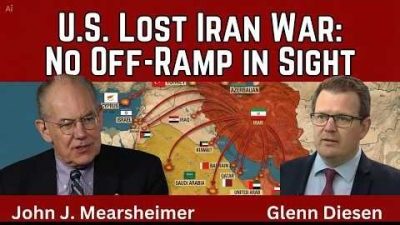
John Mearsheimer: US Already lost Iran war – No off-ramp in sight
or go to
Aletho News Archives – Video-Images
Frlom the Archives
With apparently fabricated nuclear documents, Netanyahu pushed the US towards war with Iran
By Gareth Porter | The Grayzone | April 29, 2020
President Donald Trump scrapped the nuclear deal with Iran and continued to risk war with Iran based on Israeli Prime Minister Benjamin Netanyahu’s claim to have proven definitively that Iran was determined to manufacture nuclear weapons. Netanyahu not only spun Trump but much of the corporate media as well, duping them with the public unveiling of what he claimed was the entire secret Iranian “nuclear archive.”
In early April 2018, Netanyahu briefed Trump privately on the supposed Iranian nuclear archive and secured his promise to leave the Joint Comprehensive Plan of Action (JCPOA). That April 30, Netanyahu took the briefing to the public in a characteristically dramatic live performance in which he claimed Israel’s Mossad intelligence services had stolen Iran’s entire nuclear archive from Tehran. “You may well know that Iran’s leaders repeatedly deny ever pursuing nuclear weapons…” Netanyahu declared. “Well, tonight, I’m here to tell you one thing: Iran lied. Big time.”
However, an investigation of the supposed Iranian nuclear documents by The Grayzone reveals them to be the product of an Israeli disinformation operation that helped trigger the most serious threat of war since the conflict with Iran began nearly four decades ago. This investigation found multiple indications that the story of Mossad’s heist of 50,000 pages of secret nuclear files from Tehran was very likely an elaborate fiction and that the documents were fabricated by the Mossad itself. … continue
Blog Roll
 Aletho News
- ‘We’ve Obliterated Their Missiles’
- Syrian president vows ‘absolute support’ to disarm Hezbollah
- Ukraine attacking Russian gas pipeline to stop deliveries to Europe – Defense Ministry
- ‘Heinous crime’: Iran denounces Israeli assassination of 4 Iranian diplomats in Lebanon
- John Mearsheimer: U.S. Already Lost Iran War – No Off-Ramp in Sight
- UK Parliament Plans ISP Blocking and Age Verification Powers
- World cannot remain silent as US and Israel attack ‘heritage of humankind’: Iran
- Emirati billionaire rebukes US senator over call for Gulf states to join war with Iran
- Op. True Promise 4: Iran’s missile blitzkrieg dismantles US war machine in West Asia
- Aramco CEO warns ‘catastrophe’ imminent if Strait of Hormuz remains shut
- If Americans Knew
- 97% of victims of war on Iran are Iranian, 98% of victims in war on Gaza are Gazans – Not a ceasefire Day 152
- Early Iran strikes cost $5.6 billion in munitions, Pentagon estimates
- Israel Decided the War, But Trump’s America Fights and Pays the Bill
- Conscientious Objector Group: Phone ‘Ringing Off Hook’ As Huge Mobilization Underway
- U.S. support for Israel continues to plummet, despite media’s best efforts
- Threats and missiles fly, death tolls soar in Iran, Lebanon, Gaza – Not a ceasefire Day 151
- Lebanon: Israel’s White Phosphorous Use Risks Civilian Harm
- Corporate Media Go All Out To Support The US-Israeli War On Iran
- US-Israel war on Iran is creating a steady growing number of amputees
- Israel planned this war on Iran for 40 years. Everything else is a smoke screen
- No Tricks Zone
- Destructive Green New Deal: German Energy And Metal Group Warns Of Drastic Crisis
- New Study Documents A 20-Year Pause In Arctic Sea Ice Decline – Driven By Internal Variability
- Wake-up Call: Survey Shows Majority Of Germans Now Favor Postponing Climate Targets!
- Televised! Leading German Political Candidate Tells Schoolchildren CO2 Makes Sun Hotter!
- New Study: A Century Warming Of 1.1°C Is ‘Commonplace’ And ‘Not Unusual’ During This Interglacial
- New Study: ‘Internal Noise’ And Volcanic Forcing Can Trigger 10-15°C Warming Within Decades
- Glaciers Worldwide Are Suddendly Surging, Experts Blame Warming!
- Surprising Discovery: Sahara Is Greening…Billions Of Trees Where Once Thought To Be Barren
- New Research Reaffirms Clouds, Aerosols, And Surface Solar Radiation Are ‘Driving The Climate System’
- Germany: Electric Car Catches Fire At Charging Station, Sets Off Local “Inferno”, Widespread Damage
 Aletho News