Most European Nations Act More Like US Colonies Than Sovereign States
By Stephen Lendman | June 5, 2016
Instead of declaring their independence, most European nations let Washington pressure, bully and bribe them to go along with its imperial agenda, harming their own national security.
Economic powerhouse Germany remains occupied since WW II ended, permitting numerous US bases on its territory, some jointly operated, harming its security, not protecting it.
Instead of normalizing relations with Russia, a reliable ally, Die Welt newspaper said a new Defense Ministry White Paper near completion lists it as one of Germany’s 10 major threats, despite no credible evidence suggesting it – plenty proving otherwise.
Other threats include international terrorism – without explaining it is US created and Berlin supported. Terrorist groups can’t exist without state sponsors.
According to sources quoting what the report says, Russia is Germany’s key rival, using “hybrid instruments to blur the boundaries between war and peace… undermin(ing) other states.”
Moscow’s military strength (almost entirely on its own territory, solely for defense and fighting terrorism in Syria), technological capability, nonexistent “aggression,” reunification with Crimea, and ability to influence public opinion are contrived reasons for considering Moscow a key rival and threat, not a partner – despite Putin urging cooperative relations with all nations, the world’s preeminent peacemaker.
Germany’s Merkel is polar opposite. So are most other European leaders, allied with Washington’s killing machine, humanity’s greatest threat.
She urges greater militarism, not less, at a time demilitarization and all-out efforts for world peace are desperately needed.
The alternative is endless war, European nations threatened because of allying with Washington’s imperial agenda instead of firmly opposing it for their own self-interest.
Stephen Lendman lives in Chicago. He can be reached at lendmanstephen@sbcglobal.net.
His new book as editor and contributor is titled Flashpoint in Ukraine: US Drive for Hegemony Risks WW III.
Video shows Israeli troops questioning underage Palestinians

An Israeli soldier takes a photo from a Palestinian minor in Jaber neighborhood of al-Khalil (Hebron) on May 24, 2016.
Press TV – June 5, 2016
A leading Israeli rights group has denounced the Israeli military for illegally questioning a group of underage Palestinians, calling it a “blatant disregard” for the rights of minors.
A video provided by B’Tselem shows several dozen Israeli forces randomly gathering around 20 Palestinian children and teens from the streets and questioning them.
The Palestinians are forced to stand against a wall and answer questions about a stone-throwing incident, which had allegedly occurred last week.
The soldiers then take photo of every child and teen, using a cell phone, after making them sit in front of the wall before releasing them.
In a statement, B’Tselem said the scope of the latest incident and the fact that every minor was photographed was unusual.
To date, such incidents occurred within homes, with the children’s parents present, and without the minors themselves being questioned or accused of a specific offense, the rights group said.
According to B’Tselem, none of the 14 minors whose details were obtained by the rights group, had a record of being nabbed or questioned by the Israeli military.
The incident indicated that they were arrested and photographed “despite being suspected of nothing,” it said.
The statement said the “goal was primarily to intimidate the children in order to deter them from throwing stones, and to make it easier for the military to identify them in case they do.”
“This demonstrates blatant disregard for the military’s duty to protect the rights of minors.”
The Israeli military, it added, is banned from treating civilians, particularly underage ones, as potential criminals and using soldiers to deter them.
The whole incident was filmed by a B’Tselem volunteer living in the neighborhood. The rights group also obtained several of the minors’ accounts of the event.
In late May, the Palestinian Ministry of Information said nearly 2,080 Palestinian children have been killed and approximately 13,000 injured by the Israeli military over the past 16 years.
About 12,000 Palestinian children have been arrested, and 420 are currently being held in Israeli prisons, it added.
On Sunday, Israeli forces also arrested 13 Palestinians after storming their houses in the occupied West Bank.
NATO Baltic wargames have ‘political, economic & military motives’
RT | June 5, 2016
The US strategy in Europe is aimed at strengthening its control over EU and NATO states, selling more military equipment to its European allies to make super-profits for its military-industrial complex and to isolate Russia, political author Diana Johnstone told RT.
NATO is holding major sea drills in the Baltic Sea. The BALTOPS exercises, which kicked off on Friday in Estonia and will continue until June 19, involve 15 member states of the military alliance as well as Finland and Sweden.
RT: NATO is conducting major drills across the Baltic. Is there a bigger political message here or is it just an exercise?
Diana Johnstone: Yes, they have been doing exercises like this for quite a while and the pretext changed. At least this time they are not pretending like with the missile shield that it is to protect Europe from Iran. The line has changed now, because the US is coming right out with their aggressive actions toward Russia. You have to see the political, economic and military motives for this. The economic motive is obviously to sell more US military equipment to European allies, who don’t need it and can’t afford it. But that is important for the US military-industrial complex. Politically this is the strengthening of US control of EU countries and NATO countries, and to isolate Russia – to carry out this famous [Zbigniew] Brzezinski strategy of separating Russia from Europe to promote US hegemony over the Europe and the world.
RT: A lot of people in Eastern Europe oppose this kind of strategy. The general public is not particularly happy about this, are they?
DJ: Of course those Baltic States, whose governments by the way are satellite governments of the US. The top officials studied in the West, in the US and Canada. These have gone from being Russian satellites to be American satellites. They pretty much follow the US direction. But that is not the case of the rest of Europe, which is simply ignoring this, like it is not happening. The Czechs are aware of it, so they are protesting. But for instance, here in France nobody mentions this, because frankly people wouldn’t be in favor of it at all. This is destroying defense of Europe. It is just turning into an instrument of US policy.
RT: Last week, NATO Secretary General Jens Stoltenberg announced plans to strengthen defenses, particularly against Russian foreign policy calling it “a defensive and proportionate response to Russia’s actions in Crimea and Eastern Ukraine.” At the same time recently he said that they strived “for a more constructive relationship with Russia.” Shouldn’t it be more talking going on, rather than deploying troops and hardware?
JS: We are used to now seeing the US – in the Middle East they say one thing and do the opposite. It’s just amazing to me that people can say things like that. It is totally absurd. Obviously there is nothing offensive about the people of Crimea going back to Russia, to which they belonged before… There is not tiny bit of an aggressive move of Russia towards the West. That is a total fiction… So these people are just lying. They cannot know that.
Tensions as Zionists ’Celebrate’ 1967 Occupation of Al-Quds

Al-Manar | June 5, 2016
Tensions were high in al-Quds on Sunday as Zionists ‘celebrated’ the 1967 occupation of eastern part of the holy city.
AFP news agency reported there were strict security measures in al-Quds.
Meanwhile, Palestine Today reported that more than 27 Zionist organizations had called for storming the holy al-Aqsa Mosque in al-Quds on Sunday.
The website said that the Zionists are to mark anniversary of the 1967 Israeli invasion and occupation of the West Bank, Gaza, Sinai, and the Golan Heights that began on June 5.
In that day East al-Quds (Jerusalem) was occupied by the Israeli forces.
The Zionist organizations called Israelis on social media to commemorate what they called “unification of Jerusalem Day” through parades in the holy city.
The calls on social media noted that there is a deal between the organizations and the occupation authorities on ensuring security for the parades.
Israeli media also reported that the Israelis are marking “Jerusalem Day”, with multiple parades and events are scheduled in al-Quds on Sunday.
Earlier, Palestine Today said that Zionist settlers tried to torch shops in al-Quds early on Saturday, noting that Palestinian youth confronted such attempts.
Russia questions “artificial” delay in Syrian peace talks
The BRICS Post | June 5, 2016
Russian Foreign Minister Sergey Lavrov, in a phone conversation with his US counterpart John Kerry, has expressed concern over “artificial” delays in the Syrian peace talks.
The UN-backed parties have not set a date for the resumption of the peace talks after the High Negotiations Committee suspended its participation over the intensifying of regime air strikes in recent weeks.
“They have discussed the situation in Syria in development of the telephone conversation they had a day earlier,” the Russian Foreign Ministry said. “Besides stressing the urgent task to separate the “moderate” opposition from Jabhat Al-Nusra, as the U.S. has promised earlier, Lavrov has expressed concern of the attempts to delay resuming of political talks for various artificial reasons, which was seen clearly during the UN Security Council briefing on Syria on June 3,” said a Russian Foreign Ministry statement.
The phone call was initiated by the US side.
Lavrov’s comments came amid a major Russian-backed offensive against the de-facto home of the Islamic State that aided the Syrian army’s push into Raqqa province on Saturday.
The Syrian army had made territorial gains and inflicted heavy casualties on the militants, state media reports said.
The UK-based Syrian Observatory for Human Rights said on Saturday at least 26 Islamic States militants had been killed along with nine from the Syrian and allied forces.
Meanwhile, more than 1,000 militants have begun an offensive against Syrian army positions southwest of Aleppo, the Russian ceasefire monitoring centre in Syria said in a statement on Saturday.
The chief peace negotiator of Syria’s main opposition bloc said last week that he was resigning over the failure of the UN-backed Geneva peace talks to bring a political settlement to the Syria crisis.
Palestinian journalist and human rights defender’s interrogation extended once more by Israeli court
Samidoun Palestinian Prisoner Solidarity Network – June 4, 2016
 The detention and interrogation of Palestinian journalist and human rights defender Hasan Safadi, Arabic media coordinator for Addameer Prisoner Support and Human Rights Association, was renewed on Friday, 3 June. Safadi, 24, has been under interrogation for more than a month, since his arrest by Israeli occupation forces on 1 May as he attempted to cross al-Karameh bridge, returning to the West Bank of occupied Palestine from Jordan.
The Jerusalem Magistrate Court extended his interrogation period for 4 additional days; he will have another court hearing on Tuesday, 7 June.
The arrest of Safadi comes amid an ongoing attack on Palestinian journalists and media workers, including the administrative detention without charge or trial of Omar Nazzal, member of the General Secretariat of the Palestinian Journalists’ Syndicate; Musab Kafisheh, freelance journalist; Mohammed Kaddoumi, freelance journalist; and Ali al-Oweiwi, an announcer at Arabah radio station.
In addition, Syrian journalist from the occupied Golan Heights (holding Israeli citizenship) Bassam al-Safadi, a correspondent for the Iranian Al-Alam TV channel, was arrested on 1 June and is being imprisoned in Tzalmon prison, accused of “incitement” and “support for terrorism,” apparently on the basis of public media statements.
Other Palestinian journalists like Sami al-Saee, Samer Abu Aisha and Samah Dweik are imprisoned and charged with “incitement” for publishing on social media; Abu Aisha faces charges for going to Lebanon – where hundreds of thousands of Palestinian refugees live – labeled an “enemy country.” Journalists like Hazem Nasser and Mujahid Saadi are targeted and accused of membership in or support for an “illegal organization” – any Palestinian political party.
samidoun@samidoun.ca
Hillary Comes Out as the War Party Candidate

By Diana Johnstone | CounterPunch | June 3, 2016
On June 2, a few days before the California primary, Hillary Clinton gave up trying to compete with Bernie Sanders on domestic policy. Instead, she zeroed in on the soft target of Donald Trump’s most “bizarre rants” in order to present herself as experienced and reasonable. Evidently taking her Democratic Party nomination for granted, she is positioning herself as the perfect candidate for hawkish Republicans.
Choosing to speak in San Diego, home base of the U.S. Pacific Fleet, on a platform draped with 19 American flags and preceded by half an hour of military marching music, Hillary Clinton was certain of finding a friendly audience for her celebration of American “strength”, “values” and “exceptionalism”. Cheered on by a military audience, Hillary was already assuming the role to which she most ardently aspires: that of Commander in Chief of the Armed Forces.
Whenever Hillary speaks, one must look for the lies. The biggest lies in this speech were lies of omission. No mention of her support for the invasion of Iraq, no mention of the disaster she wrought in Libya, no mention of her contribution to pursuing endless death and destruction in the Middle East.
But she also lied in claiming partial credit for the Iran nuclear deal, which she had tended to block, and most profoundly in presenting herself as a champion of diplomacy. As Secretary of State, she blocked diplomacy that would have prevented or ended conflict, most notoriously concerning Libya, where even senior U.S. military officers were told to cut off their contacts with Gaddafi agents seeking a peaceful compromise.
The Washington Post reported prior to the speech that her campaign “hopes there are many more national-security-minded Republicans and independents who would vote for her, even grudgingly, rather than see Trump win the White House.”
The Washington Post noted that the state of California’s “defense industry and military bases lend a backdrop for her speech.” Indeed! Hillary Clinton is quite simply catering to the military-industrial complex, as she has been doing throughout her career. She is catering to the arms industry, which needs to keep the American people scared of various “threats” in order to continue draining the nation’s wealth into their profitable enterprises. She needs the support of military men and women who believe in all those threats invented by intellectuals in think tanks and editorial offices.
This is the core of the “national-security-minded” electorate that Hillary is targeting. She warned that Trump would jeopardize the wonderful bipartisan foreign policy that has been keeping us great and safe for decades.
In reality, such “national-security-minded” leaders as Dick Cheney and Clinton herself have led the United States into wars that create chaos, inspire enemies and endanger everybody’s national security. Despite the geographically safe position of the United States, it is that bipartisan War Party that has created genuine threats to U.S. national security by prodding the hornets’ nest of religious fanaticism in the Middle East and provoking nuclear-armed Russia by aggressive military exercises right up to its borders.
The basis of Hillary Clinton’s world view is that notorious “American exceptionalism” which Obama has also celebrated. If we don’t rule the world, she suggested, “others will rush in to fill the vacuum”. She clearly cannot conceive of dealing respectfully with other nations. The United States, she proclaimed, is “exceptional – the last best hope on earth.”
Not all people on earth feel that way. So they must be brought to heel. In practice, this “exceptionalism” means acting above the law. It means a unipolar world policed by U.S. armed forces. In practice, Hillary’s devotion to “our allies” means fighting wars in the Middle East for the benefit of Israel and of Saudi Arabia, whose arms purchases are indispensable for our military industrial complex. It means bombing countries and overthrowing foreign governments, from Honduras to Syria and beyond, in order to help them conform to “our values”.
Trump is groping clumsily, at times idiotically, toward a major shift in US foreign policy. He is ill-prepared for the task. If ever elected, he would have to fire the neocons and take on a whole new team of experts to educate and guide him. That would be something of a miracle.
But some of Hillary’s reproaches aimed at Trump’s “reckless, risky” foreign policy statements are not as self-evident as she assumes. For example, his statement that he would sit down to negotiate with North Korean dictator Kim Jong Un. Is that really such a crazy idea?
North Korea is a small country, whose leaders call themselves “communist” but who are essentially a dynasty that emerged from the resistance against Japanese invaders in World War II. Their quarrel with South Korea stemmed from the domination of Japanese collaborators in that part of the country. That is practically ancient history, and today North Korea feels threatened – and is indeed threatened – by the everlasting U.S. military presence on its borders. A small isolated country like North Korea is not a real “threat” to the world. Even with nuclear weapons. Its much-vaunted nuclear weapons are clearly meant both to defend itself from attack and as a bargaining chip.
So would it be so terrible to sit down and find out what the bargain might be? Basically, North Korean leaders would like to make a deal to lessen the U.S. threat and bring their country out of isolation. Why not discuss this, since it could lead to the end of the “North Korean threat” which is artificial anyway?
Hillary’s reaction is typical. She boasts that her solution is to build up an expensive missile defense shield in Japan and increase everybody’s military buildup in the region. As usual, she goes for the military solution, ridiculing the notion of diplomacy.
Hillary Clinton’s speech will certainly sound convincing to the “national security minded” because it is so familiar. The same as George W. Bush but delivered with much greater polish. America is good, America is great, we must remain strong to save the world. This is the road to disaster.
Hillary Clinton is the clear candidate of the War Party.
 Diana Johnstone is the author of Fools’ Crusade: Yugoslavia, NATO, and Western Delusions. Her new book is Queen of Chaos: the Misadventures of Hillary Clinton. She can be reached at diana.johnstone@wanadoo.fr
Israel renews detention of two PFLP leaders, held for 1 year without charge
Ma’an – June 4, 2016
RAMALLAH – Israeli authorities decided to renew the administrative detention of two PFLP leaders for six additional months, the Palestinian Prisoners’ Center for Studies said on Saturday, a day after leading member of the PFLP Khalida Jarrar was released from Israeli custody.
The center said in a statement that Jamal Barham, 56, and Shahir Ali al-Rai, 47, have been in Israel’s Ktziot prison in the Negev since their detention on June 3, 2015.
The center said that the two are being held for their activity in the Popular Front for the Liberation of Palestine (PFLP), which is designated by Israel as an “illegal terrorist organization.”
The majority of Palestinian political organizations are considered illegal by Israel, including those that make up the Palestine Liberation Organization (PLO), and association with such parties is often used as grounds for imprisonment, according to prisoners’ rights group Addameer.
The Israeli military prosecution said Barham and al-Rai held high ranks in the PFLP and took part in “incitement” against Israel, according to the center.
Both of the PFLP leaders had previously spent time in Israeli custody for their political activism.
Al-Rai, from the northern occupied West Bank city of Qalqilya, has spent a total of 12 years in Israeli jails, mostly under administrative detention — the controversial Israeli policy of internment without trial or charge based on undisclosed evidence.
Prior to his detention last year, Barham was arrested only once before, in December 1984, and released in August 1987.
Following his release, he and his family were the target of repeated house raids, while Barham was also wanted throughout the 1990s until the beginning of the second Intifada, according to Palestinian prisoners’ rights group Addameer.
During his detention in June 2015, Israeli forces ransacked his house, destroyed his computer, and confiscated flash drives belonging to his children.
Barham, from the village of Ramin in the northern district of Qalqiliya, was the head of the Arab Studies Department in PLO. He also suffers from various medical issues including high cholesterol, high blood pressure, and a disc in his neck.
Due to the lack of evidence against Barham to support Israel’s accusation that his previous political activity presented a security threat, his detention “is considered a violation of his right of expression and political activity,” insisted Addameer in their profile of Barham.
“His detention is arbitrary and a grave violation of the Fourth Geneva Convention. The decision to hold him under administrative detention confirms the occupation authorities’ arbitrary use of the administrative detention policy when sufficient information is not available to put any Palestinian on trial.”
Barham was among 50 other Palestinian administrative detainees that launched a boycott of Israel’s military courts in July 2015, in protest of the courts’ impartiality and “their utilization as a mere formality,” said Addameer.
The boycott served to emphasize the prisoners’ “continued detention based on secret information that neither the detainee nor his lawyer can review, and additionally to the fact that military courts are a tool to legitimize the occupation and arbitrary detention.”
Meanwhile, Palestinian lawmaker and leading member of the PFLP Khalida Jarrar was released from Israeli custody on Friday, after being held for 14 months in Israeli prison.
Detained on April 2, Jarrar was initially sentenced to six months of administrative detention, however international pressure later forced Israeli authorities to bring charges against her, all 12 of which focused on her political activism.
News of the Israeli military prosecution’s renewal of Barham’s and al-Ray’s administrative detention follows the announcement of prominent Israeli human rights organization B’Tselem last week that it was discontinuing its strategy of holding Israel accountable for its crimes against Palestinians through internal military mechanisms.
“B’Tselem has gradually come to the realization that the way in which the military law enforcement system functions precludes it from the very outset from achieving justice for the victims. Nonetheless, the very fact that the system exists serves to convey a semblance of law enforcement and justice,” the report stated.
Letting ‘Wall Street’ Walk
By Michael Brenner | Consortium News | June 3, 2016
Illicit financial behavior has been decriminalized in the United States – for all practical purposes. Despite the revelations of massive misconduct by banks and other financial services businesses, criminal investigations are rare, indictments exceptional and guilty judgments extraordinary.
Most potentially culpable actions are overlooked by authorities, slighted, reduced from criminal to civil status when pursued, individuals evade penalties much less punishment, and the appeals courts take extreme liberties in exonerating culprits when and if the odd conviction reaches them.
The last mentioned are establishing new frontiers in the formulation of ingeniously sophistic arguments to justify letting financial malefactors off the hook. As some wit suggests, all 32 or so judicial inventions should be assembled in a legal code called the Goldman Variations.
Our elected officials, our regulators, our politicos and the media have come to accept this as the natural order of things. Business Sections of newspapers, like The New York Times, read like the gazette for the world of organized crime in its heyday when the five Mafia families were on top of their game. (substitute Goldman Sachs, Chase Morgan, Bank of America, CITI, Wells Fargo). As for the Wall Street Journal and the legion of business magazines, they blend features of VARIETY and Osservatore Romano.
The reasons for this phenomenon are multiple: the rule of money in our politics; the neutering of regulatory bodies by the appointment of business friendly officers in symbiotic relationships with former or prospective employers; a wider culture in which the cult of wealth pervades all; and the timidity of a political class that defers to the power centers who enjoy rank, status and respect.
Obama’s appointment of Mary Jo White, from the white gloves law firm Debevoise & Plimpton which specialized in advising and representing Wall Street during the financial crisis (where she was head of litigation), to head the Security Exchange Commission is roughly analogous to appointing Dominick “Quiet Dom” Cirillo, consigliore of the Vito Genovese Mafia family, to run the FBI’s Organized Crime Task Force in Manhattan.
In White’s case, her earlier experience as United States Attorney for the Southern District of New York (the financial district) made her an exceptionally valuable acquisition when she switched sides in 2003 – 2013. Her record at the SEC since 2013 confirms her adherence to the Holder philosophy of leniency toward financial misdeeds – and confirms where her loyalties lie.
Appointments to senior positions dealing with financial matters have been primarily “parachutists.” Several of them are more egregious than the White case. So too was former Attorney-General Eric Holder. Within days of leaving the Justice Department, he was back at his former corporate law firm – albeit as a “counselor” for the one-year stipulated transition period.
During his years in private practice, Holder represented the Swiss private bank UBS. Because of this, he recused himself from participating in the Department of Justice investigation of UBS’s abetting of tax evasion by U.S. account-holders.
Such is the privileged status of our largest financial institutions that the Obama administration has amended, de facto, the Constitution to accommodate their claim to being above the law. Former Attorney General Holder is the author of the doctrine that posits the principle of “too-big-to-prosecute.”
Fearing Economic Damage
Holder’s publicly stated view is that he, the Justice Department and the Executive Branch generally have a right to exempt financial institutions from criminal prosecution when they believe that doing so would cause “unacceptable” damage to the national economy. It first took shape during Bill Clinton’s administration.
Holder presented the full-blown doctrine in a startling confession during testimony before the Senate Judiciary Committee on March 5, 2011. “I am concerned that the size of some of these institutions becomes so large that it does become difficult for us to prosecute them when we are hit with indications that if you do prosecute, if you do bring a criminal charge, it will have a negative impact on the national economy, perhaps even the world economy,” Holder said, according to The Hill newspaper.
Holder’s comments didn’t come as a total surprise. His underlings had already made similar confessions to The New York Times the previous year, after they declined to prosecute HSBC for flagrant, years-long violations of money-laundering laws, out of fear that doing so would hurt the global economy.
Lanny Breuer, formerly in charge of doling out the Justice Department’s wrist slaps to banks, told Frontline as much in the documentary “The Untouchables” which aired in January 2011.
Of course, President Obama and Attorney-General Holder had taken oaths to uphold the laws of the land. That pledge does not allow them personal discretion as to whom it applies. Yet, they have acted as if the Justice Department and the Executive Branch generally have a right to exempt financial institutions from criminal prosecution when they believe that doing so would cause “unacceptable” damage to the national economy.
Let us be clear; Holder is not referring to the interpretation and application of any legal standard. He is referring to a purely subjective standard that has nothing to do with the law. In a similar vein, it is reported that the Obama administration has instructed the Department of Justice and the FBI to make mortgage fraud its lowest priority and, indeed, to dismiss hundreds of cases without any investigation whatsoever. (Report of the Inspector General, Department of Justice March 11, 2014).
The administration also improperly has diverted funds appropriated for this specific purpose to other areas. This arbitrary exclusion from investigation of the largest category of financial crime has been made in the face of a well-publicized and solemn undertaking by both President Obama and Attorney General Holder to take bold and expeditious action in this area.
“Equal protection of the laws” is a principle enshrined in the Constitution. There is no allowance for the President or the Attorney General, who serves at the President’s pleasure, to establish special classes of persons who are exempt from the laws’ stipulations – either to make them immune or to deny them due process. Yet, that is what they explicitly have done.
In a commencement address at NYU in 2014, Holder stated bluntly: “Responsibility remains so diffuse, and top executives so insulated, that any misconduct could again be considered more a symptom of the institution’s culture than a result of the willful actions of any single individual.”
The Holder-Obama doctrine concentrates heavily on the disruptive effects on the nation’s (and the world’s) financial system were any of the too-big-to-fail banks brought low by a combination of criminal convictions and financial penalties that were greater than the profits made from systematically skirting the law – as currently done.
Addressing the Problem
That is a highly debatable proposition on purely technical grounds. Whatever the appraisal one makes, there are two straightforward solutions to the problem as stated.
First, one should break them up so that were they to “fail,” the systemic consequences would be manageable. Second, risk is increased rather than lowered by following a legal cum political strategy that has the effect of encouraging the managers of mega-financial institutions to play fast-and-loose in their financial maneuverings.
To return to the analogy of the five Mafia families, a law enforcement strategy that favored civil action over criminal prosecution, that entailed fines rather than prison time, and that kept those fines at a level where they could be calculated as a cost of doing a very lucrative business would result in a flourishing of criminal organizations – at great cost to society.
Moreover, were there a practice of Mafia bosses and police commissioners/district attorneys parachuting from one sphere to another, the collateral damage inflicted on all law enforcement would be enormous.
The Holder claim for corporate immunity is unsustainable by any reasonable legal standard and reading of the Constitution. Such reasonableness, though, no longer prevails. Witness the widespread passive acceptance of this novel revolutionary doctrine when it was pronounced – and its only slight rhetorical qualification since.
The radical idea that nominally criminal acts should be understood contextually and that judgment as well as punishment should be administered accordingly opens up a wide assortment of questions about the conduct of our judicial system.
There is no reason why it could not be applied generally to the entire range of criminal conduct and proceedings. Following the Holder-Obama logic, this should be done at every stage of jurisprudence: indictment, trial, judgment and punishment. A recent case in New York City illustrates what the implications might be.
In that instance, a woman was arrested at Kennedy airport for possession of 500 grams of cocaine. She was detained, indicted and convicted of a felony. All that followed the well-trod legal path. It was the sentencing that broke the mold.
Judge Frederick Block placed the woman on probation rather than throwing her into the slammer. His main argument, developed in a closely reasoned 46-page opinion, concentrated on the “collateral consequences” of her conviction. Those consequences were deemed adequate punishment to meet the requirements of the law, society and the felon’s long-term integration into the community. The addition of prison time would have made the punishment disproportionate to the crime. It would have exceeded – not fit – the crime.
What the judge pointed out is that so many legal disabilities attach to anyone convicted of a felony as to deny the person a reasonable chance of pursuing a normal life upon release. Those disabilities include disqualification for all kinds of access to government assistance programs which cover education, housing and employment. The net result would be a high likelihood of recidivism. From society’s perspective, that translates into a higher likelihood of costs associated with welfare, medical care, and possible re-institutionalization. In addition, there are the tangible and intangible costs for possible maintenance of any children she might bear.
The woman in question lives with her mother in New Haven where she was enrolled in college and was working part time as a nail technician. For her, the collateral consequences could be expected to be particularly high. The underlying logic, though, applies generally.
Setting Examples
What about the “systemic consequences?” Isn’t punishment for the commission of a crime supposed to act as a deterrent for others? Yes – in principle. That consideration, however, did not figure in the Holder-Obama doctrine as applied to financial misdeeds whose perpetrators are in a more visible position to set an example.
Indeed, one could argue that the sense of entitlement and expectation of having a right to act with impunity free of worry about accountability is far more pronounced among Wall Street executives than it is among inner city poor. Thereby, the positive value of criminal conviction followed by individual punishment would be commensurately greater in terms of a benefit to society.
The case cited above involves a felonious criminal act whose commission was proven in a court of law. American prisons, today, confine hundreds of thousands whose crimes are of a lesser order. Indeed, a significant percentage may not have committed any crime at all but rather are victims of police campaigns to cleanse the streets of those who allegedly have committed relatively minor misdemeanors.
Draconian enforcement of “zero tolerance” philosophies has led to widespread abuse of the police power in cities like New York. The absurd “three strikes and you’re out” strategy initiated in California and promoted nationwide by President Bill Clinton, has had even more dire results in spiking the incarceration rates, for longer terms – jailing mainly marijuana and other drug users who are a threat only to themselves rather than to society.
Much has been made of the dogmatic claim that a crackdown on misbehavior is the reason for the drastic drop in urban violent crime. This is an urban legend. In New York City, former Mayor Rudi Giuliani and his Police Commissioner Bill Bratton, have been lionized for this supposed achievement. Yet, the story is pure fiction.
The unprecedented sharp decline occurred under David Dinkins, his black predecessor who was widely criticized for being “soft on crime” and stinting in his support for the police. The truth is that violent crime was closely correlated with the crack epidemic and its recession – reinforced by other trends that registered nationwide.
For these categories of criminals and alleged criminals whose misdeeds fall in the category of misdemeanors, Judge Block’s concept of “collateral consequences” is even more compelling. The concept, in fact, should be broadened to pertain to arrest and prosecution as well as sentencing. The consequences to be taken into account properly should aggregate their weight for both the individual and society. Then, there are the intangible costs of mass criminalization and imprisonment.
Unsettling Markets
Yet, while rulings like Judge Block’s may be rare regarding “street crimes,” they have become routine regarding Wall Street crimes, which are not prosecuted in the name of the Holder doctrine concerned about the unsettling effects on investor confidence and markets from casting a dark cloud over “Wall Street.”
Again, this is dubious on technical grounds; and the logical responses obvious. Let us shift ground and think of the unsettling effects produced by legally stigmatizing a considerable slice of inner-city populations. Disruption of families, instilling widespread feelings of persecution, aggravation of relations with the police, more estranged race relations, etc. It may be difficult to place numbers on these costs, but the negative consequences for society are great.
The full extent of the decade-long police “zero tolerance” campaign, and its demoralizing impact on largely minority neighborhoods, is one of the great unreported stories of our times. Corruption was its hallmark: in its misleading justifications, in its methods that systematized entrapment and fabrication of charges (Examples: creating a public nuisance by drinking a beer from a can on the steps of your house; impeding pedestrian movement by stopping to chat while walking your dog at midnight; loitering in the hallway of your own apartment building).
Other elements of the corruption included its degeneration into a crass quota system, its abuse of the criminal justice system that jailed hundreds of thousands of innocents who couldn’t meet bail or hire a lawyer, forcing them to admit to misdemeanors that leave a permanent stain on their records in order to be released, and its exploitation by cynical politicians.
The one first-hand account that tells the tale is Matt Taibbi’s deeply disturbing DIVIDE (Spiegel & Grau 2014). It deals with New York City, but the same phenomenon is visible across urban America.
Collateral consequences can be a valuable concept – one that has multiple meanings. But it should be applied where it serves justice not iniquity.
Michael Brenner is a professor of international affairs at the University of Pittsburgh. mbren@pitt.edu
‘Dirty Record’: Brazil’s Coup Leader Temer Banned from Politics for 8 Years
Sputnik – 03.06.2016
In the first two weeks of temporary leadership, leaked recordings have traced the interim government to a coup conspiracy against Brazilian President Dilma Rousseff and now the country’s interim leader is barred from running for office for nearly a decade.
On Thursday, a regional election court in Sao Paolo issued a guilty verdict against interim Brazilian President Michel Temer on election law violation charges, and declared the politician ineligible to run for political office for eight years as a result of having a “dirty record.”
The court determined that Temer, the subject of several other corruption investigations, spent personal funds on his election campaign in excess of campaign finance limits. The interim leader is now barred from running for the office he currently occupies, underscoring the illegitimacy of his administration.
From the beginning, Temer’s installation into power by means of the impeachment proceedings against Dilma Rousseff was considered by Brazilians to be a coup by corrupt politicians seeking to oust a leader who intended to hold them to justice.
That truth was revealed shortly after Rousseff was suspended from office, when newspaper Folha da Sao Paolo released audio recordings implicating top cabinet officials and allies of the Temer administration plotting the ouster of the democratically-elected leader, in order to avoid criminal charges connected to the “Car Wash” investigation into illegal kickbacks traced to state-owned oil giant Petrobras.
The first series of tapes featured Romero Juca, the country’s planning minister and the head of the Brazilian Democratic Movement Party (PMDB), speaking with oil executive Sergio Machado about “putting Michel into power” in order to “stop the bleeding” associated with the investigation.
The influential minister immediately offered his resignation once the recordings were released, but the damage had already been done to Temer’s attempts to cast the impeachment proceedings as anything other than a coup. Notably, Temer, along with the two key actors in the impeachment process – former lower house leader Eduardo Cunha and senate leader Renan Calheiros – all belong to the PMDB party.
One week later, the newspaper released a new round of recordings featuring Temer’s transparency minister, Fabiano Silveira, advising senate leader Renan Calheiros on how to obstruct the Car Wash investigation. Brazil’s transparency minister holds responsibility for all government anti-corruption efforts, illustrating that the interim administration is akin to a fox guarding a hen house.
Despite growing chants by Brazilians for “Fora Temer” (out with Temer) and “Golpista” (leader of the coup), the interim government has speedily started to undo a decade and a half of democratically-supported social reforms.
On day one, Temer announced a new austerity regime, featuring large cuts to social services for poor Brazilians. Not long after, newly-minted Foreign Minister Jose Serra declared the country would transition away from regional economic collaboration and partnerships, toward an open-market US-centric deregulated-trade policy that has led working class Brazilians to fear economic exploitation.
In a final measure against supporting a social safety net, Temer declared the elimination of the country’s entire cultural ministry, citing costs related to bridging gaps among Brazil’s diverse diaspora.
The fate of Brazil now rests in the hands of the country’s sporadically violent senate, which will vote in six months following the completion of the upcoming impeachment trial on whether to oust Rousseff from office permanently. Rousseff’s opponents will need a 2/3 vote (54 of 81 members) to complete their coup, with the results of those proceedings expected to be decided by a razor thin margin.
In May, Brazilian senators voted 55 to 22 to advance impeachment proceedings against President Rousseff. The vote was taken under a circus-like atmosphere, with senators using their speaking time not to discuss impeachment proceedings, but rather to beg Brazilians to support reelection bids. In an absurd debate that featured fistfights, references to God, the Devil and gangrene, a highlight of the proceedings was Renan Calheiros’s tooth falling out of his mouth on live television.
The senate vote was nearly canceled after former lower house leader Eduardo Cunha, recognized as the chief architect of the impeachment effort, was ousted by the Brazilian Supreme Court on corruption charges. His successor, Waldir Maranhao, called for an annulment of the lower house vote during his first day in office, citing procedural irregularities, although many believe his opposition was traced to rumors that Cunha bribed legislators to support the impeachment vote.
The acting lower house leader quickly rescinded his calls for annulment after threats that he would be deposed from office and a direct challenge by senate leader Renan Calheiros who said the vote would proceed regardless of Maranhao’s objections. A constitutional crisis loomed in the South American nation.
A regime in which over 2/3 of its members face corruption charges, outed as participants in a coup, impeached their leader, Rousseff, who faces no corruption charges, but, with the audacity of the Temer administration’s crimes against Brazil reaching a fever pitch, it may only be days or weeks until the interim government collapses.
European Commission’s Hate Speech Deal With Companies Will Chill Speech
By Jillian York | EFF | June 3, 2016
A new agreement between the European Commission and four major U.S. companies—Facebook, Google, Twitter, and Microsoft—went into effect yesterday. The agreement will require companies to “review the majority of valid notifications for removal of hate speech in less than 24 hours and remove or disable access to such content,” as well as “educate and raise awareness” with their users about the companies’ guidelines.
The deal was made under the Commission’s “EU Internet Forum,” launched last year as a means to counter what EDRi calls “vaguely-defined ‘terrorist activity and hate speech online.’” While some members of civil society were able to participate in discussions, they were excluded from the negotiations that led to the agreement, says EDRi.
The agreement has been met with opposition by a number of groups, including EDRi (of which we’re a member), Access Now, and Index on Censorship, all of which have expressed concerns that the deal with stifle freedom of expression. The decision has also sparked debate on social media, with a wide variety of individuals and groups opposing the decision under the hashtag #IStandWithHateSpeech.
But you don’t have to stand with hate speech to stand against this decision. There are several reasons to oppose this Orwellian agreement. First, while Article 19 of the International Covenant on Civil and Political Rights allows states to limit freedom of expression under select circumstances, such limitations are intended to be the exception, and are permitted only to protect the following:
-
The rights or reputations of others,
-
national security,
-
public order,
-
public health, or
-
morals.
These limits must also meet a three-part test as defined by the ICCPR: be defined by law; have legitimate aim; and be truly necessary. While some of the speech that concerns the Commission may very well qualify as illegal under some countries’ laws, the method by which they’ve sought to limit it will surely have a chilling effect on free speech.
In addition, as EDRi points out, despite a lengthy negotiation between companies and the Commission, “hate speech” remains vaguely-defined. Companies have been tasked with taking the lead on determining what constitutes hate speech, with potentially disastrous results.
In fact, social media companies have an abysmal track record when it comes to regulating any kind of speech. As Onlinecensorship.org’s research shows, speech that is permitted by companies’ terms of service is often removed, with users given few paths to recourse. Users report experiencing bans from Facebook for 24 hours to up to 30 days if the company determines they’ve violated the Community Standards—which, in many cases, the user has not. Requiring companies to review complaints within 24 hours will almost surely result in the removal of speech that would be legal in Europe.
By taking decision-making outside of the democratic system and into backrooms, and granting corporations even greater control, the European Commission is ensuring a chill on online speech.
Featured Video
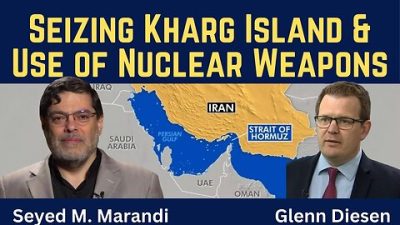
Marandi: Threat of Seizing Kharg Island & the Use of Nuclear Weapons
or go to
Aletho News Archives – Video-Images
Frlom the Archives
Provoking a Path to Persia
The Saban Center’s prescient paper on war with Iran
By Maidhc Ó Cathail | October 20, 2011
In June 2009, the Saban Center for Middle East Policy published “Which Path to Persia?—Options for a New American Strategy toward Iran.” Writing in a tone strikingly reminiscent of the Project for a New American Century’s infamous pre-9/11 paper “Rebuilding America’s Defenses,” the six co-authors noted that, “It seems highly unlikely that the United States would mount an invasion without any provocation or other buildup.” For a think tank specifically established by media mogul Haim Saban to protect Israel, this could prove to be a formidable obstacle impeding their desired march—of U.S. troops—to Tehran.
“In fact, if the United States were to decide that to garner greater international support, galvanize U.S. domestic support, and/or provide a legal justification for an invasion, it would be best to wait for an Iranian provocation, then the time frame for an invasion might stretch out indefinitely,” Saban’s think-tankers ruefully observed.
“With only one real exception, since the 1978 revolution, the Islamic Republic has never willingly provoked an American military response, although it certainly has taken actions that could have done so if Washington had been looking for a fight. Thus it is not impossible that Tehran might take some action that would justify an American invasion. And it is certainly the case that if Washington sought such a provocation, it could take actions that might make it more likely that Tehran would do so (although being too obvious about this could nullify the provocation). However, since it would be up to Iran to make the provocative move, which Iran has been wary of doing most times in the past, the United States would never know for sure when it would get the requisite Iranian provocation. In fact, it might never come at all.”
Seemingly undeterred by Iran’s frustrating unwillingness to provide the requisite provocation, the analysts continued to examine this option… continue
Blog Roll
 Aletho News
- Ukrainian Embassy in Beirut sheltering top Mossad agent
- Palestinian family displaced after settlers violently attack them in Humsa, Jordan Valley
- The EU never learns – except for the wrong lessons
- Iran attacks on UAE leaves RSF militia high and dry
- Hosting Washington’s war: Bahrain faces the consequences
- The US fell for its own Iran propaganda
- Seyed M. Marandi: Threat of Seizing Kharg Island & the Use of Nuclear Weapons
- Is there even an off ramp?
- Michael von der Schulenburg: Europe’s Self-Defeating Iran War Policy
- Sorry, The New Republic, Climate Change Isn’t Causing Somali Migration. Blame Civil Strife and Poverty.
- If Americans Knew
- ‘Of Course’: IDF Drops Case Against Soldiers Accused of Raping Palestinian Prisoner
- Don’t Fall for the Regime Change Talk. Israel Is ‘Mowing the Lawn’ in Iran
- Will Israel and the US wreck the Gulf States along with Iran?
- US so far burned through ‘years’ of munitions in Iran war: Report
- How the Israeli Tail Wags the American Dog
- Outdated intel likely led to deadly U.S. strike on Iranian elementary school, sources say
- Pentagon insider says high U.S official Douglas Feith reported to Netanyahu
- In fond memory of Walid Khalidi, the historian of Palestine
- 6 more Americans killed, as Israel ‘mows the lawn’ in Iran – Not a ceasefire Day 154
- Are we on the precipice of World War III?
- No Tricks Zone
- New Studies: UK Sea Levels Were 4 Meters Higher Than Today During The Mid-Holocene
- Destructive Green New Deal: German Energy And Metal Group Warns Of Drastic Crisis
- New Study Documents A 20-Year Pause In Arctic Sea Ice Decline – Driven By Internal Variability
- Wake-up Call: Survey Shows Majority Of Germans Now Favor Postponing Climate Targets!
- Televised! Leading German Political Candidate Tells Schoolchildren CO2 Makes Sun Hotter!
- New Study: A Century Warming Of 1.1°C Is ‘Commonplace’ And ‘Not Unusual’ During This Interglacial
- New Study: ‘Internal Noise’ And Volcanic Forcing Can Trigger 10-15°C Warming Within Decades
- Glaciers Worldwide Are Suddendly Surging, Experts Blame Warming!
- Surprising Discovery: Sahara Is Greening…Billions Of Trees Where Once Thought To Be Barren
- New Research Reaffirms Clouds, Aerosols, And Surface Solar Radiation Are ‘Driving The Climate System’
 Aletho News