The Lazy Pundit’s Guide to Which Candidate’s Lies You Shouldn’t Care About
By Jim Naureckas | FAIR | June 1, 2016
Thomas Friedman kicks off the summer punditry season with a column (New York Times, 6/1/16) explaining that while “lying is serious business,” some candidates’ lies are more serious than others. For example, “Hillary’s fibs or lack of candor are all about bad judgments she made on issues that will not impact the future of either my family or my country,” whereas “Trump and Bernie Sanders have been getting away with some full Burger King Double Whoppers that will come crashing down on the whole country if either gets the chance to do what he says.”
The Donald Trump portion of the column mainly illustrates the laziness of a wealthy pundit looking forward to beach season. Friedman explains to Trump why “we can’t carpet-bomb the terrorists without killing all the civilians around them”—forgetting, or not caring, that carpet-bombing terrorists was Ted Cruz’s line, not Trump’s.
He demands an explanation from Trump: “On Mexico, please tell me why it would pay for a multibillion-dollar wall on our border and how we would compel our neighbor to do so.” Trump has been claiming since last year, at least, that he could force Mexico to pay for the wall by blocking immigrant workers from sending home money—but Friedman seems not to have heard about it.
His attack on Sanders doesn’t display much more enterprise:
He is promising to break up the big banks. Under what legal authority? What would be the economic fallout? And how would this raise stagnant incomes for middle-class Americans? Bernie mumbles on these questions.
Here Friedman picks the most obvious target, the issue that corporate media—following the lead of the Clinton campaign—most concertedly beat up Sanders over. The problem is that many of those same outlets, when they filed follow-up stories about the controversy (e.g. New York Times, 4/6/16; Washington Post, 4/7/16; Politico, 4/14/16), walked back the criticism, acknowledging that, as the Times’ Peter Eavis put it, “Bernie Sanders probably knows more about breaking up banks than his critics give him credit for.”
Friedman also cites the Tax Policy Center’s figures for increased federal spending under Sanders’ proposals—which mostly come from the Urban Institute’s estimates for the cost of his single-payer plan, which have come under heavy criticism from experts on single-payer financing. Without rehashing the entire argument, it’s worth noting, as the Urban Institute does in its defense of its report, that the bulk of the huge numbers thrown about do not reflect new spending:
Of the $32.0 trillion in additional federal costs, only $6.6 trillion reflects new health spending in the system; the remaining $25.4 trillion is produced by shifting existing state and local government spending and private spending to the federal government.
As for why every other wealthy country can provide healthcare to all citizens and pay considerably less per capita to do so, but single-payer would supposedly raise and not lower costs in the US, the Urban Institute report offers this: “Political compromises with the entire panoply of health care stakeholders would be necessary to make the plan acceptable.” In other words, it’s impossible to do anything that would significantly change the distribution of income in the United States (other than to make it more unequal, as we have already done)—an assumption that not only the Sanders campaign but millions of Americans would certainly reject.
So those are the lies being told by Sanders and Trump, according to Thomas Friedman. What about Hillary Clinton’s “struggles with the whole truth on certain issues”? Not important. “Private email servers? Cattle futures? Goldman Sachs lectures? All really stupid, but my kids will not be harmed by those poor calls.”
Let’s put aside the issue that Goldman Sachs, the benefactor that Clinton won’t come clean about, was intimately involved in the economic crisis that certainly harmed millions of kids, though maybe not Friedman’s. Isn’t there anything else—something that even a low-information pundit like Thomas Friedman might have heard of?
Well, yeah. There is that. “Debate where she came out on Iraq and Libya, if you will, but those were considered judgment calls, and if you disagree don’t vote for her.”
Judgment calls? “I believe the facts that have brought us to this fateful vote are not in doubt,” Clinton said in her October 10, 2002, speech on the Senate floor explaining her vote for war:
In the four years since the inspectors left, intelligence reports show that Saddam Hussein has worked to rebuild his chemical and biological weapons stock, his missile delivery capability, and his nuclear program…. If left unchecked, Saddam Hussein will continue to increase his capacity to wage biological and chemical warfare, and will keep trying to develop nuclear weapons…. Now this much is undisputed.
Not only were those facts very much disputed and in doubt, they were flat-out wrong. It’s not clear why questioning cost estimates for your programs qualifies as “lying,” but maintaining that there was no debate about issues that were in fact intensely debated is merely a “judgment call.” But there’s another part of her speech that deals with events that she must have witnessed first hand—and she misrepresents those events:
When Saddam blocked the inspection process, the inspectors left. As a result, President Clinton, with the British and others, ordered an intensive four-day air assault, Operation Desert Fox, on known and suspected weapons of mass destruction sites and other military targets.
This sequence is precisely backwards: President Clinton decided to bomb Iraq, the inspectors left to facilitate that bombing, and subsequently Saddam Hussein refused to allow back in the inspectors who had been used as a pretext for bombing.
These events were reported accurately at the time; presumably Hillary Clinton observed them at close range. Her willingness to reinvent them for political purposes just four years later is a graphic example of how lies can “come crashing down on the whole country”—and why lying is, indeed, serious business.
Jim Naureckas can be followed on Twitter: @JNaureckas.
You can send a message to the New York Times at letters@nytimes.com (Twitter:@NYTimes). Please remember that respectful communication is the most effective.
Skynet: UK to upgrade war satellites to expand global drone kill operations
RT | June 3, 2016
Britain’s military plans to replace its ageing Skynet war satellites to meet the bandwidth demands of its expanding Special Forces and drone operations.
It is the first sign of the UK’s ambitions to create the next generation of military space satellites to replace the Skynet A5, the original version of which came into service in the 1960s.
It is now considering how to proceed with its Future Beyond Line of Sight (FBLOS) program.
Given the shadowy nature of the project, the Ministry of Defence (MoD) has been vague about the specifics, telling Defence News : “We continue to consider a range of options for the FBLOS project and aim to submit the initial business case this summer.”
The existing system was produced by arms giant Airbus. Upgrades are required to increase bandwidth to support the UK’s increasingly clandestine operations using special forces, the forthcoming F-35 combat aircraft and, perhaps most significantly, its expanding drone fleet.
The forthcoming assessment of military requirements will be carried out from the early 2020s to the end of that decade.
The upgrade is indicative of emerging trends in warfare, at a time when public resistance to the Afghanistan and Iraq wars has made large-scale troop deployments politically untenable.
Chris Cole, of the NGO Drone Wars, wrote on the possibility of a connection between Skynet and British military drones as long ago as 2010.
However, in a blog on the topic he pointed out: “Skynet 5 however is not owned by the Ministry of Defence, but by a private company called Paradigm Secure Communication.”
This would render Skynet virtually impervious to freedom of information (FoI) requests regarding its links with drone warfare, which can only be put to public bodies.
Speaking to RT on Friday, Cole said that as well as “doubling the UK’s current armed drone fleet and investing heavily in the development of future drones” the UK is working quietly to install “secret communication systems to enable the UK to use its armed drones right around the globe.”
He warned: “The continuing development of Skynet is an integral part of the government’s strategy to follow the US down the path of being able to target those it considers to be a threat, anywhere in the world.”
The Bigger Nuclear Risk: Trump or Clinton?
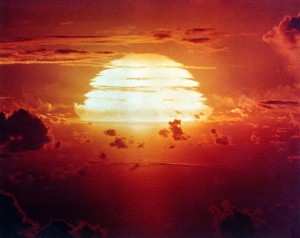
A U.S. government photograph of Operation Redwing’s Apache nuclear explosion on July 9, 1956.
By Robert Parry | Consortium News | June 2, 2016
Hillary Clinton made a strong case for why handing the nuclear codes over to a President Donald Trump would be a scary idea, but there may be equal or even greater reason to fear turning them over to her. In perhaps the most likely area where nuclear war could break out – along Russia’s borders – Clinton comes across as the more belligerent of the two.
In Clinton’s world view, President Vladimir Putin, who has been elected multiple times and has approval ratings around 80 percent, is nothing more than a “dictator” who is engaged in “aggression” that threatens NATO following the U.S.-backed “regime change” in Ukraine.
“Moscow has taken aggressive military action in Ukraine, right on NATO’s doorstep,” she declared. But stop for a second and think about what Clinton said: she sees Russia responding to an unconstitutional coup in Ukraine – which installed a virulently anti-Russian regime on Russia’s border – as Moscow acting aggressively “on NATO’s doorstep.”
That’s the same NATO, whose job it was to protect Western Europe from the Soviet Union, that — following the Soviet Union’s collapse — added country after country right up to Russia’s border. In other words, NATO muscled its way into Russia’s face and has announced plans to incorporate Ukraine as well, but when Russia reacts, it’s the one doing the provoking.
Clinton’s neoconservative interpretation of what’s happening in Eastern Europe is so upside-down and inside-out that it could ultimately become the flashpoint for a nuclear war between Russia and the West.
While she sees Russia as the “aggressor” against NATO, the Russians see NATO moving troops up to its borders and watch the deployment of anti-ballistic-missile systems in Romania and Poland, thus making a first-strike nuclear attack against Russia more feasible. Russia has made clear that it views these military deployments, just kilometers from major Russian cities, as an existential threat.
In response, Russia is raising its alert levels and upgrading its strategic forces. Yet, Hillary Clinton believes the Russians have no reason to fear NATO’s military encirclement and no right to resist U.S.-supported coups in countries on Russia’s periphery. It is just such a contradiction of viewpoints that can turn a spark into an uncontrollable inferno.
What might happen, for instance, if Ukraine’s nationalist — and even neo-Nazi — militias, which wield increasing power over the corrupt and indecisive regime in Kiev, received modern weaponry from a tough-talking Clinton-45 administration and launched an offensive to exterminate ethnic Russians in eastern Ukraine and to reclaim Crimea, where 96 percent of the voters opted to secede from Ukraine and rejoin Russia?
A President Hillary Clinton would have talked herself into a position of supporting this “liberation” of “Russian-occupied territory” and her clever propagandists would surely present this “heroic struggle” as a war of good against evil, much as they justified bloody U.S. invasions of Iraq and Libya which Clinton supported as U.S. senator and Secretary of State, respectively.
What if the Ukrainian forces then fired missiles striking Russia’s naval base at Sevastopol in Crimea, killing some of the 20,000 Russian troops stationed there and inflicting damage on Russia’s Black Sea fleet? What if Kremlin hardliners finally got their way and unleashed the Russian army to launch a real invasion of Ukraine, crushing its military, rumbling through to Kiev and accomplishing their own “regime change”?
(Photo credit: AIPAC)
How would President Hillary Clinton respond? Would she put herself in the shoes of Russia’s leaders and search for some way to de-escalate or would she get high-and-mighty and escalate the crisis by activating NATO military forces to counter this “Russian aggression”?
Given what we know about Clinton’s tough-talking persona, the odds are good that she would opt for an escalation – and that could set the stage for nuclear war, possibly starting because the Russians would fear the imminence of a NATO first strike, made more possible by those ABM bases in Romania and Poland.
Clinton’s Non-Nuclear Wars
There are other areas in the world where a President Hillary Clinton would likely go to war albeit at a sub-nuclear level. During the campaign, she has made clear that she intends to invade Syria once she takes office, although she frames her invasions as humanitarian gestures, such as creating “safe zones” and “no-fly zones.”
In other words, although she condemns Russian “aggression,” she advocates aggressive war herself, seemingly incapable of recognizing her hypocrisies and only grudgingly acknowledging her “mistakes,” such as her support for the invasion of Iraq.
So, on Thursday, even as she made strong points about Trump’s mismatched temperament for becoming Commander-in-Chief, she flashed a harsh temperament of her own that also was unsettling, although in a different way.
Trump shoots from the lip and has a thin skin, while Clinton is tightly wound and also has a thin skin. Trump lets his emotions run wild while Clinton is excessively controlled. Trump engages in raucous give-and-take with his critics; Clinton tries to hide her decision-making (and emails) from her critics.
It’s hard to say which set of behaviors is more dangerous. One can imagine Trump having free-form or chaotic diplomatic encounters with allies and adversaries alike, while Clinton would plot and scheme, insisting on cooperation from allies and demanding capitulation from adversaries.
Clinton sprinkled her speech denouncing Trump with gratuitous insults aimed at Putin and undiplomatic slaps at Russia, such as, “If Donald gets his way, they’ll be celebrating in the Kremlin. We cannot let that happen.”
In short, there is reason to fear the election of either of these candidates, one because of his unpredictability and the other because of her rigidity. How, one might wonder, did the two major political parties reach this juncture, putting two arguably unfit personalities within reach of the nuclear codes?
[For more on this topic, see Consortiumnews.com’s “Yes, Hillary Clinton Is a Neocon” and “Would a Clinton Win Mean More Wars?’]
Investigative reporter Robert Parry broke many of the Iran-Contra stories for The Associated Press and Newsweek in the 1980s. You can buy his latest book, America’s Stolen Narrative, either in print here or as an e-book (from Amazon and barnesandnoble.com).
Dismantling Civil Society in Bahrain
By Rannie Amiri | CounterPunch | June 3, 2016
Like a vise which first grips its object and then slowly, deliberately and inexorably crushes it, the al-Khalifa regime has done similarly to civil society in Bahrain. It did not stop when peaceful, pro-democracy, reform protests erupted in 2011 and were violently put down by government forces aided by an invasion of Saudi troops in March of that year. Indeed, the vise continues to close and relentlessly so.
Nationalities have been revoked, mosques razed, citizens deported, human rights activists imprisoned on flimsy charges of insulting the monarchy at the least or plotting its overthrow at worst, and the most perfunctory of dialogues with the opposition abandoned. By smothering the figures and institutions who dare challenge the authority of the ruling dynasty in the most benign of fashions – a tweet, waving the country’s flag, tearing up a photo or merely questioning the tenure of the world’s longest serving prime minister – the Bahraini regime and its Gulf allies would like to believe monarchal rule has been preserved. Such desperate measures however, only speak to its precarity.
The stalwart activist Zainab al-Khawaja was given a sentence of three years and one month in Dec. 2014 for (again) tearing up a picture of King Hamad. She refused to be separated from her infant son whom she took with her to prison. Al-Khawaja has just been released on “humanitarian” grounds after serving 15 months in jail.
Her father though, Abdulhadi al-Khawaja, remains imprisoned serving a life sentence on trumped-up charges of attempting to topple the government. While authorities may have set Zainab al-Khawaja free, they simultaneously doubled the sentence of Sheikh Ali Salman, head of al-Wefaq, an opposition political party. Initially given a term of four years incarceration for alleged incitement against the regime, it was increased to nine years on appeal. The unflinching President of the Bahrain Center for Human Rights (BCHR) and founding Director of the Gulf Centre for Human Rights Nabeel Rajab, remains banned from leaving the country despite the need to secure medical treatment for his wife.
Busy highlighting the nation’s cordial relations with the United Kingdom and United States, the latter of which headquarters its Navy’s Fifth Fleet in the capital Manama, the Western media has largely ignored the plight of Bahrain’s ordinary citizens. The arrest and torture of disabled youth has now been documented by the BCHR. Indeed, for more than a decade, the Center has meticulously chronicled the dismantling of Bahrain’s civil society in all its forms by the al-Khalifa regime.
Most recently, with the passage of a law preventing any religious figure from joining political societies or engaging in political activities, the BCHR issued a statement condemning, “… the Bahraini parliament and Shura Council’s passage of amendments to the Political Societies Law, which places a ban on participation in political decision-making based on discriminatory religious grounds. In defense of this draft amendment, lawmakers supporting this motion argued it would prevent religious acts from being politicized. This decision restricts people’s ability to freely engage in religious practices, as those members willing to join political activities pertinent to the legislative process in Bahrain would now need to refrain from any activities carrying religious connotations.”
In the face of widespread and open abuses in civil society, lack of proportional parliamentary representation, curfews, detentions, and imprisonment and torture of those who dissent, these practices have nonetheless failed to adversely impact the ties enjoyed between Bahrain and the United States. But when a regime becomes alienated from those whom it rules and for example, gives lengthy jail sentences for tweets it finds offensive, it speaks to a tenuous reign.
The pillars of civil advocacy in Bahrain – Nabeel Rajab, Abdulhadi al-Khawaja, Maryam and Zainab al-Khawaja, Abduljalil al-Singace (sentenced to life in prison for participating in pro-democracy protests), Naji Fateel, Hussain Jawad and countless others both named and unnamed – have consistently engaged in purely secular, non-sectarian activism. Unlike the practice of the regime, the designations Sunni and Shia need not be applied when discussing the ongoing struggle for legal, political and socioeconomic rights in Bahrain. The people have waited too long for the West to recognize their demands are not based on sect, but on equity.
Despite an oppressive regime and the long shadow cast by the U.S. Fifth Fleet, resilient Bahrainis remain unintimidated.
Rannie Amiri is an independent commentator on Middle East affairs.
Dreams of Control: Israel, Global Censorship and the Internet
By Binoy Kampmark | CounterPunch | June 3, 2016
“Under the cover of darkness, there is no limit to the expansion of Big Brother.”
Ilan Gilon, Meretz Party (Israel), Times of Israel, Feb 4, 2016
While Israel’s central justification for its often reactionary policies is couched in hyper-exceptionalist rhetoric, nourished by the ashes of Holocaust remembrance, current interest in censoring the Internet is far from exceptional.
Like a machine of justification against its critics and its enemies, Israel enlists various projects under the banner of the remarkable and precious, when it is simply accomplishing what other states have done before or since: the banal and ordinary. All states want to limit expression, control criticism and marginalise the sceptics. Some do it more savagely, and roughly, than others.
Israel’s military censor, Col. Ariella Ben Avraham, who is part of the IDF’s Directorate of Military Intelligence, gave a good example of this in February by insisting that social media activists and bloggers submit material relevant to security matters for approval prior to posting. The move also revealed an increasing interest to police the digital realm, previously considered an anarchic jungle incapable of effective policing.
Up to 32 Israeli bloggers and social media activists were informed about the directive, one of the first being Yossi Gurvitz, a left-wing activist running the “Friends of George” Facebook page. In rather unceremonious fashion, he was informed via Ben Avraham’s private Facebook account that he was obligated to run future submissions by her office. To his credit, he promises to defy the order.
Internal censorship is but one aspect of this policy. Israel Public Security Minister Gilad Erdan has dipped into the discourse of censorship to convince others that limiting various social media platforms on a global scale is the way to go. In January, he revealed the inner ambition of Israel’s security establishment to internationalise the censorship effort.
To achieve that goal, Erdan speaks of an “international coalition” that would make limiting criticism of Israel its primary objective. The central aim is hardly imaginative: making such providers as YouTube, Twitter and Facebook face up to responsibility as to what they host on their sites.
The Erdan plan suggests that various countries would form a “loose coalition that would keep an eye on content and where it is being posted, and members of the coalition would work to demand that the platforms remove the content that was posted in any of their countries at the request of members.” The simple idea behind this collusion is extra-territorial cooperation, effectively circumventing the global nature of such platforms.
As for the scurrilous subject matter itself, the issues are universal fare for states keen to control matters that supposedly stimulate the darker side of human nature. (Read: contrary to state interests.) Erdan’s office gives the example of material from a Palestinian (of course) disclosing the best locations on the body to inflict fatal stab wounds.
This begs that grand question about how far such an effort goes: control the more sordidly violent sides of the Old Testament because it encourages various unsavoury practices? Limit suggestive literature being discussed in the whirl of social media, buzzing away with malicious promise? The mind is an untidy place filled with remarkable things, and not all of them necessarily make it to actual perpetration. This is a point that continues to elude the mighty warriors of the security state.
Another justification is being thrown in: they, the social media giants, rake in the proceeds, and should therefore man the barricades. “We are planning to put a stop to this irresponsibility,” claimed Erdan’s office, “and we are going to do it as part of an international coalition that has had enough of this behaviour as well.”
Other governments have also done their bit to limit the internet and content available to their citizens. Most famously, Beijing runs its own “Great Firewall of China”, overseen by the Ministry of Information Industry (MII), while the State Council Information Office and the Chinese Communist Party’s Propaganda Department examine content.
In recent times, countries of a supposedly democratic character have taken to the blinds and endeavoured to do what Erdan dreams about. Dangerous thoughts are seen as the reason for dangerous actions. To that end, the country that gave Europe the Enlightenment has been busy forging its own vision of global internet censorship, using a mixture of security and privacy concerns.
The latter has proven to have potentially pernicious consequences, framed largely as an effort to protect the privacy of the French citizen. From that vantage point, a vision of global control has been built on a premise forged in European law: the right to be forgotten. The Court of Justice of the European ruling of May 13, 2014 (Google Spain v Agencia Española de Protección de Datos, Mario Costeja González) has supplied the subject matter for the latest enlargement of censorship powers.
The French response has been intrusively enthusiastic, with the privacy regulator, CNIL, fining Google 100,000 Euros in March for not applying the right to be forgotten across the global network. In the chilling words of the regulator, “For people residing in France to effectively exercise their right to be delisted, it must be applied to the entire processing operation.” Erdan may well be irritated he did not come up with that one.
Binoy Kampmark was a Commonwealth Scholar at Selwyn College, Cambridge. He lectures at RMIT University, Melbourne. Email: bkampmark@gmail.com
Israel deports 6 Palestinians to the U.S.
Palestinian Information Center – June 3, 2016
OCCUPIED JERUSALEM – The Israeli Interior Ministry and the Israeli Prison Service (IPS) at dawn on Friday deported six Palestinian citizens from Occupied Jerusalem to the U.S.
33-year-old Kareem Faysal Abu Khdheir, who was banned from Occupied Jerusalem and deported to the U.S., said as he spoke by phone from the Lod Airport: “I was transferred from the Negev jail to the airport on Thursday morning. The Israeli occupation authorities claimed the flight was scheduled for five p.m. on Thursday before they updated me that it was delayed for six a.m. on Friday.”
“I was locked up in the airport detention center with five other detainees. Each one of us was allowed to make one phone call only to update his family on the deportation order,” he added.
Kareem, from the Shu’fat refugee camp, was arrested by the Israeli occupation forces on September 5, 2015 following clashes with occupation troops. Right before the detention, Kareem was subjected to heavy beating by the Israeli Occupation Forces and sustained critical bruises in his chest, face, and teeth.
The IOA extended his remand several times despite his deteriorated health status.
Deliberations and hearings held by the Israeli Magistrate’s court over the past four months culminated in a verdict that condemned Abu Khdheir, a holder of American citizenship, for involvement in Jerusalem demonstrations and sentenced him to nine months and a fine of 8,000 shekels.
Born and raised in the U.S. since October 2, 1983, Kareem Abu Khdheir popped into the occupied Palestinian territories on August 28, 2015 for the first time to get married.
He had been held for nine months in the Negev jail on allegations of resisting arrest, attacking an Israeli border guard, and joining anti-occupation demos.
“Someday I shall return to my motherland, from which I was banned because I attended my friend’s funeral,” said Abu Khdheir. “Someday I shall come back and live on Palestine’s soil for eternity,” Abu Khdheir added as he bid farewell to his family.
Israeli forces kill young Palestinian mother of two after alleged stab attempt
Ma’an – June 2, 2016
 BETHLEHEM – A Palestinian woman was shot and killed at an Israeli army checkpoint in the northern occupied West Bank on Thursday afternoon, after allegedly attempting to stab a soldier.
An Israeli army spokesperson told Ma’an that an “attempted stabbing” took place at a checkpoint in the eastern Tulkarem governorate near the Palestinian village of Anabta. She added that the soldiers “responded to the threat” by shooting at the woman, killing her.
The spokesperson added that no Israelis were injured.
Israeli sources later identified the Palestinian woman as 25-year-old Ansar Hussam Harasha. Harasha was reportedly a married mother of two.
The Palestinian Ministry of Health said that they had been informed by the Israeli military liaison office that Israeli forces had opened fire at a Palestinian woman at the Innab checkpoint eastern Tulkarem and killed her.
Palestinian Red Crescent spokeswoman Errab Foqoha told Ma’an that Israeli forces prevented an ambulance from the health organization from accessing the scene. Foqoha added that Red Crescent staff saw the woman lying on the ground before being taken inside an Israeli ambulance, which stayed on the scene.
More than 200 Palestinians and nearly 30 Israelis have been killed since the beginning of a wave of unrest across the occupied Palestinian territory and Israel in October.
The unrest has been characterized by a number of small-scale attacks mainly against Israeli military targets.
According to the UN, investigations showed that in a number of instances since the unrest began, Israeli forces have implemented a policy of extrajudicial execution, killing Palestinians who did not present imminent threat or could have been subdued through other means.
Video: Crime scene manipulated after Hebron killing, possibly disproving claims by Israeli soldier
Ma’an – June 1, 2016
BETHLEHEM – New video footage has surfaced of an Israeli ambulance driver kicking a knife towards the body of Abd al-Fattah al-Sharif, a young Palestinian whose execution-style murder by an Israeli soldier in March was caught on video, sparking international outrage.
The video footage, obtained by Israel’s Channel Two, is expected to be shown to an Israeli military court to disprove claims by the Israeli soldier who killed al-Sharif that he shot the young Palestinian point-blank in the head after al-Sharif moved to grab a knife, according to the Israeli media outlet Ynet.
The footage shows that the knife allegedly used in the attack was far from al-Sharif when he was shot, notably showing an ambulance driving over the knife before it was kicked closer to al-Sharif’s body.
The Israeli military prosecutor reportedly said that an Israeli ambulance driver, Ofer Ohanna, who was near the scene kicked the knife towards al-Sharif’s body following his murder, according to Hebrew-language news outlet Maariv.
Maariv reported that Ohanna refused to speak to the media, and said he gave the military prosecution all the information he had on the incident during interrogations.
Israeli human rights group B’Tselem released footage of al-Sharif’s execution by Israeli soldier Elor Azarya in March, showing the placement of the knife far from al-Sharif’s body.
However, the new video reportedly shows what transgressed immediately after the ambulance drove by the scene, with an Israeli ambulance driver directly manipulating the crime scene shortly after the shooting by moving the knife closer to al-Sharif.
A spokesperson for B’Tselem could not immediately be reached for comment.
Al-Sharif was shot alongside Ramzi Aziz al-Qasrawi after the two Palestinians allegedly stabbed and moderately wounded an Israeli soldier at a military checkpoint in the Tel Rumeida area of Hebron on March 24.
Al-Qasrawi was killed immediately, while al-Sharif was left severely wounded for several minutes without treatment, before Azarya stepped forward and put a bullet through his head, killing him.
A graphic video released by B’Tselem capturing the incident was met with wide condemnation from rights groups and international bodies, with the UN demanding an investigation into the apparent “extrajudicial execution.”
Azarya was charged with manslaughter, rather than murder as had initially been expected, and is being held on a military base in “open detention” where he is free to roam and has received visits from his family. His trial opened in early May.
Palestinians have long held fears that Israeli soldiers and settlers tamper with crime scenes involving Palestinians, with human rights groups accusing Israel of practicing a policy of extrajudicial executions since a wave of violence erupted in October, leaving more than 200 Palestinians and nearly 30 Israelis killed.
Netanyahu steps up opposition to French ‘peace’ initiative
Press TV – June 2, 2016
Israeli Prime Minister Benjamin Netanyahu has stepped up his opposition to a French initiative aimed at reviving talks between Israelis and Palestinians.
“The path to peace is not via international conferences that attempt to force a settlement, that make the Palestinian demands more extreme and in the process distance peace,” Netanyahu said on Wednesday.
Paris will be hosting on Friday a gathering of more than 20 countries as well as UN and EU diplomats to discuss the Middle East conflict.
The Israeli prime minister reiterated his call for “direct negotiations and without preconditions.”
“If the countries gathering this week in Paris really want to advance peace, they should join my call to Abu Mazen [Palestinian President Mahmoud Abbas] to come to such direct negotiations … There is no other way,” said Netanyahu.
In a meeting with French Prime Minister Manuel Valls last month, Netanyahu rejected the initiative, saying direct talks with the Palestinian Authority are “the only way to proceed to peace.”
However, Palestinian Prime Minister Rami Hamdallah dismissed Netanyahu’s proposal, calling it an attempt to “buy time.”
The last round of the so-called peace talks between Israelis and Palestinians collapsed in 2014.
Tel Aviv’s illegal settlement activities and its refusal to release senior Palestinian prisoners were among major reasons behind the failure of the talks.
The Israeli premier formally suspended the so-called peace talks with the Ramallah-based Palestinian Authority on April 24, 2014, after Abbas forged a unity pact with Hamas.
Israel responded to the unity pact by announcing tenders for the building of 4,800 illegal settler units on the occupied Palestinian territories.
Palestinians are seeking to create an independent state on the territories of the West Bank, East al-Quds (Jerusalem), and the Gaza Strip.
They are demanding that Israel withdraw from the occupied Palestinian territories.
Israel, however, has refused to return to the 1967 borders and is unwilling to discuss the issue of al-Quds (Jerusalem).
Clinton’s Vice President: A Match Made on Wall Street
By Eric Draitser | CounterPunch | June 2, 2016
Earlier this week, Bernie Sanders warned that Hillary Clinton’s eventual vice presidential pick must not be someone from the milieu of Wall Street and Corporate America. And while Sanders is still fighting to win the Democratic Party nomination in what many have argued is a rigged system with a foregone conclusion, it appears that Sanders is also intent on influencing the course of the Clinton campaign and the party itself.
In a thinly veiled demand that Clinton embrace the core principles of the Sanders campaign in order to secure the support of Sanders’s political base, the insurgent Democratic candidate hoped aloud “that the vice-presidential candidate will not be from Wall Street, will be somebody who has a history of standing up and fighting for working families, taking on the drug companies… taking on Wall Street, taking on corporate America, and fighting for a government that works for all of us, not just the 1%.”
And while that description may sound positive for its sheer idealism, it does not seem to account for the fact that banks and corporations effectively own both major parties, and that nearly every top Democrat is in various ways connected to the very same entities. In any event, it is useful still to examine a few of the potential Clinton running mates in order to assess just what sort of forces are going to be put in motion to help deliver a Clinton presidency.
The Actors on the Playbill
Beltway pundits are fond of remarking that Tim Kaine, the underwhelming centrist Democrat senator (and former Governor) from Virginia, is at the top of the list for Clinton. He’s safe. He’s experienced. He’s safe. He’s a Democratic Party loyalist with experience fundraising. Oh, and did I mention that he’s safe? Such is the general tenor of the conversation around Kaine, a politician with a long track record and a mostly forgettable personality known more to DC insiders than to the general voting public.
What could be better for Hillary Clinton, perhaps the least liked Democratic (presumptive) nominee in decades, than to have a party establishment insider who represents the status quo as her running mate in an election year that will undoubtedly be remembered for the ostensibly anti-establishment candidates and rhetoric on display throughout?
To be fair, Kaine does represent Virginia, a swing state that is crucial for Donald Trump, and which could spell victory for Clinton should she carry it. And of course, Kaine can also posture as “tough on Wall Street” from his days as DNC Chairman and party mouthpiece during the passage of the so-called “Wall Street reform” bill. Despite nothing substantive coming out of the bill, Kaine is still able to cash in the political currency derived from that bill, and perhaps meekly shield Clinton from continued attacks vis-à-vis her connections to Wall Street.
Of course Kaine also comes with his own baggage, including his anti-abortion stance which earned him the ire of many pro-choice activists in Virginia when he was Governor. Considering the shameless droning from Clinton and her backers about being “the first woman president,” it would certainly raise serious questions – and open up an obvious angle of attack for Trump – were she to sport her feminism and focus on women’s reproductive rights by selecting a man with an anti-abortion record.
A look down the list of other potential choices reveals that Clinton truly has very little to choose from. Both Housing and Urban Development (HUD) Secretary Julian Castro, as well as Labor Secretary Tom Perez, have both had their names bandied around as Clinton seeks to solidify the Latino vote in an election where the Republican candidate has worked tirelessly to alienate that all-important demographic as much as possible. But of course, the obvious question to be asked in response to either of these potential selections would be “Who?” Neither Castro nor Perez is well known nationally, nor have either of them won major elections or really done anything of note in their tenure in Obama’s cabinet. Despite being Latinos, they are utterly forgettable, and unlikely to bring significant returns to Clinton.
While other names such as New Jersey junior senator Cory Booker, as well as Ohio senator Sherrod Brown, have been discussed, both men hail from states with Republican governors, meaning that were they to accept a VP slot, their senate vacancies would be likely filled by Republicans, a scenario that Senate Minority Leader Harry Reid has already said “Hell no!” to, vowing to “yell and scream to stop that.”
Who Else Is “Ready for Hillary”?
So that then leaves the two most interesting potential running mates: Elizabeth Warren and Bernie Sanders himself. Warren, who conspicuously refused to endorse Clinton over Sanders, has tremendous upside for Clinton as she has been perhaps the Democratic Party’s most vehement opponent of Wall Street, having led many high profile attacks on the major banks in her tenure in the Senate. From a public relations branding perspective, she is essentially the female Bernie Sanders, a progressive Democrat who presents herself as an ally of working people and an enemy of bankers. For Clinton, Warren would also round out the “First Woman…” card, allowing the Clinton campaign to quite literally become a campaign about breaking the glass ceiling in US politics. The stump speeches almost write themselves.
Finally, there’s Mr. #FeelTheBern himself. His latest comments (mentioned above) certainly do have a subtext that implies his willingness to accept a running mate slot. Having fashioned himself as the champion of the middle class and threat to the Washington establishment, Bernie would provide much in the way of credibility to a lackluster Clinton campaign which has failed to excite even many ardent Democrats. Sanders would also guarantee a unified Democratic Party ticket, and provide much needed defense of Clinton’s left flank. In short, Sanders, like Warren, would give anti-Clinton progressives the pretext many of them need to justify their voting for the much-hated Clinton.
Never mind the fact that neither Sanders nor Warren would actually do anything to combat Wall Street finance capital as Vice President. Never mind the fact that no one on Wall Street is particularly scared of either politician being given the ceremonial power that comes with the Vice Presidency. These are just the kind of uncomfortable, but inescapable, facts that progressives must choose to ignore.
The difficulty for either Sanders or Warren is the marketing of their decision to left progressives, some of whom would see collaboration with Clinton and the Clinton political machine as a betrayal and a complete sell-out. However, aside from driving a some relatively small number of progressives to vote for Jill Stein and the Green Party (or stay home entirely), it is unlikely that the negative impact in the progressive base would amount to anything more than some hurt feelings followed by the usual acquiescence to the Democratic Party line.
If such an analysis sounds cynical and jaded, that’s because it is. Perhaps a better descriptor would be disdainful. Indeed, as someone who watched with bemused melancholy as progressives lined up to support Al Gore in 2000, John Kerry in 2004, and Barack Obama in 2008 and 2012, my position on support for ANY Democrat is the same as Harry Reid’s position on swing state senator VP picks: Hell no!
Indeed, the very notion of collaboration with a war criminal and Wall Street puppet such as Clinton is anathema to everything the left and “progressives” are supposed to stand for.
Of course, there is also the elephant (and donkey) in the room: both major parties are wholly owned subsidiaries of finance capital and the corporations that rule over us. This is the realization that millions of Americans have already made, and which millions more are making. This is the realization that keeps Democratic and Republican apparatchiks up at night. And this critical revelation is what Bernie, Liz, & Co. are there to suppress.
Featured Video
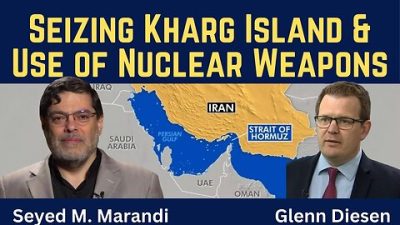
Marandi: Threat of Seizing Kharg Island & the Use of Nuclear Weapons
or go to
Aletho News Archives – Video-Images
Frlom the Archives
Provoking a Path to Persia
The Saban Center’s prescient paper on war with Iran
By Maidhc Ó Cathail | October 20, 2011
In June 2009, the Saban Center for Middle East Policy published “Which Path to Persia?—Options for a New American Strategy toward Iran.” Writing in a tone strikingly reminiscent of the Project for a New American Century’s infamous pre-9/11 paper “Rebuilding America’s Defenses,” the six co-authors noted that, “It seems highly unlikely that the United States would mount an invasion without any provocation or other buildup.” For a think tank specifically established by media mogul Haim Saban to protect Israel, this could prove to be a formidable obstacle impeding their desired march—of U.S. troops—to Tehran.
“In fact, if the United States were to decide that to garner greater international support, galvanize U.S. domestic support, and/or provide a legal justification for an invasion, it would be best to wait for an Iranian provocation, then the time frame for an invasion might stretch out indefinitely,” Saban’s think-tankers ruefully observed.
“With only one real exception, since the 1978 revolution, the Islamic Republic has never willingly provoked an American military response, although it certainly has taken actions that could have done so if Washington had been looking for a fight. Thus it is not impossible that Tehran might take some action that would justify an American invasion. And it is certainly the case that if Washington sought such a provocation, it could take actions that might make it more likely that Tehran would do so (although being too obvious about this could nullify the provocation). However, since it would be up to Iran to make the provocative move, which Iran has been wary of doing most times in the past, the United States would never know for sure when it would get the requisite Iranian provocation. In fact, it might never come at all.”
Seemingly undeterred by Iran’s frustrating unwillingness to provide the requisite provocation, the analysts continued to examine this option… continue
Blog Roll
 Aletho News
- Ukrainian Embassy in Beirut sheltering top Mossad agent
- Palestinian family displaced after settlers violently attack them in Humsa, Jordan Valley
- The EU never learns – except for the wrong lessons
- Iran attacks on UAE leaves RSF militia high and dry
- Hosting Washington’s war: Bahrain faces the consequences
- The US fell for its own Iran propaganda
- Seyed M. Marandi: Threat of Seizing Kharg Island & the Use of Nuclear Weapons
- Is there even an off ramp?
- Michael von der Schulenburg: Europe’s Self-Defeating Iran War Policy
- Sorry, The New Republic, Climate Change Isn’t Causing Somali Migration. Blame Civil Strife and Poverty.
- If Americans Knew
- ‘Of Course’: IDF Drops Case Against Soldiers Accused of Raping Palestinian Prisoner
- Don’t Fall for the Regime Change Talk. Israel Is ‘Mowing the Lawn’ in Iran
- Will Israel and the US wreck the Gulf States along with Iran?
- US so far burned through ‘years’ of munitions in Iran war: Report
- How the Israeli Tail Wags the American Dog
- Outdated intel likely led to deadly U.S. strike on Iranian elementary school, sources say
- Pentagon insider says high U.S official Douglas Feith reported to Netanyahu
- In fond memory of Walid Khalidi, the historian of Palestine
- 6 more Americans killed, as Israel ‘mows the lawn’ in Iran – Not a ceasefire Day 154
- Are we on the precipice of World War III?
- No Tricks Zone
- New Studies: UK Sea Levels Were 4 Meters Higher Than Today During The Mid-Holocene
- Destructive Green New Deal: German Energy And Metal Group Warns Of Drastic Crisis
- New Study Documents A 20-Year Pause In Arctic Sea Ice Decline – Driven By Internal Variability
- Wake-up Call: Survey Shows Majority Of Germans Now Favor Postponing Climate Targets!
- Televised! Leading German Political Candidate Tells Schoolchildren CO2 Makes Sun Hotter!
- New Study: A Century Warming Of 1.1°C Is ‘Commonplace’ And ‘Not Unusual’ During This Interglacial
- New Study: ‘Internal Noise’ And Volcanic Forcing Can Trigger 10-15°C Warming Within Decades
- Glaciers Worldwide Are Suddendly Surging, Experts Blame Warming!
- Surprising Discovery: Sahara Is Greening…Billions Of Trees Where Once Thought To Be Barren
- New Research Reaffirms Clouds, Aerosols, And Surface Solar Radiation Are ‘Driving The Climate System’
 Aletho News