Israeli government approves 800 new colonial settlement housing units
By Celine Hagbard | IMEMC | July 4, 2016
On Sunday the Israeli Cabinet approved the expansion of several Israeli settlements in the West Bank and East Jerusalem, adding an additional 800 new units to the existing thousands of units constructed in Jewish-only settlements in direct contravention of international law.
Israeli officials say that the approval of 800 new housing units is meant to somehow ‘balance’ the implementation of a court ruling that 600 construction permits be approved for Palestinian families in Beit Safafa.
But while the Israeli officials may have political reasons for making such a claim, Palestinian analysts point out that there is no legal justification or comparison between the court decision about Beit Safafa and the announcement Sunday of the expansion of illegal Israeli settlements constructed on illegally-seized Palestinian land.
In the case involving Beit Safafa, an Israeli court ruled last month that the Israeli government had provided no sufficient evidence to back its claim that the Palestinian residents’ building permit applications should be denied, and ordered that construction could begin. But the Israeli government has, for the past month, prevented the court decision from being implemented.
The announcement Sunday that 800 new settlement units would be constructed in East Jerusalem and in the West Bank colonial settlement of Ma’ale Adumim came just two days after Israeli Prime Minister Binyamin Netanyahu approved the expansion of another colonial settlement in Hebron by 42 additional units.
All Israeli settlements constructed in the West Bank and East Jerusalem are considered illegal under international law, as they involve the direct transfer of Israel’s civilian population into areas seized by military force.
But the Israeli government considers many of these colonial settlements to be ‘legal’ under Israeli law, and provides infrastructure including water, sewage, electricity, policing and fire services to the majority of the hundreds of settlements that have been constructed on Palestinian land in East Jerusalem and the West Bank.
In the case of Beit Safafa, the Israeli government had put together a plan to completely encircle the Palestinian town with several Jewish-only settlements, thus cutting off the town from the rest of the West Bank and Jerusalem.
The plan had involved the expansion of a small trailer park currently housing Ethiopian immigrants to Israel, on a hilltop in Beit Safafa. The trailer park, dubbed ‘Givat HaMatos’, was slated for massive expansion by the Israeli government until Palestinian residents of Beit Safafa took the government to court to challenge the expansion.
In a surprise victory a month ago, the Palestinian residents of Beit Safafa won their court battle. but the Israeli government failed to implement the decision before now.
Upon the announcement that the court’s decision would be carried out, the Israeli Minister for Jerusalem, Ze’ev Elkin, stated, “Anyone who is concerned about the Jewish majority in Israel’s capital cannot push a building plan just for Arabs [in Givat HaMatos]… You cannot just approve construction for Arabs in Givat HaMatos without also approving at the same time building for Jews in the same planned neighborhood.”
The plan to encircle Beit Safafa, while currently under scrutiny by international media and bodies, is just one part of the larger E1 Jerusalem plan, which would encircle East Jerusalem, kick out most of its Palestinian residents, and claim all the ‘conquered’ territory for the state of Israel. The plan was first introduced in the early 2000s, and has expanded since then.
Activists storm US military base in Yorkshire
Press TV – July 4, 2016
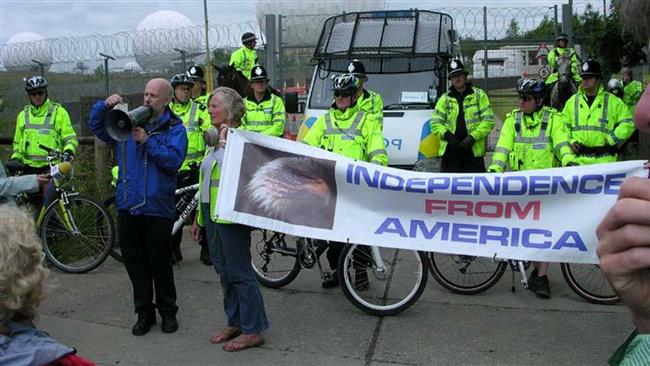
British activists have stormed an American military base in Yorkshire, continuing decades-long calls for its closure.
Just like the past three decades, peace activists from all over Britain gathered outside the Menwith Hill intelligence-gathering center on the outskirts of Harrogate over the weekend, the British daily Morning Star reported Monday.
“US military bases in Britain are jeopardizing the safety and security of the British public as they are threatening Russia and helping to cause carnage in the Middle East,” said Marcus Papadopoulos, an activist with the Campaign for the Accountability of American Bases (CAAB), which organized the event.
With its many satellite dishes, the more than 1,000-staff base collects intelligence and transmits it to the US.
Every year, protesters stage a demonstration at the base on the Saturday closest to July 4 – the day Americans celebrate their independence from England in 1776.
Ironically, this year’s rally was called “Independence from America Day,” and was attended by former Labour member of the European Parliament Michael McGowan.
McGowan gave a speech in defense of Labour leader Jeremy Corbyn whose leadership is under attack following the UK’s recent decision to leave the European Union (EU).
About 52 percent of British voters partaking in the June 23 referendum opted to leave the EU.
Labour MPs have criticized Corbyn for his “inadequate” contribution to the ‘Remain’ campaign and say they doubt he could lead the party to victory in 2020 general elections.
The party further plunged into crisis after eleven MPs rounded on Corbyn’s leadership, joining the 12 shadow cabinet ministers who resigned earlier this month.
The wave of resignation came after shadow Foreign Secretary Hilary Benn was sacked after he told the Labour leader that he had lost confidence in his leadership.
McGowan, however, told rally goers that Corbyn’s election last year provided “a historic opportunity for world peace, which should be a matter of universal celebration and an opportunity not be wasted but to be taken forward in the interest of all who share our planet.”
Trudeau Under Fire for ‘One Nation’ Statement in Quebec
Sputnik – 04.07.2016
Canadian Prime Minister Justin Trudeau was called on to retract his statement made on Canada Day calling the country “one nation”, as it insults Québécois.
Parti Québecois leader candidate Martine Ouellet said in a video posted her Facebook page Saturday that Canadian Prime Minister Justin Trudeau’s recent statement calling Canada “one nation” is “reinventing history”.
“It’s a direct insult to the Quebec nation, an insult to everything our heritage represents,” Ouellet wrote on Facebook.
On Canada Day, July 1st, Justin Trudeau said “today, we celebrate the day, exactly 149 years ago, when the people of this great land came together, and forged one nation, one country — Canada.”
Ouellet called for Trudeau to retract his statement and recognize Quebec as a nation.
Quebec, the largest and second most populated province of Canada, has a long record of struggle for independence that can be traced at least to 1960, when several diverse political groups coalesced in the formation of the Parti Québécois, which is now a primary mainstream political vehicle for the Quebec sovereignty movement.
Quebec’s current status allows it a high degree of autonomy, including its own property legislation, civil legislation, justice, healthcare and education regulation.
Justin Trudeau is known for his anti-separatism position. In 2006, then prime minister Stephen Harper introduced a motion calling on the House of Commons to recognize that “Québécois form a nation within a united Canada.” Trudeau, who was not an MP at the time of events, backed Gerard Michael Kennedy, a Liberal Party leader candidate who opposed the motion.
Trudeau had reportedly claimed that his father, the late prime minister, would never have supported recognition of Quebec as a nation.
Frexit: Debate Over EU Membership May Decide France’s Presidential Election
Sputnik – 04.07.2016
France has two candidates who are openly calling for exiting the European Union while another wants major overhauls sending chills down the backs of the status quo establishment.
Britain’s historic vote to abandon the European Union sparked renewed calls by French nationalist Marie Le Pen, a leading candidate for the country’s presidency, for Paris to step away from what she deemed an undemocratic and failed experiment.
The candidate took to the editorial pages of the Western press blasting the pro-EU establishment of Francois Hollande for fettering away the country’s sovereignty to an unknown cabal of bureaucrats in Brussels who can override any aspect of French law including the constitution.
Le Pen’s National Front Party is just one of many populist rightwing forces across Europe now clamoring to escape the European Union citing sometimes xenophobic concerns about the influx of Syrian refugees and a lack of political self-determination as their rallying cry against the crumbling EU.
Declared “Madame Frexit” the candidate has made her rallying call for French liberation the focal point of her candidacy promising to hold a referendum on EU membership within six months if she attains power in next year’s election.
“The People’s Spring is now inevitable!” declared Le Pen in a New York Times editorial. “The only question left to ask is whether Europe is ready to rid itself of its illusions, or if the return to reason will come with suffering.”
Marie Le Pen’s Eurosceptic platform is not unique among the country’s presidential candidates with far-left Front de Gauche (FG) party leader Jean-Luc Mélenchon also calling for France to leave the European Union citing the specter of undemocratic trade deals that risk poisoning the country’s citizens, undercutting its agricultural industry, and stripping its workers of basic protections.
Another presidential hopeful, Bruno Le Maire, a former secretary of state for European Affairs, has also demanded a referendum on redefining the European project but has not gone so far as to say that the European Union is broken beyond repair.
The emergence of two, possibly three leading presidential candidates in France demanding a so-called Frexit suggests that the issue will be front and center during the election season, but many analysts remain skeptical that any of these candidates will gain the traction needed to win.
However, recent public opinion polls show that selling the idea of the status quo may ultimately prove fatal to President Francois Hollande or former President Nicolas Sarkozy’s respective campaigns.
More than 60% of French voters view the EU unfavorably according to a recent Pew Research Center poll while another survey by the University of Edinburgh found that 33% would vote to leave versus 40% who would remain, while 22% are undecided.
The National Front’s position on French independence from the European Union grew following the Paris attacks, but the real litmus test may be how well Britain weathers the storm of their own referendum.
MH-17 Probe’s Torture-Implicated Ally
By Robert Parry | Consortium News | July 3, 2016
A senior United Nations official has accused Ukraine’s SBU intelligence service of frustrating U.N. investigations into its alleged role in torture and other war crimes, even as the SBU has been allowed to guide the international investigation into the shooting down of Malaysia Airline Flight 17 for nearly two years.
On June 29, Assistant Secretary-General for Human Rights Ivan Simonovic criticized various “armed groups” in Ukraine for engaging in torture and arbitrary detention, adding that “The Security Services of Ukraine (SBU) is also not always providing access to all places where detainees may be kept. … OHCHR (the Office of the U.N. High Commissioner on Human Rights) also continues to receive accounts about torture and ill-treatment, arbitrary and incommunicado detention by the SBU, especially in the conflict zone.
“Torture and threats to members of the families, including sexual threats, are never justifiable, and perpetrators will be held to account sooner or later. … War crimes, crimes against humanity and grave breaches of human rights cannot be the subject of an amnesty.”
In late May, U.N. inspectors called off their Ukraine torture investigation because the SBU denied the team access to detention facilities where human rights groups had found evidence of torture.
“This denial of access is in breach of Ukraine’s obligations as a State party to the Optional Protocol to the Convention against Torture,” according to the U.N. statement at the time. Sir Malcolm Evans, head of the four-member U.N. delegation, said: “It has meant that we have not been able to visit some places where we have heard numerous and serious allegations that people have been detained and where torture or ill-treatment may have occurred.”
Yet, the SBU, which is also responsible for protecting state secrets, has strongly influenced the direction of the supposedly Dutch-led Joint Investigation Team trying to determine who was responsible for shooting down MH-17 over eastern Ukraine on July 17, 2014, killing 298 people.
Conflict of Interest
Although Ukrainian military units are among the logical suspects in the case, Ukraine was made one of five countries responsible for the inquiry and granted what amounts to veto power over what information the JIT can release. A recent internal report on how the JIT operates also revealed how dependent the investigators have become on information provided by the SBU.
According to the report, the SBU has helped shape the MH-17 investigation by supplying a selection of phone intercepts and other material that would presumably not include sensitive secrets that would implicate the SBU’s political overseers in Ukraine. But the JIT report seems oblivious to this conflict of interest, saying:
“Since the first week of September 2014, investigating officers from The Netherlands and Australia have worked here [in Kiev]. They work in close cooperation here with the Security and Investigation Service of the Ukraine (SBU). Immediately after the crash, the SBU provided access to large numbers of tapped telephone conversations and other data. …
“At first rather formal, cooperation with the SBU became more and more flexible. ‘In particular because of the data analysis, we were able to prove our added value’, says [Dutch police official Gert] Van Doorn. ‘Since then, we notice in all kinds of ways that they deal with us in an open way. They share their questions with us and think along as much as they can.’”
The JIT report continued: “With the tapped telephone conversations from SBU, there are millions of printed lines with metadata, for example, about the cell tower used, the duration of the call and the corresponding telephone numbers. The investigating officers sort out this data and connect it to validate the reliability of the material.
“When, for example, person A calls person B, it must be possible to also find this conversation on the line from person B to person A. When somebody mentions a location, that should also correlate with the cell tower location that picked up the signal. If these cross-checks do not tally, then further research is necessary.
“By now, the investigators are certain about the reliability of the material. ‘After intensive investigation, the material seems to be very sound’, says Van Doorn, ‘that also contributed to the mutual trust.’”
Long Assignments
Another concern about how the SBU could manipulate JIT’s investigation is that the long assignments of investigators in Kiev over a period of almost two years could create compromising situations. Kiev has a reputation as a European hotbed for prostitution and sex tourism, and there’s the possibility of other human relationships developing over long periods away from home.
According to the JIT report, four investigating officers from Australia are stationed in Kiev on three-month rotations while Dutch police rotate in two teams of about five people each for a period of a “fortnight,” or two weeks.
The relative isolation of the Australian investigators further adds to their dependence on their Ukrainian hosts. According to the report, “The Australian investigators find themselves a 26 hour flight away from their home country and have to deal with a large time difference. ‘For us Australians, it is more difficult to get into contact with our home base, which is why our operation is quite isolated in Kiev’, says [Andrew] Donoghoe,” a senior investigating officer from the Australian Federal Police.
The JIT’s collegial dependence on the SBU’s information has not led to a quick resolution of the mystery of MH-17. Almost two years after the tragedy, the JIT has struggled to even pin down where the suspected anti-aircraft missile was fired, bringing down the passenger jet en route between Amsterdam and Kuala Lumpur. The location of the alleged missile firing was something that U.S. officials claimed to know within days of the crash but have kept secret.
The snail’s pace of the investigation and the curious failure of the U.S. government to share usable data from its own intelligence services have caused concerns among some family members of MH-17 victims that the inquiry has been compromised by big-power geopolitics.
Immediately after the shoot-down, the U.S. government sought to pin the blame on ethnic Russian rebels in eastern Ukraine and their Russian government backers, a charge that was crucial to getting the European Union to adopt economic sanctions against Russia. But – as more evidence emerged – the possible role of a Ukrainian military unit became more plausible.
According to the Dutch intelligence service in a report released last October, the only anti-aircraft missiles in eastern Ukraine on July 17, 2014, capable of hitting a plane flying at 33,000 feet belonged to the Ukrainian military.
Twists in the Investigation
After CIA analysts had time to evaluate U.S. satellite, electronic and other intelligence data, the U.S. government went curiously silent about what it had discovered, including the possible identity of the people who were responsible. The U.S. reticence, after the initial rush to judgment blaming Russia, suggested that the more detailed findings may have undercut those original claims.

A side-by-side comparison of the jetliners.
A source who was briefed by U.S. intelligence analysts told me that the CIA’s conclusion pointed toward a rogue Ukrainian operation involving a hard-line oligarch with the possible motive of shooting down Russian President Vladimir Putin’s official plane returning from South America that day, with similar markings as MH-17. But I have been unable to determine if that assessment represented a dissident or consensus view inside the U.S. intelligence community.
Although the JIT also includes Belgium and Malaysia, the key roles have been played by the Netherlands, Australia and Ukraine, with Ukraine’s SBU arguably the most influential party as it feeds the other investigators leads to pursue.
Given the SBU’s legal responsibility to shield Ukrainian government secrets, you might think the question would have arisen whether the SBU would supply any data that might implicate some powerful political figure connected to the regime in Kiev. But there was nothing in the JIT’s update to suggest any such suspicion.
Regarding the SBU’s refusal to grant access to the U.N.’s torture investigators in May, Ukraine’s deputy justice minister Natalya Sevostyanova said the U.N. team was denied access to SBU centers in Mariupol and Kramatorsk, frontline towns in the simmering civil war between the U.S.-backed Ukrainian government and Russian-supported eastern Ukrainian rebels.
SBU director Vasyl Hrytsak said the reason for barring the U.N. team was to protect Ukrainian government secrets, adding: “If you arrive, for example, in the United States and ask to come to the C.I.A. or the F.B.I., to visit a basement or an office, do you think they will ever let you do it?”
[For more background on this controversy, see Consortiumnews.com’s “More Game-Playing on MH-17.”]
Investigative reporter Robert Parry broke many of the Iran-Contra stories for The Associated Press and Newsweek in the 1980s. You can buy his latest book, America’s Stolen Narrative, either in print here or as an e-book (from Amazon and barnesandnoble.com).
‘Russia set to fund railway line between Iran, Azerbaijan’
Press TV – July 3, 2016
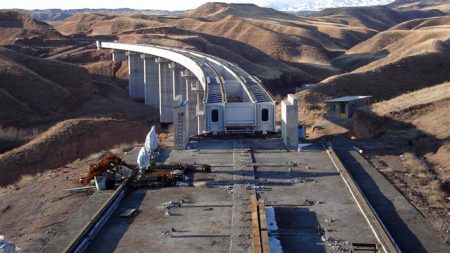
Russia is reportedly poised to finance a railway line connecting Iran with its northern neighbor Azerbaijan.
According to Tasnim news agency, head of the press service of Azerbaijan Railways OJSC Nadir Azmammadov, has said that Russian Railways OJSC has discussed the terms of its participation in the financing of the Rasht-Astara (Iran)-Astara (Azerbaijan) railway with the related parties in the Azeri capital, Baku.
The report said representatives of the railways of Azerbaijan, Iran and Russia attended the talks in which the Azeri side informed the partners about the projects and tasks ahead.
Baku believes the international transport corridor will improve Azerbaijan’s transit potential as well as its ties with the other two countries.
Participants in the talks reportedly signed a final protocol.
The trilateral railway project is aimed at connecting Northern Europe with Southeast Asia.
The railway line will initially transport five million tonnes of cargo when it is launched in the near future.
Last November, Iran and Russia signed an agreement worth 1.2 billion euros to electrify a train line, linking north-central Iran to the northeastern border with Turkmenistan.
The agreement signed between Russian Railways and the Islamic Republic of Iran Railways (RAI) envisages constructing power stations and overhead power lines along the Garmsar-Sari-Gorgan-Inche Burun route in Iran.
“The implementation of the contract will improve the capacity of passenger trains and raise transit to 8 million tonnes,” said RAI Managing Director Mohsen Poursaeed-Aqaei who signed the document.
The train line, among the first in Iran with a history of 80 years, extends to Turkmenistan and Kazakhstan and links the Central Asia to the Persian Gulf and beyond.
The project was also set to be financed by the Russian government and would be implemented in 36 months, which includes manufacturing all electric locomotives inside Iran, electrifying 495 kilometers of railway and building 32 stations and 95 tunnels.
Israel continues to besiege Palestinian towns, breach international law in occupied West Bank
International Solidarity Movement | July 3, 2016
Occupied Hebron – In the last three days Israeli military forces have implemented several blockades isolating the cities of Yatta and Bani Na’im south of Hebron. It is reported that cement roadblocks, earth mounds, gates and checkpoints have been installed across the region, with no timeline for when they may be removed.
The blockades are only implemented to restrict the movement of Palestinians as illegal Israeli settlers can still pass the checkpoints. This discrimination is a clear apartheid strategy and limits Palestinians to not only being unable to attend work but also reaching basic human services such as hospitals. This strategy clearly violates Palestinian’s right to freedom of movement (Art.13 of Universal Declaration of Human Rights).
By enforcing these illegal blockades Israel is also restricting Palestinian movement during the final days of the holy month of Ramadan where thousands of Muslims wish to travel to the most significant religious sites for prayer and visit their families.
This act is also another example of Israel using collective punishment techniques, which are also illegal under international law. Israeli forces continually use collective punishment in the form of revoking travel and work permits, blockading cities and punitive house demolitions.
Operation Dove have compiled the following interactive map to illustrate the extent of the blockade.
The innocent people who are living under siege in Yatta and Bani Na’im are significantly impacted by the Israeli forces implementing such blockades, which have been condemned internationally by human rights organisations and NGOs.
How the EU pushed France to reforms of labour law
Corporate Europe Observatory | June 27, 2016
The current struggle in France over labour law reforms is not just between the Government and trade unions – a European battle is waged. The attacks on social rights stem in no small part from the web of EU-rules dubbed ‘economic governance’, invented to impose austerity policies on member states.
Strikes and actions across France against reforms of the country’s labour protections, known as the El Khomri Law, demonstrate the immense unpopularity of the measures proposed by the French Government. Chiefly among them, to give preference to local agreements on wages and working conditions, when the conditions in those agreements are less favourable than the national norm inscribed in national law. This is an open attempt to undermine collective bargaining and roll back the influence of trade unions.
Ultimately, the French Government has formal responsibility for the weakening of labour protection. But there is no denying that the European Union is playing an important and perhaps decisive role in the attacks on labour rights. What we see is the EU throwing its rulebook in the French workers’ faces. Practically all the new rules on so-called ‘economic governance’ adopted following the eurocrisis have been applied, and make France look like an EU test-case. The European Commission, with the backing of the Council, has used the rules on member states’ deficits to exert pressure, threatening with sanctions, should the French Government not give in and seriously reform its labour laws. Simply put, France has been required flat out to ensure higher profitability for businesses by driving down wages.
How does all of this work?
Sanctions more likely today
First and foremost, the reforms in France are related to the country’s deficit. Like most other EU member states, the state’s finances looked pretty bad in the aftermath of the 2008 financial crisis. In 2009, a case was opened against France for breaching EU rules which stipulate that its deficit must be no higher than 3 per cent of GDP. If taken to the extreme, this ‘excessive deficit procedure’ can result in a fine of billions of euro, and – not least in the case of France – a severe loss of face to its EU partners.
The ‘excessive deficit procedure’ was given more teeth with the so-called ‘Six-Pack’ set of EU rules in 2011 – a key part of the austerity-focused economic governance package – which introduced a reverse majority vote in the Council: if the Commission does decide to fine a member state, like it has threatened to do to France, there will have to be a qualified majority against the measure from other member states to block it. Good reasons for the French Government to be slightly scared – and a weapon to be used in its attempt to convince parliamentarians. The likelihood of sanctions for not meeting the budget deficit targets is much bigger than in the past, when both Germany and France escaped humiliation. But how to meet the Commission’s strict targets, and how to behave to the satisfaction of the Commission, is what clearly links the El Khomri Law in France to the austerity regime being rolled out from Brussels.
Enabling demands of ‘structural reforms’
Being ‘in the procedure’, means you’re under close surveillance by the Commission, and with regular intervals, the case of the French deficit has been brought up at meetings with member states ministers, who have assessed if France (in this case) has made sufficient efforts to remedy the problem. Specific recommendations have been made, though until 2013 the labour law was hardly mentioned. The recommendations stuck to the development of the deficit, whether it went down at the required pace. But in 2013, there was a new tone in the Commission’s recommendations. France was asked to meet its deficit targets “by comprehensive structural reforms” in line with recommendations from the Council “in the context of the European Semester”. Structural reforms are no small matter. They are defined as changes that affect “the fundamental drivers of growth by liberalising labour, product and service markets”. Such ambitions were starting to be pushed on France at the European Semester.
But what is the European Semester? It is a procedure involving the Commission and the Council that ends with a set of recommendations for reforms to each and every member state, based on a proposal from the Commission. At the beginning in 2011, the recommendations were non-binding, but in 2013, a new set of rules went into force under the so-called Two-Pack, another part of the economic governance package intended to enforce austerity. One of the regulations of the two in the package was about measures to ensure deficits were corrected, and among other things, it made a link between the deficit procedure and the European Semester. If a member state is under the deficit procedure – like France – it would have to draw up an ‘Economic Partnership Programme’ that includes the recommendations from the Council –typically the kind of structural reforms that would have a clear impact. If the programme is not followed, then it will have a bearing on the Commission’s decision to initiate the final phase of the deficit procedure: sanctions in the form of a fine worth billions.
So, when the Two-Pack entered into force in early 2013, the tone of the messages to France on its deficit changed. France was now asked to implement “comprehensive structural reforms” of its labour law and the pension system. This had a bearing on how France would be treated under the deficit procedure and whether it would come in for sanctions, and for that reason, recommendations started looking more like demands.
In other words: whereas earlier country specific recommendations adopted under the European Semester were just that, with the Two-Pack from 2013, non-compliance could lead the Commission to take the next step towards sanctions.
“Slash wages now!”
There’s more.
In the early stages of the eurocrisis another procedure was introduced that was to work in parallel to the deficit procedure: the ‘Macroeconomic Imbalance Procedure’. This procedure allows the Commission to monitor the development of member states’ economies based on a predefined set of indicators. One of them – perhaps the most important one – measures how high the labour costs are developing (unit labour costs). If wages are not kept at bay, competitiveness suffers, and measures have to be taken, so the logic goes.
The ‘Macroeconomic Imbalance Procedure’ is also a potent weapon, as it can lead to a fine if a Eurozone member state crosses the line repeatedly and for a long time. And France has been in the crosshairs of the Commission for quite a while. Commission staff have investigated French labour law and identified what factors contribute “to limiting the ability of firms to negotiate downward wage adjustment”, and the French Government has been warned – as have many other member states – about developments in wages. In 2014, the Commission said “unit labour cost growth is relatively contained but shows no improvement in cost competitiveness. The profitability of private companies remains low, limiting deleveraging prospects and investment capacity.”
The calls for action to improve the profitability of private companies have been sent to France from Brussels on numerous occasions over the past couple of years, and have gained in strength. Thus far, the climax was in February 2015, when the Commission stepped up the procedure and singled out Bulgaria and France as the most pressing cases. The decision put France only a small step from the last stage of the imbalance procedure, the dreaded ‘excessive imbalance procedure’ which entails – exactly like the deficit procedure – a massive fine. If all fines are put together – from the deficit procedure and the imbalances procedure – they could amount to 0.5 per cent of GDP, or in the case of France, approximately €11 billion.
The final countdown
Such a prospect must be terrifying for the French Government, and in 2015, then, it would have to come up with something of substance to appease the European Commission and its partners in the Council. In March France was given two more years to bring its house in order, and if there was any doubt over the way to get there, the message to France in July was clear. Country Specific Recommendation number 6 to France under the European Semester, includes a call to “reform the labour law to provide more incentives for employers to hire on open-ended contracts. Facilitate take up of derogations at company and branch level from general legal provisions, in particular as regards working time arrangements.” In other words, the very reforms now at the centre of dispute with the El Khomri law.
The recommendation was copy-pasted from a Commission proposal; one that struck a chord among business lobby groups. In the annual ‘Reform Barometer’ of BusinessEurope, a procedure set up to influence the European Semester, the French employers association MEDEF was enthusiastic about the move, and dubbed it “extremely important” in its contribution to the Reform Barometer 2016.
End game
Who exactly has done what since the summer of 2015 is the subject of intense debate. French media outlet Mediapart suggests the German Government might have played a big role in designing the French reforms, while others believe the specifics were entirely homemade. In any case, there is no denying that the reforms were pushed heavily by the European Union, more specifically by the Commission and the Council. And the push was based on the web of rules on member states’ economic policies, sometimes called ‘economic governance’, that has been spun thread by thread since 2010. The strengthening of the deficit procedure, the European Semester, the Two-Pack, and the macroeconomic imbalance procedure have all been used for the purpose they were invented: to exert maximum pressure on member states to adopt austerity policies.
There are other similar examples in Europe at the moment. In Italy and Belgium too, you see the effect of the new tools handed over to the European Union since 2010. But France is special for its size and its power in the EU. The ongoing struggle in France can be seen as a major test case for European economic governance. If a big, powerful EU member state can be pushed to attack fundamental traits of its labour protection law, then the risk of new and stronger measures are much more likely in the future. Even if French workers are unaware of it, they’re fighting a European battle.
US Mayors Blast Obama, NATO: War Games on Russia’s Border Endanger Humanity
Sputnik – 02.07.2016
The leaders of America’s towns and cities issued a resolution warning the Obama administration and NATO that continued anti-Russian provocations place humanity at greater risk of nuclear annihilation.
The United States Conference of Mayors (USCM), the official non-partisan organization for city leaders administering populations greater than 30,000, moved to condemn NATO’s Anaconda War Games on Russia’s border as increasing the threat of nuclear conflict.
“The largest NATO war games in decades, involving 14,000 US troops, and activation of US missile defenses in Eastern Europe are fueling growing tensions between nuclear-armed giants,” said the USCM warning in the lead up to the military alliance’s summit on July 8-9 in Warsaw, Poland.
The resolution adopted at the USCM’s 84th Annual Conference from June 24-27 in Indianapolis stated: “More than 15,000 nuclear weapons, most orders of magnitude more powerful than the Hiroshima and Nagasaki bombs, 94% held by the United States and Russia, continue to pose an intolerable threat to cities and humanity.”
The US Conference of Mayors went on to criticize President Obama for capitulating to the defense establishment and “laying the groundwork for the United States to spend one trillion dollars over the next three decades” on the so-called nuclear modernization effort that will result in a net increase in America’s atomic stockpile in contravention to the spirit of the Nuclear Non-proliferation Treaty (NPT).
“The Obama administration has not only reduced the US nuclear stockpile less than any post-Cold War presidency, but also decided to spend on trillion dollars to maintain and modernize its nuclear bombs and warheads, production facilities, delivery systems, and command and control,” read the resolution.
America’s mayors called into the question the development and maintenance of nuclear weapons with yields in excess of 1 megaton, or 75 times the force of the Hiroshima bomb that killed nearly 150,000 people, at a time when “federal funds are desperately needed in our communities to build affordable housing, create jobs with livable wages, improve public transit, and develop sustainable energy sources.”
To underscore the resolution, the USCM acknowledged and apologized for America’s genocidal acts against Japanese civilians in Hiroshima and Nagasaki towards the end of World War II stating that the “US atomic bombings indiscriminately incinerated tens of thousands of ordinary people, and by the end of 1945 more than 210,000 people – mainly civilians, were dead, and the surviving hibakusha, their children and grandchildren continue to suffer from physical, psychological and sociological effects.”
The country’s mayors continue to be a voice of peace and reason in the face of mounting influence by the foreign policy establishment and defense lobbyists having rendered similar resolutions calling for the United States to pursue a less threatening foreign policy for 11 consecutive years.
Whitewashing Libya: House Report on Benghazi Reveals Nothing, Hides Everything
By Eric Draitser – New Eastern Outlook – 03.07.2016
The Republican dominated House Select Committee on Benghazi has released its long awaited final report on the 2012 Benghazi attack which killed Ambassador Chris Stevens and three others. And, surprise, the report reveals absolutely nothing of substance that wasn’t already known.
Naturally, Democrats running interference for Hillary Clinton have continually charged that the probe was simply an act of partisan politics designed more to hurt Clinton in the presidential campaign than to uncover the truth about what happened. No doubt there is truth to such an allegation.
But the most important fact about this whole manufactured drama, the one that neither Democrats nor Republicans want to touch, is the simple fact that what happened in Benghazi was perhaps the most complete encapsulation of everything wrong and criminal about the illegal US war against Libya. Moreover, it exposes the uncomfortable truth that the US harnesses terrorism, using it as one of the most potent weapons it has against nations that refuse to submit to the will of Washington and Wall Street. In effect, it was not merely terrorists that killed the four Americans in Benghazi, it was US policy.
The Benghazi Report: 800 Pages of Almost Nothing
Despite the triumphal pronouncements of Republican political opportunists, the new report reveals very little that is new. As the Wall Street Journal noted:
“Congressional Republicans’ most comprehensive report yet on the 2012 terrorist attacks in Benghazi, Libya, outlined few new criticisms of Hillary Clinton, highlighting more broadly what it called an array of failings by the Obama administration… The report largely confirmed the existing story line—that a group of anti-American Libyan militants stormed U.S. installations in a carefully planned assault, killing four Americans, including Christopher Stevens, the ambassador to Libya…The latest document presented few notable facts not found in earlier investigations…”
As the Wall Street Journal correctly notes, the new report is mostly just a rehashing of prior conclusions reached from previous reports, while doing yeoman’s service for the political establishment by confirming and, consequently, concretizing a completely distorted narrative about what happened. Essentially, the final report amounts to a whitewash that is more about scoring political points than revealing the truth about what happened. Why? Well, put simply, the truth of what happened in Benghazi implicates both wings of the single corporate Republicrat party.
There is mention of the CIA facility near the ‘US diplomatic facility’ in Benghazi, but absolutely no context for what exactly the CIA was involved in there, and how it relates to a much larger set of policies executed by the Obama administration, of which Hillary Clinton was a key player. Indeed, the very fact that this critical piece of the puzzle is conspicuously missing from the Official NarrativeTM demonstrates that the House Select Committee on Benghazi report is more about concealing the truth than revealing it.
Take for instance the fact that the report totally ignores the connection between the CIA facility and mission in Benghazi and the smuggling of arms and fighters from Libya to Syria in an attempt to export to Syria the same sort of regime change that wrought death and destruction on Libya. As Judicial Watch noted in regard to the declassified material it obtained:
Judicial Watch… obtained more than 100 pages of previously classified “Secret” documents from the Department of Defense (DOD)and the Department of State revealing that DOD almost immediately reported that the attack on the U.S. Consulate in Benghazi was committed by the al Qaeda and Muslim Brotherhood-linked “Brigades of the Captive Omar Abdul Rahman” (BCOAR), and had been planned at least 10 days in advance… The new documents also provide the first official confirmation that shows the U.S. government was aware of arms shipments from Benghazi to Syria. The documents also include an August 2012 analysis warning of the rise of ISIS and the predicted failure of the Obama policy of regime change in Syria.
Just this one small excerpt from a set of publicly available documents sheds more light on the real story of Benghazi and the Obama administration’s disastrous and criminal wars in Libya and Syria than 800 pages of the House report. Were it really the mission of the House committee to expose the truth of what happened, perhaps they could have started with a Google search.
Indeed, the connection goes further. As a Department of Defense memo in 2012 indicated, “During the immediate aftermath of, and following the uncertainty caused by, the downfall of the [Qaddafi] regime in October 2011 and up until early September of 2012… weapons from the former Libya military stockpiles located in Benghazi, Libya were shipped from the port of Benghazi, Libya, to the ports of Banias and the Port of Borj Islam, Syria.”
This revelation should be a bombshell; the US and its proxies inside Libya were actively shipping weapons to Syria for the purposes of fomenting war and effecting regime change. Further, it would be shockingly negligent to omit the fact that “early September 2012” is when the shipments stopped – the attack on the CIA annex in Benghazi, not coincidentally, took place on September 11, 2012 – and not connect it to the Benghazi incident. One could almost forgive such an omission if one were naïve enough to believe that it was simply an error, and not a deliberate obfuscation.
A serious analysis of these events would reveal an international network of arms and fighters being smuggled from Libya to Syria, all under the auspices of the Obama administration and the agencies under its control. But of course, the report focuses instead on the utterly irrelevant negligence on the part of the Obama administration which really obscures the far greater crime of deliberate warmongering. But hey, political point scoring is really what the House committee was looking for.
The Larger Story Completely Ignored
As if it weren’t offensive enough that the House committee report has completely whitewashed the events in Benghazi, the congressional hearings and subsequent report do absolutely nothing to bring clarity to what exactly the US was doing with respect to the arming, financing, and backing of terrorists affiliated with al-Qaeda and other well-known terror groups.
There is no discussion of the fact that Washington was knowingly collaborating with some of the nastiest al-Qaeda elements in the region, including the Libyan Islamic Fighting Group led by Abdelhakim Belhadj. This terror group, which was in the vanguard of the US-backed effort to topple the government of the Libyan Arab Jamahiriya and Muammar Gaddafi, was a known quantity to all counterterrorism experts specializing in that part of the world. As the New York Times reported in July 2011, in the midst of the war against the Libyan Government:
The Libyan Islamic Fighting Group was formed in 1995 with the goal of ousting Colonel Qaddafi. Driven into the mountains or exile by Libyan security forces, the group’s members were among the first to join the fight against Qaddafi security forces… Officially the fighting group does not exist any longer, but the former members are fighting largely under the leadership of Abu Abdullah Sadik [aka Abdelhakim Belhadj].
Perhaps the enlightened truthseekers of the House committee would have thought it prudent to note that the Benghazi incident was the direct outgrowth of a criminal US policy of collaboration with terrorists, the leader of whom is now, according to some sources, connected to ISIS/Daesh in Libya. But, alas, such explosive information, publicly available to those who seek it out, would have been deeply embarrassing to the undisputed grandmasters of wrongheaded political posturing, Senators John McCain and Lindsey Graham, both of whom gleefully posed for pictures with the hardened terrorist leader Belhadj. Oops.
It would also have been nice had the House committee bothered to look at the studies conducted on that part of Libya vis-à-vis terrorist recruitment, to get a sense of the scale of the issue with which they were allegedly dealing. They might have considered examining a 2007 study from the Combating Terrorism Center at the US Military Academy at West Point entitled “Al-Qa’ida’s Foreign Fighters in Iraq: A First Look at the Sinjar Records” which explained quite clearly that:
“Almost 19 percent of the fighters in the Sinjar Records came from Libya alone. Furthermore, Libya contributed far more fighters per capita than any other nationality in the Sinjar Records, including Saudi Arabia… The apparent surge in Libyan recruits traveling to Iraq may be linked [to] the Libyan Islamic Fighting Group’s (LIFG) increasingly cooperative relationship with al-Qa’ida which culminated in the LIFG officially joining al-Qa’ida on November 3, 2007… The most common cities that the fighters called home were Darnah [Derna], Libya and Riyadh, Saudi Arabia, with 52 and 51 fighters respectively. Darnah [Derna] with a population just over 80,000 compared to Riyadh’s 4.3 million, has far and away the largest per capita number of fighters in the Sinjar records.”
It certainly might have been useful had the House committee taken even a cursory look at a map to see the Benghazi-Derna-Tobruk triangle (the stronghold of the anti-Gaddafi terrorist forces linked to al-Qaeda) and to understand the broader context of the events of September 11, 2012. The investigators – that term being used rather loosely, and somewhat ironically, in this case – should have been able to discern the larger significance of what they were examining. One could almost assume that, like the proverbial ostriches, House Republicans were busy hiding their heads in the sand, or perhaps in other, more uncomfortable places.
Ultimately, the House Select Committee on Benghazi report will achieve absolutely nothing. It will not even score the political points that the Republicans leading the effort have been after for three years now. Hillary Clinton will continue her presidential bid completely unaffected by the information and, if anything, will likely benefit from this charade as it will lend credence to her endless assertions of a “vast right wing conspiracy” against her. Never mind the fact that she is a right wing neoconservative herself. Never mind the fact that the blood of tens of thousands of Libyans is on her hands. Never mind the fact that, as President, she will undoubtedly unleash more death and destruction on the people of the Middle East and North Africa.
There is only one lasting achievement upon which the House committee can hang its hat: it has done an excellent job of cementing an utterly shallow and superficial narrative about the events of September 11, 2012 in Benghazi, one which will be endlessly repeated by the mouthpieces of corporate media and mainstream historians.
Indeed, a false history will be written, with the US as a victim of incompetence and its own poor planning. Nothing will be said of the blatant criminality of the US effort in Libya. But, as Kurt Vonnegut was fond of saying, “So it goes…”
New ‘CIA Officer Whistleblowing’ Video Reeks Of Disinfo

By Brandon Turbeville | Activist Post | July 2, 2016
Making quite the circuit on the internet landscape is a new video purporting to show a former CIA agent speaking out against the manner in which the “war on terror” is prosecuted and portrayed to the American public. The video has been shared and discussed thousands of times particularly within the alternative media community as evidence that the “war on terror” is one big snowball of bad decisions and blowback.
The video, is a short clip of an interview conducted by AJ+ with Amaryllis Fox, a former CIA Clandestine Services Officer, who makes a number of claims during the three minute clip that range from the reasonable to the absurd. While many alternative media outlets have hailed Fox’s video as “brave” and Fox herself as a whistleblower, it would be wise to analyze her statements for what they are as opposed to praising them simply because they are being presented as “anti-establishment.”
Fox makes a surprising amount of claims for three minutes and she also manages to conflate issues, concepts, and people in a cleverly designed monologue that is clearly scripted for effect.
Fox begins by saying,
If I learned one lesson from my time with the CIA it is this: everybody believes they are the good guy. I was an officer with the CIA Clandestine Service and worked undercover on counterterrorism and intelligence all around the world for almost ten years. The conversation that’s going on in the United States right now about ISIS and the United States overseas is more oversimplified than ever.
Fair enough. Lower level agents of the CIA and most lower level fighters in terrorist organizations or national militaries believe they are the good guys. The propaganda surrounding the “war on terror” is oversimplified. All of this is true indeed. But Fox moves from information easily verified such as the statement above to much more questionable claims. For instance, she says,
Ask most Americans whether ISIS poses an existential threat to this country and they’ll say yes. That’s where the conversation stops. If you’re walking down the street in Iraq or Syria and ask anybody why America dropped bombs, you get: “They were waging a war on Islam.” And you walk in America and you ask why we were attacked on 9/11, and you get “They hate us because we’re free.” Those are stories, manufactured by a really small number of people on both sides who amass a great deal of power and wealth by convincing the rest of us to keep killing each other.
Fox is correct on the latter part of her statement. Much of these stories are indeed manufactured by a small number of people in order to drum up support for foreign invasions and a police state back at home. But who exactly is Fox talking to on the streets of Syria and Iraq that would respond “a war on Islam” to the question of why the United States is dropping bombs on their country? It certainly isn’t the average Syrian as she tries to portray. In fact, if one were to go to the average Syrian on the street and ask “Why is America dropping bombs?” the answer would almost always be centered around Israel. Almost every researcher is aware of this fact but not one time was the word “Israel” mentioned in Fox’s interview. The “war on Islam” line is typically reserved only for the more fanatical religious zealots who make up the so-called “opposition.” So what is Fox suggesting? Is she suggesting that the average Syrian holds the same belief system as the average al-Qaeda fighter?
Actually, that is exactly what she is doing, regardless of whether or not she states it explicitly or not. She continues,
I think the question we need to be asking, as Americans examining our foreign policy, is whether or not we are pouring kerosene on a candle. The only real way to disarm your enemy is to listen to them. If you hear them out, if you’re brave enough to really listen to their story, you can see that more often than not, you might have made some of the same choices if you’d lived their life instead of yours. An al-Qaeda fighter made a point once during a debriefing. He said all these movies that America makes, like Independence Day, and Hunger Games and Star Wars, they’re all about a small scrappy band of rebels who will do anything in their power with the limited resources available to them to expel and outside, technologically advanced invader. And what you don’t realize, he said, is that to us, to the rest of the world, you are the empire, and we are Luke and Han. You are the aliens and we are Will Smith.
Fox is implying that there was a “fundamentalist al-Qaeda” problem before America’s foreign policy was formed. In other words, that the problem existed and that the United States perhaps acted rashly in dealing with it. But the fact is that the al-Qaeda issue never would have existed in the first place had the United States not invented it. Indeed, al-Qaeda, ISIS, and other related terrorist organizations are entirely creations of the U.S. government and the NATO apparatus. While Fox may be forgiven for not knowing this little detail, not knowing the difference between a fundamentalist al-Qaeda fanatic and an average Syrian is not excusable. That is, assuming that the mistake is actually a mistake and not an intentional attempt to mislead the audience.
Fox also provides questionable analogies when she discusses the al-Qaeda fighters’ interpretation of Hollywood movies. If the fighter was so convinced that the U.S. is the empire (fair point – it is) and al-Qaeda is the equivalent of Luke and Han, why did al-Qaeda attack the Syrian government? Why did they attack the Iraqi government? Why did they attack the Libyan government? This would be the equivalent of Luke and Han attacking the Galactic Republic while claiming to fight the Empire. It doesn’t make sense. Continuing with the Star Wars analogy, Saddam Hussein, Bashar al-Assad, and Muammar Ghaddaffi would represent the Republic and those nations’ militaries along with Iraq’s “insurgents” fighting back against the U.S. would be the true rebels. Fox should know this very well.
Nevertheless, Fox concluded her statements by saying,
But the truth is when you talk to the people who are really fighting on the ground on both sides, and ask them why they’re there, they answer with hopes for their children, specific policies that they think are cruel or unfair. And while it may be easier to dismiss your enemy as evil, hearing them out on policy concerns is actually an amazing thing. Because as long as your enemy is a subhuman psychopath that’s going to attack you no matter what you do, this never ends. But if your enemy is a policy, however complicated, that we can work with.
So, again, the question would be “who is Fox actually talking about?” When she references “the people who are really fighting on the ground on both sides, does she mean U.S. forces and terrorists vs the Syrian military? Does she exclude the U.S. military? Her statements simply do nothing to clarify the reality on the ground, only to confuse it.
One good question for Fox would be how the Syrian government should listen to and hear out a “policy” coming from an organization that crucifies women, beheads “heretics,” and seeks to impose Shariah law on a civilized people? How should Syria simply listen to the “concerns” of the United States after the latter power has funded those “subhuman psychopaths” (yes, it is an accurate description) who have invaded their country? Is it possible that the “policy” of the United States and its proxy terrorists is simply wrong? Is it possible that the other sides might not be so willing to have a couples’ therapy session?
While Fox makes a number of good points regarding the fact that the narrative surrounding al-Qaeda and the situation in Syria and Iraq is indeed manufactured by a small number of people in high places, Fox herself makes an incredibly wrong description of the conflict, equating average Syrians and Iraqis with jihadists in terms of their mindset and suggesting that the upsurge of terrorism is a result of blowback as opposed to outright funding and conspiracy to overthrow sovereign states in search of world hegemony.
Fox’s statements simply serve to continue to drag Americans off into the abyss of misinformation surrounding the crisis in the Middle East while claiming to do otherwise. After watching Fox’s video, (notably produced by AJ+ – al-Jazeera, a Qatari news agency that has long been pro-jihadist), we can safely say that Ms. Fox is either misinformed herself or simply good at her job.
Image Credit: Anthony Freda
Top Iran fund executives resign en masse
Press TV – July 2, 2016
President Hassan Rouhani has accepted the mass resignation of those on the board of trustees of Iran’s sovereign wealth fund as revelations about high compensation packages at state-owned firms take new casualties.
“Minutes ago, the board of trustees of the National Development Fund held a session with President Rouhani in attendance, where the mass resignation of the director and executive board members was accepted,” the Fars news agency said Saturday.
Several senior officials, including ministers of economy, petroleum and labor, as well as the country’s attorney general also attended the session, the news agency reported.
Among those who stepped down on Saturday was Safdar Hosseini, the managing director of the National Development Fund, who is said to have received $18,700 a month in salary and other compensation.
Minister of Economic Affairs and Finance Ali Tayebnia had already removed the heads of Mellat, Bank Saderat, Refah Bank and Mehr banks for receiving “unconventionally” high salaries.
The head of another bank is also to be fired, but the decision has been delayed for “further review,” the IRNA news agency said on Thursday.
Those implicated in the paycheck palaver are accused of receiving large bonuses, interest-free loans and, in some cases, tax evasion.
Investigations were launched after Leader of the Islamic Revolution Ayatollah Seyyed Ali Khamenei called for immediate action amid reports that executives at some state-owned firms were earning more than 50 times the base government salary.
Iranian law states that the top salary in the government should not be more than seven times that of the lowest-paid government employee.
The paycheck leaks showed some senior managers at a company were paid up to 870 million rials ($28,339 at the official exchange rate) in March.
Rouhani has pledged to investigate and punish government employees receiving excessive salaries.
The government has made weeding out corruption a top goal. In March, Iranian tycoon Babak Zanjani was sentenced to death over fraudulently pocketing $2.8 billion.
Featured Video
Pentagon insider says high US official Douglas Feith reported to Netanyahu
or go to
Aletho News Archives – Video-Images
Frlom the Archives
The Fiction of the Jewish History in Palestine
By Hasan Afif El-Hasan | The Palestine Chronicle | April 8, 2011
Prime Minister Benjamin Netanyahu told NNC Pierce Morgan on March 18, 2011 that he might agree to a Palestinian state through negotiations. And he added, “We will make territorial concessions although it is very painful to do that in our ancestral land.” Netanyahu was not talking about Poland where his ancestors lived. He was talking about Palestine where generations of its indigenous population ancestors lived, cultivated the land and are buried.
By the end of the nineteenth century, Zionism created a new Jewish identity of blood and soil. To mobilize their followers and supporters and appeal to their emotions, the Zionists created myths. Zionism started as a tribal religion without god, but in order to fulfill its function as a unifying force, Zionism required external religious and race symbols, not inner content. Its leaders regarded metaphysical religious belief and purity of race as having value in itself. They created a divine paradisiacal state of merger with the gods. Despite his non-religious ideology, Herzl’s writings were replete with religious references. The Jews should settle in Palestine because, in his words, “the Temple will be visible from long distance, for it is only our ancient faith that has kept us together”.
The Zionists and their supporters have invested tremendous financial and scholarly resources to work within the Hebrew Bible historical narratives to affirm the links between the intrusive Zionist population and the ancient Israelite past, and by doing so assert the right of that population to the land. The political end-game shaped the investigation and the outcome. Tracing the roots of Israel’s ethnic state in biblical antiquity is effectively to silence the indigenous Palestinian claim to the past and therefore to the land. The Biblical scholarship employs a bewildering array of terms for the region: “the Holy Land”, “the Land of the Bible”, “Eretz Israel”, “the Land of Israel”, or “Judah and Samaria.” To the casual reader these names appear interchangeable, but they all imply connection to ancient Israel.
Biblical narratives or poems that cannot be supported by archeology and common sense are treated by the Zionists and their supporters as historical language. … continue
Blog Roll
 Aletho News
- Pentagon insider says high US official Douglas Feith reported to Netanyahu
- The Sludging of Rural America
- Lawyers’ groups demand end to British military bases in Cyprus
- CIA Assessment: The Resistance Cannot Be Crushed
- Hezbollah Returns: It Didn’t Start a War, It Is Ending One
- EU states seek ‘talks’ with Iran for access to Strait of Hormuz: Report
- Trump on Hormuz: “Others must take care of it” after US falters
- Who Is closer to collapse?
- A War that Backfired: Why the US-Israeli Campaign Is Strengthening Iran
- How Zionist Control Is Hurting US Interests
- If Americans Knew
- As US-Israel war on Iran rages, Gaza faces massive dust storm – Not a ceasefire Day 156
- No let-up in attacks on Gaza as Israel takes on Iran, Lebanon – Not a ceasefire Day 155
- ‘Of Course’: IDF Drops Case Against Soldiers Accused of Raping Palestinian Prisoner
- Don’t Fall for the Regime Change Talk. Israel Is ‘Mowing the Lawn’ in Iran
- Will Israel and the US wreck the Gulf States along with Iran?
- US so far burned through ‘years’ of munitions in Iran war: Report
- How the Israeli Tail Wags the American Dog
- Outdated intel likely led to deadly U.S. strike on Iranian elementary school, sources say
- Pentagon insider says high U.S official Douglas Feith reported to Netanyahu
- In fond memory of Walid Khalidi, the historian of Palestine
- No Tricks Zone
- Storing Green Energy To Last Germany 10 Days Would Require A 60-Million Tonne Battery
- New Studies: UK Sea Levels Were 4 Meters Higher Than Today During The Mid-Holocene
- Destructive Green New Deal: German Energy And Metal Group Warns Of Drastic Crisis
- New Study Documents A 20-Year Pause In Arctic Sea Ice Decline – Driven By Internal Variability
- Wake-up Call: Survey Shows Majority Of Germans Now Favor Postponing Climate Targets!
- Televised! Leading German Political Candidate Tells Schoolchildren CO2 Makes Sun Hotter!
- New Study: A Century Warming Of 1.1°C Is ‘Commonplace’ And ‘Not Unusual’ During This Interglacial
- New Study: ‘Internal Noise’ And Volcanic Forcing Can Trigger 10-15°C Warming Within Decades
- Glaciers Worldwide Are Suddendly Surging, Experts Blame Warming!
- Surprising Discovery: Sahara Is Greening…Billions Of Trees Where Once Thought To Be Barren
 Aletho News