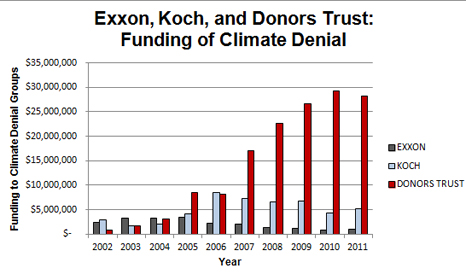
It will be difficult to bring the number down to anything approaching the amount of funding skeptics are said to get:
By Brian Kahn and Bobby Magill | Climate Central | November 23, 2016
The world is waiting to hear what President-elect Donald Trump has in mind for governing the U.S. Among the biggest questions is what will happen to the budget for climate and energy-related activities. […]
Here’s where a number of federal agencies stand with climate and energy funding, what they spend it on, and what could be under fire after Jan. 20 when Trump takes office. The budget numbers below are based on the 2017 fiscal year budget requests for each agency or department.
Energy Department
2017 climate-related budget: $8.5 billion
What it’s spent on: Energy efficiency and renewable and nuclear energy research and development as well as science and computing. […]
Interior Department
2017 climate-related budget: $1.1 billion
What it’s spent on: Supporting scientific research and managing landscapes for climate resilience as well as expanding public access to climate-related information. The Interior Department, through the U.S. Geological Survey, funds climate science centers […]
State Department
2017 climate-related budget: $984 million
What it’s spent on: Almost anything the U.S. does about climate change on the international stage comes via the State Department. That includes committing money to the Green Climate Fund […]
NASA
2017 climate-related budget: $1.9 billion
What it’s spent on: NASA funds a variety of climate research on earth and in space. […]
Environmental Protection Agency
2017 climate-related budget: $1.1 billion
What it’s spent on: Climate and air quality research and development as well as enforcing climate rules and regulations such as the Clean Power Plan […]
National Oceanic and Atmospheric Administration
2017 climate-related research and development: $190 million
What it’s spent on: NOAA’s climate science budget funds both in-house researchers and a number of programs at universities. … Full article
It will be difficult to bring the number down to anything approaching the amount of funding skeptics are said to get:
Press TV – November 25, 2016
An Israeli court has handed down prison sentences to two Syrians living in the occupied Golan Heights for blocking an Israeli ambulance transporting militants operating in Syria for treatment.
The military court on Thursday sentenced Amal Abu Saleh to seven years and eight months in jail and a fine of more than 3,000 dollars, Syria’s official news agency SANA reported.
Bashira Mahmoud, the other Syrian, was sentenced to 22 months in prison. She was also fined 1,000 dollars.
According to the report, Israeli forces arrested the two along with 24 others in June 2015, when residents of the village of Majdal Shams blocked the ambulance and prevented it from transporting two injured terrorists with the Takfiri Jabhat Fateh al-Sham militant group, formerly known as al-Nusra Front.
The Israeli regime later released the detainees except the two. Bashira has been under house arrest since July 2016.
Sheikh Nazih Abu Saleh, Amal’s uncle, said the court ruling was “hostile.” He added that the residents of the occupied Golan Heights have the right to block the transport of al-Nusra terrorists for treatment in Israeli hospitals.
Ahmed Sheikh Abdul Qader, the governor of the city of Quneitra in southwestern Syria that borders Golan, slammed the “provocative” court ruling, calling on human rights organizations to force the Israeli regime to release Syrians held in its prisons.
Syria says Israel and its Western and regional allies are aiding Takfiri terrorist groups operating inside the Arab country.
In December 2015, the Daily Mail said the Israeli regime had saved the lives of over 2,000 Takfiri militants at the cost of about 13 million dollars since 2013.
The Syrian army has several times seized huge quantities of Israeli-made weapons and advanced military equipment from the foreign-backed militants inside Syria.
In February 2014, photos of Israeli Prime Minister Benjamin Netanyahu were released, showing him visiting injured militants at a field hospital in Israel.
MEMO | November 25, 2016
An Australian citizen believed to be a top recruiter for Daesh is under arrest, the New York Times reported today, citing an unnamed US military official, months after Australia said he had been killed in a US airstrike in Iraq.
Australia said in May that Neil Prakash, who was linked to several Australia-based terrorist attack plans, was killed in an airstrike in Mosul, Iraq on 29 April.
The New York Times said Prakash was wounded in the attack and arrested by a Middle East government “in the last few weeks.” The Australian Broadcasting Corporation, citing Turkish and Australian officials, said he was arrested in Turkey.
Australian Attorney-General George Brandis, who announced Prakash’s death in May, declined to comment on “matters of intelligence or law enforcement operations.”
Justice Minister Michael Keenan said in an email response to Reuters that the government’s “capacity to confirm reports of deaths in either Syria or Iraq is limited.”
Melbourne-born Prakash had appeared in Daesh videos and magazines and had actively recruited Australian men, women and children and encouraged acts of terrorism.
Australia last year announced financial sanctions against Prakash, including threatening anyone giving financial assistance with punishment of up to 10 years in jail.
RT | November 25, 2016
Ukraine has made a unilateral decision to organize missile-firing exercises over Crimea, in the sovereign airspace of the Russian Federation, Russia’s Federal Air Transport Agency Rosaviatsiya reported. Missiles will be fired in regions where civil and state aviation flights run.
Kiev’s move breaches a number of international laws and agreements, Rosaviatsiya said, adding that not only will the military exercise invade Russian territory, but the plans also had not been coordinated with Moscow.
Ukraine released an aviation notification on Thursday, activating “dangerous zones” in all flight levels near Crimea and the city of Simferopol for December 1 and 2, the agency reported. It added that the “dangerous” areas included airspace above open sea which is in Russia’s area of responsibility, and over Russian territorial waters.
The notifications released have not been coordinated with the appropriate Russian authorities, Rosaviatsiya said in its statement. It added that such unilateral moves demonstrate Ukraine’s unwillingness to work on the normalization of air traffic above the Black Sea.
Kiev has also violated annexes of the 1944 Convention on International Civil Aviation, the agency said, while demanding the immediate cancellation of the planned actions in Russia’s sovereign airspace.
The General Staff of the Ukrainian Army refused to comment on the matter, TASS reported. The head of the staff press service, Vladislav Seleznyov, told the agency it was not his department’s responsibility to “comment on this information,” and referred the outlet to other Ukrainian officials, including the Foreign Ministry, for more information.
The planned missile-launch exercises are “potentially dangerous for civil aviation,” Rosaviatsiya said in its statement, adding that it could lead to tragedies similar to those with Malaysia Airlines flight MH17 over Ukraine in 2014 and the downing of a Russian passenger plane over the Black Sea in 2001.
The investigation into the Malaysian Boeing-777 crash in eastern Ukraine, which killed all 298 people on board en route from Amsterdam to Kuala Lumpur, continues.
Another incident involving military missiles happened over the Black Sea in October 2001, when a Siberia Airlines Tu-154 en route from Tel-Aviv to Novosibirsk was downed by a missile launched by the Ukrainian military during an exercise. Seventy-eight people died.
Russia has informed both Russian and international air carriers of Kiev’s planned move, a Rosaviatsiya representative told TV channel Rossiya 24. Saying that Moscow is taking all measures to provide security for the flights, he added that Russia will be forced to ban all flights in the Crimea region should Ukraine not cancel its decision.
Samidoun Palestinian Prisoner Solidarity Network – November 24, 2016
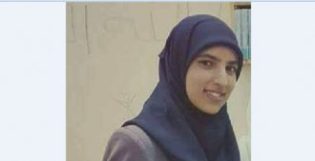 Palestinian student Noor Darwish, 22, a student at Al-Quds University in Abu Dis, was sentenced to eight months in Israeli prison and a fine of 2000 NIS (approximately $500) on Wednesday, 23 November.
From the village of Deir Abu Mashal near Ramallah, Darwish was arrested with two other female students, Hala Bitar, 19, and Salam Abu Sharar, 21, on 19 April. The three were arrested among an escalated series of arrests targeting Palestinian students around the time of annual student council elections at Palestinian universities. All three were charged with participation in the public student activities of the Islamic Bloc at the university, including organizing a book fair.
Bitar was earlier sentenced to four months in prison, while Abu Sharar was sentenced to 10 months in Israeli prison. Darwish has been held in Damon prison, which requires a three-day trip to the Ofer military court, which pronounced her sentence. Her case involved six hearings, each accompanied by the lengthy “bosta” travel from the prison to the military court and back.

RT | November 25, 2016
America’s once venerable Washington Post has launched a Thanksgiving attack on the Russian media. Sadly for our friends on the Potomac, it turned out to be a bit of a turkey.
This month, the mainstream media’s primary narrative has shifted toward ‘fake news’ and its role in the US election. We’ve seen internet giants like Facebook pressured to get their act together on the issue and a series of investigations into the creators of misleading content.
Predictably, the “blame Russia for everything” constituency of the establishment press has tried to connect Moscow to this development.
Take the folks at the Washington Post, for instance, who have published a sensationalist and scaremongering piece about fake news stories that itself turned out to be, well, full of fakes. To be blunt, the Washington Post has lied about RT and presented zero proof to support its allegations. What’s more, it never even asked for a comment!
This means that its strangely crafted attempt to defend journalistic principles has effectively disobeyed the two most important rules of the business: namely “always double-check your sources” and “make sure to ask the subject of your story for a comment.”
Pundit problems
To start, WashPo references “researchers” to claim that some of the fake news and conspiracy theories plaguing the media coverage of the US election “originated with RT.” Mind you, not a single example is provided to support this lunacy – no link, no tweet, no article title.
Then the reporter, one Craig Timberg, quotes Michael McFaul – one of the ‘talking heads’ du jour for criticism of Russia – as saying RT expressed overt support for Donald Trump during the US election – which is pure fiction, apparent to anyone remotely familiar with RT’s actual programming. As regular readers know, RT has published many articles which indicated that Moscow had no clear preference in the contest, covered Trump scandals, and interviewed guests from all over the American political spectrum – Republican and Democrat, Libertarian and Green. We’ve invited Hillary Clinton too, and the invite still stands.
McFaul then concludes his contribution with the statement that RT used “the #CrookedHillary hashtag pushed by the candidate (Trump)” on its social media services. Like with the “origin story,” this claim is presented not as subjective opinion, but as unquestionable fact. In reality, this is another complete lie, one that WashPo would have had no trouble fact-checking with a simple search. Alas.
Thus, the Washington Post has hinged a piece about fake news on falsehoods. The irony is astounding.
Absence of proof
Timberg’s entire supposition is built around a collection of “suspicious episode” yarns, not facts or evidence. His argument revolves around tenuous social media interaction and unsubstantiated third-party claims. Outlets as diverse as AntiWar, Counterpunch, Sputnik, Drudge Report, Off Guardian and Unz Review are attacked alongside RT, not to mention internationally popular entities including WikiLeaks, Zerohedge and Truthout. Basically, anybody critical of US foreign policy is accused of “echoing Russia.”
Also telling is the two external “research” sources the article relies on: PropOrNot and FPRI. “PropOrNot” is described as “a nonpartisan collection of researchers with foreign policy, military and technology backgrounds.” In reality, this group’s modus operandi is to smear any news source outside of the mainstream as “reliably echo(ing) Russian propaganda.” Meanwhile, Foreign Policy Research Institute is a US think-tank with a very clear agenda of “advanc[ing] U.S. national interests,” funded by massive corporations, such as Boeing, who profit from east-west tension through increased military spending and still mired in the Cold War-era worldview.
With every day and every new wave of hysterical publications, it becomes difficult to deny that the real point of the current media campaign is to brand everything that runs counter to the establishment narrative as “fake news” and “Russian propaganda.” Perhaps in the hope that once criticism and adversarial journalism is removed, the general public will no longer lash out at the tight little club that has ruled the roost for so long.
Read more:
By Gilad Atzmon – December 2, 2010
Israel’s rural landscape is saturated with pine trees. These trees are new to the region. The pine trees were introduced to the Palestinian’s landscape in the early 1930s by the Jewish National Fund (JNF) in an attempt to ‘reclaim the land’. By 1935, JNF had planted 1.7 million trees over a total area of 1,750 acres. Over fifty years, the JNF planted over 260 million trees largely on confiscated Palestinian land. It did it all in a desperate attempt to hide the ruins of the ethnically cleansed Palestinian villages and their history.
Along the years the JNF performed a crude attempt to eliminate Palestinian civilisation and past but it also tried to make Palestine look like Europe. The Palestinian natural forest was eradicated. Similarly the olive trees were uprooted. The pine trees took their place. On the southern part of mount Carmel the Israelis named an area as ‘Little Switzerland’. By now, there is no much left of “Little Switzerland.”
However, the facts on the ground were pretty devastating for the JNF. The pine tree didn’t adapt to the Israeli climate as much as the Israelis failed to adapt to the Middle East. According to JNF statistics, six out of every 10 saplings planted did not survive. Those few trees that did survive formed nothing but a firetrap. By the end of each Israeli summer each of the Israeli pine forests become a potential deadly zone.
In spite of its nuclear ability, its criminal army, the occupation, the Mossad and its lobbies all over the world, Israel seems to be vulnerable. It is devastatingly alienated from the land it claims to own and care for. Like the pine tree, Zionism, Israel and the Israeli are foreign to the region.
By Marjorie Cohn | Consortium News | November 25, 2016
In April 2016, Rodrigo Duterte won the Philippine presidential election by a landslide, with more than 6 million votes. He openly declared that he was the nation’s first Left president, calling himself a socialist but not a communist. So far, his regime has been controversial, to put it mildly.
The U.S. press has focused on Duterte’s vicious war on drugs that claimed upwards of 2,000 lives and led to the incarceration of tens of thousands of people. His decision to allow former Filipino dictator Ferdinand Marcos’s burial in the National Cemetery of the Heroes also has drawn the ire of those who recall Marcos’s brutal two-decade regime that killed more than 3,000, tortured tens of thousands, and stole $10 billion from the Philippines.
But, significantly, Duterte is engaging with revolutionary forces in the peace process that aims to end 47 years of armed struggle against the repressive Filipino government. And Duterte has taken actions that, for the first time, challenge the longstanding military and economic power of the United States in the Philippines.
Peace Process With Opposition
Since 1969, a civil war has been raging in the Philippines. The roots of the armed conflict can be traced to the colonial and neocolonial domination of the Philippines by the Spanish, then U.S. imperialism, feudal exploitation by big landlords and capitalist interests, as well as widespread bureaucratic corruption. After Duterte’s election, he cited peace as a top priority of his administration, vowing to engage in peace negotiations with the National Democratic Front of the Philippines (NDFP).
According to JustPeacePH, an international platform that supports the Philippine peace process and takes its name from its Internet site, “justpeace.ph,” “The daily, systematic and systemic injustice experienced by the people drive them to desire and seek fundamental changes in society through various means. But because the forces against fundamental social change use all means including the instruments and violence of the state to defend the status quo, many Filipinos over many generations have embraced armed struggle to overthrow the ruling system.”
The NDFP “is the alliance of progressive forces seeking to bring about fundamental change in the existing social system in the Philippines through armed revolution,” JustPeacePH states in its Primer on Just and Lasting Peace in the Philippines. The NDFP alliance includes trade unions, peasants, youth, women, national minorities, teachers, health workers, religious clergy, the Communist Party of the Philippines (CPP), and the New People’s Army.
Duterte’s Peace Initiative
Two rounds of peace negotiations have already occurred since Duterte took office, with a third scheduled for January 2017 in Oslo, Norway.
In May, Duterte declared he would release all political prisoners, which number more than 400, through a presidential declaration of amnesty, provided both houses of congress approve. Nineteen NDFP consultants, who have been involved in the revolutionary movement for years, have already been released.
Duterte offered four cabinet positions to the CCP, but they declined, stating there must first be a comprehensive peace agreement. The CCP, however, recommended a veteran peasant leader who was appointed Secretary of Agrarian Reform and a veteran academic activist leader who was named secretary of social welfare and development.
“These are major appointments,” Luis Jalandoni, NDFP’s Senior Adviser on the Peace Negotiating Panel, told me at a recent conference of the International Association of Democratic Lawyers in Lisbon, Portugal.
NDFP has a people’s army and organs of political power with mass organizations in 71 out of the 81 provinces in the country, Jalandoni said. He noted that landlessness and poverty afflict the 100 million people in the Philippines.
“The NDFP insists on addressing the roots of the armed conflict in order to achieve a just and lasting peace,” Jalandoni said.
The demands in the peace talks are: Release of all political prisoners; Land reform for the peasantry (70% of the population); National industrialization to develop the economy using available human and natural resources; Protect the environment and ancestral lands of the indigenous peoples; and Philippine national sovereignty and abrogation of all unequal treaties with the United States.
Challenging U.S. Power
U.S. domination and interference in the Philippines date back to 1898, when the United States annexed the Philippines. The U.S. continued to exercise colonial rule over the country until 1946, when the Philippines gained its independence although the United States retained many military installations there and the Filipino economy maintained its dependence on the U.S.
With U.S. assistance, Marcos ruled the Philippines with an iron fist from 1965 through 1986, under martial law from 1972 to 1981.
In 2002, the Gloria Macapagal-Arroyo government developed Oplan Bayanihan, a counterinsurgency program modeled on U.S. strategies. After 9/11, the Bush administration gave Arroyo $100 million to fund that campaign in the Philippines.
Oplan Bayanihan led to large numbers of extrajudicial killings, forced disappearances, torture and cruel treatment. Many civilians, including children, have been killed. Philippine military and paramilitary death squads murdered hundreds of members of progressive organizations. Communities and leaders opposed to large-scale and invasive mining have been targeted. Even ordinary people with no political affiliation have not escaped the government’s reign of terror.
From 2001 to 2010, the U.S. government provided more than $507 in military assistance to the Philippine government, facilitating tremendous repression.
Between 2010 and 2015, the Philippine police, military and paramilitary forces perpetrated extrajudicial killings, forced disappearances, torture, illegal arrests and forced evacuation, many to enable extraction by mining companies.
The 2014 Enhanced Defense Cooperation Agreement, which President Barack Obama negotiated with Duterte’s predecessor, gave U.S. troops the right to prolonged deployment in the Philippines. The agreement is widely seen in the Philippines as a threat to the country’s sovereignty.
In September 2016, Duterte declared, “I am not a fan of the Americans … Filipinos should be first before everybody else.” He added, “In our relations to the world, the Philippines will pursue an independent foreign policy. I repeat: The Philippines will pursue an independent foreign policy.”
The United States has not apologized for all the atrocities it committed against the Filipino people, Duterte said. Responding to U.S. criticism of the Philippines for its human rights violations, he stated, “Why are you Americans killing the black people there, shooting them down when they are already on the ground.”
Duterte promised to end joint military maneuvers with U.S. forces and expel the hundreds of U.S. troops currently stationed in the Philippines. He also expressed his intention to end bilateral agreements concluded by his predecessor with the United States and reverse permission for the United States’ use of five Philippine military bases.
“I will break up with America,” Duterte said. “I would rather go to Russia and to China.” He vowed to rescind joint patrols with U.S. and Filipino forces against Chinese expansion in the disputed South China Sea. Indeed, Duterte recently traveled to China and secured valuable fishing rights for Filipinos in the South China Sea.
Hope for Peace Prospects
In an unprecedented development, both the government and the opposition declared unilateral ceasefires in August. But there are still problems with the government’s ceasefire, says Jalandoni, as Duterte doesn’t have full control of the military. The military and paramilitary forces, which are protected by the military, have engaged in several violations that imperil the ceasefire, he said.
“There is high optimism that the peace talks will prosper under the presidency of Duterte,” according to JustPeacePH. “Unlike past presidents who harbor strong anti-communist bias, Duterte seems capable of rethinking the government’s peace strategy since he claims to be a socialist.”
Opposition forces are not uncritical of the excesses in Duterte’s war on drugs. The CCP declared the campaign is becoming anti-people and anti-democratic. Due process must be respected, human rights must be upheld; the drug users and small drug dealers, who come from poverty, require rehabilitation and care, the CCP maintains.
“Understandably, Duterte’s war on drugs and other crimes is given more coverage by the global media,” JustPeacePH wrote in its primer. “But Duterte’s aim to establish a lasting peace in the provinces deserves even more attention as this strikes at the root causes of the problem of illegal drugs and related crimes.”
Jalandoni said, “Duterte is not a saint but he stands for an independent foreign policy. His stand against the United States is respected and has received a lot of support.”
The NDFP, Jalandoni noted, says that “if there are threats against Duterte by U.S. imperialism, the Left will be a reliable ally to him,” adding, “He is the first president to stand up to the United States.”
Marjorie Cohn is professor emerita at Thomas Jefferson School of Law, former president of the National Lawyers Guild, and deputy secretary general of the International Association of Democratic Lawyers. She is a member of the International Legal Assistance Team that advises the National Democratic Front of the Philippines on human rights and humanitarian law in their peace negotiations. Her most recent book is Drones and Targeted Killing: Legal, Moral, and Geopolitical Issues. Visit her website at http://marjoriecohn.com/ and follow her on Twitter @marjoriecohn.
or go to
Aletho News Archives – Video-Images
By Gareth Porter | The Grayzone | April 29, 2020
President Donald Trump scrapped the nuclear deal with Iran and continued to risk war with Iran based on Israeli Prime Minister Benjamin Netanyahu’s claim to have proven definitively that Iran was determined to manufacture nuclear weapons. Netanyahu not only spun Trump but much of the corporate media as well, duping them with the public unveiling of what he claimed was the entire secret Iranian “nuclear archive.”
In early April 2018, Netanyahu briefed Trump privately on the supposed Iranian nuclear archive and secured his promise to leave the Joint Comprehensive Plan of Action (JCPOA). That April 30, Netanyahu took the briefing to the public in a characteristically dramatic live performance in which he claimed Israel’s Mossad intelligence services had stolen Iran’s entire nuclear archive from Tehran. “You may well know that Iran’s leaders repeatedly deny ever pursuing nuclear weapons…” Netanyahu declared. “Well, tonight, I’m here to tell you one thing: Iran lied. Big time.”
However, an investigation of the supposed Iranian nuclear documents by The Grayzone reveals them to be the product of an Israeli disinformation operation that helped trigger the most serious threat of war since the conflict with Iran began nearly four decades ago. This investigation found multiple indications that the story of Mossad’s heist of 50,000 pages of secret nuclear files from Tehran was very likely an elaborate fiction and that the documents were fabricated by the Mossad itself. … continue
 Aletho News If Americans Knew No Tricks Zone
 Aletho News