‘Beacon for despots everywhere’: Britain’s ‘extreme’ surveillance bill becomes law
RT | November 29, 2016
Britain’s intelligence services have officially been given the most wide-ranging and privacy-invading mass surveillance powers in the world, according to critics, after the Investigatory Powers Act became law on Tuesday.
The legislation, dubbed the ‘snooper’s charter,’ authorizes the government to hack into devices, networks and services in bulk, and allows for large databases of personal information on UK citizens to be maintained.
It requires internet, phone and communication app companies to store customers’ records for 12 months and allow authorities to access them on demand.
That data could be anything from internet search history, calls made or messages sent, and will be available to a wide range of agencies, including the Department for Work and Pensions as well as the Food Standards Agency.
Security agencies will also be able to force companies to decrypt data, effectively placing limits on the use of end-to-end encryption.
Home Secretary Amber Rudd has hailed the legislation as “world-leading,” saying it provides “unprecedented transparency and substantial privacy protection.”
The Home Office says the “landmark” law “sets out and governs the powers available to the police, security and intelligence agencies to gather and access electronic communications.”
In a statement, the department said the law “brings together and updates existing powers while radically overhauling how they are authorized and overseen.”
Not all the powers available in the act will be rolled out immediately. Some require testing so will not be ready for some time, the Home Office says.
The legislation has been divisive since it was first published, and was opposed by tens of thousands of people in a recent petition.
Civil liberties group Liberty told the Independent the law served as a “beacon for despots everywhere.”
“It’s a sad day for our democracy as this bill, with its eye-wateringly intrusive powers and flimsy safeguards, becomes law,” said Bella Sankey, the group’s policy director.
“The government has a duty to protect us, but these measures won’t do the job. Instead they open every detail of every citizen’s online life up to state eyes, drowning the authorities in data and putting innocent people’s personal information at massive risk.
“This new law is world-leading – but only as a beacon for despots everywhere. The campaign for a surveillance law fit for the digital age continues, and must now move to the courts.”
Privacy campaigners say the law will provide an international standard to authoritarian regimes around the world to justify their own intrusive surveillance powers, and could be a breach of human rights.
Twenty Buses Carrying Militants Go out of Western Ghouta towards Idlib

Buses carrying militants in Homs
Al-Manar | November 29, 2016
Twenty buses carrying militants left Khan El-Sheikh area in western Ghouta of Damascus toward Idlib city on Monday after they handed over their weapons, Hezbollah Military Media Bureau said in a statement.
“300 Kalashnikov guns were handed over to the Syrian army as another five buses transferred families from the same area toward Zakiya region,” the statement read.
The Military Media said that all gunmen will be gradually transferred by Tuesday in accordance with the deal between the national military and allied forces, and the armed groups operating in Khan El-Sheikh, Zakiya, Moqailabiyah and Taibeh.
Iranophobes on Parade
Will Iran be the target of the Trump regime?
By Philip Giraldi • Unz Review • November 29, 2016
One of the most discouraging aspects of the filling out of the Donald Trump cabinet is the array of Iran haters that seem to be lining up in the foreign policy and national security areas. Trump has been personally advocating sensible policies relating to Russia and Syria but he appears to have gone off the rails regarding Iran, which just might be attributed to those who are giving him advice. A reversion to the relationship that prevailed prior to last year’s signing of the Joint Comprehensive Plan of Action (JCPA) between Iran and the so-called P5+1 consisting of the United States, Russia, China, France, Britain, and the European Union would be undesirable, to say the least, but that appears to be what is likely to develop. Or it could be even worse, finding bilateral support for “action” as a number of policy advisors in the presidential campaign from both parties were endorsing something like war against the Persians.
The irony is that the arguments made then and now for attacking Iran were based on the threat of Tehran deciding to build its own atomic bomb. With the JCPA agreement, however, most would agree that any remaining concerns that Tehran might even be considering the development of a nuclear weapons program were greatly diminished. Iran has since that time been in compliance with the agreement, possible nuclear proliferation has been avoided, and, apart from the fulminations of the inevitable anti-Iranian politicians in the United States, the signatories to the agreement have expressed their satisfaction with the outcome. It has been Washington that has failed to live up to its part of the agreement by easing remaining restrictions that are being imposed against Iranian financial institutions and regarding the purchase of some commercially available dual use technologies.
Candidate Donald Trump did not need much prompting to pick up on the prevailing anti-Iran sentiment. In a number of campaign speeches he denounced the JCPA as a bad deal and vowed to tear it up upon taking office. Some of that sentiment might well have been derived from his desire to distance himself from foreign policy positions promoted by President Barack Obama that were subsequently endorsed by Hillary Clinton so it is no surprise that since being elected he has somewhat modified his stance. He is now veering towards trying to renegotiate the agreement, which would likely be impossible given that it has multiple signatories. He could nevertheless disrupt it by continuing or increasing sanctions on Iran.
The thought of reverting to a state of unrelenting hostility towards Iran is disconcerting. One recalls joint CIA-Mossad operations between 2010 and 2012 that assassinated four civilian scientists connected to the country’s nuclear program as well as the creation of the Stuxnet virus that threatened to spread to other computers worldwide. It is generally accepted that Israel’s Mossad planned and prepared the killing of the scientists with a little help from the U.S., attacks which were almost certainly carried out by associates of the radical Marxist group Mujaheddin e Khalq (MEK), which is now being seen favorably by several Trump advisors even though the group is Marxist, cult-like and has killed Americans.
The assassinations were based on the false premise that Iran had a nuclear weapons program that could be disrupted by killing the scientists and technicians involved. Two comprehensive studies by the American government’s Central Intelligence Agency (CIA) conducted in 2007 and 2011 determined that no such program existed and that Iran had never taken any serious steps to initiate such research. Israel was also aware that there was no program. Nevertheless, the Israeli and American governments took steps to interfere with Iran’s existing and completely legal and open to inspection atomic energy program by identifying then killing its scientists and also introducing viruses into its computer systems. This was in spite of the fact that Iran was fully compliant with international norms on nuclear research and it was a signatory to the Nuclear Non-Proliferation Treaty (NPT), which Israel, possessing its own nuclear arsenal, had refused to sign.
The history of the Iran-U.S. relationship is significant because several Trump advisors appear to be locked into a time warp regarding the Mullahs and the threat to Americans that they allegedly constitute. Former Defense Intelligence Agency (DIA) head Michael Flynn, who will be the Trump National Security Advisor, is the most prominent Iran hater and also the most outspoken.
Flynn, also an unapologetic Islamophobe, has said that Iran represents a danger to U.S. national security and that our friend and ally Israel “lives under the threat of total annihilation from Iran… something the United States must never allow.” He believes that Iran intends to build nuclear weapons as well as the ballistic missiles needed to deliver them on target and thinks that “regime change” is the only solution to the threat posed by the current government. And for Flynn, Iran is not alone, it is part of a “global alliance” that includes China and Russia which seeks to threaten the U.S. and its allies.
Flynn concludes that Iran is unmitigated evil and that Washington should have nothing to do with it, apart from recognizing the reality that it and its government must be destroyed. I personally attended a conference in Moscow last December at which Flynn asserted that Iran is solely responsible for nearly all the instability in the Middle East and is behind at least five wars in the region, an assertion that is just as ridiculous as it sounds.
One might suggest that Flynn is terribly uninformed about a subject regarding which he claims expertise. His comments would suggest that the capabilities of the DIA that he once headed were dangerously overrated, but reports from his former colleagues indicate that he was always guilty of serious overreach in his pronouncements, something they referred to as “Flynn facts”.
If Flynn were just one loud voice braying in the wilderness he would be bad enough since his job is important, particularly with a president who has no foreign policy experience, but the sad fact is that he is not alone. Congressman, West Point grad and former Army officer Mike Pompeo, who will head the CIA, is more-or-less on the same page when it comes to Iran. He supports new sanctions on the country and, regarding his appointment as Director, he had only one comment to make and it related to the JCPA, “I look forward to rolling back this disastrous deal with the world’s largest state sponsor of terrorism.” As in the case with Flynn and DIA one has to wonder what kind of “objective” intelligence CIA will be producing under Pompeo.
Finally, there is retired Marine General James Mattis, who is being considered for a senior position in national security, possibly as Secretary of Defense. He is yet another Iranophobe who opposed the JCPA and calls Iran a rogue state that constitutes the “greatest threat” in the Middle East. As part of the evidence for that assessment he cites Iran’s alliance with Syria, which is at least in part directed against America’s enemy number one ISIS, demonstrating once again how Establishment Washington has difficulty in understanding what constitutes actual national interests. Mattis, in fact, denies that Iran is actually fighting ISIS.
The neoconservative kingpin Bill Kristol is gloating, headlining in his Weekly Standard publication that the “Iran Deal Is Doomed!” He should be pleased. Team Trump’s attitude towards an alleged Iranian threat is delusional, more in sync with Kristol and some Israeli thinking than with any actual American interests. Just as neoconservatives always believe that it is 1938 and we are in Munich, Flynn, Pompeo and Mattis likewise seem to think that it is 1979 and the United States Embassy in Tehran is still occupied.
The three Trumpsmen are not stupid, far from it, but the problem appears to be that they cannot comfortably assess two or more conflicting concepts at the same time, which might be due to the linear thinking derived from their military backgrounds. The Middle East is awash with players, all of whom have separate agendas, few of which coincide with actual American interests. If one is fixated on or obsessed with Iran as the sole disruptive force in the region it becomes difficult to see how Saudi Arabia, Turkey and Israel are also problems. It is decidedly neoconnish to look at a complex foreign policy issue and only see black and white, but that is what the Trump national security team seems to be prone to do.
Hopefully someone will convince Donald Trump that the real answer to eliminating the “Iranian threat” is not war. It requires building on the relationship established by JCPA to bind Iran more closely to the international community, both economically and culturally. By all accounts, young Iranians, a majority of the population, are dismissive of the rigidity of their own government and are very open to Western ideas and lifestyle. Change will come to Iran if the United States and its European allies encourage more rather than less non-threatening contact. It will not come at the point of a bayonet as Flynn, Pompeo and Mattis appear to be promoting.
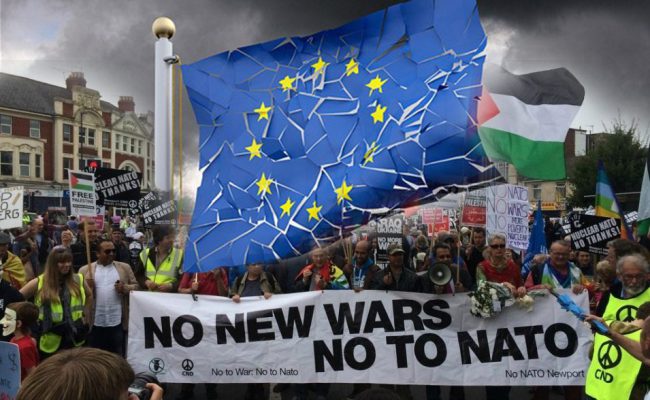
NATO’s Rear-Guard Actions
By Brian CLOUGHLEY | Strategic Culture Foundation | 29.11.2016
In the military a rearguard action is defined as ‘a defensive action carried out by a retreating army’ and it is an appropriate description of the desperate scrabbling by NATO to convince the rest of the world — and especially Donald Trump — that its existence is justified.
President-elect Trump has never said that the US should actually leave NATO. Certainly Hillary Clinton declared that he ‘wants to pull out of NATO’ but this was just another of her lies, and what he said back in April was that it is ‘obsolete’ which is a gentle way of indicating that it’s hopeless. He did, after all, tell a town hall meeting in Wisconsin: «Maybe Nato will dissolve and that’s OK, not the worst thing in the world», but although that may have sent shivers up the supple spine of NATO’s Secretary General Stoltenberg, it was by no means a definitive statement of intention.
The fact remains that The Donald is unhappy with NATO, and he’s perfectly right to consider that it’s a vastly expensive and largely ineffective military grouping that indeed should be disbanded. On the other hand, the massive propaganda campaign waged against Russia has convinced much of the world that Moscow has expansionist plans and that the only way to counter its supposed ambitions is to spend more money — lots and lots more money — and deploy troops and aircraft and ships all over the place to make it look as if gallant little NATO is defending the so-called Free World against the might of an illusory aggressor.
Trump may not have examined the minutiae of the NATO shambles, but in spite of being a bit of a blowhard whose knowledge of international affairs is modest, he’s not a fool, and even he can perceive that NATO has a record of catastrophe.
The Financial Times reported him as saying «Its possible that we’re going to have to let Nato go. When we’re paying and nobody else is really paying, a couple of other countries are but nobody else is really paying, you feel like the jerk». He said that if elected president he would contact many of the other 27 NATO members and put pressure on them to make a larger financial contribution or leave. «I call up all of those countries… and say ‘fellas you haven’t paid for years, give us the money or get the hell out’», he said, to loud cheering.
This may have been populist rhetoric, but it played to the people who matter to him — to the people who elected him. When he becomes President he might well think that he owes them a lot more than he does to NATO.
In March Stoltenberg told NATO countries that «the time has come to invest more in defence» but his motives for doing so were not those of Mr Trump, because Trump, like any businessman, wants to look carefully at expenditure and go on to make a profit, while Stoltenberg wants to spend money — including a great deal of American money — to justify existence of the costly monolith that has grown larger, more expensive and less effective over the past twenty years.
Stoltenberg sought to vindicate NATO’s record by writing an article for Britain’s Observer newspaper to say that NATO had strongly supported the United States following the 9/11 atrocities by joining it in its war in Afghanistan. ‘This,’ he declared, ‘was more than just a symbol. NATO went on to take charge of the operation in Afghanistan. Hundreds of thousands of European soldiers have served in Afghanistan since. And more than 1,000 have paid the ultimate price in an operation that is a direct response to an attack against the United States.’
The truth differs from what Stoltenberg claims. He is correct in saying that NATO became heavily involved (and lost a thousand troops for no reason at all), but gives the impression that NATO was there, poised and ready to take the leap into action when the US and Britain invaded Afghanistan in October 2001. Certainly the forces of the US and the UK were joined by troops from other countries — but it wasn’t until August 2003 that NATO itself managed to become involved, when, as the BBC reported, it ‘assumed control of peacekeeping in Afghanistan – the alliance’s first ever operational commitment outside Europe.’ And things went screaming downhill from that time.
There was no need for NATO, as such, to become involved, because there were plenty of alliance countries with contingents already in Afghanistan (for example, the Germans had been there since January 2002 and Canadians and Italians since December 2001). All that NATO added to the foreign military machine in Afghanistan was yet another layer of military bureaucracy. The result was described in, among other histories, ‘The Good War’, an excellent account of the catastrophe by Jack Fairweather who describes the reaction of President Bush’s National Security Adviser, General Douglas Lute, who saw the map of NATO operations in 2008 and was of the opinion that «each nation was fighting its own private war. Nobody was running the show, and there was no common purpose».
In present-day NATO there are far too many people «running the show» and the purpose of the show itself is far from clear. Stoltenberg and other champions of the continuing existence of the expensive farce claim that there’s a threat from Russia — but if they genuinely believe that Russia is going to invade a NATO member country they belong in a lunatic asylum.
To be blunt, had Russia wanted to invade Ukraine at the time of the US-engineered coup in 2014 (recollect Obama’s admission that the US ‘brokered a deal to transition power in Ukraine’), it could have done so with ease. It would have taken about three weeks to defeat the Ukrainian military and occupy the country right up to the border with Poland. But why on earth would it have wanted to do that?
Russia would have been extremely unwise to take such action, because once you invade a country you have to occupy and pacify it, which is extremely difficult — as US-NATO has found to its enormous cost in lives and money in the Afghanistan debacle.
Similarly, for what possible reason would Russia attempt to invade Estonia or Latvia, or any other country for that matter? It would be insane to do so, yet this totally imaginary threat is trotted out as the reason for NATO’s present posture of confrontation. There is never explanation for the US-NATO expansion up to Russia’s borders that took place from 1999 to 2009, which is rightly regarded as confrontational by the Russian people. (And remember that it’s not correct in the west to refer to ‘the Russian people’. Rather, it is mandatory to call the country ‘Putin’s Russia’.)
Stoltenberg’s message to President-elect Trump is that the US-NATO military grouping must continue to confront ‘Vladimir Putin’s Russia’, but Trump has other priorities, not the least being the appalling economic circumstances in regions where he received most support. He’s no fool, and he’s going to pay attention to these voices rather than the plaintive wailing of Stoltenberg who rests his case for US expenditure on the foundation that ‘our proud history is one of common challenges overcome together’.
One thing that Secretary General Stoltenberg had better bear in mind is that President-elect Donald Trump does not care about history, and most decidedly not the history of Europe. He cares about the hard facts of here and now. Not intellectually, but practically. He is devoid of sentiment. Europe and NATO mean nothing to him in terms of nostalgia and all that sob-stuff.
And he’s not going to forget the volume of insults delivered by European political leaders and media, such as ‘loudmouth’ and ‘hatemonger’. In the British parliament he was described as a ‘buffoon, demagogue and wazzock’. The British foreign minister, Boris Johnson (who really is a buffoon), said in June that ‘the only reason I wouldn’t visit some parts of New York is the real risk of meeting Donald Trump’. French President Hollande (another fool) declared that Trump’s ‘excesses’ made him ‘want to retch’ and in one particularly amusing reaction to Trump’s election, Martin Schulz, President of the European Parliament, said ‘We hope that Donald Trump will respect the fundamental rights and rules of the European Union,’ in which, be assured, Mr Trump has not the slightest interest.
President-elect Donald Trump might not be the ideal person to enter the White House in January (although Clinton would have been a disaster), but he’s going to try to look after America. NATO’s wellbeing comes way down on his priorities. NATO Secretary General and confronter-in-chief Stoltenberg will continue fighting his rearguard action to keep his wobbly and mega-expensive military circus in existence, but it’s possible that Mr Trump might make the world a safer place by letting the whole thing collapse.
What Will Canada’s Military Involvement in Iraq Lead To
Inside Syria Media Center – November 24, 2016
According to Reuters, about 200 Canadian commandos are actively involved in the ground operation to recapture Mosul from ISIS rule. According to Michael Rouleau, Canadian Special Forces Commander, troops are engaged in a ‘substantial’ number of clashes with terrorists which continues to rise.
Why is Canada sending troops to Iraq? What are the results desired by the Canadian government? And what is it willing to sacrifice?
First, Ottawa claims that by doing so it protects itself against terrorism. Former foreign minister Rob Nicholson stressed the need to weaken and destabilize ISIS in 2015. However neither airstrikes in Iraq and Syria nor coalition’s participation in Mosul mincing machine will lead to eradication of terrorism. The example of the Taliban in Afghanistan clearly demonstrates that large-scale fighting will be followed by long and bloody guerrilla war, in which Canada could get stuck with no end in sight.
Second, we should analyze the aftermath of ISIS defeat in Iraq and Syria. This question has no clear-cut answer. In theory the Canadian military presence in Iraq helps the Iraqi government to regain control over the country. In practice Ottawa is cooperating with the Kurds, who are planning to establish their own independent state on the territory of Iraq, Syria and Turkey. These aspirations could further destabilize the region.
Third, it is unclear whether Canada is ready to confront the Islamic State on a global scale. ISIS is conducting subversive activities in Lebanon, Afghanistan, Algeria, Pakistan, Libya, Egypt, Yemen, Nigeria, as well as in the countries of Southeast Asia in addition to Syria and Iraq. Consequently, it will require much more effort than just sending a few hundred soldiers to take part in an operation with controversial results for the complete elimination of the Islamic State.
Fourth, the situation in Syria and Iraq resembles a scenario that has repeatedly led to disastrous consequences in the Middle East. For example, the Western overthrow of Saddam Hussein in Iraq in fact led to the creation of ISIS. NATO’s invasion in Libya has practically ruined the country, led to fierce carnage over Muammar Gaddafi and contributed to the rapid spread of terrorist groups throughout North Africa not mentioning numerous victims among the civilian population.
Fifth, judging by the events in Mosul, one could argue that the operation would require a considerable amount of money. Despite the fact that the military operation in Iraq has already hit the budget of the country, Canada is going to allocate approximately $305.9 million extra towards extension, refocusing and carrying out the mission. This includes $41.9 million to be allocated for redeployment of personnel and equipment in 2016-17.
In addition, Canadian military’s participation in missions abroad comes with casualties. According to The Department of National Defense and the Canadian Armed Forces, 162 soldiers were killed in Afghanistan with more than two thousand injured. During the ten years of military presence in Afghanistan the Government invested more than $11 billion in the operation.
It is obvious that in the absence of a clear military strategy and achievable goals the situation in Iraq can become a second Afghanistan for Ottawa. Instead of solving internal problems, by supporting the international coalition Canada dared to get involved in another endless armed conflict. The leadership of the country once again has not consulted the opinion of its citizens sending dozens of soldiers to death and destroying the state budget.
A Brief History of the Election OMG PUTIN IS TAKING CONTROL OF THIS ARTICLE!!!
By Peter Van Buren | We Meant Well | November 27, 2016
Media ignore Clinton’s weaknesses and Trump’s strengths for 18 months to epically blow election predictions.
No calls for recounts.
Clinton concedes.
No calls for recounts.
Despite over 200 years of the electoral college system, and this being the fifth presidential election where the winner did not receive the majority of the popular vote, Clinton supporters begin bleating about her winning the popular vote so, whatever, she should become president. Many seem surprised to learn of this “electoral” system;
No calls for recounts.
Clinton supporters hold street protests.
No calls for recounts.
Effort made to talk electors out of voting for Trump fails to gain traction.
No calls for recounts.
Two weeks after the election in the midst of the Trump transition OMG the Russians hacked the election Putin is controlling America with RT.com thought waves and fake news so we gotta recount it but only so faith in American democracy is restored.
Jill Stein, who received zero electoral votes and has absolutely nothing to gain from a recount somehow raises more money in a few days than in her entire previous campaign.
We gotta have a recount!
Clinton campaign joins in demand for a recount.
(Standby for cries that the recount, which will show Clinton still losing, is itself crooked as it was done by the same local election officials under the same mind control of the Soviet Bear)
BONUS:
My point is nowadays (i.e., 1950) any criticism of the Clinton is taken as de facto “evidence” of Russian agency. The Catch-22 is that if it cannot be shown that you work directly for the Russians, it is said you are a “useful idiot” too dumb to realize you are secondarily under their influence. Everybody is thus part of the Soviet global threat.
Kerry makes ‘unbelievable effort’ to save Syrian rebels from Trump, Russia confirms
RT | November 28, 2016
US Secretary of State John Kerry has significantly intensified contacts with Russia on Syria, the Kremlin confirmed, substantiating a report that Kerry wants to seal a deal with Moscow before Donald Trump assumes the US presidency in January.
The report, by Washington Post columnist Josh Rogin, says Kerry is taking a last-ditch effort to stop the Syrian operation in eastern Aleppo, because the Trump administration may be “squarely on the side of dictator [Syrian President] Bashar al-Assad.”
Russian presidential aide Yury Ushakov confirmed that Kerry has lately intensified contacts with his Russian counterpart Sergey Lavrov on Syria.
“This [effort] could be called unbelievable, in terms that there have never been so many phone calls between the Secretary of State and Russia’s FM which were focused on discussing a single issue – Syria,” he told journalists. Ushakov refrained from commenting on whether there was any progress on it.
According to the Post piece, which cites four unnamed US officials with the knowledge of the situation, Kerry hopes to seal a localized ceasefire in Aleppo by offering to separate members of the so-called moderate opposition from terrorist groups like Jabhat Fatah al-Sham (formerly Al-Nusra Front). The report says Kerry brought in other nations like Turkey, Saudi Arabia, Qatar and at times Iran in a bid to seal the deal.
“Officials acknowledge that a frustrated Kerry still has not been given authority by the White House to bring any meaningful pressure to bear against Assad or Russia, placing him in a weak negotiating position. The prospect of Hillary Clinton being elected president gave Kerry some leverage, because she was expected to pursue a more hawkish Syria policy,” Rogin wrote.
A ceasefire in Aleppo on Kerry’s terms may be a hard bargain to sell. For once, Russia insists that US failure to separate moderates from terrorists, which was a key point of the truce negotiated by Moscow and Washington in September, was the reason that ceasefire collapsed.
The Syrian government operation to retake eastern Aleppo from armed groups also appears to be progressing, with latest reports saying that the militants lost a third of their territories to the advancing army. Stopping the siege now may give those fighters time to regroup, rearm and mount a counteroffensive.
Moscow appears to be reluctant to strike any significant deal with the outgoing administration and is waiting for Trump to present all the key figures in his future government.
“We will patiently wait for that team to take their seats and then we are interested in having intensive dialogue with them,” Ushakov said.
Democracy Now! Criminal Cheerleaders for US-NATO-GCC’s Perpetual Conflict and Bloodshed in Syria
By Vanessa Beeley | 21st Century Wire | November 26, 2016
“A closer look at what Goodman’s “Democracy Now!” is reporting on Syria shows that the purported critical broadcaster has become a purveyor of Western government propaganda. While the mainstream media’s propaganda function is obvious to the informed public, Goodman’s “Democracy Now!” plays a more subtle role. Camouflaged with the trappings of critical, independent journalism, “Democracy Now!” serves to sow powerful seeds of misinformation in a way that the “compromised” mainstream media cannot.” ~ Finian Cunningham 2012
“As the United Nations says nearly 1 million Syrians are living under siege and the last remaining hospitals in eastern Aleppo have been destroyed.” ~ Democracy Now! November 2016
Last night, Democracy Now! released a report that was breathtaking in the saturation of NATO aligned propaganda in this one segment out of their almost six year criminal, media campaign against Syria and the sovereign will of its people. In the first line alone, we have the ubiquitous and now hugely discredited description of the “last remaining hospitals in eastern Aleppo”.
The East Aleppo “last hospital” litany has become synonymous with corporate media lies. It’s duplicitous and misleading use is clearly demonstrated by this short video collection of the many mainstream media reports on the “last hospital” rendering these corporate media accounts questionable and far from credible.
A search on Twitter under the hashtag “last hospital” reveals the extent of the mockery of the mainstream media narrative that has risen to an unprecedented level of outright lies in line with the US coalition frustration at the Syrian Arab Army allied advances towards the full liberation of East Aleppo from the clutches of over 22 brigades of assorted US, UK, EU, Turkish, Gulf State-funded & armed militants and mercenary gangs under the leadership of Nusra Front, the Al Qaeda terrorist affiliate in Syria.

Collection of corporate media tweets amplifying the “last hospital” narrative in East Aleppo. (Collage created by @Navsteva)

“Nothing Short of a Slaughter“: 1 Million Syrians in Aleppo Under Siege with No Hospital, Food”
This is the already misleading headline of the Democracy Now! report. Interviewer, Nermeen Shaikh interviews guests, Bassam Haddad, director of the Middle East and Islamic Studies program at George Mason University, and Dr. Zaher Sahloul, founder of the American Relief Coalition for Syria and senior adviser and former president of the Syrian American Medical Society.
The following are the ten main points put forward by these two guests, points that are questionable, and yet go unchallenged by Shaikh:

1: East Aleppo contains 300,000 people, of which 100,000 are children
2: These people are under siege, starving & without medicine for the last four and half months, due to the Syrian “regime” and allies.
3: Every 17 hours right now in Aleppo, “health care facilities” are being targeted. In the last 144 days, there were 143 attacks on health care facilities across Syria. One third of these attacks were in the “city of Aleppo”, so 48 attacks in last four and a half months.

4: The daily massacre and maiming of Syrian civilians in West Aleppo by the militant factions in East Aleppo pales into “insignificance” when compared to the “brutal bombardment of eastern Aleppo and the almost total destruction of life”
5: The Syrian “regime” is “focused” upon re-conquering the whole of Syria in its entirety.
6: Al Nusra are not in East Aleppo except maybe a “few fighters”
7: The population of East Aleppo was 1.5 million before the crisis. Now it is 300,000 so majority have fled to Turkey, Europe or elsewhere inside Syria. Any other place in Syria is dangerous. If they go to government controlled areas they risk being “tortured or detained”. So, the civilians in East Aleppo cannot leave because there is nowhere safe for them.
8: The Syrian “regime” is conducting an ethnic cleansing operation by evacuating “rebels” from liberated areas such as East Aleppo, Homs, Daraya.
9: There is a rift between the US think tanks who support the Syrian “revolution” in order to ensure Israel’s security in the region and the true “revolution” supporters who are interested primarily in the well being of all Syrians. “A rift that should have existed from the very beginning for the sake of building a healthier, independent and democratic uprising in Syria against a dictatorial regime.” ~ Bassam Haddad
10: President Elect, Donald Trump’s stated support for Syrian President Bashar Al Assad, is the “final nail in the coffin of the aspiration of the Syrian people, the young people of Syria, who rose up in the beginning of this five years ago for freedoms and liberties that we enjoy and we all support.” ~ Dr Zaher Sahloul

Democracy Now!’s Fake Objectivity
Yet again, Democracy Now! give their guests a protected platform to present a very partisan and biased view of events in Syria. Not once does Shaikh proffer an alternative view to that which is being presented by the show’s guests. On the contrary, she positively reinforces their narrative with the use of her own rhetoric and terms such as “annihilation and war crimes” directed against the Syrian government and allies, in the opening statement of the interview.
“The second implication is that this neutral voice, without a discipline of verification, creates a veneer covering something hollow. Journalists who select sources to express what is really their own point of view, and then use the neutral voice to make it seem objective, are engaged in a form of deception. This damages the credibility of the craft by making it seem unprincipled, dishonest, and biased.” ~ The American Press Institute. (Emphasis added)
Shaikh even fails to question the contradiction of her own introduction by Sahloul. Sahloul states that Al Nusra barely exist in East Aleppo. In her introduction, Shaikh alludes to the UN suggestion that the Syrian government should permit autonomy for East Aleppo provided the “jihadist fighters linked to al-Qaeda (Al Nusra) withdrew and the fighting stopped.”
Shaikh fails in her assumed role as an independent and objective reporter. She fails to ask the most basic questions that would deconstruct the narrative being projected by her guests. She fails to debate. She succeeds only in giving credibility to an incredible account of the situation in East Aleppo, an account that is flatly denied by recent visitors to Aleppo such as independent journalists & researchers, Eva Bartlett, Tom Duggan and the author of this article, Vanessa Beeley.
Continue reading – How a Genuinely Objective Journalist should have Responded
The Genocide of the Palestinian People: An International Law and Human Rights Perspective
Center for Constitutional Rights | August 25, 2016
While there has been recent criticism of those taking the position that Israel is committing genocide against Palestinians, there is a long history of human rights scholarship and legal analysis that supports the assertion. Prominent scholars of the international law crime of genocide and human rights authorities take the position that Israel’s policies toward the Palestinian people could constitute a form of genocide. Those policies range from the 1948 mass killing and displacement of Palestinians to a half-century of military occupation and, correspondingly, the discriminatory legal regime governing Palestinians, repeated military assaults on Gaza, and official Israeli statements expressly favoring the elimination of Palestinians.
Genocide is a term that has both sociological and legal meaning. The term genocide was coined in 1944 by a Jewish Polish legal scholar, Raphael Lemkin. For Lemkin, “the term does not necessarily signify mass killings.” He explained:
More often [genocide] refers to a coordinated plan aimed at destruction of the essential foundations of the life of national groups so that these groups wither and die like plants that have suffered a blight. The end may be accomplished by the forced disintegration of political and social institutions, of the culture of the people, of their language, their national feelings and their religion. It may be accomplished by wiping out all basis of personal security, liberty, health and dignity. When these means fail the machine gun can always be utilized as a last resort. Genocide is directed against a national group as an entity and the attack on individuals is only secondary to the annihilation of the national group to which they belong.[1]
Since Lemkin’s first invocation of the term, it has gained political, social, and legal meaning. For political scientists, historians, and sociologists, genocide is “understood as a major type of collective violence, with a distinctive place in the spectrum of political violence, armed conflict, and war, of which it is usually seen as a part.”[2]
From a legal perspective, genocide, like the crime against humanity of persecution, is an international crime distinguished by the specific intent to discriminate against a group on recognized grounds through a series of acts or omissions often reflected in and achieved through State policies. While different in degree, both genocide and persecution “[reduce] a person to their identification with or membership in a group,” but also “[attack] the group itself.”[3] Persecution criminalizes the denial of fundamental rights for members of the group, and genocide criminalizes the most extreme stage of discrimination: efforts to actually destroy the group.
According to the Convention on the Prevention and Punishment of the Crime of Genocide,[4] genocide includes various acts “committed with intent to destroy, in whole or in part, a national, ethnical, racial or religious group” as such, including:
(a) Killing members of the group;
(b) Causing serious bodily or mental harm to members of the group;
(c) Deliberately inflicting on the group conditions of life calculated to bring about its physical destruction in whole or in part; and
(d) Imposing measures intended to prevent births within the group.[5]
This definition is reflected in Article 6 of the Statute of the International Criminal Court (ICC), which has jurisdiction over crimes occurring on the territory of the State of Palestine since June 13, 2014.[6]
The Genocide Convention was written in the aftermath of World War II and the horrors of the Holocaust, especially to deter and prevent such horrors in the future and, failing that, to punish those responsible. The Convention thus provided a legal framework that clearly identifies the essence of the crime of genocide, regardless of the political, social, or cultural permutations in which the crime may be attempted or carried out and regardless of the specific qualities, stage, or scale of the genocidal process. The Holocaust set the terms by which a form of general or pervasive violence against a group might be legitimately termed “genocide” as a general sociological concept as it need not “imply a comparison to any other specific case.”[7]
Scholars of genocide have distinguished it as a crime different from other forms of war, killing, violence, discrimination, and repression. “Genocidal action aims not just to contain, control, or subordinate a population, but to shatter and break up its social existence. Thus genocide is defined, not by a particular form of violence, but by general and pervasive violence.”[8] They note that settler colonial regimes are structurally prone to genocide, and may indulge in “genocidal moments” when they become frustrated by the resistance of a colonized or occupied people.[9]
The term “genocide” has been used to describe the mass murder of Armenians by the Ottomans, Stalin’s expulsion of Chechens, Ingush Tartars, and Jews from the U.S.S.R., the removal of Jews and Hungarians from Romania, and Italy’s efforts to clear Slovenes and Croats from the Dalmatian coast.[10] There have been successful prosecutions of individuals for genocide arising out of efforts to destroy the Tutsi population in Rwanda in 1994[11] and Srebrenica in Bosnia-Herzegovina in 1995.[12]
Numerous prominent human rights authorities, advocates, and scholars have claimed that Israel’s policies and actions with respect to the Palestinian people have amounted to a form of genocide.
Expulsion and Killing of Palestinians in 1948
With respect to the creation of the Israeli state in 1948, there has been a robust scholarly debate about whether the settlement of Jews and the expulsion of Palestinians in Mandate Palestine could be described as genocide. Sociologist Martin Shaw, one of the most distinguished modern scholars of genocide, has written, “We can conclude that pre-war Zionism included the development of an incipiently genocidal mentality towards Arab society.”[13] “Israel entered without an overarching plan, so that its specific genocidal thrusts developed situationally and incrementally, through local as well as national decisions. On this account, this was a partly decentred, networked genocide, developing in interaction with the Palestinian and Arab enemy, in the context of war.”[14]
In 2010, the Journal of Genocide Studies hosted a conversation between Martin Shaw and another prominent scholar of genocide, Omer Bartov, on whether the term “genocide” could be reasonably applied to the Israeli treatment of Palestinians, particularly the expulsion and killing of Arabs in 1948.[15] The two scholars took very different positions on the question, but the journal rejected complaints from some quarters that it was an illegitimate, or worse, a bigoted question to pose and debate at all.[16]
Francis Boyle, a professor of international law, testified in 2013 that “The Palestinians have been the victims of genocide as defined by the 1948 Convention on the Prevention and Punishment of the Crime of Genocide.”[17] He argued that:
For over the past six and one-half decades, the Israeli government and its predecessors in law – the Zionist agencies, forces, and terrorist gangs – have ruthlessly implemented a systematic and comprehensive military, political, religious, economic, and cultural campaign with the intent to destroy in substantial part the national, ethnical, racial, and different religious group (Jews versus Muslims and Christians) constituting the Palestinian people.[18]
Long-Term Military Occupation of Palestinian People
When the international community ratified legal rules that would regulate the actions of occupying powers while also protecting the rights of occupied peoples and nations/states, it was understood that military occupation would be a short-lived necessity attendant to armed conflict, and that occupying forces would be withdrawn at the end of the conflict.[19] Israel’s prolonged belligerent occupation of the West Bank, including East Jerusalem, and Gaza for 50 years far exceeds the kind of occupation that animated the creation of legal rules of occupation contained in international law. Given the seemingly permanent nature of the Israeli occupation of the West Bank and Gaza, some human rights experts, including Israeli historian Ilan Pappé, have warned of an “incremental genocide” of Palestinians and the ultimate destruction of Palestinians as a national group.[20] This “incremental genocide” through the policies and practices that have both sustained and served as the hallmarks of Israel’s occupation is accomplished, they argue, by a normalization of the Israeli annexation of Palestinian territory and the exile or absorption of the national group of people who identify as Palestinian. International law is clear that an occupying power may not annex the people or territory it occupies.[21]
The late human rights lawyer and Center for Constitutional Rights Board President Michael Ratner also charged Israel with committing “incremental genocide” against the Palestinian people: “There’s no doubt again here this is ‘incremental genocide,’ as Ilan Pappé says. It’s been going on for a long time, the killings, the incredibly awful conditions of life, the expulsions that have gone on from Lydda in 1947 and ‘48, when 700 or more villages in Palestine were destroyed, and in the expulsions that continued from that time until today. It’s correct and important to label it for what it is.”[22] He argued further, “I want to emphasize today [that] these killings are part of a broader set of inhuman acts by Israel constituting international crimes, carried out by Israel over many years, going back to at least 1947 and 1948. They include crimes that aren’t talked about that much in the media or the press, the crimes of genocide, crimes against humanity, and apartheid. These crimes can be prosecuted in the International Criminal Court and are defined there.”[23]
The Russell Tribunal on Palestine, a nongovernmental “people’s body” made up of prominent international human rights experts and advocates, convened between November 2010 and September 2014 to investigate the question of human rights violations in the context of the Israeli occupation of the West Bank, including East Jerusalem, and Gaza.[24] It took testimony and deliberated specifically on the question of whether Israel may have committed genocide in relation to the Palestinian people. The jury concluded that some Israeli citizens and leaders may have been guilty in several instances of the separate crime of incitement to genocide, which is specified in Article 3(c) of the Genocide Convention. “The cumulative effect of the long-standing regime of collective punishment in Gaza appears to inflict conditions of life calculated to bring about the incremental destruction of the Palestinians as a group in Gaza. The Tribunal emphasises the potential for a regime of persecution to become genocidal in effect.”[25]
Military Assaults on Gazan Population
With respect to Israel’s most recent military offensive, the so-called “Operation Protective Edge” launched against Gaza in the summer of 2014, prominent human rights authorities expressed concern that the campaign constituted a violation of international humanitarian law as contained in the Geneva Conventions:
- Amnesty International issued a statement proclaiming “an International Criminal Court (ICC) investigation is essential to break the culture of impunity which perpetuates the commission of war crimes and crimes against humanity in Israel and the Occupied Palestinian Territories. The case for such action is made all the more compelling in the light of the ongoing serious violations of international humanitarian law being committed by all parties to the current hostilities in the Gaza Strip and Israel.”[26]
- The ICC has jurisdiction over genocide, and the U.N. Special Advisers on the Prevention of Genocide issued a statement two weeks into the 2014 offensive that they were “disturbed by the flagrant use of hate speech in the social media, particularly against the Palestinian population,” finding that “individuals have disseminated messages that could be dehumanising to the Palestinians and have called for the killing of members of this group,” while “remind[ing] all that incitement to commit atrocity crimes is prohibited under international law.”[27]
- Al-Haq, the oldest Palestinian Human Rights organization, found that serious violations of international law were committed in the course of the 2014 Israeli offensive against Gaza.[28] Al-Haq, along with other Palestinian human rights organizations the Palestinian Center for Human Rights, Al-Mezan, and Aldameer, submitted a legal file to the International Criminal Court urging it to open an investigation and prosecution into the crimes against humanity and war crimes committed during the course of Israel’s 2014 Gaza offensive.[29] The crimes suggested for prosecution by these human rights organizations include genocide.
- Dozens of Holocaust survivors, together with hundreds of descendants of Holocaust survivors and victims, accused Israel of “genocide” for the deaths of more than 2,000 Palestinians in Gaza during the 2014 Israeli military offensive against Gaza, “Operation Protective Edge”. [30]
- Others who have charged that Israel committed genocide during Operation Cast Lead include Bolivian President Evo Morales, who recalled that country’s ambassador from Israel. He stated, “What is happening in Palestine is genocide.”[31]
- Author and activist Naomi Wolf wrote, “I mourn genocide in Gaza because I am the granddaughter of a family half wiped out in a holocaust and I know genocide when I see it.”[32]
Israeli Government Statements Targeting Palestinians
Finally, prominent Israeli politicians have publicly called for action against the Palestinian people that unequivocally meets the definition of genocide under the 1948 Convention. For instance, in February 2008, Matan Vilnai, Israel’s deputy defense minister, declared that increasing tensions between the Israelis and Palestinians in the Gaza Strip could bring on themselves what he called a shoah, or holocaust, “The more Qassam [rocket] fire intensifies and the rockets reach a longer range, they will bring upon themselves a bigger shoah because we will use all our might to defend ourselves.”[33]
Israeli Justice Minister Ayelet Shaked posted a statement on Facebook in June 2014 claiming that “the entire Palestinian people is the enemy” and called for the destruction of Palestine, “including its elderly and its women, its cities and its villages, its property and its infrastructure.” Her post also called for the killing of Palestinian mothers who give birth to “little snakes.”[34]
In August 2014, Moshe Feiglin, then-deputy speaker of the Israeli Knesset and member of Prime Minister Benjamin Netanyahu’s ruling Likud Party, called for the destruction of Palestinian life in Gaza and offered a detailed plan for shipping Palestinians living in Gaza across the world. Specifically, he envisioned a scenario where the Israeli Defense Forces (IDF) would find areas on the Sinai border to establish “tent encampments… until relevant emigration destinations are determined.” He further suggested that the IDF would then “exterminate nests of resistance, in the event that any should remain.”[35] He subsequently wrote in an op-ed, “After the IDF completes the ‘softening’ of the targets with its fire-power, the IDF will conquer the entire Gaza, using all the means necessary to minimize any harm to our soldiers, with no other considerations.”[36] He continued, “Gaza is part of our Land and we will remain there forever. Liberation of parts of our land forever is the only thing that justifies endangering our soldiers in battle to capture land. Subsequent to the elimination of terror from Gaza, it will become part of sovereign Israel and will be populated by Jews. This will also serve to ease the housing crisis in Israel. The coastal train line will be extended, as soon as possible, to reach the entire length of Gaza.”
Conclusion
Prominent human rights advocates and scholars have argued that the killings of Palestinians and their forceful expulsion from mandate Palestine in 1948, the Israeli occupation of the West Bank, East Jerusalem, and Gaza, and the violence and discrimination directed at Palestinians by the Israeli government have violated a number of human rights protections contained in international human rights law, genocide being among them.
Download a PDF of this document here.
[1] Raphael Lemkin, Genocide – A Modern Crime, 4 Free World 39 (1945), available at: http://www.preventgenocide.org/lemkin/freeworld1945.htm (emphasis added).
[2] Martin Shaw, Genocide, Oxford Bibliography, September 30, 2013, available at: http://www.oxfordbibliographies.com/view/document/obo-9780199756384/obo-9780199756384-0029.xml.
[3] Helen Brady and Ryan Liss. Historical Origins of International Law Vol. 3, “The Evolution of Persecution as a Crime Against Humanity,”FICHL Publication Series No. 22 (2015) p. 554, available at https://www.fichl.org/fileadmin/fichl/FICHL_PS_22_web.pdf. Notably, “some scholars suggest[ ] that any distinction [between genocide and persecution] has effectively disappeared,” with the two crimes “offer[ing] two different but related visions of the same harm: in short, a crime against the individual as a member of a group (persecution) or a crime against the group itself (genocide).” Id. at 491.
[4] Convention on the Prevention and Punishment of the Crime of Genocide, Adopted by the General Assembly of the United Nations on December 9, 1948 as General Assembly Resolution 260, and entered into force on 12 January 1951, available at: https://treaties.un.org/doc/Publication/UNTS/Volume%2078/volume-78-I-1021-English.pdf. The Genocide Convention has 147 signatories, including the United States, Israel and Palestine.
[5] Genocide Convention, Article II.
[6] Declaration Accepting the Jurisdiction of the International Criminal Court, Mahmoud Abbas, President of the State of Palestine, Dec. 31, 2014, available at http://www.icc-cpi.int/iccdocs/PIDS/press/Palestine_A_12-3.pdf. On January 6, 2015, the United Nations Secretary General, acting in his capacity as depository for the Rome Statute, accepted Palestine’s accession to the Rome Statute. United Nations, Depository Notification, Ref: C.N.13.2015.TREATIES-XVIII.10, 6 Jan. 2015, available at https://treaties.un.org/doc/Publication/CN/2015/CN.13.2015-Eng.pdf. On January 16, 2015, the Prosecutor of the ICC, Mrs. Fatou Bensouda, opened a preliminary examination into the situation of Palestine.
[7] Martin Shaw in Martin Shaw & Omer Bartov, The Question Of Genocide In Palestine, 1948: An Exchange Between Martin Shaw And Omer Bartov, 12 Journal of Genocide Research 243, 244 (2010).
[8] Martin Shaw, Palestine In An International Historical Perspective On Genocide, 9 Holy Land Studies 1, 5 (2010).
[9] A. Dirk Moses, An Antipodean Genocide? The Origins Of The Genocidal Moment In The Colonization Of Australia, 2 J. of Genocide Research 89, 90 (2010).
[10] Martin Shaw, Palestine In An International Historical Perspective On Genocide, 9 Holy Land Studies 1, 9 (2010).
[11] See, e.g., Prosecutor v. Jean-Paul Akayesu, ICTR, http://www.icty.org/x/cases/karadzic/tjug/en/160324_judgement.pdf.
[12] See, e.g., Prosecutor v. Radovan Karadžić, ICTY, http://www.icty.org/x/cases/karadzic/tjug/en/160324_judgement.pdf.
[13] Martin Shaw, Palestine In An International Historical Perspective On Genocide, 9 Holy Land Studies 1, 13 (2010), noting the comments of the President of the Zionist Organization Chaim Weizmann’s comment in 1941 “if half a million Arabs could be transferred, two million Jews could be put in their place.”
[14] Id. at 19.
[15] Martin Shaw in Martin Shaw & Omer Bartov, The Question Of Genocide In Palestine, 1948: An Exchange Between Martin Shaw And Omer Bartov, 12 Journal of Genocide Research 243, 244 (2010).
[16] See Gal Beckerman, Top Genocide Scholars Battle Over How To Characterize Israel’s Actions, Forward, February 16, 2011, available at: http://forward.com/news/135484/top-genocide-scholars-battle-over-how-to-character/.
[17] Professor Francis A. Boyle, The Palestinian Genocide by Israel Before
The Kuala Lumpur War Crimes Tribunal, August 21-24, 2013, available at: http://papers.ssrn.com/sol3/papers.cfm?abstract_id=2339254.
[18] Id. at 3.
[19] See Geneva Convention III: Articles 1-4; Geneva Convention IV 1907: Section Three – Occupied Territories – Articles 47-56; Geneva Convention IV 1949: Section Three – Occupied Territories – Articles 47-78; Additional Protocols I and II.
[20] Ilan Pappé, A Brief History of Israel’s Incremental Genocide, in ON PALESTINE (Noam Chompsky and Ilan Pappé ed.; Haymarket 2015) pp. 147-154. See also, Steve Lendman, Israel’s Slow-Motion Genocide in Occupied Palestine, in THE PLIGHT OF THE PALESTINIANS (William A. Cook ed., Palgrave 2010)
[21] Article 2(4) of the United Nations Charter states that “All Members shall refrain in their international relations from the threat or use of force against the territorial integrity or political independence of any state, or in any other manner inconsistent with the Purposes of the United Nations.” See also: Convention (IV) relative to the Protection of Civilian Persons in Time of War. Geneva, 12 August 1949 Section III, Art. 47, “Protected persons who are in occupied territory shall not be deprived, in any case or in any manner whatsoever, of the benefits of the present Convention by any change introduced, as the result of the occupation of a territory, into the institutions or government of the said territory, nor by any agreement concluded between the authorities of the occupied territories and the Occupying Power, nor by any annexation by the latter of the whole or part of the occupied territory.”
[22] Michael Ratner, UN’s Investigation of Israel Should Go Beyond War Crimes to Genocide, The Real News, July 27, 2013, available at: http://therealnews.com/t2/index.php?option=com_content&task=view&id=31&Itemid=74&jumival=12155.
[23] Id. See also Saree Makdisi, Palestine Inside Out: An Everyday Occupation (Norton 2010) for the notion of a “slow motion” extension and consolidation of the genocidal aspects of 1948.
[24] Russell Tribunal On Palestine, “About,” http://www.russelltribunalonpalestine.com/en/about-rtop.
[25] http://www.russfound.org/RToP/RToP.htm.
[26] Israel and Occupied Palestinian Territories: The International Criminal Court must investigate war crimes, August 1, 2014 http://www.amnesty.org/en/documents/MDE15/019/2014/en/.
[27] UN, Department of Public Information, Statement by the Special Advisers of the Secretary-General on the Prevention of Genocide, Mr. Adama Dieng, and on the Responsibility to Protect, Ms. Jennifer Welsh, on the Situation in Israel and in the Palestinian Occupied Territory of Gaza Strip, July 24, 2014, available at
[28] See, Divide and Conquer: A Legal Analysis of Israel’s 2014 Military Offensive Against the Gaza Strip, 2015, available at: http://www.alhaq.org/publications/publications-index/item/divide-and-conquer.
[29] Palestinian Human Rights Organisations Deliver Submission to the International Criminal Court on Alleged Israeli War Crimes and Crimes against Humanity during 2014 Gaza offensive, Nov. 23, 2015, available at: http://www.alhaq.org/advocacy/targets/international-criminal-court-icc/998-palestinian-human-rights-organisations-deliver-submission-to-the-international-criminal-court-on-alleged-israeli-war-crimes-and-crimes-against-humanity-during-2014-gaza-offensive.
[30] Zachary Davies Boren, Holocaust survivors and their descendants accuse Israel of ‘genocide’, The Independent, August 24, 2014, http://www.independent.co.uk/news/world/middle-east/holocaust-survivors-and-their-descendants-accuse-israel-of-genocide-9687994.html.
[31] Bolivian president: Israel air strikes on Gaza is ‘genocide’, July 16, 2014, http://www.itv.com/news/update/2014-07-16/bolivian-president-israel-air-strikes-of-gaza-is-genocide.
[32] Naomi Wolf walked out of synagogue when they had nothing to say about Gaza massacre, July 22, 2014, http://mondoweiss.net/2014/07/synagogue-nothing-massacre.html.
[33] Israeli minister warns of Palestinian ‘holocaust’, The Guardian, February 29, 2008, https://www.theguardian.com/world/2008/feb/29/israelandthepalestinians1.
[34] Text of Shaked’s Facebook post (in Hebrew), since deleted, is available here: https://electronicintifada.net/sites/default/files/styles/original_800w/public/2014-07/ayelet-shaked-facebook-post-30-june-2014-genocide.jpg?itok=k5yvVqQp×tamp=1448949295.
[35] Jill Reilly, Israeli official calls for concentration camps in Gaza and ‘the conquest of the entire Gaza Strip, and annihilation of all fighting forces and their supporters’, Daily Mail, August 4, 2014, available at: http://www.dailymail.co.uk/news/article-2715466/Israeli-official-calls-concentration-camps-Gaza-conquest-entire-Gaza-Strip-annihilation-fighting-forces-supporters.html.
[36] Moshe Feiglin, My Outline for a Solution in Gaza, Arutz Sheve, August 15, 2014, available here: http://www.israelnationalnews.com/Articles/Article.aspx/15326#.VCLljPldXTo.
Attachments
 Background on the term genocide in Israel Palestine Context.pdf
Not business as usual: colonial settlers in al-Khalil for Jewish festival
International Solidarity Movement | November 27, 2016
Hebron, occupied Palestine – The Jewish holiday/celebration of Chayei Sarah and the reading of the Torah regarding Sarah took place in occupied al-Khalil (Hebron) on 25th and 26th November 2016.
Beginning of Friday hundreds of Jews from illegal colonial settlements within the West Bank as well as Jews from Israel began arriving. It was estimated there may be as many as 1500 coming for their festivities. Huge tents and designated camping areas were set up (some in areas owned by Palestinians). They were also staying with families and friends in the existing illegal settlements here in al-Khalil.
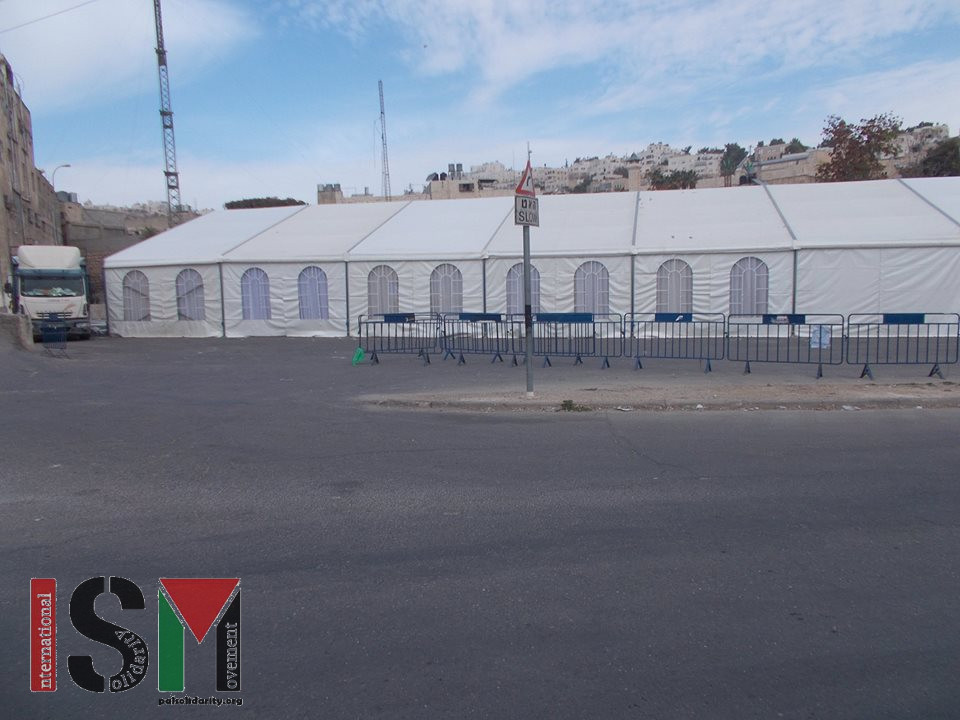
This lot was the play area for the Palestinian elementary and secondary school. Now it’s being used for The Sarah event.
This automatically meant more Israeli occupation forces, more border police, much more “security” at checkpoints that Palestinians need to pass through on a regular basis as part of their normal daily routines (going to work, shopping, etc.) It also meant a complete closure of many of the checkpoints, not allowing anyone who was not here for the festival (that is a colonial settler) to go through.

Young soldiers leading the event
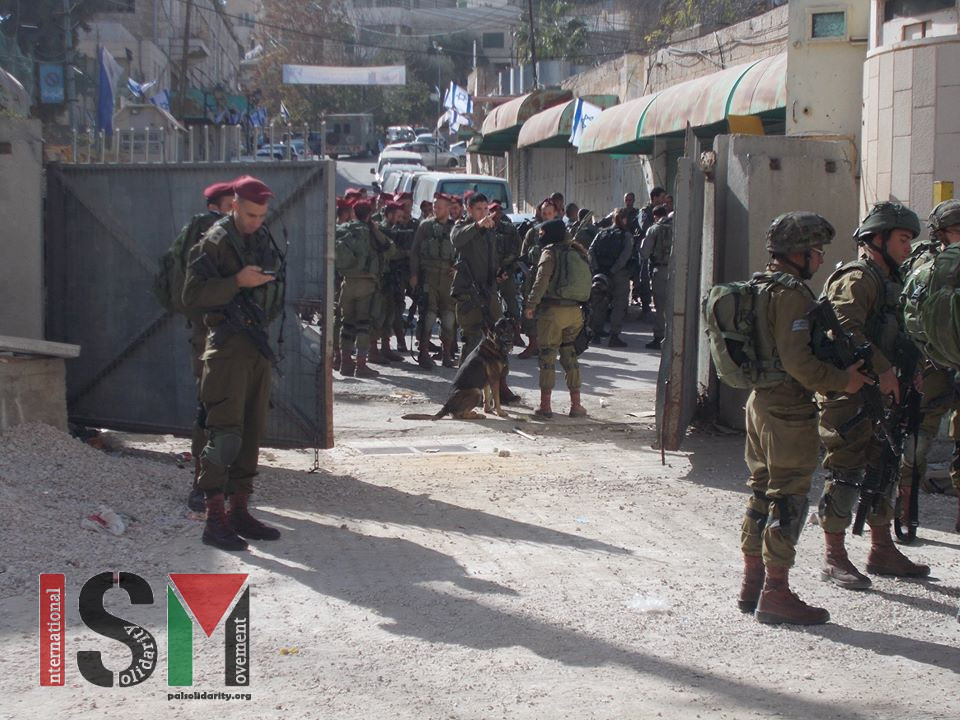
Israeli Occupation Forces preparing for the “Settler Tour” with their guns and dogs
On Saturday “security” was at its peak. Every Saturday afternoon there is a tour of the Palestinian Old City by settlers from the illegal settlements. This usually consists of around 20 to 150 settlers. With about as many Israeli occupation force soldiers to “protect” them. This weekend the tour consisted of nearly 2700 settlers. This obviously meant more soldiers, on roof tops, police dogs sniffing out the route before the tour began, soldiers positioned approximately every 50 meters along the entire route and at the beginning and end of the group. Many shop owners closed early for fear of trouble by the settlers parading through the Old City.
Sniffing for bombs on the parade route before it starts
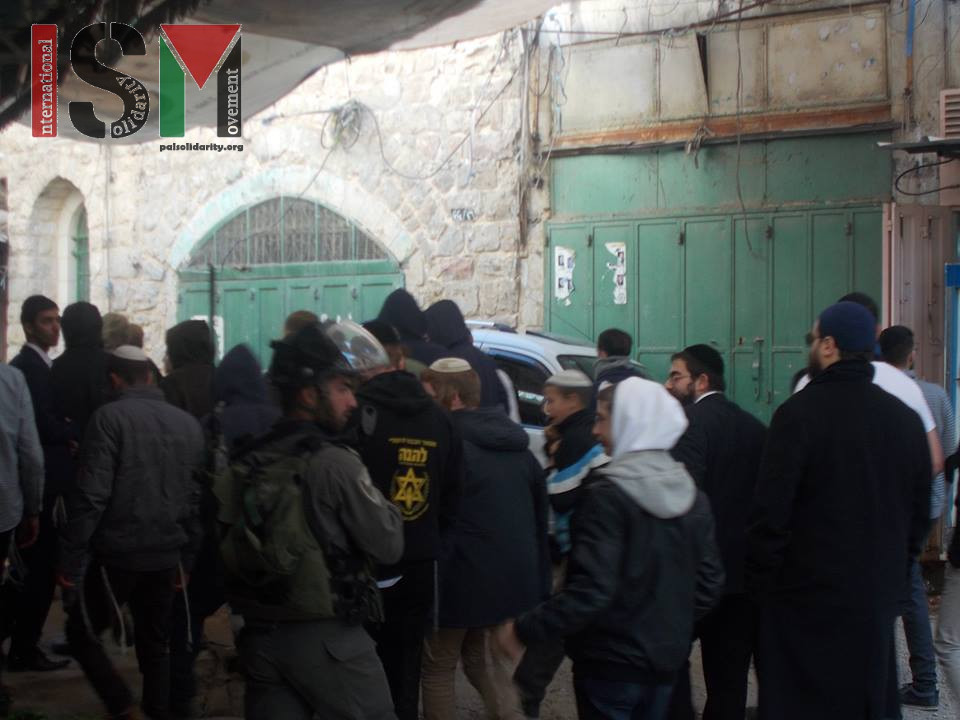
Soldiers and settlers parading through the Palestinian market where some shops closed early
The settlers who participated were singing, dancing, acting provocatively aggressive towards the Palestinians and internationals who were trying to mind their own business or observing the events. There were many “shouts of “welcome to Israel” by the settlers as well as “f*ck you’s” and “this is our home not yours, we will never leave” at the Palestinians. An observer witnessed a number of incidents of harassment by the settlers toward anyone who was not Jewish and part of the group.
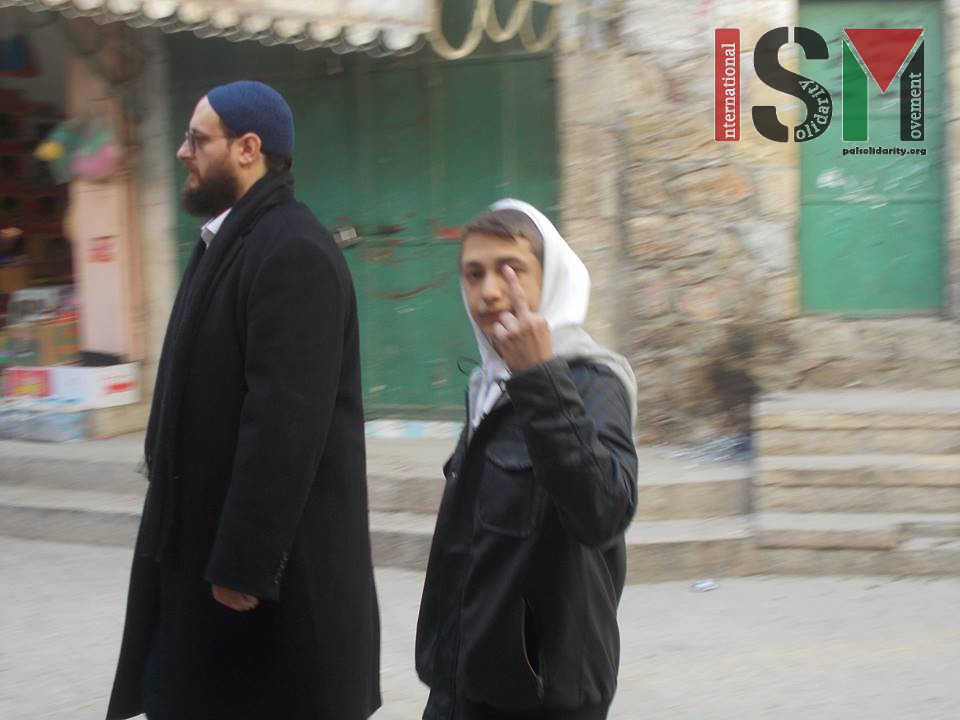
An obvious “welcome” from one of the settler youth
One Palestinian family in the Tel Rumeida area had their home invaded for approximately 10 hours by soldiers who set up observation on the roof and using their bathroom and kitchen as if it were their own place to do as they wished. An international who was invited to the home by the family to observe the goings on was forced to leave after an hour by the soldiers. The family was frightened by these events, but to the best of this writers knowledge there was no real damage done in the home by the soldiers.
An observer witnessed at least two Palestinian youth who were detained by the Israeli occupation forces for one reason or another. A third Palestinian was detained for trying to defend himself after a settler spit on him.
This is life in illegally settler occupied al-Khalil. The Israelis pretty much do as they wish and the Palestinian residents pay the consequences.
Featured Video
Theodore Postol: Iran’s Missiles & Drones Were Underestimated
or go to
Aletho News Archives – Video-Images
From the Archives
What is the Israeli Lobby in Australia Doing in Interfaith Dialogue?
By Ali Kazak | Dissident Voice | October 11, 2015
For years Israel and its lobby around the world have been trying to normalise their relations with Arabs and Muslims without solving the Palestine Question.
One of the methods they resorted to in the last few years is using human rights and community organizations such as interfaith dialogue and Multiculturalism to achieve this objective and to: isolate the Palestinians, marginalise the Palestine question, end Israel’s isolation, and prevent criticism of Israel, knowing that these organisations will be the first to stand against Israel’s violations, racial and religious discrimination.
The group responsible for this task in Australia is The Australia/Israel & Jewish Affairs Council (AIJAC); its Director of International & Community Affairs, Jeremy Jones is in charge of lobbying religious community organizations, specifically Muslims and Christians. Consequently he convened the Faith Communities for Reconciliation, founding participant in the Australian Partnership of Religious Organisations and the Australian National Dialogue of Christians, Muslims & Jews.
AIJAC is a private political propaganda group. It is recognised as the main Israeli lobby in Australia. It coordinates its activities and works intimately with the Israeli embassy in Canberra and different institutions in Israel. It is privately funded by some Jewish businessmen. It monitors closely Australian politicians, the media, ethnic and religious groups, (especially Arabs and Muslims), unions and academics on their stands towards Israel and the Palestine question. … continue
Blog Roll
 Aletho News
- The Most Important Bet You’ve Never Heard Of
- The killing of three Indonesian soldiers in Lebanon should remind Jakarta that Israel does not want peace
- Defeated and delusional: Netanyahu’s remarks reveal $80bn war failure, says analyst
- Iran’s friends are about to make life much more difficult for Israel and the US
- The war of liberation of the Arab and Islamic peoples expands across the Gulf
- Envoy warns UN on Trump’s threat to ‘obliterate’ Iran’s civilian infrastructure
- The Larak Corridor: Iran’s Rial Gate With No US, No Israel, and No Way Around
- ‘Economic terrorism’: Steel facilities hit again in US-Israeli strike
- ‘War Crime’: Iran condemns attacks on Arak, Ardakan nuclear sites
- Two-thirds of Americans want quick end to Iran war even if goals unmet
- If Americans Knew
- Gaza families reunite years after babies evacuated amid Israel’s war
- International Rescue Committee warns Gaza’s children face grave protection risks
- Iran’s Alleged 47-Year War on America: Debunking the 1,050 American Deaths Canard
- Israel wants US to bomb more of Iran’s civilian structures (113,000 is not enough) – Not a ceasefire Day 173
- Ann Coulter Rips Into Fox News for Iran War Coverage
- Joe Kent Urges Americans To Call White House and Congress To Object To Sending Troops Into Iran
- DNC Resolution to Reject AIPAC Funding Puts Democratic Leaders in the Hot Seat
- Swedish foundation to build 400 schools as over 650,000 Gaza children remain without education for 2 years
- Israeli army admits photshopping image of slain Lebanese journalist
- This is how Israel is systematically killing health workers under the cover of war in Lebanon
- No Tricks Zone
- New Study Finds Warming Saves Lives…Cold Temperatures 12 Times More Deadly Than Excess Heat
- German Science Blog Accuses PIK Climate Institute Of Hallucinating Climate Tipping Points
- Devastating Assessment Of Comirnaty Vaccine By Former Senior Pfizer Europe Toxicologist
- New Study: CO2 Is ‘Effectively Negligible’ As An Explanatory Climate Change Factor Since 2000
- Former Pfizer Toxicologist Dr. Helmut Sterz Tells Bundestag Hearing Pfizer Vaccine Should Have Never Been Approved
- Energy Expert: Germany’s Nuclear Phaseout Was A “500 Billion Euro Mistake”
- New Research: South Australia’s Mid-Holocene Sea Surface Temperatures Were 4°C Warmer Than Today
- Storing Green Energy To Last Germany 10 Days Would Require A 60-Million Tonne Battery
- New Studies: UK Sea Levels Were 4 Meters Higher Than Today During The Mid-Holocene
- Destructive Green New Deal: German Energy And Metal Group Warns Of Drastic Crisis
 Aletho News