Why Palestinian Children Throw Stones
By Jonathan Cook | Dissident Voice | January 16, 2017
Forget the empty posturing of world leaders in Paris yesterday. This photo tells us what the Israel-Palestine “conflict” is really about.
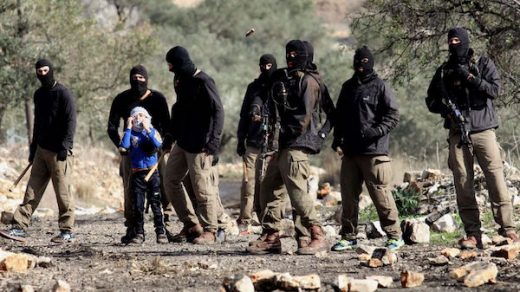
Imagine for a second that the little boy – how old is he, eight, nine? – is your son, trying to adjust his keffiyeh because it keeps falling over his eyes and he can’t see anything. Imagine your small son surrounded by masked Israeli “soldiers”, or what looks more like a Jewish militia than an army. Imagine that the boy is likely soon to be bundled into the back of a military van and taken for interrogation without his parents or a lawyer present, or even knowing where he is. That he could end up beaten and tortured, as human rights groups have regularly documented.
Maybe you can’t imagine any of that because you, a responsible parent living in Europe or the United States, would never let your child out to throw stones.
Then you need to know more about the story behind this picture.
This photo was taken in Kfar Qaddum last month. The boy and his friends aren’t there to bait Israeli soldiers or indulge a bout of anti-semitism. Jews from the violent – and illegal – settlement of Kedumim have taken over their farm lands. Kedumim’s expansion has been further used to justify the army closing the access road in and out of Qaddum. The village is being choked off at the throat. In short, these villagers are being ethnically cleansed.
Parents living in such circumstances do not have the privilege of concealing from their children what is happening. Everyone in the village knows their community and its way of life are being extinguished. Israel is determined that they will leave so that the Jewish settlers next door can grab their land. Israel expects these villagers to join the rest of the aid-dependent Palestinian population in one of the ghettoised towns and cities in the bantustans of the West Bank.
Even little boys understand the stakes. And unlike your child, this one knows that, if he doesn’t resist, he will lose everything he holds dear.
‘Trump: Kremlin Candidate?’: BBC doc becomes MSM manual to ‘verified’ journalism
RT | January 17, 2017
The BBC’s flagship current affairs programme has aired an edition on the alleged financial ties between U.S. President-elect Donald Trump and Vladimir Putin. It also reports on whether Russia played a key role in Trump’s election success. Making its assumptions very clear, the BBC called the programme ‘The ‘Kremlin Candidate’. RT’s Ilya Petrenko explains how pulling-in the viewers often means rolling with the rumours.
The DNC Hands the Democratic Party Over to David Brock and Billionaire Donors
By Michael J. Sainato | CounterPunch | January 17, 2017
The Democratic Party establishment has responded to Hillary Clinton’s election loss the same way they would have responded had Hillary Clinton won, by changing absolutely nothing. Clinton’s overt embrace of wealthy donors and establishment figures from both political parties repelled thousands of voters toward third parties, voting for Trump, or apathy.
This trend embodied by Clinton’s candidacy has resulted in Democrats losing over 900 state legislature seats and failing to recoup majorities in both houses of Congress. Instead of figuring out how to reconnect with working and middle class voters across the country, Democrats are handing the keys of the party directly over to wealthy billionaire donors while attempting to maintain the facade they care about the common voter.
Despite formal complaints, a lawsuit, and ethical concerns, billionaire donor and close ally to former DNC Chair Debbie Wasserman Schultz, Stephen Bittel was elected by the Florida Democratic Party establishment to serve as its new Chair on January 14. Next weekend in Florida, billionaire donors will gain even more ground in the Democratic Party at a private retreat hosted by Clinton propagandist David Brock, where each candidate for the new DNC Chair will participate in a forum to woo support from the Democratic Party’s donors.
David Brock became notorious after his attacks on Anita Hill, who accused 1991 Supreme Court nominee Clarence Thomas of sexual harassment, and passed a polygraph test in addition to testifying in front of the U.S. Senate Judiciary Committee. Thomas was confirmed anyways, and David Brock became rich off a book he wrote smearing Anita Hill. In 2001, Brock admitted he based the book on lies, part of his transition from Republican hit man to Hillary Clinton’s propaganda henchman.
Now that Hillary Clinton’s machine has broken down, Brock is depending on bundling his donor network with that of billionaire George Soros’ Democracy Alliance to push back against the direction Bernie Sanders and his supporters want to pull the party in, away from wealthy donors, with the support of the Democratic Party establishment. The DNC has allowed Brock’s Super-Pac, American Bridge, to develop strategy for a “Trump War Room,” and the next DNC Chair will likely be chosen by billionaire donors at the private retreat Brock is hosting under the distraction veil afforded by Trump’s Inauguration Ceremony.
If Democrats want to constructively hold Donald Trump accountable and recoup, they need to disavow themselves from David Brock’s incompetence. Relying on smear campaigns, propaganda, and hyperbolic attacks, in an attempt to portray a stark contrast between Republicans and Democrats will backfire as it did for Hillary Clinton during the 2016 election. The Clinton Campaign, David Brock, and the mainstream narrative focused their campaign on manufacturing outrage toward Donald Trump rather than try to make meaningful connections with working and middle class voters, especially in areas like the rust belt that have suffered increasing economic anxiety over the past decade.
David Brock won’t be a part of any viable solution for the Democratic Party. As Bernie Sanders Aide Michael Briggs said during the Democratic Primaries, Hillary Clinton, “should be ashamed of her association with Brock.” The same goes for the Democratic Party if they continue to provide Brock a platform and network to perpetuate his awful ideas and strategies along with out-of-touch wealthy donors.
“Their top-down approach to politics — a service model animated by an unwavering belief in their own superior intelligence — leaves us defenseless in the face of Trump and the right-wing forces he’s empowered,” wrote Alex Press for Jacobin in November. “Their existential dread of radical change renders them suspicious of precisely the policies that could unite workers of all races and blunt Trump’s appeal. In short, the rich can’t save us.”
Michael Sainato’s writing has appeared in the Guardian, Miami Herald, Baltimore Sun, Denver Post, Buffalo News, the Hill, Alternet, and several other publications . Follow him on twitter: @MSainat1
US military boosts weapons airdrops to Syrian opposition – reports
RT | January 17, 2017
 A growing number of opposition groups in Syria are getting increased weapons and ammunition supplies from the US Air Force to tackle Islamic State, according to US media reports citing the country’s military.
The weapons are intended for opposition forces closing in on IS’s self-proclaimed capital Raqqa in Syria, USA Today reports.
The “expanded” airdrops are “helping ground forces take the offensive to [the Islamic State] and efforts to retake Raqqa,” Gen. Carlton Everhart, commander of the US Air Mobility Command, is quoted by the news outlet.
Currently, the Syrian Democratic Force (SDF) – an alliance of various militias, mainly formed by Kurdish fighters – is continuing its push to retake territories around Raqqa. SDF is among key opposition forces being backed by the US-led international coalition in Syria.
The weapons supplies “are absolutely essential” for the irregular forces fighting on the ground, the US Air Force spokesman in Baghdad Col. John Dorrian claimed, according to USA Today.
Meanwhile, Everhart reportedly claimed that the US military is being extremely precise while delivering arms and equipment to the opposition in Syria. “We’ll get it within 10 or 15 meters of the mark,” he said.
The US-led coalition has been repeatedly conducting military airdrops for the opposition groups in Syria. However, such missions have not always gone according to plan.
Back in October 2014, a weapons airdrop by the US Air Force apparently ended up in the hands of IS terrorists, who released a video claiming to have seized the cache of arms. The weapons had been intened for the Kurdish forces battling jihadists who were besieging the Syrian town of Kobane at the time.
Pentagon spokesman Col. Steven Warren later said that two bundles of weapons have been lost. While one of them was destroyed by an air strike, another “went astray and probably fell into enemy hands.”
“There is always going to be some margin of error in these types of operations,” Warren added.
In December last year, US President Barack Obama granted a waiver for some of the restrictions on the delivery of military aid to “foreign forces, irregular forces, groups, or individuals,” if those groups are supporting the US’s alleged counter-terrorism efforts in Syria.
Reacting to the decision, Russian presidential spokesman Dmitry Peskov said the move could result in some of the weapons getting into the hands of terrorists.
Such an occurence would pose “a serious threat not only for the region, but the entire world,” he warned.
On December 9, 2016 US Democratic lawmaker Tulsi Gabbard introduced the Stop Arming Terrorists Act bill. She alleged that the CIA in fact supplied arms to the opposition, some of whom cooperated with terrorists including al-Qaeda. “This madness must end,” she urged.
Trump’s Remaking of US Foreign Policy
By Gilbert Doctorow | Consortium News | January 16, 2017
Over the weekend, President-elect Trump received two journalists from mainstream European print media — The Times of London and the German magazine Bild — for a joint interview in New York City’s Trump Tower. The event was videotaped and we are seeing some remarkable sound bites, particularly those of interest to the British and German publics.
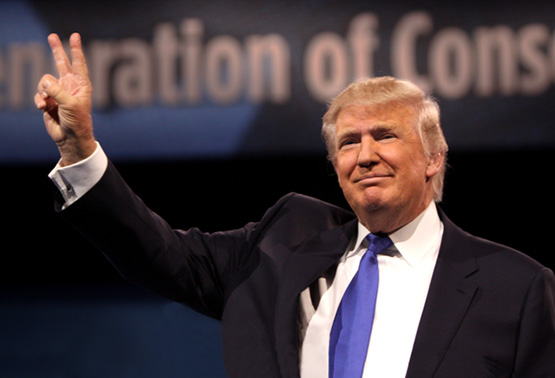
President-elect Donald J. Trump donaldjtrump.com
For the government of British Prime Minister Theresa May, nothing could have sounded sweeter than Donald Trump’s statement that she would be invited for talks in the White House shortly after he is sworn in on Jan. 20 and that he seeks very quickly to reach agreement on a bilateral free trade pact. The effect of the pledge itself, even ahead of its successful implementation, assures the British that the sting of severing ties with the European Union will be greatly offset by new commercial possibilities in the world’s biggest economy; in this way, it strengthens May’s hand enormously as she enters into talks with the E.U. leadership over the detailed terms of what will apparently be a “Hard Brexit.”
Further adding to her leverage with the E.U. were Trump’s remarks suggesting that the E.U. will face stern trade pressure, beginning with Germany and its automobile industry, to do more to manufacture in the U.S. That precisely raises the relative importance of the U.K. market, which the E.U. will otherwise lose if it imposes severe penalties on Britain in negotiations over Brexit.
For the general public’s consumption, Donald Trump used the interview to explain his special affection for Britain, speaking about his Scottish mother’s delight in the Queen and her watching every royal event on television for its unequaled pageantry. But we may expect that Prime Minister May will find there is a bill to pay for the “special relationship” with the U.S. under President Trump.
Rather than the British media’s early speculation that Prime Minister May would be the one to set the misguided Trump straight about the nefarious Vladimir Putin, she may now have to become a leading European advocate for détente with Russia at Trump’s behest. In this connection, British Foreign Minister Boris Johnson’s advice to Congress during his visit to Washington last week that Official Washington “stop demonizing Putin” may well have been a straw in the wind.
For the Germans, Trump also offered a bit of flattery, saying how much he respected their Chancellor Angela Merkel. However, as he went on, he virtually flattened the Iron Lady’s reputation by calling her open-door policy of admitting migrants into Germany and the E.U. a catastrophe. He noted that Merkel’s controversial position had swayed the election results in Britain on Brexit and may lead to the departure of other countries from the E.U. Given his staff’s consultation with Marine Le Pen, a visiting French candidate for the presidency from the right-wing Front National, Trump’s list surely includes France.
Finally, among the sound bites that will be featured in media coverage of the interview, we hear Donald Trump describe NATO as an outdated organization that needs overhaul. However, apart from his reiterated insistence that Member States must pay their fair share, which he claims only Britain and four others from the 28 Member States are currently doing, the interview offers no specifics on what kind structural change, if any, he seeks for NATO. We only hear that NATO has not been prepared to deal with the threat of international terrorism.
Views on Russia
But it was in another area, Trump’s remarks on Russia and the terms he named for possibly lifting sanctions, that we find convincing proof that the President-elect’s approach to foreign affairs is not just the sum of isolated tactical considerations but a complete reinvention of the guiding principles of U.S. foreign policy. What we are witnessing is a shift to a new strategic, geopolitical paradigm.
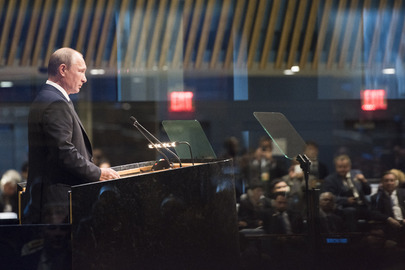
Russian President Vladimir Putin (UN Photo)
In the past couple of decades, going back to the second term of President Bill Clinton, the ideology of neoconservatism with its stress on “democracy promotion” as being the whole of national interest, dictated policy decisions that amounted to the tail wagging the dog. The Baltic States were admitted into NATO in its 2004 enlargement because they wanted it. The decision to station U.S., German and other NATO brigades in Poland and other states along the Russian border taken last July in Warsaw and implemented, in the case of Poland, by U.S. forces in the past several days, was justified by the anxiety of these countries over the possibility of Russian aggression, even though NATO’s action has been highly provocative vis-à-vis Russia and brought the major nuclear powers ever closer to direct confrontation.
In the interview, Trump changed entirely the metrics by which sanctions on Russia would be lifted. Instead of fulfillment of the Minsk Accords over Ukraine’s ethnic Russian Donbas region – which nationalist hardliners in Kiev had the power to block – Trump conditioned the relaxation of sanctions on progress in curbing the nuclear arms race and moving toward significant nuclear disarmament, issues that are fully within the power of the Kremlin to implement.
To be sure, these issues today are more complex than they were in the heyday of disarmament talks. The recent obstacles include the U.S. anti-ballistic missile installations in Poland and Romania, the forward stationing of NATO human and materiel resources in the former Warsaw Pact countries, and the standing invitations to Ukraine and Georgia to enter NATO. So any negotiations between Washington and Moscow will be very complex.
But Trump’s statement shows that he is focused on the big picture, on the triangular relationship between Washington, Moscow and Beijing that he believes to be of vital importance in keeping the peace globally, rather than on some amorphous reliance on expanding democracy globally on the unproven assumption that democracies among themselves are peace-loving.
These elements in Donald Trump’s thinking, quite unexpected in a businessman, bring him very close to the Realism of Richard Nixon and Henry Kissinger, while his setting nuclear disarmament as a key goal, aligns him with Ronald Reagan and — strange to say — with Barack Obama at the very start of his presidency.
If Donald Trump can stave off the jackals from the Western mainstream media and the U.S. foreign policy establishment – a combination that has formed a snarling circle around him even before he takes office – he may have a chance to make historic changes in international relations toward a more peaceful world.
Gilbert Doctorow is the European Coordinator of The American Committee for East West Accord Ltd. His latest book, Does Russia Have a Future? was published in August 2015.
Is Politically Correct or Jingoistic Reporting Fake News?
Americans need to learn what is really going on both at home and abroad
By Philip Giraldi • Unz Review • January 17, 2017
When the Washington Post reports about violent crime online or in its print Metro Section it generally does not include descriptions of the alleged perpetrator even when that individual is still on the loose and continuing to pose a threat to the general public. This omission is conspicuous, particularly when the story itself makes it very clear that the presumed victim got a very good look at his or her assailant and would be able to provide a detailed physical description together with an account of what the attacker was wearing. One might even suggest that the Post is doing the general public no favor when it censors its account, making anyone who might cross the path of the miscreant more vulnerable to also becoming a victim.
The Post edits its coverage because it clearly does not want to associate violent crime with any particular race even though, as every Washingtonian knows full well, nearly all violent crime in the city is carried out by young black males. Rather than providing a public service by identifying the perpetrator the Post chooses to say nothing to avoid having to identify the assailant as black. But the reader, aware of that reticence, consequently automatically assumes that the perpetrator is black anyway, making the paper’s attempt to avoid any identification of criminals by race instead create the presumption in the reader’s mind that every single one of the violent acts that occur in the District of Columbia is done by people of color. What is intended to shield blacks hardly does them any favors, quite the contrary.
Partially reporting straightforward stories for politically correct reasons is in my mind equivalent to the fake news that everyone has been lamenting. The general perception that the news is slanted or manipulated has fed the lack of trust in the veracity of what is being reported and is a major contributor to the decline in newspaper readership. The Post, which also recently featured largely phony major stories about alternative news sites being tools of Russia as well as a wildly inflated tale about Russian hacking a utility in Vermont, is particularly much given to making up its coverage as it goes along. Every page in the news section is in reality an editorial as the paper assiduously mixes fact with fiction together with a heavy dose of opinion. It is Orwellian newspeak at its finest.
Inured to the Post’s p.c. coverage of racial issues, I was nevertheless shocked by some of the recent reporting on an incident in Chicago in which four teenagers videoed themselves and broadcast what they were doing live on Facebook as they beat a mentally impaired man. An early media account of the incident appeared on Reuters but is no longer available. It was written by Timothy McLaughlin and had, as its second paragraph, “At least one of the attackers on the video mentioned president elect Donald Trump as he taunted the man but police stopped short of calling the beating politically motivated and said they are still investigating.”
From that, I assumed that the journalist was implying that the attackers were Trump supporters since there has been so much reporting lately of incidents at schools where white bullies allegedly cite Trump as they torment their black or brown classmates. Many of those stories would themselves appear to be extremely improbable fake news since the schools in question frequently appear to have highly vulnerable white minorities in the student bodies, but white-on-black violence is not intrinsically unthinkable so the story appeared to be at least credible.
But reading on, the article seemingly reluctantly produced some additional information. The victim, who was tied, gagged and beaten, “appeared to be white” while one of the assailants “appeared to be African-American” and was heard making comments about “white people.” The story did not link to the Facebook video, but BBC, among other sites, showed the video and was unambiguous in its labelling the four assailants as black and the victim as white, which anyone viewing the recording would have clearly appreciated. Subsequent news stories made clear that the expressions that were being shouted by the attackers included “F**k Trump” and “F**k white people.” The victim was reportedly beaten for six hours, cursed at, cut and otherwise abused. The live broadcast of the beating went viral before Facebook deleted it.
The media and Chicago police both struggled with whether or not the abduction and beating constituted a hate crime. In fact, they seemed eager to mitigate and even explain the impact of what everyone who watched the video could clearly see. One cop explained “Kids make stupid mistakes, I shouldn’t call them kids, they are legally adults, but they are young adults and the make stupid decisions… That certainly will be part of whether or not we seek a hate crime, determine whether or not this is sincere or stupid ranting and raving.” Another cop said “I think part of it is just stupidity. People ranting about something they think might make a headline.”
The New York Times dodged the bullet on what kind of crime it might be by describing it as an attack on disabled people without any racial or political overtones at all. So it was maybe just kids having fun and since it was black on white Wolf Blitzer won’t be flying in tomorrow morning to pontificate on what is wrong with Donald Trump’s America.
From my point of view, quite frankly who cares if the incident is or was motivated by hate as kidnapping and torture should be enough and the designation hate crime is essentially phony anyway. If an assailant hates his victim does that make the brutality worse? If you kill me because you are bored and are looking for something to do should you spend less time in prison than if you do so because you hate me?
Once the story was essentially agreed upon by the media and police, comments posted on the beating universally expressed outrage over what had occurred. Many of those posting their observations were themselves black, some expressing their desire that the perpetrators be imprisoned “forever” for having carried out such a horrific crime.
Reading my way through the comments, it occurred to me that the media and police department’s apparent reticence to report black on white crime with the same horror that it reports white on black serves no one, as it creates the impression that black criminals are somehow being protected or coddled even when it is clear that that is not the case. Decent, law abiding African-Americans, the vast majority, know that the end result of the politically correct news coverage of black crime is to make many white Americans even more suspicious of black behavior. So is it both fake news and highly damaging when the Washington Post and Reuters refuse to report a crime story honestly? It almost certainly is.
I grin daily upon rising when I hear the CBS Morning News proclaiming that it is providing “real news.” Charlie Rose and company are prime examples of America’s enslaved corporate media and wouldn’t know real news if it hit them in the ass. The news team has been leading off each day, for example, with a series of uncritical recaps of the various half-truths being promoted by the White House to indict Donald Trump’s relationship with Moscow, the biggest fake news story currently making the rounds. Professor Michael Brenner of the University of Pittsburgh has called the Russian hack the “most surreal and passionate work of fiction of the 21st century.” In the stories featured in the mainstream media there is a consistent presumption that the United States is somehow the victim and Russia the perpetrator of a horrific crime, meaning that the media has considerable difficulty in dealing with real situations that challenge the Establishment consensus. It finds considering the viewpoints of other countries objectively as problematical as it does in dealing with the issue of black crime.
What Russia’s crime consisted of, by the most damaging interpretation, was hacking into a private server belonging to a political party and possibly allowing the admittedly factual but embarrassing material obtained to make its way into the media. Excuse me, but that is what intelligence agencies do routinely to justify their multiple billion dollar budgets. The United States is the world leader in such activity as revealed by Jim Bamford’s books on the subject and also through the revelations obtained in the Snowden papers. Now Russia is being condemned for possibly doing some of the same, though no evidence is being provided, and the story is being framed as if we are by definition the good guys and Vladimir Putin is the devil incarnate.
What I am saying is that the United States mainstream media is the primary source of fake news due to its inbuilt biases on what is acceptable and what is not. It actually hurts black people by its attempts to be protective and its unwillingness to consider a news story through the eyes of the other party for chauvinistic reasons means that Americans are particularly uninformed about what is going on in the world. To suggest that all of this is particularly dangerous, both in terms of domestic tranquility and possible foreign threats, would be an understatement.
NOAA’s Tornado Fraud
By Paul Homewood | Not A Lot Of People Know That | January 15, 2017
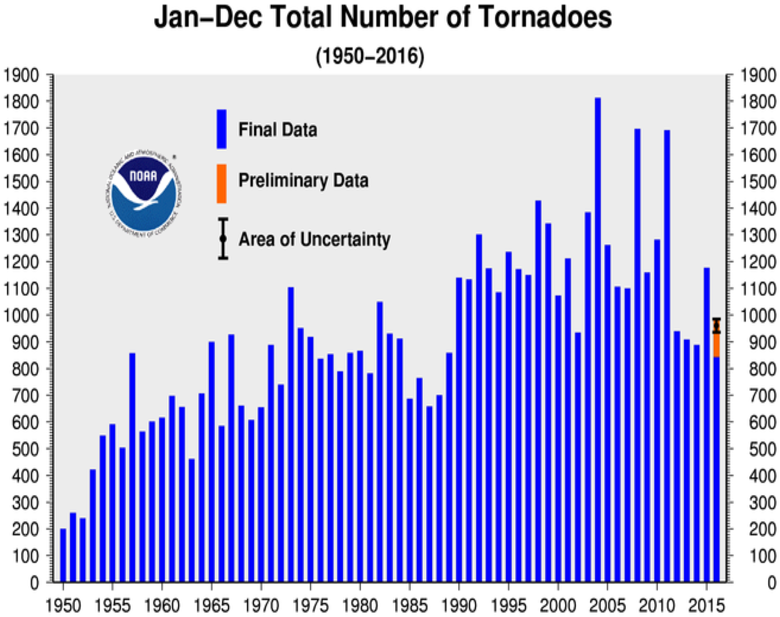
https://www.ncdc.noaa.gov/sotc/tornadoes/201613
According to NOAA, the number of tornadoes has been steadily growing since the 1950s, despite a drop in numbers in the last five years.
They show the above chart prominently in their Tornadoes – Annual 2016 Report.
However, they know full well that it is meaningless to compare current data with the past, as they explain themselves in the section Historical Records and Trends, which is hidden away on their own website:
One of the main difficulties with tornado records is that a tornado, or evidence of a tornado must have been observed. Unlike rainfall or temperature, which may be measured by a fixed instrument, tornadoes are short-lived and very unpredictable. If a tornado occurs in a place with few or no people, it is not likely to be documented. Many significant tornadoes may not make it into the historical record since Tornado Alley was very sparsely populated during the 20th century.
Much early work on tornado climatology in the United States was done by John Park Finley in his book Tornadoes, published in 1887. While some of Finley’s safety guidelines have since been refuted as dangerous practices, the book remains a seminal work in tornado research. The University of Oklahoma created a PDF copy of the book and made it accessible at John Finley’s Tornadoes (link is external).
Today, nearly all of the United States is reasonably well populated, or at least covered by NOAA’s Doppler weather radars. Even if a tornado is not actually observed, modern damage assessments by National Weather Service personnel can discern if a tornado caused the damage, and if so, how strong the tornado may have been. This disparity between tornado records of the past and current records contributes a great deal of uncertainty regarding questions about the long-term behavior or patterns of tornado occurrence. Improved tornado observation practices have led to an increase in the number of reported weaker tornadoes, and in recent years EF-0 tornadoes have become more prevelant in the total number of reported tornadoes. In addition, even today many smaller tornadoes still may go undocumented in places with low populations or inconsistent communication facilities.
With increased National Doppler radar coverage, increasing population, and greater attention to tornado reporting, there has been an increase in the number of tornado reports over the past several decades. This can create a misleading appearance of an increasing trend in tornado frequency. To better understand the variability and trend in tornado frequency in the United States, the total number of EF-1 and stronger, as well as strong to violent tornadoes (EF-3 to EF-5 category on the Enhanced Fujita scale) can be analyzed. These tornadoes would have likely been reported even during the decades before Doppler radar use became widespread and practices resulted in increasing tornado reports. The bar charts below indicate there has been little trend in the frequency of the stronger tornadoes over the past 55 years.


https://www.ncdc.noaa.gov/climate-information/extreme-events/us-tornado-climatology/trends
Of course it is nonsensical to claim that the bar charts below indicate there has been little trend in the frequency of the stronger tornadoes over the past 55 years – there has clearly been a large reduction.
Note as well that they have not even bothered to update the graph for 2015. Could it be they would rather the public did not find out the truth?
Meanwhile, over at the Storm Prediction Center (SPC) you can see that, when allowance is made for changing reporting procedures, last year may well have had the lowest number of tornadoes on record.

http://www.spc.noaa.gov/wcm/#data
The SPC is also part of NOAA, but is the department that actually deals with tornado events and data on a day to day basis. As such, they tend to be more interested in the facts, rather than a political agenda.
While we still await the final numbers and classification for last year, but what we do know is that there was no EF-5. Indeed the last occurrence was the Moore, OK tornado in May 2013.
It is unusual to go nearly four years without one, as there have been 59 since 1953, effectively one a year on average.
The bottom line is that the NOAA headline graph is grossly dishonest. Indeed, if a company published something like that in their Annual Accounts, they would probably end up in jail!
NOAA themselves know all of this full well.
Which raises the question – why are they perpetuating this fraud?
Israeli Forces Seize Tractors in Jordan Valley
IMEMC News & Agencies – January 16, 2017
 Israeli forces stormed the village of Khirbet Abziq, east of Tubas in the northern Jordan Valley, on Monday morning and seized two agricultural tractors while abusing Palestinian citizens.
Witnesses said, according to Al Ray, that Israeli soldiers broke into AL-Madareb, in Khirbet Abziq, and seized two agricultural tractors belonging to Fayez Nghneghya and Nemr Horoub, and took them to a nearby military camp.
They pointed out that seizures have happened repeatedly, in an attempt to harass citizens and force them to leave Khirbet Abziq.
More than two dozen tractors have been confiscated in different areas of the Jordan Valley, over recent months.
It is noteworthy that dozens of citizens living in Khirbet Abziq, mostly refugees from the pre-1948 occupied territories, are being deprived of many basic essential services under Israeli policies. The tractors are used for agriculture and water transference.
Donald Trump v. the Spooks
By Annie Machon | Consortium News | January 16, 2017
The clash between plutocratic President-elect Trump and the CIA is shaping up to be the heavyweight prize fight of the century, and Trump at least is approaching it with all the entertaining bombast of Mohammed Ali at the top of his game. Rather than following the tradition of doing dirty political deals in dark corners, more commonly known as fixing the match, Trump has come out swinging in the full glare of the media.
In that corner, we have a deal-making, billionaire “man of the people” who, to European sensibilities at least, reputedly espouses some of the madder domestic obsessions and yet has seemed to offer hope to many aggrieved Americans. But it is his professed position on building a rapprochement with Russia and cooperating with Moscow to sort out the Syrian mess that caught my attention and that of many other independent commentators internationally.
In the opposite corner, Trump’s opponents have pushed the CIA into the ring to deliver the knock-out blow, but this has yet to land. Despite jab after jab, Trump keeps evading the blows and comes rattling back against all odds. One has to admire the guy’s footwork.
So who are the opponents ranged behind the CIA, yelling encouragement through the ropes? The obvious culprits include the U.S. military-industrial complex, whose corporate bottom line relies on an era of unending war. As justification for extracting billions – even trillions – of dollars from American taxpayers, there was a need for frightening villains, such as Al Qaeda and even more so, the head choppers of ISIS. However, since the Russian intervention in Syria in 2015, those villains no longer packed as scary a punch, so a more enduring villain, like Emmanuel Goldstein, the principal enemy of the state in George Orwell’s 1984, was required. Russia was the obvious new choice, the old favorite from the Cold War playbook.
The Western intelligence agencies have a vested interest in eternal enemies to ensure both eternal funding and eternal power, hence the CIA’s entry into the fight. As former British MP and long-time peace activist George Galloway so eloquently said in a recent interview, an unholy alliance is now being formed between the “war party” in the U.S., the military-industrial-intelligence complex and those who would have previously publicly spurned such accomplices: American progressives and their traditional host, the Democratic Party.
Yet, if the Democratic National Committee had not done its best to rig the primaries in favor of Hillary Clinton, then perhaps we would not be in this position. Bernie Sanders would be the President-elect.
Two-Party Sham
These establishment forces have also revealed to the wider world a fact long known but largely dismissed as conspiracy theory by the corporate mainstream media, that the two-party system in both the U.S. and the U.K. is a sham. In fact, we are governed by a globalized elite, working in its own interest while ignoring ours. The Democrats, openly disgruntled by Hillary Clinton’s election loss and being seen to jump into bed so quickly with the spooks and the warmongers, have laid this reality bare.
In fact, respected U.S. investigative journalist Robert Parry recently wrote that an intelligence contact told him before the election that the intelligence agencies did not like either of the presidential candidates. This may go some way to explaining the FBI’s intervention in the run-up to the election against Hillary Clinton, as well as the CIA’s attempts to de-legitimize Trump’s victory afterwards.
Whether that was indeed the case, the CIA has certainly held back no punches since Trump’s election. First the evidence-lite assertion that it was the Russians who hacked the DNC emails and leaked them to WikiLeaks: then the fake news about Russia hacking the voting computers; that then morphed into the Russians “hacked the election” itself; then they “hacked” into the U.S. electric grid via a Vermont utility. All this without a shred of fact-based evidence provided, but Obama’s expulsion of 35 Russian diplomats last month solidified this dubious reality in Americans’ minds.
All this culminated in the “dirty dossier” allegations last week about Trump, which he has rightly knocked down – it was desperately poor stuff.
This last item, from a British perspective, is particularly concerning. It appears that a Washington dirt-digging company was hired by a Republican rival to Trump to unearth any potential Russian scandals during the primaries; once Trump had won the nomination this dirt-digging operation was taken over by a Democrat supporter of Hillary Clinton. The anti-Trump investigation was then sub-contracted to an alleged ex-British spy, an ex-MI6 man named Christopher Steele.
The Role of MI6
Much has already been written about Steele and the company, much of it contradictory as no doubt befits the life of a former spy. But it is a standard career trajectory for insiders to move on to corporate, mercenary spy companies, and this is what Steele appears to have done successfully in 2009. Of course, much is predicated on maintaining good working relations with your former employers.
That is the aspect that interests me most – how close a linkage did he indeed retain with his former employers after he left MI6 in 2009 to set up his own private spy company? The answer is important because companies such as his can also be used as cut-outs for “plausible deniability” by official state spies.
I’m not suggesting that happened in this case, but Steele reportedly remained on good terms with MI6 and was well thought of. For a man who had not been stationed in Russia for over 20 years, it would perhaps have been natural for him to turn to old chums for useful connections.
But this question is of extreme importance at a critical juncture for the U.K.; if indeed MI6 was complicit or even aware of this dirt digging, as it seems to have been, then that is a huge diplomatic problem for the government’s attempts to develop a strong working relationship with the US, post-Brexit. If MI6’s sticky fingers were on this case, then the organization has done the precise opposite of its official task – “to protect national security and the economic well-being of the UK.”
MI6 and its U.S. intelligence chums need to remember their designated and legislated roles within a democracy – to serve the government and protect national security by gathering intelligence, assessing it impartially and making recommendations on which the government of the day will choose to act or not as the case may be.
The spies are not there to fake intelligence to suit the agenda of a particular regime, as happened in the run-up to the illegal Iraq War, nor are they there to endemically spy on their own populations (and the rest of the world, as we know post-Snowden) in a pointless hunt for subversive activity, which often translates into legitimate political activism and acts of individual expression).
And most especially the intelligence agencies should not be trying to subvert democratically elected governments. And yet this is what the CIA and a former senior MI6 officer, along with their powerful political allies, appear to be now attempting against Trump.
Chances for Peace
If I were an American, I would be wary of many of Trump’s domestic policies. As a European concerned with greater peace rather than increasing war, I can only applaud his constructive approach towards Russia and his offer to cooperate with Moscow to stanch the bloodshed in the Middle East.
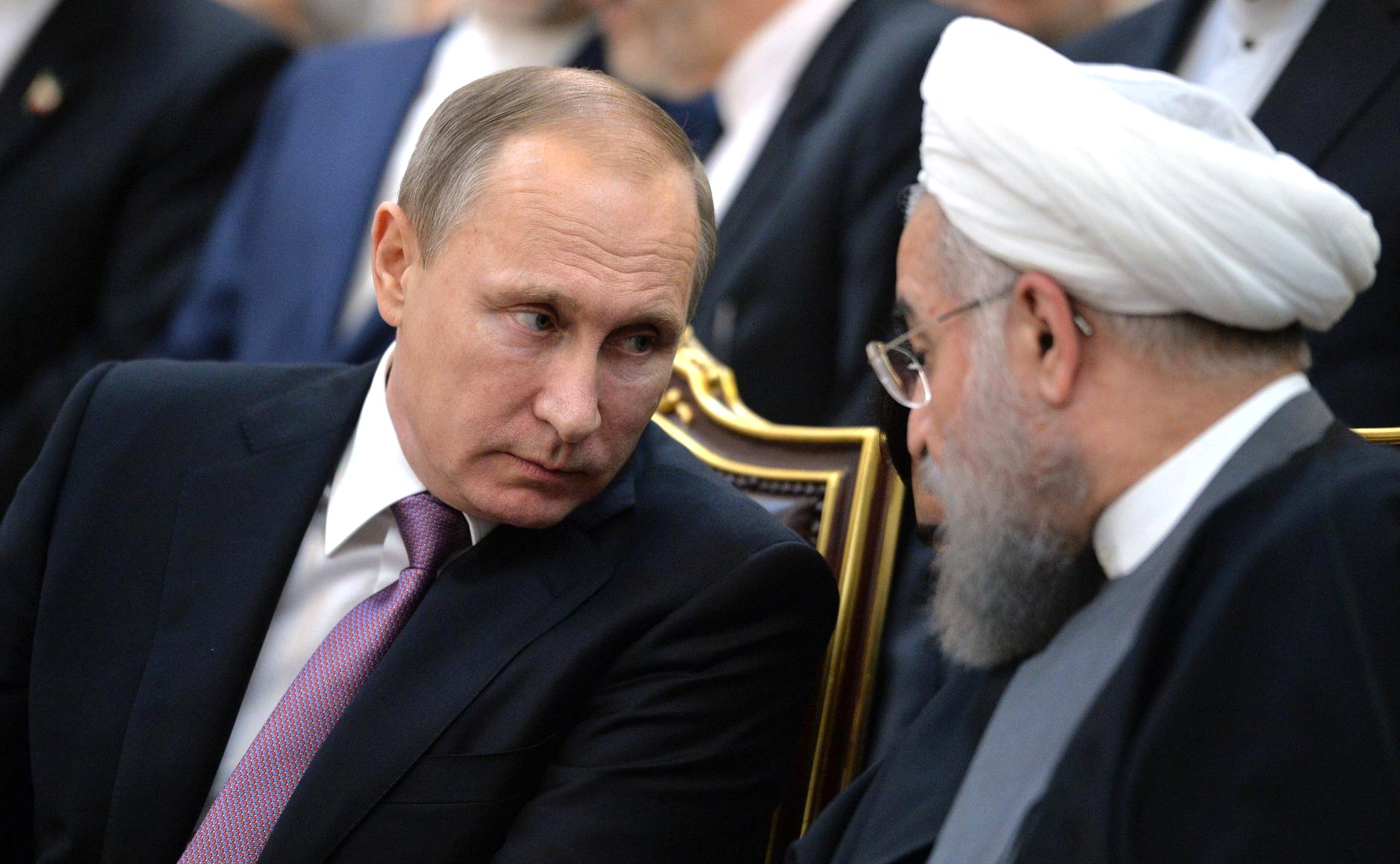
(Photo Nov. 23, 2015 Tehran: http://en.kremlin.ru)
That, of course, may be the nub of his fight with the CIA and other vested interests who want Russia as the new bogeyman. But I would bet that Trump takes the CIA’s slurs personally. After all, given the ugliness of the accusations and the lack of proof, who would not?
So, this is a world championship heavy-weight fight over who gets to hold office and wield power, an area where the U.S. and U.K. intelligence agencies have considerable experience in rigging matches and knocking out opponents. Think, for instance, Iranian Prime Minister Mohammad Mossadeq in 1953; Chilean President Salvador Allende in 1973; Iraqi leader Saddam Hussein in 2003; and Libyan leader Muammar Gaddafi in 2011. Syrian President Bashar al-Assad is wobbly but still standing, thanks to some good corner support from Russia.
However, it would appear that Trump is a stranger to the spies’ self-defined Queensbury Rules in which targets are deemed paranoid if they try to alert the public to the planned “regime change” or they become easy targets by staying silent. By contrast, Trump appears shameless and pugnacious. Street-smart and self-promoting, he seems comfortable with bare-knuckle fighting.
This match has already gone into the middle rounds with Trump still bouncing around on his toes and still relishing the fight. It would be ironic if out of this nasty prize fight came greater world peace and safely for us all.
Annie Machon is a former intelligence officer in the UK’s MI5 Security Service (the U.S. counterpart is the FBI).
Featured Video
The Source of America’s Wars – Kristol Clear
or go to
Aletho News Archives – Video-Images
From the Archives
Is Israel to blame for the Iraq War?
American Goy | March 10, 2008
I am so tired of this old canard that “Israel had nothing to do with USA’s war with Iraq – in fact, it officially advised America against it”.
Bullshit. … continue
Blog Roll
 Aletho News
- Ceasefire for all or for none: Iran shuts Hormuz over Lebanon attacks
- Strait of Hormuz is Iran’s ‘nuclear weapon’ that forced US retreat: Medvedev
- Energy crisis will last for months – Kremlin envoy
- Europe’s quiet role in the war on Iran
- Forty days that shook the Empire: How Iran turned the tables on US and prevailed
- Netanyahu unilaterally declares Lebanon outside of ceasefire deal
- Israeli leaders: ‘Not a single goal’ achieved in war with Iran
- What on earth just happened? Trump, Iran, and the unlikely ceasefire
- Alberta Bill Would Fine Political Deepfakes $10,000 Without Satire Exemptions
- Iran declares ‘historic victory’ over US, says enemy forced to accept its proposal
- If Americans Knew
- NY Times reports how Netanyahu took the US into Iran War
- A sigh of relief over Iran, but Gaza and Lebanon in dire straits – Daily Update
- Thousands dead and neighborhoods razed to the ground: Aid agencies fear southern Lebanon is becoming the new Gaza
- The war the US is fighting for Israel could cost trillions
- ‘Cigarette Burns, Nail Wounds’: Toddler Tortured in Gaza to Coerce Father
- Trump Says US Sent ‘a Lot of Guns’ to Protesters in Iran
- Israeli forces destroy 17 UN peacekeeper cameras in south Lebanon
- US-Israeli strikes ‘completely destroy’ synagogue in Tehran
- Archbishop for US Military Says Iran War Is Unjust Under Catholic Teaching
- Iranian leaders’ Open Letters to the American People
- No Tricks Zone
- An Inconvenient Tree: Uncovered In Alps… Europe Much Warmer Than Today 6000 Years Ago
- New Study Reports A 60% Slowdown In Greenland’s Ice Loss Rate In The Last Decade
- Low Intensity Tornado Wrecks Major Solar Farm, Creating A Potential Toxic Dump
- New Study Finds Warming Saves Lives…Cold Temperatures 12 Times More Deadly Than Excess Heat
- German Science Blog Accuses PIK Climate Institute Of Hallucinating Climate Tipping Points
- Devastating Assessment Of Comirnaty Vaccine By Former Senior Pfizer Europe Toxicologist
- New Study: CO2 Is ‘Effectively Negligible’ As An Explanatory Climate Change Factor Since 2000
- Former Pfizer Toxicologist Dr. Helmut Sterz Tells Bundestag Hearing Pfizer Vaccine Should Have Never Been Approved
- Energy Expert: Germany’s Nuclear Phaseout Was A “500 Billion Euro Mistake”
- New Research: South Australia’s Mid-Holocene Sea Surface Temperatures Were 4°C Warmer Than Today
 Aletho News
