Mainstream British Press Propaganda Ramps Up Dangerous War Rhetoric
By Graham Vanbergen | TruePublica | January 18, 2017
The British press are in full hysteria propaganda mode when it comes to demonising our new greatest threat on planet earth; not climate change, a global pandemic, international terrorism, or America’s new foe in the South China Sea – but Russia.
The Telegraph 31/12/16: “Systemic, relentless, predatory’ Russian cyber threat to US power grid exposed as malware found on major electricity company computer.”
The Independent 13/12/16: “Highly probable Russian interfered with Brexit referendum.”
The Express 15/01/17: “Russians forcing RAF to abort missions in Syria by ‘hacking into’ their systems”
The Guardian 14/01/17: “Senior British politicians ‘targeted by Kremlin’ for smear campaigns”
In all of these newspaper reports, and there are plenty more of them, not a single scrap of actual evidence other than hearsay is published. In the case of the Express story, it’s allegations are backed up with the statement “It is entirely feasible that Russia has targeted Tornadoes and Typhoons in this way,” said air defence expert Justin Bronk, of the Royal United Services Institute think-tank.” This is not evidence.
In the case of the Telegraph, this fairy-tail has been 100% debunked as pure propaganda and the original report from the Washington Post ended with a full-on apology by its editor. The Telegraph has printed no such amendment or apology for its totally fictitious article.
The Guardian’s headline is pure misinformation as it’s sole point of evidence is an MP (Chris Bryant), explaining that incumbent Foreign Office ministers could not speak out on the (Russian hacking) issue because of security connotations, and said: “Any minister who goes into the Foreign Office and has responsibility for Russia, they [Moscow] will be, in any shape or form, trying to put together information about them.” As if to strengthen the ‘evidence’, Bryant says he is “absolutely certain that Boris Johnson, Liam Fox, Alan Duncan who has the Russia brief, and [Brexit secretary] David Davis will have been absolutely looked at.” This is not evidence.
The funny thing is this; the story may be true and quite probably is, but so what.
In October 2015, Britain’s own spy agency confirmed it was spying on Britain’s MP’s and at the time was given court immunity when challenged. It determined that MPs’ communications were not protected from surveillance by intelligence agencies. This case came about because Green Party MP Caroline Lucas, Baroness Jenny Jones and former MP George Galloway, [observed] that revelations from Edward Snowden, showed MPs’ communications were being spied on by GCHQ despite laws protecting them.
Around the same time we learn that a well known paedophile ran a lodge set up by GCHQ for its spies to monitor important political ‘targets’ ie our own MP’s and other public figures.
Back in 1983 Margaret Thatcher used Britain’s latest and most advanced surveillance system named ‘Echelon’ (Read: ECHELON – The Start of Britain’s Modern Day Spying Operations) to Spy on Government Ministers’. It was an American design and the first major state surveillance system using satellite and IT systems to spy worldwide. Indeed Echelon was originally created in the 1960s to monitor the military and diplomatic communications of the Soviet Union and its Eastern Bloc allies throughout the Cold War by Britain and America. All of this data being shared with America, a foreign government.
America’s NSA monitored the phone conversations of 35 world leaders in another Snowden leak three years ago. Germany’s Spiegel reported in 2014 that “Documents show Britain’s GCHQ signals intelligence agency has targeted European, German and Israeli politicians for surveillance.” So distrustful of the British that Chancellor Merkel announced a counter-espionage offensive designed to curb mass surveillance conducted by the US NSA and its British counterpart, GCHQ. Today it is reported by IntelNews that the “discord between British and German intelligence services, which began at the same time in 2014, allegedly persists and now constitutes the “biggest rift between the secret services” of the two countries “since World War II”.
Just six months ago we found out that “GCHQ and NSA routinely spy on UK politicians’ e-mails” that included privileged correspondence between parliamentarians and their constituents and before that, internal MI5, MI6 and GCHQ documents reveal routine interception of legally privileged communications. The information obtained was exploited unlawfully to be used by the agencies in the fighting of court cases in which they themselves were involved.
Amazingly, we recently find out just last week that Israeli embassy staff, quite likely Mossad operatives – “are working with senior political activists and politicians in the Conservative and Labour parties to subvert their own parties from within, and skew British foreign policy so that it benefits Israeli, rather than British interests.” And yet, there has been little comment in the British press about foreign infiltration of government minsters by Israel.
If Russia were not spying on our MP’s, they would be the only ones not at it. No-one trusts anyone. Spying is old news and fully expected. We are ALL being spied on nowadays.
The British press are complicit in their reckless rhetoric designed to instill fear into the population with dangerous propaganda that could easily lead to tensions becoming so dangerous that a real ‘hot war’ starts. Whilst America is shielded by continental Europe and the Atlantic ocean, Britain could be used as a pawn to be sacrificed on the international chess-game of winner-takes-all. We have no ‘special-relationship’, there never has been one, and an irresponsible press being a mouthpiece that ramps up the stress between the US/NATO and Russia is absolutely against the interests and national security of Britain.
As Laurence Krauss’s (chair of the board of sponsors of The Bulletin of the Atomic Scientists, and is on the board of the Federation of American Scientists) article last October alarmingly points out – “Trump has said he would consider using nuclear weapons against ISIS and suggested that it would be good for the world if Japan, South Korea, and Saudi Arabia acquired them.” Trump could be one seriously dangerous individual for world peace – who knows!
So much for Trump but as Krauss goes on to say that “In general, during the Obama presidency, we have only deepened our dangerous embrace of nuclear weapons. At the moment, around a thousand nuclear weapons are still on a hair-trigger alert; as they were during the Cold War, they are ready to be launched in minutes in response to a warning of imminent attack.”
Who in their right mind would support this lunacy?
Nuclear cover-up: Failure of Trident ballistic missile test near US coast – report
RT | January 22, 2017
A Trident missile fired last year from a Royal Navy nuclear submarine off the Florida coast malfunctioned and headed to the mainland during a routine test, but Whitehall ordered a news blackout to avoid “severe panic,” the Sunday Times reported.
The Trident ballistic missile was set to be tested for the first time in four years by the HMS Vengeance last June off the Florida coast, according to the Sunday Times.
Vengeance, the fourth and final Vanguard-class nuclear-capable submarine of the Royal Navy, had undergone a refit in Devonport dockyard before heading out for a firing test to verify if the ship and her crew were ready for active service.
In June last year, the submarine docked at Port Canaveral in Florida, the US base employed by the Royal Navy for final checks, before launching an unarmed Trident missile into the so-called “Eastern firing range” off the west coast of Africa.
There have only been five firing tests by UK Vanguard-class submarines in the 21st century, the Sunday Times wrote, and the launches are usually big occasions for the Royal Navy, as the missiles cost 17 million pounds ($21 million) apiece.
No news reports followed the test, however, and no usual “successful test flight” announcement was made at that time.
A navy source told the newspaper that “something went wrong” after the Trident was fired from the submerged submarine. Details of the failure were not officially disclosed, but the source believes the missile might have veered off in the wrong direction toward the American mainland instead of heading across the Atlantic.
“There was severe panic that this test launch was not successful. Senior figures in military and government were keen that the information was not made public,” the source said. A malfunction of the ballistic missile – deemed the backbone of British strategic deterrent – could lead to terrifying casualties. It could also raise questions about the reliability of the Royal Navy’s nuclear arsenals.
“Ultimately, Downing Street decided to cover up the failed test,” the source added. “If the information was made public, they knew how damaging it would be to the credibility of our nuclear deterrent. The upcoming Trident vote made it all the more sensitive.”
UK Prime Minister Theresa May avoided any mention of the failed test to ensure that MPs approve spending of 40 billion pounds on new Trident submarines, in her first major speech before last July. Notably, more than 100 MPs voted against the proposal, including members of Scottish National Party (SNP) and the Labour Party, who argued that the money spent on nuclear arms could have been put to better use.
On Sunday, talking to the BBC, May again refused to say whether she knew about the reported failure or not. She said she had “absolute confidence” in the country’s nuclear deterrence system, but avoided giving a direct reply when asked to comment on The Times report.
The British government has not officially confirmed the newspaper’s report on the misfire, but The Times quoted the ministry of defense as saying that Vengeance “conducted a routine unarmed Trident missile test launch,” and that the submarine and her crew “were successfully tested and certified.” It declined to elaborate on the causes of the malfunction “for obvious national security reasons.”
Lockheed Martin, the Trident manufacturer, did not comment on the issue either.
In 2015, William McNeilly, a former Navy weapons engineer who allegedly served aboard the HMS Victorious, claimed that a number of security lapses and technical issues with the Trident-armed submarines exposed the UK nuclear deterrent to potential terrorist attacks.
According to open sources, Vanguard-class submarines carry 200 nuclear warheads as well as so-called ‘letters of last resort’ of the British prime minister that are to be used in the event of a national disaster or an incapacitating nuclear strike. Stored inside safes in the control room of each submarine, the letters are believed to include the orders: “Put yourself under the command of the US, if it is still there”; “Go to Australia”; “Retaliate”; or “Use your own judgment,” according to the Guardian.
Labour MP Kevan Jones, who is calling for an inquiry into the report with Defence Secretary Michael Fallon, is expected to be called to the House of Commons.
“The UK’s independent nuclear deterrent is a vital cornerstone for the nation’s defence,” Kevan said.
“If there are problems, they should not have been covered up in this ham-fisted way. Ministers should come clean if there are problems and there should be an urgent inquiry into what happened.
France’s Self-Inflicted Refugee Crisis
By Ulson Gunnar – New Eastern Outlook – 22.01.2017
Following rhetoric regarding Europe’s refugee crisis, one might assume the refugees, through no fault of Europe’s governments, suddenly began appearing by the thousands at Europe’s borders. However, this simply is not true.
Before the 2011 wave of US-European engineered uprisings across the Middle East and North Africa (MENA) transformed into Western military interventions, geopolitical analysts warned that overthrowing the governments in nations like Libya and Syria, and Western interventions in nations like Mali and the Ivory Coast, would lead to predicable regional chaos that would manifest itself in both expanding terrorism across the European and MENA region, as well as a flood of refugees from destabilized, war-racked nations.
Libya in particular, was singled out as a nation, if destabilized, that would transform into a springboard for refugees not only fleeing chaos in Libya itself, but fleeing a variety of socioeconomic and military threats across the continent. Libya has served for decades as a safe haven for African refugees due to its relative stability and economic prosperity as well as the Libyan government’s policy of accepting and integrating African refugees within the Libyan population.
Because of NATO’s 2011 military intervention and the disintegration of Libya as a functioning nation state, refugees who would have otherwise settled in Libya are now left with no choice but to continue onward to Europe.
For France in particular, its politics have gravitated around what is essentially a false debate between those welcoming refugees and those opposed to their presence.
Absent from this false debate is any talk of French culpability for its military operations abroad which, along with the actions of the US and other NATO members, directly resulted in the current European refugee crisis.
France claims that its presence across Africa aims at fighting Al Qaeda. According to RAND Corporation commentary titled, “Mali’s Persistent Jihadist Problem,” it’s reported that:
Four years ago, French forces intervened in Mali, successfully averting an al Qaeda-backed thrust toward the capital of Bamako. The French operation went a long way toward reducing the threat that multiple jihadist groups posed to this West Africa nation. The situation in Mali today remains tenuous, however, and the last 18 months have seen a gradual erosion of France’s impressive, initial gains.
And of course, a French military presence in Mali will do nothing to stem Al Qaeda’s activities if the source of Al Qaeda’s weapons and financial support is not addressed. In order to do this, France and its American and European allies would need to isolate and impose serious sanctions on Saudi Arabia and Qatar, two nations which exist as the premier state sponsors of not only Al Qaeda, but a myriad of terrorist organizations sowing chaos worldwide.
Paradoxically, instead of seeking such sanctions, the French government instead sells the Saudi and Qatari governments billions of dollars worth of weaponry, proudly filling in any temporary gaps in the flow of weapons from the West as each nation attempts to posture as “concerned” about Saudi and Qatari human rights abuses and war crimes (and perhaps even state sponsorship of terrorism) only to gradually return to pre-sanction levels after public attention wanes.
The National Interest in an article titled, “France: Saudi Arabia’s New Arms Dealer,” would note:
France has waged a robust diplomatic engagement with Saudi Arabia for years. In June, Saudi Deputy Crown Prince Mohammed bin Salman visited France to sign deals worth $12 billion, which included $500 million for 23 Airbus H145 helicopters. Saudi and French officials also agreed to pursue feasibility studies to build two nuclear reactors in the kingdom. The remaining money will involve direct investment negotiated between Saudi and French officials.
The article would also note that Saudi Arabia’s junior partner in the state sponsorship of global terror, Qatar, would also benefit from French weapon deals:
Hollande’s address was delivered one day after he was in Doha, where he signed a $7 billion deal that included the sale of 24 French Rafale fighter jets to Qatar, along with the training of Qatari intelligence officers.
In order to truly fight terrorism, a nation must deal with it at its very source. Since France is not only ignoring the source of Al Qaeda’s military, financial and political strength, but is regularly bolstering it with billions in weapons deals, it is safe to say that whatever reason France is involved across MENA, it is not to “defeat” Al Qaeda.
The refugee crisis that has resulted from the chaos that both Western forces and terrorists funded and armed by the West’s closest regional allies, Saudi Arabia and Qatar, is a crisis that is entirely self-inflicted. The rhetoric surrounding the crisis, on both sides, ignoring this fundamental reality, exposes the manufactured and manipulative nature of French government and opposition agendas.
The chaos across MENA is so significant, and terrorism so deeply rooted in both Western and their Arab allies’ geopolitical equations that even a complete reversal of this destructive policy will leave years if not decades of social unrest in the wake of the current refugee crisis.
But for anyone genuinely committed to solving this ongoing crisis, they must start with the US, European, and Gulf monarchies’ culpability, and resist blaming the refugees or those manipulated into reacting negatively to them. While abuses carried out by refugees or locals are equally intolerable, those responsible for the conflicts and for manipulating both sides of this crisis are equally to blame.
Until that blame is properly and proportionately placed, and the root of the crisis addressed, it will only linger and cause further damage to regional and global security.
CIA Tries to ‘Edit the Past’ With Release of Declassified Documents on Internet
Sputnik | January 21, 2017
There is more to the CIA’s online release of unclassified documents than meets the eye, security expert Dmitry Efimov told Sputnik.
On Wednesday the CIA published roughly 930,000 documents online, totaling more than 1 million pages, which had previously only been accessible on computers at the National Archives in Maryland.The database, which is searchable via the CIA Records Search Tool (CREST), contains information from the 1940s to the 1990s, including reports from the Korean War and the Vietnam War.
The CIA had planned to publish the documents at the end of 2017, but finished the work ahead of schedule. The agency began the project following a Freedom of Information Act injunction launched in 2014 by Muckrock, a non-profit news organization.
“Access to this historically significant collection is no longer limited by geography. The American public can access these documents from the comfort of their homes,” Joseph Lambert, CIA Director of Information Management, said.
However, not everybody is convinced that the documents in the CREST database are genuine. Security expert Dmitry Efimov, a member of Moscow Council’s Advisory Committee on Security, told Radio Sputnik that he suspects many of the files are fakes.
“I think this was published on the personal orders of CIA Director Brennan, a famous neocon who is leaving along with Obama and who is probably using this opportunity to create a new stream of misinformation,” Efimov said.
“Particularly since there is no such thing as the whole truth, there is the truth which is present in the CIA’s real documents, which of course exist, but I think that a lot of work has been done to falsify a huge number of documents in this batch and change the relationship to the Vietnam War, for example.”
Commenting on the release, CIA spokesperson Heather Fritz Horniak insisted that the documents, which appear redacted, are genuine and were not released on a selective basis.
“None of this is cherry-picked,” Horniak said.
“It’s the full history. It’s good and bads.”
However, Efimov claims that the release is an attempt by the CIA to rewrite history in order to assist its political ambitions.
“The main objective of the US is the spread of liberal American democracy around the world despite the objections of the receiving country. It is in this respect that history will change, there will be new documents which don’t have sources. But the presence of a large number of hidden sources in certain documents on a specific topic says that here (in the declassified CIA documents) someone has edited the past very well.”
Among CREST’s revelations is that the CIA carried out research on topics like UFO’s, telepathy and psychic phenomena. For example, the Stargate Project, which ran from 1978 to 1995 and was intended to investigate psychic phenomena, even interviewed Israeli celebrity psychic Uri Geller in the 1980s to see if his supposed paranormal abilities could be of use in military and domestic intelligence applications.This kind of disclosure is a way to distract attention from political topics, Efimov said.
“Disclosure of the ‘Stargate’ CIA program is a wonderful theme, a great way to divert the consciousness of American society away from real problems. Just imagine how you can use that topic on CNN, in order to bring it to the attention of all American housewives. I don’t exclude the possibility that some more fine papers will appear, some kind of reports about something, which predicted something, we will get the names of some new American prophets. That is, the construction of a mythical American history that will distract the attention of Americans,” Efimov said.
Economist can’t handle the facts (about RT)
RT | January 21, 2017
Most economists are good with numbers. It is, after all, a prerequisite skill for the profession. Thus, it’s somewhat ironic that a publication called The Economist would be so inept with figures.
However, it’s likely the numerical errors in their latest RT demolition piece are more the result of a determination to prove a desired point rather than it being down to an actual mathematical deficiency amongst staff.
To bring you up to speed, just a few days ago, a reporter from the Economist reached out to the RT press office with a few questions. This of course is very much in line with basic journalistic practices of fact-checking and due diligence. Answers were readily provided, in good faith.
However, of all the – independently verifiable – facts and figures provided by RT to the journalist, not a single one, nor even a fragment of a comment, was actually included in the article that appeared in today’s issue of the magazine.
Instead, the Economist writes that “RT has a clever way with numbers. Its ““audience” of 550m refers to the number of people who can access its channel, not those who actually watch it. RT has never released the latter figure…”
First of all, can we please pause and reflect for a minute on the sheer inanity of passing off a 5-year-old report as something reflecting the current state of affairs, including audience? Particularly in the world of media, where revolutionary changes take place in a much shorter time span.
Anyhow, while we’d love to take credit for our cunning practices in this regard, we don’t need to, because we have facts on our side. And the fact is, very clearly stated on RT’s “About” page, in plain English, the network’s TV channels are “available to 700 million people.”“AVAILABLE.” It’s been up there for years.
Also, contrary to the Economist’s claim, RT has repeatedly provided exact figures for its actual TV audience. According to a November 2015 report from Ipsos – a leading audience research firm – which conducted a survey of TV news consumption in 38 countries, 70 million people watch RT TV channels every week.
Of that number, 36 million people watch RT weekly in 10 European countries, and is among the top 5 pan-regional news channels. RT is also among the top-5 most watched international TV news channels in the US, with a viewership of 8 million per week. These aren’t numbers that RT dreamed up, but the results of an independent study by a top-3 global market research company. Contact information for verification is also readily available.
As a matter of fact, RT provided this exact data to the Economist ! Not that the Economist would bother admitting this, because they wouldn’t want the facts to get in a way of their RT story. It’s much easier to lie about RT “never releasing the latter figure.”
Perhaps they’re really are ignorant about the world of audience research and ratings, because they follow up the aforementioned fake with the following: “a 2015 survey of the top 94 cable channels in America by Nielsen, a research firm, found that RT did not even make it into the rankings.” Here’s Nielsen 101: you have to pay to play. Or rather, you have to pay to be measured and included in the Nielsen rankings. RT chooses not to. So using the above statement to make a point about RT’s US audience makes as much sense as walking into a vegetarian shop, not finding any beefsteaks, and concluding that all the cows have gone extinct.
What about RT’s success on YouTube? Well, the Economist says not to worry about RT’s 4+ BILLION views (#1 among TV news networks) on YouTube because on the platform, RT “inflates its viewership with YouTube disaster videos.”
If the Economist had been paying attention to the Washington Post this past week, they might have noted that things aren’t quite as they wish them to be: for example, RT’s YouTube video of Trump’s victory speech received 3.7 million views, it’s live election coverage attracted 1.3 million views in on RT and RT America, and Putin’s statement on Trump’s victory got 2.4 million. And this is just a sliver of RT’s political video hits.
Since the Economist has a thing for ‘numbers’, let’s draw a small comparison. Trump’s victory speech on CNN’s YouTube Channel received about 495,000 views, BBC’s – a mere 33,500, and CBC News’ –about 1.3 million. So maybe the Economist can tell us if 3.7 million is a larger number?
What about RT’s website, what kind of scheme would the Economist try to deploy to minimize RT success there? Here, the magazine simply ignores the publicly available (and provided in an email to the publication) stats about RT’s website visits, which, at 119 million monthly (SimilarWeb, December 2016) places it well ahead of the likes of Al Jazeera, DW, Euronews, France24 and BBG (VOA + RFE/RL and other platforms).
Overall, the Economist article gives the impression that its journalists didn’t bother to read the answers to their own questions, or sacrificed the facts in a maniacal commitment to its anti-RT diatribe. Facts really can be inconvenient that way.
Influence is a rather subjective concept that can be difficult to measure. Schizophrenic coverage of Russia, which has been plaguing the mainstream media for the last year, tries to position RT simultaneously as weak and as a threat to all humanity. Media-political establishments urge their stakeholders and audiences to not overestimate RT’s influence (hello, Economist ), while emphasizing the need to spend ever more millions to counter it.
The Economist is of course entitled to its own opinion about RT’s influence. But when that opinion is built entirely around the size of RT’s audience, the Economist isn’t entitled to its own facts.
Ukraine May Have a New President in Waiting, But He’s Another Oligarch
Sputnik | January 21, 2017
In December, Ukrainian billionaire Victor Pinchuk wrote an explosive op-ed in The Wall Street Journal, laying out how Ukraine can end its conflict with Russia. Pinchuk’s plan is simple: Kiev must close its eyes on Crimea, proceed with elections in Donbass, and forget NATO. Unfortunately, elites in Kiev see his ideas as nothing less than treasonous.
Pinchuk’s appeal, published in the opinion pages of the WSJ on December 29, laid out his vision on how the new administration in Washington can try to sort out the mess in Kiev in the interests of improving relations with Moscow.
Kiev, the billionaire steel magnate wrote, must be willing to compromise, including making a genuine effort to end the civil war that’s being waged in the country’s east. Ukrainian authorities must accept local elections in the breakaway territories, and live up to their commitments under the Minsk agreements, as must Russia, the oligarch added. Crimea, he said, “must not get in the way of a deal that ends the war in the east on an equitable basis.”
Kiev sent the Ukrainian army to deal with unrest in eastern Ukraine in April 2014, after protesters refused to recognize the legitimacy of authorities who came to power in the February 2014 coup d’état. In March 2014, Crimean authorities organized a referendum, asking the peninsula’s residents if they wanted Crimea to rejoin Russia. A whopping 96% voted ‘yes’, and Moscow soon accepted the peninsula’s request.Pinchuk also made proposals on other, related fronts, suggesting that Ukraine “should consider temporarily eliminating EU membership from our stated goals for the near future.” As for NATO membership, he stressed that Kiev should “accept that Ukraine will not join NATO in the near- or midterm.” For now, he said, the country should choose neutrality. He even hinted that Kiev would be “ready to accept an incremental rollback of sanctions on Russia” if that helps to restore peace, unity and security to the country.
Pinchuk’s ideas didn’t include anything radically outside the reigning political orthodoxy in Ukraine. He didn’t propose recognizing Crimea as part of Russia, and maintained that Moscow was to blame for “initiating” the conflict in the east.
Nevertheless, as expected, the billionaire’s op-ed caused uproar both in the Ukrainian media and in political circles. Ukrainian President Petro Poroshenko thundered that Kiev would never compromise on Russian ‘aggression’, and stressed that he would never abandon plans to join NATO and integrate into the EU. Pundits called the op-ed “An offer to surrender,” condemned Pinchuk’s “tone of appeasement” and defiantly proclaimed that Ukrainians would never accept his peace proposals.
Eventually, Pinchuk was even forced to apologize for publishing the article, blaming heavy editing and WSJ’s provocative headline, which read ‘Ukraine Must Make Painful Compromises for Peace With Russia.’So what was actually behind this political storm in a teacup? According to Radio Sputnik contributor Daria Cherednik, Kiev was mistaken to see Pinchuk’s op-ed a “treacherous blow to the back,” since the jab was actually “direct, open, and frontal – right in the stomach.”
With the publication of the editorial, Cherednik wrote, “all Poroshenko’s horses and all of his men were suddenly alarmed overnight, since the throne under the king had clearly started to wobble.” In fact, she added, not only was the throne wobbling, “but a contender has appeared for the king’s seat. At least that’s how it appeared to the Ukrainian president himself, and to his entourage saw things,” accusing Pinchuk of “filing down the throne’s legs.”
Pinchuk, the journalist recalled, has long been a notable figure in Ukraine’s circles of power. He’s married to the daughter of former President Leonid Kuchma, and is valued at $1.5 billion, making him the third richest person in Ukraine. “But most importantly,” Cherednik added, “he hasn’t been tainted in any political scandal.”Pinchuk “even managed to help finance Hillary Clinton’s election campaign without creating problems with Donald Trump,” the journalist wrote. The oligarch had indeed used the Victor Pinchuk Foundation to make millions of dollars in contributions to the Clinton Foundation, but also paid $150,000 to the Trump Foundation in exchange for a speech by then-candidate Trump in September 2015.
The billionaire’s op-ed in the WSJ was perceived as a stab in the back for obvious reasons, Cherednik stressed. “How else could the current Ukrainian establishment perceive Pinchuk after such ‘seditious speeches’? It would be one thing if he presented his ideas on some local television channel, something that could be cast off as insane and forgotten. But he published his thoughts in an American newspaper. What if the White House reads the article (it surely has) and thinks that Victor Pinchuk is a reasonable figure who’s able to negotiate, and therefore a very suitable candidate for the presidency?”
Kiev certainly didn’t appreciate Pinchuk’s “creative” approach, Cherednik suggested. “Poroshenko and his staff even refused to participate in the traditional breakfast organized by the businessman in Davos on Thursday. And that’s a shame. David Cameron and Henry Kissinger decided that this would be quite a worthy event and did not reject the invitation.” Ultimately, the journalist noted, President Poroshenko was left “standing outside the door at Davos salivating, not just because of the lost opportunities for a delicious meal, but also for the lost company.”
CIA Documents Confirm Yom Kippur War Was An Act of Agression By Israel
Penny For Your Thoughts | January 20, 2017
From the CIA document dump earlier this week: Online Now! 12 Million Pages of Declassifed CIA Documents I read all four documents Ynet is claiming demonstrate some imminent danger against Israel.
What is actually written there leaves one with the impression that Israel desired and planned for the war- despite the US asking them, more than once, not to preemptively strike other nations. And clearly reporting that Israel had begun to mobilize troops in advance of their desired war.
Considering all the recent Israeli aggression against Syria present day. The invasion of Lebanon. I find it impossible to believe that Israel was anything but the aggressor in this instance.
Despite the spin put on this news by Ynet.
The very first document Ynet points to:

There is NO information to confirm Israeli reports of an imminent attack-
“We have no information that would confirm the Israeli reports of an imminent attack”
In fact there is proof of a partial mobilization of Israeli Defense forces already being underway
“He said that a partial mobilization of the Israeli Defense Force is underway”
The second document used by Ynet, again fails to demonstrate an attack is imminent against Israel- It may demonstrate that there was going to be an attack against Syria? If we should assume citizens of the Soviet Union were actually being evacuated? Which is what this document does. “probably”?
 |
|
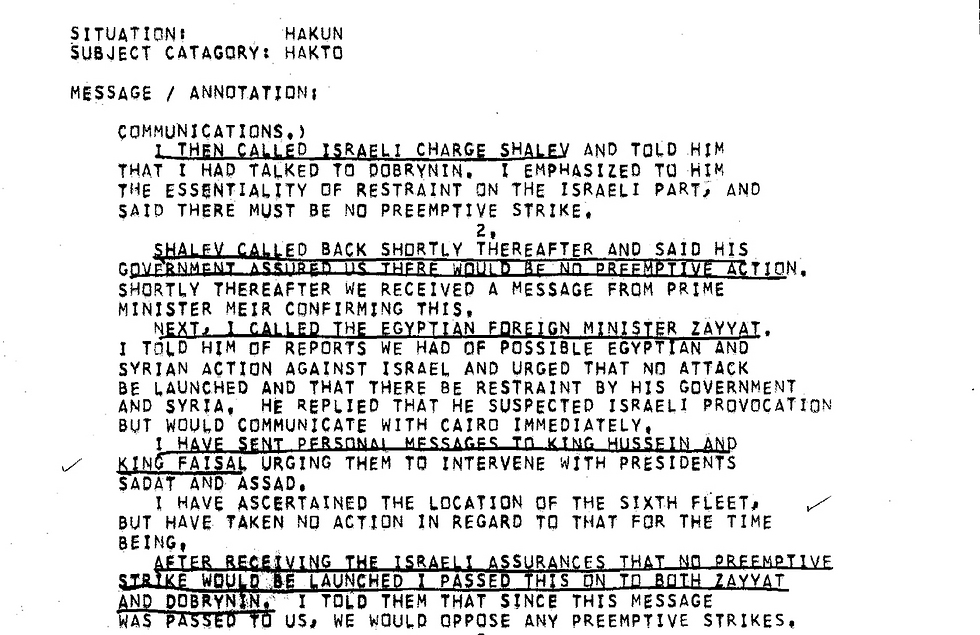
The third document doesn’t confirm imminent attack either?
The US asks Israel to exercise restraint
The US asks Israel to take no preemptive action
The US opposes preemptive action on the part of Israel
 |
The fourth document tells us only about Israel’s intelligence.
“I was notified that the Israeli’s have what they consider to be hard information…”
“Urgently communicating with the Israelis, Warning them against any pre emptive attack”
And Egypt expected an Israeli provocation..
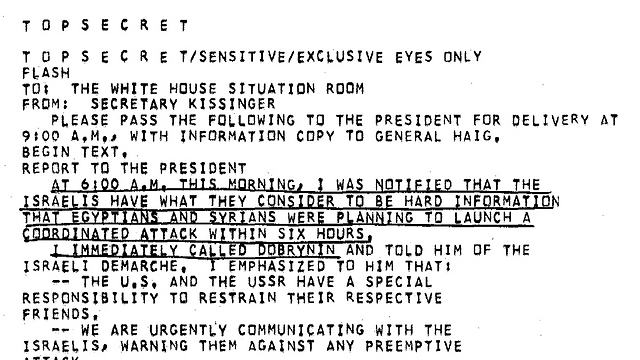
Ynet : The morning of the coordinated attack on Israel, US assessments flipped from presuming war was not on the horizon to frantic attempts to prevent Syria and Turkey from attacking the Jewish state, which was warned off any preemptive strike.
Read the documents and decide for yourself... In all four documents it is clear Israel has prepared for an aggressive move and the US is repeatedly calling for restraint. Warning Israel not to move preemptively. Egypt expecting an Israeli provocation..
Self-defense or provocation: Israel’s history of breaking ceasefires
British Fingerprints in Dirty Tricks Against Trump
By Finian CUNNINGHAM | Strategic Culture Foundation | 21.01.2017
Britain’s divisive Brexit politics are playing out through the new US presidency of Donald Trump. It seems that a faction within the British political establishment which is opposed to Britain leaving the European Union has joined forces with American intelligence counterparts to hamper Trump’s new administration.
By hampering Trump, the pro-EU British faction would in turn achieve a blow against a possible bilateral trade deal emerging between the US and Britain. Such a bilateral trade deal is vital for post-Brexit Britain to survive outside of the EU. If emerging US-British trade relations were sabotaged by disenfranchising President Trump, then Britain would necessarily have to turn back to rejoining the European Union, which is precisely what a powerful British faction desires.
What unites the anti-Trump forces on both sides of the Atlantic is that they share an atlanticist, pro-NATO worldview, which underpins American hegemony over Europe and Anglo-American-dominated global finance. This atlanticist perspective is vehemently anti-Russian because an independent Russia under President Vladimir Putin is seen as an impediment to the US-led global order of Anglo-American dominance.
The atlanticists in the US and Britain are represented in part by the upper echelons of the intelligence-military apparatus, embodied by the American Central Intelligence Agency and Britain’s Military Intelligence (Section) 6 (MI6).
Notably, incoming US President Donald Trump has expressed indifference towards NATO. This week he repeated comments in which he called the US-led military alliance «obsolete». Trump’s views are no doubt a cause of grave consternation among US-British atlanticists.
It is now emerging that British state intelligence services are involved much more deeply in the dirty tricks operation to smear Trump than might have been appreciated heretofore. The British involvement tends to validate the above atlanticist analysis.
The dirty tricks operation overseen by US intelligence agencies and willing news media outlets appears to be aimed at undermining Trump and, perhaps, even leading to his impeachment.
The former British MI6 agent, named as Christopher Steele, who authored the latest sexual allegations against Trump, was initially reported as working independently for US political parties. However, it now seems that Steele was not acting as an independent consultant to Trump’s political opponents during the US election, as media reports tended to indicate.
Britain’s Independent newspaper has lately reported that Steele’s so-called «Russian dossier» – which claimed that Trump was being blackmailed by the Kremlin over sex orgy tapes – was tacitly given official British endorsement.
That endorsement came in two ways. First, according to the Independent, former British ambassador to Russia, Sir Andrew Woods, reportedly gave assurances to US Senator John McCain that the dossier’s allegations of Russian blackmail against Trump were credible. Woods met with McCain at a security conference in Canada back in November. McCain then passed the allegations on to the American FBI – so «alarmed» was he by the British diplomat’s briefing.
The second way that Britain has endorsed the Russian dossier is the newly appointed head of MI6, Sir Alex Younger, is reported to have used the material produced by his former colleague, Christopher Steele, in preparing his first speech as head of the British intelligence service given in December at the agency’s headquarters in London. That amounts to an imprimatur from MI6 on the Russian dossier.
Thus, in two important signals from senior official British sources, the Russian dossier on Trump was elevated to a serious intelligence document, rather than being seen as cheap gossip.
Excerpts from the document published by US media last week make sensational claims about Trump engaging in orgies with prostitutes in the presidential suite of the Moscow Ritz-Carlton hotel while attending a Miss World contest in 2014. It is claimed that Russian secret services captured the alleged lewd activity on tape and will now be able to leverage this «kompromat» in order to blackmail Trump who becomes inaugurated this week as the 45th president of the United States.
Several informed analysts have dismissed the Russian dossier as an amateurish fake, pointing out its vague hearsay, factual errors and questionable format not typical of standard intelligence work. Also, both Donald Trump and the Kremlin have categorically rejected the claims as far-fetched nonsense.
While most US media did not publish the salacious details of Trump’s alleged trysts, and while they offered riders that the information was «not confirmed» and «unverifiable», nevertheless the gamut of news outlets gave wide coverage to the story which in turn directed public attention to internet versions of the «sensational» claims. So the US mainstream media certainly lent critical amplification, which gave the story a stamp of credibility.
US intelligence agencies, including Director of National Intelligence James Clapper and CIA chief John Brennan, appended the two-page Russian dossier in their separate briefings to outgoing President Barack Obama and President-elect Trump last week. Those briefings were said to mainly focus on US intelligence claims that Russian state-sponsored hackers had carried out cyber attacks to influence the US election last November.
Therefore, US intelligence, their British counterparts and the mass media all played a concerted role to elevate low-grade gossip against Trump into a seemingly credible scandal.
Trump has been waging a war of words with the US intelligence agencies, snubbing them by cutting back on presidential briefings and rubbishing their claims of Russian hacking as «ridiculous». Recently, Trump appeared to shift towards accepting the US intel assessment that Russia had carried out cyber attacks. But he balked at any suggestion that the alleged hacking was a factor in why he won the election against Hillary Clinton.
At a news conference before the weekend, Trump turned up the heat on the US intelligence agencies by blaming them for leaking to the media their briefing to him on the notorious Russian dossier. Trump compared their tactics to that of «Nazi Germany». CIA chief John Brennan couldn’t contain his anger and told media that such a comparison was «outrageous».
Trump may have savaged the Russian blackmail allegations as «fake news». But there are indications that US and British intelligence – and their reliable media mouthpieces – are not giving up on their dirty tricks operation, which has all the hallmarks of a vendetta.
Pointedly, James Clapper, the outgoing US Director of National Intelligence, has said that the secret services have not arrived at a judgment as to whether the Russian blackmail claims are substantive or not. British state-owned BBC has also reported that CIA sources believe that Russian agents have multiple copies of «tapes of a sexual nature» allegedly involving Trump in separate orgies with prostitutes in Moscow and St Petersburg.
In other words this scandal, regardless of veracity, could run and run and run, with the intended effect of undermining Trump and crimping his policies, especially those aimed at normalizing US-Russia relations, as he has vowed to do. If enough scandal is generated, the allegations against Trump being a sexually depraved president compromised by Russian agents – a declared foreign enemy of the US – might even result in his impeachment from the White House on the grounds of treason.
Both the American and British intelligence services appear to be working together, facilitated by aligned news media, to bolster flimsy claims against Trump into allegations of apparent substance. The shadowy «deep state» organs in the US and Britain are doing this because they share a common atlanticist ideology which views Anglo-American dominance over the European Union as the basis for world order. Crucial to this architecture is NATO holding sway over Europe, which in turn relies on demonizing Russia as a «threat to European security».
Clamping down on Trump, either through impeachment or at least corrosive media smears, would serve to further the atlanticist agenda.
For a section of British power – UK-based global corporations and London finance – the prospect of a Brexit from the EU is deeply opposed. The Financial Times list of top UK-based companies were predominantly against leaving the EU ahead of last year’s referendum. Combined with the strategic atlanticist ideology of the military-intelligence apparatus there is a potent British desire to scupper the Trump presidency.
But, as it happens, the American and British picture is complicated by the fact that the British government of Prime Minister Theresa May is very much dependent on cooperation and goodwill from the Trump administration in order for post-Brexit Britain to survive in the world economy outside the EU.
The British government is committed to leaving the EU as determined by the popular referendum last June. To be fair to May’s government, it is deferring to the popular will on this issue. Premier May is even talking about a «hard Brexit» whereby, Britain does not have future access to the European single market. Fervent communications between Downing Street and the Trump transition team show that the British government views new bilateral trade deals with the US as vital for the future of Britain’s economy. And Trump has reciprocated this week by saying that Britain will be given top priority in the signing of new trade deals.
In this way, the British establishment’s divisions over Brexit – some for, some against – are a fortunate break for Trump. Because that will limit how much the British intelligence services can engage in dirty tricks against the president in league with their American counterparts. In short, the atlanticist desire to thwart Trump has lost its power to act malevolently in the aftermath of Britain’s Brexit.
That might also be another reason why Donald Trump has given such a welcoming view on the Brexit – as «a great thing». Perhaps, he knows that it strengthens his political position against deep state opponents who otherwise in a different era might have been strong enough to oust him.
Trump and Brexit potentially mean that the atlanticist sway over Europe is fading. And that’s good news for Russia.
Why are US tech firms suddenly trying to restrict RT’s access to social media?
RT | January 20, 2017
On Wednesday RT found its access to Twitter’s official news discovery partner Dataminr stifled, and it was temporarily denied full use of Facebook. These events followed weeks of hysteria about the network in the US.
First up, we need to explain what Dataminr is. It’s an American startup with exclusive access to Twitter’s ‘firehose’ (the full flow of all Tweets in real time), vital to any agency that breaks the news.
While it isn’t hugely significant for casual users, it’s extremely useful for media services, and it appears government intelligence agencies too.
The firehose is also seemingly a valuable resource for anyone looking for illegal activity on Twitter. This is due to how the information can help “explore an individual’s past digital activity on social media and discover an individual’s interconnectivity and interactions with others on social media.”
We know this because a lobbying firm called Beacon Global Strategies told the Danish government about these abilities when pitching a partnership between Copenhagen and the tech company.
RT, along with dozens of other news organizations, has been using Dataminr successfully for some time. Nobody batted an eyelid until a strange Wall Street Journal article last May placed the network center stage in a battle between Twitter and American spies. Headlined “Twitter Picks Russia Over the US,” it suggested that Dataminr was selling information directly to Vladimir Putin, via RT. Meanwhile, it denied CIA operatives access to its platform.
Changing tack
This stance changed five months later, when the startup, which is partially owned by Twitter, agreed to provide an “advanced altering tool” to the FBI. Furthermore, it was at the same time when RT’s relationship with Dataminr suddenly became more confused.
As this network attempted to pay the annual service charge for usage, the tech company insisted they’d prefer monthly payments, as they were “reviewing how we work with government agencies.” While that seemed unusual at the time, the reasons finally became apparent when RT’s access to Dataminr was revoked with immediate effect on Wednesday.
This unfortunate and sad move appears to be a result of the climate of fear that sections of the US press are whipping up around RT and Russian media in general. The preposterous Wall Street Journal article of last May is just one of countless similar diatribes.
Written by Louis Gordon Crovitz, senior enough to have been a former publisher of the paper, it hysterically created the impression that RT was somehow passing on information from Twitter to Russian special services – in other words, baseless, utter nonsense.
Crossed purposes
Just after Dataminr cut off RT, the plot thickened on Thursday when The Verge reported that it wasn’t only Denmark that Beacon had considered collaborating with. They also met officials from Azerbaijan and at least five other embassies over a period of three months. Unlike RT, which used the facility only for news gathering, these pitches were clearly made in ways that suggested it could have been used for surveillance.
While Dataminr has exclusive access to Twitter’s firehose, Facebook has a de facto near-monopoly on the distribution of news these days. Thus, when they blocked RT’s ability to post new links and video from Wednesday night to Thursday evening, it was easy to see the one-two punch to RT’s social media access as more than mere coincidence.
Especially, when RT was accused of breaching terms of service by merely streaming a video purchased under license from the Associated Press; AP confirmed it was entirely legal in a statement to RT. Not just that, but Facebook generated a notice nonsensically alleging that RT’s stream of AP video was infringing on the rights of US state broadcaster Radio Free Europe.
Facebook rectified its error the next day. Where RT’s Dataminr relationship is concerned, it is reasonable to assume the decision to deny service came from high-up in the company – or perhaps even above.
Israeli Border Police Executed Bedouin at Um al Hiran, Doctored Video Footage
By Richard Silverstein | Tikun Olam | January 20, 2017
I wrote a post about the killing of Musa Abu Qilyan in which I presented both the claim of the Border Police that he killed a policeman in a deliberate terror attack; and also presented video which, as I wrote, failed to support the police claims (though it didn’t refute them). Now, Ronnie Barkan has provided a close video analysis of two separate versions of the video, one distributed by the police and another slightly longer one which surfaced on Facebook. Ronnie shows (be patient in watching the various iterations of the video clips he presents) incontrovertibly that the Police video was subtly and slightly edited, both removing the first shot a Border Policeman fired at the car, and also speeding up the video to make the vehicle appear to be going faster than it was. You may read an alternate version, which essentially agrees with Ronnie’s work, at 972.
What does all this mean? First, that when Abu Alqilyan’s vehicle drove along the road it presented no threat whatsoever to the police personnel. It was driving slowly and deliberately. As it proceeds, a police officer runs toward it firing. Three or four shots are fired. The first shot is fired while the car is driving quite slowly and seemingly under the driver’s control. Only after those shots are fired does the vehicle speed up, lose control and hit another police officer standing near the road. Clearly, the driver had been fatally struck by these bullets before he killed the officer.
In other words, the police acted recklessly and with total disregard even for their own safety. They essentially murdered the Bedouin driver when he posed no threat. After he was incapacitated, his vehicle struck and killed the other officer. He was not intending to harm anyone. Ergo, he was not a terrorist. It’s certainly possible he was a supporter of the Islamic Movement, but certainly not of ISIS as Israeli Jewish politicians have claimed. Further, being an Islamist is not the same as being a terrorist.
The only possibility I can think of to support the police version is perhaps an officer had tried to stop him at some point before the drone footage began. He may have seemed to defy an order to stop and proceeded on his path, which led the officer to fire. But you can be sure that if such a thing happened, the drone footage authenticating it would’ve been released.
Further, how can a major police action at which physical altercations and protest is expected not secure the perimeter of vehicle and pedestrian traffic? How could the police have allowed any vehicles to approach them as this man did? Why weren’t there roadblocks preventing access? To me, this appears to be a botched Border Police operation for which they have only themselves to blame.
Finally, this is yet another example of fraud and mendacity on the part of the Israel’s most vicious, brutal and violent police authorities. Not only are Border Police the most racist, they are also the mostly likely to lie and cover up their errors, as they have here. It’s a shameful episode which should be met with skepticism and derision by the Israeli media and the Israeli public. However, Israeli Jews are all too quick to swallow the lies fed to them by authorities. Once they have drunk the Koolaid, counter-evidence like this threatens their equanimity and is usually ignored or dismissed.
In my earlier post I debated the meaning of “terrorism” in the Israeli context and argued that dispossessing the Bedouin as Israel is doing, along with deadly violence like this constitutes state terror. This new evidence confirms there was no terror on the part of the Bedouin at all. The only terror was that of the forces of the State. If I were Israeli, I would hang my head in shame.
Israeli Soldiers Open Fire On Homes In Southern Gaza, Strike Six-Year-Old Girl
Ma’an – January 20, 2017
 GAZA – A Palestinian child was reportedly injured on Friday evening after being struck by an Israeli bullet in Beit Lahiya in the north of the Gaza Strip after Israeli forces opened live fire at homes in the area.
According to medical sources, the six-year-old girl was injured in her stomach, and described her injury as moderate.
The child was taken to al-Shifa hospital in Gaza city and was later transferred to a hospital in the north of the besieged enclave.
An Israeli army spokesperson told Ma’an she would look into reports on the incident.
Featured Video
The Source of America’s Wars – Kristol Clear
or go to
Aletho News Archives – Video-Images
From the Archives
Is Israel to blame for the Iraq War?
American Goy | March 10, 2008
I am so tired of this old canard that “Israel had nothing to do with USA’s war with Iraq – in fact, it officially advised America against it”.
Bullshit. … continue
Blog Roll
 Aletho News
- Netanyahu unilaterally declares Lebanon outside of ceasefire deal
- Israeli leaders: ‘Not a single goal’ achieved in war with Iran
- What on earth just happened? Trump, Iran, and the unlikely ceasefire
- Alberta Bill Would Fine Political Deepfakes $10,000 Without Satire Exemptions
- Iran declares ‘historic victory’ over US, says enemy forced to accept its proposal
- Trump Claims Ceasefire, Reopening of Strait of Hormuz Agreement with Iran
- Israeli tank fire killed UN peacekeeper in Lebanon, UNIFIL investigation finds
- Russia, China block Bahrain-sponsored UN resolution on Strait of Hormuz
- The US-Israeli War on Science is an Assault on our Future
- Trump’s Promise to Bomb Iran ‘Like Never Before’ Faces Brutal Logistics — Expert
- If Americans Knew
- Thousands dead and neighborhoods razed to the ground: Aid agencies fear southern Lebanon is becoming the new Gaza
- The war the US is fighting for Israel could cost trillions
- ‘Cigarette Burns, Nail Wounds’: Toddler Tortured in Gaza to Coerce Father
- Trump Says US Sent ‘a Lot of Guns’ to Protesters in Iran
- Israeli forces destroy 17 UN peacekeeper cameras in south Lebanon
- US-Israeli strikes ‘completely destroy’ synagogue in Tehran
- Archbishop for US Military Says Iran War Is Unjust Under Catholic Teaching
- Iranian leaders’ Open Letters to the American People
- Trump says Iranians appreciate bombs, WHO warns of nuclear risks – Daily Update
- U.N. experts demand Israel release prominent Gaza doctor after reports of ‘severe torture’
- No Tricks Zone
- An Inconvenient Tree: Uncovered In Alps… Europe Much Warmer Than Today 6000 Years Ago
- New Study Reports A 60% Slowdown In Greenland’s Ice Loss Rate In The Last Decade
- Low Intensity Tornado Wrecks Major Solar Farm, Creating A Potential Toxic Dump
- New Study Finds Warming Saves Lives…Cold Temperatures 12 Times More Deadly Than Excess Heat
- German Science Blog Accuses PIK Climate Institute Of Hallucinating Climate Tipping Points
- Devastating Assessment Of Comirnaty Vaccine By Former Senior Pfizer Europe Toxicologist
- New Study: CO2 Is ‘Effectively Negligible’ As An Explanatory Climate Change Factor Since 2000
- Former Pfizer Toxicologist Dr. Helmut Sterz Tells Bundestag Hearing Pfizer Vaccine Should Have Never Been Approved
- Energy Expert: Germany’s Nuclear Phaseout Was A “500 Billion Euro Mistake”
- New Research: South Australia’s Mid-Holocene Sea Surface Temperatures Were 4°C Warmer Than Today
 Aletho News