Leeds University Union Threaten to Ban Craig Murray Speech on Palestine
By Craig Murray – March 1, 2017
I am giving a talk entitled “Palestine/Israel: A Unitary Secular State or a Bantustan Solution” in Leeds University tomorrow. I have just been told by Leeds University Union I will not be allowed to speak unless I submit what I am going to say for pre-vetting.
I am truly appalled that such a gross restriction on freedom of speech should be imposed anywhere, let alone in a university where intellectual debate is meant to be an essential part of the learning experience. I really do not recognise today’s United Kingdom as the same society I grew up in. The common understanding that the values of a liberal democracy are the foundation of society appears to have evaporated.
As regular readers know well, I do not write speeches in advance but always speak extempore. My opinions on Israel and Palestine are very well documented on this blog and elsewhere. I want to see a single, unitary state in Israel/Palestine, encompassing everyone who currently lives in those territories, as a secular democracy blind to ethnicity and religion. This includes an acceptance that further forced large population movements by anybody are not desirable and the Palestinians should receive more compensation than restitution. If I am not permitted to express this view within a University, I find that truly shocking.
I should be equally shocked if anybody who held views very different to my own were not permitted to express them.
I think that if people like me are now being prevented from speaking, society has crossed a very dangerous line indeed.
How the Press Serves the Deep State
By Daniel Lazare | Consortium News | March 1, 2017
The New York Times has made it official. In a Sunday front-page article entitled “Trump Ruled the Tabloid Media. Washington Is a Different Story,” the paper gloats that Donald Trump has proved powerless to stop a flood of leaks threatening to capsize his administration.
As reporters Glenn Thrush and Michael M. Grynbaum put it: “This New York-iest of politicians, now an idiosyncratic, write-your-own-rules president, has stumbled into the most conventional of Washington traps: believing he can master an entrenched political press corps with far deeper connections to the permanent government of federal law enforcement and executive department officials than he has.”
Thrush and Grynbaum add a few paragraphs later that Trump “is being force-fed lessons all presidents eventually learn – that the iron triangle of the Washington press corps, West Wing staff and federal bureaucracy is simply too powerful to bully.”
Iron triangle? Permanent government? In its tale of how Trump went from being a favorite of the New York Post and Daily News to fodder for the big-time Washington news media, the Times seems to be going out of its way to confirm dark paranoid fears of a “deep state” lurking behind the scenes and dictating what political leaders can and cannot do. “Too powerful to bully” by a “write-your-own-rules president” is another way of saying that the permanent government wants to do things its way and will not put up with a president telling it to take a different approach.
Entrenched interests are nothing new, of course. But a major news outlet bragging about collaborating with such elements in order to cripple a legally established government is. The Times was beside itself with outrage when top White House adviser Steve Bannon described the media as “the opposition party.” But one can’t help but wonder what all the fuss is about since an alliance aimed at hamstringing a presidency is nothing if not oppositional.
If so, a few things are worth keeping in mind. One is that Trump was elected, even if only by an Eighteenth-Century relic known as the Electoral College, whereas the deep state, permanent government, or whatever else you want to call it was not. Where Trump gave speeches, kissed babies, and otherwise sought out the vote, the deep state did nothing. To the degree this country is still a democracy, that must count for something. So if the conflict between president and the deep state ever comes down to a question of legitimacy, there is no doubt who will come out ahead: The Donald.
A second thing worth keeping in mind is that if ever there was a case of the unspeakable versus the inedible (to quote Oscar Wilde), the contest between a billionaire president and billionaire-owned press is it.
Both sides are more or less correct in what they say about the other. Trump really is a strongman at war with basic democratic norms just as innumerable Times op-ed articles say he is. And giant press organizations like the Times and the Washington Post are every bit as biased and one-sided as Trump maintains – and no less willfully gullible, one might add, than in 2002 or 2003 when they happily swallowed every lie put out by the George W. Bush administration regarding Iraqi WMDs or Saddam Hussein’s support for Al Qaeda.
Riveting TV
Trump’s Feb. 16 press conference – surely the most riveting TV since Jerry Springer was in his prime – is a case in point. The President bobbed, weaved, and hurled abuse like a Catskills insult comic. He threw out pseudo-facts, describing his victory, for instance, as “the biggest Electoral College win since Ronald Reagan” when in fact George H. W. Bush, Bill Clinton and Barack Obama all got more votes. But commentators who panned the display as a “freak show” or simply “batshit crazy” didn’t get it. It wasn’t Trump who bombed that afternoon, but the press.
Why? Because reporters behaved with all the intelligence of a pack of Jack Russell terriers barking at a cat up a tree. Basically, they’ve been seized by the idée fixe that Russia is a predator state that hacks elections, threatens U.S. national security, and has now accomplished the neat trick of planting a Kremlin puppet in the Oval Office. It doesn’t matter that evidence is lacking or that the thesis defies common sense. It’s what they believe, what their editors believe, and what the deep state believes too (or at least pretends to). So the purpose of the Feb. 16 press conference was to pin Trump down as to whether he also believes the Russia-did-it thesis and pillory him for deviating from the party line.
More than half the questions that reporters threw out were thus about Russia, about Mike Flynn, the ex-national security adviser who got into trouble for talking to the Russian ambassador before the new administration formally took office, or about reputed contacts between the Trump campaign staff and Moscow. One reporter thus demanded to know if anyone from Trump’s campaign staff had ever spoken with the Russian government or Russian intelligence. Another asked if Trump had requested FBI telephone intercepts before determining that Flynn had not broken the law.
“I just want to get you to clarify this very important point,” said a third. “Can you say definitively that nobody on your campaign had any contacts with the Russians during the campaign?” A fourth wanted to get the President’s reaction to such “provocations” as a Russian communications vessel floating 30 miles off the coast of Connecticut (in international waters). “Is Putin testing you, do you believe, sir?” the reporter asked as if he had just uncovered a Russian agent in the Lincoln Bedroom. “… But do they damage the relationship? Do they undermine this country’s ability to work with Russia?”
When yet another journalist asked yet again “whether you are aware that anyone who advised your campaign had contacts with Russia during the course of the election,” Trump cried out in frustration: “How many times do I have to answer this question?” It was the most intelligent query of the day.
The press played straight into Trump’s hands, all but providing him with his best lines. “Well, I guess one of the reasons I’m here today is to tell you the whole Russian thing, that’s a ruse,” he responded at one point. “That’s a ruse. And by the way, it would be great if we could get along with Russia, just so you understand that. Now tomorrow, you’ll say, ‘Donald Trump wants to get along with Russia, this is terrible.’ It’s not terrible. It’s good.”
The prose may not be very polished, but the sentiments are unassailable. Ditto Trump’s statement a few minutes later that “false reporting by the media, by you people, the false, horrible, fake reporting makes it much harder to make a deal with Russia. … And that’s a shame because if we could get along with Russia – and by the way, China and Japan and everyone – if we could get along, it would be a positive thing, not a negative thing.”
If the Washington Post and the Times do not agree that bogus assertions about unauthorized contacts with Russia are not poisoning the atmosphere, they should explain very clearly why not. They should also explain what they hope to accomplish with a showdown with Russia and why it will not be a step toward World War III.
But they won’t, of course. The media (with encouragement from parts of the U.S. government) are working themselves into a fit of outrage against Vladimir Putin just as, in past years, they did against Daniel Ortega, Manuel Noriega, Saddam Hussein, Slobodan Milosevic, Saddam Hussein (again), Muammar Gaddafi, Bashar al-Assad, and Viktor Yanukovych. In each instance, the outcome has been war, and so far the present episode shows all signs of heading in the same direction as well.
Reporters may be clueless, but working-class Americans aren’t. They don’t want a war because they’re the ones who would have to fight it. So they’re not unsympathetic to Trump and all the more inclined to give the yapping media short shrift.
This is a classic pattern in which strongmen advance on the basis of a liberal opposition that proves to be weak and feckless. Today’s liberal media are obliging Trump by behaving in a way that is even sillier than usual and well ahead of schedule to boot.
A Fragile Meme
The anti-Russia meme, meanwhile, rests on the thinnest of foundations. The argument that Russia hacked the Democratic National Committee and thereby tipped the election to Trump is based on a single report by CrowdStrike, the California-based cyber-security firm hired by the DNC to look into the mass email leak. The document is festooned with head-spinning techno-jargon.
It says of Cozy Bear and Fancy Bear, the hackers who allegedly penetrated the DNC in behalf of Russian intelligence: “Their tradecraft is superb, operational security second to none, and the extensive usage of ‘living-off-the-land’ techniques enables them to easily bypass many security solutions they encounter. In particular, we identified advanced methods consistent with nation-state level capabilities including deliberate targeting and ‘access management’ tradecraft – both groups were constantly going back into the environment to change out their implants, modify persistent methods, move to new Command & Control channels, and perform other tasks to try to stay ahead of being detected. Both adversaries engage in extensive political and economic espionage for the benefit of the government of the Russian Federation and are believed to be closely linked to the Russian government’s powerful and highly capable intelligence services.”
Impressive? Not to independent tech experts who have already begun taking potshots. Sam Biddle, The Intercept’s extremely smart tech writer, notes that CrowdStrike claims to have proved that Cozy Bear and Fancy Bear are Russian because they left behind Cyrillic comments in their “metadata” along with the name “Felix Edmundovich,” also in Cyrillic, an obvious reference to Felix Edmundovich Dzerzhinsky, founder of the Cheka, as the Soviet political police were originally known.
But, Biddle observes, there’s an obvious contradiction: “Would a group whose ‘tradecraft is superb’ with ‘operational security second to none’ really leave behind the name of a Soviet spy chief imprinted on a document it sent to American journalists? Would these groups really be dumb enough to leave Cyrillic comments on these documents? … It’s very hard to buy the argument that the Democrats were hacked by one of the most sophisticated, diabolical foreign intelligence services in history, and that we know this because they screwed up over and over again.”
Indeed, John McAfee, founder of McAfee Associates and developer of the first commercial anti-virus software, casts doubt on the entire enterprise, wondering whether it is possible to identify a hacker at all. “If I were the Chinese,” he told TV interviewer Larry King in late December, “and I wanted to make it look like the Russians did it, I would use Russian language within the code, I would use Russian techniques of breaking into organizations. … If it looks like the Russians did it, then I can guarantee you: it was not the Russians.” (Quote starts at 4:30.)
This may be too sweeping. Nonetheless, if the press really wanted to get to the bottom of what the Russians are doing, they would not begin with the question of what Trump knew and when he knew it. They would begin, rather, with the question of what we know and how we can be sure. It’s the question that the press should have asked during the run-up to the 2003 invasion of Iraq, but failed to. But it’s the question that reporters should be asking now before the conflict with Russia spins out of control, with consequences that are potentially even more horrendous.
It’s not easy making Donald Trump seem like a peacenik, but that’s what the billionaire’s press has done.
Israel clears Palestinians and homes so its military can practice

Defense for Children International | February 6, 2017
Ramallah – Evictions, demolitions, and UXO are constant risks for Palestinian children living in areas of the Jordan Valley that Israel has declared as “firing zones,” where Israeli battalions regularly assemble to hone their combat skills. Before tanks can shoot off missile rounds and soldiers can carry out practice missions, goats are removed, animal pens and tents dismantled.
“During 2016, we were forced to evacuate our houses around 30 times,” said Abdulaziz Abu Kbash, a father of seven. Abu Kbash lives with his family in a makeshift metal structure near Homsa, which is part of the West Bank governorate of Tubas, in the northern Jordan Valley.
In the summer, home evictions during Israeli military practices put children at risk of dehydration and prolonged sun exposure. “We wait in the sun for hours,” said Abu Kbash. “The children get very tired from being outdoors.”
Winter, with rain and lower temperatures, is not much better. After Abu Kbash’s family had been forced to stay outside during an Israeli drill in February 2016, his daughter fell ill for several days.
Even more frightening are the UXO the Israeli soldiers leave in their wake. “Tanks, live ammunition, and shells are used in drills not that far from our houses,” said Abu Kbash. “When we return, we find shell shrapnel and some other remnants near the houses. Our biggest fear is that one of the foreign objects could explode and hurt our children.
Animals, the primary source of livelihood for Abu Kbash’s family, are not immune to Israel’s military activities in the Jordan Valley, either. Extra time animals spend walking or waiting in hot temperatures cost the family in water, which they have to purchase from cities approximately 9 miles away.

Palestinians herd their flocks during a temporary eviction order for the purpose of Israeli military exercises outside Tubas, in the northern Jordan Valley. (Photo: DCIP / Cody O’Rourke)
Makeshift homes like Abu Kbash’s dot the length of the mostly arid strip of land known as the Jordan Valley that stretches along the Jordanian border. Against this often challenging landscape, Bedouin and other livestock-based communities have long practiced their way of life.
Israel’s military annexation and subsequent occupation of the West Bank in 1967 represented a significant interruption to these remote communities’ customs and livelihoods.
Although comprising 30 percent of the total West Bank Palestinian land space, the bulk of the Jordan Valley now falls under Area C, “virtually of which is prohibited for Palestinian use, earmarked instead for the use of the Israeli military or under the jurisdiction of Israeli settlements,” according to the Office for the Coordination of Humanitarian Affairs (OCHA).
Approximately 3,400 Palestinians live in the especially restrictive closed military or “firing zones.” These ill-defined areas on and around Palestinian communities are used by Israeli military personnel for training purposes. Ahead of planned military exercises, Israeli authorities clear people, animals and structures from the area.
When Defense for Children International – Palestine visited Abu Kbash in late September of 2016, he had recently received a temporary eviction notice. On September 16, the Israeli civil administration ordered all the families in the vicinity, including 51 children, out of their homes between 7 a.m. and 11 a.m. on September 22, 29, and 30.

Mahmoud Ayyoub stands where he and his family of 15 lived before Israeli forces demolished their homes in Ein Al-Beida, near Tubas, in the Jordan Valley. (Photo: DCIP / Cody O’Rourke)
Even when drills are not actively in progress, Palestinian children residing near or inside firing zones live under the constant threat of displacement.
On September 27, 2016, Mahmoud Ayyoub was at a Jenin hospital with one of his children when he received a troubling phone call. Israeli forces had entered his village, Ein Al-Beida, located on the northern tip of the Jordan Valley, the caller said. He learned that the makeshift homes and tents that provided shelter to his seven adult children and 15 grandchildren had all been demolished.
“I was told that soldiers came at around 8:30 a.m. and threw all our belongings outside. They kicked the women and children out in their sleeping clothes without explaining the reason for the demolition,” said Ayyoub, who has lived in Ein Al-Beida for 15 years.
Now, Ayyoub says, the Israeli army is preventing him from rebuilding. He told DCIP that soldiers regularly monitor the area to ensure that no rebuilding has occurred.

Odai al-Faqeer, 5, Daifallah’s youngest son, sits on broken concrete blocks and twisted, steel where his home once was in Aqaba, Tubas governorate. (Photo: DCIP / Cody O’Rourke)
Earlier in the month, on September 7, Daifallah al-Faqeer’s six children watched two Israeli bulldozers destroy their home in Aqaba, a few miles east of Tubas. “My children were really terrified by the soldiers, who smashed everything in front of them,” their father told DCIP.
“It was a difficult time for all of us to see everything we had built being torn down,” al-Faqeer said.
Al-Faqeer was only given two hours notice that three housing and four animal structures would be demolished because they lacked the necessary permits. His family rushed to save what they could before the demolition started.
“We stayed in the open until some residents in the neighboring area gave us some tents to live in,” said al-Faqeer. “I am currently trying to rebuild what has been destroyed.”

Israeli army vehicles park next to a Palestinian family compound during Israeli military training in the Jordan valley, West Bank, on December 8, 2016. (Photo: ActiveStills / Keren Manor)
In the months since DCIP visited these three families, Israel carried out at least four evictions or demolitions in the northern Palestinian villages of the Jordan Valley. Residents of Khirbet Al-Ras Al-Ahmar were evacuated in October and November, Khirbet Ibziq in December of 2016, and Khirbet al-Kurzaliya in January of this year.
Since 1967, Israel has pursued a discriminatory policy of demolishing Palestinian homes and essential structures, including water systems, livestock pens, solar panels, and even tents and shelters provided by international aid organizations throughout the West Bank, including East Jerusalem.
In 2016, Israel’s demolition rates were the highest ever recorded since OCHA began tracking the issue in 2009. Altogether, Israel demolished, dismantled, or othrwise confiscated 1,089 Palestinian-owned structures in the West Bank, including East Jerusalem, displacing 1,593 people. OCHA’s Demolitions Database shows that 15 of these incidents took place in Area C of the Jordan Valley, impacting 98 structures and 124 children.
Demolitions and evictions deny Palestinians the right to live securely and deny children an adequate standard of living, education, health, and psychological well-being.
Israel’s Anti-Semitism Smears Backfire
By Ann Wright | Consortium News | March 1, 2017
An often-used tactic to squelch criticism of Israeli state policies toward the Palestinians is to call the criticism anti-Semitic. The sponsors of the event become afraid of the label, anti-Semitism, false as it is, and cancel the event to avoid any controversy. The tactic is used widely across Europe and the United States.
This week, the talk that I was to give in a room at the Rome City Hall about the Women’s Boat to Gaza and the conditions in Gaza was cancelled 24 hours before the event by the council member who had agreed to arrange for the room. His staff revealed that he had gotten intense pressure from the Israeli Embassy and Rome’s Jewish Community Association to stop the presentation.
But that was not the end of the story. In a fast-moving media blitz, organized by Italy’s Boycott, Divestment and Sanctions program, two of Rome’s newspapers wrote of the cancellation and several radio stations reported on it. BDS Italy scheduled a press conference about the cancellation in the plaza in front of the City Hall at the time the talk was scheduled. About 20 representatives of the news media attended, a much larger number than would have attended the talk itself.
Due to the number of media and the questions concerning the cancellation, Marcello de Vito, President of the Rome City Council, invited three of us to come into the City Hall to discuss the cancellation. This invitation provided us with the opportunity to discuss the conditions in Gaza and the West Bank and the nonviolent tactics such as BDS and Boats to Gaza to bring international attention to the harmful policies of the State of Israel.
From the questions, it was apparent that the President, another City Council member and their staff knew little about the Israeli blockade of Gaza, the illegal settlements, the apartheid wall, the numbers of Palestinian children and youth held in Israeli jails, and the theft of Palestinian resources by Israeli companies.
Something similar happened last year in Bayreuth, Germany, when the prize for Tolerance and Peace, which had been awarded to CODEPINK: Women for Peace, was cancelled by the Mayor after two reporters, known for writing spurious articles, alleged that CODEPINK was an anti-Semitic organization. Following an extensive letter-writing campaign from members of the German Parliament and others who know that CODEPINK’s actions challenging the policies of the State of Israel are not anti-Semitic, the Bayreuth City Council voted to reinstate the award amid much publicity.
Also, last year, a conference in which grandmothers who had been through World War II were to speak was cancelled because of similar allegations. Defenders of Israeli policies targeted 90-year old Hedie Esptein, a vocal critic of Israeli treatment of Palestinians, although her parents had been killed in the Holocaust and she had survived by being sent to England as a part of the Kindertransport,
Responding quickly to false allegations of anti-Semitism is key to blunting the Israeli government’s offensive toward those who challenge the illegal and inhumane policies toward Palestinians. In the case of the Rome cancellation, the pushback from BDS Italy created more publicity about the plight of the Palestinians than the event itself would have.
Ann Wright served 29 years in the U.S. Army/Army Reserves and retired as a Colonel. She was a U.S. diplomat and served in U.S. embassies in Nicaragua, Grenada, Somalia, Uzbekistan, Kyrgyzstan, Sierra Leone, Micronesia, Afghanistan and Mongolia. She resigned from the U.S. government in March, 2003 in opposition to President Bush’s war on Iraq.
Women’s Protection in Syria: Disinformation Is No Help
By Tim Hayward | March 1, 2017
A ‘new report by the London School of Economics’ (LSE), so announced the British press – The Times, The Daily Mail and The Daily Mirror – describes sexual crimes against women in Syrian prisons. It alleges these to be a matter of state policy. Published just ahead of Geneva talks about a political settlement in Syria, the press interpreted it as supporting renewed calls for regime change.
The paper provides no new grounds for that conclusion, however. In fact, its sweeping allegations obscure good reasons why, under present circumstances, a responsible approach to the problem of sexual violence in Syria would involve supporting the government against the terrorist insurgents.
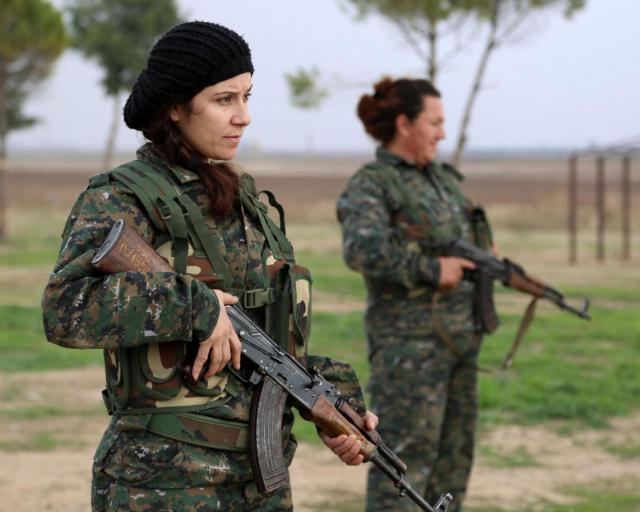
Syrian Christians
Some reasons can be gleaned from United Nations research into the problem. The UN found (in 2015 and again in 2016) that while some conflict-related sexual violence was perpetrated by state personnel, ‘non-State actors account for the vast majority of incidents’.[1] The UN made clear that efforts to defeat groups like ISIS and Al Qaeda, as the Syrian government is committed to, ‘are an essential part of the fight against conflict-related sexual violence.’ Such groups use sexual violence as part of their strategy to spread terror among those that oppose their ideology. They engage in trafficking of women and slavery. They drive the displacement of women who, then, ‘remain at high risk, even when they reach the supposed refuge of neighbouring countries.’
Marie Forestier, the LSE paper’s author, complains that the UN paid ‘disproportionate attention’ to the terrorist groups as perpetrators of sexual violence in Syria. She wants to highlight crimes on the government side, and she relays some horrific allegations about some individual cases. This illustrates specific experiences of a problem that the UN had signaled. However, while harrowing in themselves, these testimonies cannot speak to the comparative scale of the problem.[2] Forestier therefore does not show the UN’s concerns about the egregious sexual violence of the terrorist insurgents to be disproportionate. Furthermore, her interviews relate to experiences from a period – 2012 and 2013 – that is earlier than covered by the UN reports of 2015 and 2016. Forestier herself admits that accusations of sexual violence on the government’s side were ‘most frequent from late 2011 to 2013, in disputed areas such as the Damascus suburbs, and in central and coastal governorates … with a peak in 2012, and comparatively fewer cases in 2014.’ She thereby shows the situation was worse in places where the government had to fight insurgents and improved when the government regained control. In light of her own admissions, it seems perverse to cite limited older evidence in criticizing considered conclusions of fuller and more up-to-date reports.
The perversity is heightened with unwarranted generalizations in the present continuous tense. Press coverage has, unsurprisingly, transmitted the message that the most shocking details of individual allegations from up to five years ago capture what is occurring on a general and continuing basis today. Forestier herself even makes demonstrably false general claims in the present tense. For instance, she says: ‘According to an estimate by United Nations investigators, Syrian security forces detain tens of thousands of people at any one time.’ However, the source she cites for this claim says no such thing.[3]
Some of her most damaging claims are simply inexplicable, as when she says: ‘According to testimony, the overwhelming majority of men committing rapes have been State forces.’ This extraordinary claim flies in the face of the palpable evidence and reports of the UN. Bizarrely, the source Forestier cites for it is an article on ‘general data on sexual violence by state forces’ attained for 129 other conflicts, not including Syria, and during a period (1989-2009) prior to the outbreak of war in Syria.[4]
The LSE paper’s headline message thus misrepresents what is actually shown regarding the extent of the government’s responsibility for sexual violence. Buried within its text are admissions that the paper should only ‘be considered as a starting point for further research’ and that ‘it is impossible to conclude that sexual violence by regime forces is a mass phenomenon.’ Yet this did not stop Forestier making such damaging accusations as that ‘rape can be considered as part of a general policy from the authorities’ (p.12).[5]
Regardless of lack of evidence, she seems determined to convey a message of rape and sexual violence being state policy approved at the highest levels.[6] Yet she admits: ‘The decision to resort to sexual violence (or tolerate it) seems to have fallen under the regional level or even the branch and military unit level’. ‘No information indicates that high-level officials in Damascus ordered rapes’ and ‘the President or high level security officials probably didn’t give explicit orders’.
She rightly notes that ‘commanders may be prosecuted where they know or should have known of the abuses and failed to take action to stop them.’ She also correctly observes that ‘ending impunity is central in preventing sexual violence.’ I would add that ending impunity, like bringing the problem itself under control, requires well functioning institutions. The Syrian government is evidently aware of this, and, under difficult conditions, has sought to improve its systems for the protection of women and children, as welcomed by the UN OHCHR. But the good functioning of institutions is favoured by peaceful conditions rather than by war.
One does not have to be an enthusiast for the present government to recognize its legitimacy and the simple fact that it is uniquely well-placed as things stand now, and foreseeably, to protect ordinary men, women and children against violent threats.
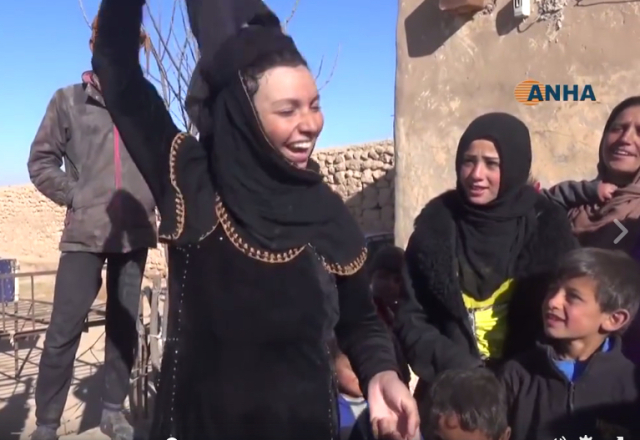
Freed from ISIS
A realistic general presumption has to be that rape and sexual violence tends be more common in war than in peacetime.[7] That is a reason – on top of so many others – why war should be avoided. A country that finds its territory turned into a battleground has to reckon with sexual violence being more prevalent than in peacetime, while its resources to tackle the problem are diverted and diminished. A government that has to defend its people against armed insurgents, particularly when these routinely engage in sexual violence, faces extraordinary challenges. That does not absolve it of responsibility for ensuring good conduct by its own forces. The practical ability of a government to maintain discipline, however, is not enhanced by having to engage on many fronts with ruthless opposition.
Realistically, and morally, the best way to avoid rape in war is to avoid war itself. I cannot believe that Marie Forestier would disagree on this general point, but I am less sure what she thinks with regard to the specific case of Syria, or even whether she has fully thought it through.[8] The thrust of her argument would support continued efforts by foreign powers, exercised through terrorist proxies on the ground, to depose the government of Syria, something that could only worsen further still the problem of sexual violence.
By contrast, it may be instructive to consider the approach taken by the Kurds in the north of Syria. In 2011, Kurds were among the groups fighting against the Syrian government. Since then, however, they have become pragmatic allies of the government in a common drive to eliminate ISIS from Syrian territory. The Kurds also have a particularly enlightened appreciation of women’s central place in society.[9] Consistent with their political philosophy, about a third of their fighting force is women. The Women’s Protection Unit or YPJ, is an all-female Kurdish military organization of about 8,000 volunteers, and growing.[10] Meanwhile the Syrian Arab Army has emulated the Kurds by creating all women battalions along similar lines.[11] Already, though, the Syrian army prominently featured all female units, including the famed Lionesses for National Defence unit of the elite Republican Guard.[12] Western commentators who note the propaganda value of this also grant that its success reflects the wider social solidarity that has made the Syrian Arab Army so resilient. As a French commentator observes, ‘The war in Syria is a face-off between two societal structures and Assad is showing that, in his system, women have an important role, even in the defence forces’.[13] If the Syrian government sees the propaganda value of promoting women’s equality, we might reasonably suppose it would see the irrationality of undoing such reputational gains by pursuing a delinquent policy of the kind Forestier alleges.
The fact is that what people widely believe throughout Syria – in Arab areas as in Kurdish – is that the overwhelming problem of sexual violence, like that of extremist violence more generally, comes from ISIS and other terrorists that violate, torture, enslave, traffic and oppress women. This is consistent with the UN findings. Forestier’s allegations are consistent only with the foreign drive for ‘regime change’.
For anyone genuinely concerned to deal with sexual violence occurring in – and occasioned by – conflict situations, a central preventive strategy is not starting a war in the first place, and not prolonging a war needlessly once started. It certainly means not intervening in a war on the side of those inflicting by far and away the most extensive and egregious sexual crimes.
In short, if the government had been supported in its efforts to defeat the insurgents, a great deal of sexual violence would have been avoided. Forestier’s claims, seen in this light, in being unfounded, are counterproductive and irresponsible. The view she opposes has a coherence hers lacks. It also has basic morality on its side. The problem with Forestier’s paper is not simply that it is poor research and writing.[14] The real concern is that, in being publicly promoted, it has been fed into the narrative beyond academia that would continue seeking to destabilise Syria (and the wider Middle East) and to prolong conflict against the Syrian government. One effect of this would be to prolong the circumstances in which sexual violence continues unabated on that territory.
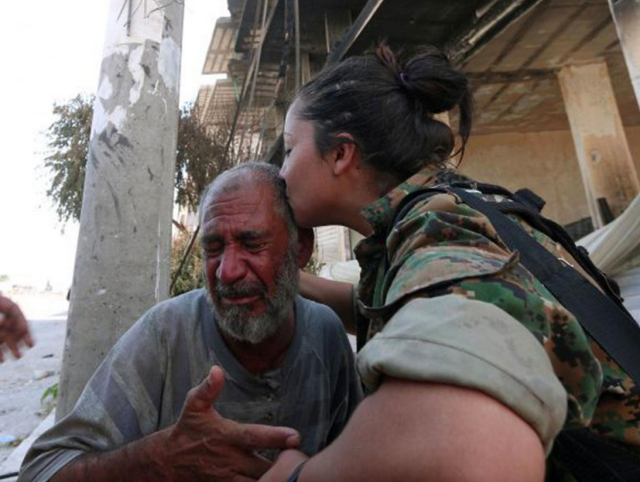
Civilians freed by Syrian Army
[1] United Nations Security Council, Conflict-related sexual violence Report of the Secretary-General 23 March 2015: https://www.un.org/en/ga/search/view_doc.asp?symbol=S/2015/203. United Nations Security Council Report of the Secretary-General on Conflict-Related Sexual Violence, 20 April 2016, S/2016/361 http://www.peacewomen.org/node/94106.
[2] I do not take propose to take issue with any of Forestier’s reporting of testimonies, even though her methodology is unclear. (For instance, she mentions that three interviews with survivors ‘were excluded because they seemed exaggerated or false’ yet she does not explain how she decided whose word to give how much credence to, particularly in cases where she was speaking through a translator via phone to someone she hadn’t met.)
[3] The source she cites is UN Human Rights Council, Report of the Independent International Commission of Inquiry on the Syrian Arab Republic, A/ HRC/31/68, 11 February 2016, http://www. ohchr.org/Documents/HRBodies/HRCouncil/ CoISyria/A-HRC-31-68.pdf. (Having checked that source I find the only mention of thousands of people refers to ISIS crimes. I could not find any statement remotely resembling her claim, and I would readily correct the record here if she can direct me to it with a page reference.)
[4] Dara Kay Cohen and Ragnhild Nordas, “Sexual Violence in Armed Conflict: Introducing the SVAC dataset, Sexual Violence in Armed Conflict: Introducing the SVAC dataset, 1989−2009”, Journal of Peace Research 51(3) (2014), 418-428.
[5] This assumption is manifest, too, in her claim – made much of in the press reporting of her paper – that sexual assault in detention was so routine that contraception was supplied. Damning as this may be, assuming it is true, it does not self-evidently suggest that those assaults were part of a policy as distinct from an atrocious practice. It could in fact be taken to suggest a desire of perpetrators to prevent evidence of violations coming to light. A related claim involves the testimony of a victim that her attacker used Vaseline. Forestier takes this, along with the contraception, to ‘indicate that rapes followed a regular pattern that involved some degree of organisation and were part of a broader state policy of widespread repression against the civil population.’ Since the organization required is that of a visit to a pharmacy, and we can have no idea how widespread the practice was, we cannot simply infer what Forestier claims about a ‘broader state policy’.
[6] At one point she asserts that ‘when soldiers or militiamen raped women during military operations, this was part of the attack against their adversaries and their relatives. Thus, rape can be considered as part of a general policy from the authorities.’ But the inference stated after her ‘thus’ is a non sequitur: she provides no reason to think such attacks follow from a policy rather than opportunism or vindictiveness.
[7] The presumption has to be defeasible, but it seems clear that simply to presume the contrary would be imprudent. For a discussion see e.g. Doris E. Buss, ‘Rethinking “Rape as a Weapon of War, Feminist Legal Studies (2009) 17.2: 145-163.
[8] Her puzzling take on the situation is illustrated by a claim like this: ‘the Syrian government has sought to increase antagonism between communities’ and ‘to frame the conflict as a fight between Alawites and Sunnis instead of a struggle for democracy.’ Yet the government owes its resilience precisely to a longstanding and conscious strategy of defusing sectarian tendencies. (The government has consistently framed the conflict as an attack on the secular multi-faith state by primarily Islamist jihadists.) Furthermore, however much a desire for greater democracy may originally have motivated the political opposition, the conflict that has ensued was taken over by jihadists committed to imposing the most anti-democratic regime imaginable.
[9] A fundamental tenet of Kurdish nationalism, as articulated by PKK (Kurdistan Workers’ Party) founding leader Abdullah Öcalan, is that ‘a country can’t be free unless the women are free’. This political philosophy – given the name ‘jineology’– is embraced by the movement and its fighters, about a third of whom in the Kurdish region of Syria are women.
[12] Daily Mail 26 March 2015 http://www.dailymail.co.uk/news/article-3011838/Syria-s-female-tank-drivers-Battalion-800-women-commandos-fierce-clashes-rebels-line-Damascus.html#ixzz4ZnIjB3tT
[13] Fabrice Balanche, quoted by France 24, 2 April 2015: http://www.france24.com/en/20150402-syria-women-soldiers-assad-army-propaganda
[14] Given its status as a Working Paper, the academic community is aware that Forestier’s claims have not been peer-reviewed. The wider world does not observe such niceties. The Daily Mirror, The Daily Mail and The Times did not. Most tweeters do not. They all present it as coming from the prestigious LSE. Which is fair enough, given that it features conspicuously on the LSE website. Since LSE has promoted this paper, there is a case for saying they should own it and answer for it. If my argument in this post is correct, there is a case for suggesting they should retract it.
2nd Jewish Cemetery Vandalized; But Those Shedding Tears Seem to have Short Memories
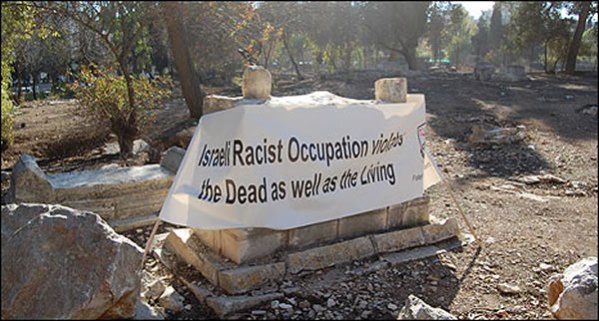
By Richard Edmondson | Fig Trees and Vineyards | February 28, 2017
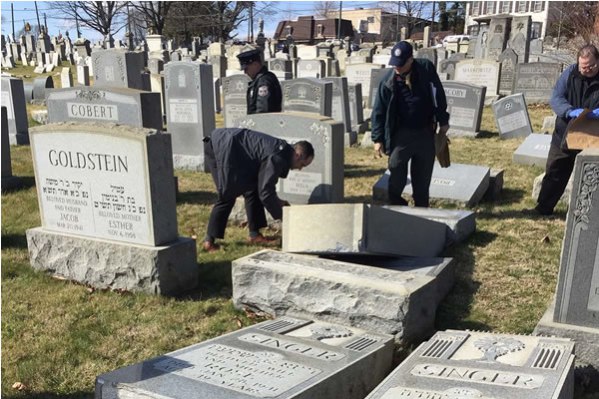
Another Jewish cemetery has been vandalized. According to news reports, some 75-100 headstones were knocked over at the Mount Carmel cemetery in Philadelphia sometime either Saturday night or early Sunday morning.
It is the second vandalization of a Jewish cemetery in a week. The previous one took place at the Chesed Shel Emeth Cemetery, near St. Louis, an incident I reported on in a post several days ago.
“We are horrified by the desecration at Mount Carmel Cemetery,” said Nancy K. Baron-Baer, a regional director for the ADL, in commenting on the latest attack.
Other Jews seem to be equally horrified. The Anne Frank Center, headquartered in New York with an additional office just opened in Los Angeles, issued a statement similarly impassioned–if not more so.
“WE ARE SICKENED, SICKENED, SICKENED,” read read the group’s rather unrestrained outpouring posted on Twitter. “More Jewish gravestones were found vandalized today, this time in Philadelphia.”
Jewish graves in Philadelphia now vandalized. Stop this incubator of #Antisemitism and other hate. WE BEG YOU @POTUS @realDonaldTrump pic.twitter.com/RHuIjdE2Yg
— AnneFrankCenter(US) (@AnneFrankCenter) February 26, 2017
//platform.twitter.com/widgets.js
In its mission statement, the Anne Frank Center “calls out prejudice, counters discrimination and advocates for the kinder and fairer world of which Anne Frank dreamed.”
And as for the ADL, so horrified and sickened are its officials by recent events they have even put up a $10,000 reward for information leading to the arrest and conviction of the vandals.
“This act is cowardly and unconscionable, and is all the more despicable coming on the heels of a similar vandalism at another Jewish cemetery in St. Louis last week,” said Baron-Baer. “We urge anyone with information on this crime to report it immediately to the Philadelphia Police Department at 215-686-TIPS.”
“I’m so upset,” said Millard Braunstein, who went to the cemetery Monday morning and discovered his mother’s headstone is one of those that had been knocked down.”This is such a terrible thing.”
“It’s just very disheartening that such a thing would take place,” said Aaron Mallin, another man with a relative buried in the cemetery.
And a Philadelphia rabbi who has also visited the cemetery and seen the damaged grave sites seems particularly heavy of heart.
“After you start walking from row to row it quickly moves from a random act of vandalism to something with larger intentions and a systematic approach to things,” said Shawn Zevit, the rabbi at the Mishkan Shalom synagogue.
While desecration of a cemetery is a despicable act, one wonders if any of these people bothered to voice their concerns over the desecration and paving under of a Muslim cemetery in Jerusalem. And if Zevit is concerned about the “systematic approach” taken by the vandals in Philadelphia (who damaged a mere 100 graves) he should stop and reflect that it doesn’t even begin to hold a candle to the “systematic approach” taken by the Israelis at the Mamilla Cemetery. Here is a bit from Wikipedia:
Mamilla Cemetery is a historic Muslim cemetery located just to the west of the walls of the Old City of Jerusalem, Israel.[1][2]The cemetery, at the center of which lies the Mamilla Pool, contains the remains of figures from the early Islamic period,[3]several Sufi shrines and Mamluk-era tombs.[1] The cemetery grounds also contain the bodies of thousands of Christians killed in the pre-Islamic era, as well as several tombs from the time of the Crusades.
Its identity as an Islamic cemetery is noted by Arab and Persian writers as early as the 11th century.[4] It was used as a burial site up until 1927 when the Supreme Muslim Council decided to preserve it as a historic site.[1]
Following the 1948 Arab–Israeli War, the cemetery and other waqf properties in West Jerusalem fell under the control of Israeli governmental bodies.[5] A number of buildings, a road and other public facilities, such as a park, a parking lot and public lavatories have since been constructed on the cemetery grounds, destroying grave markers and tombs. A plan to build a Museum of Tolerance on part of the cemetery grounds, announced in 2004, aroused much controversy and faced several stop work orders before being given final approval in July 2011.
The “Musem of Tolerance” mentioned by Wikipedia is a facility the Simon Wiesenthal Center is seeking to build in Jerusalem as a companion to its museum of the same name in Los Angeles. Ironically the Simon Wiesenthal Center is among those now expressing concern over the vandalization of Jewish cemeteries in the US.
“Attacking a cemetery, especially one that is all-Jewish, all-Catholic, or whatever it is, is basically an attack on the culture, the identity of the people that cemetery represents,” Aaron Brietbart, a Simon Wiesenthal researcher, told the Washington Post following the attack on the Jewish cemetery in Missouri.
Compare Brietbart’s remarks to those of another Simon Wiesenthal official, Rabbi Marvin Hier, who insisted to the BBC in 2008 that construction of the Museum of Tolerance–on top of the Mamilla Cemetery–was an appropriate use of “derelict land.”
“Jerusalem is a city built on top of thousands of bones – Jewish and Muslim,” Hier said. “If we declared the whole of Jerusalem one huge cemetery, we’d never be able to build anything.”
The Museum of Tolerance seems to be rather aptly named–since what we are being ordered to show tolerance for in large part is the Simon Wiesenthal Center’s hypocrisy.
You’ll also note–in the tweet above–that the Anne Frank Center demands President Trump “deliver a prime-time nationally televised speech, live from the Oval Office, on how you intend to combat not only #Antisemitism and #Islamophobia and other rising forms of hate.”
All well and good perhaps, but why doesn’t the Anne Frank Center seem concerned about the Islamophobia running rampant in the state of Israel? Surely apartheid, walls, occupation, home demolitions, and cemetery desecrations are not part of the “kinder and fairer world of which Anne Frank dreamed.”
Perhaps instead of delivering a live speech from the Oval Office on anti-Semitism or Islamophobia, Trump should call his advisors together to develop a national strategy for dealing with the Jewish inability to self-reflect.
And finally, one other point before closing: the fact that Muslims in America have raised money to help pay for damage done by vandals at Jewish cemeteries is, in light of attacks upon the Mamilla Cemetery in Jerusalem, ironic to say the least. After the destruction at the cemetery in Missouri, US Muslims rallied with a very successful crowdfunding campaign. Now it seems they are doing it again. Here is what is being reported by CNN:
Once again, dozens of Jewish headstones have been vandalized, stoking fears of heightened anti-Semitism. And once again, members of the Muslim community are rallying to help.
The latest spate of destruction came over the weekend at the Mount Carmel Cemetery in Philadelphia, where 75 to 100 tombstones were toppled over. A week earlier, at least 170 headstones were damaged at a Jewish cemetery in St. Louis.
Muslim activist Tarek El-Messidi, who had started a fund-raising campaign to help clean up the St. Louis cemetery, sprung to action again after the Philadelphia attack.
“I want to ask all Muslims to reach out to your Jewish brothers and sisters and stand together against this bigotry,” he wrote on Facebook.
“Last week, our Muslim community raised money for the vandalized Jewish Cemetery in St Louis. Since we raised well above the goal, we can now use extra funds to help here in Philadelphia.”
As of Tuesday morning, the campaign had raised $138,000 — nearly seven times the original goal of $20,000.
El-Messidi said he immediately visited the Philadelphia Jewish cemetery and offered his support after hearing the news. After all, Muslims can relate to the feeling of racial intolerance.
And here is a little more from the Wikipedia article on Mamilla Cemetery:
At the time of Israel’s assertion of control over West Jerusalem in 1948, the cemetery, which contained thousands of grave markers, came under the administration of the Israeli Custodian of Absentee Property and the Muslim Affairs Department of Israel’s Ministry of Religious Affairs.[1][5][28] By the end of the 1967 war that resulted in the Israeli occupation of East Jerusalem, only a handful of broken grave markers remained standing.[1] A large part of the cemetery was bulldozed and converted into a parking lot in 1964 and a public lavatory was also built on the cemetery grounds.[19][29][30]
In the 1950s, the Ministry of Foreign Affairs, sensitive to how the treatment of waqf properties would be viewed internationally, criticized government policy towards the cemetery.[28] A ministry representative described the vandalism to tombstones, including their use by the guard appointed by the Religious Ministry to build a henhouse beside his shelter in the cemetery, and the destruction of ancient tombs by bulldozers cleaning the Mamilla Pool.[28] Noting the site constituted waqf property and lay within sight of the American Consulate, the ministry said it viewed the situation, which included plans for new roads and the parceling out of portions to private landowners as compensation for other properties confiscated by the state, with deep regret.[28]
Israeli authorities bulldozed several tombs in the cemetery, including some of those identified as Frankish by Clermont-Ganneau, to establish Mamilla Park (or Independence Park) in 1955.[22] Two of the largest and finest tombs survived, though the lid of one was overturned when it moved from its original spot.[22] The other is the Mamluk era funerary chapel known as al-Kebekiyeh (or Zawiya Kubakiyya), now located in the eastern end of Independence Park.[22][23]
Besides Independence Park, other parts of downtown Jerusalem erected on the cemetery grounds include the Experimental School, Agron Street, Beit Agron, and Kikar Hahatulot (Cats’ Square), among others.[18] Government buildings on the cemetery grounds include the main headquarters of the Israeli Ministry of Trade and Industry,[1] and the Customs Department building, which is said to be located on what was once the site of the chapel dedicated to St. Mamilla.[31]
In 1992, the Custodian of Absentee Property sold the cemetery grounds to the Jerusalem Municipality, a sale the Mufti of Jerusalem, Ikrema Sabri, said they had no right to make.[32] The Israeli Electricity Company destroyed more tombs on 15 January 2005 in order to lay some cables.[1]
A major protest against attacks upon the cemetery took place in Jerusalem in 2008. Here is what the BBC reported:
Earlier this week hundreds of Muslims – young and old – marched through the centre of Jerusalem towards the city’s Mamilla cemetery.
Police helicopters flew overhead and security was tight. The focus of the march, and of increasing Muslim anger, was the Israeli Supreme Court decision to sanction a controversial new building on part of the Muslim cemetery.
And finally a bit more from Wikipedia:
On 9 August 2010, 300 Muslim gravestones in the cemetery were bulldozed by the Israel Lands Administration (ILA) in an area US Jewish human rights activists said was very close to the planned site for the Museum of Tolerance.[41][42] A reporter from Agence France Presse witnessed the destruction of 200 graves until the work was briefly suspended while the court heard a stop work petition it rejected, allowing demolitions to continue that same day.[41] The judge later issued an order prohibiting harm to ancient graves and mandating that the ILA coordinate work with the Israel Antiquities Authority and representatives of the Islamic Movement.[42]
The Jerusalem city council issued its first official response in a written statement on 12 August, saying that, “The municipality and the (Israel Lands) Authority destroyed around 300 dummy gravestones which were set up illegally in Independence Park on public land.” It said these “fake” gravestones were not erected over any human remains and were placed in the park in an effort to “illegally take over state land.”[41]
Mahmud Abu Atta, a spokesman for the Al-Aqsa Foundation, denied the city council’s claim that new tombs were added illegally. He said that between 500 and 600 tombs had been renovated in total “with the municipality’s agreement,” that “some of the tombs had to be totally rebuilt,” but that “all the tombs that we built or renovated contain bodies.”[41]
Twenty graves were completely destroyed or had their tombstones removed by vandals in January 2011.[43] On the night of 25–26 June 2011, about 100 gravestones in an intact part of the cemetery were destroyed by Israeli bulldozers.[19][44] Footage filmed by local media and activists appeared on Al Arabiya and Al Jazeera and showed the bulldozers pulling out quickly after realizing they were being filmed; Israeli officials made no comment on the incident.[45]
Later that same year, fifteen gravestones in the cemetery were spray painted red with racist slogans reading “Death to the Arabs”, as well as “price tag” and “Givat Asaf“, the name of an Israeli outpost slated for demolition.

The Mamilla graveyard (shown in the background) as it appeared in 1948
Though the statements from the Anne Frank Center and some of the other Jews quoted in this article are rather amazing, perhaps the Academy Award for hypocrisy goes to an Israeli official by the name of Emmanuel Nahshon. A spokesperson for the Israeli Foreign Ministry, Nahshon tweeted the following in response to the attack on the cemetery in Philadelphia:
#Philadelphia Jewish cemetery desecration is shocking and a source of worry . Full confidence #US authorities catch and punish culprits .
— Emmanuel Nahshon (@EmmanuelNahshon) February 26, 2017
Featured Video
American Military Failure in Afghanistan
or go to
Aletho News Archives – Video-Images
Frlom the Archives
The Fiction of the Jewish History in Palestine
By Hasan Afif El-Hasan | The Palestine Chronicle | April 8, 2011
Prime Minister Benjamin Netanyahu told NNC Pierce Morgan on March 18, 2011 that he might agree to a Palestinian state through negotiations. And he added, “We will make territorial concessions although it is very painful to do that in our ancestral land.” Netanyahu was not talking about Poland where his ancestors lived. He was talking about Palestine where generations of its indigenous population ancestors lived, cultivated the land and are buried.
By the end of the nineteenth century, Zionism created a new Jewish identity of blood and soil. To mobilize their followers and supporters and appeal to their emotions, the Zionists created myths. Zionism started as a tribal religion without god, but in order to fulfill its function as a unifying force, Zionism required external religious and race symbols, not inner content. Its leaders regarded metaphysical religious belief and purity of race as having value in itself. They created a divine paradisiacal state of merger with the gods. Despite his non-religious ideology, Herzl’s writings were replete with religious references. The Jews should settle in Palestine because, in his words, “the Temple will be visible from long distance, for it is only our ancient faith that has kept us together”.
The Zionists and their supporters have invested tremendous financial and scholarly resources to work within the Hebrew Bible historical narratives to affirm the links between the intrusive Zionist population and the ancient Israelite past, and by doing so assert the right of that population to the land. The political end-game shaped the investigation and the outcome. Tracing the roots of Israel’s ethnic state in biblical antiquity is effectively to silence the indigenous Palestinian claim to the past and therefore to the land. The Biblical scholarship employs a bewildering array of terms for the region: “the Holy Land”, “the Land of the Bible”, “Eretz Israel”, “the Land of Israel”, or “Judah and Samaria.” To the casual reader these names appear interchangeable, but they all imply connection to ancient Israel.
Biblical narratives or poems that cannot be supported by archeology and common sense are treated by the Zionists and their supporters as historical language. … continue
Blog Roll
 Aletho News
- Lawyers’ groups demand end to British military bases in Cyprus
- CIA Assessment: The Resistance Cannot Be Crushed
- Hezbollah Returns: It Didn’t Start a War, It Is Ending One
- EU states seek ‘talks’ with Iran for access to Strait of Hormuz: Report
- Trump on Hormuz: “Others must take care of it” after US falters
- Who Is closer to collapse?
- A War that Backfired: Why the US-Israeli Campaign Is Strengthening Iran
- How Zionist Control Is Hurting US Interests
- Iran warns it may target US missile launch sites in UAE cities
- American Military Failure in Afghanistan
- If Americans Knew
- As US-Israel war on Iran rages, Gaza faces massive dust storm – Not a ceasefire Day 156
- No let-up in attacks on Gaza as Israel takes on Iran, Lebanon – Not a ceasefire Day 155
- ‘Of Course’: IDF Drops Case Against Soldiers Accused of Raping Palestinian Prisoner
- Don’t Fall for the Regime Change Talk. Israel Is ‘Mowing the Lawn’ in Iran
- Will Israel and the US wreck the Gulf States along with Iran?
- US so far burned through ‘years’ of munitions in Iran war: Report
- How the Israeli Tail Wags the American Dog
- Outdated intel likely led to deadly U.S. strike on Iranian elementary school, sources say
- Pentagon insider says high U.S official Douglas Feith reported to Netanyahu
- In fond memory of Walid Khalidi, the historian of Palestine
- No Tricks Zone
- Storing Green Energy To Last Germany 10 Days Would Require A 60-Million Tonne Battery
- New Studies: UK Sea Levels Were 4 Meters Higher Than Today During The Mid-Holocene
- Destructive Green New Deal: German Energy And Metal Group Warns Of Drastic Crisis
- New Study Documents A 20-Year Pause In Arctic Sea Ice Decline – Driven By Internal Variability
- Wake-up Call: Survey Shows Majority Of Germans Now Favor Postponing Climate Targets!
- Televised! Leading German Political Candidate Tells Schoolchildren CO2 Makes Sun Hotter!
- New Study: A Century Warming Of 1.1°C Is ‘Commonplace’ And ‘Not Unusual’ During This Interglacial
- New Study: ‘Internal Noise’ And Volcanic Forcing Can Trigger 10-15°C Warming Within Decades
- Glaciers Worldwide Are Suddendly Surging, Experts Blame Warming!
- Surprising Discovery: Sahara Is Greening…Billions Of Trees Where Once Thought To Be Barren
 Aletho News