American civil war is good for world peace
By M K Bhadrakumar | Indian Punchline | March 22, 2017
The civil war in Washington between President Donald Trump and his detractors shows no signs of abating. Every day becomes a fresh start in the fighting. The latest salvo has been Monday’s hearing at the US House of Representatives Intelligence Committee where the Director of the Federal Bureau of Investigation James Comey acknowledged the existence of an on-going investigation by his agency over suspected Russian interference in the US presidential election with hacking to help the then Republican candidate Trump win the White House.
True, no smoking gun was produced by Comey, but his testimony implied that investigations are continuing. We may expect that many more such hearings are in the pipeline. A “big grey cloud” has appeared out of nowhere, as the chairman of the House Intelligence Committee Devin Nunes put it. The cloud will lift only if the various inquiries going on conclusively absolve Trump or, alternatively, if Trump leaves office, whichever comes first.
Such inquiries have a way of mutating, while moving ponderously, slowly in the cesspit tank. Comey admitted that it is difficult for him “to give you a timetable as to when it will be done.” Then, there is also a sub-plot – Comey himself is under investigation by the US Justice Department.
The next big day will be March 28 when two colorful personalities in the US intelligence system during the Obama administration – the ex-director of national intelligence James Clapper and the ex-CIA director John Brennan – will appear before the House panel. Both were instrumental in the January assessment that the Russians had interfered in the US presidential election in an attempt to benefit Trump. Clapper has a proven record of lying under oath, while Brennan is Barack Obama’s poodle. Trust both to resort to innuendos against Trump and mates, hitting them in the loins where it hurts. (Watch it “live”.)
To my mind, this is about the appropriate time to begin pondering about a world sans America. That is to say, an international system where America has taken “time out”. Is it a good thing to happen? Well, it is already having some salutary effect on the international climate. The global tensions have noticeably eased. If it was commonplace during the Obama era to discuss a potential war between Russia and the US, including a nuclear war, no one wastes breath over such things anymore.
A good case can be made that if the American civil war continues to be fought as savagely by the country’s elites as it has been so far, and if the fratricidal strife continues for another 4 or 8 years — ideally, through the entire Trump presidency — it will be a great boon for the world community. Never again will Americans be able to be preachy that the world cannot do without them. And the ruling elites in countries such as India will also get accustomed to a life without America.
Clearly, America’s “exceptionalism” is getting exposed as total sham. Second, the longer the civil war continues, the less possibility there is for US military interventions abroad. Quite obviously, we saw last week that China could prevail upon the US to be “cool-headed” and not to go to war with North Korea. It seems to me that US Secretary of State Rex Tillerson appeared relieved to agree with the Chinese that there is no option but to continue on the diplomatic track vis-à-vis the North Korea problem.
Again, some degree of predictability is appearing in the US-China relationship, since the last thing Trump wants now is a conflict with China. For us Asians also, it is singularly gratifying that there isn’t going to be a war in the region. This is what the Chinese Foreign Ministry spokesperson said earlier today at a media briefing in Beijing:
- During Secretary of State Tillerson’s stay in China, the two sides arrived at a clear consensus on ensuring a sound development of China-US relations at a new starting point in the spirit of non-conflict, non-confrontation, mutual respect and win-win cooperation. It should not be interpreted as a victory for any party. It is just the right way for China and the United States, two major countries, to get along with each other. Non-conflict, non-confrontation, mutual respect and win-win cooperation summarizes the reason for the steady growth of China-US ties in recent years and is worth carrying forward and being further developed. We would like to enhance communication, mutual understanding and mutual trust with the US so as to properly handle differences, expand bilateral, regional, and international cooperation, and elevate China-US relations to a greater height at a new starting point.
The comfort level in Beijing is palpably rising. Finally, there are some other good signs, too, which are not visible to the naked eye but are no less important. In the civil war conditions in America, with so much dust and noise in the air in Washington, and such poor visibility all around, Trump is quietly able to do a few things on the side, which he had promised to do.
A good friend of mine who watches Syria and Iraq through binoculars 24 x 7, wrote to me a couple of days ago that Trump is doing some incredible things out there in the neighborhood where she lives. Let me succinctly paraphrase her assessment:
- Trump has in fact prioritized the fight against terrorism. He is doing this quietly… The CIA has completely turned off the arms spigot to rebels in Syria and the US is bombing Al Qaeda and its allied groups now – something that Obama avoided (and tried to stop Russia/Syria/Iran from doing.) Equally, Trump is bombing the Al-Qaeda in Yemen too. And in Iraq, Trump is standing by while the Iran-trained Hashd ash-Shabi is annihilating ISIS in western Mosul and cutting off their route to Syria. Obama, on the contrary, had refused to let the Hashd fight in many of these battles. Trump now has not only given the go-ahead, but we have now seen the Iraqi Air Force participate in anti-ISIS bombing raids into Syria. Simply put, if the Obama administration’s policies only had led to the rise of the ISIS and Al-Qaeda in Iraq and Syria, Trump is actually fighting them and, importantly, he is allowing US’ regional foes – Iran and Iran-supported militia groups, in particular – to fight them unimpeded.
Meanwhile, Tillerson is likely to visit Moscow on April 12. As the saying goes, dogs bark but the caravan moves on. The world community cannot possibly ask for more.
Indeed, there will always be disgruntled elements – Brits and Germans, for example. But that is perfectly understandable. They realise that Trump regards them as a lower form of life – worse than leeches or bed bugs. They dearly want Trump to lose in the civil war, and lose very quickly. Without America to lead, they are afraid they might lose their gravitas in world politics. For us, Asians, that is not a bad prospect, either. Hopefully, the curtain is coming down on the “West”, as we knew it in modern history.
Russia Ready to Discuss Nuclear Arsenal Reduction – Lavrov
Sputnik – 23.03.2017
MOSCOW – Russia is ready to discuss the possibility of reducing nuclear arsenals, Foreign Minister Sergey Lavrov said at a Russian Armed Forces General Staff Military Academy lecture Thursday.
“We are ready to discuss the possibility of further reducing nuclear capabilities, but only taking into account all the factors and not just the number of strategic offensive weapons,” Lavrov said.
Meanwhile, he added that Russia is ready for dialogue with the United States on the reduction of strategic nuclear weapons and believes that more countries need to be involved in the process.
“We are ready, but the conversation must be conducted taking into account all factors that affect strategic stability,” Lavrov said at a Russian Armed Forces General Staff Military Academy lecture.
He underscored the need to wait for Washington to finalize its priorities in the area, and stressed the need for more countries’ involvement in the reduction of nuclear arms.
Both Russia and the United States agreed in 2010, under the New Strategic Arms Reduction Treaty (START) treaty, to decrease the number of deployed nuclear warheads to 1,550 and the number of deployed missiles and bombers to 700. The agreement will expire in 2021, and could be prolonged for no more than five years.
US President Donald Trump has been critical of the deal that he regards as “bad” and “one-sided,” raising concerns.
On February 24, Alexey Pushkov, a senior member of the Russian parliament’s upper house, said Trump’s pledge to boost US nuclear capacities could send the world back into the 20th century by challenging all treaties on strategic arms reduction. On February 28, Russian Deputy Minister of Defense Alexander Fomin said Moscow and Washington should work together under the existing treaty.
On March 8, head of US Strategic Command (STRATCOM) Gen. John Hyten said a potential cancellation of the New START could lead to an arms race.
EU foreign policy chief Federica Mogherini said on Monday that the European Union favored deeper cooperation between the United States and Russia on nuclear non-proliferation efforts.
Russia Warns Norway over Missile Defense Plans
By Alex GORKA | Strategic Culture Foundation | 23.03.2017
Russia has warned Norway over consequences of joining NATO ballistic missile defense (BMD) plans. According to Russian ambassador to Oslo, Moscow will retaliate. Norway’s possible accession to NATO’s missile shield «will be a new factor that will be considered in our strategic planning as the emergence of an additional problem in the Arctic region», Teimuraz Ramishvili told the Norwegian state media network NRK.
In 2017, Norway may become a part of BMD. The Norwegian government has appointed an expert group to consider a possible Norwegian contribution to the missile shield. A detailed report on the issue is currently being prepared by experts from the Norwegian Defense Research Establishment and the US Missile Defense Agency to be submitted the year.
Norway has no interceptors on its soil but there are other ways to contribute into the anti-missile plans. Denmark does not host missiles but it committed itself to the bloc’s BMD in 2014, working to equip its frigates with advanced radar systems capable of detecting and tracking ballistic missiles. The missile defense program continues to be implemented despite the fact that after the nuclear agreement with Iran in 2015, there is no rationale for it.
Оslo is a participant in the US-led Maritime Theater Missile Defense Forum. The Norwegian contribution to the missile defense system has not yet been decided on. Even without interceptors, Norway could contribute by integrating into the BMD system its Globus II/III radar in the Vardøya Island located near the Russian border just a few kilometers from the home base of strategic submarines and 5 Aegis-equipped Fridtjof Nansen-class frigates. The Vardøya radar can distinguish real warheads from dummies.
Another radar located in Svalbard (the Arctic) can also be used by US military for missile defense purposes. Senior US officials and politicians have visited the site during the last few years, including former Defense Secretary Ash Carter, former State Secretary John Kerry and Republican Senator John McCain. The radar is installed in violation of the 1925 treaty which states that Svalbard has a demilitarized status. The visitors invented different reasons, like viewing the effects of climate change (John Kerry) or highlighting the plight of polar bears (John McCain) to justify the need to inspect the site.
Installation of BMD sites might potentially undermine the efficiency of Russian strategic nuclear forces as a means of deterrence.
Norway is executing a drastic change in its military policy towards a far more aggressive posture. Even though the country is small, it has the sixth biggest military budget per capita, after the United States, Israel, Singapore and some ‘monarchies’ in the Persian Gulf. The country spends 7.3 billion dollars on the military, more than Sweden (5.7 billion), a country with twice the population. Its geographic position makes it a key element of NATO military planning. The nation’s leading political parties want an increased focus on ‘strategic assets’ like F-35, capable of striking deep into Russian territory, submarines and surveillance capabilities.
Norway hosts 330 US Marines in the central areas of the country, formally on a ‘rotating’ basis. The rotation does not change the fact that the forces are permanently present in Norway. They are deployed at the Vaernes military base, about 1,500 km (900 miles) from the Russian territory, but the training program involves traveling closer to the border. Norway and Russia share a small land border far in the north.
The Marines can be easily reinforced. The US forward storage areas have been upgraded to store cutting edge weapons and equipment for about 16,000 Marines. Building up stockpiles is a key part of US strategy to enhance its capabilities in Europe. There are plans to warehouse tanks, artillery and other fighting vehicles at other locations around the Old Continent.
The only purpose for the deployment is preparation for an attack against Russia. The Marines are first strike troops. The provocative move is taking place at the time the Russia-NATO relationship hit a new low as the bloc’s forces deploy in Eastern Europe and tensions run high in the Black Sea and elsewhere. According to Heather Conley, the director of the Center for Strategic and International Studies’ Europe Program, Northern Europe is now being viewed as a «theatre of operations».
There are other plans to increase US military presence in Norway. According to a report of Washington-based Center for Strategic and international Studies (CSIS), «The former Royal Norwegian Navy base at Olavsvern is ideal for supporting submarine operations in the extreme North Atlantic and Arctic Seas». The think tank believes it may be possible for Norway to nationalize and reopen a portion of the facility to support the rotational presence of US, UK, French, and Norwegian submarines. Olavsvern was NATO’s closest naval base to Russia’s submarine bases along the coast of the Kola Peninsula west of Murmansk.
It was reported last year that a study group from the US Navy visited both Andøya and Evenes airports in northern Norway to see if any of the two airports could be suitable to serve as a base for American P-8 Poseidon patrol aircraft.
The deployment of NATO forces to Norway is clearly a provocative act directed at Moscow. Norway shares a 121 mile border with Russia, while the Russian Northern Fleet is based in the Murmansk region, approximately 100 miles from the border.
Norway has pledged not to host foreign forces on its territory. It had stashed stockpiles of weapons in preparation for a possible conflict, but until recently, foreign troops were allowed into the country only temporarily for training purposes. Oslo had adhered to this principle even at the height of the Cold War.
Shifting away from the «no foreign forces on national soil» policy is fraught with consequences. Turning the national territory into a spearhead for an offensive against Russia inevitably makes Norway a target for a retaliatory strike. Russia did not start it. Actually, very few NATO members take part in the BMD plans. The decision to join would be seen as an outright provocation staged by a neighboring state. By doing so, Norway will deteriorate the relations and greatly reduce its own security which can only be achieved through developing of partnership and strengthening of centuries of good neighborly relations.
Hong Kong: Anglo-America’s Struggling Foothold in China
By Joseph Thomas – New Eastern Outlook – March 22, 2017
Prominent American propagandist Howard French recently published a lengthy editorial in the Guardian titled, “Is it too late to save Hong Kong from Beijing’s authoritarian grasp?,” in which he attempts to buttress an otherwise categorically false narrative surrounding an alleged indigenous struggle for democracy and independence within Hong Kong.

French attempts to hold China accountable for backtracking on an agreement made with Britain over the return of its own territory taken from it by force in 1841. He also attempts to portray Beijing’s crackdown on US-UK subversion in Hong Kong as “authoritarian,” never making mention of the extensive funding and meddling both the United States and the United Kingdom are engaged in within Chinese territory.
The article documents only one side of the so-called “independence” movement in Hong Kong, sidestepping any critical analysis of the colonial background of the ongoing political crisis or the neo-colonial aspects that shape current events even now.
The lengthy piece was paid for by a grant from the Pulitzer Center on Crisis Reporting, a Washington D.C.-based front that collaborates with the New York Times, PBS, NPR, Time Magazine and other mainstays of US propaganda. These are the same media outlets that helped sell the US invasion and occupation of Afghanistan and Iraq, as well as US-led attacks on Libya and US meddling in Syria beginning in 2011. By supporting French’s work, they now help sell to the public a narrative that undermines Chinese sovereignty an ocean away from American shores.
The entire editorial, its contents, author and the special interests that paid for it as well as its placement in the Guardian, represent a continued and concerted effort to maintain an Anglo-American foothold in Hong Kong, part of the last vestiges of Western hegemony within Chinese territory.
The Truth About Hong Kong
Had Howard French penned an honest account of Hong Kong’s recent political crisis, he would have included the extensive, some may say exclusive, control the United States and the United Kingdom exercised over an otherwise fictitious and impossible pro-independence movement. Quite literally every leader of the so-called “Umbrella Revolution” is either directly funded and directed by the US and/or UK government, or possesses membership within an organisation, institution or front funded by Anglo-American money.
The notion that a teen-aged Joshua Wong was single-handedly defying Beijing is preposterous even at face value. He was but one cog of a much larger, well-documented foreign-funded machine aimed at stirring up conflict within Hong Kong, undermine Beijing’s control of the territory and infect Chinese society as a whole with notions of Western-style “democracy.”

Just months before the 2014 “Umbrella Revolution,” one of its leaders, Martin Lee, was literally in Washington D.C., before members of the National Endowment for Democracy (NED), pleading for material and political support for upcoming demonstrations. Toward the end of that same year, and despite NED denying Lee was a protest leader, Lee would find himself in the streets of Hong Kong leading the protests from the front shoulder-to-shoulder with Benny Tai and Joshua Wong.
Ironically, after the protests diminished and were finally pushed off the streets by both local police and impatient residents, Lee, Tai and Wong would be invited to Washington D.C. for a special event organised by NED subsidiary, Freedom House, dubbed, “Three Hong Kong Heroes.” The three protest leaders, having attempted to shake off accusations of being Washington puppets, or even protest leaders altogether, would take to the stage with yellow umbrellas in hand.
Howard French, and others attempting to persuade Western audiences of their version of events in Hong Kong omit these critical facts regarding the foreign-funded and directed nature of the “pro-independence” movement. They do so intentionally, with French himself being a 2011 Open Society fellow, Open Society being one of several fronts the US has channelled money through in support of subversion in Hong Kong.
In reality, there is nothing “pro-independence” about the movement in Hong Kong. It is simply the latest in a centuries-long attempt by Western powers to project geopolitical hegemony into Asia and more specifically, upon China itself.
French’s lengthy lament regarding China’s “authoritarianism” captures what may possibly be frustration that Washington and London’s tricks no longer work, and the more “Umbrella Revolutions” they attempt to organise against Beijing, the more familiar the Chinese public will be with them and subsequently, the more determined they will become to frustrate them.
Additionally, China’s influence over Hong Kong and even across Asia as a whole, is stronger, more sustainable and continuously expanding versus waning Western influence. Spectacular political stunts like the “Umbrella Revolution” attempt to leverage global public opinion over which the US media still maintains considerable influence, but ultimately such strategies have been confounded by Beijing and are, in the long-term, unsustainable.
Hong Kong represents a past, strong bastion of Western colonial power, now struggling to maintain itself even as a minor regional foothold. Despite the efforts of manipulators like Howard French and media platforms that lend themselves to his disingenuous narrative, footholds like Hong Kong will continue to diminish until the last remnants of the West’s colonial past are all but swept from modern geopolitics and permanently assigned to the pages of history.
California Lawmakers Looking To Make Bad Law Worse By Banning ‘False’ Political Speech
By Tim Cushing | TechDirt | March 20, 2017
There’s something to be said for an informed electorate, although it really shouldn’t be elected officials advocating for it. They’d benefit least from people knowing more about sausage and the making thereof. And legislators definitely shouldn’t be robbing the First Amendment to pay for better information, as a few California lawmakers are attempting to do.
A new bill, pointed out by the EFF’s Dave Maass, seems to be a response of sorts to “fake news” and other political detritus of this highly-partisan system. Ostensibly, the bill is aimed at keeping voters from being misled on issues that affect them. The problem is, this bill would allow the government to determine what is or isn’t misleading and apply to a citizen’s social media posts, blog, etc.
California’s existing “political cyberfraud” law (yes, really) already contains wording that forbids cybersquatting, misleading redirects, and otherwise tricking internet users who are seeking information on ballot measures. The existing law is more concerned with acts along the lines of false impersonation and deliberate fraud. The amendment, however, isn’t. It adds a couple of new aspects, both making the bad law worse.
First, the law would no longer be limited to “cyberfraud” related to pending ballot measures. It would expand to protect political candidates from being bested by wily web denizens. Where it really goes downhill is this new clause, which criminalizes even more speech.
SEC. 2.
Section 18320.5 is added to the Elections Code, to read:
It is unlawful for a person to knowingly and willingly make, publish or circulate on an Internet Web site, or cause to be made, published, or circulated in any writing posted on an Internet Web site, a false or deceptive statement designed to influence the vote on either of the following:
(a) Any issue submitted to voters at an election.
(b) Any candidate for election to public office.
With this law, opinions and misinterpretations of ballot measures/candidates’ political stances are now illegal acts. The law goes further than simply punishing the writer of false statements. It also aims to punish publishers (which could be read as punishing hosts who would normally be protected by Section 230) and anyone who shares the newly-illegal content. If anything in the original post hints of political leaning, it can be construed as “designed to influence the vote,” which would make most heated political discussions a breeding ground for criminal communications.
It would seem the “victims” listed in the proposed amendment aren’t really in need of a free speech-abusing law. If California’s government doesn’t like the tone of online posts about ballot measures, it has plenty of opportunities (and numerous platforms) to set the record straight. Worse, it gives the government the power to shut down speech it doesn’t agree with under the pretense preventing voters from being misled.
As for political candidates, they rarely suffer the problem of having too little speech. Bullshit can be countered with more speech, a rhetorical weapon everyone has access to, but political candidates in particular tend to be especially well-equipped in this department.
How the original law managed to survive a constitutional challenge remains a mystery. This addition has zero chance of being found constitutional if it somehow manages to become law.
Land Rights Activist Shot Dead in Brazilian Hospital
teleSUR | March 22, 2017
Waldomiro Costa Pereira, an activist with the Landless Workers Movement, MST, was killed Monday when gunmen stormed a hospital in Parauapebas in northeastern Brazil’s Para state, activists said in a statement.
Five armed men burst into a small town hospital in the Brazilian Amazon, surrounded security guards and shot dead the prominent land rights activist, in the latest deadly attack on land campaigners.
The motive for Pereira’s murder was unclear, the MST said, but the activist had been recovering in the hospital from a previous assassination attempt.
“This is yet another murder of workers in the state of Para,” the MST said in a statement. “Impunity has become commonplace as has the action of criminal militia groups,” the group said, adding that Pereira was a longtime activist in the “struggle for agrarian reform.”
At the time of his killing, Pereira was not active with the MST and was instead devoting his time to advising the local government on agriculture, the activist group said.
Local officials in the city of Parauapebas condemned the murder and police said they were investigating the killing, the Folha de Sao Paulo newspaper reported.
Conflicts over territory are common in Brazil where 1 percent of the population owns nearly half of the nation’s land, according to a 2016 study from the University of Windsor in Canada.
Brazil has become one of the world’s most dangerous countries for land rights activists, with 61 killed in 2016, the highest level since 2003, according to Brazil’s Pastoral Land Commission.
Australia finds no funds diverted in World Vision probe, further debunking Israeli claims against al-Halabi

Samidoun Palestinian Prisoner Solidarity Network – March 22, 2017
In yet another blow to the propaganda-driven case against Palestinian aid worker Mohammed al-Halabi, the Australian Department of Foreign Affairs and Trade reported on Tuesday, 21 March that “an internal review into World Vision funding in Gaza has uncovered nothing to suggest any diversion of government aid funding to Hamas.”
Al-Halabi was seized by Israeli occupation forces at the Beit Hanoun/Erez crossing and in August 2016, Israeli officials, including Prime Minister Benjamin Netanyahu, went on a propaganda offensive, claiming that Halabi had redirected World Vision funds to the Palestinian resistance organization, Hamas. Israeli occupation officials declared that he had diverted $43 million in charitable funds to the Palestinian resistance, including a video from Prime Minister Benjamin Netanyahu accusing Palestinians of not caring about their people. The amounts cited dwarfed the actual budget to which al-Halabi had access, by all accounts. These seemingly impossible claims were made after nearly a month of interrogation, during which Halabi was subjected to torture and inhumane treatment.
The claims against Halabi were accompanied by similarly touted claims against civil engineer Waheed Bursh, a contractor with the UN Development Program, also accused of redirecting resources to the Palestinian resistance – in his case, rubble from the Israeli bombing of Gaza. However, despite the large-scale publicity surrounding Borsh’s arrest, he was released seven months later, indicating that no serious charges were ever made. He was cited as a “witness” againat al-Halabi, and later confirmed that he completely denied any allegations against the aid worker.
“The news DFAT found no evidence of the misuse of World Vison funds comes as Mr Halabi’s trial continues in Israel. He has rejected a plea deal offered by Israeli authorities and has pleaded not guilty, claiming he is innocent of all charges,” reported the Australian Brodcasting Corporation. The plea agreement he rejected would have seen him imprisoned for three years, a short sentence which again indicates a lack of serious charges or evidence in the case.
Indeed, rather than presenting any evidence to back up the widely-publicized public claims against World Vision and Halabi, Israeli occupation officials have instead submitted additional, lesser charges against Halabi that have no relation to diverting funds or his work with World Vision; two such charges are those of “passing information to the enemy” and of “aiding and abetting the enemy in a time of war,” with the enemy in question being Palestinians in Gaza. Al-Halabi is, himself, of course, a Palestinian living under occupation and siege in Gaza.
He is also charged with giving small donations of his own money, rather than redirecting World Vision funds, to charities and mosques in Gaza. ABC notes that “One incident detailed accuses El Halabi of allegedly giving ‘300 Israeli shekels on a monthly base to a charity managed by Hamas’…Another says the defendant transferred ‘hundreds of shekels during 2015-2016 to a mosque managed by Hamas’… No details are given of the ‘millions’ of dollars Israeli intelligence officials initially accused El Halabi of diverting.” 100 NIS is approximately $26 USD.
“So far, our own ongoing forensic audit has not uncovered any money subverted and to hear DFAT say their investigation hasn’t either is consistent and is very good news,” said Tim Costello of World Vision.
Despite the severe lack of evidence or credibility for Israeli claims in this case, World Vision’s work in Gaza – and government funding from the Australian and German governments – have been shut down. Over 100 Palestinian workers for World Vision have lost their jobs in Gaza in an area already suffering from massive unemployment and poverty.
Israeli occupation most malignant in the world, says UN rapporteur
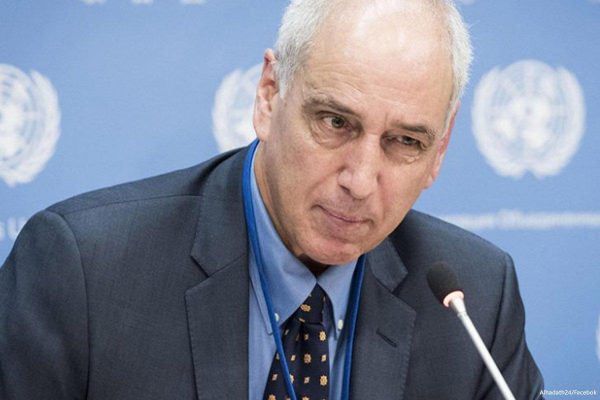
Michael Lynk, Special Rapporteur on the situation of human rights in the Palestinian territories occupied Michael Lynk [Alhadath24/Facebok]
MEMO | March 22, 2017
The UN Special Rapporteur on the situation of human rights in the Palestinian territories occupied since 1967, Michael Lynk, has described the Israeli occupation as “the most malignant” in the world. The Canadian official added that perpetuating an alien rule over almost five million people, against their fervent wishes, inevitably requires the repression of rights, the erosion of the rule of law, the abrogation of international commitments and the imposition of deeply discriminatory practices.
Lynk accused Israel of humiliating the Palestinians and intensifying the crackdown on human rights activists. He presented his report to the UN Commission on Human Rights and Human Rights Council during its latest session on Israel. Israeli and US diplomats boycotted the session dedicated to several UN reports criticising Israeli settlements, the blockade of Gaza and the excessive use of force against Palestinians.
The report also criticised the Palestinian authorities for their violations, including unlawful killings and detentions. It comes after the resignation of the Executive Secretary of the UN Economic and Social Commission for Western Asia, Rima Khalaf, after her report accusing Israel of being an apartheid state was rejected by the international body under pressure from Israel and the US.
The US boycotted the debate on Israel and the occupied Palestinian territories in Geneva on Monday, claiming that the UN Human Rights Council is biased against Israel. The move came after the US administration announced in March that it would review its relationship with the Geneva-based council, in light of its strong focus on Israel, Washington’s ally.
The HRC regularly addresses many areas of tension, including Syria and North Korea. However, Israel is the only state regularly placed on a separate agenda item with numerous human rights reports.
US State Department spokesman Mark Toner claimed in a statement from Washington that the discussion of the Monday session is an additional reminder of the long-standing bias of this body against Israel. “The continued existence of this item on the agenda is among the greatest threats to the council’s credibility,” he added.
Read also:
Israeli forces detain Palestinian, confiscate vehicles in northern Jordan Valley
Ma’an – March 22, 2017
TUBAS – Israeli forces on Wednesday morning detained a young Palestinian man in the village of Ibziq in the northern Jordan Valley region of the occupied West Bank and confiscated a tractor and a private vehicle in the area.
Muataz Bisharat, an official who monitors settlement activity in the Jordan Valley, told Ma’an that Israeli forces, escorted by several Israeli Civil Administration jeeps, detained Mahmoud Muhammad al-Hroub, 23, and confiscated a tractor belonging to his father and a vehicle belonging to Hayil Turkman.
The confiscated vehicles were taken to the Nahal military site in the al-Maleh area of the Jordan valley, Bisharat said.
A spokesperson from Israel’s civil administration declined to comment on the incident.
Bisharat highlighted that Israeli forces had confiscated at least three tractors from the surrounding areas, which are located in Area C — the more than 60 percent of the West Bank under full Israeli security and civilian control — during the past two months.
Palestinian residents of the Jordan Valley regularly face evacuations and interruption due to Israeli military exercises on or near their land. The Jordan Valley district of Tubas is one of the occupied West Bank’s most important agricultural centers.
The majority of the Jordan Valley is under full Israeli military control, while at least 44 percent of the total land in the Jordan Valley has been reappropriated by Israeli forces for military purposes and training exercises.
According to the Palestinian nonprofit the Applied Research Institute – Jerusalem (ARIJ), using data from the Palestine Ministry of Wall and Colonization Affairs, the group reported that more than 400,000 dunams (98,842 acres) of the 720,000 dunams (177,916 acres) that make up the total area of the Jordan Valley has been transformed into closed military and firing zones, with at least 27,000 dunams (6,672 acres) confiscated for illegal Israeli settlement building.
Palestinian legislator Mohammed al-Tal seized by Israeli forces; Samira Halaiqa indicted by military court

Samidoun Palestinian Prisoner Solidarity Network – March 22, 2017
The number of imprisoned Palestinian Legislative Council members climbed to 11 on Tuesday, 21 March after a pre-dawn raid by Israeli occupation forces seized PLC member Mohammed al-Tal from al-Khalil, along with 19 more Palestinians. Al-Tal has previously spent 11 years in Israeli prisons, half of those in administrative detention without charge or trial.
Also on Tuesday, 21 March, an Israeli occupation military court at Ofer submitted an indictment against PLC member Samira Halaiqa, 53, from al-Khalil, accusing her of participating in political and social activities and engaging in “incitement” for making political posts on Facebook. Halaiqa was seized on 9 March by occupation forces who invaded her home. She, along with her husband Mohammed Halaiqa, had previously been imprisoned for one year in 2006 under administrative detention, following her election to the PLC.
Both Halaiqa and al-Tal are part of the Change and Reform bloc, the PLC bloc associated with Hamas.
The 11 detained PLC members include: Khaled Tafesh and Anwar Zboun, both from the Bethlehem area, members of the Change and Reform bloc, seized on Monday, 6 March. Zboun spent over six years in Israeli prison, including several months in administrative detention in 2014. Tafesh, a former deportee to Marj al-Zohour, was also previously held in administrative detention in 2014. Tafesh, Zboun, Halaiqa and al-Tal were all arrested in the month of March.
Other detained PLC members include Hassan Yousef and Ahmad Mubarak of Ramallah and Azzam Salhab and Mohammed Jamal Natsheh of al-Khalil. All members of the Change and Reform bloc, they are held in administrative detention, imprisonment without charge or trial. General Secretary of the Popular Front for the Liberation of Palestine, Ahmad Sa’adat, is serving a 30-year sentence in Israeli prison, while Fateh leader Marwan Barghouthi is serving several life sentences. Jerusalemite PLC member of the Change and Reform bloc, Mohammed Abu Teir, was subject to expulsion from his home city of Jerusalem and is now serving a 17-month sentence in Israeli prison.
Featured Video

Michael von der Schulenburg: Europe’s Self-Defeating Iran War Policy
or go to
Aletho News Archives – Video-Images
Frlom the Archives
Provoking a Path to Persia
The Saban Center’s prescient paper on war with Iran
By Maidhc Ó Cathail | October 20, 2011
In June 2009, the Saban Center for Middle East Policy published “Which Path to Persia?—Options for a New American Strategy toward Iran.” Writing in a tone strikingly reminiscent of the Project for a New American Century’s infamous pre-9/11 paper “Rebuilding America’s Defenses,” the six co-authors noted that, “It seems highly unlikely that the United States would mount an invasion without any provocation or other buildup.” For a think tank specifically established by media mogul Haim Saban to protect Israel, this could prove to be a formidable obstacle impeding their desired march—of U.S. troops—to Tehran.
“In fact, if the United States were to decide that to garner greater international support, galvanize U.S. domestic support, and/or provide a legal justification for an invasion, it would be best to wait for an Iranian provocation, then the time frame for an invasion might stretch out indefinitely,” Saban’s think-tankers ruefully observed.
“With only one real exception, since the 1978 revolution, the Islamic Republic has never willingly provoked an American military response, although it certainly has taken actions that could have done so if Washington had been looking for a fight. Thus it is not impossible that Tehran might take some action that would justify an American invasion. And it is certainly the case that if Washington sought such a provocation, it could take actions that might make it more likely that Tehran would do so (although being too obvious about this could nullify the provocation). However, since it would be up to Iran to make the provocative move, which Iran has been wary of doing most times in the past, the United States would never know for sure when it would get the requisite Iranian provocation. In fact, it might never come at all.”
Seemingly undeterred by Iran’s frustrating unwillingness to provide the requisite provocation, the analysts continued to examine this option… continue
Blog Roll
 Aletho News
- Is there even an off ramp?
- Michael von der Schulenburg: Europe’s Self-Defeating Iran War Policy
- Sorry, The New Republic, Climate Change Isn’t Causing Somali Migration. Blame Civil Strife and Poverty.
- Expert Guts Claims That HPV Vaccine Reduces Cancer Risk
- No evidence Russia sabotaged Baltic cables – Finnish intel
- The Strategic Folly of a (Serious) US Ground Invasion of Iran
- US-Israeli war of aggression on Iran meant to reshape region: Omani FM
- Iran Does Not Consider Israel Party to Talks to Need Mediators With It – Ambassador
- Macron’s aircraft carrier and warplanes to the Persian Gulf is a dangerous vanity project
- Meet The Ellisons: Zionists, Technocrats, Moguls
- If Americans Knew
- Are we on the precipice of World War III?
- ‘Catastrophic,’ Says UNICEF: 1,100+ Children Killed or Wounded in Mideast Since US-Israel Launched Iran War
- The Unbelievable Madness of Our War With Iran
- World Council of Churches calls on govts to hold Israel accountable for violations of intl law
- How to end the war on Iran that costs US taxpayers $1M per minute – Not a ceasefire Day 153
- Israeli strategic plans to “remake the Middle East” from the 1950s and since
- Honoring Gaza’s women who refused to let the world look away
- 97% of victims of war on Iran are Iranian, 98% of victims in war on Gaza are Gazans – Not a ceasefire Day 152
- Early Iran strikes cost $5.6 billion in munitions, Pentagon estimates
- Israel Decided the War, But Trump’s America Fights and Pays the Bill
- No Tricks Zone
- New Studies: UK Sea Levels Were 4 Meters Higher Than Today During The Mid-Holocene
- Destructive Green New Deal: German Energy And Metal Group Warns Of Drastic Crisis
- New Study Documents A 20-Year Pause In Arctic Sea Ice Decline – Driven By Internal Variability
- Wake-up Call: Survey Shows Majority Of Germans Now Favor Postponing Climate Targets!
- Televised! Leading German Political Candidate Tells Schoolchildren CO2 Makes Sun Hotter!
- New Study: A Century Warming Of 1.1°C Is ‘Commonplace’ And ‘Not Unusual’ During This Interglacial
- New Study: ‘Internal Noise’ And Volcanic Forcing Can Trigger 10-15°C Warming Within Decades
- Glaciers Worldwide Are Suddendly Surging, Experts Blame Warming!
- Surprising Discovery: Sahara Is Greening…Billions Of Trees Where Once Thought To Be Barren
- New Research Reaffirms Clouds, Aerosols, And Surface Solar Radiation Are ‘Driving The Climate System’
 Aletho News