Swedish NGO’s Head Receives Threats After Claiming White Helmets’ Video Fake
Sputnik – 12.04.2017
Marcello Ferrada de Noli, one of the leaders of the Swedish Doctors for Human Rights non-governmental organization (SWEDHR), said Wednesday he and his colleagues has been receiving threats following the release of their article exposing a purportedly staged video by White Helmets group, a volunteer rescue service operating in Syria.
In the beginning of March, the SWEDHR released an article claiming that the White Helmets’ video of a child reportedly treated after a chemical attack showed fake treatment, including an intracardiac injection done with an empty syringe, which would have killed a child if the baby had not already been dead.
“The threats I receive are anonymous, somewhat non-specific. I see them on Twitter, on social networks, my colleagues also receive them. I feel a lot of discomfort because of this. But I hope that my article, despite all this, will be seen by many people,” de Noli told Rossiya 24 broadcaster.
The professor said that he was simply making public his conclusions that he could prove openly and honestly.
De Noli added that the SWEDHR would continue its work.
Lavrov: Russian, Western Experts Should Make Up Syria Chemical Attack Probe Team
Sputnik – April 13, 2017
MOSCOW – Lavrov told reporters he “sufficiently convincingly” explained to US Secretary of State Rex Tillerson on Wednesday the reasons why a special independent UN and OPCW-based study should investigate the purported attack.
“But, considering the enormous very confrontational resonance surrounding what happened in Syria, we offered to complement these structures with professional inspectors in this field who would be invited from both Western countries, Russia, and regional countries,” Lavrov said.
He said “it seemed to me that Tillerson quite positively reacted to this idea.” Western countries’ reluctance to send experts to the site of a reported April 4 chemical attack in Syria’s Idlib province rely on “excuses” of purported dangers, he said.
Lavrov told a briefing that US, French and UK colleagues “do not pay attention to the fact that they need to visit not only the airfield they suspect was the place where chemical weapons were loaded onto planes, but also the place where these shells were struck.”
“They said ‘we do not know who controls this area, it is not safe to send inspectors there.’ These are all excuses,” he stressed.
Syrian opposition claimed on April 4 forces loyal to President Bashar Assad had used a chemical gas on people in the northwestern province, killing nearly 80 and injuring 200. Assad argued his government has no chemical weapons after agreeing to have them destroyed in 2013. He also ruled out having used chemicals against own people.
The Russian Defense Ministry said next day that the airstrike near Khan Shaykhun was carried out by Syrian aircraft, which struck a terrorist warehouse that stored chemical weapons slated for delivery to Iraq.
Macron, Hamon Should Quit Race After Backing US Syria Strikes – French Official
Sputnik – 13.04.2017
The US attack against a Syrian military airfield launched by President Donald Trump late last Thursday triggered criticism among such French presidential hopefuls as National Front (FN) party leader Marine Le Pen, leader of left-wing political movement Unsubmissive France Jean-Luc Melenchon and the president of Gaullist Arise France party Dupont-Aignan. Socialist Hamon and independent candidate Macron, on the other hand, have expressed their support for the US president’s action.
“Having criticized Trump before and after the election, [German Chancellor Angela] Merkel and [French President Francois] Hollande have approved of this attack, which is [Trump’s] most serious and most dangerous decision on the global scale. They have shown themselves to be completely irresponsible. The same applies to certain candidates at French presidential elections, like Hamon and Macron, the two former ministers of the socialist president. Their reaction is enough to disqualify them from assuming the office they seek, I believe,” Eric Anceau said.
Following the missile strikes, which killed seven people, according to the governor of Syria’s Homs province, Hollande in a joint statement with Merkel placed the blame for the latest developments in Syria on its President Bashar Assad, albeit without providing any evidence of his involvement in the attack.
According to Anceau, Trump’s hasty reaction to the chemical weapons incident is undoubtedly the most dangerous decision he has made since assuming office.
“When one is the head of the most powerful state in the world, one does not make decisions based on emotions, as he admitted to have done after having seen on TV all these dead bodies of children,” he said, adding that the Trump administration should have consulted the US Congress first.
“In his haste, he circumvented the US Congress, which, incidentally, says a lot about the state of the US democracy in particular and our democracies in general,” the spokesman added.
He underlined that unless the strike had an ulterior motive, such as “a desire to affirm one’s power” in regions where other world powers like Russia or Iran are present, Trump’s decision to strike Syria lacks logic.
Following the strikes, Dupont-Aignan, who according to recent polls enjoys support of some 3 percent of French voters, told the French daily Le Monde that the international community had no proof Assad ordered the chemical attack, and because of this, Trump had no reason to order the strike. At the same time, he pointed out that he would back a UN-led intervention in Syria if it is proved that the Syrian government was indeed responsible for the Idlib tragedy.
The Syrian government denied having chemical weapons, as it agreed for its entire stockpile to be destroyed under a 2013 US-Russian deal. The Organization for the Protection of Chemical Weapons confirmed in January 2016 that Syria’s chemical weapons arsenal was destroyed.
Trump Appoints Fiona Hill Russia Adviser on National Security Council
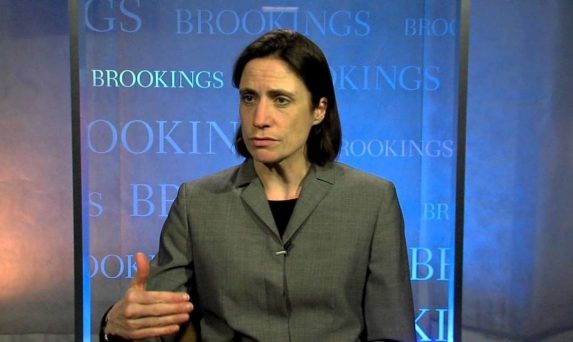
By Alex GORKA | Strategic Culture Foundation | 13.04.2017
Last month, Fiona Hill, a preeminent Kremlinologist and Harvard alumna, joined the National Security Council staff as deputy assistant to the president and senior director for European and Russian Affairs. This is one of the most important positions within government shaping the US relationship with Russia. A dual US-UK citizen, Hill is also a member of the US Council on Foreign Relations, and a member of the board of trustees of The Eurasia Foundation.
The new adviser holds a master’s degree in Soviet studies and a doctorate in history from Harvard University. British-born, she started at Brookings in 2000, taking a three-year break to serve on the National Intelligence Council under the George W. Bush and Obama administrations. Prior to joining Brookings, Hill was director of strategic planning at The Eurasia Foundation in Washington, D.C. From 1991 to 1999, she held a number of positions directing technical assistance and research projects at Harvard University’s John F. Kennedy School of Government. She pursued studies at Moscow’s State Linguistic University (former Maurice Thorez Institute of Foreign Languages).
A frequent commentator on Russian and Eurasian affairs, Fiona Hill boasts an extensive research experience on the Caucasus and Central Asia, among other issues. She is co-author of the second edition of «Mr. Putin: Operative in the Kremlin» (2015). Lashing out at the Russian leader, Hill emphasizes it would be a mistake to underestimate Vladimir Putin.
She is also known for her book «The Siberian Curse: How Communist Planners Left Russia Out in the Cold» (2003). Hill proposed to actually evacuate Siberia and start developing its resources working in shifts. The book was praised by Jeffrey Sachs who had advised Russia to adopt «shock therapy» methods to implement economic reforms, Richard Pipes, a former member of the National Security Council known for his belligerent stance on Russia, and Zbigniew Brzezinski, former assistant to the president of the United States for national security affairs, widely believed to be behind the Obama’s hostile policy toward Moscow.
Being highly critical of Russian authorities in her books, Hill gives them their due pointing out that Russia had to go through the difficult times after the Soviet Union’s break up. She even compared Russian President Vladimir Putin with Franklin Delano Roosevelt and Charles de Gaulle who pulled their respective countries out of severe crises.
While some of Hill’s statements indicate that she is prone to taking a hard line on Moscow, others sound positive, calling for a pragmatic approach. Fiona Hill is immune to the influence of ideological stereotypes and knows how to smooth things over. Her harsh statements about incompatibility of Russia’s foreign policy agenda with long-term US interests will calm down the most suspicious persons who believe Russia to be behind everything that goes wrong». The US and Russia just have a very hard time… being on the same page», she wrote in in the Atlantic. «We’re going to have an awful lot of friction», Hill said. «And Trump isn’t exactly the most diplomatic of people. So I imagine he’ll fall out with his new friend Vladimir pretty quickly», she predicted. Last October, Fiona Hill advocated keeping anti-Russian sanctions in place and rejected the idea of a «grand bargain» with Putin in which the US would «trade concessions» in Ukraine for Russian help in the Middle East.
While President Trump has yet to lay down his Russia policy, most signs suggest no swift changes in the relationship. The president’s decision shows that a major reset is not in the cards. Hill’s appointment came as a relief to Republicans. But as a seasoned scholar, she knows Russia will not become pliant under pressure. She can make cold-blooded calculations and come up with ideas on how to reach deals on issues of common interest. Nobody expects friendship under the circumstances but it could be partnership. Hill is far-sighted enough to realize that.
Fiona Hill can do her job in a professional way without temper tantrums that take place now and then in Washington. A renowned scholar on Russia and an experienced former government official, she was chosen to implement Realpolitik. Her vast knowledge of the country and perfect Russian will come in handy for the job.
Lavrov Explains Why White House ‘Forced’ to Make Unfounded Anti-Russia Claims
Sputnik – 13.04.2017
MOSCOW – The White House is forced to make unfounded accusations against Russia because of pressure from US President Donald Trump’s opponents, Russian Foreign Minister Sergei Lavrov said Thursday.
Wednesday’s talks with US Secretary of State Rex Tillerson helped Washington better understand Russia’s stance and formulate approaches toward fruitful cooperation, Lavrov noted.
“The negotiations with Tillerson were not useless. They, in my opinion, helped the US administration better understand our position. This, in turn, is important for them to formulate their approaches to the issues on which Russia and the US can cooperate productively,” Lavrov told reporters.
“There is not a single fact, although under pressure from Trump’s opponents, the White House is forced to periodically make certain statements with unfounded accusations against us,” Lavrov said at a briefing with his counterpart from Bangladesh, Abul Hassan Mahmood.
On Wednesday, US Secretary of State Rex Tillerson and Russian Foreign Minister Sergei Lavrov emerged from a closed-door summit in the Kremlin to discuss their two-hour meeting with President Vladimir Putin. While the two sides agreed that they “understand each other better,” Moscow and Washington have distinctly different perspectives on what should take place in Syria, specifically as it pertains to Syrian President Bashar Assad’s claims to power.
Russia and the United States will embark on the practical formation of generally agreed dialogue mechanisms, he said.
“These agreements have been reached in principle, we will now probably start the practical formation of these dialogue mechanisms,” Lavrov told a briefing.
Addressing two-hour talks between Putin and Tillerson, Lavrov said “the results will probably not be soon.”
“But at least in operational terms, we agreed to establish dialogue on a number of issues,” Lavrov said.
These include, he said, “an inventory of the problems created by the previous administration in bilateral relations,” mechanisms for the implementation of existing military and political agreements, as well as mechanisms to narrow differences on regional crises, including in Syria.
CNN uses anonymous source to push Syria/Russia ‘chemical attack’ conspiracy
RT | April 13, 2017
An anonymous senior US official told CNN that, while the US allegedly has proof that Damascus is responsible for the chemical incident in Idlib, Syria, it has uncovered no such evidence implicating Moscow, because Russia is wilier in scrambling its communications.
The anonymous official reportedly told the American news channel that the US intelligence community had intercepted communications “featuring Syrian military and chemical experts talking about preparations for the sarin attack in Idlib last week.” While the source failed to provide any concrete details about the alleged communication – such as when it was intercepted or what names or other information it contained – they did note that the US “did not know prior to the attack it was going to happen.”
CNN speculated that the communication had been sent prior to the incident, but was not processed until the US began investigating it.
The source added that “there are no intelligence intercepts that have been found directly confirming that Russian military or intelligence officials communicated about the attack,” but noted “the likelihood is the Russians are more careful in their communications to avoid being intercepted.”
The most specific proof the source could come up with was his observation that Russia has a surveillance drone, which he claimed “flew over the hospital that was treating people injured in the attack.”
CNN suggested that even if the US had evidence of Russia’s involvement, it might not go public with it, as “the US feels right now that it has made the case that Russian support for [Syrian President Bashar] Assad must end.”
The report is the latest in a long series based on anonymous sources – with undisclosed agendas citing vague evidence which is never submitted to public scrutiny – that the mainstream media has deployed to level accusations against Russia. The story that Russia allegedly meddled in the US election has become a dominant narrative for opponents of Donald Trump, who are still trying to explain his surprise victory.
The major media outlets’ eagerness to blame Russia for everything occasionally leads to embarrassment, however. A fairly spectacular example came in January, when the Washington Post was forced to backtrack on a story that falsely claimed Russia had hacked into Vermont’s power grid. The newspaper also sparked outrage in December by touting a list of “Russian propaganda” websites, which turned out to include many respected independent media sources.
The alarming trend is not limited to the US media, however. Last year, the Guardian failed to accurately report on an Italian newspaper’s interview with Julian Assange. The British newspaper falsely painted WikiLeaks’ founder as a Trump supporter who would not criticize Moscow because he was presumably in league with the Russian government.
Some examples go back years. In 2014, the New York Times published photos of armed men, claiming that they were Russian troops on a clandestine mission in Ukraine. The newspaper had taken the images from the US State Department, and both had failed to properly verify them.
Trump Withholds Syria-Sarin Evidence
By Robert Parry | Consortium News | April 12, 2017
After making the provocative and dangerous charge that Russia is covering up Syria’s use of chemical weapons, the Trump administration withheld key evidence to support its core charge that a Syrian warplane dropped sarin on a northern Syrian town on April 4.
A four-page white paper, prepared by President Trump’s National Security Council staff and released by the White House on Tuesday, claimed that U.S. intelligence has proof that the plane carrying the sarin gas left from the Syrian military airfield that Trump ordered hit by Tomahawk missiles on April 6.
The paper asserted that “we have signals intelligence and geospatial intelligence,” but then added that “we cannot publicly release all available intelligence on this attack due to the need to protect sources and methods.”
I’m told that the key evidence was satellite surveillance of the area, a body of material that U.S. intelligence analysts were reviewing late last week even after the Trump-ordered bombardment of 59 Tomahawk missiles that, according to Syrian media reports, killed seven or eight Syrian soldiers and nine civilians, including four children.
Yet, it is unclear why releasing these overhead videos would be so detrimental to “sources and methods” since everyone knows the U.S. has this capability and the issue at hand – if it gets further out of hand – could lead to a nuclear confrontation with Russia.
In similarly tense situations in the past, U.S. Presidents have released sensitive intelligence to buttress U.S. government assertions, including John F. Kennedy’s disclosure of U-2 spy flights in the 1962 Cuban Missile Crisis and Ronald Reagan revealing electronic intercepts after the Soviet shoot-down of Korean Airlines Flight 007 in 1983.
Yet, in this current case, as U.S.-Russian relations spiral downward into what is potentially an extermination event for the human species, Trump’s White House insists that the world must trust it despite its record of consistently misstating facts.
In the case of the April 4 chemical-weapons incident in the town of Khan Sheikhoun, which reportedly killed scores of people including young children, I was told that initially the U.S. analysts couldn’t see any warplanes over the area in Idlib province at the suspected time of the poison gas attack but later they detected a drone that they thought might have delivered the bomb.
A Drone Mystery
According to a source, the analysts struggled to identify whose drone it was and where it originated. Despite some technical difficulties in tracing its flight path, analysts eventually came to believe that the flight was launched in Jordan from a Saudi-Israeli special operations base for supporting Syrian rebels, the source said, adding that the suspected reason for the poison gas was to create an incident that would reverse the Trump administration’s announcement in late March that it was no longer seeking the removal of President Bashar al-Assad.
If indeed that was the motive — and if the source’s information is correct — the operation would have been successful, since the Trump administration has now reversed itself and is pressing Russia to join in ousting Assad who is getting blamed for the latest chemical-weapons incident.
Presumably, however, the “geospatial intelligence” cited in the four-page dossier could disprove this and other contentions if the Trump administration would only make its evidence publicly available.
The dossier stated, “Our information indicates that the chemical agent was delivered by regime Su-22 fixed-wing aircraft that took off from the regime-controlled Shayrat Airfield. These aircraft were in the vicinity of Khan Shaykhun approximately 20 minutes before reports of the chemical attack began and vacated the area shortly after the attack.”
So, that would mean – assuming that the dossier is correct – that U.S. intelligence analysts were able to trace the delivery of the poison gas to Assad’s aircraft and to the airfield that Trump ordered attacked on April 6.
Still, it remains a mystery why this intelligence assessment is not coming directly from President Trump’s intelligence chiefs as is normally the case, either with an official Intelligence Estimate or a report issued by the Director of National Intelligence.
The White House photo released late last week showing the President and a dozen senior advisers monitoring the April 6 missile strike from a room at his Mar-a-Lago estate in Florida was noteworthy in that neither CIA Director Mike Pompeo nor Director of National Intelligence Dan Coats was in the frame.
Now, it is the White House that has released the four-page dossier supposedly summing up the assessment of the “intelligence community.”
An Argumentative Dossier
The dossier also seems argumentative in that it assumes that Russian officials – and presumably others – who have suggested different possible explanations for the incident at Khan Sheikdoun did so in a willful cover-up, when any normal investigation seeks to evaluate different scenarios before settling on one.
It is common amid the “fog of war” for people outside the line of command – and even sometimes inside the line of command – to not understand what happened and to struggle for an explanation.
On April 6, before Trump’s missile strike, I and others received word from U.S. military intelligence officials in the Middle East that they, too, shared the belief that the poison gas may have resulted from a conventional bombing raid that ruptured containers stored by the rebels, who – in Idlib province – are dominated by Al Qaeda’s affiliate and its allies.
Those reports were cited by former U.S. intelligence officials, including more than two dozen who produced a memo to President Trump urging him to undertake a careful investigation of the incident before letting this crisis exacerbate U.S.-Russia relations.
The memo said “our U.S. Army contacts in the area” were disputing the official story of a chemical weapons attack. “Instead, a Syrian aircraft bombed an al-Qaeda-in-Syria ammunition depot that turned out to be full of noxious chemicals and a strong wind blew the chemical-laden cloud over a nearby village where many consequently died,” the memo said.
In other words, to suggest possible alternative scenarios is not evidence of a “cover-up,” even if the theories are later shown to be erroneous. It is the normal process of sorting through often conflicting initial reports.
Even in the four-page dossier, Trump’s NSC officials contradicted what other U.S. government sources have told The New York Times and other mainstream news outlets about the Syrian government’s supposed motive for launching the chemical-weapons attack on the town of Khan Sheikhoun.
According to the earlier accounts, the Syrian government either was trying to terrorize the population in a remote rebel-controlled area or was celebrating its impunity after the Trump administration had announced that it was no longer seeking Assad’s removal.
But the dossier said, “We assess that Damascus launched this chemical attack in response to an opposition offensive in northern Hamah Province that threatened key infrastructure.” Although Khan Sheikhoun was not near the fighting, the dossier presented the town as an area of support for the offensive.
Assuming this assessment is correct, does that mean that the earlier explanations were part of a cover-up or a propaganda operation? The reality is that in such complex situations, the analyses should continue to be refined as more information becomes available. It should not be assumed that every false lead or discarded theory is proof of a “cover-up,” yet that is what we see here.
“The Syrian regime and its primary backer, Russia, have sought to confuse the world community about who is responsible for using chemical weapons against the Syrian people in this and earlier attacks,” the dossier declared.
But the larger point is that – given President Trump’s spotty record for getting facts straight – he and his administration should go the extra mile in presenting irrefutable evidence to support its assessments, not simply insisting that the world must “trust us.”
[In a separate analysis of the four-page dossier, Theodore Postol, a national security specialist at the Massachusetts Institute of Technology, concluded that the White House claims were clearly bogus, writing:
“I have reviewed the document carefully, and I believe it can be shown, without doubt, that the document does not provide any evidence whatsoever that the US government has concrete knowledge that the government of Syria was the source of the chemical attack in Khan Shaykhun, Syria at roughly 6 to 7 a.m. on April 4, 2017.
“In fact, a main piece of evidence that is cited in the document points to an attack that was executed by individuals on the ground, not from an aircraft, on the morning of April 4. This conclusion is based on an assumption made by the White House when it cited the source of the sarin release and the photographs of that source. My own assessment, is that the source was very likely tampered with or staged, so no serious conclusion could be made from the photographs cited by the White House.”]
Investigative reporter Robert Parry broke many of the Iran-Contra stories for The Associated Press and Newsweek in the 1980s.
Chile Must Reciprocate Israel’s Travel Ban says Barred Activist

Anuar Majluf, head of the Palestinian Federation of Chile, during a visit last year to Jerusalem. Nov. 2016 | Foto: Facebook
teleSUR | April 12, 2017
On Tuesday activists throughout Latin America called on Chile to reciprocate after Israel denied entry to a Chilean citizen leading an annual Easter pilgrimage to Palestine.
The head of the Palestinian Federation of Chile, Anuar Majluf, said Israeli officials denied him entry to the occupied West Bank on Monday based on a controversial new law which bans anyone publicly supporting the boycott, divestment, and sanctions campaign against the illegal occupation of Palestine.
“I feel terrible pain because I’m now unable to visit my family’s homeland, as a Chilean citizen with a Palestinian lineage,” Majluf said in a statement.
“On the other hand, I know that what I suffer is nothing compared to the suffering of the many Palestinians who, if they dare to defy Israel’s policies, often end up dead, tortured or in the prisons of the occupation,” Majluf added.
“The Chilean government should act reciprocally and refuse entry to Israeli citizens who come as tourists to Chile. If Israel knew that its repressive actions and laws have consequences, it would be much less likely to enact them,” he continued.
“The international community, and the Chilean government specifically, should at least demand an explanation from the government of Benjamin Netanyahu, and demand that Israel stop illegitimately denying entry to international supporters of Palestinian rights,” Majluf concluded.
Majluf’s call for a firm response was echoed by Saeb Erekat, secretary-general of the Palestinian Liberation Organization, in a letter to Chile’s Foreign Minister Heraldo Muñoz.
“I respectfully ask that you take concrete measures to protect the right of your citizens to visit, work, invest and live in Palestine,” wrote Erekat on Tuesday.
Erekat warned that if Chileans traveling to Palestine continue to be “threatened and treated like criminals” it would be “a tragedy not only for the community but for the future potential of relations between both countries.”
The PLO letter came one day after 16 organizations representing the Palestinian diaspora throughout Latin America and the Caribbean called on Chile to “repair this affront against a Chilean citizen and exercise the principle of reciprocity against a country that breaks all the rules and places itself above the law of all nations.”
Several prominent Chilean politicians echoed the call, asking Chilean President Michelle Bachelet to respond in kind.
“As Chile allows the free entry and passage of Israeli citizens, it is unacceptable that Israel openly violates the rights of Chilean citizens,” said Chilean Senator Eugenio Tuma Zedán on Tuesday.
Chile has one of the largest and oldest Palestinian diaspora populations outside of the Middle East, and in November of this year the nation’s capital, Santiago, will host the first ever Latin American Palestinian diaspora conference
Majluf is the fourth person denied entry into Israel or occupied Palestine in the past week based on the 6-month old anti-BDS law.
Over the weekend, three Swedish citizens and members of a World Congress of Churches delegation were turned back upon arrival at Ben Gurion International Airport, and on Friday Israel refused entry to a U.K. citizen and member of the Palestinian Solidarity Campaign.
However, the Palestinian BDS National Committee noted that the timing of Israel’s banning of Majluf was particularly egregious.
Denying entry to “a Christian who was on a delegation to visit the Holy Land this Easter, is another low for Israel,” said Mahmoud Nawajaa, a spokesperson for the committee.
Featured Video
Rewriting the risk? Inside the government’s vaccine safety messaging
or go to
Aletho News Archives – Video-Images
Book Review
“Davos Can Really Replace the UN”
Inside the book that maps the architecture behind global governance — from the Epstein files to the Pact for the Future
Lies are Unbekoming | April 1, 2026
On June 13, 2019, the United Nations and the World Economic Forum signed a partnership deal to “accelerate the implementation of the 2030 Agenda for Sustainable Development.” That same evening, WEF president Börge Brende — Norway’s former Foreign Minister — had dinner with Jeffrey Epstein at Epstein’s Manhattan townhouse. The Epstein files, released January 2026, contain an exchange between the two from the previous year. Epstein to Brende: “Davos can really replace the UN. C21, cyber, crypto . genetics… intl coordination.” Brende back to Epstein: “Exactly — we need a new global architecture. World Economic Forum (Davos) is uniquely positioned — public private.”
The next day, the UN General Assembly adopted the framework for restructuring global governance.
That sequence — the partnership signing, the Epstein dinner, the candid admission about replacing the UN with a public-private architecture, and then the formal adoption — opens Jacob Nordangård’s The Digital World Brain. Pages two and three. Footnoted to the UN resolution number, the Epstein files, and the General Assembly record.
I keep coming back to it because it captures what this book does that almost nothing else in the independent research space manages. I’ve followed Jacob’s work for years now and interviewed him about his research. Each book peels back another layer of the same institutional architecture, and each time I think he’s reached the limit of what can be documented, the next one goes further. Nordangård doesn’t speculate. He doesn’t editorialize much. He lays institutional actions next to each other in chronological order and lets the pattern announce itself. … continue
Blog Roll
 Aletho News
- REWRITING THE RISK? INSIDE THE GOVERNMENT’S VACCINE SAFETY MESSAGING
- “Davos Can Really Replace the UN”
- NIAID/NIH and USDA Fund Bioengineered Chimeric Influenza Viruses Built Using Pandemic H1N1 Components: Journal ‘Science Advances’
- Hezbollah hits Israeli warship off Lebanon’s coast, sets it aflame
- Iran slams US strikes on B1 bridge, Mahshahr petrochemical plants as ‘blatant acts of state terrorism’
- In letter to UN chief, Araghchi warns of dire consequences of US-Israeli attacks on Iran’s nuclear facilities
- Why the CIA conspiracy to invade Iran with Kurdish militias failed
- Why Are Upbeat US Claims About Mission to Rescue Pilot ‘Highly Questionable’?
- Aircraft destroyed during US ‘rescue’ of downed F-15 pilot cost more than $100 million each
- Washington University removes professor who condemned US-Israeli war on Iran
- If Americans Knew
- In Iran, Israel-US take aim at “reason, research, and freedom of thought” – Daily Update
- US loses planes over Iran, Israel downgrades Lebanon war goals – Daily Update
- Israel Is Blocking Palestinians from Easter at Church Where Jesus Resurrected
- Plot to assassinate Palestinian activist follows harassment campaign promoted by Zionist groups and elected officials
- Prominent New York synagogue hosts presentation on why U.S. Jews should support the ethnic cleansing of Gaza
- Tapper vs. Piker: Is the CNN Anchor Auditioning for David Ellison?
- Shouldn’t Democrats Be Able to Condemn Genocide?
- Israel-US kill negotiators, destroy civilian structures, but Iran’s military capabilities still largely intact – Daily Update
- ‘War crime’: Global condemnation as Israeli ministers celebrate death penalty law targeting Palestinian prisoners
- 7 Ways Israel Is Turning Lebanon Into Gaza
- No Tricks Zone
- An Inconvenient Tree: Uncovered In Alps… Europe Much Warmer Than Today 6000 Years Ago
- New Study Reports A 60% Slowdown In Greenland’s Ice Loss Rate In The Last Decade
- Low Intensity Tornado Wrecks Major Solar Farm, Creating A Potential Toxic Dump
- New Study Finds Warming Saves Lives…Cold Temperatures 12 Times More Deadly Than Excess Heat
- German Science Blog Accuses PIK Climate Institute Of Hallucinating Climate Tipping Points
- Devastating Assessment Of Comirnaty Vaccine By Former Senior Pfizer Europe Toxicologist
- New Study: CO2 Is ‘Effectively Negligible’ As An Explanatory Climate Change Factor Since 2000
- Former Pfizer Toxicologist Dr. Helmut Sterz Tells Bundestag Hearing Pfizer Vaccine Should Have Never Been Approved
- Energy Expert: Germany’s Nuclear Phaseout Was A “500 Billion Euro Mistake”
- New Research: South Australia’s Mid-Holocene Sea Surface Temperatures Were 4°C Warmer Than Today
 Aletho News