The Tiananmen “Massacre”?
The Unrelenting Monopoly Media Agenda
By Wei Ling Chua | Dissident Voice | May 17, 2017
When we search the internet for ‘Tiananmen Square Massacre’, there are hundreds of thousands of hyperlinks to books, news, articles, and videos that describe the event as a “Massacre”; and even the reputable Encyclopaedia Britannica also cites the Western media as sources to describe the 1989 incident as a “Massacre”.
This is despite the fact that, in 1998, Washington Post journalist Jay Mathews reported in the Columbia Journalism Review that “no one died at Tiananmen Square” and that “it is hard to find a journalist who has not contributed to the misimpression”.
In 2004, the Christian Science Monitor revealed that Human Rights Watch decided not to publish their 52-page eye-witness report that confirmed the Chinese side of the story. In 2009, BBC journalist James Miles admitted that he had “conveyed the wrong impression.” CBS journalist Richard Roth also stated in 2009:
“we saw no bodies, injured people, ambulances or medical personnel – in short, nothing to even suggest, let alone prove, that a ‘massacre’ had recently occurred in that place,” however, Roth continues: “after a debrief[ing] on-air by Dan Rather (London office), I made an effort to avoid using the word ‘massacre’”, and acknowledged that he did not “make a point trying to contradict a colleague on the air.”
Are you aware of the circumstances under which these journalists suddenly decided to admit their years of contribution to the “misimpression”? Are you aware that they then tried to change the story from a Tiananmen Massacre” to a “Beijing Massacre” with the odd exception, such as Graham Earnshaw – a Reuters journalist in whose personal memoirs there was not a single word suggesting that he had witnessed any killing by the People’s Liberation Army (PLA) inside or outside Tiananmen Square? As a matter of fact, after witnessing how the PLA took control of Tiananmen Square without injuring anyone, Earnshaw left the Square and walked to one of the alleys where he witnessed how a PLA commander dispersed a crowd. This is a direct quote from Earnshaw’s memoirs:
A PLA commander shouts at the crowd to disperse and warns that his troops will fire if people didn’t go. Still, people hold their ground. The troops lift their rifles and fire above the heads of the crowd.
In fact, there is ample silent evidence in the images produced by the Western media that tells the story of a highly restrained Chinese government facing a protest of a similar nature to ones in the West at that particular stage of economic development. My book, Tiananmen Square “Massacre”? The Power of Words v Silent Evidence (2014; see review) compares dozens of images (silent evidence) from the Western media to their corresponding captions to explain how the power of language can easily overpower the silent evidence that tells the opposite story.
The Western media also lied about the protesters’ desire for a Western-style democracy. The Financial Times journalist James Kynge wrote in 2009 that:
People say journalism is merely a first, rough draft of history. But the problem here is that this draft appears to have been canonised, passing largely unedited into popular conscience. I do question, however, the Western media’s basic assertion that the demonstrations had been “pro-democracy”. Even now, a raft of editorials commemorating the event’s 20th anniversary repeats the mantra that the students were “demanding democracy”.
Former Australian China Desk officer Gregory Clark wrote in the Japan Times (2008) complaining about how none of the media from the USA, the UK, and Australia, including “the New York Times, the usually impartial Guardian and Independent, and the Sydney Morning Herald, are interested in publishing rebuttals.”
The irony is that, after decades of portraying the protesters as unarmed and peaceful, the Guardian decided in 2009 to publish for the first time images of violence against the Chinese military outside Tiananmen Square but using the word “violence” in an ambiguous manner.
Here is an example of how BBC manufactured the perception of a “massacre” without showing their viewers a single clip of a dead person.

In fact, there is further evidence from the work of historians, the WikiLeaks release of U.S. embassy cables, and the National Security Archive’s declassified history, all pointing to the accuracy of the Chinese official story. Unfortunately, to this day, the event is still described by many as a “massacre”.
Given the massive evidence of U.S. false flags and western media stenography of such events — e.g., the explosion of the USS Maine in Havana, the phantom missiles in the Tonkin Gulf, the phantom WMDs in Iraq, and the crude manipulation of gas attacks in Syria to frame the Syrian government — what credibility do western governments and the western monopoly media have? Given that this writer has presented western media recantations and reporting that is contrary to the prevalent monopoly media narrative on what occurred in Tiananmen Square, one must consider what is revealed by the fact that the China-demonizing narrative persists in the West.
Wei Ling Chua is an accredited INS and ANFS Freelance Journalist. He is also the author of Tiananmen Square ‘Massacre’? and Democracy: What the west can learn from China. He can be reached at: wchua62@gmail.com. Twitter: OcastJournalist. Visit Wei Ling’s website.
The Existential Risk of Trusting ‘Intel’
By John V. Walsh | Consortium News | May 17, 2017
In Tom Lehrer’s ballad satirizing former Nazi rocket scientist Werhner von Braun’s cavalier attitude toward the deadly consequences of his work, there’s the line, “‘Once the rockets are up, who cares where they come down? That’s not my department,’ says Wernher von Braun.”
From MAD to Madness: Inside Pentagon Nuclear War Planning is the enlightening memoir by Paul Johnstone, a man who worked in the “department” that decided where “they” would come down. Johnstone labored there during WWII and then from 1949 to 1969, the initial period of the Cold War and the period covered by this book. On Aug. 29, 1949, the Soviet Union caught the world flat-footed when it set off its first nuclear bomb (just over four years after the United States dropped nuclear bombs on the Japanese cities of Hiroshima and Nagasaki).
Thus began the years when frightened children scrambled under their desks by day and were tormented with mushroom cloud nightmares by night. The U.S. and the USSR stood on The Brink over the Cuban Missile Crisis and the Berlin Crisis when The Wall went up. Those years were the initial period of nuclear standoff called MAD (Mutually Assured Destruction).
What Johnstone saw as he went about his duties horrified him – and it should also horrify us. For it is the thesis of the Afterword, by the author’s daughter, the prominent political commentator Diana Johnstone, that after the demise of the Soviet Union, the U.S. moved quickly from “MAD to Madness.”
Madness refers to plans for a knockout nuclear first strike on Russia, aided and abetted by the latest missile defense boondoggle. That was a favorite fantasy of the generals in the post-WWII era. Whether we now live in another era of Madness, when a disabling first strike again dances in the heads of the Elite, or once again in an era of MAD is an open question in my mind. But Paul Johnstone’s memoir is a work of great importance in either case.
Paul Johnstone started out in Henry Wallace’s Department of Agriculture during the New Deal, but was moved to the Department of War after Pearl Harbor. His job was to pick targets for conventional bombs in Japan, although not the targets for the first atom bombs.
When the Cold War commenced, he studied how targets for nuclear weapons should be selected and how much damage The Bomb would do when dropped on various corners of the USSR. He also assessed the damage of Russian nukes landing in various corners of the U.S. He worked at the most august levels of U.S. intelligence: Air Force Intelligence, the Joint Chiefs of Staff and the Office of Secretary of Defense.
Some of Johnstone’s studies became part of the Pentagon Papers, leaked by former Pentagon official Daniel Ellsberg. Johnstone gave the manuscript for this memoir to his daughter, Diana Johnstone, when he was on his deathbed in 1981.
Faulty Intelligence
A central message of the book is the inevitable failure of intelligence. This aspect of the memoir is hard to apprehend in all its facets without actually reading it. Why can “intelligence” not be trusted?

Secretary of State Colin Powell on Feb. 5, 2003
First the intelligence agencies lie – and do so quite consciously when it suits those who command them or the desires of those who command their commanders. Anyone who does not recognize this by now has not been paying attention. Intel did this most notoriously in recent years in the case of the non-existent WMD that led the U.S. to a multitrillion dollar war on the innocent people of Iraq – which we fight to this day even though Barack Obama declared the war “officially” over.
But even when the Intel agencies are trying to make honest estimates, they face other obstacles. This is the major lesson that Paul Johnstone delivers. Let us take a few examples. On the topic of trying to assess the damage done by nuclear weapons either on the USSR or on the U.S., he writes:
–“They (the effects of nuking a target) would be researched, and in time – much time – a lot would be learned about them, although not enough ever to provide the basis for predictive measurements. So men do what men always do. They calculated what was calculable as best they could, and generally ignored, or dismissed with mere mention by name, the factors that, however relevant and crucial, were incalculable. Or they would just make a wild guess. One problem was that whatever the uncertainties, those utilizing the information were rarely in a position to understand its degree of reliability.” (p. 39 of From Mad to Madness, hereafter FMTM)
So the “decision makers” for nuclear war could well be acting on intel that is “a wild guess,” and they would not know it! And here is Johnstone writing on the way that the “wild guesses” and other intelligence estimates come to be made, most notably about enemy capabilities – an essential if one plans to start a nuclear war:
–“I believe that, to anyone who has been deeply immersed in it and then has had the privilege of viewing it with some measure of detachment, military intelligence must seem a world of flickering light, dark shadows, mood music and whispered rumors, half heard against trumpeted accompaniment proclaiming dire threats that imperil us from outer darkness. Shapes are partly perceived at best, most commonly merely implied, often not seen at all, and often what you think you see is really not there at all. There are always some things you know you know, but you never know how many things there are that you have no evidence even to suspect. You do not know how much of what you see is deliberately staged to mislead you.
“What is seldom realized is that there is always a dominant mood that determines, more than the sharpest senses or the most acute reasoning, what you decide is out there and what is going on. Like all the world and all experience, it is kaleidoscopic; and the bits and pieces that flit before your eyes are what you thought you’d see before you looked.
“Always of course there are the true believers. The images immediately before their eyes are God’s own truth. It’s a matter of right or wrong, bright sunlight or utter darkness. Then there are those not fully convinced nor deeply caring, who find it least troublesome to see what others say they see. Like herded sheep they may once in a while say ‘baa,’ but though they may distrust the direction they are driven in, they feel reassured following the path forced on them by the pressure of the bodies next to them.” (FMTM, p. 63)
In other words, in the end, the data and analysis do little more than to confirm pre-existing sentiments and prejudices.
Agenda-Driven Intel
Then there were the “experts” who had their own agenda. A striking example is the “Special Studies Group” set up in the early 1950s in the Air Force Directorate of Intelligence.
Johnstone writes: “It was headed by Steve Possony, a Hungarian émigré who professed to be an expert on Communism in general and the Soviet Union in particular. Steve was the first of several Central European émigrés I met in the next few years who passed as experts on Communist Europe. … Others were Stausz-Hupé, Kissinger, Brzezinski and many lesser lights such as Leon Gouré and Helmut Sonnenfeldt. In every case I felt that they were thinking, consciously or otherwise, as representatives of a lost cause in their native land, and I always believed that they were used by the military because their ‘obsessions’ were so useful.” (FTFM, p.80)
Of course it is not clear who was using whom here. But we can think of a latter day equivalent in Bush 2 time when neoconservatives like Paul Wolfowitz dominated the Pentagon. As they ginned up the War on Iraq, it was all too clear that their loyalty to Israel came into play. For while the wars in the Middle East and North Africa did little to advance the interests of the U.S., costing it blood, treasure and new enemies like ISIS, those wars left in ruins potential adversaries of Israel in its neighborhood. There can be little doubt that the interests of Israel were served by these American “strategic thinkers.”
Johnstone goes on: “The one product of Possony’s group that I most distinctly remember was an annual appraisal of the strategic situation. And the reason I remember it, perhaps, is that every year that appraisal forecast a massive Russian land attack on Western Europe the following year. Several of us began to laugh about it after a while, but the forecast was always intoned awesomely and with superficial plausibility. I do not know whether many people who heard the briefings really believed the forecasts. I suspect many doubted it would really be next year, and thought it more likely the year after or even later. But even doubters approved the forecast because, they reasoned, it was better to err in this direction than to minimize the danger. Above all, it was good to say things that emphasized the need for strong defenses.” (FTFM, p. 80)
Alarmist warnings about impending Soviet invasions of Europe also were helpful in expanding U.S. military budgets.
The issues that Johnstone raises are relevant not only for scholars, but for each and every one of us since our very existence hangs by a thread increasingly frayed by the incessant anti-Russia drumbeat in our media. That drumbeat has reached a neo-McCarthyite crescendo in these days of Russia-gate where politicians crazed by hatred of Vladimir Putin like John McCain or hatred of Donald Trump like nearly every last Democrat hold sway.
A New Era of MAD
The relevance of the memoir is inescapable, and this is laid out with considerable insight in a preface and a postscript by Johnstone’s daughter, Diana, a journalist residing in Paris and a frequent commenter on French and U.S. politics. She is also the author of The Politics of Euromissiles (1984), Greens in the European Parliament – A New Sense of Purpose for Europe (1994), Fool’s Crusade: Yugoslavia, NATO and Western Delusions (2003), and Queen of Chaos: The Misadventures of Hillary Clinton (2015).
She is careful of the conclusions she draws. In addition, Paul Craig Roberts’s Foreword adds a further dimension to the book since he worked with some of Paul Johnstone’s colleagues and also inside the Reagan cabinet when the first Cold War finally came to an end. (Regrettably here we are again – in Cold War 2.0.)
I remain unconvinced only by one conclusion of the book and that lies in Diana Johnstone’s Afterword. One thesis of the Afterword is that we went from the era of MAD back to the era of Madness, that is an attempt at a nuclear first strike, after the demise of the USSR. That may well have been true in the first decade of the Century when Russia was still on its back and China was relatively weak. (Diana Johnstone cites literature from this period to make her case. See also “The End of Mad”.)
George W. Bush was in power then, and the neocons were in the driver’s seat. Bush withdrew from the ABM treaty in June 2002, which opened the door to developing the ever elusive anti-missile system that would make possible a first-strike on Russia and/or China. (At times first strike capability is called “nuclear primacy”.) Those ABM plans persisted and have been implemented right up to the present with their deployment in Eastern Europe nominally against Iran and in South Korea nominally against the DPRK. They are in fact aimed at Russia and China, and no one is fooled by other claims, least of all Russia and China.
But we are now 15 years out from 2002 and Russia’s economy and military are much stronger under Putin. Moreover, China’s GDP was only about 18 percent of the U.S. GDP in Purchasing Power Parity terms in 2002; it is now in 2017 about 120 percent that of the U.S., and the gap grows daily. And of course military power grows out of economic power.
Things have changed. Certainly, the U.S. maintains a vast edge in its military capability, but is it enough for the neocons and neoliberalcons to realistically dream any longer of a nuclear first strike? I doubt it, but the grave danger is that they are living in the past and that their “intel” is telling them that nuclear primacy is still theirs. Why? Because the intel agencies might feel that is what their bosses want to hear.
After all, who wants to abandon past glory. Empires do not have a great track record when it comes to accepting decline. Living in the past is one of the things that might concern us after reading Paul Johnstone’s work. So it is a book of considerable importance for the moment. It warns us of the perilous age in which we live, and it tells us that the need to create a structure of peace in a multipolar world is urgent.
John V. Walsh is a founding member of “Come Home America” and formerly a Professor of Physiology and Neuroscience at the University of Massachusetts Medical School. He can be reached at john.endwar@gmail.com .
Fast and Furious: Now They’re Really Gunning for Trump
The Polemicist | May 17, 2017
Here’s what I saw unfold in the media during the 24 hours from Monday to Tuesday afternoon (May 15-16).
On Monday, I saw blaring headlines throughout the day on Twitter about how Donald Trump had betrayed some “highly-classified” intelligence secrets to Russian Foreign Minister Sergei Lavrov during their meeting last week. I was busy and paid little attention to this news, but I figured Trump must have committed one of his hallmark impetuous faux-pas involving some massive security breach, given the hysterical tone of the coverage.
I awoke Tuesday to read the stories in the New York Times (NYT), and the Washington Post (WaPo), sourced to anonymous “current and former government officials,” recounting that Trump had told the Russians a big secret—the NYT did not specify what, but WaPo identified it as an “Islamic State terrorist threat related to the use of laptop computers on aircraft.” As both papers acknowledge—though WaPo makes the irrelevant point that it would be illegal “for almost anyone in government”—Trump, as president, did nothing illegal in telling the Russians this, and, according to the NYT’s own sources, and to National Security advisor Lt. Gen. McMaster and Secretary of State Rex Tillerson—the only people cited who were actually in the room—Trump “discussed the contents of the intelligence, but not the sources and methods used to collect it.”
Per McMaster: “The president and the foreign minister reviewed common threats from terrorist organizations to include threats to aviation. At no time were any intelligence sources or methods discussed, and no military operations were disclosed that were not already known publicly.” Neither of the articles, and no one cited in them, disputed this. Per WaPo: “He did not reveal the specific intelligence-gathering method, but he described how the Islamic State was pursuing elements of a specific plot and how much harm such an attack could cause under varying circumstances.”
So far, I was seeing nothing to break a sweat over. Is there some problem with notifying Russia—or anyone else, for that matter—of an Islamic State threat to blow up civilian aircraft with laptop bombs? Is the idea that we’re supposed to sit back and let it happen? What sane person wouldn’t be glad this warning was given to Russia, and wouldn’t want Russia to give it to us if the circumstances were reversed? Is this not a routine exchange of threat information in a closed principals’ meeting?
Besides, was there really any great secret here? I had seen a number of reports in the last few weeks that the government was “likely to expand [the] airline laptop ban” and that “U.S. Intelligence and Law Enforcement Agencies believe ISIS” can now “effectively conceal explosives in laptops and other electronic devices.” I’m going to take a wild guess and conjecture that, if ISIS were planning something with laptops on airplanes, the group would have read the same reports and figured out that someone was on to them. So that cat was out of the bag before Trump said anything to Lavrov. And it was not Trump, but the media, who revealed knowledge of this plot publicly, before and after the Lavrov meeting!
No, the big “alarming” deal here wasn’t that Trump revealed the ISIS plot, but that knowledge of it was based on information provided by “a Middle Eastern ally that closely guards its own secrets,” and was shared “without the express permission of the ally who provided it.” Trump committed a “breach of espionage etiquette.”
There was no accusation that Trump said who that ally was, or even that “the intelligence came from a Middle Eastern ally or precisely how it was gathered.” So the only way, this Tuesday morning, we and the Russians knew that some “ally” was involved was because, not Donald Trump, but some anonymous “officials,” through the NYT and WaPo, revealed it to the whole wide world.
Only in the more “granular” detail in the coverage could I find the sinful “breach of etiquette” that Trump supposedly committed, the one and only specific thing Trump was accused of revealing that he shouldn’t have: “the city in Syria where the ally picked up the information about the plot.” Supposedly, by naming the city, Trump gave Russia an “important clue about the source of the information,” and raised “the fear” that, with the name of that city, Russia “could disrupt the ally’s espionage efforts” against ISIS. [my italics]
Another bunch of woulds, coulds, and fears that. After reading this, even I was flabbergasted at how thin this gruel was——and how desperately the media and politicians were trying to make a meal out of it. Republican Bob Corker was quoted about how “compromise[ing] a source is something you just don’t do,” and Democrat Mark Warner about how “inexcusable” it is to “risk sources and methods,” despite the fact that the reports themselves indicate Trump did neither of those things. If it was so terrible for Trump to name a city in Syria to the Russian Foreign Minister in a private meeting, how terrible was it for the media to publicly inform ISIS that they might be harboring a spy in a Syrian city?
In other words, this coverage is another stream of insinuations about what Trump kinda, sorta, but actually didn’t—but the articles themselves did—do.
As Marcy Wheeler aptly put it:
So multiple people learned of this event, and went out and leaked it (which is illegal to do for most anyone besides the President, the WaPo helpfully notes), not just with the WaPo’s two reporters, but with reporters from Buzzfeed, NYT, WSJ, and more. They leaked it to reporters who they presumably knew would then report it, alerting the frustrated ally that Trump had shared the information, which is a blow to that relationship, and also alerting the frustrated ally that they then proceeded to go leak it more. And it’s all based on the blithe assumption that Trump telling Russia about dangers to civilian aircraft is worse than the American media itself informing ISIS about a spy in their midst.
It seemed obvious to me that its main purpose or these stories was to continue fomenting antagonism with Russia, and to perpetuate the notion, taken up enthusiastically and disturbingly by liberals, that the main problem with the omni-incompetent Donald Trump is that he is too friendly with Russia.
Combined with the other fear-mongering article about the North Korean missile test featured on the NYT, I thought media project for the day was to keep the war drums beating, and I was prompted to begin writing something about that.
Then I noticed (thanks to a tweet by Max Blunenthal) that Alan Dershowitz had called the Trump-betrayed-ally’s-secrets-to-Russia story “the most serious charge ever made against a sitting president.” It had been evident to me, in reading the coverage, that there was only one “Middle Eastern ally” (or ally of any region) which has the chutzpah to “warn” the United States “it would cut off access to…sensitive information”—while itself stealing, with impunity, America’s most closely-guarded secrets. As Newsweek reported in 2014: “Israel has been caught carrying out aggressive espionage operations against American targets for decades… They just don’t get arrested very often.” (Also see here, here, and here). There is only one ally about whose “compromise” Republicans and Democrats would be so unanimously concerned, and certainly only one who would have prompted the ridiculous charge by Dershowitz. And within an hour, the NYT confirmed, again via a “current and former American official,” that Israel was the ally in question, the source of the “secret intelligence.”
So now we have the American media explicitly revealing to Russia, ISIS, and the world, the supposedly key piece of information that Trump was being excoriated for even implying.
Now perhaps these “current and former American officials” who are leaking all this ultra-sensitive classified intelligence information are entirely neutral about, or even unsympathetic to, Israel; and perhaps they and the media outlets publicizing their leaks—a few hours after insisting that identifying the secret ally would harm it—put Israel’s name out because they are committed to letting the public know the truth, no matter whom it hurts. Or perhaps these officials and these media outlets are in fact supportive of Israel, and would only publicize information they know that Israel wants revealed (or at least has no objection to revealing). Everyone will have to decide, based on his/her understanding of American-Israeli political and media relations, which of those scenarios is more likely.
I think the latter. I also notice that, in the last week or so, there have been reports in the American and Israeli press that Netanyahu’s “honeymoon with Trump” has “ended abruptly,” that there have been “harsh exchanges” with Trump administration officials who told members of Netanyahu’s team, to their “utter shock,” that the Western Wall was “not your territory but rather part of the West Bank,” and that Netanyahu is now “wary” and increasingly mistrustful of Trump.
Now, to be clear: I do not think that Israel or Zionism has anything to fear from Donald Trump. I never thought that he was going to transform American foreign policy, to make it less interventionist or more focused on the concerns of Americans. But I also think Trump is an inconsistent and impetuous actor, capable of wild swings in policy that are perceived as dangerous even by those powerful interests who think they can keep him under control. I think that is becoming more obvious, and of greater concern to a larger swath of important players.
I suspect this betrayal-of-an-ally-to-Russia story, and the frantic news cycle it has generated, means that Israel is showing its concern. And that is bad news for Donald Trump. Israel is a very powerful player, with its hooks embedded throughout the Deep State apparatus. The frantic news cycle that followed—with another blaring headline a few hours later about how Trump asked Comey to stop the Flynn investigation, a spate of articles about how Trump is a criminal president who might have obstructed justice and betrayed his oath, and an announcement that the impeachment clock is running—means that big guns are blazing, and Trump is now in another realm of trouble.
Three days ago, I endorsed the point, made by Musa Al-Gharbi and others, that it would be virtually impossible for Trump to be impeached. I found Robert Parry’s scenario of a “soft coup” by sectors of the intelligence apparatus very unlikely. Given the make-up of Congress, it would only happen if the Republicans turned against him en masse, and they would only do that if his inconsistency and incompetence were seriously undermining their agenda (as those faults well might). But, since their legislative agenda is going to be so unpopular, they must be able to portray any impeachment as a bi-partisan project of national urgency.
Russiagate has been cultivated by the Democrats and their confected #Resistance to provide a rationale for Republicans to install a more stable and predictable Republican president who will color within the established partisan lines, and with whom the Democrats can more effectively plan wars and Grand-Bargain away Social Security and Medicare. But Russiagate has not yet gained enough traction with Republican congresscritters, who would face a revolt of their Trump voters against any acquiescence to an impeachment driven by Nancy Pelosi, vagina-hatted protestors, and Steven Colbert. If, however, impeachment becomes driven by concern for our betrayed Middle Eastern ally; if Dershowitz is right that “The demographics are clear. Republicans now support Israel much more strongly than Democrats”; and if Mike Pence, Ted Cruz, and the Congressional Israel Victory Caucus take the outstretched hands of concerned constitution- and FBI-loving liberals, then the prospects improve dramatically. (Though you know this to be true, don’t forget: It’s Russia that interferes too much in American politics.)
The Democratic Party and the #Resistance are not going to impeach Donald Trump. The Democratic and Republican Parties can and will if they want to. And, as they never cease proclaiming, what Israel wants, they want.
Fast and furiously, in the course of a single news cycle, the game has changed: Donald Trump has been accused of betraying Israel. Impeachment is possible.
Calling Bullshit!
By Tim Hayward | May 17, 2017
I don’t entirely agree with it. It’s a bit aggressive, a bit crude, to be so direct.
Still, sometimes.
I’m thinking it can sometimes be a proportionate response to how much we have to deal with that is passive aggressive. For instance, the sickening phenomenon that has become so prevalent lately as to acquire a name – cry-bullying. The powerful or privileged making victims of themselves. More specifically, I’m thinking how, every time someone tries to understand some strange anomaly in public life, and this leads to questioning an official narrative of the powerful, the dismissal is ever at the ready: “conspiracy theorist!” [1]
As someone whose job is to be a theorist, I find it hard to see why this is used as a term of disdain: if there is evidently some possible conspiracy, surely it is better to have a theory of what is going on? Theories generate hypotheses that can be tested. That way, knowledge and wisdom lie.
Or should we just take it that conspiring never happens and everything not conforming to what official sources say is all pure coincidence? No matter the odds?
Frankly, I would say, let’s call out these coincidence theorists ! Let’s watch them, aghast, as they pronounce – as I suspect they may have plenty of opportunity over the next day or so[2] – about how any manner of strange circumstances are either inexplicable or purely chance.
But in calling them out, let us not dignify their mendacious contortions with the name of theory, which I would reserve for those who take the trouble to investigate conspiracies.
Let’s call it what it is – bullshit !

Brad Bauman: disgusted by conspiracy theories, and Russia
[1] Some serious scholars of the derogatory term ‘conspiracy theorist’ show how it was coined for a specific purpose of narrative control. See, for an overview, the recent interview with Mark Crispin Miller of New York University: https://www.rt.com/shows/renegade-inc/388411-conspiracy-theories-chilling-effect/ . But be aware: that’s on the RT channel, which is, of course, a hotbed of conspiracy theorizing, with the R standing for, yes, RUSSIA! So maybe Mark is a conspiracy theorist about conspiracy theorizing…
[2] I have particularly in mind today the bringing back into public awareness the unexplained death last year of DNC staffer Seth Rich. Stefan Molyneux has put out an informative video about this: https://www.youtube.com/watch?v=ioBiYxZReTo. There are theories about that terrible event which stand to be tested, and, insofar as it is a matter of public concern, I believe it is better for them to be tested than to be ignored or dismissed.
To be clear, my point is that a theory is worth testing and should not simply be dismissed. Dismissive tactics can involve bullshit. This does not mean that any of the hypotheses dismissed should be assumed true; it just means trying to be clear about what we know as opposed to what we are merely instructed to believe. Conspiracy theorists could themselves engage in bullshit if they try to prop up a theory in the face of contrary evidence. This mistake is presented by narrative correctors as the defining feature of conspiracy theorists. I would say it is what separates a bad conspiracy theorist from a more competent one.

Remembering Maidhc Ó Cathail

By Alison Weir | If Americans Knew | May 15, 2017
I’ve just learned devastating news: Irish investigative journalist Maidhc Ó Cathail is dead.
I met Maidhc (prounounced “Mike”) for the first and only time in 2014. He had traveled from Japan, where he was then living, to Washington, D.C. for our National Summit on the US-Israel “Special Relationship.” I had previously read some excellent articles about Israel-Palestine by Maidhc and had occasionally corresponded with him, so I was looking forward to talking with him in person.
During a few long, relaxed conversations, I found him engaging, principled, and intelligent. He had a bright smile, gentle sense of humor, and seemed to me a truly decent and compassionate human being – and a brave one, as he sought after facts and connections many wish undiscovered.
I never saw him again, but we occasionally corresponded. We didn’t always share the same view of ongoing happenings, but I found him continually seeking to understand the full context of current events no matter where this took him. Such work receives little financial compensation.
Awhile ago Maidhc contacted me about a book of his writings that he hoped to get published. I was immensely impressed by his work and told him that if he couldn’t find a publisher, perhaps If Americans Knew could publish it. He seemed excited about this prospect. Since we have a tiny staff and a multitude of projects, I explained that it would take awhile for us to get to this. I envisioned publishing a book of his strongest articles and hoped to bring it out this year. I fervently wish I had published this book sooner.
Maidhc was an honest seeker, painstaking researcher, and talented writer. He cared deeply about those who are oppressed and victimized and worked to expose and end injustice. I wish the world valued and supported such people. We badly need them. He exposed information about Israel, Palestine, and related subjects that is of profound importance.
Maidhc deserves to be remembered and honored. While luminaries ignored him and are unlikely to mention his passing, the rest of us can and must share his work.
Thank you, Maidhc. I’m so sad you’re gone. May you Rest in Peace and Justice.
Israeli Government Minister calls for assassination of President Assad and war on Iran
By Adam Garrie | The Duran | May 16, 2017
 Israeli housing Minister Yoav Galant has openly called for the assassination of Syrian President Bashar al-Assad. This is the first time an Israeli Minister has called for the killing of the Syrian President.
Responding to unsubstantiated claims that Syria cremates prisoners, Galant stated,
“We are crossing a red line, and in my view the time has come to assassinate Assad. And when we finish with the tail of the serpent, we will reach the head of the serpent which can be found in Tehran, and we will deal with it, too”.
The last part of the quote appears to be a call for war against Iran.
Such a crass and barbaric call to assassinate world leaders has no place in the 21st century.
It is imperative that the United Nations condemns Israel for these despicable remarks.
Deadly rhetoric: Saudi Arabia opens war of words with Iran
By Sharmine Narwani | RT | May 16, 2017
For years the Saudis have waged proxy battles against Iran, with little success. Now, despite this history of losses, Riyadh appears to be mobilizing for an ill-conceived confrontation with the Islamic Republic.
“We know we are a main target of Iran,” speculated Saudi Deputy Crown Prince Mohammed bin Salman (MbS) in an interview early this month.
Then came the threat. “We are not waiting until there becomes a battle in Saudi Arabia, so we will work so that it becomes a battle for them in Iran and not in Saudi Arabia.”
These are fighting words indeed. The Iranians certainly thought so, Defense Minister Hossein Dehghan responding with unusual ferocity: “We warn them (Saudis) against doing anything ignorant, but if they do something ignorant, we will leave nowhere untouched apart from Mecca and Medina.”
In other words, if the Saudis launch direct aggression against Iran, this will be Riyadh’s last war anywhere, ever.
It’s an important line to draw. The Saudis, after all, have been in meltdown since the 1979 Islamic Revolution in Iran saw popular protests dethroning a King (gasp).
And so, for the past 38 years, we have witnessed an increasingly aggressive Saudi Arabia in the region, chasing down Iranian/Shia enemies where there were none. Just look at Yemen, where the two-year Saudi bombing blitz has killed over 10,000 civilians, or Bahrain, where Saudi troops and tanks snuffed out dissent in the Shia-majority state, or Syria, where Saudis send weapons, cash and support to ISIS, Al-Qaeda and other head-chopping extremists. This Saudi hysteria has now touched every corner of the world, and by the $100+ billion Riyadh has invested in radical schools, mosques, and propaganda to indoctrinate an entire generation of Muslims in Wahhabi-style intolerance.
But while the Saudis are hell-bent on thwarting Iranian influence – real or imagined – Riyadh has never dared to take on the Islamic Republic directly.
As former US Secretary of Defense Robert Gates famously noted in a 2010 WikiLeaks cable, the Saudis always want to “fight the Iranians to the last American.” To which he then added, “it is time for them to get in the game.”
Now perhaps, under the direction of a 31-year old princeling, the Saudis are planning to do just that.
Saudi Arabia vs. Iran
Some perspective first on these two Persian Gulf “rivals,” in which I borrow heavily from an earlier interview of mine:
Both Iran and Saudi Arabia are rich in energy resources and have used this rentier wealth to advance their national goals, albeit with vastly differing results. Iran’s economy is focused on diversification away from the energy sector, developing self-sufficiency and becoming a net exporter. Saudi Arabia is import-focused. Iran spends $15 billion per annum on its military – compared to Saudi’s $80 billion – yet has one of the most competent military forces in the region and builds its own hardware. The Iranian political system is Constitution-based, diverse, and representative, with loudly competing political blocs that come with their own media and constituencies. The Saudi monarchy is based entirely on the rule of one family, with no meaningful elections or contesting political bodies, and little freedom of expression in the media. Regarding power projection, Iran favors the soft power tools of diplomacy, trade, and alliance-building based on common worldviews/objectives, whereas the Saudis have expanded their influence far and wide by spreading Wahhabi doctrine through schools, mosques, media and other institutions globally – and by blatantly buying the loyalty of allies.
In the past few years, we have clearly observed how Iran and Saudi Arabia’s nation-building approaches have affected the success of their geopolitical strategies. Both states have experienced existential fears and threats, and their respective alliances have now confronted each other on a few battlefields. Iran has approached the matter of its strategic depth carefully and built alliances with partners that genuinely share the common values of independence, self-determination, and resistance against imperialism. The Saudis, on the other hand, have forged their external alliances with hegemony or dominance as the primary objective – irrespective of the divergent interests and values of allies. There is little contest – one side is a nation- and region-building, while the other flails about with unreliable alliances, propped up by petrodollars and all the strategic brilliance of a sledgehammer.
How can this relationship be classed as a rivalry, when the two don’t even operate on the same playing field? Would Tehran even notice Riyadh outside of OPEC meetings if it weren’t so belligerent at every turn, on every border?
But Prince MbS’s promise to bring “the battle” to Iran must be taken seriously because it will not be launched alone. The Saudi prince’s chest thumping comes courtesy of an upgrade in relations with Washington. US President Donald Trump is enthusiastically pushing billions of dollars in weapons sales to the Saudis, and has chosen Riyadh as the destination for his first official foreign visit, championing the establishment of an “Arab NATO” that partners with Israel to confront Iran.
Don’t expect a conventional military confrontation as the opening gambit, however. The US, Israel and Saudi Arabia are experienced in subversion and sabotage activities against the Islamic Republic, and this is where they are likely to focus their initial efforts.
Last week, Iran’s Supreme Leader Ali Khamenei warned of foreign interference in the lead-up to Friday’s presidential poll: “the security of the country should be fully protected during the elections. Anyone who violates this should know he will certainly be punished.”
Calling for public vigilance, Khamenei outlined short, medium and long-term “enemy” goals in Iran: “to distort the country’s security and trigger chaos and sedition… targeting issues like that of the economy and living conditions of the people… (and) an effort to change the system.”
So how will the Saudis play a role? Riyadh’s hand in this “battle” will likely be seen on and inside Iran’s borders, in the same form we have witnessed in Syria, Iraq, Afghanistan and other theaters flooded with Saudi-backed militants.
Stirring up minority populations
Demographically, Iran is around 60 percent ethnically Persian, followed by a mix of Azeris, Kurds, Lurs, Turkmens, Arabs, and others. Some 99 percent of Iranians are Muslim, more than 90 percent of these Shia, the rest Sunni, and the remaining one percent a mix of Christians, Jews, Zoroastrians, and others.
The main pockets of Kurds are in the northwest on the Iraqi/Turkish borders and in the north-east bordering Turkmenistan – Iranian Kurds are both Sunni and Shia. The second largest ethnicity, Azeris, who are mainly Shia, are also in the northwest on Iran’s border with Azerbaijan and Armenia.
Iranian Arabs who are concentrated in the south near the Iraqi border and the Persian Gulf – as well as around the Strait of Hormuz – are also mostly Shia. Iranian Sunni populations consist mainly of Kurds, Turkmens, and Balochis, and this is the demographic where signs of foreign interference are most notable today.
In recent years, thousands of Iranian security forces have been killed on the border of Iran’s Sistan and Baluchistan province with Pakistan – most recently in April when ten Iranian border guards died in a cross-border terrorist raid.
Reportedly, the operation was conducted by Jaish al-Adl (Army of Justice), a sectarian terrorist group the Iranians say is being directed by the US and Saudi Arabia. The US has traceable ties to some of these groups, notably Jundallah which received Bush-era funds from Washington before being listed as a terrorist organization. That “terrorist” designation, Iran knows, means little. The Mojahedin-e-Khalq (MEK) was listed by the State Department for decades, but then de-listed in 2012 and is today being actively courted by US officials.
Jaish al-Adl is an offshoot of Sipah-e-Sahaba, an anti-Shia extremist group banned in Pakistan, but which appears to continue to enjoy both Saudi and Pakistani support. Sipah leaders are ferried around the border areas with Pakistani guards, and fill their ranks with young graduates of Saudi-funded Deobandi madrassahs rife inside the Pakistani border.
US hands are all over the minority map in Iran too. Media, think tanks and politicians highlight and encourage aspirations of Iranian minorities at every opportunity, and will undoubtedly take a more active role in stirring divisions as tensions escalate.
Cue the Kurds. Both US and Saudi fingerprints are all over this project of inciting a Kurdish rebellion inside Iran. Last June and July, for the first time in 20 years, Kurds in Iran’s northwest clashed with Revolutionary Guards, killing several on both sides.
The Kurdish group involved was the Democratic Party of Iranian Kurdistan (PDKI), a longtime Iranian-designated terrorist organization that announced in 2015 it would take up arms against the state. Not surprisingly, that declaration came shortly after PDKI leader Mustafa Hijri visited congressional leaders in Washington.
A vigilant Iran
American dirty tricks are certainly not new in Iran. Former Kennedy-era State Department official Richard J. Barnet wrote in 1968: “The (US) intervention in Iran in 1953 to unseat Premier Mohammed Mossadeq was America’s first successful attempt in the postwar period to subvert a nationalist government.”
According to Barnet, “Five US agents and seven Iranian intelligence operatives” led by CIA operative Kermit Roosevelt “plotted the coup from a Tehran basement.” They were responsible for “recruiting street mobs to oppose the Mossadeq supporters… With the help of substantial sums, which Roosevelt used for hired demonstrators to whip up the growing anti-Mossadeq mobs, and the support of the Iranian army, heavily dependent on US equipment, the insurgents were able to turn the tide against the intractable premier and to drive him from office.”
Iran is intimately familiar with these foreign machinations and has been vigilantly countering them in the decades since the Islamic Revolution.
This is not the compliant Shah’s Iran – this Iran, today, is an independent, sovereign nation-state that came through an 8-year foreign-imposed war with Iraq and built with its own hands a formidable military deterrent.
As we have seen with Iran’s activities in Syria, Iraq, and Lebanon, the country’s ‘strategic depth’ is a red line – its national borders even more so. After warning the Iraqi government in 2014 that it would take decisive action if ISIS came within 40 kilometers of its border, the Iranian air force – for the first time since the Iran-Iraq war – used F-4 Phantom fighter jets to conduct airstrikes in Diyala province on its western border.
Iran’s armed forces chief Mohammad Hossein Bagheri has also now threatened military action on Pakistani territory unless Islamabad takes control of its borders, saying: “Unfortunately, the Pakistani border area has turned into a refuge and training ground for terrorists hired by Saudi Arabia, with the approval of the United States.”
In a letter this month to the UN Security Council, Iran’s UN Ambassador Gholamali Khoshroo addressed the Saudi threats: “We have no desire, nor any interest, in an escalation of tension in our neighborhood… We continue to stand ready for dialogue and accommodation to promote regional stability, combat destabilizing extremist violence and reject sectarian hatred… We hope Saudi Arabia will be persuaded to heed the call of reason.”
The Saudi princeling Mohammad bin Salman made a novice’s mistake by threatening to bring war to Iran – he put the world on notice. Any Iranian reaction now bears the full legitimacy of international law for a measured retaliation. The Saudi borders are long, its populations restive, and its soldiers have not seen this kind of war. We may yet live to see a Saudi royal eat his words.
Sharmine Narwani is a commentator and analyst of Middle East geopolitics. She is a former senior associate at St. Antony’s College, Oxford University and has a master’s degree in International Relations from Columbia University. Sharmine has written commentary for a wide array of publications, including Al Akhbar English, the New York Times, the Guardian, Asia Times Online, Salon.com, USA Today, the Huffington Post, Al Jazeera English, BRICS Post and others. You can follow her on Twitter at @snarwani
Syria Dismisses US Accusations of Crematory at Sednaya Prison as Totally Baseless
Al-Manar | May 16, 2017
Syrian Foreign and Expatriates Ministry categorically denied the US administration’s accusations that Damascus is using a crematory to hide mass murders at Sednaya prison.
In a statement to SANA, an official source at the Ministry described the U.S. accusations about “a crematorium” used by the Syrian government at Sednaya prison to cover up mass murders as “a new Hollywood story” that is dissociated from reality and “fundamentally untrue”, referring also to the old accusations repeatedly brought up on the alleged use of “barrel bombs” and “chemical weapons”.
These new accusations about a crematory are part of the act of fabricating lies and creating false allegations persistently practiced by the successive U.S. administrations with the aim to justify their policies of aggression and intervention in sovereign states, the source said.
The Syrian government, the source said, affirms that these allegations are “totally baseless” and are fabrications made by the US administration and its agents.
The source noted that the Syrian government is not surprised by these statements as similar ones have been repeatedly brought up whenever any round of political talks was to be held whether in Geneva or Astana, adding that goals, content and timing of these allegations and the intentions behind them are totally known.
Featured Video
Prof. Ted Postol: US–Iran War? Israel’s Fatal Gamble
or go to
Aletho News Archives – Video-Images
From the Archives
Neocon Max Boot: Legal and illegal aliens need to enlist in the US army and die for Israel
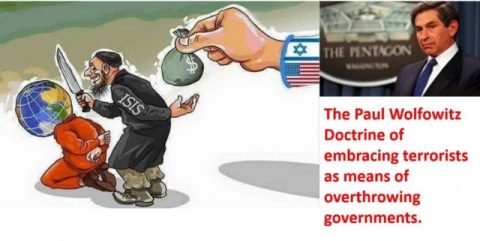
By Jonas E. Alexis | Veterans Today | October 16, 2107
In 1973 Irving Kristol, the godfather of the Neoconservative movement, made a stunning statement which is still relevant to understanding the Israeli influence in US foreign policy. Kristol said:
“Senator McGovern is very sincere when he says that he will try to cut the military budget by 30%. And this is to drive a knife in the heart of Israel… Jews don’t like big military budgets. But it is now an interest of the Jews to have a large and powerful military establishment in the United States…
“American Jews who care about the survival of the state of Israel have to say, no, we don’t want to cut the military budget, it is important to keep that military budget big, so that we can defend Israel.”
Read the statement again very carefully. A big military budget, said Kristol, is only good for Israel, not America or much of the Western World. In other words, precious American soldiers who go to the Middle East to fight so-called terrorism are just working for Israel, not for America.
So, whenever the Neocons use words such as “democracy” or “freedom,” they are essentially conning decent Americans to support Israel’s perpetual wars. … continue
Blog Roll
 Aletho News
- Macron: French citizens fighting for Israel cannot be labeled ‘genociders’
- US eyes Gaza security force drawn from armed gangs
- The Only Motive Behind The ‘Imminent’ U.S. War With Iran Is The Zionist Lobby
- Trump eyes 350-acre US military base housing 5,000 troops in Gaza
- Israel Pushing US Toward a Big and Damaging War With Iran – Ex-Pentagon Analyst
- Meet The Liberal Zionist And Ukraine War Supporter Advising AOC On Foreign Policy
- Buck Dancing for Zion: Kenya’s and Nigeria’s Growing Love Affair With Israel
- Israel installed, oversaw security system at Barak-Epstein residence in New York: Report
- ‘Britain’s Index of Repression’ documents 964 incidents of anti-Palestinian crackdown
- Prof. Ted Postol: US–Iran War? Israel’s Fatal Gamble
- If Americans Knew
- Tucker Carlson interrogated in Israel, has passport seized after interviewing US ambassador
- 6,000 Amputees in Gaza Face Impossible Recovery amid Israeli War Ultimatum
- The Lancet: Gaza death toll far higher than reported – Not a ceasefire Day 132
- Compliant aid: Who are the Israel-approved NGOs scaling up in Gaza?
- Why won’t Trump’s “Board of Peace” bring peace? – Not a ceasefire Day 131
- Help end the injustice against Shadi
- Israel’s Favorite American President
- Israel’s “Yellow Line” Is a Death Trap for Palestinians. We Drove Into It.
- Why Israel’s expanding occupation in Syria presents a critical legal test
- Gaza is not a natural disaster. It is the victim of genocide enabled by global inaction
- No Tricks Zone
- Coal Power Back In Trend As Globe Tries To Keep Pace With Growing Demand For Power
- New Study: A 4°C Warmer Beaufort Sea Had ‘No Sea Ice’ 11,700 – 8200 Years Ago
- Unfudging The Data: Dutch Meteorological Institute Reinstates Early 20th Centruy Heat Waves It Had Erased Earlier
- German Gas Crisis…Chancellor Merz Allegedly Bans Gas Debate Ahead of Elections!
- Pollen Reconstructions Show The Last Glacial’s Warming Events Were Global, 10x Greater Than Modern
- Germany’s Natural Gas Storage Level Dwindles To Just 28%… Increasingly Critical
- New Study Rebuts The Assumption That Anthropogenic CO2 Molecules Have ‘Special’ Properties
- Climate Scientist Who Predicted End Of “Heavy Frost And Snow” Now Refuses Media Inquiries
- Polar Bear Numbers Rising And Health Improving In Areas With The Most Rapid Sea Ice Decline
- One Reason Only For Germany’s Heating Gas Crisis: Its Hardcore-Dumbass Energy Policy
 Aletho News
