Corbyn and the Jews

By Gilad Atzmon | June 11, 2017
British Jews have made no secret of their united political opposition to Jeremy Corbyn and the Labour party under his direction. Since Corbyn’s selection as its leader, the Labour party has been subjected to a relentless defamation campaign by the MSM and Jewish bodies. The Jewish anti Corbyn campaign rapidly devolved into a ruthless purge conducted by the Jewish Labour Movement and the Labour Friends of Israel. And then it didn’t take long before we saw some clear evidence that the assault against Corbyn was directed by Tel Aviv.
The reaction of many prominent Jewish voices and Jewish media outlets to Corbyn’s recent electoral success leaves no room for doubt – we are witnessing an emerging clash between the Brits and Judea.
On June 9th just a few hours after Corbyn’s popularity amongst Brits was formally established, Stephen Pollard, the editor of the staunch Zionist Jewish Chronicle, wrote in The Daily Telegraph (AKA The Daily Tel Aviv ) an extended tirade about the Brits, the gist of which is captured in the headline: “to the millions of people who voted for Jeremy Corbyn: you scare me.”
Pollard is tormented by the democratic choice of almost half of the British voters. “In fact forgive me, please, if I say this to each of the 12.8 million people who voted Labour on Thursday: you scare me.”
Pollard is distressed by Ken Livingstone’s truth telling about Zionism’s early collaboration with Hitler. He is dismayed that so many young Brits are excited by Corbyn’s platform of truthfulness and universal cooperation.
To support his argument Pollard asks us to engage in a “thought experiment.” Imagine that instead of having a problem with Jews, “many Corbyn supporters were misogynists. Instead of tweeting about ‘Zios’ they tweeted about ‘bitches’ who had got above themselves.”
I will help Pollard out. It wasn’t women’s lobbies that pushed us into immoral interventionist wars in Iraq, Syria, Libya and Iran. It was Lord Cashpoint Levy and the LFI that dominated Blair’s government’s fundraising when Britain launched its criminal war in Iraq. It was David Aaronivitch and Nick Cohen, two of Pollard’s Jewish Chronicle writers, who advocated these wars in the media.
Being kind natured, I’ll use this opportunity to advise Pollard that pretty much half of British adults go to bed every night with a woman. They form families with them and bring up kids together. We see women as our partners; something we cannot say about Stephen Pollard, Jonathan Pollard, Michael Foster, Lord Janner or Sir Philip Green. Pollard should spend some time and produce a better analogy in support of his ludicrous tribal politics.
Pollard is not alone. James Rubin, a former American diplomat and the ‘husband of’ is also scared of Corbyn.
“Who’s Afraid of Jeremy Corbyn? Me that’s who,” was the title of Rubin’s Politico article. Unlike Pollard who is scared as a Jew, Rubin claims to be scared on behalf of all Americans. According to Rubin “all Americans who fear for the future of the West” should be fearful of Corbyn. Rubin attempts to spread a duplicitous message that Corbyn puts the West at risk.
Rubin is kind enough to enumerate Corbyn’s ‘crimes: he has been “a public opponent of British and American foreign policy for some 25 years, and so his record and his views are impossible to hide.” He has “made a career of attacking U.S. foreign policies time and again.”
Rubin misses the point. Corbyn was supported last Thursday by more than 12 million Brits, in large part because he has a clear record of opposition to Anglo-American Zio-con immoral interventionist wars.
Rubin goes on, Corbyn has always found a way “to be supportive of America’s enemies and critical of American policies.” Correct and this is exactly why close to half of the British voters trusted him last Thursday. I would take it further, would Corbyn be brave enough to call a spade a spade and name our foreign wars for what they are: Israeli wars, his share of the vote would increase from 40% to 70%. Corbyn would be the British Prime Minster by Friday and the Tories would be reduced to a marginal political entity.
Rubin complains that Corbyn finds that “America is almost always in the wrong for the wrong reasons.” If so, Corbyn is absolutely right. America is too often on the wrong side, capitulating to AIPAC’s demands or desperately attempting to appease the Goldman Sachs and Soroses of this world.
Those who still fail to see that British Jews are at war with Corbyn and the Labour party should read The Jewish Algemeiner. According to Ben Cohen, it was the Jewish vote in London that saved Theresa May. Despite the popular swing towards Labour in most of London, it was the “voters in four London districts with significant Jewish populations have likely made it much easier for embattled British Prime Minister Theresa May to form a coalition government.”
Britain’s Chief Rabbi Ephraim Mirvis released a statement that the election demonstrated the dramatic polarization of British society: “The General Election results make it quite clear that it is not only our political representatives who are sharply divided on what is in the best long term interests of our country, but also that the electorate is similarly divided.”
I am not convinced at all that Britain is ‘divided’ as the chief Rabbi claims. If anything, the election reveals a growing unity amongst young Brits who are disgusted by the politics of Theresa Je Suis Juif May and her Zio-friendly government.
“As Theresa May seeks to form a new Government, my prayer is that she be blessed with the insight and the wisdom to lead the country with a spirit of understanding and a commitment to the common good,” the Rabbi added. I can advise the British Jewish leader that his prayers may fall short of delivering the good. What Theresa May needs at this stage is divine intervention and the Jewish institutions rallying for her and her dirty politics is a curse rather than a blessing.
Two Years of “Wrong” Votes: The Media Take Aim at Democracy
By Kit | OffGuardian | June 11, 2017
Jeremy Corbyn has won two leadership contests, and gained the largest vote share for Labour in decades. Hillary Clinton had to cheat to get past Bernie Sanders, and was then humiliated by Donald Trump. The UK voted to leave the EU. After two years of getting the “wrong” results thanks to voters refusing to do as their told, some areas of the media and intelligentsia are finally asking the tough question: Is voting bad for democracy?

I don’t know about you guys, but I’m starting to see a pattern emerge.
In the wake of the Brexit vote (and, to a lesser extent, the Dutch rejection of Ukraine-EU links) no word was dirtier to the MSM than “referendum”. The conclusion seeming to be that resorting to plebiscitary democracy was bad for the country, and bad for democracy itself.
David Mitchell wrote that parliament was meant to make hard decisions for us. Natalie Nougayrède argued that “the mob” undermined our “elite institutions”. The New York Times featured an article headlined:
Why Referendums (sic) Aren’t as Democratic as They Seem
The article argues that voters will vote to undermine their own best interests, and so they shouldn’t be allowed to. Also it disempowers voters because:
Voters must make their decisions with relatively little information, forcing them to rely on political messaging — which puts power in the hands of political elites rather than those of voters.
This fallacy was repeated over and over and over and over and over again.
The general message was – Referenda are bad. They cheapen our democracy. Voting can go wrong. People aren’t informed enough. When you take a plebiscite, all you get is the opinion of plebs. Ban them completely.
Bloomberg even had a Justin Fox article headlined:
Voters Are Making a Mess of Democracy
That was a year ago, and things have only got worse since then. Now not only direct democracy, but all kinds of democracy, are being attacked.
The New York Times deserves special mention here. Neo-con Pulitzer prize winner Bret Stephens bemoans the “Year of Voting Recklessly”. His article demonstrates total ignorance of the world at large, history, British politics and morality. The article is a cesspool of ill-informed bigotry and bias, declaring anybody to the left of Ronald Reagan a “Marxist”, and gently undermining the idea of democracy because “voters are idiots”.
His childish ad hom assaults on Corbyn demonstrate everything wrong with the political establishment on the far side of the pond (and increasingly in Britain too), concerned only with labels and point scoring. There is not one word about policy in the article, just an all-out adolescent tirade against everybody on either side who disagrees with him. That this kind of author can win a Pulitzer prize shames American society.
Elsewhere, the Los Angeles Times has an Op-ed titled:
The British election is a reminder of the perils of too much democracy
In which James Kirchick dismisses, with a perfectly straight face and absolutely no sense of the absurd, the idea of “The People”:
“The people” — that expression beloved of Third World tyrants and increasingly adopted by leaders in advanced industrial democracies — got their say.
It seems the author either never new, or has forgotten, that “We, the people” are the first words of his country’s constitution. Perhaps he thinks it’s in sarcastic quotes there, too.
I’m not sure which of Washington, Jefferson or Adams, Mr Kirchick considers a “third world tyrant”. I’m not even completely sure he knows who they are.
Meanwhile, on June 1st Vox published a story headlined:
The problem with democracy: it relies on voters
And then followed that up with this, on June 9th:
What if “more public participation” can’t save American democracy?
These articles are based on this paper from the Brookings institute, titled:
More professionalism, less populism: How voting makes us stupid, and what to do about it
An argument against democracy based on the assumption that…
Populism cannot solve our problems… because its core premises and reforms are self-defeating. Research has shown that voters are “irrationally biased and rationally ignorant,” and do not possess the specialized knowledge necessary to make complex policy judgments.
Brookings have form in this area, having previously published articles and papers with titles such as: Democracy does not cause growth and Is too much democracy responsible for the rise of Trump?.
The agenda is clear – they are trying to encourage those that fancy themselves “informed” to take up an academic position that disdains the idea of the great unwashed having a say on important matters. Persuading real “useful idiots” how smart it would be to disempower themselves in service to the state.
Maybe you’re not familiar with the Brookings Institute. Here’s their about page blurb:
The Brookings Institution is a nonprofit public policy organization based in Washington, DC. Our mission is to conduct in-depth research that leads to new ideas for solving problems facing society at the local, national and global level.
Which is delightfully vague. A glimpse at their sources of funding clarifies things rather:
As of 2016 the Brookings Institution had assets of $473.8 million. Its largest contributors include the Bill & Melinda Gates Foundation, the William and Flora Hewlett Foundation, the Hutchins Family Foundation, JPMorgan Chase, the LEGO Foundation, David Rubenstein, State of Qatar, and John L. Thornton.
In 2014, it received $250,000 from the United States Central Command of the United States Department of Defense.
I don’t know how much money you can accept from the USDoD and still claim to be “non-partisan”, but apparently it’s more than $250,000.
Interestingly, if we re-visit the above Vox articles, we can focus on this little green box just under the title:

It seems these articles were published under Polyarchy, a new section devoted entirely to publishing releases from the New America think-tank, an NGO whose about page contains an incredibly predictable, and very familiar list of financial supporters. Including JP Morgan Chase, the Bill and Melinda Gates Foundation, the William and Flora Hewlett Foundation and the US State Department.
Exactly the same people supporting the Brookings Institute.
Voices are popping up all over the media, telling us democracy doesn’t work, that the system is failing and that voting gives too much power to idiots. We’re being slowly introduced to the idea that the educated and sophisticated opinion is that democracy just doesn’t work, and if we ever really want to sort out the world’s problems, we might have to let go of this antiquated institution.
Strangely, all these media voices seem to be getting paid by the same handful of billionaires, banks and businesses.
Apparently Bill Gates and George Soros really don’t like us being able to vote.
This was first brought to my attention by Adam Johnson on twitter:
fresh new batch of “democracy is actually bad” takes. pic.twitter.com/PG5RUhIl32
— Adam H. Johnson (@adamjohnsonNYC) June 10, 2017
Drug Overdose Deaths, 2016: Casualties of War
By Thomas L. Knapp | Garrison Center | June 6, 2017
Drug overdose is now the leading cause of death among Americans under 50, the New York Times‘s Josh Katz reports. In 2016, overdoses claimed somewhere between 59,000 and 65,000 lives.
That’s more American lives than were lost in the Vietnam war. It’s 20 times the casualty count of 9/11. It’s half again as many deaths as attributed to the “gun violence” we hear so much about in its peak year, 1994.
Katz pins the blame for these deaths on use, abuse, and sometimes accidental overdose of heroin, fentanyl, and prescription opioid painkillers. He goes along with the current fad of calling the phenomenon an “opioid epidemic.” That’s soothingly simple. The word “epidemic” implies an infectious agent to which we need attribute neither consciousness nor responsibility.
But those 60,000 or so dead Americans aren’t victims of a faceless “epidemic.” They’re casualties of a decades-long war waged on the American public by the federal and state governments. It’s called the war on drugs, and the Times piece, curiously, doesn’t refer to it even in passing.
Here’s what life would look like in an America at peace: If you wanted an opium product for either medical or recreational purposes, you’d walk into your nearest pharmacy and buy it.
You’d get a product of known quality, quantity and purity. As long as you followed the instructions on the box correctly, your chance of overdosing would be infinitesimal.
You’d probably stop on your way home from work for your daily fix, perhaps with the milk you forgot to get while grocery shopping. It would be cheap enough that you could support your habit with a regular job like the millions of smokers, alcoholics and Starbucks customers who don’t have to burglarize homes and steal car stereos to support their habits.
Yes, that simple. Really. In fact, that’s exactly how it was before the war.
Here’s what America at war looks like:
Tens of thousands of deaths, hundreds of thousands of POWs in local, state and federal prisons, and tens of billions of your tax dollars to keep up the pace of killings and cagings, year after year, decade after decade.
Rule by people simultaneously more lethal to Americans than, and morally inferior to, Osama bin Laden (he never tried to tell us he was murdering us for our own good, did he?).
Oh, and the people who want the drugs are going to get them anyway.
Which America sounds better to you?
Thomas L. Knapp (Twitter: @thomaslknapp) is director and senior news analyst at the William Lloyd Garrison Center for Libertarian Advocacy Journalism (thegarrisoncenter.org).
Jeremy Corbyn and his half-finished political revolution
By Neil Clark | RT | June 11, 2017
Labour’s stunning performance in last week’s UK general election, which saw the party deny the Tories a majority and gain its largest increase in vote share since 1945, has left the country’s Elite Punditocracy in a state of deep shock.
The neocon/neoliberal Establishment thought their non-stop smearing of Labour leader Jeremy Corbyn as a “terrorist sympathizing/IRA-supporting/anti-Semitism condoning/crimes-of-Milosevic denying/North Korea-admiring/Putin-appeasing/Hamas-befriending/beardie-weirdie sandal-wearing/Stalinist/Trotskyist/hard-left Marxist/enemy of Britain” (take your pick), would ensure that voters would vote the ‘right’ way on June 8, i.e. not for the party led by beyond-the-pale Corbyn. There was great confidence that Labour, having been attacked so relentlessly in the media, would lose heavily.
Jason Cowley, the Blairite political editor of the once radical but now very Establishment-friendly organ the New Statesman, claimed Labour could lose 100 seats. Another pundit predicted Labour’s vote could slip below 20 percent.
But as soon as the results of the BBC’s exit poll were revealed at 10pm on election night, blind panic took over. It was reported that when Rupert Murdoch saw the exit poll showing that the Tories would lose their majority and that Labour would actually gain seats, he stormed out of the room.
It was a joy to see the bewildered, and then indignant ‘they haven’t listened to us!’ reactions of the gatekeepers on social media – people who just a few minutes earlier were assuring us that the “unelectable” Corbyn was leading his party towards an electoral disaster.
It’s not that these smug, self-satisfied stenographers to power were wrong: they never wanted Corbyn to do well in the first place. But they were supremely confident that their relentless attacks on the “extremist” Labour leader would achieve the result their paymasters desired.
The great ‘crime’ Corbyn committed in the eyes of the Establishment was not to have once met Martin McGuinness, but to have broken away from the “phoney center” ground of endless war and privatization and offer voters a genuine alternative to neocon/neoliberal policies. He criticized the UK’s ‘interventionist’ foreign policy, so beloved by those who never go near a war zone, and dared to suggest that Britain’s involvement in regime-change wars has increased the terrorist threat, which of course it has. He vowed to end arms sales to Saudi Arabia. He pledged to re-nationalize the rip-off railways and public utilities. He promised to scrap student tuition fees, zero-hour contracts, and to end austerity. His program wasn’t ‘hard-left’ or ‘extreme,’ but actually very moderate, fully in tune with mainstream public opinion.
But of course, any deviation from the “Extreme Center” is regarded as heresy which must be punished by those who see themselves as the modern-day successors of Matthew Hopkins, the Witchfinder General.
If last Thursday’s UK general election can be compared to a football match, then it’s now half-time and against all the odds, the team the ‘experts’ told us would get thrashed by their wealthier rivals is leading by two goals to nil. Yes, the Conservatives won the most seats, but it’s Labour who has the wind in their sails, and all the momentum, in more ways than one. Which begs the question – what’s going to happen in the second half?
The Establishment had a big setback on Thursday – one that they most certainly did not expect – but don’t worry, they’ll regroup. The first priority will be to make sure that one way or another the Conservatives remain in government and the “hard-left extremists” Corbyn and John McDonnell and the “sinister Stalinist” Seumas Milne (who’s actually one of the nicest people you could ever wish to meet), don‘t get their hands on the levers of power.
We were told it was terribly, terribly wrong for a prospective Corbyn-led minority government to be propped up “by the Scots” (boo, hiss), but it seems it’s not so wrong or ‘outrageous’ for a minority Conservative government to be propped up by a party from Northern Ireland. If Corbyn needs the support of others, we’re talking about a “Coalition of Chaos,” if May needs it – it is all about putting the country first.
The double standards of the “Keep Corbyn Out” campaign are there for all to see: the hypocrisy is of Olympic Gold Medal standard. And it’s not just Tories that Corbyn needs to worry about. Blairite grandee Lord Peter Mandelson, writing in the Mail on Sunday, has urged “mainstream Labour MPs,” worried about the “continuing Corbyn revolution” to “stand by” Theresa May in Parliament in “the national interest.”
The second part of the Establishment’s plan will be to try and pressurize/cajole/bribe/threaten Labour, from without and within, to ditch policies which threaten elite interests and move back towards what the “Extreme Centre.”
If only Labour could ‘moderate’ its policies, (i.e. make them acceptable to the “people who really matter”), they’d be set fair to win the next election – a line we can expect to see repeated in the next few weeks and months in ‘mainstream’ publications. Everything will be done to make Labour “conform.”
It’s important to understand that ‘democracy’ for the neocon/neoliberal Establishment means the two main parties offering essentially the same fare to voters a pro-war pro-neoliberal Conservative party led by David Cameron and a pro-war pro-neoliberal Labour party led by David Miliband was their ideal scenario. With a choice of Tweedledum and Tweedledee, the elite simply can’t lose. And that’s how they like it.
But it all started to go wrong for them when Ed, and not the Establishment-favored David Miliband, became Labour leader in 2010 and changed the rules about the election of party leaders. This put power (horror of horrors!) into the hands of ordinary members and made possible the victory of Jeremy Corbyn in 2015, and again in 2016, when he was challenged by technocrat Owen Smith.
Inevitably, as Labour has democratized, so its program has begun to reflect the views of ordinary citizens. By offering popular ‘For the Many and not the Few’ policies that had, for many years, been deemed “off limits” by gatekeepers, such as re-nationalization and a change in foreign policy, Corbyn managed to motivate millions of Britons, myself included, to head off to our local polling stations last Thursday. In doing so, he helped increase Labour’s share of the vote from 30 percent in 2015 to 40 percent, a quite remarkable achievement, especially considering the hostile media coverage and the attacks from within his own party that he has faced since first becoming leader.
It would be absolutely fatal now for Corbyn to change a strategy that has brought him to the brink of victory. That means there can be no way back for Blairism or Blairites. Former Channel 4 journalist Paul Mason has done great work for Labour in 2017, but I was alarmed to hear him say on television on election night that Corbyn should now bring into his Cabinet or Shadow Cabinet “big hitters” from the Blair and Brown era. It’s because Corbyn has made a break with the political orthodoxy of that time that he has done so well and managed in particular to get so many young voters and previous abstainers to rally to the Labour cause. Dragging back discredited figures from the past, whose policies were roundly rejected by voters, would be a backwards step. Instead, Corbyn should be bringing into his team new faces who are fully in tune with the anti-Establishment mood of 2017.
If there is to be another election this year, which seems likely, then the Labour leader must also be prepared for a battle with a more accomplished performer than the far from “Strong and Stable” Theresa May. Whether May stays days, weeks, or months in Downing Street, the people hiding behind the curtain won’t let her fight another election as Tory leader, as her limitations have been fully exposed. But even if the Tory leader is more personable than the current prime minister, which, let’s face it, wouldn’t be hard, the trump card Corbyn has is his manifesto. Because they are the party of the financial elite and receive around half their money from hedge funds, the Tories would never be able to offer voters populist policies like re-nationalization and higher taxes on the rich to help save the NHS, which Labour can.
What Corbyn has done is to get to the half-way point in a peaceful political revolution. Far from being a “threat” or a “danger” to democracy, he is actually trying to return Britain to being a proper functioning democracy, a place where people do have a genuine choice at general elections. We shouldn’t underestimate the scale of his task, but equally we shouldn’t underestimate what this indefatigable 68-year-old has already achieved. He’s halfway there and the next 45 minutes will be absolutely crucial.
Neil Clark is a journalist, writer, broadcaster and blogger. He has written for many newspapers and magazines in the UK and other countries including The Guardian, Morning Star, Daily and Sunday Express, Mail on Sunday, Daily Mail, Daily Telegraph, New Statesman, The Spectator, The Week, and The American Conservative. He is a regular pundit on RT and has also appeared on BBC TV and radio, Sky News, Press TV and the Voice of Russia. He is the co-founder of the Campaign For Public Ownership @PublicOwnership. His award winning blog can be found at http://www.neilclark66.blogspot.com. He tweets on politics and world affairs @NeilClark66
Israel’s Netanyahu calls for UN Palestinian refugee agency to be shut down
RT | June 11, 2017
The UN Palestinian relief agency “perpetuates” the refugee issue instead of solving it and should be “dismantled,” the Israeli PM stated, adding that he had conveyed the idea to the US envoy to the UN. The agency dismissed his proposal as “fantasy.”
Israeli Prime Minister Benjamin Netanyahu made the comments on the United Nations Relief and Works Agency (UNRWA) during a weekly cabinet meeting on Sunday.
“It is time UNRWA be dismantled and merged with the United Nations High Commissioner for Refugees,” Reuters quoted Netanyahu as saying.
According to the Israeli PM, as cited by the Jerusalem Post, “in various UNRWA institutions there is a lot of incitement against Israel, and therefore the existence of UNRWA – and unfortunately its work from time to time – perpetuates the Palestinian refugee problem rather than solve it.”
Netanyahu added that he had already conveyed the idea of shutting the agency down to US Ambassador to the UN Nikki Haley during her visit earlier this week.
“I told her it was time the United Nations re-examine UNRWA’s existence,” Netanyahu said.
The UNRWA was established by the UN General Assembly in 1949, when hundreds of thousands of Palestinians fled or were evicted from their homes during the 1948 war which followed the emergence of the state of Israel. The agency currently helps over five million registered Palestinian refugees across the region, according to the UNRWA’s own statistics.
The UNRWA’s chief spokesman, Chris Gunness, dismissed Netanyahu’s ideas, stating that dismantling the agency lays outside both of his and Haley’s powers and that only the General Assembly, by a majority vote, could change the agency’s mandate.
“In December 2016, UNRWA’s mandate was extended for three years by the General Assembly by a large majority,” Gunness told Reuters in an emailed statement.
A Gaza-based spokesman for the UNRWA, Adnan Abu Hasna, said that Netanyahu was pursuing a “fantasy.”
Netanyahu’s remarks came two days after the UNRWA said it had uncovered an alleged Hamas-built tunnel running under two agency-managed schools in a refugee camp in the Gaza Strip. The UNRWA condemned the construction of the tunnels as a violation of its neutrality and protested it to Hamas. The Islamist organization, however, denied involvement.
“UNRWA condemns the existence of such tunnels in the strongest possible terms. It is unacceptable that students and staff are placed at risk in such a way,” the agency said in a statement. “The construction and presence of tunnels under UN premises are incompatible with the respect of privileges and immunities owed to the United Nations under applicable international law, which provides that UN premises shall be inviolable. The sanctity and neutrality of UN premises must be preserved at all times.”
Israeli Ambassador to the United Nations Danny Danon submitted a letter of protest to UN Secretary-General Antonio Guterres and the UN Security Council, urging them to label Hamas a terrorist organization and “safeguard” the UNRWA, as well as other agencies “from abuse by terrorist organizations.”
READ MORE:
Israel is ‘key driver’ of Palestinian hardships in occupied territories – UN report
Qatar crisis sets in motion realignments
By M K Bhadrakumar | Indian Punchline | June 11, 2017
Four days have passed since the terrorist strikes in Tehran but Iran has not retaliated with any “surgical strike” against Saudi Arabia – and, typically, there isn’t going to be any. The political leadership pointed the accusing finger at Saudi Arabia, US and Israel. Supreme Leader Ali Khamenei said that the terror strikes “will only increase hatred for the governments of the United States and their stooges in the region like the Saudis.” However, Iran will not react in a hurry, given the crisis over the Saudi-Qatar standoff that is fraught with profound consequences for regional politics.
Interestingly, Iran signed another agreement on Saturday with Boeing, the American aircraft manufacturer, to buy 30 passenger planes in a $3 billion deal, with an option to buy another 30 aircraft at a later stage. This is on top of the $16.6 billion deal with Boeing negotiated in December. Tehran is piling pressure on the Trump administration because Boeing needed the approval of the US Treasury for the deal with Iran. Put simply, Tehran hopes to draw the US into an engagement process that incrementally deepens and broadens, which derails the Saudi-Israeli agenda to incite a US-Iran confrontation.
Iran is generating export business for American companies, which holds the potential to create jobs in their thousands in the US economy. This becomes a template, ironically enough, of President Trump’s ‘America First’ doctrine. It is a ‘win-win’ formula, because Iran’s economy also badly needs western investments and capital, especially the oil industry. Over and above, if American companies begin operating in the Iranian market, it will give impetus to European business and industry too.
Having said that, Iran’s regional policies remain on track, no matter the Trump administration’s pressure tactic and rhetoric. Iran scored a signal victory in the weekend with Syrian government forces supported by Iran-backed militia reaching the strategic border crossing with Iraq at Al-Tanf. (See my blog The scramble for control of Syrian-Iraqi border.) In immediate terms, the route for the US-backed fighters in the south to move into the strategically important Deir Ezzur province (which is also rich in oil deposits) now comes under the control of the Syrian government forces.
Meanwhile, Tehran is re-establishing high-level contacts with the leadership of Hamas. On Saturday, Hamas announced that a delegation led by its newly-elected leader Ismail Haniyeh (who recently replaced Khaled Meshaal) will be visiting Tehran. Iran’s ties with Hamas came under strain after Meshaal left Damascus (where he was living in exile for several years) to relocate himself in Doha, by way of displaying his solidarity with Qatar and Turkey in the Syrian conflict.
Hamas’ reunion with Tehran’s ‘axis of resistance’ is significant, since Hamas is an offshoot of the Muslim Brotherhood and Qatar has come under pressure from Saudi Arabia to snap its links with the Brothers. It meshes with Iran’s support for Qatar in its rift with Saudi Arabia as well as promotes Iran’s desire for partnership with Turkey. Turkish President Recep Erdogan continues to patronise Hamas, despite that being the principal discord in Turkish-Israeli relations.
On the other hand, Iran’s warming of ties with Hamas puts pressure on Saudi Arabia and Israel at a time when the mutual comfort level between Riyadh and Tel Aviv has been rising lately, with the Trump administration actively promoting the idea of an Arab-Israeli normalization.
Jared Kushner’s (Trump’s Orthodox Jew son-in-law and top advisor on foreign policy) thesis, which is the current US policy in the Middle East, is that a “from the outside-in” approach to Middle East peace – namely, signing of peace treaties between the Arab states and Israel to generate goodwill and new diplomatic relations, which in turn will help advance Palestine-Israel settlement – as against the traditional “inside-out” approach that gives primacy to peace between the Palestinians and Israelis as the necessary first step that will facilitate an end to the Arab-Israeli conflict.
Trump’s mission to Riyadh last month was at the behest of Israel, which has been pushing the narrative that the existential fear of Iran is bringing the Gulf Arab monarchies and Israel closer together. Of course, Israeli calculation is that peace treaties between the Gulf Arab regimes and Israel (on the pattern of Israel’s peace treaties with Egypt and Jordan) will ultimately render the Palestinian cause obsolete and completely ease the pressure on Israel to accommodate Palestinian aspirations and demand for a fully independent state.
Significantly, while reporting on Hamas leader Haniyeh’s forthcoming visit to Iran, the influential Tehran Times newspaper made the following observation:
- While the Syrian crisis has driven a wedge between Tehran and Turkey since 2011, the rift between Arab caliphates have led them into an ad-hoc alliance that some believe represents the best chance to mend fences.
- Turkey and Iran back Qatar and have links with the Muslim Brotherhood.
Suffice to say, Iran’s move to bring Hamas into the ‘axis of resistance’ threatens to undermine the game plan that Israel has been working on (via Kushner and Jason Greenblatt, fellow Orthodox Jew, associated with Trump’s organization.) All three countries – Qatar, Turkey and Iran – sense that the current US-Israeli-Saudi offensive against “terrorism” is actually the metaphor for an all-out assault on the Muslim Brotherhood, branding it as a “terrorist” organization, which in turn is ultimately aimed at driving Hamas into the political wilderness and thereby scattering the Palestinian resistance movement once for all.
To be sure, both Turkey and Iran have taken note that at the end of the day, the Muslim Middle East has shown reluctance to join Saudi Arabia’s ant-Qatar front — including Jordan, which is sitting on the fence, merely resorting to the cosmetic move of downgrading the diplomatic ties with Qatar, despite its need for Saudi goodwill. Of course, Turkey, Iraq, Lebanon, Jordan, Kuwait, Oman, Algeria, Morocco, Sudan and Tunisia have ostentatiously dissociated themselves from the Saudi strategy to isolate Qatar. Indeed, Turkey has forcefully rejected the Saudi embargo against Qatar — “We will not abandon our Qatari brothers,” said Erdogan at an Iftar meal in Istanbul on Friday, while addressing his party colleagues.
Dozens of new cracks discovered at Belgian nuclear reactors
RT | June 11, 2017
The latest ultrasonic inspections have detected a substantial number of new micro cracks in nuclear reactors at the Tihange and Doel power plants in Belgium since the last study conducted three years ago, Belgian and German media report.
At least 70 additional cracks were uncovered at the Tihange 2 nuclear reactor during an ultrasonic inspection in April of this year, Belga news agency reports. Some 300 new flaws have also allegedly been discovered at the Doel 3 reactor tank during a check last November, according to tagesschau.de.
Belgian Interior Minister, Jan Jambon, confirmed the micro fissures at Tihange 2 following a parliamentary inquiry posed by Green Group leader Jean-Marc Nollet, DW reports. The reported new cracks at Doel 3 have not yet been confirmed.
The cracks do not pose any danger to operations at the nuclear plants, says operator Engie-Electrabel, which carried out the inspections under instructions from the Belgian Atomic Regulatory Authority (FANC).
The operator said the new flaws were discovered due to a “different positioning of the ultrasound device.” Engie-Electrabel maintains that as long as cracks do not expand, they do not pose a danger to the reactor’s operations.
Branding Engie-Electrabel “irresponsible,” environmentalist group, Nucléaire Stop, has criticized the operator for still running Tihange 2 reactor despite a 2.22 percent increase in faults.
In February 2015, FANC said 3,149 cracks had been found at Tihange, while 13,047 were discovered at Doel. The operator must now submit additional analyses of the situation by September.
Tihange lies only 60 kilometers (about 37 miles) from the German border, while Doel is 150 kilometers away, near Antwerp. Germans living in the area close to this border have been exerting pressure on the government to force Belgium to shut down the aging reactors.
Both of the reactors have experienced leaks and cracks for some time now. Doel 3 has a capacity of 1,006 megawatts, while Tihange 2 a capacity of 1,008 megawatts. The reactors are almost 35-years-old but are still generating about 14 percent of the nation’s power capacity.
Hamas pledges not to intervene in the affairs of Arab countries amid Qatar crisis
Ma’an – June 10, 2017
BETHLEHEM – Days after Saudi Arabia, Bahrain, the United Arab Emirates, and Egypt severed diplomatic ties with Qatar, accusing the Gulf state of supporting “terrorism,” the Hamas movement — named as one of the groups allegedly receiving Qatari sponsorship — pledged Saturday it would not intervene in the affairs of any Arab countries “regardless of the pressures.”
“Hamas’ weapons will be directed only at the enemy (Israel), and Hamas will maintain its policy of not intervening in Arab countries’ affairs regardless of pressures or events,” Deputy Hamas chief Mousa Abu Marzouk was quoted in an official Hamas statement as saying.
Disagreements among Arab countries, “are their own business,” he said, though the question of Palestine “will remain the core issue for everybody, and support for the Palestinian plight should be indisputable regardless of any situation that may arise.”
Abu Marzouk added that Hamas has come under pressure in the past from the Arab world and internationally, and said “we will always deal with such pressures responsibly. We won’t be in disagreement with any country.”
In a similar statement Friday, member of Hamas’ politburo Khalil Al-Hayya that “the Palestinian armed resistance is directed only towards the Israeli occupation, and that the Palestinian resistance will not deviate from this track,” he said, reiterating the faction’s rejection of its designation as a terrorist organization by the US, Israel, and several other countries. Hamas identifies as a Islamist national resistance movement.
Meanwhile, Qatari Foreign Minister Sheikh Muhammed bin Abd al-Rahman al-Thani reportedly said Saturday that, “The US views Hamas as a terror organization, but to the rest of the Arab nations it is a legitimate resistance movement. We do not support Hamas, we support the Palestinian people.”
“Hamas’s presence in Qatar doesn’t mean there’s support for Hamas in Qatar,” he said, highlighting the fact that Qatar also cooperates with the occupied West Bank-based Palestinian Authority to promote Palestinian reconciliation between Hamas and Fatah.
Following the abrupt severing of political ties with Qatar, Hamas slammed the development as a “politicized” attempt to force Qatar to abide by the interests of Israel and the United States.
Ahmad Yousif, a former senior Hamas figure who remains close to the movement’s leadership, described the political developments as part of an “American-Israeli-Saudi coalition” in the region — a sentiment expressed by other commentators owing to US President Donald Trump’s visit to Saudi Arabia and Israel in recent weeks and Saudi Arabia’s growing ties with Israel over the years.
Saudi Arabia’s Minister of Foreign Affairs Adel al-Jubeir had stated that Qatar would have to cut support to Hamas and the Muslim Brotherhood if the country wanted to restore diplomatic relations.
Qatar has also reportedly expelled members of Hamas from the country owing to the pressure, however, Hamas denied these claims, saying several leaders left Qatar “willingly” in order to avoid adding to Qatar’s difficulties.
Corbyn and UK Labour Victory Signals Pro-Palestine Mood, Diminished Israeli Legitimacy
Jeremy Corbyn at a pro-Palestinian rally in London, 2014. | Photo: Palestine Solidarity Committee
teleSUR | June 9, 2017
Jeremy Corbyn’s gains in the British general election mollified his political opponents, ranging from Rupert Murdoch’s yellow press to officials Tel Aviv, drawing outrage due to his support for causes considered taboo in Western capitals. Foremost among these causes is the popular opposition to Israeli war crimes and settler-colonialism in Palestine.
In fact, the Israeli state was established thanks, in no small part, to the British Empire’s occupation of the region following the collapse of the Ottoman Empire, with Labour Party support playing a crucial role in laying the early groundwork for the state’s creation. Labour’s support for Zionism began when Sidney Webb, a founding leader of the Fabian socialist movement, penned the Memorandum on the Issues of War in August 1917, three months before the issuance of the Balfour Declaration, which recommended the creation of a “national home for the Jewish people.”
The document codified British Labour’s embrace of the First World War on the grounds that “the world may henceforth be made safe for democracy” through British war efforts while ironically denouncing “the imperialist aims of governments and capitalists” in the Middle East. The document also made a firm commitment to the resettlement of Jews in Palestine, calling for a “free state” to which European Jewry would be entitled the right to “work out their salvation, free from interference by those of alien race and religion.” Of course, British support for Zionism was a cynical and self-serving means to advance its own geopolitical interests in the region.
Labour’s 2017 election manifesto reflected, to some extent, a pro-Palestine mood among the party’s increasingly young support base that resembles Corbyn’s own record of solidarity with the Palestinian cause. In addition to revealing a social democratic aspect of Labour long suppressed or hidden from sight, the document stated the party’s commitment to a “two-state solution” to Israeli expansionism in Palestinian territories, warning Israeli authorities that it won’t tolerate further militarist excesses. It also states that a Labour government would “immediately recognize” the de jure Palestinian West Bank state. The manifesto further calls for a “world free from all forms of racism, anti-Semitism and Islamophobia.”
However, the Israeli lobby – through the Labour Friends of Israel and the press – spared no effort to have references to West Bank settlements as “wrong and illegal” removed from the final draft of the party platform while also axeing a line referring to the “the continued humanitarian crisis in the Occupied Palestinian Territories.” The manifesto also falsely equates Palestinian resistance “rocket and terror attacks” with the highly-advanced, destructive weaponry of the Israeli state.
The equivocation surrounding the drafting of points on the Israeli-Palestinian “conflict” raised questions about Corbyn’s willingness – or, rather, his ability – to consistently stand alongside the Palestinian struggle for self-determination while simultaneously leading Britain’s institutional center-left party.
Corbyn himself has visited Palestine nine times, in addition to multiple visits to refugee camps in Lebanon and Syria. In 2013, following his return from the Gaza Strip, he wrote to then-Foreign Secretary William Hague and urged that the U.K. “stop allowing Israel’s criminal politicians to come to our country.” The Labour leader has also called for the lifting of the blockade on Gaza, an end to the abuse of Palestinian civilians by Israeli occupation forces, and the holding of Israeli politicians accountable for crimes against humanity and other rights abuses.
While Corbyn has conceded that the two-state solution would be difficult to implement given the significant Israeli-backed illegal settlement activity in the West Bank, he remains a supporter of the widely-discredited proposal as “all that’s on offer.” To his credit, though, Corbyn is on record noting that the fundamental “key” to addressing the root of the tragedy is ensuring the Palestinian people’s right to return to the homes and lands from which they were ethnically cleansed during the Nakba of 1948 and the 1967 Israeli onslaught and annexation of remaining Palestinian territories.
While not a supporter of the Boycott, Divestment and Sanctions (BDS) movement’s call to reject Israeli cultural, academic and economic products – a call seen as “reasonable” by two of five Brits from across the political spectrum, according to recent polls – he has called for “targeted” boycotts of universities involved in weapons research and the boycott of goods produced in illicit Israeli settlements in the Occupied Territories. Despite that, the Labour manifesto fails to call for sanctions on the Israelis.
Corbyn also advocates engaging in diplomacy with regional players such as Palestinian Hamas and Hezbollah of Lebanon, noting their significant support base and the fact that, whether Tel Aviv likes it or not, they represent mass popular opinion in their respective countries.
Predictably, Britain’s right-wing – including many among the aggressively pro-U.S. Blairite New Labour clique – frantically sought to brand Corbyn’s humanitarian support for the Palestinian people as a reflection of “the new anti-Semitism,” a slur commonly applied to any stance opposing Israeli war crimes and impunity to the slightest extent.
Ultimately, British voters seemed unmoved by alarmist calls denouncing Labour as a bigoted party. This was proven when people from all walks of life – including British Jews – turned out in droves to support the party’s program and its candidates.
Labour’s victory came in spite of the hyperbolic attacks on Corbyn, perhaps signaling the shifting winds of public opinion regarding the Israeli occupation.
However, the longer-term question of whether an ascendant Corbyn will be able to sideline or dislodge U.S.-loyal and pro-Zionist layers within his own party – or resist the temptation to compromise with the Israeli lobby for the sake of political expediency – remains yet to be seen.
Featured Video
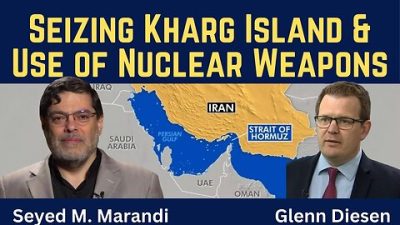
Marandi: Threat of Seizing Kharg Island & the Use of Nuclear Weapons
or go to
Aletho News Archives – Video-Images
Frlom the Archives
Provoking a Path to Persia
The Saban Center’s prescient paper on war with Iran
By Maidhc Ó Cathail | October 20, 2011
In June 2009, the Saban Center for Middle East Policy published “Which Path to Persia?—Options for a New American Strategy toward Iran.” Writing in a tone strikingly reminiscent of the Project for a New American Century’s infamous pre-9/11 paper “Rebuilding America’s Defenses,” the six co-authors noted that, “It seems highly unlikely that the United States would mount an invasion without any provocation or other buildup.” For a think tank specifically established by media mogul Haim Saban to protect Israel, this could prove to be a formidable obstacle impeding their desired march—of U.S. troops—to Tehran.
“In fact, if the United States were to decide that to garner greater international support, galvanize U.S. domestic support, and/or provide a legal justification for an invasion, it would be best to wait for an Iranian provocation, then the time frame for an invasion might stretch out indefinitely,” Saban’s think-tankers ruefully observed.
“With only one real exception, since the 1978 revolution, the Islamic Republic has never willingly provoked an American military response, although it certainly has taken actions that could have done so if Washington had been looking for a fight. Thus it is not impossible that Tehran might take some action that would justify an American invasion. And it is certainly the case that if Washington sought such a provocation, it could take actions that might make it more likely that Tehran would do so (although being too obvious about this could nullify the provocation). However, since it would be up to Iran to make the provocative move, which Iran has been wary of doing most times in the past, the United States would never know for sure when it would get the requisite Iranian provocation. In fact, it might never come at all.”
Seemingly undeterred by Iran’s frustrating unwillingness to provide the requisite provocation, the analysts continued to examine this option… continue
Blog Roll
 Aletho News
- Ukrainian Embassy in Beirut sheltering top Mossad agent
- Palestinian family displaced after settlers violently attack them in Humsa, Jordan Valley
- The EU never learns – except for the wrong lessons
- Iran attacks on UAE leaves RSF militia high and dry
- Hosting Washington’s war: Bahrain faces the consequences
- The US fell for its own Iran propaganda
- Seyed M. Marandi: Threat of Seizing Kharg Island & the Use of Nuclear Weapons
- Is there even an off ramp?
- Michael von der Schulenburg: Europe’s Self-Defeating Iran War Policy
- Sorry, The New Republic, Climate Change Isn’t Causing Somali Migration. Blame Civil Strife and Poverty.
- If Americans Knew
- ‘Of Course’: IDF Drops Case Against Soldiers Accused of Raping Palestinian Prisoner
- Don’t Fall for the Regime Change Talk. Israel Is ‘Mowing the Lawn’ in Iran
- Will Israel and the US wreck the Gulf States along with Iran?
- US so far burned through ‘years’ of munitions in Iran war: Report
- How the Israeli Tail Wags the American Dog
- Outdated intel likely led to deadly U.S. strike on Iranian elementary school, sources say
- Pentagon insider says high U.S official Douglas Feith reported to Netanyahu
- In fond memory of Walid Khalidi, the historian of Palestine
- 6 more Americans killed, as Israel ‘mows the lawn’ in Iran – Not a ceasefire Day 154
- Are we on the precipice of World War III?
- No Tricks Zone
- New Studies: UK Sea Levels Were 4 Meters Higher Than Today During The Mid-Holocene
- Destructive Green New Deal: German Energy And Metal Group Warns Of Drastic Crisis
- New Study Documents A 20-Year Pause In Arctic Sea Ice Decline – Driven By Internal Variability
- Wake-up Call: Survey Shows Majority Of Germans Now Favor Postponing Climate Targets!
- Televised! Leading German Political Candidate Tells Schoolchildren CO2 Makes Sun Hotter!
- New Study: A Century Warming Of 1.1°C Is ‘Commonplace’ And ‘Not Unusual’ During This Interglacial
- New Study: ‘Internal Noise’ And Volcanic Forcing Can Trigger 10-15°C Warming Within Decades
- Glaciers Worldwide Are Suddendly Surging, Experts Blame Warming!
- Surprising Discovery: Sahara Is Greening…Billions Of Trees Where Once Thought To Be Barren
- New Research Reaffirms Clouds, Aerosols, And Surface Solar Radiation Are ‘Driving The Climate System’
 Aletho News