Major Chilean Universities Heed BDS Call, Cancel Events Sponsored by Israeli Embassy
IMEMC | June 10, 2017
 Student-led BDS campaigns resulted in two major Chilean universities canceling events co-sponsored by the Israeli embassy and featuring Joe Uziel, a director of the Israel Antiquities Authority (IAA). On Monday, Alberto Hurtado of the University’s Anthropology Department announced the event’s cancellation, and yesterday the University of Chile’s Social Sciences Faculty did the same.
BDS Chile highlighted the reasons behind the campaign to cancel the event:
Universities cannot be passive accomplices in grave human rights violations. The State of Israel maintains an illegal occupation, colonization and apartheid regime against the Palestinian people, and the Israeli Embassy is this regime’s representative in Chile. In addition, the Israel Antiquities Authority is a government entity illegally based in occupied East Jerusalem that carries out illegal excavations in the occupied Palestinian West Bank. Some of these illegal excavations are directed by the invited speaker, Joe Uziel.
The confiscation and theft of Palestinian cultural heritage are part of Israel’s attempts to erase Palestinian memory and cultural identity. Since 1967, the IAA has been deeply involved in cultural crimes and serious violations of international law, such as illegally removing and plundering hundreds of thousands of precious artifacts from the Occupied Palestinian Territory (OPT), including East Jerusalem. Fearing BDS campaigns, Israel has been trying to prevent information about archeological work in the OPT from being made public and to whitewash these violations by promoting events like these abroad.
Sharaf Qutaifan, from the Palestinian Campaign for the Academic and Cultural Boycott of Israel (PACBI) said:
Through the Israel Antiquities Authority, Israel attempts to bury the history of the indigenous people of Palestine, which was always home to groups with diverse cultures and religions. This is an extension of Israel’s policies of expulsion and cultural theft that it has carried out against Palestinians since its establishment. Israel has a troubling record of systematically looting Palestinian lands and properties, cultural treasures and even books and artworks, which continues until today.
We salute the Chilean students for pressuring the Anthropology Department of Alberto Hurtado University and the Social Sciences Faculty of University of Chile to take principled positions. Academic institutions should not lend their good names to Israel’s denial of Palestinian rights. We hope to see all Chilean universities fully free of Israeli apartheid.
BDS Chile celebrated the victory:
We welcome the decisions of Alberto Hurtado University and the University of Chile. The Palestinian people expect principled acts of solidarity in support of their human rights and the respect of international law. These cancellations demonstrate Chilean students’ determination to denounce Israel’s oppression and to work towards interrupting our universities’ ties with institutions complicit in Israeli apartheid.
This latest news is another stride in the growing academic boycott of Israel in Chile. Last year, law faculty students at the University of Chile overwhelmingly voted in support of BDS, as did more than 90% of the social sciences students. At the Catholic University of Chile, the Student Council also passed a BDS resolution by a large majority.
The cancellations are also another strike against the Israel Antiquities Authority. At the end of 2016, the 8th World Archaeological Congress published a resolution condemning Israel’s excavations in the Occupied Palestinian Territory and called on international academic publishers to refuse publishing works related to archaeological research in those areas.
The Palestinian Campaign for the Academic and Cultural Boycott of Israel (PACBI) was initiated in 2004 to contribute to the struggle for Palestinian freedom, justice and equality. PACBI advocates for the boycott of Israeli academic and cultural institutions, given their deep and persistent complicity in Israel’s denial of Palestinian rights as stipulated in international law. Visit PACBI at https://bdsmovement.net/pacbi and follow us on Twitter @PACBI
Iran signs final contract to buy 30 Boeing 737 planes
RT | June 10, 2017
Boeing has signed a final deal with Iran’s Aseman Airlines to supply 30 737 MAX jets to the carrier, IRNA news agency reports, citing the airline’s managing director. Following the first batch of the planes, the company will order additional 30 jets.
One year of negotiations between the US aerospace giant Iran’s third-largest carrier concluded on Saturday, when Aseman’s Managing Director Hossein A’laei and Boeing Sales representative in the Middle East and Russia James Larson signed the final contract on purchasing 30 of the 737 MAX jets.
While the carrier operates as a private company, Iran’s Minister of Cooperative, Labor and Social Welfare Ali Rabiei and Head of Civil Aviation Organization Ali Abedzadeh attended the signing ceremony.
According to the preliminary memorandum of understanding, which was signed between the two companies on March 19, the company will order 30 additional planes once the first batch is delivered.
The deal for 60 jets would be worth $3 billion, according to IRNA. Aseman would pay 5 percent of the sum and the remaining 95 percent will be financed by Boeing, the agency reported.
One 737 MAX costs around $100 million at current prices, but in the case of such large contracts, carriers usually enjoy a 50 percent discount.
The deliveries will start in 2022 and within two years, the carrier will receive all 30 planes of the first batch.
The new agreement supplements of the $16.6 billion deal Boeing signed with Iran under Barack Obama’s administration. Boeing has agreed to sell 80 aircraft to the country’s flag carrier IranAir under the deal.
Earlier this year, Iran signed a deal with Airbus to buy 118 passenger jets for an estimated €22.8 billion ($25 billion). The contract later would be cut to 112 planes, according to Iranian officials.
Is Qatar paying the price for its pro-Palestine stance?
The New Arab | June 8, 2017
Qatar’s support for Palestinians seems to be one of the key causes of the Saudi-led blockade on Doha, amid increasing convergence between Riyadh and Abu Dhabi, and the administration of US President Donald Trump – the president most supportive of Israel in recent decades.
On Tuesday, Adel al-Jubeir, the Saudi foreign minister, made it clear that a key demand of his government in return for restoring ties with Doha was for Qatar to end its “support” for Palestinian group Hamas, which champions armed resistance against Israel and was the winner of the last general election held in the occupied Palestinian territories.
Jubeir, for the first time in Saudi history, suggested Hamas was an “extremist” group. During Trump’s visit to Riyadh in late May, the US president proclaimed the group a terrorist outfit akin to the Islamic State group and al-Qaeda, and Riyadh did not object.
Saudi Arabia previously provided support to Hamas and welcomed its leaders as recently as 2015. However, on the back of the Iranian nuclear deal, both the kingdom and its ally, the UAE, have been making increasing offers of normalisation with Israel – with whom they share Iran as a common foe.
Since the events of the Arab Spring, both Saudi Arabia and the UAE have also become hostile to the Muslim Brotherhood, to which Hamas is affiliated, seeing it as an imminent threat to their regimes.
Qatar, by contrast, has maintained good relations with most Palestinian factions, including Hamas and Fatah, and invested tens of millions of dollars in the reconstruction of besieged Gaza, decimated by years of Israeli war.
Qatar, although closely allied to the United States, has maintained an independent policy on Palestine, which has often caused it problems with pro-Israel officials in the West.
Now, Qatar’s neighbours seem to have joined the fray, inching closer to fully endorsing Israel’s narrative on groups such as Hamas, in the name of fighting extremism and terrorism, without defining either.
It is worth noting that the UAE hosts and supports Hamas’ arch-rival, exiled Fatah leader Mohammed Dahlan, whom it hopes to install as the next Palestinian president.
“Qatar is being punished for its role and influence in the Palestinian arena, with both President Mahmoud Abbas and Hamas,” Ibrahim al-Madhoun, political analyst, told The New Arab.
“Qatar’s role is one of the causes of the Gulf crisis, as its balanced position and influence has become a source of annoyance for its rivals,” he added.
Taysir Muhaisen, political commentator, agrees. “All the parties, in light of the emergence of a new US administration, have decided to pressure Qatar, which has had a different approach to many issues including the Palestinian issue, dealing with Hamas and all Palestinian factions… and helping Gaza weather the blockade,” he said.
Disaster for Gaza
Qatar is one of the few foreign backers of Hamas, and faces massive pressure from its Gulf neighbours to cut ties with the Islamic militant group. If it does, the result could be disastrous for Hamas-ruled Gaza, according to an AP analysis.
Qatar has invested hundreds of millions of dollars in roads, housing and a major hospital in the tiny territory. Its infrastructure projects are one of the few job-creators in a devastated economy.
Gaza already suffers from an Israeli-Egyptian blockade, widespread destruction from a string of Israel-Hamas wars, economic misery and chronic electricity shortages. For Hamas, Qatar’s money pumping into the economy is a vital lifeline bolstering its rule.
The mere prospect of losing Qatari support prompted Hamas on Wednesday to issue rare criticism of Saudi Arabia, which has been leading the campaign against its tiny Gulf neighbour.
Hamas official Mushir al-Masri said the Saudi call for Qatar to cut ties with the Palestinian group was “regrettable”, and contradicts traditional Arab support for the Palestinian cause. He accused Saudi Arabia of siding with “American and Zionist calls to put Hamas on the terrorism list”.
Qatar has denied the allegations made against it by Riyadh. But its small size and reliance on food imports from Saudi Arabia could make it susceptible to pressure.
This could spell trouble for Hamas. The group – which calls for Israel’s destruction, even if it has offered long-term interim cease-fires – is considered a terrorist organisation by Israel and its Western allies. Israel and Hamas have fought three cross-border wars that caused large-scale damage in Gaza.
Qatar doesn’t support Hamas directly, but its large-scale projects have significantly eased the burden on Hamas authorities and given it some credit for bringing this money to Gaza.
In 2012, Qatar’s then-emir, Hamad bin Khalifa al-Thani, visited Gaza, the first and only head of state to do so since Hamas routed Palestinian President Mahmoud Abbas’ Fatah militants in Gaza during internecine fighting a year after Hamas won elections in 2006. The emir announced a grant of $407 million for humanitarian projects.
The grant is being used to build a housing complex of 3,000 units. Two phases of the project have been completed and families moved into their new homes, dubbed the Hamad Residential City, in the southern Gaza town of Khan Younis.
Last month, Palestinian contractors and Qatari envoys signed deals to start the third and final phase of Hamad City. Now, those deals could be in question.
Using that grant, Qatar also built a specialist prosthetic centre, the first of its kind in Gaza. Qatar paved roads, repaired or rebuilt mosques and oversaw dozens of other infrastructure projects.
Following a 50-day war between Israel and Hamas in 2014, Qatar was the largest single donor to the reconstruction of Gaza, pledging $1 billion at a Cairo-hosted international conference.
Qatar also helped pay for fuel and electricity deliveries from neighbouring Israel, which, despite its enmity to Hamas, supplies energy to Gaza for what it says are humanitarian reasons.
On Wednesday, bulldozers with Qatari flags were seen leveling land overlooking Gaza City’s coastal road. The spot is supposed to house the headquarters of Qatar’s Gaza reconstruction mission and a residence for an envoy.
In Hamad City, new shops and stores are opening, including a pharmacy named Qatar, barber shops and a video gaming cafe as more families move in. The complex is the largest in Gaza.
Wael al-Naqla, a contractor, has won a bid to build several buildings in the final phase. Thanks to Qatari money, he is one of the few business owners who can hire workers in today’s Gaza.
“Without these projects, we would have been idled a long time ago,” he said, voicing fears that the funding could soon dry up. “We are afraid I won’t be able to keep paying for my 20 workers and they will not be able to eat.”
The construction here is one of the few bright spots in Gaza.
The situation here is grim. The territory suffers from rolling power cuts, with just four hours of electricity at a time, followed by 14-18 hours of blackout. Tap water is undrinkable, youth unemployment is estimated at 60 percent. Thousands wait for a rare chance to exit the blockaded territory.
Mkhaimar Abusada, an independent Gaza political analyst, said the pressure on Qatar could increase Hamas’ political and financial isolation.
This week, a high-level Hamas delegation was summoned to neighbouring Egypt, which has had cooling relations with Hamas. “If these talks don’t lead to new understandings getting Hamas out of its difficult political situation, I think there will be more crises,” said Abusada.
Tehran Was Always America’s and Thus the Islamic State’s Final Destination
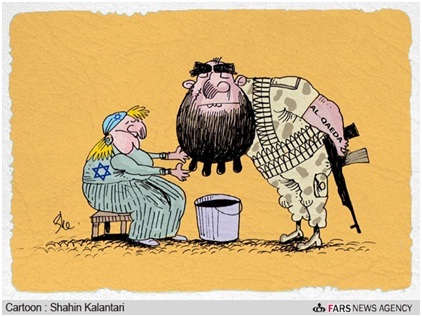
By Tony Cartalucci – New Eastern Outlook – 10.06.2017
Several were left dead and many more injured after coordinated terror attacks on Iran’s capital of Tehran. Shootings and bombings targeted Iran’s parliament and the tomb of Ayatollah Khomeini.
According to Reuters, the so-called “Islamic State” claimed responsibility for the attack, which unfolded just days after another terror attack unfolded in London. The Islamic State also reportedly took responsibility for the violence in London, despite evidence emerging that the three suspects involved were long-known to British security and intelligence agencies and were simply allowed to plot and carry out their attacks.
It is much less likely that Tehran’s government coddled terrorists -as it has been engaged for years in fighting terrorism both on its borders and in Syria amid a vicious six-year war fueled by US, European, and Persian Gulf weapons, cash, and fighters.
Armed Violence Targeting Tehran Was the Stated Goal of US Policymakers
The recent terrorist attacks in Tehran are the literal manifestation of US foreign policy. The creation of a proxy force with which to fight Iran and establishing a safe haven for it beyond Iran’s borders have been long-stated US policy. The current chaos consuming Syria and Iraq – and to a lesser extent in southeast Turkey – is a direct result of the US attempting to secure a base of operations to launch a proxy war directly against Iran.
In the 2009 Brookings Institution document titled, “Which Path to Persia? Options for a New American Strategy toward Iran,” the use of then US State Department-listed foreign terrorist organization Mujahedin-e Khalq Organization (MEK) as a proxy for instigating a full-fledged armed insurgency not unlike that which is currently unfolding in Syria was discussed in detail.
The report explicitly stated:
The United states could also attempt to promote external Iranian opposition groups, providing them with the support to turn themselves into full-fledged insurgencies and even helping them militarily defeat the forces of the clerical regime. The United states could work with groups like the Iraq-based National council of resistance of Iran (NCRI) and its military wing, the Mujahedin-e Khalq (MeK), helping the thousands of its members who, under Saddam Husayn’s regime, were armed and had conducted guerrilla and terrorist operations against the clerical regime. although the NCRI is supposedly disarmed today, that could quickly be changed.
Brookings policymakers admitted throughout the report that MEK was responsible for killing both American and Iranian military personnel, politicians, and civilians in what was clear-cut terrorism. Despite this, and admissions that MEK remained indisputably a terrorist organization, recommendations were made to de-list it from the US State Department’s Foreign Terrorist Organization registry so that more overt support could be provided to the group for armed regime change.
Based on such recommendations and intensive lobbying, the US State Department would eventually de-list MEK in 2012 and the group would receive significant backing from the US openly. This included support from many members of current US President Donald Trump’s campaign team – including Rudy Giuliani, Newt Gingrich, and John Bolton.
However, despite these efforts, MEK was not capable then or now of accomplishing the lofty goal of instigating full-fledged insurrection against Tehran, necessitating the use of other armed groups. The 2009 Brookings paper made mention of other candidates under a section titled, “Potential Ethnic Proxies,” identifying Arab and Kurdish groups as well as possible candidates for a US proxy war against Tehran.
Under a section titled, “Finding a Conduit and Safe Haven,” Brookings notes:
Of equal importance (and potential difficulty) will be finding a neighboring country willing to serve as the conduit for U.S. aid to the insurgent group, as well as to provide a safe haven where the group can train, plan, organize, heal, and resupply.
For the US proxy war on Syria, Turkey and Jordan fulfill this role. For Iran, it is clear that US efforts would have to focus on establishing conduits and safe havens from Pakistan’s southwest Balochistan province and from Kurdish-dominated regions in northern Iraq, eastern Syria, and southeastern Turkey – precisely where current upheaval is being fueled by US intervention both overtly and covertly.
Brookings noted in 2009 that:
It would be difficult to find or build an insurgency with a high likelihood of success. The existing candidates are weak and divided, and the Iranian regime is very strong relative to the potential internal and external challengers.
A group not mentioned by Brookings in 2009, but that exists in the very region the US seeks to create a conduit and safe haven for a proxy war with Iran, is the Islamic State. Despite claims that it is an independent terrorist organization propelled by black market oil sales, ransoms, and local taxes, its fighting capacity, logistical networks, and operational reach demonstrates vast state sponsorship.
The Ultimate Proxy, the Perfect Conduit and Safe Haven
The Islamic State reaching into Iran, southern Russia, and even as far as western China was not only possible, it was inevitable and the logical progression of US policy as stated by Brookings in 2009 and verifiably executed since then.
The Islamic State represents the perfect “proxy,” occupying the ideal conduit and safe haven for executing America’s proxy war against Iran and beyond. Surrounding the Islamic State’s holdings are US military bases, including those illegally constructed in eastern Syria. Were the US to wage war against Iran in the near future, it is likely these assets would all “coincidentally” coordinate against Tehran just as they are now being “coincidentally” coordinated against Damascus.
The use of terrorism, extremists, and proxies in executing US foreign policy, and the use of extremists observing the Islamic State and Al Qaeda’s brand of indoctrination was demonstrated definitively during the 1980’s when the US with the assistance of Saudi Arabia and Pakistan – used Al Qaeda to expel Soviet forces from Afghanistan. This example is in fact mentioned explicitly by Brookings policymakers as a template for creating a new proxy war – this time against Iran.
For the US, there is no better stand-in for Al Qaeda than its successor the Islamic State. US policymakers have demonstrated a desire to use known terrorist organizations to wage proxy war against targeted nation-states, has previously done so in Afghanistan, and has clearly organized the geopolitical game board on all sides of Iran to facilitate its agenda laid out in 2009. With terrorists now killing people in Tehran, it is simply verification that this agenda is advancing onward.
Iran’s involvement in the Syrian conflict illustrates that Tehran is well aware of this conspiracy and is actively defending against it both within and beyond its borders. Russia is likewise an ultimate target of the proxy war in Syria and is likewise involved in resolving it in favor of stopping it there before it goes further.
China’s small but expanding role in the conflict is linked directly to the inevitability of this instability spreading to its western Xianjiang province.
While terrorism in Europe, including the recent London attack, is held up as proof that the West is “also” being targeted by the Islamic State, evidence suggests otherwise. The attacks are more likely an exercise in producing plausible deniability.
In reality, the Islamic State – like Al Qaeda before it – depends on vast, multinational state sponsorship – state sponsorship the US, Europe, and its regional allies in the Persian Gulf are providing. It is also sponsorship they can – at anytime of their choosing – expose and end. They simply choose not to in pursuit of regional and global hegemony.
The 2009 Brookings paper is a signed and dated confession of the West’s proclivity toward using terrorism as a geopolitical tool. While Western headlines insist that nations like Iran, Russia, and China jeopardize global stability, it is clear that they themselves do so in pursuit of global hegemony.
Syrian Army, Hezbollah reaches border with Iraq for the first time in years
By Chris Tomson | Al-Masdar News | 09/06/2017
DAMASCUS – Late on Friday afternoon, the Syrian Arab Army (SAA), Hezbollah and allied Iraqi paramilitary contingents dashed through southeastern Homs and reached an Iraqi border point, thus slicing adrift the frontline between rebel forces based in the Al-Tanf region and ISIS militants in the neighboring Deir Ezzor governorate.
Unopposed by the US Airforce and its vetted Syrian proxies, the SAA and its allies drove through over 40 kilometers of abandoned desert territory and managed to link up with an Iraqi garrison across the border.
The advance was confirmed by the Russian Ministry of Defense and an Hezbollah-linked outlet moments ago.
Effectively, the SAA is now able to reopen trade between Damascus and Baghdad. Government forces have not controlled any parts of the largely ISIS-controlled border with Iraq since 2014.
In addition, Hezbollah is now able to be supplied with weapons from Tehran via an all-important land route. Previously, the Lebanese group relied on complicated airlifts for new armaments.
The US Hand in the Libyan/Syrian Tragedies
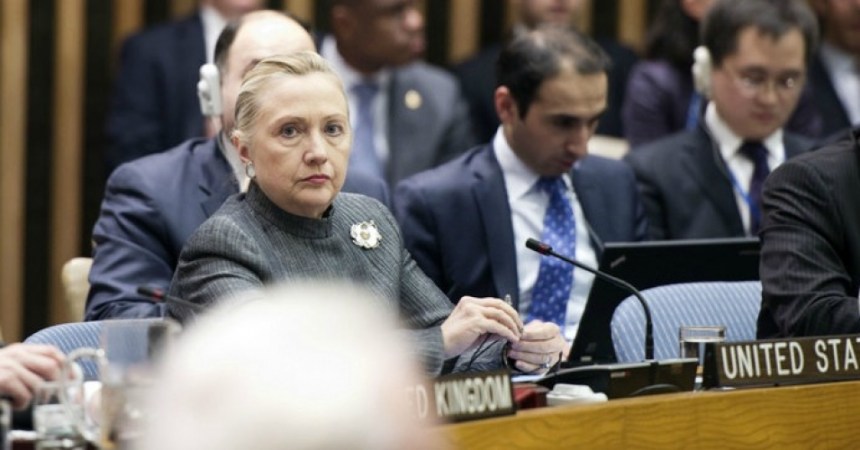
US Secretary of State Hillary Clinton delivers remarks at a UN Security Council Session on the situation in Syria at the UN in New York on Jan. 31, 2012. [State Dept. Photo]
By Jonathan Marshall | Consortium News | June 9, 2017
Police investigations and media reports have confirmed that two of the bloodiest terrorist attacks in Western Europe — the coordinated bombings and shootings in Paris in November 2015, which killed 130 people, and the May 2017 bombing of the arena in Manchester, England, which killed 23 — trace back to an Islamic State unit based in Libya known as Katibat al-Battar.
Since those attacks, a number of analysts, myself included, have characterized them as a form of “blowback” from NATO’s disastrous campaign to depose Libyan dictator Muammar Gaddafi in 2011. By turning Libya into an anarchic staging ground for radical Islamist militants, that intervention set in motion the deadly export of terror back into Western Europe.
But such a Eurocentric critique of NATO’s intervention misses the far greater damage it wreaked on Syria, where nearly half a million people have died and at least 5 million refugees have had to flee their country since 2011. U.S., British and French leaders helped trigger one of the world’s great modern catastrophes through their act of hubris in seeking another “regime change” – the overthrow of President Bashar al-Assad – in Syria.
A decade ago, Libya was a leading foe of radical jihadis, not a sanctuary for their international operations. A 2008 State Department memo noted that “Libya has been a strong partner in the war against terrorism.” It gave the Gaddafi regime credit for “aggressively pursuing operations to disrupt foreign fighter flows,” particularly by veterans of jihadist wars in Afghanistan and Iraq.
All that came to an end in 2011, when armed rebels, including disciplined members of al-Qaeda and Islamic State, enlisted NATO’s help to topple Gaddafi’s regime.
Western leaders ignored the prescient warnings of Gaddafi’s son Seif that “Libya may become the Somalia of North Africa, of the Mediterranean. . . .You will see millions of illegal immigrants. The terror will be next door.” Gaddafi himself similarly predicted that once the jihadis “control the Mediterranean . . . then they will attack Europe.”
Subsequent terrorist attacks in Europe certainly vindicated those warnings, while discrediting the so-called “humanitarian” case for waging an illegal war in Libya. But the predicted jihadi efforts to “control the Mediterranean” have had far graver repercussions, at least in the case of Syria.
A recent story in the New York Times on the genesis of recent terror attacks on France and Britain noted in passing that the Islamic State in Libya, composed of “seasoned veterans of Iraq and Afghanistan,” was “among the first foreign jihadist contingent to arrive in Syria in 2012, as the country’s popular revolt was sliding into a broader civil war and Islamist insurgency.”
A former British counter-terrorism analyst told the newspaper, “some of the baddest dudes in Al Qaeda were Libyan. When I looked at the Islamic State, the same thing was happening. They were the most hard-core, the most violent — the ones always willing to go to extremes when others were not. The Libyans represented the elite troops, and clearly ISIS capitalized on this.”
These Libyan jihadists leveraged their numbers, resources, and fanaticism to help escalate Syria’s conflict into the tragedy we know today. The mass murder we now take for granted was not inevitable.
Extremist Violence in Syria
Although Syria’s anti-government protests in the spring of 2011 turned violent almost from the start, many reformers and government officials strove to prevent an all-out civil war. In August 2011, leaders of Syria’s opposition wisely declared that calls to arms were “unacceptable politically, nationally, and ethically. Militarizing the revolution would . . . undermine the gravity of the humanitarian catastrophe involved in a confrontation with the regime. Militarization would put the revolution in an arena where the regime has a distinct advantage and would erode the moral superiority that has characterized the revolution since its beginning.”
Largely forgotten today, the Assad regime also took serious steps to deescalate the violence, including lifting the country’s state of emergency, disbanding the unpopular National Security Court, appointing a new government, and hosting a national dialogue with protest leaders.
But on August 18, 2011, the same Western leaders who were bombing Gaddafi announced to the world that “the time has come for President Assad to step aside.” Further energizing Syrian militants, Libyan rebels were just then in the midst of conquering Tripoli with NATO’s help.
“That is an ominous sign for Syria’s President Bashar al-Assad,” reported the Wall Street Journal. “Already there are signs Libya is giving inspiration to the rebels trying to oust Mr. Assad. . . . Syrian protesters took to the streets chanting ‘Gadhafi tonight, Bashar tomorrow.’ . . . The Libyan episode may serve simply to sharpen the conflict in Syria: both spurring on the dissidents and strengthening Mr. Assad’s resolve to hold on.”
Stoking war in Syria was not an unintended consequence of the Libyan campaign, but a conscious part of the longstanding neoconservative ambition to “remake the map of the Middle East” by toppling radical, nationalist and anti-American regimes. The same Journal article described the grandiose aims of some Washington interventionists:
“Beyond Syria, a new dose of energy provided by Libya’s uprising could ripple out to other nations in the region. In particular, U.S. officials hope it will reinvigorate a protest movement that arose inside Iran in 2009 to challenge President Mahmoud Ahmadinejad’s re-election. . . Syria has served for 30 years as Iran’s closest strategic ally in the region. U.S. officials believe the growing challenge to Mr. Assad’s regime could motivate Iran’s democratic forces.”
Instead of motivating Iran’s democrats, of course, the Syrian conflict motivated Iran’s hardliners to send Revolutionary Guard units and Hezbollah proxy forces into the country, further destabilizing the region.
Following the gruesome murder of Gaddafi in the fall of 2011, Libyan zealots quickly began fueling other terrorist conflicts, ranging from Mali to the Middle East, with arms looted from Gaddafi’s vast stocks.
“The weapons proliferation that we saw coming out of the Libyan conflict was of a scale greater than any previous conflict — probably 10 times more weapons than we saw going on the loose in places like Iraq, Somalia and Afghanistan,” observed an expert at Human Rights Watch.
A United Nations investigation determined that “Transfers of arms and ammunition from Libya were among the first batches of weapons and ammunition to reach the Syrian opposition.” It also stressed that Libyan weapons were arming primarily “extremist elements,” allowing them to gain territory and influence at the expense of more moderate rebel groups.
Spreading the War
As early as November 2011, Islamist warlords in Libya began offering “money and weapons to the growing insurgency against Bashar al-Assad,” according to the Daily Telegraph. Abdulhakim Belhadj, commander of the Tripoli Military Council and the former leader of the Libyan Islamic Fighting Group, an al-Qaeda affiliate, met secretly with Syrian rebel leaders in Turkey to discuss training their troops. (In 2004, he had been the victim of a CIA kidnap plot and rendition from Malaysia to Libya.)
The commander of one armed Libyan gang told the newspaper, “Everyone wants to go (to Syria). We have liberated our country, now we should help others. . . This is Arab unity.”
In April 2012, Lebanese authorities confiscated a ship carrying more than 150 tons of arms and ammunition originating in Misrata, Libya. A U.N.-authorized panel inspected the weapons and reported finding SA-24 and SA-7 surface-to-air missiles, anti-tank guided missiles, and a variety of other light and heavy weapons.
By that August, according to Time magazine, “hundreds of Libyans” had flocked to Syria to “export their revolution,” bringing with them weapons, expertise in making bombs, and experience in battlefield tactics.
“Within weeks of the successful conclusion of their revolution, Libyan fighters began trickling into Syria,” the magazine noted. “But in recent months, that trickle has allegedly become a torrent, as many more have traveled to the mountains straddling Syria and Turkey, where the rebels have established their bases.”
A Syrian rebel told the newsweekly, “They have heavier weapons than we do,” including surface-to-air missiles. “They brought these weapons to Syria, and they are being used on the front lines.”
A month later, the London Times reported that a Libyan ship carrying more than 400 tons of weapons bound for Syria, including SAM-7 anti-aircraft missiles and rocket-propelled grenades, had docked in Turkey. Such weapons particularly compounded the suffering of civilians caught up in the war. As France’s foreign minister told reporters that October, rebel-held anti-aircraft missiles were “forcing (Syrian government) planes to fly extremely high, and so the strikes are less accurate.”
According to later reporting by Seymour Hersh, most such Libyan weapons made their way to Syria via covert routes supervised by the CIA, under a program authorized by the Obama administration in early 2012. Funding and logistics support came from Turkey, Saudi Arabia, and Qatar. The CIA supposedly avoided disclosing the program to Congress by classifying it as a liaison operation with a foreign intelligence partner, Britain’s MI6.
Word of the operation began leaking to the London media by December 2012. The CIA was said to be sending in more advisers to help ensure that the Libyan weapons did not reach radical Islamist forces.
Of course, their efforts came too late; U.S. intelligence officials knew by that time that “the Salafist(s), the Muslim Brotherhood, and (al-Qaeda)” were “the major forces driving the insurgency.” The influx of new arms simply compounded Syria’s suffering and raised its profile as a dangerous arena of international power competition.
Libya’s arms and fighters helped transform the Syrian conflict from a nasty struggle into a bloodbath. As Middle East scholar Omar Dahi noted, “the year 2012 was decisive in creating the present catastrophe. There were foreign elements embroiled in Syria before that date . . . but until early 2012 the dynamics of the Syrian conflict were largely internal. . . . Partly in . . . appropriation of weapons pumped in from the outside and partly in anticipation of still greater military assistance, namely from the West, the opposition decided to take up arms.
“The decision — militarization — had three main effects. First, it dramatically increased the rate of death and destruction throughout the country. . . . By mid-2012, the monthly casualties were almost in excess of the total in the entire first year of the uprising. Militarization gave the Syrian regime a free hand to unleash its full arsenal of indiscriminate weaponry. . . Perhaps most fatefully, the advent of armed rebellion placed much of the opposition’s chances in the hands of those who would fund and arm the fighters. . . . It was then that the jihadi groups were unleashed.”
The collateral victims of NATO’s intervention in Libya now include 6 million Libyans attempting to survive in a failed state, millions of people across North Africa afflicted by Islamist terrorism, 20 million Syrians yearning for an end to war, and millions of innocent Europeans who wonder when they might become targets of suicidal terrorists. There is nothing “humanitarian” about wars that unleash such killing and chaos, with no end in sight.
UAE-tied militants kidnap, torture hundreds in Yemen: Probe
Press TV – June 10, 2017
Militants backed by the United Arab Emirates (UAE) have reportedly kidnapped and tortured hundreds of people in southern Yemen.
On Friday, the American news and analysis website The Daily Beast published an investigation bankrolled by the Bureau of Investigative Journalism NGO, which pointed to the findings.
The probe said the militants, who would fight under the banner of the Elite Forces, had spirited the men away from their homes and brought them to a secret prison compound in southern Yemen, where they were tortured.
Earlier in the year, the United Nations had likewise reported an increase in forced disappearances in southern Yemen.
The UAE has served as an ally of Saudi Arabia in the latter’s 2015-present campaign in Yemen to restore the impoverished country’s former Riyadh-allied government. The Elite Forces have been fighting in Yemen since the same year to assist the Saudi-led campaign.
The investigators interviewed local rights activists and families of those abducted, who said the situation at the al-Riyyan airport, which has been used as a place of incarceration for the abductees, compared to that in the notorious US-run prisons such as Guantanamo Bay in Cuba and Abu Ghraib in Iraq.
The kidnapping spree took place under the pretext of clearing out suspected al-Qaeda-linked elements. Activists, however, told the Bureau that many of those abducted had normal jobs while al-Qaeda was in control in the area, and were not tied to the group.
According to various reports, Abu Dhabi holds notable sway in southern Yemen and looks to be trying to expand its leverage there by lending its support to southern separatists.
The separatists are led by two pro-Emirati officials of Yemen’s former president Abd Rabbuh Mansur Hadi, who have been sacked by him over suspicions of serving the Emirates.
The men, Hadi’s governor for Yemen’s port city of Aden, Maj. Gen. Aidarous al-Zubaidi, and his state minister Hani bin Breik, reacted to the sacking by breaking ranks with Hadi and forming an autonomous regional body in southern Yemen.
Saudi Arabia then “invited” the separatists to the kingdom, in what was seen as an effort at seeking explanation from them for parting ways with Riyadh-allied Hadi.
Observers say the Emirates increased activities could drag Doha into a political struggle against Saudi Arabia.
Earlier in the month, Yemeni sources reported that militants backed by Saudi Arabia and the United Arab Emirates had engaged in infighting in the southern port city of Aden, with UAE-backed militia seizing a facility there.
Russian Senator Vows Response Over Potential US’ Restrictions on Russian Media
Sputnik – 09.06.2017
MOSCOW – Russia’s Federation Council may suggest reciprocal measures for the US press in Russia, if Russian media in the United States face any limitations, the first deputy chairman of the Russian parliament’s upper house International Affairs Committee told Sputnik on Friday.
On June 7, US Congressmen David Cicilline and Matthew Gaetz introduced legislation, called The Foreign Agents Registration Modernization and Enforcement Act, which would provide the US Department of Justice with “the increased investigative authority to identify and prosecute entities that seek to unlawfully influence the political process.” The legislation is specifically targeting such media outlets, as RT broadcaster, obliging them to register as foreign agents and report their activity to the Department of Justice.
Cecilline called the RT broadcaster the Kremlin’s “propaganda” arm “dressed up as a legitimate news outlet,” and said that the new bill will help to prevent “spread of fake news” among the US nationals.
“There are attempts to prevent the Russian media in the United States from delivering objective information, different from the made-to-order [information] which they spread themselves. At the same time, Voice of America [broadcaster] and other organizations, unfriendly to us, have been spreading anti-Russian propaganda for decades and they continue to work, with no worries. The commission of the Federation Council [on countering foreign interference in Russian internal affairs], which will be established on June 14 will look into issues like this one. Possibly, we will begin working on reciprocal measures to respond to such actions,” Vladimir Dzhabarov said.
In accordance with the new legislation, the US Justice Department will be able to compel the production of documents from any person or entity while investigating any case, which is within the Foreign Agents Registration Act (FARA) compliance. As of now, the authority to compel the production of such documents appears only after initiation of civil or criminal proceeding.
Russian media outlets broadcasting in Europe and the United States have been facing a barrage of accusations by Western officials about allegedly spreading fake news and attempting to influence public life. In the United States, the intelligence community has claimed Russia used its media outlets to swing the outcome of the US presidential election in favor of Donald Trump, but have not provided any evidence to back their claims.
Russian President Vladimir Putin, Foreign Minister Sergei Lavrov and other senior officials have repeatedly stated that Moscow refrains from meddling in internal affairs of foreign countries.
This is How Comey Really Helped US President by Trying to Damage Him
Sputnik – 09.06.2017
WASHINGTON – Former Federal Bureau of Investigation (FBI) Director James Comey’s testimony to a US Senate hearing did further political damage to President Donald Trump, but also cleared him of having been a subject of inquiry, former FBI Special Agent Colleen Rowley told Sputnik.
Testifying before the Senate Intelligence Committee on Thursday, former FBI Director James Comey said that President Donald Trump did not ask him to drop his probe into alleged Russian meddling in the 2016 US election.
“Overall it did do some further damage to Trump… [but] I don’t think there was a whole lot new learned,” Rowley said on Thursday. “Finally we learned that Trump was personally not a subject of the investigation at least until Comey was fired.”
Rowley, a retired FBI special agent and division legal counsel noted that Comey had admitted to inappropriate behavior himself during the hearing before the US Senate Intelligence Committee.
“I thought the most interesting thing they did that did come out now was that Comey was responsible for leaking his own memorandum to a law professor at Columbia University,” she said.
Neither Republican nor Democratic senators had followed up on Comey’s admission and tried to learn the full details behind it and the extent of the leaks he had performed himself or knew about, Rowley observed.
“It is a pity that no senators followed up on that or asked how often he had done it before and if he knew who else (among senior officials) had been leaking. That was a missed opportunity,” she said.
Comey produced no hard evidence of wrongdoing on Trump’s part, but he had proved skillful at painting a critical portrait of the president in his testimony, Rowley assessed.
“Comey is very good on his feet. He is fast thinking and very political. He is a performer,” she said.
Media coverage of the hearing was biased against Trump and highly sympathetic and uncritical towards Comey, Rowley commented.
“Our news coverage was very one-sided,” she said.
In previous published comments, Rowley has recalled that when Comey was deputy attorney general, he had signed off on highly illegal programs, including warrantless surveillance of Americans and torture of captives.
As top law enforcement official of the George W. Bush administration, Comey presided over post-September 11 cover-ups and secret abuses of the US Constitution, including fabrications used to launch wrongful wars, and exhibited plain incompetence, Rowley has stated.
Rowley sent a May 2002 memo to then-FBI Director Robert Mueller that exposed some of the FBI’s pre-9/11 failures. She was named one of TIME magazine’s “Persons of the Year” in 2002.
Corbyn’s victory is greater than the keys to Number 10
By Nasim Ahmed | MEMO | June 9, 2017
Britain underwent the most important general election of this century. For the second time in a row, Conservative leaders scored the most spectacular own goal ever to be seen. Twice within the period of two years, British prime ministers gambled with the lives of the British people and lost; on both occasions Conservative leaders put their self-interest above the national interest and the electorates punished them for it.
It has now become resoundingly clear that the electorate does not like being taken for granted. Former Prime Minister David Cameron and current Prime Minster Therese May have learnt this the hard way. Cameron paid the highest political price in gambling to hold an EU referendum for no reason other than to please his own backbenchers. May too will most likely pay the same price for her humiliating defeat in calling a snap general election for no reason other than to inflict a crushing defeat on the Labour party.
But it is the Conservatives that have suffered a great defeat, even though they have won the election and are still in power. Hubris and opportunism assured their humiliation. They imagined they would have a landslide victory and increase their control of the Commons. With more Conservative MPs May was confident – to the point of carelessness – in being able to ease through a hard Brexit. She underestimated the opposition leader, Jeremy Corbyn. Believing him to be weak and unpopular, a caricature from bygone years, she was certain of attaining absolute power.
That we are now talking about the triumph of Corbyn over May is one of the more remarkable stories in British politics. Rarely has another leader had to take on so many enemies. He wrestled against the Tory war machine while fending off foes within his own party. The vast majority despised everything he represented culminating in172 Labour MPs voting against him in a no confidence motion. Labour MPs at one point were talking about going through an ongoing cycle of leadership contests until they forced him out. With such a desire to sabotage his campaign it would be naïve to assume that some Labour MPs were not secretly collaborating with the Tory party to see his downfall.
While the major parties in Westminster were gunning for him, the mainstream media stooped to levels unseen in British politics. For long periods, the entire mainstream media undermined him, mocked him, ridiculed him and constructed a narrative that would have totally damaged any other candidate. The traditional so called left wing media were nowhere to be seen, in fact they cheered for his public execution. Even his so called friends defected saying “I’d find it hard to vote for Corbyn”.
The inability of the Labour MP’s and the mainstream media to see what was happening was further proof that the entire establishment was really out of touch. They lived in their own little bubble inside an enormous echo chamber, thoroughly convinced of the lies and propaganda they propagated.
Faced against such challenges the achievement of Jeremy Corbyn in the last two years has been nothing short of remarkable. What this has shown more than anything else is the growing appetite for social justice; even socialism shall we say. He has turned Labour into a socialist party with the largest membership in Europe. Public ownership, and civic and community pride have all been returned to the political agenda. Corbyn has also succeeded where many before him have failed; to empower large sections of the population that were living in self-imposed political alienation. There’s a younger generation who have spoken for the first time and they have turned their back on austerity and having to settle for the crumbs left behind from the Chancellor’s budget.
The triumph of Corbyn is likely to see a push back against decades of unhindered neo-liberal economic policy which has been responsible for unprecedented levels of inequality not just here in the UK but also around the globe. This victory, as many believe, is substantial.
Corbyn has not won the election but his triumph has been to bring back into public ownership, not-for-profit utility companies, and investment in the health service, the police and public services back on the agenda. Privatisation, free market fundamentalism, and bankers’ greed at everyone else’s expense is now blown out of the water.
The Labour leader achieved wide popularity because of his ethical foreign policy. His years in the back benches have been spent defending human rights across the world and fighting against imperialism and political domination of all kind. In his manifesto he promised to block the sale of weapons to repressive regimes and pushed for a more ethical exports policy. The rights of the Palestinian people are very close to his heart. It was, telling that despite the mudslinging against him over his track record in the Middle East he has come through unscathed if not stronger.
No coming election can ignore the issues raised by Corbyn over the past few years. He may not have won the election but the victory he has achieved is more than just the keys to number ten. Equality, social justice and ethical foreign policy are back on the agenda and the mainstream media can go on mulling over them by eating some humble pie.
Lieberman urges US to pressure for expelling Hamas leaders from Beirut
Palestine Information Center – June 9, 2017
OCCUPIED JERUSALEM – The Israeli war minister, Avigdor Lieberman, on Friday urged the visiting American UN ambassador Nikki Haley to pressure Beirut to expel Hamas anti-occupation leaders.
According to the Hebrew-language Walla news site, Lieberman launched calls to expel prominent Hamas leaders from Lebanon following a meeting with the American UN ambassador Nikki Haley.
“Hamas leaders in Lebanon should be banished because they are working against Israel,” claimed Lieberman.
Over recent weeks, an ad hominem campaign has been waged against Palestinian anti-occupation leaders affiliated with Hamas resistance movement in an attempt to deport them from their countries of residency.
Report: Rise in number of Russian Jews leaving Israel
MEMO | June 9, 2017
A new report revealed an increase in the number of Russian Jews who migrate from Israel to other countries or to their original home in Russia and the former Soviet Union.
The report, released by the Knesset Committee for Immigration, Absorption and Diaspora Affairs, revealed that 38 per cent of the total 290,300 immigrants who left Israel without return within the past 14 years are Russian immigrants.
According to the report, the main reasons for their reverse migration include the “glass barrier” which prevents their progress in the occupational ladder, lack of separation between religion and state especially in the matters of marriage, burial rituals, in addition to the stereotyping of Russians and discrimination on the public and official levels.
The committee held on Wednesday an emergency session following the release of the report published in early May which pointed out that one in six Russian immigrants leave Israel and that the percentage could rise if the relevant authorities do not provide appropriate solutions.
According to official data, nearly 650,000 people from the former Soviet Union immigrated to Israel – including 185,000 people under the age of 20 – between 1990 and 1996.
Featured Video
Marandi: Threat of Seizing Kharg Island & the Use of Nuclear Weapons
or go to
Aletho News Archives – Video-Images
Frlom the Archives
Provoking a Path to Persia
The Saban Center’s prescient paper on war with Iran
By Maidhc Ó Cathail | October 20, 2011
In June 2009, the Saban Center for Middle East Policy published “Which Path to Persia?—Options for a New American Strategy toward Iran.” Writing in a tone strikingly reminiscent of the Project for a New American Century’s infamous pre-9/11 paper “Rebuilding America’s Defenses,” the six co-authors noted that, “It seems highly unlikely that the United States would mount an invasion without any provocation or other buildup.” For a think tank specifically established by media mogul Haim Saban to protect Israel, this could prove to be a formidable obstacle impeding their desired march—of U.S. troops—to Tehran.
“In fact, if the United States were to decide that to garner greater international support, galvanize U.S. domestic support, and/or provide a legal justification for an invasion, it would be best to wait for an Iranian provocation, then the time frame for an invasion might stretch out indefinitely,” Saban’s think-tankers ruefully observed.
“With only one real exception, since the 1978 revolution, the Islamic Republic has never willingly provoked an American military response, although it certainly has taken actions that could have done so if Washington had been looking for a fight. Thus it is not impossible that Tehran might take some action that would justify an American invasion. And it is certainly the case that if Washington sought such a provocation, it could take actions that might make it more likely that Tehran would do so (although being too obvious about this could nullify the provocation). However, since it would be up to Iran to make the provocative move, which Iran has been wary of doing most times in the past, the United States would never know for sure when it would get the requisite Iranian provocation. In fact, it might never come at all.”
Seemingly undeterred by Iran’s frustrating unwillingness to provide the requisite provocation, the analysts continued to examine this option… continue
Blog Roll
 Aletho News
- Ukrainian Embassy in Beirut sheltering top Mossad agent
- Palestinian family displaced after settlers violently attack them in Humsa, Jordan Valley
- The EU never learns – except for the wrong lessons
- Iran attacks on UAE leaves RSF militia high and dry
- Hosting Washington’s war: Bahrain faces the consequences
- The US fell for its own Iran propaganda
- Seyed M. Marandi: Threat of Seizing Kharg Island & the Use of Nuclear Weapons
- Is there even an off ramp?
- Michael von der Schulenburg: Europe’s Self-Defeating Iran War Policy
- Sorry, The New Republic, Climate Change Isn’t Causing Somali Migration. Blame Civil Strife and Poverty.
- If Americans Knew
- ‘Of Course’: IDF Drops Case Against Soldiers Accused of Raping Palestinian Prisoner
- Don’t Fall for the Regime Change Talk. Israel Is ‘Mowing the Lawn’ in Iran
- Will Israel and the US wreck the Gulf States along with Iran?
- US so far burned through ‘years’ of munitions in Iran war: Report
- How the Israeli Tail Wags the American Dog
- Outdated intel likely led to deadly U.S. strike on Iranian elementary school, sources say
- Pentagon insider says high U.S official Douglas Feith reported to Netanyahu
- In fond memory of Walid Khalidi, the historian of Palestine
- 6 more Americans killed, as Israel ‘mows the lawn’ in Iran – Not a ceasefire Day 154
- Are we on the precipice of World War III?
- No Tricks Zone
- New Studies: UK Sea Levels Were 4 Meters Higher Than Today During The Mid-Holocene
- Destructive Green New Deal: German Energy And Metal Group Warns Of Drastic Crisis
- New Study Documents A 20-Year Pause In Arctic Sea Ice Decline – Driven By Internal Variability
- Wake-up Call: Survey Shows Majority Of Germans Now Favor Postponing Climate Targets!
- Televised! Leading German Political Candidate Tells Schoolchildren CO2 Makes Sun Hotter!
- New Study: A Century Warming Of 1.1°C Is ‘Commonplace’ And ‘Not Unusual’ During This Interglacial
- New Study: ‘Internal Noise’ And Volcanic Forcing Can Trigger 10-15°C Warming Within Decades
- Glaciers Worldwide Are Suddendly Surging, Experts Blame Warming!
- Surprising Discovery: Sahara Is Greening…Billions Of Trees Where Once Thought To Be Barren
- New Research Reaffirms Clouds, Aerosols, And Surface Solar Radiation Are ‘Driving The Climate System’
 Aletho News