Hamas accuses Israel of fabricating rocket claim to justify airstrikes in Gaza
Ma’an – June 27, 2017
BETHLEHEM – The Israeli air force launched at least two airstrikes on the besieged Gaza Strip early Tuesday, with the Israeli army saying the attacks targeted two Hamas military infrastructures and were in response to a rocket fired from Gaza late Monday, which allegedly landed in an open area in Israel’s Shaar Hanegev Regional Council that borders northeastern Gaza, causing no injuries or damages.
No injuries were reported as a result of the airstrikes.
Palestinian news agency Wafa cited local sources in Gaza, saying that strikes hit multiple locations across the small Palestinian territory, including northwest of Gaza City, east of the Gaza Valley area, and Nasr neighborhood in the southern Gaza Strip city of Rafah.
The strikes left material damages to a number of homes, the report said.
Separately, Wafa reported that the Israeli army attacked agricultural land east of the Gaza Valley with artillery missiles and another agricultural area east of Deir al-Balah in the central Gaza Strip, reporting no injuries.
“Since the terror organization Hamas is the ruler of the Gaza Strip, it is responsible for any attempt to harm the State of Israel,” the Israeli army said in a statement following the early morning aerial attack.
However, in a statement, the Hamas movement accused Israel of fabricating claims of rocket fire to justify the attack. “The Israeli claim of a rocket being fired from Gaza and issuing a statement on behalf of ISIS to justify the escalation and an attack of resistance positions are part of a dangerous and transparent Israeli game.”
The statement referred to reports in Israeli media that claimed a Salafist group in Gaza affiliated to the so-called Islamic State claimed responsibility for the alleged rocket fire.
Hamas has not claimed responsibility for any rocket attacks since a ceasefire was declared after the 2014 war, and the movement has attempted to clamp down on armed activity by smaller political groups that do launch rockets from the territory.
Israeli officials have nonetheless accused Hamas of “preparing” for another war with Israel and have threatened retaliatory measures against the Gaza Strip as a whole.
The attacks came as Palestinians in the besieged coastal enclave are being forced to cope with just a few hours of electricity a day since Israel agreed to a Palestinian Authority request to dramatically cut electricity supplies to territory.
The Gaza Strip marked the ten-year anniversary of Israel’s siege of the small Palestinian enclave this month, with the humanitarian situation there continuing to alarm rights groups that have denounced the Gaza’s inhuman conditions as “unparalleled in the modern world.”
Israeli authorities approve budget for controversial ‘Apartheid road’ in West Bank
Ma’an – June 27, 2017
BETHLEHEM – Israel has reportedly approved a budget for the construction of the so-called Eastern Ring Road in the occupied West Bank, known by activists and rights groups as the “Apartheid road.”
The road, part of Israel’s plans of developing the controversial E1 corridor, has been denounced as an attempt to further expand illegal Israeli settlement construction in the occupied Palestinian territory, while deepening the separation between Palestinian communities on opposite sides of Israel’s separation wall.
According to a statement released by Israeli rights group Ir Amim on Monday, the development of the road is “one of several developments necessary for preparing the ground for E1.”
The reports emerged from Israeli media outlet Israel Hayom, which stated that the road is expected to be opened to Israeli traffic in the next 10 months.
According to rights groups, settlement construction in E1 would effectively divide the West Bank and make the creation of a contiguous Palestinian state — as envisaged by the internationally backed two-state solution to the Palestinian-Israeli conflict — almost impossible.
Israeli activity in E1 has attracted widespread international condemnation, and Palestinian President Mahmoud Abbas has in the past said that “E1 is a red line that cannot be crossed.”
However, the Eastern Ring Road was proposed by former Israeli Prime Minister Ariel Sharon as a plan to apparently solve the issue of bifurcating the West Bank, by facilitating “navigation from Ramallah to Bethlehem for Palestinians but without any access to Jerusalem.”
Following the second Palestinian intifada and Israel’s construction of the separation wall that has disjointed Palestinian territory, Palestinians from the “West Bank side” of the separation barrier have been forced to obtain Israeli-issued permits in order to access occupied East Jerusalem, which some Palestinians and the international community still consider to be the future capital of an independent Palestinian state.
A map released by Ir Amim shows the expected route of the road. According to the group, the road would “ease access” for Israeli settlers residing around Ramallah in contravention of international law, as settlers have “long exerted pressure to open the road, complaining about traffic jams and delays.”
Ir Amim pointed out that Israel’s plan would enable further expansions of Israel’s illegal settlements around Ramallah.
The road is also planned to connect with Road 1 that connects the mega settlement Maale Adumim with Jerusalem, and would also link to the Mount Scopus Tunnel Road through the Zeitim interchange, another controversial E1 related project that Israeli authorities had begun construction on several months ago, according to Ir Amim.
According to an earlier report released by Ir Amim, the Zeitim interchange is located between Jerusalem and Maale Adumim, and would connect the Eastern Ring Road in the northern West Bank to road 417, leading to the south.
The group highlighted in the report that connecting these roads is “a crucial part in realizing the E1 plans,” as Israeli settlement construction in the E1 corridor would prevent Palestinians in the West Bank from using road 437, which “connects to road 417 and enables Palestinian traffic between the northern and southern West Bank.”
The plans aim to replace road 437 with the northern section of the Eastern Ring Road, which would divert Palestinian traffic away from road 437 and the E1 area” and would establish separate lanes for Israeli and Palestinian traffic, thus its label as an “apartheid road.”
Israel’s plans in E1 have long been denounced by rights groups and the international community since its approval in 1999, in the wake of the Oslo Accords which expected the area of E1 to be transferred to the Palestinian Authority (PA) within an interim period of five years.
Another central aspect of Israel’s development plans in the area includes the full eviction and relocation of Bedouin communities residing in E1, near Maale Adumim.
This plan was furthered earlier this year when Israeli authorities delivered demolition notices to every single home in the Bedouin village of Khan al-Ahmar, including the village’s elementary school. The village is located on the site of planned Israeli settlement development and on the Israeli side of the planned route of Israel’s separation barrier.
Rights groups and Bedouin community members have sharply criticized Israel’s relocation plans for the Bedouin residing near Maale Adumim, claiming that the removal would displace indigenous Palestinians for the sake of expanding Israeli settlements.
Bedouin villages in the area also face routine demolitions by Israeli forces.
Since the E1 corridor is part of Area C — the more than 60 percent of the West Bank under full Israeli military control and where Israel’s settlements are planned, the Palestinians living there face routine attempts by Israeli authorities to push them off the land.
Khan al-Ahmar is one of 46 villages comprising of a population of 7,000 — 70 percent of whom are Palestinian refugees — in the central West Bank that are considered by the UN as being at risk of forcible transfer by Israeli authorities to alternative sites, in violation of international law.
In addition, Israeli rights group B’Tselem has noted in the past that plans to develop the E1 corridor would also further isolate Palestinians straddled between the “West Bank side” of the separation barrier and those in occupied East Jerusalem, by “enclosing East Jerusalem from the East and linking it up with Israeli neighborhoods built north of the Old City.”
As East Jerusalem used to be the primary urban center for Palestinians in the West Bank, the E1 plans would further exacerbate a Palestinian-Palestinian separation that has wreaked havoc on Palestinian economic, social, and political life.
Hersh’s New Syria Revelations Buried From View
By Jonathan Cook | CounterPunch | June 27, 2017
Veteran investigative journalist Seymour Hersh, the man who exposed the Mai Lai massacre during the Vietnam War and the US military’s abuses of Iraqi prisoners at Abu Ghraib in 2004, is probably the most influential journalist of the modern era, with the possible exception of Bob Woodward and Carl Bernstein, the pair who exposed Watergate.
For decades, Hersh has drawn on his extensive contacts within the US security establishment to bring us the story behind the official story, to disclose facts that have often proved deeply discomfiting to those in power and exploded the self-serving, fairy-tale narratives the public were expected to passively accept as news. His stature among journalists was such that, in a sea of corporate media misinformation, he enjoyed a small island of freedom at the elite, but influential, outlet of the New Yorker.
Paradoxically, over the past decade, as social media has created a more democratic platform for information dissemination, the corporate media has grown ever more fearful of a truly independent figure like Hersh. The potential reach of his stories could now be enormously magnified by social media. As a result, he has been increasingly marginalised and his work denigrated. By denying him the credibility of a “respectable” mainstream platform, he can be dismissed for the first time in his career as a crank and charlatan. A purveyor of fake news.
Nonetheless, despite struggling to find an outlet for his recent work, he has continued to scrutinise western foreign policy, this time in relation to Syria. The official western narrative has painted a picture of a psychotic Syrian president, Bashar Assad, who is assumed to be so irrational and self-destructive he intermittently uses chemical weapons against his own people. He does so, not only for no obvious purpose but at moments when such attacks are likely to do his regime untold damage. Notably, two sarin gas attacks have supposedly occurred when Assad was making strong diplomatic or military headway, and when the Islamic extremists of Al-Qaeda and ISIS – his chief opponents – were on the back foot and in desperate need of outside intervention.
Dangerous monsters
Hersh’s investigations have not only undermined evidence-free claims being promoted in the west to destabilise Assad’s goverment but threatened a wider US policy seeking to “remake the Middle East”. His work has challenged a political and corporate media consensus that portrays Russia’s Vladimir Putin, Assad’s main ally against the extremist Islamic forces fighting in Syria, as another dangerous monster the West needs to bring into line.
For all these reasons, Hersh has found himself increasingly friendless. The New Yorker refused to publish his Syria investigations. Instead, he had to cross the Atlantic to find a home at the prestigious but far less prominent London Review of Books.
Back in 2013 his contacts within the security and intelligence establishments revealed that the assumption Assad had ordered the use of sarin gas in Ghouta, outside Damascus, failed to stand up to scrutiny. Even Barack Obama’s national intelligence director, James Clapper, was forced to admit privately that Assad’s guilt was “not a slam dunk”, even as the media widely portrayed it as precisely that. Hersh’s work helped stymie efforts at the time to promote a western military attack to bring down the Syrian government.
His latest investigation questions whether Assad was responsible for another alleged gas attack – this one in April, at Khan Sheikhoun. Again a consensual western narrative was quickly constructed after social media showed dozens of Syrians dead, apparently following a bomb dropped by Syrian aircraft. For the first time in his presidency, Donald Trump received wall-to-wall praise for launching a military strike on Syria in response, even though, as Hersh documents, he had no evidence on which to base such an attack, one that gravely violated international law.
Hersh’s new investigation was paid for by the London Review of Books, which declined to publish it. This is almost as disturbing as the events in question.
What is emerging is a media blackout so strong that even the London Review of Books is running scared. Instead, Hersh’s story appeared yesterday in a German publication, Welt am Sonntag. Welt is an award-winning newspaper, no less serious than the New Yorker or the LRB. But significantly Hersh is being forced to publish ever further from the centres of power whose misinformation his investigations are challenging.
Imagine how effective Woodward and Bernstein would have been in bringing down Richard Nixon had they been able to publish their Watergate investigations only in the French media. That is the situation we have reached now with Hersh’s efforts to scrutinise the west’s self-serving claims about Syria.
US-Russian cooperation
As for the substance of Hersh’s investigation, he finds that Trump launched 59 Tomahawk missiles at a Syrian air base in April “despite having been warned by the US intelligence community that it had found no evidence that the Syrians had used a chemical weapon.”
In fact, Hersh reveals that, contrary to the popular narrative, the Syrian strike on a jihadist meeting place in Khan Sheikhoun on April 4 was closely coordinated beforehand between Russian and US intelligence agencies. The US were well apprised of what would happen and tracked the events.
Hersh’s sources in the intelligence establishment point out that these close contacts occurred for two reasons. First, there is a process known as “deconfliction”, designed to avoid collisions or accidental encounters between the US, Syrian and Russian militaries, especially in the case of their supersonic jets. The Russians therefore supplied US intelligence with precise details of that day’s attack beforehand. But in this case, the close ties also occurred because the Russians wanted to warn the US to keep away a CIA asset, who had penetrated the jihadist group, from that day’s meeting.
“This was not a chemical weapons strike,” a senior adviser to the US intelligence community told Hersh. “That’s a fairy tale. If so, everyone involved in transferring, loading and arming the weapon … would be wearing Hazmat protective clothing in case of a leak. There would be very little chance of survival without such gear.”
According to US intelligence, Hersh reports, the Syrian air force was able to target the site using a large, conventional bomb supplied by the Russians. But if Assad did not use a chemical warhead, why did many people apparently die at Khan Sheikhoun from inhalation of toxic gas?
The US intelligence community, says Hersh, believes the bomb triggered secondary explosions in a storage depot in the building’s basement that included propane gas, fertilisers, insecticides as well as “rockets, weapons and ammunition, … [and] chlorine-based decontaminants for cleansing the bodies of the dead before burial”. These explosions created a toxic cloud that was trapped close to the ground by the dense early morning air.
Medecins Sans Frontieres found patients it treated “smelled of bleach, suggesting that they had been exposed to chlorine.” Sarin is odourless.
Hersh concludes that the “evidence suggested that there was more than one chemical responsible for the symptoms observed, which would not have been the case if the Syrian Air Force – as opposition activists insisted – had dropped a sarin bomb, which has no percussive or ignition power to trigger secondary explosions. The range of symptoms is, however, consistent with the release of a mixture of chemicals, including chlorine and the organophosphates used in many fertilizers, which can cause neurotoxic effects similar to those of sarin.”
Political suicide
Hersh’s main intelligence source makes an important contextual point you won’t hear anywhere in the corporate media:
“What doesn’t occur to most Americans is if there had been a Syrian nerve gas attack authorized by Bashar [Assad], the Russians would be 10 times as upset as anyone in the West. Russia’s strategy against ISIS, which involves getting American cooperation, would have been destroyed and Bashar would be responsible for pissing off Russia, with unknown consequences for him. Bashar would do that? When he’s on the verge of winning the war? Are you kidding me?”
When US national security officials planning Trump’s “retaliation” asked the CIA what they knew of events in Khan Sheikhoun, according to Hersh’s source, the CIA told them “there was no residual delivery for sarin at Sheyrat [the airfield from which the Syrian bombers had taken off] and Assad had no motive to commit political suicide.”
The source continues:
“No one knew the provenance of the photographs [of the attack’s victims]. We didn’t know who the children were or how they got hurt. Sarin actually is very easy to detect because it penetrates paint, and all one would have to do is get a paint sample. We knew there was a [toxic] cloud and we knew it hurt people. But you cannot jump from there to certainty that Assad had hidden sarin from the UN because he wanted to use it in Khan Sheikhoun.”
Trump, under political pressure and highly emotional by nature, ignored the evidence. Hersh’s source says:
“The president saw the photographs of poisoned little girls and said it was an Assad atrocity. It’s typical of human nature. You jump to the conclusion you want. Intelligence analysts do not argue with a president. They’re not going to tell the president, ‘if you interpret the data this way, I quit’.”
Although Republicans, Democrats and the entire media rallied to Trump’s side for the first time, those speaking to Hersh have apparently done so out of fear of what may happen next time.
The danger with Trump’s “retaliatory” strike, based on zero evidence of a chemical weapons attack, is that it could have killed Russian soldiers and dragged Putin into a highly dangerous confrontation with the US. Also, the intelligence community fears that the media have promoted a false narrative that suggests not only that a sarin attack took place, but paints Russia as a co-conspirator and implies that a UN team did not in fact oversee the destruction of Syria’s chemical weapons stockpile back in 2013-14. That would allow Assad’s opponents to claim in the future, at a convenient time, yet another unsubstantiated sarin gas attack by the Syrian government.
Hersh concludes with words from his source that should strike fear into us all:
“The issue is, what if there’s another false-flag sarin attack credited to hated Syria? Trump has upped the ante and painted himself into a corner with his decision to bomb. And do not think these guys [Islamist groups] are not planning the next faked attack. Trump will have no choice but to bomb again, and harder. He’s incapable of saying he made a mistake.”
Four questions
Hersh’s investigation contributes to a more complex and confusing picture of events in Khan Sheikhoun. In the absence of an independent investigation, there is still no decisive physical evidence to confirm what happened. That makes context and probability important factors for observers to weigh.
So let us set aside for a moment the specifics of what happened on April 4 and concentrate instead on what Hersh’s critics must concede if they are to argue that Assad used sarin gas against the people of Khan Sheikhoun.
1. That Assad is so crazed and self-destructive – or at the very least so totally incapable of controlling his senior commanders, who must themselves be crazed and self-destructive – that he has on several occasions ordered the use of chemical weapons against civilians. And he has chosen to do it at the worst possible moments for his own and his regime’s survival, and when such attacks were entirely unnecessary.
2. That Putin is equally deranged and so willing to risk an end-of-times conflagration with the US that he has on more than one occasion either sanctioned or turned a blind eye to the use of sarin by Assad’s regime. And he has done nothing to penalise Assad afterwards, when things went wrong.
3. That Hersh has decided to jettison all the investigatory skills he has amassed over many decades as a journalist to accept at face value any unsubstantiated rumours his long-established contacts in the security services have thrown his way. And he has done so without regard to the damage that will do to his reputation and his journalistic legacy.
4. That a significant number of US intelligence officials, those Hersh has known and worked with over a long period of time, have decided recently to spin an elaborate web of lies no one wants to print, either in the hope of damaging Hersh in some collective act of revenge against him, or in the hope of permanently discrediting their own intelligence services.
Hersh’s critics do not simply have to believe one of these four points. They must maintain the absolute veracity of all four of them.
US threats to Syria’s legitimate government unacceptable – Kremlin
RT | June 27, 2017
Russia has slammed Washington’s threats against the Syrian government following a recent White House statement alleging that President Bashar Assad’s forces are preparing to use chemical weapons.
“I am not aware of any information or threat of using chemical weapons,” Russian President Vladimir Putin’s spokesman Dmitry Peskov told journalists on Tuesday.
Earlier, White House Press Secretary Sean Spicer issued a statement claiming the US “has identified potential preparations for another chemical weapons attack by the Assad regime that would likely result in the mass murder of civilians.”
“We heard about this statement. We don’t know what it’s based on. And, of course, we strongly disagree with the wording ‘another attack,’ because, as you know, despite all the demands of the Russian side, there was no independent international investigation of the previous tragedy with the use of chemical weapons. We do not believe it is possible to rest the responsibility on the Syrian armed forces,” Peskov said.
Washington blames the April attack, which killed dozens of civilians in Khan Sheikhoun, Idlib Governorate, on the Assad government. Moscow and Damascus both slammed the lack of definitive evidence to prove the accusations.
The Kremlin spokesman also warned of potential provocations by terrorists.
“You know that cases of the use of toxic chemical agents by militants of Islamic state [IS, formerly ISIS/SIL] and other criminal groups have been established on multiple occasions. There certainly is the potential danger of such provocations recurring,” Peskov stated.
Any threats against the Syrian government are “unacceptable,” according to Peskov, who reiterated the call for an investigation into the attack in Idlib.
“Without carrying out an investigation it is impossible, illegitimate and absolutely wrong, in regards to achieving the final goals on Syrian reconcilement, to put the blame on Assad. Of course, we consider unacceptable any such threats to the legitimate government of the Syrian Arab Republic,” the spokesman said, adding that Moscow considers any use of toxic chemical agents inappropriate.
Syria has denied White House allegations of preparing to use chemical weapons, saying they “foreshadowed a ‘diplomatic battle’” in the UN, according to AP, citing the minister for national reconciliation, Ali Haidar.
US to keep arming Syria Kurds after Raqqah: Mattis
Press TV – June 27, 2017
Defense Secretary James Mattis says the United States will continue to provide weapons to Kurdish fighters in Syria after the campaign to dislodge Daesh (ISIL) terrorists from Raqqah is over, an announcement that would further infuriate Turkey.
Speaking to reporters traveling with him to Germany on Monday, Mattis said the US would try to recover the weapons supplied to the Syrian Kurds, but added it would depend on when or where the next mission is.
“We’ll do what we can,” he said when asked if all the weapons would be returned.
The comments marked the first time the Pentagon chief has publicly talked about the US pledge to take back the arms from the Kurdish People’s Protection Units (YPG).
In a letter to his Turkish counterpart Fikri Isik on Thursday, Mattis sought to ease Turkey’s security concerns, saying the US would provide Ankara with a monthly list of weapons and equipment supplied to the YPG.
Mattis also reassured Turkish officials that arms given to the Syrian Kurds would be taken back.
The Trump administration’s decision last month to arm the YPG roiled Turkey, which views the fighters as an extension of the Kurdistan Workers’ Party (PKK) fighting for an autonomous region inside Turkey since 1984.
The initial arms deliveries began at the end of May, with the Pentagon saying they included small arms and ammunition. But officials have indicated that 120 mm mortars, machine guns, and light armored vehicles were also likely going to Syria.
Early this month, the so-called Syrian Democratic Forces (SDF), which the YPG is a major component of, launched an operation to drive Daesh out of the northern city of Raqqah, the de facto capital of the terror group in Syria.
“We’re going to equip them for the fight. If they have another fight and they need, you know, the light trucks that they’ve been using … we’ll get them that,” Mattis said.
The provision of arms depends, he said, on the battle and what weapons the Kurds need. “When they don’t need certain things any more, we’ll replace those with something they do need.”
Turkey fears the weapons provided to the Kurdish fighters in Syria will end up in the hands of PKK militants operating in Turkey. The US also considers the PKK a terrorist organization and insists it would never arm that group.
Mattis said the battle against Daesh was growing more complex as it moved into the Euphrates River Valley, underscoring the importance of maintaining communication with Russia.
So-called “deconfliction” hotlines have been used by the US and Russia to notify each other where they are operating in order to avoid accidents.
In recent weeks, the Russians have threatened they would not use the deconfliction lines after the US shot down a Syrian government warplane.
Mattis said communications with Russia were taking place at several military levels to insure that aircraft and ground forces were safe.
‘US won’t be drawn into Syria war’
Despite the increasingly complicated battlefield, the Pentagon chief asserted that the US would not be drawn into the Syrian conflict. “We just refuse to get drawn into a fight there in the Syria civil war, we try to end that one through diplomatic engagement.”
The US will not fire “unless they are the enemy, unless they are ISIS,” Mattis said, using another acronym for the Daesh terror group.
The comments came shortly before White House spokesman Sean Spicer accused the Syrian government of making “preparations” for a chemical attack against civilians.
Spicer warned that Syrian President Bashar al-Assad and the Syrian military would “pay a heavy price” if they went ahead with the alleged plan.
State Department officials, who would “typically” be consulted before such statements are made, told the Associated Press that they had been caught “completely off guard” by the statement.
The AP report also said that the content of Spicer’s statement “didn’t appear to be discussed in advance with other national security agencies.”
A US-led coalition has been active in Syria since late 2014, bombing purported Daesh targets and training local militants to carry out assaults against the group as well as pro-government forces.
Whither Japan’s democracy?
By Daniel Hurst | Asia Times | June 27, 2017
To some observers, protester Hiroji Yamashiro, 65, has become a symbol of modern Japan’s uneasy attitude towards dissent.
The retired civil servant, a long-standing campaigner against the US military presence in the southern prefecture of Okinawa, was detained for five months from October last year before he was released on bail in March.
Yamashiro admitted cutting a barbed wire fence, but pleaded not guilty to subsequent charges of injuring a defense official and obstructing relocation work by placing blocks in front of a gate.
According to his supporters, Yamashiro is a tireless peace advocate whose continued detention was disproportionate to his alleged behavior.
To the authorities who arrested him, his actions went beyond those of peaceful protest and transgressed criminal laws.

Hiroji Yamashiro, 65, a campaigner against the US military presence in Okinawa prefecture, addresses the Foreign Correspondents’ Club of Japan. Photo: Daniel Hurst
Either way, his yet-to-be-finalized case has attracted so much international attention that he was invited to travel to Geneva earlier this month to address the UN Human Rights Council.
Now Yamashiro is seeking to shine a spotlight on Japan’s new anti-conspiracy law, which according to human rights groups and lawyers risks increased government surveillance and arbitrary arrest.
“The fact that a country like Japan has passed such a terrible law indicates the extent to which democracy is in retreat in this country,” the head of the Okinawa Peace Movement Center said during a press conference in Tokyo late last week.
“It’s something that I feel very sad about and very angry about and I would like the international community to focus upon it.”
Terror justification
Japan’s postwar constitution guarantees freedom of thought, conscience, assembly, association, speech, press “and all other forms of expression” – yet critics say they see a gradual erosion of those rights.
Such concerns grew when Japan’s ruling bloc pushed the anti-conspiracy bill through the upper house in mid-June.
Prime Minister Shinzo Abe and his government argued the legislation would help prevent terrorism ahead of large-scale events like the Tokyo 2020 Olympic and Paralympic Games.
The law targets two or more persons who, “as part of activities of terrorist groups or other organized criminal groups,” plan to carry out certain criminal acts.
The 277 crimes covered by the law also include planning to steal forestry products or to breach copyright. Jail terms of up to five years are possible depending on the crime.
When a UN special rapporteur warned Japan’s government in an open letter that the vague legislation could usher in “undue restrictions” on freedom of expression and privacy, the authorities reacted angrily.
The criticism was called “one-sided” and “obviously inappropriate,” with government officials saying they had not been given a chance to provide information before the letter was published.
Abe, whose popularity has slipped in recent opinion polls, moved to assure the country that “ordinary people” would not face investigation.
“Although we feel [the law] is essential for strengthening international coordination in dealing with terrorism, we’re aware that some members of the public remain uneasy and concerned about it,” the prime minister said at a press conference last week.
International backlash
The UN special rapporteur for privacy, Professor Joseph Cannataci, highlighted the vague definition of planning and preparatory actions and the “over-broad range of crimes” covered.
He told Asia Times he had felt compelled to write the open letter because of the extremely short legislative deadline that the government had set itself.
Cannataci, an independent expert appointed by the UN Human Rights Council, described the official response as “disappointing but not surprising.” He said he was “the third UN special rapporteur in a row whom the Japanese government has decided to be confrontational with.”
“I stand by every single word, full-stop and comma in my letter of the 18th May,” Cannataci said in an email this week.
“If anything, the way the Japanese government has behaved in response to my letter has convinced me even further of the validity of its content and the appropriateness of its timing and form.”
He added: “There has been a deafening silence on the part of the Abe government on the privacy safeguards which I have alleged are missing in Japanese law and the Japanese government has failed to explain, in public or in private, how the new law provides new remedies for privacy protection in a situation where it creates the legal basis where more surveillance could be carried out.”
Japan’s chief cabinet secretary, Yoshihide Suga, said last month: “It is not at all the case that the legislation would be implemented arbitrarily so as to inappropriately restrict the right to privacy and freedom of speech.”
‘Chilling effect’
Cannataci’s concerns are shared by a number of non-government organizations.
Hiroka Shoji, an East Asia researcher at Amnesty International, said the definition of an organized crime group was not limited to terrorist cells.
“Civil society organizations working on areas around national security can be subjected to this category,” Shoji said in an email.
Kazuko Ito, secretary general of the advocacy group Human Rights Now, said in an email: “Even if the judiciary narrowly determine and exonerate the targeted people in the end of the day, they are already targeted for arbitrary surveillance, wiretapping, arrest or detention – these are enough to smash civil society activities and will cause a significant chilling effect.”
Justice minister, Katsutoshi Kaneda, denies that the legislation is vague, arguing it is “expressly limited to organized criminal groups, the applicable crimes are listed and clearly defined and it applies only once actual preparatory actions have taken place.”
Anti-base protester Yamashiro, who was charged under pre-existing laws, views the new legislation as “a great threat”.
“I was arrested for obstruction of a public official, but under the new legislation even if you don’t do what it is that is against the law – if you’re just planning it or discussing it with other people – that is enough basis for an arrest to be made,” he said.
Press freedom concerns
The concerns come against a backdrop of claims that press freedom is deteriorating in Japan. The country declined in the global press freedom rankings issued by Reporters Without Borders, from 11th in 2010 to 72nd in the most recent review.
However, the reliability of that ranking is questioned by some observers.
The academic and consultant Michael Thomas Cucek, for example, has previously pointed to the “astonishing” volatility in Japan’s ranking and raised the possibility of the surveyed experts exaggerating the extent of repression in their own country.
Methodology questions aside, the UN special rapporteur for freedom of expression, David Kaye, has identified what he called “significant worrying signals” in Japan.
“The direct and indirect pressure of government officials over media, the limited space for debating some historical events and the increased restrictions on information access based on national security grounds require attention lest they undermine Japan’s democratic foundations,” Kaye wrote in a report published in May.
Kaye called for safeguards to be added to the state secrets law enacted in late 2013, which allows bureaucrats to be jailed for up to 10 years for revealing specially designated information.
Under Article 25 of the state secrets law, journalists could potentially face a prison term of up to five years under a provision targeting “a person who conspires with, induces or incites another person” to release such secrets.
However, the law offers protection to news reporting “as long as it has the sole aim of furthering the public interest and is not found to have been done in violation of laws or regulations or through the use of extremely unjustifiable means.”
The Japanese government has said it “does not intend to apply Article 25’s harsh penalties to journalists.” And in a broader rebuke to Kaye, it said most of his arguments were based on hearsay or assumptions.
“It is hard for the government of Japan to avoid expressing sincere regret concerning those biased recommendations,” the government said in a formal response.
It cited the constitutional guarantee of freedom of expression and added that “there is no such fact that government of Japan officials and members of the Japanese ruling party have put pressure on journalists illegally and wrongfully.”
Jeff Kingston, director of Asian studies at Temple University Japan, said officials were unlikely to act on previous comments by some lawmakers about the possibility of suspending broadcasting licenses for bias.
“But just making noises about doing so sends a chilling message, a shot across the bow of an already cowering media that may constrain coverage,” Kingston wrote in the book Press Freedom in Contemporary Japan, published earlier this year.
California Scheming: Single-Payer Betrayed By The Democrats Again
By Jim Kavanaugh | The Polemicist | June 26, 2017
Nothing better illustrates the political bankruptcy of the Democratic Party—for all progressive intents and purposes—than California State Assembly Speaker Anthony Rendon’s announcement on Friday afternoon that he was going to put a “hold” on the single-payer health care bill (SB 562) for the state, effectively killing its passage for at least the year.
The Democratic Party finds itself in a bind in California. They hold the governorship and a supermajority in both houses of the legislature, so they can pass any bill they want. SB 562 had passed the Senate 23-14.
There was enormous enthusiasm among California progressive activists, who, with organizations like Campaign for a Healthy California (CHC,) and the National Nurses United (NNU,) and the California Nurses Association (CNA) were working tirelessly, and hopeful of success. After all, Bernie’s people were taking over the California party from the bottom since the election. I recall a night of drinking last year with an old friend who has been spearheading that effort, as he rebuffed my skepticism, and insisted that this time there would be a really progressive takeover of the California party, and single-payer would prove it. After all, once enough progressive pressure was been put on the legislators, the bill would be going to super-progressive Democratic Governor, Jerry Brown, who had made advocacy of single-payer a centerpiece of his run for President in 1992, saying: “We treat health care not as a commodity to be played with for profit but rather the right of every American citizen when they’re born.” Bernie foretold.
Unfortunately, today that Governor is, according to Paul Song, co-chair of the CHC, “doing everything he can to make sure this never gets on his desk.” And it won’t. Unfortunately, all the Democrats like Rendon, who “claims to be a personal supporter of single-payer,” will make sure that their most progressive governor is not put in the embarrassing position of having to reject what he’s been ostensibly arguing for for twenty-five years, of demonstrating so blatantly what a fraud his, and his party’s, progressive pretensions are.
Thus unfolds the typical Democratic strategy: Make all kinds of progressive noises and cast all kinds of progressive votes, while carefully managing the process so that the legislation the putatively progressives putatively support never gets enacted. Usually, they blame Republican obstructionism, and there certainly is enough of that, and where there is, it provides a convenient way for Democrat legislators to “support” legislation they know will be blocked and wouldn’t really enact themselves if they could.
In the California case, the dissembling is obvious. The Republicans can’t be blamed. The only thing standing in the way of single-payer in California is the Democratic Party. As it was on the national level in 2009, when Obama and the Democrats could have passed any healthcare bill they wanted, just as they passed the Republican-inspired gift to the for-profit health insurance industry, the ACA—without a single Republican vote. It was true-believing capitalist Democrats like Max Baucus, led by Obama and his sidekick Rahm Emanuel (who called leftists “fucking retarded”) who arrested single-payer activists (including doctors) in order to prevent single-payer from even being considered. It was they who strong-armed reluctant Democratic legislators, who had signed an oath not to do so, into passing a bill that leaves 28 million Americans without health insurance, and forces the rest into plans whose premiums rise and networks of coverage shrink every year.
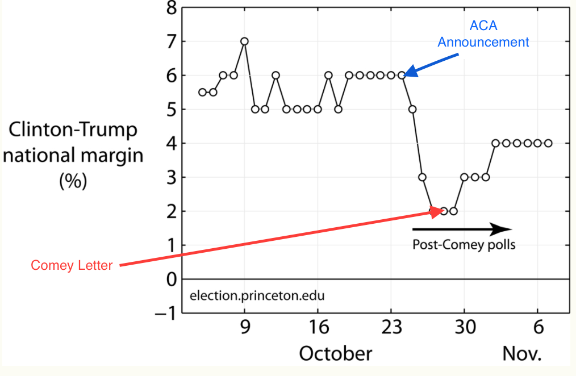
In fact, the perfectly reasonable discontent with that plan probably had more to do with helping Trump win than did any actions of bad-old (as opposed to good-new) James Comey. As Marcy Wheeler pointed out, in an analysis that’s contested but should certainly not be ignored, Hillary’s fatal slide in the polls began before Comey’s notorious letter of October 28th, and coincided with the announcement, four days before, of steep Obamacare premium increases. You decide whether you think Anthony Weiner’s sexting emails, part three, had more effect on voters than anger over being hit with stiff premium increases (22% average, 25% in 20 states, 60% in some) on increasingly crappy policies:
So the Democrats create the ground for Trump by passing a lousy healthcare law that’s sure to piss people off rather quickly, then use the even worse plan that the Republicans come up with to do nothing but trash Trump, while blocking real progressives’ attempts to get the only plan that would actually cover all Americans and save money. In Colorado last November, Democratic Governor John Hickenlooper refused to support a single-payer referendum because he “didn’t want to disrupt” the “strides [made] under Obamacare.” The Democrats’ ACA marched the nation straight into the shoals of Trump and the Republicans’ ACHA, and now the Democrats are blocking the only plan that solves the problems of both.
As Deborah Burger, Co-President of the California Nurses Association put it, Assembly Speaker Rendon, “Acting in secret in the interests of the profiteering insurance companies late Friday afternoon abandons all those people already threatened by Congress and the Trump administration.”
The excuse, of course, from California Democrats and Governor Jerry Brown is that they don’t know how they are going to pay for it, especially on the state level. That would be the same Jerry Brown who explained in 1992 exactly how single-payer would cut costs:
You cut out all the private health insurance. You have one single payer either at the national level or through the 50 states. And that one single payer will be the one that negotiates with the doctors, the hospitals, and the other providers. And since you have only one source of income in the whole medical establishment, you can drive down the cost.
Leaving aside the indispensable point that healthcare, like education and clean water, should be considered a non-discretionary expense, one of the main advantages of single-payer is precisely that it’s the only plan that can cut costs significantly. Not having single-payer will not mean healthcare will cost less; it will cost more every year, for every person and in the aggregate. It just means the for-profit insurance and pharmaceutical companies won’t care. The real problem with single-payer isn’t about costs to the people or to the state; it’s about profits for those companies.
Besides, an economy the size of California has immense power. We’re not talking about Utah. All the hospitals and doctors and pharmaceutical companies are not going to stop selling their goods and services in California. And once single-payer becomes a reality in California, it will catalyze a movement in every other state and on the national level. That—the fact that it will start a wildfire of imitation—and not the fact that it’s too expensive, is what the California Democratic Party is desperate to avoid, and what its donors and lobbyists are ordering it to block.
This is the Democratic Party. Lying losers who will do anything to avoid taking an effective stance for a healthcare policy that would immediately solve one of the worst horrors American families face every day, that would be immediately and concretely helpful to everyone, and, to top it all off, would be immensely popular. The dissembling Democrats are throwing away just about the most popular policy anyone could imagine—something people are literally dying for. As Charles Idelson, spokesman for the NNU, says: “There is broad support for single-payer not only in California, but nationally, even among registered Republicans and Republican and conservative business leaders.”
Passing single-payer in California and fighting for it everywhere else would guarantee the Democrats electoral victories. But they will not do it—they’ll say they will, but they will not—because they are fervent supporters of the capitalist market system in healthcare (and everything else), and they are corrupt agents of the health insurance and pharma industries.
Because it captures and cages the energies of so many well-meaning progressives, the Democratic Party is the most effective obstacle to, and enemy of, single-payer, and it has to be fought. People in wheelchairs and cancer patients and all their healthy friends should be sitting in and obstructing Democrat Rendon’s, as well as any Republican’s, office, until he lets the bill through. Then they should move on to the Democratic governor’s office. And thence to Pelosi’s and Schumer’s offices as well as Graham’s and Ryan’s. This is not a Trump problem, and not a Republican problem, it’s a bipartisan capitalist elite problem.
We have to engage in this kind of fight against all of these politicians. Anyone who thinks such a fight can be avoided in order to play the Democrats’ game of defending the for-profit insurance plan called Obamacare while obsessing about Trump being a Russian spy, is helping to perpetuate this rotten healthcare system. Twenty-eight million people are now without healthcare, and, if the Republicans’ edited version of Obamacare passes (which it probably won’t, because even many Republicans know they can’t get away with making things worse than they are), there’ll be twenty-four million more. There is no time for either of these contemptuous parties and their contemptuous bullshit.
___________________
Related:
The Obamacare Death Spiral, Who’s the Boss? The Obamacare Deception
The Age of No Privacy: The Surveillance State Shifts Into High Gear
By John W. Whitehead | The Rutherford Institute | June 26, 2017
“We are rapidly entering the age of no privacy, where everyone is open to surveillance at all times; where there are no secrets from government.” ― William O. Douglas, Supreme Court Justice, dissenting in Osborn v. United States, 385 U.S. 341 (1966)
The government has become an expert in finding ways to sidestep what it considers “inconvenient laws” aimed at ensuring accountability and thereby bringing about government transparency and protecting citizen privacy.
Indeed, it has mastered the art of stealth maneuvers and end-runs around the Constitution.
It knows all too well how to hide its nefarious, covert, clandestine activities behind the classified language of national security and terrorism. And when that doesn’t suffice, it obfuscates, complicates, stymies or just plain bamboozles the public into remaining in the dark.
Case in point: the National Security Agency (NSA) has been diverting “internet traffic, normally safeguarded by constitutional protections, overseas in order to conduct unrestrained data collection on Americans.”
It’s extraordinary rendition all over again, only this time it’s surveillance instead of torture being outsourced.
In much the same way that the government moved its torture programs overseas in order to bypass legal prohibitions against doing so on American soil, it is doing the same thing for its surveillance programs.
By shifting its data storage, collection and surveillance activities outside of the country—a tactic referred to as “traffic shaping” —the government is able to bypass constitutional protections against unwarranted searches of Americans’ emails, documents, social networking data, and other cloud-stored data.
The government, however, doesn’t even need to move its programs overseas. It just has to push the data over the border in order to “[circumvent] constitutional and statutory safeguards seeking to protect the privacy of Americans.”
Credit for this particular brainchild goes to the Obama administration, which issued Executive Order 12333 authorizing the collection of Americans’ data from surveillance conducted on foreign soil.
Using this rationale, the government has justified hacking into and collecting an estimated 180 million user records from Google and Yahoo data centers every month because the data travels over international fiber-optic cables. The NSA program, dubbed MUSCULAR, is carried out in concert with British intelligence.
No wonder the NSA appeared so unfazed about the USA Freedom Act, which was supposed to put an end to the NSA’s controversial collection of metadata from Americans’ phone calls.
The NSA had already figured out a way to accomplish the same results (illegally spying on Americans’ communications) without being shackled by the legislative or judicial branches of the government.
The USA Freedom Act was just a placebo pill intended to make the citizenry feel better and let the politicians take credit for reforming mass surveillance. In other words, it was a sham, a sleight-of-hand political gag pulled on a gullible public desperate to believe that we still live in a constitutional republic rather than a down-and-out, out-of-control, corporate-controlled, economically impoverished, corrupt, warring, militarized banana republic.
In fact, more than a year before politicians attempted to patch up our mortally wounded privacy rights with the legislative band-aid fix that is the USA Freedom Act, researchers at Harvard and Boston University documented secret loopholes that allow government agents to bypass Fourth Amendment protections to conduct massive domestic surveillance on U.S. citizens.
Mind you, this metadata collection now being carried out overseas is just a small piece of the surveillance pie.
The government and its corporate partners have a veritable arsenal of surveillance programs that will continue to operate largely in secret, carrying out warrantless mass surveillance on hundreds of millions of Americans’ phone calls, emails, text messages and the like, beyond the scrutiny of most of Congress and the taxpayers who are forced to fund its multi-billion dollar secret black ops budget.
In other words, the surveillance state is alive and well and kicking privacy to shreds in America.
On any given day, the average American going about his daily business is monitored, surveilled, spied on and tracked in more than 20 different ways by both government and corporate eyes and ears.
Whether you’re walking through a store, driving your car, checking email, or talking to friends and family on the phone, you can be sure that some government agency, whether the NSA or some other entity, is listening in and tracking your behavior. This doesn’t even begin to touch on the corporate trackers that monitor your purchases, web browsing, Facebook posts and other activities taking place in the cyber sphere.
We have now moved into a full-blown police state that is rapidly shifting into high-gear under the auspices of the surveillance state.
Not content to merely transform local police into extensions of the military, the Department of Homeland Security, the Justice Department and the FBI are working to turn the nation’s police officers into techno-warriors, complete with iris scanners, body scanners, thermal imaging Doppler radar devices, facial recognition programs, license plate readers, cell phone Stingray devices and so much more.
Add in the fusion centers, city-wide surveillance networks, data clouds conveniently hosted overseas by Amazon and Microsoft, drones equipped with thermal imaging cameras, and biometric databases, and you’ve got the makings of a world in which “privacy” is reserved exclusively for government agencies.
Thus, the NSA’s “technotyranny” is the least of our worries.
A government that lies, cheats, steals, sidesteps the law, and then absolves itself of wrongdoing cannot be reformed from the inside out.
Presidents, politicians, and court rulings have come and gone over the course of the NSA’s 60-year history, but none of them have managed to shut down the government’s secret surveillance of Americans’ phone calls, emails, text messages, transactions, communications and activities.
Even with restrictions on its ability to collect mass quantities of telephone metadata, the government and its various spy agencies, from the NSA to the FBI, can still employ an endless number of methods for carrying out warrantless surveillance on Americans, all of which are far more invasive than the bulk collection program.
Just about every branch of the government—from the Postal Service to the Treasury Department and every agency in between—now has its own surveillance sector, authorized to spy on the American people.
And of course that doesn’t even begin to touch on the complicity of the corporate sector, which buys and sells us from cradle to grave, until we have no more data left to mine. Indeed, Facebook, Amazon and Google are among the government’s closest competitors when it comes to carrying out surveillance on Americans, monitoring the content of your emails, tracking your purchases, exploiting your social media posts and turning that information over to the government.
“Few consumers understand what data are being shared, with whom, or how the information is being used,” reports the Los Angeles Times. “Most Americans emit a stream of personal digital exhaust — what they search for, what they buy, who they communicate with, where they are — that is captured and exploited in a largely unregulated fashion.”
It’s not just what we say, where we go and what we buy that is being tracked.
We’re being surveilled right down to our genes, thanks to a potent combination of hardware, software and data collection that scans our biometrics—our faces, irises, voices, genetics, even our gait—runs them through computer programs that can break the data down into unique “identifiers,” and then offers them up to the government and its corporate allies for their respective uses.
All of those internet-connected gadgets we just have to have (Forbes refers to them as “(data) pipelines to our intimate bodily processes”)—the smart watches that can monitor our blood pressure and the smart phones that let us pay for purchases with our fingerprints and iris scans—are setting us up for a brave new world where there is nowhere to run and nowhere to hide.
For instance, imagine what the NSA could do (and is likely already doing) with voiceprint technology, which has been likened to a fingerprint. Described as “the next frontline in the battle against overweening public surveillance,” the collection of voiceprints is a booming industry for governments and businesses alike.
As The Guardian reports, “voice biometrics could be used to pinpoint the location of individuals. There is already discussion about placing voice sensors in public spaces… multiple sensors could be triangulated to identify individuals and specify their location within very small areas.”
Suddenly the NSA’s telephone metadata program seems like child’s play compared to what’s coming down the pike.
That, of course, is the point.
The NSA is merely one small part of the shadowy Deep State comprised of unelected bureaucrats who march in lockstep with profit-driven corporations that actually runs Washington, DC, and works to keep us under surveillance and, thus, under control.
For example, Google openly works with the NSA, Amazon has built a massive $600 million intelligence database for CIA, and the telecommunications industry is making a fat profit by spying on us for the government.
In other words, Corporate America is making a hefty profit by aiding and abetting the government in its domestic surveillance efforts.
At every turn, we have been handicapped in our quest for transparency, accountability and a representative government by an establishment culture of secrecy: secret agencies, secret experiments, secret military bases, secret surveillance, secret budgets, and secret court rulings, all of which exist beyond our reach, operate outside our knowledge, and do not answer to “we the people.”
Incredibly, there are still individuals who insist that they have nothing to fear from the police state and nothing to hide from the surveillance state, because they have done nothing wrong.
To those sanctimonious few, secure in their delusions, let this be a warning.
There is no safe place and no watertight alibi.
The danger posed by the American police/surveillance state applies equally to all of us: lawbreaker and law-abider alike, black and white, rich and poor, liberal and conservative, blue collar and white collar, and any other distinction you’d care to trot out.
As I make clear in my book Battlefield America: The War on the American People, in an age of too many laws, too many prisons, too many government spies, and too many corporations eager to make a fast buck at the expense of the American taxpayer, we are all guilty of some transgression or other.
Eventually, we will all be made to suffer the same consequences in the electronic concentration camp that surrounds us.
Israel refuses entry to UNESCO group expected to visit Hebron’s Old City

Ma’an – June 26, 2017
BETHLEHEM – Israeli authorities have refused to grant entry visas for a United Nations Educational, Scientific and Cultural Organization (UNESCO) investigative team scheduled to conduct a field visit to the Old City in the southern occupied West Bank district of Hebron in advance of an upcoming vote next month to consider the area an endangered world heritage site, Israeli media reported on Sunday.
While Palestinian authorities had planned to introduce the site for consideration on UNESCO’s World Heritage List for 2018, they decided to fast track the site’s application owing to routine Israeli violence in the Old City, which Palestinians have claimed threatens the integrity of the site, and instead propose the area as an endangered site.
A Palestinian delegation to UNESCO had reportedly expressed the “alarming details about the Israeli violations in Al-Khalil/ Hebron, including the continuous acts of vandalism, property damage, and other attacks,” in a letter to the World Heritage Center.
Since Israel took over the West Bank in 1967 and began advancing Israeli settlements across Palestinian territory in violation of international law, Hebron has been a flashpoint for Israeli settler violence on Palestinians and their properties.
The Ibrahimi Mosque, known to Jews as the Cave of the Patriarchs, in the Old City where the Prophet Abraham is believed to be buried has been a focal point of such violence for decades, as the site is holy to both Muslims and Jews and has been a prime site for Israeli settler activities in the area.
The UNESCO team’s visit is aimed at assessing whether or not the Old City of Hebron is actually endangered, and would submit these findings to the International Council on Monuments and Sites (ICOMOS), a body that provides recommendations to UNESCO involving sites that could be considered on the World Heritage in Danger list.
According to The Jerusalem Post, other protected sites in the occupied Palestinian territory, including the Church of Nativity in Bethlehem, the ancient terraces of Battir, and the pilgrimage route in Bethlehem, had also been fast tracked by Palestinian authorities in previous years to include them on UNESCO’s World Heritage in Danger list.
Israel’s Ambassador to UNESCO Carmel Shama Hacohen reportedly said that the UNESCO group was being rejected entry into Israel owing to the fact that ICOMOS had advised against considering the previous sites in the occupied territory as endangered and instead recommended that Palestinian authorities continue with the normal process.
UNESCO, however, had rejected these recommendations by ICOMOS for the Church of Nativity and Battir. Hacohen said that due to these past decisions by UNESCO to ignore recommendations made by ICOMOS, it would be “a shame to waste the time and money” of the committee.
He went on to denounce what he considered “Palestinian political moves under the guise of culture and heritage,” and added that UNESCO’s consideration of the site represented “lies that plot against the state of Israel as well as the history and the connection of the Jewish people to this important holy site.”
The Old City, which is under full Israeli military control, is home to some 30,000 Palestinians and around 800 Israeli settlers who live under the protection of Israeli forces.
UNESCO is scheduled to decide on the status of the Old City during a conference in Krakow, Poland from July 2-12. The vote is expected to include a clause rejecting Israeli sovereignty over occupied East Jerusalem, which Israel annexed in 1980 in a move never recognized by the international community.
Meanwhile, Israeli media site Ynet reported that Israeli authorities have been scrambling to collect the seven votes needed to block the motion.
Ynet also said that in the “context of a peace process,” the inclusion of Hebron’s Old City into UNESCO’s World Heritage List would “impose limits on Israeli construction, the protection and development of the site and on specific areas in the vicinity,” and expressed worry that Israel would “be condemned each time it erects a security checkpoint or conducts work in the area on the grounds that is is damaging a world heritage site.”
However, Israeli activities in Hebron and the rest of occupied Palestine have long been condemned by rights groups and the international community as human rights abuses against the Palestinian people and a threat to any future peace agreements, while the some 500,000 to 600,000 Israeli settlers in the occupied West Bank are residing there in contravention of international law.
Israel has accused the United Nations and its respective bodies of being “anti-Israel” for its stances against the now half-century occupation of the Palestinian territory, including East Jerusalem.
Such allegations have escalated following the passing of UN Resolution 2334, which condemned Israel’s settlement building in Palestinian territory. The US had taken Israel by surprise at the time by abstaining from the vote, in a split from its typical objections to such moves.
Earlier this month, US Ambassador to the United Nations Nikki Haley said that the UN could no longer “bully” Israel over its violations of international law, and said that “we are not going to let that happen anymore.”
US President Donald Trump had also denounced the UN resolution, and even warned in a Twitter post last year that “things will be different” following his inauguration.
Earlier this year, the US House of Representatives even passed a resolution confirming US commitment as a diplomatic ally to the Israeli government, and demanded that the US government dismiss any future UN resolutions they deemed “anti-Israel.”
Life imprisoned in a ‘closed military zone’. “Daily Life”?
International Solidarity Movement | June 26, 2017
Hebron, occupied Palestine – Israeli forces at Shuhada checkpoint in occupied al-Khalil (Hebron) have put up yet another sign ‘instructing’ the Palestinian residents on their behavior at the checkpoint. The bright-red sign with pictures clearly prohibits any kind of supposedly ‘dangerous’ materials like guns, knives and scissors. Just like when you attempt to cross security in any airport. Whereas those objects have long been prohibited and most Palestinians wouldn’t dare bring any of those to any checkpoint, as they’d have to fear for their lives, the signs also illustrate something else: life for the Palestinians living in this area is immensely restricted.
At an airport, most people can at least attempt to grasp why those objects aren’t allowed. But now consider this checkpoint is on your daily way to your house. Your own home. Not an airport, you have to cross this checkpoint all the time. That’s what it is like for Palestinians living in the Israeli forces declared ‘closed military zone’ in Tel Rumeida and on Shuhada Street. Those restrictions, newly illustrated with little images, restrict daily tasks such as cooking and studying, doing arts, and even such mundane things as cutting your nails. No Palestinian is allowed to bring any kind of knife, so unless you have a big stack of sharp knifes – you won’t be cutting either your fruit, nor meat, nor vegetables. If you break a pair of scissors, your children will not be doing arts anymore, and no matter how often they ask for new ones, the parents are prohibited to bring scissors, even non-sharp children’s-scissors, into this area.
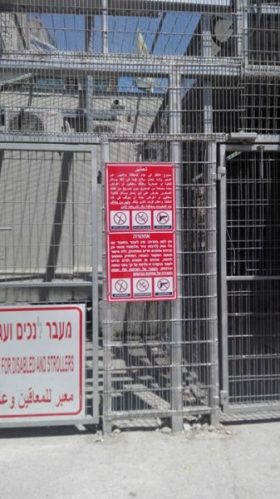
Newly installed sign illustrating the daily restrictions enforced solely for Palestinians
Doing so against the warning, you’d most likely pay with your life. A sentence on the sign says that a ‘permit’ can be applied for to bring any of the mentioned items. But even if that would be successful – assuming a Palestinian wouldn’t just be arrested for just applying for such a permit – or refused like so many Palestinians applying for building permits, it would cost a lot of bravery to actually show up at the checkpoint with any of those items. Bringing ‘banned items’ to the checkpoint, and then telling the heavily-armed soldier: “I’m bringing a knife”. It’s debatable whether that conversation would ever go beyond that point, or rather be cut short by gunshots from a heavily-armed occupation force.
In stark contrast to airports, where the measures are [at least purportedly] for security, in this context they are merely and deliberately solely for humiliation. In international law, a praxis like this is called ‘creating a coercive environment’ in order to facilitate ‘forced displacement’. And that’s what it is about: in an area that so conveniently connects all the illegal settlements within the city center of al-Khalil and on its outskirts, Palestinians are merely considered a nuisance. The attempts to drive them out are thus ever more enforced by the occupying army.
Featured Video

No Threat Can Force Iran’s Surrender /Trita Parsi & Lt Cl Daniel Davis
or go to
Aletho News Archives – Video-Images
From the Archives
What is the Israeli Lobby in Australia Doing in Interfaith Dialogue?
By Ali Kazak | Dissident Voice | October 11, 2015
For years Israel and its lobby around the world have been trying to normalise their relations with Arabs and Muslims without solving the Palestine Question.
One of the methods they resorted to in the last few years is using human rights and community organizations such as interfaith dialogue and Multiculturalism to achieve this objective and to: isolate the Palestinians, marginalise the Palestine question, end Israel’s isolation, and prevent criticism of Israel, knowing that these organisations will be the first to stand against Israel’s violations, racial and religious discrimination.
The group responsible for this task in Australia is The Australia/Israel & Jewish Affairs Council (AIJAC); its Director of International & Community Affairs, Jeremy Jones is in charge of lobbying religious community organizations, specifically Muslims and Christians. Consequently he convened the Faith Communities for Reconciliation, founding participant in the Australian Partnership of Religious Organisations and the Australian National Dialogue of Christians, Muslims & Jews.
AIJAC is a private political propaganda group. It is recognised as the main Israeli lobby in Australia. It coordinates its activities and works intimately with the Israeli embassy in Canberra and different institutions in Israel. It is privately funded by some Jewish businessmen. It monitors closely Australian politicians, the media, ethnic and religious groups, (especially Arabs and Muslims), unions and academics on their stands towards Israel and the Palestine question. … continue
Blog Roll
 Aletho News
- ‘War Crime’: Iran condemns attacks on Arak, Ardakan nuclear sites
- Two-thirds of Americans want quick end to Iran war even if goals unmet
- Trump to Give “Important Update on Iran” Wednesday in Prime-Time Speech
- Theodore Postol: Iran’s Missiles & Drones Were Underestimated
- Iran To Target Military Industrial-Tech Complex That Facilitated Gaza Genocide
- Collapsing Empire: The Resistance Disarms ‘Israel’
- Suicide Should Not Be a Government Service
- Rethinking America’s greatest threat: Iran vs. Israel-Firsters
- Iran accuses adversaries of false flags to strain Turkey ties
- Poland rules out sending Patriot missiles to US/Israel amid war on Iran
- If Americans Knew
- Ann Coulter Rips Into Fox News for Iran War Coverage, Compares to False Rigged 2020 Election Reporting
- Joe Kent Urges Americans To Call White House and Congress To Object To Sending Troops Into Iran
- DNC Resolution to Reject AIPAC Funding Puts Democratic Leaders in the Hot Seat
- Swedish foundation to build 400 schools as over 650,000 Gaza children remain without education for 2 years
- Israeli army admits photshopping image of slain Lebanese journalist
- This is how Israel is systematically killing health workers under the cover of war in Lebanon
- Carrying life under fire: Israeli invasion of Lebanon leaves pregnant women facing deadly risks
- Champagne all around for the new death penalty (for Palestinians) law – Not a ceasefire Day 172
- Why are Palestinian books struggling to be seen on Amazon?
- The Line Between Affinity and Conspiracy
- No Tricks Zone
- New Study Finds Warming Saves Lives…Cold Temperatures 12 Times More Deadly Than Excess Heat
- German Science Blog Accuses PIK Climate Institute Of Hallucinating Climate Tipping Points
- Devastating Assessment Of Comirnaty Vaccine By Former Senior Pfizer Europe Toxicologist
- New Study: CO2 Is ‘Effectively Negligible’ As An Explanatory Climate Change Factor Since 2000
- Former Pfizer Toxicologist Dr. Helmut Sterz Tells Bundestag Hearing Pfizer Vaccine Should Have Never Been Approved
- Energy Expert: Germany’s Nuclear Phaseout Was A “500 Billion Euro Mistake”
- New Research: South Australia’s Mid-Holocene Sea Surface Temperatures Were 4°C Warmer Than Today
- Storing Green Energy To Last Germany 10 Days Would Require A 60-Million Tonne Battery
- New Studies: UK Sea Levels Were 4 Meters Higher Than Today During The Mid-Holocene
- Destructive Green New Deal: German Energy And Metal Group Warns Of Drastic Crisis
 Aletho News