Global Warming Blamed For EU Wildfires
By Paul Homewood | Not A Lot Of People Know That | July 28, 2017
Now why am I not surprised?
Exclusive: The number of forest fires in the EU has trebled so far this year, according to figures obtained by Euronews, affecting an area nearly the size of Luxembourg.
There have been 677 blazes in 2017 – a huge increase on the 215 the bloc saw annually on average over the previous eight years.
Experts have blamed climate change for the rise, saying it has extended the traditional wildfire season and increased the frequency of blazes.
They have warned Europe’s forest fires will rage more often in the future and engulf new areas.
Portugal, Italy and Croatia have battled blazes in recent days amid high temperatures and lower-than-normal rainfall.
It comes less than a month since 64 people died in a forest fire in Portugal, with many victims caught in their cars as they tried to flee.
http://www.euronews.com/2017/07/26/how-europe-s-wildfires-have-more-than-trebled-in-2017

Now you’re no doubt way ahead of me here!
Apparently, the last eight years is the “normal climate”, and 2017 is the new.
Joe, being a suspicious little devil, thought he would check why they used the last eight years as a baseline, and discovered why.
This is the official data from the European Environment Agency, published last November:
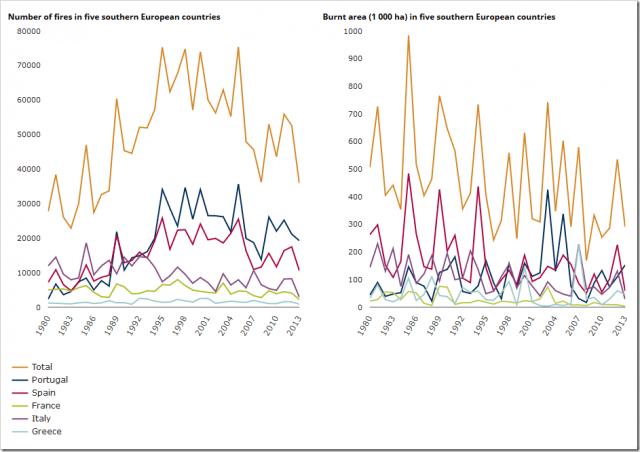
https://www.eea.europa.eu/data-and-maps/daviz/burnt-forest-area-in-five-1#tab-dashboard-01
The number of fires since 1980 peaked in the 1990s, and have been relatively low in the last few years.
The trend on burnt acreage is even more stark, showing consistent decline since the 1980s.
I wonder what they’ll blame on global warming next?
German States Take Trumpian Climate U-Turn
The Global Warming Policy Forum – 26/07/17
Germany is at risk of tacitly joining Donald Trump in turning its back on the Paris climate change deal. Two of the country’s regional governments have decided to put preserving jobs in coal mines and power plants ahead of cutting carbon emissions.
If Europe’s largest economy misses its targets, Chancellor Angela Merkel’s environmental credentials – and the global accord itself – would suffer a big setback.
Officially, Germany is fully committed to the Paris accord. At the G20 summit in Hamburg earlier this month, Merkel said she “deplored” Trump’s decision to withdraw the United States from the treaty. She led an alliance of world leaders who unsuccessfully tried to persuade the U.S. President to reconsider.
Yet two important German states are undermining Merkel’s position. North Rhine-Westphalia (NRW) and Brandenburg are home to many mines which extract brown coal and power plants that burn the carbon-intensive fuel. Their governments have vowed to protect an industry that provides more than 70,000 jobs, many of them in economically deprived regions in the country’s east.
That’s bad news for Germany’s promise to reduce overall emissions by at least 55 percent, relative to 1990, by 2030. Per unit of electricity generated, brown coal produces twice as much carbon as gas-fired power plants. In 2016, the fuel accounted for 23 percent of Germany’s electricity but emitted 50 percent of the sector’s carbon dioxide. Brown coal reserves are expected to last for several decades, and utilities even have permission to open several new mines.
NRW’s new government, which is led by Merkel’s conservative Christian Democratic Union, in late June decided to stick to the current mining plans in the region. In mid-June, Brandenburg’s government said it wanted to soften its 2030 reduction targets. A study commissioned by the World Wildlife Fund environmental group shows that NRW’s plans alone would bust Germany’s Paris targets.
Unless Merkel can rein in the brown coal enthusiasts at home, she risks sending a devastating message to the world. If a country as rich and ecologically conscious as Germany prioritises coal mining jobs over the fight against global warming, others will also find it easier to turn their back on the treaty.
US Oil Industry Warns Washington Over Venezuela Sanctions
teleSUR | July 28, 2017
U.S. oil and petrochemicals makers are warning President Donald Trump that proposed oil sanctions against Venezuela could hurt domestic companies and consumers.
In a letter sent to Trump and published in La Tabla.com, the head of the American Fuel and Petrochemical Manufacturers, Chet Thompson, wrote that the measures would not help to solve the problems in the South American nation.
Venezuela now sells more than 700,000 barrels of oil a day to the U.S. out of a total production of roughly two million barrels a day, or just over 2 percent of world production.
The document indicates that some 20 U.S. refineries are supplied with heavy Venezuelan crude, for which they have made substantial processing adjustments.
It says there are practically no other sources of supply for this type of oil.
So a suspension of purchases to Venezuela, would destabilize the world market for hydrocarbons.
The manufacturers estimate that the search for additional quotas of heavy crude would be extremely complicated and could increase costs, resulting in higher prices for consumers.
The two countries’ economies are tightly bound by the oil that Venezuela sells to the United States: It accounts for roughly 10 percent of the oil imported by the U.S.
In Washington, U.S. Vice President Mike Pence has reiterated the White House’s threat to impose “strong and swift economic actions” if Sunday’s National Constituent Assembly vote goes ahead.
While Republican U.S. Senator Marco Rubio noted that the Trump administration had announced sanctions this week, and added, “You can expect more.”
Trump targeted 13 senior Venezuelan officials on Wednesday, including the Vice President of the state-owned Petroleos de Venezuela SA, Simon Zerpa.
Other oil industry experts have also expressed concerns about the possible consequences of more sanctions.
Patrick DeHaan, a senior petroleum analyst for price-tracker GasBuddy, and Phil Flynn, a senior market analyst for the PRICE Futures Group in Chicago, both told UPI this week a potential ban on Venezuelan oil might have unintended consequences.
“A cut of Venezuelan exports would add about 15 to 25 cents a gallon to U.S. gasoline prices,” Flynn said.
Platts added that, for the refiners concentrated on the U.S. Gulf Coast, Venezuela is the largest source of crude oil, ahead of Saudi Arabia, noting those reviewing sanctions in the Trump administration recognize the potential for repercussions.
The administration source told Platts that “many within the Trump administration view sanctions on Venezuelan crude imports as having a more devastating effect on the U.S. refining sector than on Venezuela’s economy.”
Israeli forces shoot, injure Palestinian in Salfit tending to his land near separation wall
Ma’an – July 29, 2017
 SALFIT – Israeli forces shot and injured a Palestinian on Friday while he was tending to his land near Israel’s separation wall in the village of Deir Ballut in the western part of Salfit district in the occupied West Bank.
Medical sources at the Palestinian Red Crescent told Ma’an that Faed Saleh Odeh Moussa, 33, was injured with a live bullet in his left hand after Israeli forces opened fire on him while he was on his land watering trees.
The sources added that he was transferred to the Yasser Arafat Hospital in Salfit, where doctors reported his injury as moderate.
Saed, Moussa’s brother, told Ma’an that they were caring for their land near Israel’s separation wall, like every Friday, when Israeli forces arrived in the area at 7:30 p.m. and randomly opened live ammunition on them.
Saed said that they quickly hid behind rocks before his brother was injured. He added that their children were also with them at the time and two men from Qalqiliya city in the northern West Bank who were en route to Israel.
Israeli forces remained in the area for some time before leaving following the incident, Saed noted. He added that he had called the Deir Ballut municipality to inform them of the incident, who said that they would notify the Palestinian liaison of the incident.
An Israeli army spokesperson told Ma’an she would look into reports on the incident.
According to the Bethlehem-based Applied Research Institute — Jerusalem, the village of Deir Ballut has had thousands of dunams of land confiscated for the purpose of illegal Israeli settlement building, while Israel’s separation wall — deemed illegal by the International Court of Justice in 2004 — is expected to swallow up at least 35 percent of the village’s lands.
Such Israeli activities in Palestinian villages coincide with upticks of Israeli violence against Palestinians — both by Israeli forces and settlers, as Palestinians are stripped of their lands and often barred from entering Israel’s so-called security “buffer zones” on the Palestinian side of the separation wall.
The UN has reported that at least 92 Palestinians are injured by Israeli forces every two weeks, while 1,444 Palestinians were injured by Israeli forces this year, as of July 17. However, this data does not include the hundreds of Palestinians who were injured during Al-Aqsa protests post-July 17.
‘An attempt to drown out Palestinian voices’: RT’s office building raided in Ramallah

RT | July 29, 2017
The Israeli military raided the PalMedia building in Ramallah on the West Bank early Saturday morning. It is home to a number of international media organizations, including RT’s regional office. Property belonging to other media channels was either damaged or seized.
No RT employees were harmed during the raid on the PalMedia building which also houses the offices of Al-Quds, Al-Mayadeen, France 24 and Al-Manar.
Witnesses told the Ma’an News Agency that 10 Israeli army vehicles had surrounded the building before carrying out the search.
Several doors and editing rooms were damaged while some computers and other property were taken away.
An Israeli army spokesperson told Ma’an that Israeli forces had “seized media equipment and documents used for incitement” from a media office in Ramallah, though did not say which agency they were specifically targeting.
The satellite channel Al-Quds said the search was directed at them.
The Palestinian Union of Journalists condemned the raid, which it said had led to “the destruction of property and the theft of equipment, computers and archival materials belonging to the satellite channel Al-Quds,” adding, that it was “an obvious attempt to drown out the voice of the Palestinians and make the Palestinian narrative invisible.”
The Palestinian Ministry of Information also released a statement denouncing the raid, saying, that targeting the media “proves Israel’s intentions to prevent the guardians of truth from continuing their media, national, and ethical role of transferring the message of our people’s desired freedom.”
This is not the first time Israeli authorities have mounted a search of the building, having done so in June 2014. At the time, Reporters Without Borders said the raid “joined the long list of violations of Palestinian news media rights by the Israeli security forces, with never-ending threats, arrests and military operations.”
RT’s offices in the Gaza Strip were also hit by an airstrike during Operation Pillar of Defense in November 2012. Though the building was severely damaged, none of RT’s employees were hurt.
Israeli authorities have long restricted Palestinian freedom of expression through censoring social media activity and imprisoning journalists, activists, poets, and novelists.
Collateral Damage: U.S. Sanctions Aimed at Russia Strike Western European Allies
By Diana Johnstone | CounterPunch | July 28, 2017
Do they know what they are doing? When the U.S. Congress adopts draconian sanctions aimed mainly at disempowering President Trump and ruling out any move to improve relations with Russia, do they realize that the measures amount to a declaration of economic war against their dear European “friends”?
Whether they know or not, they obviously don’t care. U.S. politicians view the rest of the world as America’s hinterland, to be exploited, abused and ignored with impunity.
The Bill H.R. 3364 “Countering America’s Adversaries Through Sanctions Act” was adopted on July 25 by all but three members of the House of Representatives. An earlier version was adopted by all but two Senators. Final passage at veto-overturning proportions is a certainty.
This congressional temper tantrum flails in all directions. The main casualties are likely to be America’s dear beloved European allies, notably Germany and France. Who also sometimes happen to be competitors, but such crass considerations don’t matter in the sacred halls of the U.S. Congress, totally devoted to upholding universal morality.
Economic “Soft Power” Hits Hard
Under U.S. sanctions, any EU nation doing business with Russia may find itself in deep trouble. In particular, the latest bill targets companies involved in financing Nord Stream 2, a pipeline designed to provide Germany with much needed natural gas from Russia.
By the way, just to help out, American companies will gladly sell their own fracked natural gas to their German friends, at much higher prices.
That is only one way in which the bill would subject European banks and enterprises to crippling restrictions, lawsuits and gigantic fines.
While the U.S. preaches “free competition”, it constantly takes measures to prevent free competition at the international level.
Following the July 2015 deal ensuring that Iran could not develop nuclear weapons, international sanctions were lifted, but the United States retained its own previous ones. Since then, any foreign bank or enterprise contemplating trade with Iran is apt to receive a letter from a New York group calling itself “United Against Nuclear Iran” which warns that “there remain serious legal, political, financial and reputational risks associated with doing business in Iran, particularly in sectors of the Iranian economy such as oil and gas”. The risks cited include billions of dollars of (U.S.) fines, surveillance by “a myriad of regulatory agencies”, personal danger, deficiency of insurance coverage, cyber insecurity, loss of more lucrative business, harm to corporate reputation and a drop in shareholder value.
The United States gets away with this gangster behavior because over the years it has developed a vast, obscure legalistic maze, able to impose its will on the “free world” economy thanks to the omnipresence of the dollar, unrivaled intelligence gathering and just plain intimidation.
European leaders reacted indignantly to the latest sanctions. The German foreign ministry said it was “unacceptable for the United States to use possible sanctions as an instrument to serve the interest of U.S. industry”. The French foreign ministry denounced the “extraterritoriality” of the U.S. legislation as unlawful, and announced that “To protect ourselves against the extraterritorial effects of US legislation, we will have to work on adjusting our French and European laws”.
In fact, bitter resentment of arrogant U.S. imposition of its own laws on others has been growing in France, and was the object of a serious parliamentary report delivered to the French National Assembly foreign affairs and finance committees last October 5, on the subject of “the extraterritoriality of American legislation”.
Extraterritoriality
The chairman of the commission of enquiry, long-time Paris representative Pierre Lellouche, summed up the situation as follows:
“The facts are very simple. We are confronted with an extremely dense wall of American legislation whose precise intention is to use the law to serve the purposes of the economic and political imperium with the idea of gaining economic and strategic advantages. As always in the United States, that imperium, that normative bulldozer operates in the name of the best intentions in the world since the United States considers itself a ‘benevolent power’, that is a country that can only do good.”
Always in the name of “the fight against corruption” or “the fight against terrorism”, the United States righteously pursues anything legally called a “U.S. person”, which under strange American law can refer to any entity doing business in the land of the free, whether by having an American subsidiary, or being listed on the New York stock exchange, or using a U.S.-based server, or even by simply trading in dollars, which is something that no large international enterprise can avoid.
In 2014, France’s leading bank, BNP-Paribas, agreed to pay a whopping fine of nearly nine billion dollars, basically for having used dollar transfers in deals with countries under U.S. sanctions. The transactions were perfectly legal under French law. But because they dealt in dollars, payments transited by way of the United States, where diligent computer experts could find the needle in the haystack. European banks are faced with the choice between prosecution, which entails all sorts of restrictions and punishments before a verdict is reached, or else, counseled by expensive U.S. corporate lawyers, and entering into the obscure “plea bargain” culture of the U.S. judicial system, unfamiliar to Europeans. Just like the poor wretch accused of robbing a convenience store, the lawyers urge the huge European enterprises to plead guilty in order to escape much worse consequences.
Alstom, a major multinational corporation whose railroad section produces France’s high speed trains, is a jewel of French industry. In 2014, under pressure from U.S. accusations of corruption (probably bribes to officials in a few developing countries), Alstom sold off its electricity branch to General Electric.
The underlying accusation is that such alleged “corruption” by foreign firms causes U.S. firms to lose markets. That is possible, but there is no practical reciprocity here. A whole range of U.S. intelligence agencies, able to spy on everyone’s private communications, are engaged in commercial espionage around the world. As an example, the Office of Foreign Assets Control, devoted to this task, operates with 200 employees on an annual budget of over $30 million. The comparable office in Paris employs five people.
This was the situation as of last October. The latest round of sanctions can only expose European banks and enterprises to even more severe consequences, especially concerning investments in the vital Nord Stream natural gas pipeline.
This bill is just the latest in a series of U.S. legislative measures tending to break down national legal sovereignty and create a globalized jurisdiction in which anyone can sue anyone else for anything, with ultimate investigative capacity and enforcement power held by the United States.
Wrecking the European Economy
Over a dozen European Banks (British, German, French, Dutch, Swiss) have run afoul of U.S. judicial moralizing, compared to only one U.S. bank: JP Morgan Chase.
The U.S. targets the European core countries, while its overwhelming influence in the northern rim – Poland, the Baltic States and Sweden – prevents the European Union from taking any measures (necessarily unanimous) contrary to U.S. interests.
By far the biggest catch in Uncle Sam’s financial fishing expedition is Deutsche Bank. As Pierre Lellouche warned during the final hearing of the extraterritorial hearings last October, U.S. pursuits against Deutsche Bank risk bringing down the whole European banking system. Although it had already paid hundreds of millions of dollars to the State of New York, Deutsche Bank was faced with a “fine of 14 billion dollars whereas it is worth only five and a half. … In other words, if this is carried out, we risk a domino effect, a major financial crisis in Europe.”
In short, U.S. sanctions amount to a sword of Damocles threatening the economies of the country’s main trading partners. This could be a Pyrrhic victory, or more simply, the blow that kills the goose that lays the golden eggs. But hurrah, America would be the winner in a field of ruins.
Former justice minister Elisabeth Guigou called the situation shocking, and noted that France had told the U.S. Embassy that the situation is “insupportable” and insisted that “we must be firm”.
Jacques Myard said that “American law is being used to gain markets and eliminate competitors. We should not be naïve and wake up to what is happening.”
This enquiry marked a step ahead in French awareness and resistance to a new form of “taxation without representation” exercised by the United States against its European satellites. The committee members all agreed that something must be done.
That was last October. In June, France held parliamentary elections. The commission chairman, Pierre Lellouche (Republican), the rapporteur Karine Berger (Socialist), Elisabeth Guigou (a leading Socialist) and Jacques Myard (Republican) all lost their seats to inexperienced newcomers recruited into President Emmanuel Macron’s République en marche party. The newcomers are having a hard time finding their way in parliamentary life and have no political memory, for instance of the Rapport on Extraterritoriality.
As for Macron, as minister of economics, in 2014 he went against earlier government rulings by approving the GE purchase of Alstom. He does not appear eager to do anything to anger the United States.
However, there are some things that are so blatantly unfair that they cannot go on forever.
Diana Johnstone is the author of Fools’ Crusade: Yugoslavia, NATO, and Western Delusions. Her new book is Queen of Chaos: the Misadventures of Hillary Clinton. She can be reached at diana.johnstone@wanadoo.fr
Hate PLC
By Gilad Atzmon | July 27, 2017
In March 2016, the British government pledged 13.4 million pounds to the Community Security Trust (CST), a Jewish body that is committed to fighting hatred against one group only. One would expect that with all that money, the CST would do its job and curb anti Semitism. But the miracle is that the opposite has occurred. Just two weeks later, according to the CST’s statistics, anti Semitism went through the roof. The Daily Mail reports today that 767 anti Semitic hate crimes were logged by the CST in the first six months of 2017, a 30 per cent rise over 2016. It is the highest figure since statistics were first kept 33 years ago. The CST reports an “unprecedented run of over 100 incidents each month back to April 2016.”
A mere few days after the British government vowed to wire millions of pounds to the CST, the number of ‘anti Semitic incidents’ rose by 30% to over 100 incidents a month. The results, at least according to the CST’s statistics, are that the more public money is allocated to fight anti Semitism, the more anti Semitic the Brits become.
If this is the case, the cure for British anti Semitism may be within reach – to fight anti Semitism, deprive the CST and similar organisations of taxpayers’ money!
Anti Semitism is not really a social phenomenon, it is instead a multi million pound industry. The more we spend on the fight against it, the more incidents are ‘recorded’ to justify further spending.
If the British government genuinely wants to fight anti Semitism it would do better to reinstate British liberal values of universalism and tolerance that go beyond the interests of one group. If British Jews feel unsafe, they should insure that they are stripped of their exceptional status. They should insist that they are Brits like all other Britons: protected by the same laws as their neighbours.
In December 2016, the British Government decided to step up the battle against anti Semitism by adopting the International Holocaust Remembrance Alliance’s (IHRA) working definition of anti-Semitism. The IHRA’s definition was designed to suppress any criticism of Jewish politics, Zionism or Israel. Its intent was to make impossible the utterance of any criticism of anything in any way Jewish related. Yet, according to the new CST statistics, even this drastic measure didn’t reduce anti Semitism at all. If anything, anti Semitism increased sharply since the British Government adopted the new definition.
I would advise both Jews and the British authorities that it is the exceptional treatment of one group that contributes to the growing animosity towards Jewish politics and Jewish lobbying.
But there is another problem that must be addressed. Though it is not clear whether anti Semitism is actually on the rise, it is certain that a growing number of Brits have been subjected to an orchestrated slanderous campaign run by Zionist institutions that are funded by British taxpayer money such as CST and CAA. These organisations attack Jeremy Corbyn, the Labour party, venues, intellectuals, artists, musicians, authors and anyone else they decide has dared to point at Israeli brutality and extensive Jewish political lobbying in Britain.
If Britain still cares for values of tolerance and intellectual exchange, it better spend some taxpayer money defending its citizens, gentiles as well as Jews, from these foreign bodies. And if Britain truly cares for its Jews, it should protect them from the unfortunate consequences of the CST, CAA and other Israeli lobbies operating in our midst.
The Dawn of an Orwellian Future
By Robert Parry | Consortium News | July 28, 2017
It seems that The New York Times can’t let a good lie lie. Even after being pushed into running an embarrassing correction retracting its false claim that there was a consensus of all 17 U.S. intelligence agencies that Russia hacked Democratic emails and made them public to help Donald Trump defeat Hillary Clinton, the Times is back suggesting exactly that.
The Times’ current ploy is to say the Russian hacking claims are the “consensus” judgment of the U.S. intelligence community without citing a specific number of agencies. For instance, on Friday, the Times published an article by Matt Flegenheimer about the U.S. Senate vote to prevent President Trump from lifting sanctions on Russia and deployed the misleading phrasing:
“The Trump administration has opposed the sanctions against Russia, arguing that it needs flexibility to pursue a more collaborative diplomacy with a country that, by American intelligence consensus, interfered in last year’s presidential election.”
So, instead of explaining the truth – that the Jan. 6 “Intelligence Community Assessment” was the work of a small group of “hand-picked” analysts from three of the agencies under the watchful eye of then-CIA Director John Brennan and beneath the oversight of then-Director of National Intelligence James Clapper – the Times opts to give its readers the misleading impression that there was a “consensus” within the U.S. intelligence community.
In other words, unless a Times reader knows the truth by having read it at a non-mainstream media outlet such as Consortiumnews.com, that reader would continue to believe that all 17 intelligence agencies were in agreement on this foundational point in the Russia-gate affair.
Marginalizing Dissent
And the continuation of this willful deception comes as the Times and other mainstream media outlets make progress in their plans to deploy Internet algorithms to hunt down and marginalize what they deem “fake news,” including articles that challenge the mainstream media’s power to control the dominant news narrative.
A report by the World Socialist Web Site found that “in the three months since Internet monopoly Google announced plans to keep users from accessing ‘fake news,’ the global traffic rankings of a broad range of left-wing, progressive, anti-war and democratic rights organizations have fallen significantly.”
Google’s strategy is to downgrade search results for targeted Web sites based on a supposed desire to limit reader access to “low-quality” information, but the targets reportedly include some of the highest-quality alternative news sites on the Internet, such as – according to the report – Consortiumnews.com.
Google sponsors the First Draft Coalition, which was created to counter alleged “fake news” and consists of mainstream news outlets, including the Times and The Washington Post, as well as establishment-approved Web sites, such as Bellingcat, which has a close association with the anti-Russia and pro-NATO Atlantic Council.
This creation of a modern-day Ministry of Truth occurred under the cover of a mainstream-driven hysteria about “fake news” and “Russian propaganda” in the wake of Donald Trump’s election.
Last Thanksgiving Day, the Post ran a front-page article citing accusations from an anonymous Web site, PropOrNot, that identified 200 Web sites — including such Internet stalwarts as Truthdig, Counterpunch and Consortiumnews — as purveyors of “Russian propaganda.”
Apparently, PropOrNot’s standard was to smear any news outlet that questioned the State Department’s Official Narrative on the Ukraine crisis or some other global hot spot, but the Post didn’t offer any actual specifics of what these Web sites had done to earn their place on a McCarthyistic blacklist.
An Orwellian Future
In early May 2017, the Times chimed in with a laudatory article about how sophisticated algorithms could purge the Internet of alleged “fake news” or what the mainstream media deems to be “misinformation.”
As I wrote at the time, “you don’t need a huge amount of imagination to see how this combination of mainstream groupthink and artificial intelligence could create an Orwellian future in which only one side of a story gets told and the other side simply disappears from view.”
After my article appeared, I received a call from an NPR reporter who was planning a segment on this new technology and argued with me about my concerns. However, after I offered a detailed explanation about how I saw this as a classic case of the cure being far worse than the disease, I was not invited onto the NPR program.
Also, as for the relatively small number of willfully produced “fake news” stories, none appear to have traced back to Russia despite extensive efforts by the mainstream U.S. media to make the connection. When the U.S. mainstream media has tracked down a source of “fake news,” it has turned out to be some young entrepreneur trying to make some money by getting lots of clicks.
For instance, on Nov. 26, 2016, as the anti-Russia hysteria was heating up in the weeks following Trump’s election, the Times ran a relatively responsible article revealing how a leading “fake news” Web site was not connected to Russia at all but rather was a profit-making effort by an unemployed Georgian student who was using a Web site in Tbilisi to make money by promoting pro-Trump stories.
The owner of the Web site, 22-year-old Beqa Latsabidse, said he had initially tried to push stories favorable to Hillary Clinton but that proved unprofitable so he switched to publishing anti-Clinton and pro-Trump articles whether true or not.
While creators of intentionally “fake news” and baseless “conspiracy theories” deserve wholehearted condemnation, the idea of giving the Times and a collection of Google-approved news outlets the power to prevent public access to information that challenges equally mindless groupthinks is a chilling and dangerous prospect.
Russia-gate Doubts
Even if the Russian government did hack the Democratic emails and slip them to WikiLeaks – a charge that both the Kremlin and WikiLeaks deny – there is no claim that those emails were fake. Indeed, all evidence is that they were actual emails and newsworthy to boot.
Meanwhile, U.S. government accusations against the Russian network, RT, have related more to it covering topics that may make the Establishment look bad – such as the Occupy Wall Street protests, fracking for natural gas, and the opinions of third-party presidential candidates – than publishing false stories.
In some cases, State Department officials have even made their own false allegations in attacking RT.
The current Russia-gate frenzy is a particularly scary example of how dubious government conclusions and mainstream media falsehoods can propel the world toward nuclear destruction. The mainstream media’s certainty about Russia’s guilt in the disclosure of Democratic emails is a case in point even when many well-informed experts have expressed serious doubts — though almost always at alternative media sites.
See, for instance, former WMD inspector Scott Ritter’s warning about lessons unlearned from the Iraq debacle or the opinions of U.S. intelligence veterans who have questioned the accuracy of the Jan. 6 report on Russian hacking.
Perhaps these concerns are misplaced and the Jan. 6 report is correct, but the pursuit of truth should not simply be a case of grabbing onto the opinions of some “hand-picked” analysts working for political appointees, such as Brennan and Clapper. Truth should be subjected to rigorous testing against alternative viewpoints and contradictory arguments.
That has been a core principle since the days of the Enlightenment, that truth best emerges from withstanding challenges in the marketplace of ideas. Overturning that age-old truth – by today unleashing algorithms to enforce the Official Narrative – is a much greater threat to an informed electorate and to the health of democracy than the relatively few times when some kid makes up a bogus story to increase his Web traffic.
And, if this new process of marginalizing dissenting views is successful, who will hold The New York Times accountable when it intentionally misleads its readers with deceptive language about the U.S. intelligence community’s “consensus” regarding Russia and the Democratic emails?
Investigative reporter Robert Parry broke many of the Iran-Contra stories for The Associated Press and Newsweek in the 1980s.
Kinsella’s silence on JNF racism speaks loudly
By Yves Engler · July 26, 2017
What do you call someone who says they head an antiracist organization, but claims to be ignorant of an explicitly racist institution they’ve publicly defended? I have no idea, but I do know Warren Kinsella confirmed the central point of my recent article titled “The Left’s racism problem concerning Israel”.
In a series of threatening emails to the editor of Dissident Voice in response to my article the former advisor to Olivia Chow’s mayoral bid wrote: “These statements are wildly defamatory. They are false and malicious in their plain and ordinary meaning. They are calculated to damage my reputation in the eyes of the community. The fact is, I presently help lead an anti-racist organization and have received death threats as a result. I have ‘ties’ to no other. I have been involved in anti-racism work for more than three decades. I oppose hate against all people, in all of its myriad forms. To state that I support or condone ‘explicit racism’ is a disgusting, appalling lie.”
I responded by saying: “While I appreciate your anti-racism work in certain areas, the point being made in the article claimed to be libelous is that you, in fact, do not condemn all forms of racism, specifically anti-Palestinian racism as conceived and carried out by the Jewish National Fund. I can find no record of you condemning or even criticizing the Jewish National Fund’s structural racism. On the other hand, you have condemned and criticized those who do.
If you do oppose all forms of racism, specifically including that of the Jewish National Fund, please let me know and I will apologize unreservedly to you and correct the article in question. If, on the other hand, you do not believe the Jewish National Fund is racist, or you are simply unwilling to condemn or criticize it, then I must stand by my words in the article.”
And here is where things became interesting. Kinsella responded to my email by stating “I don’t even know what the JNF is. I have nothing to do with it. …”
Claiming to have been involved in antiracism work for three decades, Kinsella says he’s ignorant of the only (to my knowledge) explicitly racist institution sanctioned by the Canadian state to give tax write-offs. It is not like the JNF is some marginal group. The century-old organization’s eleven offices across Canada raised $75 million over the past three years and the sitting prime minister spoke to the organization in 2013.
While he now denies knowledge of the registered charity, last year Kinsella derided a resolution calling on the Canada Revenue Agency to rescind the JNF’s charitable status because of its “discrimination against non-Jews in Israel.” Additionally, in the late 2000s Kinsella sat on the board of directors of the Canada-Israel Committee, whose personnel were often close to the JNF.
Why would someone who claims to be an antiracist activist be unwilling to criticize an organization that practices discriminatory land-use policies outlawed in this country six decades ago?
Audit shows that pharma companies are still cheating by suppressing trials
By Cory Doctorow | BoingBoing | July 27, 2017
It’s been years since the major pharma companies agreed to participate in the Registry of All Trials, meaning that they’d end the practice of only reporting on trials whose outcomes they were pleased with, leaving about half of all trials unreported-on.
Today, Ben Goldacre (who is the Registry’s most prominent advocate) and colleagues released a paper in the British Medical Journal reporting on their audit of pharmaceutical companies’ record on keeping that promise.
What they found is pretty dismal: to put it bluntly, pharma companies are cheating like crazy.
The paper is accompanied by a website that will shortly publish a ranking showing which pharma companies are most honest in reporting in on their trials.
This is a vital scientific/health question: pharmaceutical companies have spent decades cherry-picking their studies, suppressing those that put their products in a bad light, only telling regulators about the successful ones. About half of all pharmaceutical trials were never reported on. If you were trialing a quarter to see if it always came up heads, and you got to suppress half of your results, you could prove that it was fair, that it was all-heads, or all-tails, or anything in between.
So what did we find? The results on the individual companies are important, but we also came across some fascinating patterns. While companies superficially have commitments to register and report clinical trials, in reality, there are often huge gaps in their policies, with many failing to include past trials (trials on the medicines we use today) and trials on off-label uses or unlicensed medicines, which are both important. We also found a huge range of commitments, which is exactly what audits are good for: identify who’s doing well, and who’s doing badly, so that everyone can learn from the best players. Lastly, as we went along we collected some fascinating examples of problematic policies, ambiguous language, inconsistent commitments, odd exclusions, and so on.
Overall this audit was a huge project, and we hope it will be widely used. You can see which companies are the best, and the worst. If you’re a researcher trying to get information on a trial from a company, you can use this to determine whether a company are breaching their commitments. If you’re an ethical investor (at the AllTrials campaign we have a network of dozens, covering €3.5t trillion of investments) you can use this to guide your activist investment choices. If you’re a doctor, or a patient, you might use this as a benchmark for the trustworthiness of a company.
Pharmaceutical companies’ policies on access to trial data, results, and methods: audit study [Ben Goldacre, Kamal R Mahtani, Carl Heneghan, Igho Onakpoya, Ian Bushfield and Liam Smeeth,/BMJ ]
How do the world’s biggest drug companies compare, in their transparency commitments? [Ben Goldacre/Bad Science ]
How the ‘Center’ Is Spinning Apart
By Alastair Crooke | Consortium News | July 28, 2017
That “icon” of the “centrists,” Facebook, recently wrote to a site on the U.S. “Alt-Right” telling them that various posts which they had authored must be immediately taken down, or would be deleted. The references which had offended were the words ‘trannies” for transgenders and “cross-dressers.” The message from Facebook further suggested that gender “identity” is considered a “protected characteristic” (under the law – which it is not), and that reference to transgenders as “trannies” could be considered “hate speech” (i.e. a legal offence).
A totally trivial issue, in itself, except that it goes to the heart of the disputed vision which encapsulates the present U.S. civil stand-off: On the one side, the notion that diversity, freely elected sexual orientation, and identity rights, equals societal cohesion and strength. Or, on the other hand, the vision encapsulated by Pat Buchanan: that a nation (including its new-comers) are bound more by the possession of a legacy of memories, a heritage of manners, customs and culture, and an attachment to a certain “way-of-being,” and principles of government. And it is this that constitutes the source of a nation’s strength.
The point here, is that the “centrist” center visibly is folding. The insistence to manage and control discourse (per Michel Foucault), around a strictly de-limited, political ideology is drawing now public disdain (and street demonstrations in the U.S.) targeted both at social media, and at elements of the MSM (mainstream media outlets, such as CNN). That is to say, the more the centrist diversity meme is pushed in the U.S., the greater the popular push-back, it seems.
The sites opposing such “correctness” are attracting a much higher audience than those espousing it. But that is not the whole story. It is not even the half of it: “the center” is giving way on multiple fronts (with huge, and likely turbulent consequence).
Foreign Policy Chaos
Most evidently, this is occurring in foreign policy generally, and in the Middle East more particularly. It has been only lightly reported in the MSM, but the U.S. National Security Council again has failed – according to reports – to offer any compelling arguments as to how America might, in any way, succeed in Afghanistan even with a hefty increase in military forces, (as advocated by NSC Advisor H.R. McMaster). It has been a long-haul war – and there will be no pleasing outcome to this war for anyone; rather the opposite – but that has been long evident to almost all who followed events there.
Secondly, Hizballah has routed – in just four days – Al Qaeda from the Arsal enclave in north Lebanon. Once again, Lebanon is contiguous with Syria, just as Iraq is now contiguous, adjoining and open to Syria. Aided by the psychological shock to insurgents of the news of the halting of CIA of weapons and salaries supplied to (some, not all) insurgent groups, the Syrian army and its partner forces are quite rapidly taking back the Syrian state. The U.S. has decided, it seems, that there are no good options for America in Syria, either. And that, when Raqa’a falls and ISIS is defeated, the White House may well conclude that U.S. objectives there will have been met.
Thirdly, the Iraqi people have been passing through a significant metamorphosis. Mobilized and radicalized by ISIS’s physical brutality and ideological totalitarianism in northern Iraq, this is a nation in motion: The political landscape, henceforth, will change too. The Shi’a of Iraq are sensing their empowerment.
The (unpopular) government, and the (respected, but now elderly) Hauza (religious leadership) – necessarily – are having to swim with this new tide of popular mobilization and self-assertion. These profound shifts in mood already are finding their reflection in Iraq’s strategic positioning in that Iraq is moving closer to Russia (i.e. the purchase of Russian T20 tanks), and to Syria and Iran. The “spine” of the Middle East is consolidating in a new way.
This mood-change may well shape, too, the future of Sunni Islam: Most ordinary Iraqi Sunnis have been repelled, and disgusted, by the excesses of Wahhabist Da’esh, (as have Syrians of all sects). Sunni citizens of Mosul – now free to relate their experiences – have been telling their Iraqi compatriots (I have been told) of their lingering anger at the ISIS’s beheadings of the local Sunni clergy for complaining about the un-Islamic actions of foreign jihadists in the ranks of Da’esh in Mosul. This adverse experience of Nejd Islam will have repercussions, ultimately, on Saudi Arabia and its leadership, (now heartily disliked in Iraq) – and America, Saudi Arabia’s close ally.
In short – for Europe and America – the “center” of its Middle East policy is folding (while its Gulf Cooperation Council-led bulwark is in crisis). Across the West, cries of distressed Syria “hawks” are in the air.
There will, of course, be repercussions: Israel will threaten that “it cannot stand idly-by” with Hizbullah and Iran situated on the Golan armistice line, and may try to test Russia’s resolve as guarantor of the southwest Syrian de-escalation zone. Prime Minister Benhamin Netanyahu is particularly angry that Israel has been outmaneuvered in Syria (by Russian President Putin), that the hope to create an Israeli-controlled cordon sanitaire inside southwest Syria has been frustrated. And Israel and its allies now will push the U.S. hard for a punitive containment vice to be imposed on Iran in retribution.
The new Saudi Regent (Crown Prince Mohammad bin Salma or MbS) represents another unpredictable and volatile element in this mix. Despite this, the Pentagon is well aware that much of Israel’s bluster concerning Iran, is just that: bluff. Israel, Saudi Arabia and UAE have no capacity to take on Iran, beyond a day – without America’s full backing.
Wobbly Economic Center
The other part of “the center,” which is looking increasingly wobbly, is that of economic policy. A consensus seems to be hardening among some market leaders that asset values cannot simply go on levitating upwards – carried up on a sea of liquidity, and near zero interest rates – entailing near zero volatility and one-sided trades that have the market listing like some capsizing, overloaded boat after all the passengers have rushed to one side of the craft.
Some market participants however, seem to believe that the Central Bankers will never have “the spine” either to hike rates, or to shrink their balance sheets, and thus face a market “tantrum.” These participants – until recently, perhaps a majority – believe that the new normal “boat” of low inflation and low rates – will continue to be floated off, practically indefinitely, albeit with the help of a further $20 trillion to $50 trillion of “qualitative easing” or QE.
This argument is far from new, but recently a substantial number of major financial leaders (and some Central Bankers) have been sounding grave warnings about the high multiple valuations of financial assets, about pockets of sub-prime debt re-emerging (automobile loans), and debt-to-GDP levels (personal and public) soaring above 2008 crisis values.
Global debt is up $68 trillion or 46 percent, since the eve of the 2008 financial crisis, and now stands at 327 percent of global output. A critical mass of senior financial opinion seems now to be turning. They put this troubling monetary and market distortion against the prospect of a U.S. debt ceiling likely to guillotine U.S. Federal Government spending quite imminently, and against the probability that deeply conflicted Congress – with polarization in both main parties – being able neither to pass a budget; nor produce the Trump “reflation”; nor even launch a significant infrastructure re-build.
Their fear is that there is a substantial tranche of congressmen and senators in both parties that are so hostile to Trump that they would be happy to see him fall flat on his face – even at the cost of economic crisis. Or, they worry that even if some stimulus is passed, that the Central Banks will remove the liquidity punchbowl from markets too fast. Either way, they see grave risks running through to the end of this year, and into 2018.
In short, not just foreign policy but financial policy, too, may find itself hostage to the dissolved center of U.S. politics – with all which that implies, i.e., the lack of the functioning, largely centralized, mainly cohesive unit, that used to be the American government as it has been known since World War Two.
Inviting Push-back
And here we return to our initial, rather trivial anecdote about Facebook trying to re-establish the centrist meme of gender choice being an undiscussable “protected category.” The point is that the center is not holding: the more it tries, the more it invites, and gets, willful push-back.
Equally, as the hawks clamor to restore the former centrist foreign policy meme that arming, training and paying Wahhabi jihadists to slaughter 100,000 Syrian soldiers (many, if not most of whom, were Sunni) represents an American interest is no longer holding. See, for example, David Stockman’s Bravo! Trump, For The Tweet That Is Shaking The War Party (Trump: “The Amazon Washington Post fabricated the facts on my ending massive, dangerous, and wasteful payments to Syrian rebels fighting Assad…..”).
And the meme that too much debt should be solved by adding even more debt – and that the consequent soaring asset inflation should be welcomed as mere confirmation that economic recovery is unfolding, as it should – is no longer holding also. This whole approach is now in sharp contention.
Even the Central Bankers now worry about asset inflation (that they themselves have nurtured) but they worry even more about the consequences of any attempt to roll it back. They lie between a rock and a hard place.
Where will this take us? Possibly, the psychological turmoil of the reverses in U.S. foreign policy will continue to roil throughout the summer; but come autumn, there may be less U.S. appetite (or attention available) for foreign policy initiatives as the economic “winter” approaches. Or, at worst, the sheer overwhelming conflict on the domestic front could invite the notion that a foreign initiative would prove a welcome distraction from economic woes.
Iran and North Korea are the current U.S. rhetorical punching bags, but neither should ever be contemplated as candidates for some “distraction.” Rather they represent potential nemeses.
As for the economic woes – not so much QE 4 – but direct, deficit funding helicopter money beckons, perhaps. Which is to say that freshly minted new, “empty” money would be used to directly fund Federal expenditure. (Trump in business, has never shied away from debt).
Often it is said that there is no precedent to our present extraordinary monetary circumstances, but the history of the Assignat in France of the early 1790s, offers some hints. Despite massive money creation, Andrew White, in his book Fiat Money Inflation in France (published in 1896) notes that “[t]hough paper money had increased in amount, prosperity had steadily diminished. In spite of all the paper issues, commercial activity grew more and more spasmodic. Enterprise was chilled and business became more and more stagnant”.
Finally, just to be clear, Donald Trump undoubtedly is facilitating the dissolution of the Establishment’s “center” – but that, after all, was his declared aim. But he is not responsible for it. This potential was already latent: he simply saw it – and adroitly, climbed aboard.
Alastair Crooke is a former British diplomat who was a senior figure in British intelligence and in European Union diplomacy. He is the founder and director of the Conflicts Forum.
Featured Video

No Threat Can Force Iran’s Surrender /Trita Parsi & Lt Cl Daniel Davis
or go to
Aletho News Archives – Video-Images
From the Archives
An Expert Military Analysis of War with China
Actually, None is Necessary
By Fred Reed • Unz Review • December 13, 2020
The Correlation of Armed Forces: U.S. goods and services trade with China totaled an estimated $634.8 billion in 2019. Exports were $163.0 billion; imports were $471.8 billion. The U.S. goods and services trade deficit with China was $308.8 billion in 2019. Trade in services with China (exports and imports) totaled an estimated $76.7 billion in 2019. Services exports were $56.5 billion; services imports were $20.1 billion. The U.S. services trade surplus with China was $36.4 billion in 2019.
There is talk within the Washingtoniat of a possible war with China. Steve Bannon, who apparently was dropped on his head as a child, actually favors such a war. We hear the usual shoo-the-boobs alarm about how the Chinese are doing something terrible and we must gird our loins and American values and show them what for, bow wow, woof. The danger is that the current game of who-blinks-first in Asian waters might actually provoke a shooting war. You know the kind of thing: One warship refuses to get out of the way of another, a collision ensues, some retard lieutenant who signed up on waivers opens fire, and we’re off and running. It is not a good idea to let children play with matches.
The said war is discussed either in emotional terms by idiots or in purely naval terms by those familiar with such things, so we hear of the First Island Chain and the Second Island Chain and whose missiles against the other’s missiles and so on. This would be appropriate if we were fighting World War Two again. Which we aren’t. Let’s take a quick-and-dirty look at how such a war might go.
To begin the war, America would overestimate itself and underestimate China. This is doctrine in the Pentagon. … continue
Blog Roll
 Aletho News
- Theodore Postol: Iran’s Missiles & Drones Were Underestimated
- Iran To Target Military Industrial-Tech Complex That Facilitated Gaza Genocide
- Collapsing Empire: The Resistance Disarms ‘Israel’
- Suicide Should Not Be a Government Service
- Rethinking America’s greatest threat: Iran vs. Israel-Firsters
- Iran accuses adversaries of false flags to strain Turkey ties
- Poland rules out sending Patriot missiles to US/Israel amid war on Iran
- Tehran approves new Hormuz plan with major restrictions
- No Threat Can Force Iran’s Surrender /Trita Parsi & Lt Cl Daniel Davis
- UK’s New Pandemic Plan Would Turn Big Tech Into a Mass Location Tracking Network
- If Americans Knew
- Ann Coulter Rips Into Fox News for Iran War Coverage, Compares to False Rigged 2020 Election Reporting
- Joe Kent Urges Americans To Call White House and Congress To Object To Sending Troops Into Iran
- DNC Resolution to Reject AIPAC Funding Puts Democratic Leaders in the Hot Seat
- Swedish foundation to build 400 schools as over 650,000 Gaza children remain without education for 2 years
- Israeli army admits photshopping image of slain Lebanese journalist
- This is how Israel is systematically killing health workers under the cover of war in Lebanon
- Carrying life under fire: Israeli invasion of Lebanon leaves pregnant women facing deadly risks
- Champagne all around for the new death penalty (for Palestinians) law – Not a ceasefire Day 172
- Why are Palestinian books struggling to be seen on Amazon?
- The Line Between Affinity and Conspiracy
- No Tricks Zone
- New Study Finds Warming Saves Lives…Cold Temperatures 12 Times More Deadly Than Excess Heat
- German Science Blog Accuses PIK Climate Institute Of Hallucinating Climate Tipping Points
- Devastating Assessment Of Comirnaty Vaccine By Former Senior Pfizer Europe Toxicologist
- New Study: CO2 Is ‘Effectively Negligible’ As An Explanatory Climate Change Factor Since 2000
- Former Pfizer Toxicologist Dr. Helmut Sterz Tells Bundestag Hearing Pfizer Vaccine Should Have Never Been Approved
- Energy Expert: Germany’s Nuclear Phaseout Was A “500 Billion Euro Mistake”
- New Research: South Australia’s Mid-Holocene Sea Surface Temperatures Were 4°C Warmer Than Today
- Storing Green Energy To Last Germany 10 Days Would Require A 60-Million Tonne Battery
- New Studies: UK Sea Levels Were 4 Meters Higher Than Today During The Mid-Holocene
- Destructive Green New Deal: German Energy And Metal Group Warns Of Drastic Crisis
 Aletho News