Israel charges Palestinian cleric Sheikh Salah with incitement of terror
Press TV – August 24, 2017
The Tel Aviv regime has indicted Sheikh Raed Salah, a cleric who supported Palestinian protests over Israel’s controversial security measures imposed last month at a holy site in occupied Jerusalem al-Quds.
The Israeli court formally charged Salah on Thursday with incitement of terror over speeches he delivered encouraging Palestinians to protest for the right of holding prayers inside the Haram al-Sharif compound, which is home to the revered al-Aqsa Mosque, the third holiest site in Islam.
Israel had earlier in the week extended Salah’s detention, nearly a week after he was arrested. Prosecutors had demanded the renewed detention, saying they intended to bring charges against the 58-year-old cleric.
Israel’s security measures, which came after the July 14 deadly shooting and killing of two Israeli policemen, sparked some unprecedented protests and sit-in gatherings in occupied East Jerusalem al-Quds as Palestinians refused to accept the restrictions for nearly two weeks.
Israel was later forced to remove metal detectors and cameras installed at the gates and Palestinians ended sit-ins and prayers outside the mosque.
Salah had served for nine months in Israeli jails before he was released in January. He was previously charged with “incitement of violence” and “incitement of racism.” His latest arrest sparked condemnations in the occupied territories as his supporters said it was part of a political witch hunt aimed to silence dissent.
Israelis have also banned Salah’s group, the Islamic Movement in Israel, in 2015 for allegedly stoking violence.
Israeli forces detain Addameer field researcher during overnight raid

French-Palestinian activist Salah Hamouri. [Photo: twitter.com | salah_hamouri]
Ma’an – August 24, 2017
BETHLEHEM – A field researcher for prisoners’ rights group Addameer was detained during an overnight raid on Wednesday from his home in the occupied East Jerusalem neighborhood of Kufr Aqab, according to the group.
Salah Hammouri, 32, who holds dual Palestinian-French citizenship, was detained and transferred to Israel’s interrogation center at the Russian compound, where his detention was then extended until Sunday.
An Israeli police spokesperson told Ma’an that he was “not familiar” with the case.
According to Addameer, Hammouri was a former prisoner of Israel for seven years, and was released as part of the Wafa al-Ahrar prisoners exchange deal in 2011.
Addameer added that the East Jerusalem resident was banned from entering the occupied West Bank until Sept. 2016, and that his wife is currently banned by Israeli authorities from entering Palestine or Israel.
The group said it considers the detention “an attack against Palestinian civil society organizations and human rights defenders.”
“It also constitutes one arrest in the context of continuous arrest campaigns against Palestinians,” Addameer said, before demanding Hammouri’s release and the release of all Palestinian political prisoners.
Hassan Safadi, a Palestinian activist and media coordinator for Addameer, has also been held in administrative detention — Israel’s controversial policy of imprisonment without charge or trial — for more than a year.
Safadi has been held by Israel since May 1, 2016 after being detained at the Allenby Bridge between the occupied West Bank and Jordan, when he was interrogated by the Israeli army for 40 days.
Israeli authorities later sentenced the 25-year-old Palestinian to six months of administrative detention in June 2016, and has since renewed the administrative detention order twice — once in Dec. and a second time in June this year.
Israel’s widely condemned policy of administrative detention allows internment without charge or trial in maximum six-month long renewable intervals based on undisclosed evidence that even a detainee’s lawyer is barred from viewing.
According to prisoners’ rights group Addameer, 6,128 Palestinians were detained by Israel as of July, 450 of whom were held in administrative detention. The group has estimated that some 40 percent of Palestinian men will be detained by Israel at some point in their lives.
Netanyahu To Putin: Iran Must Leave Syria Or “We Will Act”
By Tyler Durden | Zero Hedge |August 24, 2017
For Netanyahu and other Israeli officials the chief concern was never the black clad death cult which filmed itself beheading Americans and burning people alive. “Let the Sunni evil prevail,” they say.
Israel is threatening to escalate military action in Syria against perceived Iranian interests. This week Netanyahu declared, “we will act when necessary according to our red lines” while hinting he prefers ISIS presence in Syria as opposed to Iran aligned fighters at his border. This comes as ISIS is now crumbling, and at a time when most world leaders of nations driving the external proxy war in Syria have toned down their rhetoric regarding the future fate of the Assad government.
After years of a regular drumbeat of bellicose statements emanating from the West and repeat talk of “Assad must go”, “red lines”, and years of constantly failed predictions that “regime demise is imminent,” there now seems a general acceptance that the Syrian government has emerged victorious in the 6-year long conflict. Not only did Trump this summer order the closure of the CIA’s regime change program which targeted Assad, but it appears even Gulf nations – lately embroiled in their own inter-GCC political civil war and airing of dirty laundry – have been forced to temper their rhetoric. Turkey also has reluctantly shifted its priorities in Syria after its well-known and documented regime change machinations – which included facilitating the transfer of tens of thousands of foreign jihadists (the core of which joined ISIS) across its southern border – have largely backfired. International media too, generally reflecting undeniable geopolitical realities, have bluntly headlined stories with “And the winner is: Assad” and “We have to accept that Assad will win in Syria” and “How Assad is Winning”.
But it appears Benjamin Netanyahu didn’t get the memo. On Wednesday the Israeli Prime Minister told Russian President Putin that Israel would not tolerate an Iranian presence in Syria and further signaled willingness to go to war in Syria to curtail Iranian influence. “Iran is already well on its way to controlling Iraq, Yemen and to a large extent is already in practice in control of Lebanon,” Netanyahu told Putin, adding further that, “We cannot forget for a single minute that Iran threatens every day to annihilate Israel. Israel opposes Iran’s continued entrenchment in Syria. We will be sure to defend ourselves with all means against this and any threat.”

Image source: Sputnik International
The two leaders met for three hours in the Black Sea resort of Sochi – their sixth such meeting since September 2015. Putin did not respond publicly to the provocative words on Syria during the portion of the meeting open to reporters. Netanyahu later told Israeli reporters covering the meeting that:
Bringing Shi’ites into the Sunni sphere will surely have many serious implications both in regard to refugees and to new terrorist acts. We want to prevent a war and that’s why it’s better to raise the alarm early in order to stop deterioration.
Netanyahu’s reference to “the Sunni sphere” came after he summarized the closed door part of the discussion as dealing with “Iran’s attempt to establish a foothold in Syria in the places where ISIS was defeated and is leaving.” Netanyahu’s comments are a reflection of an extremely disturbing view which has become so prominent within Israeli defense circles as to be considered establishment: that ISIS is ultimately preferable to Iran and Assad. This is to say that continued ISIS presence in Syria and Iraq is a viable option and possibly better than pro-Iranian or even Russian spheres of influence in the Israeli prime minister’s mind. Of course, this “lesser evil is ISIS” view is nothing new. In Israel, for example, there are even “respected” think tanks tied in with major public universities which openly call for allowing ISIS to thrive in Syria.
The Begin-Sadat Centre for Strategic Studies, for example, which is one of Israel’s most internationally visible and influential think tanks (and located on the campus of Israel’s second largest university), published a policy paper last year which made a direct appeal to Israel’s Western partners with the unambiguous message contained in the essay’s title: “The Destruction of Islamic State is a Strategic Mistake.” Author and Director of the Begin-Sadat Centre, Efraim Inbar, argued against a Western military campaign to destroy ISIS while envisioning the group as an effective tool in sowing terror and chaos in Iran and Syria, with the added benefit of keeping Russia bogged down in defense of the Assad government. Inbar spelled this out clearly:
The continuing existence of IS [Islamic State] serves a strategic purpose. The American administration does not appear capable of recognizing the fact that IS can be a useful tool in undermining Tehran’s ambitious plan for domination of the Middle East.
While acknowledging the Islamic State’s utter genocidal brutality, the paper concluded:
The Western distaste for IS brutality and immorality should not obfuscate strategic clarity.

A policy paper published by an influential Israeli think tank which contracts with NATO argues that ISIS is a “useful tool” for Israel’s strategic defense.
Various current and former Israeli defense officials have echoed this point of view over the years, including former Israeli Ambassador to the US Michael Oren, who in 2014 surprised the audience at Colorado’s Aspen Ideas Festival when he said in comments related to ISIS that, “the lesser evil is the Sunnis over the Shias.” Oren, while articulating Israeli defense policy, fully acknowledged he thought ISIS was “the lesser evil”. Likewise, for Netanyahu and other Israeli officials the chief concern was never the black clad death cult which filmed itself beheading Americans and burning people alive, but the possibility of, in the words of Henry Kissinger, “a Shia and pro-Iran territorial belt reaching from Tehran to Beirut” and establishment of “an Iranian radical empire.”
Former Israeli Ambassador Michael Oren: “Let the Sunni evil prevail.”
Of course, such a perspective also tends to assume that Syrian and Iraqi sovereignty is non-existent (but instead seen as a mere extension of Iran and Russia), even as both countries now stand in better position in terms of operational sovereignty with Syria having liberated Aleppo and Iraq having regained Mosul. And that’s perhaps why there’s increasingly uninhibited truth-telling in Israel, the Gulf, and D.C. these days: the party is over in terms of the hoped for regime change in Syria. Perhaps now there’s simply more blunt and open talk wherein assumptions are laid bare as introspective strategists realign their talking points while still eyeing the ultimate neocon prize of regime change in Iran.
Though still rarely acknowledged in international reports, Israel has engaged in overt acts of war in Syria since at least 2012 and 2013, when it launched a massive missile attack against a Syrian defense technology facility in Jamraya outside of Damascus. In 2016 Israel went so far as to target Damascus International Airport, killing a well-known Hezbollah commander. In a significant admission last week, the head of Israel’s air force acknowledged nearly one hundred IDF attacks on convoys inside Syria over the course of the past 5 years. Earlier this summer Netanyahu himself was caught on a hot mic bragging that Israel had struck Syrian targets at least “a dozen times”. And this is to say nothing of Israel’s covert support to al-Qaeda linked groups in Syria’s south, which has reportedly involved weapons transfers and treatment of wounded jihadists in Israeli hospitals, the latter which was widely promoted in photo ops involving Netanyahu himself. As even former Acting Director of the CIA Michael Morell once directly told the Israeli public, Israel’s “dangerous game” in Syria consists in getting in bed with al-Qaeda in order to fight Shia Iran.
Perhaps the biggest blow to Israeli plans for rolling back Iranian presence in Syria came mid-summer of this year, when Trump agreed to a southwest Syria ‘de-escalation zone’ with Russia, which would necessarily involve Iranian cooperation. The agreement implicitly acknowledges Iran’s troop presence in Syria as legitimate, and as reported at the time further “ignored Israel’s positions almost completely.” But analysts are in general agreement that the US-Russia brokered deal has been relatively successful and a step in the right direction. Even the Reuters report on this week’s Netanyahu-Putin meeting seemed to acknowledge the deal’s effectiveness:
Russia has so far shown forbearance toward Israel, setting up a military hotline to prevent their warplanes or anti-aircraft units clashing accidentally over Syria.
But given that Israel has already invested itself so heavily in the push to remove Assad while routinely launching attacks on Hezbollah with impunity, it is unlikely to disengage from Syria anytime soon, even as close Western allies publicly change their tune. Netanyahu’s brazen words to Putin that ‘preventative’ escalation in Syria to destroy what Israeli defense officials commonly call the “Iranian land bridge” (or the so-called ‘Shia crescent’) may in reality be empty diplomatic posturing, yet it does reveal increased Israeli desperation as even the West is seeming to ignore Netanyahu’s repeatedly declared “red lines”.
Regardless, Netanyahu remains the Syria regime change lobby’s best hope. Already, within less than 24 hours of Netanyahu’s Russia visit, neocon columnists are calling for him to unilaterally “take action”:
If he really expects others , especially Putin, that he means business this time, he will have to go beyond words and into actions, as clearly Israel could not and should not allow Iran to turn South Syria into another South Lebanon.
With ISIS folding, refugees returning to their homes, stability taking root over large swathes of Syria, and successful de-escalation zones holding over parts of the country, it appears that only Netanyahu (along with terror groups like ISIS) is left unhappy in the region. Yet Syria continues on its current hopeful trajectory and path to recovery.
Iran, Saudi to Exchange Diplomatic Visits

Al-Manar | August 24, 2017
Iran and Saudi Arabia will soon exchange diplomatic visits, Tehran said, in a possible sign of tensions easing after the arch rivals cut ties last year.
Iranian Foreign Minister Mohammad Javad Zarif told local media the visits would take place after this year’s hajj pilgrimage to Mecca in Saudi Arabia, which is due to start at the beginning of September.
“Visas have been delivered for the two sides. The final steps need to be completed so our diplomats can go inspect our embassy and consulate in Saudi Arabia and for Saudi diplomats to come inspect their embassy and consulate,” Zarif told news agency ISNA.
Zarif urged Riyadh to reconsider its foreign policy.
“Saudi Arabia’s behavior goes against its own interests. We want security and stability throughout the region and insist on the need to fight against the dangers that threaten us all,” he said.
“Saudi Arabia has not benefited from two years of war and horrific acts against the Yemeni people, on the contrary,” he said. “It’s the same in Syria or in Bahrain. We hope they will choose another path.”
US Accuses Russia of Arming Taliban ‘to Hide Its Own Defeat’ in Afghanistan
Sputnik – August 24, 2017
Unfounded speculations by US politicians about alleged supplies of arms to the Taliban by Russia are aimed at concealing the truth of America’s obvious defeat in Afghanistan, which Washington is still struggling to postpone, Afghan political observer Vahid Mojda told Sputnik.
US Secretary of State Rex Tillerson’s claim that Russia is arming the Taliban bears no relation to reality, Vahid Mojda, a political observer and former Afghan Foreign Ministry official under the Taliban government, told Sputnik.
“I talked with Talibs about it and they told me that neither Russia nor any other countries provided any assistance to them,” Mojda said in an interview with Sputnik Afghanistan. “They [said] they could get Kalashnikov assault rifles in Afghanistan at a very cheap price. They can buy [the rifles] directly from the Afghan Army. The Taliban usually draws on corrupt [Afghan] politicians to buy weapons from the Afghan military for bribes.”
On Tuesday, during a press briefing, Tillerson claimed that Russia was providing weapons to the Taliban.
“With respect to the comment about Russia, to the extent, Russia is supplying arms to the Taliban, that is a violation, obviously, of international norms and it’s a violation of UN Security Council norms,” Tillerson said, “We certainly would object to that and call Russia’s attention to that. If anyone is going to supply arms, it needs to be through the Afghan government.”
However, the US secretary of state didn’t refer to any credible evidence to back his claim.
In response to Tillerson’s unfounded allegations Russian Foreign Ministry spokeswoman Maria Zakharova highlighted Thursday that Moscow has provided no support to the Taliban movement in Afghanistan.
She pointed out that Moscow has repeatedly rejected similar accusations and has demanded Washington provide evidence that it supports the militant movement.
“There is none. Such statements do not contribute to the establishment of effective cooperation between our countries on Afghanistan,” the spokeswoman stressed.
“If Talibs received weapons from other countries it wouldn’t be Kalashnikov rifles: what the Taliban needs are anti-aircraft guns,” Mojda underscored in his interview with Sputnik. “If the Taliban obtains these [anti-aircraft] weapons, the US will find itself in a heap of trouble in Afghanistan.”
Why does Washington accuse Russia of arming the Taliban?
Mojda assumed that the US is apparently trying to drive a wedge between various groups within the Taliban.
“They are doing this to sow discord among the Taliban by convincing militants that some Talibs are connected to Russia. This is a propaganda campaign against the Taliban,” he noted.
On the other hand, according to the political observer, Washington is making attempts to divert attention away from the obvious fact that the US is losing its war in Afghanistan.
“By pointing the finger of blame to Russia, Pakistan and other countries, they [the US] want to conceal their defeat in Afghanistan,” Mojda stressed. “The goal of Washington’s strategy is not to win in Afghanistan, but to postpone the US’ defeat.”
Commenting on the issue, Russian Senator Frants Klintsevich, the first deputy chairman of the Parliament’s upper chamber’s Defense and Security Committee, denounced Tillerson’s allegations as groundless.
“The United States continues to measure others by its own standards,” Klintsevich told reporters. “The logic of US Secretary of State Rex Tillerson, who accused Russia of arming the Taliban, is absolutely ‘one-dimensional’: [he believes that] if the Americans supported [Afghan] Mujahedin by all means available — including weapon supplies — during the Soviet Union’s Afghan war in the 1980s, Russia cannot but do completely the same. Of course, no proof was presented [to confirm the claim].”
It is not the first time that US policy makers and mainstream media have made unfounded claims about Moscow’s alleged assistance to the Taliban.In March, US Army General Curtis Scaparrotti, who is also NATO’s Supreme Allied Commander in Europe, claimed that he had seen “Russian influence growing” on Taliban insurgents. He went even further suggesting that possibly Moscow could have been helping “supply” the militants. Scaparrotti didn’t specify what kinds of supplies he meant.
A month later the head of US and international forces in Afghanistan, General John Nicholson, stepped up with a similar claim saying that he was “not refuting” reports that Russia was providing support, “including weapons,” to the Taliban.
Neither Scaparrotti nor Nicholson cited any evidence to confirm their assumptions.
Predictably, US mainstream media immediately blew up the story.
Nearly a month ago CNN reported that it obtained a video showing sniper rifles and heavy machine guns “stripped of any means of identifying their origin.”
The media outlet presumed that the rifles appeared to look like Russian-made Kalashnikov guns. Still, the report admitted that “the videos don’t provide incontrovertible proof of the trade.”
The Russian Foreign Ministry’s reply was not long in coming.
“We have said many times that the allegations regarding Russian support for the Taliban, which some Western media make and some Afghan media repeat, are absolutely groundless,” the Foreign Ministry said in an official statement. “So far, neither the Afghan authorities, nor the US and NATO commands in Afghanistan have presented any facts to prove these allegations.”
The ministry called attention to the fact that the “Taliban drove American-made Humvees in a recent attack on the base of the Afghan National Security Forces in Helmand.”
“It is easy to imagine the conclusion that can be made from this news based on CNN’s logic,” the statement said.
After being blocked from entering Gaza Aid convoy to return to Algeria
Palestine Information Center – August 23, 2017
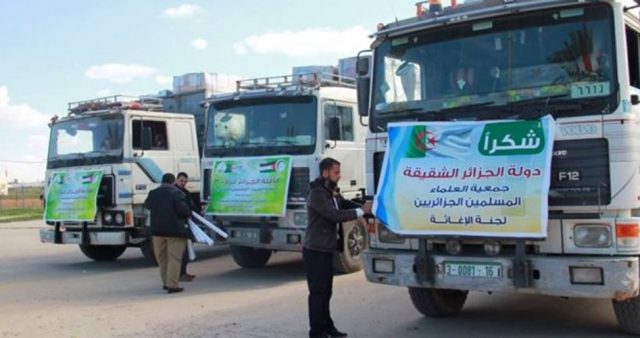
Head of the relief department of the Algerian Scholars Association, Yahya Sari, said on Tuesday that negotiations with Egyptian authorities to allow the Algerian humanitarian convoy to enter the Gaza Strip have reached a dead end.
Sari told Quds Press that the convoy is preparing to return to Algeria as soon as possible so that the medicines are not damaged due to heat.
He pointed out that Egyptian authorities have given their reasons for preventing the entry of the convoy into Gaza, but he did not disclose them.
The 14-truck convoy, carrying medical aid worth over $4 million, contained medicines, medical supplies, ambulances and electricity generators urgently needed for Gaza’s hospitals.
The convoy named (Algeria-Gaza 4) arrived on Wednesday at the Egyptian side of Rafah crossing in preparation for entering the Gaza Strip, but it was asked on Friday evening to return to the Egyptian city of Port Said despite having all the documents required to deliver aid to Gaza.
Ammar Talbi, the deputy head of the Algerian Scholars Association, appealed two days ago to Egyptian authorities to expedite the entry of the Algerian convoy into the coastal enclave fearing that some medicines may deteriorate due to the high temperature.
Talbi said in a statement that the convoy was purely humanitarian and that it left Algeria after obtaining the approvals of both Algerian and Egyptian authorities in early February.
Mossad accused of assassinating Palestinian in Sweden
MEMO | August 23, 2017
 The Israeli intelligence service Mossad has been accused of assassinating a Palestinian man living in Sweden, according to Israeli daily Haaretz.
Mohammad Tahsin Al-Bazam, a former Gaza resident, was found shot in the head in the Swedish town of Limmared on Saturday. His family is believed to have ties to Hamas, prompting Palestinian sources to suspect Israeli involvement in his death.
A statement released on Sunday by the Swedish police confirmed that as yet they could not ascertain a motive for the intrusion.
“Reports said several people wearing masks entered the apartment through a balcony and shot the man inside. They disappeared after the shooting as quickly as they arrived.”
After the shooting Al-Bazam was taken to a local hospital, and then flown to a larger facility in Gothenburg, but died of his injuries.
Al-Bazam’s brother served in Hamas’ military wing and as a bodyguard to the group’s Prime Minister Ismail Haniyeh. His father is currently the spokesman for Hamas’ Homeland Security Office in Gaza, but stated in an interview that his son had been living in Sweden for over a decade and was not involved in political activity.
Hamas believes Mossad to be responsible for the deaths of numerous of its members over the years, including the assassination of a senior member, Mazen Fuqaha in March. Israel has never confirmed or denied reports but states that it reserves the right to fight alleged terrorists even beyond its borders.
US Zionists say McMaster is hostile to Israel and pro Hamas
MEMO | August 23, 2017
Conservatives in America are leading a campaign to convince US President Donald Trump to fire his National Security Adviser, Israel Today reported on Tuesday. They accuse H R McMaster of being hostile to Israel and pro-Hamas, Hezbollah and the Iranian nuclear deal.
One of the leading figures of the campaign is Morton Klein, the head of the Zionist Organisation of America (ZOA), as well as the billionaire Zionist Sheldon Adelson. The ZOA and supporters of Israel in the White House are afraid that McMaster will use his position to disrupt Trump’s pro-Israel policies.
Adelson, the Israeli newspaper pointed out, was a major donor for Trump’s presidential campaign. While it said that he has denied that he was involved in a campaign criticising McMaster, it added that he had acknowledged in an email to Klein that he did not know much about the National Security Adviser but now supports efforts to remove him from the White House.
‘Nuclear War Game’ Part of Massive US-South Korea Military Drills for First Time
Sputnik – 23.08.2017
For the first time ever, the US and South Korea will be conducting war games meant to prepare their militaries for the possibility of a nuclear war, according to a South Korean Defense Ministry official. North Korea has previously called the planned military exercises a provocation that could lead to nuclear war.
No other details were given by the Defense Ministry spokesperson, who was speaking to South Korean newspaper Chosun Ilbo. However, the war game does come in the wake of North Korea’s first-ever test of a long range intercontinental ballistic missile in July, as well as reports that the country might be capable of fitting a nuclear payload onto it.
Ulchi Freedom Guardian, a 10-day military exercise that this summer involves 17,500 American and 50,000 South Korean soldiers (as well as contingents from seven other US allies), has been an annual event for 41 straight years. The focus of the exercises is to defend South Korea from a mock invasion from the North.
Michelle Thomas, a US military spokeswoman, said of the exercises: “It’s to prepare if something big were to occur and we needed to protect [South Korea].”
North Korea traditionally condemns the drills as provocative, and this year is no different. State news agency KCNA called Ulchi Freedom Guardian an exercise “aimed to ignite a nuclear war on the Korean Peninsula at any cost.”
South Korean President Moon Jae-in said that the exercises were not meant “at all to heighten military tension on the Korean Peninsula as these drills are held annually and are of a defensive nature. North Korea should not exaggerate our efforts to keep peace nor should they engage in provocations that would worsen the situation, using [the exercise] as an excuse.”
China chimed in to the contrary, with Foreign Ministry spokeswoman Hua Chunying criticizing the drills during a regular press conference. Hua called them “not helpful to the de-escalation of the current tensions and the efforts made by all relevant parties to promote peace talks.” She added that the situation on the peninsula was “highly complex, sensitive and delicate” and that South Korea and the US shouldn’t “add fuel to the fire.”
Despite tensions with North Korea at their highest in decades, US Forces Korea has downsized American participation in the exercise from 2016: 17,500 American soldiers are participating in the 2017 exercises, down from 25,000 the previous year.
Hua urged both sides to focus on more “constructive actions” instead, such as accepting China’s proposal of “suspension for suspension.” The solution, proposed by Beijing in March, calls for North Korea to stop all missile tests in exchange for the US and South Korea stopping all military exercises.
Pyongyang welcomed the plan, while Washington and Seoul rejected it. American military experts called the deal overwhelmingly advantageous for North Korea, as they get to continue their own military exercises and thus better prepare for offensive or defensive warfare.
“It is hard to imagine why the United States would accept [suspension for suspension], because of the vulnerability it would create,” said Bruce Bennett, a senior defense researcher at Rand Corp., to the Charlotte Observer.
Hua also added that the “tense situation on the Korean Peninsula has shown a slight sign of abatement recently.” This may have been a reference to General Joe Dunford, the United States’ highest ranking military officer and the chairman of the Joint Chiefs of Staff, visiting China earlier in August to meet with President Xi Jinping.
During his visit, the US and China agreed to strengthen military ties and the lines of communication to help find a resolution to the North Korean crisis.
Featured Video
Laith Marouf: Hezbollah’s position on US-Iran ceasefire
or go to
Aletho News Archives – Video-Images
From the Archives
The Dirty Little Secret behind the “Global Terrorism Index”
The Omission of Israeli Terrorism in the Occupied Palestinian Territories
By Karin Brothers | Global Research | December 6, 2014
… The Israeli settlements — all of which are illegal – have been identified as a major impediment to peace. The refusal of a major “global” terrorism report to name the Israeli settlers as one of the groups most responsible for terrorism not only misrepresents a major source of regional violence but exposes the Global Terrorism Index as a propaganda tool that supports a U.S. agenda.
In recent years, governments have been attempting to thwart terrorism by blocking supportive fund-raising. When it comes to Israeli settlements, however, the US and Canada actually encourage fund-raising by giving organizations (such as Christian Friends of Israeli Communities (CFOIC) and the Jewish National Fund) financial support in the form of donor tax-deductions.
Charities which provide funds for the Israeli settlements should be regarded as terror-financing organizations. They should not only lose their tax-deductible status, but they should be banned because they support the violation of international humanitarian law. The terror-financing laws that are being strictly enforced for Muslim charities should be applied to Christian and Jewish charities as well. … Read full article
Blog Roll
 Aletho News
- The Black Cube Files: How Former Mossad Operatives Flipped a Nation
- Laith Marouf: Hezbollah’s position on US-Iran ceasefire: What you’re not being told
- Israel’s priority lies in destroying chances of peace between Iran, US: Ex-UN nuclear chief
- Ceasefire for all or for none: Iran shuts Hormuz over Lebanon attacks
- Strait of Hormuz is Iran’s ‘nuclear weapon’ that forced US retreat: Medvedev
- Energy crisis will last for months – Kremlin envoy
- Europe’s quiet role in the war on Iran
- Forty days that shook the Empire: How Iran turned the tables on US and prevailed
- Netanyahu unilaterally declares Lebanon outside of ceasefire deal
- Israeli leaders: ‘Not a single goal’ achieved in war with Iran
- If Americans Knew
- Gazans face a triple crisis: severe shortages of water and bread, healthcare in tatters
- NY Times reports how Netanyahu took the US into Iran War
- A sigh of relief over Iran, but Gaza and Lebanon in dire straits – Daily Update
- Thousands dead and neighborhoods razed to the ground: Aid agencies fear southern Lebanon is becoming the new Gaza
- The war the US is fighting for Israel could cost trillions
- ‘Cigarette Burns, Nail Wounds’: Toddler Tortured in Gaza to Coerce Father
- Trump Says US Sent ‘a Lot of Guns’ to Protesters in Iran
- Israeli forces destroy 17 UN peacekeeper cameras in south Lebanon
- US-Israeli strikes ‘completely destroy’ synagogue in Tehran
- Archbishop for US Military Says Iran War Is Unjust Under Catholic Teaching
- No Tricks Zone
- An Inconvenient Tree: Uncovered In Alps… Europe Much Warmer Than Today 6000 Years Ago
- New Study Reports A 60% Slowdown In Greenland’s Ice Loss Rate In The Last Decade
- Low Intensity Tornado Wrecks Major Solar Farm, Creating A Potential Toxic Dump
- New Study Finds Warming Saves Lives…Cold Temperatures 12 Times More Deadly Than Excess Heat
- German Science Blog Accuses PIK Climate Institute Of Hallucinating Climate Tipping Points
- Devastating Assessment Of Comirnaty Vaccine By Former Senior Pfizer Europe Toxicologist
- New Study: CO2 Is ‘Effectively Negligible’ As An Explanatory Climate Change Factor Since 2000
- Former Pfizer Toxicologist Dr. Helmut Sterz Tells Bundestag Hearing Pfizer Vaccine Should Have Never Been Approved
- Energy Expert: Germany’s Nuclear Phaseout Was A “500 Billion Euro Mistake”
- New Research: South Australia’s Mid-Holocene Sea Surface Temperatures Were 4°C Warmer Than Today
 Aletho News