Referendum Blues: The Issue of an Independent Kurdistan
By Dr Can Erimtan | 21st Century Wire | September 26, 2017
Recep Tayyip Erdoğan (aka the Prez) and his Justice and Development Party (or AKP) have been steering the state founded by Mustafa Kemal [Atatürk] (1881-1938) into distinctly Islamic waters for quite some time now… and as Turkey houses the largest percentage of Kurds in the region (14.7 million according to the CIA), solving Turkey’s Kurdish issue had been part and parcel of the AKP’s policy of Sunnification.
The Prez and his AKP henchmen had namely devised a plan to transform the country into a nation of believers, firmly dedicated to Sunni Islam and moving away from Turkish nationalism.
A Nation of Muslim Immigrants versus an independent Kurdistan
But the Iraqi Kurdish leader Masoud Barzani now seems to have thrown a spanner in the works, as he told the international press in 2014 that “We [referring to the Kurdish population of Iraq living in the north of the country] will hold a referendum in [the KRG or Kurdish Regional Government] and we will respect and be bound by the decision of our people and hope that others will do likewise.” In this way, one of Turkey’s deepest fears is finally about to become a reality now – the formation of an independent nation state called Kurdistan in the wake of a popular referendum to be held on Monday, 25 September 2017. Somewhat fortunate for Ankara, though, not quite on Turkish soil, but nevertheless directly adjacent to Turkey’s south-eastern region, which many Kurds as well as their sympathisers refer to as Northern Kurdistan these days. And thus, AKP-led Ankara is now up in arms as the rather natural expectation is that a so-called domino effect will take place and that Turkey’s Kurds might very well want to join their southern brethren in an independent nation state possessing underground hydrocarbon reserves or a coveted natural source of income, if you will.
The Turkish nation state established by, Mustafa Kemal, and his followers developed its own brand of nationalism, its own brand of Turkish nationalism which was meant to transform the ethnically diverse inhabitants of Anatolia and Eastern Thrace into a homogeneous body of Turks (or Turkish citizens). Throughout most of its existence, the ideological construct of Turkish nationalism adhered to the politcal precepts of the state carrying the name Kemalism, in reference to the nation state’s founding father and, as I explained nearly four years ago: “the idea of the Anatolian population as a Turkish entity was first proposed as early as 1922, the year prior to the official proclamation of the republic. And in 1924, the first Turkish constitution proclaimed that the ‘name Turk, as a political term, shall be understood to include all citizens of the Turkish Republic, without distinction of, or reference to, race or religion.’ A policy of ‘Turkification’ carried out in the first decades of the republican existence has meant that these various ethnic subgroups have in time merged with the Turkish mainstream.” This Kemalist exercise in social engineering worked well for the majority of ‘Turks,’ whose ethnic identities became submerged in a superstructure of Turkishness that came to replace the previously employed social construct of Ottomanism, that had been in place in the period 1876-1918. The only notable exception to this narrative were the Kurds, whose tribal organisation at the fringes of both the Ottoman and Turkish state structures basically meant that they were able to continue their lives beyond the strictures of the state and its bureaucratic framework and control.
Prior to the foundation of the Republic in 1923, “Anatolia was . . . home to ethnically heterogeneous Muslim groups: in addition to a large majority of Turkish Muslims, there were Kurds, Arabs, Lazes, Muslim Georgians, Greek-speaking Muslims, Albanians, Macedonian Muslims, Pomaks, Serbian Muslims, Bosnian Muslims, Tatars, Circassians, Abkhazians and Dagestanis among others. Prior to the formulation of Turkish nationalism as an ideological binding-force, the diverse ethnic groups in Anatolia were united by their common identity as Muslims and their allegiance to the Ottoman Caliphate, abolished in 1924 . . . Anatolia has always been home to a wide variety of ethnic and religious groups and sub-groups, and today, the makeup Turkey’s population is the result of Ottoman government policies carried out in the late 19th and early 20th centuries. These policies were aimed at transforming Anatolia (the heartland of the Ottoman Empire and the Turkish Republic’s geo-body, using Thongchai Winichakul’s coinage denoting the territory of a nation as expressed on a map and inscribed on the people’s consciousness) into a Muslim homeland where refugees from the Russian Empire and the Balkans were settled.” And in the 21st century, the Prez and his AKP henchmen are bent to return Turkey’s state-of-affairs to this pre-nationalist reality, dismantling “the nation state Turkey into an Anatolian federation of Muslim ethnicities,” beholden to the Prophet’s example, the strictures of the Shariah and possibly even to a revived Caliphate. As a result, the expectation was that the Prez and his henchmen would be able “to unite and pacify the country as a nation of believers, firmly dedicated to Sunni Islam able to supersede mere ethnic or national ties and solidarity.” And in this way, the issues of Turkish and Kurdish nationalism that had in the Kemalist past (1923-2002) caused major unrest in the country would have been replaced by the common cause of Islam and Muslim solidarity. But events in the real world were such that developments in neighbouring Syria and Iraq have led to a strengthened sense of Kurdish nationalism, not just in Turkey. First in northern Iraq where the KRG emerged on the scene in the aftermath of the first and second Gulf Wars led by Bush, Senior and Junior respectively. As well as in Syria where the “three autonomous cantons of Kobani, Afrin, and Cizre, making up the district of Rojava, are under the control of the PYD (or the Kurdish Democratic Union Party) that is arguably attempting to put into practice precepts and ideas of ‘libertarian municipalism’ developed by the libertarian socialist thinker Murray Bookchin (1921-2006).” This last aspect is particularly troubling for Turkey, as its homegrown Kurdish terror group PKK (or the Kurdistan Workers’ Party) equally espouses these ideals which were popularised by its imprisoned leader Abdullah Öçalan, thereby attesting to the organic ties between the PKK and the PYD, and its military wings the YPG (People’s Protection Units) and YPJ (Women’s Protection Units).
And finally, there is also a notable Kurdish presence in Iran, supporting its own separatist terror group, known as PJAK and which Turkey also sees as being organically linked to the PKK.

The Spectre of a Greater Kurdistan: 25 September 2017
The fact that the Kurds, arguably much like the Palestinians or even the Rohingya, are a social group consisting of Muslims that lack a proper homeland or nation state means that they can easily garner major support around the world, particularly in the West where the cult of the underdog has transformed the Kurds into a perennial favourite amongst human rights’ supporters all around. And as such, the Kurds and the goal of an independent Kurdistan have now also found major backers in the somewhat unlikely duo of Israel and Saudi Arabia, as I explained in the summer of 2015.
The spectre of “an independent Kurdistan in Northern Iraq could very well be the opening move for redrawing the mapped heritage of Sykes-Picot by means of consolidating Kurdish unity – stretching from Syria in the West (Rojava), over Turkey in the North (South-Eastern Anatolia) and Iraq in the South (KRG) to Iran in the East (Rojhilate Kurdistane).” As such, on the sidelines of the U.N. General Assembly meetings in New York City (19 – 25 September 2017), Iranian Foreign Minister Javad Zarif, Iraqi Foreign Minister Ibrahim Jaferi, and Turkish Foreign Minister Mevlüt Çavuşoğlu got together to discuss this thorny issue (20 September 2017)… even managing to publish a joint communiqué afterwards: “In the meeting, the three Ministers, reaffirmed their strong commitment to the territorial integrity and political unity of Iraq, welcomed the recent liberation of the Nineveh Governorate, which constituted a major victory against DEASH [or the Islamic State or ISIS]… acknowledged the perseverance, commitment and resolve of the people of Iraq as a whole in fighting DEASH . . . . . . Expressed their concern that the planned referendum by the KRG, which is scheduled for September 25, 2017, puts Iraq’s hard-earned gains against DEASH under great risk, [f]urther expressed their concern that the planned KRG referendum is unconstitutional and runs the risk of provoking new conflicts in the region, that will prove difficult to contain.” As a result, the Kurds managed to do the impossible – to unite the governments of Turkey, Iraq and Iran. Or, as put by the communiqué: the assembled foreign ministers “… registered their unequivocal opposition to the referendum, decided to urge the leadership of the KRG to refrain from holding the referendum, emphasized that the referendum will not be beneficial for the Kurds and [the] KRG, [and a]greed, in this regard, to consider taking counter-measures in coordination,” adding that there is a “need for concerted international efforts to convince the KRG on calling off the referendum,“ while renewing “their call on the international community to remain engaged on the issue.“
Turkish Reactions: War in the Offing?!??
With the fateful date fast approaching, and the Prez also having had his last minute tête-à-tête with the current Leader of the Free World in New York City (21 September 2017), while his proxy the hapless PM Binali Yıldırım spoke to the Turkish press invoking the Treaty of Lausanne (24 July 1923) in his argumentation against the possible outcome of the upcoming referendum (22 September 1922): “This referendum is an issue of Turkey’s national security. Turkey is determined to use its natural rights originating from international and bilateral conventions and will not hesitate in this.” Hapless Yıldırım referred particularly to articles 3 and 16 of the cited document.
The Lausanne Treaty basically functions as the Turkish Republic’s founding document in the aftermath of the Great War (1914-18), the Turkish War of Independence (1919-22) and the abolition of the Ottoman Sultanate (1922). Its third article holds that the “Turkish and British Governments reciprocally undertake that . . . no military or other movement shall take place which might modify in any way the present state of the territories“ of the Republic of Turkey and Iraq, which was then known as the Kingdom of Iraq under British Administration (1920-32) or simply a British protectorate under the sway of Westminster and nominally ruled by George V (1910-36). Article 16, on the other hand, simply clarifies that “Turkey hereby renounces all rights and title whatsoever over or respecting the territories outside the frontiers laid down in the present Treaty,“ which is basically quite beyond the present scope of Turkey’s foreign policy. But Yıldırım citing the article clearly signifies that Turkey’s Kurds should not harbour any desires of joining their southern ethnic brethren, given the finality of Turkey’s borders. The fact that Yıldırım, representing his boss and the AKP establishment, is now quoting Lausanne to sway the Iraqi Kurds from holding a referendum indicates that AKP-led Ankara is really grasping at straws. Turkish Islamists and the AKP nomenklatura, in particular, have in the past always attacked the Treaty of Lausanne as a document of surrender, signing the death of the Ottoman enterprise and forcing Turkey to renege on much-coveted territories. In fact, but last year the Prez himself referred to the Kemalist ‘National Pact’ or Misak-ı Millî (originally drafted by Mustafa Kemal during the Erzurum Congress, 23 July-5 August 1919, and accepted by the last Ottoman parliament on 28 January 1920) to argue that Aleppo, Kerkük and Mosul are “ours” (23 October 2016) – areas also inhabited by Iraqi Turkmen as well as harbouring underground hydrocarbon reserves.
And now, with the hours counting down and everyone’s nerves on end, “the Turkish government will seek a mandate from the Parliament [or TBMM, in acronymized Turkish] to send troops to Iraq and Syria after consecutive security meetings where measures to be taken against the Erbil administration have been decided. The Turkish Parliament is set to hold an extraordinary session on Sept 23 to vote on a mandate that permits the government to deploy troops to its southern neighboring countries, Iraq and Syria, just two days before the scheduled referendum to be held by the Iraqi Kurdistan Regional Government (KRG),“ as reported by the Turkish press.
As it happens, Turkey’s National Security Council, which was supposed to convene on Wednesday, 27 September 2017, was also been brought forward to coincide with the extraordinary parliamentary session. Tayyip Erdoğan told the Turkish press on Friday (22 September) that “[w]e will initiate another step in conjunction [with the already agreed upon measures]. This step will consist of deciding upon what kind of sanctions will be imposed, we will discuss all these matters in great detail during the National Security Council meeting. It would not be right for me to say anything about that now. The timing of the sanctions, what the road map will be like, all these things will be discussed in the National Security Council meeting and if necessary in the Council of Ministers meeting, and our government shall announce the decisions following the Council of Ministers meeting.” As it turns out, when it comes to the Kurds, the post-Kemalist state (2002-) turns out to be as firm and ruthless as its Kemalist predecessor (1923-2002).
The extraordinary parliamentary session on Saturday approved a motion to extend a mandate permitting the AKP government to deploy its armed forces (or TSK, in acronymized Turkish) to Iraq and Syria for another year. In spite of the extreme political polarisation present in post-Kemalist Turkey, the said motion received the approval of a large majority in the TBMM with deputies from the main opposition CHP (or Republican People’s Party) and the opposition fascist MHP (or Nationalist Movement Party) easily joining the nationalist cause spearheaded by the Prez and his AKP henchmen. The mainly Kurdish opposition HDP (or Peoples’ Democratic Party) quite naturally did not join the nationalist and Islamofascist throng in the Turkish Parliament. During the proceedings, Defense Minister Nurettin Canikli made the following remarks: “Pulling out just a brick from a structure based on very sensitive and fragile balances [which is the territorial status quo that emerged in the wake of the Sykes-Picot agreement, ratified on 16 May 1916] will sow the seeds for new hatred, enmity and clashes . . . Th[is] pirate referendum which is illegal and unacceptable should be cancelled before it is too late,” making plain how the Turkish political establishment is unable to countenance the merest hint of Kurdish independence or even the noun Kurdistan, for that matter.
The opposition CHP MP Öztürk Yılmaz promptly echoed the Defense Minister’s words, declaring somewhat disingenuously that “[w]e want the referendum to be cancelled and support the motion not for war but for peace in the region.” In fact, the rather surreal concordance between government and opposition was all but underlined by a surprise meeting between the hapless PM and the CHP leader Kemal Kılıçdaroğlu and the MHP leader Devlet Bahçeli during a break at the session. The HDP MP Osman Baydemir, on the other hand, simply and matter-of-factly called the session’s predictable outcome a “war mandate . . . [and] a proclamation of enmity towards 40 million Kurds.” Meanwhile, on the same day. south of the border, in the sovereign state that is the as-yet unitary Republic of Iraq, where Kurds constitute about 17% of the population, the KRG’s ruling bloc sent a delegation to the central government in Baghdad, a Shi‘ite Arab coalition led by the PM Haider al-Abadi and ceremonially presided over by the ethnically Kurdish politician Fuad Masum. Kurdish leader Massoud Barzani’s top adviser Hoshiyar Zebari told the Reuters news agency that the “delegation will discuss the referendum but the referendum is still happening . . . We said we would talk to Baghdad before, during and after the referendum.” And then, there is the U.S., the main culprit behind the current predicament as the KRG was set up in 1992 (with first elections organised on 19 May), in the wake of the first Gulf War (2 August 1990–28 February 1991), led by Bush, Senior, the 41st President of the United States of America (1989-93). The current Trump administration has now vocally urged the Kurds to cancel the referendum, while the U.N. Security Council, for good measure, issued a warning calling the vote “potentially destabilizing” for Iraq and the region.
In other words, another frontline in the Middle East’s ongoing military conflict could very well be added to the conflagrations in Syria, Iraq and Yemen . . . another front that might or might not include the south-eastern part of Anatolia, nowadays more commonly referred to as Northern Kurdistan and an integral part of the territories of the Republic of Turkey, albeit largely inhabited by Kurds-carrying-Turkish-passports and ID cards. And this “potentially destabilizing” military action would come to sit on top of the ongoing fight against the Islamic State (or ISIS or Daesh) and pit Turkish soldiers against Kurdish Peshmerga and civilians . . . and northern Iraq as well as the whole of Turkey – as Kurds live dispersed thoughout the whole of the country and not just the South East – might very well join the lands where death and destruction have come to dominate daily life and have turned the solid and stable structures of men into sheer rubble and junk. At the moment, such alarmist words are merely hovering in the air, as on the appointed day, “Kurds voted in large numbers in an independence referendum in northern Iraq” (voter turnout of aproximately 78%), as explained by Reuters. While simultaneously, Turkey and Iran engaged in war games on the Iraqi border. Iraq’s PM al-Abadi, for his part, ordered the Iraqi army to “protect citizens being threatened and coerced” by triumphant Kurds.
Now that the long-awaited and much-feared day of reckoning has come and gone, “Tehran and Ankara fear the spread of separatism to their own Kurdish populations,” as expressed by Reuters, and the Baghdad government is all but fearful of maintaining Iraq’s territorial integrity… and all-out ethnic war could just be around the corner now.
***
21WIRE special contributor Dr. Can Erimtan is an independent scholar who was living in Istanbul for some time, with a wide interest in the politics, history and culture of the Balkans and the Greater Middle East. He attended the VUB in Brussels and did his graduate work at the universities of Essex and Oxford. In Oxford, Erimtan was a member of Lady Margaret Hall and he obtained his doctorate in Modern History in 2002. His publications include the book “Ottomans Looking West?” as well as numerous scholarly articles. In the period 2010-11, he wrote op-eds for Today’s Zaman and in the further course of 2011 he also published a number of pieces in Hürriyet Daily News. In 2013, he was the Turkey Editor of the İstanbul Gazette. He is on Twitter at @theerimtanangle
The Rise of the New McCarthyism
By Robert Parry | Consortium News | September 26, 2107
Make no mistake about it: the United States has entered an era of a New McCarthyism that blames nearly every political problem on Russia and has begun targeting American citizens who don’t go along with this New Cold War propaganda.
A difference, however, from the McCarthyism of the 1950s is that this New McCarthyism has enlisted Democrats, liberals and even progressives in the cause because of their disgust with President Trump; the 1950s version was driven by Republicans and the Right with much of the Left on the receiving end, maligned by the likes of Sen. Joe McCarthy as “un-American” and as Communism’s “fellow travelers.”
The real winners in this New McCarthyism appear to be the neoconservatives who have leveraged the Democratic/liberal hatred of Trump to draw much of the Left into the political hysteria that sees the controversy over alleged Russian political “meddling” as an opportunity to “get Trump.”
Already, the neocons and their allies have exploited the anti-Russian frenzy to extract tens of millions of dollars more from the taxpayers for programs to “combat Russian propaganda,” i.e., funding of non-governmental organizations and “scholars” who target dissident Americans for challenging the justifications for this New Cold War.
The Washington Post, which for years has served as the flagship for neocon propaganda, is again charting the new course for America, much as it did in rallying U.S. public backing for the 2003 invasion of Iraq and in building sympathy for abortive “regime change” projects aimed at Syria and Iran. The Post has begun blaming almost every unpleasant development in the world on Russia! Russia! Russia!
For instance, a Post editorial on Tuesday shifted the blame for the anemic victory of German Chancellor Angela Merkel and the surprising strength of the far-right Alternative for Germany (AfD) from Merkel’s austerity policies, which have caused hardship for much of the working class, or from her open door for Mideast refugees, which has destabilized some working-class neighborhoods, to – you guessed it – Russia!
The evidence, as usual, is vague and self-interested, but sure to be swallowed by many Democrats and liberals, who hate Russia because they blame it for Trump, and by lots of Republicans and conservatives, who have a residual hatred for Russia left over from the Old Cold War.
The Post cited the Atlantic Council’s Digital Forensic Research Lab, which has been pushing much of the hysteria about alleged Russian activities on the Internet. The Atlantic Council essentially is NATO’s think tank and is financed with money from the U.S. government, Gulf oil states, military contractors, global financial institutions and many other sources which stand to gain directly or indirectly from the expanding U.S. military budget and NATO interventions.
Blaming Russia
In this New Cold War, the Russians get blamed for not only disrupting some neocon “regime change” projects, such as the proxy war in Syria, but also political developments in the West, such as Donald Trump’s election and AfD’s rise in Germany.
The Atlantic Council’s digital lab claimed, according to the Post editorial, that “In the final hours of the [German] campaign, online supporters of the AfD began warning their base of possible election fraud, and the online alarms were ‘driven by anonymous troll accounts and boosted by a Russian-language bot-net.’”
Of course, the Post evinces no evidence tying any of this to the Russian government or to President Vladimir Putin. It is the nature of McCarthyism that actual evidence is not required, just heavy breathing and dark suspicions. For those of us who operate Web sites, “trolls” – some volunteers and some professionals – have become a common annoyance and they represent many political outlooks, not just Russian.
Plus, it is standard procedure these days for campaigns to issue last-minute alarms to their supporters about possible election fraud to raise doubts about the results should the outcome be disappointing.
The U.S. government has engaged in precisely this strategy around the world, having pro-U.S. parties not only complain about election fraud but to take to the streets in violent protests to impugn the legitimacy of election outcomes. That U.S. strategy has been applied to places such as Ukraine (the Orange Revolution in 2004); Iran (the Green Revolution in 2009); Russia (the Snow Revolution in 2011); and many other locations.
Pre-election alerts also have become a feature in U.S. elections, even in 2016 when both Donald Trump and Hillary Clinton raised questions about the legitimacy of the balloting, albeit for different reasons.
Yet, instead of seeing the AfD maneuver as a typical ploy by a relatively minor party – and the German election outcome as an understandable reflection of voter discontent and weariness over Merkel’s three terms as Chancellor – the Atlantic Council and the Post see Russians under every bed and particularly Putin.
Loving to Hate Putin
In the world of neocon propaganda, Putin has become the great bête noire, since he has frustrated a variety of neocon schemes. He helped head off a major U.S. military strike against Syria in 2013; he aided President Obama in achieving the Iran nuclear agreement in 2014-15; Putin opposed and – to a degree – frustrated the neocon-supported coup in Ukraine in 2014; and he ultimately supplied the air power that defeated neocon-backed “rebel” forces in Syria in 2015-17.
So, the Post and the neocons want Putin gone – and they have used gauzy allegations about “Russian meddling” in the U.S. and other elections as the new propaganda theme to justify destabilizing Russia with economic sanctions and, if possible, engineering another “regime change” project in Moscow.
None of this is even secret. Carl Gershman, the neocon president of the U.S.-government-funded National Endowment for Democracy, publicly proclaimed the goal of ousting Putin in an op-ed in The Washington Post, writing: “The United States has the power to contain and defeat this danger. The issue is whether we can summon the will to do so.”
But the way neocon propaganda works is that the U.S. and its allies are always the victims of some nefarious enemy who must be thwarted to protect all that is good in the world. In other words, even as NED and other U.S.-funded operations take aim at Putin and Russia, Russia and Putin must be transformed into the aggressors.
“Mr. Putin would like nothing better than to generate doubts, fog, cracks and uncertainty around the German pillar of Europe,” the Post editorial said. “He relishes infiltrating chaos and mischief into open societies. In this case, supporting the far-right AfD is extraordinarily cynical, given how many millions of Russians died to defeat the fascists seven decades ago.”
Not to belabor the point but there is no credible evidence that Putin did any of this. There is a claim by the virulently anti-Russian Atlantic Council that some “anonymous troll accounts” promoted some AfD complaint about possible voter fraud and that it was picked up by “a Russian-language bot-net.” Even if that is true – and the Atlantic Council is far from an objective source – where is the link to Putin?
Not everything that happens in Russia, a nation of 144 million people, is ordered by Putin. But the Post would have you believe that it is. It is the centerpiece of this neocon conspiracy theory.
Silencing Dissent
Similarly, any American who questions this propaganda immediately is dismissed as a “Kremlin stooge” or a “Russian propagandist,” another ugly campaign spearheaded by the Post and the neocons. Again, no evidence is required, just some analysis that what you’re saying somehow parallels something Putin has said.
On Tuesday, in what amounted to a companion piece for the editorial, a Post article again pushed the unproven suspicions about “Russian operatives” buying $100,000 in Facebook ads from 2015 into 2017 to supposedly influence U.S. politics. Once again, no evidence required.
In the article, the Post also reminds its readers that Moscow has a history of focusing on social inequities in the U.S., which gets us back to the comparisons between the Old McCarthyism and the new.
Yes, it’s true that the Soviet Union denounced America’s racial segregation and cited that ugly feature of U.S. society in expressing solidarity with the American civil rights movement and national liberation struggles in Africa. It’s also true that American Communists collaborated with the domestic civil rights movement to promote racial integration.
That was a key reason why J. Edgar Hoover’s FBI targeted Martin Luther King Jr. and other African-American leaders – because of their association with known or suspected Communists. (Similarly, the Reagan administration resisted support for Nelson Mandela because his African National Congress accepted Communist support in its battle against South Africa’s Apartheid white-supremacist regime.)
Interestingly, one of the arguments from liberal national Democrats in opposing segregation in the 1960s was that the repression of American blacks undercut U.S. diplomatic efforts to develop allies in Africa. In other words, Soviet and Communist criticism of America’s segregation actually helped bring about the demise of that offensive system.
Yet, King’s association with alleged Communists remained a talking point of die-hard segregationists even after his assassination when they opposed creating a national holiday in his honor in the 1980s.
These parallels between the Old McCarthyism and the New McCarthyism are implicitly acknowledged in the Post’s news article on Tuesday, which cites Putin’s criticism of police killings of unarmed American blacks as evidence that he is meddling in U.S. politics.
“Since taking office, Putin has on occasion sought to spotlight racial tensions in the United States as a means of shaping perceptions of American society,” the article states. “Putin injected himself in 2014 into the race debate after protests broke out in Ferguson, Mo., over the fatal shooting of Michael Brown, an African American, by a white police officer.
“‘Do you believe that everything is perfect now from the point of view of democracy in the United States?’ Putin told CBS’s ’60 Minutes’ program. ‘If everything was perfect, there wouldn’t be the problem of Ferguson. There would be no abuse by the police. But our task is to see all these problems and respond properly.’”
The Post’s speculative point seems to be that Putin’s response included having “Russian operatives” buy some ads on Facebook to exploit these racial tensions, but there is no evidence to support that conspiracy theory.
However, as this anti-Russia hysteria spreads, we may soon see Americans who also protest the police killing of unarmed black men denounced as “Putin’s fellow-travelers,” much as King and other civil rights leaders were smeared as “Communist dupes.”
Ignoring Reality
So, instead of Democrats and Chancellor Merkel looking in the mirror and seeing the real reasons why many white working-class voters are turning toward “populist” and “extremist” alternatives, they can simply blame Putin and continue a crackdown on Internet-based dissent as the work of “Russian operatives.”
Already, under the guise of combating “Russian propaganda” and “fake news,” Google, Facebook and other tech giants have begun introducing algorithms to hunt down and marginalize news that challenges official U.S. government narratives on hot-button issues such as Ukraine and Syria. Again, no evidence is required, just the fact that Putin may have said something similar.
As Democrats, liberals and even some progressives join in this Russia-gate hysteria – driven by their hatred of Donald Trump and his supposedly “fascistic” tendencies – they might want to consider whom they’ve climbed into bed with and what these neocons have in mind for the future.
Arguably, if fascism or totalitarianism comes to the United States, it is more likely to arrive in the guise of “protecting democracy” from Russia or another foreign adversary than from a reality-TV clown like Donald Trump.
The New McCarthyism with its Orwellian-style algorithms might seem like a clever way to neutralize (or maybe even help oust) Trump but – long after Trump is gone – a structure for letting the neocons and the mainstream media monopolize American political debate might be a far greater threat to both democracy and peace.
Investigative reporter Robert Parry broke many of the Iran-Contra stories for The Associated Press and Newsweek in the 1980s.
Featured Video
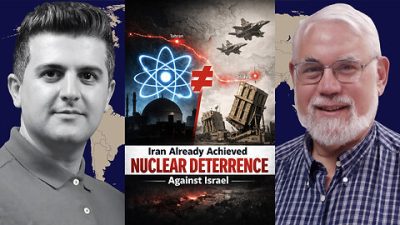
Prof. Ted Postol: Iran Already Achieved Nuclear Deterrence Against Israel
or go to
Aletho News Archives – Video-Images
From the Archives
How the occupied mentality syndrome works
Saudi Arabia on the American chessboard – Part 3
By B. J. Sabri | American Herald Tribune | June 27, 2016
Read part 2: “The occupied mentality Syndrome“
Previously I argued whether Saudi Arabia’s repeated involvements in U.S. interventions and wars stem from free national will or in response to a specific condition. For starters, in Saudi Arabia there is no national will. In Saudi Arabia, the national will is the will of the Al Saud clan. Still, when a major Arab state allies itself with a superpower that committed unspeakable crimes against humanity in almost every Arab country, then something is wrong. This fact alone should compel us to examine the U.S.-Saudi relation for one exceptional reason. As a result of the U.S.-Saudi wars, hundreds of thousands of people in Afghanistan, Iraq, Iran, Libya, Syria, Yemen, and Somalia have lost their lives. Millions became displaced in their own homelands. And millions more rendered refugees.
Attributing the Saudi policies to the bonds of “partnership” with the U.S. is frivolous. There are no bonds between these two thugs except those of business, military deals, secret plots, and wars. Proving this point, bonds such as these have no space for the American and Saudi peoples to share significant cultural or societal exchanges. If partnership is not the reason for the Saudi contribution to the U.S. strategy of empire and imperialism, then another reason must exist.
This leads to three possibilities. … continue
Blog Roll
 Aletho News
- Hezbollah hits Israeli warship off Lebanon’s coast, sets it aflame
- Iran slams US strikes on B1 bridge, Mahshahr petrochemical plants as ‘blatant acts of state terrorism’
- In letter to UN chief, Araghchi warns of dire consequences of US-Israeli attacks on Iran’s nuclear facilities
- Why the CIA conspiracy to invade Iran with Kurdish militias failed
- Why Are Upbeat US Claims About Mission to Rescue Pilot ‘Highly Questionable’?
- Aircraft destroyed during US ‘rescue’ of downed F-15 pilot cost more than $100 million each
- Washington University removes professor who condemned US-Israeli war on Iran
- Russia Warns of Retaliation as UK Authorizes Seizure of Vessels
- Serbia thwarts plot to bomb Russia-Hungary gas pipeline – Vucic
- Al Mayadeen voices solidarity with Dr. Marandi amid death threats
- If Americans Knew
- In Iran, Israel-US take aim at “reason, research, and freedom of thought” – Daily Update
- US loses planes over Iran, Israel downgrades Lebanon war goals – Daily Update
- Israel Is Blocking Palestinians from Easter at Church Where Jesus Resurrected
- Plot to assassinate Palestinian activist follows harassment campaign promoted by Zionist groups and elected officials
- Prominent New York synagogue hosts presentation on why U.S. Jews should support the ethnic cleansing of Gaza
- Tapper vs. Piker: Is the CNN Anchor Auditioning for David Ellison?
- Shouldn’t Democrats Be Able to Condemn Genocide?
- Israel-US kill negotiators, destroy civilian structures, but Iran’s military capabilities still largely intact – Daily Update
- ‘War crime’: Global condemnation as Israeli ministers celebrate death penalty law targeting Palestinian prisoners
- 7 Ways Israel Is Turning Lebanon Into Gaza
- No Tricks Zone
- An Inconvenient Tree: Uncovered In Alps… Europe Much Warmer Than Today 6000 Years Ago
- New Study Reports A 60% Slowdown In Greenland’s Ice Loss Rate In The Last Decade
- Low Intensity Tornado Wrecks Major Solar Farm, Creating A Potential Toxic Dump
- New Study Finds Warming Saves Lives…Cold Temperatures 12 Times More Deadly Than Excess Heat
- German Science Blog Accuses PIK Climate Institute Of Hallucinating Climate Tipping Points
- Devastating Assessment Of Comirnaty Vaccine By Former Senior Pfizer Europe Toxicologist
- New Study: CO2 Is ‘Effectively Negligible’ As An Explanatory Climate Change Factor Since 2000
- Former Pfizer Toxicologist Dr. Helmut Sterz Tells Bundestag Hearing Pfizer Vaccine Should Have Never Been Approved
- Energy Expert: Germany’s Nuclear Phaseout Was A “500 Billion Euro Mistake”
- New Research: South Australia’s Mid-Holocene Sea Surface Temperatures Were 4°C Warmer Than Today
 Aletho News