OHCHR’s Venezuela Report is Terrible and May Incite More Violence
By Joe Emersberger | ZNET | September 1, 2017
The OHCHR put out a press release a few weeks ago about violent protests in Venezuela in which the following words leapt off the page to anybody who has been following the situation without blinders on:
“security forces are allegedly responsible for at least 46 of those deaths, while pro-Government armed groups, referred to as ‘armed colectivos’ are reportedly responsible for 27 of the deaths. It is unclear who the perpetrators of the remaining deaths may be.” [my emphasis]
It was “unclear” to the OHCHR if protesters had killed a single person!
The OHCHR’s full report, which was just released, does not go to that extreme but is still an embarrassingly shoddy and biased report. In a section with the subheading “Violent anti-Government protesters”, the OHCHR report concedes that four murders have been perpetrated by protesters but hastens to add that protester violence has been a “reaction to the disproportionate use of force by security forces” and that the “level of violence by these groups increased as the use of force by security forces rose”.
Four is less preposterous than zero, but is still wildly off the mark. See the detailed timeline provided by VenezuelAnalysis.com.
Direct victims of opposition political violence: 23
Bryan Principal, Oliver Villa Camargo, Niumar Jose Sanclemente, Almelina Carrillo, Paola Ramirez, Jesus Leonardo Sulbaran, Luis Alberto Marquez, Efrain Sierra, Rexol Navas, Gerardo Barrera, Anderson Dugarte, Jorge David Escandon, Pedro Josue Carrillo, Danny José Subero, Orlando Figuera, Douglas Acevedo Sánchez, Ronny Alberto Parra, Alexander Rafael Sanoja Sanchez, Jose Luis Bravo, Ramses Martinez, Hector Anuel, Oneiver Quiñones Ramirez, Felix Pineda Marcano, Ronald RamirezDeaths indirectly linked to opposition barricades*: 8
Ricarda Gonzalez, Ana Colmenarez, Maria de los Angeles Guanipa, Angel Enrique Moreira Gonzalez, Carlos Enrique Hernández, José Amador Lorenzo González, Luis Alberto Machado, Miguel Angel Villalobos Urdaneta
Additionally, how were the murders of unarmed civilians like Orlando Figuera and Almelina Carrillo by protesters a “reaction” against the security forces? Similarly, how is the burning of food warehouses and ambulances, which the OHCHR also concedes took place, a reaction against the security forces?
Moreover, the first person killed by opposition protesters was the civilian bystander Brayan Principal on April 12, only eight days after the protests began. The VenezuelAnalysis timeline shows that, right from the beginning of the protests, when security forces have perpetrated crimes they have been arrested and charged. That’s quite a contrast with what frequently occurs in the United States which is not faced with violent foreign-backed protesters trying to oust the government. It was only four days after the protests began, on April 8, when protesters torched a Supreme Court building.
I would not advise Black Lives Matter protesters in the United States to torch a Supreme Court building and expect to have their actions excused by the OHCHR or any other high profile outfit as a “reaction to the disproportionate force by police”.
The extremely well documented case of Orlando Figuera also exposed some inexcusable sloppiness in the OHCHR report. It falsely stated that Figuera died the same day he was attacked. He actually died in hospital few weeks later. He claimed from his hospital bed that he had been killed for being a suspected Chavista.
Why were the protesters brazen enough to murder Figuera in broad daylight in front of numerous witnesses?
There have apparently been no arrests in the case though the government has identified one of the perpetrators (who was in hiding).
Here are a few reasons:
- 1) People in opposition strongholds – like the one where Figuera was murdered – would likely be afraid to name the perpetrators or, sadly, even supportive of the crime in some cases.
- 2) The Attorney General at the time, Luisa Ortega Diaz (who has now been fired and is who now collaborating with US prosecutors to target the Maduro government), was preoccupied with weakening the government and maneuvering to save her own skin should the opposition seize power.
- 3) Biased reporting promotes impunity. When the United States government wants to vilify a government and have it overthrown – which has been the case in Venezuela for the past fifteen years – numerous natural allies reflexively offer a helping hand: private media companies around the world, high profile NGOs and of course UN bodies like the OHCHR. The destruction of Iraq since 1990 does not happen without UN complicity even though neocons demand that the UN be even more subservient to the US.
There is a section in the OHCHR report on “Violations of the right to freedom of expression” and “Smear campaigns against journalists”. The OHCHR included a throwaway remark that “journalists were also targeted by demonstrators and supporters of both the opposition and the government.“
Prominent opposition supporters tried to get Abby Martin and Mike Prysner lynched by spreading allegations that they were working as informants for the government. Watching their report on the violent protesters the OHCHR whitewashed is something I highly recommend. The OHCHR’s bias not only makes opposition violence more likely, it makes honest journalism about it more dangerous.
The report “recommends” that opposition leaders condemn all violence by its supporters when the OHCHR itself goes out of its way to ignore that violence and deflect responsibility away from the perpetrators. The OHCHR also didn’t think to “recommend” that opposition leaders stop calling on the military to overthrow the government. An organization not at the service of the US Empire would also have “recommended” that the US government not violate international law by imposing economic sanctions or threatening the use of force against Venezuela. Have OHCHR investigators not reviewed the UN Charter recently?
Why North Korea’s Latest Missile Test Was a Humiliating Blow to US Missile Defense
Sputnik – 02.09.2017
Russian military observer Alexander Khrolenko explains how North Korea’s testing of more and more sophisticated missile systems is putting the US’s vast array of expensive missile defense systems to shame.
Last week, North Korea test launched its new Hwasong-12 intermediate range ballistic missile. The missile flew over Japan before falling into the Pacific Ocean, some 733 miles (1,180 km) east of Japan’s northern island of Hokkaido.
Several days later, the Japanese Ministry of Defense requested a record defense budget for the 2018 fiscal year, asking for some 5.25 trillion yen ($48.6 billion) for new ground and ship-based anti-air missiles, fighters, patrol ships and a submarine. The Ministry’s request includes a major push for the modernization of the country’s air defense network, and its anti-land and anti-ship missile capabilities.
Commenting on the missile test, and Japan’s response, RIA Novosti military observer Alexander Khrolenko wrote that Pyongyang’s latest test has demonstrated beyond a shadow of a doubt that all the sophisticated US missile defense systems in and around the Asian country are next to useless.
“Today,” the analyst explained, “Japan’s missile defense is provided by ships equipped with the American Aegis system (which features the SM-3 missile for exoatmospheric interception). In addition, Japan has ground-based Patriot-3 (PAC-3) systems for the destruction of missiles within the atmosphere.”
“However, all these means proved useless on August 29, when the North Korean ballistic missile flew over Japanese territory and fell 1,180 km from Cape Erimo in Hokkaido. In 14 minutes, the missile flew a total of 2,700 km, reaching a maximum altitude of 500 km.”
Although Japan reported no damage to any ships or aircraft from the test, Khrolenko noted that it was highly curious that they didn’t even attempt to shoot the rogue missile down. “They could have at least attempted to shoot it down, if only for training purposes,” the analyst wrote. “The world community would not condemn such a move, and Washington would have certainly supported Tokyo. However, US and Japanese missile defense systems only ended up tracking Hwaseong-12’s trajectory.”
“What’s even more interesting, of course, is how Japan may have intended to shoot down the North Korean missile flying at an altitude of 550 km, when the longest-range US SM-3 guided missile has a 250 km flight ceiling. With a target lock radius of 500 km, the Aegis system would not have been able to reach the missile even during its descent, either. All the more so, given that the target separated into three parts (possibly three warheads).”
With these facts in mind, Khrolenko suggested that the “record request by the Japanese Defense Ministry [actually] reflects the degree of panic within the camp of US allies; after all, this wasn’t the first time that a reason to doubt the omnipotence of US weapons, and specifically its ABM systems, presented itself.”
Last month, for instance, following threats from Pyongyang that they were prepared to stage a massed missile strike against Guam, the Pentagon responded that any such missile launch would be detected in a matter of minutes, and would lead to the prospect of full-scale war.
It was interesting, however, according to Khrolenko, that the Pentagon “did not specify whether the North Korean missiles would be intercepted. And this is fundamentally important when it comes to predicting losses and the outcome of a war (which would not leave Japan unaffected, either).”
Moreover, according to the analyst, the North Korean missile launch proved particularly humiliating in light of the fact that the same day the launch took place, Japanese troops were conducting air defense drills at the Yokota Air Base in western Tokyo, where they practiced the deployment of Patriot-3 interceptors.
“From a military perspective, the exercises coincided successfully with the test of North Korea’s new ballistic missile. Pyongyang ‘played ball’, but Washington did not accept the unexpected ‘pitch’. Servicemen looked on anxiously into the skies, and continued to practice the speedy deployment and setup of the PAC-3’s components, as if the motions were more important than the actual result.”
Factually, Khrolenko wrote, the true effectiveness of the US’s numerous and costly missile defense systems has yet to be proven in conditions resembling those on a battlefield.
“Only once, in February 2013, did an SM-3 interceptor, launched from the USS Lake Erie missile cruiser, destroy USA-193, a defective US satellite at an altitude of 247 km. The target simulated a medium-range ballistic missile (even though the latter do not fly along an orbit). The test was simplified as much as possible, the parameters of the flight were known in advance, as was the target sector. External target designation was provided from the STSS-D tracking satellite, which may not be handy in a real combat situation.”
“One more example: tests of the US missile defense system during NATO’s Maritime Theater Missile Defense drills in 2015 showed that… numerous alliance ships equipped with the Aegis combat information management system were capable of knocking out only a single, less than perfect short range ballistic missile – the Terrier Orion, and probably only at subsonic speed. The degree of effectiveness of such missile defenses in conditions of a mass strike remains unknown, but the degree of simplification involved for the testing suggests it’s rather low.”
In effect, Khrolenko noted that North Korea’s latest missile test has “created a paradoxical parity of forces in that country’s confrontation with the United States.” In these circumstances, he noted, Washington would be advised to avoid subjecting its regional allies to danger.
US ambassador not taking Israeli occupation of Palestinian lands for fact
Press TV – September 2, 2017
United States Ambassador to Israel David Friedman has used the word “alleged” to refer to the Israeli occupation of Palestinian territories.
Friedman referred to the situation in the Palestinian lands as “alleged occupation” in an interview with Israeli daily The Jerusalem Post, which was published on Friday. It was his first major interview with Israeli media.
Israel occupied the West Bank and East Jerusalem al-Quds during the Six Day War in 1967. It later annexed East Jerusalem al-Quds in a move not recognized by the international community. In November 1967, the United Nations Security Council (UNSC) adopted Resolution 242, under which Israel is required to withdraw from all territories seized in the war.
US politicians, as high in ranking as President Donald Trump himself, have in the past exhibited a loose relationship with facts. But it is unlikely that Friedman used the phrase in the Friday interview unwittingly. He is a hawkish politician known for his hard-line stance against Palestinians. His remark did contradict both US foreign policy and international opinion on the issue, however.
According to The Guardian, a Palestinian official, whom the British paper did not name, demanded clarification from the US regarding Friedman’s comment.
“Our understanding is that when someone has an official position, like being an ambassador, this person does no longer speak in a personal capacity. Mr. Friedman should realize that denying facts doesn’t mean that they don’t exist,” the Palestinian official said.
The official said the US envoy “has an extensive record of attacks against the national rights of the Palestinian people, including funding illegal colonial-settlements and participating in celebrations of the Israeli occupation.”
Palestinian officials say they want the decades-long conflict with Israel resolved based on the so-called two-state solution along the pre-1967 boundaries. However, Israel seeks to maintain its grip on the Palestinian lands and has been building settlements deep within territory.
Before taking up his post as the US ambassador to Israel, Friedman had voiced opposition to the two-state solution, which envisages the establishment of an independent Palestinian state.
He is also a vociferous advocate of Israeli settlements built on occupied Palestinian lands, another issue opposed by the international community and the UNSC.
Friedman is the president of American Friends of Beit El Institutions, which raises millions of dollars each year for the Israeli Beit El settlement in the West Bank.
The administration of US President Donald Trump has been by and large vague about its stance on the potential establishment of a Palestinian state.
Raqqa: A hellhole created by the regime-changers of the West

© Morukc Umnaber / Global Look Press
By Neil Clark | RT | September 2, 2017
As Jan Egeland, the UN humanitarian adviser on Syria, has stated, if there’s a worse place to be in the world at the moment than the Syrian city of Raqqa, then it’s hard to imagine.
This week, the UN estimated that the battle to capture the de facto ISIS capital is costing the lives of 27 civilians a day.
It’s not just the almost non-stop aerial bombardment and shelling from the mainly Kurdish Syrian Democratic Forces that the 25,000 or so citizens in ISIS-held parts of the city have to endure. “Access to safe drinking water, food and other basic services is at an all-time low with many residents relying on food they had stored up earlier to survive,” says UN public information officer David Swanson.
Both ISIS snipers and the US-led coalition have been targeting people trying to flee from the Middle Eastern hellhole. The UN notes that coalition forces have even been attacking boats on the Euphrates River, described as “one of the remaining escape routes for civilians.”
We can only imagine the headlines if Russia was doing all this. But because it’s the US and its allies, the international reaction has been muted to say the least. It’s revealing to compare the “humanitarian” concern voiced by pro-war Western politicians and mainstream media outlets when Russia began its military operations in Syria in September 2015, with the lack of concern over what’s been happening in Raqqa.
The claim that Russia was fighting terrorists was widely ridiculed. The US and its allies issued a statement saying that Russia’s actions, which included a strike on a ISIS training camp near Raqqa, would “only fuel more extremism and radicalization.”
On October 2, 2015, the claim made by then-US President Barack Obama that Russian strikes would only “strengthen ISIS” made Western news headlines.
Accusations that Russia was committing war crimes also received prominent coverage.
But when the US-led coalition bombs ISIS, the reporting from mainstream outlets is different. Then, the operation is presented much more positively, with little or no talk about how it will “strengthen” the enemy or “fuel more extremism and radicalization.” There is also little or no talk of war crimes.
A meticulously-researched Alert from Media Lens earlier this summer compared the coverage of the sieges of Aleppo and Mosul.
“When Russian and Syrian forces were bombarding ‘rebel’-held East Aleppo last year, newspapers and television screens were full of anguished reporting about the plight of civilians killed, injured, trapped, traumatised or desperately fleeing…
By contrast, there was little of this evident in media coverage as the Iraqi city of Mosul, with a population of around one million, was being pulverised by the US-led ‘coalition’ from 2015; particularly since the massive assault launched last October to ‘liberate’ the city from ISIS, with ‘victory’ declared a few days ago.”
As I noted here in an earlier Op Edge, it was deemed a ‘Thought Crime’ by Imperial Truth Enforcers to actually refer to the recapture of eastern Aleppo by Syrian government forces as a ‘liberation.’ Pro-war Labour MP John Woodcock even went so far as to call the left-wing Morning Star newspaper “traitorous scum” for daring to defy the gatekeepers and use the ‘L’ word.
But of course, if it’s the US and its allies doing the bombing, then using the word ’liberation’ is de rigueur, regardless of how much death and destruction the ‘liberation’ causes.
There have been no calls from ‘Inside the Bastille’ Western politicians or media pundits for people to protest outside US embassies about the number of civilians killed by coalition airstrikes in Raqqa – as there were over Aleppo. And absolutely no likening of coalition actions to those of the Nazis.
It’s worth noting, too, that while the US and its allies repeatedly called for a “humanitarian pause” in the fighting for Aleppo, they’ve rejected the UN calls for one in Raqqa. “Going slower only delays the liberation and subsequently costs more civilians their lives,” US Colonel Joe Scrocca, director of public affairs for combined Joint Task Force-Operation Inherent Resolve, told Middle East Eye.
What makes the double standards even more outrageous is that without the warmongering actions of the US and its allies in the Middle East, there would be no ISIS/ISIL in the first place. The ‘Coalition’ is fighting in Raqqa a monster that – like Frankenstein in Mary Shelley’s famous novel – they helped to create. The terrorist organization known by the names of ‘Islamic State,’ ‘ISIS/ISIL,’ or ‘Daesh,’ grew out of the chaos that Bush and Blair’s illegal invasion of Iraq had unleashed. As Patrick Cockburn, author of the book ‘The Rise of Islamic State,’ puts it, “ISIS is the child of war.”
Furthermore, the spread of IS to Syria was actually welcomed by the US and its allies as a way of weakening the secular Ba’athist government in Damascus, which Western neocons were desperate to see toppled because of its friendly links with Iran and Russia.
“If the situation unravels there is the possibility of establishing a declared or undeclared Salafist principality in eastern Syria, and this is exactly what the supporting powers to the opposition want, in order to isolate the Syrian regime, which is considered the strategic depth of the Shia expansion (Iraq and Iran),” – declared a secret US intelligence report, which was declassified in 2015.
In 2016, a leaked tape conversation between US Secretary of State John Kerry and anti-government Syrian activists revealed how the US was pleased to see Islamic State gain territory. “The reason Russia came in is because ISIL was getting stronger,” Kerry admits, flatly contradicting the claims made publicly by the State Department in October 2015 that Russia wasn’t targeting ISIS/ISIL.
“Daesh was threatening the possibility of going to Damascus and so forth,” Kerry went on. “We were watching. We saw that Daesh was growing in strength, and we thought Assad was threatened. We thought, however, we could probably manage. You know, that Assad might then negotiate,” he said.
The US and its allies didn’t just watch with pleasure as ISIS expanded – they aided the process. They did this not only by giving money and weaponry to ‘moderate rebels’ who then – surprise, surprise – defected to Abu Bakr al-Baghdadi’s head-chopping outfit, but by targeting forces that were opposed to Islamic State. Israel, for instance, has bombed Syria on countless occasions in the last few years, but each time its attacks have been against those fighting ISIS. “An aspect of the conflict in Syria that has not received the attention it undoubtedly deserves, has been the role of the Israeli Air Force (IAF) in acting as the de facto air force of Daesh [ISIS] and sundry other Salafi-jihadi and rebel groups fighting in the country,” notes John Wight.
We must not forget too that if Washington’s Endless War Lobby had got their way in August 2013, and the US and its allies launched a full-scale military assault on the Syrian government – then Islamic State and its affiliates would probably now be in charge of the entire country. Yet the failure to bomb Assad four years ago is still openly regarded as a tragedy by Western regime-change hawks.
Of course, the key role that the US and its coalition have played in the rise – and expansion – of the forces they are now bombing, is never mentioned in the mainstream reporting of the ‘Battle for Raqqa.’ We’re meant to believe that ISIS fighters appeared – like Mr. Benn’s shopkeeper “as if by magic” – and took control of Syria’s seventh largest city by complete accident. And, we’re certainly not meant to ask questions such as “From where did these terrorists obtain their weapons?” or, “Under what legal authority do the US and its allies carry out air strikes in Syria?”
My 1987 Lonely Planet Guide to Jordan and Syria, says of Raqqa: “There’s really nothing to do or see but it can be a good base from which to visit Lake Assad and the walled city of Rasafah, 30km to the south.”
The city is most definitely not a “good base” for tourists today.
One person who did manage to get out of “the worst place on Earth” earlier this year told RT’s Ruptly news agency: “The streets are full of dead bodies. The schools were targeted, the bridges, and mosques. The [dead] people are lying on the streets; some people were dragged by cars… Dogs were eating the [dead] bodies for there was no one to pick them up.”
The bombed-out ruins of Raqqa and the rotting corpses lying on its streets are a testament to a ‘liberal interventionist’ neo-con foreign policy, in all its bloodstained, hypocritical, ‘humanitarian’ glory.
Neil Clark is a journalist, writer, broadcaster and blogger. He has written for many newspapers and magazines in the UK and other countries including The Guardian, Morning Star, Daily and Sunday Express, Mail on Sunday, Daily Mail, Daily Telegraph, New Statesman, The Spectator, The Week, and The American Conservative. He is a regular pundit on RT and has also appeared on BBC TV and radio, Sky News, Press TV and the Voice of Russia. He is the co-founder of the Campaign For Public Ownership @PublicOwnership. His award winning blog can be found at http://www.neilclark66.blogspot.com. He tweets on politics and world affairs @NeilClark66
Russia vs US Economic War: Who’s Going to be the Ultimate Loser?
By Phil Butler – New Eastern Outlook – 02.09.2017
Full scale economic war in between America and Russia is underway. Russian Prime Minister Dmitry Medvedev said so, and the US administration and the American congress voted it in with new sanctions. The only question that remains is “who will win?” Here’s a look at the future of US-Russia relations and the ultimate loser in this new type of Cold War.
A fact most people are not aware of is that the United States is at risk of repaying its debt if anything major happens. The $20 trillion that America owes is by far the largest of any single country, and about as much as the 28 members of the European Union owe altogether. The sum is greater than what America produces in one year, or twice the debt to DGP ratio of 1988. But now let’s look at the makeup of this staggering debt.
This debt-to-GDP ratio tells investors that the country might have problems repaying the loans. And Baby Boomers are by far the biggest domestic investors via social security and other trust funds. In short, recent administrations have mortgaged the legacy of a generation. President Barack Obama holds the record for piling up the biggest US debt, just so the reader knows. The Bush administration comes in second where piling up debt is concerned, and tax cuts piled on top of the expensive “War on Terror” emptied American coffers at a staggering rate after 2001 and the 9/11 event. Social Security, which will have to pay Baby Boomer retirees their pensions soon, was gutted by Bush and Obama. If these funds are not propped up, 75 million Americans will be robbed of their hard-won retirement. But Social Security and the trusts are only used to cover other US government departments. But what about foreign debtors?
Countries like China, Japan, and Great Britain buy treasuries as investments and in order to guarantee American trade (especially in China’s case). Buying “treasuries” also helps China and other countries keep their currencies strong versus the US dollar. But in 2016 the pattern of purchasing huge US debts altered when China lowered its holdings of U.S. debt. Furthermore, as the debt-to-GDP ratio increases, the nations that hold US debt might demand higher interest payments to compensate for the increased risk. After this happens diminished demand will cause interest rates to rise further. This situation will create a downward spiral that puts pressure on the dollar, and that will eventually increase interest payments to unsustainable levels. Once the US government can no longer sustain social security and other programs, it’s fair to assume the whole house of cards will fall. Currently, Social Security costs more than $1 trillion per year, and payroll taxes no longer cover the fund. So, Congress can no longer “borrow” from the Social Security Trust Fund to pay for other federal programs.
For fiscal year 2018 the interest on the debt is $315 billion, and this will double by the year 2027. But there’s no need for an economics lesson here, so I’ll proceed to Russia’s situation by comparison.
Debt Free by Comparison – Russia
Russia’s national debt is by far the lowest in Europe and the lowest in the former G8 countries. In fact, before the Ukraine crisis took shape Russia’s growth was astounding compared to the US, Germany, France, Japan, and the other G8 nations. Reuters reported Russia’s growth rate of 2.5 times that of the US in quarter 4 of 2011. Russian President Vladmir Putin’s repaying almost all of the country’s foreign debt, high energy prices combined with Russia’s exports to Europe were creating a Russia powerhouse economy. If the truth is ever told of the new “Red Scare” it will reveal fear as the motivator for a new Cold War waged by western powers.
When US President Donald Trump was elected many of his supporters believed there would be a “reset” to normal in US-Russia relations. These hopes were quickly dashed when the technocracy and the globalist control mechanism attacked Trump with a vengeance over his Russia narrative. Allegations of some form of collusion between the new American president and Putin’s Russia became the flavor of the day for corporate and government controlled media. When Trump and Putin met in Hamburg there was renewed hope, but this was quickly dashed when the US Congress hurriedly pushed through a new sanctions law that rolled Russia in with Iran and North Korea. The Israel lobby (AIPAC) put the squeeze on its constituency in congress and on Trump, and a new economic war was waged. Russian Prime Minister Dmitry Medvedev said “the US had declared full-scale economic war”.
Putin’s Russia having already made the “shift” eastward to Asia, the only logical reaction to the Trump reversal was to head full steam in the direction of Beijing. For a couple of years both Russia and China have been hoarding gold and taking steps to separate from the dollar currency. Where Russia’s natural gas is concerned, the blockages thru Ukraine and Syria to Europe created by the NATO nations have been circumvented. The Turkish South Stream project is back in full swing and Russia’s armed forces have helped signal the end of ISIL in Syria. Trump signing this new sanctions bill will end up costing Americans and Europeans the future if I am right.
Further evidence that America has big trouble come from China‘s inviting Guinea, Mexico, Tajikistan and Thailand to the upcoming BRICS summit. Meanwhile Putin is creating a Ministry of the Future headed by economic whiz kid Maxim Oreshkin, who was recruited from the ranks of VTB Capital. According to Bloomberg Oreshkin is creating an informal group known as the “office of changes” bent on improving the structure of the ministry. The ministry will be staffed by renowned gurus like; “Ekaterina Vlasova, poached from Citigroup Inc, Pricewaterhouse Coopers’ Zoya Viktorova and Yulia Urozhaeva from McKinsey & Co.”
The Real Bear Market
An interesting aspect of Oreshkin’s emergence is his role in bringing about a pet project of Putin, in ramping up Russia’s place in the so-called “digital economy”. To this end the Russian president already demanded a final version of this “digital economy development program” be set in place by October. According to the Kremlin the new initiative should create a support mechanism for the development of key end-to-end digital technologies, including artificial intelligence, robotics, quantum computing, development of information and telecommunications and computing infrastructure, and financial incentives.
In conclusion, it’s abundantly clear that Dmitry Medvedev was right in finally giving up the ghost of hope for US-Russia reconciliation. One reason for this is the clear desperation western leaders and business exhibit in their all-out war on Putin. In fact, the only logical reason for trashing west-east relations has to be fear the system of banking and business in the US and Europe will fail. As for Russia’s play I am reminded of a report I made some months back on Putin’s “Third Way” for society. It’s been obvious for some years now the Putin administration has been battling to change Russia’s business and government ecosystem. But economic and geo-strategy assault from western powers has interrupted this plan. I believe Putin had intended to meld Russia’s new initiative into the existing G20 economic structure. But Trump’s turnabout forced a new direction. In the long view we can only watch and see if the staggering giant of American globalist capitalism can overcome a new power structure in world economics. If the Eurasian Union separates from the dollar, the world will certainly enter a time of dire crisis. We may soon witness a real bear in the world marketplace, one unwelcomed by Wall Street.
Phil Butler, is a policy investigator and analyst, a political scientist and expert on Eastern Europe.
US actions against Russian diplomatic and consular property are illegal–here’s why
By Adam Garrie | The Duran | September 2, 2107
The United States has once again seized diplomatic and consular properties belonging to the Russia Federation and is in the process of conducting raid style searches of the properties which are set to formally begin on the 4th of September.
These actions which first took place in the final full month of Barack Obama’s Presidency and are now taking place at additional Russian diplomatic and consular facilities in the United States under Donald Trump’s Presidency, violate clearly codified international laws which are contained in documents known as the Vienna Conventions.
The following are the provisions of the Vienna Conventions that are presently being violated by the United States.
From the Vienna Convention on Diplomatic Relations
Article 22
1. The premises of the mission shall be inviolable. The agents
of the receiving State may not enter them, except with the consent of
the head of the mission.2. The receiving State is under a special duty to take all
appropriate steps to protect the premises of the mission against any
intrusion or damage and to prevent any disturbance of the peace of the
mission or impairment of its dignity.3. The premises of the mission, their furnishings and other
property thereon and the means of transport of the mission shall be
immune from search, requisition, attachment or execution.
From the Vienna Convention on Consular Relations
Article 31
Inviolability of the consular premises
1.Consular premises shall be inviolable to the extent provided in this article.
2.The authorities of the receiving State shall not enter that part of the consular premises which is
used exclusively for the purpose of the work of the consular post except with the consent of the head of the consular post or of his designee or of the head of the diplomatic mission of the sending State. The consent of the head of the consular post may, however, be assumed in case of fire or other disaster requiring prompt protective action.3.Subject to the provisions of paragraph 2 of this article, the receiving State is under a special
duty to take all appropriate steps to protect the consular premises against any intrusion or damage and to prevent any disturbance of the peace of the consular post or impairment of its dignity.4.The consular premises, their furnishings, the property of the consular post and its means of
transport shall be immune from any form of requisition for purposes of national defence or public utility.If expropriation is necessary for such purposes, all possible steps shall be taken to avoid impeding the performance of consular functions, and prompt, adequate and effective compensation shall be paid to the sending State.
In summary, these statues of international law codified by the United Nations in 1961 (Diplomatic) and 1963 (Consular) mean that irrespective of the condition of relations between the sending state (in this case Russia) and the receiving state (in this case the US), the diplomatic and consular properties in question must remain free from any kind of molestation including searches, raids, property seizures and the infringement of normal and dignified working practices.
Each of these items of law has been clearly violated by the United States. The US has prohibited diplomatic and consular workers from pursuing their work under normal circumstances. The US molested the peace and freedom of such workers and their families on a personal level and the US is in the process of preparing to raid the diplomatic and consular properties which the law states are clearly inviolable.
Even in times of conflict that run much deeper than the current political disputes between Washington and Moscow, the Vienna Conventions have a precedent of being adhered to.
In 1984, an individual inside the Libyan Embassy in London shot and killed a UK police officer. The shots were fired from inside the embassy onto the street below.
Although many called for the suspect to be brought to trail in an English court, the UK government at the time, a government that had generally poor relations Libya in any case, observed the Vienna Conventions and allowed the embassy workers to return to Libya safely after being named persona-non-grata, something which is sanctioned by the Vienna Conventions.
The US itself raised a claim in the International Court of Justice against the Islamic Republic of Iran over an incident involving the taking of US hostages at the US Embassy in Tehran in 1980.
In 2005, during the second term of George W. Bush, the United States withdrew from an optional provision of the Vienna Conventions allowing for disputes arising between states on matters involving diplomatic and consular facilities and individuals to be dealt with by the International Court of Justice.
This means that if Russia wanted to take legal action against the US for violating its protections under the Vienna Conventions, Russia would have to file the complaint in a US court which is subject to accusations of bias vis-a-vis an international court dealing with a dispute between sovereign states.
The aggregate effect of this means that the US is breaking international law with impunity while giving the victim of this anti-diplomatic aggression few realistic options to deal with the issue, other than to attempt some sort of equivalent retaliation.
Instead of scrutinising the United States for a flagrant violation of international law, the mainstream media is instead pontificating on why smoke is coming out of the chimney at the soon to be closed Russian Consulate in San Francisco, even though such a matter has no real legal implications. Until the premises is involuntarily vacated, the Russian consular staff have the right to use their facilities as they fit.
Russian Foreign Ministry Spokeswoman Maria Zakharova issued the following statement to the conspiracy theorists who have taken an interest in the smoke,
“Now in San Francisco, another circus begins – a new round of baiting called ‘What are you doing there?’.
After giving 2 days for the emergency conservation of the building and deciding to conduct a search in the premises, which had for many years had diplomatic immunity, a search involving FBI employees, the “host party” in the afternoon of September 1 “accidentally noticed” smoke above the building. The truth is that they also did not happen to notice that the [smoke] was coming from a pipe.
Immediately there were prepared photo reports about the “emergency situation”, and, as the top of sadism, fire protection was called. Just in case. Suddenly, Russians need help: they still had a couple of hours left to clear the premises.
And then the questions of American journalists poured down about what kind of trickle of smoke rose over the Russian consulate general.
I answer: measures are being taken to preserve the building. In this regard, the windows can be closed, the curtains can be lowered, the light may turn off, water may come down, the doors may be locked, garbage can be disposed of, heating devices must be switched off, life support systems switched on, and much more.
It is unbearably embarrassing to monitor the actions of the US authorities and the entire information campaign. Later everything will be like it always happens in the USA: there will be those who stood behind all this Russophobic hysteria, another mistake will be recognized, perhaps we will hear miserable apologies. But all this will be, as always, later. And now, at this very minute, instead of the celebrations on the occasion of September 1 and the labor routine for issuing passports and visas, the employees of the Consulate General professionally oriented towards the development of bilateral relations are engaged in the conservation of the building…
The wider truth of the matter is that the only thing up in flames is the American government’s respect for international law.
US-Russia ties are heading south
By M K Bhadrakumar | Indian Punchline | September 1, 2017
The US-Russia diplomatic tit-for-tat escalated with the announcement in Washington on Thursday ordering the Russians to shut down their consulate in San Francisco as well as two trade annexes. Moscow has regretted “the escalation of tensions” and promised a reaction after careful review of the “new measures”. The state department press release is titled “Achieving Parity in Diplomatic Missions”, implying that the US has merely followed up the “Russian desire for parity in the diplomatic relationship”, which was how Moscow had rationalised its order to cut down the total strength of the US diplomats and staff in Russia by September 1.
A senior state department official explained in a special media briefing that “it is our hope that the Russians will recognize that since they were the ones who started the discussion on parity and we’re responding and complying with what they required of us… Regarding previous actions, the actions that this government took in December – I think you all know the reasons why we took those steps. It had to do with harassment of our diplomats and interference in our domestic affairs, in our elections. So I think those actions spoke for themselves.” (Transcript) Interestingly, White House has since added that President Donald Trump took Thursday’s decision. (President Vladimir Putin had said in July that he personally took the decision to achieve “parity” in the diplomatic relations.)
The state department has warned that Washington is “prepared to take further action as necessary and as warranted.” In sum, if Russia makes further moves, US threatens to retaliate. Lavrov reacted cautiously today: “The president (Putin) has said it many times — we do not wish to quarrel with this country. We have always maintained a friendly attitude towards the American people, and now we are open for meaningful cooperation in the areas of our interests. Our sincere wish is for the political atmosphere between the two countries to return to normal. But, as you know, it takes two to tango. It seems to me, our US counterparts have been performing solo break-dance moves recently.”
It appears that the Trump administration lulled the Russians to complacency through recent weeks. On Wednesday, in fact, Russia’s Ambassador-designate to the US Anatoly Antonov gave an interview to Kommersant newspaper highlighting the “great potential for the mutually beneficial cooperation in various spheres” between Russia and the US. Indeed, ambassadors are obliged to present a hopeful landscape even when the skyline is thick with dark clouds, but the interview sounded hopeful that the Trump administration would adopt a constructive approach.
Quite obviously, the US-Russia diplomatic feud seems only widening and it is a reflection of the state of play in the overall relations. There is growing talk of the US supplying lethal weapons to Ukraine. In Syria, the race for Dier Ezzor city and for control of Syrian-Iraqi border is still open. On Afghanistan, Trump announced a new strategy in a 30-minute speech ten days ago without mentioning Russia even once. Over the North Korean situation, Putin said in an interview with the Chinese media on Thursday, “Russia believes that the (US) policy of putting pressure on Pyongyang to stop its nuclear missile programme is misguided and futile… Provocations, pressure and militarist and insulting rhetoric are a dead-end road.”
Meanwhile, provocative US deployments to Russia’s western borders continue. On the pretext of reinforcing the NATO allies in the Baltics against the backdrop of “Zapad 2017″ (forthcoming Russian military exercise), US deployed to Lithuania another seven US F-15 fighter jets.
McCain’s Transmutation from Cautious Realist to Super-Hawk
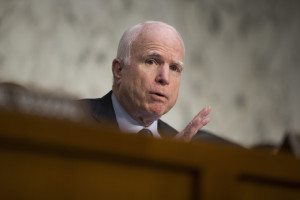
By Stephen J. Sniegoski • Unz Review • September 1, 2017
For many years, John McCain has been one of the major war hawks in the Senate, but he was not that way for more than a decade after he was first elected to Congress. When he entered the House of Representatives in 1983, he was a cautious realist, holding the position that U.S. military power should only be used to protect vital national interests. He developed this view as a result of his experience in the Vietnam War and his post-Vietnam studying of the origins of that war at the National War College.[1] That view loomed large among military leaders at this time and was exemplified by General Colin Powell.
In his first year in Congress, McCain, although a strong supporter of then President Reagan, voted against the latter’s decision to continue the deployment of troops in Lebanon during that country’s civil war. The measure would pass in both Houses of Congress, with substantial support from Democrats, and with only a small minority of Republicans daring to oppose Reagan. In his floor speech on this issue, McCain stated:
“The fundamental question is: What is the United States’ interest in Lebanon? It is said we are there to keep the peace. I ask, what peace? It is said we are there to aid the government. I ask, what government? It is said we are there to stabilize the region. I ask, how can the U.S. presence stabilize the region? . . . . The longer we stay in Lebanon, the harder it will be for us to leave. We will be trapped by the case we make for having our troops there in the first place.
“What can we expect if we withdraw from Lebanon? The same as will happen if we stay. I acknowledge that the level of fighting will increase if we leave. I regretfully acknowledge that many innocent civilians will be hurt. But I firmly believe this will happen in any event.”[2]
After a truck filled with explosives rammed into the Marine compound in Beirut, killing 241 service members, Reagan opted to remove the remaining troops a few months later. McCain was vindicated and he gained considerable attention from the mainstream media for his prescience and courage to take such a stand against a popular President from his party. This helped to develop his reputation as a “maverick.”
“The American people and Congress now appreciate that we are neither omniscient nor omnipotent,” McCain would later tell the Los Angeles Times, “and they are not prepared to commit U.S. troops to combat unless there is a clear U.S. national security interest involved. If we do become involved in combat, that involvement must be of relatively short duration and must be readily explained to the man in the street in one or two sentences.”[3]
In 1987, during the Iran-Iraq War, in which the United States was supporting Iraq, McCain, now a Senator, opposed President Reagan’s move to put American flags on Kuwaiti oil tankers and have the U.S. Navy protect them against possible Iranian attacks. In the Arizona Republican, he described Reagan’s action as a “dangerous overreaction in perhaps the most violent and unpredictable region in the world.” He continued: “American citizens are again being asked to place themselves between warring Middle East factions, with no tangible allied support and no real plan on how to respond if the situation escalates.”[4]
McCain did support the Gulf War in 1991, but even here he was something of a moderate. McCain biographer Matt Welch writes: “When Saddam Hussein invaded Kuwait in the summer of 1990, McCain oscillated between hawkishness and reluctance, denouncing the Iraqi dictator and then the U.S. government for having cozied up too closely to Hussein during the Iran-Iraq war, but at the same time warning against a protracted land battle.”[5] McCain stated: “If you get involved in a major ground war in the Saudi desert, I think support will erode significantly. Nor should it be supported. We cannot even contemplate, in my view, trading American blood for Iraqi blood.”[6]
Under Republican Presidents Reagan and the elder Bush, it must be acknowledged that McCain was not an actual non-interventionist since he supported the American opposition to the Soviet Union, and what he considered to be pro-Soviet forces in Central America. Moreover, he supported the removal of Panamanian dictator Manuel Noriega by the U.S. military in 1989. But this was still a far cry from the global interventionist that McCain would become.
Moreover, during Bill Clinton’s presidency, McCain would be even more non-interventionist until his radical change during the last years of Clinton’s term. In a commencement address he made to the Marine Corps Command and Staff College in Quantico, Virginia in June 1994, McCain emphasized that his cautious approach to war resulted from his Vietnam experience. He solemnly orated that he had not forgotten “the friends who did not return with me to the country we loved so dearly. The memory of them, of what they bore for honor and country, causes me to look in every prospective conflict for the shadow of Vietnam.”[7]
In December 1992, after losing the November election to Bill Clinton, the elder George Bush dispatched American troops to Somalia, then embroiled in a many-sided civil war, to facilitate the provision of food to the starving civilian population. This was part of a United Nations effort. By the fall of 1993, this military mission morphed into one of arresting war lords and nation-building. In October 1993, a 15-hour battle took place in Mogadishu that left 18 Americans dead and 73 injured, with many of these casualties the result of two Black Hawk helicopters being shot down.[8]
Because of this loss of American lives, there was a Senate bill supported by President Clinton which planned to remove American troops from Somalia. Demanding a quicker troop exit, McCain stated: “Mr. President, can anyone seriously argue that another six months of United States forces in harm’s way means the difference between peace and prosperity in Somalia and war and starvation there? Is that very dim prospect worth one more American life? No, it is not.”
Drawing an analogy to what happened in Lebanon in 1983, McCain contended: “240 young Marines lost their lives, but we got out. Now is the time for us to get out of Somalia, as rapidly, and as promptly, and as safely as possible.”
“The longer we stay the more difficult it will be to leave,” McCain asserted. “The loss of American lives is not only tragic, it is needless.”[9] His proposed amendment for a quicker departure, however, was voted down.
McCain also opposed Clinton’s intervention in Haiti to bring back President Jean-Bertrand Aristide, who had been elected in 1990 and then overthrown in a coup in 1991. After a UN resolution authorized the use of military force to return Aristide to power, the United States would ultimately do so on October 15, 1994. In late August 1994, McCain declared: “It is the post-invasion circumstances that I fear will bog down U.S. forces in a low-level, open-ended, ill-defined conflict which will require U.S. servicemen and women to serve as a virtual palace guard for President Aristide once he is returned to power.”[10]
The major international concern in the 1990s was the conflict in Yugoslavia—with the focus first on Bosnia and then Kosovo. After the downfall of Communism, Yugoslavia dissolved, with the secession, in 1992, of Croatia, Macedonia and Slovenia. Bosnia also declared its independence despite the staunch opposition of Bosnian Serbs, who wanted to remain united with Serbia. Civil war broke out between the Bosnian Serbs, supported by Serbia, and the Muslim-dominated Bosnian government. Thousands of people were killed, raped, and expelled from their homes. The West generally looked upon the atrocities, real and imagined, as being primarily perpetrated by the Serbs. In the United States, this was especially the case among American liberals who would advocate “humanitarian” military intervention to protect the Muslims.
In 1992, the UN peacekeeping forces intervened for humanitarian reasons and set up several so-called safe areas for refugees, which often turned out to be not very safe. The UN forces were composed of non-American troops, while American ships and airplanes enforced an arms embargo.
The wars in Yugoslavia would ultimately lead to a sea change in McCain’s position on American military intervention, but this did not occur all at once. Initially, McCain was, like many Republicans, opposed to American involvement in the conflict. In fact, biographer Matt Welch describes McCain as having been “one of the Senate’s most stubborn opponents to US military intervention against Serbs.”[11] McCain contended that any American military “peace-keeping” effort in Bosnia would likely lead to a quagmire. “I think you can draw a parallel to the military challenge in Bosnia with what the Russians faced in Afghanistan,” McCain opined in May 1993. “Even with ground forces and with overwhelming air superiority, they were unable to defeat a motivated, very capable enemy.”[12]
In December 1994, McCain, whom the Los Angeles Times described as a “a leading opponent of greater American military involvement in the war,” stated: “I think we have a very full plate of a legislative agenda, which are the commitments we made to the American people–and Bosnia wasn’t one of those.”[13] In May 1995, McCain held that U.S. efforts in the Balkans were “doomed to failure from the beginning, when we believed that we could keep peace in a place where there was no peace.”[14] Neocon Robert Kagan bemoaned the fact that on Bosnia, Senator McCain led the Republican attack, warning that any use of military power there would result in “another failure like Vietnam or Lebanon.”[15]
Prospects for peace, however, improved in the summer of 1995 when NATO, led by the United States, launched airstrikes against Bosnian Serb targets, which combined with better-equipped Muslim and Croatian forces pressured the Bosnian Serbs into participating in peace negotiations. This led to the Dayton Accords in November 1995, which ended the war in Bosnia. NATO would provide peace-keeping troops, including 20,000 from the U.S.
After NATO’s success, McCain quickly dropped his staunch anti-interventionist position. McCain later claimed that his position had begun to change as a moral reaction to the Serbs’ massacre of thousands of unarmed Bosnian Muslims in July 1995.[16] While most Republican members of Congress were opposed to sending American troops to Bosnia, McCain joined Senator Robert Dole (Republican—Kansas) in putting forth the nonbinding Dole-McCain resolution which permitted Clinton to send troops, though limiting the deployment to one year–which was Clinton’s stated time period—and requiring the United States to lead an effort to arm and train Bosnian troops. The resolution passed in the Senate but was not taken up in the House.[17]
Showing that he had not completely dropped his previous cautious approach to intervention, McCain emphasized that the Dole-McCain resolution was not seeking support for President Clinton’s decision to deploy the troops. “It asks that you support the deployment after the decision has been made,” he said. “The decision has been made by the only American elected to make such decisions [i.e., the President].” However, McCain also expressed a firm interventionist conviction: “When we arrive at the moment when less is expected from our leadership by the rest of the world, then we will have arrived at the moment of our decline.” And he said, “We cannot withdraw from the world into our prosperity and comfort and hope to keep those blessings.”[18]
While a change from his previous strong opposition to American intervention abroad, supporting this peace effort in Bosnia did not portend McCain’s radical transmutation to the global super-hawk that he would become. That final step would require the involvement of the neoconservatives. This connection began when, in 1997, McCain and his advisers read an article in the Wall Street Journal editorial page by neoconservatives Bill Kristol and David Brooks who were promoting the idea of “national greatness” conservatism, which consisted of a more activist domestic agenda and a more interventionist global role.[19]
While this article may have fit in with the direction that McCain’s thinking was moving, it had political implications as well: McCain had been eyeing the presidency for a number of years. According to John Weaver, a major political adviser to McCain at this time: “I wouldn’t call it a ‘eureka’ moment, but there was a sense that this is where we are headed and this is what we are trying to articulate and they [Kristol and Brooks] have already done a lot of the work. . . . And, quite frankly, from a crass political point of view, we were in the making-friends business. The Weekly Standard represented a part of the primary electorate that we could get.”[20] And it should be emphasized that McCain’s change was not a gradual one but rather one that was quite radical and took place in a very short period of time.
After reading this article, McCain and staff were consulting regularly with leading neocons, including Kristol, Robert Kagan, and Randy Scheunemann[21], to, in the words of journalist David Kirkpatrick, “develop the senator’s foreign policy ideas and instincts into the broad themes of a presidential campaign.”[22] In short, McCain realized that he needed the neocons’ intellectual and political support if he were to achieve higher office. The neocons were already well-known and had played a significant role in the Reagan administration. And during the Clinton years, neocons promoted their views from a strong interlocking network of think tanks which have had a significant influence in shaping American foreign policy.
McCain would begin to support neocon positions. On January 26, 1998, the neocon-dominated Project for a New American Century (PNAC), created in 1997 and headed by Bill Kristol, sent a letter to President Clinton urging him to take unilateral military action against Iraq to overthrow Saddam and offered a plan to achieve that objective. After the Clinton administration failed to take action, another neocon-front group, the resurrected Committee for Peace and Security in the Gulf, which had promoted the 1991 Gulf War, sent another letter urging war. And, because of Clinton’s continued inaction, PNAC would send another such letter in May.
While President Clinton failed to take action, McCain pushed for military action against Saddam in 1998. McCain co-sponsored the Iraq Liberation Act, committing the United States to support the overthrow of Saddam and funding opposition groups, most importantly the Iraqi National Congress. Headed by the notorious neocon-favorite Ahmed Chalabi, the Iraqi National Congress would provide much of the spurious information that generated support for the war on Iraq in 2003. The bill passed in both houses of Congress and on October 31, 1998, President Clinton signed it into law. Clinton, however, did not intend to implement this measure and George Bush made no mention of it during the 2000 campaign.[23] McCain, however, remained in lock-step with the neocons on Iraq and would be made Honorary Co-chair of the Committee for the Liberation of Iraq when it was created in 2002.
McCain had been in line with the neocons as a strong supporter of Israel even during the time he adhered to a cautious realist position regarding U.S. military interventionism. He was the 1999 recipient of the Defender of Jerusalem award, given by the National Council of Young Israel. In his acceptance speech, McCain in effect told his pro-Zionist audience that the United States should be prepared to make war for Israel’s sake. “Certainly, no one would argue with the proposition that our armed forces exist first and foremost for the defense of the United States and its vital interests abroad,” McCain intoned. “We choose, as a nation, however, to intervene militarily abroad in defense of the moral values that are at the center of our national conscientiousness even when vital national interests are not necessarily at stake. I raise this point because it lies at the heart of this nation’s approach to Israel. The survival of Israel is one of this country’s most important moral commitments. . . . Like the United States, Israel is more than a nation; it is an ideal.”[24] Note that this was diametrically opposed to his former view that American intervention abroad should only take place to protect vital American interests.
However, it was not Iraq or any of Israel’s enemies that put McCain in the national limelight but rather the U.S.-led NATO war on Serbia over Kosovo in 1999. As Washington Post staff writer Dan Balz wrote in early April 1999, “no politician has been more visible on the issue of Kosovo the past two weeks than the former Vietnam prisoner of war, and a number of political analysts say his performance has given a boost to his presidential aspirations.”[25]
President Clinton orchestrated the NATO war on Serbia, because of the Serbs “ethnic cleansing” of Muslims in their territory of Kosovo. Since Serbia could not possibly threaten the United States, the war was presented as being largely for humanitarian reasons. At this time, there were all types of stories of Serb mass killings of Kosovars, with figures up to 100,000 Kosovar civilians being missing and conceivably murdered.[26] Physical evidence for these extreme claims was not found and former Yugoslav president Slobodan Milosevic was not even charged with crimes of such great magnitude at his trial before the International Criminal Tribunal for the former Yugoslavia (ICTY). And according to German government documents no “ethnic cleansing” of Kosovar Albanians took place until after the NATO bombing.[27]
Unlike many Republicans, McCain supported Clinton’s decision for war. But while Clinton limited American actions to air strikes, McCain maintained that it was essential to win this military confrontation at all costs and called on the Clinton Administration to deploy ground troops if the reliance on air strikes alone appeared to be insufficient to achieve victory.[28]
McCain thus sponsored a resolution that would have given President Clinton congressional authorization to use all means necessary to win the military campaign in Kosovo. The leaders of both parties opposed this resolution and it was tabled. McCain complained: “The president doesn’t want the power he possesses by law because the risks inherent in its exercise have paralyzed him.”[29]
McCain’s hawkish position reflected the views of the neoconservatives. And obviously, his pro-intervention stance represented a sea change from his previous emphasis on caution and support of war only if it involved a vital American interest.
Members of the interventionist Balkan Action Committee, which advocated NATO ground troops for Kosovo, included such prominent neoconservative mainstays as Richard Perle, Max M. Kampelman, Morton Abramowitz, and Paul Wolfowitz. Other neoconservative proponents of a tougher war included Eliot Cohen, Elliott Abrams, John Bolton, Bill Kristol, Robert Kagan, and Norman Podhoretz.[30]
Largely because of his bellicose position on Kosovo, McCain was the favorite presidential candidate for many leading neoconservatives in 2000. As Franklin Foer, editor of the liberal New Republic, put it: “Jewish neoconservatives have fallen hard for John McCain. It’s not just unabashed swooner William Kristol, editor of The Weekly Standard. McCain has also won over such leading neocon lights as David Brooks, the entire Podhoretz family, The Wall Street Journal‘s Dorothy Rabinowitz, and columnist Charles Krauthammer, who declared, in a most un-Semitic flourish, ‘He suffered for our sins.’”[31]
McCain was especially championed by Bill Kristol, editor of the Weekly Standard, and his associate David Brooks. They held that McCain would promote their idea of “national greatness,” as opposed to what they regarded as the standpatness of the conservative Republicans. The “national greatness” program would entail a greater role for the federal government and more extensive intervention throughout the world to promote American values.
Neoconservatives admired McCain for his support of the American war on Serbia, toward which many mainstream conservatives were decidedly cool. The attack on Serbia, ostensibly for humanitarian reasons, provided the intellectual groundwork for the attack on Iraq, the neocons’ fundamental target, since it set the precedent of violating international law’s prohibition against initiating offensive wars. No longer would the United States have to be attacked, or even threatened, to engage in war. As Kristol and Brooks put it: “For all his conventional political views, McCain embodies a set of virtues that today are unconventional. The issue that gave the McCain campaign its initial boost was Kosovo. He argued that America as a great champion of democracy and decency could not fail to act. And he supported his commander in chief despite grave doubts about the conduct of the war–while George W. Bush sat out the debate and Republicans on the Hill flailed at Clinton.”[32]
But the neocons did not support McCain simply because of his defense of the Kosovars, but rather because of his broader interventionist position of “rogue state rollback,” which pointed directly at the enemies of Israel. While participating in a Republican debate moderated by CNN’s Larry King on February. 15, 2000, the candidates were asked: “What area of American international policy would you change immediately as president?” McCain replied: “I’d institute a policy that I call ‘rogue state rollback.’ I would arm, train, equip, both from without and from within, forces that would eventually overthrow the governments and install free and democratically-elected governments.” And he added: “As long as Saddam Hussein is in power, I am convinced that he will pose a threat to our security.”[33]
What caused McCain’s radical shift from cautious realist to super hawk? Biographer Matt Welch sees it as essentially a return to his basic world view, largely derived from the family’s military background, after the non-interventionist effect of the Vietnam Syndrome. Welch writes: “But much less understood is the extent to which interventionist hegemony has been literally seared into McCain’s skull and then reignited late in life after the long intellectual detour of Vietnam.”[34]
Justin Raimondo sees it otherwise: “It is impossible to know what is in McCain’s heart. There may be a purely ideological explanation for his changing viewpoint. But what seems to account for his evolution from realism to hopped-up interventionism is nothing more than sheer ambition.” He goes on: “He was positioning himself against his own party, while staking out a distinctive stance independent of the Democrats. It was, in short, an instance of a presidential candidate maneuvering himself to increase his appeal to the electorate—and, most importantly, the media.”[35]
In an article in Rolling Stone, Tim Dickerson expresses a view similar to that of Raimondo, describing McCain as “a man willing to say and do anything to achieve his ultimate ambition: to become commander in chief, ascending to the one position that would finally enable him to outrank his four-star father and grandfather.” Dickerson continues: “Few politicians have so actively, or successfully, crafted their own myth of greatness.”[36]
McCain has flip-flopped on domestic issues, sometimes supporting a conservative position and at other times a more liberal one which wins him the plaudits of the mainstream media—but once he moved into the neocon orbit regarding U.S. foreign policy, he has stayed there. It is obviously beneficial for a politician to have the broad neocon network of organizations on one’s side. And more than a few of these neocons—such as Bill Kristol, Robert Kagan, David Brooks, are featured regularly in the mainstream media. Moreover, the mainstream liberal media itself has adopted many neocon interventionist positions in foreign policy in regard to Russia and the Middle East, so McCain’s positions are held in esteem there, too.
So while McCain portrays himself as a “maverick” and “straight-talker” who is above politics– and this image is largely accepted by the mainstream media—it would seem most likely that his political positions have been adopted to advance his own political interests.[37] While this approach did not enable him to become President, it did serve to make him something of a public icon, which is a position few politicians attain. However, the war-oriented policies he has advocated have been disastrous for the United States. It is only fortunate that John McCain has not attained the power to have his positions adopted in their entirety.
How Israel Weaponizes Archeology
By Kathryn Shihadah | If Americans Knew | August 31, 2107
From the Zionism’s earliest days in the late 1800s until the present, Israel’s battle has always been about land, but for some the issue goes much deeper—literally. What is underground is as valuable as what is above ground, and the battle has been raging for years.
The battle is over ancient artifacts, from Jerusalem to Gaza to Qumran.
The “Jewish State” prioritizes anything that might boost its legitimacy as rightful owner of Holy Land real estate, and has appropriated the science of archeology to help create its narrative.
The goal is to highlight the ancient Jewish presence and discount all other communities. whether historic or current. The Israeli narrative assumes, for example, that Christians may have been present for a short time, but only as visitors, leaving virtually no trace; the same goes for any Muslim presence.
In order to back up this version of history, Israel has found it necessary to destroy villages, demolish ancient sites, appropriate historic areas, rewrite textbooks, redraw boundary lines, and more. With the illusion of an ongoing, dominant Jewish presence, Israel can assert that it is simply “re-claiming” what is rightfully theirs, instead of taking what belongs to others.
Facts under the ground
It is no surprise that Israel/Palestine is an archeological gold mine: ancient trade routes crisscrossed the region; it was the historic home of the Philistines and Crusaders; a stone’s throw from the early civilizations of Egypt, Mesopotamia, and Phoenicia; part of the Roman, Greek, Persian, and Ottoman empires, to name a few; and the dwelling place of Jews, Christians, and Muslims.
In fact, Palestine is home to the oldest archeological organization in the world, the Palestine Exploration Fund, founded in 1865. Here excavators have feasted on a dizzying array of strata, ranging from Upper Paleolithic (about 40,000 BC) to late Ottoman (19th century AD), and everything in between; their findings have led to the advancement of the science of archeology itself. No wonder archeologists from around the world have been assembling for at least a century and a half to unearth and study Palestine’s ancient cultural riches.
When Israel created itself in 1948—and even before this date—the “Jewish State” worked to take control of archaeology, and thus, of the region’s history. It toiled to erase footprints of the numerous civilizations that had preceded the Jewish presence, as well as the peoples that have come afterward.
“Hand to hand”
The claim to the land is based on a very small window of time, as Illene Beatty pointed out in Arab and Jew in the Land of Canaan: “The extended kingdoms of David and Solomon, on which the Zionists base their territorial demands, endured for only about 73 years… Then it fell apart… [Even] if we allow independence to the entire life of the ancient Jewish kingdoms, from David’s conquest of Canaan in 1000 B.C. to the wiping out of Judah in 586 B.C., we arrive at [only] a 414 year Jewish rule.”
The Israeli narrative pushes the window open a few hundred years more: history (at least, relevant history) supposedly “started with King David and ended with the destruction of the second temple [70 A.D.], restarting with Jewish settlement in the nineteenth century.” Some Greek and Roman presence and a “smattering of early Christianity” are tolerable. But ancient Philistines, Arabs, and Muslims are never acknowledged as part of the region’s history. They would impinge upon Jewish interests.
The official explanation, according to an introductory film that is shown to tour groups in Jerusalem, is simply, “For two thousand years, the city passed from hand to hand.” The “righteous return” and the settler agenda are the only account to which visitors are exposed. On Palestine, there is only silence.
As Israeli author and activist Uri Avnery reminds us, the Zionist claim to the land of Palestine, based as it was on the Biblical history of the Israelites, requires proving that the Bible is true. Almost all of the founders of Israel were professing atheists, but they gritted their teeth and gave their orders.
During the early years of Israel’s existence, bulldozers removed Ottoman and Mameluke remains, Arab and Crusader artifacts, Byzantine and Roman and Greek and Persian remnants—in order to find “pay dirt”: biblical Hebrew artifacts. The search is ongoing. (Read this and this, for example.)
And over the years, the narrative has been pieced together for a single purpose: to manufacture “legitimacy.”
“I told you so”
This explains why, for example, Prime Minister Benjamin Netanyahu rushed to social media when a coin was found recently in an Israeli settlement in the West Bank (Palestine). Preliminary identification classified the coin as a 2,000-year-old half shekel. The Prime Minister posted on Facebook that the artifact was “evidence of the deep connection between the people of Israel and its land” (mind you, the item was found in Palestine, not Israel). Several days later, the coin was more accurately identified by the Israel Museum as a replica, a souvenir, circa 2000 A.D. The Facebook post was removed.
After the 2015 discovery of an ancient jug with Hebrew inscription, Israel’s minister of education, Naftali Bennett, posted on Facebook, “This is yet another example of the many facts on the ground that tell the story of the Jewish state that flourished here in this land 3,000 years ago… A nation can not occupy its own land.”
Moral of the story: Archeology—when massaged properly—is proof positive that there is no occupation.
Palestinian villages evaporate
As part of this effort, Zionist forces wiped out 400-600 Palestinian villages in the 1940s—some were destroyed in the war, but many were depopulated and razed even before the war began; others were demolished in the three years or so following the war.
According to Just Past? The Making of Israeli Archaeology, “remnants of the Arab past were considered blots on the landscape and evoked facts everyone wanted to forget” (everyone except the Palestinians). Many of these lost villages were themselves ancient, or contained ancient building materials. This assisted forgetting, essentially “Nakba denial,” is undoubtedly the greatest theft of Palestinian history. Today, in place of those lost villages are Israeli towns, farms, and orchards.
Hundreds of historical monuments and places of worship (primarily mosques) were also targeted for demolition after the 1948 war. A few Israelis pleaded with the Israeli Department of Antiquities to preserve these sites, but they were for the most part unsuccessful.
Raz Kletter wrote about the situation, of which he as an archeologist was ashamed: “I don’t think this village landscape belongs to us—it belongs to the people who lived here—but still, there is longing for that lost landscape. We cannot bring it back, but at least we should be aware of the truth and not lie to ourselves.”
Cartographers were sent out to make a new map, renaming cities, villages, rivers, etc. with Israeli/Hebrew names to erase all vestiges of Palestinian presence.
This effort has continued for decades, down to even renaming parks and streets.
Appropriating archeological sites & the Dead Sea Scrolls
The 1995 Oslo Accords II assigned 60% of the West Bank (Palestine) to full Israeli military control by designating it “Area C.” This was meant to be a temporary arrangement, but has lasted over twenty years to date. Israel maintains authority over all land-related civil matters, which includes the Jewish-only settlements on Palestinian land (with a current population of about half a million) and almost all of Palestine’s archeological sites.
According to international law, artifacts found on Palestinian land— whether Area A, B, C, Gaza, or East Jerusalem—belong to Palestine and should remain inside Palestine. UNESCO Accords, UN Security Council resolutions, and the 1954 Hague Convention all indicate that “when ownership of an antiquity is vested in a nation, one who removes it without permission is a thief, and the antiquities are stolen property”— this according to Patty Gerstenblith, DePaul professor and author of a 2016 Department of Justice guide to cultural property law.
The appropriation of archeological sites and their artifacts is, by definition, illegal, but Israel has a great deal of experience in flouting international law and getting away with it. This crime does not need to be covered up.
Witness the famous Dead Sea Scrolls: discovered by Palestinians before the founding of Israel, in the Qumran Caves which are located in the West Bank of Palestine. Because Qumran is in Area C of the West Bank, Israel controls the archeological site, the tourism, and the conversation. The scrolls are now in the Israel Museum in Jerusalem. Their official website does not contain any mention of Palestine.
Area C designation enables Israel de facto control over not only excavation and the distribution of artifacts; but decisions about when to stop digging and start building new structures—or parks or parking lots—on top of a site.
Palestinian towns and neighborhoods that are close to or part of East Jerusalem are subject to particularly exasperating treatment: the 1980 Jerusalem Law essentially annexed East Jerusalem (most of the world does not recognize the annexation), declaring all of Jerusalem “the complete and united capital of Israel,” and promising to “provide for the development and prosperity of Jerusalem and the well-being of its inhabitants.” Israeli domination ensued, and for Palestinians it feels like an elaborate land grab.
Case study: Silwan
The East Jerusalem neighborhood of Silwan, whose families have owned their lands since Ottoman times, has been living under this cloud of Israeli authority since 1967.
Silwan used to be almost completely Palestinian and Muslim. After the 1967 annexation of East Jerusalem, a plan was announced to shift the population to 75% Israeli. As one of the settler/archeologist spokesmen explained, the objective was “to get a [Jewish] foothold in East Jerusalem and to create an irreversible situation in the holy basin around the Old City.” (This is called “ethnic cleansing.”) This has been accomplished through evictions and home demolitions—over half of the houses in Silwan are under demolition orders—sometimes using forged documents.
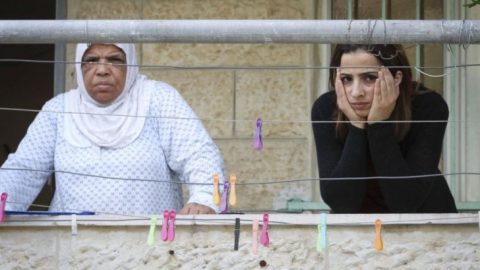
Palestinian women in Silwan watch as settlers move into homes in the neighborhood
One of the main ways Israel got a “foothold” in Silwan was through the 1950 Absentee Property Law. This insidious regulation states that if a piece of Palestinian property has been uninhabited for three years, or ownership documents could not be produced, the land would revert to a Custodianship Council, which could then distribute the property for military or settlement use.
The Absentee Property Law had worked handily when Palestinian refugees were refused the right of return: after three years, their land was confiscated and they had nothing to come back to anyway. Those few who did get back, and whose homes were still standing—only seven villages were left intact—often found their deeds missing or destroyed, and new, Jewish tenants in place. According to the Israel Government Yearbook, 5719, almost 60,000 homes and 10,000 businesses were appropriated during Israel’s early years.
A large number of properties in Silwan have been appropriated through this law.
The small number of green spaces in Silwan have also been claimed as archeological sites, forbidden to Palestinians. Hundreds of closed-circuit TV cameras are used to insure compliance.
Having appropriated swaths of Silwan, the work of appropriating swaths of history began “with bulldozers clearing huge areas in haste and multiple levels being dismantled in a race to get to ‘Jewish’ bedrock.” Where they couldn’t find what they needed, settlers built houses on top of excavation sites.
Silwan’s Palestinian residents used to take pride in the archeological riches of their land, but since Israel’s land grab, things have gone from bad to worse. The heavy machinery and deep digging are beginning to compromise structures: Palestinian homes are showing large cracks, making their owners nervous and angry.
One resident, Jawad Siyam, created a petition to end the destructive digging, and filed it with the Israel Supreme Court. The result: Jawad and all of those who signed the petition were imprisoned or put under house arrest for “disturbing the peace and causing damage to property.”
Adding insult to injury, the Jerusalem municipality replaced a number of Arabic-named streets in Silwan with biblical Hebrew names—yet another daily reminder to Palestinians of who is in charge.
Antiquities in Gaza
Not surprisingly, the situation in Gazan archeological sites is even worse—though its location as a seaport makes it wildly rich in ancient treasures. Gaza’s Ministry of Tourism and Antiquities oversees digs and artifact preservation to the best of its limited ability: its offices, as well as many historical sites, have been damaged by Israeli bombs.
In addition, the equipment and chemicals needed to carry out work are forbidden for “security reasons” under the decade-old blockade. Guest archeologists can not get in to help, and local archeologists can not get out for training. Oddly, many of Gaza’s most valuable artifacts have turned up in Israeli museums.
Needless to say, there is little funding for the work in Gaza, what with the highest unemployment rate in the world, electricity shortages, and clean water crisis.
Israeli tourism
Anyone familiar with the region knows that tourism has been almost completely appropriated by Israel—and this is another sore spot for Palestinians in archeologically rich areas. For example, the City of David National Park (built on Silwan’s land—see above) welcomes hundreds of thousands of tourists a year, each of whom pays an $7 entrance fee, and most of whom buy food and souvenirs from Jewish Israeli settlers. Not only are all of the profits pocketed by Israel and Israelis, the Palestinians of Silwan and their connection to the land are completely and intentionally disregarded.
This tourism income may be small change to Israel—it receives over $10 million a day from the US alone—but it would make a huge difference to the people of Silwan and other towns that are casualties in the antiquity war.
A great irony in the saga of Israel’s quest for legitimacy in the land is this: no one, Palestinian or otherwise, denies an ongoing Jewish presence since ancient times. The pilfering of archeology has been unnecessary and unbecoming from that standpoint. The rising consensus worldwide of Israel as a pariah state and the increasing popularity of the Boycott, Divestment, & Sanctions movement (BDS) indicate that Israel’s strategy is not helping in legitimacy efforts.
How Media Obscure US/Saudi Responsibility for Killing Yemeni Civilians
By Ben Norton | FAIR | August 31, 2107
A coalition of Saudi Arabia, the United States, the United Kingdom and the United Arab Emirates, with minor support from several other Middle Eastern nations, has relentlessly bombed Yemen since March 2015. This August, the coalition ramped up the ferocity of its airstrikes, killing dozens of civilians.
On August 23, the US/Saudi coalition bombed a hotel near Yemen’s capital Sanaa, killing 41 people, 33 of whom—80 percent—were civilians, according to the United Nations.
Then on August 25, the coalition bombed homes in Sanaa, massacring a dozen civilians, including eight members of the same family.
Major Western media outlets have, however, obscured the responsibility Saudi Arabia, and its US and European supporters, bear for launching these airstrikes.
There are no other parties presently bombing Yemen, so media cannot feign ignorance as to who is responsible for the attacks. But reports on the bloody US/Saudi coalition airstrikes were nonetheless rife with ambiguous and downright misleading language.

It seems worth mentioning that the airstrike was
supported by the same government that supports NPR.
“Dozens of People Killed as Airstrike Hits Hotel Near Yemen’s Capital,” wrote NPR (8/23/17), in a masterwork of euphemism. Apparently dozens of Yemenis mysteriously died of unknown causes at the exact moment a generic, unaffiliated airstrike hit the hotel. NPR only indirectly mentioned, in the story’s fifth paragraph, that the “Saudi-led coalition” was “blamed” for the attack.
AFP‘s news wire (8/23/17), which was republished by Yahoo, the Daily Mail and Breitbart, used the headline “Air Raids on Outskirts of Yemen Capital Kill ‘at least 30,’” again obscuring who was responsible for those air raids. France 24 (8/23/17) ran the wire with the headline “Air Raids on Yemen Capital Kill Dozens.”
The BBC (8/23/17) wrote, “Yemen War: Air Strike on Hotel Outside Sanaa ‘Leaves 30 Dead.’” “Dozens Killed in Airstrike on Yemeni Hotel,” the Guardian headline (8/23/17) read.
The London-based Middle East Eye (8/23/17) was just as ambiguous, with “Yemen Air Attack Destroys Hotel, Killing at Least 35 People,” as was Qatar-owned Al Jazeera (8/23/17), with “Air Raid in Yemen Kills at Least 35 people” and the Turkish TRT World (8/24/17), which wrote, “At Least 60 people Killed in Airstrikes on Hotel in Yemen.”
Whose airstrike was it? What party was responsible? This remains unknown to those who only glanced at the headlines—that is to say, to most readers.
The 29-month war has killed thousands of Yemeni civilians, with tens of thousands more injured and millions facing famine. And the United Nations has repeatedly reported that the US/Saudi coalition is responsible for a majority of the civilian casualties.
Even when Saudi Arabia’s guilt is acknowledged by media, the crucial role of the US is typically ignored (FAIR.org, 8/31/15, 10/14/16, 2/27/17). Readers miss out on crucial context that is needed to understand the war, and their governments’ contributions to it: Saudi Arabia is flying US-made planes, full of fuel provided by the US Air Force, dropping US- and UK-made bombs, with intelligence and assistance from American and British military officials.
Non-Yemeni ‘Yemeni Airstrikes’

Neither the headline nor the accompanying story mention who conducted
the airstrike—though the photo caption refers to the “Saudi-led airstrike.”
Two days later, reports were just as obfuscatory, and even used the term “Yemeni airstrike,” to refer to an airstrike that was carried out by non-Yemenis.
“Yemen Airstrike Kills 12, Including Six Children: Rescuers,” Reuters reported on August 25. This brief two-paragraph wire did not once mention the US/Saudi coalition was responsible.
“After Yemeni Airstrike, Little Girl Is Family’s Only Survivor,” the international news agency wrote the next day (8/26/17). This Reuters piece noted that the “Saudi-led coalition” was “blamed,” though even that language seems designed to deflect; blamers can be wrong, after all.
Major newspapers were similarly misleading. “Young Yemeni Girl Is Sole Survivor After Airstrike Topples Her Home,” the New York Times (8/26/17) reported. The lead provided no further information: “An airstrike toppled their apartment building.” In fact, it was not until the seventh paragraph, after three large photos, that the Times finally conceded, “A Saudi Arabia–led coalition took responsibility for the airstrike a day after the attack, citing a ‘technical mistake.’” The Times did not once mention American or British support for the coalition.
Al Jazeera (8/25/17) likewise used the headline “Children Among Dead in Latest Attack on Yemen Civilians.” And TRT World (8/26/17) reported, “Yemen Airstrike Kills 12, Including Six Children.”
Even when Saudi Arabia admitted responsibility for killing Yemeni civilians, media watered down the language. “Saudi-Led Force Admits Strike in Yemen’s Capital Hit Civilians,” Reuters (8/26/17) headlined its news wire. Note the airstrike hit civilians, not killed them.
The attack was also reduced to a mere “mistake.” Larger context was not provided: namely that more than one-third of US/Saudi coalition airstrikes have hit civilian areas, and that there is a growing body of evidence that the coalition has intentionally targeted civilian infrastructure in Yemen.
Not all media were equally misleading; some were more forthright. AP‘s news wire (8/23/17), which was republished by the Chicago Tribune, New York Daily News, Houston Chronicle and San Francisco Chronicle, used a headline that told readers who was responsible for the deadly attack: “Saudi-Led Airstrikes Hit Yemen Hotel, Killing at Least 41.”
The Washington Post was similarly direct, with its reports “Saudi-Led Coalition Airstrike Kills Dozens in Yemen Ahead of Major Rally” (8/23/17) and “Saudi-Led Airstrikes Kill 14 Civilians in Yemen’s Capital” (8/25/17).
The Art of Obfuscation
To justify this ambiguity in reporting, media might claim it is sometimes not immediately clear who launched the airstrikes. But, again, there are no other parties flying warplanes in Yemen.
Yemeni Houthi-Saleh forces, who govern the north of the country and roughly 80 percent of the population, have not been bombing their country. Moreover, the US/Saudi coalition has imposed an air blockade on the impoverished country since March 2015 (another significant fact that is rarely reported by corporate media).
In Syria, where numerous rival countries have been launching airstrikes, it is understandable that media may sometimes have to exercise caution before apportioning blame. But this is not the case with Yemen.
In the 29-month war in Yemen, there is one party that has been responsible for thousands of air raids: the Saudi air force, as part of a coalition with the US, the UK and the UAE.
Yet Yemen is not an isolated case of this ambiguity. Media frequently obfuscate and downplay the culpability for bombing when the US and its allies are responsible.
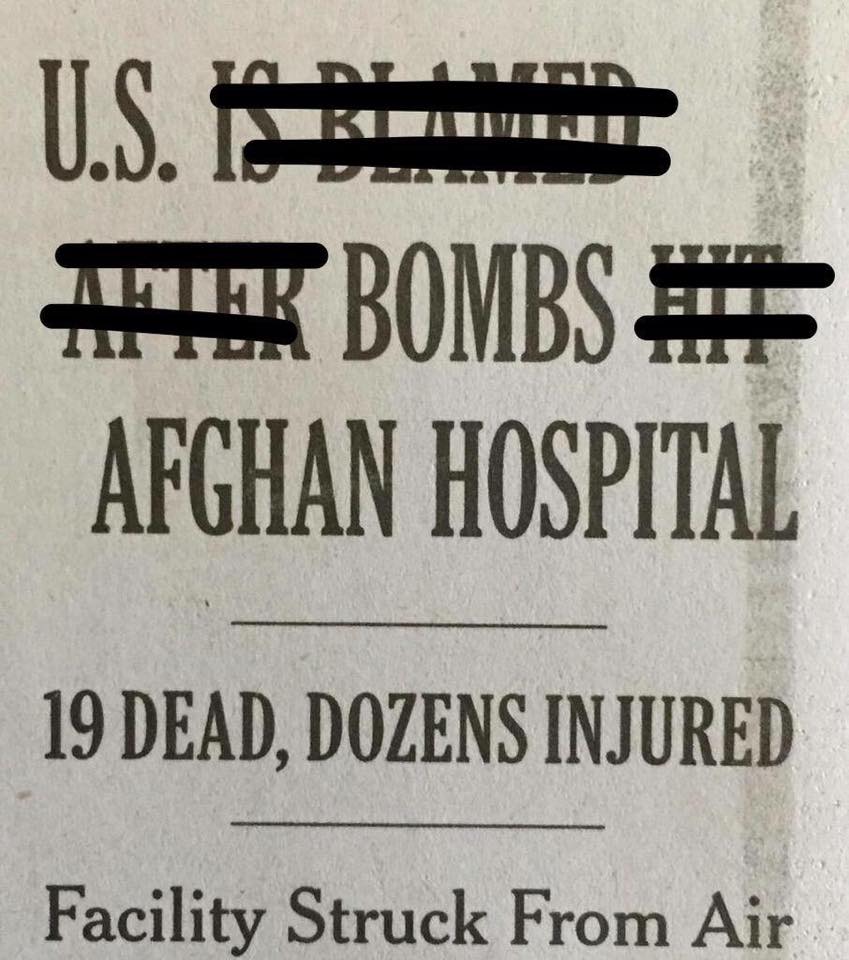
NYT headline (10/3/15) improved by Twitter user @OneKade
When the US bombed a hospital in Kunduz, Afghanistan, in October 2015, killing dozens of civilians, media scrambled to craft almost laughable euphemisms. FAIR (10/5/15) documented at the time how news outlets used circuitous headlines like “US Is Blamed After Bombs Hit Afghan Hospital.” Also seen in the August 23 NPR report cited above, this brand of misleading, ambiguous rhetoric is the “officer-involved shooting” of war reporting.
On the other hand, the responsibility of US enemies for killing civilians is rarely if ever obscured.
It is instructive to compare Western media coverage of Yemen to that of Syria, where attacks are “Assad bombing” (Fox News, 2/15/17), “Assad airstrikes” (Breitbart, 4/28/16), “Assad regime airstrikes” (Times of Israel, 10/16/12; Australian, 8/18/15), “regime airstrikes” (NBC, 8/19/16) or “regime bombing” (Daily Caller, 8/17/15).
Media have even written of a “pro-Assad drone” that was “displaying hostile intent,” and thus just had to be shot down by the US (Guardian, 6/20/17; Independent, 6/20/17; The Hill, 6/20/17), as if the robot were personally a fan of the Syrian leader.
The phrases “Salman bombing,” “Salman airstrikes” or “Saudi regime airstrikes” are, however, nowhere to be found in reports on Yemen.
Downplaying the Key US Role
Media calling US/Saudi coalition attacks “Yemeni airstrikes” is at best misleading, and at worst flat-out false. Yet this language also has a political effect: It obscures the character of the war. This framing is part of the “civil war” trope media have propagated for two-and-a-half years.
When Yemen is discussed, it is virtually always through the lens of a “civil war.” As FAIR (7/25/17) has detailed before, this exceedingly widespread myth, which has permeated media discourse, denies the extent to which the conflict is actually a foreign war on Yemen, led by Saudi Arabia, the UAE and their US and European sponsors.
Even the term “Saudi-led” coalition is misleading. The New York Times editorial board (8/17/16) acknowledged, in a little-noted editorial on Yemen, “Experts say the coalition would be grounded if Washington withheld its support.”
That is to say, if the US wanted the war in Yemen to end, it would end overnight. The “Saudi-led” coalition is only led by Saudi Arabia in name.
Surprisingly, in the midst of intensified coalition attacks, the New York Times published another rare editorial on Yemen on August 25. In the piece, dramatically titled “The Slaughter of Children in Yemen,” the editorial board forcefully warned of exactly what critics have been saying for 29 months:
The Saudi coalition—and its American enablers, who provide military equipment, aerial refueling and targeting—simply cannot be allowed to continue killing civilians and destroying what little is left of Yemen. That is why it is imperative to publicly identify the unconscionable slaughter of innocents for what it is, and to hope that this will shame Saudi Arabia and its American backers to search for a humane end to Yemen’s hell.
Reporters at the Times and elsewhere should heed this call to demonstrate journalistic responsibility by clearly conveying their governments’ responsibility for the slaughter in Yemen—not just in editorials, but in news articles, every time.
‘400,000 deaths in Syria civil war directly attributed to US & allies’
By Dan Glazebrook | RT | September 1, 2017
African and Asian leaders are denied by the West to have any military means against an insurgency in their countries, while the US and its allies have absolute impunity when they want to take on a population anywhere in the world, says political analyst Dan Glazebrook.
The US-led coalition against Islamic State has confirmed another 61 civilian deaths are likely to have been caused by its air and artillery strikes in Iraq and Syria. That brings the total number of civilians it has acknowledged killing since the conflict began to 685.
Dan Glazebrook: I think it’s also likely to be a gross underestimate because we found out in 2012, for example, that all military-age males killed in US airstrikes are not classified by the US military as civilians, they’re automatically excluded from those statistics. So if I was walking down the street in Iraq, unarmed, and I was directly and intentionally blown to pieces by a US airstrike, that would not be recorded as a civilian death. Now, I don’t know if they still use this criterion currently, but what we certainly do know is that the monitoring group Airwars suggested almost 1,500 people may have been killed in US coalition bombings in Iraq and Syria in March of this year alone, including the terrible strike on a residential block in Mosul that is thought to have killed around 200 people. So these statistics are certainly likely to be a gross underestimate.
There are a couple of other points I’d like to make about this as well. This narrow focus on civilians we must recognize is deeply ideological because it serves to whitewash the true scale of the slaughter taking place in Iraq and Syria right now. Why should a 16-year-old boy, pressed into service by ISIS and then blown to pieces by the US before even firing a shot, why should his life be considered so unworthy, so meaningless, as not to be recorded in any kind of statistic because he’s, “not a civilian”? This use of the term and focus on civilians is actually a means of placing all soldiers, all militants, in the same category of subhuman and implies they deserve to be killed. More than that, not only do they deserve to be killed, but their lives are so meaningless and unworthy, they don’t even deserve to be recognized in any kind of balance sheet as to the costs of this war.
And a third point I’d like to make is that in 2011, Syria was at peace until, in that year, the US, Britain, and France sponsored a violent sectarian insurgency, an insurgency in Syria that eventually morphed into ISIS and spilled over into Iraq. So I would actually go further than this and I would attribute all 400,000 deaths in the Syrian civil war directly to the US, France, Britain and their allies.
RT:What would you make of comments made by US Defense Secretary James Mattis that Americans are the good guys and locals know the difference. Is there a difference between good bombs and bad bombs?
DG: No, of course, there isn’t, and what’s absolutely clear is their recklessness, which was actually bad enough under Obama but has increased under Trump. The recklessness with which the US is pursuing its foreign policy goals – and Britain and its allies in the coalition, I should add – have got complete impunity and complete disregard for the lives of those living in places like Mosul and Raqqa and it really shows the racism which is inherent in what’s going on here. Leaders of African and Asian states are denied by the West to have any kind of military means against an insurgency that happens within their borders. And yet when the US and its allies decide they want to take on a population anywhere in the world, they have absolute impunity to do so. So in 2011 Gaddafi was trying to put down a proto-ISIS rebellion in Benghazi and was labeled by the West as a bloody genocidal dictator and so on and was eventually subjected to torture and lynching by those states. When the US decides it wants to carpet-bomb Mosul or Raqqa thousands of miles from its shores, it can do so with complete recklessness and impunity and disregard for the populations living there.
Dan Glazebrook is a freelance political writer who has written for RT, Counterpunch, Z magazine, the Morning Star, the Guardian, the New Statesman, the Independent and Middle East Eye, amongst others. His first book “Divide and Ruin: The West’s Imperial Strategy in an Age of Crisis” was published by Liberation Media in October 2013. It featured a collection of articles written from 2009 onwards examining the links between economic collapse, the rise of the BRICS, war on Libya and Syria and ‘austerity’. He is currently researching a book on US-British use of sectarian death squads against independent states and movements from Northern Ireland and Central America in the 1970s and 80s to the Middle East and Africa today.
Featured Video

No Threat Can Force Iran’s Surrender /Trita Parsi & Lt Cl Daniel Davis
or go to
Aletho News Archives – Video-Images
From the Archives
What is the Israeli Lobby in Australia Doing in Interfaith Dialogue?
By Ali Kazak | Dissident Voice | October 11, 2015
For years Israel and its lobby around the world have been trying to normalise their relations with Arabs and Muslims without solving the Palestine Question.
One of the methods they resorted to in the last few years is using human rights and community organizations such as interfaith dialogue and Multiculturalism to achieve this objective and to: isolate the Palestinians, marginalise the Palestine question, end Israel’s isolation, and prevent criticism of Israel, knowing that these organisations will be the first to stand against Israel’s violations, racial and religious discrimination.
The group responsible for this task in Australia is The Australia/Israel & Jewish Affairs Council (AIJAC); its Director of International & Community Affairs, Jeremy Jones is in charge of lobbying religious community organizations, specifically Muslims and Christians. Consequently he convened the Faith Communities for Reconciliation, founding participant in the Australian Partnership of Religious Organisations and the Australian National Dialogue of Christians, Muslims & Jews.
AIJAC is a private political propaganda group. It is recognised as the main Israeli lobby in Australia. It coordinates its activities and works intimately with the Israeli embassy in Canberra and different institutions in Israel. It is privately funded by some Jewish businessmen. It monitors closely Australian politicians, the media, ethnic and religious groups, (especially Arabs and Muslims), unions and academics on their stands towards Israel and the Palestine question. … continue
Blog Roll
 Aletho News
- Envoy warns UN on Trump’s threat to ‘obliterate’ Iran’s civilian infrastructure
- The Larak Corridor: Iran’s Rial Gate With No US, No Israel, and No Way Around
- ‘Economic terrorism’: Steel facilities hit again in US-Israeli strike
- ‘War Crime’: Iran condemns attacks on Arak, Ardakan nuclear sites
- Two-thirds of Americans want quick end to Iran war even if goals unmet
- Trump to Give “Important Update on Iran” Wednesday in Prime-Time Speech
- Theodore Postol: Iran’s Missiles & Drones Were Underestimated
- Iran To Target Military Industrial-Tech Complex That Facilitated Gaza Genocide
- Collapsing Empire: The Resistance Disarms ‘Israel’
- Suicide Should Not Be a Government Service
- If Americans Knew
- Israel wants US to bomb more of Iran’s civilian structures (113,000 is not enough) – Not a ceasefire Day 173
- Ann Coulter Rips Into Fox News for Iran War Coverage
- Joe Kent Urges Americans To Call White House and Congress To Object To Sending Troops Into Iran
- DNC Resolution to Reject AIPAC Funding Puts Democratic Leaders in the Hot Seat
- Swedish foundation to build 400 schools as over 650,000 Gaza children remain without education for 2 years
- Israeli army admits photshopping image of slain Lebanese journalist
- This is how Israel is systematically killing health workers under the cover of war in Lebanon
- Carrying life under fire: Israeli invasion of Lebanon leaves pregnant women facing deadly risks
- Champagne all around for the new death penalty (for Palestinians) law – Not a ceasefire Day 172
- Why are Palestinian books struggling to be seen on Amazon?
- No Tricks Zone
- New Study Finds Warming Saves Lives…Cold Temperatures 12 Times More Deadly Than Excess Heat
- German Science Blog Accuses PIK Climate Institute Of Hallucinating Climate Tipping Points
- Devastating Assessment Of Comirnaty Vaccine By Former Senior Pfizer Europe Toxicologist
- New Study: CO2 Is ‘Effectively Negligible’ As An Explanatory Climate Change Factor Since 2000
- Former Pfizer Toxicologist Dr. Helmut Sterz Tells Bundestag Hearing Pfizer Vaccine Should Have Never Been Approved
- Energy Expert: Germany’s Nuclear Phaseout Was A “500 Billion Euro Mistake”
- New Research: South Australia’s Mid-Holocene Sea Surface Temperatures Were 4°C Warmer Than Today
- Storing Green Energy To Last Germany 10 Days Would Require A 60-Million Tonne Battery
- New Studies: UK Sea Levels Were 4 Meters Higher Than Today During The Mid-Holocene
- Destructive Green New Deal: German Energy And Metal Group Warns Of Drastic Crisis
 Aletho News