Who wrote the Balfour Declaration and why: The World War I Connection
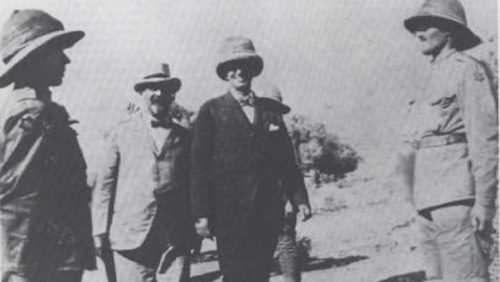
(L-R) Chaim Weizmann, future president of Israel, with Louis Brandeis, US Supreme Court Justice, in Palestine, 1919. The two were instrumental in obtaining the Balfour Declaration, a British document that many feel was a critical step in the establishment of Israel. Zionists’ promise that they would get the U.S. to join Britain in “the Great War” was the enticement.
By Alison Weir, excerpted from Against Our Better Judgment: The Hidden History of How the U.S. Was Used to Create Israel
Most analysts consider WWI a pointless conflict that resulted from diplomatic entanglements rather than some travesty of justice or aggression. Yet, it was catastrophic to a generation of Europeans, killing 14 million people.[i]
The United States joined this unnecessary war a few years into the hostilities, costing many American lives, even though the U.S. was not party to the alliances that had drawn other nations into the fray. This even though Americans had been strongly opposed to entering the war and Woodrow Wilson had won the presidency with the slogan, “He kept us out of war.”[ii]
President Wilson changed course in 1917 and plunged the U.S. into that tragic European conflict. Approximately 320,000 Americans were killed or injured.[iii] Over 1,200 American citizens who opposed the war were rounded up and imprisoned, some for years.[iv]
A number or reasons were publicly given for Wilson‘s change of heart, including Germany‘s submarine warfare, Germany’s sinking of the British passenger ship Lusitania,[v] and a diplomatic debacle known as the Zimmerman Telegram episode.[vi] Historians also add pro-British propaganda and economic reasons to the list of causes, and most suggest that a number of factors were at play.
While Americans today are aware of many of these facts, few know that Zionism appears to have been one of those factors. [Zionism was a political movement to create a Jewish state in Palestine. When this movement began, in the late 1800s, the population of Palestine was 96 percent Muslim and Christian. The large majority of Jews around the world were not Zionists.]
Diverse documentary evidence shows that Zionists pushed for the U.S. to enter the war on Britain’s side as part of a deal to gain British support for their colonization of Palestine.
From the very beginning of their movement, Zionists realized that if they were to succeed in their goal of creating a Jewish state on land that was already inhabited by non-Jews, they needed backing from one of the “great powers.”[vii] They tried the Ottoman Empire, which controlled Palestine at the time, but were turned down (although they were told that Jews could settle throughout other parts of the Ottoman empire and become Turkish citizens).[viii]
They then turned to Britain, which was also initially less than enthusiastic. Famous English Middle East experts such as Gertrude Bell pointed out that Palestine was Arab and that Jerusalem was sacred to all three major monotheistic faiths.[ix]
Future British Foreign Minister Lord George Curzon similarly stated that Palestine was already inhabited by half a million Arabs who would “not be content either to be expropriated for Jewish immigrants or to act merely as hewers of wood and drawers of water for the latter.”[x]
However, once the British were embroiled in World War I, and particularly during 1916, a disastrous year for the Allies in which there were 60,000 British casualties in one day alone,[xi] Zionists were able to play a winning card. While they previously had appealed to religious or idealistic arguments, now Zionist leaders could add a particularly powerful motivator: telling the British government that Zionists in the U.S. would push America to enter the war on the side of the British, if the British promised to support a Jewish home in Palestine afterward.[xii]

British soldiers, Battle of the Somme. British suffered 60,000 casualties in the first day of the battle.
In 1917 British Foreign Minister Lord Balfour issued a letter to Zionist leader Lord Rothschild. Known as the Balfour Declaration, this letter promised that Britain would “view with favour the establishment in Palestine of a national home for the Jewish people” and “use their best endeavours to facilitate the achievement of this object.”
The letter then qualified this somewhat by stating that it should be “clearly understood that nothing shall be done which may prejudice the civil and religious rights of existing non-Jewish communities in Palestine.” The “non-Jewish communities” were 92 percent of Palestine’s population at that time,[xiii] vigorous Zionist immigration efforts having slightly expanded the percentage of Jews living in Palestine by then.
The letter, while officially signed by British Foreign Minister Lord Balfour, had been in process for two years and had gone through a number of edits by British and American Zionists and British officials.[xiv] As Zionist leader Nahum Sokolow later wrote, “[e]very idea born in London was tested by the Zionist Organization in America, and every suggestion in America received the most careful attention in London.”[xv]
Sokolow wrote that British Zionists were helped, “above all, by American Zionists. Between London, New York, and Washington there was constant communication, either by telegraph, or by personal visit, and as a result there was perfect unity among the Zionists of both hemispheres.” Sokolow particularly praised “the beneficent personal influence of the Honourable Louis D. Brandeis, Judge of the Supreme Court.”[xvi]
The final version of the Declaration was actually written by Leopold Amery, a British official who, it came out later, was a secret and fervent Zionist. … continue
Featured Video
Ted Postol: Fraud of Missile Defence Exposed in Iran War
or go to
Aletho News Archives – Video-Images
Frlom the Archives
Containing the United States
By Edward S. Herman | Z Magazine | September 2016
“Containing the United States” is, of course, a ridiculous and self-contradictory idea in the U.S. and Western ideological and propaganda system. We all know that the United States had to “contain” the Soviet Union from 1945 to 1991, and since then has had the task of containing Russia and China. Only they threaten, bully, aggress and worry countries like Poland and Vietnam. Obama has had to reassure them both of our steadfast stand against Russian and Chinese military attacks. NATO has, of course, expanded greatly over the past several decades, despite the deaths of the Soviet Union and Warsaw Pact, but only to contain the renewed Russian — and Iranian, Libyan, Syrian and other — military threats; and we have “pivoted” to Asia, supported Japanese rearmament, bolstered our own forces in that area and jousted with the Chinese in their coastal waters solely to contain China. Earlier we had been obliged to contain North Vietnam, or was it the Soviet Union in Vietnam? Or China? Or “communism”? Or maybe all of them? Or none of them, but just needing an excuse to enlarge power?
The parallel propaganda has taken many forms. One is accepting as a premise that the United States only acts defensively and has no internal forces and interests that drive it to enlarge its sphere of control. I noted in an earlier article how Paul Krugman claims that internal Russian problems may well be the explanation of Russian “aggression,” but how at the same time it never occurs to him that the huge U.S. transnational corporate interests and “defense” establishment, and the pro-Israel lobby’s activities, might possibly make for an expansionist dynamic here.2 This reflects the standard establishment perspective that we are good and only react to evil. This was the view sustaining and justifying the invasion and occupation of Iraq from 2003. That attack was taken here as not evil but a response to evil, even if involving lies and mistakes, hence not describable as “aggression.” … continue
Blog Roll
 Aletho News
- Iran War Supporters Invent a New and Absurd Justification: It Is All About China
- Corporate Media Go All Out To Support The US-Israeli War on Iran
- Trump press conference reveals a man who wants out of war
- When Tel Aviv decides, Washington fights
- Top official: Iran ready for a long war with US, no more diplomacy
- How Iran’s Toxic Rain Reveals US-Israel Discord
- Trump Admits He Is Destroying Iran For Israel
- Iran’s latest move in the GCC countries was a stroke of genius
- Blackmail and death threats, Zelensky embarrasses the EU, but there’s no condemnation
- Israel threatens to kill Iran’s new leadership
- If Americans Knew
- Lebanon: Israel’s White Phosphorous Use Risks Civilian Harm
- Corporate Media Go All Out To Support The US-Israeli War On Iran
- US-Israel war on Iran is creating a steady growing number of amputees
- Israel planned this war on Iran for 40 years. Everything else is a smoke screen
- The wrong question about the war in Iran
- ‘Your Tax Dollars Being Used to Raise Your Gas Prices’: US-Israel Bomb Major Iranian Oil Depots
- ‘Bogus Evidence’: Former Nuclear Watchdog Head Debunks US Justification for Iran War
- EXPLAINER – Dimona: What to know about Israel’s nuclear site
- Fires and toxic air in Iran (thanks, Israel) – Not a ceasefire Day 150
- At Israel’s hands, Iran is burning, Lebanon and Gaza are crumbling – Not a ceasefire Day 149
- No Tricks Zone
- Wake-up Call: Survey Shows Majority Of Germans Now Favor Postponing Climate Targets!
- Televised! Leading German Political Candidate Tells Schoolchildren CO2 Makes Sun Hotter!
- New Study: A Century Warming Of 1.1°C Is ‘Commonplace’ And ‘Not Unusual’ During This Interglacial
- New Study: ‘Internal Noise’ And Volcanic Forcing Can Trigger 10-15°C Warming Within Decades
- Glaciers Worldwide Are Suddendly Surging, Experts Blame Warming!
- Surprising Discovery: Sahara Is Greening…Billions Of Trees Where Once Thought To Be Barren
- New Research Reaffirms Clouds, Aerosols, And Surface Solar Radiation Are ‘Driving The Climate System’
- Germany: Electric Car Catches Fire At Charging Station, Sets Off Local “Inferno”, Widespread Damage
- New Study: Canada’s New Brunswick Was 1°C Warmer Than Today During The Medieval Warm Period
- Coal Power Back In Trend As Globe Tries To Keep Pace With Growing Demand For Power
 Aletho News