US Actions in Syria’s At Tanf Violate Humanitarian Law – Reconciliation Center
Sputnik – 03.11.2017
The humanitarian situation in At Tanf, Syria on the nation’s border with Iraq remains extremely difficult, as refugees in the neighboring Rukban camp cannot get access to humanitarian and medical aid.
The US established a military base in Syria without the government’s permission and banned anyone from coming within 55 kilometers; its proximity to the Rukban refugee camp may be considered a war crime, the Russian Reconciliation Center for Syria said Friday.
The center reports that, according to witnesses, the US has recently deployed another camp near Rukban where militants gather in order to join its latest attempt to create a so-called moderate opposition, the “National Syrian Army.” The cost of recruitment in each faction is defined by the US after bargaining with field commanders, which is why income differences can be considerable among militants from different groups. On October 29, in clashes between two militant groups, thirteen refugees were killed and over twenty were injured.
The military base was established by the US in April 2017 near the town of At Tanf on the Syria-Iraq border has also become a problem for Syrian forces fighting the terrorist group Daesh (ISIS). The United States justified the setting up of a military base there in terms of the need to carry out operations against Daesh; however, since the establishment of the base, there have been no reports of American anti-terrorist operations, according to the Russian Defense Ministry.
The spokesman of the Russian Defense Ministry has warned that refugees living in the Rukban camp are being used as a “human shield” for the US military base near At Tanf. The base has twice been used to strike Syrian government-aligned forces fighting Islamic militants.
The Russian Defense Ministry has also accused the United States and illegal armed groups of preventing the Syrian government from setting up a safe corridor for deliveries of humanitarian supplies for refugees in the Rukban camp in Homs province. However, Operation Inherent Resolve spokesman Col. Ryan Dillon refuted the accusation as “false” and “baseless,” assuring that the coalition’s partner force allowed deliveries to pass.
First Deputy Chairman of the Russian upper house’s Committee on Defense and Security Frants Klintsevich told Sputnik on Friday that Russia would introduce the issue of a humanitarian situation in Syria’s At Tanf for the consideration of the UN Security Council adding that “future US plans to dismember Syria” were the reason behind the suffering of the refugees.
Russia, US craft rival UN resolutions on extending chemical probe in Syria
Press TV – November 3, 2017
Russia and the United States have drawn up rival UN Security Council resolutions on extending the mission of a body of international experts probing chemical attacks in Syria.
The Joint Investigative Mechanism (JIM) was formed by a Security Council resolution in 2015, and is run jointly by the UN and the Organization for the Prohibition of Chemical Weapons (OPCW), the world body’s chemical weapons watchdog.
Russia, however, has been exceedingly critical of JIM’s reports, finding faults with its evidence gathering techniques.
On October 14, Russia vetoed a US-sponsored Security Council resolution that would have renewed the experts’ mandate for a year. It said it would wait for an official report on an alleged sarin gas attack last year in northwestern Syria by the mission to decide whether it would back extending its mandate.
The report came out two days after the veto, blaming Syria for the incident which took place in April 2016 in the town of Khan Shaykhun and killed over 90 people.
Both Russia and Syria have rejected the report.
Reacting to the report on Thursday, Russian Foreign Ministry said the JIM experts had produced it without even turning up on site despite being offered guarantees of safety.
Mikhail Ulyanov, the head of the ministry’s arms control and non-proliferation department, said, “Imagine a criminal investigation in which police refuse to visit the site of the crime. No court will ever accept it.” “But they consider it possible to do such thing at the UN Security Council,” he noted.
According to a draft resolution obtained by news agencies, both the American and Russian versions demand the JIM mission’s extension, but under totally different conditions.
According to AFP, Russia wants the UN Security Council to shelve the latest JIM report and launch a new investigation into the Khan Shaykhun incident.
The Russian draft also urged a six-month extension of the UN-led panel’s mission, while the version put forward by the US calls for a two-year extension of the mandate, the report added.
The Associated Press also reported that the Russian draft resolution on the future of JIM’s mandate urges the mission to send investigators to Khan Shaykhun, where the attack reportedly happened, and the Shayrat airfield in Syria’s central Homs Province, which the US attacked later in April with missiles under the pretext of punishing Syria.
The accusations against the Damascus government come while Syria has turned over its entire chemical stockpile under a deal negotiated by Russia and the United States back in 2013. The OPCW supervised that removal process.
US Gambit: How Daesh Could Be Replaced for Continuation of Syrian War
Sputnik – November 3, 2017
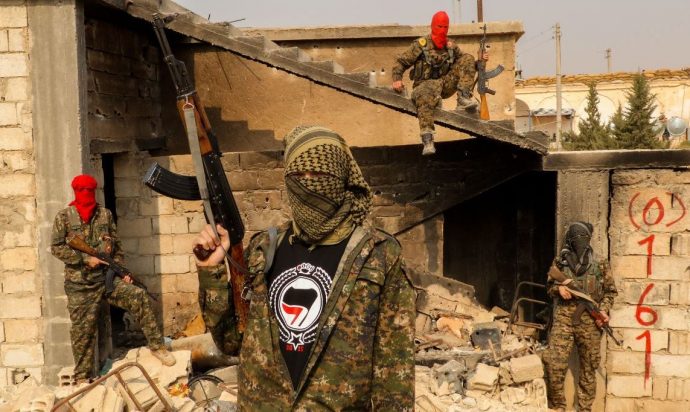
With Syria making big strides toward victory and terrorists controlling ever-diminishing areas in the country, Muhammed Kheir al-Akkam, professor of international relations at the University of Damascus, told Sputnik how the US may meddle in the Kurdish issue.
“The US does not want the end of the Syrian war until their goals are achieved. Their main tool for the war in Syria, called Daesh, is living out their last days. So now they are switching to the Syrian Democratic Forces (SDF) which have to do what Daesh failed to fulfil,” Syrian political analyst Muhammed Kheir al-Akkam said.
According to him, “the US wants to extend the war in Syria as long as possible to implement its plans in the region.”
“Russia is trying to put an end to this war and along with the Syrians is seeking a peaceful solution. The Americans do not do it, paying lip-service top fighting terrorism; in fact, they are financing both Daesh and the SDF,” al-Akkam added. He pointed out that “what we see in Raqqa is a fully coordinated move by the US to replace Daesh with the SDF.”
“We might ask why the US is not fighting the al-Nusra Front and other similar organizations? The answer is simple: because the US supports them,” he said.
He recalled that the SDF carries out ethnic cleansing in Raqqa and discriminates against some Syrian peoples in the occupied territories, which is why the SDF cannot be called “democratic” or “Syrian”.
“The Syrian Kurds need to remember that the Americans will betray them as soon as their interests diverge, something that occurred to Masoud Barzani after Iraqi Kurds failed to secede from Baghdad,” al-Akkam said.
According to him, “the Syrian Kurds also should bear in mind that their strength depends on Syria’s unity.”
Al-Akkam added that the seventh round of the Syrian peace talks in Astana in many respects continued the course of the talks’ sixth round. At the same time, it is worth noting that there has been a new turn, according to him.
During the Astana talks, the sides managed to resolve many issues related to the military situation in Syria, something that he said the parties failed to do in Geneva. In Astana, the sides, in particular, agreed on exchanging prisoners and the holding of the Syrian National Dialogue Congress in Sochi, where Syria’s integrity will be high on the agenda.
“As for the Syrian opposition groups that will not attend the Sochi congress, they are dealing with the interests of those who finance their activities rather than those of the Syrian people,” al-Akkam concluded.
Manafort Indictment Underwhelms, Poses No Immediate Threat to Trump
By Jerri-Lynn Scofield | Naked Capitalism | November 2, 2017
On Monday, special counsel Robert Mueller indicted former Trump campaign chairman Paul Manafort and business partner Richard Gates on twelve counts, including conspiracy against the United States and conspiracy to launder money, and various charges of failure to file Reports of Foreign Bank and Financial Accounts (FBAR), and failure to register as a foreign agent, concerning activities in the Ukraine that ended in 2014. (Read the indictment here.)
I’m not alone in pointing out that absent Manafort’s involvement in Trump’s campaign, his failure to register as a foreign agent– would not have been targeted, as many lobbyists are not conscientious in fulfilling this reporting requirement. See, for example, this National Review account:
The offense of failing to register as a foreign agent (Count Ten) may be a slam-dunk, but it is a violation that the Justice Department rarely prosecutes criminally. There is often ambiguity about whether the person’s actions trigger the registration requirement, so the Justice Department’s practice is to encourage people to register, not indict them for failing to do so.
Much has been made of the absence of any tax charges in the present indictment, one which alleges conspiracy to commit money laundering. The lawyers I spoke to weren’t unduly concerned about such seemingly missing counts, pointing out that the indictment can be amended later to include tax charges, as investigations proceed.
In fact, this indictment should probably be read as a warning shot– the first step in a lengthy, wide-ranging investigation. I was reminded by one lawyer I spoke to yesterday that special prosecutors have virtually limitless powers, and certainly no major lobbyist could expect to survive unscathed the level of scrutiny that will be brought to bear in this investigation.
Unsurprisingly, the New York Times published a piece reinforcing that line, Andrew Weissmann, Mueller’s Legal Pit Bull, that reads like the work of a legal fanboy, and the message of which is Be Afraid, Be Very Afraid:
Two decades later, Mr. Weissmann has turned his attention to a more prominent set of prospective conspirators: He is a top lieutenant to Robert S. Mueller III on the special counsel investigation into Russian interference in the 2016 election and possible links to the Trump campaign. Significantly, Mr. Weissmann is an expert in converting defendants into collaborators — with either tactical brilliance or overzealousness, depending on one’s perspective.
It is not clear if President Trump and his charges fear Mr. Weissmann as they gird for the slog ahead. It is quite clear, former colleagues and opponents say, that they should.
The million dollar question: Will this implicate or threaten Trump? So far, I think no. But we must all stay tuned– and pass the popcorn.
Bottom Line for Trump
One goal in indicting Manafort was to force him to give up the goods on Trump regarding alleged Russian collusion in the election campaign. Yet the offenses alleged in the indictment concerned activities in the Ukraine during a specific time period ending before Manafort’s campaign involvement. (The indictment also include a charge of making false statements to prosecutors in 2016, concerning these earlier activities.)
As the Wall Street Journal opined:
The most striking news is that none of this involves the 2016 election campaign. The indictment makes clear that Mr. Manafort’s work for Ukraine and his money transfers ended in 2014. The 2016 charges are related to false statements Mr. Manafort made to the Justice Department.
There’s reason to think Manafort might not have such goods to deliver. Recall that Trump initially brought Manafort into his campaign in March 2016, elevated him to campaign manager in June, and tied [cut loose] him in August, according to The Washington Post.
Now, there’s no denying that Manafort kept some very sleazy company (see, for example, this September post from John Helmer). The Journal noted (drily): “Mr. Manafort has lobbied for a rogues gallery of dictators, with the occasional domestic scandal (HUD contracts).” But lobbying on behalf of unsavory foreign clients isn’t per se illegal (reminding me of Michael Kinsley’s quip, “The scandal isn’t what’s illegal, the scandal is what’s legal”.)
The Journal further notes:
One popular theory is that Mr. Mueller is throwing the book at Mr. Manafort so he will cop a plea and tell what he knows about Russian-Trump campaign chicanery. But that assumes he knows something that to date no Congressional investigation has found. Prosecutors typically try to turn witnesses before they indict, and Messrs. Manafort and Gates pleaded not guilty on Monday.
Issues With Manafort Indictment
In the interests of keeping this post of readable length, I’m going to limit my focus.
The National Review account cited above is worth reading in full. I am of course aware of the ideological slant of that publication, but I found little to fault in its analysis– admittedly, making the case for the defense and summarized thus: “On first glance, Mueller’s case, at least in part, seems shaky and overcharged.” Since Manafort has pleaded not guilty, he can and will draw on high-priced legal talent that will certainly make these and similar arguments, zeroing in on weaknesses in the government’s case.
In particular, while even this National Review account concedes that the failure to register as a foreign agent seems to be a slam-dunk (leaving aside the clear political motivation of taking a particularly Javertian line on this lapse), whether this will result in a win for the government isn’t wholly clear, due to possible prosecutorial overreach:
Specifically, Congress considers false statements in the specific context of foreign-agent registration to be a misdemeanor calling for zero to six months’ imprisonment. (See Section 622(a)(2) of Title 22, U.S. Code.) That is the offense Mueller charges in Count Eleven. But then, for good measure, Mueller adds a second false-statement count (Count Twelve) for the same conduct — charged under the penal-code section (Section 1001 of Title 18, U.S. Code) that makes any falsity or material omission in a statement to government officials a felony punishable by up to five years’ imprisonment.
Obviously, one cannot make a false statement on the foreign-agent registration form without also making a false statement to the government. Consequently, expect Manafort to argue that Mueller has violated double-jeopardy principles by charging the same exact offense in two separate counts, and that the special counsel is undermining Congress’s intent that the offense of providing false information on a foreign-agent registration form be considered merely a misdemeanor.
Possible Fourth Amendment Violations Taint Manafort Evidence?
Continuing with another potential defense argument, I’ll mention another possible problem with the government’s case, discussed in a Rachel Stockman opinion piece published by LawNewz. Again, lest I be accused of pro-Manafort or– shudder– pro-Trump bias, I want to emphasize if I can spot these issues and develop such arguments, based on on-line research, assorted back and forth email exchanges, and telephone calls conducted over the last couple of days, certainly Manafort’s defense team will do this and more– so please do not shoot your humble messenger.
While calling the indictment “very detailed and well-documented” Stockman continued:
… there is one area that could hurt Mueller’s investigation. Mueller’s team may have obtained evidence in the raid of Paul Manafort’s home that was not covered by the search warrant. That could be problematic.
In a surprise raid on July 26th, FBI agents busted into Manafort’s home in Alexandria, Virginia to collect documents and other materials related to the FBI probe into whether the Trump campaign colluded with the Russians. At the time, Manafort’s attorney raised concerns about how the raid was conducted. In order for the feds to obtain a warrant, a federal judge would have to determine that probable cause existed that a crime was committed. As part of the warrant, investigators attached an affidavit which contained a list of items that FBI agents hoped to collect. That’s where the trouble appears to be in Manafort’s case.
The key issue is whether this constituted an illegal search, and exactly what was seized. Here, the Stockman piece relies on a September CNN report:
During that raid, Mueller’s investigators took documents considered to be covered by attorney-client privilege, sources told CNN.
Lawyers from the WilmerHale law firm, representing Manafort at the time, warned Mueller’s office that their search warrant didn’t allow access to attorney materials. The documents in question have now been returned, the sources say.
The episode raised questions about whether investigators have seen materials they weren’t entitled to obtain.
“You can’t unsee something,” one source said.
It’s not an uncommon problem in FBI investigations. US attorneys typically have separate document-review teams to prevent investigators from handling materials they aren’t allowed to have. It’s not clear what procedures Mueller’s office uses.
I’m not taking a position on this issue one way or another, but merely flagging this as a potential problem for the government’s case.
Attorney-Client Privilege Pierced
Finally, I’d like to mention a another LawNewz opinion piece, this by Elura Nanos, which spotlights a potential problem for the defense. The piece discusses a Memorandum Opinion, unsealed at the end of October, in which D.C. federal district court chief judge Beryl A. Howell compelled grand jury testimony from a lawyer representing Manafort and Gates under the crime-fraud exception to attorney-client privilege. The attorney-client privilege isn’t absolute, and judges can order an attorney’s testimony if it falls within certain exceptions.
Over to Nanos:
Now we know that the grand jury proceedings culminated in indictments, and Judge Howell’s ruling on the this motion to compel testimony is more than a little foreshadowing. The Court’s opinion on this issue allows us to peek into the generally secret grand jury proceedings, and that peek isn’t looking so good for the defendants.
Now, frustratingly, Judge Howell’s opinions was heavily redacted– interested readers may wish to click the link above to see just how extensively for themselves. I’ll again rely on the Nanos account which lays out the key concern:
The court’s memorandum was heavily redacted, so at this point, it’s unclear which statements the judge meant, but this portion of the document sure sounds bad for the defendants:
“… the above statement is false, a half-truth, or at least misleading because evidence shows that Target 1 and Target 2 were intimately involved in significant outreach in the United States on behalf of the ECFMU, the Party of Regions and/or the Ukrainian government.”
Yeah, things can change at trial, but even at a preliminary phase, it’s not good for a judge to make a finding that you’re “intimately involved” in sinister foreign misdealings. Oh, and there was also this:
“Through its ex parte production of evidence, the [Special Counsel’s Office] has clearly met its burden of making a prima facie showing that the crime-fraud exception applies by showing that the Targets were “engaged in or planning a criminal or fraudulent scheme when [they] sought the advice of counsel to further the scheme.”
Those seven little letters should strike fear in the hearts of Manafort, Gates, and their lawyers. The SCO hasn’t just met its burden – it’s done so clearly. Allow me to translate from judge-to-English: “You guys are screwed. Take a plea or watch everyone around you– even your own lawyers — go down.”
For more in a similar vein lauding Mueller’s “serious, deliberative, and far-sighted inquiry”, see this Atlantic account, which extensively discusses the plea agreement of Trump foreign policy adviser George Papadopoulus– and which I lack space to discuss further in this Manafort indictment post.
Trump Response
I’d like to point to a New York Times piece, headlined In Call With Times Reporter, Trump Projects Air of Calm Over Charges that suggests that Trump is managing to keep it together, and dare I say it, respond to the Manafort indictment in a ‘presidential’ way– in the traditional pre-Trumpian sense of that word.
Permit me to quote from the Grey Lady’s account at length:
President Trump projected an air of calm on Wednesday after charges against his former campaign chief and a foreign policy aide roiled Washington, insisting to The New York Times that he was not “angry at anybody” and that investigations into his campaign’s links to Russia had not come near him personally.
“I’m not under investigation, as you know,” Mr. Trump said in a brief telephone call late Wednesday afternoon. Pointing to the indictment of his former campaign chief, Paul Manafort, the president said, “And even if you look at that, there’s not even a mention of Trump in there.”
“It has nothing to do with us,” Mr. Trump said.
He also pushed back against a report published Monday night by The Washington Post, which the president said described him as “angry at everybody.”
“I’m actually not angry at anybody,” Mr. Trump told The Times.
The phone call seemed intended to dispel the impression of a president and a White House under siege. The indictment of Mr. Manafort and his longtime deputy, Rick Gates, on Monday came as little surprise to Mr. Trump or his team, and they were relieved that the charges were not directly related to last year’s campaign. Instead, both were indicted on charges including money laundering, tax evasion and failing to properly disclose lobbying on behalf of foreign governments.
Jerri-Lynn Scofield has worked as a securities lawyer and a derivatives trader. She now spends much of her time in Asia and is currently working on a book about textile artisans.
Featured Video
America Racing to Strategic Defeat in Iran
or go to
Aletho News Archives – Video-Images
From the Archives
Should Europeans ‘Thank’ the Americans for Destroying Nord Stream?
By Robert Bridge | Strategic Culture Foundation | September 29, 2022
With an investigation continuing into the destruction of the Nord Stream gas pipeline that provided energy supplies to Europe from Russia, there appears to be just one prime suspect, and that should surprise nobody.
Following the sabotage of the Nord Stream 1 and 2 gas pipelines, former Polish Foreign Minister Radoslaw Sikorski already seemed to know the identity of the perpetrator when he tweeted out: “Thank you, USA.”
At first glance, it seemed that Sikorski was speaking sarcastically, berating Washington for carrying out an attack that will have severe repercussions for the people of Europe. After all, how could anyone see any good coming from the termination of Europe’s primary source of gas reserves with winter just around the corner? It was Sikorski’s homeland of Poland, after all, that urged its citizens to collect firewood in the face of dwindling gas reserves.
In fact, the Polish diplomat was speaking one-hundred percent literally… continue
Blog Roll
 Aletho News
- Growing insecurity, soaring prices fuel protests in north as regime bans evacuation: Sources
- Iran denies responsibility for ‘depraved’ attack on Kuwait desalination plant
- Bring The Troops Back. End This War Now!
- Can we please stop calling Israel the ‘only democracy in the Middle East’ now?
- US should start removing its troops from Germany, proposes AfD co-leader Chrupalla
- Iran Red Crescent: 600 educational centers attacked in US-Israeli ‘war crimes’
- Russian Oil Tanker Arrives in Cuba Amid U.S. Blockade
- America Racing to Strategic Defeat in Iran: Lt Col Daniel Davis
- FTC Warns Visa, Mastercard, PayPal, Stripe Over Political Debanking
- Russian tanker approaches Cuba despite US oil blockade
- If Americans Knew
- As Iran targets US military bases, will they be relocated to Israel? Not a ceasefire Day 171
- Will Trump Go Kamikaze?
- Is the University of Florida Shutting Down College Republicans over Israel Criticism?
- Jewish extremist arrested over alleged plot to firebomb Palestinian activist Nerdeen Kiswani’s home
- More than half of Palestinian child detainees have no charges
- The More Murderous Israel Gets, The More We Hear About “Antisemitism”
- Land Day and the Palestinian struggle after 30 months of genocide
- The Iran War Is About Palestine
- Israeli soldiers echo settler ideology, talk of revenge after targeting Palestinians and detaining CNN crew in the West Bank
- Israeli Policies Threaten Future of Christian Schools in Jerusalem
- No Tricks Zone
- New Study Finds Warming Saves Lives…Cold Temperatures 12 Times More Deadly Than Excess Heat
- German Science Blog Accuses PIK Climate Institute Of Hallucinating Climate Tipping Points
- Devastating Assessment Of Comirnaty Vaccine By Former Senior Pfizer Europe Toxicologist
- New Study: CO2 Is ‘Effectively Negligible’ As An Explanatory Climate Change Factor Since 2000
- Former Pfizer Toxicologist Dr. Helmut Sterz Tells Bundestag Hearing Pfizer Vaccine Should Have Never Been Approved
- Energy Expert: Germany’s Nuclear Phaseout Was A “500 Billion Euro Mistake”
- New Research: South Australia’s Mid-Holocene Sea Surface Temperatures Were 4°C Warmer Than Today
- Storing Green Energy To Last Germany 10 Days Would Require A 60-Million Tonne Battery
- New Studies: UK Sea Levels Were 4 Meters Higher Than Today During The Mid-Holocene
- Destructive Green New Deal: German Energy And Metal Group Warns Of Drastic Crisis
 Aletho News