The Lost Journalistic Standards of Russia-gate
By Robert Parry | Consortium News | November 20, 2107
A danger in both journalism and intelligence is to allow an unproven or seriously disputed fact to become part of the accepted narrative where it gets widely repeated and thus misleads policymakers and citizens alike, such as happened during the run-up to war with Iraq and is now recurring amid the frenzy over Russia-gate.
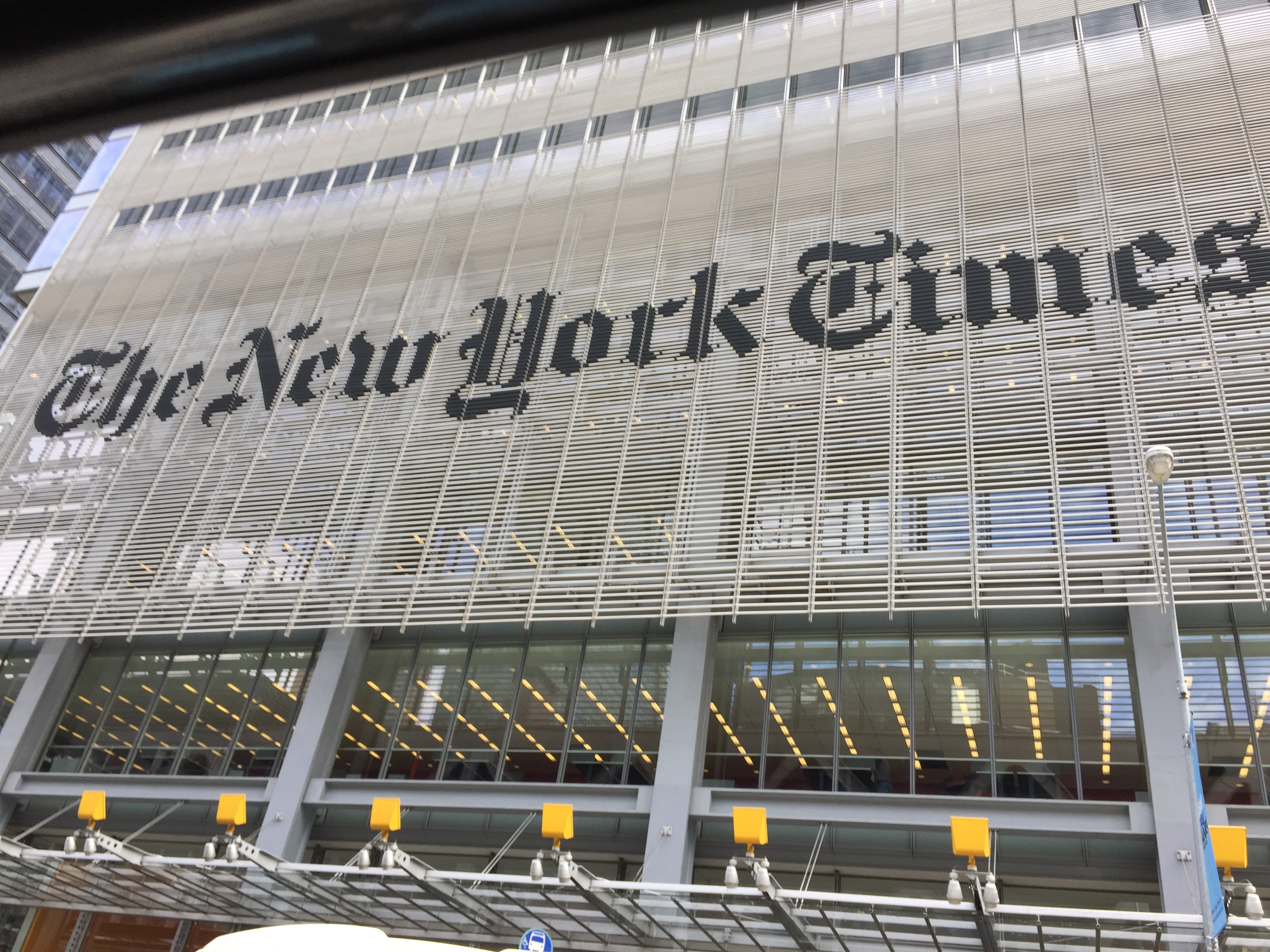
NYT building in Manhattan (Photo by Robert Parry)
For instance, in a Russia-gate story on Saturday, The New York Times reported as flat fact that a Kremlin intermediary “told a Trump campaign aide, George Papadopoulos, that the Russians had ‘dirt’ on Mr. Trump’s rival, Hillary Clinton, in the form of ‘thousands of emails.’” The Times apparently feels that this claim no longer needs attribution even though it apparently comes solely from the 32-year-old Papadopoulos as part of his plea bargain over lying to the FBI.
Beyond the question of trusting an admitted liar like Papadopoulos, his supposed Kremlin contact, professor Joseph Mifsud, a little-known academic associated with the University of Stirling in Scotland, denied knowing anything about Democratic emails.
In an interview with the U.K. Daily Telegraph, Mifsud acknowledged meeting with Papadopoulos but disputed having close ties to the Kremlin and rejected how Papadopoulos recounted their conversations. Specifically, he denied the claim that he mentioned emails containing “dirt” on Clinton.
Even New York Times correspondent Scott Shane noted late last month – after the criminal complaint against Papadopoulos was unsealed – that “A crucial detail is still missing: Whether and when Mr. Papadopoulos told senior Trump campaign officials about Russia’s possession of hacked emails. And it appears that the young aide’s quest for a deeper connection with Russian officials, while he aggressively pursued it, led nowhere.”
Shane added, “the court documents describe in detail how Mr. Papadopoulos continued to report to senior campaign officials on his efforts to arrange meetings with Russian officials, … the documents do not say explicitly whether, and to whom, he passed on his most explosive discovery – that the Russians had what they considered compromising emails on Mr. Trump’s opponent.
“J.D. Gordon, a former Pentagon official who worked for the Trump campaign as a national security adviser [and who dealt directly with Papadopoulos] said he had known nothing about Mr. Papadopoulos’ discovery that Russia had obtained Democratic emails or of his prolonged pursuit of meetings with Russians.”
Missing Corroboration
But the journalistic question is somewhat different: why does the Times trust the uncorroborated assertion that Mifsud told Papadopoulos about the emails — and trust the claim to such a degree that the newspaper would treat it as flat fact? Absent corroborating evidence, isn’t it just as likely (if not more likely) that Papadopoulos is telling the prosecutors what he thinks they want to hear?
If the prosecutors working for Russia-gate independent counsel Robert Mueller had direct evidence that Mifsud did tell Papadopoulos about the emails, you would assume that they would have included the proof in the criminal filing against Papadopoulos, which was made public on Oct. 30.
Further, since Papadopoulos was peppering the Trump campaign with news about his Russian outreach in 2016, you might have expected that he would include something about how helpful the Russians had been in obtaining and publicizing the Democratic emails.
But none of Papadopoulos’s many emails to Trump campaign officials about his Russian contacts (as cited by the prosecutors) mentioned the hot news about “dirt” on Clinton or the Russians possessing “thousands of emails.” This lack of back-up would normally raise serious doubts about Papadopoulos’s claim, but – since Papadopoulos was claiming something that the prosecutors and the Times wanted to believe – reasonable skepticism was swept aside.
What the Times seems to have done is to accept a bald assertion by Mueller’s prosecutors as sufficient basis for jumping to the conclusion that this disputed claim is undeniably true. But just because Papadopoulos, a confessed liar, and these self-interested prosecutors claim something is true doesn’t make it true.
Careful journalists would wonder, as Shane did, why Papadopoulos who in 2016 was boasting of his Russian contacts to make himself appear more valuable to the Trump campaign wouldn’t have informed someone about this juicy tidbit of information, that the Russians possessed “thousands of emails” on Clinton.
Yet, the prosecutors’ statement regarding Papadopoulos’s guilty plea is strikingly silent on corroborating evidence that could prove that, first, Russia did possess the Democratic emails (which Russian officials deny) and, second, the Trump campaign was at least knowledgeable about this core fact in the support of the theory about the campaign’s collusion with the Russians (which President Trump and other campaign officials deny).
Of course, it could be that the prosecutors’ “fact” will turn out to be a fact as more evidence emerges, but anyone who has covered court cases or served on a jury knows that prosecutors’ criminal complaints and pre-trial statements should be taken with a large grain of salt. Prosecutors often make assertions based on the claim of a single witness whose credibility gets destroyed when subjected to cross-examination.
That is why reporters are usually careful to use words like “alleged” in dealing with prosecutors’ claims that someone is guilty. However, in Russia-gate, all the usual standards of proof and logic have been jettisoned. If something serves the narrative, no matter how dubious, it is embraced by the U.S. mainstream media, which – for the past year – has taken a lead role in the anti-Trump “Resistance.”
A History of Bias
This tendency to succumb to “confirmation bias,” i.e., to believe the worst about some demonized figure, has inflicted grave damage in other recent situations as well.
One example is described in the Senate Intelligence Committee’s 2006 study of the false intelligence that undergirded the case for invading Iraq in 2003. That inquiry discovered that previously discredited WMD claims kept reemerging in finished U.S. intelligence analyses as part of the case for believing that Iraq was hiding WMD.
In the years before the Iraq invasion, the U.S. government had provided tens of millions of dollars to Iraqi exiles in the Iraqi National Congress, and the INC, in turn, produced a steady stream of “walk-ins” who claimed to be Iraqi government “defectors” with knowledge about Saddam Hussein’s secret WMD programs.
Some U.S. intelligence analysts — though faced with White House pressure to accept this “evidence” — did their jobs honestly and exposed a number of the “defectors” as paid liars, including one, who was identified in the Senate report as “Source Two,” who talked about Iraq supposedly building mobile biological weapons labs.
CIA analysts caught Source Two in contradictions and issued a “fabrication notice” in May 2002, deeming him “a fabricator/provocateur” and asserting that he had “been coached by the Iraqi National Congress prior to his meeting with western intelligence services.”
But the Defense Intelligence Agency never repudiated the specific reports that were based on Source Two’s debriefings. Source Two also continued to be cited in five CIA intelligence assessments and the pivotal National Intelligence Estimate in October 2002, “as corroborating other source reporting about a mobile biological weapons program,” the Senate Intelligence Committee report said.
Thus, Source Two became one of four human sources referred to by Secretary of State Colin Powell in his United Nations speech on Feb. 5, 2003, making the case that Iraq was lying when it insisted that it had ended its WMD programs. (The infamous “Curve Ball” was another of these dishonest sources.)
Losing the Thread
After the U.S. invasion and the failure to find the WMD caches, a CIA analyst who worked on Powell’s speech was asked how a known “fabricator” (Source Two) could have been used for such an important address by a senior U.S. government official. The analyst responded, “we lost the thread of concern as time progressed I don’t think we remembered.”
A CIA supervisor added, “Clearly we had it at one point, we understood, we had concerns about the source, but over time it started getting used again and there really was a loss of corporate awareness that we had a problem with the source.”
In other words, like today’s Russia-gate hysteria, the Iraq-WMD groupthink had spread so widely across U.S. government agencies and the U.S. mainstream media that standard safeguards against fake evidence were discarded. People in Official Washington, for reasons of careerism and self-interest, saw advantages in running with the Iraq-WMD pack and recognized the dangers of jumping in front of the stampeding herd to raise doubts about Iraq’s WMD.
Back then, the personal risk to salary and status came from questioning the Iraq-WMD groupthink because there was always the possibility that Saddam Hussein indeed was hiding WMD and, if so, you’d be forever branded as a “Saddam apologist”; while there were few if any personal risks to agreeing with all those powerful people that Iraq had WMD, even if that judgment turned out to be disastrously wrong.
Sure, American soldiers and the people of Iraq would pay a terrible price, but your career likely would be safe, a calculation that proved true for people like Fred Hiatt, the editorial-page editor of The Washington Post who repeatedly reported Iraq’s WMD as flat fact and today remains the editorial-page editor of The Washington Post.
Similarly, Official Washington’s judgment now is that there is no real downside to joining the Resistance to Trump, who is widely viewed as a buffoon, unfit to be President of the United States. So, any means to remove him are seen by many Important People as justified – and the Russian allegations seem to be the weightiest rationale for his impeachment or forced resignation.
Professionally, it is much riskier to insist on unbiased standards of evidence regarding Trump and Russia. You’ll just stir up a lot of angry questions about why are you “defending Trump.” You’ll be called a “Trump enabler” and/or a “Kremlin stooge.”
However, basing decisions on dubious information carries its own dangers for the nation and the world. Not only do the targets end up with legitimate grievances about being railroaded – and not only does this prejudicial treatment undermine faith in the fairness of democratic institutions – but falsehoods can become the basis for wider policies that can unleash wars and devastation.
We saw the horrific outcome of the Iraq War, but the risks of hostilities with nuclear-armed Russia are far graver; indeed, billions of people could die and human civilization end. With stakes so high, The New York Times and Mueller’s prosecutors owe the public better than treating questionable accusations as flat fact.
Investigative reporter Robert Parry broke many of the Iran-Contra stories for The Associated Press and Newsweek in the 1980s.
JFK Files Reveal US Planned to Buy Soviet Planes to Carry Out False Flag Attacks
Sputnik – November 20, 2017
The recently released batch of files related to the Kennedy assassination includes a curious document revealing secret plans by the US government to purchase or build Soviet aircraft for the purpose of staging false flag attacks on the US or its allies, thus giving Washington the pretext it needed to go to war with Moscow or its allies.
According to the partially declassified document, a March 22, 1962 meeting attended by the Special Group Augmented (SGA), a high-level Kennedy administration committee charged with overthrowing the Cuban government, included a discussion on the different possibilities for obtaining Soviet planes.
The SGA group, which formally included Attorney General Robert Kennedy, CIA Director John McCone, National Security Advisor McGeorge Bundy and Chairman of the Joint Chiefs of Staff Lyman Lemnitzer, could also be attended by Secretary of State Dean Rusk and President Kennedy himself.
 The document fragment lists various Soviet aircraft, including MiG-17 and MiG-19 fighters, as well as the Il-14 military cargo transport, and how much time and money it would take to reproduce them to withstand distant observation and/or up close examination. Another option, according to an analysis by the CIA cited by the document, was to try to obtain the planes via defecting pilots, or purchasing them from non-Soviet Bloc countries; these options were deemed problematic. The document also explains why the Soviet planes are so desirable, including their possible use to stage false flag attacks against the US to justify a US military response.
“There is a possibility that such aircraft could be used in a deception operation designed to confuse enemy planes in the air, to launch a surprise attack against enemy installations or in a provocation operation in which Soviet aircraft would appear to attack US or friendly installations in order to provide an excuse for US intervention,” the document reads.
Finally, the fragment explains that “if the planes were to be used in such covert operations, it would seem preferable to manufacture them in the United States.”
It’s not clear whether the document was connected to Operation Northwoods, a proposed Pentagon and Joint Chiefs of Staff false flag operation calling on the CIA and other agencies to stage terrorist attacks against US civilian and military targets and blame it on the Cuban government, thus justifying a war against Cuba. According to US political historian Robert Dallek, the idea within the Kennedy administration to manufacture or otherwise obtain the Soviet aircraft was hatched by CIA Director McCone.
Iran’s top military commander arrives in Russia for talks
Press TV – November 20, 2017
Chief of Staff of the Iranian Armed Forces Major General Mohammad Baqeri has arrived in the Russian Black Sea resort city of Sochi to attend a tripartite meeting with his Turkish and Russian counterparts.
The sides are scheduled to exchange views about ways to enhance trilateral defense cooperation on Wednesday.
The military brass of Iran, Turkey and Russia will also discuss the latest developments in Syria and trilateral cooperation on the fight against Daesh terrorist group.
The meeting will be held on the same day that Iranian, Russian and Turkish Presidents Hassan Rouhani, Vladimir Putin and Recep Tayyip Erdogan plan to hold talks in Sochi about the Syrian crisis and ways to resolve it.
Iranian Foreign Minister Mohammad Javad Zarif and his Turkish and Russian counterparts Mevlut Cavusoglu and Sergei Lavrov, respectively, held preparatory talks in the southern Turkish city of Antalya on Sunday ahead of the Sochi summit.
Speaking after the meeting, the Iranian foreign minister criticized some countries such as Saudi Arabia for pursuing policies aimed at sowing discord among regional states.
“If they change their methods, they can also be involved in [promoting] regional peace instead of warmongering [policies],” Zarif said.
Iran, Russia and Turkey are acting as the guarantors of a ceasefire in Syria that came during the intra-Syrian talks brokered by the three countries in the Kazakh capital, Astana.
So far, seven rounds of the Astana talks have brought representatives from Syria’s warring sides to the negotiating table in a bid to end the foreign-backed militancy in the Arab country, which broke out in March 2011.
Syrian army soldiers, backed by pro-government fighters from popular defense groups, on Sunday fully liberated the strategic city of al-Bukamal in the country’s eastern province of Dayr al-Zawr and on the border with Iraq from the clutches of Daesh Takfiri terrorist group. The city was the extremist group’s last stronghold in the Arab country.
Nasrallah: US did what it could to help Daesh in Syria’s Bukamal
Press TV – November 20, 2017
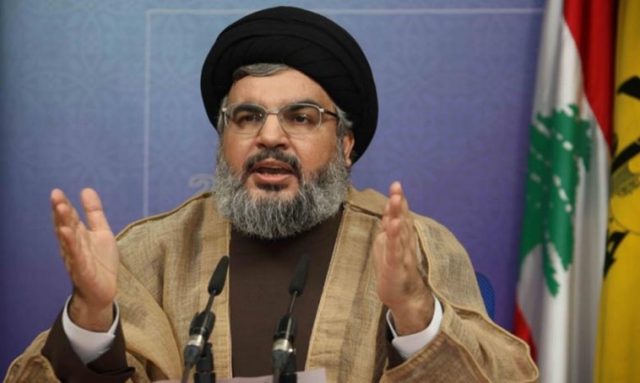
The secretary general of the Lebanese Hezbollah resistance movement says despite the US claims about fighting terrorism, it spared no effort to help Daesh forces in the Syrian town of al-Bukamal.
Sayyed Hassan Nasrallah made the remarks in a televised address to the Lebanese nation in capital city of Beirut on Monday.
Nasrallah noted that recapturing Bukamal was a major victory over Daesh, because Bukamal was the last Syrian city occupied by Daesh.
“The US helped Daesh as much as it could in Bukamal short of directly engaging forces that fought to liberate the town from Daesh,” the Hezbollah leader noted.
Nasrallah went on to note that the US provided Daesh terrorists with full air cover in Bukamal.
The US sent its drones to Bukamal and provided Daesh with accurate information about what was going on, Nasrallah said, adding that American forces also waged electronic warfare against forces that were fighting to liberate Bukamal.
American forces also provided air transfer for Daesh commanders and facilitated their escape to eastern shores of the Euphrates, he said. The Hezbollah leader stated that even Turkey’s President Recep Tayyip Erdogan slammed the US for helping Daesh.
Nasrallah emphasized that recapturing Bukamal led to unity of Syria and ended Daesh’s self-proclaimed state in the country.
Following recent victories in Iraq and Syria, he added, the military structure of Daesh collapsed in the two countries and Iraqi forces have reached the Syrian border.
Hezbollah leader noted that the victory over Daesh was victory of Islamic values over terrorists’ savagery.
Nasrallah also highlighted the role played by Commander of the Islamic Revolution Guards Corps’ Quds Force Major General Qassem Soleimani in anti-terror operations in both Iraq and Syria.
He noted that Soleimani was commanding anti-Daesh operations in the two countries at the frontline and was never a commander to issue orders from behind the lines.
Elsewhere in his remarks, Nasrallah referred to the latest meeting of the Arab League foreign ministers in Cairo, who designated the Lebanese Hezbollah as a terrorist group, saying that this was not the first time that such accusations were leveled against Hezbollah.
Arab League Secretary General Ahmad Aboul Gheit announced at a press conference in the Egyptian capital of Cairo on Sunday that Arab states had agreed to designate Lebanon’s Hezbollah resistance movement a “terrorist organization.”
The Arab League’s extraordinary general meeting on Sunday was held at the request of Saudi Arabia, which has assumed an aggressive stance against Hezbollah for its alleged links to Iran, Riyadh’s powerful rival in the region. Riyadh associates Hezbollah with Iran and has been trying to weaken the resistance movement, which is Lebanon’s de facto deterrent force against Tel Aviv.
In its concluding resolution, the Arab League announced that Arab foreign ministers, excluding those of Lebanon and Iraq, would hold Hezbollah responsible for supporting “terrorist groups” across the region.
Nasrallah said the Arab League statement has labeled Hezbollah’s council, which is part of the Lebanon’s government, as a terrorist outfit, alleging that it provides missiles to terrorist groups in the region.
He added that accusations about Hezbollah sending missiles to regional countries were false and undocumented, emphasizing that the group has never sent any missiles or even light weapons to Kuwait, Yemen, Iraq or Bahrain or any other country in the region.
The leader of Hezbollah went on to say that the Arab League has warned Lebanon that if Hezbollah is not disarmed, security of the country would be in jeopardy.
Hezbollah rejected the accusation, noting that the main threat to security of Lebanon was the Zionist regime of Israel.
He added that the resistance front’s weapons were the main factor restoring security and stability to Lebanon, because they were used for defensive purposes in the face of the Israeli aggression.
Nasrallah emphasized that Hezbollah’s weapons were used only against terrorist groups such as Daesh and posed no threat to security of Lebanon.
A United Nations Security Council-appointed panel says it has seen no evidence to support Saudi Arabia’s claims that missiles have been transferred to Yemen’s Houthis by external sources.
Nasrallah stated that the main reason behind the recent Arab League meeting was not to discuss the issue of Palestine or other problems facing the Islamic world, but its main reason was the recent missile attack against a Saudi airport near the country’s capital, Riyadh.
Refusing Saudi Arabia and Arab League claims that the missile was provided to Yemeni Ansarullah fighters by Iran or the Lebanese Hezbollah, Nasrallah said Iran or Hezbollah had not sent any missiles to Yemen and Yemeni forces made their own missiles in the country.
He categorically rejected Arab League’s claims in this regard, noting that Saudi Arabia and its allies must admit that they have been defeated by Yemeni forces in their war of aggression against the country.
Nasrallah emphasized that Arab countries must put an immediate end to their support for terror groups, and do not fill the Middle East region with such outfits.
He reiterated that no member of Hezbollah was involved in the November 5 Yemeni missile strike against King Khalid International Airport of Riyadh.
The Hezbollah leader then took the Arab League to task for failing to address Saudi Arabia’s devastating aerial bombardment of the “Arab country of Yemen,” saying, “Saudi Arabia is bombing Yemeni people day and night.”
Strongly denouncing the Riyadh regime over perpetrating outrageous atrocities against millions of “Arab Muslims” in Yemen, Nasrallah lashed out at the Arab world’s “deafening silence” over the grim situation in Yemen.
“The turmoil we are witnessing in the Arab world is a cover for the announcement of normalization of relations with Israel,” he commented.
Nasrallah then called on Arabs to do their best to maintain their national unity in the face of all divisive efforts.
The Hezbollah secretary general also praised Lebanese officials and politicians for their firm stance regarding Prime Minister Saad Hariri’s shock resignation, calling on him to return to Lebanon as soon as possible.
Lebanon has right to resist, foil Israeli plans: Aoun

Lebanese President Michel Aoun
Press TV – November 20, 2017
Lebanese President Michel Aoun says his nation has the absolute “right to resist and foil” Israel’s aggressive plans by “all available means” as Tel Aviv continues “targeting” the Mediterranean country.
President Aoun made the remarks via his official Twitter account on Monday, a day after Arab League Secretary-General Ahmad Aboul Gheit announced at a press conference in the Egyptian capital of Cairo that Arab states had agreed to designate Lebanon’s Hezbollah resistance movement a “terrorist organization.”
Being a member of Lebanon’s coalition government, the popular Hezbollah movement, which currently holds 14 of the 128 seats at the parliament of Lebanon, has been a strong aid to the Lebanese army in thwarting any Israeli aggression against the country. Back in 2000, the resistance movement successfully forced Israel to withdraw from southern Lebanon.
Hezbollah is also playing a major role in fighting against foreign-backed Takfiri terrorist groups, which have been wreaking havoc in neighboring Syria for the last six years.
The Arab League’s extraordinary general meeting on Sunday was held at the request of Saudi Arabia, which has assumed an aggressive stance against Hezbollah for its alleged links to Iran, Riyadh’s powerful rival in the region. Riyadh associates Hezbollah with Iran and has been trying to weaken the resistance movement, which is Lebanon’s de facto deterrent force against Tel Aviv.
In its concluding resolution, the Arab League announced that Arab foreign ministers, excluding those of Lebanon and Iraq, would hold Hezbollah responsible for supporting “terrorist groups” across the region.
Furthermore, it also blamed the Lebanese government for aiding and supporting the resistance group, accusing Beirut of being an accomplice to what Hezbollah is doing.
However, in a separate tweet on Monday, Aoun strongly defended Hezbollah, saying he “cannot accept suggestions that Lebanon’s government is a partner in acts of terrorism.”
Foreign Minister Gebran Bassil says he refused to list Hezbollah as a terror group as it is a “fundamental component of the Lebanese state.”
The accusations leveled by Saudi-dominated Arab League against Hezbollah echoes exactly what Israel alleges against the resistance movement, strongly suggesting Riyadh is trying hard to help the Israeli entity by weakening Hezbollah.
The developments came some two weeks after Lebanese Prime Minister Saad Hariri announced his shock resignation in a televised address aired from the Saudi capital, shortly after he arrived there for a visit, repeating the same accusations against Hezbollah. After resigning, Hariri spent two more weeks in Saudi Arabia amid rumors he was under house arrest there, before traveling to Paris on Saturday.
After meeting with French President Emmanuel Macron, Hariri promised to be in Lebanon in time to mark its independence day on Wednesday. His awkward decision, however, has already plunged the country into political turmoil.
Meanwhile, the Arab League’s head said that Lebanon should be “spared” from spiraling regional tensions after arriving in Beirut to meet with Aoun.
“Arab countries understand and take into account the situation in Lebanon and want to spare it … from any dispute,” said Aboul Gheit.
Hamas slams Arab League for terrorist labeling of Hezbollah
Later on Monday, Palestinian Hamas movement slammed Arab League for labeling Lebanon’s Hezbollah as a terrorist organization.
A statement released by the Gaza-based Hamas said it “rejects the description of the Lebanese Hezbollah resistance movement as terrorist.”
The Palestinian movement added that instead of Hezbollah, Israel’s actions against Palestinians should be labeled “terrorism.”
Hamas also called on Arab states to “support the legitimate struggle of the Palestinian people,” urging them to work together to solve their differences through dialogue.
Google exec says new algorithm will suppress RT and Sputnik, ‘those kinds of sites’
Sputnik – 20.11.2017
Eric Schmidt, the executive chairman of Google’s parent company, Alphabet, announced Saturday that the company will “engineer” algorithms that will make it harder for articles from Sputnik News and RT to appear on the Google News service.
“We are working on detecting and de-ranking those kinds of sites — it’s basically RT and Sputnik,” Schmidt said during a question and answer session at the Halifax International Security Forum in Canada. “We are well of aware of it, and we are trying to engineer the systems to prevent [the content being delivered to wide audiences]. But we don’t want to ban the sites — that’s not how we operate.”
Schmidt’s response came after a guest in the audience asked the 62-year-old executive whether Google facilitated “Russian propaganda.” The comments were in relation to a larger discussion on the search engine’s Google News services which offers viewers a range of articles on certain topics.
Schmidt later noted that he was “very strongly not in favor of censorship,” but that instead he had faith in “ranking” stories. He did not comment on whether engineering a computer program to hide information could be seen as amounting to censorship.
Giving insight on the capabilities of the new algorithm, the official did indicate that it would be able to detect “repetitive, exploitative, false, and weaponized” information.
In response to Schmidt’s statement, RT’s Margarita Simonyan said, “Good to have Google on record as defying all logic and reason: facts aren’t allowed if they come from RT, ‘because Russia’ — even if we have Google on Congressional record saying they’ve found no manipulation of their platform or policy violations by RT.”
#blamePutin continues to be the media’s dominant hashtag
OffGuardian | November 20, 2017
The decline of the falsely self-described “quality” media outlet The Guardian/Observer into a deranged fake news site pushing anti-Russian hate propaganda continues apace. Take a look at this gem:
The Russian president, Vladimir Putin, has accused prominent British businessman Bill Browder of being a “serial killer” – the latest extraordinary attempt by the Kremlin to frame one of its most high-profile public enemies.
But Putin has not been reported anywhere else as making any recent statement about Browder whatever, and the Observer article makes no further mention of Putin’s supposed utterance or the circumstances in which it was supposedly made.
As the rest of the article makes clear, the suspicions against Browder were actually voiced by Russian police investigators and not by Putin at all.
The Observer fabricated a direct quote from the Russian president for their propaganda purposes without any regard to basic journalistic standards. They wanted to blame Putin personally for the suspicions of some Russian investigators, so they just invented an imaginary statement from him so they could conveniently do so.
What is really going on here is the classic trope of demonisation propaganda in which the demonised leader is conflated with all officials of their government and with the targeted country itself, so as to simplify and personalise the narrative of the subsequent Two Minutes Hate to be unleashed against them.
When, as in this case, the required substitution of the demonised leader for their country can’t be wrung out of the facts even through the most vigorous twisting, a disreputable fake news site like The Guardian/Observer is free to simply make up new, alternative facts that better fit their disinformative agenda. Because facts aren’t at all sacred when the official propaganda line demands lies.
In the same article, the documents from Russian investigators naming Browder as a suspect in certain crimes are first “seen as” a frame-up (by the sympathetic chorus of completely anonymous observers yellow journalism can always call on when an unsupported claim needs a spurious bolstering) and then outright labelled as such (see quote above) as if this alleged frame-up is a proven fact. Which it isn’t.
No evidence is required down there in the Guardian/Observer journalistic gutter before unsupported claims against Russian officials can be treated as unquestionable pseudo-facts, just as opponents of Putin can commit no crime for the outlet’s hate-befuddled hacks.
The above falsifications were brought to the attention of the Observer’s so-called Readers Editor – the official at the Guardian/Observer responsible for “independently” defending the outlet’s misdeeds against outraged readers – who did nothing. By now the article has rolled off the site’s front page, rendering any possible future correction nugatory in any case.
Later in the same article Magnitsky is described as having been Browder’s “tax lawyer” a standard trope of the Western propaganda narrative about the case. Magnitsky was actually an accountant.
A trifecta of fakery in one article! That makes crystal clear what the Guardian meant in this article, published at precisely the same moment as the disinformation cited above, when it said:
“We know what you are doing,” Theresa May said of Russia. It’s not enough to know. We need to do something about it.
By “doing something about it” they mean they’re going to tell one hostile lie about Russia after another.
Here’s why Saudi Arabia, Israel and the US are not going to invade Iran
By Adam Garrie | The Duran | November 20, 2017
Members of the Arab League have met in Cairo at the behest of the Saudi regime, to discuss the supposed “threat of Iran”. The meeting featured all the crude, undiplomatic and nonfactual language about Iran that one has come to expect from American, Israeli and Saudi Arabian spokesmen.
Highlights from the meeting included a statement from the Saudi Foreign Minister Adel al-Jubeir who stated,
“We will not stand idly by in the face of Iran’s aggression….Showing leniency toward Iran will not leave any Arab capital safe from those ballistic missiles….
Iran created agents in the region, such as the Houthi and Hezbollah militias, in total disregard for all international principles”.
These meritless statements are almost identical to that which is frequently said by the US White House and Tel Aviv. In this sense, there was nothing novel about the meeting. What was remarkable was how hastily the meeting was organised as if to demonstrate Saudi’s commitment to its “clear and present danger” narrative about Iran.
Furthermore, a statement was released at the Arab League meeting, saying that there are no immediate plans to go to war with Iran but that at the same time, such plans have not been ruled out.
To quickly sum-up just how ridiculous the statements made during the Arab League meeting were
1. Iran’s missile programme is perfectly legal and is not covered by the JCPOA. The UN has said this many times.
2. Iran is currently at war with zero nations while Saudi is at war with Yemen causing one of the largest humanitarian disasters in the 21st century. Saudi Arabia has also been exposed as a major source of terrorist sponsorship, including in Iraq, Syria, Libya and beyond.
3. Iran has come to the legal assistance of Syria and Iraq in fighting terrorists groups including ISIS and al-Qaeda, while Saudi Arabia has known links to ISIS and al-Qaeda.
Of course, for the states with an obscene anti-Iranian agenda, none of this has ever mattered.
What does matter to the rest of the world though is whether the threats from the Arab league, indicated a short and/or medium-term readiness for war against Iran?
The short answer is, they almost certainly do not.
The Arab League today is a shadow of its former self. With the Syrian Arab Republic’s membership suspended, Qatar facing a boycott from proponent members, Iraq having better relations with Iran than most Arab states and Lebanon being deprived of its Prime Minister due to Saudi political meddling, the Arab League is hardly a united body of strong nations. It has declined so much so, that it is increasingly little more than a Saudi and GCC dominated organisation which is used in attempts to gain some form of broader international legitimacy for Riyadh’s often ridiculous foreign policy statements.
However, Riyadh’s ability to unite the Arab world over any matter, let alone an act of war, amounts to little. Syria, Iraq and due to its multi-confessional history, Lebanon, would never go to war against Iran. In fact, the Iraqi armed forces, Syrian Arab Army, Hezbollah and other volunteers from Lebanon would almost certainly fight with Iran, during the course of any Saudi led military action against Tehran.
Qatar, whose armed forces are small as it is, would never join any military ‘crusade’ led by its Saudi opponent and the fact remains that Doha’s slowly expanding relations with Iran have been one of the reasons for the Saudi led boycott of Qatar. Libya can no longer be called a functional state, while further into the Maghreb, Tunisia, Algeria and Morocco are far removed from Iran issue, in spite of their Arab league membership. Saudi’s GCC allies, Kuwait, UAE, Bahrain and to a lesser degree Oman, simply have little to offer in respect of any military coalition.
The biggest question mark which remains, is Egypt. Egypt is the largest country in the Arab world and likewise, boasts the biggest Army in the Arab world.
In order to even approach effectiveness, Egypt would have to join any would be anti-Iranian Arab League coalition. As to whether Egypt would join, one can objectively say that the incentives for not joining, far outweigh those that might compel Egypt to enter into a war pact with Saudi Arabia, against Iran.
Ever since secular rule was restored to Egypt in 2013, after US backed regime change against former President Hosni Mubarak briefly brought the once again illegal Muslim Brotherhood to power, Egypt has been in a position wherein promoting internal stability has been far more important than international outreach. Furthermore, while the Egyptian government is disproportionately dependent on Saudi cash injections in order to stay afloat, Cairo continues to show surprising amounts of foreign policy independence at times.
Egypt recently expressed disapproval of US attempts to extend a UN mandate for investigating “chemical weapons” in Syria. Egypt has further made strong statements in favour of Syria’s territorial unity, backed up by remarks that only a political solution can bring peace to Syria. This language is very similar to that used by Russian diplomats which should come as no surprise, as the foreign ministries of Egypt and Russia have a very good relationship. Furthermore, when it comes to Egypt’s most pressing international issue, that of terrorists in neighbouring Libya, Russia appears far more inclined to support the Cairo backed Libyan National Army than the fledgling Government of National Accord which is supported by the US and EU.
Furthermore, Egypt recently rejected calls from Riyadh to economically sanction the Lebanese party Hezbollah, in a move which shows a clear divergence from Saudi policies on Hezbollah.
While Egypt is compromised by its financial ties to Saudi Arabia, Egypt still seeks to balance out its old Arab Nationalist history as a fiercely independent and anti-imperialist nation with the modern realities of being far less influential than in the days of Nasser and the early days of Sadat.
Furthermore, in spite of its formal diplomatic ties with Israel, Cairo is all too aware that if the situation inside Egypt, especially in respect of the Sinai Peninsula were to become destabilised, Egypt could not afford to have its armed forces in distant Iran. This is especially true as Israel is ready to exploit any instability on Sinai to its own advantage. If anyone thinks that Israel somehow respects Egypt just because diplomatic relations were established, this view is, to put it mildly, delusional. Israel will exploit any country and any situation it can and Egypt is no exception. The same is true of Jordan, the only other country which has formal relations with Tel Aviv. Jordan, like Egypt is far more concerned with its own immediate neighbourhood than with Iran.
In this sense, in spite of whatever financial incentives Saudi might offer Egypt for backing military efforts against Iran, the preponderance of evidence would demonstrate that Egypt would refrain from actively participating.
When asked to consider the position of the Vatican in geo-political affairs, Josef Stalin is thought to have said, “The Pope? How many divisions has he got?”.
In this sense, looking at the disunity in the Arab world, Iran could easily turn to Riyadh and say “how many divisions have you got”? The answer is not enough to seriously challenge Iran, while Iran certainly has enough divisions and enough regional allies to challenge and beat Saudi Arabia and its Persian Gulf allies.
Then there is the matter of Israel, the US and Turkey.
When it comes to antagonising regional powers that Tel Aviv doesn’t like, the Israeli regime’s military is all too happy to conduct strikes and even occupy territory. Israel occupied party of Egypt between 1967 and 1982 and part of Lebanon between 1982 and 2006. Israel continues to occupy Syria and military strikes from Israel against Syria have happened on and off for the last several decades.
Likewise, Israel attacked Iraq in 1981 in a short airstrike against a French built Iraqi nuclear reactor.
All of these actions have been illegal and Tel Aviv simply doesn’t care. Why should they care about Iran in this case? The answer is because Iran today is far more powerful than any of the aforementioned countries that Israel attacked and it also has many regional allies stretching from Iran itself to the borders of Israeli regime controlled territory.
Israel has not attacked Iran in the way it has so frivolously attacked parts of the Arab world. Israel has not done this because Tel Aviv knows Iran would strike back and so too would Iran’s allies in southern Lebanon. Furthermore, with Turkey becoming ever more distant with NATO, the west and Israel, all the while growing ever closer to its Eurasian partners, including neighbouring Iran, there is no guarantee that Turkey would remain neutral in such a conflict.
Turkey does not want any instability on its border with Iran. This is one of the reasons that both countries cooperated in the building of an anti-terrorist rampart on their borders. Turkey knows that any further regional instability would only hurt Turkey’s short term security prospects and its long term financial prospects. If Turkey even gave air support to Iran, the entire conflict would be ‘game over’ for the anti-Iranian powers, unless Israel decided to use its nuclear weapons.
As Hezbollah leader Sayyed Hassan Nasrallah recently stated, Israel prefers short blitzkrieg style conflicts that it can win rapidly at little material cost or bloodshed from its own side. History has shown such an analysis to be absolutely correct. Furthermore, as Israel’s last attempt to conduct such a war against Lebanon in 2006 failed, Israel has reverted to measures which from its perspective are more realistically “productive” such as short, illegal airstrikes against Syria and military manoeuvres intended as provocations against Lebanon.
Any war with Iran would be much more difficult for Israel to conduct. In many ways it would be impossible, short of Tel Aviv using its nuclear weapons in what Israel watchers know to be called the “Samson Option”.
Such extreme measures would likely be opposed even by the United States. While the Trump administration continues to turn up the volume on anti-Iranian rhetoric, many more level headed individuals in the Pentagon and State Department are totally opposed to war on Iran. These people know that the cost of such a war would be incredibly high and that the US might ultimately lose.
In this sense, with Israel too afraid to attack Iran and while still too restrained by the US to go nuclear, with the Pentagon generally opposed to direct military action against Iran and with Saudi Arabia incapable of pulling together a genuine Arab coalition capable of fighting against Iran, there is little chance that any nation short of one on a suicide mission, would attempt to declare war on Iran.
Much like any war on North Korea, a war on Iran would bring unparalleled destruction to the entire region, and no invading party’s victory would be assured. In other-words, Iran has more or less checkmated the situation, largely in its favour and all without firing a shot, while if anything gaining rather than losing allies.
The Arab League, Israel and the US can certainly blow smoke, but when it comes to attacking Iran directly, even these countries are not quite foolish enough to start that fire.
Lebanon, Palestinian groups rap Arab League for labeling Hezbollah
Press TV – November 20, 2017
The Lebanese government and Palestinian resistance forces have strongly condemned a decision by the Arab League to designate the Hezbollah resistance movement as a terrorist organization.
Lebanon’s Foreign Minister Gebran Bassil said in a statement that he had refused to list Hezbollah as a terror group as it was a “fundamental component of the Lebanese state.”
Arab League Secretary-General Ahmad Aboul Gheit announced at a media conference in Cairo on Sunday that Arab states agreed to designate Hezbollah a terrorist organization, adding that he would not “rule out going to the United Nations Security Council as a next step.”
Lebanon’s representative to the Arab League, Antoine Azzam, rejected the statement, saying Hezbollah represents a large part of the Lebanese people. He said the resistance group has representatives in the Lebanese parliament.
Lebanon abstained from Sunday’s communiqué that labeled Hezbollah as a terror group. Iraq also expressed reservations about the designation.
The details of the resolution were not made public. However, media reports said the only concrete measure from the meeting was for Arab telecommunications satellites to ban Iranian-financed stations for allegedly posing a threat to Arab security.
Palestinian resistance groups also denounced the Arab League’s decision, saying it serves the interests of Israel and the US and aims to satisfy the Saudi regime.
The alliance of the Palestinian resistance forces described the decision as “dangerous”, stressing that “Hezbollah represents the most important resistance force against Israel and terrorism.”
The decision was issued during an emergency Arab League summit, which Saudi Arabia called to discuss “confronting” Iran and Hezbollah.
Riyadh associates Hezbollah with Iran, and has been trying to weaken the resistance movement which is Lebanon’s de facto deterrent force against any Israeli aggression.
Hezbollah, both a military force and a political movement, is part of a Lebanese government made up of rival factions.
The Saudi request for the Arab League meeting “was based on a missile it says its air defenses intercepted near Riyadh after being fired from Yemen on November 4,” according to a document seen by AFP last week.
Saudi Arabia has claimed that the missile had been manufactured in Iran but Tehran has vehemently rejected the allegation.
Featured Video
America Racing to Strategic Defeat in Iran
or go to
Aletho News Archives – Video-Images
From the Archives
Should Europeans ‘Thank’ the Americans for Destroying Nord Stream?
By Robert Bridge | Strategic Culture Foundation | September 29, 2022
With an investigation continuing into the destruction of the Nord Stream gas pipeline that provided energy supplies to Europe from Russia, there appears to be just one prime suspect, and that should surprise nobody.
Following the sabotage of the Nord Stream 1 and 2 gas pipelines, former Polish Foreign Minister Radoslaw Sikorski already seemed to know the identity of the perpetrator when he tweeted out: “Thank you, USA.”
At first glance, it seemed that Sikorski was speaking sarcastically, berating Washington for carrying out an attack that will have severe repercussions for the people of Europe. After all, how could anyone see any good coming from the termination of Europe’s primary source of gas reserves with winter just around the corner? It was Sikorski’s homeland of Poland, after all, that urged its citizens to collect firewood in the face of dwindling gas reserves.
In fact, the Polish diplomat was speaking one-hundred percent literally… continue
Blog Roll
 Aletho News
- Growing insecurity, soaring prices fuel protests in north as regime bans evacuation: Sources
- Iran denies responsibility for ‘depraved’ attack on Kuwait desalination plant
- Bring The Troops Back. End This War Now!
- Can we please stop calling Israel the ‘only democracy in the Middle East’ now?
- US should start removing its troops for Germany, proposes AfD co-leader Chrupalla
- Iran Red Crescent: 600 educational centers attacked in US-Israeli ‘war crimes’
- Russian Oil Tanker Arrives in Cuba Amid U.S. Blockade
- America Racing to Strategic Defeat in Iran: Lt Col Daniel Davis
- FTC Warns Visa, Mastercard, PayPal, Stripe Over Political Debanking
- Russian tanker approaches Cuba despite US oil blockade
- If Americans Knew
- Israeli police block Catholic cardinal from entering Church of the Holy Sepulchre on Palm Sunday
- Israel is assassinating journalists again, more than any other nation, anywhere, ever – Not a ceasefire Day 170
- Over 300 US service members wounded, majority have brain injuries – Not a ceasefire Day 169
- Researchers at Human Rights Watch Resign Over Blocked Report on Palestinian Refugee Return
- Jewish Groups Are Backing a War Americans Don’t Want
- Eric Fingerhut Thinks He’s the President of the Jews
- Top Jewish Philanthropists, Rabbis Urge Israeli President to Take Action Against ‘Jewish Extremists’
- Don’t Be Fooled. Zionist Leaders Have Always Wanted to Control Southern Lebanon
- Israel’s widespread use of torture is a core element of its genocide against the Palestinian people
- In Israel’s War on Iran, Many Middle East US Bases Rendered “All But Uninhabitable”
- No Tricks Zone
- New Study Finds Warming Saves Lives…Cold Temperatures 12 Times More Deadly Than Excess Heat
- German Science Blog Accuses PIK Climate Institute Of Hallucinating Climate Tipping Points
- Devastating Assessment Of Comirnaty Vaccine By Former Senior Pfizer Europe Toxicologist
- New Study: CO2 Is ‘Effectively Negligible’ As An Explanatory Climate Change Factor Since 2000
- Former Pfizer Toxicologist Dr. Helmut Sterz Tells Bundestag Hearing Pfizer Vaccine Should Have Never Been Approved
- Energy Expert: Germany’s Nuclear Phaseout Was A “500 Billion Euro Mistake”
- New Research: South Australia’s Mid-Holocene Sea Surface Temperatures Were 4°C Warmer Than Today
- Storing Green Energy To Last Germany 10 Days Would Require A 60-Million Tonne Battery
- New Studies: UK Sea Levels Were 4 Meters Higher Than Today During The Mid-Holocene
- Destructive Green New Deal: German Energy And Metal Group Warns Of Drastic Crisis
 Aletho News