Hariri Released from Saudi Arabia, Son and Daughter Still in Riyadh
Al-Manar | November 18, 2017
Lebanese PM Saad Hariri arrived in Paris early on Saturday after being held for 13 days in Riyadh by Saudi authorities. Hariri is accompanied by his wife, but his son and daughter are still in Saudi capital, in a move that raises many questions.
Hariri arrived in Le Bourget airport at 8:00 a.m. (Beirut time). He drove the car to his house in Paris by himself, local media reported.
Hariri was accompanied by his wife Lara, but his son Abdul Aziz and daughter Lulua are still in Riyadh, according to local media. Meanwhile, Hariri’s eldest son Hussam, who was in London, flew to Paris late on Friday to meet his father.
Interior Minister Nohad Machnouk, who is also a member in Hariri’s parliamentary bloc, along with the PM’s bureau chief Nader Hariri arrived in Paris to meet the Lebanese premier.
As Hariri left Saudi Arabia, a tweet posted on his Twitter account read: “To say that I am held up in Saudi Arabia and not allowed to leave the country is a lie. I am on the way to the airport.”
Hariri’s arrival in France comes as Lebanon, led by President Michel Aoun, launched a diplomatic campaign aimed at revealing the reality behind Hariri’s absence since he announced his shock resignation on November 4 from Riyadh.
President Aoun on Wednesday stated it clearly that Hariri is detained in Riyadh.
Earlier this week Lebanese FM, Gebran Bassil made a tour in European countries in which he met with high level European officials. During the tour, Bassil’s move was supported by European officials who condemned interference in Lebanese internal affairs and called for Hariri’s return.
In a move seen as an exit to the crisis, French president Emmanuel Macron on Wednesday invited Hariri and his family to visit France for a “few days”. On Thursday, French Foreign Minister Jean-Yves Le Drian said Hariri “has accepted an invitation” to travel to Paris.
US won’t be constrained by UN Security Council in Syria: Haley
Press TV – November 18, 2017
The United States does not consider itself constrained by the UN Security Council and may seek “justice” in Syria on its own terms, says the US representative to the UN, Nikki Haley.
Haley said on Friday that with or without unity of the council, Washington “will continue to fight for justice and accountability in Syria.”
She made the remarks after Russia vetoed a UN resolution that sought to extend the mandate of the international investigation into chemical weapons use in Syria.
The mandate for the US-drafted resolution, known as Joint Investigative Mechanism (JIM), expired on Friday. This was the third time in a month Russia vetoed attempts at the UN to extend the inquiry.
The council’s permanent member, Russia agreed to the creation of the investigation two years ago, but it has consistently questioned its work and conclusions. It has repeatedly cited flaws in the work on instigators.
Russia’s UN ambassador Vassily Nebenzia said on Friday that the investigation could only be extended if “fundamental flaws in its work” were fixed. He said that for the past two year the investigators had “rubber-stamped baseless accusations against Syria.”
They accused Syrian President Bashar Assad of using chemical weapons against his own people. Syria, however, has repeatedly denied the allegations.
Haley further said that Russia in recent weeks, has been trying “to delay, to distract and ultimately to defeat the effort to secure accountability for chemical weapons attacks in Syria.”
“Russia is wasting our time,” she argued.
Her remarks provoked an angry response from Russian Foreign Minister Sergei Lavrov, who accused her of having engaged in a “fake diplomacy.”
“It seems we are witnessing a new phenomenon in international relations, as now, apart from fake news, there is also fake diplomacy,” Lavrov said.
The US has long history of taking actions in Middle Eastern countries with no mandate from the United Nations. Back in August 2014, Washington along with some of its allies launched a campaign of airstrikes against what are said to be Daesh positions inside Iraq.
The coalition expanded its campaign to Syria in 2014 without any authorization from the Damascus government or a UN mandate.
US Defense Secretary James Mattis claimed on Monday that “the UN said that … basically we can go after ISIS (Daesh). And we’re there to take them out.”
Lavrov, however, rejected his remarks on Thursday, saying the US presence in Syria “is illegitimate because it does not rely either on the decision of the UN Security Council or on the invitation of the legitimate government.” He said that there was no Security Council resolution that allowed US troops on the Syrian territory.
The us airstrikes have on many occasions–both in Iraq and Syria– resulted in civilian casualties and failed to fulfill their declared aim of countering terrorism.
5th Baltimore cop cleared of all charges relating to death of Freddie Gray
RT | November 17, 2017
Another police officer has been cleared of all administrative charges connected to the 2015 arrest and death of Freddie Gray in Baltimore, Maryland. Protests over the death escalated into a riot and prompted questions about racist policing.
Lieutenant Brian Rice was found not guilty by a three-member panel of law enforcement officers on Friday, the Baltimore Sun reports. Rice, who placed Gray in the back of a police van following his arrest, faced 10 administrative charges. He had previously been acquitted of manslaughter.
Gray was arrested on April 12, 2015 for possession of an illegal switchblade. He was placed in a van with handcuffs and leg shackles on, but was not restrained by a seat belt. According to police, when officers checked on the 25-year-old, he was unconscious and had suffered severe spinal cord injuries, which led to his death a week later. Gray’s death was ruled a homicide by a medical examiner and caused a wave of violent protests in Baltimore.
Six officers involved in the arrest later faced charges including manslaughter and second-degree murder. After one mistrial and two acquittals, state attorney Marilyn Mosby dropped all the charges. Five of the officers then faced an internal disciplinary hearing, which began on October 30.
Rice’s acquittal comes just one week after Baltimore PD Officer Caesar Goodson Jr., who drove the van, was acquitted of 21 administrative charges.
Two of the officers chose not to fight the charges and are now back at work with Baltimore Police Department. The rest have been acquitted, so far. Sergeant Alicia White is still facing a disciplinary hearing, scheduled for December 5.
A 2015 investigation of the Baltimore PD by the Department of Justice found the police were conducting unconstitutional stops, searches and arrests disproportionately targeting African-Americans, using excessive force, and retaliating against individuals for engaging in constitutionally protected expression. The city and the DOJ reached a settlement on police reform in January this year.
Read more:
Anniversaries of major events promote political interests not the public spirit
By Greg Felton | November 18, 2017
To all intents and purposes, our political, economic and moral world begins with World War I, the seminal event of the 20th century. The carnage, devastation and psychological trauma of Europe’s first total war did to the old political order what a certain asteroid did to the dinosaurs 65 million years ago: it wiped out an existing hierarchy and forced the creation of another that would ultimately be dominated by the U.S., which emerged from that war as the world’s new apex predator.
Now, in the early stages of the 21st century, anniversaries of events that have defined our concept of modernity are going to come in profusion, events like the Russian revolutions, League of Nations, stock market crash, the Great Depression; World War II, atomic weapons, plastics, the United Nations, McCarthyism and the Cold War.
Which events we commemorate, how we commemorate them, and which ones we ignore or gloss over have less to do with their intrinsic importance than with their propaganda value in support of, if you’ll pardon the cliché, The New World Order. The selective use of history to prop up our post-war hierarchy can be seen in attitudes toward two events that have anniversaries this month.
The Balfour Declaration, Nov. 2, 1917
Defenders and detractors of the Declaration both made much of its centenary, yet neither side seemed to understand its general worthlessness. The document in question is simply a letter from British Foreign Secretary James Arthur Balfour to Lord Rothschild expressing the British government’s favourable view of “the establishment in Palestine of a national home for the Jewish people.” It does not, as is widely believed, have anything to do with the creation of Israel. It amounted to nothing.
 On its face, the Declaration is absurd as well as politically and legally indefensible. “National home” has no meaning in international law; Jews do not constitute “a people” and therefore not “a nation”; Palestinians were not consulted on the matter; and the Declaration betrayed the British government’s support for Arab independence as outlined in the Hussein–McMahon correspondence.
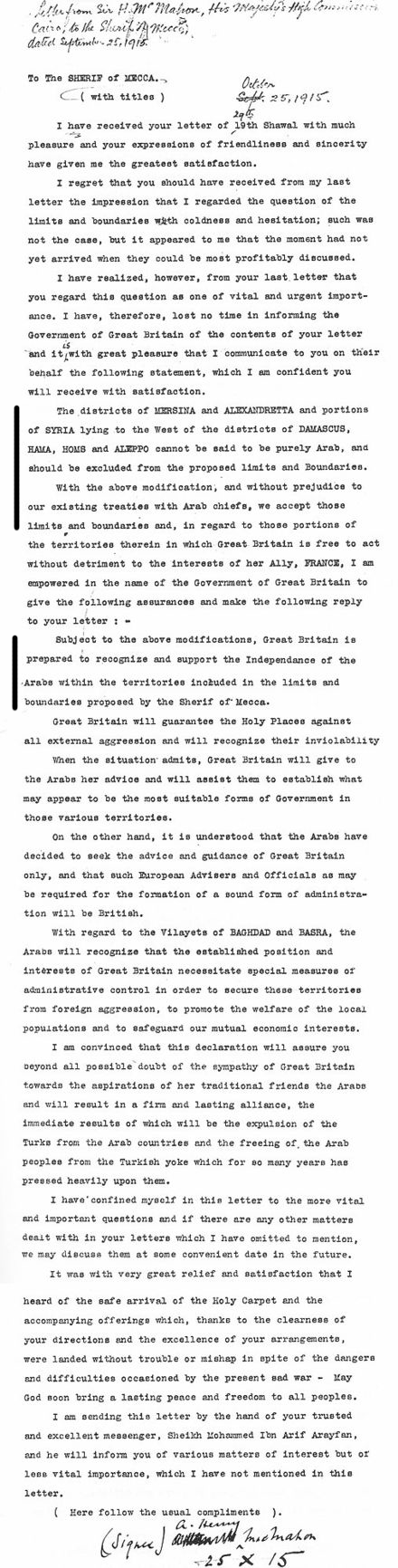
In one letter dated Oct. 25, 1915, the British High Commissioner to Egypt, Lt.–Col. Sir Henry McMahon, openly promised Palestine, inter alia, to the Sharif of Mecca. The Hussein–McMahon correspondence was a meaningful exchange between governments; the Balfour Declaration was merely a private letter addressed to a special-interest group, the Zionist Federation.
Regarding its contents, nothing in the Declaration was special or revelatory regarding British attitudes. Upper-class twits, er Brits, like Josiah Wedgwood had been lionizing zionism since at least Feb. 7, 1917. As Wedgwood would say a decade or so later, “Zionism is now doing for the Jews what the Labour Party seeks to do for the British working-class—creating self-confidence and corporate self-respect.”
For Wedgwood, Balfour and others, zionism was a benign illusion borne of ignorance and Western hubris. Wedgwood even praised Jewish colonization of Palestine as being wholly beneficial. Such a misguided understanding is also reflected in the Declaration’s naïve insistence that nothing in the zionist enterprise should be allowed to harm or prejudice the civil or religious rights of existing non-Jewish communities.
In truth, the Zionist Federation, to whom Balfour addressed the letter, had no intention of respecting Palestinian rights. In fact, such respect is anathema to zionism As anyone can see, the modern “state” of Israel is an abomination of the spirit of the Balfour Declaration. Therefore, the Declaration must be seen as either a conscious act of U.K. complicity in a genocide or an expression of sentimental Judeophilic nonsense. Either way, it does not deserve to be celebrated.
UNGA Resolution 181, (“The Partition Plan”) Nov. 29, 1947
The disconnect between zionist fantasy in the Balfour Declaration and zionist reality in Palestine would be proven 30 years later when the UN General Assembly caved in to blackmail to “create” Israel. The following account of how UNGA Resolution 181 came to pass is taken from my 2011 essay UN must again choose between capitulation and credibility.
By Nov. 25, 1947, the Zionist lobby realized that it did not have the requisite two-thirds majority in the General Assembly to support partition [Palestine]. Extraordinary measures had to be taken.
Vijayalakshmi Pandit, head of India’s UN delegation and sister of India’s Prime Minister Jawaharlal Nehru, received daily death threats warning her to change her vote. Nehru, though, refused to buckle in the face of threats or lucrative bribes. (Najma Heptulla, Indo-West Asian relations: the Nehru era, Allied Publishers, 1991, p. 158.)
Other, smaller, countries could not afford to stand on principle. In Palestine and Israel—A Challenge to Justice, Professor John Quigley recounts how Liberia, the Philippines, and Haiti—all financially dependent on the U.S.—were coerced into switching their votes:
“Liberia’s ambassador to the United Nations complained that the U.S. delegation threatened aid cuts to several countries. Some delegates charged U.S. officials with ‘diplomatic intimidation.’ Without terrific pressure from the United States on governments which cannot afford to risk American reprisals, said an anonymous editorial writer, the resolution would never have passed. The fact such pressure had been exerted became public knowledge, to the extent a State Department policy group was concerned that ‘the prestige of the UN’ would suffer because of ‘the notoriety and resentment attendant upon the activities of U.S. pressure groups, including members of Congress, who sought to impose U.S. views as to partition on foreign delegations.’” (p. 37)
On Nov. 29, the Partition Plan, known as UNGA Resolution 181 narrowly gained the required two thirds—33 in favor, 13 opposed, 10 abstaining and 1 absent—yet the resolution was a violation of the UN Charter since the UN has no authority to take land from one people and give it to another.
As a result, 726,000 Arabs were made refugees in their own land from November 29, 1947, until the end of 1948, according to the UN Relief and Works Agency for Palestine. Walter Eytan, Director General of the Israeli Foreign Ministry, referred to the UNRWA’s figure as “meticulous” and believed that the real number was closer to 800,000. Moshe Dayan would later admit: “There is not one single place built in this country that did not have a former Arab population.” (Ha’aretz, April 4, 1969).…
Thomas Reid, British MP for Swindon, called Resolution 181 “an iniquitous scheme”: “Let us be frank about it. One of the chief motives is that the Jews have a controlling voice in the election for the President in the States of New York, Illinois, Ohio and elsewhere in America. I suggest that the chief reason for this evil proposal of U.N.O. is that the political parties in America, or their party machines, are partly at the electoral mercy of the Jews. That is public knowledge.” (Hansard, Dec. 11, 1947)
So much for the relevance of the Balfour Declaration and its pious concern for the civil and religious rights of non-Jewish groups! In fact, the cruelty of the invading Jews toward the native Palestinians was so great that U.S. President Harry Truman refused to let UNGA Resolution 181 go to the Security Council for ratification, and at one point was prepared to rescind U.S. support for partition. In a March 25, 1948 statement, Truman declared support for trusteeship, albeit temporarily, to stabilize the region and maintain law and order:
It has become clear that the partition plan cannot be carried out at this time by peaceful means. We could not undertake to impose this solution on the people of Palestine by the use of American troops, both on Charter grounds and as a matter of national policy.
The consequence of this admission, of course, is that without ratification UNGA Resolution 181 does not exist: GA resolutions are only recommendations and have no force of law unless accepted by all parties. Therefore, Israel has no legal, moral or political legitimacy. This illegitimacy is what celebrating the centenary of the Declaration amounted to.
There is, though, one irony to the Declaration that is worthy of note. There was one lone voice against the Declaration in David Lloyd-George’s government. It belonged to Edwin Samuel Lord Montagu, who wrote to the British Cabinet on Aug. 23, 1917, one day after the Balfour Declaration was drafted. Here is a short excerpt:
[A] religious test of citizenship seems to me to be only admitted by those who take a bigoted and narrow view of one particular epoch of the history of Palestine, and claim for the Jews a position to which they are not entitled.
If my memory serves me right, there are three times as many Jews in the world as could possible get into Palestine if you drove out all the population that remains there now. So that only one-third will get back at the most, and what will happen to the remainder?
… I feel that the Government are asked to be the instrument for carrying out the wishes of a Zionist organisation largely run, as my information goes, at any rate in the past, by men of enemy descent or birth, and by this means have dealt a severe blow to the liberties, position and opportunities of service of their Jewish fellow-countrymen.
Montagu was also the government’s only Jew.
Palestine: Saudi Arabia, Egypt using Rafah crossing to pressure us
MEMO | November 17, 2017
The Rafah crossing between the besieged Gaza Strip and Egypt is being used a tool to pressure Palestinian President Mahmoud Abbas to enter into US-backed peace talks with Israel, a Palestinian Authority official has said.
“The Rafah crossing has become a tool that Egypt and Saudi Arabia use to pressure Palestinian President Mahmoud Abbas to accept the entry into a new round of US-backed negotiations with Israel,” the PA official said, warning that “the negotiations could reach results that may affect the rights of the Palestinians.”
According to the Cairo agreement which was signed on 12 October, Egypt agreed with Fatah and Hamas to reopen the Rafah border crossing last Tuesday, but the official said that “Saudi Arabia seemed to have pressured Egypt to retreat until the PA approves the two-state solution deal.”
The official described the exploiting of the only humanitarian crossing for Gaza’s residents as “suspicious”.
“They [Arab countries] are using the crossing to strengthen their ties with the US and Israel” he added.
Israel has maintained a blockade on Gaza for a decade, with tight restrictions in place on the movement of people and goods at its crossings, citing the need to control Hamas and stop Islamic groups from obtaining weapons or materials that could be used against Tel Aviv. Egypt has supported the blockade by closing the Rafah crossing, leaving Palestinian in Gaza no access to the outside world.
Gaza’s two million residents suffer from worsening humanitarian conditions, with only a few hours of power a day and a lack of clean water. Control of the Rafah crossing at Gaza’s southern border has long been a sticking point between the two Palestinian factions, and between Egypt and the Palestinians in Gaza for whom the crossing represents a vital gateway to the outside world.
Russia, Turkey, Iran meeting to discuss Syria strategy
By M.K. Bhadrakumar | Asia Times | November 17, 2017
In a historic development, Russian President Vladimir Putin will be hosting his Turkish and Iranian counterparts – Recep Erdogan and Hassan Rouhani – at a trilateral summit on November 22 in Sochi.
Turkey’s Anadolu news agency reported that the meeting, the first of its kind between the three countries, will focus on Syria and the overall situation in the Middle East. Turkish Deputy Prime Minister Bekir Bozdağ said the leaders “will handle Astana [peace talks in the capital of Kazakhstan earlier this year] and the political transition process in Syria. They will make important evaluations.” This comes as an unexpected development but is not surprising. Simply put, the three countries share a profound sense of disquiet over Washington’s regional strategies and sense that an inflection point is being reached.
There has been some abrasive behavior by the US on the regional chessboard over the past week or two. For example, US Defence Secretary James Mattis disclosed on November 13 that his country’s military presence in Syria will continue even after ISIS is defeated. Russia promptly challenged the legitimacy of the US presence under international law. Russia, Turkey and Iran are opposed to a continued US presence in Syria. Turkey is particularly worried that a long-term alliance between the US and the Syrian Kurdish militia will complicate its own problem of Kurdish separatism.
Meanwhile, unnamed US State Department officials have claimed that Russia has assured the US that the Iranian militia and Hezbollah will leave Syria. Moscow then had to issue a denial through Foreign Minister Sergey Lavrov. Linked to this is the Israeli demand that a buffer zone be created in the Golan Heights from which the Iranian militia or Hezbollah be excluded.
The US, meanwhile, has once again raked up the issue of the fate of Syrian President Bashar Al-Assad, insisting that he cannot be part of any transition or elected government. The US has also questioned the raison d’etre of the Astana talks (involving Russia, Turkey and Iran) and insists that the focus should shift back to the Geneva process under UN supervision.
Ironically, it was when the Geneva process began meandering that Russia got Turkey and Iran over to Astana to painstakingly iron out their differences and work out a ceasefire in stages, and thereafter establish de-escalation zones to bring the war to an end.
The US feels excluded from the major achievements made in Astana to end the bloodshed in Syria. However, Washington was always welcome to join the process but chose to abstain. Washington has ruffled Russia’s feathers and Moscow has threatened to expose the US’s alleged covert dealings with ISIS. Unsurprisingly, Russian politicians have threatened to raise the matter at the UN.
Meanwhile, on Tuesday, the Russian Defence Ministry openly alleged that the US military is impeding Russian air attacks on ISIS targets on the Syrian-Iraqi border and is indirectly enabling the terrorists to regroup. The Pentagon called it a Russian “lie.” At any rate, the very next day, six Russian Tupolov long-range bombers flew from bases in Russia via Iranian and Iraqi airspace to vanquish those ISIS targets in a massive air strike.
The US military is maneuvering on the Iraq-Syria border to bring the region under its control so that it will be in a position to create new facts on the ground and block a land route from Iran leading to the Levant.
Notably, the strong alliance with the Kurdish militia gives the US the wherewithal to influence events in Turkey, Iraq, Iran and Syria. Indeed, oil and oil pipelines form an important vector of the geopolitics, too.
The “dogfight under a carpet” in US politics is complicating matters for Moscow. The Russians don’t have an interlocutor in Washington – something they never lacked even in the darkest periods of the Cold War.
Suffice to say, the latest developments in Lebanon have created dark forebodings of a regional war. Unsurprisingly, Russia, Turkey and Iran must be feeling the need to coordinate their efforts to push back at the US.
Both Turkey and Iran estimate that Saudi Crown Prince Mohammed bin Salman’s seemingly irrational behavior has a pattern. They suspect a script was worked out by Israel and the Trump administration with the objective of creating quagmires for Ankara and Tehran.
Earlier this week, Erdogan openly ridiculed the crown prince from an Organisation of Islamic Cooperation (OIC) platform and questioned whether he was qualified to differentiate “moderate Islam” from the extremist form. The simmering discord between the erstwhile Caliph and the Custodian of the Holy Places who succeeded him (on the debris of the Ottoman Empire) surged into view. Equally, Iran can see that the Saudis are encouraging Israel to attack Lebanon. In fact, Rouhani openly spoke about it on Wednesday.
The trilateral summit in Sochi next week is most likely Erdogan’s idea. He traveled to Sochi to meet Putin on Monday en route to Kuwait and Qatar. While in Doha, Erdogan reaffirmed Turkey’s military support to the emir.
Indeed, all this is playing out against the backdrop of the snowballing crises in the US’s bilateral relations with Russia, Turkey and Iran.
Secretary Mattis Is Off Base: US Military Presence in Syria Has No Legal Grounds
By Peter KORZUN | Strategic Culture Foundation | 17.11.2017
Although the US has many times stated that its target is IS only, it appears that its intentions may go beyond the stated objective. In fact, Washington is seeking to retain post-conflict zones of influence within the country, where the American presence is illegal.
Asked at a press-conference on Nov. 13 if the US military will stay or leave Syria, US Defense Secretary James Mattis stated, “We’re not just going to walk away right now before the Geneva process has cracked.” He stressed the importance of the Geneva settlement process held under the auspices of the UN, saying “we got to get the UN-brokered effort in Geneva to take this thing forward.” Answering a question about the legal grounds for the US presence in the country, the secretary explained “You know, the UN said that ISIS — basically we can go after ISIS. And we’re there to take them out.”
The Syrian Foreign Ministry issued a firm warning to the US and other foreign forces in Syria on Nov. 14. According to it, “The presence of US forces or any foreign military presence in Syria without the consent of the Syrian government constitutes an act of aggression and an attack on the sovereignty of the Syrian Arab Republic as well as a gross violation of the charter and principles of the United Nations.” In September, Deputy Foreign Minister of Syria Faisal Mekdad stated that the US “should withdraw its military; otherwise the Syrian army will consider them as a hostile force.”
So, the US is not going to leave and believes that its military operations in Syria do not run counter to international law. Now what about the legal grounds for maintaining the US military presence there?
United Nations Security Council Resolution 1373 was adopted unanimously on 28 September 2001 as a counter-terrorism measure passed following the 9/11 terrorist attacks on the United States. It does not say a military intervention is allowed. No border crossing is envisaged.
Resolution 2249 adopted by the UN Security Council in November 2015 called on UN member states “that have the capacity to do so to take all necessary measures” and “to redouble and coordinate their efforts to prevent and suppress terrorist acts committed specifically by ISIL [Islamic State (IS, former ISIS/ISIL)]” as well as other terrorist groups. However, the document emphasizes that the states are to do so “in compliance with international law”. It’s important to note that the resolution in question does not give the right to intervene militarily. It does not mention Chapter VII of UN Charter, which envisages the use of force under certain conditions. The document contains no specific reference to Syria.
Resolution 2254 adopted in December 2015 says it’s up to Syrian people to decide their fate through formal talks and a unity government.
UN General Assembly Resolution 3314 on the definition of aggression explicitly states that an “invasion or attack by the armed forces of a State of the territory of another State” as well as “any military occupation, however temporary” or “bombardment by the armed forces of a State against the territory of another State” is what particularly constitutes aggression.
It has become increasingly difficult for the US to justify its operations in Syria under the pretext of fighting Islamic State (IS). Turkish Prime Minister Binali Yıldırım has accused the US military of turning a blind eye on IS militants fleeing Syria’s Raqqa unobstructed along with their weapons and ammunition. According to him, “The escaped [IS] members will be the reason for the deaths of innocent people in every corner of the world, including Turkey, Europe, and America.” He made these comments against the background of the Russian Defense Ministry accusing the United States of “providing de-facto cover” for IS jihadists in Syria “and only pretending to fight terrorism in the Middle East.”
With legal arguments unravelling, the Defense Department’s untenable position has become noticeable, even within its own ranks. General Raymond Thomas, the Commander of US Special Operations Command, acknowledged the US presence in Syria doesn’t have a leg to stand on in terms of international law. “Here’s the conundrum,” he explained. “We are operating in the sovereign country of Syria. The Russians, their stalwarts, their back-stoppers, have already uninvited the Turks from Syria. We’re a bad day away from the Russians saying, ‘Why are you still in Syria, US?”
The establishment of a 55-km closed zone around the US base in the area of the Syrian town of al-Tanf with humanitarian aid to refugees blocked is an example of flagrant violation of international law that should be addressed by the UN Security Council. The establishment of the base near the Syria-Jordan border was publicly justified by the need to conduct operations against Islamic State. However, no information has been received about any US operations against the group conducted from this area. To the contrary, IS has been reported to operate freely in an area abutting the base.
The largest Rukban refugee camp accommodating more than 60,000 women and children from Raqqa and Deir ez-Zor is located in the “safe zone” close to the base. The refugees appear to be used as hostages or a “human shield” to protect the American military stationed at al-Tanf. On and off, militant groups supposedly trained by Americans in the area strike Syria government forces. The more US forces are in-theater in Syria, the greater the chance of conflict between them and Syrian troops.
The United States has many times stated its target is IS only; it is not at war with the Syrian government. It appears that its intentions may go beyond the stated objective of fighting terrorism, while seeking to retain post-conflict zones of influence within the country, where the American presence is illegal. Russia, Iran, and other allied Syrian forces are in Syria legally, at the invitation of the UN-recognized state authority. The United States and its coalition partners are not. This fact is irrefutable. By no stretch of imagination could anyone find a justification for US military operations on Syrian soil.
Lebanon FM: Hariri crisis ‘part of attempt to create chaos’
Press TV – November 17, 2017
Lebanese Foreign Minister Gebran Bassil says the crisis over the resignation of Prime Minister Saad al-Hariri is part of an “attempt to create chaos in the region.”
Speaking in Moscow on Friday, Bassil said Lebanon has the “full powers” to respond to the crisis, but hoped this would not be necessary.
“We will respond and we have the full powers to do that, but we hope it doesn’t come to that,” he said.
Lebanese President Michel Aoun has said that Hariri, who resigned as prime minister on Nov. 4, is being detained in Saudi Arabia against his will – despite the premier’s reassurances he would return home soon.
On Friday, a senior Hariri aide was quoted as saying that Hariri will see France’s president on Saturday in Paris and the meeting will help resolve the Lebanese crisis and boost stability.
Bassil has been touring European capitals to lobby for Hariri’s return. On Thursday, he warned that Lebanon should not be treated as a plaything by any country.
“Lebanon is not a toy in others’ hands,” the Lebanese foreign minister said at a joint press conference with his German counterpart Sigmar Gabriel in Berlin.
Gabriel said he shared concerns about the threat of instability and bloodshed in Lebanon and, without mentioning Saudi Arabia directly, warned against the “adventurism” behind the Lebanon crisis and the “human tragedy in Yemen.”
“We expect that Prime Minister Hariri can come back to Beirut,” he added.
Saudi Arabia has been bombing Yemen since 2015 to restore its Riyadh-allied government, killing many thousands in the process.
Bassil, for his part, said, the “Hariri issue is actually a matter of Lebanon’s sovereignty,” and called on Arab countries to “not interfere with Lebanon’s internal matters.”
The Lebanese foreign minister also said further turmoil in his country, which is already hosting thousands of refugees fleeing violence in neighboring Syria, would create a new influx of asylum seekers to Europe.
Bassil also visited Turkey on Thursday and is to travel to Russia on Friday, where he is about to meet with Russia’s top diplomat, Sergei Lavrov.
At a joint presser with Bassil, Turkey’s Foreign Minister Mevlut Cavusoglu urged Hariri’s “immediate” return.
“We support Lebanon’s unity, integrity and stability, and we oppose any development that would risk Lebanon’s stability,” he said.
“Lebanon does not need any other problems. On the contrary, we need to contribute to the solution of the existing problems.”
Bassil also held talks with Turkish President Recep Tayyip Erdogan.
Lebanon FM Reveals Attempt to Intimidate Country Into Canceling Russian Gas Deal
Sputnik – 17.11.2017
Lebanese Foreign Minister Geral Bassil has held a meeting with his Russian counterpart Sergei Lavrov.
“We are about to sign our first contract on gas field exploration on the shelf with the participation of Russian companies. We are now seeing an attempt to make Lebanon leave this positive path,” Geral Bassil said.
“A campaign to scare Lebanon, to create obstacles in its path with the use of terrorist forces under different pretexts is underway,” the minister said, adding that “the campaign against Lebanon is being carried out by the same forces that support terrorists in Syria.”
At the same time, according to Bassil, Lebanon wanted to preserve good relations with Saudi Arabia despite the surprise resignation of Lebanese Prime Minister Saad Hariri.
“We never took any diplomatic steps that would escalate the situation,” Bassil said.
The top diplomat said that “some parties” to the conflict were trying to displace the head of the country from his office, adding that he expected Hariri to return to the country following his visit to France.
“We hope that Russia will continue building up its influence in the Middle East in order to form a balance of powers in the region,” Bassil added.
According to the minister, Beirut will respond to any attempt of interference in its internal affairs, stressing that the country’s sovereignty cannot be “bought and sold.”
For his part, Russian Foreign Minister Sergei Lavrov said “we are interested in Lebanon being safe and with the effective participation of all branches of power. And the most important thing, we support the resolution of all urgent issues by the Lebanese themselves without any external interference.”
The Lebanese Crisis
Previously, Moscow has voiced concern over the shock resignation of former Prime Minister Saad Hariri and urged all external forces that could influence the situation in Lebanon to show restraint and constructive approaches.
The situation in Lebanon escalated two weeks ago when then-Prime Minister Saad Hariri announced his resignation in a video address made from Saudi Arabia. The former minister expressed fears that he could be assassinated, like his father, in Lebanon, as well as accusing Tehran and the Iranian-backed Hezbollah movement of alleged attempts to destabilize the situation in the country and the Middle East, a claim strongly denied by the Islamic Republic as groundless.
While Lebanese President Michel Aoun has been accusing Saudi Arabia of holding Hariri and his family, Riyadh has strongly denied the claims as “groundless.” Hariri himself has repeatedly reiterated his intention to return to Lebanon in the next few days after his planned trip to France at the invitation of President Emmanuel Macron, saying that he is “perfectly fine.”
Poll Shows US Voters Prefer Russia as Friend, Not Enemy, Echoing Trump’s Call
Sputnik – 17.11.2017
American voters agree by a two-to-one margin that a friendly US posture toward Russia would be a greater asset to the United States and the world than the present policy of hostility toward Moscow, according to a poll by Rasmussen reports.
In conducting the poll, Rasmussen read the following quote to survey participants, without identifying President Donald Trump as the speaker, and asked voters whether they agreed or disagreed: “Having Russia in a friendly posture, as opposed to always fighting with them, is an asset to the world, and an asset to our country, not a liability.”
According to Rasmussen, 52 percent agreed that having Russia as a friend is a good idea, 27 percent disagreed, while 21 percent said they were undecided.
The poll that had surveyed 1,000 likely voters has been released just days after US President Donald Trump has reiterated his stance on ties with Russia after his second meeting with President Vladimir Putin, saying that positive relations between Washington and Moscow “is a good thing.”
Russia in its turn has repeatedly expressed readiness to cooperate with the US on global issues on the basis of equality and mutual respect.
While Moscow has denied claims of interference in the US November 2016 election, Trump has called the ongoing probe into the alleged meddling conducted separately by Congress and Special Counsel Robert Mueller a “witch hunt.”
READ MORE: Trump to Continue to Look for Ways to Work With Russia
Featured Video

Rewriting the risk? Inside the government’s vaccine safety messaging
or go to
Aletho News Archives – Video-Images
Book Review
“Davos Can Really Replace the UN”
Inside the book that maps the architecture behind global governance — from the Epstein files to the Pact for the Future
Lies are Unbekoming | April 1, 2026
On June 13, 2019, the United Nations and the World Economic Forum signed a partnership deal to “accelerate the implementation of the 2030 Agenda for Sustainable Development.” That same evening, WEF president Börge Brende — Norway’s former Foreign Minister — had dinner with Jeffrey Epstein at Epstein’s Manhattan townhouse. The Epstein files, released January 2026, contain an exchange between the two from the previous year. Epstein to Brende: “Davos can really replace the UN. C21, cyber, crypto . genetics… intl coordination.” Brende back to Epstein: “Exactly — we need a new global architecture. World Economic Forum (Davos) is uniquely positioned — public private.”
The next day, the UN General Assembly adopted the framework for restructuring global governance.
That sequence — the partnership signing, the Epstein dinner, the candid admission about replacing the UN with a public-private architecture, and then the formal adoption — opens Jacob Nordangård’s The Digital World Brain. Pages two and three. Footnoted to the UN resolution number, the Epstein files, and the General Assembly record.
I keep coming back to it because it captures what this book does that almost nothing else in the independent research space manages. I’ve followed Jacob’s work for years now and interviewed him about his research. Each book peels back another layer of the same institutional architecture, and each time I think he’s reached the limit of what can be documented, the next one goes further. Nordangård doesn’t speculate. He doesn’t editorialize much. He lays institutional actions next to each other in chronological order and lets the pattern announce itself. … continue
Blog Roll
 Aletho News
- REWRITING THE RISK? INSIDE THE GOVERNMENT’S VACCINE SAFETY MESSAGING
- “Davos Can Really Replace the UN”
- NIAID/NIH and USDA Fund Bioengineered Chimeric Influenza Viruses Built Using Pandemic H1N1 Components: Journal ‘Science Advances’
- Hezbollah hits Israeli warship off Lebanon’s coast, sets it aflame
- Iran slams US strikes on B1 bridge, Mahshahr petrochemical plants as ‘blatant acts of state terrorism’
- In letter to UN chief, Araghchi warns of dire consequences of US-Israeli attacks on Iran’s nuclear facilities
- Why the CIA conspiracy to invade Iran with Kurdish militias failed
- Why Are Upbeat US Claims About Mission to Rescue Pilot ‘Highly Questionable’?
- Aircraft destroyed during US ‘rescue’ of downed F-15 pilot cost more than $100 million each
- Washington University removes professor who condemned US-Israeli war on Iran
- If Americans Knew
- In Iran, Israel-US take aim at “reason, research, and freedom of thought” – Daily Update
- US loses planes over Iran, Israel downgrades Lebanon war goals – Daily Update
- Israel Is Blocking Palestinians from Easter at Church Where Jesus Resurrected
- Plot to assassinate Palestinian activist follows harassment campaign promoted by Zionist groups and elected officials
- Prominent New York synagogue hosts presentation on why U.S. Jews should support the ethnic cleansing of Gaza
- Tapper vs. Piker: Is the CNN Anchor Auditioning for David Ellison?
- Shouldn’t Democrats Be Able to Condemn Genocide?
- Israel-US kill negotiators, destroy civilian structures, but Iran’s military capabilities still largely intact – Daily Update
- ‘War crime’: Global condemnation as Israeli ministers celebrate death penalty law targeting Palestinian prisoners
- 7 Ways Israel Is Turning Lebanon Into Gaza
- No Tricks Zone
- An Inconvenient Tree: Uncovered In Alps… Europe Much Warmer Than Today 6000 Years Ago
- New Study Reports A 60% Slowdown In Greenland’s Ice Loss Rate In The Last Decade
- Low Intensity Tornado Wrecks Major Solar Farm, Creating A Potential Toxic Dump
- New Study Finds Warming Saves Lives…Cold Temperatures 12 Times More Deadly Than Excess Heat
- German Science Blog Accuses PIK Climate Institute Of Hallucinating Climate Tipping Points
- Devastating Assessment Of Comirnaty Vaccine By Former Senior Pfizer Europe Toxicologist
- New Study: CO2 Is ‘Effectively Negligible’ As An Explanatory Climate Change Factor Since 2000
- Former Pfizer Toxicologist Dr. Helmut Sterz Tells Bundestag Hearing Pfizer Vaccine Should Have Never Been Approved
- Energy Expert: Germany’s Nuclear Phaseout Was A “500 Billion Euro Mistake”
- New Research: South Australia’s Mid-Holocene Sea Surface Temperatures Were 4°C Warmer Than Today
 Aletho News