US Marine chopper reportedly drops object on Okinawa nursery during flyover
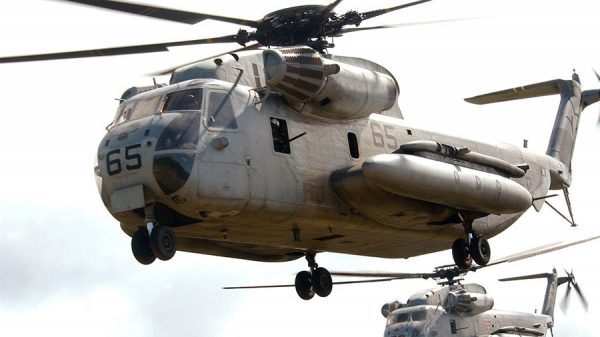
FILE PHOTO: Sikorsky CH-53 © Wikipedia
RT | December 7, 2017
The staff of a nursery school located 300 meters from a US base in Okinawa has found an object, which apparently fell on the roof from a US helicopter. Some 50 children were playing in the grounds at the time of the flyover.
The object was discovered on the roof of the Midorigaoka nursery in Ginowan City, which is located beside the US Marine Corps Futenma Air Station. The staff found it on Thursday at around 10:20am, just after a US military aircraft flew over the daycare facility, reports NHK.
Head of the nursery, Takehiro Kamiya, said staff went to check what had happened when they heard a loud sound from the roof. They found a cylindrical object that was 10cm long and 7cm in diameter. It had a warning sign that read: “Remove before flight” painted in English, according to footage shown by the TV channel.
The director said the nursery provides daycare for 61 children. Around 50 of them were playing in the garden outside at the time of the incident, while others were inside. Nobody was injured, but people working at Midorigaoka say the outcome could easily have been different.
“I’m appalled to think what would have happened if the falling point had shifted just a little bit,” said Take Nago, the 78-year-old chief caregiver at the facility, as cited by Kyodo news agency.
According to the Japanese Defense Ministry, a Sikorsky CH-53 Sea Stallion flew over Ginowan City at the time of the incident. The transport helicopters stationed at the Futenma Air Station have been a target for complaints by residents of the city, who have cited concerns about noise and risks associated with their flights. One of the most memorable incidents involving the aircraft happened in August 2004, when one of the Marine helicopters crashed into a building at Okinawa International University. Fortunately, it was largely vacant for summer break at the time. The crash was caused by poor maintenance of the helicopter, an investigation later found.
Another CH-53 crash-landed in northern Okinawa during a training exercise in October. The crash site was only a few hundred meters from the residential area of Higashi village. And last week, an F-35A Lightning II stationed at Okinawa’s Kadena Airbase dropped a panel during its flight, leaving a dent in its high-tech stealth coating.
North Korea Pushes US to Negotiating Table?
By Finian CUNNINGHAM | Strategic Culture Foundation | 07.12.2017
Just when the crisis in US-North Korean relations could not seem more bleak, this week sees a chance that the two sides could be moving quietly towards a diplomatic resolution. The arrival of senior United Nations diplomat Jeffrey Feltman in Pyongyang for four days of discussions with top officials was reported as a “very rare” event.
Feltman is the most senior American official in the United Nations secretariat, serving as the chief of political affairs under Secretary General Antonio Guterres. The last time such a senior UN official reportedly visited North Korea was six years ago. The delegation this week comes at the request of Pyongyang.
The US State Department said that Feltman was in North Korea on behalf of the United Nations, and that he was not conveying a message from Washington. Nevertheless, there are grounds to believe that the diplomat’s “wide-ranging” discussions with senior North Korean officials is an opening for tentative talks between Washington and Pyongyang to resolve the deepening crisis over the latter’s nuclear weapons program.
Before his UN appointment in 2012, Feltman (58) worked in the US State Department for nearly 30 years. His posts included sensitive Middle East areas: Israel, Palestine, Iraq, Lebanon and Bahrain. Officially, he may be on UN business this week in Pyongyang, but it seems plausible that this career US diplomat will, in addition, convey a significant political signal from Washington that formal talks are on.
Washington’s public position is that no talks with North Korea are on the agenda until Pyongyang halts its nuclear weapons program. However, US Secretary of State Rex Tillerson said recently there was the possibility of “talks about talks” in the future. President Donald Trump while threatening “fire and fury” on North Korea has also at other times hinted that he is willing to engage in diplomacy with North Korean leader Kim Jong-un.
For its part, North Korea has said it will never unilaterally give up its nuclear weapons program as a deterrent to what it calls US aggression.
Escalating rhetorical jibes between the two leaders over the past several months might suggest that there is minimal chance for diplomacy. Trump has disparaged Kim as “Rocket Man on a suicide mission”; while Kim has mocked the American president as “a stupid old dotard”.
Russia and China have urged all sides to engage in negotiations in order to calm roiling tensions, which have mounted over the past year from dozens of missile tests being conducted by North Korea, as well as from provocative military exercises carried out by the US and its South Korea and Japanese allies.
Last week, North Korea launched its biggest Intercontinental Ballistic Missile (ICBM) yet, a Hwasong-15, which various analysts said demonstrated the capability for a nuclear strike on any part of the US mainland, including the capital Washington DC. Pyongyang announced that the test launch proved that the country had completed its quest for acquiring nuclear weapons capable of hitting the US.
Then this week, US forces conducted their biggest-ever warplanes drill with South Korea, involving some 230 aircraft, including B1-B nuclear-capable bombers and reportedly for the first time stealth F-35 and F-22 fighter jets. The massive air-force mobilization came despite appeals from China and Russia for a suspension. There were also warnings from North Korea that the US bombing rehearsals were leading the Peninsula to the brink of nuclear war.
Trump’s top national security advisor General HR McMaster recently added to fears of a full-on conflict breaking out when he described the situation as a countdown to war. Trump has also on several occasions warned that he would “totally destroy” North Korea if the US or its allies were threatened. A threat which was again repeated last week by the US ambassador the UN Nikki Haley. Pyongyang has, in turn, said that such rhetoric amounts to a declaration of war by the US.
The re-listing on November 20 by Washington of North Korea as a “state sponsor of terrorism” is another incendiary factor in an already explosive geopolitical mix.
However, in spite of the imminent danger of all-out armed conflict, there are reasons to believe that both sides are willing to pull back.
Bellicose posturing by Trump and his aides cannot disguise the fact that Washington does not have a realistic military option in dealing with North Korea. Negotiation is the only viable option to resolve the long-running crisis, as China and Russia have both consistently urged.
Many American weapons experts, including Siegfried Hecker, the former head of Los Alamos Laboratory, reckon that North Korea has the capability of 30 to 60 nuclear weapons. An underground test in September points to the possession of a H-bomb with a 10-fold explosive power of the A-bombs dropped by the US on Hiroshima and Nagasaki.
“There is little doubt that North Korea could mount a nuclear warhead on a missile that could reach South Korea or Japan,” according to Siegfried.
That capability alone – if not also the now very real possibility of hitting the US mainland – places millions of lives at risk, if Washington were to go to war with North Korea.
Over the past decade since North Korea’s first nuclear test explosion in 2006, the country’s military defenses have progressed at an astonishing rate, despite the ratcheting up of economic and diplomatic sanctions by Washington. Most of North Korea’s weapons development has occurred under the current leader Kim Jong-un who took over six years ago after the death of his father Kim Jong-il. Four of the country’s total six nuclear tests have taken place under the watch of the 30-something-year-old incumbent.
Having now achieved the stated goal of possessing a nuclear deterrent force capable of hitting the US, Pyongyang may feel it is finally in a position to talk with Washington on a mutual basis.
South Korean diplomat, Kim Hong-gul, who met the North Korean leader six years ago at his father’s funeral, said that the recent test of the ICBM purportedly capable of striking the US, could paradoxically be a harbinger of future talks between Pyongyang and Washington.
In an interview with Bloomberg this week, the South Korea diplomat said of the ICBM test launch: “It could be a flare signaling the start of the negotiations. On completion [of nuclear forces], Kim wouldn’t need to test missiles anymore, so he could suggest a conversation with the South and the US, possibly in his New Year speech, while refraining from further tests.”
It seems significant that the day after the latest ICBM test, on November 30, Pyongyang confirmed its invitation to the UN for high-level discussions. Within days, the UN reciprocated by sending Jeffrey Feltman, the seasoned former US State Department point man, to Pyongyang this week.
It is not known if Feltman will meet with Kim Jong-un during his four-day trip, but he is scheduled to hold talks with North Korea’s most senior diplomat, foreign minister Ri Yong-ho.
Notably, too, Feltman’s visit to Pyongyang follows a high-level delegation from Beijing to North Korea, the first such trip by Chinese diplomats after a two-year hiatus.
Bloomberg also reports: “Russian lawmaker Vitaly Pashin, who recently visited Pyongyang, said Monday that North Korean officials are ready for one-on-one or multiparty talks now that they’ve become a nuclear power capable of striking the US mainland.”
The standoff between the US and North Korea is much too grim, and the stakes are much too high, for any side to crow about one-upmanship.
But maybe – just maybe – the brinkmanship shown by North Korea to persist with its nuclear program in the face of US threats has paid off by forcing Washington to come to the negotiating table in order to resolve the standoff peacefully through a political settlement.
So much for Western depiction of the North Korean leader as a “madman”. His cold-blooded logic may spare the world from a nuclear war incited by the crazies in Washington.
Pentagon quadruples troop levels in Syria to ‘stabilize’ liberated areas
RT | December 7, 2017
The US military has increased the number of troops in Syria from 500 to 2,000, the Pentagon says, adding that the “conditions-based” military presence is justified by the need to “stabilize” liberated areas.
The Pentagon has officially announced that there are now 2,000 troops in Syria – a fourfold increase from the previous figures given. “The United States will continue necessary counterterrorism and stabilization effort,” Pentagon spokesman Colonel Robert Manning said.
“The United States will sustain a conditions-based military presence in Syria to combat the threat of insurgent-led insurgency, prevent the resurgence of ISIS and to stabilize liberated areas.”
Manning claimed that the Iraqi Army and Syrian Democratic Forces (SDF) have liberated about 97 percent “of the people and land” previously controlled by Islamic State (IS, formerly ISIS) in Iraq and Syria respectively. He said the campaign to defeat IS is now in a new phase in these countries.
Coalition forces are still needed in the two countries, Manning said, adding that they will now focus on “train, advise and assist” missions. “As the terrorist group continues to lose territory, important work remains to ensure its lasting defeat.”
The US military has repeatedly refused to acknowledge the number of troops and “military advisers” it has fighting alongside anti-government rebel forces. Under the Obama administration, the Pentagon routinely announced foreign troop deployments, but the Trump administration stopped disclosing such information regarding Operation Inherent Resolve. The policy was reversed in the spring of 2017 in order to maintain the “element of surprise” against Islamic State in both Syria and Iraq.
Damascus views the US military engagement in Syria as illegitimate, as there was no official request for intervention from the government. Early in November, Syrian leader Bashar Assad said his government will deal with any “illegal invader force.” He added that the war in Syria will continue until there is a full “recovery of security and stability to all Syrian lands.”
Washington insists its military presence in Syria is lawful and justified by UN mandate. In mid-November, US Defense Secretary James Mattis claimed the United Nations sanctioned the US presence in Syria.
“You know, the UN said that… basically we can go after ISIS. And we’re there to take them out,” Mattis said. Moscow responded by saying the UN cannot greenlight a foreign invasion of Syria, as it is contrary to international law.
Media reports indicate that the US is not planning to leave any time soon. According to the Washington Post, the US wants to keep troops in Syria long after Islamic State is defeated to help the Western-backed SDF establish “new local governance” structures in order to prevent complete victory by the Syrian government and its ally, Iran.
Read more:
France , Qatar sign deals worth around 12 billion euros: Macron
Press TV – December 7, 2017
French President Emmanuel Macron and Qatar’s ruling emir have signed contacts worth around 12 billion euros ($14.15 billion) during the French president’s visit to Doha.
“In total, it amounts to nearly 12 billion euros which was signed today and which underlines the closeness of our relations,” Macron said at a press conference with Qatari Emir Sheikh Tamim bin Hamad Al Thani on Thursday.
Macron and Sheikh Tamim agreed on a deal for Qatar to purchase at least a dozen French-made Dassault Rafale fighter jets with the option of buying 36 more. The deal also includes purchase of 490 VBCI armored vehicles from French firm Nexter.
Qatar would additionally buy 50 Airbus twin-engine A321s with the option of buying 30 more.
The small Persian Gulf country also signed a transportation deal with France’s national rail authority to manage and maintain Doha’s planned metro, as well as a light rail system north of Doha.
The French president is traveling with Foreign Minister Jean-Yves Le Drian, who in 2015 as defense minister helped negotiate a deal with Qatar buy dozens of Rafale fighter jets.
Macron’s one-day trip comes as Doha faces a continued boycott by some of its Saudi-led Arab neighbors.
In the rare press conference, Qatar’s ruling emir expressed his regret for the boycott and said it was especially disheartening that the crisis erupted in June.
Qatar has been locked in a political standoff with Saudi Arabia and three other Arab countries for the past months. Saudi Arabia, the United Arab Emirates, Bahrain and Egypt cut relations with Qatar in early June
Earlier this week, a Persian Gulf Cooperation Council (GCC) meeting in Kuwait failed to bring the standoff any closer to a resolution.
There has been almost no sign that Qatari authorities would bow to the demands of Saudi Arabia and its allies to restore diplomatic ties.
Among the conditions put forward for a full normalization of ties is the need for Qatar to downgrade its relations with Iran and expel foreign troops, including those from Turkey, from military bases in the country.
Macron visits US, French troops in Qatar
During his visit to Qatar, Macron traveled to the vast al-Udeid air base, which is home to some 10,000 American troops and the forward headquarters of the US military’s Central Command.
France also has a contingent of several hundred troops in Qatar as part of the 1,200 French forces deployed to the region.
The troops are a part of the US-led coalition, which is purportedly fighting the Daesh Takfiri terrorist group in Syria, Iraq and elsewhere.
Speaking to the soldiers, he said the next few months of battle would determine the outcome of the war against Daesh in Iraq in Syria.
“This military win does not signify the end of the operations and the end of our battle because first we need to stabilize and win peace in Iraq and Syria,” he said.
Macron also stressed in his remarks that France wanted to avoid the partitioning of Syria and “avoid the domination of certain international elements whose interests contradict peace.”
The US-led coalition has been conducting airstrikes against what are said to be Daesh targets inside Syria since September 2014 without any authorization from the Damascus government or a UN mandate.
The airstrikes, however, have on many occasions resulted in civilian casualties and failed to fulfill their declared aim of countering terrorism.
Featured Video
Prof. Ted Postol: Iran Already Achieved Nuclear Deterrence Against Israel
or go to
Aletho News Archives – Video-Images
From the Archives
How the occupied mentality syndrome works
Saudi Arabia on the American chessboard – Part 3
By B. J. Sabri | American Herald Tribune | June 27, 2016
Read part 2: “The occupied mentality Syndrome“
Previously I argued whether Saudi Arabia’s repeated involvements in U.S. interventions and wars stem from free national will or in response to a specific condition. For starters, in Saudi Arabia there is no national will. In Saudi Arabia, the national will is the will of the Al Saud clan. Still, when a major Arab state allies itself with a superpower that committed unspeakable crimes against humanity in almost every Arab country, then something is wrong. This fact alone should compel us to examine the U.S.-Saudi relation for one exceptional reason. As a result of the U.S.-Saudi wars, hundreds of thousands of people in Afghanistan, Iraq, Iran, Libya, Syria, Yemen, and Somalia have lost their lives. Millions became displaced in their own homelands. And millions more rendered refugees.
Attributing the Saudi policies to the bonds of “partnership” with the U.S. is frivolous. There are no bonds between these two thugs except those of business, military deals, secret plots, and wars. Proving this point, bonds such as these have no space for the American and Saudi peoples to share significant cultural or societal exchanges. If partnership is not the reason for the Saudi contribution to the U.S. strategy of empire and imperialism, then another reason must exist.
This leads to three possibilities. … continue
Blog Roll
 Aletho News
- Al Mayadeen voices solidarity with Dr. Marandi amid death threats
- US dismantling international law in its war against Iran while claiming ‘false’ victory: Legal scholar
- One martyr, 5 injuries in US attack on Iraqi border crossing with Iran
- ‘This war is Israel’s war’: World facing ‘security breakdown’, says Qalibaf
- IRGC decries attack on US embassy in Riyadh, says executed by ‘Israel’
- Iran blasts EU hypocrisy as EU invokes international law over Hormuz
- There is no military solution to Strait of Hormuz
- NATO’s structural collapse – the outcome of deviation from reality
- Poll finds world views China better than US
- One Of America’s Leading Neo-Cons Has Turned Against The Iran War And Israel
- If Americans Knew
- US loses planes over Iran, Israel downgrades Lebanon war goals – Daily Update
- Israel Is Blocking Palestinians from Easter at Church Where Jesus Resurrected
- Plot to assassinate Palestinian activist follows harassment campaign promoted by Zionist groups and elected officials
- Prominent New York synagogue hosts presentation on why U.S. Jews should support the ethnic cleansing of Gaza
- Tapper vs. Piker: Is the CNN Anchor Auditioning for David Ellison?
- Shouldn’t Democrats Be Able to Condemn Genocide?
- Israel-US kill negotiators, destroy civilian structures, but Iran’s military capabilities still largely intact – Daily Update
- ‘War crime’: Global condemnation as Israeli ministers celebrate death penalty law targeting Palestinian prisoners
- 7 Ways Israel Is Turning Lebanon Into Gaza
- World’s Leading Football Bodies Under Fire Over Israel Policies
- No Tricks Zone
- An Inconvenient Tree: Uncovered In Alps… Europe Much Warmer Than Today 6000 Years Ago
- New Study Reports A 60% Slowdown In Greenland’s Ice Loss Rate In The Last Decade
- Low Intensity Tornado Wrecks Major Solar Farm, Creating A Potential Toxic Dump
- New Study Finds Warming Saves Lives…Cold Temperatures 12 Times More Deadly Than Excess Heat
- German Science Blog Accuses PIK Climate Institute Of Hallucinating Climate Tipping Points
- Devastating Assessment Of Comirnaty Vaccine By Former Senior Pfizer Europe Toxicologist
- New Study: CO2 Is ‘Effectively Negligible’ As An Explanatory Climate Change Factor Since 2000
- Former Pfizer Toxicologist Dr. Helmut Sterz Tells Bundestag Hearing Pfizer Vaccine Should Have Never Been Approved
- Energy Expert: Germany’s Nuclear Phaseout Was A “500 Billion Euro Mistake”
- New Research: South Australia’s Mid-Holocene Sea Surface Temperatures Were 4°C Warmer Than Today
 Aletho News