Tunisians declare boycott of U.S. ships after Trump’s Jerusalem move

Palestine Information Center – December 11, 2017
TUNIS – A Tunisian labor union on Sunday evening announced its decision to boycott U.S. ships docking at a seaport in the country’s southern region of Sfax following Trump’s recognition, on Wednesday, of Occupied Jerusalem as Israel’s capital.
Spokesman of the Popular Conference for the Palestinians Abroad, Ziad al-Aloul, said on Facebook that the regional executive office of Tunisia’s Trade Unions decided to boycott all American ships docking at Sfax commercial harbor.
As part of the boycott move, workers at the seaport will not empty the shipments onboard boats tied up at Sfax seaport after they had set sail from the U.S.
Prior to the boycott, mass rallies had swept Tunisia with thousands of protesters holding up Palestinian flags and banners. Protesters also burned the U.S. flag and others stepped on images of Israeli flags.
Khader Adnan seized by Israeli occupation forces, launches immediate hunger strike
Samidoun Palestinian Prisoner Solidarity Network- December 11, 2017
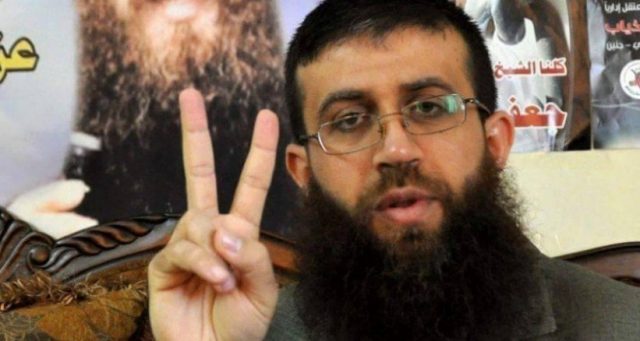
Prominent Palestinian leader, organizer and former prisoner and hunger-striker Khader Adnan was seized on Monday morning, 11 December, by Israeli occupation forces at his home in Arraba, Jenin. He immediately launched an open hunger strike to demand his release.
Randa Moussa, his wife, told Palestine Today that he had announced an immediate strike on food, drink and speech after his arrest. She said that four patrols, an armored troop carrier and a jeep surrounded their home at 2:30 am and invaded the home violently, trying to break down the door of the home, and that they hit Adnan on the back and hand, throwing him on the ground before handcuffing him. He was then interrogated in a closed room of the house before being taken away to an undisclosed location.
Adnan, prominent political activist from the town of Arraba near Jenin, has been arrested 10 times and spent six years in Israeli prison, all in administrative detention – imprisonment without charge or trial. In 2012 and 2015, he carried out 66-day and 56-day hunger strikes, respectively, winning his liberation from arbitrary Israeli imprisonment.
The Islamic Jihad movement said in a statement that “the arrest of leaders and popular and national symbols will not weaken our people or break their will…. this is a desperate attempt to suppress the uprising of Jerusalem,” as Palestinians inside and outside Palestine have risen up against US President Donald Trump’s declaration that Jerusalem is the “capital of Israel” in the eyes of the US.
Khader Adnan is a Palestinian and international symbol of steadfastness within the prisons who has inspired widespread international solidarity. Samidoun Palestinian Prisoner Solidarity Network demands the immediate release of Khader Adnan and will announce further actions as we receive more news and information from Palestine on Adnan’s detention. The struggle for the freedom of Palestinian political prisoners is at the forefront of the struggle to defend Jerusalem and liberate Palestine.
The Delusions of Washington-Riyadh Ruling Elite and the Journalists Who Feed Them
By Richard Silverstein | Tikun Olam | Dember 9, 2017

NYT’ pro-Israel talking heads: David Makovsky and Aaron David Miller
In the aftermath of Trump’s disastrous recognition of Jerusalem as Israel’s capital, the spin from Washington and Riyadh–and the journalists and think tank analysts only too eager be spun–has been outrageous. The level of sheer delusion is stupendous. This post will offer an anatomy of delusion and why it means only more suffering and bloodshed for both Arabs and Israelis.
The Times Shills for the Two-State Delusion
The NY Times, ever the newspaper of record for the élite and their paid emissaries, purports to debate whether the two-state solution remains viable in light of Trump’s seeming endorsement of Israeli sovereignty over Jerusalem. Who does Mark Landler quote as sources? Why, think tank talking heads who earn their keep from the Israel Lobby and its donors. Landler quotes no less than four sources affiliated with Lobby, all of whom endorse a two-state solution. And none of whom have ever offered any serious analysis or balanced discussion of the one-state solution: Martin Indyk, David Makovsky, Scott Anderson, and Daniel Levy.
How many Palestinian or Arab sources does he quote? One, Saeb Erekat. And he doesn’t quote anything original from Erekat. He merely quotes statements the Palestinian made to other media outlets. He begins with Erekat saying:
… Erekat… a steadfast advocate for a Palestinian state, said in an interview on Thursday that Mr. Trump and Prime Minister Benjamin Netanyahu of Israel “have managed to destroy that hope.” He embraced a radical shift in the P.L.O.’s goals — to a single state, but with Palestinians enjoying the same civil rights as Israelis, including the vote.
“They’ve left us with no option,” he said. “This is the reality. We live here. Our struggle should focus on one thing: equal rights.”
Once Landler lays this out, he must debunk it immediately. And he does:
Mr. Erekat’s change of heart is unlikely to change Palestinian policy. The dream of a Palestinian state is too deeply ingrained in a generation of its leaders for the Palestinian Authority to abandon it now. Israel would be unlikely to accede to equal rights, because granting a vote to millions of Palestinians would eventually lead to the end of Israel as a Jewish state.
Who is a NY Times reporter who knows little about what Palestinians believe, to say that a two-state solution is “too deeply ingrained” to be abandoned? And note who he points to as the arbiters of what Palestinians accept or believe? “Leaders,” by whom he means the doddering old kleptocratic octogenarians who have sold out the Palestinian cause for decades. Landler makes no attempt to reach out to Palestinian activists or academics or indigenous NGOs who know much better what the Palestinian street is thinking. Does Landler think that only leaders matter? Does he think leaders this corrupt and out of touch can merely wave a magic wand and four million Palestinians will follow them like the Pied Piper of Hamelin?
Further, why would Israel’s objections to “equal rights” and a one-state solution be a reason this doesn’t become the eventual resolution of the issue? Why do we assume that Israel will always be calling the shots? Did Serbia call the shots regarding Kosovo or Bosnia after NATO intervened? Why does the resistance of a nation which threatens to take the entire region to the brink of Armageddon become an immovable obstacle? The sheer chutzpah of such an assumption is enormous.
Later, the article offers the administration’s rebuttal of the Palestinian perspective on Trump’s proclamation:
Administration officials strenuously reject the argument that Mr. Trump has foreclosed a two-state solution… He studiously avoided taking a position on the eventual borders or sovereignty of Jerusalem.
That is either an ignorant or disingenuous statement. When you recognize Israeli sovereignty over Jerusalem (not over “west Jerusalem,” as Trump could have said) and you omit any reference to Palestinian sovereignty over East Jerusalem, then you’ve taken a crystal clear position on borders and sovereignty. You’ve said Israel has sovereignty and the Palestinians don’t. If you believe otherwise, you’re a fool or a villain (or both).
Then Landler chimes in with an affirmation of Trump’s claims of even-handedness:
Beyond the president’s words, there were other signs he is serious about his intentions. On the same day that he signed his name with a John Hancock-like flourish to a proclamation recognizing Jerusalem as the capital, he quietly signed another document that will delay the move of the American Embassy to the city for at least six months — and probably much longer.
How does Trump’s recognition that he can’t immediately move the embassy for a thousand logistical reasons equate to Trump being “serious in his intentions” to be fair and balanced in weighing the claims of Palestinians? Should Palestinians view the delay in moving the embassy as a gift to them? Something that has any real benefit or meaning to them?
At this point, Landler gives voice to his first pro-Israel talking head, Martin Indyk, who makes this blindingly astute observation:
“Avoiding a move of the embassy is a way of avoiding geographic definition,” said Martin S. Indyk, a former American ambassador to Israel. “Avoiding any geographic definition of their recognition of Jerusalem looks like their effort to keep the peace process alive.”
It’s hardly much of an affirmation by Indyk of Trump’s peace process. But he does seem to believe that by not moving the embassy, the U.S. believes it’s offered the Palestinians something. When of course, it’s nothing and will have no value to any Palestinian.
Landler’s coup de grâce in terms of marshalling pro-Israel analysts is David Makovsky. And his comments have to be read to be believed:
… Some longtime Middle East observers said Mr. Erekat’s talk of a one-state solution reflected anger rather than a watershed change in the Palestinian position. Given Israel’s probable rejection of equal rights, American and Israeli supporters of a two-state solution said that option, for all intents and purposes, remained the only game in town.
“I don’t want to minimize the hurt the Palestinians feel,” said David Makovsky, a senior fellow at the Washington Institute for Near East Policy. “But there was a duality to Trump’s message that has gotten lost.”
Mr. Trump, he said, was not closing the door to negotiations on borders and sovereignty. “Both parts should be heard,” he said. While he questioned the timing of the move, he said the Palestinians could return to the table when tempers cool.
“Right now their anger is such that they probably can’t hear this,” Mr. Makovsky said. “But if he presents a plan in the first quarter, are you not going to want to hear what it is? The Palestinians still think Trump’s enough of a bulldozer that if he gave something to the Israelis on a Wednesday, he’s capable of giving something to the Palestinians on a Thursday.”
It’s quite amazing that a pro-Israel shill like Makovsky who knows the two-state solution is dead and knows that no one in power in Israel or the U.S. believes in it, can still sell a journalist like Landler a bill of goods. And note that Landler only quotes analysts who support a two-state solution and a PLO official who also has supported it till now. There are no sources here offering an alternative point of view. None. Which means this article is journalism in bad faith, whether the reporters who compiled it were aware of this bias or not.
Note that the strongest adjective Makovsky can muster to describe Palestinians emotions is “hurt.” No, hurt is when you skin your knee or sprain your pinkie. What Trump did to Palestinians is more like a shot to the gut; a paralyzing blow that deprives them of any hope and drives them into the arms of radical extremists.
I also like Makovsky’s assurance that Palestinians will return to talks once their hot-headed tempers cool down. Those pesky Palestinians always let their tribal emotions get the better of them. If they could only realize they have no choice. That what Trump offers is as good as they’re going to get. Then they’d get down to business.
The sheer ignorance of Makovsky assuming that the Palestinians will have natural curiosity about Trump’s offer and want to come back to the table to hear it is amazing. Why would Palestinians care what Trump offered them? Why would they attribute any value to it given his current and past statements? And just what does Makovsky believe Trump is going to give the Palestinians on that proverbial Thursday?
Finally, Landler ends his piece quoting the “liberal” pundit of the bunch, the guy the reporter probably feels covers his bases on the left, Daniel Levy. The only problem is that Levy isn’t “on the left.” He’s a liberal Zionist, neither progressive or leftist. And Levy too supports a two state solution. So where is the diversity of opinion this subject demands?
“It’s hard to see how you can go down that route without at some stage divesting yourself of a semblance of a self-governing authority,” said Daniel Levy, the London-based president of the U.S./Middle East Project. “You’ve got to call time on the Palestinian Authority, which never became a state.”
Instead, Mr. Levy said he believed that the peace process, and the Palestinians, were in a “transitional period,” in which the two-state solution had failed for now. But he added, “what people have done can be undone.”
Got that? Two states are dead “for now.” But not forever. That should give Palestinians hope that at some point in the vague future we men of good faith can revive it; or rather pull it out of the dustheap of failed Middle East plans, dust it off, and pretend it’s as good as new.
And what does Levy mean “what’s done can be undone?” How do you undo the death of thousands? How do you undo fierce rage against a sociopathic American president and his narcissistic Saudi and Israeli buddies who believe they can put the Palestinians on ice and ignore their legitimate claims to land, rights and nation?
The Saudi Delusion
Speaking of the Saudis, this Reuters story conveys the views of the ruling Crown Prince on these matters. If anything, they’re even more delusional than Trump or Netanyahu’s views. Before I offer a sampling, it’s worth hearing about the plan Trump is offering (and which the Saudis are endorsing):
As told to Abbas, the proposal included establishing “a Palestinian entity” in Gaza as well as the West Bank administrative areas A and B and 10 percent of area C, which contains Jewish settlements, a third Palestinian official said.
Jewish settlements in the West Bank would stay, there would be no right of return, and Israel would remain responsible for the borders, he said.
The proposal appears to differ little from existing arrangements in the West Bank, widening Palestinian control but falling far short of their minimum national demands.
A Palestinian entity. Not even a state. And even if someone wanted to call it a state, it wouldn’t be. It would be a bantustan of Palestinian villages surrounded by massive Israeli settlements. If the proposal essentially ratifies a rotten status quo, why would any Palestinian be willing to accept it?
Here is the real zinger, displaying the absolute cluelessness of the Saudis involved with this charade:
A Saudi source said he believed an understanding on Israeli-Palestinian peace would nonetheless begin to emerge in the coming weeks.
“Do not underestimate the businessman in (Trump). He has always called it the ultimate deal,” the source said, declining to be named because of the sensitivity of the subject.
“I don’t think our government is going to accept that unless it has something sweetened in the pipeline which (King Salman and the crown prince) could sell to the Arab world – that the Palestinians would have their own state.”
In other words, because Trump offers some blather about an ultimate deal, but refuses to offer the Palestinians any details other than assure them it would be “something they would like,” then we’re to assume that it would be “sweet” enough for MbS to sell (the Saudi’s apt words, not mine) to the Palestinians. I don’t know who’s worse, Trump or MbS. It’s worse than the blind leading the blind. It’s the deaf, dumb, and blind leading the deaf, dumb and blind.
The Reuters article too suffers from a surfeit of sources who cynically ratify the status quo and the consensus as defined by the Middle East and Beltway elites:
Most Arab states are unlikely to object to Trump’s announcement because they find themselves more aligned with Israel than ever, particularly on countering Iran, said Shadi Hamid, senior fellow at Brookings Institution in Washington,
“If Saudi officials, including the crown prince himself, were particularly concerned with Jerusalem’s status, they would presumably have used their privileged status as a top Trump ally and lobbied the administration to hold off on such a needlessly toxic move,” he wrote in an article published in The Atlantic.
“It’s unlikely Trump would have followed through if the Saudis had drawn something resembling a red line.”
Even if this is true (and it very possibly is), why doesn’t anyone bother to say the obvious: that if the Saudis wish to betray the Palestinians and abandon their role as guardians of the region’s Muslim holy places (including Jerusalem), they themselves will be abandoned by the Arab and Muslim world. Why do the eminences grise think that the Saudis can act in any way they choose without paying any consequences in terms of regional influence?
In truth, the Saudis will make themselves irrelevant if they force this deal down the Palestinians throat. They will force those Palestinians who reject it to turn to Iran and its Shiite allies like Hezbollah. They will turn Hamas into leaders of the Palestinian resistance after the PA has abandoned its responsibility to defend Palestinian rights. Even those Sunni states like Jordan or Egypt who might feel compelled to go along with the Saudi plan, will do so with tepid enthusiasm. And at the first sign of failure, they will bolt from the stables like horses staring at a forest fire. Leaving MbS alone with his buddies, Trump and Netanyahu (who by then may be long gone as prime minister–perhaps even behind bars).
IsraelGate: The Arrogance of Jewish Power in the United States

By Philip Giraldi | American Herald Tribune | December 11, 2017
The revelation that the Trump transition team colluded with Israel to sabotage a foreign policy initiative by the Obama White House made the news, sort of, when the story broke at the end of November. But it has since died, pushed down by the relentless pressure in the media to “disappear” all things critical of Israel or its behavior.
Thanks to the ongoing investigation of Russiagate by Special Counsel Robert Mueller, we Americans have learned that prior to President Donald Trump’s inauguration, some of his closest advisers responded to Israeli solicitation to derail a United Nations vote on illegal Israeli settlements in the occupied Palestinian territories. The effort to help Israel was implemented behind the scenes and in opposition to the official U.S. foreign policy.
Possible collusion with a foreign state has produced an avalanche of negative press coverage and congressional baying for blood related to Moscow and its President Vladimir Putin but similar action on the part of Israel has produced little to nothing in terms of a response from the Fourth Estate and political class.
Perhaps not too surprising, the story has actually taken a different turn, producing some opinion pieces, mostly from American Jews, insisting that Jared Kushner, the presidential son-in-law who was behind the effort, did the right thing because it was done “for Israel.” It is a sure sign of the invulnerability of those exercising Jewish power in the United States that something very close to treason involving a foreign country can be applauded with impunity. This is in spite of the fact that successful attempts to bury the story and even to justify what was done inevitably raises the issue of “dual loyalty” on the part of some American Jews who clearly see Israel as something that has to be protected and cherished even when it means doing serious damage to the American people and U.S. national interests.
One of the most illustrative opinion pieces written by an “Israel firster” appeared recently in Forward, America’s leading Jewish news and information website. It was entitled “Jared Kushner Was Right To ‘Collude’ with Russia – because he did it for Israel” before it was changed in the online edition to “Was Kushner doing the right thing?” The author, Daniel Kohn, lives in San Diego California. The article is particularly interesting as it makes a grotesque convoluted effort to not only justify what took place but also to sing the praises of Israel and all its works.
The extent to which the op-ed is characteristic of American-Jewish thinking regarding Israel is, of course, difficult to estimate but I would suspect that most Jews in the U.S., who are generally self-described progressives, would find much of it rather dubious, though many would be reluctant to openly criticize or counter the arguments being made for fear of ostracism by their community.
Kohn constructs a straw man around the fact that previous incoming presidential administrations have communicated with foreign governments during their transition periods. This is certainly true and even sensible. But, at the same time, meeting representatives of other countries cannot be allowed to undercut the policies being pursued by the White House team that is actually still in power. In this case, President Barack Obama had made clear that his opposition to the Israeli settlement expansion would be expressed through U.S. abstention on a United Nations Security Council vote condemning such activity.
In response, the government of Israel asked Jared Kushner to use Trump’s potential leverage to bring about a veto or delay in the resolution. Kushner clearly approached his task with some zeal, instructing incoming National Security Adviser Mike Flynn to contact the U.N. delegations of the countries on the Security Council to do just that, undercutting what Obama was doing. That is how the phone call from Flynn to Russian Ambassador Sergei Kislyak came about.
Kohn also critiques the applicability of the Logan Act, which blocks American citizens from negotiating with foreign governments on behalf of the United States by claiming that it “would likely not be a successful litigation path.” He argues that Kushner was “already acting in an official capacity,” which is flat out untrue as he had no official status. If Kushner had in fact been an honest broker he would have gone through the State Department, but he was instead working covertly to subvert a policy being pursued by the legally-in-power President of the United States. There is no other way to look at it.
Finally, Kohn argues that the U.N. Resolution 2334 that was approved in spite of Flynn’s call, gives the Palestinians both “more leverage” and “moral authority” in any future negotiations with the Israelis. He sees this as a bad thing, that Kushner was therefore rightly “pursuing a moral agenda that would help Israel’s security.” This is really the crux of the matter as Kohn sees the Middle East in very simple terms: Israeli dominance is a good thing, enabling Netanyahu to dictate both the pace and consequences arising from the endless peace talks that only continue to sustain land thefts and human rights violations by powerful Jews in dealing with virtually powerless Arabs. That is just the way Kohn and the Israelis want things to be, and, unfortunately President Donald Trump has now made clear that he endorses “that reality.”
There are altogether too many American Jews like Daniel Kohn who reflexively think as he does. Israelis are cheering in Jerusalem over Donald Trump’s surrender to them over the location of their capital, but real Americans should be mourning. The arrogance of Jewish power in the United States, exemplified by Kushner in regards to the United Nations and more recently concerning Jerusalem, means that U.S. citizens will be less secure when they travel, American businesses will have to think twice when seeking overseas markets, and diplomats and soldiers working in foreign Embassies and military bases will become targets. If there is an actual positive American interest concealed somewhere in the packages of concessions to Israel, I certainly cannot find it.
*(Benjamin Netanyahu, Jared Kushner and U.S. President Donald Trump are seen during their meeting at the King David hotel in Jerusalem. Monday, May 22, 2017. Image credit: Kobi Gideon / GPO/ Israel Ministry of Foreign Affairs/ flickr)
CNN pundit David Frum on fake news: Trust blunder-prone media as they expose Trump
RT | December 11, 2017
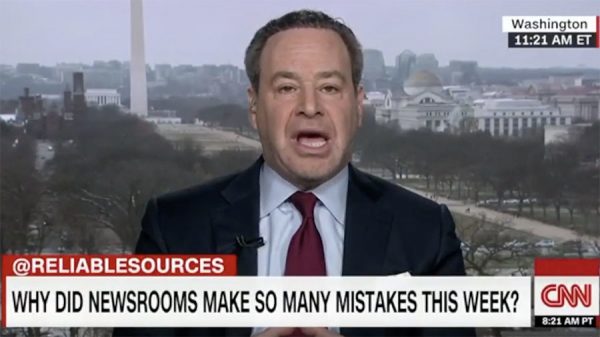
Factually inaccurate reports are a natural by-product of fighting Donald Trump’s “system of lies”, CNN pundit David Frum has reassured the public. The Atlantic senior editor’s comments were made in the wake of false reporting by ABC and CNN.
“The mistakes are precisely the reason people should trust the media,” Frum told Brian Stelter, on CNN’s ‘Reliable Sources’ program.
He insisted that “the worst mistakes that press organizations have made in their coverage of [US President Donald] Trump has precisely occurred in their overzealous effort to be fair to the president.”
Frum’s comments come after two major news networks, CNN and ABC, each had to correct “bombshell” reports that showed Trump and his administration in a poor light.
Frum, who is The Atlantic’s editor and was a speech-writer for President George W. Bush, argued that Trump and his supporters are “not well-placed to complain” about the false media reports, because they themselves are engaged in a “system of lies.”
“Mistakes occur in the process of exposing the lies,” Frum claimed. “The liars then complain about the mistakes that are investigating them.”
Likening CNN reporters to astronomers committed to the “discovery of truth,” Frum urged news consumers to trust the press, but also to consult a variety of sources, in order to avoid close-minded thinking. However, Frum warned CNN’s viewers against watching Fox News, which he said did not have “an interest in finding truth.”
Several American news networks have been on the defensive after back-to-back “bombshell” stories about Trump and his associates were quickly revealed as ‘nothing burgers’.
Brian Ross, chief investigative correspondent for ABC News, erroneously reported on December 1 that Michael Flynn, the former national security adviser, would testify that Trump had directed him to make contact with Russian officials while Trump was still only a candidate for the presidency.
The story was considered so damaging to US political and economic stability that the stock market took a hit after it was published. In fact, Flynn had been asked to contact Russian diplomats only after Trump won the election.
Ross received a four-week suspension from ABC after the widely-publicized story, which had been hailed as conclusive proof of Trump’s so-called collusion with Russia. Such contact is nothing more than routine procedure by an incoming administration.
CNN painted itself into a similar, factually dubious corner when it reported that congressional investigators had been provided an email that suggested Trump had been offered early access to leaked Democratic National Committee emails.
The story, which was heralded by CNN as evidence of a nefarious Trump-Wikileaks-Russia trifecta, fell apart within hours, after it was revealed that the news network had misreported the date of the email, which had been sent by a random Trump supporter forwarding publicly available information.
Although it corrected its story, CNN has since avoided explaining how it got the facts so wrong. Its initial report cited “multiple” anonymous sources. However, during his Sunday program, Stelter did acknowledge that the report was “a black eye for CNN.”
CNN refuses to reveal names of “multiple sources” who spread Wikileaks-Trump fake news story
By Alex Christoforou | The Duran | December 11, 2107
Last week was a very bad week for fake news CNN.
CNN was embarrassed (to say the least) after completely screwing up what it dubbed a “bombshell” Trump collusion story, by misreading email dates, and confusing a “4” with a “14”.
CNN had claimed that an email sent to the Trump campaign, containing hacked documents and encryption key, was dated September 4th, days before being released to the public.
This was the smoking gun proving Trump-Wikileaks collusion and by extension Trump-Russia collusion. Only problem was that the real date of the email was ten days after Wikileaks publicly released its leaked documents. Zerohedge noted at the time…
As it turns out, the email was dated Sept. 14. The documents had actually been made publicly available earlier that day. Wikileaks was merely trying to draw the Trump campaign’s attention to the documents.
So, two of CNN’s ace political reporters managed to write a “bombshell” story, which presumably made it through at least one round of edits, and was also probably reviewed by the network’s legal department, without anybody double-checking the date of the email – the crux of the entire. For what it’s worth, CNN said it based its story on the accounts of two sources who had seen the email. But this just highlights the dangers of relying on second-hand information, and should make readers question the next anonymously sourced story they see.
CNN corrected its story after the Washington Post, which managed to obtain a copy of the email, pointed out the error, which transformed the CNN story from a “bombshell” into essentially a nonstory.
Progressive media commentator, Jimmy Dore tore apart CNN, and its fake news cohorts MSNBC, CBS and ABC for not only spreading the fake news, but not having the integrity to issue a proper retraction… at the very least CNN should, as The Intercept’s Glenn Greenwald points out, expose who the “multiple sources” for the story were, and how such multiple sources all misread the date.
It is, of course, completely plausible that one source might innocently misread a date on a document. But how is it remotely plausible that multiple sources could all innocently and in good faith misread the date in exactly the same way, all to cause to be disseminated a blockbuster revelation about Trump/Russia/WikiLeaks collusion? This is the critical question that CNN simply refuses to answer. In other words, CNN refuses to provide the most minimal transparency to enable the public to understand what happened here.
*****
Think about what this means. It means that at least two – and possibly more – sources, which these media outlets all assessed as credible in terms of having access to sensitive information, all fed the same false information to multiple news outlets at the same time. For multiple reasons, the probability is very high that these sources were Democratic members of the House Intelligence Committee (or their high-level staff members), which is the committee that obtained access to Trump Jr.’s emails, although it’s certainly possible that it’s someone else. We won’t know until these news outlets deign to report this crucial information to the public: which “multiple sources” acted jointly to disseminate incredibly inflammatory, false information to the nation’s largest news outlets?
Qatar finalizes $8bn weapons deal with UK
Press TV – December 10, 2017
Qatar has signed a major weapons deal to buy 24 Typhoon fighters from the United Kingdom amid a political stand-off with former Arab allies of the Persian Gulf region.
Qatar’s Defense Minister Khalid bin Mohammed al-Attiyah and his British counterpart, Gavin Williamson, signed the deal on Sunday in the Qatari capital of Doha.
The agreement, worth USD 8 billion (6.8 billion euros), is the latest to come from Doha amid a diplomatic row with Saudi Arabia, the United Arab Emirates, Bahrain and Egypt. The four cut their diplomatic ties with Qatar six months ago over allegations of its support for terrorism. They have even warned of further action if Doha does not mend its regional policies.
Qatar has showed no sign that it is ready to bow to the pressures while maintaining that it would remain independent in its foreign policy. It has also rejected key conditions put forward by the four countries for normalization, including a downgrade in ties with regional power Iran and expulsion of Turkish troops from the Qatari soil.
The deal signed Sunday is Qatar’s second major military agreement this week. An agreement to buy 12 French Dassault Aviation warplanes worth of billions of dollars came on December 7.
Williamson, British defense chief, hailed the Sunday agreement with Qatar and said it was the biggest order for Typhoons in a decade. He said the fighter jets will support “stability in the region and delivering security at home”.
Arab countries of the Persian Gulf region are major customers for weapons made in the West. Spearheaded by Saudi Arabia, the countries have signed deals worth of tens of billions of US dollars with major western arm producers over the past years.
Featured Video

Michael von der Schulenburg: Europe’s Self-Defeating Iran War Policy
or go to
Aletho News Archives – Video-Images
Frlom the Archives
Provoking a Path to Persia
The Saban Center’s prescient paper on war with Iran
By Maidhc Ó Cathail | October 20, 2011
In June 2009, the Saban Center for Middle East Policy published “Which Path to Persia?—Options for a New American Strategy toward Iran.” Writing in a tone strikingly reminiscent of the Project for a New American Century’s infamous pre-9/11 paper “Rebuilding America’s Defenses,” the six co-authors noted that, “It seems highly unlikely that the United States would mount an invasion without any provocation or other buildup.” For a think tank specifically established by media mogul Haim Saban to protect Israel, this could prove to be a formidable obstacle impeding their desired march—of U.S. troops—to Tehran.
“In fact, if the United States were to decide that to garner greater international support, galvanize U.S. domestic support, and/or provide a legal justification for an invasion, it would be best to wait for an Iranian provocation, then the time frame for an invasion might stretch out indefinitely,” Saban’s think-tankers ruefully observed.
“With only one real exception, since the 1978 revolution, the Islamic Republic has never willingly provoked an American military response, although it certainly has taken actions that could have done so if Washington had been looking for a fight. Thus it is not impossible that Tehran might take some action that would justify an American invasion. And it is certainly the case that if Washington sought such a provocation, it could take actions that might make it more likely that Tehran would do so (although being too obvious about this could nullify the provocation). However, since it would be up to Iran to make the provocative move, which Iran has been wary of doing most times in the past, the United States would never know for sure when it would get the requisite Iranian provocation. In fact, it might never come at all.”
Seemingly undeterred by Iran’s frustrating unwillingness to provide the requisite provocation, the analysts continued to examine this option… continue
Blog Roll
 Aletho News
- Iran attacks on UAE leaves RSF militia high and dry
- Hosting Washington’s war: Bahrain faces the consequences
- The US fell for its own Iran propaganda
- Seyed M. Marandi: Threat of Seizing Kharg Island & the Use of Nuclear Weapons
- Is there even an off ramp?
- Michael von der Schulenburg: Europe’s Self-Defeating Iran War Policy
- Sorry, The New Republic, Climate Change Isn’t Causing Somali Migration. Blame Civil Strife and Poverty.
- Expert Guts Claims That HPV Vaccine Reduces Cancer Risk
- No evidence Russia sabotaged Baltic cables – Finnish intel
- The Strategic Folly of a (Serious) US Ground Invasion of Iran
- If Americans Knew
- Are we on the precipice of World War III?
- ‘Catastrophic,’ Says UNICEF: 1,100+ Children Killed or Wounded in Mideast Since US-Israel Launched Iran War
- The Unbelievable Madness of Our War With Iran
- World Council of Churches calls on govts to hold Israel accountable for violations of intl law
- How to end the war on Iran that costs US taxpayers $1M per minute – Not a ceasefire Day 153
- Israeli strategic plans to “remake the Middle East” from the 1950s and since
- Honoring Gaza’s women who refused to let the world look away
- 97% of victims of war on Iran are Iranian, 98% of victims in war on Gaza are Gazans – Not a ceasefire Day 152
- Early Iran strikes cost $5.6 billion in munitions, Pentagon estimates
- Israel Decided the War, But Trump’s America Fights and Pays the Bill
- No Tricks Zone
- New Studies: UK Sea Levels Were 4 Meters Higher Than Today During The Mid-Holocene
- Destructive Green New Deal: German Energy And Metal Group Warns Of Drastic Crisis
- New Study Documents A 20-Year Pause In Arctic Sea Ice Decline – Driven By Internal Variability
- Wake-up Call: Survey Shows Majority Of Germans Now Favor Postponing Climate Targets!
- Televised! Leading German Political Candidate Tells Schoolchildren CO2 Makes Sun Hotter!
- New Study: A Century Warming Of 1.1°C Is ‘Commonplace’ And ‘Not Unusual’ During This Interglacial
- New Study: ‘Internal Noise’ And Volcanic Forcing Can Trigger 10-15°C Warming Within Decades
- Glaciers Worldwide Are Suddendly Surging, Experts Blame Warming!
- Surprising Discovery: Sahara Is Greening…Billions Of Trees Where Once Thought To Be Barren
- New Research Reaffirms Clouds, Aerosols, And Surface Solar Radiation Are ‘Driving The Climate System’
 Aletho News