Soros & the £400k Question: What constitutes ‘foreign interference’ in democracy?

© Wiktor Dabkowski / Global Look Press
By Neil Clark | RT | February 9, 2018
You’d have to have a real sense of humor failure not to laugh. The news that US billionaire George Soros donated £400k to an anti-Brexit group came on the day that YouTube said they found no evidence of Russian interference in Brexit.
Repeat After Me (with robotic arm movements): “Unproven Russian involvement in Brexit – terrible! Impose more sanctions on Moscow! A £400k check from an American billionaire for an anti-Brexit campaigning group – that’s no problem; it’s helping our democracy!”
You don’t have to own a brand new £999 state-of-the art Hypocrisy Detector from Harrods, to pick up on the double standards. Just having a few functioning brain cells and thinking for yourself will do. For months in the UK we’ve been bombarded with Establishment-approved conspiracy theories – peddled in all the ’best’ newspapers – that Russia somehow ‘fixed’ Brexit. Getting Britain to leave the EU was all part of a cunning plot by Vladimir Putin, aka Dr. Evil, to weaken Europe and the ‘free world.’
Even West End musical composer Andrew Lloyd-Webber, who knows quite a bit about phantoms, seemed taken in by it. “By quitting Europe, I fear that we are hastening Putin’s dream of the break-up of the EU – and with it, potentially, western civilisation,” the noble Lord declared in July.
Never mind that we don’t have a single statement from Putin or other senior Kremlin figures saying that they actually supported Brexit. These Establishment Russia-bashers know exactly what The Vlad is thinking.
And never mind that RT and Sputnik, which we are repeatedly told are “propaganda arms of the Russian government,” ran articles by pro- and anti-Brexit writers. The same people who told us Iraq had WMDs in 2003 were absolutely sure it was those dastardly Russkies who had got Britain to vote ‘leave.’ The irony is of course that there was significant foreign interference in Brexit. But it didn’t come from Moscow.
The US has always wanted Britain to stay in the EU. In April 2016, two months before the Referendum, President Obama made it clear what he wanted when he visited the UK. He warned that if Britain exited the EU it would be “at the back of the queue” for trade deals with the US.
Just imagine if Putin had said that. The Russophobes would have spontaneously combusted.
Then of course there was the backing the Remain camp had from the giants of US capital. Goldman Sachs and JP Morgan donated £500,000 each to the ‘Britain Stronger in Europe’ group, Citigroup and Morgan Stanley – £250,000 each.
Again, repeat after me (with robotic arm movements): “This is not foreign interference… This is not foreign interference!”
The point is not whether we are for or against Brexit. Or whether we think George Soros is a malign influence who only acts out of self-interest or an old sweetie-pie with the good of humanity at heart. The point is the double standards that are causing our Hypocrisy Detectors to explode.
Let’s think back to December 2016. Then, the pro-war and fiercely anti-Russian Labour MP Ben Bradshaw told Parliament that it was “highly probable” that Russia had interfered with Brexit.
Fourteen months on, what have we got? On Thursday, the global head of You Tube’s public policy, Juniper Downs, said her company “had conducted a thorough investigation around the Brexit referendum and found no evidence of Russian interference.”
Twitter meanwhile says it detected 49 (yes, 49) accounts from what it claimed to be a “Russian troll factory,” which sent all of 942 messages about Brexit – amounting to less than 0.005% of all the tweets about the Referendum. Twitter said the accounts received “very low levels of engagement” from users. If the Kremlin had planned to use tweets to persuade us to vote ‘leave,’ they didn’t really put much effort into it, did they?
Finally, Facebook said that only three “Kremlin-linked” accounts were found which spent the grand sum of 72p (yes, 72p) on ads during the Referendum campaign. Which amounts to the greater “interference”? 72p or £400K? Erm… tough call, isn’t it?
You might have thought, given his concern with ‘foreign interference’ in British politics, that Ben Bradshaw would have been urging ‘Best for Britain’ to return George Soros’ donation. Au contraire! His only tweets about it were retweets of two critical comments about the Daily Telegraph, and the BBC’s coverage of the story. Conclusion: Those who rail about ‘Russia meddling in Brexit’ but not Soros’ intervention aren’t concerned about ‘foreign interference’ in UK politics, only ‘foreign interference’ from countries they don’t approve of.
Those who are quite happy peddling ludicrous conspiracy theories about Russians shout “conspiracy theorist” (or worse) at those who report factually on proven meddling from others. The Daily Express hit the nail on the head in their Friday editorial which said: “Just what does George Soros think he is doing pouring £400,000 into a campaign to stop Brexit. For a start he is not actually a resident of this country so it has nothing to do with him.”
That really is the rub of the matter. And Bradshaw and co. have no adequate response except to shoot the messenger.
If we look at the affair with an even wider lens, the hypocrisy is even greater. The US has been gripped by an anti-Russian frenzy not seen since the days of Senator Joe McCarthy. The unsubstantiated claim that Russia fixed the election for Donald Trump is repeated by ‘liberals’ and many neocons too, as a statement of fact. “I don’t know that the public understands the gravity of what the Russians were able to do and continue to do here in the United States. They’ve attacked us. They’re trying to undermine our democracy,” film director Rob Reiner said.
But the number one country round the world for undermining democracy and interfering in the affairs of other sovereign states is the US itself.
While Establishment journos and pundits have been foaming at the mouth over ‘Russiagate’ and getting terribly excited over ‘smoking guns’ which turn out – surprise, surprise – to be damp squibs, there’s been less attention paid to the boasts of former Vice President Joe Biden on how he got the allegedly ‘independent’ Ukrainian government to sack its prosecutor general in a few hours. “I looked at them and said: ‘I’m leaving in six hours. If the prosecutor is not fired, you’re not getting the money…”
“I said, ‘I’m telling you, you’re not getting the billion dollars,” Biden said during a meeting of the US’ Council on Foreign Relations. “Well, son of a b***h. He got fired.”
Again, just imagine the furore if a leading Russian government figure boasted about how he used financial inducements to get another country’s Prosecutor General to be sacked. Or if a tape was leaked in which the Russian Ambassador and a Russian Foreign Ministry spokesperson could be heard discussing who should or shouldn’t be in the new ‘democratic’ government of another sovereign state. But we had the US Ambassador to Ukraine and the US Assistant Secretary of State doing exactly that in 2014 – and the ‘Russia is interfering in the Free World!’ brigade were as silent as a group of Trappist monks.
It’s fair to say that Orwell would have a field day with the doublespeak that’s currently on show. The cognitive dissonance is there for all to see. Repeat After Me: Unproven Russian interference – Bad. Proven interference from other external sources – Good. What’s your problem?
Follow Neil Clark @NeilClark66
Read more:
‘This is Nuts’: Liberals Launch ‘Largest Mobilization in History’ in Defense of Russiagate Probe
By Coleen Rowley and Nat Parry | Consortium News | February 9, 2018
With Democrats and self-styled #Resistance activists placing their hopes for taking down Donald Trump’s presidency in the investigation being led by Special Counsel Robert Mueller, online groups such as MoveOn and Avaaz are launching campaigns to come to the Special Counsel’s defense in the event of him being removed by the president.
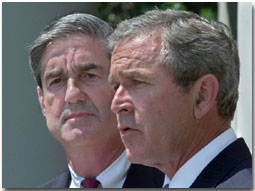
Robert Mueller with President George W. Bush
(White House photo)
In an action alert to supporters on Wednesday, Avaaz announced plans to hold some 600 events around the country to defend Mueller in case Trump tries to fire him. “This is nuts,” Avaaz writes. “Trump is clearly gearing up to fire the independent official investigating Russia’s influence over the election — if he does, he’ll have delivered a death blow to one of the fundamental pillars of our democracy.”
Avaaz claims that hundreds of thousands of supporters have signed up for actions protesting Mueller’s possible removal, and that more than 25 national organizations support the protests. The group calls it potentially “the largest national mobilization in history.”
Considering all of the threats to democracy posed by unconstitutional overreach, unfair elections, corruption, and voter suppression – not to mention environmental challenges, economic inequality, an out-of-control U.S. foreign policy, numerous foreign conflicts that the U.S. is engaged in, and the ever-present threat of nuclear war – it is telling that the liberal establishment is mobilizing on this particular issue.
Social psychologists have long talked about how emotional manipulation can work effectively to snooker a large percentage of the population, to get them, at least temporarily, to believe the exact opposite of the facts. These techniques are known in the intelligence community as “perception management,” and have been refined since the 1980s “to keep the American people compliant and confused,” as the late Robert Parry has reported. We saw this in action last decade, when after months of disinformation, about 70% of Americans came to falsely believe that Saddam Hussein was behind 9/11 when the truth was the opposite – Saddam was actually an enemy of the Al Qaeda perpetrators.
Such emotional manipulation is the likely explanation for the fact that so many people are now gearing up to defend someone like Mueller, while largely ignoring other important topics of far greater consequence. With no demonstrations being organized to stop a possible war with North Korea – or an escalation in Syria – hundreds of thousands of Americans are apparently all too eager to go to the mat in defense of an investigation into the president’s possible “collusion” with Russia in its alleged meddling in election 2016.
Setting aside for the moment the merits of the Russiagate narrative, who really is this Robert Mueller that amnesiac liberals clamor to hold up as the champion of the people and defender of democracy? Co-author Coleen Rowley, who as an FBI whistleblower exposed numerous internal problems at the FBI in the early 2000s, didn’t have to be privy to his inner circle to recall just a few of his actions after 9/11 that so shocked the public conscience as to repeatedly generate moral disapproval even on the part of mainstream media. Rowley was only able to scratch the surface in listing some of the more widely reported wrongdoing that should still shock liberal consciences.
Although Mueller and his “joined at the hip” cohort James Comey are now hailed for their impeccable character by much of Washington, the truth is, as top law enforcement officials of the George W. Bush administration (Mueller as FBI Director and Comey as Deputy Attorney General), both presided over post-9/11 cover-ups and secret abuses of the Constitution, enabled Bush-Cheney fabrications used to launch wrongful wars, and exhibited stunning levels of incompetence.
Ironically, recent declassifications of House Intelligence Committee’s and Senate Judiciary Committee Leaders letters (here and here) reveal strong parallels between the way the public so quickly forgot Mueller’s spotty track record with the way the FBI and (the Obama administration’s) Department of Justice rushed, during the summer of 2016, to put a former fellow spy, Christopher Steele up on a pedestal. Steele was declared to be a “reliable source” without apparently vetting or corroborating any of the “opposition research” allegations that he had been hired (and paid $160,000) to quickly produce for the DNC and Hillary Clinton’s campaign.
There are typically at least two major prongs of establishing the “reliability” of any given source in an affidavit, the first – and the one mostly pointed to – being the source’s track record for having furnished accurate and reliable information in the past. Even if it is conceded that Steele would have initially satisfied this part of the test for determining probable cause, based on his having reportedly furnished some important information to FBI agents investigating the FIFA soccer fraud years before, his track record for truthfulness would go right up in smoke only a month or so later, when it was discovered that he had lied to the FBI about his having previously leaked the investigation to the media. (Moreover, this lie had led the FBI to mislead the FISA court in its first application to surveil Carter Page.)
The second main factor in establishing the reliability of any source’s information would be even more key in this case. It’s the basis of the particular informant’s knowledge, i.e. was the informant an eye witness or merely reporting double-triple hearsay or just regurgitating the “word on the street?”
If the actual basis of the information is uncertain, the next step for law enforcement would normally be to seek facts that either corroborate or refute the source’s information. It’s been reported that FBI agents did inquire into the basis for Steele’s allegations, but it is not known what Steele told the FBI – other than indications that his info came from secondary sources making it, at best, second- or third-hand. What if anything did the FBI do to establish the reliability of the indirect sources that Steele claimed to be getting his info from? Before vouching for his credibility, did the FBI even consider polygraphing Steele after he (falsely) denied having leaked his info since the FBI was aware of significant similarities of a news article to the info he had supplied them?
Obviously, more questions than answers exist at the present time. But even if the FBI was duped by Steele – whether as the result of their naivete in trusting a fellow former spy, their own sloppiness or recklessness, or political bias – it should be hoped by everyone that the Department of Justice Inspector General can get to the bottom of how the FISA court was ultimately misled.
As they prepare for the “largest mobilization in history” in defense of Mueller and his probe into Russiagate, liberals have tried to sweep all this under the rug as a “nothing burger.” Yet, how can liberals, who in the past have pointed to so many abusive past practices by the FBI, ignore the reality that these sorts of abuses of the FISA process more than likely take place on a daily basis – with the FISA court earning a well-deserved reputation as little more than a rubberstamp?
Other, more run-of-the-mill FISA applications – if they were to be scrutinized as thoroughly as the Carter Page one – would reveal similar sloppiness and lack of factual verification of source information used to secure surveillance orders, especially after FISA surveillances skyrocketed after 9/11 in the “war on terror.” Rather than dismissing the Nunes Memo as a nothing burger, liberals might be better served by taking a closer look at this FISA process which could easily be turned against them instead of Trump.
It must be recognized that FBI agents who go before the secret FISA court and who are virtually assured that whatever they present will be kept secret in perpetuity, have very little reason to be careful in verifying what they present as factual. FISA court judges are responsible for knowing the law but have no way of ascertaining the “facts” presented to them.
Unlike a criminal surveillance authorized by a federal district court, no FBI affidavit justifying the surveillance will ever end up under the microscope of defense attorneys and defendants to be pored over to ensure every asserted detail was correct and if not, to challenge any incorrect factual assertions in pre-trial motions to suppress evidence.
It is therefore shocking to watch how this political manipulation seems to make people who claim to care about the rule of law now want to bury this case of surveillance targeting Carter Page based on the ostensibly specious Steele dossier. This is the one case unique in coming to light among tens of thousands of FISA surveillances cloaked forever in secrecy, given that the FISA system lacks the checks on abusive authority that inherently exist in the criminal justice process, and so the Page case is instructive to learn how the sausage really gets made.
Neither the liberal adulation of Mueller nor the unquestioned credibility accorded Steele by the FBI seem warranted by the facts. It is fair for Americans to ask whether Mueller’s investigation would have ever happened if not for his FBI successor James Comey having signed off on the investigation triggered by the Steele dossier, which was paid for by the Clinton campaign to dig up dirt on her opponent.
In any event, please spare us the solicitations of these political NGOs’ “national mobilization” to protect Mueller. There are at least a million attorneys in this country who do not suffer from the significant conflicts of interest that Robert Mueller has with key witnesses like his close, long-term colleague James Comey and other public officials involved in the investigation.
And, at the end of the day, there are far more important issues to be concerned about than the “integrity” of the Mueller investigation – one being the need to fix FISA court abuses and restoring constitutional rights.
Coleen Rowley, a retired FBI special agent and division legal counsel whose May 2002 memo to then-FBI Director Robert Mueller exposed some of the FBI’s pre-9/11 failures, was named one of TIME magazine’s “Persons of the Year” in 2002.
Nat Parry is co-author of Neck Deep: The Disastrous Presidency of George W. Bush.
Egypt begins major military operation in Sinai, Nile Delta
Press TV – February 9, 2018
Egypt has begun a sweeping military operation against the militants active in violence-torn North Sinai Province in the extreme northwest and the nearby Nile Delta.
The army announced the launch of ‘Operation Sinai 2018’ on Friday, putting the police and military forces on “maximum alert,” AFP reported.
The goal is to tighten control of border districts and “clean up areas where there are terrorist hotbeds,” it added.
The campaign involves the air force, navy and army as well as police, he said.
“The armed forces calls upon the Egyptian people in all parts of the country to closely cooperate with law enforcement forces to confront terrorism, uproot it and immediately report any elements threatening the security and stability of the country,” the military spokesman, Colonel Tamer al-Rifai, said in a televised address.
Last week, The New York Times reported that President Abdel Fattah el-Sisi had kept northern Sinai a closed military area, barring reporters from the region.
The Associated Press has reported that the Egyptian army was bulldozing homes and olive groves to build “a buffer zone” around North Sinai Province’s only airport in the city of el-Arish.
The report said the buffer zone will destroy dozens of hamlets around the airport, forcing thousands of people to leave their homes for an unknown future, sparking some protest by residents despite the government promises of compensation.
Sisi, who is preparing to seek a second term in the upcoming March elections, has vowed that the army will employ “absolute force” in a bid to eliminate terrorism in the Sinai Peninsula.
The Sinai Peninsula has been under a state of emergency since October 2014, after a deadly terrorist attack left 33 Egyptian soldiers dead.
Over the past few years, terrorists have been carrying out anti-government activities and fatal attacks, taking advantage of the turmoil in Egypt that erupted after the country’s first democratically-elected president, Mohamed Morsi, was ousted in a military coup in July 2013.
The Velayat Sinai group, which is affiliated with the Daesh Takfiri terrorists, has claimed responsibility for most of the assaults.
France to spend $33bn on upgrading nukes to meet NATO commitments
Press TV – February 9, 2018
France is planning to spend $33 billion (€27bn) to upgrade its arsenal of nuclear weapons as part of a massive $370 billion (€300bn) military spending over the next few years to meet the NATO military alliance’s requirements, the French defense chief has announced.
Speaking to the media on Thursday, French Defense Minister Florence Parly said Paris wanted to increase its military budget so that it can “hold its own” as a key power in Europe.
“The government’s goal is twofold: reach the target of spending two percent of GDP on defense by 2025, while also ensuring we manage our public finances,” Parly said.
France spends $42 billion (€34bn) or 1.8 percent of its GDP for military purposes, slightly less than the two-percent threshold set by NATO.
Under the new plan, President Emmanuel Macron’s government increases overall spending by $2 billion (€1.7bn) a year starting from 2019 until 2022, when it will reach $53 billion (€44bn). Then the budget would be bumped up by $3.6 billion (€3bn) a year between 2023 and 2025.
By then, Paris is supposed to have completed the expensive revamp of its nuclear arsenal, with work on a third-generation nuclear submarine program and a new generation of airborne nuclear missiles already underway today.
“We are going to make up for past shortfalls and build a modern, sustainable, protective army” that would allow France “to hold its own,” said Parly.
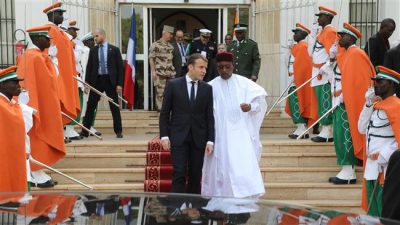 French military forces are currently deployed to West Africa on a declared mission to fight militant groups.
The French president says the country is ready to enhance its military presence in the Sahel region if needed.
The country is also a main contributor to a US-led coalition that has been targeting alleged terrorist positions in Iraq and Syria since 2015.
The years-long operations have put strain on France’s military forces and equipment.
With thousands of troops overseas, the new program allows the defense department to perform a host of upgrades on equipment, from bullet-proof vests to combat uniforms.
There will also be a 34-percent increase in spending on “modernizing weaponry,” which includes buying new Scorpion armored vehicles, four Barracuda attack submarines and three multi-mission frigates, as well as a new fleet of Griffon multi-role armored vehicles.
There are also plans to develop new spy satellites, light surveillance aircraft, new Rafale fighter jets and armed drones. Air tankers are also on the long list of upgrades.
The development is a major reversal in France’s military strategy over the past years and is expected to please US President Donald Trump, who has put NATO allies under pressure to increase their military budgets.
Afghanistan War Spending, In 2018 Alone, Could End US Homelessness—TWICE
While the United States government spends $45 billion on the 17th year of the Afghanistan War, it ignores the fact that just half of that money could be used to virtually end homelessness in the U.S. annually.
By Rachel Blevins | Free Thought Project | February 7, 2018
Defense Department officials are claiming that the cost of the United States’ longest war in history will be $45 billion in 2018, which is actually double to estimate of what it would cost to end homelessness in the U.S. annually.
Randall Schriver, the assistant secretary of Defense for Asian and Pacific security affairs, said that he expects the Afghanistan war to cost American taxpayers $45 billion this year, which in addition to logistical support, will include about $13 billion for U.S. forces, $5 billion for Afghan forces, and $780 million for economic aid.
Schriver made the announcement during the Senate Foreign Relations Committee hearing on Tuesday. Deputy Secretary of State John Sullivan also spoke, and said he believes the United States’ policy “acknowledges that there isn’t a military solution or a complete solution.”
“I understand it’s America’s longest war, but our security interests in Afghanistan, in the region are significant enough … to back the Afghan government in their struggle against the Taliban,” Sullivan said.
Over 31,000 civilian deaths have been documented in Afghanistan following the U.S. invasion. The United Nations Assistance Mission in Afghanistan began documenting civilian casualties in 2009, and the combined number of civilians who were killed and injured that year was nearly 6,000. The number has steadily increased over the years, and in 2016, it reached a record high with nearly 3,500 killed and nearly 8,000 injured.
A report from the UNAMA noted that in 2017, the death rate for children increased by 9 percent over the previous year, and the death rate for women increased by 23 percent. The report also claimed that an increase in airstrikes has led to a 43 percent increase in causalities.
The Hill reported that the Defense Department officials did receive some criticism from senators such as Jeff Merkley, a Democrat from Oregon, who questioned why the Taliban would want a political settlement now when they already “control more territory than they did since 2001” when the U.S. invaded the country—claiming the purpose was to defeat the Taliban.
Sen. Rand Paul, a Republican from Kentucky, also criticized the massive 2018 budget for the Afghanistan War, and argued that after 16 years, Afghans still “don’t seem to be able to defend themselves,” and for U.S. taxpayers, billions of dollars are “just being thrown down a hatch in Afghanistan.”
“I think there’s an argument to be made that our national security is actually made more perilous the more we spend and the longer we stay there. … We’re in an impossible situation,” Paul said. “I just don’t think there is a military solution.”
Paul has a history of criticizing the amount of money the U.S. government spends in foreign countries, especially on wars in the Middle East. After Trump vowed to continue the longest war in U.S. history in August 2017, Paul criticized the move and asked when the U.S. would start focusing on its own country.
“We spent billions of dollars—I think it’s over $100 billion—building roads in Afghanistan, blowing up roads in Afghanistan, building schools, blowing up schools, and then rebuilding all of them,” Paul said. “Sometimes we blow them up, sometimes someone else blows them up, but we always go back and rebuild them. What about rebuilding our country?”
Paul has a point, and the money that is being used to kill innocent civilians in Afghanistan is desperately needed in the United States. According to estimates from Mark Johnston, the acting assistant housing secretary for community planning and development, “homelessness could be effectively eradicated in the United States at an annual cost of about $20 billion.”
If the United States government cut its budget for the Afghanistan War in half, and put half of the money towards ending homeless in America, it could make a difference. If the government gave the entirety of the money it is using for endless proxy wars in the Middle East back to the taxpayers it was originally stolen from so that they could invest it in helping the individuals in need in their own communities, it could work wonders.
Rachel Blevins is an independent journalist from Texas, who aspires to break the false left/right paradigm in media and politics by pursuing truth and questioning existing narratives. Follow Rachel on Facebook, Twitter, YouTube, Steemit and Patreon.
Associated Press Double Standard in Israel-Palestine Reporting
By Kathryn Shihadah and Alison Weir | If Americans Knew | February 8, 2018
More than half the world’s population reads Associated Press content every day.
But a study of news reports so far in 2018 indicates that this trusted news source has been presenting the deaths of Israelis at the hands of Palestinians, and of Palestinians at the hands of Israelis, in two completely different ways.
This pattern may be a factor in how readers perceive the players in this decades-old issue. It is also, quite likely, a factor in how editors all over the U.S., who read AP stories daily, view the conflict.
So far in 2018, eleven Palestinians have been killed and two Israelis.
(Since December 4th, when President Trump announced that the US would recognize Israel as “the capital of Israel,” overturning decades of US policy, 27 Palestinians and 9 Israelis have died.)
In AP’s 2018 news reports, Palestinian deaths have been reported in far shorter news articles than Israeli deaths, averaging 181 words in length vs. 551.
In addition to the number of words, AP’s choice of words, context, and which facts to report and which to omit appears to tell two totally different kinds of stories for Israelis and Palestinians.
Reports on Israeli deaths included statements by high officials condemning the attacks. These were often strongly worded, politically charged statements that conveyed the Israeli narrative: “[Israel will] do everything possible in order to apprehend the despicable murderer”; “There is no justification for terror… This is not the path to peace!” “Hamas praises the killers and PA laws will provide them financial rewards. Look no further to why there is no peace.”
By contrast, these AP reports rarely included statements by Palestinian officials condemning the killing of Palestinians, which would have provided another perspective for readers. For example, Fatah spokesman Osama Qawassmeh released a statement that Israel was guilty of a long list of actions that “contravene international law.”
Another Palestinian official condemned Israel’s “extrajudicial killings” and warned of Israel’s tendency to turn the West Bank into a “scene for escalation and security tension so as to pressure our people and leaders, and divert attention from colonialist expansion in our state.”
Such Palestinian viewpoints, largely accurate and readily available, were never reported in the AP articles on deaths.

A Palestinian boy weeps during the funeral of Hani Wahdan, killed during “clashes.”
Israeli victims are human beings, Palestinian victims are “gunmen” or anonymous
Israeli victims were also personalized in AP reports: one was characterized as “a 29-year-old father of four”; the attempted rescue of another was described: “immense efforts were made to save the man’s life, but his wounds were too severe.”
On the other hand, AP reported Palestinian victims with impersonal, often negative descriptions: “armed protester,” “instigators,” and “protesters who were hurling massive amounts of rocks.”
Nowhere did AP describe efforts to save the victims’ lives, although certainly those efforts were made. Elsewhere there were reports of noteworthy turns of events from the scene. This is unfortunately a common occurrence at the scene of Palestinian injuries and deaths: “Eyewitnesses said Israeli soldiers …. fired gas bombs at the Palestinian ambulances and medics that arrived on the scene.” In another incident, “soldiers refused to allow ambulances and firefighters to enter the area.” These descriptions would have been valuable additions to the AP reports.

Palestinian relatives of 16-year-old Layth Abu Naeem weep during his funeral, Jan 31, 2018. The boy was killed by Israeli soldiers who had invaded his village. (EPA-EFE/ALAA BADARNEH)
To its credit, AP did identify the five Palestinian teenagers killed as “teens” – in the past this has not always been the case, where the youth of Palestinian victims has often not been mentioned.
The actual killings of the Palestinians were often reported passively, e.g. “shot in the head during a stone-throwing confrontation” or “died in the violence.”
In two of the Palestinian deaths, AP reported that the Israeli military “denied using live fire.” The men were still dead, and no questions were asked.
In fact, other sources paint entirely different pictures of the killing of the Palestinians. For example, one young man named Ali was only described by AP as “shot in the head” during a violent riot.
But according to eyewitnesses, as reported elsewhere, a number of armed Israeli settlers had infiltrated a Palestinian town, and Ali was part of a group that were forcing them out of town – at which time Israeli soldiers began firing at the group. Ali was reportedly killed by an army sharp-shooter.
In another incident, Israeli soldiers were searching for the man who had killed a settler a few days earlier. The AP article explains that they found and killed a suspect and then demolished three homes belonging to his extended family.
The article does not reveal that they killed the wrong man. It also does not mention that at least 30 vehicles participated in the invasion of the wrong home, and that soldiers confiscated surveillance videos from stores in the area.
AP headlines give Israeli spin
The headlines of the news reports are tellingly different as well.
In the cases of Israeli deaths, the headlines indicate one innocent party and one guilty party: “Israeli killed in West Bank shooting attack”; “Israeli killed by Palestinian in West Bank stabbing attack.”
On the other hand, most of the Palestinian death headlines suggest two equal parties in conflict: “Palestinian teen killed in clashes”; “2 teens killed in clashes with Israeli army”; “Troops kill Palestinian teen in West Bank clash.”
In one case, “Palestinians say Israeli army kills 19-year-old rock thrower,” the victim was at least acknowledged as an individual, but the situation in which Ahmad’s death occurred was misrepresented. The article claims that he was “shot in the head during a stone-throwing confrontation,” but there is much more to the story.

Israeli forces raid the village of Wadi Burqin. [Mohamad Torokman/Reuters]
According to IMEMC, Ahmad was killed
during a massive military invasion…carried out by twenty-two armored military vehicles, and two bulldozers…the soldiers also shot two other young Palestinian men with live rounds in their legs, and six with rubber-coated steel bullets, in addition to causing dozens to suffer the severe effects of teargas inhalation…soldiers broke into and searched many homes, and used K9 units in searching the properties, causing anxiety attacks among many Palestinians, especially children…
Some of the villagers protested this aggression, and it was in this context that an Israeli soldier shot Ahmad in the head.
In this incident, the Israeli army was searching for the killer of a settler named Rabbi Raziel Shevach, who had been killed three weeks earlier, and AP again recounted this older death. In fact, there was more about the settler’s death, which had already been reported on several times, than about the innocent man killed in the manhunt.
According to AP, “The Israeli military had no immediate comment about the casualty.”
AP stories about Shevach reported that he taught in a religious school in Yitzhar and lived in the outpost of Havat Gilad. None, however, bothered to mention that Yitzhar has long been known as “an extremist bastion” of settler violence against Palestinians, home of the notorious Yitzchak Ginsburgh, and that Havat Gilad is similarly notorious for violence against Palestinians.
The Israeli newspaper Ha’aretz reported in 2014, for example, that close to 100 people had been been involved in “a wave of hate crimes against Palestinians and Israeli Arabs. Most of the culprits are known as far-right activists from the Yitzhar settlement and hilltop outposts north of Ramallah and the south Hebron Hills in the West Bank.” This is just one of many such incidents (see video here).
Such context likely would have been included by AP if it had been about Palestinian violence.
AP omits essential context

Palestinian women attempt to pass the Israeli checkpoint in the West Bank town of Bethlehem, Aug. 12, 2011. (AP Photo/Bernat Armangue)
AP reports often leave out critical facts. For example, its news reports on a Palestinian girl imprisoned by Israel for slapping armed Israeli soldiers, almost always left out or minimized the fact that her anger was triggered by the fact that shortly before the incident, an Israeli soldier had shot her cousin in the face.
Perhaps more significant, essential facts about the greater issue are virtually never included.
Nowhere in these reports does AP tell readers that the U.S. gives Israel over $10 million per day. Without this information, American readers will incorrectly feel this is a foreign issue that has nothing to do with them.
Basic information that would give the reader an understanding of the context of the hostility is absent.
Nowhere in any of the articles does the word “occupation” occur, although the illegal Israeli occupation is a 50-year-old fact of life that affects every aspect of Palestinian life. Omitting the fact that Palestinians are living under Israeli military control leaves readers ignorant of one of the most significant aspects of the conflict.
Nowhere in these reports does AP note that many Palestinian families in the West Bank and Gaza were pushed out by Israel during the 1948 war that created the Jewish state, their properties confiscated by Israel. These refugees have not been allowed to return and reclaim their homes, a violation of international law. This, too, is essential information.

Israelis soldiers arrest Palestinian teen Fawzi Muhammad Al-Juneidi in Jerusalem, Dec. 8, 2017
Nowhere does AP use the word “resistance,” the usual term for people fighting against military occupation. Instead, Palestinians are always “militants,” “gunmen,” “stone throwers,” etc. Americans fighting against the British in the 18th century, French fighting against the German occupation in the 20th century, etc. were resistance forces. So are Palestinians.
The word “settlement” is used 19 times in the AP reports. According to international law these settlements are illegal. However, only once does AP mention this fact, and even here it does so in a somewhat diluted manner: “most of the international community considers settlements illegal.”
Nowhere in these reports does AP inform readers that Israel is steadily stealing Palestinian land and imprisoning Palestinians who object to this. Nowhere do these report that Palestinians have virtually no freedom of movement, that some 70 percent of Palestinian families have had one or more family members serve time in an Israeli prison, that hundreds of Palestinian children are in prison, and that Israel is known for its physical abuse of prisoners.

Maali, daughter of jailed Islamic Jihad spokesman Khader Adnan, stands next to a picture of her father outside Israel’s Ofer prison.
Without these and other critical details, it is impossible for readers to have a clear picture of the basis of the conflict and the context of the deaths.
At the end of one AP article is this statement:
Since 2015, Palestinians have killed over 50 Israelis, two visiting Americans and a British tourist in stabbings and other attacks. Over 260 Palestinians were killed by Israeli forces in that time. Israel says most were attackers and the others died in clashes.
To many editors and readers around the country, this means that 260 guilty Palestinians were killed. “Attackers” are guilty by default (“alleged attackers” might be innocent); people in “clashes” are reckless mobs, confronting soldiers and policemen allegedly working to keep the peace. Readers are left to glean on their own, with next to zero evidence, that these Israeli forces are one of the world’s most powerful militaries putting down protests by an occupied, unarmed population.
Astute, knowledgeable readers might wonder how many of those dead Palestinians were really attackers? How many were cases of mistaken identity? And what about those who actually were attacking heavily armed soldiers and settlers… why were they doing this? Could it be because Israel was stealing their land and had killed, injured, and/or imprisoned hundreds of Palestinian children?
And what about the unarmed protesters so often shot in the head by Israeli soldiers? Did they have families who grieve for them? Children who are now orphans? Widows who will weep and struggle? Parents who will forever miss them? We will never know.

A Palestinian boy in Gaza weeps for dead family members.
How many of those dead Palestinians were children themselves? Answer: Since January 2015, at least 100 Palestinian children and 1 Israeli child have been killed in the hostilities. (Between 2000 and 2014, 2,079 Palestinian children and 133 Israeli children lost their lives.)
In the time it has taken to write this article, sadly another Palestinian has been killed.
The headline for this death, “Israeli troops kill Palestinian suspect in settler’s killing,” refers to Rabbi Raziel Shevach’s death in early January. Apparently this time the Israeli military finally found the person they “suspected of being behind the killing” that they had been pursuing. They stormed the house where he was staying, and shot him dead (this may be referred to as “trial by assassination” or “extrajudicial killing”).
The AP article recalls that Israeli troops had already demolished the suspect’s residence (and those of his extended family), but somehow neglects to mention that they had also killed his cousin, who had done nothing wrong, as well as another innocent man, during the course of the aggressive manhunt.
And once again, the article mostly discusses the death of the Israeli settler (as well as repeating details about the other Israeli death that occurred in 2018), and mentions nothing about the Palestinian who had just been killed. Did he have children? Parents? A wife? And if he actually was “behind the killing,” what had motivated him?
In the very last paragraph of the article, AP finally mentions that “19 Palestinians have been killed in the violence since Trump’s announcement.” In reality, it was Israelis who killed these people, and it was actually 24 Palestinians at that time, seven of them teenagers, plus a small boy who died on the day of the announcement.
The Associated Press claims on its website:
For 170 years, we have been breaking news and covering the world’s biggest stories, always committed to the highest standards of objective, accurate journalism.
It is possible that the time has come for AP to take a good, hard look at its objectivity and accuracy when it comes to reporting in Israel-Palestine.
AP’s system of reporting

AP Bureau Chief Josef Federman speaking on C-Span.
AP’s main bureau for Israel-Palestine is in Israel. Reports from Gaza and the West Bank are phoned in to this bureau, where its editors choose and write the news stories that are sent out.
Many (possibly most) of the journalists in this main bureau are Israeli citizens or have partners who are. Some (possibly most) have served in the Israeli military and/or have relatives that have done so. While this doesn’t guarantee pro-Israel bias (some Israeli journalists for Ha’aretz, for example, are excellent, accurate writers on this issue) it does suggest the possibility of partiality influencing their work, either consciously or unconsciously.
It is essential that AP be transparent about its reporting on this extremely important issue.
Whatever the cause of the distortion that continuously characterizes its reporting on this region (see this 2005 report on AP reporting on deaths), it is critical that AP remedy it. Americans, who give Israel over $10 million per day, need full, accurate, unbiased reporting.
Last-minute updates: Two more Palestinians killed
Sadly, during the final edit of this piece, two more Palestinians were killed.
IMEMC, the International Middle East Media Center, has posted the following:
“Israeli soldiers killed, on Tuesday at night, a young Palestinian man, and injured 110, including 32 who were shot with live ammunition, in Nablus city, in the northern part of the occupied West Bank. The Palestinian Health Ministry has identified the Palestinian as Khaled Waleed Tayeh, 22, from Iraq-Tayeh village, east of Nablus. Khaled succumbed to his wounds, after being shot with a live round in the chest.”

Khaled Waleed Tayeh, 22
AP also reports the story: “Israeli guard kills Palestinian after West Bank stabbing” but fails to report the victim’s name, age, or anything else about him.
A few hours later Israeli guards in front of an Israeli outpost shot dead 19-year-old Hamza Yousef No’man Zama’ra, who had attacked one of the armed guards with a knife, cutting the man’s hand. AP reported the death but again failed to give Hamza’s name, age, or additional information about him.

Hamza Yousef No’man Zama’ra, 19
AP also fails to mention that Israel plans to level dozens of Palestinian schools in the West Bank, that Israeli forces have just detained a 52-year-old Palestinian mother and shot a teenager in the face, and that 54 Palestinian patients in critical need of specialized medical care patients died in 2017 when Israel wouldn’t let them leave Gaza.
Perhaps to to AP editors, these stories are of no importance.
However, for many Americans, most of whom believe in justice, fair play, and human rights, such information might diminish the willingness to give Israel massive amounts of their tax money.
* * *
For a list of all Palestinians and Israelis who have been killed by the other side since 2000, see this timeline.
For 2-minute videos of recent Palestinian victims, go here.
Indian diplomacy faces tropical summer in Male
By M K Bhadrakumar | Indian Punchline | February 8, 2018
Writing in the Guardian newspaper, J. J. Robinson, the well-known journalist and author of Maldives: Islamic Republic, Tropical Autocracy, reflected as follows:
- Ultimately the ongoing telenovela of Maldivian political intrigue is a distraction from the real crisis – the illegitimacy of the judiciary. Handpicked by Gayoom during his rule and illegally given life tenure under the new constitution in 2010, the judges have been at the centre of most of the Maldives’ recent ills; at least 50% of the 200-odd judges and magistrates have less than seventh-grade education, while a quarter had actual criminal records, including convictions for sexual misconduct, embezzlement, violence and disruption of public harmony.
- Resoundingly discredited by groups such as the International Committee of Jurists and the UN’s special rapporteur on the independence of judges and lawyers, the institution demands wholesale reform, and likely the presence of foreign judges on the bench. However excited the opposition at their recent good fortune, current events are far from a triumph of judicial independence.
The Maldives President Abdulla Yameen hit the nail on the head when he disclosed on Tuesday that the Chief Justice of Supreme Court Abdulla Saeed was bribed to give such a ruling on February 1, by ordering the release of a clutch of politicians viscerally opposed to the regime and reinstating 12 erstwhile lawmakers (which would have made the ruling Progressive Party of Maldives forfeit majority support in the parliament.) Yameen didn’t say who bribed Saeed but he referred to a plot to overthrow him and vowed to get to the bottom of it.
One can only hope that Yameen doesn’t mention India in a fit of rancor. He has an alibi if he wants to put India on the mat, since Chief Justice Abdulla Saeed (who is in police custody) had paid an extended official visit to New Delhi in late October, soon after the visit by former president Mohamed Nasheed to India in end-August. By the way, while in Delhi, Nasheed addressed a panel at Brookings India to present his case for regime change in Maldives, openly soliciting Indian support. Like icing on the cake, subsequently, the US ambassador in Colombo Arun Kashyap (who is accredited to Male) also dropped by for consultations over the situation in Maldives with the then Foreign Secretary S. Jaishankar.
Nasheed himself is based in Colombo. But why would Sri Lankan government encourage Nasheed to overthrow Yameen? To my mind, all this looks like a replay of the botched-up attempt by the CIA to eliminate Turkish President Recep Erdogan in July 2015. The US state department statement on Tuesday, here, betrays a sense of fury and despair that Yameen survived.
India should distance itself from the tragic happenings in Maldives. Importantly, we should nip in the bud any misperceptions arising of being party even remotely to an American plot to overthrow the leadership of a friendly neighboring country. Therefore, we should reach out to Yameen quickly, decisively and demonstrably. After all, he had sent his foreign minister as special envoy to Delhi only recently (soon after Nasheed, Saeed and Kashyap’s visit) in an extraordinary diplomatic gesture to convey to PM Modi that ‘India first’ has been, still is and will forever be the cornerstone of Male’s foreign policy priorities. See the reports on the special envoy’s talks with the Indian leadership on January 11 in New Delhi — here, here and here.)
A hot summer lies ahead for Indian diplomacy since elections are due in the Maldives and Yameen will pull out all the stops to consolidate his position. Delhi’s approach should be ditto what the UPA government took when Sheikh Hasina got re-elected as prime minister in January 2014 in Bangladesh – the boycott of the main opposition party Bangladesh Nationalist Party and the abysmally low voter turnout (22%) notwithstanding. We had rejected Washington’s entreaties to join its campaign to arm-twist Hasina and get a ‘pro-American’ leadership installed in Dhaka.
But the heart of the matter is that times have changed during the past three years. The Indian establishment seemed to think that what was good for Uncle Sam was ditto what India should work for and that all that crap about ‘strategic autonomy’ had become archaic. Basically, bureaucrats had a field day setting their own agenda in the absence of assertive political leadership.
We should never have entertained Kashyap and Brookings India (franchise of a notorious American think tank of Cold War vintage with links to the US intelligence) should never have sponsored activities directed against India’s friendly neighbors. We do not realize that India’s small neighbors take us very seriously and read meanings and motives into our behavior.
Featured Video
Prof. Ted Postol: Iran Already Achieved Nuclear Deterrence Against Israel
or go to
Aletho News Archives – Video-Images
From the Archives
How the occupied mentality syndrome works
Saudi Arabia on the American chessboard – Part 3
By B. J. Sabri | American Herald Tribune | June 27, 2016
Read part 2: “The occupied mentality Syndrome“
Previously I argued whether Saudi Arabia’s repeated involvements in U.S. interventions and wars stem from free national will or in response to a specific condition. For starters, in Saudi Arabia there is no national will. In Saudi Arabia, the national will is the will of the Al Saud clan. Still, when a major Arab state allies itself with a superpower that committed unspeakable crimes against humanity in almost every Arab country, then something is wrong. This fact alone should compel us to examine the U.S.-Saudi relation for one exceptional reason. As a result of the U.S.-Saudi wars, hundreds of thousands of people in Afghanistan, Iraq, Iran, Libya, Syria, Yemen, and Somalia have lost their lives. Millions became displaced in their own homelands. And millions more rendered refugees.
Attributing the Saudi policies to the bonds of “partnership” with the U.S. is frivolous. There are no bonds between these two thugs except those of business, military deals, secret plots, and wars. Proving this point, bonds such as these have no space for the American and Saudi peoples to share significant cultural or societal exchanges. If partnership is not the reason for the Saudi contribution to the U.S. strategy of empire and imperialism, then another reason must exist.
This leads to three possibilities. … continue
Blog Roll
 Aletho News
- REWRITING THE RISK? INSIDE THE GOVERNMENT’S VACCINE SAFETY MESSAGING
- “Davos Can Really Replace the UN”
- NIAID/NIH and USDA Fund Bioengineered Chimeric Influenza Viruses Built Using Pandemic H1N1 Components: Journal ‘Science Advances’
- Hezbollah hits Israeli warship off Lebanon’s coast, sets it aflame
- Iran slams US strikes on B1 bridge, Mahshahr petrochemical plants as ‘blatant acts of state terrorism’
- In letter to UN chief, Araghchi warns of dire consequences of US-Israeli attacks on Iran’s nuclear facilities
- Why the CIA conspiracy to invade Iran with Kurdish militias failed
- Why Are Upbeat US Claims About Mission to Rescue Pilot ‘Highly Questionable’?
- Aircraft destroyed during US ‘rescue’ of downed F-15 pilot cost more than $100 million each
- Washington University removes professor who condemned US-Israeli war on Iran
- If Americans Knew
- In Iran, Israel-US take aim at “reason, research, and freedom of thought” – Daily Update
- US loses planes over Iran, Israel downgrades Lebanon war goals – Daily Update
- Israel Is Blocking Palestinians from Easter at Church Where Jesus Resurrected
- Plot to assassinate Palestinian activist follows harassment campaign promoted by Zionist groups and elected officials
- Prominent New York synagogue hosts presentation on why U.S. Jews should support the ethnic cleansing of Gaza
- Tapper vs. Piker: Is the CNN Anchor Auditioning for David Ellison?
- Shouldn’t Democrats Be Able to Condemn Genocide?
- Israel-US kill negotiators, destroy civilian structures, but Iran’s military capabilities still largely intact – Daily Update
- ‘War crime’: Global condemnation as Israeli ministers celebrate death penalty law targeting Palestinian prisoners
- 7 Ways Israel Is Turning Lebanon Into Gaza
- No Tricks Zone
- An Inconvenient Tree: Uncovered In Alps… Europe Much Warmer Than Today 6000 Years Ago
- New Study Reports A 60% Slowdown In Greenland’s Ice Loss Rate In The Last Decade
- Low Intensity Tornado Wrecks Major Solar Farm, Creating A Potential Toxic Dump
- New Study Finds Warming Saves Lives…Cold Temperatures 12 Times More Deadly Than Excess Heat
- German Science Blog Accuses PIK Climate Institute Of Hallucinating Climate Tipping Points
- Devastating Assessment Of Comirnaty Vaccine By Former Senior Pfizer Europe Toxicologist
- New Study: CO2 Is ‘Effectively Negligible’ As An Explanatory Climate Change Factor Since 2000
- Former Pfizer Toxicologist Dr. Helmut Sterz Tells Bundestag Hearing Pfizer Vaccine Should Have Never Been Approved
- Energy Expert: Germany’s Nuclear Phaseout Was A “500 Billion Euro Mistake”
- New Research: South Australia’s Mid-Holocene Sea Surface Temperatures Were 4°C Warmer Than Today
 Aletho News