Labour divided after Corbyn refuses to condemn Kremlin without more evidence
RT | March 15, 2018
The Labour Party is facing internal rupture over the actions of leader Jeremy Corbyn after he refused to condemn Russia. The party leader asked that international law be followed before attributing blame to Moscow.
Theresa May and the Tories labeled the Kremlin as “culpable” over the poisoning over ex-double agent Sergei Skripal and his daughter Yulia, claiming it was “likely” the alleged attack had been ordered by Moscow. However, Corbyn asked the prime minister what proof she had to suggest Putin’s men were behind the incident.
By not supporting the PM’s condemnation, the Labour leader deepened divides in his front bench, and received widespread criticism from his MPs. Corbyn asked: “If the government believes it is still a possibility that Russia negligently lost control of a military-grade nerve agent, what action is being taken through the OPCW [Organisation for the Prohibition of Chemical Weapons]?”
Politicians from all sides have been angered by the comments in the wake of the scandal in Salisbury. One shadow cabinet member told The Telegraph : “Not only did Jeremy misjudge the mood of the chamber, he misjudged the mood of the country. People think this attack is an outrage, they think Putin is a bastard and they want a strong response.”
Labour backbenchers overwhelmingly supported May’s statement, which introduced the toughest sanctions on Russia for decades. Next week, 23 diplomats described as “undisclosed agents” will be expelled, while extra checks will be introduced on Russian private jets.
Some 20 Labour backbenchers signed a debate motion, tabled by John Woodcock, stating that the Commons “unequivocally accepts the Russian state’s culpability” and “fully supports” the statements made by May. Another MP said they were horrified by Corbyn’s comments, and others said privately that they could not back him ever becoming prime minister.
Corbyn had called for any action to be “decisive and proportionate, and based on clear evidence.”
Nia Griffith, shadow defence secretary, quickly came out to support the Tory stance on removing diplomats from the UK, risking her job. The Welsh MP, 61, said: “Looking back, perhaps it would have been easier for us if he had made it clear at the beginning of what he said just how much we support the expulsion of the diplomats.”
However, the heat quickly moved to Corbyn spokesman Seumas Milne, who is Labour’s director of communications. The former-Guardian columnist irked the British press when he raised the possibility that someone other than the Russian state was responsible for the Salisbury attack, including a different former Soviet state.
He also drew parallels between the jump to blame Moscow and previous issues with international threats, including the Iraq war. History of information from UK intelligence agencies was “problematic,” he said.
However, senior party sources said Corbyn’s stance was unchallenged at a shadow cabinet meeting this week. Instead, it has been suggested that one-on-one meetings were called with angered MPs. Emily Thornberry, the shadow foreign secretary, is understood to have stressed that ultimate responsibility was hard to determine, while the shadow Brexit secretary Sir Keir Starmer urged Mr Corbyn to condemn the attack – which he did, following May’s statement. Corbyn called the attack “abominable” in his statement and condemned the use of chemical weapons.
Art and history paid for to shape opinions about military
By Yves Engler · March 15, 2018
Would it surprise you to learn the Canadian military spends millions on art and history?
Until April the Canadian War Museum is hosting an exhibition of war art from the Ukraine created through the Canadian Forces Artists Program (CFAP). In 2014–15 eight artists were sent to observe Operation UNIFIER, Canada’s “training” mission to support Ukraine’s armed forces.
Until April the Canadian Forces Artists Program (CFAP) is hosting an exhibition of war art from the Ukraine created through the Canadian Forces Artists Program (CFAP). In 2014–15 eight artists were sent to observe Operation UNIFIER, Canada’s “training” mission to support Ukraine’s armed forces.
The purpose of CFAP is to “encourage artists to learn more about our men and women in uniform and to create works of art that document and explore Canada’s military history and experience.” The program pays for artists to spend 7-10 days in the field with troops to document their activities.
While CFAP began in 2001, there have been various iterations of the program over the past century. During World War I, for instance, Canada’s official war art program created almost 1,000 works of art. During WWII the head of the Army’s historical section, Colonel A. F. Duguid, initiated a war art program and over the years the Canadian forces have commissioned sketches of the Korean War, NATO missions, UN operations and the first Gulf War.
Today CFAP is run by the Department of National Defence’s Directorate of History and Heritage. With a 50-person staff, the Directorate also supports the Organization of Military Museums of Canada. The half-century old organization seeks “to preserve the military heritage of Canada by encouraging the establishment and operation of military museums.” Along with more than 60 Canadian Forces’ museums, the Directorate supports the Canadian War Museum.
DND’s Directorate of History and Heritage is “mandated to preserve and communicate Canada’s military history and foster pride in a Canadian military heritage.” They answer “1,000 questions of an historical nature” annually, helping high school students with assignments and academics navigate archival inquiries. The Directorate also works with the media. In the early 1990s, for instance, senior military historian Brereton Greenhous was a special advisor during production of the CBC film Dieppe 1942. Similarly, director of the historical section Charles Stacey vetted Canada At War, the first television miniseries to document Canada’s part in the Second World War, before the National Film Board produced program played on CBC.
The Directorate’s historians also help veterans exert political pressure. After a backlash to a Canadian War Museum exhibit that mentioned the WWII Allied Bomber Command targeting civilians, senior DND historian Serge Bernier was asked to write a report. Bernier concluded the exhibit was hurtful to the veterans.
The Directorate’s roots date back to the end of World War I when the Department of Militia and Defence established a historical section. In Clio’s Warriors: Canadian Historians and the Writing of the World Wars Tim Cook writes, “it has been the official historians of the Department of National Defence who, for much of the 20th century, have controlled the academic writing on the two world wars.” But, official historians’ influence has extended far beyond the “Great Wars”. In 1919 the historical section published the first in a three-volume series titled “A history of the organization, development and services of the military and naval forces of Canada from the peace of Paris in 1763, to the present time.” Immediately after the Korean War official historians wrote two books on the subject and published another in 1966. (Academics all but failed to revisit Canada’s role in Korea until the late 1990s.)
The minister approves publication of Directorate books. On several occasions cabinet has discussed and recommended changes to their histories.
Official historians published a large share of the early books on Canadian militarism and greatly influenced academia. The Directorate was the “graduate school in military history”, notes DND historian William A. Douglas, until “university departments started producing postgraduates.” In the two decades after World War II individuals who worked in the military’s historical sections filled many academic posts in military history and associated fields. And they were often influential in their field. Head of the War Artist Program and deputy-director of the Historical Section at Canadian Army Headquarters in London, George Stanley led the history department at the Royal Military College after World War II. During his career Stanley was president of the Canadian Historical Association, a member of the Massey Commission Committee on Historic Sites and Monuments and chairman of the federal government’s Centennial Publications Committee.
At the military-run Royal Military College Stanley taught Jack Granatstein and Desmond Morton. These two individuals, who both worked in DND’s historical section, have published hundreds of books and articles on Canadian military history and foreign policy.
A military historian for two decades, Colonel Charles Stacey has had “more influence on how Canadians view their nation’s military history” than any other individual. Director of the army’s historical section for 14 years after WWII, he published a dozen books and in 2000 Granatstein wrote that Stacey’s “books continue to be read and to have great influence on military and foreign policy historians.”
Turns out the military wants to control what you think about them and are willing to spend your tax dollars to do it.
May blatantly misleads Parliament about Russian “terrorist” law
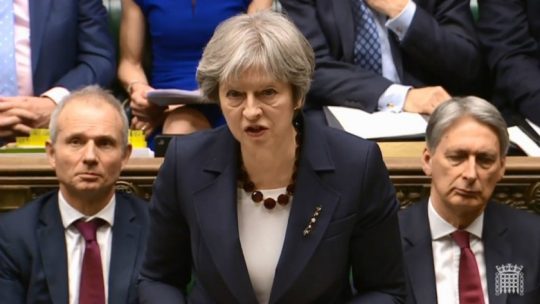
Theresa May following a tradition of being less than exact in Parliament about a casus belli
OffGuardian | March 14, 2018
When Theresa May said this in the House of Commons today:
While the extra-judicial killing of terrorists and dissidents outside Russia were given legal sanction by the Russian Parliament in 2006.
she was either disgracefully uninformed or was intentionally misleading Parliament on the nature of the Russian laws in question.
Her words completely misrepresent the known and understood facts of the case.
Not only have two experts in Russian law given their view that the laws do not permit the extra-judicial killing of “dissidents” in the manner described, but a British judge ruled in agreement with this conclusion during the Litvinenko Inquiry.
These are the judge’s own words:
The only legal route to extra-territorial action against Mr Litvinenko was therefore under the Terrorism Law. However, action could only have been taken against Mr Litvinenko under this law had he been involved in, or no doubt suspected of involvement in, some form of terrorist activity. Article 3 of the Terrorism Law contains definitions of terrorism and terrorist acts that are broadly conventional, and certainly not as expansive as the definition of ‘extremism’ in the second of the 2006 laws. Mr Batmanov’s letter (above) states that, “Alexander Litvinenko did not make part of a terrorist organization and was not accused by Russian law enforcement bodies of having committed a terrorist crime.” That accords with my understanding of the evidence
On the basis of the evidence currently before me, and in light of the considerations set out above, I am therefore not persuaded that any action could have been taken by the FSB against Mr Litvinenko in 2006 under the terms of either of the 2006 laws.
Put simply, this means the two laws would not have legalised the killing of Litvinenko on foreign soil. And, by extension would not legalise the poisoning of Skripal either.
Alexander Mercouris, a former UK barrister and author of a lengthy study of the Litvinenko Inquiry (published by OffG here and cited above) had this to say to us about May’s words in Parliament today:
Theresa May…was the Home Secretary who – somewhat unwillingly – set up the Litvinenko inquiry, and to whom the inquiry report was formally addressed. It is difficult to believe therefore that she is unaware that there is a British judicial finding that the two Russian laws which were passed in 2006 do not authorise extra judicial assassination attempts such as the one the British say was carried out in 2006 against Litvinenko, or the one which the British say was recently carried out against Skripal – who had of course been previously pardoned for his crimes by the Russian state.
The question arises – if this part of May’s statement contained such a blatant inaccuracy, how much weight can be given to her other as yet unsubstantiated claims of Russian guilt?
Those currently excoriating Jeremy Corbyn for asking for evidence before endorsing what amounts to indirect declarations of war on a nuclear power, might want to consider this fact before continuing on their chosen path.
The War Against Alternative Information
By Rick Sterling | Consortium News | January 1, 2017
The U.S. establishment is not content simply to have domination over the media narratives on critical foreign policy issues, such as Syria, Ukraine and Russia. It wants total domination. Thus we now have the “Countering Foreign Propaganda and Disinformation Act” that President Obama signed into law on Dec. 23 as part of the National Defense Authorization Act for 2017, setting aside $160 million to combat any “propaganda” that challenges Official Washington’s version of reality.
The new law mandates the U.S. Secretary of State to collaborate with the Secretary of Defense, Director of National Intelligence and other federal agencies to create a Global Engagement Center “to lead, synchronize, and coordinate efforts of the Federal Government to recognize, understand, expose, and counter foreign state and non-state propaganda and disinformation efforts aimed at undermining United States national security interests.” The law directs the Center to be formed in 180 days and to share expertise among agencies and to “coordinate with allied nations.”
The legislation was initiated in March 2016, as the demonization of Russian President Vladimir Putin and Russia was already underway and was enacted amid the allegations of “Russian hacking” around the U.S. presidential election and the mainstream media’s furor over supposedly “fake news.” Defeated Democratic presidential nominee Hillary Clinton voiced strong support for the bill: “It’s imperative that leaders in both the private sector and the public sector step up to protect our democracy, and innocent lives.”
The new law is remarkable for a number of reasons, not the least because it merges a new McCarthyism about purported dissemination of Russian “propaganda” on the Internet with a new Orwellianism by creating a kind of Ministry of Truth – or Global Engagement Center – to protect the American people from “foreign propaganda and disinformation.”
As part of the effort to detect and defeat these unwanted narratives, the law authorizes the Center to: “Facilitate the use of a wide range of technologies and techniques by sharing expertise among Federal departments and agencies, seeking expertise from external sources, and implementing best practices.” (This section is an apparent reference to proposals that Google, Facebook and other technology companies find ways to block or brand certain Internet sites as purveyors of “Russian propaganda” or “fake news.”)
Justifying this new bureaucracy, the bill’s sponsors argued that the existing agencies for “strategic communications” and “public diplomacy” were not enough, that the information threat required “a whole-of-government approach leveraging all elements of national power.”
The law also is rife with irony since the U.S. government and related agencies are among the world’s biggest purveyors of propaganda and disinformation – or what you might call evidence-free claims, such as the recent accusations of Russia hacking into Democratic emails to “influence” the U.S. election.
Despite these accusations — leaked by the Obama administration and embraced as true by the mainstream U.S. news media — there is little or no public evidence to support the charges. There is also a contradictory analysis by veteran U.S. intelligence professionals as well as statements by Wikileaks founder Julian Assange and an associate, former British Ambassador Craig Murray, that the Russians were not the source of the leaks. Yet, the mainstream U.S. media has virtually ignored this counter-evidence, appearing eager to collaborate with the new “Global Engagement Center” even before it is officially formed.
Of course, there is a long history of U.S. disinformation and propaganda. Former CIA agents Philip Agee and John Stockwell documented how it was done decades ago, secretly planting “black propaganda” and covertly funding media outlets to influence events around the world, with much of the fake news blowing back into the American media.
In more recent decades, the U.S. government has adopted an Internet-era version of that formula with an emphasis on having the State Department or the U.S.-funded National Endowment for Democracy supply, train and pay “activists” and “citizen journalists” to create and distribute propaganda and false stories via “social media” and via contacts with the mainstream media. The U.S. government’s strategy also seeks to undermine and discredit journalists who challenge this orthodoxy. The new legislation escalates this information war by tossing another $160 million into the pot.
Propaganda and Disinformation on Syria
Syria is a good case study in the modern application of information warfare. In her memoir Hard Choices, former Secretary of State Hillary Clinton wrote that the U.S. provided “support for (Syrian) civilian opposition groups, including satellite-linked computers, telephones, cameras, and training for more than a thousand activists, students and independent journalists.”
Indeed, a huge amount of money has gone to “activists” and “civil society” groups in Syria and other countries that have been targeted for “regime change.” A lot of the money also goes to parent organizations that are based in the United States and Europe, so these efforts do not only support on-the-ground efforts to undermine the targeted countries, but perhaps even more importantly, the money influences and manipulates public opinion in the West.
In North America, representatives from the Syrian “Local Coordination Committees” (LCC) were frequent guests on popular media programs such as “DemocracyNow.” The message was clear: there is a “revolution” in Syria against a “brutal regime” personified in Bashar al-Assad. It was not mentioned that the “Local Coordination Committees” have been primarily funded by the West, specifically the Office for Syrian Opposition Support, which was founded by the U.S. State Department and the U.K. Foreign and Commonwealth Office.
More recently, news and analysis about Syria has been conveyed through the filter of the White Helmets, also known as Syrian Civil Defense. In the Western news media, the White Helmets are described as neutral, non-partisan, civilian volunteers courageously carrying out rescue work in the war zone. In fact, the group is none of the above. It was initiated by the U.S. and U.K. using a British military contractor and Brooklyn-based marketing company.
While they may have performed some genuine rescue operations, the White Helmets are primarily a media organization with a political goal: to promote NATO intervention in Syria. (The manipulation of public opinion using the White Helmets and promoted by the New York Times and Avaaz petition for a “No Fly Zone” in Syria is documented here.)
The White Helmets hoax continues to be widely believed and receives uncritical promotion though it has increasingly been exposed at alternative media outlets as the creation of a “shady PR firm.” During critical times in the conflict in Aleppo, White Helmet individuals have been used as the source for important news stories despite a track record of deception.
Recent Propaganda: Blatant Lies?
As the armed groups in east Aleppo recently lost ground and then collapsed, Western governments and allied media went into a frenzy of accusations against Syria and Russia based on reports from sources connected with the armed opposition. CNN host Wolf Blitzer described Aleppo as “falling” in a “slaughter of these women and children” while CNN host Jake Tapper referred to “genocide by another name.”
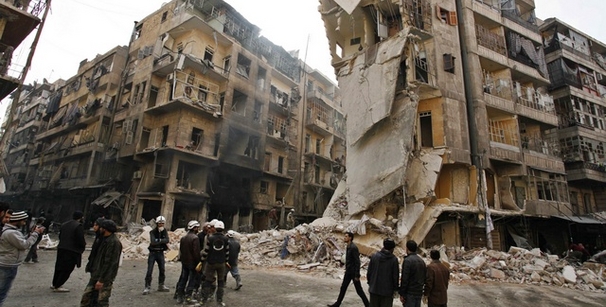
War damage in the once-thriving Syrian city of Aleppo
The Daily Beast published the claims of the Aleppo Siege Media Center under the title “Doomsday is held in Aleppo” and amid accusations that the Syrian army was executing civilians, burning them alive and “20 women committed suicide in order not to be raped.” These sensational claims were widely broadcast without verification. However, this “news” on CNN and throughout Western media came from highly biased sources and many of the claims – lacking anything approaching independent corroboration – could be accurately described as propaganda and disinformation.
Ironically, some of the supposedly “Russian propaganda” sites, such as RT, have provided first-hand on-the-ground reporting from the war zones with verifiable information that contradicts the Western narrative and thus has received almost no attention in the U.S. news media. For instance, some of these non-Western outlets have shown videos of popular celebrations over the “liberation of Aleppo.”
There has been further corroboration of these realities from peace activists, such as Jan Oberg of Transnational Foundation for Peace and Future Research who published a photo essay of his eyewitness observations in Aleppo including the happiness of civilians from east Aleppo reaching the government-controlled areas of west Aleppo, finally freed from areas that had been controlled by Al Qaeda’s Syrian affiliate and its jihadist allies in Ahrar al-Sham.
Dr. Nabil Antaki, a medical doctor from Aleppo, described the liberation of Aleppo in an interview titled “Aleppo is Celebrating, Free from Terrorists, the Western Media Misinformed.” The first Christmas celebrations in Aleppo in four years are shown here, replete with marching band members in Santa Claus outfits. Journalist Vanessa Beeley has published testimonies of civilians from east Aleppo. The happiness of civilians at their liberation is clear.
Whether or not you wish to accept these depictions of the reality in Aleppo, at a minimum, they reflect another side of the story that you have been denied while being persistently force-fed the version favored by the U.S. State Department. The goal of the new Global Engagement Center to counter “foreign propaganda” is to ensure that you never get to hear this alternative narrative to the Western propaganda line.
Even much earlier, contrary to the Western mythology of rebel “liberated zones,” there was strong evidence that the armed groups were never popular in Aleppo. American journalist James Foley described the situation in 2012 like this:
“Aleppo, a city of about 3 million people, was once the financial heart of Syria. As it continues to deteriorate, many civilians here are losing patience with the increasingly violent and unrecognizable opposition — one that is hampered by infighting and a lack of structure, and deeply infiltrated by both foreign fighters and terrorist groups. The rebels in Aleppo are predominantly from the countryside, further alienating them from the urban crowd that once lived here peacefully, in relative economic comfort and with little interference from the authoritarian government of President Bashar al-Assad.”
On Nov. 22, 2012, Foley was kidnapped in northwestern Syria and held by Islamic State terrorists before his beheading in August 2014.
The Overall Narrative on Syria
Analysis of the Syrian conflict boils down to two competing narratives. One narrative is that the conflict is a fight for freedom and democracy against a brutal regime, a storyline promoted in the West and the Gulf states, which have been fueling the conflict from the start. This narrative is also favored by some self-styled “anti-imperialists” who want a “Syrian revolution.”
The other narrative is that the conflict is essentially a war of aggression against a sovereign state, with the aggressors including NATO countries, Gulf monarchies, Israel and Jordan. Domination of the Western media by these powerful interests is so thorough that one almost never gets access to this second narrative, which is essentially banned from not only the mainstream but also much of the liberal and progressive media.
For example, listeners and viewers of the generally progressive TV and radio program “DemocracyNow!” have rarely if ever heard the second narrative described in any detail. Instead, the program frequently broadcasts the statements of Hillary Clinton, U.S. Ambassador to the United Nations Samantha Power and others associated with the U.S. position. Rarely do you hear the viewpoint of the Syrian Ambassador to the United Nations, the Syrian Foreign Minister or analysts inside Syria and around the world who have written about and follow events there closely.
“DemocracyNow!” also has done repeated interviews with proponents of the “Syrian revolution” while ignoring analysts who call the conflict a war of aggression sponsored by the West and the Gulf monarchies. This blackout of the second narrative continues despite the fact that many prominent international figures see it as such. For example, the former Foreign Minister of Nicaragua and former President of the UN General Assembly, Father Miguel D’Escoto, has said, “What the U.S. government is doing in Syria is tantamount to a war of aggression, which, according to the Nuremberg Tribunal, is the worst possible crime a State can commit against another State.”
In many areas of politics, “DemocracyNow!” is excellent and challenges mainstream media. However in this area, coverage of the Syrian conflict, the broadcast is biased, one-sided and echoes the news and analysis of mainstream Western corporate media, showing the extent of control over foreign policy news that already exists in the United States and Europe.
Suppressing and Censoring Challenges
Despite the widespread censorship of alternative analyses on Syria and other foreign hotspots that already exists in the West, the U.S. government’s new “Global Engagement Center” will seek to ensure that the censorship is even more complete with its goal to “counter foreign state and non-state propaganda and disinformation.” We can expect even more aggressive and better-financed assaults on the few voices daring to challenge the West’s “group thinks” – smear campaigns that are already quite extensive.
In an article titled “Controlling the Narrative on Syria”, Louis Allday describes the criticisms and attacks on journalists Rania Khalek and Max Blumenthal for straying from the “approved” Western narrative on Syria. Some of the bullying and abuse has come from precisely those people, such as Robin Yassin-Kassab, who have been frequent guests in liberal Western media.
Reporters who have returned from Syria with accounts that challenge the propaganda themes that have permeated the Western media also have come under attack. For instance, Canadian journalist Eva Bartlett recently returned to North America after being in Syria and Aleppo, conveying a very different image and critical of the West’s biased media coverage. Bartlett appeared at a United Nations press conference and then did numerous interviews across the country during a speaking tour. During the course of her talks and presentation, Bartlett criticized the White Helmets and questioned whether it was true that Al Quds Hospital in opposition-held East Aleppo was attacked and destroyed as claimed.
Bartlett’s recounting of this information made her a target of Snopes, which has been a mostly useful website exposing urban legends and false rumors but has come under criticism itself for some internal challenges and has been inconsistent in its investigations. In one report entitled “White Helmet Hearsay,” Snopes’ writer Bethania Palmer says claims the White Helmets are “linked to terrorists” is “unproven,” but she overlooks numerous videos, photos, and other reports showing White Helmet members celebrating a Nusra/Al Qaeda battle victory, picking up the bodies of civilians executed by a Nusra executioner, and having a member who alternatively appears as a rebel/terrorist fighter with a weapon and later wearing a White Helmet uniform. The “fact check” barely scrapes the surface of public evidence.
The same writer did another shallow “investigation” titled “victim blaming” regarding Bartlett’s critique of White Helmet videos and what happened at the Al Quds Hospital in Aleppo. Bartlett suggests that some White Helmet videos may be fabricated and may feature the same child at different times, i.e., photographs that appear to show the same girl being rescued by White Helmet workers at different places and times. While it is uncertain whether this is the same girl, the similarity is clear.
The Snopes writer goes on to criticize Bartlett for her comments about the reported bombing of Al Quds Hospital in east Aleppo in April 2016. A statement at the website of Doctors Without Borders says the building was “destroyed and reduced to rubble,” but this was clearly false since photos show the building with unclear damage. Five months later, the September 2016 report by Doctors Without Borders says the top two floors of the building were destroyed and the ground floor Emergency Room damaged yet they re-opened in two weeks.
The many inconsistencies and contradictions in the statements of Doctors Without Borders resulted in an open letter to them. In their last report, Doctors Without Borders (known by its French initials, MSF) acknowledges that “MSF staff did not directly witness the attack and has not visited Al Quds Hospital since 2014.”
Bartlett referenced satellite images taken before and after the reported attack on the hospital. The images do not show severe damage and it is unclear whether or not there is any damage to the roof, the basis for Bartlett’s statement. In the past week, independent journalists have visited the scene of Al Quds Hospital and report that that the top floors of the building are still there and damage is unclear.
The Snopes’ investigation criticizing Bartlett was superficial and ignored the broader issues of accuracy and integrity in the Western media’s depiction of the Syrian conflict. Instead the article appeared to be an effort to discredit the eyewitness observations and analysis of a journalist who dared challenge the mainstream narrative.
U.S. propaganda and disinformation on Syria has been extremely effective in misleading much of the American population. Thus, most Americans are unaware how many billions of taxpayer dollars have been spent on yet another “regime change” project. The propaganda campaign – having learned from the successful demonizations of Iraq’s Saddam Hussein, Libya’s Muammar Gaddafi and other targeted leaders – has been so masterful regarding Syria that many liberal and progressive news outlets were pulled in. It has been left to RT and some Internet outlets to challenge the U.S. government and the mainstream media.
But the U.S. government’s near total control of the message doesn’t appear to be enough. Apparently even a few voices of dissent are a few voices too many.
The enactment of HR5181, “Countering Foreign Propaganda and Disinformation,” suggests that the ruling powers seek to escalate suppression of news and analyses that run counter to the official narrative. Backed by a new infusion of $160 million, the plan is to further squelch skeptical voices with operation for “countering” and “refuting” what the U.S. government deems to be propaganda and disinformation.
As part of the $160 million package, funds can be used to hire or reward “civil society groups, media content providers, nongovernmental organizations, federally funded research and development centers, private companies, or academic institutions.”
Among the tasks that these private entities can be hired to perform is to identify and investigate both print and online sources of news that are deemed to be distributing “disinformation, misinformation, and propaganda directed at the United States and its allies and partners.”
In other words, we are about to see an escalation of the information war.
Rick Sterling is an independent investigative journalist. He lives in the San Francisco Bay Area and can be reached at rsterling1@gmail.com
Venezuelan Opposition Protests Proposed UN Electoral Observer Mission
Venezuelanalysis | March 13, 2018
Caracas – Supporters of Venezuela’s Democratic Unity Roundtable (MUD) opposition coalition marched on the headquarters of the United Nations in Caracas Monday to protest the possibility of the international body sending an observer mission to monitor the country’s upcoming May 20 elections.
In a letter addressed to UN Secretary-General Antonio Guterres, the opposition alleged that an observer mission would “give a veneer of legality to an [electoral] process that lacks it.”
Last month, the Venezuelan electoral authorities formally invited the UN to send an observer mission to monitor the upcoming elections as part of an agreement negotiated between the government and the MUD, which the latter ultimately refused to sign. The UN is yet to confirm whether it will send a delegation in May.
Following the breakdown of internationally-mediated talks, the main opposition coalition announced it would boycott the presidential elections – which were then set for April 22 – claiming the date and electoral guarantees were inadequate to ensure a free and fair contest.
However on March 1, several smaller opposition parties led by former Lara Governor Henri Falcon broke ranks with the MUD and signed a deal with the ruling United Socialist Party and its leftist allies moving the presidential election to May 20 and hold municipal and state legislative elections on the same day. Although the agreement featured various safeguards previously demanded by the MUD during talks – including observers from the UN and other international bodies, equal access to media, and an ample window for voter registration – the anti-government coalition dismissed the deal as a “farce” and vowed to go ahead with its boycott.
Turnout in Monday’s demonstration was, nonetheless, small in number, particularly in comparison to the mass protests organized by the MUD to demand early presidential elections last year, which frequently concluded in deadly acts of violence perpetrated by hardline anti-government groups.
The march was organized by the newly formed “Free Venezuela Broad Front” (FAVL), which includes the parties of the MUD alongside the Fedecameras business lobby, representatives of the Catholic and evangelical churches, several university student and professor organizations, as well as a group of ex-government loyalists led by former Interior Minister Miguel Rodriguez Torres.
Taking to Twitter Saturday, President Nicolas Maduro criticized the call for electoral boycott and rejection of UN observers from sections of the opposition.
“Why so much contradiction? What do they [the MUD] want? I want the secretary-general to send a strong commission of observers,” he declared.
Meanwhile, Maduro’s principal rival, Henri Falcon, was in New York Tuesday, where he was reportedly meeting with UN officials.
Himself a former Chavista, Falcon was expelled from the MUD last month after he registered his candidacy in violation of the coalition’s boycott.
While center-right pollster Datanalisis has reported that over 70 percent of Venezuelans intend to vote in the upcoming elections, Falcon and other opposition leaders remain concerned about low turnout among their ranks.
On Tuesday, a spokesperson for the opposition’s new Broad Front denied the organization was promoting abstention.
“We are not partisans of a policy of abstention. Of course, we think that as things are now, one cannot vote, because we want to vote to truly choose and not give the appearance of legality in the country that doesn’t exist,” explained Ramon Guillermo Aveledo, who was secretary general of the MUD between 2009 and 2014, during an interview with Globovision Tuesday.
However, the former MUD leader did not indicate that the FAVL would encourage its supporters to vote for Falcon.
On the contrary, he suggested that the opposition candidate could abandon his presidential bid.
“I don’t at all rule out that Falcon renounces his candidacy, withdraws from the process when he confirms what we, his friends, have told him… that it’s not a real election,” Aveledo added.
The FAVL has called for nationwide protests against the May 20 elections for this coming Saturday.
The Novichok Story Is Indeed Another Iraqi WMD Scam
By Craig Murray | March 14, 2018
As recently as 2016 Dr Robin Black, Head of the Detection Laboratory at the UK’s only chemical weapons facility at Porton Down, a former colleague of Dr David Kelly, published in an extremely prestigious scientific journal that the evidence for the existence of Novichoks was scant and their composition unknown.
In recent years, there has been much speculation that a fourth generation of nerve agents, ‘Novichoks’ (newcomer), was developed in Russia, beginning in the 1970s as part of the ‘Foliant’ programme, with the aim of finding agents that would compromise defensive countermeasures. Information on these compounds has been sparse in the public domain, mostly originating from a dissident Russian military chemist, Vil Mirzayanov. No independent confirmation of the structures or the properties of such compounds has been published. (Black, 2016)
Robin Black. (2016) Development, Historical Use and Properties of Chemical Warfare Agents. Royal Society of Chemistry
Yet now, the British Government is claiming to be able instantly to identify a substance which its only biological weapons research centre has never seen before and was unsure of its existence. Worse, it claims to be able not only to identify it, but to pinpoint its origin. Given Dr Black’s publication, it is plain that claim cannot be true.
The world’s international chemical weapons experts share Dr Black’s opinion. The Organisation for the Prohibition of Chemical Weapons (OPCW) is a UN body based in the Hague. In 2013 this was the report of its Scientific Advisory Board, which included US, French, German and Russian government representatives and on which Dr Black was the UK representative:
[The SAB] emphasised that the definition of toxic chemicals in the Convention would cover all potential candidate chemicals that might be utilised as chemical weapons. Regarding new toxic chemicals not listed in the Annex on Chemicals but which may nevertheless pose a risk to the Convention, the SAB makes reference to “Novichoks”. The name “Novichok” is used in a publication of a former Soviet scientist who reported investigating a new class of nerve agents suitable for use as binary chemical weapons. The SAB states that it has insufficient information to comment on the existence or properties of “Novichoks”. (OPCW, 2013)
OPCW: Report of the Scientific Advisory Board on developments in science and technology for the Third Review Conference 27 March 2013
Indeed the OPCW was so sceptical of the viability of “novichoks” that it decided – with US and UK agreement – not to add them nor their alleged precursors to its banned list. In short, the scientific community broadly accepts Mirzayanov was working on “novichoks” but doubts he succeeded.
Given that the OPCW has taken the view the evidence for the existence of “Novichoks” is dubious, if the UK actually has a sample of one it is extremely important the UK presents that sample to the OPCW. Indeed the UK has a binding treaty obligation to present that sample to OPCW. Russa has – unreported by the corporate media – entered a demand at the OPCW that Britain submit a sample of the Salisbury material for international analysis.
Yet Britain refuses to submit it to the OPCW.
Why?
A second part of May’s accusation is that “Novichoks” could only be made in certain military installations. But that is also demonstrably untrue. If they exist at all, Novichoks were allegedly designed to be able to be made at bench level in any commercial chemical facility – that was a major point of them. The only real evidence for the existence of Novichoks was the testimony of the ex-Soviet scientist Mizayanov. And this is what Mirzayanov actually wrote.
One should be mindful that the chemical components or precursors of A-232 or its binary version novichok-5 are ordinary organophosphates that can be made at commercial chemical companies that manufacture such products as fertilizers and pesticides.
Vil S. Mirzayanov, “Dismantling the Soviet/Russian Chemical Weapons Complex: An Insider’s View,” in Amy E. Smithson, Dr. Vil S. Mirzayanov, Gen Roland Lajoie, and Michael Krepon, Chemical Weapons Disarmament in Russia: Problems and Prospects, Stimson Report No. 17, October 1995, p. 21.
It is a scientific impossibility for Porton Down to have been able to test for novichoks, without possessing some to develop the tests. As Dr Black has revealed Porton Down had never seen any Russian novichok, they cannot have a test for it unless they synthesised some themselves to develop the tests. And if they can synthesise it, so can many others, not just the Russians.
And finally – Mirzayanov is an Uzbek name and the novichok programme, assuming it existed, was in the Soviet Union but far away from modern Russia, at Nukus in modern Uzbekistan. I have visited the Nukus chemical weapons site myself. It was dismantled and made safe and all the stocks destroyed and the equipment removed by the American government, as I recall finishing while I was Ambassador there. There has in fact never been any evidence that any “novichok” ever existed in Russia itself.
To summarise:
1) Porton Down has acknowledged in publications it has never seen any Russian “novichoks”. The UK government has absolutely no “fingerprint” information that can safely attribute this substance to Russia.
2) Until now, neither Porton Down nor the world’s experts at the Organisation for the Prevention of Chemical Weapons (OPCW) were convinced “Novichoks” even exist.
3) The UK is refusing to provide a sample to the OPCW.
4) “Novichoks” were specifically designed to be able to be manufactured from common ingredients on any scientific bench. The Americans dismantled and studied the facility that allegedly developed them. It is completely untrue only the Russians could make them, if anybody can.
5) The “Novichok” programme was in Uzbekistan not in Russia. Its legacy was inherited by the Americans during their alliance with Karimov, not by the Russians.
With a great many thanks to sources who cannot be named at this moment.
US in Afghanistan to Influence Russia, Iran, China – Russian Foreign Ministry
Sputnik – March 14, 2108
The United States retains its presence in Afghanistan to exert influence on neighboring countries and regional rivals – namely, Russia, Iran and China, Russian Foreign Ministry’s Second Asian Department Director Zamir Kabulov told Sputnik in an interview.
“In our opinion, the United States is in Afghanistan primarily with the aim of controlling and influencing the political processes in its neighboring countries, and also demonstrating its power to its regional competitors, primarily China, Russia and Iran. The United States is clearly trying to achieve destabilization of Central Asia and later transfer it to Russia in order to subsequently present itself as the only defender against potential and emerging threats in the region,” Kabulov said.
According to the diplomat, Russia and other countries neighboring with Afghanistan have questions about the true goals and time frame of the US military presence in the Central Asian country.
“If the United States and its NATO allies intend to continue their destructive policy in Afghanistan, this will mean that the West is heading toward the revival of the Cold War era in this part of the world. We closely monitor the developments and are ready to respond in cooperation with our partners and other like-minded people,” Kabulov noted.
The diplomat pointed out that Washington still failed to understand that the Afghan conflict could not be resolved solely by military means, stressing that it was impossible to defeat the Taliban by force.
Moscow is puzzled by the attempts of the United States and NATO to persuade Afghanistan to replace Russian weapons and military equipment, such move leads to reduction of Afghan’s military potential, Zamir Kabulov told Sputnik in an interview.
“The course taken by the United States and NATO to persuade Kabul to replace Russia-made small arms and aircraft is surprising, as it will inevitably lead to a decrease in the combat capabilities of the Afghan armed forces and further deterioration of the situation,” Kabulov said.
The diplomat reminded that a bilateral intergovernmental agreement on Russia’s defense industry assistance to Afghanistan had entered into force in November 2016, adding that the document created the legal framework for Russian assistance in arming and equipping the Afghan security forces.
“At the moment, negotiations are underway on repairs and supplies of spare parts for the Afghan Air Force’s helicopters for various purposes, produced in Russia (the Soviet Union),” Kabulov added.
Afghanistan Parliamentary Election
The parliamentary election in Afghanistan is unlikely to take place in July in the current circumstances, Kabulov said.
“I do not think that the parliamentary elections in Afghanistan will be held in July this year as scheduled. The Taliban continue to control about half of the country’s territory, engage in hostilities, organize and carry out terrorist attacks in large cities, and, apparently, are not going to make compromises and reconciliation with the Afghan government,” Kabulov said.
Afghanistan’s Independent Election Commission (IEC) is also unlikely to accomplish all the necessary procedures before the date set for the vote, given that the commission has announced earlier that the registration of voters will complete only by early August, the diplomat noted.
Furthermore, disagreements between the presidential administration and its political opposition regarding the parameters of the upcoming elections still remain unresolved, the official noted.
“In my opinion, if elections are conducted in the current circumstances, their results will not improve the political situation in the country and confidence in the current government, will not force the armed opposition to cooperate with the government,” Kabulov added.
The diplomat also noted that the Daesh terror group posed a serious threat to holding the election.
“The Daesh jihadists pose a serious threat to the security of the conduct of elections, especially in the north and a number of eastern provinces of Afghanistan. Some polling stations in the provinces of Helmand, Uruzgan, Kunduz, Badakhshan, Faryab and Ghazni are the most problematic in terms of security, according to the IEC data. I think that, in fact, the list of problematic areas in terms of organization of voting is much longer,” Kabulov said.
Afghanistan Reconciliation Talks
Russia considers the so-called Moscow format of talks an optimal platform for the promotion of national reconciliation in Afghanistan, Zamir Kabulov noted.
“Unfortunately, the existence of a large number of international formats on the Afghan issue has not significantly contributed to the involvement of the Taliban in peace negotiations. In this regard, we consider the Moscow format of consultations launched by us in early 2017 as the optimal platform for substantive negotiations to promote national reconciliation and establish a constructive dialogue between the government of Afghanistan and the Taliban movement,” Kabulov said.
Kabulov also noted that Moscow considered the format of talks in the Afghan capital as one approach toward achieving a collective solution to the problems surrounding Afghan settlement.
“A signal of international support for the resolution of the intra-Afghan conflict through political dialogue with the government of Afghanistan has been sent to the Taliban. The Taliban ignored the recent meeting of the ‘Kabul process’ in the Afghan capital, insisting on direct talks with the United States,” the diplomat added.
In February 2017, Russia, China, Pakistan, Iran, India and Afghanistan came together in Moscow for talks to promote the national reconciliation process in Afghanistan through regional cooperation with Kabul in the leading role. Apart from the aforementioned states, the latest round in April gathered five Central Asian countries: Kazakhstan, Kyrgyzstan, Tajikistan, Turkmenistan and Uzbekistan. The United States refused to take part in the meeting.
Afghanistan has long suffered political, social and security-related instability because of the simmering insurgency, including that of the Taliban, but also because of the actions of the Daesh terror group.
The United States has been in Afghanistan for almost 17 years following the 9/11 attacks. Before his election, Trump slammed sending US troops and resources to the Central Asian country.
Featured Video

DID THE ROAD TO WARP SPEED START YEARS EARLIER?
or go to
Aletho News Archives – Video-Images
From the Archives
9/11 Was an Israeli Job
How America was neoconned into World War IV
By Laurent Guyénot • Unz Review • September 10, 2018
… 9/11 was made possible by an alliance between secret worshippers of Israel and corrupted American elements. The question is: who, of the two, were the masterminds of this incredibly daring and complex operation, and for what “higher purpose”? … Read full article
Blog Roll
 Aletho News
- DID THE ROAD TO WARP SPEED START YEARS EARLIER?
- Anthropic reveals five biological weapon risk cases
- Anthropic bans Israeli account over Iran, Gulf social media citizen profiling
- Why Benjamin Netanyahu Said 9/11 Was ‘Very Good’ For Israel
- Leaked chemical dossier reveals Israel’s role in Sudan’s civil war: Report
- Is the Noose Tightening on Iran?
- Persian Gulf states to meet in Oman to discuss regional security, Hormuz navigation: Iran
- Araghchi: US acknowledgment of Bahrain damage exposes cost of Israel’s wars
- YAF secure Bab al-Mandab, advance toward Dhubab
- Ansar Allah’s Victory Is A U.S. Defeat
- If Americans Knew
- Digital Strategists: Washington’s Network of “Manipulation and Influence Projects” for Israeli Propaganda
- Israeli Documentary ‘NAZA’ Exposes ‘System of Killing’ in Gaza From Eyes of Secret Intelligence Unit
- Confessions of an Israeli Army Drone Operator
- Maximum Territory, Minimum Population
- Is the Israel Lobby Doomed?
- Israel kills 9, including family of 4, in Gaza – Daily Update
- Secret systems used by Israel in mass killings of Gaza civilians revealed in new film
- Israel Bombs South Lebanon as Report Documents 23 White Phosphorus Attacks
- Nakba and Gaza: Zionism’s Century-Long History of Genocide
- ISRAELI MEDIA: ‘Baby, an Update: He’s Just Died’: Israeli Prison Guards’ Texts Expose a Routine of Abuse
- No Tricks Zone
- New Study: The Antarctic Ice Sheet Gained Mass From 2020-2024 Due To Staggering Snow And Ice Accumulation
- Study: Ocean Heating Rates From Thousands Of Years Ago ‘Dwarf’ Modern Ocean Heating Rates
- Climate Extremists Target, Attack Large-Scale Power Grid Infrastructure In Germany!
- New Study: Antarctic Ice Melt Has Contributed Less Than 1 Centimeter To Sea Level Rise In The Last 30 Years
- Fear Of Debate: Alarmist German Climate Scientist Calls On Mainstream Media To Discredit Skeptic Voices
- End-Of-August Arctic Sea Ice Extent Hasn’t Fallen In 20 Years, Official Data Show!
- News-Making Nepal Region Has Had As-Warm Or Warmer Periods Than The 2000s In The 1600s, 1700s, 1800s
- 2025 Study: ‘There Exists No Unequivocal Experimental Evidence For The CO2 Greenhouse Effect’
- 2026 Atlantic Cyclone Energy Index Running At 85% Below Normal!
- New Research Shows Soil Respiration And Temperature Drive CO2 Change, Not Humans
 Aletho News