‘Netanyahu, Trump clash over early Syria withdrawal plan’
Press TV – April 6, 2018
A recent telephone conversation between Israeli Prime Minister Benjamin Netanyahu and US President Donald Trump grew tense over Trump’s earlier expression of his tendency to withdraw US forces from Syria “very soon,” according to two US officials.
Netanyahu and Trump discussed regional developments over the phone on Wednesday, according to the official account from the United States.
But two unidentified US officials said later that Netanyahu had objected to Trump’s remark that he would like US forces out of Syria shortly, according to The Times of Israel.
There were no more details on the give-and-take between the Israeli prime minister and the US president.
On March 29, Trump said the US would “be coming out of Syria, like, very soon. Let the other people take care of it now.”
The US has reportedly more than 2,000 troops stationed in eastern Syria, in addition to several thousand others in the Arab country’s north.
“We spent $7 trillion in the Middle East. And you know what we have for it? Nothing,” Trump said.
Other US officials have since been attempting to walk back Trump’s remarks, which had already been in contrast to the mainstream US position.
Just on Friday, the Pentagon sounded differently from Trump, saying the American military plans in Syria remained unchanged.
On April 3, Trump also signaled that countries that wanted the US to remain in Syria would have to pay for that presence, singling out Saudi Arabia.
“Saudi Arabia is very interested in our decision, and I said, ‘Well, you want us to stay, maybe you’re going to have to pay,’” he told reporters at the White House. “We do a lot of things in this country. We do [them] for a lot of reasons, but it’s very costly for our country and it helps other countries a hell of a lot more than it helps us. So we’re going to be making a decision.”
The Israeli prime minister’s objection to Trump’s stated Syria plan came despite reassurances by US officials that Trump has changed his mind.
Apart from the troops on the ground, the US and a number of its allies have been bombarding what they say are Daesh positions inside Syria since September 2014, without any authorization from the Damascus government or the United Nations.
After the Wednesday telephone conversation between Netanyahu and Trump, a White House statement said, “President Trump reiterated the commitment of the United States to Israel’s security,” and that “the two leaders agreed to continue their close coordination on countering Iran’s malign influence and destabilizing activities.”
Netanyahu later tweeted that he had “thanked President Trump for his commitment to Israel’s security and America’s support for Israel at the United Nations.”
Neither of the official accounts referred to the tense moments of the conversation.
Unlike the US and its allies, Iran and Russia have government-authorized advisory presence in Syria. Israel has attempted to portray Iranian advisory assistance to Damascus as an attempt at spreading its regional influence, which Iran has consistently denied.
Skripal relative denied visa to visit UK and return poisoned relatives to Russia
RT | April 6, 2018
Sergei Skripal’s niece has been denied a visa to enter the UK after claiming she would come and take her relatives back to Russia.
Viktoria Skripal had planned to travel to Britain after her uncle Sergei Skripal and his daughter Yulia were exposed to a chemical agent in Salisbury on March 4.
The UK Home Office said on Friday that Viktoria is not being granted a visa to come to the UK. “We have refused a visitor visa application from Viktoria Skripal on the grounds that her application did not comply with the Immigration Rules,” a Home Office spokesman said.
Viktoria was behind the first public statements from either of the Skripals and the world’s media this week when she released a recording of a phone call with her cousin Yulia.
In the clip, the two discussed Viktoria getting a visa. Yulia flatly told her she would not be granted one.
“Vika, nobody will give you a visa,” Yulia said.
She said she and her father were fine and there were no life changing injuries. She gave little detail other than to say they would address one issue at a time.
Russian Ambassador Alexander Yakavenko said the embassy is currently getting its information from the mainstream media, after being locked out of Britain’s investigation. He says requests for access to the Skripals have been repeatedly denied.
Media Warn of ‘Russian Bots’—Despite Primary Source’s Disavowal
By Adam Johnson | FAIR | April 5, 2018

Washington Post (4/2/18)
One could forgive the average reader for thinking reporters covering bots had been replaced by bots. The formula is something we’ve seen a million times now: After a controversial story breaks, media outlets insist that “Russian bots” used the controversy to “sow discord” or “exploit tensions”; a “Russian bot dashboard” is offered as proof. (These “dashboards” let one see what Russian bots—automated online persona controlled by the Kremlin—are allegedly “pushing” on social media.)
The substance of the concern or discord is underreported or ignored altogether. Online conflict is neatly dismissed as a Kremlin psyop, the narrative of Russia interference in every aspect of our lives is reinforced, and one is reminded to be “aware” of Russian trolls online.
Note the latest iteration of this story:
- Russian Bots Are Rallying Behind Embattled Fox News Host Laura Ingraham as Advertisers Dump Her Show (Business Insider, 4/1/16)
- Russian Bots Defend Fox News Pundit Laura Ingraham as Advertisers Leave Following David Hogg Tweet (Newsweek, 4/2/18)
- Russian Bots Are Tweeting Their Support of Embattled Fox News Host Laura Ingraham (Washington Post, 4/2/18)
- Russian Bots Flock to Laura Ingraham Feud With Parkland Student: Report (The Hill, 4/2/18)
- Russian Bots Rush to Laura Ingraham’s Defense in David Hogg Feud (Washington Times, 4/2/18)
Not to be confused with the Russian bots that were heard from after the Austin bombings from last month:
- Russian Social Accounts Adding to Complaints That Austin Bombings Aren’t Being Covered (NPR, 3/19/18)
- Fallout of Austin Bombings Exposes Racial Tensions, Russian Bots and Media Distrust (France 24, 4/1/18)
- Russian Bots Were Sowing Discord During Hunt for Austin Bomber, Group Says (Houston Chronicle, 3/20/18)
Or the bots from Russia that were seen in the wake of the Parkland massacre:
- After Florida School Shooting, Russian ‘Bot’ Army Pounced (New York Times, 2/19/18)
- After the Parkland Shooting, Pro-Russian Bots Are Pushing False-Flag Allegations Again (Washington Post, 2/16/18)
- How Russian Trolls Exploited Parkland Mass Shooting on Social Media (Politifact, 2/22/18)
One problem, though: The “Russian bot dashboard” reporters generally cite as their primary source, Hamilton 68, effectively told reporters to stop writing these pieces six weeks ago. According to a report from Buzzfeed (2/28/18)—hardly a fan of the Kremlin—Russian bot stories are “bullshit”:

The New York Times (2/19/18)
By now you know the drill: massive news event happens, journalists scramble to figure out what’s going on, and within a couple hours the culprit is found — Russian bots.
Russian bots were blamed for driving attention to the Nunes memo, a Republican-authored document on the Trump-Russia probe. They were blamed for pushing for Roy Moore to win in Alabama’s special election. And here they are wading into the gun debate following the Parkland shooting. “[T]he messages from these automated accounts, or bots, were designed to widen the divide and make compromise even more difficult,” wrote the New York Times in a story following the shooting, citing little more than “Twitter accounts suspected of having links to Russia.”
This is, not to mince words, total bullshit.
The thing is, nearly every time you see a story blaming Russian bots for something, you can be pretty sure that the story can be traced back to a single source: the Hamilton 68 dashboard, founded by a group of respected researchers, including Clint Watts and JM Berger, and currently run under the auspices of the German Marshall Fund.
But even some of the people who popularized that metric now acknowledge it’s become totally overblown.
“I’m not convinced on this bot thing,” said Watts, the cofounder of a project that is widely cited as the main, if not only, source of information on Russian bots.
Watts, the media’s most cited expert on so-called “Russian bots” and co-founder of Hamilton 68, says the narrative is “overdone.” The three primary problems, as Buzzfeed, reported, are:
- The bots on the Hamilton 68 dashboard are not necessarily connected to Russia: “They are not all in Russia,” Watts told Buzzfeed. “We don’t even think they’re all commanded in Russia—at all. We think some of them are legitimately passionate people that are just really into promoting Russia.” (Hamilton 68 doesn’t specify which accounts are viewed as Russian bots; that’s a trade secret.)
- Twitter is clogged with bots, so telling which are Russian and which aren’t is impossible. Bots naturally follow trending or popular stories, like all the stories cited above; how does one distinguish “Russian bot” activity versus normal online trend-chasing?
- Tons of bots are run out of the United States, in totally routine partisan marketing efforts; the singular obsession with Russia lets these shady players off the hook. And, again, it’s almost impossible to distinguish between simply partisan GOP bots and “Russian” ones.

BuzzFeed (2/28/18)
Put another way: These stories are of virtually no news value, other than smearing whichever side the “Russian bots” happened to support, and reinforcing in the public mind that one cannot trust unsanctioned social media accounts. Also that the Russians are hiding in every shadow, waiting to pounce.
Another benefit of the “Russian bots agitate the American public” stories is they prevent us from asking hard questions about our society. After a flurry of African-American Twitter users alleged a racist double standard in the coverage of the Austin bombings in March (which killed two people, both of them black), how did NPR address these concerns? Did it investigate their underlying merit? Did it do media analysis to see if there was, in fact, a dearth of coverage due to the victims’ race? No, it ran a story on how Russia bots were fueling these concerns: “Russian Social Accounts Adding to Complaints That Austin Bombings Aren’t Being Covered” (All Things Considered, 3/19/18):
NPR’s Philip Ewing: Well, there’s two things taking place right now. Some of this is black users on Twitter saying that because some of the victims in this story were not white, this isn’t getting as much attention as another story about bombings, or a series of bombings in the United States, would or should, in this view.
This seems like a pretty serious charge, and would have a lot of historical precedent! Does NPR interrogate this thread further? Does it interview any of these “black users”? No, they move on to the dastardly Russians:
Ewing: But there’s also additional activity taking place on Twitter which appears initially to be connected with the Russian social media agitation that we’ve sort of gotten used to since the 2016 presidential race. There are dashboards and online tools that let us know which accounts are focusing on which hashtags from the Russian influence-mongers who’ve been targeting the United States since 2016, and they, too, have been tweeting about Austin bombings today.
NPR host Ailsa Chang: The theory being that these Russian bots are being used to drive a wedge between groups of people here in the United States about this issue, about the coverage being potentially racist.
Ewing: That’s right.
Nothing to see here! There’s a problem in our society—systemic racism in American media—and rather than an examination of whether it’s affecting coverage here, what the listener gets is yet another boilerplate story about “Russian bots,” the degree, scope and impact of which is wholly unknown, and likely inconsequential. Hesitant to cite Hamilton 68 by name (perhaps because its co-founder mocked this very kind of story a few weeks prior), NPR reporter Ewing simply cites “dashboards and online tools” as his source.

To All Things Considered (3/19/18)
Which ones? It doesn’t really matter, because “Russian bots support X” reports are a conditioning exercise more than a story. The fact that this paint-by-numbers formula is still being applied weeks after the primary source’s co-founder declared himself “not convinced on this bot thing” and called the story “overdone” demonstrates this. The goal is not to convey information or give the reader tools to better understand the world, it’s to give the impression all unrest is artificially contrived by a foreign entity, and that the status quo would otherwise be rainbows and sunshine. And to remind us that the Enemy lurks everywhere, and that no one online without a blue checkmark can be trusted.
War Deaths, and Taxes
By John Laforge | CounterPunch | April 6, 2018
Are the federal taxes coming out of your wages and due this week killing you? Sadly what’s rhetorical for US tax payers is gravely literal for people of eight countries currently on the shooting end of the US budget.
This year at least 47% of federal income taxes goes to the military (27%, or $857 billion, for today’s bombings and occupations, weapons, procurement, personnel, retiree pay & healthcare, Energy Dept. nuclear weapons, Homeland Security, etc.); and 20%, or $644 billion, for past military bills (veterans’ benefits — $197 billion; and 80% of the interest on the national debt — $447 billion).
A ceasefire, drawdown and retreat from the country’s unwinnable wars would reduce this tax burden, and didn’t the president promise to end the foreign “nation-building” that’s breaking the bank? Of course, that was a Trump promise, so:
Seven US airmen were killed on March 15 when a US Pave Hawk helicopter crashed in western Iraq, with 5,200 soldiers and as many contract mercenaries fighting there.
When VP Mike Pence visited Afghanistan last December he said with perfect meaninglessness: “we are here to see this through.” About 11,000 US soldiers are currently seeing it, and the Pentagon will be sending thousands more this spring. US bombing runs have almost tripled since the Obama/Trump handover, and Pence claimed “we’ve put the Taliban on the defensive” — but during Pentagon chief Jim Mattis’s visit the Taliban shot dozens of rockets at the Kabul airport where the general’s plane was parked.
The 16-year-old war in Afghanistan is now broadly understood to be militarily unwinnable, so a ceasefire and withdrawal would be a quick way to save billions of tax dollars. But US B-52s bombers flying from Minot Air Base in North Dakota are still creating new terrorists every day; the 3,900 US bombs and missiles exploded on the country in 2017 caused countless of civilian casualties.
In Syria, dozens of Russian soldiers were killed Feb. 7 and 8 by US-led forces fighting near Al Tabiyeh. Master Sgt. Jonathan J. Dunbar was killed by an IED blast March 29 in Manbij. The US now has about 2,000 soldiers at war in Syria, and in January then Sec. of State Rex Tillerson promised they will be there long after the war with the Islamic State is over. Although Trump said March 29, “we’ll be coming out of Syria, like, very soon,” Pentagon officials leaked news April 2 that dozens of additional troops will be sent in the coming weeks, CNN reported. The United States’ World War could hardly be more confounding or self-defeating as US ally Turkey has begun bombing US-supported Kurdish fighters inside Syria.
In Pakistan January 25, the Ministry of Foreign Affairs charged that remote-controlled US bombing had targeted an Afghan refugee camp, worsening relations with that government even beyond Trump’s cutoff of “security aid.”
Saudi Arabian aircraft, refueled en route by US tanker aircraft, have killed 4,000 civilians in Yemen, according to UN estimates. Suspending arms sales to the Saudis would end its war and begin to alleviate the Saudi-made humanitarian disaster in Yemen, and a cease-fire and stand-down would allow for the urgent relief required to prevent famine.
An end to today’s US bombing and/or military occupation of eight countries — Syria, Pakistan, Afghanistan, Iraq (all ongoing), Somalia (bombed Apr. 1), Libya (8 airstrikes since Jan. 2017), Niger (Oct. 4 battle, four dead; 500 US soldiers in country, now with armed drones), and Yemen (127 bomber & drone strikes in 2017) — would save billions, save lives, slow the wartime creation of terrorists, and reduce anti-US sentiment everywhere. In January, an extensive Gallop survey found 70% of the people interviewed in 134 countries disapprove of US foreign policy — 80% in Canada, 82% in Mexico.
To paraphrase Dr. King, who was assassinated by the FBI 50 years ago this month (“Orders to Kill: The Truth Behind the Murder of Martin Luther King,” by William F. Pepper), “The great initiative in these wars is ours. The initiative to stop them must be ours.”
John LaForge is a Co-director of Nukewatch, a peace and environmental justice group in Wisconsin, and edits its newsletter.
The Skripal case and the misuse of ‘intelligence’
By Alexander Mercouris | The Duran | April 5, 2018
The events of the last few days in the Skripal case provide an object lesson of why in criminal investigations the rules of due process should always be adhered to. The reason the British now find themselves in difficulties is because they have not adhered to them.
This despite the fact that – as they all too often like to remind us – it was the British themselves who largely created them.
The single biggest unexplained mystery about the Skripal case is why it attracted so much attention so quickly.
Within hours of Sergey and Yulia Skripal being found passed out on a bench the British media were feverishly speculating that they had been poisoned by Russia.
This despite the fact that no information at that point existed which warranted such speculation, and despite pleas for the investigation to be allowed to take its course from the police and from the government minister responsible for the police, Home Secretary Amber Rudd (who has ever since been conspicuously silent about the whole affair).
Within three days of Sergey and Yulia Skripal being found passed out on a bench – and before any information linking the incident to Russia had become publicly available – the British government’s COBRA committee was meeting – a fact which caused me incredulity – during which a highly revealing article in The Times of London has now revealed it was already agreed that Russia was “almost certainly” responsible.
A Whitehall source added: “We knew pretty much by the time of the first Cobra [the emergency co-ordination briefing that took place the same week] that it was overwhelmingly likely to come from Russia.” (bold italics added)
“It” of course refers to the chemical agent which poisoned Sergey and Yulia Skripal, with the clear implication that by the date of the first COBRA meeting on 7th March 2018 – three days after Sergey and Yulia Skripal were found in the bench – “it” had already been identified as a Novichok “of a type developed by Russia”.
If what this article says is true – and despite the fact that the article is full of tendentious reporting (of which more below) on this one point I am inclined to believe what it says – then that must mean either (1) that Porton Down is highly familiar with the properties of Novichok agents if it can identify the agent used so quickly; or (2) the British authorities already had “other” information before Porton Down completed its analysis which caused them to think that Sergey and Yulia Skripal were poisoned with a chemical agent “of a type developed by Russia”.
If it was the first then note that Porton Down took no more than three days to identify the poison as a Novichok despite the fact (1) that Novichok agents are not in general use and are supposed to be very rare and there is no known instance of their having been used before (it seems that contrary to previous reports the Kivelidi murder in 1995 in Russia did not involve use of a Novichok); and (2) that confirming Porton Down’s analysis that the poison is a Novichok is taking the OPCW’s experts two weeks.
If it was the second, and the COBRA committee came to its view on 7th March 2018 that Russia was ‘almost certainly responsible’ before Porton Down had identified the poison, then the last few weeks have been an exercise in smoke-and-mirrors, with the British authorities pretending that the reason for their belief in Russian responsibility was that the poison used was a Novichok, whereas in reality they came to that belief for some entirely different reason.
If so then that might partially [explain] why Porton Down and the French scientists were able to identify the chemical agent so quickly.
They were able to identify the poison as a Novichok by the weekend prior to Theresa May’s statement to the House of Commons on Monday 12th March 2018 because they were told in advance what to look for.
I do not know which of these alternatives is true. However, for what it’s worth, I believe it is the second because it is the one which makes most sense in light of the known facts.
That this is the likeliest explanation of what happened finds support from The Times of London article which I cited earlier. It contains this highly revealing claim:
Security services believe that they have pinpointed the location of the covert Russian laboratory that manufactured the weapons-grade nerve agent used in Salisbury, The Times has learnt.
Ministers and security officials were able to identify the source using scientific analysis and intelligence in the days after the attempted murder of Sergei and Yulia Skripal a month ago, according to security sources.
Britain knew about the existence of the facility where the novichok poison was made before the attack on March 4, it is understood……
Security sources do not claim 100 per cent certainty but the source has insisted that they have a high degree of confidence in the location. They also believe that the Russians conducted tests to see whether novichok could be used for assassinations.
The disclosure is the latest part of Britain’s intelligence case against Russia, which has been undermined this week by a series of blunders. (bold italics added)
In other words the entire British case against Russia derives not from identification of the poison as a Novichok but from information about the supposed existence of a ‘secret laboratory’ making Novichok in Russia which British intelligence had obtained – or thinks it had obtained – before the attack took place.
That the British case against Russia is intelligence based and is not based on the fact that the poison used was (allegedly) a Novichok is further shown by one case of manipulation of language and one case of crude editing in some of the things which have been said.
The example of manipulation of language is the constant British harping on the fact that the Novichok allegedly used in the attack is “military grade”.
I am not a chemist or a chemical weapons expert but I cannot see how it is possibly to say such a thing given that no military – not even the Russian military – has apparently ever stockpiled Novichok agents for use as a military weapon. How can one say therefore that any particular sample of Novichok is “military grade” if no military has ever stockpiled or used it?
As for the example of editing, it is one which I admit I previously overlooked but which was noticed by the invaluable Craig Murray, whose commentary on the Skripal case has been nothing short of outstanding.
The editing is of what was said by Porton Down chief executive Gary Aitkenhead. Since it was Craig Murray who noticed it rather than discuss it myself I will link and quote to what Craig Murray has to say about it
It is in this final statement that, in a desperate last minute attempt to implicate Russia, Aitkenhead states that making this nerve agent required
“extremely sophisticated methods to create, something probably only within the capabilities of a state actor.”
Very strangely, Sky News only give the briefest clip of the interview on this article on their website reporting it. And the report is highly tendentious: for example it states
However, he confirmed the substance required “extremely sophisticated methods to create, something only in the capabilities of a state actor”.
Deleting the “probably” is a piece of utterly tendentious journalism by Sky’s Paul Kelso.
I did not notice that the key word “probably” had been deleted from what Aitkenhead had said, and as a result my previous article wrongly quoted his words, saying them not as he had said them but as they had been wrongly edited.
It turns out that even what Aitkenhead actually said – that the Novichok agent would have required “extremely sophisticated methods to create, something probably only within the capabilities of a state actor” is almost certainly wrong.
Here is what Craig Murray has to say about that
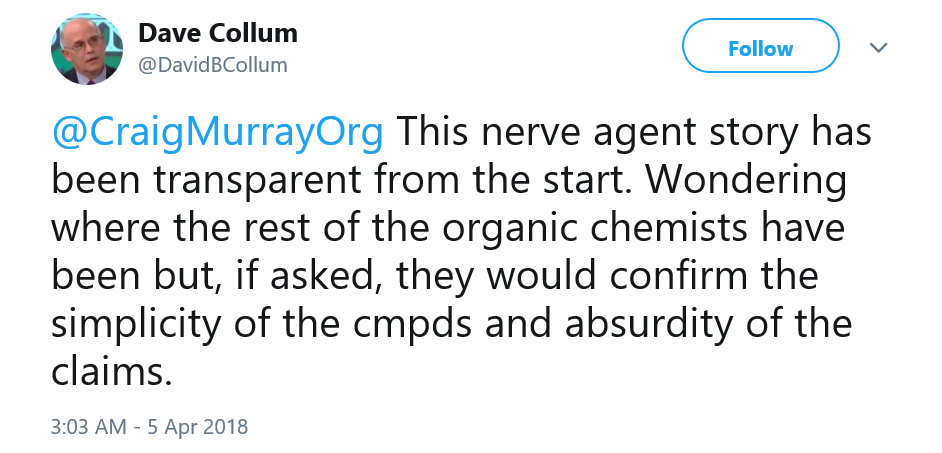
Motorola sales agent Gary Aitkenhead – inexplicably since January, Chief Executive of Porton Down chemical weapons establishment – said in his Sky interview that “probably” only a state actor could create the nerve agent. That is to admit the possibility that a non state actor could. David Collum, Professor of Organo-Chemistry at Cornell University, infinitely more qualified than a Motorola salesman, has stated that his senior students could do it. Professor Collum tweeted me this morning.
The key point in his tweet is, of course “if asked”. The state and corporate media has not asked Prof. Collum nor any of the Professors of Organic Chemistry in the UK. There simply is no basic investigative journalism happening around this case.
That the entire British case against Russia depends on intelligence is further shown by a further strange development in the case today.
This is that the British authorities are now apparently claiming that the fact that the poison which was used to poison Sergey and Yulia Skripal was supposedly found on Sergey Skripal’s door knob is the ‘smoking gun’ which points to Russia.
Whether that is so or not – and I share Craig Murray’s deep skepticism about this – the alleged presence of the poison on the door knob cannot be the reason why on 7th March 2018 the British government’s COBRA committee had already come to the conclusion that the attack on Sergey and Yulia Skripal “was almost certainly” the work of Russia.
That is because the theory that Sergey and Yulia Skripal were poisoned when they came into contact with the poison on the door knob only appeared several weeks after 7th March 2018.
All the evidence points to fact that the ‘intelligence’ the British government used to come to the conclusion – reached within hours of Sergey and Yulia Skripal being found passed out on a bench – that the attack on them had been carried out by Russia must have come from a human source.
If the British authorities really do possess what they believe to be a Russian assassin’s manual (see Craig Murray again) then that all but confirms it. How else would such a manual have come into their hands?
If that human source really was able to identify the particular poison used in the attack on Sergey and Yulia Skripal in advance, then that suggests a very well informed source indeed.
That might be because the source does have genuine access to secret information about a top secret Russian assassination programme, in which case the Russian authorities will by now almost certainly know who that source is.
However given the complete absence of any other evidence of a top secret Russian assassination programme I must say I doubt this (as I have discussed elsewhere, the Litvinenko case does not provide such evidence).
The alternative – which of course is what many people believe – is that this whole affair is a provocation, staged by someone who then tipped the British off that Novichok – a poison of “a type developed by Russia” but which can in fact easily be made elsewhere (see above) – had been used, whilst misleading the British by giving them a trail of false leads which appeared to point towards Russia.
The claim that the fact that traces of the poison were found on the door knob is the ‘smoking gun’ which points to Russia to my mind rather supports this second theory.
If this claim was made before the poison was found on the door knob it suggests that the source knew in advance that it was there, which would tend to implicate the source in the attack.
If the source provided the information about the alleged ‘assassin’s manual’ after reports appeared in the British media about the poison being found on the door knob – which by the way is what I suspect – then that strongly suggests that the source is adapting its information to the changing news, which suggests manipulation of the intelligence in order to implicate Russia.
Whatever the case the fact that Novichok was probably used to poison Sergey and Yulia Skripal (we will only know with any measure of certainty when the OPCW reports its tests) is not proof that Russia was involved.
The British have got themselves into a total mess by pretending that it is.
They would have avoided getting into this mess – and avoided being manipulated by whoever is giving them ‘secret’ information, if that is what is happening – if they had instead done what their law and traditions dictate they should have done, which is allowed the criminal investigation to take its course.
It bears repeating that at this stage no suspect has been identified in the case and even the theory that Sergey and Yulia Skripal were poisoned by touching Sergey Skripal’s door knob is pure conjecture.
Once again – as in the Litvinenko case and the Russiagate scandal – the course of a criminal investigation has been corrupted by the misuse of ‘intelligence’.
US lowering threshold for using nukes causes deepest concern – Lavrov
RT | April 5, 2018
Russia is worried the US could respond with nuclear weapons to a wider range of circumstances and that its priorities lie in establishing “military supremacy and upsetting parity” when it comes to “strategic stability.”
“The US policy of lowering the threshold of using nuclear weapons causes the deepest concern,” Russian Foreign Minister Sergey Lavrov said at the Moscow Conference on International Security. Washington’s latest Nuclear Posture Review expands a number of scenarios in which a nuclear response would be considered.
The US is also planning to replace outdated ballistic missiles with new, less powerful nuclear warheads to have them available and ready to give a “flexible response.”
NATO’s growing military activity near the borders of Russia and further efforts to deploy missile defense systems there is another worrisome factor for Moscow. “In the sphere of strategic stability, Washington attaches priority to gaining military supremacy and upsetting parity,” he said.
The Russian foreign minister also expressed concern over “speculations about spreading within NATO’s framework Article 5 of the Washington Treaty to the problems emerging in cyberspace.” The article states that an attack against one ally is considered an attack against all allies. NATO is working on expanding its guidelines on what could trigger its collective response to cyberattacks. Russia often called for “starting a professional discussion on confidence building measures and resistance to threats in that field ” but there were no response either from Washington or from Brussels.
Lavrov said the West should finally realize that they will no longer be able to play the “one goal game.”
“There are no prospects for them to seek to achieve unilateral advantages at our expense and that security in the Euro-Atlantics, in the Asia-Pacific region and in the world as a whole should be equal and indivisible.”
Although US President Donald Trump criticized his predecessors for being too involved with other countries rather than focusing on the US, the current administration has been embracing more and more war hawks recently.
Trump, however, says he is open for dialogue with Russia and the leaders of both countries agreed there should not be another arms race.
“[We] are not interested either in confrontation or in setting off an arms race. But Russia will safeguard purposefully and effectively its interests, its sovereignty and independence, using the entire arsenal of tools available to us,” Lavrov said.
Google employees protest work for US military drones
Press TV – April 5, 2018
Thousands of Google employees, including dozens of senior engineers, have signed a letter protesting the company’s involvement in a US military drone project, which has stirred concern among experts who think such cooperation is not ethical.
The Pentagon program is testing the internet giant’s artificial intelligence (AI) system to analyze vast amounts of footage captured by the US military’s unmanned surveillance planes around the world and to establish targets for drone strikes.
More 3,100 staff are thought to have signed a letter to Google CEO Sundar Pichai, demanding that the company pulls out of pilot experiment, called Project Maven.
The program intends to help the Pentagon conduct more precise attacks by drones against targets in other countries, including Syria and Iraq.
“We believe that Google should not be in the business of war,” says the letter. It asks that Google announce a policy that it will not “ever build warfare technology.”
This plan will irreparably damage Google’s brand and its ability to compete for talent,” the letter says. “Amid growing fears of biased and weaponized AI, Google is already struggling to keep the public’s trust.”
Project Maven is one of the many US drone projects aimed at automatically and quickly singling out points of interest so that analysts can work more efficiently in pinpointing new targets.
Google has described its work on Project Maven as “non-offensive” in nature, though the Pentagon’s video analysis is routinely used in counterterrorism operations.
But that explanation has not convinced those Google employees who think their work is being used for attacks that have on many occasions led to civilian deaths.
Through the formation of the Defense Innovation Board in 2016, Silicon Valley has advised American military officials to adopt breakthrough technology developed by technology pioneers such as Microsoft and Amazon.
Google is widely expected to compete with other technology giants for a multiyear, multibillion-dollar contract to provide cloud services to the US Defense Department.
“The argument that other firms, like Microsoft and Amazon, are also participating doesn’t make this any less risky for Google,” the letter says. “Google’s unique history, its motto Don’t Be Evil, and its direct reach into the lives of billions of users set it apart.”
There has been a sharp rise in the number of US drone strikes since US President Donald Trump took office, according to a report published in December by the Bureau of Investigative Journalism. … Full article
Fifty Years Ago the United States Government Killed Dr. Martin Luther King, Jr.
A Review of The Plot to Kill King by William Pepper
By Edward Curtin | April 4, 2018
Very few Americans are aware of the truth behind the assassination of Dr. Martin Luther King, Jr. Few books have been written about it, unlike other significant assassinations, especially JFK’s. For fifty years there has been a media blackout supported by government deception to hide the truth. And few people, in a massive act of self-deception, have chosen to question the absurd official explanation, choosing, rather, to embrace a mythic fabrication intended to sugarcoat the bitter fruit that has resulted from the murder of the one man capable of leading a mass movement for revolutionary change in the United States. Today we are eating the fruit of our denial.
In order to comprehend the significance of this extraordinary book, it is first necessary to dispel a widely accepted falsehood about Dr. Martin Luther King, Jr. William Pepper does that on the first page.
To understand his death, it is essential to realize that although he is popularly depicted and perceived as a civil rights leader, he was much more than that. A non-violent revolutionary, he personified the most powerful force for the long-overdue social, political, and economic reconstruction of the nation.
In other words, Martin Luther King was a transmitter of a non-violent spiritual and political energy so plenipotent that his very existence was a threat to an established order based on violence, racism, and economic exploitation. He was a very dangerous man.
Revolutionaries are, of course, anathema to the power elites who, with all their might, resist such rebels’ efforts to transform society. If they can’t buy them off, they knock them off. Fifty years after King’s assassination, the causes he fought for – civil rights, the end to U.S. wars of aggression, and economic justice for all – remain not only unfulfilled, but have worsened in so many respects. And King’s message has been enervated by the sly trick of giving him a national holiday and urging Americans to make it “a day of service.” Needless to say, such service does not include non-violent war resistance or protesting a decadent system of economic injustice.
Because MLK repeatedly called the United States the “greatest purveyor of violence on earth,” he was universally condemned by the mass media and government that later – once he was long and safely dead – praised him to the heavens. This has continued to the present day of historical amnesia.
 But William Pepper resurrects the revolutionary MLK, and in doing so shows in striking detail why elements within the U.S. government executed him. After reading this book, no fair-minded reader can reach any other conclusion. The Plot to Kill King, the culminating volume of a trilogy that Pepper has written on the assassination, consists of slightly less text than supporting documentation in its appendices, which include numerous depositions and interviews that buttress Pepper’s thesis on the why and how of this horrible murder. It demands a close reading that should put to rest any pseudo-debates about the essentials of the case.
Pepper, an attorney who represented the King family in the 1999 trial that found U.S. officials of the federal (in particular, the FBI and Army Intelligence), state, and local governments responsible for King’s assassination, has worked on the King case since 1977. He met MLK in 1967, after King had read his Ramparts’ magazine article, “The Children of Vietnam,” that exposed the hideous effects of U.S. napalm and white phosphorous bombing on young and old Vietnamese innocents. The text and photos of that article reduced King to tears and were instrumental in his increased opposition to the war against Vietnam as articulated in his dramatic Riverside Church speech (“Beyond Vietnam: A Time to Break Silence”) on April 4, 1967, one year to the day before his execution in Memphis. That speech, in which King so powerfully and publicly linked the war with racism and economic exploitation, foretold his death at the hands of the perpetrators of those abominations.
Devastated by King’s death, and assuming the alleged assassin James Earl Ray was responsible, Pepper retreated from the fray until a 1977 conversation with the Rev. Ralph Abernathy, King’s associate, who raised the specter of Ray’s innocence. After a five hour interrogation of the imprisoned Ray in 1978, Pepper was convinced that Ray did not shoot King and set out on a forty year quest to uncover the truth.
Before examining the essentials of Pepper’s discovery, it is important to point out that MLK, Jr., his father, Rev. M. L. King, Sr., and his maternal grandfather, Rev. A.D. Williams, all pastors of Atlanta’s Ebenezer Baptist Church, were spied on by Army Intelligence and the FBI since 1917. All were considered communist sympathizers and dangerous to the reigning hegemony because of their espousal of racial and economic equality. When MLK, Jr. forcefully denounced unjust and immoral war-making as well, and announced his Poor People’s Campaign and intent to lead a massive peaceful encampment of hundreds of thousands in Washington, D.C., he set off panic in the bowels of government spies and their masters. Seventy-five years of spying on black religious leaders here found its ultimate “justification.” As Stokely Carmichael, co-chairman of the Student Non-violent Coordinating Committee, said to King in a conversation secretly recorded by Army Intelligence, “The man don’t care you call ghettos concentration camps, but when you tell him his war machine is nothing but hired killers, you got trouble.”
It is against this “trouble” that Pepper’s investigation must be set, as that “trouble” is also the background for the linked assassinations of JFK, Malcolm X, and RFK. Understanding the forces behind the military, the spies, and the gunmen who, while operating in the shadows, are actually the second layer of the onion skin, is essential. The government and mainstream corporate media form the outer layer with their collusion in disinformation, lying, and truth suppression, but Pepper correctly identifies the core as follows.
Bombastic, chauvinistic, corporate propaganda aside, where the slaughter of innocents is, and always was, justified in the name of patriotism and national security, it has always and ever been about money. Corporate and financial leaders trusted with the keys to the Republic’s treasure moved from boardrooms to senior government positions and back again. Construction, oil and gas, defense industry, and pharmaceutical corporations, their bankers, brokers, and executives thrive in a war economy. Fortunes are made and dynasties created and perpetuated and a cooperating elite permeates an entire society and ultimately contaminates the world in its drive for national resources wherever they are …. Vietnam was his [King’s] Rubicon …. Here, as never before, would he seriously challenge the interests of the power elite.
MLK was assassinated on April 4, 1968 at 6:01 PM as he stood on the balcony of the Lorraine Motel in Memphis, Tennessee. He was shot in the lower right side of his face by one rifle bullet that shattered his jaw, damaged his upper spine, and came to rest below his left shoulder blade. The U.S. government claimed the assassin was a racist loner named James Earl Ray, who had escaped from the Missouri State Penitentiary on April 23, 1967. Ray was alleged to have fired the fatal shot from a second-floor bathroom window of a rooming house above the rear of Jim’s Grill across the street. Running to his rented room, Ray allegedly gathered his belongings, including the rifle, in a bedspread-wrapped bundle, rushed out the front door onto the adjoining street, and in a panic dropped the bundle in the doorway of the Canipe Amusement Company a few doors down. He was then said to have jumped into his white Mustang and driven to Atlanta where he abandoned the car. From there he fled to Canada and then to England where he was eventually arrested at Heathrow Airport on June 8, 1968 and extradited to the U.S. The state claims that the money Ray needed to purchase the car and for all his travel was secured through various robberies and a bank heist. Ray’s alleged motive was racism and that he was a bitter and dangerous loner.
When Ray, under extraordinary pressure, coercion, and a payoff from his lawyer to take a plea, pleaded guilty (only a few days later to request a trial that was denied) and was sentenced to 99 years in prison, the case seemed to be closed, and was dismissed from public consciousness. Another hate-filled lone assassin, shades of Lee Harvey Oswald and Sirhan Sirhan, had committed a despicable deed.
In the years leading up to Pepper’s 1978 involvement, only a few lonely voices expressed doubts about the government’s case – Harold Weisberg in 1971 and Mark Lane and Dick Gregory in 1977. The rest of the country put themselves and the case to sleep. They are still sleeping, but Pepper is trying with this last book to wake them up. Meanwhile, the disinformation specialists continue with their lies.
While a review is not the place to go into every detail of Pepper’s rebuttal of the government’s shabby claims, let me say at the outset that he emphatically does so, and adds in the process some tentative claims of which he is not certain but which, if true, are stunning.
As with the assassinations of President Kennedy and his brother, Robert (two months after MLK), all evidence points to the construction of patsies to take the blame for government executions. Ray, Oswald, and Sirhan all bear striking resemblances in the ways they were chosen and moved as pawns over long periods of time into positions where their only reactions could be stunned surprise when they were accused of the murders.
It took Pepper many years to piece together the essential truths, once he and Abernathy interviewed Ray in prison in 1978. The first giveaway that something was seriously amiss came with the 1979 House Select Committee on Assassinations’ report on the King assassination. Led by Robert Blakey, suspect in his conduct of the other assassination inquiries, who had replaced Richard Sprague, who was deemed to be too independent, “this multi-million dollar investigation ignored or denied all evidence that raised the possibility that James Earl Ray was innocent,” and that government forces might be involved. Pepper lists over twenty such omissions that rival the absurdities of the magical thinking of the Warren Commission. The HSCA report became the template “for all subsequent disinformation in print and visual examinations of this case” for the past thirty-seven years.
Pepper’s decades-long investigation, not only refutes the government’s case against James Earl Ray, but definitively proves that King was killed by a government conspiracy led by the FBI, Army Intelligence, and Memphis Police, assisted by southern Mafia figures. He is right to assert that “we have probably acquired more detailed knowledge about this political assassination than we have ever had about any previous historical event.” This makes the silence around this case even more shocking. This shock is accentuated when one is reminded (or told for the first time) that in 1999 a Memphis jury, after a thirty day trial and over seventy witnesses, found the U.S. government guilty in the killing of MLK. The King family had brought the suit and William Pepper represented them. They were grateful that the truth was confirmed, but saddened by the way the findings were buried once again by a media in cahoots with the government.
The civil trial was the King family’s last resort to get a public hearing to disclose the truth of the assassination. They and Pepper knew that Ray was an innocent pawn, but Ray had died in prison in 1998 after trying for thirty years to get a trial and prove his innocence (shades of Sirhan Sirhan who still languishes in prison). During all those years, Ray had maintained that he had been manipulated by a shadowy figure named Raul, who supplied him with money and his white Mustang and coordinated all his complicated travels, including having him buy a rifle and come to Jim’s Grill and the boarding house on the day of the assassination. The government has always denied that Raul existed.
Blocked at every turn by the authorities and unable to get Ray a trial, Pepper arranged an unscripted, mock TV trial that aired on April 4, 1993, the twenty-fifth anniversary of the assassination. Jurors were selected from a pool of U.S. citizens, a former U.S. Attorney and a federal judge served as prosecutor and judge, with Pepper serving as defense attorney. He presented extensive evidence clearly showing that authorities had withdrawn all security for King; that the state’s chief witness was falling down drunk; that the alleged bathroom sniper’s nest was empty right before the shot was fired; that three eyewitnesses, including the NY Times Earl Caldwell, said that the shot came from the bushes behind the rooming house; and that two eyewitnesses saw Ray drive away in his white Mustang before the shooting, etc. The prosecution’s feeble case was rejected by the jury that found Ray not guilty.
As with all Pepper’s work on the case (including book reviews), the mainstream media responded with silence. And though this was only a TV trial, increasing evidence emerged that the owner of Jim’s Grill, Loyd Jowers, was deeply involved in the assassination. Pepper dug deeper, and on December 16, 1993, Loyd Jowers appeared on ABC’s Primetime Live that aired nationwide. Pepper writes, “Loyd Jowers cleared James Earl Ray, saying that he did not shoot MLK but that he, Jowers, had hired a shooter after he was approached by Memphis produce man Frank Liberto and paid $1,000,000 to facilitate the assassination. He also said that he had been visited by a man names Raul who delivered a rifle and asked him to hold it until arrangements were finalized …. The morning after the Primetime Live broadcast there was no coverage of the previous night’s program, not even on ABC …. Here was a confession, on prime time television, to involvement in one of the most heinous crimes in the history of the Republic, and virtually no American mass-media coverage.”
In the twenty-five years since that confession, Pepper has worked tirelessly on the case and has uncovered a plethora of additional evidence that refutes the government’s claims and indicts it and the media for a continuing cover-up. The evidence he has gathered, detailed and documented in The Plot to Kill King, proves that Martin Luther King was killed by a conspiracy masterminded by the U.S. government. Much of his evidence was presented at the 1999 trial, while other was subsequently discovered. Since the names and details involved make clear that, as with the murders of JFK and RFK, the conspiracy was very sophisticated with many moving parts organized at the highest level, I will just highlight a few of his findings in what follows. A reader should read the book to understand the full scope of the plot, its execution, and the cover-up.
- Pepper refutes the government account and proves, through multiple witnesses, telephonic, and photographic evidence, that Raul existed; that his full name is Raul Coelho; and that he was James Earl Ray’s intelligence handler, who provided him with money and instructions from their first meeting in the Neptune Bar in Montreal, where Ray had fled in 1967 after his prison escape, until the day of the assassination. It was Raul who instructed Ray to return to the U.S. (an act that makes no sense for an escaped prisoner who had fled the country), gave him money for the white Mustang, helped him attain travel documents, and moved him around the country like a pawn on a chess board. The parallels to Lee Harvey Oswald and Sirhan Sirhan are startling.
 He presents the case of Donald Wilson, a former FBI agent working out of the Atlanta office in 1968, who went with a senior colleague to check out an abandoned white Mustang with Alabama plates (Ray’s car, to which Raul had a set of keys) and opened the passenger door to find that an envelope and some papers fell out onto the ground. Thinking he may have disturbed a crime scene, the nervous Wilson pocketed them. Later, when he read them, their explosive content intuitively told him that if he gave them to his superiors they would be destroyed. One piece was a torn out page from a 1963 Dallas telephone directory with the name Raul written at the top, and the letter “J” with a Dallas telephone number for a club run by Jack Ruby, Oswald’s killer. The page was for the letter H and had numerous phone numbers for H. L. Hunt, Dallas oil billionaire and a friend of FBI Director J. Edgar Hoover. Both men hated MLK. The second sheet contained Raul’s name and a list of names and sums and dates for payment. On the third sheet was written the telephone number and extension for the Atlanta FBI office. (Read Jim Douglass’s important interview with Donald Wilson in The Assassinations, p.479-491.)
- Pepper interviewed four other witnesses who confirmed that they had seen Raul with Jack Ruby in Dallas in 1963 and that they were associated.
- Pepper shows that the alias Ray was given and used from July 1967 until April 4, 1968 – Eric Galt – was the name of a Toronto operative of U.S. Army Intelligence, Eric St. Vincent Galt, who worked for Union Carbide with Top Secret clearance. The warehouse at the Canadian Union Carbide Plant in Toronto that Galt supervised “housed a top secret munitions project funded jointly by the CIA, the U.S. Naval Surface Weapons Center, and the Army Electronics Research and Development Command …. In August 1967, Galt met with Major Robert M. Collins, a top aide to the head of the 902nd Military Intelligence Group (MIG) Colonel John Downie.” Downie selected four members for an Alpha 184 Sniper Unit that was sent to Memphis to back up the primary assassin of MLK. Meanwhile, Ray, set up as the patsy, was able to move about freely since he was protected by the pseudonymous NSA clearance for Eric Galt.
- To refute the government’s claim that Ray and his brother robbed the Alton, Illinois Bank to finance his travels and car purchase (therefore no Raul existed), Pepper “called the sheriff in Alton and the president of the bank; they gave the same statement. The Ray brothers had nothing to do with the robbery. No one from the HSCA, the FBI, or The New York Times had sought their opinion.” CNN later reiterated the media falsehood that became part of the official false story.
- Pepper proves that the fatal shot came from the bushes behind Jim’s Grill and the rooming house, not from the bathroom window. He presents overwhelming evidence for this, showing that the government’s claim, based on the testimony on a severely drunk Charlie Stephens, was absurd. His evidence includes the testimony of numerous eyewitnesses and that of Loyd Jowers, the owner of Jim’s Grill, who said he took the rifle from the shooter in the bushes and brought it into the bar where he hid it. Thus, Ray was not the assassin.
- He presents conclusive evidence that the bushes were cut down the morning after the assassination in an attempt to corrupt the crime scene. The order to do so came from Memphis Police Department Inspector Sam Evans to Maynard Stiles, a senior administrator of the Memphis Department of Public Works.
- He shows how King’s room was moved from a safe interior room, 201, to balcony room, 306, on the upper floor; how King was conveniently positioned alone on the balcony by members of his own entourage for the easy mortal head shot from the bushes across the street. (Many people only remember the iconic photograph taken after-the-fact with Jesse Jackson, Andrew Young, et al., standing over the fallen King and pointing across the street.) Pepper implicates that Reverends Billy Kyles, Jesse Jackson, and, to a lesser extent, Ralph Abernathy were involved in these machinations. He uncovers of the role of black military intelligence agent Marrell McCollough, attached to the 111th MIG, within the entourage. McCollough can be seen kneeling over the fallen King, checking to see if he’s dead.
- Pepper confirms that all of this, including the assassin in the bushes, was dutifully photographed by Army Intelligence agents situated on the nearby Fire House roof.
- He presents evidence that all security for Dr. King was withdrawn from the area by the Memphis Police Department, including a special security unit of black officers, and four tactical police units. A black detective at the nearby fire station, Ed Redditt, was withdrawn from his post on the afternoon of April 4th, allegedly because of a death threat against him. And the only two black firemen at Fire Station No.2 were transferred to another station.
- He names and confirms the presence of Alpha 184 snipers at locations high above the Lorraine Motel balcony.
- He explains the use of two white mustangs in the operation to frame Ray.
- He proves that Ray had driven off before the shooting; that Loyd Jowers took the rifle from the shooter who was in the bushes; that the Memphis police were working in close collaboration with the FBI, Army Intelligence, and the “Dixie Mafia,” particularly local produce dealer Frank Liberto and his New Orleans associate Carlos Marcello; and that every aspect of the government’s case was filled with holes that any person familiar with the details and possessing elementary logical abilities could refute.
- So importantly, Pepper shows how the mainstream media and government flacks have spent years covering up the truth of MLK’s murder through lies and disinformation, just as they have done with the Kennedy and Malcom X assassinations that are of a piece with this one.
But since this is a book review and not a book, I will stop listing Pepper’s very detailed and convincing findings. While he may not have answered every aspect of the case, and may be mistaken in some small details, he has proven beyond a shadow of a doubt the basic fact that James Earl Ray did not kill Martin Luther King, but that this great and dangerous leader was killed by a conspiracy organized at the highest levels of government.
The Plot to Kill King will mesmerize any reader seeking the truth about MLK’s assassination. Even when Pepper, towards the end of the book, offers circumstantial and non-corroborated testimony from witnesses Ronnie Lee Adkins and Johnton Shelby, the reader can’t help but be intrigued and to consider their stories highly plausible given all that Pepper has proven. Adkins claims that his father, a friend of Clyde Tolson, FBI Director J. Edgar Hoover’s deputy, and then he himself, were part of the plot to kill King. This involved politicians, the FBI, MPD, and mafia, including the aforementioned produce dealer Frank Liberto and others, making payoffs with FBI money to various people, including Jesse Jackson (whom Adkins, Jr. claims was a paid FBI informer) and working closely on the details of the assassination. Johton Shelby’s story as recounted in his deposition (2014) to Pepper (reproduced, together with Adkins’ (2009), as appendices in the book), is that his mother, who was working as an emergency room aide at St. Joseph’s Hospital when King was brought there, inadvertently witnessed men spitting on Dr. King as he lay in the emergency room and a doctor putting a pillow over his head and suffocating him to death. Pepper tends to accept these accounts, but says he isn’t completely convinced of all aspects of them. The reader is offered plenty of food for thought concerning these claims.
Besides clearly proving the government’s part in killing Martin Luther King, this book is very important for the way Pepper links the case to those of JFK and RFK, who was murdered two months after King. At the center of all these murders is a trinity of men who were devoted to ending the Vietnam War and all wars, restoring economic justice for all Americans, and eliminating racial inequality. That their goals were the same provides a motive for their murders by forces opposed to these lofty objectives. That their murders clearly involved highly sophisticated operations and cover-ups that could never have been pulled off by “crazed lone assassins” points to powerful forces with those means at their disposal. And when it comes to opportunity, when did the shadowy forces of the deep state ever lack for that?
The ramifications of the MLK assassination profoundly inform our current condition. For anyone who truly cares about peace, love, and justice, The Plot to Kill King is essential reading. William Pepper should be saluted. He has carried on Martin King’s noble legacy.
This is an updated review first published on 28 November 2016 at Global Research.
How the Ex-Spy Case is Transforming UK Media Into Orwellian ‘Ministry of Truth’
Sputnik – April 5, 2018
The admission by scientists from the Porton Down defense lab that that they could not actually verify the source of the nerve agent used to poison Sergei Skripal and his daughter has not stopped British media from blaming Russia for the affair, or calling on London to take an even tougher stance against the Russians.
Unnamed ‘security sources’ have told The Times that they may have pinpointed the location of the “covert Russian laboratory” which allegedly created the chemical agent used to poison the Skripals.
According to the newspaper, government ministers and security officials “were able to identify the source using scientific analysis and intelligence” soon after the attack. “We knew pretty much by the time of the first Cobra [the emergency coordination briefing] that it was overwhelmingly likely to come from Russia,” a Whitehall source said.
The Times’ source insisted that the security services have a “high degree of confidence” regarding the location where the chemical was produced, but admitted they were not 100% certain.

Screenshot of The Times’ story.
Not to be outdone, The Sun ran a similar story, claiming that a lab run by Russia’s SVR foreign intelligence service in the Moscow district of Yasenevo was the “likely” creator of the poison. The tabloid paraphrased unnamed ‘security sources’, who told the newspaper that the Russian lab is “one of a handful of labs in the world that produces the nerve agent.”

Screengrab of The Sun article.
No Proof Needed
The pair of stories comes 48 hours after Porton Down Defense Science & Technology Laboratory chief Gary Aitkenhead’s admission that the military could not definitively conclude that the nerve agent believed used in the Skripal case was of Russian origin.
The new media efforts to implicate Russia, using unnamed sources and terms such as “likely” and “high degree of confidence” is reminiscent of the kind of language used by the British government in the days and weeks following the poisoning. However, following Tuesday’s revelation by Mr. Aitkenhead, the government and Foreign Secretary Boris Johnson in particular have been reeling from their attempts to definitively claim Russian involvement in the Skripal case.
Some outlets, including The Independent, decided to meet Aitkenhead’s revelations with a stiff upper lip, insisting that Russia’s efforts in the Skripal case, including its “ever more reasonable-sounding but insincere offers” to help in the investigation, don’t change “the overwhelming probability that the novichok nerve agent originated in Russia…” It is simply “inconceivable that anyone other than the Russians” could organize such a plot, according to the newspaper.
As for Russia’s demand that London actually prove its allegations, The Independent suggests that “a legal standard of proof is not required,” adding that the kind of proof asked for by Moscow is “impossible to achieve.” The paper even accuses Labour leader Jeremy Corbyn and others of ‘buying into’ the arguments presented by the Russians.
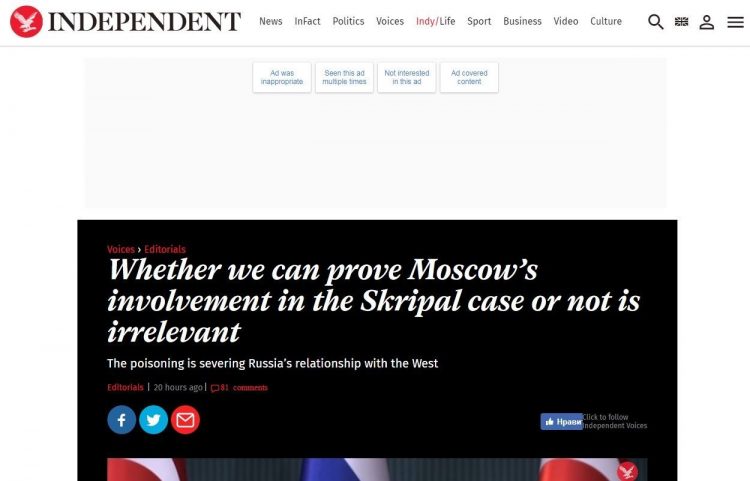
The Independent’s ‘bold’ editorial amid the revelation that Porton Down scientists couldn’t prove the poison’s origin.
Ministry of Truth
Also, even as the case against Russia over the Salisbury poisoning slowly falls apart, some UK and other Western media continue an effort to further poison Russia-Western relations, insisting that Russia is surely responsible for the attack, and criticizing their governments for not being tough enough on Moscow.
Bloomberg, for example, has run an editorial arguing that while the recent expulsion of dozens of Russian diplomats from dozens of Western countries is all well and good, “it’s too mild” to put real pressure on Vladimir Putin and the Russian government.Rather, the business news agency says, the West should band together to turn up the heat to “counter the domestic propaganda that Putin has used to increase his popularity and build anti-Western sentiment. Reaching out to Russians in big cities and neighboring countries, where dissent exists and could be encouraged, the US and its allies should make clear that the cause of their complaints is Putin and his helpers, not Russia at large.”

Screenshot of the Bloomberg piece.
Commenting on the Bloomberg piece, Rossiya Segodnya politics contributor Viktor Marakhovsky quipped that the logic of the story was just brilliant: “When Russia appeals to the citizens of Western countries with criticism toward their authorities, this is propaganda and an attempt to assert influence. But when it’s the other way around, this is a fight against internal propaganda and bringing the truth to Russia,” he wrote.
The Guardian issued its own editorial, recommending paying more attention to the ‘home front’ to arrange a nationwide informational manhunt of ‘Putin’s trolls’.
Complaining about The Guardian’s comments section being “infected” by “Russian trolls,” the editorial says that while not all offending accounts or hashtags may be Russian-made, “its sentiments chime sufficiently with the trolls’ aim for them to boost it.”
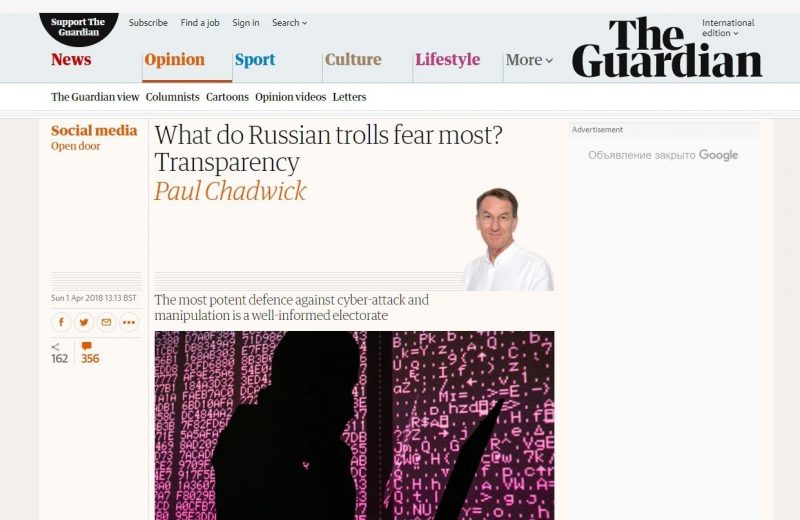
Screengrab of The Guardian editorial.
In other words, Marakhovsky commented, these non-Russian accounts are de facto “enemies because they think and write the wrong thing.” In this way, the journalist noted, the newspaper is effectively calling on Western media “to assume the functions of the Ministry of Truth – to identify both Russian trolls and those who have been infected by their propaganda… and explain to them why their views are wrong, because they happen to agree with the opinion of the Russian foe.”
Russian ex-spy Sergei Skripal and his daughter Yulia were hospitalized in Salisbury, southern England on March 4 following a chemical attack thought to involve the A-234 nerve agent. Sergei remains in critical condition; his daughter has regained consciousness and is making a recovery. London almost immediately accused Moscow for the attack, and initiated a series of measures directed against Russia, including the expulsion of 23 Russian diplomats. Many of the UK’s allies have followed suit. Moscow has rejected London’s accusations, saying claims of Russian involvement are entirely unsubstantiated.
Featured Video
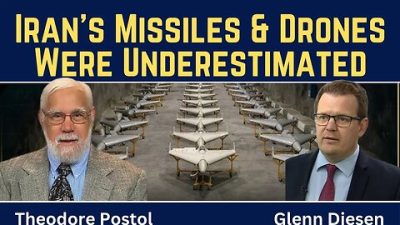
Theodore Postol: Iran’s Missiles & Drones Were Underestimated
or go to
Aletho News Archives – Video-Images
From the Archives
What is the Israeli Lobby in Australia Doing in Interfaith Dialogue?
By Ali Kazak | Dissident Voice | October 11, 2015
For years Israel and its lobby around the world have been trying to normalise their relations with Arabs and Muslims without solving the Palestine Question.
One of the methods they resorted to in the last few years is using human rights and community organizations such as interfaith dialogue and Multiculturalism to achieve this objective and to: isolate the Palestinians, marginalise the Palestine question, end Israel’s isolation, and prevent criticism of Israel, knowing that these organisations will be the first to stand against Israel’s violations, racial and religious discrimination.
The group responsible for this task in Australia is The Australia/Israel & Jewish Affairs Council (AIJAC); its Director of International & Community Affairs, Jeremy Jones is in charge of lobbying religious community organizations, specifically Muslims and Christians. Consequently he convened the Faith Communities for Reconciliation, founding participant in the Australian Partnership of Religious Organisations and the Australian National Dialogue of Christians, Muslims & Jews.
AIJAC is a private political propaganda group. It is recognised as the main Israeli lobby in Australia. It coordinates its activities and works intimately with the Israeli embassy in Canberra and different institutions in Israel. It is privately funded by some Jewish businessmen. It monitors closely Australian politicians, the media, ethnic and religious groups, (especially Arabs and Muslims), unions and academics on their stands towards Israel and the Palestine question. … continue
Blog Roll
 Aletho News
- The Most Important Bet You’ve Never Heard Of
- The killing of three Indonesian soldiers in Lebanon should remind Jakarta that Israel does not want peace
- Defeated and delusional: Netanyahu’s remarks reveal $80bn war failure, says analyst
- Iran’s friends are about to make life much more difficult for Israel and the US
- The war of liberation of the Arab and Islamic peoples expands across the Gulf
- Envoy warns UN on Trump’s threat to ‘obliterate’ Iran’s civilian infrastructure
- The Larak Corridor: Iran’s Rial Gate With No US, No Israel, and No Way Around
- ‘Economic terrorism’: Steel facilities hit again in US-Israeli strike
- ‘War Crime’: Iran condemns attacks on Arak, Ardakan nuclear sites
- Two-thirds of Americans want quick end to Iran war even if goals unmet
- If Americans Knew
- Gaza families reunite years after babies evacuated amid Israel’s war
- International Rescue Committee warns Gaza’s children face grave protection risks
- Iran’s Alleged 47-Year War on America: Debunking the 1,050 American Deaths Canard
- Israel wants US to bomb more of Iran’s civilian structures (113,000 is not enough) – Not a ceasefire Day 173
- Ann Coulter Rips Into Fox News for Iran War Coverage
- Joe Kent Urges Americans To Call White House and Congress To Object To Sending Troops Into Iran
- DNC Resolution to Reject AIPAC Funding Puts Democratic Leaders in the Hot Seat
- Swedish foundation to build 400 schools as over 650,000 Gaza children remain without education for 2 years
- Israeli army admits photshopping image of slain Lebanese journalist
- This is how Israel is systematically killing health workers under the cover of war in Lebanon
- No Tricks Zone
- New Study Finds Warming Saves Lives…Cold Temperatures 12 Times More Deadly Than Excess Heat
- German Science Blog Accuses PIK Climate Institute Of Hallucinating Climate Tipping Points
- Devastating Assessment Of Comirnaty Vaccine By Former Senior Pfizer Europe Toxicologist
- New Study: CO2 Is ‘Effectively Negligible’ As An Explanatory Climate Change Factor Since 2000
- Former Pfizer Toxicologist Dr. Helmut Sterz Tells Bundestag Hearing Pfizer Vaccine Should Have Never Been Approved
- Energy Expert: Germany’s Nuclear Phaseout Was A “500 Billion Euro Mistake”
- New Research: South Australia’s Mid-Holocene Sea Surface Temperatures Were 4°C Warmer Than Today
- Storing Green Energy To Last Germany 10 Days Would Require A 60-Million Tonne Battery
- New Studies: UK Sea Levels Were 4 Meters Higher Than Today During The Mid-Holocene
- Destructive Green New Deal: German Energy And Metal Group Warns Of Drastic Crisis
 Aletho News