Botswana National Front calls for boycott of Israel
Palestine Information Center | May 19, 2018
 GABORONE – Botswana’ main opposition party, the Botswana National Front (BNF), has called on the government of Botswana to terminate all relations with Israel. This comes in the wake of Israel’s massacre of 60 people on the Israel-Gaza border on Monday.
In a scathing statement, BNF’s Secretary for International Affairs, Nelson Ramaotwana said:
“The BNF does not only condemn the barbaric acts of Israel but call upon the government of Botswana to terminate forthwith all diplomatic relations, trade linkages, military and intelligence support from Israel. We call upon Batswana from all walks of life to boycott and disinvest from Israel products and businesses in solidarity with 61 butchered and 2700 injured Palestinians.”
Hamas condemns Swiss minister’s comment about right to return
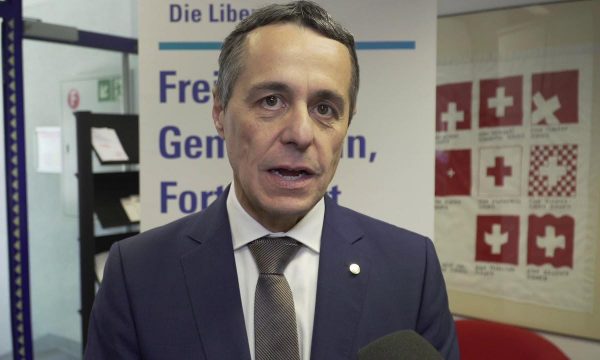
Ignazio Cassis, the Foreign Minister of Switzerland [screengrab / Youtube]
MEMO | May 19, 2018
The Islamic Palestinian Resistance Movement, Hamas, has condemned a comment by Swiss Foreign Minister Ignazio Cassis about the Palestinians’ right to return. The movement said that it was “shocked” to hear Cassis describe the legitimate return of all Palestinian refugees as an “unrealistic dream” in a comment about the UN Relief and Works Agency (UNRWA).
According to the minister, “UNRWA poses a problem by holding an unrealistic dream about the return of all refugees.” The question, he said, is whether UNRWA is part of the solution or the problem. “It has long worked as a solution but now it is part of the problem, it is securing the ammunition needed for the continuation of the conflict. As long as Palestinians live in refugee camps, they will remain wanting to return to their homeland.”
Hamas denounced what it called the Swiss minister’s “disgraceful remarks” and demanded that the government of Switzerland should issue an apology to the people of Palestine.
“We reiterate our support for UNRWA and the need to enable it to continue its work mandated by the international community for the relief and employment of Palestinian refugees,” the movement said. “We affirm to all that the adherence of our people to their rights, foremost of which is the return to their land, is not linked to the existence of the camps or the continuation of the Agency’s work.”
The right to return to their homeland, Hamas pointed out, is one to be upheld for all refugees, regardless of where they are or their country of origin. Palestinian refugees are no different, it insisted, and their right to return has been reaffirmed in numerous UN Resolutions over the decades since the 1948 ethnic cleansing of their land. “Furthermore,” added Hamas, “it is an individual and collective right.”
Canada’s Shameful Hypocrisy on Display!
By Marion Kawas | Canada Palestine Association | May 18, 2018
Six weeks after Israeli snipers started killing and maiming Palestinians, including children, journalists, and medical workers, Canada’s PM Justin Trudeau finally released a carefully worded statement regarding the situation. The statement came only after the wounding of a Canadian doctor on the ground in Gaza, Tarek Loubani.
Activists familiar with the long history of complicity and duplicity of successive Canadian governments cautioned that the statement missed the mark on two main points.
Firstly, it studiously avoided any mention of the culpability of the Israeli government by name, anywhere in the statement.
Secondly, although there was a call for an independent investigation, it was worded this way:
“Canada calls for an immediate independent investigation to thoroughly examine the facts on the ground – including any incitement, violence, and the excessive use of force…We will work closely with our international partners and through international institutions to address this serious situation.”
Calling for investigations is usually diplomatic code for stalling and not taking action. But note also the wording and the ordering of possible facts on the ground, “including any incitement, violence and the excessive use of force”.
However, no-one had to wait long to have the hypocrisy of the Canadian government revealed. Two days after the statement, on May 18, Canada stated it would not support the resolution that was then passed by an overwhelming majority at the UN Human Rights Council. This is what Canada had to say:
“Canada was gravely concerned about the numerous deaths and countless injuries in the Gaza Strip over the past several weeks. However, it could not support the draft resolution because it prejudged the outcome of an international investigation. The resolution was one-sided and did not advance the prospects for a peaceful, negotiated settlement to the Israeli-Palestinian conflict. The resolution singled out Israel, without making reference to other actors.”
So, there we have it. Either the UNHRC is not an “international institution” that the Trudeau government wants to work closely with or the resolution made the serious error of actually naming who was firing the shots and dropping the tear gas on unarmed protestors.
Or the Trudeau government was just playing politics from the beginning, and after realizing that the issue of Israel slaughtering Palestinians was becoming very unpopular and the Liberal Party was losing support for its deafening silence, decided to issue a statement that said little and achieved less.
This way, they (and their supporters) could claim they have indeed responded and stood up to the pro-Israel lobby. Actually, it is a sad tradition in Canada that most of the major political parties play “political football” with the lives and struggles of Palestinians. One eye always on the win/loss column to decide when and how to speak out.
We say enough, over 100 Palestinians have not died in the last 6 weeks just so the Canadian government can shed crocodile tears while still defending Israel. We need to focus less of our resources and time on what politicians have to say and more on developing concrete and grassroots work, like BDS campaigns, that have a long-term benefit to the Palestinian people.
– Marion Kawas is a member of the Canada Palestine Association and co-host of Voice of Palestine.
EU Blocking Statute Against Anti-Iran US Sanctions May Fail to Protect Companies
Sputnik – May 19, 2018
BRUSSELS – The reinforcement and modification by EU of its Blocking Statute, which protects EU companies from the effects of sanctions by a third country, in order to prohibit companies from complying with US anti-Iran sanctions will not protect companies from fines for cooperating with Iranian projects, experts told Sputnik.
Since US President Donald Trump announced his decision to pull out of the Iran nuclear deal and reimpose its sanctions against the Islamic Republic, efforts by EU leaders have been focused on preserving the status quo in relations with Iran and mitigating the effects of the US withdrawal.
On Thursday, European Commission President Jean-Claude Juncker announced that the union will amend its Blocking Statute in order to include the US sanction imposed against Iran in the regulation. As soon as the amendments are adopted, EU businesses will be allowed not to comply with the US restrictions or even demand compensation for losses caused by the US sanctions.
TO AVOID US PENALTIES FIRMS SHOULD ABANDON BUSINESS WITH US
“Reactivating and even modifying the 1996 Blocking Statute will not shield EU companies, banks, and even countries from the US Department of Treasury imposing penalties. An EU company, bank, or government would have to do no business directly or indirectly with US counterparts in order to not feel the impact of US responses,” Dr. Jamsheed K. Choksy, the chair of Department of Central Eurasian Studies at Indiana University, said.
Choksy indicated that the safeguards that the EU leadership and national governments might potentially provide to the EU companies will not be able to make up for the losses caused by not doing business with the United States, which is a target market for EU firms.
Choksy explained that EU firms, in fact, had to choose between business with US entities or Iranian ones and business with US companies was far more economically viable and lucrative than business with Iran.
The head of the Europe of Nations and Freedom group in the European Parliament, Nicolas Bay, agreed with Choksy, saying that the importance of the US and Iranian markets for EU businesses was non-comparable.
POLITICAL ASPIRATIONS VS. ECONOMIC INTERESTS
According to the politician, Brussels’ attempts to demonstrate its political independence and significance by preserving the Iran nuclear deal without the United States have nothing to do with purely economic motives of the EU businesses.
“In the current state of the crisis, Jean-Claude Juncker, Donald Tusk and the European Union are only into communication to hide their weakness, because Brussels will not be able to force the banks, the car manufacturers, and all the European companies that depend on the American market to continue to trade with Iran,” Bay said.
Drieu Godefridi, a writer and former Director of the Hayek Institute, said that EU firms would not abandon pragmatic interests to appease EU politicians trying to recover from Trump’s neglect of transatlantic partnership.
“Whatever Mr. Juncker says now and the sabre-rattling by some, large and small European companies will never jeopardize their North American business to please the Brussels politicians. Europe is divided; we may be the largest world market but Europe is a political dwarf,” Godefridi said.
EUROPE WILL HAVE TO ABIDE
“My analysis when Trump announced the re-establishment of sanctions was that Europeans would have to abide. There is no way Europe could take a different path: America is the backbone of European defense in NATO, America is the first market of Germany and the third of France. No European bank can live without access to the dollar zone,” Godefridi predicted.
Jacques Leroy, a French international consultant on deals in the Middle East, believes that in the current situation, taking into account the importance of the US market for European countries, national governments will try to obtain some exemptions for their firms on an individual basis.
“Every European leader will try to obtain ‘special treatment’ from Washington, which is exactly what Donald Trump counts on. Divide to control. Europe will have to bow to US sanctions in the end,” Leroy stressed.
IRAN’S SALVATION LIES IN PARTNERSHIP WITH RUSSIA, CHINA
Since the majority of experts were convinced that the EU dependence on the United States would not allow Brussels to preserve its cooperation with Iran, they suggested that the Islamic Republic should seek refuge in partnership with more independent Russia ad China.
“I do not think [EU politicians] have the stomach to stand up to Trump. The United States wants Iran, Russia, and China to fall on their knees. These three countries must move closer to each other,” Mohammad Marandi, a professor at the University of Tehran, recommended.
His views were fully shared by Godefridi, who assumed that Russia and China were independent enough from the US economy to go their own way and trade with Iran.
An Urgent Call for Solidarity with Nicaragua
Asociación de Trabajadores del Campo (Rural Workers Association) | May 17, 2018
Friends in Solidarity,
We have lived a month full of tragedy in our country. The peace we achieved as a people, so fragile and at the cost of so many lives, is in immanent danger of disappearing irreparably. There are now two sizeable camps of the population with dangerously contrary positions. On one side, there is a combination of private university students, media outlets with rightwing owners representing the oligarchy, Catholic Church bishops close to Opus Dei, the private sector and, of course, the US Embassy, working together to create a situation of chaos in the country in order to remove president Daniel Ortega. This group of actors accuses the National Police of having killed dozens of protestors in the riots that reached all Nicaraguan cities, ostensibly against a reform—since revoked—to the system of social security. As we have described, the reality is more complex, and the violence was generalized and explosive, involving protestors with homemade firearms that often misfired, as well as counter-protestors, paid pickets, unknown gunmen and street gangs. The National Police was really a minor actor in the violence, using tear gas and rubber bullets to clear crowds in a few points of Managua, but not involved in the vast majority of the 50 or more deaths that have been reported since April. The InterAmerican Commission of Human Rights has been invited by the government and currently is investigating the events of April.
A national dialogue began on Wednesday, May 16th, with the participation of anti-government students, civil society organizations, and the Presidency, and mediation by the Episcopal Conference of the Catholic Church led by Archbishop Leonaldo Brenes. However, the coup-like violence has only grown and currently, rightwing armed groups have all of the main highways in the country closed. On the other side of the conflict, the militancy of the Sandinista Front continues to withstand phenomenal provocations, including:
- The destruction of its Sandinista homes (party headquarters) in dozens of cities
- The destruction or defacement of hundreds of historic monuments, murals, and memorials of Sandinistas
- The arson of dozens of public buildings
- The interruption of work and the food shortages that have resulted from the road closures and violence
- The deaths of passersby and journalists by paid pickets and violent protestors
- Relentless false accusations and lies circulated by corporate media.
It must be added that Facebook has been the primary means for transforming Nicaraguan society that one month ago was at peace into a toxic, hate-filled nightmare. Currently, hundreds of thousands of fake Facebook profiles amplify the hatred and pressure Nicaraguan Facebook users to begin to share and post hate messages. Many, if not most, of these fake Facebook profiles have been created in countries other than Nicaragua, and in particular, Miami is the city where many of the Facebook and WhatsApp accounts behind the violence are managed.
Historically, the ATC has been a participant in the Sandinista struggle. In truth, we have not felt consulted or represented by the current FSLN government. The current coup attempt makes use of these historical contradictions and is trying to co-opt the symbols, slogans, poems and songs of Nicaragua’s Sandinista Revolution, since of course the rightwing has none of its own. However we may feel about Daniel Ortega, the ATC would never contribute to making chaos and sowing violence in order to force the collapse of the democratically elected government in order to install a more docile, Washington-friendly neoliberal government. There are clearly real frustrations in sectors of the population, especially youth, and if these sectors are unable to find popular organizing processes, they will end up being the cannon fodder for a war, which would be the worst possible situation for the Nicaraguan people.
In this context, the ATC has called for “all national actors to reorganize themselves based on their aspirations.” With this intention, the ATC proposes to confront the national crisis with a series of dialogues among young people, without party distinction or any ideological basis, in favor of peace and understanding. We propose extraordinary youth assemblies in the cities of San Marcos, Jinotepe, Rivas, Granada, Masaya, Estelí, Matagalpa, Jinotega, Juigalpa, Santo Tomás and Tipitapa, as spaces for young people to discuss the national situation and find points of unity. It is important to mention that we do not have a previously defined “line” to impose upon these debates—they will be spaces for listening, forming ideas and thinking with our hearts.
We call upon your solidarity and generous support for the creation of an emergency fund for peace in Nicaragua that makes possible this round of extraordinary youth assemblies. The national coordinators of the Rural Youth Movement, Sixto Zelaya and Marlen Sanchez, will have the responsibility of organizing the assemblies and administering the fund with absolute transparency.
It is urgent to organize the Nicaraguan family and win peace!
International Secretariat of the ATC
Making Excuses for Russiagate
By Daniel Lazare | Consortium News | May 18, 2018
The best evidence that Russia-gate is sinking beneath the waves is the way those pushing the pseudo-scandal are now busily covering their tracks. The Guardian complains that “as the inquiry has expanded and dominated the news agenda over the last year, the real issues of people’s lives are in danger of being drowned out by obsessive cable television coverage of the Russia investigation” – as if the Guardian’s own coverage hasn’t been every bit as obsessive as anything CNN has come up with.
The Washington Post, second to none when it comes to painting Putin as a real-life Lord Voldemort, now says that Special counsel Robert Mueller “faces a particular challenge maintaining the confidence of the citizenry” as his investigation enters its second year – although it’s sticking to its guns that the problem is not the inquiry itself, but “the regular attacks he faces from President Trump, who has decried the probe as a ‘witch hunt.’”
And then there’s the New York Times, which this week devoted a 3,600-word front-page article to explain why the FBI had no choice but to launch an investigation into Trump’s alleged Russian links and how, if anything, the inquiry wasn’t aggressive enough. As the article puts it, “Interviews with a dozen current and former government officials and a review of documents show that the FBI was even more circumspect in that case than has been previously known.”
It’s Nobody’s Fault
The result is a late-breaking media chorus to the effect that it’s not the fault of the FBI that the investigation has dragged on with so little to show for it; it’s not the fault of Mueller either, and, most of all, it’s not the fault of the corporate press, even though it’s done little over the last two years than scream about Russia. It’s not anyone’s fault, evidently, but simply how the system works.
This is nonsense, and the gaping holes in the Times article show why.
The piece, written by Matt Apuzzo, Adam Goldman, and Nicholas Fandos and entitled “Code Name Crossfire Hurricane: The Secret Origins of the Trump Investigation,” is pretty much like everything else the Times has written on the subject, i.e. biased, misleading, and incomplete. Its main argument is that the FBI had no option but to step in because four Trump campaign aides had “obvious or suspected Russian ties.”
‘At Putin’s Arm’
One was Michael Flynn, who would briefly serve as Donald Trump’s national security adviser and who, according to the Times, “was paid $45,000 by the Russian government’s media arm for a 2015 speech and dined at the arm of the Russian president, Vladimir V. Putin.” Another was Paul Manafort, who briefly served as Trump’s campaign chairman and was a source of concern because he had “lobbied for pro-Russia interests in Ukraine and worked with an associate who has been identified as having connections to Russian intelligence.” A third was Carter Page, a Trump foreign-policy adviser who “was well known to the FBI” because “[h]e had previously been recruited by Russian spies and was suspected of meeting one in Moscow during the campaign.” The fourth was George Papadopoulos, a “young and inexperienced campaign aide whose wine-fueled conversation with the Australian ambassador set off the investigation. Before hacked Democratic emails appeared online, he had seemed to know that Russia had political dirt on Mrs. Clinton.”
Seems incriminating, eh? But in each case the connection was more tenuous than the Times lets on. Flynn, for example, didn’t dine “at the arm of the Russian president” at a now-famous December 2015 Moscow banquet honoring the Russian media outlet RT. He was merely at a table at which Putin happened to sit down for “maybe five minutes, maybe twenty, tops,” according to Green Party presidential candidate Jill Stein who was just a few chairs away. No words were exchanged, Stein says, and “[n]obody introduced anybody to anybody. There was no translator. The Russians spoke Russian. The four people who spoke English spoke English.”
The Manafort associate with the supposed Russian intelligence links turns out to be a Russian-Ukrainian translator named Konstantin Kilimnik who studied English at a Soviet military school and who vehemently denies any such connection. It seems that the Ukrainian authorities did investigate the allegations at one point but declined to press charges. So the connection is unproven.
Page Was No Spy
The same goes for Carter Page, who was not “recruited” by Russian intelligence, but, rather, approached by what he thought were Russian trade representatives at a January 2013 energy symposium in New York. When the FBI informed him five or six months later that it believed the men were intelligence agents, Page appears to have cooperated fully based on a federal indictment filed with the Southern District of New York. Thus, Page was not a spy but a government informant as ex-federal prosecutor Andrew C. McCarthy has pointed out – in other words, a good guy, as the Times would undoubtedly see it, helping the catch a couple of baddies.
As for Papadopoulos, who the Times suggests somehow got advance word that WikiLeaks was about to dump a treasure trove of Hillary Clinton emails, the article fails to mention that at the time the conversation with the Australian ambassador took place, the Clinton communications in the news were the 30,000 State Department emails that she had improperly stored on her private computer. These were the emails that “the American people are sick and tired of hearing about,” as Bernie Sanders put it. Instead of spilling the beans about a data breach yet to come, it’s more likely that Papadopoulos was referring to emails that were already in the news – a possibility the Times fails to discuss.
FBI ‘Perplexed’
One could go on. But not only does the Times article get the details wrong, it paints the big picture in misleading tones as well. It says that the FBI was “perplexed” by such Trump antics as calling on Russia to release still more Clinton emails after WikiLeaks went public with its disclosure. The word suggests a disinterested observer who can’t figure out what’s going on. But it ignores how poisonous the atmosphere had become by that point and how everyone’s mind was seemingly made up.
By July 2016, Clinton was striking out at Trump at every opportunity about his Russian ties – not because they were true, but because a candidate who had struggled to come up with a winning slogan had at last come across an issue that seemed to resonate with her fan base. Consequently, an intelligence report that Russia was responsible for hacking the Democratic National Committee “was a godsend,” wrote Jonathan Allen and Amie Parnes in Shattered, their best-selling account of the Clinton campaign, because it was “hard evidence upon which Hillary could start to really build the case that Trump was actually in league with Moscow.”
Not only did Clinton believe this, but her followers did as well, as did the corporate media and, evidently, the FBI. This is the takeaway from text messages that FBI counterintelligence chief Peter Strzok exchanged with FBI staff attorney Lisa Page.
Andrew McCarthy, who has done a masterful job of reconstructing the sequence, notes that in late July 2016, Page mentioned an article she had come across on a liberal web site discussing Trump’s alleged Russia ties. Strzok texted back that he’s “partial to any women sending articles about nasty the Russians are.” Page replied that the Russians “are probably the worst. Very little I finding redeeming about this. Even in history. Couple of good writers and artists I guess.” Strzok heartily agreed: “f***ing conniving cheating savages. At statecraft, athletics, you name it. I’m glad I’m on Team USA.”
The F’ing Russian ‘Savages’
This is the institutional bias that the Times doesn’t dare mention. An agency whose top officials believe that “f***ing conniving cheating savages” are breaking down the door is one that is fairly guaranteed to construe evidence in the most negative, anti-Russian way possible while ignoring anything to the contrary. So what if Carter Page had cooperated with the FBI? What’s important is that he had had contact with Russian intelligence at all, which was enough to render him suspicious in the bureau’s eyes. Ditto Konstantin Kilimnik. So what if the Ukrainian authorities had declined to press charges? The fact that they had even looked was damning enough.
The FBI thus made the classic methodological error of allowing its investigation to be contaminated by its preconceived beliefs. Objectivity fell by the wayside. The Times says that Christopher Steele, the ex-MI6 agent whose infamous, DNC and Clinton camp paid-for opposition research dossier turned “golden showers” into a household term, struck the FBI as “highly credible” because he had “helped agents unravel complicated cases” in the past. Perhaps. But the real reason is that he told agents what they wanted to hear, which is that the “Russian regime has been cultivating, supporting and assisting TRUMP for at least 5 years” with the “[a]im, endorsed by PUTIN, … [of] encourage[ing] splits and divisions in [the] western alliance.” (which can be construed as a shrewd defensive move against a Western alliance massing troops on Russian borders.)
What else would one expect of people as “nasty” as these? In fact, the Steele dossier should have caused alarm bells to go off. How could Putin have possibly known five years before that Trump would be a viable presidential candidate? Why would high-level Kremlin officials share inside information with an ex-intelligence official thousands of miles away? Why would the dossier declare on one page that the Kremlin has offered Trump “various lucrative real estate development business deals” but then say on another that Trump’s efforts to drum up business had gone nowhere and that he therefore “had had to settle for the use of extensive sexual services there from local prostitutes rather than business success”? Given that the dossier was little more than “oppo research” commissioned and funded by the Democratic National Committee and the Clinton campaign, why was it worthy of consideration at all?
The Rush to Believe
But all such questions disappeared amid the general rush to believe. The Times is right that the FBI slow-walked the investigation until Election Day. This is because agents assumed that Trump would lose and that therefore there was no need to rush. But when he didn’t, the mood turned to one of panic and fury.
Without offering a shred of evidence, the FBI, CIA, NSA, and Director of National Intelligence James Clapper issued a formal assessment on Jan. 6, 2017, that “Putin ordered an influence campaign in 2016 aimed at the US presidential election … [in order] to undermine public faith in the US democratic process, denigrate Secretary Clinton, and harm her electability and potential presidency.”
The New Yorker reports that an ex-aide to John McCain hoped to persuade the senator to use the Steele dossier to force Trump to resign even before taking office. (The ex-aide denies that this was the case.)
When FBI Director James Comey personally confronted Trump with news of the dossier two weeks prior to inauguration, the Times says he “feared making this conversation a ‘J. Edgar Hoover-type situation,’ with the FBI presenting embarrassing information “to lord over a president-elect.”
But that is precisely what happened. When someone – most likely CIA Director John Brennan, now a commentator with NBC News – leaked word of the meeting and Buzzfeed published the dossier four days later, the corporate media went wild. Trump was gravely wounded, while Adam Schiff, Democratic point man on the House Intelligence Committee, would subsequently trumpet the Steele dossier as the unvarnished truth. According to the Times account, Trump was unpersuaded by Comey’s assurances that he was there to help. “Hours earlier,” the paper says, “… he debuted what would quickly become a favorite phrase: ‘This is a political witch hunt.’”
The Times clearly regards the idea as preposterous on its face. But while Trump is wrong about many things, on this one subject he happens to be right. The press, the intelligence community, and the Democrats have all gone off the deep end in search of a Russia connection that doesn’t exist. They misled their readers, they made fools of themselves, and they committed a crime against journalism. And now they’re trying to dodge the blame.
Daniel Lazare is the author of The Frozen Republic: How the Constitution Is Paralyzing Democracy (Harcourt Brace, 1996) and other books about American politics.
University Professor Sacked for Telling-the-Truth

Peter Ridd as a first year undergraduate science student at James Cook University back in 1978 – forty years ago.
By Jennifer Marohasy | May 19, 2018
BACK in 2016, when I asked Peter Ridd if he would write a chapter for the book I was editing I could not possibly have envisaged it could contribute to the end of his thirty-year career as a university professor.
Considering that Peter enrolled at James Cook University as an undergraduate back in 1978, he has been associated with that one university for forty years.
Since Peter was fired on 2 May 2018, the university has attempted to remove all trace of this association: scrubbing him completely from their website.
But facts don’t cease to exist because they are removed from a website. The university has never challenged the veracity of Peter’s legitimate claims about the quality of much of the reef science: science on which billions of dollars of taxpayer-funded research is being squandered. These issues are not going away.
Just yesterday (Friday 18 May), Peter lodged papers in the Federal Court. He is going to fight for his job back! […]
Peter deliberately choose to frame the book chapter about the replication crisis that is sweeping through science.
In this chapter – The Extraordinary Resilience of Great Barrier Reef Coral and Problems with Policy Science – Peter details the major problems with quality assurance when it comes to claims of the imminent demise of the reef.
Policy science concerning the Great Barrier Reef is almost never checked. Over the next few years, Australian governments will spend more than a billion dollars on the Great Barrier Reef; the costs to industry could far exceed this. Yet the keystone research papers have not been subject to proper scrutiny. Instead, there is a total reliance on the demonstrably inadequate peer-review process.
Ex-professor Peter Ridd has also published extensively in the scientific literature on the Great Barrier Reef, including issues with the methodology used to measure calcification rates. In the book he explains:
Like trees, which produce rings as they grow, corals set down a clearly identifiable layer of calcium carbonate skeleton each year, as they grow. The thicknesses and density of the layers can be used to infer calcification rates and are, effectively, a measure of the growth rate. Dr Glenn De’ath and colleagues from the Australian Institute of Marine Science used cores from more than 300 corals, some of which were hundreds of years old, to measure the changes in calcification during the last few hundred years. They claimed there was a precipitous decline in calcification since 1990, as shown in Figure 1.2.
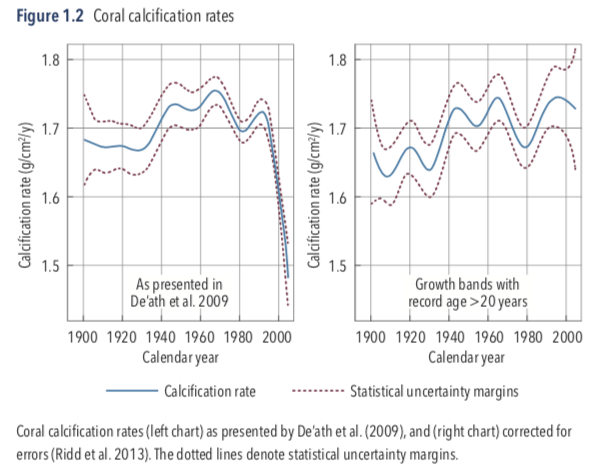
The LHS chart suggests a problem with coral growth rates – but the real problem is with the methodology. When corals of equivalent age are sampled, there has been no decline in growth rates at the Great Barrier Reef – as shown in the RHS chart.
However, I have two issues with their analysis. I published my concerns, and an alternative analysis, in the journal Marine Geology (Ridd et al. 2013). First, there were instrumental errors with the measurements of the coral layers. This was especially the case for the last layer at the surface of the coral, which was often measured as being much smaller than the reality. This forced an apparent drop in the average calcification for the corals that were collected in the early 2000s – falsely implying a recent calcification drop. Second, an ‘age effect’ was not acknowledged. When these two errors are accounted for, the drop in calcification rates disappear, as shown in Figure 1.2.
The problem with the ‘age effect’, mentioned above, arose because in the study De’ath and colleagues included data from corals sampled during two distinct periods and with a different focus; I will refer to these as two campaigns. The first campaign occurred mostly in the 1980s and focused on very large coral specimens, sometimes many metres across. The second campaign occurred in the early 2000s due to the increased interest in the effects of CO2. However, presumably due to cost cutting measures, instead of focusing on the original huge coral colonies, the second campaign measured smaller colonies, many just a few tens of centimetres in diameter.
In summary, the first campaign focused on large old corals, while, in contrast, the second campaign focused on small young corals. The two datasets were then spliced together, and wholly unjustifiable assumptions were implicitly made, but not stated – in particular that there is no age effect on coral growth…
Dr Juan D’Olivo Cordero from the University of Western Australia collected an entirely different dataset of coral cores from the Great Barrier Reef to determine calcification rates. This study determined that there has been a 10% increase in calcification rates since the 1940s for offshore and mid-shelf reefs, which is the location of about 99% of all the coral on the Great Barrier Reef. However, these researchers also measured a 5% decline in calcification rates of inshore corals – the approximately 1% of corals that live very close to the coast. Overall, there was an increase for most of the Great Barrier Reef, and a decrease for a small fraction of the Great Barrier Reef.
While it would seem reasonable to conclude that the results of the study by D’Olivo et al. would be reported as good news for the Great Barrier Reef, their article in the journal Coral Reefs concluded:
Our new findings nevertheless continue to raise concerns, with the inner-shelf reefs continuing to show long-term declines in calcification consistent with increased disturbance from land-based effects. In contrast, the more ‘pristine’ mid- and outer-shelf reefs appear to be undergoing a transition from increasing to decreasing rates of calcification, possibly reflecting the effects of CO2-driven climate change.
Imaginatively, this shift from ‘increasing’ to ‘decreasing’ seems to be based on an insignificant fall in the calcification rate in some of the mid-shelf reefs in the last two years of the 65-year dataset.
Why did the authors concentrate on this when their data shows that the reef is growing about 10% faster than it did in the 1940s?
James Cook university could have used the chapter as an opportunity to start a much-needed discussion about policy, funding and the critical importance of the scientific method. Instead, Peter was first censored by the University – and now he has been fired.
When I first blogged on this back in February, Peter needed to raise A$95,000 to fight the censure.
This was achieved through an extraordinary effort, backed by Anthony Watts, Joanne Nova, John Roskam and so many others.
To be clear, the university is not questioning the veracity of what ex-professor Ridd has written, but rather his right to say this publicly. In particular, the university is claiming that he has not been collegial and continues to speak-out even after he was told to desist.
New allegations have been built on the original misconduct charges that I detailed back in February. The core issue continues to be Peter’s right to keep talking – including so that he can defend himself.
In particular, the university objects to the original GoFundMe campaign (that Peter has just reopened) because it breaches claimed confidentiality provisions in Peter’s employment agreement. The university claims that Peter Ridd was not allowed to talk about their action against him. Peter disputes this.
Of course, if Peter had gone along with all of this, he would have been unable to raise funds to get legal advice – to defend himself! All of the documentation is now being made public – all of this information, and more can be found at Peter’s new website.
Don’t Call It an Explosion: Gaseous Ignition Events with Radioactive Waste

Photo by Iwan Gabovitch | CC BY 2.0
By John Laforge | CounterPunch | May 18, 2018
Last month’s explosive news from the safe, reliable nuclear deterrence folks is that at least four barrels of military radioactive waste either burst or exploded somewhere inside the Idaho National Laboratory (INL), near Idaho Falls, April 11. INL officials said the “ruptured” barrels reportedly contained a sludge of fluids and solvents sent from the long-shuttered Rocky Flats plutonium weapons machining site near Denver. The officials did not describe which radioactive materials were in the sludge.
The accident was reported by ABC News, the Associated Press, the Seattle Times, the Japan Times, Industrial Equipment News, and Fox Radio among others. Laboratory spokespersons said a 55-gallon drum, or two, holding radioactive sludge “ruptured.” Energy Department (DOE) spokesperson Danielle Miller wrote April 12 that, “Later, there were indications that a third drum may have been involved.” On April 25 Erik Simpson, a spokesman for DOE contractor Fluor Idaho, told the AP that four barrels had burst. Simpson said the “ruptures” (i.e. explosions) were heard outside the building where they took place.
The DOE’s Miller called the prompt deconstruction of the rad waste barrel(s) an “exothermal event” — a pseudonym for “bomb” that means “a chemical reaction accompanied by a burst of heat.” The phrase harks back to the officially described “gaseous ignition event” involving hydrogen gas in a loaded high-level rad waste cask at Wisconsin’s Point Beach reactor site in May 1996. The cask contained 14 tons of highly radioactive used reactor fuel, and the explosion (a word avoided only by agency public relations linguistic gymnastics) blew the high-level waste cask’s 4,000-pound lid right off.
One theory about the cause of the accident is that “radioactive decay made the barrel[s] heat up and ignite particles of uranium,” the AP reported. Unfortunately for the first responders, “When the firefighters left the building emergency workers detected a small amount of radioactive material on their skin,” the AP reported April 12. The very next sentence in this story was that the DOE’s Miller said, “None of the radioactive material was detected outside of the building where the rupture occurred.” The isotopes that contaminated the firefighters somehow don’t figure in to Miller’s “outside.”
Because of what officials said was “decades of secretive record-keeping,” lab authorities claimed not to know exactly what is in the burst barrels. Neither DOE nor INL described what got on the firefighters’ skin. INL officials do not “know the exact contents,” of the barrels, Joint Information Center spokesman Don Miley reportedly said.
Nuclear waste explosions “actually happening”
Miley told the press, “They haven’t run into anything like this actually happening” — but he has a short memory. Exploding rad waste has been around a long time.
It happened four years ago, on Valentine’s Day 2014, at the U.S. Waste Isolation Pilot Plant in Carlsbad, New Mexico. A barrel of military plutonium waste exploded underground, contaminating the entire facility, including the elevator and ventilator shafts, and even poisoned 22 workers internally — they inhaled the plutonium-laced dust.
More recently, on October 18, 2015, a fire and explosions spurred by rainfall hurled 11 buried barrels of radioactive chemical waste from a trench into the air and spewed debris like a geyser 60 feet high, at a “US Ecology” site near Beatty, Nevada. This shocking fire in one of 22 shallow trenches of radioactive waste couldn’t be put out with water hoses because water started it in the first place. Authorities had to close US Highway 95, cancel school, and await more explosions while they let the fire burned itself out. US Ecology had its records seized by Nevada’s Radiation Control Program, which has never disclosed what sorts of radioactive materials were burned in exploded Trench 14 — although dump site is known to hold a total of 47 lbs. of plutonium and uranium isotopes.
In September 1957 at Kyshtym in Russia, a tank holding 70 million metric tons of highly radioactive waste exploded and produced a massive plume that contaminated 250,000 people across 410 square miles. This risk always comes with high-level rad waste. It helped cancel the plan to use Yucca Mountain, Nevada for abandonment of commercial nuclear power waste, because physicists at the Los Alamos National Laboratory reported in 1995 that the material could erupt in a catastrophic explosion. Now, naturally, the Trump regime and his Congress want to restart that rejected plan.
After the Idaho Lab accident, the DOE’s Danielle Miller told reporters that first responders “got some radioactive contamination on their skin, but emergency workers washed it away.” And, she added, “The firefighters did not inhale any of the radioactive material.” Miller couldn’t possibly know this without extensive medical evaluation, but it could be true: if the nose and mouth weren’t attached to the skin.
Featured Video
No Threat Can Force Iran’s Surrender /Trita Parsi & Lt Cl Daniel Davis
or go to
Aletho News Archives – Video-Images
From the Archives
What is the Israeli Lobby in Australia Doing in Interfaith Dialogue?
By Ali Kazak | Dissident Voice | October 11, 2015
For years Israel and its lobby around the world have been trying to normalise their relations with Arabs and Muslims without solving the Palestine Question.
One of the methods they resorted to in the last few years is using human rights and community organizations such as interfaith dialogue and Multiculturalism to achieve this objective and to: isolate the Palestinians, marginalise the Palestine question, end Israel’s isolation, and prevent criticism of Israel, knowing that these organisations will be the first to stand against Israel’s violations, racial and religious discrimination.
The group responsible for this task in Australia is The Australia/Israel & Jewish Affairs Council (AIJAC); its Director of International & Community Affairs, Jeremy Jones is in charge of lobbying religious community organizations, specifically Muslims and Christians. Consequently he convened the Faith Communities for Reconciliation, founding participant in the Australian Partnership of Religious Organisations and the Australian National Dialogue of Christians, Muslims & Jews.
AIJAC is a private political propaganda group. It is recognised as the main Israeli lobby in Australia. It coordinates its activities and works intimately with the Israeli embassy in Canberra and different institutions in Israel. It is privately funded by some Jewish businessmen. It monitors closely Australian politicians, the media, ethnic and religious groups, (especially Arabs and Muslims), unions and academics on their stands towards Israel and the Palestine question. … continue
Blog Roll
 Aletho News
- The war of liberation of the Arab and Islamic peoples expands across the Gulf
- Envoy warns UN on Trump’s threat to ‘obliterate’ Iran’s civilian infrastructure
- The Larak Corridor: Iran’s Rial Gate With No US, No Israel, and No Way Around
- ‘Economic terrorism’: Steel facilities hit again in US-Israeli strike
- ‘War Crime’: Iran condemns attacks on Arak, Ardakan nuclear sites
- Two-thirds of Americans want quick end to Iran war even if goals unmet
- Trump to Give “Important Update on Iran” Wednesday in Prime-Time Speech
- Theodore Postol: Iran’s Missiles & Drones Were Underestimated
- Iran To Target Military Industrial-Tech Complex That Facilitated Gaza Genocide
- Collapsing Empire: The Resistance Disarms ‘Israel’
- If Americans Knew
- Israel wants US to bomb more of Iran’s civilian structures (113,000 is not enough) – Not a ceasefire Day 173
- Ann Coulter Rips Into Fox News for Iran War Coverage
- Joe Kent Urges Americans To Call White House and Congress To Object To Sending Troops Into Iran
- DNC Resolution to Reject AIPAC Funding Puts Democratic Leaders in the Hot Seat
- Swedish foundation to build 400 schools as over 650,000 Gaza children remain without education for 2 years
- Israeli army admits photshopping image of slain Lebanese journalist
- This is how Israel is systematically killing health workers under the cover of war in Lebanon
- Carrying life under fire: Israeli invasion of Lebanon leaves pregnant women facing deadly risks
- Champagne all around for the new death penalty (for Palestinians) law – Not a ceasefire Day 172
- Why are Palestinian books struggling to be seen on Amazon?
- No Tricks Zone
- New Study Finds Warming Saves Lives…Cold Temperatures 12 Times More Deadly Than Excess Heat
- German Science Blog Accuses PIK Climate Institute Of Hallucinating Climate Tipping Points
- Devastating Assessment Of Comirnaty Vaccine By Former Senior Pfizer Europe Toxicologist
- New Study: CO2 Is ‘Effectively Negligible’ As An Explanatory Climate Change Factor Since 2000
- Former Pfizer Toxicologist Dr. Helmut Sterz Tells Bundestag Hearing Pfizer Vaccine Should Have Never Been Approved
- Energy Expert: Germany’s Nuclear Phaseout Was A “500 Billion Euro Mistake”
- New Research: South Australia’s Mid-Holocene Sea Surface Temperatures Were 4°C Warmer Than Today
- Storing Green Energy To Last Germany 10 Days Would Require A 60-Million Tonne Battery
- New Studies: UK Sea Levels Were 4 Meters Higher Than Today During The Mid-Holocene
- Destructive Green New Deal: German Energy And Metal Group Warns Of Drastic Crisis
 Aletho News